1.4558 (X2NiCrAlTi32-20) Custom Forging Parts — ISO-Certified OEM Manufacturer in China
Last Updated: March 2025 | Request Free Quote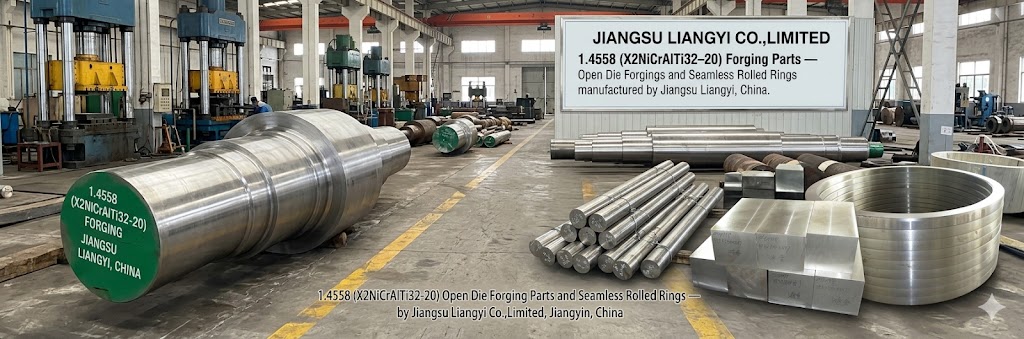
Established in 1997, Jiangsu Liangyi Co.Limited is a professional ISO-certified manufacturer in China.Our main products are 1.4558 (X2NiCrAlTi32-20, also known as X2NiCrAlTi3220 / X2NiCrAlTi32.20) open die forging parts and seamless rolled steel forged rings.
With over 25 years of forging experience, we supply custom 1.4558 forged parts to customers in more than 50 countries across Europe, North America, the Middle East, Southeast Asia, and Australia.Our full range of X2NiCrAlTi32-20 forging products includes forged steel round bars, square bars, flat bars, seamless rolled rings, hubs, housings, shells, sleeves, bushes, hollow bars, discs, plates, seamless steel pipes, tubes, and fully machined custom parts.
We support production from 30 KGS to 30,000 KGS per piece, with an annual manufacturing capacity of 120,000 tons.
Get Free Custom Quote for 1.4558 ForgingsThe prices for 1.4558 forging per kg depends on the forging type (open die forging, seamless rolled ring or precision machined part),weight,standards, inspection scope and order quantity.
Main price is USD 2 per kg.
Contact us for a free custom quotation with detailed pricing breakdown within 24 hours.
Jiangsu Liangyi Technical Team
Senior Metallurgical & Forging Engineering Experts
With 25+ years of specialization in high-alloy forging manufacturing — including EN 1.4558, Alloy 800HT, nickel-based alloys, and nuclear/cryogenic grade steels — our engineering team provides in-depth material consultation and custom forging design for global oil & gas, LNG, and nuclear power clients. Ask our technical team a question →
What is 1.4558 (X2NiCrAlTi32-20) Steel?
- EN Names:
- 1.4558 / X2NiCrAlTi32-20
- Steel Type:
- It is a High-alloy austenitic stainless steel made from nickel-iron-chromium, and it is added aluminum-titanium for better stabilization.
- Standard:
- EN 10088-1 (European stainless steel list); equivalent to DIN X2NiCrAlTi32-20
- Closest ASTM/UNS Equivalent:
- UNS N08811 — Alloy 800HT (ASTM B409, ASTM B564)
- Main Characteristics:
- Good corrosion resistance (SCC, pitting, crevice), high-temperature oxidation resistance up to 1000°C, and cryogenic toughness down to −196°C
- Main Uses:
- Nuclear power, oil & gas, LNG cryogenic, petrochemical, turbomachinery
The name X2NiCrAlTi32-20 encodes the alloy chemistry: "X2" indicates ultra-low carbon (max 0.03%), "Ni" and "Cr" are the main alloying elements with content of 32% nickel and 20% chromium, and "AlTi" refers to the aluminum-titanium system that controls carbide precipitation and grain boundary.
1.4558 (X2NiCrAlTi32-20) Forging Production Standards & Accordance
All of our 1.4558 (X2NiCrAlTi32-20) forging parts meet international standards for critical industrial uses worldwide:
- EN 10216-5: 2014 — It is an EU standard. It is suitable for seamless stainless steel pressure tubes.
- EN 10297-2: 2005 — It is an EU standard. It is suitable for seamless round stainless steel tubes. These tubes are for mechanical and general engineering.
- EN 10088-1: 2005 — It is an EU standard for stainless steels. It includes the 1.4558 grade.— Reference: ISO/CEN
- API 6A — It is a global oil and gas standard. It is suitable for wellhead and Christmas tree equipment. — Reference: API.org
- NORSOK M122 / M123 — They are material standards. They are suitable for offshore oil and gas uses. It is a North Sea standard.
- ASTM B409 / ASTM B564 / ASME BPVC — They are North American industrial standards. They are equivalent to UNS N08811. Reference: ASTM International
Chemical Composition of 1.4558 (X2NiCrAlTi32-20) Stainless Steel
We strictly control the chemical composition of 1.4558 (X2NiCrAlTi32-20) according to EN 10088-1.Thus it can have good corrosion resistance,good high-temperature stability and cryogenic toughness.
| Element | EN Standard Content Range |
|---|---|
| Carbon (C) | Max 0.03% |
| Silicon (Si) | Max 0.7% |
| Manganese (Mn) | Max 1.0% |
| Nickel (Ni) | 32.0% – 35.0% |
| Phosphorus (P) | Max 0.020% |
| Sulfur (S) | Max 0.015% |
| Chromium (Cr) | 20.0% – 23.0% |
| Titanium (Ti) | Max 0.60% |
| Aluminum (Al) | 0.15% – 0.45% |
| Iron (Fe) | Balance |
Swipe horizontally to view full table on mobile devices
Mechanical Properties of 1.4558 (X2NiCrAlTi32-20) Forged Bars
Our X2NiCrAlTi32-20 forged products have stable mechanical properties after standard +AT (Solution Annealed & Treated) heat treatment per EN standards. The good low-temperature impact toughness at −196°C makes this alloy suitable for LNG and cryogenic uses:
| Mechanical Property | Test Condition | EN Standard Value |
|---|---|---|
| Tensile Strength (Rm) | +AT | 450 – 700 MPa |
| 0.2% Proof Strength (Rp0.2) | +AT | Min 180 MPa |
| Longitudinal Impact Energy (KV) | +20°C | Min 120 J |
| Transverse Impact Energy (KV) | +20°C | Min 90 J |
| Transverse Impact Energy (KV) | −196°C | Min 60 J |
| Longitudinal Elongation at Fracture (A) | +AT | Min 35% |
| Transverse Elongation at Fracture (A) | +AT | Min 30% |
| Hardness (HB) | +AT | Typically 130–180 HB |
Swipe horizontally to view full table on mobile devices
Request Detailed Material Data Sheet1.4558 (X2NiCrAlTi32-20) International Material Equivalents
To help global procurement and engineering teams, we provide full set of traceable materials across all main international standard systemss for 1.4558 (X2NiCrAlTi32-20) and its equivalent grades:
| Standard System | Grade Name | Main Standard Documents |
|---|---|---|
| European EN Standard | 1.4558, X2NiCrAlTi32-20 | EN 10088-1, EN 10216-5 |
| German DIN Standard | X2NiCrAlTi32-20 | DIN 17400 |
| ASTM/UNS (Functionally Aligned) | UNS N08811 (Alloy 800HT) | ASTM B409, ASTM B564 |
| ASME Code | Alloy 800HT equivalent | ASME BPVC Section II Part B |
| NORSOK (Oil & Gas) | Per NORSOK M122/M123 | NORSOK M122, NORSOK M123 |
Swipe horizontally to view full table on mobile devices
Physical Properties of 1.4558 (X2NiCrAlTi32-20) Steel
The following physical properties of 1.4558 (X2NiCrAlTi32-20) are important for engineering design in cryogenic, high-temperature, and corrosive service uses:
| Physical Property | Value | Test Temperature |
|---|---|---|
| Density (ρ) | 7.95 g/cm³ | Room Temperature (20°C) |
| Melting Range | 1350–1400°C | — |
| Thermal Conductivity (λ) | 11.5 W/(m·K) | 20°C |
| Thermal Conductivity (λ) | 18.5 W/(m·K) | 500°C |
| Mean Thermal Expansion Coefficient (α) | 15.0 × 10⁻⁶/K | 20–100°C |
| Mean Thermal Expansion Coefficient (α) | 16.5 × 10⁻⁶/K | 20–500°C |
| Specific Heat Capacity (c) | 460 J/(kg·K) | 20°C |
| Electrical Resistivity (ρ) | 1.03 × 10⁻⁶ Ω·m | 20°C |
| Elastic Modulus (E) | 195 GPa | 20°C |
| Elastic Modulus (E) | 170 GPa | 500°C |
Swipe horizontally to view full table on mobile devices
When designing heat exchangers and welded parts involving 1.4558 (X2NiCrAlTi32-20), a relatively low thermal conductivity and a high coefficient of thermal expansion must be taken into account to prevent thermal fatigue and deformation.
1.4558 (X2NiCrAlTi32-20) Corrosion Resistance
The good corrosion resistance of 1.4558 (X2NiCrAlTi32-20) comes from its high nickel (32–35%) and chromium (20–23%) content combined with ultra-low carbon (max 0.03%) and aluminum-titanium stability.:
- General Corrosion: The high nickel content provides good resistance to hydrochloric, phosphoric, and sulfuric acids over a wide rang of concentration and temperature.
- Stress Corrosion Cracking (SCC): Austenitic stainless steel becomes very resistant to chloride-induced cracking when the nickel content is over 30%, which is especially important for offshore oil & gas and marine
- Pitting & Crevice Corrosion: The combination of Ni + Cr + Mo equivalents provides a high PREN (Pitting Resistance Equivalent Number), which is suitable for seawater and aggressive chloride media.
- High-Temperature Oxidation: Aluminum forms a stable Al₂O₃ (alumina) protective scale. It resists sulfidation and oxidation reaching up to 1000°C in cyclic thermal service.
- Sensitization Prevention: Ultra-low carbon content (C≤0.03%), using titanium-aluminum stabilizer to prevent intergranular corrosion.
- Sour Service (H₂S): 1.4558 meet NACE MR0175/ISO 15156 for sour oil and gas uses with H₂S levels above 300 ppm.
These corrosion-resistant properties make 1.4558 (X2NiCrAlTi32-20) one of the most useful high-alloy steels in complex, multi-corrosive environments. Reference standard: ASTM International and ISO Standards.
1.4558 (X2NiCrAlTi32-20) Weldability
1.4558 (X2NiCrAlTi32-20) has good weldability because of its ultra-low carbon content, which minimizes carbide precipitation at grain boundaries during the welding thermal cycle. Main characteristics on weldability:
- Preheating: It is generally not be used for base metal thicknesses less than 25 mm. Preheating to 100–150°C is usually used to reduce the risk of hydrogen-induced cracking for thicker sections or high-restraint parts.
- Post-Weld Heat Treatment (PWHT): It is usually not suitable for corrosion-resistant uses. However, some parts have strict requirements on nuclear safety, including pressure vessels that need to be carefully inspected. For these parts, solution annealing (+AT) may be required after welding.This heat treatment is done at a temperature between 1050°C and 1100°C.
- Filler Metal: You can use AWS A5.11 ENiCrFe-2 or ENiCrMo-6 covered electrodes. You can also use AWS A5.14 ERNiCrMo-3 (Alloy 625) wire for GMAW or GTAW welding. The filler metal must have a nickel content of at least 55%.This high nickel level makes the weld metal richer in alloy, which helps it prevent the weld from cracking at high temperatures.
- Welding Processes: GTAW (TIG), GMAW (MIG), SMAW, SAW, and FCAW can all be used. GTAW with argon back-purging is a good method for the root pass of pipe joints.
- Interpass Temperature: Set maximum interpass temperature to 150°C to control heat input and minimize distortion.
- NDT After Welding: Dye penetrant testing (PT) or radiographic testing (RT) will be done after welding.The result must meet EN ISO 17635 or ASME Section V standards.The specific testing method is determined by the corresponding construction code.
Welding qualification is according to ISO 15614-1 (WPQR) or ASME IX. Our facility is certified to ISO 3834-2 for fusion welding quality requirements.
1.4558 (X2NiCrAlTi32-20) Heat Treatment Method
The standard heat treatment method for 1.4558 (X2NiCrAlTi32-20) forgings is +AT (Solution Annealed & Treated) as specified in EN 10216-5 and EN 10088-3. The method is as below:
| Heat Treatment Step | Temperature Range | Cooling Medium | Purpose |
|---|---|---|---|
| Solution Annealing (+AT) | 1050°C – 1100°C | Water quench or rapid air cool | Dissolve carbides, homogenize microstructure, restore corrosion resistance |
| Stress Relief (optional) | 870°C – 950°C | Furnace cool to 600°C, then air cool | Reduce residual stresses in complex weldments without sensitizing |
| Stabilization Anneal (optional) | 900°C – 925°C | Air cool | Precipitate Ti/Al carbides, prevent sensitization in HAZ (for welded assemblies) |
Swipe horizontally to view full table on mobile devices
Important: After final solution annealing, avoid prolonged exposure within the sensitization range of 425°C - 815°C, as this may cause chromium carbide precipitation at the grain boundaries and reduce corrosion resistance. Despite the low carbon content, the Ti/Al stability is 1.4558. Jiangsu Liangyi heat treatment furnaces are calibrated and certified in accordance with the AMS 2750 / NADCAP standard, and can provide temperature uniformity investigation (TUS) and system accuracy test (SAT) records as required..
Request Technical Data sheet & Heat Treatment Report1.4558 vs Similar Alloy Grades — Technical Comparison
Understanding how 1.4558 (X2NiCrAlTi32-20) compares to similar high-alloy steels helps engineers choose the correct material for their used:
| Property | 1.4558 (X2NiCrAlTi32-20) | 1.4876 (Alloy 800H) | 316L (1.4404) | 904L (1.4539) |
|---|---|---|---|---|
| Ni Content | 32–35% | 30–35% | 10–14% | 23–28% |
| Cr Content | 20–23% | 19–23% | 16–18% | 19–23% |
| Max Carbon (C) | 0.03% | 0.10% | 0.03% | 0.02% |
| Max Temp | 1000°C | 1050°C | 870°C | 400°C |
| Cryogenic (min) | −196°C | −100°C | −196°C | −196°C |
| SCC Resistance | Excellent | Very Good | Limited | Excellent |
| Nuclear Grade | Yes | Yes | No | No |
| NORSOK Qualified | Yes (M122/M123) | Limited | Partial | Partial |
Swipe horizontally to view full table on mobile devices
Full-Process Production & Machining Capabilities
Jiangsu Liangyi is equipped with advanced full-process production infrastructure for 1.4558 (X2NiCrAlTi32-20) forging manufacturing:
Forging & Heat Treatment Equipment
- 2000T / 4000T / 6300T hydraulic forging presses; 0.75T–9T electro-hydraulic forging hammers; manipulators with 60T lifting capacity
- 1M & 5M seamless ring rolling machines for custom diameter rolled rings
- 30T EAF, LF, VOD steel melting equipment for full chemical composition control
- Heating forging furnaces (max 150T capacity); hydrogen bake-out furnaces up to 14M length
- Semi-automatic heat treatment system with furnaces up to 18M length and quenching tanks up to 16M depth
View our complete equipment list: Production & Inspection Equipment
Precision Machining & Quality Inspection
We offer complete rough and finish machining services through vertical lathes, parallel lathes, extra-large parallel lathes, CNC boring machines, milling machines, planning machines and column drills to meet customers' size and tolerance requirements. We do below testing on all 1.4558 forgings: chemical composition testing (OES), mechanical property testing (tensile, impact, hardness), non-destructive testing (UT, PT, MT), metallographic inspection and size inspection, thus we can make them have uniform microstructure, free of blisters, cracks and harmful inclusions.
Discuss Your Custom Forging Project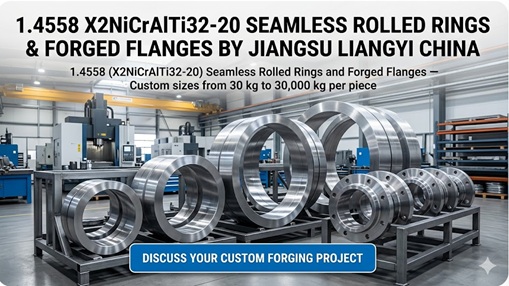
Uses & Global Cases
1.4558 (X2NiCrAlTi32-20) forged parts are used in critical industrial systems requiring simultaneous corrosion resistance, cryogenic toughness and high-temperature stability:
Oil & Gas Upstream & Midstream Industry
We supply 1.4558 forged drilling tools, risers, connectors, flexible joints, seals, flanges, gaskets, casing heads, tubing heads, casing hangers, tubing hangers, tubing spools, casing spools, spacer spools, integral mud flanges, and studded crosses accordance with API 6A and NORSOK M122/M123.
Custom forged casing heads and tubing spools are made of X2NiCrAlTi32-20.They are used in deep-sea oil and gas extraction projects in the Middle East and the Gulf of Mexico. These parts are accordance with API 6A and NORSOK M122/M123 standards. And they work well in high-pressure and corrosive sour crude environments. The hydrogen sulfide (H₂S) content in these environments is higher than 300 ppm
Industrial Valve & Flow Control Industry
We provide forged valve parts made of X2NiCrAlTi32-20.These include valve balls, bonnets, valve bodies, stems, closures, seat rings, valve cores and discs. They are used in ball valves, gate valves, check valves and high-performance cryogenic butterfly valves (HPBV) that work at temperatures as low as −196°C.
Forged valve bodies and stems made of 1.4558 are used in cryogenic valves for LNG storage and transportation in Europe and Australia.These parts keep stable ductility with a minimum impact value of 60 J at −196°C.They also maintain reliable sealing performance at liquid nitrogen temperature.They meet the cryogenic valve standards of EN 12516 and BS 6364.
Nuclear Power Industry
We manufacture 1.4558 forged nuclear reactor coolant pump parts including rotors, impellers, casings, shells, and containment seal chambers, as well as main shafts for butterfly valves in nuclear island systems.
X2NiCrAlTi32-20 forged reactor coolant pump casings and impellers supplied to 3rd-generation pressurized water reactor (AP1000) nuclear power plants in China and Southeast Asia. Meeting Nuclear Safety Class 1 equipment requirements with certified impact toughness and long-term structural stability.
Turbomachinery & Power Generation
1.4558 forged partpartss used in turbo centrifugal compressor impellers, shrouded impellers, gas compressor turbine blades, and main shafts for industrial turbines across Asia and Europe.
Pumps, Pressure Vessels & Heat Exchangers
We supply X2NiCrAlTi32-20 forged pump casings, covers, barrels, impellers, shafts, housings, and wear rings, plus pressure vessel reactor nozzles, boiler/heat exchanger parts parts,including seamless tubes, shells, tube sheets, baffle plates, nozzles, and channel flanges for global petrochemical projects.
See project references: Global Project References
Get Suitable Forging SolutionQuality Certifications & Full Traceable Material
The production system of Jiangsu Liangyi has been certified by ISO 9001:2015, ISO 14001, ISO 50001, ISO 3834-2, ISO 9712, ISO/IEC 17025, NORSOK M122, and NORSOK M123 .These certifications indicate that we are capable of producing 1.4558 forgings.These products meet the strictest requirements of global projects.All 1.4558 forged parts will be shipped with EN 10204 3.1 or 3.2 material test reports.
These reports are issued or approved by well-known international third-party organizations. These organizations include DNV-GL, Bureau Veritas, Lloyd's Register, ABS, RINA, and TÜV. This ensures full set of traceable materials from the heat number to the final part
See all material grades Forging Material Grades
1.4558 (X2NiCrAlTi32-20) Technical Data sheet & Free Quote
- Free Technical Datasheet:
- Our 1.4558 (X2NiCrAlTi32-20) technical data sheet PDF includes full chemical composition (EN 10088-1), mechanical properties (+AT), physical properties, heat treatment procedures, weldability data, corrosion resistance summary, applicable standards, and size ranges. Available upon request.
- Custom Quotation:
- Send us your drawings or specifications. We will give you a free, detailed quotation for your custom 1.4558 forged parts.You will get this quotation within 24 business hours.
How to Order Custom 1.4558 Forging Parts — 6 Steps
Our simplified ordering steps make sure you can get a quick response, correct quotations and timely delivery of custom 1.4558 (X2NiCrAlTi32-20) forging orders:
Send Inquiry with Drawings or Specifications
Send your drawings and technical manuals. Provide the material specification 1.4558 / X2NiCrAlTi32-20. State your order quantity and inspection requirements. You can email these materials to [email protected]. You can also send them via WhatsApp to +86-13585067993.
Get a Free Quotation
Our team will give clients a detailed quotation in 24 business hours. The quotation will include unit price ,heat treatment, testing scope, and certification options.
Order Confirmation
We will provide our clients a formal purchase order.In the purchase order, all necessary information included, such as product specifications,the certification type of 3.1 or 3.2, delivery terms such as FOB, CIF, and EXW,inspection standards,including EN, ASTM.
Full-Process Production with Witnessing Option
Production includes several steps. First is steel melting using EAF, LF, and VOD. Next is to open die forging or ring rolling. Then comes heat treatment ,which is marked as +AT. After that are rough machining and NDT testing. The process finishes with finish machining and final inspection. Customers or third-party inspectors may witness any production stage.
Third-Party Inspection & EN 10204 Certification
We prepare EN 10204 3.1 or 3.2 material test reports. These reports can be countersigned by authorized organizations. The organizations include DNV-GL, Bureau Veritas, Lloyd's Register, ABS, RINA, and TÜV. This service is available if you request it.
Shipment with Full Document
Products are packed in wooden cases. They are ready for sea freight transportation. We provide a full set of documents. These include commercial invoice, packing list, and certificate of origin. Bill of lading and material certificates are also included. These documents help with smooth customs clearance worldwide.
Global Project Cases & Delivery References
Jiangsu Liangyi has been in business since 1997.We have supplied 1.4558 (X2NiCrAlTi32-20) forged parts to over 50 countries.We show representative project cases below. Customer names are kept confidential according to NDA agreements.
We supplied custom X2NiCrAlTi32-20 forged valve bodies. These parts were used for an LNG cryogenic terminal project in Europe. Full EN 10204 3.2 documentation. Performance at −196°C confirmed on-spec by third-party inspection.
LNG Terminal Project — Europe |
1.4558 seamless rolled rings for offshore wellhead API 6A system. Full DNV-GL 3.2 certification. Delivered FOB Shanghai within agreed schedule. Long-term supply cooperation.
Offshore Oil & Gas Project — Gulf of Mexico |
We have made reactor coolant pump forgings for Nuclear Safety Class 1 uses. These forgings are made from 1.4558.Full NDT and metallographic documentation is provided .Inspection is witnessed by the third-party inspector.
Nuclear Power Plant Project — Asia-Pacific |
See full project references: Global Project References & Case Studies
Frequently Asked Questions (FAQ) About 1.4558 (X2NiCrAlTi32-20) Forgings
1.4558 (X2NiCrAlTi32-20) is a high-alloy austenitic stainless steel that meets EN 10088-1. It contains 32–35% nickel, 20–23% chromium and ultra-low carbon (max 0.03%). It is very stable with aluminum and titanium (Al 0.15–0.45%, Ti max 0.6%).It has good resistance to general corrosion, pitting, crevice corrosion, and stress corrosion cracking (SCC).It also has great high-temperature oxidation resistance up to 1000°C and good low-temperature toughness down to −196°C.It is widely used in nuclear power, oil & gas, LNG cryogenic, and petrochemical industries.
There is no direct ASTM equivalent for 1.4558. The closest functional grade is UNS N08811 (Alloy 800HT), which is used in nASTM B409 (plate/sheet/strip), ASTM B564 (forgings), and ASME BPVC Section II Part B. They both have high nickel content, similar corrosion resistance, and high-temperature stability. So they are interchangeable in many uses. However, engineers must verify chemical composition limits and creep-rupture requirements before substitution.
1.4558 forging parts are used in:(1) Nuclear power: reactor coolant pump rotors, impellers, casings and containment seal chambers for Safety Class 1 uses.(2) Oil & gas: API 6A wellhead casing heads, tubing spools and Christmas tree parts.(3) LNG cryogenic: valve bodies, stems and bonnets for cryogenic butterfly and gate valves operating at −196°C.(4) Turbomachinery: centrifugal compressor impellers and turbine main shafts.(5) Pressure vessels & heat exchangers: tube sheets, nozzles and channel flanges.(6) Industrial valves: ball valve bodies, bonnets and flow control parts used in sour service environments
Yes. Jiangsu Liangyi produces fully custom 1.4558 forgings from 30 kg to 30,000 kg per piece per drawing and specification. Services cover: raw material selection → steel melting (EAF/LF/VOD) → open die forging (2000T–6300T presses) → seamless ring rolling → heat treatment (+AT solution annealing) → precision CNC machining → NDT + size inspection → EN 10204 3.1/3.2 certification. Normal lead time is 4–12 weeks depending on weight and quantity.
Our 1.4558 forgings are manufactured in an ISO 9001:2015, ISO 14001, ISO 50001, ISO 3834-2, ISO 9712, and ISO/IEC 17025 certified facility. Products are accordance with EN 10088-1, EN 10216-5, API 6A, NORSOK M122, and NORSOK M123 standards. EN 10204 3.1 and 3.2 material test reports are issued or countersigned by DNV-GL, Bureau Veritas, Lloyd's Register, ABS, RINA, or TÜV upon request.
1.4558 (X2NiCrAlTi32-20) features ultra-low carbon content with a maximum of 0.03%. It has no minimum grain size requirement. This makes it ideal for cryogenic and nuclear uses. Low carbon reduces the risk of sensitization. 1.4876 (X10NiCrAlTi32-21, Alloy 800H) permits carbon content up to 0.10%. It requires a minimum ASTM grain size of No. 5.This improves creep-rupture strength at temperatures above 600°C. Choose 1.4876 for steam reformers and high-temperature heat exchangers operating above 600°C. Choose 1.4558 for nuclear safety parts, LNG cryogenic parts, and uses needing maximum SCC resistance.
Jiangsu Liangyi accepts 1.4558 forging orders with a minimum weight of 30 kg per piece. There is no strict minimum order quantity. Project orders, small engineering batches, and single prototype pieces are all acceptable. Normal production lead time ranges from 4 to 12 weeks. Lead time depends on forging complexity, weight, heat treatment and machining needs. Contact us at [email protected] for a schedule.
Quality assurance at Jiangsu Liangyi for 1.4558 forgings includes: OES chemical composition verification for each heat. Mechanical testing including tensile, yield, Charpy impact at +20°C and −196°C, and hardness tests. NDT including UT according to EN 10228-3/4 or ASTM A388, PT, and MT as required. Size inspection using CMM. Metallographic examination for grain structure. Full material traceability from raw steel heat number to finished product tag. All test data are recorded in EN 10204 3.1 or 3.2 Material Test Reports (MTRs).
The price of 1.4558 (X2NiCrAlTi32-20) forgings is USD 2 per kg. Contact our sales team at [email protected] for a free detailed custom quotation within 24 hours.
Yes. 1.4558 (X2NiCrAlTi32-20) has good weldability because of its ultra-low carbon content of max 0.03%. This reduces carbide precipitation at grain boundaries during welding.Recommended filler metals are ENiCrFe-2 (AWS A5.11) electrodes or ERNiCrMo-3 (Alloy 625) wire for GTAW/GMAW No preheating is required for thicknesses up to 25 mm; maximum interpass temperature is 150°C. Post-weld solution annealing (+AT at 1050–1100°C) may be required for nuclear safety class or high-pressure vessel uses. Welding qualification per ISO 15614-1 or ASME IX.
A comprehensive 1.4558 (X2NiCrAlTi32-20) material datasheet including chemical composition, mechanical properties, physical properties, corrosion resistance data, weldability parameters, and heat treatment procedures is available from Jiangsu Liangyi upon request. The official material standard is EN 10088-1 , available through ISO / CEN member bodies. The equivalent ASTM specification for UNS N08811 (Alloy 800HT) is available from ASTM International. Contact us at [email protected] to request our technical datasheet PDF.