1.2738 (40CrMnNiMo8-6-4) Forged Steel Parts — Manufacturer Technical Guide & Supply
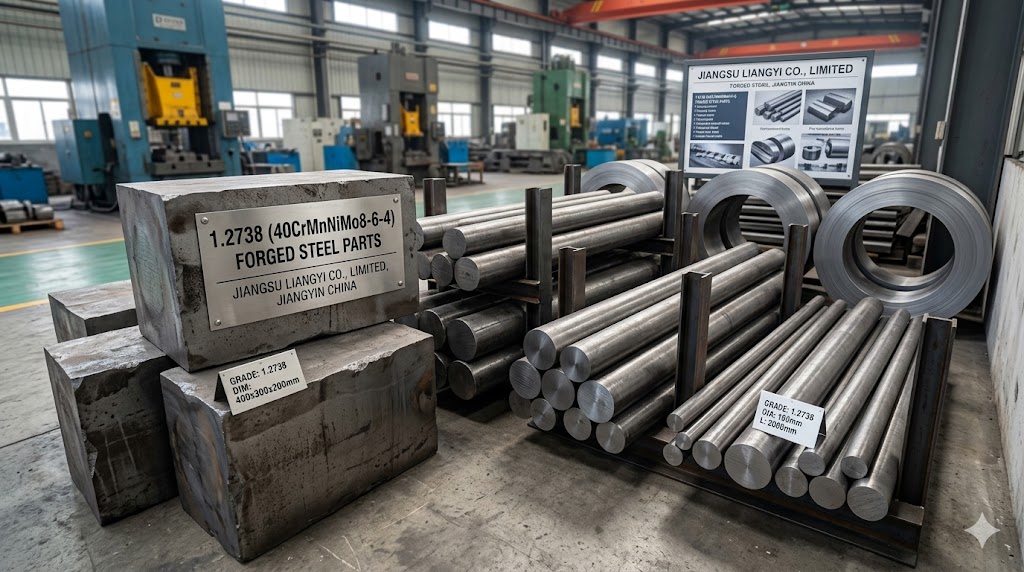
⚡ 1.2738 / 40CrMnNiMo8-6-4 — Key Specifications at a Glance
Manufacturer Overview — Who We Are & What We Produce
Jiangsu Liangyi Co.,Limited was established in 1997 in Jiangyin City, Jiangsu Province — a city recognized as one of China's most concentrated forging industry clusters, located 100 km northwest of Shanghai. Over 25+ years, we have grown into a specialized manufacturer of 1.2738 (40CrMnNiMo8-6-4) open die forged components and seamless rolled rings, serving more than 200 long-term global clients across 50+ countries including Germany, the Netherlands, the United States, South Korea, Italy, Australia and across Southeast Asia.
Our facility covers the complete production chain under one roof — from raw material EAF melting and ingot casting through open die forging, heat treatment, rough CNC machining and full non-destructive testing — with no subcontracting at any stage. This single-source control is why multinational procurement teams consistently rely on us for critical large-section 1.2738 forgings where intermediate handling and outsourcing introduce unacceptable quality risks.
We are ISO 9001:2015 certified and provide EN 10204 3.1 material inspection certificates with all of our 1.2738 forged products as standard.Third-party inspection (SGS, Bureau Veritas, TÜV, Intertek, or buyer-nominated inspector) is available upon request at buyer's cost. We have no exclusive affiliation with any inspection agency.
Available 1.2738 Forging Shapes & Forms — Full Product Range
We produce 1.2738 (40CrMnNiMo8-6-4) forgings in the following standard and custom forms, all manufactured to your 2D/3D engineering drawings:
- Forged Round Bars & Rods: Diameter 50–1,200 mm, length up to 6,000 mm; rough turned or as-forged surface
- Forged Square & Flat Bars: Cross-section up to 600 × 600 mm, custom length
- Forged Blocks & Plates: Mold base sheet stock up to 2,000 × 1,200 × 500 mm (L×W×T); parallel-faced or rough-machined
- Seamless Rolled Rings & Flanges: OD 200–3,000 mm, wall thickness 30–500 mm; radial/axial rolled
- Forged Discs & Disks: Diameter 100–2,000 mm, thickness 30–600 mm
- Forged Shafts & Gear Shafts: Diameter 50–800 mm, length up to 8,000 mm; stepped profiles available
- Forged Sleeves, Hollow Bars & Housings: Custom bore/OD ratio, forged hollow or bored from solid
- Custom Open Die Forgings: Irregular profiles (yokes, connecting rods, flanged shafts, crane hooks, etc.) per 3D drawing
The Metallurgical Science Behind 1.2738 — Why This Alloy Design Works
1.2738 is not simply a P20 steel with nickel added. Its alloy design represents a carefully balanced multi-element system where each constituent serves a specific metallurgical purpose. Understanding this is essential for engineers choosing the correct material for large mold base applications — and it explains why 1.2738 consistently outperforms cheaper alternatives in thick-section applications.
The Role of Each Alloying Element
Carbon (C): 0.35–0.45%
- Primary hardness-forming element; forms martensite upon quenching
- Upper limit controlled to keep adequate toughness and weldability
- Balanced with carbide-forming elements (Cr, Mo) to prevent grain boundary carbide precipitation during tempering
Chromium (Cr): 1.80–2.10%
- Delays bainite/pearlite transformation; important for hardenability in thick sections
- Forms stable carbides that improve wear resistance in mold cavities
- Improves temper resistance — keeps hardness at elevated operating temperatures
Nickel (Ni): 0.90–1.20% — The Key Differentiator
- Does not form carbides; dissolves entirely in the ferrite matrix
- Substantially improves through-hardenability in large cross-sections by lowering the martensite start (Ms) temperature and extending the bainitic bay in the CCT diagram
- Dramatically improves low-temperature impact toughness by reducing grain boundary cohesion energy
- Reduces sensitivity to temper embrittlement (Ni counters the embrittling effect of Mn + P at grain boundaries)
- This is the element entirely absent in 1.2311 (P20) — the single reason 1.2311 fails in cross-sections over 150 mm
Manganese (Mn): 1.30–1.60%
- Strong hardenability promoter — shifts CCT curves to longer times
- Combines with Ni for synergistic hardenability enhancement in thick sections
- Must be balanced: excess Mn increases temper embrittlement susceptibility — neutralized in 1.2738 by the controlled Ni addition
Molybdenum (Mo): 0.15–0.25%
- The most effective element for suppressing temper embrittlement (reversible temper brittleness at 300–400°C)
- Refines grain matrix, promoting consistent 7/8 grain size throughout large cross-sections
- Improves temper resistance: Mo-bearing steels retain higher hardness at elevated tempering temperatures
Silicon (Si): 0.20–0.40%
- Deoxidation element added during steelmaking — reduces oxygen content and non-metallic inclusions
- Strengthens ferrite matrix; slightly improves wear resistance of the tempered martensite
- Excessive Si increases decarburization risk during heat treatment — hence the controlled upper limit
Chemical Composition of 1.2738 (40CrMnNiMo8-6-4) — EN 10083-3 Specification
Our 1.2738 forged steel is produced from premium alloy steel ingots smelted in our own 60-ton Electric Arc Furnace (EAF), refined in Ladle Furnace (LF) and degassed in VD/VOD units before casting. Every heat is chemically analyzed by OES (Optical Emission Spectrometer) at our in-house laboratory to verify compliance with the following EN 10083-3 specification limits:
| Element | Symbol | Min % | Max % | Our Target % | Primary Function |
|---|---|---|---|---|---|
| Carbon | C | 0.35 | 0.45 | 0.38–0.42 | Hardness, strength |
| Silicon | Si | 0.20 | 0.40 | 0.25–0.35 | Deoxidation, matrix strengthening |
| Manganese | Mn | 1.30 | 1.60 | 1.40–1.55 | Hardenability, synergy with Ni |
| Nickel | Ni | 0.90 | 1.20 | 0.95–1.10 | Through-hardenability, toughness |
| Chromium | Cr | 1.80 | 2.10 | 1.90–2.05 | Hardenability, wear resistance |
| Molybdenum | Mo | 0.15 | 0.25 | 0.18–0.23 | Temper embrittlement prevention, grain refinement |
| Phosphorus | P | — | 0.030 max | < 0.020 | Controlled impurity |
| Sulfur | S | — | 0.030 max | < 0.015 | Controlled impurity |
Note that our internal production targets are tighter than the EN 10083-3 specification minimum, particularly for phosphorus and sulfur. This is not a legal requirement — it reflects our production philosophy of targeting the center of specification rather than the edges, to ensure consistent batch-to-batch mechanical performance for critical mold and engineering applications.
Melting & Refining Equipment — Our In-house Steelmaking Capability
To get the required material purity and composition control for 1.2738 large-section forgings, we operate the following steelmaking equipment at our Jiangyin facility:
Primary Melting
- 60 t Electric Arc Furnace (EAF), 40 MVA — primary melting of selected scrap and alloy additions
- Continuous temperature and composition monitoring via immersion probes
- EAF slag practice for initial phosphorus and sulfur removal
Secondary Metallurgy
- 2 × Ladle Furnaces (LF) — final alloying, deslagging, homogenization; temperature ±5°C control
- 2 × VD/VOD Vacuum Degassing Units — hydrogen removal to <2 ppm, nitrogen and oxygen reduction
- ESR Plant (max 32 t) — electro-slag remelting for ultra-high cleanliness grades when needed
Casting
- Bottom-pouring pit casting — minimizes turbulence-induced inclusions vs. top-poured ingots
- Ingot weights from 500 kg to 30 t to match forging size requirements
- Controlled cooling rate after casting to prevent hydrogen flaking in large sections
In-house Analysis
- OES (Optical Emission Spectrometer) for heat analysis — all 8 alloying elements
- Combustion analysis for C and S independent verification
- ICP-OES for trace element verification in important heats
Physical & Mechanical Properties of 1.2738 Pre-hardened Forged Steel
The following physical and mechanical property data is based on our production records and EN 10083-3 reference values for 1.2738 (40CrMnNiMo8-6-4) in various delivery conditions:
| Property | Value | Unit | Condition |
|---|---|---|---|
| Density | 7.80 | g/cm³ | Room temperature |
| Modulus of Elasticity | 210 | GPa | Room temperature |
| Thermal Conductivity | 29–33 | W/m·K | 20–300°C |
| Thermal Expansion Coefficient | 11.5–13.0 × 10⁻⁶ | K⁻¹ | 20–400°C |
| Specific Heat Capacity | 460 | J/kg·K | Room temperature |
| Electrical Resistivity | 0.22–0.28 | µΩ·m | Pre-hardened condition |
| Magnetic Permeability | Ferromagnetic | — | All conditions |
| Property | Typical Value | Unit |
|---|---|---|
| Tensile Strength (Rm) | 950–1,100 | MPa |
| 0.2% Proof Stress (Rp0.2) | 800–950 | MPa |
| Elongation A5 | ≥ 12 | % |
| Reduction of Area Z | ≥ 45 | % |
| Impact Energy (Charpy V, +20°C) | ≥ 27–40 | J |
| Brinell Hardness (HB) | 280–320 | HB |
| Rockwell Hardness | 30–34 | HRC |
| Vickers Hardness | 285–330 | HV 30 |
Complete Heat Treatment Guide for 1.2738 (40CrMnNiMo8-6-4) Forged Steel
We operate a fully in-house, computer-controlled heat treatment facility with continuous atmosphere furnaces, pit furnaces for large forgings, and modern polymer/oil quench tanks. The following parameters represent our validated production processes — not textbook recommendations — refined through 25+ years of treating large-section 1.2738 forgings.
Soft Annealing — For Maximum Machinability
Temperature: 710°C – 740°C. Heating rate: max 80°C/hour for sections >300 mm to prevent thermal shock. Hold time: minimum 2 hours + 1 hour per 50 mm cross-section. Cooling: controlled furnace cooling at max 20°C/hour to below 500°C, then air cool. Result: maximum hardness 235 HB — optimal for rough CNC milling, drilling, turning and EDM wire cutting without tool wear issues. This condition is recommended when customers plan to finish-machine the forging before sending for separate hardening.
Hardening (Austenitizing + Quenching) — For Maximum Hardness
Austenitizing temperature: 840°C – 870°C (our production standard: 850°C ± 10°C). Heating in two stages for large sections: preheat at 450–500°C, then transfer to hardening furnace. Soak time: minimum 30 minutes + 1 minute per mm cross-section after reaching set temperature throughout the section. Quenching: in oil (50–80°C) or polymer solution (concentration 6–10%) for standard sections; forced-air cooling for very large sections (>500 mm) where polymer quench causes distortion risk. Immediately transfer to tempering furnace — do not allow surface to cool below 80°C before tempering to prevent quench cracking in large sections. Achievable as-quenched hardness: 52–54 HRC.
Tempering — Hardness & Toughness Adjustment
Temperature range: 500°C – 650°C for working hardness adjustment. Hold time: minimum 1 hour per 25 mm wall thickness, minimum 3 hours total regardless of section size. Double tempering (two separate tempering cycles) is recommended for large sections (>200 mm) and for sections needing low temper embrittlement risk. Cooling: still air for standard conditions; accelerated air cooling (fan-assisted) for temper embrittlement-sensitive applications to rapidly cool through the 300–500°C embrittlement range. Achievable hardness ranges by temperature: 600°C → 36–40 HRC; 560°C → 40–43 HRC; 520°C → 43–47 HRC; 500°C → 43–46 HRC. Pre-hardened delivery (280–320 HB) is achieved through a standard tempering protocol at approximately 560–600°C.
Stress Relieving — Post-machining Dimensional Stability
Temperature: 500°C – 550°C (always at least 20–30°C below the final tempering temperature used, to avoid any hardness reduction). Hold time: minimum 2 hours + 1 hour per 50 mm section thickness. Cooling: slow furnace cooling to 300°C, then still air. This treatment is strongly recommended after: (a) heavy roughing operations removing >30 mm material, (b) deep cavity EDM machining, (c) welding repairs, (d) any thermal cutting. In our experience, large mold bases not stress-relieved after heavy machining show dimensional drift of 0.05–0.15 mm over 3–6 months of service — a level unacceptable for precision injection molds.
Hardness vs. Tempering Temperature — Verified Production Data
The following data is based on our own furnace-controlled tempering records for 1.2738 forgings in the 100–200 mm cross-section range, after hardening at 850°C + oil quench:
| Tempering Temp (°C) | Hardness (HRC) | Hardness (HB Approx.) | Tensile Strength Approx. (MPa) | Recommended Application |
|---|---|---|---|---|
| 100 | 51.5 | ~500 | ~1,800 | Maximum wear resistance (not recommended for molds) |
| 200 | 50.2 | ~480 | ~1,700 | Wear-critical inserts, punches |
| 300 | 48.0 | ~455 | ~1,580 | Tooling inserts, high-wear die components |
| 400 | 46.2 | ~435 | ~1,480 | Die casting components |
| 500 | 43.0 | ~405 | ~1,360 | Structural components, large mold plates |
| 560 | 40.0 | ~375 | ~1,250 | Pre-hardened mold base standard condition |
| 600 | 39.0 | ~365 | ~1,200 | Large mold frames, high-toughness requirements |
| 650 | 34.0 | ~320 | ~1,050 | Maximum toughness, structural engineering |
| 700 | 29.0 | ~275 | ~900 | Soft condition for re-machining |
Why Forged 1.2738 is Superior to Rolled Bar or Cast Steel
This is a question we hear regularly from buyers evaluating whether the premium cost of forged 1.2738 over hot-rolled bar or cast steel is justified. The answer depends entirely on the application — but for large, load-bearing or precision mold applications, the difference is significant and measurable.
| Property / Criterion | Open Die Forging (Our Product) | Hot-Rolled Bar (Mill Product) | Cast Steel |
|---|---|---|---|
| Internal Soundness | Excellent — forging closes ingot porosity and voids through mechanical working (minimum 3:1 reduction ratio) | Good — rolling closes most porosity, but limited section reduction for large rounds | Poor — internal shrinkage cavities and porosity inherent in casting solidification |
| Grain Flow / Fiber Structure | Controlled directional grain flow aligned with part geometry — maximizes strength and fatigue resistance in service load direction | Unidirectional grain flow along bar length — adequate for simple geometries, poor for complicate shapes | Isotropic, no grain flow — lowest mechanical properties in all directions |
| Grain Size Uniformity | Fine, uniform 7/8 grain (ASTM E 112) throughout cross-section — controlled by forging temperature and deformation ratio | Fine in thin sections; coarser in large-diameter bars where rolling reduction is insufficient | Coarse dendritic grain matrix; non-consistent throughout section |
| Inclusion Distribution | Inclusions broken up and redistributed by forging deformation — no clustered inclusion zones | Inclusions elongated along rolling direction — acceptable for standard use | Inclusions clustered at solidification boundaries — highest risk of stress concentration |
| Achievable Maximum Section | No practical limit for forging — 200 mm to 2,000 mm+ cross-section available | Limited to mill production: typically up to ~600 mm diameter for alloy bars | No size limit — but structural properties inadequate for precision tooling |
| UT Quality Level | Routinely meets ASTM A578-S9 / EN 10228-3 Grade 3 or better | Meets EN 10308 for rolled bar; not guaranteed for large diameters | Rarely meets forging-class UT requirements |
| Typical Cost Premium vs. Cast | +40–80% vs. cast equivalent | +20–40% vs. cast equivalent | Baseline (lowest cost) |
When Do You Actually Need Forged 1.2738?
Based on our experience, forged 1.2738 is essential — not merely preferred — in the following situations:
- Mold base or structural part cross-section exceeds 100 mm — rolled bar begins to show through-hardenability limitations
- Part will carry cyclic mechanical loads (presses, clamping forces, injection pressure) — grain flow alignment matters for fatigue life
- Part needs EN 10228-3 or ASTM A578-S9 ultrasonic testing acceptance — rolled bar frequently fails for UT class 3 or better
- Surface treatment (nitriding, PVD) will be applied — uniform base hardness is essential for uniform case layer
- Tight dimensional tolerances after heat treatment — forged material has lower residual stress variation than rolled bar cut from coil
International Grade Equivalents of 1.2738 — Global Standard Comparison
1.2738 is a European (DIN/EN) designation. Engineers sourcing from different countries may encounter this steel under different designations, proprietary brand names, or approximate equivalents. The following table consolidates the most accurate equivalences based on chemical composition alignment, not just application similarity:
| Standard / Country | Designation / Grade | Equivalence Level | Key Compositional Difference |
|---|---|---|---|
| EN (Europe) — DIN 1.2738 | 40CrMnNiMo8-6-4 | Identical ✓ | Reference grade — EN 10083-3 |
| USA — AISI / SAE | P20 Modified (no standard AISI number) | Close but not exact | US P20 Mod typically has Ni 0.5–1.0% (lower than 1.2738); no fixed AISI number for this composition |
| Japan — JIS / Proprietary | NAK55 (Daido Steel), PX5 (Hitachi Metals) | Similar application, not identical | NAK55 / PX5 are precipitation-hardening steels containing Cu additions — fundamentally different hardening mechanism to 1.2738's quench-and-temper process; not interchangeable in heat treatment cycle |
| Sweden — ASSAB / Uddeholm | IMPAX Supreme, ROYALLOY | Functional equivalent | Proprietary compositions with minor variations; generally comparable through-hardenability to EN 1.2738 |
| China — GB Standard | 3Cr2MnNiMo (SM4 proprietary) | Close approximation | GB 3Cr2MnNiMo has slightly lower Cr (1.4–2.0%); does not fully replicate EN 10083-3 composition — verify heat analysis before substitution |
| Austria — Böhler | M238 (Böhler designation) | Near identical ✓ | Böhler M238 is manufactured to EN 10083-3 1.2738 specification — near equivalent (verify current production spec with Böhler directly) |
| France — Industeel | 45NiCrMo16 (similar class) | Different composition | Higher Ni content (4%); different hardenability curve — not a true equivalent; do not substitute |
Machining 1.2738 Pre-hardened Steel — Manufacturer's Practical Guide
One of the principal advantages of 1.2738 in pre-hardened condition (280–320 HB) is that mold makers can machine it to final dimensions without additional heat treatment — significantly reducing lead times compared to soft-annealed then hardened alternatives. The following parameters are based on feedback from our customers' machining operations and our own rough machining department:
| Operation | Cutting Speed (m/min) | Feed Rate (mm/rev or mm/tooth) | Depth of Cut (mm) | Tool Recommendation |
|---|---|---|---|---|
| Face milling (rough) | 120–180 | 0.20–0.35 mm/tooth | 3–8 | PVD-coated carbide inserts (e.g. Sandvik, ISCAR, Seco or equivalent); TiAlN coating preferred |
| Face milling (finish) | 180–250 | 0.10–0.20 mm/tooth | 0.3–1.5 | CBN or CVD diamond-coated carbide for Ra <0.8 |
| Turning (rough) | 120–160 | 0.30–0.50 mm/rev | 3–8 | P25–P40 uncoated carbide with negative rake; flood coolant |
| Turning (finish) | 160–220 | 0.10–0.20 mm/rev | 0.3–1.5 | P10–P20 coated carbide; TiCN or TiAlN coating |
| Drilling (<30 mm dia) | 30–50 (surface speed) | 0.15–0.25 mm/rev | Full diameter | TiAlN-coated HSS-Co or solid carbide drill; internal coolant preferred |
| Deep-hole drilling | 20–35 | 0.08–0.15 mm/rev | Full diameter | Carbide gun drill with through-coolant; flush with high-pressure oil |
| EDM (die-sinking) | — | — | — | Excellent EDM machinability in pre-hardened condition; no special precautions vs. soft annealed |
| Grinding | 25–35 m/s wheel speed | 0.01–0.03 mm/pass | 0.005–0.02 | Al₂O₃ or CBN wheels; avoid overheating — burn will reduce surface hardness; flood coolant essential |
Common Machining Issues and Solutions
- Built-up edge (BUE) on tools: Increase cutting speed; switch to TiAlN coating; use positive rake geometry. At 280–320 HB, 1.2738 is in the range where higher speed (not lower) typically resolves BUE.
- Chatter during milling: 1.2738 forged blocks have excellent damping compared to cast equivalents. If chatter occurs, increase tool stiffness (shorter overhang), not reduced feed rate — underfeeding in pre-hardened steel causes rubbing rather than cutting.
- Surface finish >Ra 1.6 not possible: Check the tool nose radius (it should be at least R0.4 for finish turning); make sure the workpiece is properly supported; and use a portable hardness tester to make sure the BH is even. If the surface hardness varies by more than ±20 HB, it means the tempering wasn't done right, and we would fix it under our quality warranty.
- Drill breakage in deep holes: Pre-hardened 1.2738 requires through-coolant delivery and strict chip clearance — pecking cycles every 1–2× diameter for conventional twist drills; switch to gun drill for L/D > 8.
Surface Treatment Options Compatible with 1.2738 Forged Steel
Pre-hardened 1.2738 at 280–320 HB is compatible with the following surface enhancement processes, each providing different performance benefits for specific mold and tooling applications:
| Treatment | Surface Hardness | Case Depth | Process Temp | Core Hardness Effect | Typical Application |
|---|---|---|---|---|---|
| Gas Nitriding | 600–750 HV | 0.10–0.30 mm | 490–530°C | None (below tempering temp) | Wear-resistant mold cavity surfaces; plastic injection molds for abrasive resins |
| Ion (Plasma) Nitriding | 700–900 HV | 0.10–0.25 mm | 400–520°C | Minimal at low temperatures | Controlled compound layer (white layer) thickness; high dimensional precision |
| Hard Chrome Plating | 800–1,000 HV | 0.01–0.05 mm | Room temp (electrolytic) | None | Corrosion resistance + wear; mold surfaces for PVC and corrosive polymers |
| PVD TiN Coating | ~2,000 HV | 2–5 µm | 180–250°C | None | Low friction, wear-resistant mold cores; gold color indicator of wear |
| PVD TiAlN / AlCrN | 2,500–3,200 HV | 2–5 µm | 180–500°C | None below 500°C | High-temperature oxidation resistance; die-casting mold components |
| Electroless Nickel | 500–700 HV | 0.01–0.05 mm | 85–95°C (bath) | None | Corrosion protection, uniform coverage of complex geometries |
| Carburizing | — | — | 900–950°C | SOFTENS CORE — Not compatible | Not recommended — high C content of 1.2738 base makes carbon uptake inefficient; treatment temperature destroys pre-hardened condition |
Weldability of 1.2738 Steel — Procedures & Precautions
1.2738 steel is weldable, but it is a medium-carbon alloy steel and therefore requires careful welding procedure to prevent cold cracking (hydrogen-induced cracking), HAZ softening, and hardness non-uniformity in the weld zone. The following guidelines are based on our practical experience with mold repair welding on returned 1.2738 components:
Pre-weld Preparation
- Preheat: Mandatory preheat to 200–300°C throughout the component — not just locally. Use thermocouples to verify temperature at distance from weld; surface thermocheck is not sufficient for large sections. Insufficient preheat is the primary cause of HAZ cracking in 1.2738.
- Filler material: Use low-hydrogen electrodes (H4 or H2 class per ISO 3580) with composition matching the 1.2738 base — e.g., matching-composition low-hydrogen filler wire (Böhler EAS 2-IG, Thyssenkrupp Thermanit or equivalent brands). Dry consumables immediately before use — remove from oven max 2 hours before welding.
- Joint preparation: Grind or machine all oxidized surfaces. In repair welding, remove all damaged material by grinding until bright metal is visible before welding — welding over oxidized or decarburized surfaces produces hard, brittle zones.
- Interpass temperature: Maintain 200–250°C minimum interpass temperature. Never allow the weld zone to cool below 150°C between passes. Use heat blankets or infrared lamps for large components.
Post-weld Treatment
- Post-weld tempering: Required immediately after welding while still warm. Heat entire component to 500–550°C (below original tempering temperature) for minimum 2 hours. This removes hydrogen, relieves weld stresses, and partially recovers HAZ properties.
- Hardness verification: After post-weld tempering, verify hardness at weld area and 10 mm / 30 mm / 50 mm from weld center. Acceptable variation: ±25 HB vs. parent material. HAZ hardness >350 HB indicates insufficient tempering — re-temper.
- Full re-heat treatment: For structural welds in important parts (pressure-bearing, high-load), full re-hardening and re-tempering of the entire part is needed to get consistent properties — localized post-weld treatment is insufficient for structural welds.
For mold base repair welding (cosmetic or cavity repair), TIG welding with matching filler wire is preferred over MMA/SMAW due to lower hydrogen input and better control of small deposit volumes. Laser welding (laser beam welding) is also highly compatible with 1.2738 for precision cavity repairs with minimal heat input and distortion.
Quality Control & Inspection — What Every Delivery Includes
Our quality system follows ISO 9001:2015 requirements at every production stage. The following describes exactly what inspections are performed — and what documentation every delivery of 1.2738 forgings includes:
In-process Inspection (Performed During Production)
- Heat Analysis (OES): Chemical composition verified against EN 10083-3 specification before casting; product analysis performed on forged bar samples after forging
- Forging Ratio Verification: Calculated minimum 3:1 reduction ratio documented for each heat to guarantee full grain matrix refinement
- Dimensional Inspection: Diameter, length, straightness and surface condition verified against drawing after forging and after heat treatment
- Heat Treatment Record: Time-temperature chart automatically recorded by furnace PLC for every heat treatment batch — not estimated, but actual recorded data
- Hardness Testing: Brinell hardness measured at both ends and center of each bar / at multiple points per block, using calibrated portable hardness tester; tolerance ±20 HB vs. specification
Final Inspection Standards (100% on Every Delivery)
- ASTM A578 – S9: 100% straight-beam ultrasonic testing of all forged flat bars and round bars; acceptance criterion per S9 supplementary requirement (most stringent standard UT level)
- EN 10228-3: Ultrasonic inspection of steel forgings using calibrated angle beam probes; all forgings must pass Class 3 acceptance minimum
- ASTM E 8 / E 8M: Tensile testing (Rm, Rp0.2, A5, Z) on specimens cut from test coupon forged alongside production piece — same heat, same heat treatment batch
- ASTM E 10: Brinell hardness testing — 3 measurements per bar/block end face minimum; all values within specification range
- ASTM E 112: Grain size determination — minimum one test per heat; confirms uniform 7/8 grain size with no abnormal grain growth
- Visual and Dimensional: 100% visual inspection for surface cracks, laps, seams; final dimensional check against drawing with documented measurement report
Documentation Supplied With Every Delivery
- EN 10204 3.1 Material Test Certificate (MTC) — original signed by our QC manager; includes: heat number, heat analysis, product analysis, mechanical test results, hardness data, heat treatment records, UT test report reference
- Dimension test report with actual measurements vs. drawing tolerances
- Ultrasonic test report with scan coverage map and acceptance statement
- Heat treatment record (time-temperature chart printout for the specific batch)
- Grain size evaluation report per ASTM E 112 (on request for standard orders; standard for special grades)
- Third-party inspection report (if SGS / BV / TÜV inspection was arranged — report issued directly by third-party agency)
How to Write a Correct RFQ for 1.2738 Forgings — Buyer's Guide
After processing thousands of inquiries for 1.2738 forged parts, we know that incomplete RFQs cause delays and misunderstandings. The following checklist ensures your inquiry generates an accurate quotation on the first response — without multiple clarification rounds:
✅ Essential Information (Always Required)
- Material specification: "1.2738 per EN 10083-3" — not just "1.2738" or "P20 Mod" without further specification
- Forging shape and approximate dimensions (diameter × length for bars; OD × ID × height for rings; L × W × T for blocks)
- Delivery condition: pre-hardened (280–320 HB), soft annealed, or hardened + tempered to specified hardness
- Quantity (pieces) and target delivery date / lead time requirement
- Required certification: EN 10204 3.1 (standard with us), or 2.2 / 2.1 if acceptable
✅ Important But Often Missed
- Ultrasonic testing requirement: ASTM A578-S9 or EN 10228-3 class number (Class 3, 4, or 5)
- Surface condition: as-forged (black scale), rough turned, or machined to specific diameter tolerance
- Whether 2D/3D drawing is attached — or if standard bar sizes are acceptable
- Port of destination / Incoterms preference (FOB Qingdao, CIF Rotterdam, etc.)
- Any third-party inspection requirement (SGS, BV, TÜV, or buyer-nominated inspector) — must be arranged and confirmed before production starts; cost borne by buyer
Common Mistakes That Cause Misquotations
- Specifying "P20" without Ni content — we always quote 1.2738 (Ni 0.9–1.2%) as standard; if lower Ni is acceptable, 1.2311 is 20–30% cheaper for smaller sections
- Specifying hardness without delivery condition — "40 HRC" without stating whether we should deliver hardened, or whether customer will harden after receiving
- Requesting "as per sample" without providing a sample or composition certificate — we cannot guarantee composition matching without chemical data
- Not specifying UT requirement — UT is standard in our process, but acceptance class determines whether additional scanning is needed
Industry Applications — Where 1.2738 Forged Steel Is Used
1.2738 (40CrMnNiMo8-6-4) forged steel has earned its place as the global reference material for large-section mold bases and heavy structural tooling. The following describes actual applications where our customers use our 1.2738 forged parts:
Large-Scale Plastic Injection Mold Construction
The primary application domain for 1.2738. Our forged blocks (up to 2,000 × 1,200 × 500 mm) are machined into mold bases for large automotive exterior parts (bumpers, fenders, dashboards), household appliance housings (refrigerator doors, washing machine tubs), PET preform injection molds and thick-wall industrial containers. In these applications, the 400mm+ through-hardenability of 1.2738 is not optional — it is the minimum requirement for getting consistent mold surface hardness and cavity dimensional stability across the mold's full service life of 500,000–2,000,000 shots. Our European mold-maker customers specify 1.2738 by name for this reason, consistently preferring it over cheaper 1.2311 alternatives even at 15–25% cost premium per kilogram.
Automotive Tier 1 Component Manufacturing
We supply 40CrMnNiMo8-6-4 forged gear shafts, differential housings, gearbox shafts, spindles and wheel hub forgings to Tier 1 and Tier 2 automotive suppliers in Germany, South Korea and Japan. The steel's proven combination of high tensile strength (950–1,100 MPa in pre-hardened condition), excellent fatigue resistance (due to controlled grain flow from forging), and good low-temperature impact toughness (Charpy V ≥27 J at +20°C) meets the demanding requirements of modern automotive drivetrain and structural components under high-cycle fatigue loading.
Die-Casting Mold Frames & Holder Blocks
Zinc die-casting molds and aluminum low-pressure die-casting mold frames in the 300–600 mm cross-section range routinely use 1.2738 forged blocks. The material's combination of 280–320 HB delivery hardness (sufficient for frame rigidity without full hardening) and resistance to thermal fatigue cracking makes it the best choice material to standard structural steels in this demanding cyclical-temperature environment. Our German and Italian die-casting tooling customers report 40–60% longer mold frame service life versus equivalent frames made from rolled structural steel.
Heavy Industrial Plant & Pressure Vessel Components
Forged 1.2738 sleeves, pressure-vessel flanges, hydraulic cylinder bodies, pump casings and heavy gearbox housings for industrial plant construction represent a growing export segment for us, particularly for customers in the Netherlands, Australia and the Middle East. For these applications, the EN 10204 3.1 material certificate — which includes full mechanical test data, heat analysis and heat treatment records — is essential for plant approval and insurance compliance.
Precision Tooling & Jig Fixtures
Precision 1.2738 forged blocks are used as sub-plates and fixture bases in high-precision assembly jigs for aerospace and electronics manufacturing. The material's dimensional stability after stress relieving (no movement beyond ±0.02 mm in 12 months in our customer experience) and excellent surface finish after grinding (Ra achievable <0.4 µm on properly prepared 1.2738) makes it the best jig material where machined aluminum or cast iron alternatives lack the long-term stability or surface hardness required.
Frequently Asked Questions — 1.2738 / 40CrMnNiMo8-6-4 Forgings
1.2738 (EN designation: 40CrMnNiMo8-6-4) is a pre-hardened, nickel-bearing alloyed tempered tool steel standardized under EN 10083-3. It is delivered with a standard hardness of 280–320 HB (30–34 HRC) and can be hardened and tempered to a maximum of 52 HRC.
The nickel content (0.9–1.2%) is the defining characteristic that separates 1.2738 from standard P20/1.2311. Nickel does not form carbides — it dissolves in the ferrite matrix, substantially improving through-hardenability (enabling uniform hardness in sections exceeding 400 mm), significantly increasing low-temperature toughness, and crucially, counteracting the temper embrittlement effect that Mn and P create at grain boundaries. Without this nickel addition, large mold bases develop a hardness gradient from surface to core after quenching — surface hard, core soft — which leads to uneven wear, cavity deformation and premature mold failure.
The fundamental difference is nickel content: 1.2738 contains 0.9–1.2% Ni; 1.2311 (40CrMnMo7) contains no nickel at all. This single difference has major practical consequences:
- Section hardenability: 1.2311 achieves reliable consistent hardness only up to approximately 150 mm cross-section. 1.2738 achieves this for sections exceeding 400 mm.
- Toughness: 1.2738 shows 20–40% higher Charpy impact energy at identical hardness levels
- Temper embrittlement: 1.2738 is substantially more resistant, which matters for parts experiencing temperature cycling in service
- Cost: 1.2738 forged material is typically 15–25% more expensive than 1.2311 per kilogram
Choose 1.2311 when: Mold wall thickness <100 mm, moderate toughness requirements, cost sensitivity is high. Choose 1.2738 when: Wall thickness >100 mm (mandatory above 200 mm), high toughness or impact resistance needed, long mold service life required.
1.2738 gets the following hardness levels depending on treatment condition:
- Soft annealed: Maximum 235 HB — optimal for machining before hardening
- Pre-hardened (standard delivery): 280–320 HB (30–34 HRC) — ready for mold cavity machining without further treatment
- Hardened (as-quenched at 850°C + oil): 52–54 HRC
- Tempered at 500°C: 43 HRC; at 560°C: 40 HRC; at 600°C: 39 HRC; at 650°C: 34 HRC; at 700°C: 29 HRC
Hardness uniformity across the cross-section is the critical metric for large forgings — surface-to-core variation must be <20 HB for sections up to 300 mm and <30 HB for 300–500 mm sections to be acceptable for mold applications. Our production records confirm this consistently in 1.2738 due to its Ni+Mn+Cr hardenability combination.
1.2738 is a DIN/EN designation. Close international equivalents include: Europe: EN 10083-3 40CrMnNiMo8-6-4 (identical), Böhler M238 (identical); USA: P20 Modified (no AISI number — composition varies by producer; typically lower Ni 0.5–1.0% vs. 1.2738's 0.9–1.2%); Japan: NAK55 (Daido), PX5 (Hitachi) — similar application but different hardening mechanism (precipitation + temper vs. 1.2738 quench + temper); Sweden: Uddeholm IMPAX Supreme / ROYALLOY (functional equivalent); China: 3Cr2MnNiMo (approximate equivalent — verify heat analysis before substitution).
Important: No exact AISI/SAE standard grade covers the full 1.2738 composition. When an American buyer specifies "P20 Modified," always confirm Ni content ≥0.9% to ensure full section hardenability equivalent to EN 1.2738.
Yes, 1.2738 is weldable with the correct procedure. Key requirements: (1) Preheat entire component to 200–300°C before and during welding — mandatory, not optional; (2) Use low-hydrogen electrodes (H4 or H2 class, ISO 3580) with matching composition filler; (3) Maintain interpass temperature 200–250°C minimum; (4) Post-weld temper immediately at 500–550°C for minimum 2 hours to remove hydrogen and relieve stress. (5) For structural welds in critical components: full re-hardening and re-tempering of the entire component is required after welding for uniform properties.
Not suitable for welding without preheat — carbon equivalent (CE) of 1.2738 is approximately 0.75–0.85, indicating high cracking susceptibility without preheating. Hydrogen cracking will occur within 24–48 hours of welding without correct procedure.
1.2738 is compatible with: Gas nitriding (490–530°C; surface 600–750 HV; no core softening); Ion/plasma nitriding (400–520°C; surface 700–900 HV; highly controlled white layer); Hard chrome plating (800–1,000 HV; 10–50 µm; no heat effect); PVD TiN/TiAlN coating (2,000–3,200 HV; 2–5 µm; process below 500°C); Electroless nickel plating (500–700 HV after 300°C aging; excellent corrosion resistance); EDM machining (excellent compatibility in both pre-hardened and hardened conditions).
Not compatible: Carburizing (process temperature 900–950°C destroys pre-hardened condition; base carbon content too high for efficient carbon uptake). Always make sure nitriding temperature is at least 20°C below the original tempering temperature to prevent core hardness reduction.
When receiving 1.2738 forged parts, we recommend the following verification checks:
- Certificate check: Confirm EN 10204 3.1 certificate is present, signed, and heat number matches bar markings. Verify all 8 elements are within EN 10083-3 specification limits; specifically confirm Ni ≥ 0.90% (critical for large-section through-hardenability).
- Hardness verification: Use portable Brinell tester (HBW 2.5/187.5 or HBW 5/750) on both ends of each bar / on each face of blocks. All readings should be 280–320 HB for pre-hardened delivery. Readings below 275 HB or above 335 HB indicate non-conformance.
- Ultrasonic check (for critical components): Contract a local UT service provider to verify ASTM A578-S9 / EN 10228-3 acceptance if you cannot rely solely on our UT report.
- Grain size estimation (if required): Cut a small coupon from the end, etch with 2% Nital, and compare under microscope vs. ASTM E 112 grain size chart. Expected: 7/8 grain size uniform throughout section.
Minimum order quantity: 1 piece — we support single-piece prototypes, small series and full production runs equally.
Lead time: 15–30 days standard for most specifications. Rush production (10–15 days) is available with surcharge for stock ingot heats. Large orders (>10 t) or unusual specifications may require 30–45 days.
Packaging: Large forged blocks and bars are wrapped in anti-rust VCI (Volatile Corrosion Inhibitor) film, then crated in export-standard wooden crates. Maximum rust prevention for sea freight transit up to 90 days. Weight and dimension markings per IATA/IMDG export requirements. Export documentation: commercial invoice, packing list, certificate of origin (CO), B/L or airway bill, EN 10204 3.1 material certificate.
Incoterms available: EXW Jiangyin; FOB Qingdao / Shanghai; CFR / CIF any port worldwide; DAP (for LCL shipments to Europe).
Why Global Engineers Choose Jiangsu Liangyi for 1.2738 Forgings
After 25+ years of specialized forging manufacturing, we understand exactly what international procurement engineers need from a Chinese forging supplier — and where others fall short. The following honest assessment explains why long-term customers consistently re-order from us rather than switching to cheaper alternatives:
- We produce our own steel: Our 60 t EAF, LF and VD/VOD melting equipment means we control composition from the first kilogram of scrap to the finished forging certificate. Most smaller Chinese forging shops buy ingots on the spot market — heat-to-heat Ni variation can be ±0.2% without their knowledge. Our in-house OES analysis eliminates this risk.
- Large section capability with proven data: We regularly produce 1.2738 forgings in 400–700 mm cross-sections with verified hardness uniformity ≤25 HB surface-to-core. This requires specific ingot size calculation, forging ratio control and heat treatment protocols developed over years of production — not available from suppliers who only occasionally produce large sections.
- EN 10204 3.1 certificates that auditors accept: Our certificates contain actual measured values — not generic tabulated data. Every certificate includes the specific furnace batch number, actual holding temperature and time, and actual measured hardness values from each bar end. European QA auditors who have reviewed our certificates consistently note they meet the documentation standard of European mill producers.
- Pricing transparency: We provide itemized quotations showing raw material, forging, heat treatment, UT inspection and certification costs separately. Our prices are 25–45% below equivalent European mill prices for the same specification — direct factory, no trading company margin.
- Consistent quality, not sample-quality: Our quality management system ensures that production pieces match approved samples. ISO 9001:2015 is not a wall decoration for us — it defines our internal control procedures that are third-party audited annually by our accredited certification body.
Contact Us — 1.2738 / 40CrMnNiMo8-6-4 Forging Inquiry
Send us your 2D/3D drawings or specification for a prompt technical review and quotation. We respond to all inquiries within 24 hours (business days). For urgent needs, WhatsApp or phone contact is available during office hours.
Inquiry Email
Phone / WhatsApp
Office Tel / Fax
Official Website
Factory Address
Chengchang Industry Park, Jiangyin City, Jiangsu Province, China 214400
Office Hours
Mon–Fri 08:00–17:30 CST (UTC+8)