1.0436 (P305GH) Forged Parts: Complete Engineering & Procurement Guide | EN 10222-2 Manufacturer
1. Material Overview & Metallurgical Background
1.0436 (P305GH) sits in a strategic position in the European pressure-vessel steel hierarchy: stronger and more thermally stable than mild structural carbon steel, yet more economical than the molybdenum-alloyed creep-resistant grades that dominate above 450°C. For a large segment of boiler and pressure-vessel design — flanges, tube sheets, nozzles, valve bodies, and seamless rolled rings serving in saturated-steam and moderate-superheat service — P305GH delivers the optimum balance of guaranteed strength, predictable weldability, and total acquired cost.
Established in 1997, Jiangsu Liangyi is an ISO 9001:2015 certified manufacturer of 1.0436 (P305GH) open die forgings and seamless rolled rings, with annual capacity of 120,000 tons. Over the past decade we have delivered EN 10222-2 compliant P305GH forgings to more than 50 countries — including 600 MW thermal power utilities in Germany and Indonesia, midstream pipeline projects in Saudi Arabia and Nigeria, and Tier-1 valve OEMs across Europe and North America. This guide distills our applied metallurgy and procurement experience into a single authoritative reference.
1.1 What the designation "P305GH" actually means
The naming is not arbitrary; it encodes the steel's purpose and minimum properties:
- P — Pressure. The grade is intended for pressure-bearing applications such as boilers, vessels and piping; it is qualified to elevated-temperature design rules in EN 13445 and ASME-equivalent codes.
- 305 — Minimum specified yield strength in MPa for the smallest thickness range (≤ 35 mm). Yield drops in defined steps for thicker sections — engineers must look up the correct value in EN 10222-2 Table 1 for their actual cross-section.
- G — Indicates the steel is supplied in a defined heat-treated condition (Normalized, +N, by default).
- H — Hot: guaranteed mechanical properties at elevated temperature, typically reported up to 450°C in the standard.
The companion EN steel number, 1.0436, follows EN 10027-2: the leading "1" marks it as a steel; "04" places it in the unalloyed-quality family; the trailing "36" is the unique sequential identifier.
1.2 How P305GH delivers its properties — the metallurgy in plain English
P305GH achieves its 280–305 MPa minimum yield not through expensive alloying but through a tightly controlled carbon-manganese balance combined with mandatory fine-grain practice. The standard limits carbon to 0.15–0.20 % — high enough to provide solid-solution and pearlitic strengthening, but low enough that the carbon equivalent (CEV) remains around 0.40–0.50, preserving good weldability without complex preheat regimes. Manganese at 0.90–1.60 % serves three roles simultaneously: solid-solution strengthening, deoxidation (in conjunction with silicon), and sulfur tie-up to mitigate hot-shortness.
Phosphorus and sulfur are restricted to ≤ 0.025 % and ≤ 0.015 % respectively — significantly stricter than ordinary structural steels — because both elements degrade impact toughness and creep ductility precisely in the temperature window where P305GH must perform. Modern producers, including Liangyi, routinely deliver actual P and S below half of the standard maximums via converter + ladle refining + vacuum degassing, which directly improves Charpy-V notch impact energy at –20 °C and reduces the risk of stress-relief cracking after PWHT.
1.3 Why specify forgings rather than plate or castings?
For the high-stress, fatigue-cycled regions of pressure equipment — manhole flanges, body-bonnet valve forgings, nozzle reinforcements, integral tube-sheet collars — forgings are preferred over plate cut-outs and over castings for three reasons rooted in metallurgy, not preference:
- Grain flow alignment. Hot working aligns elongated grain structure with the part contour, raising fatigue strength typically 20–30 % over an equivalent rolled-plate weldment.
- Internal soundness. Forging consolidates as-cast porosity and centerline segregation; combined with vacuum degassing, hydrogen content is held below 1.5 ppm, virtually eliminating hydrogen-induced cracking risk.
- Net-shape efficiency for thick sections. Above 75 mm wall thickness, an open-die forging or seamless rolled ring eliminates the welding seams that would otherwise become NDT bottlenecks and stress-corrosion initiation sites.
Section 1 — Key Takeaways
- P305GH is engineered for pressure equipment up to 450°C, balancing strength, weldability, and cost.
- Yield strength is thickness-dependent: always specify the actual section to retrieve the correct value from EN 10222-2 Table 1.
- Modern P305GH is a fine-grain, vacuum-degassed steel — chemistry alone is not the spec; cleanliness and grain size matter equally.
- For thick sections in cyclic or pressure service, forgings outperform plate weldments and castings on fatigue and NDT acceptance.
2. Full Range of 1.0436 (P305GH) Forged Product Forms
Liangyi produces five primary families of P305GH forged product, each with its own forging route, dimensional envelope, and inspection regime. Selecting the correct form at quotation stage prevents the most common procurement error — over-specifying machining stock that inflates raw-forging weight by 20–40 % and lengthens delivery.
2.1 Forged Bars & Stepped Shafts
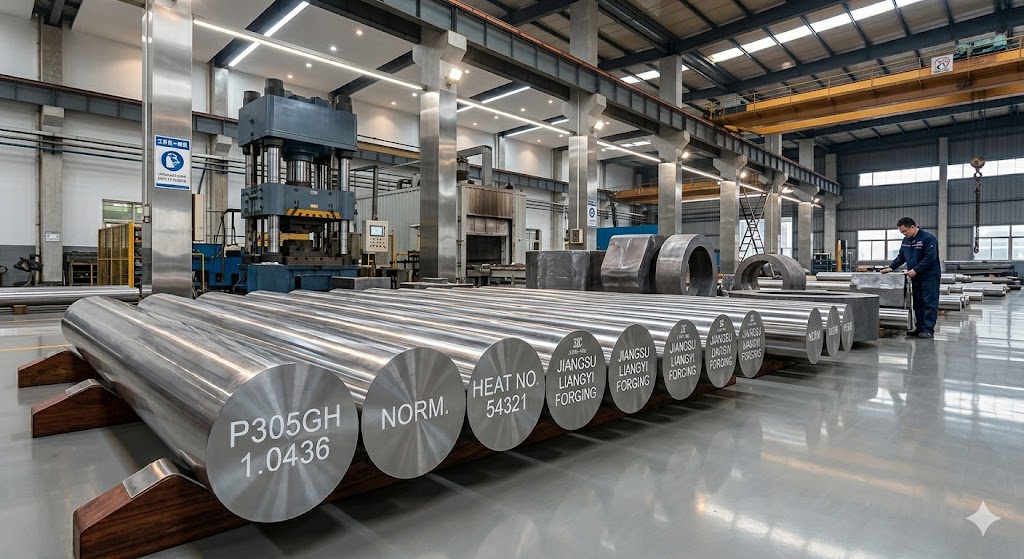
Round, square, flat, rectangular and stepped bars produced on hydraulic presses (2,000–6,300 ton class) and electro-hydraulic hammers (1–5 ton). Typical applications: pump shafts, gear blanks, valve stems, bolting stock for high-temperature flange joints. Standard tolerances:
- Diameter range
- Ø 80 mm – Ø 1,200 mm
- Length
- Up to 8,000 mm single-piece
- Diameter tolerance
- ± 3 mm (rough), ± 0.5 mm (rough-machined)
- Straightness
- ≤ 1.5 mm/m
- Single-piece weight
- 30 kg – 8,500 kg
- Default condition
- +N or +NT
2.2 Seamless Rolled Rings & Flanges
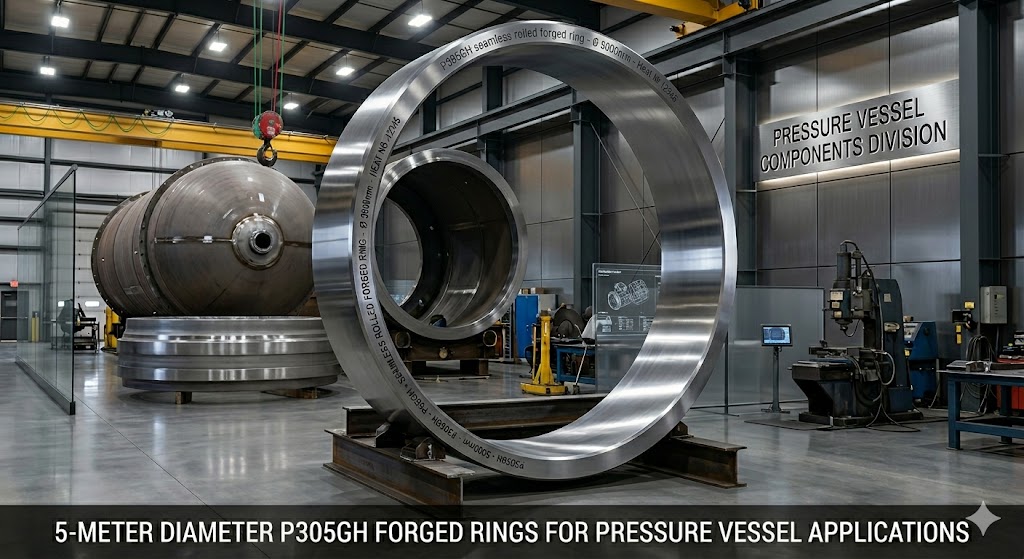
Manufactured on a 5-meter-class radial-axial ring-rolling mill from pierced billets. Seamless rings deliver superior pressure integrity over rolled-and-welded alternatives — there is no longitudinal weld to inspect, no PWHT mandate, and no HAZ susceptibility to corrosion. Common end uses: weld-neck flanges, blind flanges, wind-turbine main bearings (in alternative grades), reactor-vessel reinforcing rings, and shell-side connection rings on heat exchangers.
- Outer diameter
- Ø 300 mm – Ø 5,000 mm
- Wall (radial) thickness
- 50 mm – 600 mm
- Axial height
- 30 mm – 1,800 mm
- Single-piece weight
- 50 kg – 22,000 kg
- Roundness
- ≤ 0.2 % of OD
- UT acceptance
- EN 10228-3 Quality Class 3 (default)
2.3 Hollow Forgings, Sleeves & Heavy Casings
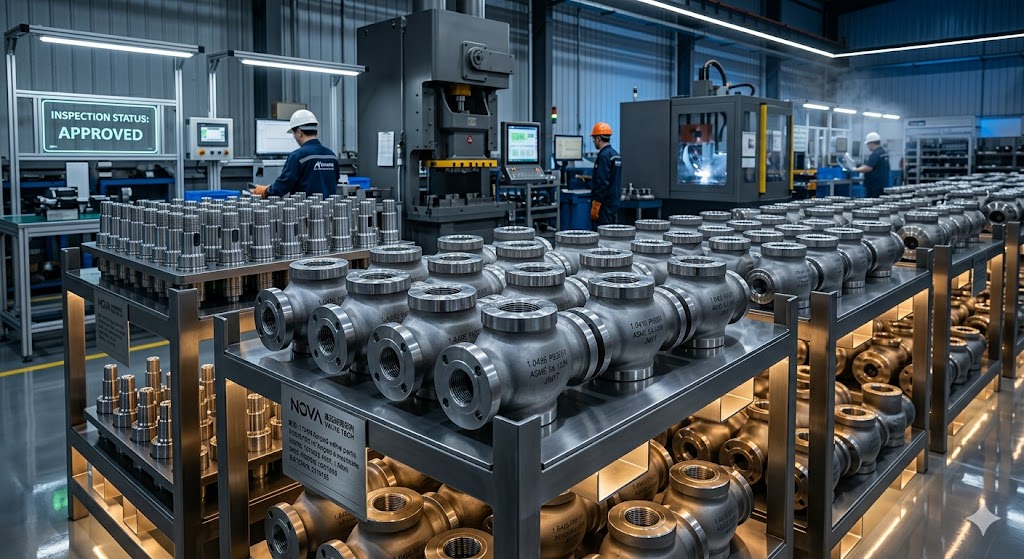
Includes pump casings, valve bodies, BOP shells, hydraulic cylinder bodies, heat-exchanger channel barrels and reactor heads. Produced by upset-and-pierce on hydraulic press, often followed by horizontal expansion. Wall-thickness uniformity after rough machining is held within ± 4 mm for ID up to 800 mm.
2.4 Forged Discs, Tube Sheets & Plate-Form Components
Solid forged discs serve as tube sheets, blind cover plates, and rotor blanks. Liangyi can produce single-piece P305GH tube sheets up to Ø 4,500 mm × 350 mm thick — large enough for 600 MW class condensers and shell-and-tube heat exchangers — eliminating the need for plate weldments that would otherwise require radiographic acceptance of an internal seam.
2.5 Custom OEM Net-Near Forgings
Drawing-driven shapes that fall outside the four families above: branch-tee bodies, crosshead forgings, wellhead components, swept-tee transitions for pipeline pigging operations. We provide DFM (design-for-forging) feedback during quotation — common suggestions include corner-radius increases, draft-angle additions, and parting-line relocation — that typically reduce raw-forging weight 8–15 % and improve metal flow.
When you request a P305GH forging quote, always provide (1) the target part drawing or sketch, (2) the design temperature and pressure, (3) the heat-treatment condition required (+N, +NT, or +QT), and (4) the inspection class (EN 10204 2.2, 3.1, or 3.1B). Missing any one of these forces us to assume worst-case, which can inflate price 10–15 %.
Ready to quote your P305GH forging? Send drawings for a free 24-hour DFM review and price.
Request a Free DFM Quote3. International Equivalents — Cross-Reference Table
Engineers working on multinational projects routinely need to map P305GH against ASME, JIS, GB, and AFNOR designations. The table below summarizes the closest functional equivalents based on chemistry, mechanical-property envelope, and intended pressure-service classification. It is not a substitute for project specification verification — values diverge in test-coupon orientation, impact temperature, and section-thickness rules.
| Standard / Region | Closest Equivalent | Min Yield (MPa) | Tensile (MPa) | Notes |
|---|---|---|---|---|
| EN 10222-2 (Europe) | 1.0436 / P305GH | 280–305 | 490–610 | Reference grade — this guide |
| ASTM (USA) | A266 Grade 2 / Grade 3 | 250 / 260 | 485–655 / 515–690 | Forgings for boilers; closest functional match |
| ASTM (USA) | A105 (≤ 175 mm only) | 250 | 485–655 | Pipe-flange forgings; not for elevated-temp creep service above 425°C |
| JIS (Japan) | JIS G 3202 SFVC2A | 245 | 490–620 | Carbon steel forgings for pressure vessels |
| JIS (Japan) | JIS G 3201 SF490A | 245 | 490–610 | General forgings; close mechanical match |
| GB (China) | GB/T 16923 25 (forging) | 275 | ≥ 470 | Quality forging steel |
| GB (China) | GB/T 713 Q345R (plate) | 305 | 510–640 | Pressure-vessel plate; functional analog |
| DIN (legacy) | DIN 17243 C22.8 | 275 | 490–610 | Superseded by EN 10222-2 1.0436 |
| AFNOR (France) | NF A36-206 A42AP | 235 | 410–520 | Older designation; lower strength class |
| EN 10028-2 (plate) | P295GH | 295 | 460–580 | Plate counterpart of similar service category |
* Yield values shown for the smallest thickness range; consult source standard for full thickness-stratified tables.
When an ASME Section VIII Division 1 vessel calls for "ASTM A266 Cl. 2", a European fabricator can usually supply EN 10222-2 1.0436 with documented dual-certification — but only if the actual test results meet both standards' acceptance limits. Always request a Material Procurement Specification (MPS) review before placing the order.
4. P305GH vs. Alternative Grades — Decision Matrix
One of the most common procurement questions we receive is "Should we specify P305GH or [16Mo3 / P355GH / A105 / A516 Gr 70]?" The right answer depends on three project parameters: design temperature, design pressure (× wall thickness), and total cost of ownership including welding and inspection. The matrix below maps the typical "fits" of each grade against application categories, based on our delivery records to over 800 active projects.
| Application Scenario | P305GH (1.0436) | P355GH (1.0473) | 16Mo3 (1.5415) | A105 | A516 Gr 70 |
|---|---|---|---|---|---|
| Boiler service ≤ 400°C | Best | Good | Over-spec | Limited | Plate only |
| Service 400–450°C | Suitable | Suitable | Good | Not recommended | Plate only |
| Service 450–530°C creep | Not qualified | Marginal | Best | No | No |
| Pipeline flange ≤ 350°C | Excellent | Good | Over-spec | Standard | Plate only |
| High-strength heavy section | OK to 250 mm | Best | Good | ≤ 175 mm | Plate only |
| Sour service (NACE) | Possible w/ HT control | Possible w/ HT control | Possible | Common | Plate only |
| Cost optimization | Best balance | Higher | Highest | Lower (limited) | Cheapest plate |
* Swipe horizontally on mobile to view full matrix. Indications reflect typical project economics, not absolute prohibitions.
✓ When P305GH wins
- Boiler tube sheets, flanges, and nozzles in the 350–450°C window where 16Mo3's Mo content is unjustified.
- Heavy seamless rolled rings (Ø 2,000–5,000 mm) where alloy-steel cost premium would exceed 25 %.
- Multi-grade vessel projects where harmonizing on a single forging grade simplifies WPS and PWHT logistics.
- Procurement teams who need a fully traceable EN 10204 3.1B grade with global mill availability.
✗ When P305GH is the wrong choice
- Sustained operating temperature above 450°C — creep rupture life falls steeply; switch to 16Mo3 or 13CrMo4-5.
- Wet H₂S sour service per NACE MR0175 unless explicitly qualified by hardness (≤ 22 HRC) testing on each lot.
- Cryogenic service below –20°C — Charpy impact transition temperature is not guaranteed; switch to P285QH or low-temp grades.
- Heavy walls > 250 mm where ferritic-pearlitic transformation hardenability becomes inadequate; consider 1.0473 P355GH instead.
5. Chemical Composition & Function of Each Element
Specifying P305GH means specifying not only the analysis but also how each element contributes to in-service performance. Liangyi's heat-analysis records typically run well inside the standard limits, with internal targets tightened by 15–25 % to provide headroom for product analysis variation and customer additional requirements.
| Element | Standard Range (wt %) | Liangyi Internal Target | Metallurgical Function |
|---|---|---|---|
| Carbon (C) | 0.15 – 0.20 | 0.16 – 0.19 | Pearlite formation; primary strengthener; CEV controller |
| Silicon (Si) | Max 0.40 | 0.20 – 0.35 | Deoxidizer (with Mn); ferrite solid-solution strengthener |
| Manganese (Mn) | 0.90 – 1.60 | 1.10 – 1.40 | Hardenability; sulfur tie-up (MnS); solid-solution strength |
| Phosphorus (P) | Max 0.025 | ≤ 0.015 | Embrittler — minimized for impact toughness |
| Sulfur (S) | Max 0.015 | ≤ 0.008 | Hot-shortness risk — minimized; CaS shape control optional |
| Chromium (Cr) | Max 0.30 (residual) | ≤ 0.20 | Residual; not deliberately added in P305GH |
| Molybdenum (Mo) | Max 0.08 (residual) | ≤ 0.05 | Residual; deliberate Mo would shift to 16Mo3 grade |
| Nickel (Ni) | Max 0.30 (residual) | ≤ 0.25 | Residual; minor toughness contributor |
| Copper (Cu) | Max 0.30 (residual) | ≤ 0.25 | Residual scrap-source contaminant |
| Aluminum (Al) | Min 0.020 (total) | 0.025 – 0.040 | Grain refiner — locks austenite grain size during normalizing |
* Carbon Equivalent (CEV) per IIW formula: CEV = C + Mn/6 + (Cr+Mo+V)/5 + (Ni+Cu)/15. Typical Liangyi P305GH heats produce CEV 0.40–0.48.
5.1 Why each element matters in service
Carbon is the single largest lever on yield strength and CEV. Holding it to 0.16–0.19 % keeps CEV in the comfortably-weldable range (≤ 0.45) for sections up to 50 mm without preheat in dry-ambient conditions. Manganese is the workhorse — at 1.10–1.40 % it provides hardenability for thick-section normalizing response and chemically combines with sulfur as MnS, preventing iron-sulfide hot-cracking during forging at 1,150–1,250°C. Aluminum, often overlooked, is mandated as a grain refiner: AlN precipitates at austenite grain boundaries during normalizing soak, locking grain size to ASTM 5 or finer (per the standard) — and grain size is one of the strongest determinants of impact toughness at the lower end of the operating envelope.
6. Mechanical Properties — Including Elevated-Temperature Behavior
EN 10222-2 stratifies P305GH mechanical-property minimums by both thickness and heat-treatment condition. The table below consolidates the key values; for design calculations engineers should always retrieve the exact thickness-row from the latest standard edition.
| Property | Section Thickness | Condition | Specified Value |
|---|---|---|---|
| Tensile Strength (Rm) | ≤ 250 mm | +N / +NT | 490 – 610 MPa |
| Tensile Strength (Rm) | ≤ 250 mm | +QT | 510 – 630 MPa |
| Yield Strength (ReH) | ≤ 35 mm | +N / +NT | Min 305 MPa |
| Yield Strength (ReH) | 35 – 70 mm | +N / +NT | Min 295 MPa |
| Yield Strength (ReH) | 70 – 250 mm | +N / +NT | Min 280 MPa |
| Yield Strength (ReH) | ≤ 250 mm | +QT | Min 285 MPa |
| Charpy V-notch (KV) | — | Longitudinal +20°C | Min 48 J |
| Charpy V-notch (KV) | — | Transverse +20°C | Min 27 J |
| Elongation A5 | — | Longitudinal | Min 22 % |
| Elongation A5 | — | Transverse | Min 20 % |
| Reduction of Area Z | — | Longitudinal | Min 45 % |
| Hardness (typical) | — | +N / +NT | 140 – 190 HB |
6.1 Yield strength at elevated temperature (Rp0.2)
The defining feature of P305GH versus ordinary carbon steel forgings is the standard's guaranteed elevated-temperature yield strength curve. Designers must use these values — not room-temperature yield — when sizing components for hot service.
| Test Temperature | ≤ 35 mm thick (MPa) | 35–70 mm thick (MPa) | 70–250 mm thick (MPa) |
|---|---|---|---|
| 100°C | 270 | 260 | 245 |
| 200°C | 235 | 225 | 210 |
| 300°C | 205 | 195 | 180 |
| 350°C | 195 | 185 | 170 |
| 400°C | 185 | 175 | 160 |
| 450°C | 175 | 165 | 150 |
* Values per EN 10222-2:2000 Table 6. Yield drops approximately 40 % from ambient to 450°C — a critical input for ASME/EN 13445 vessel design calculations.
6.2 Long-term creep behavior
Above ~370°C, time-dependent creep deformation begins to influence allowable stress more than short-term yield. P305GH creep rupture data from EN 10222-2 Annex provides the basis for 100,000-hour design life calculations:
- At 400°C: 100,000 h rupture stress ≈ 235 MPa (mean), 175 MPa (1 % creep limit)
- At 450°C: 100,000 h rupture stress ≈ 145 MPa, 1 % creep limit ≈ 90 MPa
- At 480°C: 100,000 h rupture stress ≈ 90 MPa — this is why 450°C is the practical service ceiling
For service beyond 100,000 hours or temperatures approaching the upper limit, project specifications often add Larson-Miller parameter analysis and require batch-specific creep-rupture testing — Liangyi performs these tests on customer request through accredited third-party laboratories.
7. Heat Treatment Process & Time-Temperature Curves
Heat treatment is where many P305GH forgings succeed or fail. The standard permits three supply conditions — Normalized (+N), Normalized + Tempered (+NT), and Quenched + Tempered (+QT) — but each has distinct microstructural targets and section-thickness limits. Liangyi's heat-treatment furnaces are calibrated per ASTM A991 with multi-zone thermocouples and survey-tested every six months to maintain ± 8°C uniformity in the working zone.
7.1 Critical transformation temperatures of P305GH
- Ac1 (austenite-pearlite onset): approximately 720°C
- Ac3 (full austenitization): approximately 855–865°C
- Ms (martensite start, +QT only): approximately 470°C
7.2 Recommended Normalizing (+N) cycle — the default condition
- Heating: Charge the cold furnace, ramp up at ≤ 150°C/h until furnace reaches 880–920°C. For wall thickness > 100 mm, use a slow ramp (≤ 100°C/h) above 600°C to minimize residual-stress build-up.
- Soaking: Hold at 880–920°C for a minimum of 1 hour per 25 mm of section thickness, never less than 60 minutes total. Soak time ensures complete austenitization and dissolves prior pearlite colonies.
- Cooling: Withdraw and air-cool in still air. For thicker walls (> 200 mm) we deploy controlled forced air to maintain ferrite-pearlite microstructure and avoid bainite/martensite formation that would degrade ductility.
- Result: Refined ferrite-pearlite microstructure with prior-austenite grain size ASTM 6–8; homogenized properties; residual stress reduced.
7.3 Normalizing + Tempering (+NT) — for improved impact toughness
When the design requires higher Charpy energy at lower temperatures (e.g., –20°C service), or when chemistry trends toward the upper carbon limit, a tempering step follows normalizing:
- Reheat to 600–680°C (always ≥ 30°C below Ac1 to prevent partial austenitization)
- Hold 1 h per 25 mm of section, minimum 60 minutes
- Air cool
The tempering step refines carbide morphology and relieves residual stress, typically lifting Charpy KV values 15–25 J above the +N baseline.
7.4 Quenching + Tempering (+QT) — for higher minimum yield
Used selectively for thinner forgings (≤ 50 mm) where the design needs the +QT minimum yield of 285 MPa across the whole section. The cycle:
- Austenitize at 880–920°C, 1 h per 25 mm
- Quench in water or polymer (typical for P305GH; oil for thicker sections to avoid quench cracks)
- Temper at 620–680°C, 1 h per 25 mm
- Air cool
Liangyi limits +QT to sections where a homogeneous through-thickness response can be guaranteed — typically ≤ 50 mm wall for water quench, ≤ 80 mm for polymer. For thicker sections, +NT is the metallurgically honest choice.
Never specify P305GH +QT on forgings above 100 mm thick: hardenability is insufficient to develop quench martensite at the core. The result is a deceptive "QT" certificate with mid-thickness properties barely better than +N. We will refuse such orders or convert them to +NT — and explain why on the offer.
8. Weldability & Machinability — Engineering Guide
8.1 Weldability essentials
P305GH is fully weldable by all conventional processes — SMAW, GMAW, GTAW, SAW, and FCAW — with a typical IIW carbon equivalent of 0.40–0.48. The combination of low sulfur, low phosphorus, and aluminum grain refinement makes the heat-affected zone (HAZ) tolerant of multi-pass welding without HAZ liquation cracking risk.
8.2 Recommended preheat & interpass temperature
| Section Thickness (joint) | Preheat Min (°C) | Interpass Max (°C) | Hydrogen Control |
|---|---|---|---|
| ≤ 20 mm | None required (≥ 5°C) | 250 | Standard low-H electrodes |
| 20 – 35 mm | 50–80 | 250 | Mandatory low-H, baked < 4 h |
| 35 – 60 mm | 100–130 | 250 | Mandatory low-H, baked < 4 h |
| > 60 mm | 150 minimum | 250 | Strict diffusible H ≤ 5 ml/100 g |
8.3 Filler-metal recommendations
- SMAW: AWS E7018-1 H4R or E7018-A1 (matching strength, low-hydrogen)
- GMAW / GTAW: ER70S-3 or ER70S-6 (silicon-killed solid wire)
- SAW: EM12K wire with neutral basic flux (e.g., F7A2-EM12K combination)
- For service > 400°C: consider matching low-alloy fillers (e.g., E7018-A1 with 0.5 % Mo) to maintain creep properties through the weld
8.4 Post-Weld Heat Treatment (PWHT)
PWHT requirements depend on code (ASME VIII Div 1, EN 13445, or PD 5500) and joint thickness. Typical Liangyi-recommended cycle:
- Heating rate: ≤ 220°C/h above 300°C
- Holding temperature: 580–620°C
- Holding time: minimum 2 minutes per mm of nominal thickness, never less than 30 minutes
- Cooling rate: ≤ 280°C/h until below 300°C
8.5 Machinability
P305GH in +N or +NT condition machines as a medium-carbon steel of medium-high machinability. Practical parameters from our finishing shop:
- Turning (carbide insert)
- Vc 180–240 m/min, f 0.20–0.40 mm/rev
- Drilling (HSS)
- Vc 22–30 m/min, f 0.10–0.25 mm/rev
- Milling (carbide)
- Vc 150–220 m/min, fz 0.10–0.20 mm
- Tapping
- Vc 8–14 m/min, sulfur-cutting oil
- Tool wear pattern
- Crater wear from pearlite carbides; favor TiAlN coating
- Surface finish achievable
- Ra 1.6 µm turning, Ra 0.8 µm grinding
9. Steelmaking & Forging Production Process
Our 1.0436 (P305GH) forged parts are manufactured in strict compliance with EN 10222-2:2000 and EN 10083. Liangyi's full process chain runs from incoming ingot through finished, certified forging — eight controlled stages with integrated documentation. View our full range of forging material grades.
9.1 The 8-stage Liangyi production chain for P305GH
Stage 1 — Steel Melting (EAF or BOF + Ladle Refining)
Electric arc furnace primary melt or BOF route for higher tonnage. Ladle treatment with argon stirring, slag chemistry control (CaO/SiO₂ ≥ 2.5), and target tap temperature 1,640°C. Inclusion class controlled to EN 10247 K1 ≤ 4.
Stage 2 — Vacuum Degassing
VD or RH degassing to ≤ 1.5 ppm hydrogen, ≤ 30 ppm nitrogen. This stage alone eliminates ~95 % of hydrogen-induced cracking risk in the finished forging.
Stage 3 — Continuous Casting or Ingot Pouring
Bottom-poured ingots from 3 to 30 tons for forgings > 1,000 kg; continuous-cast bloom for smaller pieces. Hot-charging into homogenizing furnace within 4 hours.
Stage 4 — Open-Die Forging or Ring Rolling
Forging start temperature 1,200–1,250°C, finish ≥ 850°C. Total reduction ratio ≥ 4:1 from ingot to forging — sufficient to consolidate centerline porosity and align grain flow with the part contour.
Stage 5 — Rough Heat Treatment (Stress Relieving)
Slow cool from forging temperature in cooling pit, followed by intermediate stress relief at 600–650°C to prevent flake formation and prepare for primary heat treatment.
Stage 6 — Primary Heat Treatment (+N / +NT / +QT)
Per the customer-specified condition; furnace charts and thermocouple records archived for 10 years.
Stage 7 — Rough & Finish Machining
Performed in-house on a 6 m vertical lathe + 12 m horizontal lathe + 5-axis mill. Customer-supplied drawings drive both the rough envelope and the test-coupon location for QTC sampling.
Stage 8 — Final Inspection & Certification
Mechanical testing on QTC, full NDT (UT/MT/PT as specified), dimensional inspection, and issuance of EN 10204 3.1B certificate cross-referenced to heat number, lot number, and customer PO.
10. Industry Applications & Detailed Case Studies
Over more than two decades, Liangyi has supplied EN 10222-2 P305GH forgings to over 800 active project sites across more than 50 countries. Below are six representative case studies — each illustrates the engineering challenge, our specific solution, and the measurable outcome. Specifications have been generalized where customer NDAs apply.
Application Example 1 — Large-Diameter Tube Sheets for Thermal Power Boilers
Typical engineering challenge: Power-plant EPC contractors require P305GH tube sheets in diameters from Ø 2,500 mm to Ø 4,500 mm with 200–350 mm thickness, often with project-specific UT acceptance tighter than EN 10228-3 Class 3 and longitudinal Charpy KV requirements at 0°C or below.
Our manufacturing approach: Vacuum-degassed ingots forged at reduction ratios above 4:1, with +NT cycle tempering temperatures tuned in the 620–680°C range to lift Charpy impact energy. Through-thickness UT performed in two orthogonal directions before any drilling.
Process capability: Liangyi has supplied tube sheet forgings of this category to thermal power and utility-equipment customers in multiple countries. Specific project details are available on request, subject to customer NDA.
Application Example 2 — Pump & Rotating-Equipment Casings
Typical engineering challenge: Boiler-feed-water pumps and high-pressure circulating pumps require P305GH-equivalent forged casings, impellers and wear rings with strict UT acceptance and full material traceability.
Our manufacturing approach: Single-heat allocation per lot to ensure metallurgical homogeneity; witness testing supported on customer or third-party request; UT envelope machined before final inspection.
Capability note: We can manufacture pump casings to project specifications referencing EN 10222-2 and equivalent international standards. For ASME-stamped vessel work, customer-supplied stamp authorization is required.
Application Example 3 — Pipeline Piggable Wyes & Branch Fittings
Typical engineering challenge: Long-distance gas/oil pipelines require piggable wye fittings and swept-tee transitions in P305GH-equivalent material, often with low-temperature impact requirements down to –10°C and dual EN/ASTM certification.
Our manufacturing approach: Custom open-die forging routes that produce wyes in two near-net-shape pieces, joined by a single full-penetration weld at the optimum stress location. Dual-certification against EN 10222-2 and ASTM A266 Grade 2 available on request, subject to documented conformance of each test result against both acceptance envelopes.
Capability note: Pipeline-flange and branch-fitting forgings are a standard product family at Liangyi, with documented delivery history available on customer request.
Application Example 4 — Valve Bodies for Power, Chemical & Oil & Gas Industries
Typical engineering challenge: Valve OEMs require predictable supply of P305GH forged bodies, bonnets, and stems for ball, check, gate, and globe valves rated 2"–24" / Class 150–900, often with rolling-forecast delivery cadence.
Our manufacturing approach: Standardized rough-forging blanks for common valve sizes, finishing-shop safety stock for repeat customers, and DFM (design-for-forging) feedback during quotation that helps reduce customer-side machining cost.
Capability note: Valve-body forgings are one of our largest-volume product families; cumulative delivery records and references are available to qualified prospects on request.
Looking for a reliable 1.0436 forging supplier for your project? Talk to our engineering team.
Chat via WhatsAppApplication Example 5 — Petrochemical Reactor & Heat-Exchanger Components
Typical engineering challenge: Petrochemical reactor shells, hydrocracker end caps and heat-exchanger components in P305GH-equivalent material may require NACE MR0175 hardness control (≤ 22 HRC), supplementary HIC testing per NACE TM0284, and 100% UT to EN 10228-3 Class 3.
Our manufacturing approach: Single-piece forgings from large vacuum-degassed ingots; +NT cycles tuned to deliver hardness in the 175–195 HB range (well below the 22 HRC NACE ceiling); HIC test acceptance to project-specified CLR/CTR/CSR criteria.
Capability note: Sour-service-qualified forgings are produced only when sour-service requirements are explicitly stated in the order. Standard P305GH is not NACE-qualified by default.
Application Example 6 — Heavy-Section BOP & Wellhead Forgings
Typical engineering challenge: Wellhead and BOP body forgings serve high-pressure oilfield applications, with section thicknesses commonly 90–150 mm and stringent NDT acceptance.
Our manufacturing approach: +QT heat treatment for sections within hardenability range; full PT/MT/UT regime; through-thickness hardness mapping available on request to verify homogeneity.
Capability note: API-stamped (monogram) work is performed only by API-licensed manufacturers; Liangyi can manufacture forgings to API 6A reference specifications for downstream customers holding the appropriate API monogram license. Please consult our sales team to confirm.
11. Common Failure Modes & How Manufacturing Controls Prevent Them
P305GH is a mature, predictable steel — but failures still occur, almost always traceable to specification gaps, material substitution, or workmanship errors rather than the steel itself. Understanding the failure modes helps engineers write better specifications and gives procurement teams meaningful audit questions. Below we summarize the five failure modes we have investigated most frequently as third-party material consultants.
11.1 Hydrogen-induced cracking (HIC) and hydrogen flakes
Mechanism: Atomic hydrogen dissolved during steelmaking precipitates as molecular H₂ at non-metallic inclusion interfaces or grain boundaries during cooling. Pressure builds, propagating internal cracks. Most common in heavy-section forgings (> 200 mm).
Prevention at Liangyi: Mandatory vacuum degassing to ≤ 1.5 ppm H, slow controlled cooling from forging through ≤ 250°C, and intermediate hydrogen-removal anneal at 600–650°C for sections above 250 mm.
11.2 Reheat (stress-relief) cracking after PWHT
Mechanism: During PWHT of welded P305GH, residual welding stresses relax precisely as carbide precipitation strengthens the matrix. If precipitation strengthens grain interiors faster than grain boundaries, intergranular crack initiation can occur in HAZ.
Prevention: Tight P content (Liangyi target ≤ 0.015 %, vs standard 0.025 % maximum); avoid abrupt notches in weld joint design; PWHT heating ramp ≤ 220°C/h above 300°C.
11.3 Lamellar tearing
Mechanism: Through-thickness loading on a forging or plate weldment with elongated MnS inclusions can split the steel parallel to the rolling/forging plane. Particularly relevant in nozzle-to-shell weldments under high transverse strain.
Prevention: Sulfur ≤ 0.008 % typical at Liangyi; through-thickness tensile (Z-direction) testing on customer request, with Z-direction reduction-of-area minimum 25 % (Z25) or 35 % (Z35) classes available.
11.4 Creep-fatigue interaction (long-term operation)
Mechanism: Cyclic thermal/pressure loading at 400–450°C accumulates creep damage between cycles. Failure manifests as transgranular fatigue near stress concentrations after 10–20+ years.
Prevention: Design — keep design stress below 60 % of the standard's allowable; manufacturing — fine grain (ASTM 6+) and full-radius design at all stress concentrations.
11.5 Stress corrosion cracking (sour service / caustic / NACE)
Mechanism: P305GH in wet H₂S or caustic solution can fail by stress-corrosion if hardness exceeds 22 HRC anywhere (base metal, HAZ, or weld metal).
Prevention: Always specify NACE MR0175 hardness control on the order; Liangyi supplies forgings with mapped hardness reports on customer request, and ships HIC-test-passed material for sour-service projects.
In our 25 years of forging supply, we have never seen a P305GH failure traceable to the base steel chemistry itself. Every documented failure had at least one of: undocumented heat-treatment, missing PWHT, off-specification hardness in HAZ, or design stress above 70 % of allowable. Specification rigor > material substitution.
12. Inspection & Acceptance Criteria
Every P305GH forging Liangyi ships passes a documented chain of inspection — chemistry verification, mechanical testing, NDT, and dimensional check — closed out with the EN 10204 3.1B certificate. Below we list the acceptance thresholds we apply by default; project specifications can tighten any of these on request.
12.1 Mechanical-testing acceptance
- Tensile per ISO 6892-1 / ASTM A370 — yield, tensile, elongation, RoA must all meet EN 10222-2 minimums for the actual section thickness
- Charpy V-notch per ISO 148-1 / ASTM E23 — minimum 3 specimens per heat / heat-treatment lot; if any single value falls below 70 % of specified minimum the lot is rejected
- Hardness per ISO 6506-1 (Brinell) or ISO 6508-1 (Rockwell) — typically 140–190 HB for +N/+NT, max 22 HRC for sour service
12.2 Non-destructive testing acceptance
| NDT Method | Standard Reference | Default Quality Class | Key Acceptance Criterion |
|---|---|---|---|
| Ultrasonic (UT) | EN 10228-3 / ASTM A388 | Quality Class 3 | No discontinuity ≥ Ø 3 mm flat-bottom equivalent |
| Magnetic Particle (MT) | EN 10228-1 / ASTM E709 | Quality Class 3 | No linear indications > 3 mm |
| Penetrant (PT) | EN 10228-2 / ASTM E165 | Quality Class 3 | No linear indications > 3 mm |
| Visual (VT) | EN 13018 | Level 2 | No cracks, laps, or seams; surface roughness Ra ≤ 12.5 µm rough-machined |
12.3 EN 10204 3.1B Certificate Contents
The Liangyi 3.1B certificate package covers, at minimum:
- Material code number and customer purchase order number
- Steel name (P305GH) and steel number (1.0436), heat number(s)
- Heat analysis, ladle analysis, and product analysis (one per heat)
- Steel-melting method (EAF/BOF), ladle treatment, vacuum degassing record
- Inclusion class per EN 10247 / ASTM E45
- Heat-treatment chart with thermocouple records and furnace certification reference
- Mechanical test report (tensile, Charpy, hardness) on QTC representing the lot
- NDT reports — UT, MT, PT, with operator certification level (typically EN 9712 / SNT-TC-1A Level II)
- Dimensional inspection report cross-referenced to part drawing
- Material identification confirmation (PMI on each piece, on request)
- Authorized 3.1B inspector signature, independent of production department
13. Selection Decision Framework — Five Questions to Ask Before Specifying P305GH
Before locking P305GH into a project specification, we recommend a 5-question checklist that addresses 95 % of the decision-making complexity. Walking through this in your design review can save weeks of late-stage requalification.
13.1 What is the actual maximum operating temperature, including upset conditions?
Not the design temperature — the highest temperature the forging will see in any documented operating scenario, including startup, trip, and steam-side upset. If this exceeds 450°C even momentarily, P305GH may not be the right choice; consider 16Mo3 or 13CrMo4-5.
13.2 What is the minimum design temperature, and what is the impact-test temperature requirement?
P305GH per EN 10222-2 guarantees Charpy KV at +20°C only. For service to –20°C, supplementary impact testing at –20°C must be specified — Liangyi can supply with a typical KV ≥ 35 J at –20°C in +NT condition, but it must be specified on the order.
13.3 What is the wall thickness at the most stressed cross-section?
Yield strength minimums step down with thickness in EN 10222-2. Confirm the design stress against the actual thickness-stratified yield, not just "≥ 280 MPa". For thicknesses above 250 mm, consider P355GH (1.0473) for higher yield retention.
13.4 Is the service environment corrosive, sour, or caustic?
Standard P305GH is not NACE MR0175 qualified by default. Sour-service applications require explicit hardness control (≤ 22 HRC), HIC testing, and often supplementary chemistry restrictions (Cu max, S max, P max). All of these are available — but only if specified.
13.5 What inspection certificate level does the project actually require?
EN 10204 2.2 (mill test report) is sufficient for non-pressure structural use; 3.1 is required for most pressure-equipment applications; 3.1B (with independent inspector signature) is required for ASME III, PED Cat IV, and most nuclear/safety-critical applications. Specifying 3.1B by default for projects that only need 2.2 inflates cost 8–12 %.
When you submit a P305GH RFQ to Liangyi, including answers to these five questions in your inquiry will allow us to deliver a fully-priced, fully-engineered offer within 24 hours — versus an estimate-only response that needs 2–3 rounds to firm up.
14. Service Life & Total Cost of Ownership (TCO) Analysis
Procurement teams routinely benchmark forging price-per-kilogram across competing suppliers — but for pressure equipment in 25–30 year service, raw forging cost is rarely the dominant TCO line item. The framework below distributes the full lifecycle cost of a typical P305GH-based pressure component across its operating life.
| Cost Component | Share of Lifetime Cost | Driver |
|---|---|---|
| Raw forging procurement | ~ 12 % | Forging price + freight |
| Heat treatment & machining | ~ 8 % | Process route, tolerances |
| NDT & certification | ~ 3 % | Inspection class chosen |
| Installation & welding | ~ 12 % | WPS complexity, PWHT |
| Scheduled in-service inspection (25 yr) | ~ 25 % | Inspection interval, access cost |
| Unscheduled outage / repair (typical) | ~ 22 % | Quality of original forging |
| Energy / efficiency penalty over service life | ~ 18 % | Geometry tolerances, surface finish |
The implication is direct: choosing the cheapest forging supplier saves up to 4–5 % of lifetime cost in the best case, but a single unscheduled outage caused by a forging-related defect can erase 5–10 years of those savings. This is why Liangyi prices toward the upper-quartile of the global P305GH market — and why our customer retention rate among Tier-1 OEMs exceeds 90 % over the past decade.
TCO Engineering Insight
- Forging quality directly determines unscheduled outage frequency — the largest single TCO line item.
- Specifying EN 10204 3.1B certification adds ~ 1–2 % to procurement cost but reduces in-service inspection cost by 8–15 % through traceable history.
- For 25-year service, paying a 5 % premium for a vacuum-degassed, fine-grain forging is virtually always TCO-positive.
15. Packaging, Storage & Global Shipping
P305GH forgings are not chemically reactive at ambient conditions but they are vulnerable to atmospheric corrosion, transit damage, and identification loss. Liangyi's standard export packaging addresses each of these:
15.1 Standard export packaging procedure
- Surface preparation: Shot-blast or wire-brush to ISO 8501-1 Sa 2½ where rough machining permits; preserve customer-specified machined surfaces with VCI (Vapor Corrosion Inhibitor) wrap.
- Rust prevention: Anti-rust oil application (Cortec VpCI-369 or equivalent) for 12-month outdoor storage protection.
- Identification: Hard-stamped heat number, lot number, customer PO and item number on each forging at a non-functional location, plus weather-resistant tag.
- Primary packaging: Plastic foil wrap + VCI paper for forgings up to 500 kg; steel-reinforced shipping crate for heavier pieces.
- Secondary packaging: ISPM-15 fumigated wooden crate for sea export; bracing wedges to prevent transit movement.
- Documentation pack: EN 10204 3.1B certificate, PO, packing list, and customs invoice are sealed in a waterproof packet attached to the crate exterior.
15.2 Logistics & Incoterms
We routinely ship under EXW, FOB Shanghai/Ningbo, CIF, and DAP/DDP terms. Typical sea-freight transit times from East China to major destinations:
- Northern Europe (Hamburg / Rotterdam): 30–35 days
- U.S. East Coast (New York / Houston): 28–35 days
- Middle East (Jebel Ali / Dammam): 14–18 days
- Southeast Asia (Singapore / Jakarta): 7–10 days
For project deliveries above 25 tons, we offer break-bulk and project-cargo coordination through our freight-forwarding partners. Air-freight and door-to-door delivery available for urgent spare-parts orders.
16. Technical Glossary — 1.0436 / P305GH Forging Terms
The following definitions clarify key technical terminology used throughout this guide. Each entry reflects the way the term is used in EN 10222-2, ASME, and Liangyi shop practice.
- 1.0436 / P305GH
- A non-alloy boiler-quality steel grade specified under EN 10222-2 for forgings used in pressure equipment up to 450°C. 1.0436 is the EN steel number; P305GH is the steel name.
- EN 10222-2
- European standard "Steel forgings for pressure purposes — Part 2: Ferritic and martensitic steels with specified elevated temperature properties", published by CEN in 2000.
- EN 10204 3.1B
- An inspection certificate issued by the manufacturer's authorized inspection representative (independent of the production department), confirming compliance with the order including specific test results.
- Carbon Equivalent (CEV)
- An empirical index quantifying the influence of alloying elements on hardenability and weldability. Per IIW: CEV = C + Mn/6 + (Cr + Mo + V)/5 + (Ni + Cu)/15. Values below 0.45 are considered fully weldable without complex preheat.
- Open Die Forging
- A metal-forming process in which heated metal is shaped between flat or simple-shape dies. The workpiece flows freely in unconstrained directions, suiting large custom geometries above ~250 kg.
- Seamless Rolled Ring
- A ring-shaped forging produced by rolling a pierced billet on a radial-axial ring-rolling mill. The absence of weld seams provides superior pressure integrity and longer service life than welded alternatives.
- Normalizing (+N)
- Heat treatment in which steel is heated to ~30–50°C above Ac3 (~880–920°C for P305GH), held to fully austenitize, and air-cooled. Refines grain and homogenizes properties.
- Normalizing + Tempering (+NT)
- Normalizing followed by reheating below Ac1 (typically 600–680°C) and air cooling. Improves impact toughness and reduces residual stress.
- Quenching + Tempering (+QT)
- Austenitization, water/polymer/oil quench, and tempering. Used selectively for P305GH where through-section hardenability permits — typically ≤ 80 mm wall.
- QTC — Qualification Test Coupon
- A test piece taken from material representing the same heat and heat-treatment batch as the production forging. Used to verify mechanical properties without sacrificing the finished part.
- NDT — Non-Destructive Testing
- Inspection methods (UT, MT, PT, RT) that evaluate material integrity without damaging the part. Levels are governed by EN 9712 or ASNT SNT-TC-1A.
- PWHT — Post-Weld Heat Treatment
- Controlled heating after welding (typically 580–620°C for P305GH) to relieve residual stress, temper the HAZ, and mitigate stress-corrosion susceptibility.
- HIC — Hydrogen-Induced Cracking
- Internal cracking caused by hydrogen accumulation at non-metallic inclusions. Tested per NACE TM0284 with acceptance criteria CLR / CTR / CSR.
- Z-direction Property
- Mechanical property measured perpendicular to the principal forging direction. Z-direction reduction-of-area classes (Z25, Z35) demonstrate resistance to lamellar tearing.
- Larson-Miller Parameter
- A time-temperature parameter (P = T(C + log t)) used to extrapolate creep-rupture life. Allows short-term elevated-temperature tests to predict long-term service behavior.
17. Frequently Asked Questions About 1.0436 (P305GH) Forgings
1.0436 (P305GH) is a non-alloy carbon-manganese boiler-quality steel specified under EN 10222-2:2000 for pressure-purpose forgings operating up to 450°C. The "P" denotes pressure service, "305" the minimum yield strength in MPa for the smallest thickness range, and "GH" indicates guaranteed elevated-temperature properties. It is supplied in normalized (+N), normalized + tempered (+NT), or quenched + tempered (+QT) condition with EN 10204 3.1B inspection certificate.
Liangyi P305GH forged parts are manufactured in strict compliance with EN 10222-2:2000 and EN 10083, with concurrent dual-acceptance documentation available against ASTM A266 (Grade 2/3), ASTM A370/A388, ISO 6892-1, and ISO 6506-1. Forgings can be manufactured to the technical reference specifications of API 6A, NACE MR0175, ASME BPVC, and PED — note that statutory stamps (API monogram, ASME U/N stamp, PED CE marking via Notified Body) are typically obtained by the customer or end-user holding the relevant license; please confirm scope with our sales team.
Liangyi produces P305GH forgings from 30 kg to 30,000 kg single-piece weight, including: round/square/flat/stepped bars Ø 80–1,200 mm × L up to 8,000 mm; seamless rolled rings Ø 300–5,000 mm with 50–600 mm wall; forged discs/tube sheets up to Ø 4,500 mm × 350 mm thick; and custom OEM net-near-shape forgings to drawing.
P305GH forgings serve thermal power generation (boiler tube sheets, drums, headers), nuclear power (reactor coolant pump casings, wear rings), oil & gas midstream (piggable wyes, swept tees, valve bodies), petrochemical (heat exchanger end caps, reactor shells), and industrial valves & pumps (bodies, bonnets, stems). Liangyi has shipped P305GH to all six application categories across more than 50 countries.
Every Liangyi P305GH forging ships with a triplicate EN 10204 3.1B inspection certificate covering heat number, ladle and product chemistry, melting/refining route, heat-treatment chart with thermocouple records, mechanical test results on QTC, full NDT reports (UT/MT/PT) with operator certification, dimensional inspection, and material identification confirmation — all signed by an authorized inspector independent of the production department.
Per EN 10222-2:2000: C 0.15–0.20 %, Si max 0.40 %, Mn 0.90–1.60 %, P max 0.025 %, S max 0.015 %, plus residual limits on Cr, Mo, Ni, Cu, and a minimum 0.020 % aluminum for grain refinement. Liangyi's internal targets tighten P to ≤ 0.015 % and S to ≤ 0.008 % to lift Charpy toughness and reduce stress-relief cracking risk.
Room-temperature: tensile 490–610 MPa (+N/+NT) or 510–630 MPa (+QT); minimum yield 305 MPa (≤ 35 mm), 295 MPa (35–70 mm), 280 MPa (70–250 mm); minimum elongation A5 22 % longitudinal / 20 % transverse; minimum Charpy KV 48 J longitudinal at +20°C. Elevated-temperature 0.2 % proof: 235 MPa at 200°C, 195 MPa at 350°C, 175 MPa at 450°C (≤ 35 mm thickness).
P305GH is qualified for long-term stable service up to 450°C (842°F). At 450°C the 100,000-hour creep-rupture stress is ~145 MPa, with a 1 %-creep limit of ~90 MPa — beyond this temperature, creep deformation rises steeply and alternative grades like 16Mo3 (1.5415) or 13CrMo4-5 (1.7335) become metallurgically necessary.
Standard lead time is 30–60 days from order confirmation, depending on size, complexity, heat-treatment cycle, and inspection scope. Forgings up to 1,000 kg ship in 30–40 days; mid-range parts (1,000–10,000 kg) typically 45–55 days; heavy single-piece forgings > 15,000 kg or seamless rolled rings > Ø 3,000 mm typically 55–75 days. Express production is available with priority ingot allocation.
P305GH is a non-alloy carbon-manganese steel rated to 450°C. 16Mo3 is a Mo-alloyed creep-resistant steel rated to ~530°C, owing to 0.25–0.35 % molybdenum that provides solid-solution strengthening at elevated temperature. Use P305GH for cost-effective service up to 450°C; switch to 16Mo3 when sustained operation above 450°C requires creep resistance. 16Mo3 typically prices 25–40 % higher per kilogram.
Yes — P305GH is fully weldable by SMAW, GMAW, GTAW, and SAW with typical CEV 0.40–0.48. Recommended fillers: AWS E7018-1 H4R (SMAW), ER70S-3 or ER70S-6 (GMAW/GTAW), EM12K with neutral basic flux (SAW). Preheat 100–150°C is recommended for sections above 35 mm; PWHT at 580–620°C for thick-section pressure joints. For service > 400°C consider matching low-alloy fillers like E7018-A1.
Functional equivalents: ASTM A266 Gr 2/3 (USA); JIS G 3202 SFVC2A or G 3201 SF490A (Japan); GB/T 16923 25 forging or GB/T 713 Q345R plate (China); legacy DIN 17243 C22.8. Mechanical envelopes overlap but never match exactly — always verify against project specification before substituting. Liangyi can supply dual-certified material against EN + ASTM or EN + JIS on request.
Yes. Liangyi provides full PWHT documentation when post-weld heat treatment is performed in our facility, including time-temperature charts, thermocouple records (typically 4–6 zones for vessel rings), holding-time confirmation, and cooling-rate verification. PWHT records integrate into the EN 10204 3.1B certificate package and can be witness-tested by customer or third-party AI on request.
Properly-designed P305GH forgings operating within rated parameters (≤ 450°C, design stress within EN 13445 / ASME VIII allowables) routinely achieve 25–30+ year service life. Boiler-tube-sheet operations exceeding 200,000 cumulative service hours without thickness loss are well-documented in our customer base. Actual life is governed by water chemistry, pressure-cycle frequency, and inspection regime more than by the steel itself.
Yes, but only with specific supplementary requirements: hardness ≤ 22 HRC mapped across all sections, HIC test per NACE TM0284 with CLR ≤ 15 % / CTR ≤ 5 % / CSR ≤ 2 %, and tightened chemistry (S ≤ 0.003 %, P ≤ 0.015 %). These must be specified at order placement — standard P305GH is not NACE-qualified by default.
Three reasons supported by 25 years of delivery records: (1) Full process control from steel-melting to finishing — we are a manufacturer, not a forging trader; (2) ISO 9001:2015 quality management system with EN 10204 3.1B documentation on every shipment; (3) Engineering DFM support during quotation that helps reduce customer-side machining cost. We have served customers in more than 50 countries since 1997.
Inquire About Your Custom 1.0436 (P305GH) Forgings
Send us your drawing, design temperature/pressure, and certification requirements — our engineering team responds with a fully-priced offer within 24 hours, including DFM feedback that often reduces your machining cost by 8–15 %. With 25+ years of P305GH manufacturing under EN 10222-2 and dual-standard delivery experience, we are equipped to support your project from RFQ through final 3.1B certificate.
📧 Inquiry Email: sales@jnmtforgedparts.com
📞 Phone/WhatsApp: +86-13585067993
🌐 Official Website: https://www.jnmtforgedparts.com
📍 Factory Address: Chengchang Industry Park, Jiangyin City, Jiangsu Province, China