1.0426 (P280GH) Forged Steel Forgings | ISO Certified China Manufacturer
Technical Guide: Chemical Composition, Mechanical Properties, Applications & Custom Manufacturing — Produced to EN 10222-2
🔑 Key Facts About 1.0426 (P280GH) at a Glance
- EN Material Number
- 1.0426
- Steel Designation
- P280GH
- Standard
- EN 10222-2:2000
- Material Type
- Pressure vessel grade carbon steel
- Min. Yield Strength
- ≥ 280 MPa
- Tensile Strength
- 460 – 580 MPa
- Max. Service Temperature
- ~ 400°C (752°F)
- Carbon Content
- 0.080 – 0.20%
- Weldability
- Excellent (CEV ≤ 0.43)
- Typical Lead Time
- 15 – 30 days
- Weight Range
- 30 kg – 30,000 kg per piece
- Certification
- EN 10204 3.1B (standard) / 3.2 (optional)
📑 Table of Contents
- 1.0426 (P280GH) Material Overview
- Metallurgy Deep Dive: Why P280GH Works
- Full Range of P280GH Forged Products
- Key Application Industries
- P280GH vs P265GH vs P355GH
- Cross-Standard Equivalents (ASME/ASTM/JIS/GB)
- Design Allowable Stress at Temperature
- Typical Industry Applications
- 7-Step Manufacturing Process
- Forging Engineering Insights
- Failure Modes & Field Lessons
- Production Standards & QC
- Chemical Composition
- Mechanical Properties
- Weight & Size Range
- Sour Service & Hydrogen Compatibility
- Emerging Applications: Hydrogen, Wind, LNG
- Procurement Guide for Engineers
- Inspection & Certification
- Frequently Asked Questions
- Contact & Free Quote
1.0426 (P280GH) Steel Material Overview
Established in , Jiangsu Liangyi Co.,Limited is an ISO 9001:2015 certified professional China manufacturer of 1.0426 (P280GH) open die forging parts and seamless rolled steel forged rings. 1.0426 is the official EN standard material number for P280GH, a premium pressure vessel grade carbon steel specially engineered for elevated temperature and high-pressure applications, fully compliant with EN 10222-2:2000 standard, the European reference for steel forgings used in pressure equipment.
Founded in 1997 with continuous experience in heavy forging production, we supply custom P280GH forged steel parts to industrial customers internationally across Europe, Asia, the Middle East, North America and beyond. Our 1.0426 forgings are manufactured with advanced equipment, including 6300T hydraulic presses, 5T electro-hydraulic hammers and 5M seamless ring rolling machines. Learn more about our ISO-certified forging production facility.
The "GH" suffix in P280GH designates that this carbon steel grade is specifically formulated for use at elevated temperatures (höhere Temperaturen in German), with controlled chemistry to keep creep resistance and structural integrity under sustained thermal and mechanical stress. This makes 1.0426 the best choice material for pressure-bearing forged components in extreme industrial systems worldwide.
Metallurgy Deep Dive: Why P280GH Works at Elevated Temperatures
Most material specifications only outline chemical limits and minimum mechanical property requirements. With years of specialized production experience across a wide range of custom part numbers for 1.0426 forgings, our engineering team has built in‑depth metallurgical insight into the inherent performance characteristics of P280GH. We share this professional expertise with clients throughout design review sessions. This section outlines the main metallurgical principles that differentiate P280GH from conventional generic carbon steel grades.
The Carbon-Manganese Synergy: An Engineering Compromise
P280GH’s chemical composition is engineered with clear metallurgical intent. Its controlled carbon content of 0.08–0.20% and manganese range of 0.90–1.50% represent a deliberate engineering balance, optimized to satisfy four critical performance demands simultaneously:
- Strength: Carbon contributes to solid-solution and pearlite strengthening; manganese substitutes into the iron lattice and increases tensile strength by approximately 100 MPa per 1% Mn.
- Weldability: The carbon equivalent (CEV = C + Mn/6 + …) must remain below 0.43 to permit field welding without preheat for sections under 30 mm. P280GH's typical CEV of 0.35–0.40 sits comfortably below this threshold.
- Hardenability: Manganese delays austenite-to-pearlite transformation, guaranteeing consistent mechanical properties through the full cross-section of thick forgings (up to 250 mm wall thickness in our experience).
- Toughness retention: Excessive carbon causes coarse pearlite and embrittlement; insufficient carbon causes ferrite cold-shortness. The 0.08–0.20% window preserves Charpy V-notch toughness above 27 J even at -10°C.
This is why simply substituting a "cheaper" carbon steel like S235JR or A36 for P280GH is a costly mistake — those grades lack the controlled chemistry envelope and elevated-temperature qualification testing that defines 1.0426.
Why Silicon Is Capped at 0.40%
Silicon serves as a deoxidizer during steelmaking and contributes to solid-solution strengthening. However, P280GH limits Si to 0.40% maximum for two reasons most material datasheets do not explain:
- Low-temperature toughness: Above 0.50% Si, the ductile-to-brittle transition temperature (DBTT) shifts upward by approximately 15–25°C, compromising service in cold-climate installations (Northern Europe, Canada, Russia, mountain pipelines).
- Surface scale adhesion: High silicon causes tenacious oxide scale that complicates both forging surface quality and downstream pickling/painting operations.
Phosphorus and Sulfur: Why the Limits Are So Strict
P280GH caps P at 0.025% and S at 0.015% — significantly stricter than commodity carbon steels. These limits exist because:
- Phosphorus segregates to grain boundaries during slow cooling, causing temper embrittlement and reducing impact toughness. Below 0.025%, this effect is essentially deleted for normalized forgings.
- Sulfur forms manganese sulfide (MnS) inclusions that elongate during forging, creating planes of weakness in the transverse direction. The 0.015% cap, combined with our vacuum degassing and inclusion shape control, keeps transverse impact energy above 27 J.
For NACE MR0175 sour service applications, we further reduce the sulfur ceiling to 0.005% by ladle metallurgy, and add calcium treatment to globularize residual MnS — a process detail that distinguishes pressure vessel grade forgings from general structural steel.
Microstructure: What You Should See Under the Microscope
A correctly normalized 1.0426 P280GH forging exhibits a consistent ferrite-pearlite microstructure with the following characteristics, which our metallography lab verifies on every heat:
- Ferrite-to-pearlite ratio: approximately 70:30 to 80:20 by area
- ASTM grain size number: 7 to 9 (finer = better toughness)
- Pearlite colony size: less than 30 μm
- No visible widmanstätten ferrite (which would indicate excessive cooling rate or insufficient normalizing time)
- Inclusion rating per ASTM E45 Method A: typically < 1.5 in all four categories (sulfides, alumina, silicates, globular oxides)
Any departure from this baseline microstructure — especially excessive grain coarsening (ASTM grain size No.5 or larger) and pronounced banded segregation — serves as important warning signs. These defects directly point to improper forging temperature control or insufficient ingot homogenization during primary melting and hot working. Customers holding our 3.1B inspection certificates may request supporting micrograph documentation to verify full compliance with required microstructural criteria.
Full Range of 1.0426 P280GH Forged Steel Products
We offer a complete line of custom 1.0426 P280GH forged steel products in all kinds of shapes and specifications, and they are made based on your project drawings and technical requirements. Our production range covers 30 KGS to 30,000 KGS per piece, with full in-house machining, heat treatment and inspection services included:
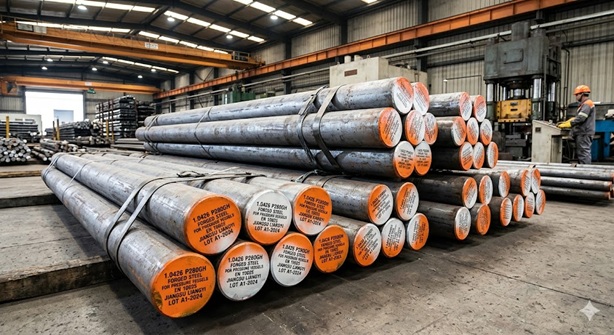
Forged Steel Bars & Shafts
1.0426 forged steel round bars, square bars, flat bars, rectangular bars, step shafts, gear shafts, rotor shafts and custom engineered forged shafts. Diameter range: 50–1500mm; length up to 12m.
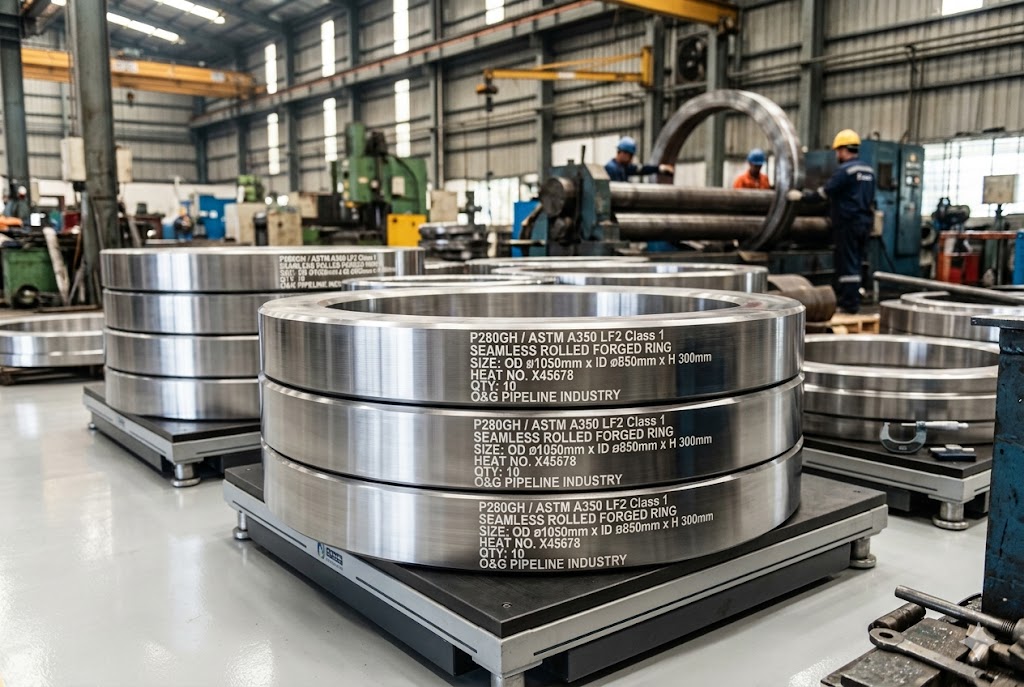
Seamless Rolled Forged Rings
P280GH seamless rolled rings, forged flanges, swivel ring flanges, gear rings, contoured rolled rings, bearing races and custom forged ring parts. Outer diameter capability is up to 5000mm.
Forged Sleeves, Bushes & Hollow Bars
P280GH forged hubs, housings, shells, sleeves, bushes, bushing cases, cylinder liners and heavy-wall hollow bars. Wall thickness is up to 350mm; hollow ID from 100mm.
Forged Discs, Plates & Blocks
1.0426 forged steel discs, disks, blind flanges, tube sheets, forged blocks and heavy steel plates. Disc diameter up to 3000mm; thickness up to 800mm.
Forged Pipes, Tubes & Casings
P280GH forged steel pipes, seamless tubes, tubings, piping shells, pressure vessel casings, case barrels and heavy-duty housings. And they are suitable for high-pressure pipeline transmission systems.
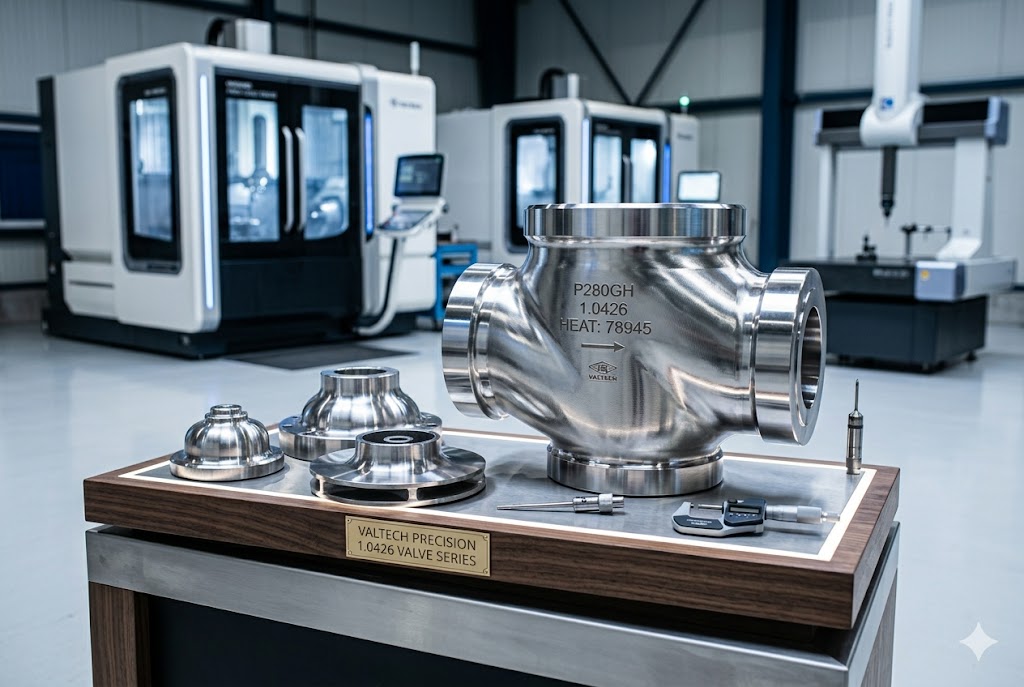
Custom Forged Valve & Pump Parts
Custom P280GH forged valve balls, valve bonnets, valve bodies, valve stems, valve closures, valve seat rings, valve cores, valve discs, as well as 1.0426 forged pump casings, pump covers, pump barrels, pump impellers, pump shafts, pump housings, pump shells and pump wear rings.
We also offer a full range of other forging material grades, including carbon steel, alloy steel, stainless steel and nickel alloy forgings. View our full material grade list here.
Main Application Industries of P280GH (1.0426) Forgings
Our 1.0426 P280GH forged steel parts are widely used in important industries across Europe (Germany, UK, France), North America (USA, Canada), the Middle East (UAE, Saudi Arabia) and Southeast Asia (Thailand, Singapore, Indonesia), where all parts need to have excellent high-temperature resistance, high-pressure bearing capacity and long-term reliable mechanical performance. Following are the main area our parts are used for:
- Power Generation: Boiler drums, heat exchangers, pressure vessels, reactor vessels and heater parts for thermal power and nuclear power plants
- Industrial Valves: Ball valves, check valves, gate valves, globe valves, back pressure valves and pump systems
- Oil & Gas Transmission: Pipeline fittings, wye pieces, piggable wyes, swept branches, wellhead equipment and christmas tree assemblies
- Chemical & Petrochemical: High-pressure reactors, distillation columns, processing vessels and refining equipment
- Drilling Equipment: Blowout preventer (BOP) bodies for onshore and offshore oil and gas drilling rigs
- Marine Engineering: Shipbuilding parts, offshore platform structural parts and subsea equipment housings
- LNG & Cryogenic Equipment: Pressure-bearing parts for liquefied natural gas storage and transport systems
P280GH vs P265GH vs P355GH: Material Comparison Guide
Engineers frequently compare 1.0426 (P280GH) against other EN 10222-2 pressure vessel grades when specifying forgings. The table below summarizes the important differences to help you choose the right material for your project:
| Property | P265GH (1.0425) | P280GH (1.0426) | P355GH (1.0473) |
|---|---|---|---|
| Min. Yield Strength | ≥ 265 MPa | ≥ 280 MPa | ≥ 355 MPa |
| Tensile Strength | 410–530 MPa | 460–580 MPa | 510–650 MPa |
| Carbon Content (Max) | 0.20% | 0.20% | 0.22% |
| Manganese Content | 0.80–1.40% | 0.90–1.50% | 1.10–1.70% |
| Min. Elongation (Long.) | ≥ 23% | ≥ 23% | ≥ 22% |
| Max. Service Temp. | ~ 400°C | ~ 400°C | ~ 400°C |
| Weldability | Excellent | Excellent | Good (preheat req.) |
| Typical Application | Medium-pressure boilers, light pressure vessels | Heavy-duty pressure vessels, valves, oil & gas pipelines | Thick-wall reactors, high-pressure heat exchangers |
Choice Tip: When you need a pressure vessel forging that is strong, easy to weld, and cheap, P280GH (1.0426) . For applications with thick walls and very high pressure, upgrade to P355GH. For less demanding medium-pressure boiler shells, use P265GH.
Cross-Standard Equivalents: P280GH in ASME, ASTM, JIS, GB & UNS
One of the most frequent questions we get from international procurement teams is: "What is the equivalent of 1.0426 P280GH in our local standard?" The honest answer is that no perfect 1:1 equivalent exists across all standards, because each system has slightly different chemistry tolerances and mechanical property test conditions. The table below documents the closest functional equivalents we have qualified through actual cross-supply contracts:
| Standard / Region | Equivalent Designation | Key Difference vs P280GH | Typical Use |
|---|---|---|---|
| EN 10222-2 (Europe) | P280GH / 1.0426 | Reference standard | PED 2014/68/EU compliant pressure equipment |
| ASME Section II (USA) | SA-105 (closest functional match) | Carbon allowed up to 0.35% (significantly higher); requires CEV calculation | ASME VIII Div.1 pressure vessels in North America |
| ASTM (USA) | A266 Class 2 | Tensile range 485-655 MPa (slightly higher upper limit) | Heavy carbon steel forgings for pressure vessels |
| UNS (Unified) | K03014 / K02501 | Numerical designation only | North American purchasing reference |
| JIS G3202 (Japan) | SFVC2A | Slightly lower yield strength target (255 MPa min) | Japanese pressure vessel forgings |
| GB/T 12228 (China) | 25 / 20MnMo (closest) | 20MnMo adds Mo for creep resistance | Chinese domestic pressure vessels |
| GOST (Russia) | 20K / 16GS | Different impact test temperatures and specimen orientation | Eurasian Customs Union projects |
| DIN 17243 (Germany legacy) | 17Mn4 / Ck20 | Superseded by EN 10222-2 | Legacy drawings; new orders should reference P280GH |
Important procurement note: When an end-user specification calls for "ASME SA-105 or equivalent," do not assume P280GH is acceptable without code review. SA-105 permits up to 0.35% carbon while P280GH caps at 0.20% — meaning a part made to SA-105 chemistry would fail a 1.0426 acceptance test. Conversely, P280GH always meets SA-105 chemistry, but mechanical property tests must be re-performed per the relevant standard. We routinely supply dual-certified forgings (P280GH + SA-105 for example) on a single MTC when customer specifications cross multiple codes.
Design Allowable Stress of P280GH at Elevated Temperatures
Pressure vessel and piping design engineers need temperature‑adjusted material allowables for code calculations per ASME, EN and PED regulations. Listed below are the minimum 0.2% proof stress (Rp0.2) values for P280GH based on 10222‑2 at standard reference temperatures, applicable to nominal section thicknesses up to 35 mm. All our forgings are given individual heat treatment and independent mechanical testing to verify full compliance with these rated values for every shipment.
| Service Temperature | Min. Rp0.2 (MPa) | % of Room Temp. Yield | Design Note |
|---|---|---|---|
| 20°C (RT) | 280 | 100% | Reference baseline |
| 100°C | 245 | 87.5% | Standard hot water systems |
| 200°C | 215 | 76.8% | Low-pressure steam piping |
| 250°C | 200 | 71.4% | Refinery process streams |
| 300°C | 185 | 66.1% | Saturated steam boiler drums |
| 350°C | 170 | 60.7% | Approaching creep regime |
| 400°C | 160 | 57.1% | Upper service limit; check creep curves |
Sample Design Calculation
To illustrate practical use, consider a P280GH forged shell operating at 300°C with a design pressure of 5 MPa (50 bar). Using a typical safety factor of 1.5 against yield (per PED for time-independent regime), the design allowable stress is 185 MPa ÷ 1.5 = 123 MPa. For a cylindrical shell of inner diameter 1000 mm, the minimum needed wall thickness is approximately t = (P × D) / (2 × σ_allow − P) = (5 × 1000) / (2 × 123 − 5) ≈ 20.7 mm, before adding corrosion allowance and manufacturing tolerance. This is why P280GH is often chosen for pressure vessels in this temperature range — the strength margin remains favorable while keeping wall thickness economical.
Above 400°C: Why P280GH Is Not the Right Choice
Above 400°C, time-dependent creep deformation gradually replaces instantaneous yielding as the dominant failure mechanism. Per EN 10222-2, P280GH is not qualified for long-term continuous service beyond 400°C, as its 100,000-hour creep rupture strength declines drastically at elevated temperatures. For operating conditions exceeding 400°C, designers shall choose dedicated creep-resistant steel grades for reliable long-term structural stability.
- 16Mo3 (1.5415): Up to 530°C — molybdenum addition extends creep life
- 13CrMo4-5 (1.7335): Up to 580°C — Cr-Mo for sustained high-temperature steam service
- 10CrMo9-10 (1.7380): Up to 600°C — primary boiler tube and superheater material
- X10CrMoVNb9-1 (P91 / 1.4903): Up to 620°C — modern supercritical power plants
We supply forged parts in all of the above grades. Refer to our complete material grade catalog for choice guidance.
Typical Industry Applications of 1.0426 P280GH Forgings
The following are representative application scenarios where 1.0426 P280GH forged steel is widely deployed across global industrial projects. These show how engineers usually use this material grade, which helps them figure out when P280GH is the best choice. If you ask, we can talk about specific project references under NDA.
Application Scenario: Cross-Border Natural Gas Transmission Pipelines
P280GH forged valve bodies, bonnets, seat rings, and stems are commonly specified for high-pressure natural gas transmission pipelines in temperate climate zones (typical service: -10°C to +60°C ambient, design pressure 60–100 bar). The 1.0426 grade is the best choice because it has EN 10204 3.1B documentation availability, low-temperature impact resistance, and stable pressure-bearing capacity. All of these features help reduce inspection frequency and improve long-term operational safety
Application Scenario: Thermal Power Plant Boilers and Heat Exchangers
We make custom P280GH forged tube sheets, channel flanges, and seamless piping shells, which are widely used in thermal power plants. These parts usually work continuously at 250–350°C, with steam pressures up to 17 MPa. Meeting EN 10222-2 standards ensures the forged parts meet the high-temperature mechanical property requirements set by pressure vessel codes in countries around the world.
Application Scenario: Oilfield Wellhead and Christmas Tree Components
Custom P280GH forged tubing heads, casing hangers, wye pieces, and adapter spools are widely used for onshore oilfield development in all kinds of climate conditions. If the wellhead working environment contains H2S, customers need to add the NACE MR0175 / ISO 15156 requirements to their specifications (these are explained in our Sour Service section). When ordered with the right specifications, 1.0426 forgings can work reliably for long periods in both temperate and desert oilfield settings.
Application Scenario: Petrochemical Refinery Pressure Equipment
P280GH forged shells, channel covers, and tube sheets are widely used for pressure vessels and heat exchangers in petrochemical refineries. Many refinery projects need compliance with two sets of industrial codes at the same time, such as ASME Section VIII Div. 1 together with EN 10222-2. We can provide forged parts with dual certification on one single material test certificate, to meet both code rules whenever the base material specification allows.
7-Step Manufacturing Process for 1.0426 P280GH Forgings
Every P280GH forging produced at our facility follows a rigorously controlled 7-step manufacturing workflow, making sure every part meets EN 10222-2 specifications and customer drawing tolerances:
- Step 1 — Steel Making: Primary steel making via electric arc furnace (EAF) or basic oxygen furnace (BOF), followed by ladle refining (LF) treatment to achieve precise chemical composition matching EN 10222-2 P280GH specifications.
- Step 2 — Vacuum Degassing: Full vacuum degassing (VD/VOD) treatment to lower hydrogen levels below 2 ppm. This process also removes nitrogen and oxygen to make the material cleaner, more pure, and more isotropic in terms of mechanical properties.
- Step 3 — Material Quality Control: Strict non-radioactive material control to meet global nuclear power and food industry safety requirements; quality class minimum MQ in accordance with ISO 6336-5 or DIN 3990-5.
- Step 4 — Open Die Forging / Ring Rolling: Hot forging at 1100–1250°C using 6300T hydraulic press or 5T electro-hydraulic hammer, with controlled forging ratio ≥ 3:1 to guarantee consistent grain refinement. Seamless rings are rolled on 5M ring rolling machines.
- Step 5 — Heat Treatment: Precision heat treatment including normalizing at 880–940°C, optional quenching, and tempering at 580–680°C, performed in computer-controlled furnaces with documented temperature curves to meet EN 10222-2 mechanical property targets.
- Step 6 — Precision CNC Machining: 5-axis CNC machining to drawing tolerances (typically ±0.1mm to ±0.5mm depending on feature). Surface finish from rough machined (Ra 12.5) to fully finished (Ra 1.6 or better) per customer requirements.
- Step 7 — Inspection & Certification: Full dimension test (CMM), 100% NDT coverage (UT, MT, PT, RT as applicable), tensile and Charpy impact testing, hardness testing, and issuance of EN 10204 3.1B Mill Test Certificate (or 3.2 from BV/SGS/TUV upon request).
Forging Engineering Insights from 25 Years of Production
Generic forging articles describe a process. This section shares engineering insights our team has accumulated from producing 1.0426 P280GH parts since our company was founded in 1997 — knowledge that affects part performance and which most material datasheets omit.
Why Forging Ratio Matters More Than Most Buyers Realize
Forging ratio (the ratio of cross-sectional area before and after forging) is the single most important parameter determining the final mechanical properties of a P280GH forging. Our internal testing across hundreds of heats has produced the following empirical relationship between forging ratio and transverse impact toughness:
| Forging Ratio | Typical ASTM Grain Size | Typical Transverse KV (+20°C) | Recommended Use |
|---|---|---|---|
| 2:1 | 5–6 | ~ 30 J | Not recommended for pressure equipment |
| 3:1 | 7–8 | ~ 40 J | EN 10222-2 minimum acceptable |
| 4:1 | 8 | ~ 50 J | Important pressure equipment (our default) |
| 5:1+ | 8–9 | ~ 60 J | NACE sour service, low-temperature applications |
In the industry, forging ratios below 3:1 are sometimes used to reduce production cost; however, parts produced this way may pass minimum tensile testing while showing reduced transverse impact and fatigue performance. As standard practice, we forge our 1.0426 parts to a minimum 3:1 ratio, with 4:1 used for pressure-critical components.
The Forging Temperature Window: Why 1100–1250°C Is Not Negotiable
P280GH must be forged within a narrow temperature window for three reasons:
- Upper limit (1250°C): Above this, austenite grain growth becomes uncontrollable and surface oxidation creates excessive scale loss. Burning (incipient melting at grain boundaries) begins around 1300°C, causing catastrophic property loss.
- Lower limit (Ar3 + ~50°C, around 850°C): Below this, the steel starts to change into ferrite during forging, which makes mixed structures that don't recrystallize evenly. Forging below 800°C ("cold forging" of carbon steel) adds residual stress and the chance of cracking.
- Final-pass temperature (≥ 950°C): Our process specifications need the final forging blow or roll pass to occur above 950°C to guarantee complete dynamic recrystallization, producing the fine equiaxed grain matrix that delivers optimum toughness after normalizing.
Every press and hammer station in our workshop is equipped with calibrated optical pyrometers that automatically lock out the operator if the workpiece temperature drops below set-point — a small but critical detail that distinguishes a controlled process from a chaotic shop floor.
Heat Treatment Subtleties: When to Specify Q&T Instead of Normalizing
EN 10222-2 default heat treatment for P280GH is normalizing. However, three customer scenarios justify the additional cost of quench and temper (Q&T):
- Sections above 100 mm: Air-cooling alone produces slower cooling at the core, resulting in coarser pearlite and reduced core toughness. Q&T provides uniform properties through the full thickness.
- Hardness-controlled NACE applications: Sour service requires hardness below 22 HRC (~ 237 HBW). Q&T followed by tempering above 600°C reliably places hardness in this range.
- Critical fatigue parts: Quenched and tempered matrix has higher fatigue strength than normalized structure for the same yield level, due to finer carbide dispersion.
We discuss heat treatment selection during the drawing review stage. Customers often arrive with "normalized" specified by default, but a brief design review reveals that Q&T is the better economic and technical choice — saving thousands on premature failures.
Failure Modes & Field Lessons: What Goes Wrong in Service
With years of supplying P280GH forged parts to global clients in oil and gas, power generation and chemical fields, we have gathered feedback on every on-site problem reported. It proves that 1.0426 is one of the most steady and reliable grades for pressure vessel service in general industry. Meanwhile, all failure cases we have checked can be linked to five main root causes, and all these risks can be avoided with clear material rules and standard fabrication work.
Failure Mode #1: Hydrogen-Induced Cracking (HIC) in Sour Service
Scenario: Standard P280GH forging put in a wet H2S environment without following NACE MR0175 or ISO 15156. In the high-stress areas, hairline cracks that run parallel to the rolling/forging direction show up within 6 to 18 months.
Root cause: Atomic hydrogen generated by H2S corrosion penetrates the steel and recombines at MnS inclusion sites, creating internal pressure that nucleates cracks.
Prevention: Specify NACE MR0175 compliance up-front. This needs sulfur ≤ 0.005%, calcium-treated inclusion shape control, hardness ≤ 22 HRC, and supplementary HIC testing per NACE TM0284.
Failure Mode #2: Stress Corrosion Cracking Near Welds
Scenario: Welded fabrication using P280GH forging as base metal. Section thickness 40 mm. PWHT skipped to save schedule. Three years later, fine cracks discovered during routine inspection at the weld toe.
Root cause: Residual tensile stress from welding combined with corrosive service environment. The weld heat-affected zone (HAZ) hardness exceeded 240 HBW, exceeding NACE limits.
Prevention: Always heat treat sections that are more than 35 mm thick at 580–620°C for 1 hour for every 25 mm of thickness. After PWHT, write down the hardness on a coupon from the same heat.
Failure Mode #3: Creep Deformation Above 400°C
Scenario: P280GH valve body originally sized for 350°C service. Process upgrade pushed operating temperature to 430°C. Two years later, valve seats begin leaking due to permanent body distortion.
Root cause: P280GH was operated outside its time-temperature design envelope. Above 400°C, time-dependent creep accumulates measurable strain.
Prevention: When process conditions evolve, re-evaluate material choice. For 400–530°C service, upgrade to 16Mo3 (1.5415). For 530–600°C, specify 13CrMo4-5 or 10CrMo9-10.
Failure Mode #4: Brittle Fracture at Low Ambient Temperature
Scenario: The P280GH flange was put on the gas pipeline in northern Canada. Flange broke during a cold snap (-35°C) when debris from a contract hit it.
Root cause: Testing for P280GH standard impact is done at +20°C. Without any extra qualification, this grade usually goes from ductile to brittle between -20 and -30°C.
Prevention: For operating ambient temperatures below -20°C, supplementary low-temperature impact testing shall be specified at the minimum design temperature. Alternatively, materials can be upgraded to dedicated cryogenic-rated grades including P285NH and P355NL2 for reliable low-temperature toughness performance.
Failure Mode #5: Inadequate Corrosion Allowance
Scenario: Cooling water service for the P280GH heat exchanger tube sheet. The wall was made to be 50 mm thick, with 3 mm of extra space for corrosion. After eight years, the walls are still 40 mm thick, which is four times more than what was expected.
Root cause: Aggressive cooling water chemistry was not characterized during design. P280GH itself performed as expected; the corrosion allowance was simply too small.
Prevention: Always conduct water chemistry analysis and consult corrosion specialists. For aggressive media, consider stainless steel cladding on the wetted surface, or a higher corrosion allowance (6–10 mm) with periodic UT thickness monitoring.
Lessons Summary
Most field failures we have investigated could have been prevented at the specification or design review stage. We strongly encourage customers to send drawings before finalizing material selection, so our metallurgical team can flag potential mismatches between intended service and material capability. This drawing review is offered free of charge as part of every quotation.
Production Standard & Full-Process Quality Control
International Compliance Standards
Our 1.0426 P280GH forged steel parts are made according to the following international standards:
- EN 10222-2:2000 — Steel forgings for pressure purposes: Ferritic and martensitic steels with specified elevated temperature properties (primary specification)
- EN 10083 — Steels for quenching and tempering
- ASTM A788 — Standard Specification for Steel Forgings, General Requirements (US equivalent)
- API 6A — Specification for Wellhead and Christmas Tree Equipment (oil & gas)
- ASME Boiler and Pressure Vessel Code, Section VIII — supplementary compliance for North American projects
- EN 10204 3.1B / 3.2 — Inspection Certification Standards for material documentation
- PED 2014/68/EU — European Pressure Equipment Directive compliance
Chemical Composition of 1.0426 (P280GH) Steel
The chemical composition of our 1.0426 (P280GH) forged steel strictly meets the EN 10222-2:2000 standard requirements, with the following controlled element ranges (verified via spectrometric analysis on every heat):
| Chemical Element | Symbol | Content Range (Weight %) | Functional Role |
|---|---|---|---|
| Iron | Fe | 97.9 – 99.02 | Base matrix metal |
| Manganese | Mn | 0.9 – 1.5 | Strength, deoxidation, hardenability |
| Silicon | Si | 0 – 0.4 | Deoxidizer, strengthener |
| Carbon | C | 0.080 – 0.20 | Strength, hardness |
| Phosphorus | P | 0 – 0.025 (max) | Impurity (controlled low) |
| Sulfur | S | 0 – 0.015 (max) | Impurity (controlled low) |
Note on weldability: The carbon equivalent value (CEV) of P280GH usually stays below 0.43, calculated by the IIW formula: CEV = C + Mn/6 + (Cr+Mo+V)/5 + (Ni+Cu)/15. This makes the 1.0426 grade easy to weld with all common welding methods including SMAW, GTAW, GMAW and SAW, with no extra special steps needed for part thickness below 30mm.
Mechanical Properties of P280GH Forged Steel
Our 1.0426 P280GH forgings have stable and reliable mechanical properties, and they fully meet the requirements of high-pressure elevated temperature applications. All test values are verified per ISO 6892-1 (tensile) and ISO 148-1 (impact):
| Mechanical Property | Test Condition | Standard Value |
|---|---|---|
| Tensile Strength (Rm) | Nominal thickness ≤ 35mm | 460 – 580 MPa |
| Minimum Yield Strength (ReH) | Nominal thickness ≤ 35mm | ≥ 280 MPa |
| Impact Energy (KV) | Longitudinal, +20°C | Min 48 J |
| Impact Energy (KV) | Transverse, +20°C | Min 27 J |
| Elongation at Fracture (A) | Longitudinal | Min 23% |
| Elongation at Fracture (A) | Transverse | Min 21% |
| Hardness (Brinell, typical) | After normalizing | 130 – 180 HB |
| Reduction of Area (Z) | Longitudinal, typical | ≥ 45% |
Weight Range & Production Capacity Specifications
Our forging facility can produce 1.0426 P280GH parts across an exceptionally wide range of sizes and weights, from small precision parts to massive heavy-section forgings:
| Forging Type | Weight Range | Diameter / Size Range | Production Method |
|---|---|---|---|
| Round Bars & Shafts | 30 kg – 25,000 kg | Ø 50 – 1,500 mm × L 12 m | Open die forging |
| Seamless Rolled Rings | 50 kg – 30,000 kg | OD 200 – 5,000 mm | Ring rolling |
| Hollow Sleeves & Bushes | 30 kg – 15,000 kg | OD 200 – 2,500 mm | Open die forging |
| Discs & Blocks | 30 kg – 20,000 kg | OD up to 3,000 mm; T up to 800 mm | Upset / open die |
| Pipes & Casings | 100 kg – 18,000 kg | OD 300 – 2,000 mm | Hollow forging |
| Valve & Pump Components | 5 kg – 5,000 kg | Custom per drawing | Closed/open die forging |
Production capacity: Capable of large-volume production. Minimum order quantity: 1 piece (prototype) / 5–10 pieces (small parts production). Standard lead time: 15–30 days from drawing approval, depending on complication and quantity.
Sour Service & Hydrogen Compatibility: Specifying P280GH for H2S and H2 Environments
Standard P280GH as per EN 10222‑2 does not inherently qualify for sour service (H₂S‑containing media) or hydrogen‑rich environments. Amid growing global activity in sour‑field natural gas processing and rapid expansion of hydrogen infrastructure, it is important for customers to understand the supplementary requirements that upgrade standard P280GH into a sour‑service‑qualified forging.
NACE MR0175 / ISO 15156 Sour Service Requirements
To qualify a 1.0426 P280GH forging for wet H2S service per the global NACE MR0175 / ISO 15156-2 standard, our engineering team applies the following five supplementary controls, in addition to the base EN 10222-2 specification:
- Restricted chemistry: Sulfur ≤ 0.005% (vs 0.015% standard), Phosphorus ≤ 0.020%, Calcium treatment for inclusion shape control to globularize MnS
- Hardness control: Maximum 22 HRC (~ 248 HV / 237 HBW) on the surface and at the maximum hardness location
- Heat treatment: Quench and temper at minimum 595°C tempering temperature, with documented temperature curves
- Supplementary testing: HIC (Hydrogen Induced Cracking) test per NACE TM0284 with Solution A or B, reporting CLR, CTR, and CSR ratios; SSC (Sulfide Stress Cracking) testing per NACE TM0177 Method A
- Documentation: Complete inclusion rating per ASTM E45 or DIN 50602, with maximum K0/K4 values agreed by contract
The cost premium for NACE MR0175 P280GH forgings is typically 15–25% over standard parts, but this is a small price for service in sour gas wells, where premature failure can cost millions in lost production and environmental remediation.
Hydrogen Service Considerations
Green hydrogen and blue hydrogen infrastructure is growing quickly across the world, including electrolyzer factories in Germany and Australia, plus hydrogen mixing pipelines in the UK and Netherlands. For these applications, P280GH can be adopted for low-pressure hydrogen distribution under about 100 bar at normal room temperature, yet users need to make careful assessments when working above this pressure limit.
- Hydrogen embrittlement risk increases with hardness. Keep forging hardness below 200 HBW and avoid Q&T microstructures with martensite content above 5%.
- Surface condition matters: avoid notch-sensitive features and provide smooth machined surfaces (Ra ≤ 3.2 μm) on hydrogen-wetted areas.
- Welding procedures must be qualified for hydrogen service per ASME B31.12 or equivalent. Hydrogen pipeline welding needs lower hardness HAZ (max 235 HBW).
- For high-pressure hydrogen (above 200 bar) or pure hydrogen storage tanks, we recommend upgrading to specifically qualified low-alloy grades such as 4130 (with hydrogen testing) or austenitic stainless steel.
We are an active participant in hydrogen industry pre-qualification programs and can supply 1.0426 P280GH forgings with full hydrogen service documentation when project specifications demand it.
Emerging Applications: Where P280GH Demand Is Growing in 2025–2026
Traditional applications for 1.0426 P280GH (boilers, chemical pressure vessels, oilfield wellheads) remain stable. However, four new market drivers are creating significant additional demand for P280GH forgings, based on inquiries we have tracked from our global customer base:
1. Offshore Wind Energy Infrastructure
Europe's North Sea wind farms, Taiwan's Hsinchu offshore developments, and emerging US East Coast wind projects are driving demand for large-diameter P280GH forged flanges (typically 4–6 m OD), tower base plates, and bedplate parts. These parts must withstand:
- Cyclic loading from wind and wave forces (10⁹+ cycles over 25-year design life)
- Marine atmospheric corrosion with salt spray exposure
- Low ambient temperatures requiring impact testing at -20°C or -40°C
For offshore wind applications, we typically supply P280GH or P355NL2 forgings with supplementary fatigue and low-temperature qualification. Our 5 m ring rolling capability is well-matched to the 4–5 m flange diameters typical of 8–15 MW turbine designs.
2. Green Hydrogen Production and Distribution
Electrolyzer skids, hydrogen pressure vessels, transport pipeline fittings, and refueling station equipment are all pushing up demand for P280GH forged parts that work well in hydrogen service. The European Union’s REPowerEU plan aims to produce 10 million tons of local green hydrogen by 2030, which creates huge market need for forged products. We have provided P280GH parts for:
- Alkaline electrolyzer pressure vessels (60–80 bar)
- Hydrogen-blending pipeline T-pieces and reducers (up to 10% H2 in natural gas)
- Compressed hydrogen storage tank end-flanges (up to 200 bar with strict hardness control)
3. LNG Receiving Terminals and Bunkering
Post-2022 LNG infrastructure expansion, particularly in Europe (Wilhelmshaven, Brunsbüttel, Stade in Germany; Le Havre in France; Hellenic terminals in Greece) and Southeast Asia (Vietnam, Thailand, Philippines), has created strong demand for P280GH forgings in:
- BOG (boil-off gas) handling system pressure parts
- Send-out pipeline valves and fittings
- Loading arm bases and structural parts
While cryogenic LNG itself requires austenitic stainless or 9% Ni steel, many auxiliary systems operate at moderate temperatures where P280GH is the cost-effective choice.
4. Low-Carbon "Green Steel" Forgings for CBAM Compliance
The EU's Carbon Border Adjustment Mechanism (CBAM) will take full effect in 2026, and it charges carbon fees on imported steel based on Scope 1 and Scope 2 emissions from production factories. For European customers, buying P280GH from low-emission manufacturers brings clear cost benefits. We cooperate with steel producers to certify EAF and scrap-made P280GH. Its recorded carbon footprint is about 30–50% lower than products made from blast furnace routes, and we can provide complete emission documents that meet CBAM rules for all shipments to Europe.
Procurement Guide: How to Specify and Buy 1.0426 P280GH Forgings Successfully
This procurement guide sums up the practical experience our team has built through supporting global buyers, ranging from new procurement staff placing their first forging order to senior project engineers in charge of large multi-million-euro procurement packages. Following these eight key steps will effectively lower overall project risks and cut total costs.
Step 1: Define the Service Envelope Before Choosing Material
Before choosing P280GH, record the full working service range: design pressure, design temperature, fluid makeup (especially H2S, H2, chloride and oxygen content), cyclic load conditions, minimum ambient temperature, and overall design lifespan. Most specification conflicts happen when teams only use steady operating temperature as the design value, while overlooking temporary or abnormal working conditions that go past P280GH’s 400°C upper limit.
Step 2: Cross-Check Against Code Requirements
P280GH is a European specification. If your project is governed by ASME (USA), TSCA (Canada), JIS (Japan), GB (China), or another regional code, verify that P280GH is either listed directly or has an accepted equivalence path. For ASME projects, this typically needs either dual-certification or a Code Case authorization.
Step 3: Specify Inspection Level Appropriately
EN 10204 3.1B Mill Test Certificate is sufficient for most general industrial applications. Step up to EN 10204 3.2 (third-party witnessed inspection by BV, SGS, TÜV, DNV, or Lloyd's) when:
- The end-user is a regulated entity (oil major, utility, government)
- Insurance underwriters require independent verification
- The part has high consequence-of-failure (BOPs, Christmas trees, nuclear-grade)
Step 4: Evaluate the Forging Manufacturer's Capability — Not Just Price
Quotations can vary widely between suppliers. Significantly lower bids may correspond to differences in forging ratio, heat treatment soak time, or NDT coverage — buyers should clarify these details before comparing prices. When evaluating forging suppliers, request:
- ISO 9001 certification with current expiry date
- List of installed forging equipment (press tonnage, hammer capacity, ring rolling diameter capability)
- Heat treatment furnace size and instrumentation
- NDT operator certification level (Level II minimum for UT)
- Recent project references in your industry vertical
- 3rd-party audit reports (TÜV, BV, ABS) if available
Step 5: Insist on Drawing Review Before PO Placement
A quick engineering drawing check by our forging manufacturer’s technical team helps prevent expensive rework. At this stage, common problems include undercut shapes that don't work, tolerance values that don't match, missing notes about the surface finish, unclear rules for heat treatment, and part cross-sections that don't meet the standard forging ratio requirements. We will review your drawings for free if you ask us to do so for a formal project.
Step 6: Understand Lead Time Reality
Realistic lead times for custom 1.0426 P280GH forgings depend on size, drawings, and order quantity:
- Standard production (rounds, simple rings): 15–25 days after drawing approval
- Complex valve / pump parts: 25–45 days including machining
- Large heavy forgings > 5 tons: 30–60 days
- NACE / 3.2 / dual-certified parts: Add 7–14 days for additional testing
- International ocean shipping: + 25–40 days to Europe, + 35–50 days to North America, + 12–20 days to Middle East
Buyers should be cautious of unusually short lead time promises (e.g. 7-10 days for fully custom parts), as these typically indicate either use of pre-existing stock material that may not exactly match the specification, or shortened heat treatment / inspection procedures.
Step 7: Understand Total Landed Cost
FOB Shanghai pricing for P280GH forged parts only accounts for 60–75% of the final total landed cost. Sea freight ranges from $1,500 to $4,000 per 20-foot container and should be included in your overall budget. Based on standard 2026 shipping rates from Shanghai to Europe, additional expenses cover cargo insurance (0.3–0.5% of goods value), destination port charges, and customs duties. Most regions have no duties, but some EU countries have rates of 5% to 7% that are set by EUR rules. Other costs include fees for certifying the origin, local VAT or sales tax, and delivery fees within the country. We have flexible shipping terms to meet the needs of our customers, such as FOB, CIF, and DDP delivery options.
Step 8: Plan for Documentation and Compliance
Required documentation for international P280GH forging deliveries typically includes: commercial invoice, packing list, ocean bill of lading, EN 10204 3.1B/3.2 MTC, certificate of origin (Form A, EUR.1, Form E depending on FTA), NDT reports, dimension test reports, and PED Module H certificate when applicable for European deliveries. From 2026 onward, EU shipments also require CBAM emissions reporting. Our export documentation team prepares all of this as part of standard service.
Strict Inspection & Official Certification
Full Inspection Standards
All our 1.0426 P280GH forged steel parts are given strict full-process inspection according to global authoritative standards, following are the main standards:
- ASTM A370 — Mechanical Testing of Steel Products
- ISO 6892-1 — Tensile Testing at Room Temperature
- ISO 148-1 — Charpy Pendulum Impact Test
- ASTM A751 — Chemical Analysis of Steel Products
- ASTM E112 — Grain Size Determination
- ISO 9712 & SNT-TC-1A — Non-destructive Testing (NDT): UT (Ultrasonic), MT (Magnetic Particle), PT (Penetrant), RT (Radiographic)
- ASTM E10 / E18 — Hardness Testing (Brinell / Rockwell)
- ASTM E45 — Microscopic Inclusion Rating
Official Delivery Certification
All finished 1.0426 forged steel products are provided with triplicate inspection certificates based on EN 10204 3.1B as standard, which includes the following full information:
- Material code number and purchase order number
- Material designation and standard compliance
- Heat number, heat analysis and melting methods
- Purity grade test results (microsection K1 value)
- Full mechanical test results including hardness range
- Complete information of all heat treatments performed
- Full NDT test results and inspection reports
- Material identification check confirmation
- Dimensional and visual check confirmation
- Authorized signature and company stamp
EN 10204 3.2 certificates issued by third-party inspection agencies (such as Bureau Veritas (BV), SGS, TÜV, DNV, or Lloyd's Register) are also available upon customer request, with witnessing of chosen manufacturing and testing operations.
Frequently Asked Questions (FAQ)
1.0426 is the official EN standard material number for P280GH carbon steel, a premium pressure vessel grade steel engineered for elevated temperature and high-pressure applications. It has a minimum yield strength of 280 MPa and tensile strength of 460–580 MPa. P280GH is widely used in the manufacturing of boiler parts, pressure vessels, valve parts and pipeline fittings, fully compliant with EN 10222-2:2000 standard.
The main difference is the minimum yield strength: P280GH (1.0426) has a minimum yield strength of 280 MPa, while P265GH (1.0425) has a minimum yield strength of 265 MPa. P280GH offers approximately 5.7% higher load-bearing capacity at elevated temperatures, making it ideal for heavy-duty high-pressure industrial applications such as thick-walled pressure vessels and high-pressure pipelines, while P265GH is more suitable for medium-pressure boiler shells.
We provide EN 10204 3.1B Mill Test Certificates (MTC) for all 1.0426 P280GH forgings as standard, which include full chemical composition, mechanical property test results, heat treatment details and NDT inspection reports. EN 10204 3.2 certificates from third-party inspection agencies (Bureau Veritas, SGS, TÜV) are also available upon customer request. We are also fully compliant with API 6A and ASTM A788 certification standards.
Yes, we specialize in making custom open die forgings and seamless rolled rings that are made exactly to the client's engineering drawings and technical requirements. We can make 1.0426 P280GH forgings that weigh anywhere from 30 KGS to 30,000 KGS each. We also offer full in-house machining, heat treatment, and inspection services. The usual time it takes is 15 to 30 days, depending on the drawings of parts and the number of items.
P280GH (1.0426) forgings are widely used in critical industries requiring exceptional high-temperature and high-pressure resistance, including: thermal power generation (boilers and heat exchangers), oil and gas (pipeline valves and wellhead equipment), nuclear power, chemical and petrochemical processing (pressure vessels and reactors), marine engineering and shipbuilding, and onshore/offshore drilling equipment such as blowout preventers (BOPs).
Per EN 10222-2:2000, P280GH (1.0426) chemical composition is: Carbon (C) 0.080–0.20%, Manganese (Mn) 0.9–1.5%, Silicon (Si) max 0.4%, Phosphorus (P) max 0.025%, Sulfur (S) max 0.015%, with iron (Fe) as the balance (97.9–99.02%). The carbon and manganese ranges are precisely controlled to ensure elevated temperature strength and weldability.
P280GH (1.0426) is designed for elevated temperature service per EN 10222-2 and is suitable for continuous operation up to approximately 400°C (752°F) under pressure. Above this temperature, creep resistance becomes the limiting factor and higher-grade alloy steels such as 16Mo3 (1.5415) or 13CrMo4-5 (1.7335) should be considered for sustained high-temperature service.
Standard manufacturing lead time for custom 1.0426 P280GH forgings is 15–30 days depending on size and drawings. Shipping to Europe (Germany, UK) takes about 7–14 days longer, to North America (USA, Canada) by sea it takes 20–30 days longer, and to the Middle East (UAE, Saudi Arabia) it takes 5–10 days longer. For urgent projects, there are air freight options. We ship to more than 50 countries via FOB Shanghai, CIF, or DDP terms.
Yes. Because of its controlled carbon equivalent (CEV typically ≤ 0.43), P280GH (1.0426) is very easy to weld. All standard fusion welding methods, such as SMAW, GTAW, GMAW, and SAW, can be used to weld it. It is best to preheat thick sections (>30mm) to 100–150°C. For sections over 35mm, post-weld heat treatment (PWHT) at 580–620°C may be needed to relieve residual stress and meet code requirements.
Our minimum order quantity is 1 piece for prototype or sample orders. For production orders, we are flexible based on the part weight: small forgings (<100kg) typically have a MOQ of 5–10 pieces, while large forgings (>1000kg) can be ordered as a single piece. We accommodate one-off custom forgings as well as serial production runs of thousands of pieces.
P280GH (1.0426) does not have a perfect 1:1 equivalent across all standards because chemistry tolerances differ. The closest equivalents are: ASME SA-105 (carbon steel forgings for piping), ASTM A266 Class 2 (carbon steel forgings for pressure vessels), JIS G3202 SFVC2A, GB/T 12228 grade 25, and UNS K03014. When converting specifications, always cross-check carbon, manganese and impurity limits, since SA-105 allows up to 0.35% C while P280GH caps at 0.20% C, which directly affects weldability. We frequently supply dual-certified forgings on a single MTC.
The 0.20% carbon ceiling in P280GH is engineered to balance three competing requirements: (1) sufficient strength via solid-solution and precipitation hardening, (2) excellent weldability with carbon equivalent (CEV) below 0.43, and (3) low-temperature impact toughness retention down to -10°C. Higher carbon would force preheat and PWHT on every weld, which is uneconomical for pressure vessel fabrication. The 0.080% lower bound prevents cold-shortness and ensures consistent strength.
We forge 1.0426 P280GH with a minimum forging ratio of 3:1 for general parts and 4:1 to 5:1 for critical pressure-bearing components. Forging ratio directly correlates with as-forged grain refinement and isotropic mechanical properties. At 3:1 ratio we typically achieve ASTM grain size 7–8; at 5:1 we achieve grain size 8–9 and a measurable 8–12% increase in transverse impact toughness. Some competitors quote lower prices by using 2:1 ratio — these parts pass minimum tensile testing but fail transverse impact and accelerated fatigue tests.
The default heat treatment for P280GH forgings per EN 10222-2 is normalizing at 880–940°C followed by air cooling, which produces a uniform ferrite-pearlite microstructure and meets the standard mechanical property requirements. For thick sections above 100mm or when enhanced toughness is required, normalizing followed by tempering at 580–680°C is applied. Quench-and-temper treatment is an option for highly stressed parts but is not the EN 10222-2 default; it must be specified in the purchase order with target hardness or yield strength bands.
Per EN 10222-2 minimum 0.2% proof stress (Rp0.2) values for P280GH at temperature: 280 MPa at 20°C, 245 MPa at 100°C, 215 MPa at 200°C, 200 MPa at 250°C, 185 MPa at 300°C, 170 MPa at 350°C, and 160 MPa at 400°C. Designers typically apply a safety factor of 1.5–2.5 to derive working stress, depending on the applicable code (PED, ASME VIII Div.1, or local pressure vessel regulations). Above 400°C, creep becomes the design-limiting factor and time-dependent allowable stresses must be used.
Based on field feedback we have collected on our 1.0426 P280GH forgings, the three most common service failures we have observed are: (1) hydrogen-induced cracking in wet sour service (H2S environments) when the part was not specified to NACE MR0175/ISO 15156, (2) stress-corrosion cracking near welds where post-weld heat treatment was omitted on sections above 35mm, and (3) creep deformation when operating temperature exceeded 400°C for extended periods. All three failure modes are preventable through proper material specification, fabrication procedures and operating envelope discipline.
Standard P280GH is not certified for sour service by default. For wet H2S environments, customers must specify NACE MR0175 / ISO 15156 compliance, which adds requirements for hardness control (typically max 22 HRC), reduced sulfur (max 0.005%), restricted phosphorus, and additional inclusion shape control. For hydrogen service (e.g. green hydrogen pipelines and storage), supplementary HIC testing per NACE TM0284 and SSC testing per NACE TM0177 are recommended. Our facility produces NACE-compliant P280GH forgings as a custom option with 15–25% cost premium.
A genuine EN 10204 3.1B certificate must include: heat number traceable to the steelmaking ladle, full chemical analysis from the producing mill (not just the forging shop), mechanical test results performed on test specimens cut from the same heat, NDT inspection records with operator certification level, manufacturer's quality department signature and stamp, and a unique certificate number. To verify, you can: cross-reference the heat number with the steel mill, request the original test specimen sketches, ask for hardness mapping data, and for high-stakes orders specify EN 10204 3.2 third-party witnessed inspection by BV, SGS, TÜV or Lloyd's Register.
We are seeing four major emerging demand trends for 1.0426 P280GH forgings: (1) offshore wind turbine tower flanges and bedplate components driven by European and Asian wind energy expansion, (2) green hydrogen infrastructure including electrolyzer pressure vessels and hydrogen transport pipeline fittings, (3) LNG receiving terminal expansion in Southeast Asia and Europe replacing pipeline gas, and (4) low-carbon steelmaking variants using EAF + scrap with verified Scope 2 emissions data, requested by EU customers preparing for CBAM (Carbon Border Adjustment Mechanism) compliance from 2026.
Pricing of 1.0426 P280GH forged parts is driven by four cost components: raw steel billet (40–55%), forging and heat treatment energy (15–20%), machining and inspection (15–25%), and packaging plus international logistics (5–15%). Typical FOB Shanghai pricing ranges from USD 1.80–3.50 per kg for simple shapes (rounds, rings), USD 3.50–7.00 per kg for complex valve and pump components, and USD 6.00–12.00 per kg for fully machined and NACE-certified parts. Custom drawings, third-party inspection (3.2 cert), tight tolerances and small batch quantities all increase unit price.
Our international delivery quality control involves five steps: (1) marine-grade rust prevention using VCI paper and oil dipping for parts shipping by sea, (2) custom wooden crates with steel reinforcement designed to withstand ocean container vibration, (3) full photo documentation of every piece before crating with serial-numbered tags, (4) pre-shipment inspection (PSI) by customer or third-party available on request, and (5) all shipping documents including B/L, commercial invoice, packing list, and EUR.1 / Form A / Form E certificates of origin prepared accurately for customs clearance in EU, US, Middle East, and Southeast Asia.
Contact Us for Custom 1.0426 P280GH Forging Solutions
As a professional China-based 1.0426 P280GH forging manufacturer, Jiangsu Liangyi Co.,Limited is committed to providing high-quality custom forged steel parts for global clients. Welcome to visit our official website to learn more details, or send your custom drawing, material requirement and quantity for a detailed free quotation!
📧 Inquiry Email: sales@jnmtforgedparts.com
📞 Phone/WhatsApp: +86-13585067993
🌐 Website: https://www.jnmtforgedparts.com
📍 Address: Chengchang Industry Park, Jiangyin City, Jiangsu Province, China 214400