1.8928 (S690QL) is a high-strength low-alloy (HSLA) structural steel in the quenched and tempered condition, standardized under EN 10025-6. The designation "1.8928" is the DIN material number; "S690QL" is the EN grade designation. Main properties: minimum yield strength of 690 MPa, tensile strength 770–940 MPa, Charpy impact energy ≥20J at −20°C.
Jiangsu Liangyi Co.,Limited is a professional ISO 9001:2015 certified manufacturer and supplier of 1.8928 (S690QL) open die forging parts, seamless rolled rings, and custom forged steel components from China. Established in 1997, with over 25 years of dedicated OEM forging experience, an 80,000 ㎡ integrated production base in Jiangyin, Jiangsu, and full one-stop in-house capabilities — from raw steel melting (EAF + AOD/VOD) through open die forging, heat treatment (quenching & tempering), CNC precision machining, to full NDT inspection and EN 10204 certification — we have supplied high-quality, EN 10025-6 compliant 1.8928 S690QL forged parts to engineering and procurement teams in 50+ countries, including Germany, the USA, Australia, the UAE, Saudi Arabia, and South Africa. Our factory is ISO 9001:2015 certified, and all forgings are manufactured and tested in full compliance with internationally recognized standards including EN 10025-6, EN 10228-4, and EN 10204.
Unlike traders or stockists, every 1.8928 S690QL forged component we supply is manufactured in-house from verified raw material heat, with full material traceability from melt heat number through to finished part, and complete mill test documentation. This end-to-end control is why our European, Australian and Middle East clients consistently return for repeat orders on critical projects in wind energy, defense, and offshore oil & gas.
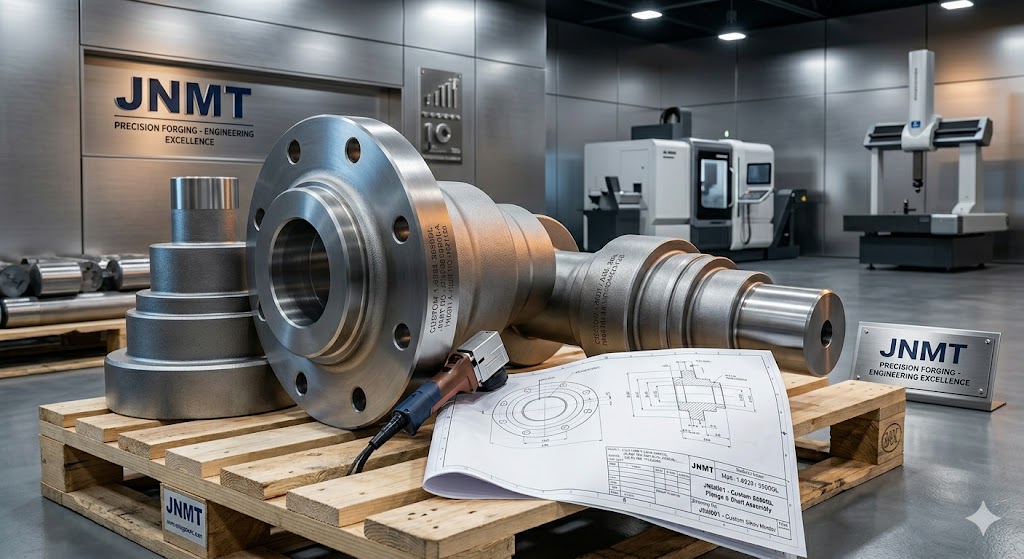
We support full OEM custom manufacturing of 1.8928 (S690QL) forged steel parts in a wide range of shapes and specifications, strictly manufactured to client drawings and international standards to meet diverse project requirements:
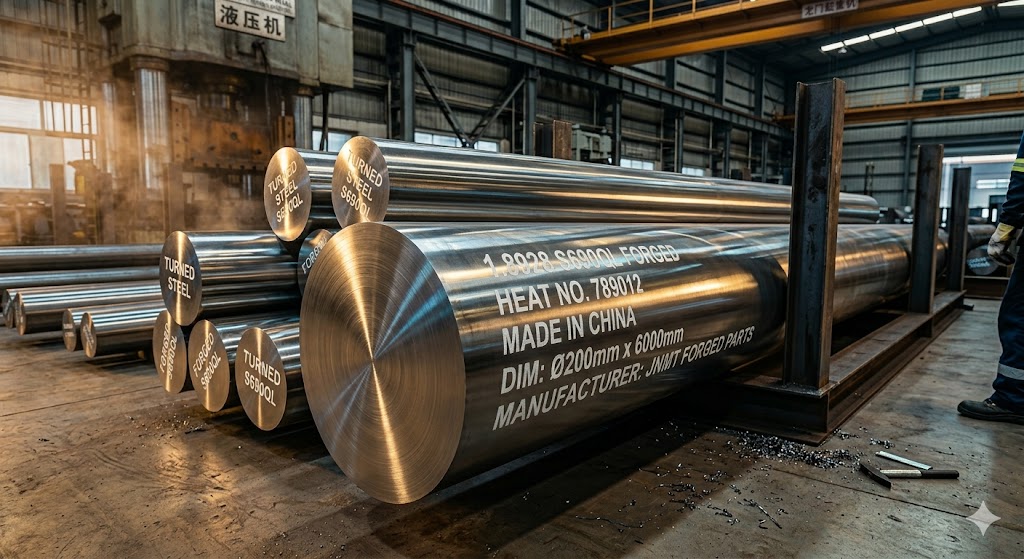
1.8928 (S690QL) forged round bars, square bars, flat bars, rectangular bars, solid rods, step shafts, gear shafts and custom forged shafts with precise dimensional control.
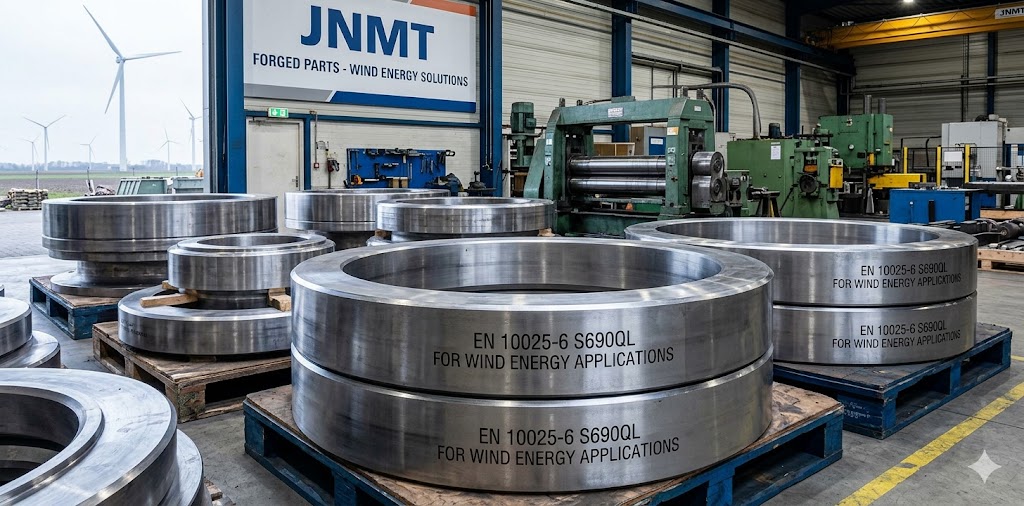
S690QL seamless rolled rings, gear rings, slewing bearing rings, contoured rolled rings and custom forging rings for bearing, flange and heavy structural applications, with strict tolerance compliance.
1.8928 forged steel hubs, housings, shells, sleeves, bushes, cases, hollow bars and custom hollow components for heavy equipment and pressure vessel applications.
S690QL forged steel discs, disks, blocks, plates and custom forged blanks for pressure-bearing, structural and machining applications.
1.8928 forged steel pipes, tubings, piping shells, casings, case barrels and custom tubular components for oil & gas and pipeline projects.
Our production limits for 1.8928 (S690QL) forging parts (fully compliant with global heavy project requirements):
Electric Arc Furnace + vacuum refining for ultra-clean S690QL billets
80MN hydraulic press forging or CNC ring rolling per drawing
Controlled quenching & tempering to achieve ≥690MPa yield strength
Tight tolerance machining per client 2D/3D drawings
100% UT/MPI NDT + chemical & mechanical test report
Learn more about our production capabilities from our advanced forging equipment page.
Our 1.8928 (S690QL) forged steel raw material is produced via a three-stage refining route: Basic Electric Arc Furnace (EAF) primary melting → AOD (Argon Oxygen Decarburization) or VOD (Vacuum Oxygen Decarburization) secondary refining → optional Electroslag Remelting (ESR) for the most demanding applications requiring ultra-low inclusion content. This is not standard for all steel suppliers — many traders source commercial-quality billets where secondary refining is skipped.
For 1.8928 S690QL, the reason this process discipline matters is rooted in the steel's chemistry: with C ≤0.20%, the quenching response and martensite formation during heat treatment depend critically on homogeneous carbon distribution. Non-metallic inclusions from poorly refined heats act as stress concentration sites that dramatically reduce low-temperature impact toughness — precisely the property that makes S690QL suitable for −20°C service environments. Our AOD/VOD process reduces total oxygen to below 20 ppm and sulfur below 0.005%, producing a far cleaner matrix than commercially available billets, which translates directly to consistent Charpy KV ≥20J at −20°C in finished forgings.
One critical parameter that rarely appears on other suppliers' product pages — but which our engineering clients frequently ask about — is the forging ratio. For all 1.8928 S690QL components we manufacture, we maintain a minimum forging ratio of 3:1 for open die forged bars and shafts, and a minimum 2.5:1 for seamless rolled rings. This is not arbitrary: a forging ratio below 2:1 for this grade fails to break down the dendritic cast structure of the original ingot, leaving residual segregation bands that appear as anisotropic mechanical properties in the finished part — the transverse impact values may be 25–40% lower than longitudinal values. Our controlled forging ratio ensures full microstructural homogeneity, so you receive isotropic mechanical properties regardless of test direction.
All our 1.8928 (S690QL) forging parts are manufactured, heat treated, tested, and certified in full compliance with the following international standards. Unlike many suppliers who claim compliance without specifying the edition year, we operate to the current controlling revisions:
| Standard | Scope | Our Compliance Level |
|---|---|---|
| EN 10025-6: 2004 | Hot rolled flat products of high yield strength structural steels, quenched & tempered condition — the primary governing standard for S690QL plate material chemistry and properties | Full compliance for chemical composition and mechanical property requirements adopted for forgings |
| EN 10137-2: 1996 | Plates and wide flats in high yield strength Q&T structural steels — delivery conditions for Q&T grades | Full compliance for heat treatment delivery condition |
| EN 10228-4 / ASTM A388 | Non-destructive testing of steel forgings — ultrasonic testing requirements | 100% UT per Level S3/E3 or customer specification |
| EN 10204: 2004 (3.1 / 3.2) | Metallic products — types of inspection documents (Mill Test Certificate requirements) | EN 10204 3.1 standard; 3.2 with TPI on request |
| ASTM A788 | General requirements for steel forgings (ASTM) | Can manufacture per ASTM A788 chemical and mechanical requirements; ASME Code-stamped products require project-specific qualification — contact us for details |
1.8928 (S690QL) is a premium high-strength, low-alloy (HSLA) structural steel in quenched and tempered condition. What sets it apart from conventional structural steels (such as S355 or S460) is not merely higher strength, but an engineered combination of ultra-high yield strength, low-temperature impact toughness, and controlled weldability achieved through a precisely managed alloy system and Q&T heat treatment cycle. It is the best choice material for heavy-duty applications where weight reduction is structurally important, such as offshore wind turbine foundations, crane superstructures, and armored vehicle components.
The "QL" suffix in S690QL is directly significant: Q = Quenched & Tempered (heat treatment condition); L = Low-temperature toughness requirement (longitudinal Charpy KV ≥20J at −20°C). Following are the metallurgical mechanism works:
This metallurgical understanding is important for forging engineers, because the Q&T cycle must be applied to the finished forging, not the billet. Re-forging after quench and temper destroys the fine-grained heat-treated microstructure. All our 1.8928 S690QL forgings are forged to near-net shape first, then Q&T heat treated as finished or semi-finished components.
| Element | Max Limit | Role in S690QL Performance |
|---|---|---|
| Carbon (C) | 0.20% | Primary hardness/strength contributor; low C limit preserves weldability |
| Silicon (Si) | 0.80% | Deoxidizer; strengthens ferrite; too high reduces toughness |
| Manganese (Mn) | 1.70% | Enhances hardenability and strength; solid solution strengthener |
| Phosphorus (P) | 0.020% | Strict limit — P segregates to grain boundaries and severely embrittles steel at low temperature |
| Sulfur (S) | 0.010% | Strict limit — S forms MnS inclusions that act as fracture initiation sites in impact loading |
| Nitrogen (N) | 0.015% | Controlled to prevent strain-age embrittlement; Al or Nb fixes free N as nitrides |
| Boron (B) | 0.005% | Micro-alloying element; dramatically improves hardenability at trace levels (0.001–0.003%) |
| Chromium (Cr) | 1.50% | Improves hardenability and temper resistance; promotes fine martensite |
| Molybdenum (Mo) | 0.70% | Prevents temper embrittlement; retains strength at elevated temperatures |
| Nickel (Ni) | 2.00% | Critical for low-temperature toughness; refines prior-austenite grain size |
| Vanadium (V) | 0.12% | Precipitation hardening via fine V carbides/nitrides; grain refinement |
| Niobium (Nb) | 0.06% | Grain boundary pinning (prevents austenite grain coarsening during heating) |
| Titanium (Ti) | 0.05% | Fixes nitrogen as TiN; maintains fine grain structure |
| Copper (Cu) | 0.50% | Precipitation hardening; atmospheric corrosion resistance |
| Zirconium (Zr) | 0.15% | Grain refinement; sulfide shape control |
| Carbon Equivalent (CEV) | 0.83% | Weldability index — see Welding Guide section below |
Most suppliers only show properties for the thinnest section (3–50mm). The following comprehensive table covers the full thickness range — critical for heavy forgings and large-diameter rings where section thickness significantly affects quench depth and resulting mechanical properties:
| Nominal Thickness (mm) | Min. Yield Strength ReH (MPa) | Tensile Strength Rm (MPa) | Min. Elongation A (%) | Impact KV @ 0°C (J) | Impact KV @ −20°C (J) |
|---|---|---|---|---|---|
| 3 – 50 | 690 | 770 – 940 | 14% | ≥50 | ≥20 |
| 50 – 100 | 650 | 760 – 930 | 14% | ≥50 | ≥20 |
| 100 – 150 | 630 | 710 – 900 | 13% | ≥40 | ≥20 |
| 150 – 200 | 590 | 690 – 890 | 13% | ≥40 | ≥20 |
| >200 (consult)* | ≥550 | 680 – 880 | 12% | ≥30 | ≥20 |
* For forgings exceeding 200mm section thickness, mechanical properties are agreed between manufacturer and buyer per individual project specification. Jiangsu Liangyi has experience supplying 1.8928 forgings up to 500mm equivalent section with enhanced heat treatment protocols — contact us for project-specific consultation.
| Physical Property | Value | Notes |
|---|---|---|
| Density | ~7,850 kg/m³ | Same as structural steel; strength gain is not from density change |
| Elastic Modulus (E) | ~210 GPa | Stiffness is equivalent to mild steel; only yield strength is elevated |
| Thermal Conductivity | ~37 W/m·K (at 100°C) | Lower than carbon steel; relevant for welding heat dissipation calculations |
| Coefficient of Thermal Expansion | ~12 × 10⁻⁶ /°C | Similar to structural steel; minimal distortion during controlled Q&T |
| Hardness (Q&T condition) | ~270–320 HBW | Equivalent to 28–34 HRC; higher hardness = better wear resistance |
| Fatigue Limit (approx.) | ~350–400 MPa | Estimated at R = −1; surface quality and notch geometry are critical factors |
The following comparison helps engineers select the right high-strength structural steel grade for their forged components:
| Property / Grade | S690QL (1.8928) | S690Q (1.8927) | S690QL1 (1.8988) | S960QL (1.8933) |
|---|---|---|---|---|
| Standard | EN 10025-6 | EN 10025-6 | EN 10025-6 | EN 10025-6 |
| Min. Yield Strength | 690 MPa | 690 MPa | 690 MPa | 960 MPa |
| Tensile Strength | 770–940 MPa | 770–940 MPa | 770–940 MPa | 980–1150 MPa |
| Impact Test Temperature | −20°C | +20°C only | −40°C | −20°C |
| Min. Impact Energy (KV) | 20J @ −20°C | 30J @ +20°C | 27J @ −40°C | 27J @ −20°C |
| Best For | Wind energy, offshore, general HSLA | Mild climate structural use | Arctic / extreme cold regions | Ultra-high strength, lightweight |
| Weldability | Good (CEV ≤0.83) | Good | Good | Moderate (requires preheat) |
| Forging Available | ✅ Yes | ✅ Yes | ✅ Yes | ✅ Yes |
* All grades available as custom open die forgings and seamless rolled rings. Contact us for grade-specific technical consultation and free quotation.
Engineers procuring 1.8928 S690QL structural components frequently face this decision. The following is our manufacturer's perspective based on 25 years of open die forging experience, working alongside clients who have specified or switched from plate and casting alternatives, and observing the technical outcomes.
| Comparison Factor | 1.8928 S690QL Forging | 1.8928 S690QL Plate (Rolled) | High-Strength Cast Steel |
|---|---|---|---|
| Microstructure | Fully wrought, fine equiaxed grain, no porosity or segregation | Wrought in rolling direction; some residual anisotropy | Cast dendritic structure; inherent porosity and shrinkage cavities |
| Mechanical Properties | Isotropic in all test directions; highest impact toughness per mm² cross-section | Strong in longitudinal direction; Z-direction (through-thickness) often weaker | Generally lower yield strength and Charpy impact values; requires PWHT |
| Fatigue Performance | Superior — no internal defects; grain flow aligned to part geometry | Good for flat plate structures; reduced fatigue life at flame-cut edges | Significantly lower — internal pores act as fatigue crack initiation sites |
| Custom Geometry | Rings, bars, shafts, discs, flanges — virtually unlimited custom shapes | Limited to flat or simple bent shapes; wasteful for complex parts | Good for complex shapes, but poor surface quality and dimensional precision |
| Dimensional Tolerance | ±0.5mm (machined); ±2mm (as-forged near-net shape) | Plate thickness ±0.3mm; cut profiles require secondary machining | Poor as-cast tolerance; typically ±3–5mm; extensive machining required |
| NDT Acceptability | Meets EN 10228-4 UT Level S3/E3; zero internal defect tolerance achievable | UT per EN 10160 on flat plate; acceptable for most structural use | Porosity and shrinkage inevitable; repair welding often needed |
| Typical Lead Time | 15–30 working days (custom orders) | Stock or 1–2 weeks if standard dimensions | 4–10 weeks including pattern and mold preparation |
| Best Application | Wind turbine flanges, gear rings, crane pivot shafts, valve bodies, offshore pile connectors | Structural beams, crane booms (straight sections), bridge decks | Complex housings where near-net shape casting is acceptable with lower performance requirement |
Our recommendation: For any 1.8928 S690QL component that is cyclically loaded, operates at temperatures below 0°C, or requires full traceability and UT certification, forging is the technically correct choice. Plate is acceptable for flat structural applications. Casting should not be used for S690QL performance requirements because no casting process reliably achieves 690MPa yield strength with ≥20J at −20°C in a certified, reproducible manner.
Welding of 1.8928 S690QL forgings is a topic where we receive frequent technical inquiries from our engineering clients, because poor welding practice is one of the most common causes of field failures in high-strength structural steel assemblies. The following guidance is based on our production and technical experience — it does not replace a formal welding procedure specification (WPS), which should always be developed and qualified per EN ISO 15614-1 or equivalent.
The Carbon Equivalent Value (CEV) for S690QL is specified at ≤0.83% (calculated per the IIW formula: CEV = C + Mn/6 + (Cr+Mo+V)/5 + (Ni+Cu)/15). A CEV of 0.83 is high by conventional structural steel standards (S355 has CEV ≈0.43), which means S690QL has a significant risk of hydrogen-induced cold cracking (HICC) in the heat-affected zone (HAZ) if preheat and interpass temperature controls are not rigorously applied. This is not a material defect — it is the inherent price of high strength — and it is fully manageable with correct welding procedure.
| Plate/Forging Thickness | Min. Preheat Temperature | Max. Interpass Temperature | Notes |
|---|---|---|---|
| <20mm | 50°C | 220°C | Measure at 75mm from joint; maintain preheat throughout |
| 20 – 40mm | 100°C | 220°C | Critical — insufficient preheat is the #1 cause of HAZ cracking |
| 40 – 75mm | 150°C | 220°C | Electric resistance or flame heating; infrared thermometer verification required |
| >75mm | 175–200°C | 220°C | Slow cooling after welding; hydrogen bakeout at 200–250°C for 2h recommended |
To guarantee 100% qualified products for every order and full compliance with project requirements, all our 1.8928 (S690QL) forged steel parts are given strict, stage-by-stage inspection and testing before delivery. Our quality system is not a final checkpoint — it is integrated into every step of production.
Every 1.8928 S690QL forged part we deliver carries a unique heat number and part identification marking, ensuring full traceability from the original steel melt through to delivery. The complete quality dossier provided with each shipment includes: original billet/ingot mill test certificate → forging record (forging ratio, temperatures) → heat treatment chart → chemical analysis report → mechanical test report → NDT report → dimensional inspection report → EN 10204 3.1 (or 3.2) Mill Test Certificate. This level of documentation meets the requirements of oil & gas, energy, and heavy industrial sectors — we provide it as standard for all custom forgings regardless of application.
Our 1.8928 S690QL forged parts are deployed in heavy industrial projects across Europe, the Middle East, Australia, North America, and Southeast Asia. The following analyses document the specific mechanical demands that make S690QL the correct material selection, and the exact forged components we supply for each sector.
1.8928 (S690QL) is widely recognized as a material of choice wherever maximum structural performance at minimum weight is required. At equivalent load-carrying capacity, an S690QL structural member can be 35–48% lighter than the equivalent S355 section — a decisive advantage in mobile equipment, heavy lifting machinery, and special-purpose vehicles where every kilogram of structural weight saved directly increases useful payload or operational range.
Specific 1.8928 S690QL forged components we supply for this sector: vehicle chassis cross-members and longitudinal beams (open die forged, up to 6m length); heavy bridge panel connection forgings (precision machined to ±0.3mm); heavy vehicle suspension component forgings (stepped shafts, trunnion housings). All forgings supplied with EN 10204 3.1 MTC as standard; 3.2 with TPI witness available on request.
Wind energy is the single largest and fastest-growing application for S690QL forgings globally, driven by the shift to larger turbines (10–15MW class offshore). A modern 12MW offshore wind turbine tower flange may have an OD exceeding 7 meters, a wall thickness of 100–150mm, and a weight of 10–20 tonnes — achievable only as a seamless rolled ring forging. Using S690QL over S355J2 allows the designer to reduce flange thickness by approximately 35–40%, directly cutting sea transportation cost, crane capacity requirements during offshore installation, and fatigue stress concentration at the flange-to-tower weld interface.
We produce S690QL seamless rolled rings for wind energy tower flanges (OD up to 3,000mm, wall 50–300mm, height up to 600mm) with post-rolling Q&T, 100% UT, and EN 10204 3.1 MTC. We also supply main shaft forgings (2–15 tonnes), yaw and pitch bearing ring forgings, and nacelle frame structural forgings for onshore and offshore wind projects globally.
Crawler cranes (500–3000 tonne class), hydraulic excavators (>100 tonne), and large-scale earth-moving equipment apply complex dynamic loading to structural and rotating components — combined cyclic loading, shock loading (rock/ground impact), and vibration — demanding materials that maintain yield strength and fatigue resistance over 15,000–25,000 operating hours. Where a crane boom pivot pin in S355 must be designed to Ø180mm, the same pin in S690QL can be Ø130mm — a 28% diameter reduction cutting component weight by 48% and reducing inertial loads on the slewing ring proportionally.
Components we supply: crane boom foot pins and luffer pins (Ø80–400mm, up to 3m length); hydraulic cylinder end forgings (flanged rod eyes, clevis brackets); excavator arm pivot bushings (seamless hollow forgings); bulldozer push plate hinge forgings; lattice boom chord connection plate forgings. Lead time: 15–25 working days from approved drawing.
The oil and gas industry's requirements for 1.8928 S690QL are shaped by two converging pressures: increasing operating pressure envelopes (wellhead equipment at 15,000–20,000 psi is routine for deep-water fields), and low-temperature service environments where Charpy KV ≥20J at −20°C is a minimum operational requirement — not a safety margin — for North Sea, Norwegian Sea, Caspian Sea, and Siberian field conditions. Thinner-wall S690QL forgings reduce material cost, weld volume, and RT inspection time compared to lower-grade alternatives at equivalent pressure rating.
Typical forged components: valve body forgings (gate, globe, ball; 6"–24"; pressure class 900–2500); subsea wellhead housing forgings (up to 15,000 psi rated); pipeline pig launcher/receiver end closures; high-pressure vessel shell forgings (ring-rolled shells, ID 300–2000mm, wall 30–200mm). For sour service (H₂S-containing environments), we can discuss NACE MR0175 / ISO 15156 material requirements and coordinate HIC resistance testing per NACE TM0284 through accredited third-party laboratories — please specify this requirement at the inquiry stage.
Mining haul trucks (200–400 tonne payload class) and SPMT self-propelled modular transporters use 1.8928 S690QL forgings to maximize payload-to-structural-weight ratio. A mining haul truck frame in S690QL versus S355 saves approximately 3–5% of gross vehicle weight in structural steel. At 400 tonne GVW, this translates to 12–20 tonnes of additional ore per trip — a significant operational economics benefit over a 20-year mine life.
Components we supply: dump truck body hinge pin assemblies (Ø100–280mm); SPMT axle beam forgings (stepped rectangular, up to 8m length); trailer king-pin forgings; heavy vehicle suspension knuckle forgings. Typical delivery: 20–28 working days from approved drawing, including Q&T and full inspection.
In long-span bridge design — cable-stayed, suspension, and arch bridges with main span >300m — grade selection at key connection nodes determines not only material quantity but constructability of the joint. A connection in S355 requiring 180mm throat thickness in the gusset plate can be designed to 120mm in S690QL, making the joint compact enough for shop fabrication and single-lift erection rather than field-welding in challenging access conditions. This "compact joint" principle is why S690QL forgings are increasingly specified by European bridge engineering firms for cable anchor hardware and bearing plates.
We supply: bridge bearing pin forgings (manufactured to dimensional and material requirements suitable for EN 1337 bridge bearing applications); cable anchor socket forgings (precision machined internal threads to ACME or metric specification); structural connection plate forgings (up to 3m length, 200mm thickness); expansion joint housing forgings. Bridge hardware supplied with EN 10204 3.2 by European-recognized third-party inspection (TPI) agencies such as Bureau Veritas, Lloyd's Register, or SGS.
View our global project cases from our project reference page.
Based on 25+ years of supplying 1.8928 S690QL forgings to international buyers in Europe, Australia, the Middle East, and North America, we have compiled the following procurement guidance. This section addresses the most common challenges and mistakes our clients have encountered when sourcing high-strength steel forgings from China — knowledge we share openly because correct procurement decisions lead to better project outcomes for both parties.
All 1.8928 S690QL forged parts are packed for international sea freight export in the following standard:
Typical sea freight transit times: China to Germany ~28–35 days; China to USA East Coast ~28–32 days; China to Australia ~18–22 days; China to UAE ~14–18 days. We work with established freight forwarders and can arrange door-to-port or CIF delivery per client's Incoterms preference (EXW, FOB, CFR, CIF, DAP).
1.8928 (also known as S690QL) is a high-strength low-alloy (HSLA) structural steel in quenched and tempered condition, and it meets EN 10025-6 standard. It has a minimum yield strength of 690MPa, excellent low-temperature toughness, and good weldability, so that it is the best choice material for heavy-duty applications that need high strength and weight reduction.
The main difference is the low-temperature toughness requirement: S690QL is required to meet impact energy standards at -20°C, while S690Q only requires impact testing at +20°C. This makes S690QL (1.8928) suitable for low-temperature environments, such as offshore wind energy, cold-region construction, and subsea oil & gas projects.
Yes, all our 1.8928 S690QL forged parts are supplied with EN 10204 3.1 Mill Test Certificate as standard, and we can also provide EN 10204 3.2 Certificate with third-party inspection per client requirements.
Absolutely. We specialize in OEM custom open die forging and seamless ring rolling, and can manufacture 1.8928 S690QL forged parts strictly according to your 2D/3D drawings, material specifications, and heat treatment requirements. Our engineering team will provide full technical support from drawing review to final production.
For 1.8928 S690QL forged parts, we can produce components with a maximum outer diameter of 3 meters, maximum length of 12 meters, and maximum single piece weight of 25 tons, with a minimum order weight of 30KG.
We supply a wide range of forging steel materials, including carbon steel, alloy steel, stainless steel, duplex steel, nickel alloy, tool & die steel, compliant with ASTM, DIN, EN, JIS, API standards. You can visit our Materials page to view the full material list.
Yes — this is an important engineering concern specific to S690QL that many engineers overlook. The 690MPa minimum yield strength of 1.8928 S690QL is achieved by the quenching and tempering heat treatment cycle, with tempering typically performed at 580–650°C. If post-weld stress-relief PWHT is applied at temperatures above 580°C, the thermal exposure can over-temper the martensite in the forging's heat-affected zone, reducing yield strength below the 690MPa minimum required by EN 10025-6. For most structural welding applications, PWHT is not necessary if correct preheat and low-hydrogen welding procedures are followed. Where PWHT is contractually required (e.g., certain pressure vessel codes), the temperature should be set below the original tempering temperature (typically <550°C) and the holding time kept to the minimum necessary. We strongly recommend consulting our technical team before specifying PWHT for S690QL weldments.
The main differences are microstructure, mechanical property direction, and application geometry. 1.8928 S690QL plate is rolled in one direction — it has its highest strength and ductility in the rolling direction (longitudinal), with lower through-thickness (Z-direction) properties. This makes plate suitable for flat structural members where the primary stress is longitudinal, but problematic for components loaded in multiple directions or requiring complex geometry. 1.8928 S690QL forgings produced with adequate forging ratio (≥3:1 for bars; ≥2.5:1 for rings) have a fully wrought, equiaxed grain matrix — they are essentially isotropic, with consistent properties in all directions. Additionally, forgings can be produced in round, ring, shaft, disc, and custom geometries that are physically impossible to produce from plate without excessive waste and machining cost. For cylindrical components (flanges, rings, shafts, hubs), forging is always the technically superior and economically more efficient manufacturing route.
The raw material cost of 1.8928 S690QL is typically 15–35% higher than equivalent-weight S355 or S420 structural steel forgings, depending on current market conditions and alloying element prices (particularly Ni, Mo, and V). However, total project economics usually favor S690QL when the full cost picture is considered: because S690QL is approximately 1.9× stronger than S355, the finished forging can be 30–50% smaller and lighter for the same structural duty — reducing material cost, machining time, coating area, transportation weight, and installation crane capacity requirements. In our clients' experience across wind energy tower flange projects, the switch from S355 to S690QL flanges resulted in a net project cost saving of 8–18% when all downstream factors were included. We are happy to provide a comparative technical and commercial analysis for your specific component if you share the loading requirements and current design dimensions.
Yes. For applications requiring ultra-high cleanliness — including specialty energy, precision industrial, high-performance structural, and demanding engineering components — we can arrange 1.8928 S690QL (or equivalent composition) forging stock via Electroslag Remelting (ESR) through our qualified supply chain. ESR produces an exceptionally clean, homogeneous, porosity-free ingot by melting a conventionally cast electrode through a liquid slag pool, which acts as a filter for non-metallic inclusions. ESR S690QL forgings typically exhibit 30–50% improved Charpy impact values compared to EAF-only material at the same test temperature, and significantly reduced anisotropy between longitudinal and transverse directions. ESR is not standard — it increases lead time (typically +7–14 days) and cost (+20–40% on material) — but for the right application, it is the correct technical choice. Please contact our technical team with your specific cleanliness and isotropy requirements for a formal assessment.
Jiangsu Liangyi Co.,Limited is committed to delivering high-quality, custom 1.8928 (S690QL) forging parts that meet your exact project specifications and international standards. Welcome to contact us with your drawings, material requirements and quantity for a detailed free quotation, and our professional engineering team will support you with full-cycle forging solutions.
📧 Inquiry Email: sales@jnmtforgedparts.com
📞 Phone/WhatsApp: +86-13585067993
🌐 Official Website: https://www.jnmtforgedparts.com
📍 Factory Address: Chengchang Industry Park, Jiangyin City, Jiangsu Province, China 214400
📄 Product Page Permanent Link: https://www.jnmtforgedparts.com/1.8928-s690ql-forged-steel-parts.html
🗺️ Sitemap
Page last updated: | Jiangsu Liangyi Co.,Limited ©