1.7735 (14CrMoV6-9) Forging Parts ISO 9001:2015 Certified
About 1.7735 (14CrMoV6-9) Alloy Steel — EN Standard, Metallurgy & Designation Explained
1.7735, also designated 14CrMoV6-9, is an EN-standard quenched-and-tempered chromium-molybdenum-vanadium (Cr-Mo-V) alloy steel engineered specifically for components that must carry high mechanical loads at elevated service temperatures — typically up to 550°C on a continuous basis. It belongs to the family of heat-resistant alloy steels governed by EN 10222-2 (steel forgings for pressure purposes with specified elevated-temperature properties) and is one of the most demanding grades we forge at Jiangsu Liangyi Co.,Limited.
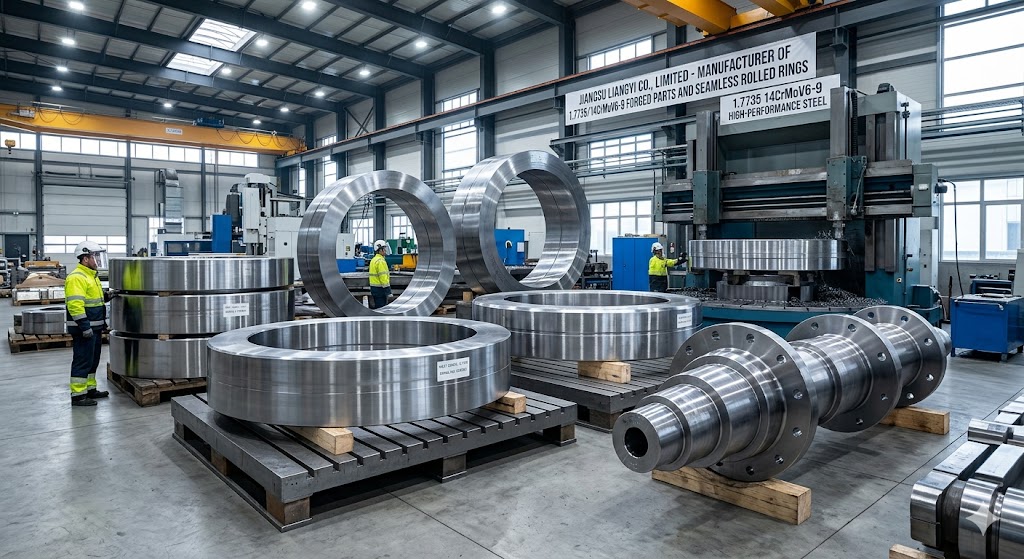
Established in , Jiangsu Liangyi Co.,Limited is a professional China-based, ISO 9001:2015 certified manufacturer of 1.7735 (14CrMoV6-9) open die forging parts and seamless rolled steel forged rings. With an 80,000 ㎡ factory, 40 million USD in fixed assets, and over 29 years of focused industry experience, we provide factory-direct supply of high-quality 1.7735 forging parts to customers from more than 50 countries across Europe, North America, Middle East, Australia, and Asia.
How to Read the 14CrMoV6-9 Designation
The EN steel designation system encodes the alloy chemistry directly into the name. In 14CrMoV6-9, the number "14" represents the nominal carbon content × 100, meaning approximately 0.14% C. "CrMoV" identifies the principal alloying elements — chromium, molybdenum, and vanadium. The trailing figures "6-9" express the Cr content multiplied by 4 (giving ~1.5% Cr) and Mo content multiplied by 10 (giving ~0.90% Mo). Vanadium, while present at 0.20–0.30%, is indicated only by the letter "V" rather than a numeric value in this designation scheme. This naming convention, defined by EN 10027-1, allows engineers worldwide to immediately identify the alloy class and approximate composition without consulting a data sheet.
The Role of Each Alloying Element in 1.7735
Understanding why each element is present helps engineers make better selection decisions and helps purchasing teams verify that supplied material genuinely meets specification. In our foundry experience over nearly three decades with Cr-Mo-V grades, here is what each element contributes in 14CrMoV6-9:
- Carbon (C 0.11–0.17%): Provides the base matrix strength through solid-solution and precipitation hardening after quenching and tempering. The relatively narrow carbon band is intentional — too little and the grade cannot reach 980 MPa tensile strength; too much and weldability, toughness, and creep ductility all suffer. At 0.11–0.17%, carbon is kept low enough to allow welding without preheat in most thicknesses, while still enabling the desired hardness range of 291–350 HB after heat treatment.
- Chromium (Cr 1.25–1.5%): Serves two distinct purposes. First, it dramatically improves hardenability, meaning the steel can be through-hardened in large cross-sections (up to ~300 mm diameter) without the core remaining soft. Second, Cr forms stable chromium carbides (Cr₇C₃, Cr₂₃C₆) that resist dissolution even at 500–550°C, which slows the coarsening of the microstructure and underpins creep resistance. Without Cr at this level, the grade would suffer significant mechanical property degradation after prolonged exposure above 450°C.
- Molybdenum (Mo 0.80–1.0%): Molybdenum has one of the highest solid-solution strengthening efficiencies among alloying elements in ferritic/bainitic steels. Dissolved Mo atoms inhibit dislocation climb — the primary deformation mechanism in creep — by reducing iron self-diffusion rates. Mo also raises the secondary hardening temperature, ensuring that tempering at 620–680°C does not excessively soften the matrix. Among the three alloying elements (Cr, Mo, V), Mo contributes most to the long-term creep rupture strength of 14CrMoV6-9.
- Vanadium (V 0.20–0.30%): Despite its small quantity, vanadium has a disproportionate effect on elevated-temperature properties. During tempering and high-temperature service, V reacts with C and N to precipitate extremely fine vanadium carbide/nitride (VC/VN) particles — typically 5–30 nm in diameter — distributed uniformly within the tempered martensite matrix. These nano-scale precipitates act as powerful obstacles to dislocation motion at temperatures up to 550°C, providing the secondary hardening response and the creep resistance that distinguish 14CrMoV6-9 from simpler Cr-Mo grades like 13CrMo4-5 (1.7335). Vanadium also refines the austenite grain size during normalizing and forging, which further improves toughness.
- Manganese (Mn 0.8–1.0%): Deoxidizes the melt, improves hardenability, and combines with sulfur to form MnS inclusions that prevent hot shortness during forging. Mn is held below 1.0% to avoid excessive hardenability, which could promote cold cracking during post-forge cooling in heavy sections.
- Phosphorus & Sulfur (P ≤0.02%, S ≤0.015%): Both are controlled to very low limits because P segregates to grain boundaries and embrittles the steel during long-term service at 400–550°C (temper embrittlement), while S promotes elongated MnS inclusions that reduce transverse toughness in forgings. Our steelmaking practice routinely achieves P <0.015% and S <0.008% through ladle refining.
Microstructure After Full Heat Treatment
After the standard quench-and-temper cycle (quenching from ~920°C + tempering at 640–680°C), 1.7735 develops a tempered martensitic/lower bainitic microstructure. The high-dislocation-density martensite laths are stabilized by a fine dispersion of Cr-Mo carbides and V-bearing nano-precipitates distributed along lath boundaries and within laths. This microstructure is key to the combination of high strength (Rm 980–1180 MPa), good toughness (elongation ≥12%), and exceptional resistance to creep and thermal fatigue that makes 14CrMoV6-9 the preferred choice for components operating in cyclic high-temperature environments like steam turbines and rocket propulsion systems.
Available 1.7735 (14CrMoV6-9) Forged Product Forms & Specifications
We produce custom 1.7735 (14CrMoV6-9) forging components across the full range of geometries, from 30 KGS to 30,000 KGS single piece weight, using our fleet of 1,000-ton to 8,000-ton hydraulic presses and ring rolling mills. All product forms listed below are available in both rough-forged (black) condition and fully machined to your drawing dimensions.
Forged Bars & Rods
14CrMoV6-9 forged steel round bars, square bars, flat bars, and rectangular bars. Round bars are available up to ~1,000 mm diameter; flat bars up to 500 × 2,000 mm cross-section. Used as raw material for further machining of shafts, pins, valve bodies, and structural inserts. All bars are produced with a minimum forging reduction ratio of 3:1 from the ingot, ensuring full closure of central porosity and a uniform, refined grain structure through the entire cross-section.
Seamless Rolled Rings
1.7735 seamless rolled forged rings with OD up to 3,500 mm, wall thickness from 50 mm, and height up to 600 mm. Contoured (profiled) rings are available for near-net-shape applications that minimize downstream machining cost. Seamless rings provide superior fiber orientation compared to plate-cut blanks, resulting in higher hoop strength and fatigue life — critical for turbine casings, bearing races, and gear ring blanks operating under cyclic loading.
Forged Shafts & Gear Components
14CrMoV6-9 forged steel stepped shafts, gear shafts, pinion shafts, spindles, and gear wheel blanks. Shaft diameters from 50 mm to 800 mm, lengths up to 8,000 mm. We forge shafts as a single piece without welds, preserving the continuous grain flow that gives forgings their fatigue advantage over machined bar or fabricated assemblies. Gear blanks are produced with a forging reduction ratio ≥4:1 from billet to ensure sound internal quality per aerospace and defense requirements.
Forged Housings, Sleeves & Casings
1.7735 forged steel hubs, housings, shells, sleeves, bushes, casings, hollow bars, thick-wall pipes, and pressure vessel bodies. Hollow forgings are pierced on our mandrel press to produce a seamless bore, avoiding the welded seam that represents a structural weak point in high-pressure applications. Wall thicknesses from 30 mm to 350 mm are achievable; bore diameters from 80 mm to 1,200 mm.
Forged Discs, Plates & Blocks
14CrMoV6-9 forged steel discs (up to 3,000 mm OD, 400 mm thick), rectangular blocks (up to 2,000 × 1,500 × 800 mm), and circular plates. Turbine discs and compressor discs are among our highest-volume 14CrMoV6-9 products, with ultrasonic testing (UT) performed to SEP 1921 Class C or better on request to verify internal soundness before delivery.
All our 1.7735 forged products can be fully machined and customized according to your drawings and technical specifications. Request a custom quote for your 14CrMoV6-9 forging project today →
Our 1.7735 (14CrMoV6-9) Forging Process — Step by Step
Forging 14CrMoV6-9 to specification requires precise temperature control at every stage. Because this grade contains Vanadium, which forms carbides that dissolve only above ~1,050°C, the homogenization soak time and forging temperature window are tighter than for plain Cr-Mo steels. Below is our documented production sequence for 1.7735 open die forgings and seamless rolled rings:
Raw Material Receiving & Chemical Verification
We procure 1.7735 ingots or billets from certified steelmakers with EN 10204 3.1 heat certificates. On arrival, our laboratory performs optical emission spectrometry (OES) to independently verify the chemistry of every heat — including trace elements like P, S, Sn, As, Sb — against the EN standard limits. Heats that fail any element are rejected before entering production. This double-verification step provides the foundation for our EN 10204 3.1 MTC documentation and supports EN 10204 3.2 witness inspection when a third-party inspector is present on behalf of the customer.
Furnace Heating & Homogenization
Ingots and billets are charged into our gas-fired or electric resistance furnaces and heated to 1,150–1,220°C. The upper limit of 1,220°C is strictly controlled to prevent incipient melting at segregated zones and to avoid excessive grain coarsening, both of which degrade toughness. Soaking time is calculated based on section thickness — typically 1 hour per 100 mm of minimum cross-section — guaranteeing that V-bearing carbides fully dissolve into the austenite matrix before forging begins. A fully dissolved Vanadium population is essential; undissolved carbides at forging temperatures create hard, brittle clusters in the final part.
Open Die Forging or Ring Rolling
Forging commences between 1,080–1,180°C — the high austenite region where the steel is most workable and recrystallization is complete between passes. We maintain a minimum forging reduction ratio of 3:1 for standard structural applications and ≥4:1 for components destined for aerospace, nuclear power, and defense end-uses. This reduction ratio is not merely a best-practice number: at ratios below 3:1, central void closure is incomplete and the forged grain flow may not fully develop, both of which reduce fatigue life and impact toughness. If the billet cools below 900°C during forging, it is returned to the furnace for a reheat before work continues; forcing deformation below 900°C risks creating micro-cracks along austenite grain boundaries and produces a non-uniform, coarse-grained structure in the finished part.
Controlled Post-Forge Cooling & Intermediate Annealing
Immediately after the final forging pass, 14CrMoV6-9 parts are placed in insulated boxes or transferred to an annealing furnace for a controlled slow cool to below 300°C. This step prevents thermal shock cracking in heavy sections (above ~200 mm thickness) caused by the high hardenability of this grade — even moderate air cooling can generate sufficient quenching stress to initiate surface cracks. For parts >250 mm in smallest dimension, we perform a subcritical stress-relief anneal at 650–700°C immediately after forging, before the part is allowed to drop below 300°C, further reducing the residual stress level prior to rough machining and final heat treatment.
Rough Machining to Test Coupon Locations
After post-forge annealing, parts are rough machined to remove scale and to cut test coupon locations defined by the applicable EN standard or customer drawing. For 1.7735 pressure-purpose forgings per EN 10222-2, test coupons are typically taken from the thermally least-favorable location (e.g., mid-thickness of the heaviest section) to ensure that certified mechanical property values represent a conservative lower bound for the entire forging, not just the surface.
Final Heat Treatment (Quench + Temper)
See the dedicated Heat Treatment section below for full parameter details. After quenching and tempering, test coupons are machined and tested before the batch is cleared for delivery — this is the production hold point mandated by ISO 9001 and covered in our EN 10204 3.1 MTC documentation.
Non-Destructive Testing (NDT)
All 1.7735 forgings are given ultrasonic testing (UT) per ASTM A388 or EN 10228-3, and magnetic particle testing (MT) per ASTM E709 or EN 10228-1, to detect internal flaws (voids, cracks, inclusions) and surface/near-surface discontinuities respectively. For important aerospace or nuclear applications, we can additionally perform liquid penetrant testing (PT) and phased-array ultrasonic testing (PAUT) to tighter acceptance criteria on request.
Final Machining, Marking & Packing
We machine and finish fully machined parts to your dimensional tolerances on our CNC lathes, machining centers and boring mills. Each finished piece is stamped with its heat number, material designation and our manufacturer's mark. Export packing uses wooden cases or steel cradles with VCI (Volatile Corrosion Inhibitor) film for sea freight, ensuring parts arrive free from corrosion after 60+ day ocean transit.
View our advanced forging equipment to learn more about our full production capabilities.
Heat Treatment of 1.7735 (14CrMoV6-9) Forgings — Parameters & Practical Guidance
Heat treatment is arguably the most critical process in 1.7735 production. The same raw chemistry, improperly heat-treated, can produce a forging that fails inspection — or worse, one that passes dimensional and hardness checks but has severely degraded creep life. Below we detail the heat treatment routes we use at Jiangsu Liangyi and explain the engineering logic behind each step.
Preliminary Soft Annealing (Optional, for Machinability)
When customers order 1.7735 forgings in the annealed condition for in-house machining before final heat treatment, we perform a subcritical soft anneal at 680–720°C (below the Ac1 transformation temperature of approximately 750°C for this composition). Soaking at this temperature for 2–4 hours and cooling in the furnace at ≤20°C/h dissolves some of the as-forged carbides and reduces hardness to 180–220 HB — a range that allows efficient rough and semi-finish machining without excessive tool wear. Note that soft-annealed 1.7735 does not meet the tensile and creep requirements of EN 10222-2; the quench-and-temper cycle described below must be performed after machining.
Normalizing (for Large Sections and Grain Refinement)
For forgings with a maximum cross-section exceeding approximately 200 mm, we perform a preliminary normalizing heat treatment at 950–980°C before the final quench-and-temper. Normalizing dissolves coarse carbides formed during the post-forge slow cool, homogenizes the austenite, and refines the prior austenite grain size (PAGS) to ASTM 5–7. A finer PAGS not only improves room-temperature toughness (lower ductile-to-brittle transition temperature) but also reduces the scale of carbide networks that form along grain boundaries during cooling — networks that act as initiation sites for creep cavities in service. Normalizing is followed by air cooling or controlled forced-air cooling to room temperature before the quenching heat begins.
Quenching (Hardening)
The part is austenitized at 900–940°C, held for a time calculated as 1.5 minutes per mm of maximum cross-section (minimum 30 minutes), then quenched. The quench medium depends on section size and geometry:
- Oil quench (heated oil at 60–80°C): Used for sections up to ~250 mm diameter. Provides sufficient cooling rate to fully transform austenite to martensite while reducing the thermal gradient — and thus the distortion and quench-crack risk — compared to water quenching.
- Polymer quench (aqueous polymer solution, 10–15% concentration): Used for complex geometries and sections where oil gives excessive distortion. Polymer concentration is adjusted to control the cooling severity between water and oil.
- Water spray or water + air quench: Applied to very large sections (>400 mm) where the quench must reach the core before the surface starts transforming. Spray quenching is computer-controlled to prevent localized steam blanketing that would cause soft spots.
Immediately after the quench, parts are transferred to the tempering furnace within 30 minutes of reaching 200°C surface temperature. Holding fully martensitic 14CrMoV6-9 at room temperature for extended periods before tempering risks spontaneous quench cracking from residual stress, especially in complex geometries.
Tempering (Final Property Development)
Tempering is performed at 620–680°C — the range that drives precipitation of the fine Cr-Mo-V carbide dispersion responsible for the grade's elevated-temperature strength, while also allowing sufficient dislocation recovery to achieve the target toughness. The tempering temperature and time both matter:
- At 620°C, higher strength (~1,100–1,180 MPa Rm, 320–350 HB) with somewhat lower toughness — preferred for high-pressure pressure vessel components where strength is the primary design criterion.
- At 660–680°C, lower strength (~980–1,050 MPa Rm, 291–320 HB) but higher impact toughness — preferred for nuclear internals and defense components where damage tolerance under shock loading is prioritized.
Soak time at the target tempering temperature is at least 1 hour per 25 mm of maximum section, with a minimum total of 2 hours. Cooling after tempering is performed in still air for most sections; for very large parts (>500 mm), a controlled furnace cool to 400°C prevents re-embrittlement from too-rapid cooling through the 400–500°C range where phosphorus segregation to grain boundaries accelerates.
What We Provide in Our Heat Treatment Documentation
For every 1.7735 forging batch, our heat treatment certificate includes: actual furnace temperature vs. time graphs (not just set-point values), thermocouple calibration records, part load configuration diagram, quench medium temperature and agitation rate, and the signature of our quality manager. EN 10204 3.2 MTC — requiring a third-party inspection body co-signature — can be arranged on request; please specify your preferred inspection body when placing the order so we can confirm scheduling and availability.
1.7735 vs. Similar Grades — When to Choose 14CrMoV6-9
Buyers frequently ask how 1.7735 compares with other Cr-Mo or Cr-Mo-V grades available from our factory. The following table and explanations are drawn from our 29 years of application engineering experience with these materials:
| Material Number | Designation | Cr (%) | Mo (%) | V (%) | Max. Rm (MPa) | Continuous Temp. Limit | Key Advantage vs 1.7735 |
|---|---|---|---|---|---|---|---|
| 1.7735 | 14CrMoV6-9 ✔ | 1.25–1.5 | 0.80–1.0 | 0.20–0.30 | 1,180 | ~550°C | Best combination of strength, creep & weldability in this Cr-Mo-V class |
| 1.7335 | 13CrMo4-5 | 0.90–1.20 | 0.45–0.65 | — | 590 | ~480°C | Lower cost; easier welding; sufficient for moderate temp pressure piping |
| 1.7362 | 12CrMo9-10 | 2.0–2.5 | 0.9–1.1 | — | 780 | ~550°C | Better oxidation/corrosion resistance at similar temperatures; chosen where process gas is corrosive |
| 1.7715 | 14MoV6-3 | — | 0.50–0.70 | 0.22–0.30 | 490 | ~530°C | Very good weldability without preheat; lower strength requirement applications |
| 1.6580 | 30CrNiMo8 | 1.8–2.2 | 0.3–0.5 | — | 1,250 | <350°C | Higher room-temp strength; chosen for shaft/gear applications where temp is not the constraint |
Temperature limits are indicative continuous-service values based on creep and oxidation criteria. Always verify against the applicable pressure or structural design code (e.g., EN 13480, ASME B31.3, AD 2000). We can supply all grades listed above in forged form; contact us to discuss which grade best suits your application.
When 14CrMoV6-9 (1.7735) Is the Right Choice
From our application engineering experience, 1.7735 is the optimal selection when your component simultaneously requires: (1) high room-temperature strength >900 MPa, (2) continuous service above 480°C but at or below ~550°C, (3) good weldability without mandatory post-weld heat treatment in thinner sections, and (4) resistance to thermal fatigue under start/stop cycling. If your service temperature exceeds 580°C, you should evaluate 9–12% Cr martensitic grades (e.g., X10CrMoVNb9-1 / Grade P91) with us instead. If the primary concern is room-temperature mechanical properties below 350°C, 30CrNiMo8 or 34CrNiMo6 may offer higher strength at lower cost.
Key Applications & Industry Use Cases of 14CrMoV6-9 (1.7735) Forging Parts
1.7735 (14CrMoV6-9) forging parts are widely used for the manufacture of rocket engines, electric motor components, lightweight and durable aircraft structures, racing vehicle frames, and vital components in the nuclear and defense industries. Below are our verified industry use cases, drawn from components we have actually produced and delivered over 29 years:
Aerospace & Aviation Industry
Our 1.7735 (14CrMoV6-9) forged components are widely adopted in commercial and military aircraft manufacturing, including landing gear parts, engine mounting brackets, and lightweight airframe structural frames. The critical design driver in aerospace is the strength-to-weight ratio combined with fatigue life under variable amplitude loading — both of which favor the fine-grained, tempered martensitic microstructure that a properly processed 14CrMoV6-9 forging delivers. Our China factory has supplied 14CrMoV6-9 seamless rolled rings to aerospace-related manufacturers in Europe and Asia for turbine housing and structural applications. We actively support customers through first-article inspection (FAI), full material documentation packages, and production-lot traceability records to assist their own qualification and incoming inspection processes.
Nuclear Power & Defense Industry
As a professional China forging manufacturer, we supply 1.7735 forging parts for critical nuclear power plant components, including reactor pressure vessel (RPV) internals, control rod drive mechanism (CRDM) housings, and high-pressure valve bodies rated for pressurized water reactor (PWR) and boiling water reactor (BWR) environments. 14CrMoV6-9 is used in non-irradiated structural zones of the reactor circuit where elevated temperature and pressure cycling are the primary load cases; it is not specified for highly irradiated beltline regions where embrittlement under neutron flux governs the design. Our 14CrMoV6-9 forged steel sleeves, casings, and barrels are also widely used in defense-related applications, such as armored vehicle transmission components and structural housings, where high impact resistance and long-term structural stability are required.
Power Generation — Steam Turbines & Gas Turbines
Steam turbine discs, rotor forgings, and valve bodies represent the highest-volume application of 1.7735 in our factory. In a typical supercritical steam turbine, the intermediate-pressure (IP) and high-pressure (HP) rotor discs operate at steam inlet temperatures of 540–565°C, which falls within the design envelope of 14CrMoV6-9. The material's resistance to stress relaxation — the gradual reduction of bolt load or interference fit stress under sustained high temperature — is particularly valued in rotor disc applications, where loss of interference between the disc and the shaft journal must be avoided over a 30–40 year service life. We have supplied forged 1.7735 turbine discs ranging from 600 mm to 2,400 mm OD to power generation equipment manufacturers in Germany, Italy, South Korea, India, and the United States.
Racing & High-Performance Transportation
Our custom 14CrMoV6-9 (1.7735) forged gear shafts, spindles, and pinion shafts are the best choice material for professional racing teams and high-performance vehicle manufacturers worldwide. These 1.7735 forging parts are used for high-performance racing vehicle frames, transmission systems, and suspension parts. The alloy's excellent plasticity, high tensile strength, and durability allow for lightweight design without compromising load-bearing capacity, supporting extreme speed and harsh operating conditions in circuit racing and off-road events. In motorsport, 1.7735 competes with titanium alloys for certain shaft applications — the choice comes down to whether the application is temperature-limited (where 1.7735 has the thermal advantage) or purely mass-limited (where titanium wins). For transmission shafts where frictional heating in the gearbox regularly reaches 200–300°C under race conditions, the superior elevated-temperature yield strength of 14CrMoV6-9 prevents the bore distortion and fretting damage that limits simpler alloy steels.
Rocket Propulsion & Fuel Systems
1.7735 forged steel discs, blocks, and bars are extensively used in the production of rocket engine combustion chamber structural shells, turbopump housings, and thrust vector control actuator bodies. In these applications, the material must withstand short but extremely intense thermal and mechanical loads — the exact design regime where the combination of high strength at elevated temperature and good ductility (elongation ≥12%) is essential to prevent catastrophic brittle fracture. Our China factory supplies 14CrMoV6-9 forging parts for large industrial electric motor shafts, generator rotors, and steam turbine parts, and all parts have stable mechanical performance under continuous high-load, high-temperature operating environments.
Looking for 1.7735 forging parts for your industry project? Contact our engineering team for a customized solution →
View our global project references to learn more about our successful deliveries for these industries.
Melting Methods for 1.7735 (14CrMoV6-9) Forged Material — & How to Choose
We offer flexible melting processes for all 1.7735 (14CrMoV6-9) forged materials, fully customizable to your project requirements and applicable international standards (EN, ASTM, DIN, JIS). The choice of melting route has a significant impact on the cleanliness, segregation level, and therefore fatigue life and toughness of the finished forging. Here is a practical guide to each route:
- EAF (Electric Arc Furnace): The conventional commercial melting route. Produces heats that are chemically compliant with acceptable inclusion levels for general structural, power generation and oil & gas applications. The cheapest option. Meets EN 10204 3.1 certification requirements.
- EAF + LF + VD (Ladle Refining + Vacuum Degassing): LF allows fine-adjustment of chemistry, desulfurization to <0.005% S, and calcium treatment for inclusion shape control. VD (vacuum degassing) reduces dissolved hydrogen to <1.5 ppm, eliminating the risk of hydrogen-induced flaking in large-section forgings. This route is our standard recommendation for forgings >500 mm diameter or >5,000 KGS. Required for most EN 10222-2 pressure-purpose forgings.
- EAF + ESR (Electro Slag Remelting): The ingot from EAF+LF is remelted through a reactive slag bath that scavenges sulfides and oxides, producing a directionally solidified ingot with far lower inclusion content and reduced macro-segregation compared to conventionally cast material. ESR improves both longitudinal and transverse mechanical properties and is commonly specified for aerospace rotating components, high-cycle fatigue applications, and parts requiring superior ultrasonic test (UT) response (cleaner steel gives less ultrasonic noise).
- EAF + PESR (Protective Atmosphere ESR): Conventional ESR is conducted in air, which means the slag can absorb atmospheric oxygen and nitrogen, slightly elevating O and N in the remelted ingot. PESR is performed in a sealed vessel under protective gas (argon or nitrogen), eliminating this contamination source. Required for titanium-containing grades or for 1.7735 heats with very tight total oxygen requirements (<10 ppm) specified for critical rotating components or advanced gas turbine applications.
- VIM + PESR (Vacuum Induction Melting + Protective Atmosphere ESR): The highest-purity route available for 1.7735 forgings. VIM allows precise control of all elements including reactive elements (Ti, Al) and extremely low oxygen and nitrogen levels in the primary melt. Combined with PESR for macro-homogeneity, this double-vacuum route is reserved for the most demanding applications — high-cycle fatigue aerospace rotating components, rocket propulsion hardware, and medical-grade structural implants where ultra-high cleanliness is non-negotiable. Cost is substantially higher; lead time for ingot is 6–10 weeks.
If you are unsure which melting route your project requires, our engineering team can review your drawing, design code, and end-use environment and provide a written recommendation. In most cases, EAF+LF+VD is the correct and cost-effective choice; ESR or double-vacuum routes should be specified only when the application genuinely demands the incremental cleanliness they provide.
Chemical Composition of 14CrMoV6-9 (1.7735) Forging Steel
The chemical composition of our 14CrMoV6-9 (1.7735) forging steel strictly complies with EN 10222-2, EN 10083, ASTM, and DIN international standards. EN 10204 3.1 Mill Test Certificate (MTC) with independently verified chemistry is provided as standard with every batch; EN 10204 3.2 (requiring third-party inspection body co-signature) is available on request. Our actual production typically achieves P <0.015% and S <0.008% through LF refining — significantly below the EN upper limits — because controlling these impurities is the single most cost-effective way to improve toughness and creep ductility without changing nominal composition.
| Element | Symbol | EN Limit (wt%) | Role in Steel |
|---|---|---|---|
| Carbon | C | 0.11–0.17 | Base strength; controls hardenability and carbide volume fraction |
| Silicon | Si | 0.25 max | Deoxidizer; low limit preserves toughness and weldability |
| Manganese | Mn | 0.8–1.0 | Hardenability, deoxidation, hot ductility during forging |
| Phosphorus | P | 0.02 max | Controlled low; prevents temper embrittlement in service |
| Sulfur | S | 0.015 max | Controlled low; reduces anisotropy and improves transverse toughness |
| Chromium | Cr | 1.25–1.5 | Hardenability; stable carbide former; oxidation resistance at ≤550°C |
| Molybdenum | Mo | 0.80–1.0 | Creep resistance via solid-solution strengthening; inhibits temper embrittlement |
| Vanadium | V | 0.20–0.30 | Fine carbide/nitride precipitation; grain refinement; secondary hardening |
Mechanical Properties of 1.7735 (14CrMoV6-9) Raw Forging Material
Our 1.7735 (14CrMoV6-9) raw forging material meets the following mechanical property requirements in the quenched-and-tempered condition, as verified by our in-house advanced testing equipment and third-party laboratories. Properties are measured on specimens taken from the thermally least-favorable location of the forging, as required by EN 10222-2.
| Property | Test Standard | Standard Requirement |
|---|---|---|
| Tensile Strength Rm | ASTM E8 / EN ISO 6892-1 | 980–1,180 MPa |
| Yield Strength Rp0.2 | ASTM E8 / EN ISO 6892-1 | ≥780 MPa |
| Elongation A5 | ASTM E8 / EN ISO 6892-1 | ≥12% |
| Reduction of Area Z | ASTM E8 / EN ISO 6892-1 | ≥50% |
| Brinell Hardness HB | ASTM E10 / EN ISO 6506-1 | 291–350 HB |
| Impact Strength KCU (20°C) | ASTM E23 / EN ISO 148-1 | ≥6 J/cm² |
Practical note on hardness vs. strength correlation: For 14CrMoV6-9, a hardness of 291 HB corresponds approximately to Rm ≈ 980 MPa, and 350 HB to Rm ≈ 1,180 MPa. We routinely measure hardness on the finished forging surface as a non-destructive surrogate for tensile strength, but this does not replace tensile testing on coupons — it supplements it. Hardness testing is also used to verify heat treatment uniformity across large forgings (e.g., measuring at multiple points around the circumference of a large ring) where mechanical testing of multiple coupons would be prohibitively expensive.
1.7735 International Standard Cross-Reference
Global buyers often specify forgings under their own national or industry standards. The following cross-reference is provided as a practical guide for procurement teams — note that exact equivalence between standards can never be guaranteed, as each standard may differ in permitted test coupon location, heat treatment state, or supplementary requirements. Always verify with your metallurgist before substitution in a safety-critical design.
| Standard Body | Standard Number | Designation / Grade | Scope |
|---|---|---|---|
| EN (Europe) | EN 10222-2 | 14CrMoV6-9 / 1.7735 | Steel forgings for pressure purposes — elevated temp. |
| EN (Europe) | EN 10083-3 | 14CrMoV6-9 / 1.7735 | Quenched and tempered steels — technical delivery conditions |
| DIN (Germany) | DIN 17240 | 14CrMoV6 9 | Steel for bolts and nuts at elevated temperature |
| ASTM (USA) | ASTM A336 | Grade F22 (closest; Cr-Mo, no V) | Alloy steel forgings for pressure & high-temp parts (approximate; no direct ASTM equivalent with V) |
| BS (UK) | BS 1503 / BS EN 10222 | 14CrMoV6-9 | Forgings for pressure vessels and boilers |
| NF (France) | NF EN 10222-2 | 14CrMoV6-9 / 1.7735 | French adoption of EN standard |
We can provide documentation supporting both EN and ASTM equivalent standards on request. If your project specifies a standard not listed here, please send us your technical requirements and we will confirm compliance before quoting.
Inspection Standards & Full Certification for 14CrMoV6-9 Forged Parts
Inspection Standards We Follow
All our 1.7735 (14CrMoV6-9) forged parts are tested and inspected based on international ASTM and EN standards, under our ISO 9001:2015 quality management system. Following are the main inspection standards:
- ASTM E8 / ASTM E8M: Tension Testing of Metallic Materials — used for all tensile and yield strength verification
- ASTM E10 / EN ISO 6506-1: Brinell Hardness Testing — used for non-destructive strength estimation and heat treatment uniformity verification
- ASTM E23 / EN ISO 148-1: Charpy V-notch impact testing at room temperature and sub-zero temperatures on request
- ASTM E139: Conducting Creep, Creep-Rupture, and Stress-Rupture Tests — available for long-term elevated temperature property verification
- ASTM E292: Time-for-Rupture Notch Tension Tests — for fracture mechanics characterization
- ASTM A388 / EN 10228-3: Ultrasonic examination of heavy steel forgings — standard UT for all forgings; phased-array UT (PAUT) available on request
- ASTM E709 / EN 10228-1: Magnetic particle examination — for all ferritic forgings, surface and near-surface discontinuity detection
- EN 10228-2: Penetrant testing — for non-magnetic materials or when MT sensitivity must be supplemented
Full Certification Documentation Provided with Every Order
Every batch of our finished 1.7735 (14CrMoV6-9) forged steel products comes with a complete inspection and certification package, including:
- Identification number, material number & designation, order number, and drawing number
- Heat number, heat chemical analysis (from our OES lab), melting method, and final product chemical analysis
- Complete heat treatment certification — including actual furnace temperature vs. time graphs, thermocouple calibration records, quench medium type and temperature, cooling method, holding time, and full documentation for all re-heat-treatments
- Non-destructive testing (NDT) records including UT scan maps, MT reports, and NDT inspector qualification records
- Full mechanical test results: tensile (Rm, Rp0.2, A, Z), hardness (HB), and impact (KCU or KV at specified temperature), including actual test values and specimen location diagram
- Residual stress measurement results and dimensional inspection report with actual measurements against nominal tolerances
- EN 10204 3.1 MTC (signed by our quality manager) as standard with every order. EN 10204 3.2 MTC (requiring co-signature by a customer-nominated or internationally recognized third-party inspection body) available on request — please specify your preferred inspection body at order placement so scheduling can be confirmed in advance.
- All deviation (NCR) reports for any non-conformance to standard specification, with disposition records
Why Choose Jiangsu Liangyi for Your 1.7735 (14CrMoV6-9) Forging Supply
There are hundreds of forging factories in China. Here is what specifically makes our facility the right choice for high-specification 1.7735 (14CrMoV6-9) forgings that must perform reliably in aerospace, nuclear, power generation, and defense applications:
29+ Years Focused on Alloy Steel Forgings
Founded in , our factory has accumulated metallurgical and process knowledge specifically around demanding alloy steel grades including 14CrMoV6-9, 30CrNiMo8, P91, and similar Cr-Mo-V materials. We do not forge aluminum, titanium, or copper — we specialize in steel, and that specialization shows in our reject rate and dimensional consistency.
Full In-House Production: Melt to Machine
We control the entire process chain — from raw material chemistry verification, through forging, heat treatment, NDT, and final machining — under one roof and one quality system. This eliminates the subcontracting quality gaps that occur when separate vendors handle different stages of production.
120,000 Ton/Year Capacity with Scalability
Our 80,000 ㎡ facility houses multiple hydraulic presses (1,000–8,000 ton) and ring rolling mills to handle concurrent multi-customer programs. We can simultaneously manage small-batch (5–10 pieces) prototype orders and high-volume (500+ pieces) production runs without schedule conflict or priority battles.
Third-Party Inspection Support
EN 10204 3.2 certification — requiring a third-party inspection body co-signature on the MTC — can be arranged on request. We have experience supporting customer-nominated inspection bodies and can accommodate witness inspection at key production hold points (chemistry release, mechanical testing, NDT, final dimensional). Please specify your requirements at order placement so we can confirm scheduling with your chosen inspection body.
In-House Chemistry & Mechanical Test Lab
Our laboratory is equipped with optical emission spectrometry (OES) for rapid full-chemistry verification, servo-hydraulic tensile testing machines (capacity to 600 kN), Charpy impact test equipment (to -60°C), Brinell/Rockwell/Vickers hardness testers, and portable hardness testers for field verification. Lab reports are available within 24 hours of test completion.
Export Experience Across 50+ Countries
We have successfully managed customs documentation, export controls, packing requirements and shipping logistics for customers in the EU, UK, USA, Canada, Australia, UAE, Saudi Arabia, India, South Korea, Brazil and many other markets. Freight terms (EXW, FOB, CIF, DAP) are fully flexible and we work with major freight forwarders to optimize shipping cost and transit time to your location.
Practical Ordering Guide — How to Get an Accurate Quote for 1.7735 Forging Parts
International buyers often ask what information they need to provide to get an accurate, comparable quote from a Chinese forging manufacturer. Based on 29 years of working with purchasing managers, project engineers, and procurement teams across 50+ countries, following is exactly what we need to give you a complete price and lead time within 24 hours:
Required Information for a Firm Quote
- Part drawing (PDF or DWG/STEP): Dimensional drawing with all critical dimensions, tolerances, and surface finish requirements. If you are at early design stage and drawings are not finalized, a rough sketch with key dimensions (OD, ID, length/height, weight estimate) is sufficient for a budgetary quote.
- Material specification: EN 1.7735 / 14CrMoV6-9 with applicable standard (e.g., EN 10222-2) and heat treatment condition (Q+T, normalized, or annealed). If the same part has been previously purchased to a DIN or ASTM cross-reference, let us know — we can cross-reference and confirm equivalence.
- Delivery condition: Rough forged (black), rough machined (turned to general tolerances), or fully machined to final drawing dimensions. Fully machined parts require a final machining drawing with all tolerances, thread specifications, and surface finish (Ra) callouts.
- Certification requirements: EN 10204 3.1 (standard) or 3.2 (with third-party co-signature, arranged on request). If you require a specific third-party inspection body, please state this at inquiry stage — scheduling availability varies by inspection body and location.
- NDT requirements: Standard ASTM A388 UT + MT, or enhanced requirements (PAUT, tighter acceptance class, 100% scanning coverage).
- Quantity and delivery schedule: Total quantity needed and expected delivery date (or project milestone). Indicate if repeat orders are to be made on a call-off or blanket order basis.
Typical Order Timeline for 1.7735 Forgings
- Quote response: Within 24 hours of receiving complete technical inquiry
- Order confirmation & raw material procurement: 3–7 days
- Forging production: 5–12 days depending on size and complexity
- Heat treatment: 5–10 days (including furnace cycle, testing, and lab results)
- NDT & certification: 3–5 days
- Machining (if required): 5–15 days depending on complexity
- Final inspection & shipping: 2–4 days
- Total rough-forged lead time: Typically 15–25 days
- Total fully machined lead time: Typically 25–40 days
Expedited production is available for urgent orders — contact us to discuss your specific schedule constraint. We have successfully delivered rush 1.7735 forgings in 10 working days for customers with critical project shutdowns or unplanned equipment failures.
Frequently Asked Questions About 1.7735 (14CrMoV6-9) Forging Parts
1.7735 (14CrMoV6-9) is a high-performance EN standard Cr-Mo-V alloy steel designed for components operating at elevated temperatures up to ~550°C under high mechanical loads. It is widely used for aerospace turbine housings and landing gear, nuclear reactor internals, steam turbine discs and rotor shafts, rocket propulsion hardware, power generation valve bodies, high-performance racing drivetrain components, and defense industry critical structures. Its appeal is the combination of high tensile strength (980–1,180 MPa), excellent creep resistance from fine V-carbide precipitates, and good weldability — a combination not available in simpler Cr-Mo grades without Vanadium.
Per EN standard: C 0.11–0.17%, Si 0.25 max, Mn 0.8–1.0%, P 0.02 max, S 0.015 max, Cr 1.25–1.5%, Mo 0.80–1.0%, V 0.20–0.30%. The key differentiator from simpler grades is the combination of Mo and V — Mo for solid-solution creep resistance and V for fine carbide precipitation strengthening at elevated temperatures. Our actual production typically achieves P <0.015% and S <0.008% through ladle refining, well within EN limits. EN 10204 3.1 MTC with independent chemistry verification is provided as standard with every batch; 3.2 is available on request with third-party inspection.
We supply custom 1.7735 (14CrMoV6-9) forging parts in a complete range of shapes: forged round, square, and flat bars; seamless rolled rings (OD up to 3,500 mm); stepped shafts, gear shafts, and spindles (diameter up to 800 mm, length up to 8,000 mm); hollow forgings including sleeves, casings, and thick-wall pipe bodies; turbine discs and compressor discs; rectangular blocks and plates. Single piece weight ranges from 30 KGS to 30,000 KGS. Both rough-forged and fully machined to drawing conditions are available.
We provide a complete documentation package: ISO 9001:2015 quality management certification; EN 10204 3.1 Mill Test Certificate (standard with every order), with actual chemistry and mechanical test results; complete heat treatment records including furnace temperature-time graphs (not just set-points); UT and MT non-destructive test reports with inspector qualification records; dimensional and visual inspection report; residual stress measurement report (for process qualification); and full deviation/NCR reports for any non-standard conditions. EN 10204 3.2 MTC — requiring third-party inspection body co-signature — can be arranged on request; please specify your preferred inspection body at order placement.
Actual timeline depends on size of section (larger portions take longer heat treatment cycles), quantity, machining complexity and scheduling of third party inspections. We offer rush production for those urgent orders — we’ve delivered in as few as 10 working days for critical project deadlines. Contact us with your required delivery date and we will confirm if this is possible at the time of inquiry.
Yes. We have been exporting 1.7735 (14CrMoV6-9) forgings to customers in Germany, Italy, France, the Netherlands, the UK, the USA, Canada, and many other markets for over 25 years. We are familiar with standard EU import documentation requirements and work with established freight forwarders for both air and sea freight. PED (Pressure Equipment Directive 2014/68/EU) compliance and CE marking, where required for the finished equipment, are responsibilities of the equipment manufacturer — we provide the material documentation (MTC, test reports) that supports your PED conformity assessment process. We can arrange DDP (Delivered Duty Paid) shipment if preferred.
In the quenched-and-tempered condition per EN standard: Tensile Strength Rm 980–1,180 MPa; Yield Strength Rp0.2 ≥780 MPa; Elongation A5 ≥12%; Reduction of Area Z ≥50%; Hardness 291–350 HB; Impact Strength KCU ≥6 J/cm² at 20°C. Higher hardness (350 HB) corresponds to higher tempering temperatures (~620°C) and provides greater tensile strength but slightly lower toughness; lower hardness (291 HB) comes from higher tempering temperatures (~680°C) and gives superior impact toughness. Your design engineer should specify the target hardness range based on the primary failure mode in service.
Heating: 1,150–1,220°C maximum, with soak time based on section thickness (minimum 1 hour per 100 mm). Forging begins at 1,080–1,180°C and must be completed above 900°C minimum finish temperature — work below 900°C risks incomplete recrystallization, grain boundary cracking, and non-uniform properties. Minimum reduction ratio: 3:1 for standard structural applications; ≥4:1 for aerospace and nuclear applications. If the part cools below 900°C during a forging sequence, it is returned to the furnace for a controlled reheat before further deformation.
Standard heat treatment for EN 10222-2 property compliance: (1) Normalizing at 950–980°C + air cool (for large sections ≥200 mm, recommended before quenching); (2) Austenitizing at 900–940°C with a hold time of 1.5 min/mm, then oil or polymer quench; (3) Tempering at 620–680°C for minimum 1 hour per 25 mm of maximum cross-section. The tempering temperature is the primary lever for balancing strength vs. toughness: 620°C gives higher strength (up to 1,180 MPa), 680°C gives higher toughness at 980–1,050 MPa strength. Full furnace temperature-time records are provided with each order.
Five melting routes are available: (1) EAF — standard commercial quality; (2) EAF+LF+VD — sulfur <0.005%, hydrogen <1.5 ppm, recommended for all forgings >500 mm; (3) EAF+ESR — lowest inclusion content, improved transverse toughness and UT response, standard for aerospace rotating components; (4) EAF+PESR — ESR under protective atmosphere, eliminating oxygen/nitrogen pick-up, for very tight oxygen specifications; (5) VIM+PESR — double-vacuum route for the highest possible cleanliness, used in rocket propulsion and critical high-cycle fatigue applications. We recommend EAF+LF+VD as the cost-effective baseline for most industrial applications.
14CrMoV6-9, 14CrMoV69, and 14CrMoV6.9 are all equivalent notations for exactly the same alloy with EN material number 1.7735. The hyphen, dot, or absence of separator between "6" and "9" in the designation is a formatting variation only — it reflects whether the steel designation is written following EN 10027-1 (14CrMoV6-9 with hyphen) or an abbreviated form commonly used in commercial communications. There is no difference in chemistry, mechanical properties, heat treatment requirements, or applicable standards between these three notations.
Both are Cr-Mo alloy steels, but 14CrMoV6-9 (1.7735) is the higher-performance grade. The differences: 1.7735 contains Vanadium (0.20–0.30%) which 13CrMo4-5 (1.7335) does not; 1.7735 has higher Cr (1.25–1.5% vs. 0.9–1.2%) and higher Mo (0.8–1.0% vs. 0.45–0.65%); as a result, 1.7735 achieves tensile strength up to 1,180 MPa vs. ~590 MPa for 1.7335 in normalized condition. The continuous service temperature limit for 1.7735 is ~550°C vs. ~480°C for 1.7335. Choose 1.7335 if your design temperature is below ~480°C and cost is a major concern. Choose 1.7735 if you want higher strength and it will be used above 480°C.
Inquire About Custom 1.7735 (14CrMoV6-9) Forging Parts
Jiangsu Liangyi Co.,Limited is your trusted China-based manufacturer of high-quality 1.7735 (14CrMoV6-9) forging parts, with full customization capabilities, strict quality control, and complete international certification support. With an annual manufacturing capacity of 120,000 tons and 29+ years of focused Cr-Mo-V forging experience, we can meet both small-batch custom prototype requirements and large-scale serial production programs for global clients. Send us your project drawings, material requirements, and quantity today for a free, no-obligation quote within 24 hours.
Inquiry Email: sales@jnmtforgedparts.com
Phone/WhatsApp: +86-13585067993
Website: https://www.jnmtforgedparts.com
Address: Chengchang Industry Park, Jiangyin City, Jiangsu Province, China
Page Permanent Link: https://www.jnmtforgedparts.com/1.7735-14CrMoV6-9-forging-parts.html