1.1133 (20Mn5) Forging Parts | ISO 9001 Certified China Open Die Forging Manufacturer
1.1133 (20Mn5) Forging Parts — Manufacturer Overview
1.1133 is the EN material number; 20Mn5 is the EN steel name. Both designations refer to the identical carbon-manganese structural forging steel defined in EN 10250-2:2000 and EN 10269:1999. With C 0.17–0.23%, Mn 1.00–1.50% and mandatory Al ≥ 0.02% for grain refinement, this grade delivers a minimum tensile strength of 530 MPa, good weldability (CE ≈ 0.43–0.50) and reliable impact toughness at +20°C — making it the workhorse open die forging steel across hydropower, pressure vessel, valve, gearbox and heavy machinery applications worldwide.
Founded in 1997, Jiangsu Liangyi Co.,Limited is an ISO-certified China manufacturer and exporter of custom 1.1133 (20Mn5) open die forging parts and seamless rolled rings for industrial clients in 50+ countries. Our factory is located in Jiangyin City, Jiangsu Province — one of China's most established forging manufacturing hubs, with direct access to domestic steel mills and major export ports.
Over 25 years of continuous operation have given our engineering team hands-on experience with virtually every challenge that 20Mn5 forgings present — from managing manganese segregation in large ingots, to optimising the normalizing window for consistent Brinell hardness in thick sections, to ensuring hydrogen content is controlled below 2ppm when EAF+LF+VD melting is specified for critical applications. That practical depth is reflected in every part we ship.
Our production capabilities for 1.1133 (20Mn5) forgings include a weight range of 30 KGS to 30,000 KGS per single piece and an annual capacity of 120,000 Ton, supported by a fleet of hydraulic open die forging presses from 800T to 8,000T and radial axial ring rolling mills for seamless rolled rings up to 6,000mm outer diameter.
Get a Custom Quote — 24H ResponseMetallurgical Characteristics of 20Mn5 (1.1133) Steel — Why This Grade Works
Most product pages for 20Mn5 simply list composition numbers and stop there. What follows is a practical explanation of why the 1.1133 composition is designed the way it is — knowledge our engineers apply every day in production decisions.
The Role of Each Alloying Element
Carbon (C): 0.17 – 0.23%
Carbon is the primary strengthener in 20Mn5. The narrow range of 0.17–0.23% is deliberate: enough carbon to develop the ferrite-pearlite microstructure that delivers Rm ≥ 530 MPa after normalizing, but low enough that the carbon equivalent remains in the weldable zone without mandatory preheating for thin sections. Exceeding 0.23% risks harder, less tough pearlite and starts to compromise the welding characteristics that make this grade so commercially versatile.
Manganese (Mn): 1.00 – 1.50%
Manganese is the defining element of the 20Mn5 designation and its most important contributor after carbon. Mn suppresses the austenite-to-ferrite transformation temperature, refining the pearlite spacing and increasing strength without the brittleness penalty of simply raising carbon. It also has a strong solid-solution hardening effect and improves hardenability, extending the effective section size over which consistent mechanical properties can be achieved compared to plain carbon grades such as C22 or C25. One practical trade-off: manganese increases segregation tendency in large-diameter ingots, which is why our melting practice for heavy forgings above 10,000 KGS specifies controlled solidification rates and, where the end-use demands it, EAF+ESR remelting to eliminate centre segregation bands.
Aluminum (Al): minimum 0.02%
The minimum 0.02% aluminium requirement is often overlooked but technically significant. Aluminium combines with nitrogen to form fine, stable aluminium nitride (AlN) precipitates that pin austenite grain boundaries during heating and forging. This grain-boundary pinning mechanism is what keeps the austenite grain size fine (ASTM grain size number ≥ 5 is typical) when the forging blank is soaked at austenitizing temperature, which in turn ensures the final normalized or Q&T microstructure is fine-grained — and fine-grained microstructures consistently deliver better impact energy at the Charpy test temperature compared to coarse-grained alternatives at equivalent carbon and manganese levels.
Residual Elements: Cr, Mo, Ni ≤ 0.40% each; Cr+Mo+Ni < 0.63%
EN 10250-2 caps the combined residual Cr+Mo+Ni below 0.63% total. This ceiling matters because: above this combined level, hardenability increases to the point where 20Mn5 starts behaving like a low-alloy steel — increasing the risk of martensite formation during air cooling after normalizing in heavier sections, making hardness less predictable. Keeping residuals controlled ensures that the Brinell hardness target of 156–207 HB in normalized condition is reliably achievable across different production lots without requiring water quenching.
Microstructure in Practice
In normalized condition, 20Mn5 exhibits a predominantly ferrite-pearlite microstructure. The pearlite fraction increases with section size (slower cooling = more time for pearlite transformation) and with manganese content. In Q&T condition, the microstructure becomes tempered martensite or tempered bainite depending on section size and quench severity — this condition delivers superior Charpy impact values, particularly in sections above 100mm where normalized properties begin to fall due to slower cooling through the pearlite transformation range.
Chemical Composition of 1.1133 (20Mn5) — EN 10250-2:2000
Ladle analysis, weight percent. These values apply to the cast analysis; product analysis may deviate within the tolerance range specified in EN 10250-2 Annex A.
| Element | Symbol | Specified Range (wt%) | Metallurgical Function |
|---|---|---|---|
| Carbon | C | 0.17 – 0.23 | Primary strengthener; controls pearlite fraction |
| Silicon | Si | Max 0.40 | Deoxidizer; solid-solution hardening |
| Manganese | Mn | 1.00 – 1.50 | Strengthening; hardenability improvement; pearlite refinement |
| Nickel | Ni | Max 0.40 | Residual; limited to cap hardenability |
| Phosphorus | P | Max 0.035 | Impurity; controlled for ductility and toughness |
| Sulfur | S | Max 0.035 | Impurity; controlled for toughness (MnS inclusion shape control) |
| Chromium | Cr | Max 0.40 | Residual; limited to cap hardenability |
| Molybdenum | Mo | Max 0.10 | Residual; limited to cap hardenability |
| Aluminum | Al | Min 0.020 | Grain refiner (AlN precipitates); deoxidizer |
| Cr + Mo + Ni combined | — | < 0.63 total | Hardenability ceiling — ensures normalized condition predictability |
The EN 10250-2 product analysis (cut from the forged piece) allows a tolerance relative to the cast analysis. For carbon in 20Mn5: the product analysis may be up to +0.02% above the cast upper limit. Our mill test certificates report both cast and product analysis for full traceability. Where clients specify tighter tolerances (e.g. C ≤ 0.20% product analysis for specific welding procedures), we can commit to this in our heat selection and provide confirmation in the MTC.
Mechanical Properties of 1.1133 (20Mn5) Forgings — All Thickness Ranges
The mechanical properties of open die forgings are thickness-dependent because heavier sections cool more slowly — which affects the transformation microstructure in normalized condition and the depth of hardening in Q&T condition. The table below covers all three thickness bands specified in EN 10250-2:2000.
| Nominal Thickness | Rm Min (MPa) | Re Min (MPa) | A Min % (Longit.) | A Min % (Transv.) | KV Min (J) +20°C | HB (Normalized) |
|---|---|---|---|---|---|---|
| ≤ 100 mm | 530 | 300 | 22 | 20 | 55 | 156 – 207 |
| > 100 to ≤ 250 mm | 530 | 275 | 22 | 18 | 55 | 156 – 207 |
| > 250 to ≤ 500 mm | 510 | 255 | 20 | 16 | 45 | 156 – 207 |
For open die forgings, "nominal thickness" refers to the maximum cross-sectional dimension of the finished part — for a shaft this is the maximum diameter; for a ring this is the wall thickness; for a disc it is the height. When a single forging spans two thickness bands (e.g. a stepped shaft with a flange at 350mm diameter and a journal at 180mm diameter), the mechanical properties are quoted for the thickest section, and test specimens are extracted from the thickest representative location as agreed at order placement.
Reduction of Area (Z) and Additional Properties
EN 10250-2 does not mandate a minimum reduction of area (Z) for 20Mn5 as a standard requirement, but our routine mechanical testing includes Z measurement as part of the full tensile report. Typical values achieved in production: Z ≥ 50% for thickness ≤ 100mm in Q&T condition; Z ≥ 40% for thickness 100–250mm. Clients specifying Z requirements should state the minimum value and test direction (longitudinal or transverse) on the drawing or purchase order — we will confirm achievability and commit in the MTC.
Heat Treatment Parameters for 1.1133 (20Mn5) Forgings
Heat treatment is one of the most consequential steps in producing compliant 1.1133 forged components, and one where process precision directly determines whether the as-delivered part meets its mechanical property specification. Our heat treatment shop operates continuous-atmosphere batch furnaces with ±5°C temperature uniformity throughout the load, documented against calibrated thermocouple records that are retained and available on request.
Option 1: Normalizing (N)
| Parameter | Recommended Value | Notes |
|---|---|---|
| Austenitizing temperature | 860 – 900°C | Centre of piece must reach temperature uniformly |
| Soak time at temperature | Min 1 hr per 25mm of max section | Measured from when thermocouple confirms temperature reached |
| Cooling medium | Still air (calm conditions) | Forced air is not used — would increase cooling rate, risk uneven hardness |
| Target microstructure | Ferrite-pearlite | Pearlite fraction varies with Mn content and section size |
| Expected hardness | 156 – 207 HB | Measured at mid-radius position, 3 readings averaged |
Normalizing is the standard and most cost-effective delivery condition for 20Mn5 forgings in sections ≤ 100mm. It produces uniform hardness and machinability across the section, making it the preferred condition for components that will undergo extensive machining before service.
Option 2: Quenching & Tempering (QT)
| Step | Temperature Range | Cooling / Hold | Purpose |
|---|---|---|---|
| Austenitizing (Quench) | 840 – 880°C | Water or polymer quench; immediate transfer | Form martensite or bainite through-section |
| Soak before quench | 840 – 880°C | Min 1 hr per 25mm of max section | Ensure full austenitization |
| Tempering | 550 – 650°C | Air cool; min 1 hr per 25mm of max section | Relieve quench stresses; restore ductility and toughness |
| Post-temper cooling | Ambient | Air cool (no water quench from temper) | Prevent thermal shock; maintain dimensional stability |
Q&T is specified for sections above 100mm, for components with demanding impact toughness requirements at elevated or sub-zero temperatures, and for parts in high-integrity or high-pressure gas applications. The quench severity (water vs polymer) is selected based on section thickness and hardenability: heavier sections that are borderline may require water quenching and immediate transfer to the tempering furnace to avoid quench cracking in high-carbon areas of the segregation band — this judgment call is made by our heat treatment engineer on a part-by-part basis.
For 20Mn5 in Q&T condition, tempering in the range 550–650°C is essential — this is above the "temper embrittlement" temperature zone (approximately 350–550°C) where manganese and phosphorus can co-segregate to prior austenite grain boundaries and dramatically reduce Charpy impact energy. Clients who specify a lower tempering temperature to chase higher hardness risk triggering this embrittlement mechanism. Our default recommendation is 580–630°C tempering, which balances strength and impact toughness and reliably achieves KV ≥ 55J at +20°C across all section sizes.
Weldability of 20Mn5 (1.1133) — Carbon Equivalent Calculation & Preheating Guide
One of the key reasons 20Mn5 is specified over higher-strength alloy grades for many structural and pressure vessel applications is its field-weldability. Here we provide a practical, engineering-level weldability assessment — the kind of information procurement and welding engineers actually need but rarely find on supplier websites.
Carbon Equivalent — IIW Formula
The most widely used weldability index for structural steels is the International Institute of Welding (IIW) carbon equivalent:
CE (IIW) = C + Mn/6 + (Cr + Mo + V)/5 + (Ni + Cu)/15 For a typical 20Mn5 heat with representative composition (C = 0.20%, Mn = 1.25%, Cr = 0.20%, Mo = 0.05%, Ni = 0.20%):
CE = 0.20 + 1.25/6 + (0.20 + 0.05)/5 + 0.20/15 = 0.20 + 0.208 + 0.050 + 0.013 = 0.471 The practical implication of CE ≈ 0.43–0.50 for 20Mn5:
| Section Thickness | CE Range | Recommended Preheat | Guidance |
|---|---|---|---|
| ≤ 25 mm | 0.43 – 0.50 | None required (ambient ≥ 5°C) | Low hydrogen consumables recommended |
| 25 – 60 mm | 0.43 – 0.50 | 75 – 100°C | Low hydrogen consumables; check restraint level |
| 60 – 100 mm | 0.43 – 0.50 | 100 – 150°C | PWHT (600–650°C) recommended for pressure-retaining welds |
| > 100 mm | 0.43 – 0.50 | 150°C minimum | Full WPS/PQR required; PWHT mandatory for most codes |
The CE values above are based on typical 20Mn5 chemistry. Because carbon and manganese are both at the upper end of their specification range in some heats, the CE of a specific delivery lot could reach 0.50 or slightly above. Our MTC reports the actual CE calculated from the certified ladle analysis for every heat — we recommend welding engineers use the actual MTC CE value when developing or qualifying their welding procedure specification (WPS) rather than assuming the nominal typical value.
Post-Weld Heat Treatment (PWHT)
For pressure vessel and boiler applications governed by codes such as EN 13445 or ASME Section VIII, PWHT is typically mandatory for welds in 20Mn5 above a certain thickness or when the joint is in a cyclic service environment. The standard PWHT temperature range for 20Mn5 welds is 580–640°C, held for minimum 1 hour per 25mm of maximum joint thickness, followed by slow furnace cooling to ≤ 300°C before air cooling. This treatment relieves residual weld stresses and tempers any hard zones in the heat-affected area.
1.1133 / 20Mn5 International Steel Grade Equivalents
Engineers working across different national specifications frequently need to cross-reference 20Mn5 to their domestic steel standard. The table below provides the closest international equivalents. Note: These are approximate equivalents based on similar carbon-manganese composition ranges — they are not certified interchangeable unless formally reviewed against your specific technical requirements and the applicable product standard.
| Standard / Country | Grade Designation | Key Similarities / Differences |
|---|---|---|
| EN (Europe) — Steel Number | 1.1133 | Primary designation — identical to 20Mn5 |
| EN (Europe) — Steel Name | 20Mn5 | Same grade, alternate naming system |
| Germany DIN | 20Mn5 (DIN 17200) | Essentially identical; pre-EN German standard now superseded by EN |
| USA AISI / SAE | AISI 1524 (approx.) | Similar C + Mn; AISI 1524 has Mn 1.35–1.65% (slightly higher); no Al requirement |
| Japan JIS | SMn420 (JIS G 4106) | Similar Mn 1.20–1.50%; slightly different minor element limits |
| China GB | 20Mn (GB/T 699) | Lower Mn range (0.70–1.00%) — weaker hardenability; not a direct substitute for heavy sections |
| France NF | 20M5 (NF A 35-552) | Very close; NF standard now absorbed into EN 10250-2 |
| UK BS | 150M19 (BS 970) | Similar but slightly different Mn upper limit; BS 970 now largely superseded by EN |
| Sweden SS | SS 2132 | Approximate equivalent; verify product standard requirements |
When our clients require us to supply forgings certified to an international standard other than EN (for example, to JIS G 4106 for Japanese end-users), we manufacture to the applicable chemical and mechanical requirements of that standard and issue an MTC referencing it directly. Simply specify the target standard on your purchase order or drawing.
20Mn5 vs C45 vs 42CrMo4 — Which Forging Steel Should You Choose?
Procurement engineers and design teams regularly ask us to help them select between 20Mn5, C45 and 42CrMo4 — the three most commonly specified open die forging grades in European engineering. The right choice depends on wall thickness, required strength, weldability needs and cost constraints. The comparison below is based on our experience producing all three grades.
| Property / Factor | 20Mn5 (1.1133) | C45 (1.0503) | 42CrMo4 (1.7225) |
|---|---|---|---|
| Typical Rm (MPa) — normalized | 530 – 650 | 580 – 760 | 800 – 1,000+ (Q&T) |
| Carbon Equivalent (CE IIW) | 0.43 – 0.50 | 0.48 – 0.55 | 0.65 – 0.75 |
| Weldability (without high preheat) | Good — minimal preheat for thin sections | Moderate — preheat typically required | Poor — high preheat + PWHT mandatory |
| Hardenability (thick sections) | Moderate — effective to ~100mm | Low — surface hardening grade | High — effective to 500mm+ |
| Machinability (normalized) | Excellent | Good | Moderate (harder in Q&T) |
| Impact toughness at +20°C | High (≥55J KV specified) | Moderate (not Charpy-specified in EN 10250-2) | Very high in Q&T |
| Typical applications | Hydropower shafts, pressure vessel shells, valve bodies, gearbox components ≤250mm wall | Gears (surface hardened), shafts requiring high surface hardness | Heavy-section shafts, high-load gears, oil & gas components requiring Rm >700MPa |
| Relative material cost | Lower | Lower | Higher (alloy surcharge) |
Choose 20Mn5 when your section is ≤ 250mm, you need an impact-tested forging steel, good weldability is important, and your strength requirement is in the 530–650 MPa range. This is the cost-optimal choice for the majority of structural and pressure-retaining forging applications across hydropower, chemical, and general machinery industries.
Choose C45 only when you specifically require local surface hardness through induction or flame hardening — if a weld-on nozzle or a weldable shaft is part of the design, C45's CE will create fabrication challenges.
Choose 42CrMo4 when wall thickness exceeds 200–250mm and you need consistent Rm ≥ 700 MPa through the full cross-section, or when the application involves high fatigue loading that requires the superior fatigue limit of the chrome-moly grade.
Custom 1.1133 20Mn5 Forging Product Forms We Supply
1 — 20Mn5 Forged Bars & Rods
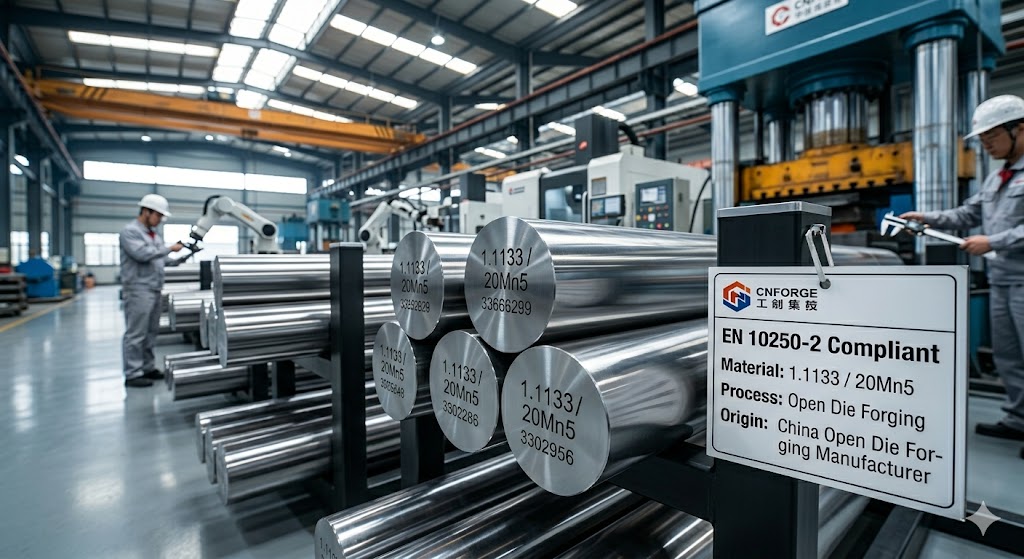
We supply fully customized 1.1133 forged steel round bars, square bars, flat bars, rectangular bars and stepped bars. Dimensional tolerances can be supplied to EN 10250-2 standard tolerance, EN 10250-2 close tolerance (Z-class), or to customer-specified drawing tolerances for near-net-shape delivery. Forged bars are widely used in transmission machinery shafts, structural pins, hydraulic cylinder rods and heavy industrial tooling, with uniform grain flow from end to end and consistent hardness across the bar cross-section.
2 — 1.1133 Seamless Rolled Rings
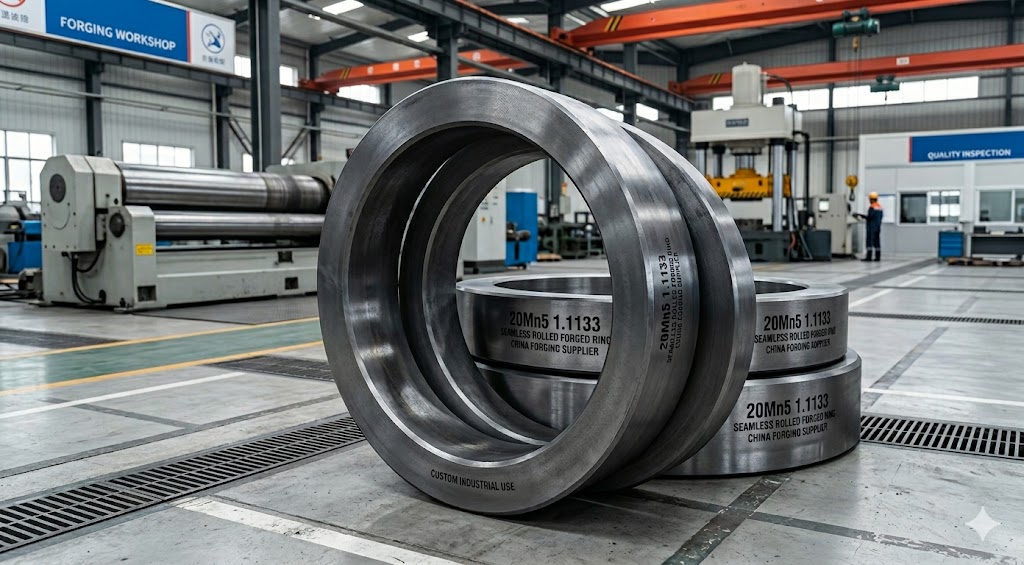
Custom 20Mn5 seamless rolled forged rings from 300mm to 6,000mm outer diameter, including flat rings, profiled/contoured rings, gear ring blanks, bearing ring blanks, flange rings and valve body rings. Rings are produced on radial-axial ring rolling mills, which achieve continuous grain flow in the circumferential direction — the ideal microstructural orientation for maximum resistance to hoop stresses in pressure vessels, rings and flanges. 100% ultrasonic testing per EN 10228-3 or ASTM A388, with dimensional inspection to drawing per EN 10250-2.
3 — Forged Hollow & Sleeve Components
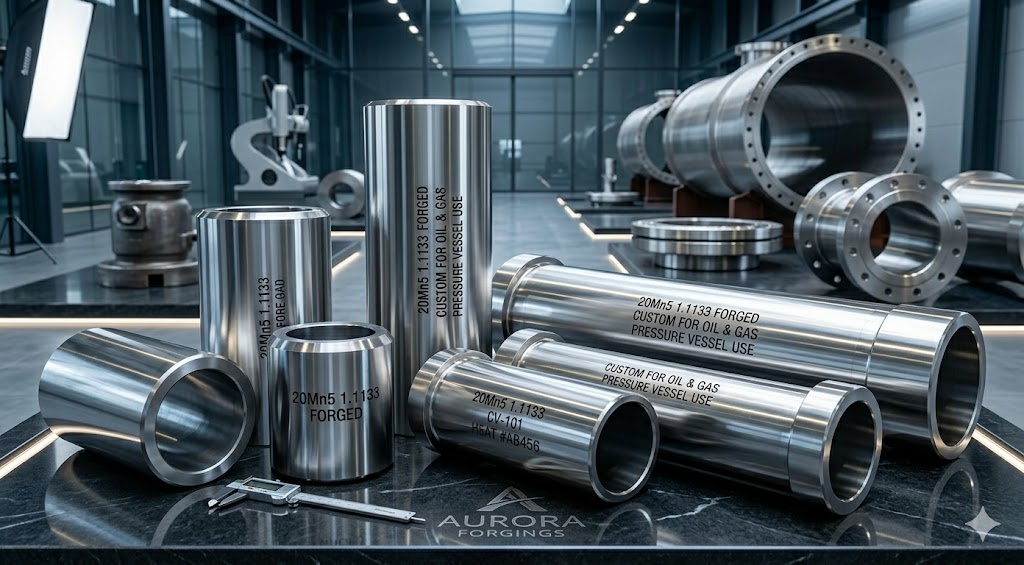
1.1133 forged steel hubs, housings, shells, sleeves, bushes, cases and hollow bars produced by open die forging with mandrel punching — not by machining solid bar, which would cut grain flow lines. The through-forged hollow structure preserves circumferential grain flow and ensures the bore surface has the same refined microstructure as the outer diameter, giving superior fatigue performance in rotating applications such as pump casings and gearbox housings. Suitable for oil & gas, chemical processing, power generation and marine industries.
4 — Forged Discs, Plates & Blocks
20Mn5 forged steel discs, disks, blocks, plates and open die forgings for tube sheets, flanges, valve components and pressure vessel parts. We supply these in rough-forged condition, turned/faced condition, or fully machined to drawing. For pressure vessel tube sheets that will later be drilled, we recommend specifying 100% UT to EN 10228-3 Class 3 or better to detect any internal lamination or segregation bands before the customer's drilling program begins — this is far more economical than discovering a defect after expensive machining.
5 — Forged Pipes & Tubing Components
1.1133 forged steel pipes, tubes, piping shells, casings, barrels and housings for boiler, heat exchanger, pressure vessel, reactor and heater systems. Our custom 20Mn5 forged pipes are produced with mandrel forging to achieve controlled wall thickness uniformity (typically ±5% WT per drawing specification) and full-length ultrasonic testing. Available in rough-forged OD/ID condition, or with machined OD and bored ID to finished drawing dimensions. Particularly suited to high-temperature, high-pressure service in chemical processing and power generation.
6 — Forged Shafts
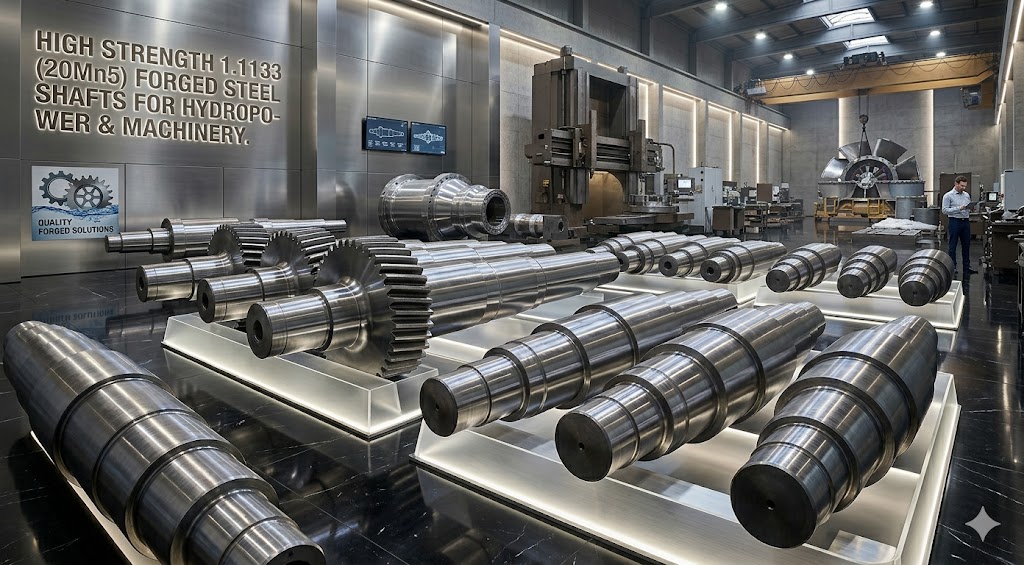
Custom 20Mn5 forged shafts — step shafts, gear shafts, pinion shafts, hydro turbine generator shafts, pump shafts, main shafts, propeller shafts and crankshafts. Shaft forgings are produced with the grain flow oriented along the shaft axis, maximising axial tensile and fatigue strength. Customized heat treatment (normalizing for standard applications; Q&T for shafts >100mm diameter or cyclic load applications) with hardness checks at both ends and mid-length after heat treatment to verify uniformity before shipping. 100% ultrasonic testing per EN 10228-1 or ASTM A388 for all shafts.
Our Open Die Forging Process for 1.1133 (20Mn5) — From Ingot to Finished Forging
Understanding how a forging is made explains why a correctly produced 1.1133 open die forging delivers properties that cannot be matched by cut bar or casting. Here is how we approach every 20Mn5 order.
Step 1: Steel Melting & Ingot Production
Raw material for 20Mn5 forgings begins with electric arc furnace (EAF) melting. All heats are refined through ladle furnace (LF) treatment to achieve the target manganese content with minimal sulfur and phosphorus. For orders requiring low hydrogen content or high-purity internal quality (critical pressure vessel applications, large heavy-section forgings), we add vacuum degassing (VD) to reduce dissolved hydrogen below 2ppm and oxygen below 20ppm. The melt is continuously composition-monitored by optical emission spectrometry (OES) before tapping to confirm the analysis is within specification. Ingot design — size, taper, feeder ratio — is calculated to minimize pipe, shrinkage porosity and centre segregation in the solidified ingot.
Step 2: Ingot Heating & Temperature Control
Ingots are charged to gas-fired preheating furnaces and heated according to a controlled heating curve: typically 150–200°C/hour rate to 800°C, then faster heating to the forging temperature window of 1,150–1,250°C for 20Mn5. The maximum forging temperature is set to avoid excessive grain growth (austenite grain coarsening becomes rapid above 1,250°C in 20Mn5) while ensuring the steel is hot and ductile enough to flow plastically under press load. The minimum stop-forging temperature is set at 850°C — below this, the risk of forging cracks in the partially transformed steel increases sharply.
Step 3: Open Die Forging — Forging Ratio & Grain Flow
The forging ratio (also called the reduction ratio) is the ratio of the ingot cross-sectional area to the finished forging cross-sectional area. This is perhaps the single most important process parameter for internal quality:
- Forging ratio ≥ 3:1: Achieves complete breakdown of the as-cast dendritic structure, closes solidification porosity, and achieves the minimum grain refinement required by EN 10250-2 for standard engineering forgings. This is our standard minimum for all 20Mn5 forgings.
- Forging ratio ≥ 4:1: Achieves more complete grain refinement and improved transverse mechanical properties. We specify this for pressure vessel shells, seamless ring blanks and shaft forgings for hydropower applications where the MTC must report transverse test results.
- Forging ratio ≥ 5:1: Specified for high-integrity pressure equipment, high-pressure gas and precision industrial applications. At this reduction ratio, the as-cast dendritic structure is essentially undetectable in the final macro-etch and the through-thickness mechanical property uniformity is maximized.
Our 8,000-tonne hydraulic press allows us to achieve the specified forging ratio even in large-section billets up to 30,000 KGS, where smaller presses cannot generate adequate pressure at the centre of a heavy ingot cross-section.
Step 4: Intermediate & Final Heat Treatment
After forging, all 20Mn5 components undergo a controlled slow-cool or intermediate anneal cycle before final heat treatment — this degasses hydrogen from the forging, relieves forging stresses and softens the material for any rough machining that precedes final heat treatment. The final normalizing or Q&T cycle is described in detail in the Heat Treatment section above.
Our 8-Step Quality Control Workflow for 1.1133 20Mn5 Forgings
Every 1.1133 (20Mn5) forging we deliver passes through a documented 8-step quality control workflow. Each step generates records that are retained and can be provided with the EN 10204 MTC package.
- Heat Certification at Melting
OES chemical analysis of each heat before tapping. Heat is approved only if all elements — including Al, tramp Cu, and the Cr+Mo+Ni sum — are within EN 10250-2 specification. Each approved heat is assigned a unique heat number that becomes the backbone of all subsequent traceability. - Ingot Macro-Etch & Segregation Check
A sacrificial slice from the ingot top is macro-etched to assess centre segregation, pipe depth and ingot quality. For large ingots ≥ 10,000 KGS intended for critical applications, we perform a full macro-etch inspection before committing the ingot to production. Ingots showing unacceptable segregation bands or anomalous macro-structures are rejected before forging begins — never after. - Forging Process Monitoring
Forging temperature is monitored by calibrated optical pyrometer at start, during key reduction passes and before final finishing. Forging ratio is calculated and documented for every piece. Press loads are recorded to confirm full plastic deformation was achieved at each reduction step. - Post-Forging Dimensional Check
All forged pieces are dimensionally checked against the rough-forging drawing immediately after forging — before heat treatment — to confirm sufficient machining stock is present on all surfaces and the piece is within the forged tolerance. Non-conforming pieces are identified before heat treatment cost is incurred. - Heat Treatment Record & Hardness Verification
Heat treatment furnace charts are retained showing thermocouple temperature vs. time records for every batch. After heat treatment, Brinell hardness is measured at minimum 3 locations on each piece (both ends and mid-length for shafts; top face and mid-radius for discs). All readings must fall within the specified range before the piece advances. - 100% Ultrasonic Testing (UT)
All 20Mn5 forgings undergo 100% manual ultrasonic testing per EN 10228-3 (forgings for pressure equipment) or ASTM A388 (general industrial). Test frequency and acceptance class are as specified on the client's drawing or purchase order — our default is EN 10228-3 Class 3 for pressure vessel forgings and Class 2 for structural forgings. Full UT reports referencing scan coverage, probe frequency and calibration data are issued. - Mechanical Testing
Test specimens are machined from a prolongation or sacrificial section of the forging (or a separately forged test coupon from the same heat, same heat treatment batch, per EN 10250-2). Tests performed: full tensile (Rm, Re, A, Z), Charpy V-notch impact at the specified temperature (standard: +20°C), and Brinell hardness. All individual test values — not just the averages — are reported in the MTC. - Final Dimensional Inspection & MTC Issue
All dimensions of the finished forging (or machined part) are verified against the client's drawing. Non-conforming dimensions trigger an NCR and disposition before shipment. The complete EN 10204 3.1 MTC — covering chemical analysis, mechanical tests, UT results, heat treatment records and dimension test — is reviewed and signed off by our quality manager before the forging is released for packing and shipment.
Production & Inspection Standards for 20Mn5 (1.1133) Forged Steel
All 1.1133 (20Mn5) forgings from Jiangsu Liangyi are manufactured and inspected in accordance with the following international standards. We also support client-specified project standards — simply include the applicable standard reference on your purchase order or drawing.
Material Standards
- EN 10250-2: 2000 — Open steel die forgings for general engineering purposes: Non-alloy quality and special steels. This is the primary material standard for 1.1133 (20Mn5) forgings.
- EN 10269: 1999 — Steels and nickel alloys for fasteners and similar components with specified elevated and/or low temperature properties.
- DIN, ASTM, AISI, JIS, API 6A — Available upon request; supply to multiple simultaneous standards is possible where compositions are compatible.
Testing & Inspection Standards
- EN 10204: 2004 — Metallic products: Types of inspection documents. We issue 3.1 (internal QC) or 3.2 (third-party witness) certificates as specified.
- EN 10228-3 — Non-destructive testing of steel forgings: Ultrasonic testing of ferritic and martensitic steel forgings.
- EN 10228-1 — Non-destructive testing of steel forgings: Magnetic particle inspection.
- ASTM A388 — Standard Practice for Ultrasonic Examination of Steel Forgings (for clients requiring ASTM-based inspection reports).
- EN ISO 6892-1 — Metallic materials: Tensile testing — Method of test at room temperature.
- EN ISO 148-1 — Metallic materials: Charpy pendulum impact test — Part 1: Test method.
- EN ISO 6506-1 — Metallic materials: Brinell hardness test — Part 1: Test method.
- EN ISO 643 — Steels: Micrographic determination of the apparent grain size.
- EN ISO 9001: 2015 — Quality management system (our factory certification).
- EN ISO 9712 — Non-destructive testing: Qualification and certification of NDT personnel.
- EN 13018 — Non-destructive testing: Visual testing — General principles.
Industry Applications & Global Project Cases of 1.1133 20Mn5 Forgings
Our 1.1133 (20Mn5) forging parts have been supplied to clients in the following core industries across six continents. The following project cases reflect an actual category of work — specific client names are withheld per commercial confidentiality agreements, but technical details are accurate and representative:
- Hydropower Industry — Southeast Asia: Supplied custom 20Mn5 forged hydro turbine generator shafts (max diameter 800mm, total length 6,000mm, weight 12,000 KGS per shaft) for 10MW run-of-river hydropower stations. The specifications included EN 10250-2 material, Q&T heat treatment with a verified Rm 560–650 MPa, 100% UT per EN 10228-3 Class 3, EN 10204 3.2 MTC with a third-party inspector witness, and an anti-corrosion oil coating on all machined surfaces before the steel was crated and sent by ocean freight.
- Gear Transmission & Mining Industry — Germany: Custom 1.1133 forged gear shaft blanks and pinion shaft blanks for German mining machinery manufacturers. They are heat-treated to HB 165–185 (which is best for the client's next gear hobbing operation), have a forging ratio of at least 4:1 to make them tougher across the board, and are 100% UT per EN 10228-3. The client's design team worked with our engineers to confirm that 20Mn5 in normalized condition met the fatigue life requirement for the pinion pitch diameter — avoiding the higher cost of 42CrMo4 which their original specification had conservatively specified.
- Boiler & Pressure Vessel Industry — Middle East (UAE): Provided 20Mn5 forged tube sheets (diameter 2,400mm, thickness 280mm), nozzle forgings and channel flanges for a chemical plant project that will produce 300,000 tons of chemicals a year. 100% UT per EN 10228-3 Class 4 (the most stringent level), EN 10204 3.2 MTC with client-nominated third-party inspector, and dimensional inspection to ±0.5mm position tolerance on all nozzle bore locations. Delivered on schedule with no non-conformances across the complete supply package.
- Industrial Valve & Oil and Gas Industry — USA: Supplied mass production of 1.1133 forged valve bodies, bonnets, and body-bonnet rings for US oil and gas pipeline projects. Parts are made according to the client's purchase specification and API 6A requirements. All heat lots are documented to API 6A 21st Edition PSL 3 chemical and mechanical requirements using the client's qualified procedure. As per the client's request, extra HIC resistance testing and SSC resistance screening were done for sour service applications.
- Power Generation Industry — China: Supplied 20Mn5 forged impellers and rotor ring blanks for industrial power plant coolant pump applications, using EAF+LF+VD melting process to achieve low hydrogen content and controlled phosphorus levels per the client's technical specification. Full material traceability from heat number to finished part, with EN 10204 3.1 MTC and complete mechanical test documentation provided for every production batch.
- Industrial Pump & Water Treatment Industry — South America (Brazil): We made custom 1.1133 forged pump casings, impellers, wear rings, and shaft sleeves for big municipal water supply pumping stations that move 15,000 m³/hr of water. We provided these parts in rough-machined according to semi-finish drawing dimensions, with surface roughness Ra ≤ 6.3 μm on all bore surfaces and Ra ≤ 12.5 μm on external surfaces
- Construction & Mining Machinery Industry — Australia: 20Mn5 forged crane wheels (900mm diameter, weight 380 KGS each), gear rings and structural forgings for Australian open-pit mining projects. Delivered in normalized condition with surface induction hardening capability confirmed (the client's subsequent in-house treatment), full magnetic particle inspection (MPI) of all tread and flange surfaces per EN 10228-1, and CE certification confirming conformance with Australian import requirements.
How to Write a 1.1133 (20Mn5) Forging Purchase Specification — A Practical Guide
A well-written purchase specification is what separates a smooth delivery from a dispute over non-conformance. After processing orders for more than 25 years, we suggest that you include the following in your purchase order or drawing note for 20Mn5 forgings:
Essential Minimum Requirements
- Material grade and standard: "1.1133 (20Mn5) per EN 10250-2:2000" — both the EN number and name, plus the standard year.
- Heat treatment condition: "N" for normalized or "QT" for quenched and tempered. If you need a specific hardness range rather than the EN minimum, state it explicitly (e.g., "Normalized, HB 160–190").
- Geometry: Full 2D drawing with all important dimensions, tolerances, and surface finish callouts. 3D STEP files are welcome but do not replace a 2D drawing for inspection reference.
- Weight and quantity: Approximate rough weight (or finished weight + machining stock) and the number of pieces.
- Inspection certificate type: "EN 10204 3.1" for most applications; "EN 10204 3.2 with [named TPI]" when third-party witness is required.
- UT acceptance class: Reference the applicable standard and class (e.g., "100% UT per EN 10228-3 Class 3").
Additional Requirements for Important Applications
- Minimum forging ratio (e.g., "Forging ratio ≥ 4:1 required; to be stated on MTC")
- Maximum hydrogen content after VD melting (e.g., "H ≤ 2.0 ppm, confirmed by hot vacuum extraction")
- Tightened chemistry limits (e.g., "C ≤ 0.20% product analysis" for specific welding procedures)
- Sub-zero Charpy requirements (e.g., "KV ≥ 40J at −20°C" for cold climate service)
- Grain size requirement (e.g., "ASTM grain size ≥ 5 per EN ISO 643")
- MPI in addition to UT (e.g., "100% MPI of machined surfaces per EN 10228-1")
- Dimension test with CMM report for tight-tolerance machined features
Inspection Capabilities & EN 10204 MTC for 20Mn5 Forgings
Our quality laboratory is equipped with the following instruments dedicated to 1.1133 (20Mn5) forging inspection:
- OES (Optical Emission Spectrometer): Full elemental analysis of 20+ elements including all specified and tramp elements. Calibrated to certified reference standards.
- Universal Servo-Hydraulic Tensile Testing Machine: 1,000 kN capacity, automated extensometer, full digital load-displacement recording per EN ISO 6892-1.
- Instrumented Charpy Impact Testing Machine: Tests from −60°C to +200°C; standard test temperature for 20Mn5 is +20°C; sub-zero capability available for special requirements.
- Brinell Hardness Tester: Certified per EN ISO 6506-1; portable units for in-line forge shop hardness verification.
- Phased-Array Ultrasonic Testing (PAUT) System: Full 100% volumetric coverage including complex-geometry forgings; calibrated per EN 10228-3 / ASTM A388.
- Magnetic Particle Inspection (MPI) Equipment: Wet fluorescent MPI for surface and near-surface crack detection per EN 10228-1.
- CMM (Coordinate Measuring Machine): 3D dimensional verification of machined components to ±0.01mm positional accuracy.
- Metallographic Laboratory: Grain size determination per EN ISO 643; inclusion rating per EN ISO 4967; microstructure evaluation.
Our EN 10204 3.1 MTC for every 20Mn5 forging order contains: unique heat number and full melting type details; full chemical analysis with all elements including tramp elements; complete mechanical test results with all individual test values (not just averages); 100% UT results with calibration reference and acceptance criteria; Brinell hardness readings at all measured positions; dimensional inspection results; heat treatment furnace record reference number; and final release signature of our authorized quality manager. EN 10204 3.2 certificates with third-party witness are available when the client nominates and arranges their preferred inspection agency.
Frequently Asked Questions About 1.1133 (20Mn5) Forging Parts
1.1133 is the EN steel number and 20Mn5 is the EN steel name — both refer to the identical European standard carbon-manganese forging steel defined in EN 10250-2:2000 and EN 10269:1999. The name "20Mn5" encodes the chemistry: "20" indicates approximately 0.20% carbon, "Mn" identifies manganese as the main alloying element, and "5" means the manganese content is approximately 5/4 = 1.25% (EN uses a divisor of 4 for manganese in the naming convention). Combined with a mandatory minimum 0.02% aluminium for grain refinement, this composition delivers a minimum tensile strength of 530 MPa and a carbon equivalent of approximately 0.43–0.50 — making it both mechanically capable and field-weldable.
The closest approximate equivalents are: USA AISI/SAE 1524 (slightly higher Mn upper limit, no Al requirement); Japan JIS SMn420 (similar Mn range); China GB 20Mn (lower Mn range, weaker hardenability — not suitable for sections >100mm without verification); France NF 20M5; UK BS 150M19; Sweden SS 2132; Germany DIN 20Mn5 (essentially identical, now superseded by EN). These are approximate equivalents sharing similar carbon-manganese chemistry — always verify to your specific standard before substituting in a qualified design.
Properties decrease with increasing section size because heavier sections cool more slowly through the transformation temperature range. For EN 10250-2 normalized or Q&T 20Mn5: sections ≤ 100mm achieve Rm ≥ 530 MPa and Re ≥ 300 MPa; sections 100–250mm achieve Rm ≥ 530 MPa but Re drops to ≥ 275 MPa; sections 250–500mm achieve Rm ≥ 510 MPa and Re ≥ 255 MPa. Charpy impact energy also reduces from ≥ 55J (≤250mm) to ≥ 45J (250–500mm). For applications requiring consistent properties through very heavy sections, we recommend Q&T condition rather than normalizing, and for sections above 250mm, a discussion with our engineering team about whether 42CrMo4 may be a better specification choice is worthwhile.
The IIW carbon equivalent for 20Mn5 is typically 0.43–0.50, calculated as CE = C + Mn/6 + (Cr+Mo+V)/5 + (Ni+Cu)/15. With a CE in this range: sections ≤ 25mm can normally be welded at ambient temperature (≥ 5°C) without preheating using low-hydrogen consumables; sections 25–60mm benefit from 75–100°C preheat; sections 60–100mm typically require 100–150°C preheat. The actual CE of each delivery lot is reported on our MTC — welding engineers should use this specific value for their WPS qualification rather than the typical nominal value, since CE can approach 0.50 when both carbon and manganese are at the high end of their specification ranges.
For sections ≤ 100mm in standard engineering applications: normalized condition is sufficient, cost-effective and produces excellent machinability. For sections 100–250mm where impact toughness is important: Q&T is preferred because slower air cooling in normalizing reduces the ferrite-pearlite transformation rate, sometimes resulting in Charpy values that only marginally exceed the minimum. For sections > 250mm or any application with sub-zero Charpy requirements: Q&T is mandatory — the section is too thick for normalizing to reliably achieve consistent mechanical properties through the cross-section. For pressure vessel tube sheets that will later be welded: both N and Q&T are used depending on code requirements — specify based on your applicable pressure vessel design code (e.g., EN 13445, ASME Section VIII, or PED 2014/68/EU).
Our standard recommendation by application type: general structural forgings → EN 10228-3 Class 2; pressure-retaining components (pressure vessel shells, tube sheets, nozzle forgings) → EN 10228-3 Class 3; high-integrity pressure equipment and critical industrial components → EN 10228-3 Class 4 (most stringent — requires no single indication exceeding 3mm diameter equivalent reflector). For US-market components, the equivalent reference is ASTM A388 with agreed acceptance criteria per your specific project specification. Specifying the correct UT class upfront at order placement ensures our production planning includes the appropriate scan coverage pattern and calibration setup — adding this requirement after forging requires re-testing which adds lead time and cost.
Yes — full end-to-end custom manufacturing from steel melting through final inspection and shipping is our core business. We accept drawings in DXF, DWG, PDF and STEP formats. Weight range: 30 KGS to 30,000 KGS per single piece. Annual production capacity: 120,000 Ton. Typical lead time: 4–8 weeks from drawing approval to shipping, depending on complexity and current production schedule — we confirm the specific lead time at quotation stage. EN 10204 3.1 MTC issued as standard; 3.2 available upon request with client-nominated TPI.
EAF: standard for general engineering applications — cost-effective, fully compliant with EN 10250-2. EAF+LF+VD: adds ladle refining and vacuum degassing; specify when hydrogen content must be ≤ 2ppm (large thick sections susceptible to flake cracking), sulfur ≤ 0.010% is required, or when the application demands tighter control on dissolved gases. EAF+ESR: electro slag remelting after primary melting; dramatically reduces non-metallic inclusions and centre segregation; specify for the highest internal cleanliness requirements in large forgings where ultrasonic transparency and mechanical property uniformity are paramount. EAF+PESR: adds protective atmosphere to ESR; specify for reactive alloy additions or where ESR slag interaction with atmosphere would compromise chemistry. VIM+PESR: vacuum induction melting + protective atmosphere ESR; specify for ultra-high purity and precision industrial applications requiring oxygen ≤ 10ppm and hydrogen ≤ 1.0ppm with full inert-atmosphere melting traceability.
Choose 20Mn5 when: (1) your section is ≤ 250mm and does not require through-thickness hardenability of alloy grades; (2) the component will be welded in fabrication (CE 0.43–0.50 allows this with manageable preheating); (3) your design requires a Charpy impact-tested forging steel at moderate cost; (4) machinability of the as-delivered forging is important. Choose C45 only for components specifically requiring local surface hardening — C45 is not a better all-round choice than 20Mn5 and its CE is borderline for welding. Choose 42CrMo4 when section thickness exceeds 250mm and consistent Rm ≥ 700 MPa through the full cross-section is required, when design loads involve high fatigue cycles demanding the superior fatigue limit of the chrome-moly grade, or when sub-zero service temperatures require the toughness that 42CrMo4 in Q&T delivers. Our engineers are available to review your specific design requirements and recommend the optimally specified grade — contact us with your drawing and operating conditions.
We take trial orders for single pieces (at least 30 KGS) with no minimum order value. This lets clients test us on a first part before committing to production volumes. For regular production orders, shipping full containers is the most cost-effective way to do it. Payment: T/T (telegraphic transfer); 30% of the total is due when the order is confirmed, and the rest is due before shipping. We take US dollars, euros, and British pounds. Shipping options include EXW, FOB, CIF, and DDP (door-to-door delivery to the customer's location in Europe, North America, the Middle East, Australia, and other places). Our freight forwarding team takes care of insurance and customs clearance for DDP shipments. Before each shipment, all the shipping papers, such as the commercial invoice, packing list, bill of lading, certificate of origin, and EN 10204 MTC, are made and sent.
Inquire About Custom 1.1133 (20Mn5) Forging Parts — 24H Response
Send us your drawing (DXF, DWG, PDF or STEP), quantity, material standard, heat treatment condition, inspection requirements and target delivery date. Our engineering team will review the drawing for manufacturability and issue a detailed technical and commercial quotation within 24 hours. We provide engineering consultation on material selection, heat treatment optimisation and inspection specification at no charge — we want your project to succeed, not just to win an order.
We support DDP door-to-door delivery to Europe, North America, Middle East, Australia and other destinations, with USD, EUR and GBP payment accepted and full export documentation provided for customs clearance.
Inquiry Email: sales@jnmtforgedparts.com
Phone / WhatsApp: +86-13585067993
Official Website: https://www.jnmtforgedparts.com
Factory Address: Chengchang Industry Park, Jiangyin City, Jiangsu Province, China (214400)
Business Hours: Monday – Friday, 08:00 – 17:30 (GMT+8); Email inquiries answered within 24 hours including weekends for urgent requests.