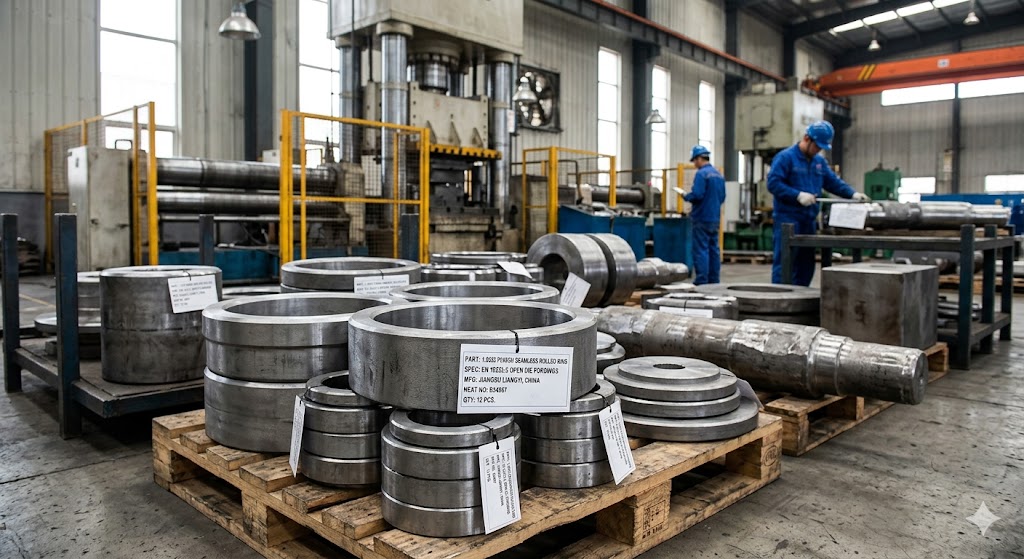
Quick AnswerWhat is 1.0352 (P245GH) Forged Steel?
1.0352 (P245GH) is a European standard carbon steel for pressure purposes, defined in EN 10222-2. The material number is 1.0352; the grade name is P245GH. It is widely used for open die forgings, seamless rolled rings, pressure vessels, boilers, valves, and pipeline components requiring stable mechanical performance at elevated temperatures.
- Standard: EN 10222-2 (Ferritic steels, elevated temperature properties)
- Tensile Strength: 410–530 MPa | Min. Yield Strength: 220–245 MPa
- Key Advantage: Excellent weldability + high temperature stability
- Manufacturer: Jiangsu Liangyi Co.,Limited — ISO 9001:2015 certified, 27+ years experience, Jiangyin, China
About Jiangsu Liangyi: 27 Years of P245GH Forging Expertise
Founded in 1997 in Jiangyin, Jiangsu Province — one of China's most concentrated heavy manufacturing corridors along the Yangtze River Delta — Jiangsu Liangyi Co.,Limited has spent over two decades building specialized expertise in EN 10222-2 compliant 1.0352 (P245GH) open die forgings and seamless rolled rings. Unlike distributors or trading companies, every kilogram of P245GH steel we forge is processed entirely in-house, from initial billet selection through final dimensional inspection, giving us complete traceability and process control at every stage.
Our 80,000㎡ production campus houses five dedicated forging production lines, three ring rolling mills covering inner diameters from 200mm to 6,000mm, four heat treatment furnaces with ±5°C temperature uniformity certification, and a fully equipped metallurgical laboratory. This integrated infrastructure means that when an engineering team specifies a 1.0352 (P245GH) tube sheet at 2,400mm diameter and 280mm thickness, we can commit to a firm dimensional tolerance, a traceable heat treatment record, and a guaranteed MTC 3.2 — not estimate one.
What Separates Our P245GH Forgings from Standard Market Supply
Most buyers of 1.0352 (P245GH) forged components encounter a common frustration: certificates that do not match the actual material, heat treatment records that are vague or retroactively generated, and dimensional compliance that relies on generous tolerance interpretation. We have structured our entire operation to eliminate these failure modes:
- Heat-traceable billets only: Every batch of P245GH raw material is sourced from steel mills that provide ladle-level chemical reports. We reject any heat where the actual carbon content exceeds 0.19% even if it falls within the EN 10222-2 maximum, because our engineering experience shows that heats above 0.19%C produce harder-to-weld forgings that create downstream problems for pressure equipment fabricators.
- Dedicated P245GH heat treatment protocols: We have developed in-house normalizing and normalizing-plus-tempering cycles specifically for thick-section P245GH forgings above 100mm. These cycles address the grain growth risk that occurs when large-section P245GH forgings are normalized at temperatures above 920°C — a risk that generic heat treatment tables do not flag.
- Third-party witness inspection supported: For critical pressure vessel, offshore, and high-specification industrial projects, we can accommodate full third-party witness inspection by any client-nominated inspection body, including SGS, Bureau Veritas, TÜV Rheinland, Intertek, or others. Our facilities include a dedicated inspection area with calibrated measuring equipment and unobstructed access for independent inspectors at all production stages.
- Bilingual engineering communication: Our technical team communicates in English on all drawing review, tolerance clarification, and inspection report sign-off. No translation gaps between your specification and what enters the production floor.
We produce 1.0352 P245GH forged components across the full industrial weight range from 30 kg to 30,000 kg per piece, serving EPCs, engineering firms, pressure vessel fabricators, valve OEMs, and industrial plant operators across the United States, Germany, Netherlands, France, United Kingdom, Australia, Saudi Arabia, UAE, Singapore, India, Brazil, and beyond. Every production batch is covered by a full EN 10204 3.1 or 3.2 Mill Test Certificate, issued and signed by a qualified third-party inspector upon request.
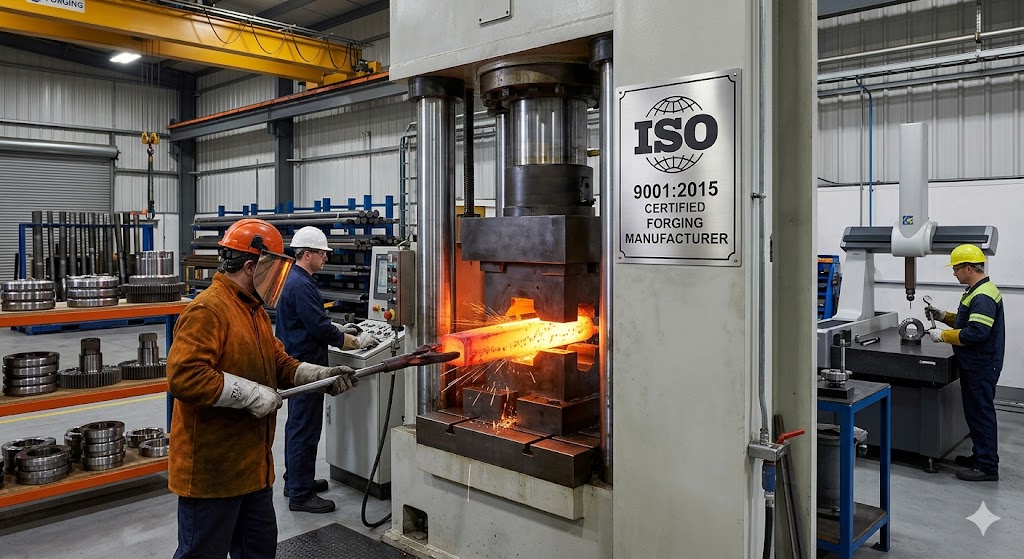
ISO 9001:2015
Certified QMS
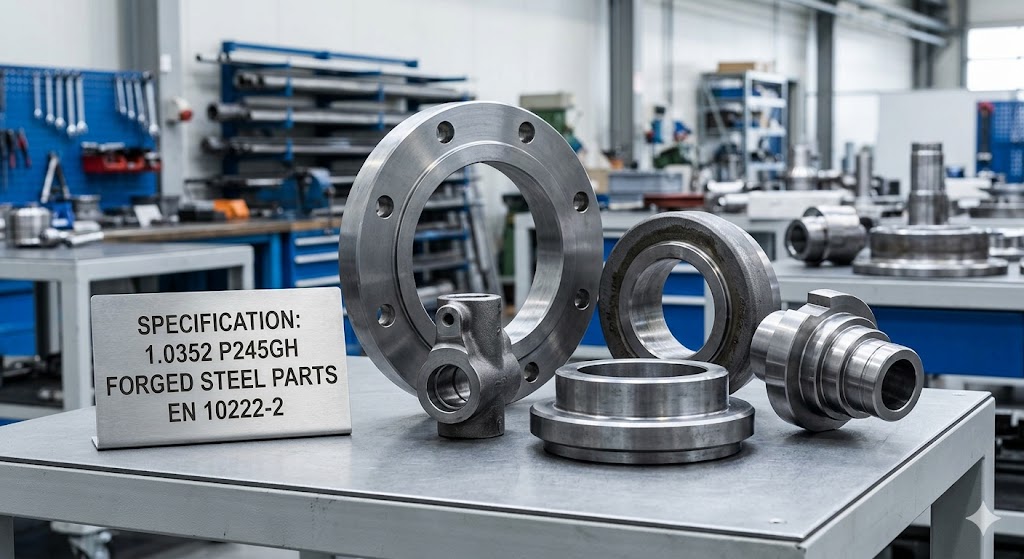
EN 10222-2
Production Standard
ASTM A788
Production Standard
MTC 3.1 / 3.2
Inspection Document
Full Range of 1.0352 (P245GH) Forged Steel Products
P245GH (1.0352) is not a one-shape steel. Its combination of consistent weldability, fine-grained microstructure after normalizing, and reliable toughness at the thicknesses common in pressure equipment makes it suitable for a wider shape range than most pressure steel grades. Below is our full production range for this material, with dimensional guidance and application context that generic supplier catalogs rarely provide.
1.0352 Open Die Forged Bars, Rods & Custom Shafts
P245GH forged round bars are our highest-volume product in this grade. We produce them in outside diameters from 80mm to 1,200mm and lengths up to 6,000mm, with a forge ratio of at least 3:1 to ensure grain refinement and eliminate center porosity from the cast billet. Square bars, flat bars, and rectangular bars are available in section sizes from 80×80mm up to 600×1,200mm. Custom step shafts, turbine shafts, and pump shafts are produced to your drawing, with machined pilot diameters and thread ends included if required. All forged bars in P245GH are normalized or normalized + tempered before shipment unless the client specifies as-forged supply for subsequent fabricator heat treatment.
Key specification ranges: Round bar OD: 80–1,200mm | Length: up to 6,000mm | Forge ratio: ≥3:1 | Straightness tolerance: ≤1mm/m | Surface finish: as-forged or rough-machined to Ra 12.5μm.
P245GH Seamless Rolled Rings & Forged Flanges
1.0352 seamless rolled rings are produced on our radial-axial ring rolling mills, covering inside diameters from 200mm to 6,000mm, wall thicknesses from 20mm to 500mm, and heights from 30mm to 800mm. The seamless ring rolling process for P245GH achieves circumferential grain flow alignment that is simply not achievable with cut plate or welded ring alternatives — a critical advantage when the component will see cyclic pressure loading or must pass through-thickness ultrasonic testing to EN 10228-3 or ASTM A388 acceptance criteria.
Flanges — including weld neck, slip-on, blind, lap joint, socket weld, threaded, and spectacle — are produced from P245GH forgings to EN 1092-1, ASME B16.5, ASME B16.47 Series A/B, and DIN standards. We can supply flanges in pressure ratings from PN6 to PN400 and ANSI Class 150 to Class 2500, with full facing options (raised face, flat face, ring type joint).
Key specification ranges: Ring ID: 200–6,000mm | Wall thickness: 20–500mm | Height: 30–800mm | Roundness tolerance: per EN 10222-2 Table 9 | Flange standards: EN 1092-1, ASME B16.5, ASME B16.47, DIN 2501.
1.0352 Hollow Forged Components, Hubs & Sleeves
Hollow forgings in P245GH are used wherever a thick-walled cylinder needs better mechanical properties than a machined-from-bar alternative provides, without the overhead of a full ring rolling setup. We produce P245GH forged sleeves, bushes, hubs, housings, and pressure cylinders using a punch-and-draw open die process on billets from 150mm ID to 2,000mm OD. This method produces a continuous longitudinal grain flow that makes hollow P245GH forgings superior in fatigue resistance to centerless-bored bar stock for rotating or pressure-cycling applications.
Typical applications include pump bearing housings, valve actuator cylinders, hydraulic pressure vessels, and nozzle forgings for heat exchangers. We supply these components in the as-forged, rough-machined, or finish-machined condition to ±0.1mm tolerance on critical bores.
P245GH Forged Discs, Plates & Tube Sheets
P245GH forged tube sheets are among the most technically demanding forgings we produce. A tube sheet for a shell-and-tube heat exchanger must be flat to within 0.5–1.0mm across its full face, must meet UT acceptance criteria across 100% of its cross-section, and must be supplied in a heat treatment condition that keeps hardness below HB 200 to allow subsequent drilling without tool wear problems. We produce tube sheets from 300mm to 3,000mm in diameter and 30mm to 500mm in thickness, with full-face ultrasonic testing to EN 10228-3 Level 3 or ASTM A388 as standard.
Forged discs and blocks are produced for pressure vessel end caps, valve bodies, and structural components. Forged plate in P245GH, while less common than S355 plate, is specified for applications requiring the better through-thickness toughness that forging provides over mill-rolled plate.
1.0352 Forged Pipe Shells, Barrels & Pressure Cylinders
Large-bore P245GH forged pipe shells and pressure cylinders serve as the primary containment body in pressure vessels, reactor vessels, and high-pressure storage systems. Our production range covers OD from 200mm to 2,500mm, wall thicknesses from 30mm to 350mm, and lengths up to 3,000mm in a single forging. For longer vessels, we supply multiple shell forgings with matched weld-preparation ends (typically J-groove or V-groove to the customer's WPS) to allow field assembly. All pipe shell forgings are ultrasonically tested in both longitudinal and transverse directions before shipment.
P245GH Valve Body, Bonnet & Pump Component Forgings
The valve and pump industries represent a major share of our P245GH output, and they have the most demanding geometric requirements. P245GH forged valve bodies — including globe, gate, check, ball, and butterfly valve bodies — require net-shape or near-net-shape open die forging that minimizes downstream machining while ensuring no internal laps, cold shuts, or forging defects in the critical flow path area. Our valve body forgings are produced to client drawings with MPI (magnetic particle inspection) on all surface-critical areas as standard. Stem forgings, bonnet forgings, and seat ring forgings are produced from bar-derived closed-die or open-die processes depending on the geometry.
For centrifugal pump applications, we supply P245GH forged impellers, pump casings, diffuser bowls, pump barrels, and wear rings. Our pump impeller forgings are balanced to ISO 1940 G6.3 grade upon request, with machined hub bores to H7 tolerance as standard.
Beyond P245GH, we maintain full production capability across a broad range of European and ASTM pressure steel grades. Explore our complete forging material grades or contact our engineering team to discuss your specific requirement.
Request a Custom Forging Quote1.0352 (P245GH) Complete Technical Specifications & Material Standards
The following technical data is drawn from our production experience with EN 10222-2:2000 compliant P245GH forgings combined with the normative requirements of the standard. Engineers specifying this grade for new pressure equipment designs will find the elevated-temperature property data and heat treatment guidance particularly useful, as these are rarely presented together in supplier literature.
Governing Standards for 1.0352 (P245GH) Forgings
- EN 10222-2:2000 — Steel forgings for pressure purposes, Part 2: Ferritic and martensitic steels with specified elevated temperature properties. This is the primary normative standard governing material chemistry, mechanical properties, heat treatment, and inspection requirements for P245GH forged parts.
- EN 10083-2 — Steels for quenching and tempering; supplementary standard referenced for general quality and testing requirements.
- EN 10204:2004 — Metallic products: types of inspection documents. Our default supply document is 3.1 (manufacturer-validated). 3.2 (third-party endorsed) is available on request.
- EN 10228-3 — Non-destructive testing of steel forgings: ultrasonic testing of ferritic or martensitic steel forgings. The applicable quality class (Q1–Q4) is agreed at order stage.
- ASTM A788 — Standard Specification for Steel Forgings, General Requirements. Referenced when North American project specifications require dual certification.
- ASTM A370 — Standard Test Methods for Mechanical Testing of Steel Products. All tensile and Charpy impact tests are conducted under this standard in addition to ISO 6892-1 and ISO 148-1.
- PED 2014/68/EU — Pressure Equipment Directive: P245GH is classified as a Group 1 material under this directive, suitable for the highest-risk pressure equipment categories.
The P245GH Steel Making Process: From Molten Steel to Finished Billet
The final properties of any P245GH forging are determined as much by the steel making process as by the forging and heat treatment steps. Poor steel making — particularly inadequate control of oxygen, hydrogen, and sulfur levels — produces forgings that pass room-temperature mechanical tests but fail in service through hydrogen-induced cracking, lamellar tearing, or premature fatigue. Our procurement and quality specifications require all P245GH billets to meet the following steel making criteria:
- Primary melting via Electric Arc Furnace (EAF) or Basic Oxygen Furnace (BOF): Both routes are acceptable; BOF typically produces lower residual tramp element levels (Cu, Sn, As, Sb), which is important for high-specification and long-term cyclic service applications.
- Ladle Refining Furnace (LRF) treatment: Mandatory for all P245GH heats. The LRF step allows precise adjustment of chemistry, particularly sulfur reduction to ≤0.008% (tighter than the EN 10222-2 maximum of 0.015%), and inclusion morphology modification via calcium treatment to improve through-thickness toughness.
- Vacuum Degassing (VD or VOD): Required for all P245GH billets above 300mm in any cross-sectional dimension. Degassing reduces dissolved hydrogen to ≤1.5 ppm (measured by vacuum hot extraction) to prevent flake formation in thick sections — a defect that does not appear in room-temperature mechanical testing but causes catastrophic brittle fracture in heavy section forgings.
- Ingot casting or continuous casting: Ingot casting is mandatory for forgings above 8 tonnes finished weight. Continuous casting blooms are acceptable for smaller forgings where the bloom cross-section is at least 3× the finished forging cross-section to ensure adequate forge ratio for billet center soundness.
- Tramp element control: For high-specification applications where residual element levels are critical, we can provide detailed tramp element analysis (Cu, Sn, As, Sb, Pb) on the heat certificate. Customers with specific radiological or cleanliness requirements for their project should state these requirements at the time of inquiry so we can confirm compliance capability before order placement.
- Material quality class: We supply P245GH forgings to quality class MQ as a minimum (per ISO 6336-5 / DIN 3990-5), which requires ladle refining, vacuum degassing, and UT acceptance to EN 10228-3 Level 3.
Chemical Composition of 1.0352 (P245GH) — Why Each Element Matters
Understanding the reason each chemical element is controlled — not just the specified range — helps engineers make better material decisions and helps procurement teams evaluate supplier chemistry certificates critically:
| Element | EN 10222-2 Range | Our Aim Range | Engineering Significance |
|---|---|---|---|
| Carbon (C) | 0.08 – 0.20% | 0.12 – 0.18% | Primary strengthening element. Below 0.08%: insufficient yield strength. Above 0.20%: reduces weldability; increases carbon equivalent above 0.43 CEq, triggering mandatory preheat in most welding procedures. We aim below 0.19% to keep CEq ≤ 0.42 and allow preheat-free welding on wall thicknesses up to 30mm. |
| Silicon (Si) | Max. 0.40% | 0.15 – 0.35% | Deoxidizer and mild solid-solution strengthener. Heats below 0.10% Si indicate inadequate deoxidation practice. Above 0.40%: increases susceptibility to graphitization during long-term service above 400°C (not a risk within P245GH's rated range of ≤350°C, but kept low as a precaution). |
| Manganese (Mn) | 0.50 – 1.30% | 0.80 – 1.20% | Critical for toughness. Mn neutralizes sulfur by forming MnS inclusions (preferable to FeS), and improves hardenability in thick sections. The high end of our aim range (1.20%) is specified for forgings above 200mm section thickness where center-cooling rate is slow. |
| Phosphorus (P) | Max. 0.025% | Max. 0.018% | P segregates to grain boundaries during solidification, causing temper embrittlement and reducing impact toughness — particularly relevant for P245GH components subjected to heat treatment above 550°C. We specify a tighter maximum of 0.018% on all forgings for high-specification and sour service applications. |
| Sulfur (S) | Max. 0.015% | Max. 0.008% | Sulfur, even at levels allowed by the standard, reduces through-thickness ductility and toughness (the "Z-direction" properties critical for tube sheets and flanges). Our standard production target of ≤0.008%S, achieved via LRF treatment and calcium wire injection, measurably improves transverse Charpy impact values. |
| Chromium (Cr) | Max. 0.30% | Max. 0.20% | Residual element in carbon steel. Controlled to minimize carbon equivalent and maintain good weldability. For dual-certified P245GH / SA516 Gr.70 supply, we ensure Cr stays below 0.20% to meet ASME Section II chemical requirements. |
| Nickel (Ni) | Max. 0.30% | Max. 0.25% | Residual element. At levels above 0.30%, Ni begins to affect tempering response and may require declaration on NACE MR0175 / ISO 15156 compliance documentation for sour service applications. |
| Molybdenum (Mo) | Max. 0.08% | Max. 0.05% | Residual element. P245GH is a carbon-manganese steel, not a creep-resisting chromium-molybdenum grade. Mo above 0.08% would push it toward 16Mo3 territory and trigger different normative requirements. We monitor Mo to ensure material identity integrity. |
Mechanical Properties of 1.0352 (P245GH) at Room Temperature
The following room-temperature mechanical properties are the minimum/range requirements per EN 10222-2:2000. All values are verified on test pieces taken from the thickest section of the forging (or a sacrificial extension), in both longitudinal and transverse orientations for critical applications:
| Property | Orientation | Test Condition | EN 10222-2 Requirement |
|---|---|---|---|
| Tensile Strength (Rm) | Longitudinal | +20°C | 410 – 530 MPa |
| 0.2% Proof Strength (Rp0.2) | Longitudinal | +20°C | Min. 245 MPa (≤16mm section) |
| 0.2% Proof Strength (Rp0.2) | Longitudinal | +20°C | Min. 235 MPa (16–40mm section) |
| 0.2% Proof Strength (Rp0.2) | Longitudinal | +20°C | Min. 220 MPa (>100mm section) |
| Elongation at Fracture (A5) | Longitudinal | +20°C | Min. 25% |
| Elongation at Fracture (A5) | Transverse | +20°C | Min. 23% |
| Impact Energy (KV2) | Longitudinal | +20°C | Min. 32 J (average); 22 J (individual) |
| Impact Energy (KV2) | Transverse | +20°C | Min. 27 J (average); 20 J (individual) |
| Brinell Hardness (HBW) | Surface | Post heat treatment | 120 – 185 HBW (typical; not mandatory by EN 10222-2) |
Elevated Temperature Yield Strength of P245GH — Critical for Pressure Design
The "GH" suffix in P245GH stands for Geschmiedete druckbehälter Hohe Temperatur (forgings for pressure purposes, high temperature). The elevated-temperature properties below are the reason this grade is preferred over standard structural carbon steel for boiler and pressure vessel applications. These values, from EN 10222-2 Table 4, are used directly in PED and ASME pressure design calculations:
| Temperature | Min. 0.2% Proof Strength (Rp0.2) | Application Significance |
|---|---|---|
| +20°C (room temp) | 245 MPa (≤16mm) | Baseline design value |
| +50°C | 238 MPa | District heating, low-pressure steam |
| +100°C | 218 MPa | Low-pressure steam systems, hot water boilers |
| +150°C | 207 MPa | Medium-pressure steam, process heat exchangers |
| +200°C | 196 MPa | Saturated steam, process vessel shells |
| +250°C | 179 MPa | Upper design boundary for most PED Category III vessels |
| +300°C | 163 MPa | High-pressure hot water, superheated steam at moderate pressure |
| +350°C | 147 MPa | Maximum rated temperature per EN 10222-2 |
Note: Values above are for wall thickness ≤16mm. For thicker sections (16–40mm, 40–100mm, >100mm), the normative values decrease progressively per EN 10222-2 Table 4. Our engineering team can provide the applicable values for your specific section thickness on request.
Heat Treatment Options for 1.0352 (P245GH) Forgings
EN 10222-2 requires that P245GH forgings be supplied in one of the following heat treatment conditions. The choice depends on section thickness, required mechanical properties, and the downstream fabrication process:
| Condition Code | Treatment | Temperature | Best For |
|---|---|---|---|
| N | Normalizing | 880 – 920°C, air cool | Sections ≤100mm; standard supply condition for most applications; produces uniform fine-grained microstructure across the full section |
| N+T | Normalizing + Tempering | Normalize 880–920°C, Temper 600–680°C | Sections >100mm; reduces residual stress from normalizing; improves toughness in large cross-sections; recommended for thick tube sheets and large-diameter rings |
| QT | Quench + Temper | Austenitize 880–920°C water/oil quench, Temper 600–680°C | Non-standard for P245GH but occasionally specified to achieve superior toughness in very thick sections (>200mm); requires specific agreement at order stage |
Our heat treatment furnaces maintain ±5°C temperature uniformity, verified through calibrated thermocouple surveys, and every heat treatment batch is recorded with a printed time-temperature chart that forms part of the delivery MTC. For post-weld heat treatment (PWHT) of P245GH pressure equipment at fabricator sites, we recommend a PWHT temperature of 580–620°C for 1 hour per 25mm of thickness, with a maximum heating rate of 200°C/h above 400°C.
P245GH vs Similar Pressure Steel Grades: Which to Choose?
Engineers frequently need to select between P245GH (1.0352) and closely related carbon or low-alloy pressure steel grades. The decision is not always straightforward, particularly when international projects specify mixed European and ASTM standards. The following comparison, based on our production experience with all of these grades, is intended to help engineers and procurement teams make the right specification choice:
| Grade | Standard | Min. Yield (RT) | Max. Temp. | Key Difference vs P245GH |
|---|---|---|---|---|
| P245GH (1.0352) | EN 10222-2 | 245 MPa | 350°C | Reference grade — baseline comparison |
| P265GH (1.0425) | EN 10222-2 | 265 MPa | 400°C | Higher yield strength and rated temperature. Slightly higher C content (max 0.20%); CEq marginally higher. Preferred when section thickness reduction matters. Drop-in replacement for P245GH in most fabrication procedures with minor WPS revision. |
| P280GH (1.0477) | EN 10222-2 | 280 MPa | 400°C | Higher yield again. Max C 0.22% — requires confirmed preheat for most weld procedures. Used where thinner vessel walls are required by weight constraints. |
| 16Mo3 (1.5415) | EN 10222-2 | 275 MPa | 530°C | Molybdenum-alloyed grade for elevated temperature applications above 350°C — the point where P245GH cannot be used. 16Mo3 is significantly more expensive than P245GH but essential where temperatures exceed 350°C. |
| SA516 Gr. 70 | ASTM A516 | 260 MPa (38 ksi) | 343°C (650°F) | The closest ASTM equivalent to P245GH. Routinely dual-certified with P245GH on our production. Key difference: SA516 Gr.70 is a plate standard; when specified for forgings, ASTM A105 (for small forgings) or ASTM A266 (for large pressure vessel forgings) are the ASTM equivalents. Not an exact cross-reference — always verify chemistry and properties. |
| ASTM A105 | ASTM A105 | 250 MPa (36 ksi) | ~345°C | Standard ASTM forging grade for flanges and fittings. Higher C max (0.35%) and higher CEq than P245GH — weldability is inferior. Commonly used for pipe flanges but P245GH is preferred for thick-section pressure vessel forgings where toughness matters. |
| Q245R | GB 150 (China) | 245 MPa | 350°C | Chinese GB standard equivalent widely used in domestic Chinese pressure vessels. Mechanical properties are very close to P245GH. Not accepted by European PED notified bodies without additional testing and conformity assessment — specify P245GH for export equipment. |
Our recommendation: If your project operates below 350°C, P245GH (1.0352) is the standard choice for European-code pressure equipment. If you need ASTM certification on the same forging, specify dual certification as P245GH + SA516 Gr.70 equivalent at order stage — we can accommodate this on most sizes. If the operating temperature exceeds 350°C, step up to P265GH or 16Mo3 depending on the specific temperature range.
Industry Applications: Where P245GH (1.0352) Forgings Are Specified and Why
P245GH (1.0352) is not simply a generic "pressure steel." It occupies a very specific engineering niche: it is the correct choice when you need the guaranteed elevated-temperature mechanical properties of EN 10222-2, better weldability than higher-strength pressure grades, and documented traceability for PED Category III or IV pressure equipment — but you do not need the additional cost of chromium-molybdenum alloying. Understanding this niche helps explain exactly which components across which industries this grade dominates:
1. Power Generation: Boilers, Heat Exchangers & Steam Systems
In thermal power plants — whether coal, gas, biomass, or waste-to-energy — the steam-side pressure components that operate between 150°C and 350°C at design pressures from 25 to 160 bar are the natural domain of P245GH open die forgings. Specific components include:
- Boiler drum forgings: The cylindrical shell sections, end caps, and nozzle forgings of steam drums operating at saturation pressures of 60–170 bar. P245GH tube sheets for drum internals can reach 2,000mm diameter and 300mm thickness. These require 100% UT to EN 10228-3 Level 3, full heat treatment records, and often third-party witness inspection by the plant's insurer.
- Heat exchanger tube sheets: Shell-and-tube heat exchangers in steam condensers, feedwater heaters, and process coolers use P245GH tube sheets from 400mm to 2,800mm in diameter. The key requirement is hardness below HB 185 to prevent tube-drilling tool wear during fabrication. Our controlled normalizing cycle consistently delivers HB 140–170 on these components.
- Steam turbine valve bodies: Main steam stop valves, control valves, and bypass valves in steam turbine admission systems. P245GH is preferred over cast steel for these components in European plants because EN 10222-2 forgings provide better dimensional control, superior toughness, and full MTC traceability that castings (regulated by EN 10213) do not as reliably provide.
2. Oil, Gas & Petrochemical: Wellhead, Vessel & Pipeline Components
While the oil and gas industry more commonly specifies ASTM materials, European operators and EPC contractors routinely specify EN 10222-2 P245GH for pressure vessel and piping components in onshore processing plants. The specific applications where P245GH is regularly chosen include:
- Separator vessel shells and end caps: Three-phase separators, gas scrubbers, and knock-out drums operating at low to medium pressure (typically <100 bar, <300°C) are frequently designed with P245GH shell forgings. The grade's good weldability simplifies field fabrication and circumferential weld PWHT procedures.
- Pipeline pig receiver and launcher barrels: Large-diameter (600–1,200mm OD) forged barrel sections for pigging systems. The through-thickness ultrasonic testing requirement for these components — typically EN 10228-3 Level 2 or better — is comfortably met by our P245GH production process.
- Pressure vessel nozzle forgings: Weld-neck nozzle forgings welded into vessel shells for instrument connections, safety valve connections, and manway openings. Forged nozzles in P245GH are specified in preference to fabricated plate nozzles because the grain flow alignment in a forging provides better fatigue resistance at the nozzle-to-shell weld junction — a known high-stress concentration area in pressure vessel design.
3. Industrial Power & Energy: Secondary Circuit Components
In power generation facilities — including thermal power, waste-to-energy, and combined-cycle gas plants — the secondary circuit components operating at temperatures below 350°C are a major application area for P245GH forgings. These include steam generator auxiliary components, condensate system pump casings, deaerator vessel shells, and auxiliary cooling water system heat exchanger components. For customers in the power sector who require specific quality documentation beyond our standard ISO 9001:2015 system, we support enhanced documentation packages including project-specific inspection plans, third-party witness inspection, and extended traceability records. Nuclear-grade supply with specialized nuclear QA certification requirements (such as ASME N-Certificate or national nuclear quality assurance regulations) falls outside our current standard scope — customers with such requirements should discuss specific project documentation needs with our sales team directly before ordering.
4. Chemical Processing: Reactors, Columns & Pressure Vessels
Chemical plant pressure equipment in service with non-corrosive process streams at temperatures below 350°C is a high-volume application for P245GH forgings. The most common components include reaction vessel shells and heads, distillation column shell sections, absorption tower components, and heat exchanger bodies. For services involving hydrogen or hydrogen sulfide (sour service), we supply P245GH forgings with special chemistry controls: maximum 0.35% CE (carbon equivalent), maximum 250 HV10 hardness (equivalent to ~238 HBW), and NACE MR0175 / ISO 15156 compliance documentation.
5. Valve Manufacturing: Full-Body Precision Forgings
Valve OEMs across Europe, North America, and Asia specify P245GH forged valve bodies for EN 10222-2 compliance in PED-regulated systems. The grade's consistent chemistry and predictable machining behavior make it easier to dimension machine than cast equivalent grades. Common valve types supplied include:
- Gate valves (API 600, BS 1414): bonnet, body, wedge, stem, seat ring forgings
- Globe valves (EN 13709, API 623): body, bonnet, and disc forgings
- Ball valves (EN 17292, API 6D): body, end cap, trunnion, and ball forgings
- Check valves (API 594, EN 13789): body and disc forgings
- Butterfly valves (EN 593): body and disc shaft forgings
For valve bodies in P245GH, we offer fully rough-machined condition with bore, face, and connection ends machined to ±0.5mm, reducing fabricator's machining time by 60–70% versus as-forged supply.
Global Field-Proven Application Cases
Case 1: Power Generation — Steam Generator Tube Sheet Forgings (Southeast Asia)
A power plant equipment fabricator in Southeast Asia required large-format P245GH forged tube sheet blanks for steam generator assemblies in a new combined-cycle gas power plant project. The tube sheets, ranging from 1,400mm to 2,200mm in diameter and up to 260mm in thickness, required 100% volumetric ultrasonic testing to EN 10228-3 Level 3, hardness below HBW 185 across the full face to facilitate subsequent tube hole drilling, and delivery of EN 10204 Type 3.1 MTCs with full heat treatment records. Our engineering team coordinated closely with the fabricator's QA department on the inspection sequence and sampling plan before production began, ensuring that test piece orientation and sampling location matched the fabricator's pressure vessel design code requirements. All tube sheet forgings were delivered within the contracted schedule and passed incoming inspection at the fabricator's facility without any dimensional or quality rejections.
Case 2: Oil & Gas Processing — Pressure Vessel Shell & Nozzle Forgings (Europe)
A European pressure vessel fabricator required a series of P245GH forged shell sections and weld-neck nozzle forgings for onshore gas processing separator vessels rated at 80 bar design pressure. The project required NACE MR0175 sour service compliance — a maximum hardness of 248 HV10 across the full cross-section — in addition to EN 10222-2 standard mechanical properties. Our production team implemented tighter chemistry controls (C ≤ 0.17%, Mn ≤ 1.15%, and enhanced sulfur control at ≤ 0.008%) and verified hardness at three locations per piece after heat treatment. Full EN 10204 Type 3.1 MTCs with NACE compliance declarations were supplied. The fabricator's incoming inspection accepted all pieces without qualification, and the completed vessels passed the final hydrotest at 1.43× design pressure prior to shipment to the installation site.
Case 3: District Heating Infrastructure — Seamless Rolled Rings & Forged Flanges (Central Europe)
A district heating network expansion project in Central Europe required a large batch of P245GH seamless rolled rings and forged flanges across multiple sizes — from 200mm to 1,200mm ID — for pre-insulated pipe network connections, expansion joints, and valve block assemblies. Operating at 120°C and 16 bar, these components needed to meet EN 10222-2 with individual piece marking (heat number and dimension code on every piece) for full installation traceability. The production challenge was managing a high SKU count with consistent delivery timing to match the installation contractor's construction schedule. We organized production into coordinated batches and delivered all pieces with a delivery schedule aligned to the contractor's weekly site requirements, with EN 10204 Type 3.1 MTCs supplied for every batch.
Case 4: Chemical Plant Maintenance — Replacement Tube Sheet Forgings for Heat Exchangers (Middle East)
A refinery in the Middle East required replacement P245GH tube sheet forgings for shell-and-tube heat exchangers that had experienced premature service degradation linked to poor through-thickness toughness in the original supply. Our replacement tube sheets were produced from P245GH heats with enhanced sulfur control (S ≤ 0.008%) and calcium treatment for inclusion morphology modification — significantly improving Z-direction properties versus standard EN 10222-2 supply. 100% UT to EN 10228-3 Level 3 was performed on every tube sheet, with results documented in detailed UT reports included in the MTC package. The fabricator's welding team reported significantly improved weldability compared to the original supplier's material, with no weld cracking observed during the repair welding qualification procedure.
Inspection, Quality Control & Certification for P245GH Forgings
Quality control of P245GH pressure steel forgings is not a single inspection event at the end of production — it is a continuous verification chain that begins at incoming billet inspection and concludes with the signing of the MTC. The following describes our complete inspection sequence, the standards each step is performed to, and what the acceptance criteria mean in practical terms for the engineer or fabricator receiving these components.
Stage 1: Incoming Billet Inspection
Every P245GH billet or ingot entering our facility is verified against its heat certificate before entering production. We perform incoming spectroscopic analysis on a minimum of one billet per heat using our in-house optical emission spectrometer (OES), and we compare this against the ladle analysis on the billet certificate. A discrepancy of more than 0.01% on carbon or 0.05% on any other element triggers quarantine of the entire heat pending investigation. Billets showing any surface cracks, laps, or scale inclusions deeper than 3mm are rejected before forging begins.
Stage 2: Forging Process Verification
During forging, we monitor and record die temperature, billet temperature at transfer, and forge reduction per pass. The minimum forge ratio (total billet cross-section area to finished forging cross-section area) is 3:1 for all P245GH parts and is documented on the production route card. For thick-section forgings above 200mm, we calculate and verify forging center-closure criteria using our in-house FEM simulation to confirm that sufficient forge work has been applied to close billet center pipe and porosity before final form is reached.
Stage 3: Heat Treatment Verification
Heat treatment is the most critical post-forging process for P245GH, because normalizing must achieve full austenite transformation across the entire cross-section without causing excessive grain growth at the surface. Our heat treatment records include:
- Continuous temperature chart from all furnace zone thermocouples throughout the full heat treatment cycle (not just the hold period)
- Confirmation that the minimum soak temperature of 880°C was achieved at the thermocouple positions nearest to the center of the heaviest cross-section in the charge
- Controlled cooling rate record for any forgings requiring controlled air cooling (section >150mm) to avoid thermal gradient cracking
- Calibrated thermocouple survey records confirming ±5°C temperature uniformity across the furnace working zone, maintained and renewed annually
Stage 4: Non-Destructive Testing (NDT)
Our standard NDT package for P245GH pressure forgings combines ultrasonic testing (UT) of the full volume with surface examination of all accessible faces. All NDT is performed by Level II or Level III qualified personnel (certified to ISO 9712 or ASNT SNT-TC-1A).
- Ultrasonic Testing (UT) — EN 10228-3 / ASTM A388: Performed using calibrated immersion or contact probes at frequency 2–5 MHz. Standard acceptance class is EN 10228-3 Level 3 (equivalent to ASTM A388 4/4 acceptance) unless the client specifies otherwise. Level 4 (most stringent) is available for the most critical pressure vessel applications. UT coverage is 100% of the forging volume, scanned in at least two orthogonal directions. All indications above the recording threshold are sized and characterized; indications above the acceptance threshold cause rejection of the affected zone.
- Magnetic Particle Inspection (MPI/MT) — EN ISO 17638 / ASTM E709: Applied to all accessible surfaces after final machining or surface preparation. We use the wet fluorescent method (WFMT) for maximum sensitivity on P245GH forgings destined for offshore and high-criticality applications. Acceptance criteria per ASME Section VIII Div.1 Appendix 6 or EN 10228-1 Quality Class 3 unless otherwise specified.
- Liquid Penetrant Testing (PT) — EN ISO 3452 / ASTM E165: Available as an alternative to MPI for non-ferromagnetic configurations or where MPI accessibility is limited. We use Type II (fluorescent) penetrant for maximum defect detection sensitivity.
- Dimensional Inspection: All critical dimensions are measured and recorded on a dimensional inspection report. For machined faces and bores, we use calibrated CMM (coordinate measuring machine) measurement to ±0.01mm resolution. For as-forged surfaces, we use calibrated straight-edge, caliper, and radius gauge inspection, with dimensional tolerances per EN 10222-2 Table 9 or client drawing tolerances as applicable.
- Hardness Testing — EN ISO 6506 / ASTM E10 (Brinell): Performed on a representative face of each forging after heat treatment, at minimum one test per piece. For large forgings above 1,000mm, we test at three locations — two surfaces and one center-area of a sectioned test coupon if required.
Stage 5: Destructive Testing (Mechanical Properties)
Test pieces are machined from the designated test location (typically an extension of the forging in the same heat treatment charge, or from a dedicated separately-forged test ring produced from the same heat). The following tests are performed as standard for all P245GH pressure forgings:
- Tensile test (ISO 6892-1 / ASTM E8): One longitudinal tensile test per heat per heat treatment charge, reporting ultimate tensile strength (Rm), 0.2% proof strength (Rp0.2), elongation at fracture (A5), and reduction of area (Z). Transverse tensile testing available on request.
- Charpy V-notch impact test (ISO 148-1 / ASTM E23): One set of three Charpy specimens per heat per heat treatment charge, tested at +20°C (standard EN 10222-2 test temperature). Testing at lower temperatures (0°C, -20°C, -46°C) available on request for cold-climate service applications.
- CTOD (Crack Tip Opening Displacement) testing (ISO 12135): Available for offshore and fracture-critical applications where Charpy impact values alone are insufficient to demonstrate adequate fracture toughness. We perform CTOD testing at -10°C as standard for North Sea project requirements.
- NACE TM0284 HIC testing: Available for P245GH forgings destined for sour service (H₂S-containing) environments. Solution A exposure (pH 2.7, 25°C, 96-hour exposure). Acceptance: CLR ≤15%, CTR ≤5%, CSR ≤2%.
Complete Mill Test Certificate (MTC) Contents
Every delivery of P245GH forged parts is accompanied by a full EN 10204 inspection document. Our standard MTC 3.1 document includes the following information, all of which is verifiable against production records held on file for a minimum of 15 years:
- Order number, drawing number, specification reference, and piece identification mark
- Heat/cast number, melting method, ladle analysis, and product analysis
- Heat treatment condition, furnace number, charge date, holding temperature, holding time, and cooling method
- All mechanical test results with test piece orientation, location, and test date
- UT report summary: equipment used, calibration block reference, scanning pattern, and acceptance class
- Surface inspection report and hardness test results
- Dimensional inspection results for all critical dimensions
- Declaration of conformity to EN 10222-2:2000 and any additional standards or customer specifications
- Authorized signatory name, qualification, and signature
Governing Inspection Standards Referenced
- ASTM A788 — Standard Specification for Steel Forgings, General Requirements
- ASTM A751 — Chemical Analysis of Steel Products
- ASTM A370 — Mechanical Testing of Steel Products
- ASTM E112 — Average Grain Size Determination
- ASTM E18 — Rockwell Hardness Testing
- ASTM E10 — Brinell Hardness Testing
- ISO 9712 — NDT Personnel Qualification and Certification
- SNT-TC-1A — ASNT NDT Personnel Qualification
- ISO 6892-1 — Metallic Materials Tensile Testing
- ISO 148-1 — Charpy Pendulum Impact Test
- EN 10228-3 — Ultrasonic Testing of Steel Forgings
- EN ISO 17638 — Magnetic Particle Testing
- NACE TM0284 — Evaluation of Pipeline and Pressure Vessel Steels for Resistance to HIC
Frequently Asked Questions About 1.0352 (P245GH) Forgings
What is 1.0352 (P245GH) steel and what does the designation mean?
1.0352 is the official EN steel material number assigned by CEN (the European Committee for Standardization) to the grade known as P245GH. Breaking down "P245GH": "P" stands for pressure purposes; "245" is the minimum yield strength in MPa at room temperature; "GH" stands for the German abbreviation for forgings with elevated temperature properties (Geschmiedete druckbehälter Hohe Temperatur). The full normative standard is EN 10222-2:2000, which defines this steel for forged components in pressure equipment with operating temperatures up to +350°C. 1.0352 and P245GH are identical materials — the choice of which designation to use depends on whether the specifying engineer prefers the numeric material number (1.0352) or the grade name (P245GH). Both should appear on the Mill Test Certificate.
What is the difference between 1.0352 and P245GH?
There is no material difference — 1.0352 is the EN numeric material designation and P245GH is the corresponding symbolic grade name for the exact same carbon steel. Both refer to the same chemical composition, mechanical property requirements, and heat treatment specifications under EN 10222-2. In practice, European pressure vessel designers typically refer to P245GH in engineering drawings, while procurement documentation and MTC headers often show both (e.g., "P245GH / 1.0352") for complete identification. If only one appears on a certificate, both identifiers are still valid as long as the chemistry and properties match the standard.
What international standards govern the production of 1.0352 (P245GH) forgings?
The primary governing standard is EN 10222-2:2000 ("Steel forgings for pressure purposes — Part 2: Ferritic and martensitic steels with specified elevated temperature properties"). This standard specifies the chemical composition, mechanical properties (both room temperature and elevated temperature), heat treatment conditions, dimensional tolerances, and inspection requirements. Supporting standards include EN 10228-3 for ultrasonic testing, EN ISO 17638 for magnetic particle testing, EN 10204 for inspection certificate types (3.1 or 3.2), and ISO 6892-1 / ISO 148-1 for tensile and impact testing respectively. For projects with ASTM requirements, P245GH is commonly dual-certified against ASTM A788 (general forging requirements) and the chemistry and property equivalence verified against SA516 Gr.70 or ASTM A266.
What are the main applications of P245GH (1.0352) forged parts?
P245GH forged parts are used in any pressure-containing application where the operating temperature is between -10°C and +350°C and where European PED compliance is required. Major industries and applications include: power generation (boiler drums, steam turbine valve bodies, heat exchanger tube sheets, steam generator shells); oil and gas (separator vessel shells, nozzle forgings, pipeline components); industrial power generation (steam generator components, auxiliary cooling system components); chemical processing (reactor vessel shells, column sections, heat exchanger components); valve manufacturing (valve bodies, bonnets, stems, and seat rings for gate, globe, ball, check, and butterfly valves); and industrial pump manufacturing (pump casings, impellers, diffusers, and bearing housings).
Can you produce custom 1.0352 (P245GH) forgings from drawings?
Yes — custom drawing production is our primary business model. We do not maintain a stock inventory of standard shapes; every forging we produce is manufactured to a customer-supplied drawing or specification. To initiate a custom forging project, we need: a dimensioned drawing (PDF or DWG/STEP format), the material specification (EN 10222-2 P245GH is sufficient as a minimum; additional requirements should also be stated), required heat treatment condition, NDT requirements (UT class, surface inspection type), inspection certificate type (MTC 3.1 or 3.2), and quantity and delivery deadline. Our engineering team typically provides a preliminary DFM (Design for Manufacturability) review within 48 hours of receiving a drawing, identifying any features that would benefit from drawing revision before production begins. Our production weight range is 30 kg to 30,000 kg per piece for open die forgings, and ID 200mm to OD 6,000mm for seamless rolled rings.
What is the difference between P245GH forged parts and P245GH cast parts?
Forged and cast P245GH parts start with the same steel chemistry but differ fundamentally in their internal microstructure and resulting mechanical properties. Forging mechanically works the steel, refining grain size, closing porosity and voids from the original cast billet, and aligning grain flow along the shape of the component. This produces 15–30% higher impact toughness, better fatigue resistance, and superior through-thickness properties compared to a cast equivalent. Cast P245GH parts (produced under EN 10213) are acceptable for many applications but are typically rejected for components subject to cyclic pressure loading, fracture-critical service, or PWHT-induced stress in heavy sections. For pressure vessel tube sheets, pump casings, valve bodies, and nozzle forgings, forged P245GH consistently outperforms cast equivalents in service lifetime.
What is the carbon equivalent (CE) of P245GH and why does it matter for welding?
The carbon equivalent (CEq) of P245GH, calculated using the IIW formula (CE = C + Mn/6 + (Cr+Mo+V)/5 + (Ni+Cu)/15), typically falls in the range of 0.38–0.44 for production heats within the EN 10222-2 chemistry specification. Our controlled aim range (C 0.12–0.18%, Mn 0.80–1.20%) targets a CE of 0.40–0.42, which allows preheat-free welding on wall thicknesses up to 25–30mm under most welding procedures (WPS). Above 30mm wall thickness, a preheat of 75–100°C is typically required per EN ISO 13916 to prevent hydrogen-assisted cold cracking. The CE matters for fabricators because: it determines preheat requirements (directly affecting fabrication cost and schedule), it influences post-weld heat treatment (PWHT) temperature selection, and it affects the likelihood of HAZ (heat-affected zone) hardening, which is relevant for sour service NACE compliance.
What is the maximum section thickness P245GH can be forged to and still meet mechanical property requirements?
EN 10222-2 specifies decreasing minimum yield strength with increasing section thickness: 245 MPa (≤16mm), 235 MPa (16–40mm), 220 MPa (>100mm). There is no absolute maximum section thickness defined by the standard, but in practice, achieving the required mechanical properties in cross-sections above 300–400mm becomes progressively more challenging because the cooling rate during normalizing decreases in thick centers, leading to coarser grain structure and reduced toughness. For forgings above 200mm maximum cross-section dimension, we specify N+T (normalizing + tempering) heat treatment as standard — the tempering step reduces residual stress and improves center-section toughness. For sections above 400mm in any critical pressure application, we recommend discussing the project with our engineering team early in the design phase to align the specification with achievable production results.
How long does it take to produce custom P245GH forgings?
Lead time for custom P245GH forgings depends on complexity, weight, quantity, and our current production queue. As a general guideline: simple bar, disc, or ring forgings under 500 kg in quantities of 1–10 pieces are typically deliverable in 4–6 weeks from drawing confirmation. Complex shapes (valve bodies, tube sheets with tight dimensional tolerances, large rings above 2,000mm ID) or large forgings above 5,000 kg require 8–14 weeks. Projects requiring third-party witness inspection (MTC 3.2) add 1–2 weeks to coordinate inspection schedules with the nominated body. We provide a formal delivery schedule commitment at the time of order confirmation, which we treat as a contractual commitment. For urgent requirements, contact our sales team directly — we can often accelerate production by schedule adjustment or priority queuing for specific project requirements.
Can P245GH forgings be used for low-temperature applications (below 0°C)?
EN 10222-2 specifies impact testing for P245GH at +20°C as standard, which means the grade is formally certified only for the temperature range of -10°C minimum operating temperature (a practical engineering convention for carbon steel). For applications where the design minimum temperature is below -10°C (for example, outdoor equipment in cold climates, or cryogenic service), P245GH is typically not the correct choice. Instead, low-temperature carbon steel grades (such as EN 10222-3 P250GH-L or ASTM A350 LF2) or nickel-alloyed steels should be considered. However, if a customer's project requires Charpy testing at a lower temperature — 0°C, -20°C, or even -40°C — as a supplementary requirement on top of EN 10222-2, we can perform additional testing at those temperatures to support the customer's engineering justification, provided the results are treated as information rather than standard compliance data. Our P245GH production heats with tighter Mn control (aim 1.10–1.20%) and lower P and S typically achieve acceptable Charpy results at 0°C and -10°C even though this is not guaranteed by the standard.
What inspection certificates do you provide for P245GH forged parts?
Our standard supply document is a Mill Test Certificate (MTC) to EN 10204 Type 3.1, validated and signed by our own authorized quality personnel. For projects requiring Type 3.2 (signed by an independent third-party inspection body), we can accommodate inspection by any client-nominated accredited body — clients typically nominate their preferred inspector at order stage and we coordinate directly with them to agree the inspection schedule. The MTC includes: full chemical analysis (ladle and product), complete mechanical test results (tensile, impact, and any supplementary tests), heat treatment records, NDT report summary, dimensional inspection results, hardness test results, and a declaration of conformity to EN 10222-2 and any project-specific specifications. All records are maintained on file for a minimum of 10 years and are traceable to the specific heat number and production batch.
Get Your Free Custom Quote for 1.0352 (P245GH) Forgings
Fill in the form below, and our sales & engineering team will get back to you within 24 hours with a detailed quote and technical solution.
Contact Us Directly
As a professional China-based 1.0352 (P245GH) forging manufacturer, Jiangsu Liangyi Co.,Limited is committed to providing high-quality custom forged steel parts for global customers. Whether you need standard 1.0352 forged bars or custom P245GH seamless rolled rings, we can provide you with a professional solution and competitive quote.
📧 Inquiry Email: sales@jnmtforgedparts.com
📞 Phone/WhatsApp: +86-13585067993
🌐 Official Website: https://www.jnmtforgedparts.com
📍 Factory Address: Chengchang Industry Park, Jiangyin City, Jiangsu Province, China