X8CrNiMoAl15-7-2 (1.4532, 1.4574) Forged Parts | China Jiangsu Leading Manufacturer
Jiangsu Liangyi – Key Facts
Jiangsu Liangyi Co., Limited, located in Chengchang Industry Park, Jiangyin City – the heart of China's forging industrial cluster, is a professional ISO 9001:2015 certified manufacturer of 1.4532 (1.4574, X8CrNiMoAl15-7-2) open die forging parts and seamless rolled steel forged rings. With over 25 years of manufacturing experience, we produce high-quality X8CrNiMoAl15-7-2 components that meet international standards including ASTM, AMS, DIN and EN, as well as custom customer specifications.
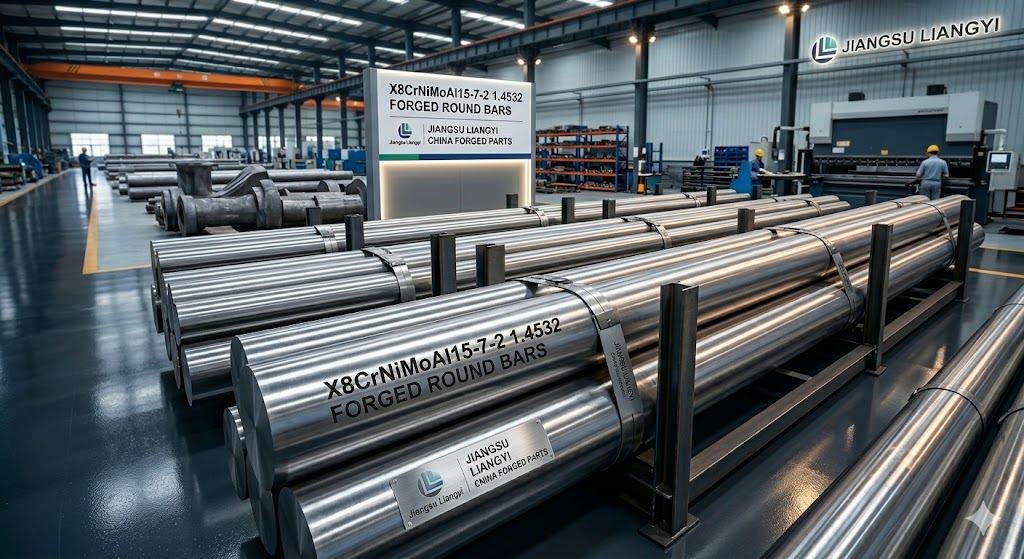
Our factory covers an area of 80,000 m² with an annual manufacturing capacity of 120,000 tons, capable of producing 1.4532 forged parts ranging from 30 kg to 30,000 kg per piece. We provide complete one-stop solutions from steel melting, forging, heat treatment to precision machining, serving customers in more than 50 countries worldwide.
What Is X8CrNiMoAl15-7-2 (1.4532 / 1.4574)?
X8CrNiMoAl15-7-2 (EN material numbers 1.4532 and 1.4574) is a semi-austenitic precipitation hardening (PH) stainless steel. It is a molybdenum-modified variant of X7CrNiAl17-7 (17-7PH, EN 1.4568), in which 2% Molybdenum replaces 2% Chromium. This substitution delivers significantly higher tensile strength at elevated temperatures, superior resistance to stress corrosion cracking, and improved resistance to reducing acids and chloride-containing environments compared to standard 17-7PH.
The alloy is distinguished by its ability to be formed in a soft austenitic condition (Condition A, ~896 MPa UTS) and subsequently hardened through low-temperature precipitation heat treatments – producing minimal dimensional distortion while developing ultimate tensile strengths exceeding 1,310 MPa (Condition CH900). So that it is the best choice material for intricate, precision-important parts in power generation, oil & gas, and aerospace applications.
Available X8CrNiMoAl15-7-2 Forged Product Shapes & Dimensions
We manufacture a full range of 1.4532 forged steel products in all kinds of shapes and custom dimensions to meet your specific project requirements:
- Forged Bars: Round bars (up to 2,000 mm diameter), square bars, flat bars, rectangular bars and rods
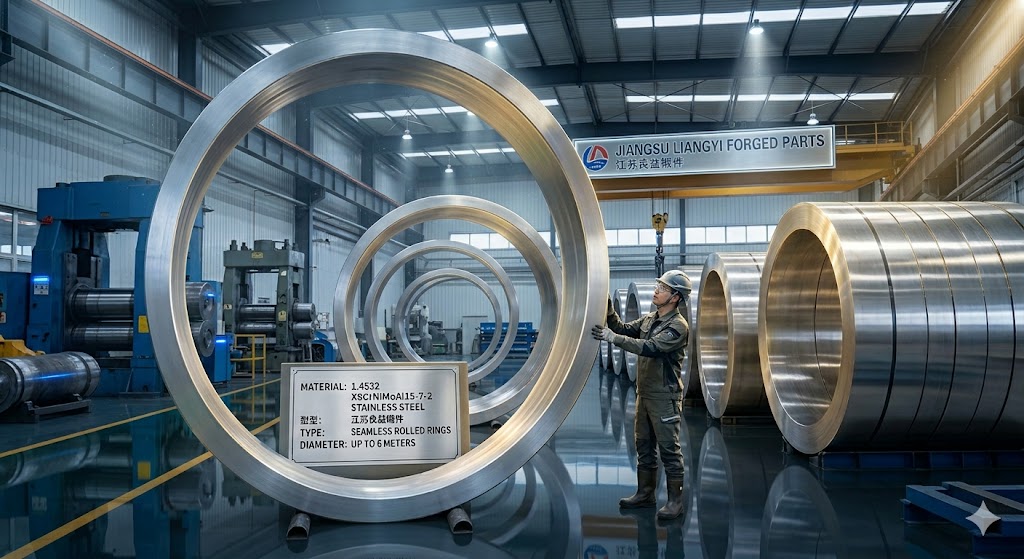
- Seamless Rolled Rings: Custom forged rings up to 6 meters in diameter and 30 tons in weight
- Forged Shafts: Step shafts, turbine shafts, pump shafts and propeller shafts up to 15 meters in length
- Hollow Components: Hubs, housings, shells, sleeves, bushes and hollow bars up to 3,000 mm OD
- Flat Products: Discs, disks, blocks and plates up to 3,000 mm diameter
- Pipe Products: Pipes, tubes, tubings, shells, casings and barrels for pressure applications
- Valve Components: Valve bodies, bonnets, stems, seat rings, balls and discs
Industrial Applications of 1.4532 (X8CrNiMoAl15-7-2) Forgings
X8CrNiMoAl15-7-2 is a precipitation hardening stainless steel specifically designed for applications needing high strength, good toughness and moderate corrosion resistance at elevated temperatures. Our 1.4574 forged parts are widely used in the following important industries:
Power Generation Industry
- Gas and steam turbine disks, impellers and blisks for thermal power plants
- Turbine blades and flat rectangular bars for gas compressor parts
- Turbine guide rings, seal rings, labyrinth rings and diaphragm seals
- Rotor end rings and casing rings for power generation equipment
- Nuclear power reactor coolant pump rotor impellers and casing shells
- Containment seal chambers for nuclear reactor coolant pump systems
Oil & Gas and Petrochemical Industry
- High-pressure valve balls, valve bonnets, valve bodies and valve stems
- X8CrNiMoAl15-7-2 valve seat rings, valve cores and valve discs
- Components for H-type two-way, one-way and back pressure valves
- Ball valves, check valves and gate pump parts for oilfield applications
- Pipes, tubes, shells and tubing for high-pressure vessels and reactors
- Tube sheets, nozzles and channel flanges for boilers and heat exchangers
- Heater parts and process equipment for petrochemical plants
Aerospace Industry
- High-strength valve parts and fuel tanks for aircraft systems
- CNC machined parts and precision tooling
- Structural parts needing excellent strength-to-weight ratio
- Engine parts operating at moderate elevated temperatures
Marine Industry
- Marine ship and boat propeller shafts for commercial and naval vessels
- Marine engine parts and valve systems
- Shipboard piping and pressure vessel parts
Downhole Drilling Industry
- Downhole drilling tool mud motor splined drive shafts
- Downhole electric submersible pumps (ESP) motor splined shafts
- Drilling equipment parts needing high strength and wear resistance
Turbomachinery and Pump Industry
- Turbo centrifugal compressor impellers and shrouded impellers
- Pump casing covers, pump barrels and pump impellers
- 1.4574 forged pump shafts, pump housings and pump wear rings
- Double-headed studs, fasteners and bolts for industrial equipment
Material Properties & Advantages of X8CrNiMoAl15-7-2 (1.4532, 1.4574)
1.4532 is a molybdenum-modified version of 17-7 stainless steel, with 2% Molybdenum substituted for 2% Chromium. This composition results in significantly higher room and elevated temperature strength compared to standard 17-7PH.
Main Manufacturing Advantage: X8CrNiMoAl15-7-2 can be formed in a soft austenitic condition and then hardened to high strength levels through low-temperature precipitation heat treatments. This process results in minimal distortion compared to conventional quench and temper hardening, making it ideal for complex precision parts.
Superior Corrosion Resistance
This steel offers better stress corrosion cracking resistance and improved resistance to reducing acids and chloride-containing solutions than 1.4568 (17-7PH) steel. It is resistant to acids and chlorides commonly found in river water and sufficiently resistant to ammonia and nitrogen tetroxide at mild temperatures.
Chemical Composition (wt%) – EN 10088 / AMS 5529
| Element | Range (wt%) |
|---|---|
| Iron (Fe) | 69.58 – 76.75 (balance) |
| Chromium (Cr) | 14.0 – 16.0 |
| Nickel (Ni) | 6.5 – 7.75 |
| Molybdenum (Mo) | 2.0 – 3.0 |
| Aluminum (Al) | 0.75 – 1.5 |
| Manganese (Mn) | ≤ 1.0 |
| Silicon (Si) | ≤ 1.0 |
| Carbon (C) | ≤ 0.09 |
| Phosphorus (P) | ≤ 0.04 |
| Sulfur (S) | ≤ 0.04 |
Mechanical Properties – Condition A (Solution Annealed)
| Property | Metric | English |
|---|---|---|
| Hardness, Rockwell B | 88 HRB | 88 HRB |
| Tensile Strength, Ultimate (UTS) | 896 MPa | 130,000 psi |
| Tensile Strength, Yield (0.2% Proof) | 372 MPa | 54,000 psi |
| Elongation at Break | 35% | 35% |
| Modulus of Elasticity | 200 GPa | 29,000 ksi |
| Poisson's Ratio | 0.27 – 0.30 | 0.27 – 0.30 |
Mechanical Properties by Heat Treatment Condition – Full Data Table
The mechanical properties of X8CrNiMoAl15-7-2 (1.4532) vary significantly depending on the applied heat treatment condition. The table below shows the typical minimum mechanical properties for each standard delivery condition, allowing engineers to select the optimal condition for their specific application. All values are for forged bar products tested in the longitudinal direction at room temperature (20°C).
| Condition | UTS (MPa) | YS 0.2% (MPa) | Elongation A₅ (%) | Reduction of Area (%) | Hardness |
|---|---|---|---|---|---|
| A (Solution Annealed) | 896 | 372 | 35 | 65 | 88 HRB |
| T (75°C Transform) | 1,000 | 793 | 20 | 55 | 30 HRC |
| R100 (–73°C Transform) | 1,069 | 827 | 20 | 52 | 32 HRC |
| TH1050 | 1,170 | 1,000 | 14 | 50 | 37 HRC |
| RH950 | 1,241 | 1,103 | 10 | 45 | 40 HRC |
| C (Cold Worked) | 1,241 | 965 | 8 | 30 | 40 HRC |
| CH900 (Peak Strength) | ≥ 1,310 | 1,172 | 6 | 25 | 43 HRC |
Engineering Selection Note: For structural components where ductility and toughness are just as important as strength — such as turbine discs and valve bodies subjected to cyclic loading — Condition TH1050 provides the best overall balance: a tensile strength (UTS) of 1,170 MPa, combined with 14% elongation and 50% reduction in area. When maximum fatigue strength is the top priority, with acceptable reduced ductility, Condition RH950 or CH900 is specified. Jiangsu Liangyi's engineering team is available to advise on the optimal condition for your specific load case and operating environment.
Physical & Thermal Properties of X8CrNiMoAl15-7-2 (1.4532)
Accurate physical property data is essential for structural analysis, thermal modelling and equipment design. The following table presents the verified physical properties of 1.4532 (X8CrNiMoAl15-7-2) across a range of temperatures relevant to its principal industrial applications. Note that physical properties are largely independent of the heat treatment condition.
| Property | Value at 20°C | Value at 200°C | Value at 315°C | Unit |
|---|---|---|---|---|
| Density | 7.78 | 7.74 | 7.71 | g/cm³ |
| Modulus of Elasticity | 200 | 193 | 186 | GPa |
| Mean Thermal Expansion (from 20°C) | – | 10.6 × 10⁻⁶ | 11.0 × 10⁻⁶ | /°C |
| Thermal Conductivity | 14.8 | 16.5 | 17.9 | W/(m·K) |
| Specific Heat Capacity | 460 | 502 | 524 | J/(kg·K) |
| Electrical Resistivity | 0.80 | 0.93 | 1.01 | μΩ·m |
| Poisson's Ratio | 0.27 – 0.30 | 0.27 – 0.30 | 0.27 – 0.30 | – |
| Melting Range | 1,400 – 1,440°C | °C | ||
| Magnetic Permeability (Condition A) | ~1.5 | – | – | μᵣ (relative) |
| Magnetic Permeability (Hardened) | 5 – 40 | – | – | μᵣ (relative) |
Important design note on magnetic behaviour: In Condition A, X8CrNiMoAl15-7-2 is semi-austenitic and exhibits low magnetic permeability (μᵣ ≈ 1.5), so that it is suitable for applications that need near-non-magnetic performance. After precipitation hardening, the transformation to a martensitic microstructure increases the permeability to 5–40 μᵣ, depending on the specific condition. Engineers designing for magnetic field-sensitive environments (such as MRI adjacent equipment and marine navigation instruments) must explicitly specify the condition when placing an order.
Corrosion Resistance of 1.4532 (X8CrNiMoAl15-7-2)
The corrosion behaviour of X8CrNiMoAl15-7-2 is a direct result of its chemical composition: the 14–16% chromium content forms the foundation of the passive oxide layer, while the addition of 2–3% molybdenum significantly enhances its resistance to pitting, crevice corrosion, and attack by reducing acids — a main limitation of molybdenum-free precipitation hardening grades such as 17-7PH (1.4568) and 17-4PH (1.4542).
Pitting Resistance Equivalent Number (PREN)
The PREN is a calculated index used to rank the relative pitting resistance of stainless steels in chloride-containing environments:
PREN = %Cr + 3.3 × %Mo + 16 × %N
For X8CrNiMoAl15-7-2 at nominal composition (15% Cr, 2.5% Mo, ~0% N):
PREN ≈ 15.0 + (3.3 × 2.5) = 15.0 + 8.25 = ~23.3
By comparison: 17-7PH (1.4568) PREN ≈ 17.0 | 17-4PH (1.4542) PREN ≈ 16.5
The molybdenum in 1.4532 contributes +8.25 PREN points versus Mo-free PH grades, representing a significant and measurable improvement in pitting resistance.
Performance in Specific Environments
| Environment / Medium | Performance | Notes |
|---|---|---|
| Atmospheric (rural/urban) | ✅ Excellent | Passive film stable; minimal maintenance required |
| Fresh water / River water | ✅ Excellent | Resistant across all heat treatment conditions |
| Seawater / Brine (aerated) | 🟡 Moderate | CH900 or RH950 preferred; avoid crevice conditions; consider cathodic protection for extended immersion |
| Dilute H₂SO₄ (<10%, ambient) | 🟡 Improved vs 17-7PH | Mo addition provides measurable benefit; concentration and temperature dependent |
| Dilute HCl (<2%, ambient) | 🟡 Limited | Better than 17-7PH; not recommended for prolonged immersion above 2% concentration |
| Dilute HNO₃ (oxidising) | ✅ Good | Chromium passivation effective in oxidising acids |
| Ammonia (NH₃, mild temp.) | ✅ Resistant | Suitable for ammonia-containing process streams at moderate temperatures |
| Nitrogen tetroxide (N₂O₄) | ✅ Resistant (mild temp.) | Used in aerospace propellant systems; qualified per applicable aerospace standards |
| Stress Corrosion Cracking (SCC) | ✅ Better than 17-7PH | Mo addition and lower Cr content reduce SCC susceptibility in chloride environments; CH900 condition shows best SCC resistance |
| Concentrated HCl / H₂SO₄ | ❌ Not recommended | Concentrated reducing acids will attack the passive layer; specify higher-alloyed grades (e.g. duplex or super-austenitic) for these environments |
Passivation: After any machining, grinding or welding, all 1.4532 forged parts is given passivation treatment per ASTM A967 to restore and optimise the protective chromium oxide passive layer. This step is particularly recommended for parts used in chloride-bearing or mildly acidic environments.
International Standards & Material Equivalents
There are many international standards that cover X8CrNiMoAl15-7-2 (1.4532 / 1.4574). Here are the main standards and their approximate equivalent grades to help engineers and procurement teams make sure that specifications are the same across regions:
| Standard System | Designation / Grade | Document |
|---|---|---|
| European (EN) | X8CrNiMoAl15-7-2 / 1.4532 / 1.4574 | EN 10088-3, EN 10250-4 |
| German (DIN) | X8CrNiMoAl15-7-2 | DIN 17224 |
| American (AMS) | AMS 5529 (sheet/strip), AMS 5812 (bar/forgings) | SAE AMS |
| American (ASTM) | ASTM A564 Grade XM-25 (approx.) | ASTM A564 / A693 |
| Military (US) | MIL-S-25043 | DoD |
| UNS | S15700 (nearest, 15-7Mo PH) | ASTM DS-56 |
Material Comparison: X8CrNiMoAl15-7-2 vs. 17-7PH vs. 17-4PH
The following comparison helps engineers choose the right precipitation hardening grade for their application:
| Property / Feature | X8CrNiMoAl15-7-2 (1.4532) | 17-7PH (1.4568) | 17-4PH (1.4542) |
|---|---|---|---|
| UTS (peak condition) | ≥ 1,310 MPa (CH900) | ≥ 1,240 MPa (CH900) | ≥ 1,310 MPa (H900) |
| Cr content | 14 – 16% | 16 – 18% | 15.5 – 17.5% |
| Mo content | 2 – 3% ✓ | None | None |
| Elevated-temp. strength | Superior | Good | Moderate |
| Stress corrosion cracking resistance | Excellent | Good | Moderate |
| Resistance to reducing acids | Superior (Mo addition) | Moderate | Moderate |
| Typical applications | Turbine discs, valve seats, downhole tools | Springs, diaphragms, structural parts | Pump shafts, fittings, medical |
| EN material number | 1.4532 / 1.4574 | 1.4568 | 1.4542 |
Heat Treatment Process for 1.4532 (X8CrNiMoAl15-7-2)
The heat treatment process for 1.4532 (1.4574, X8CrNiMoAl15-7-2) forging material consists of three main stages:
- Austenite conditioning at elevated temperature
- Controlled cooling to transform austenite to martensite
- Precipitation hardening at low temperature to develop final properties
The material is typically supplied from the mill in Condition A (solution annealed). After fabrication, an austenite conditioning treatment is performed, followed by a transformation treatment to either Condition T or Condition R100. The material is then subjected to precipitation hardening to either Condition TH 1050 or Condition RH 950, so as to develop fully usable mechanical properties. For applications that need the highest possible strength, the material in Condition A is transformed into martensite at the mill through cold reduction, resulting in Condition C. After the customer completes the fabrication process, hardening to Condition CH 900 can be achieved with a single low-temperature heat treatment.
Heat Treatment Conditions Summary
| Condition | Treatment Route | Aging Temp. | Approx. UTS | Typical Use |
|---|---|---|---|---|
| A | Solution anneal only | – | 896 MPa | Supplied state, forming |
| T | A → 75°C / 8 hr | – | Intermediate | Pre-hardening |
| R100 | A → –73°C | – | Intermediate | Pre-hardening |
| TH1050 | T → 566°C / 90 min | 566°C (1050°F) | ~1,170 MPa | Moderate strength |
| RH950 | R100 → 510°C / 90 min | 510°C (950°F) | ~1,240 MPa | High strength |
| C | Cold work at mill | – | ~1,241 MPa | Maximum strength base |
| CH900 | C → 482°C / 60 min | 482°C (900°F) | ≥ 1,310 MPa | Highest strength |
Weldability & Machining Guidelines for 1.4532 (X8CrNiMoAl15-7-2)
Weldability
X8CrNiMoAl15-7-2 (1.4532)can be welded using all standard fusion welding processes. However, since the alloy gains its strength through precipitation hardening, the design of the weld joint and the strategy for post-weld heat treatment (PWHT) must be carefully considered. This is to restore the full mechanical properties of both the heat-affected zone (HAZ) and the weld metal.
| Parameter | Recommendation | Reason |
|---|---|---|
| Preferred welding state | Condition A (solution annealed) | Soft austenitic state minimizes HAZ hardening and cracking risk; allows subsequent full PWHT |
| Recommended processes | GTAW (TIG), PAW, GMAW (MIG) | Low heat input processes preserve HAZ toughness; GTAW preferred for precision components |
| Filler metal – matching | Composition matched to X8CrNiMoAl15-7-2 base metal | Ensures weld metal responds consistently to PWHT; full base metal properties achievable |
| Filler metal – alternative | AWS ER630 (17-4PH type) or Inconel 625 | Inconel 625 used where weld metal ductility is prioritised over strength matching |
| Preheat temperature | Not required for Condition A <25 mm section | Austenitic microstructure not susceptible to hydrogen-induced cracking; preheat may be applied for thick sections ≥ 25 mm |
| Interpass temperature | ≤ 150°C maximum | Excessive interpass temperature promotes sensitisation and reduces post-weld toughness |
| Post-weld heat treatment | Full solution anneal + precipitation harden per required condition | Restores both weld metal and HAZ to specified mechanical properties; joint efficiency typically 90–95% of base metal |
| Welding in hardened condition | Not recommended without engineering review | Risk of HAZ cracking and unpredictable property distribution; if unavoidable, use low heat input and Inconel 625 filler |
Machining Guidelines
The machinability of1.4532 (X8CrNiMoAl15-7-2) depends heavily on the heat treatment condition. Condition A — the solution-annealed state, in which the material is typically rough-machined — has a machinability index of about 45–55% relative to free-machining AISI 1212 carbon steel. The main challenges in machining are its significant work-hardening tendency and the formation of built-up edge (BUE) on cutting tools.
| Parameter | Carbide Insert (Uncoated/TiN) | Carbide Insert (TiAlN Coated) |
|---|---|---|
| Cutting speed (Vc) | 30 – 50 m/min | 45 – 65 m/min |
| Feed rate (f) | 0.15 – 0.25 mm/rev | 0.15 – 0.30 mm/rev |
| Depth of cut (ap) | 1.5 – 3.5 mm | 2.0 – 4.0 mm |
| ISO grade | P20 / P30 | P20 / M20 |
| Coolant | Water-soluble emulsion (8–10%) or neat cutting oil – strongly recommended; flood application preferred | |
Machining Best Practices for 1.4532
- Maintain constant feed: Never allow the tool to dwell or rub on the workpiece surface. The work-hardening rate of 1.4532 in Condition A is higher than conventional austenitic stainless steels; any rubbing without cutting will harden the surface ahead of the tool and cause rapid tool wear.
- Use rigid setups: Minimize tool overhang and workpiece vibration. Chatter accelerates work hardening and degrades surface finish.
- Rough machine before final heat treatment: Perform the majority of material removal in Condition A, leaving 0.5–1.5 mm stock per face for finish machining after precipitation hardening.
- Finish machining in hardened condition: For CH900 and RH950 conditions (38–43 HRC), switch to CBN (cubic boron nitride) or ceramic inserts and reduce cutting speed to 15–25 m/min. Minimal stock removal at this stage reduces tool cost significantly.
- Drilling and tapping: Use cobalt high-speed steel (HSS-Co) or solid carbide drills; use form taps rather than cutting taps where possible. Cutting fluid application is important for tapping to prevent seizing.
- Surface finish achievable: Ra 1.6 µm or finer on final machined surfaces is routinely achieved with sharp inserts, correct cutting parameters and flood coolant in Condition A material.
Quality Testing Standards & Assurance
All our X8CrNiMoAl15-7-2 forged steel parts is given rigorous testing and inspection according to international standards to make sure all parts have the highest quality and reliability:
- ASTM E10-12: Brinell hardness testing
- ASTM A370-12: Mechanical testing of steel products
- ASTM E23-07a: Notched bar impact testing
- AMS 2315G: Delta ferrite content determination
- ASTM E45-05: Inclusion content determination
- ASTM E112-10: Average grain size determination
- ASTM E837: Residual stresses measurement by hole-drilling strain-gage method
- 100% Ultrasonic Testing (UT) and Magnetic Particle Testing (MT) as required
We provide complete Mill Test Certificates (MTC) EN 10204 3.1 / 3.2 with every shipment, and third-party inspection services (SGS, Bureau Veritas, TÜV, Lloyds Register) are available upon request.
Our Manufacturing Process: From Steel Melt to Finished 1.4532 Forging
Jiangsu Liangyi operates a fully integrated manufacturing chain forX8CrNiMoAl15-7-2 (1.4532) forged components. Every stage of production is carried out in-house at our 80,000 m² facility in Jiangyin, enabling us to have full control over product quality, traceability and delivery schedule. The nine-stage process below details how a raw material inquiry is transformed into a certified, ready-to-ship forged part.
Stage 1 – Steel Melting & Refining
Premium-grade raw materials — including selected low-residual stainless steel scrap, iron, chromium, nickel, molybdenum ferro-alloys and high-purity aluminum — are charged into ourElectric Arc Furnace (EAF). The molten metal is then transferred to an Argon Oxygen Decarburisation (AOD) vessel for precise carbon removal and chemical composition adjustment, making sure it meets the strict compositional range required by EN 10088 and AMS 5529 standards. For applications needing ultra-low gas content, we can arrange Vacuum Induction Melting (VIM)and Vacuum Arc Re-melting (VAR) through our qualified partner mills upon your request. Before the molten metal is tapped, its chemical composition is verified by optical emission spectrometry (OES).
Stage 2 – Ingot Casting & Homogenization
Refined steel is cast into ingots weighing 500 kg to 35,000 kg using bottom-pour technology, which helps minimize macro-segregation. The ingots are then subjected to a high-temperature homogenization soak at 1,150–1,230°C for 8–24 hours (the exact duration depends on the ingot cross-section). This process is designed to dissolve the solidification segregation of chromium, molybdenum, and aluminum — elements that have a strong tendency to segregate during the solidification process. This step is important to get consistent chemical composition and, ultimately, mechanical properties across large-cross-section forgings.
Stage 3 – Primary Forging (Billet or Preform)
Homogenized ingots are reheated to the forging temperature range of 1,050–1,180°C and processed on our 6,300-ton hydraulic press to produce billets, slabs, or near-net preforms. We apply progressive reduction ratios of ≥ 4:1 (typically 6:1 to 10:1 for important applications) to break down the as-cast dendritic grain matrix into a refined wrought microstructure, which improves mechanical properties, toughness, and ultrasonic inspectability. Throughout the entire forging process, forging temperatures are monitored using infrared pyrometry to guarantee stability and consistency.
Stage 4 – Ring Rolling or Open Die Forging to Shape
Depending on the final product shape, billets are processed either on our 5-metre radial-axial ring rolling mill (capable of producing seamless rolled rings with an outer diameter of up to 6,000 mm) or returned to the hydraulic press for open-die forging of bars, shafts, discs, blocks, and hollow sections. The ring rolling process imparts additional grain refinement through circumferential and axial deformation, resulting in rings with excellent grain flow orientation parallel to the ring face — this is the ideal grain flow direction for resisting hoop stresses during service.
Stage 5 – Solution Annealing (Condition A)
All 1.4532 forgings undergo solution annealing at 1,040–1,065°C, followed by rapid air or water quenching to dissolve any precipitates formed during forging and place the material in the fully austenitic, solution-annealed Condition A. The temperature uniformity across the furnace load is maintained within ±8°C, which is verified by calibrated thermocouples. This heat treatment ensures a uniform, homogeneous austenitic starting microstructure for all subsequent fabrication and heat treatment operations, while also delivering the highest machinability for downstream processing.
Stage 6 – Rough Machining & Intermediate Inspection
Condition A forgings are rough-machined using CNC lathes, vertical turning lathes (VTLs) or machining centres to near-net dimensions, with 0.5–1.5 mm stock left per face for final finishing after precipitation hardening. An intermediate Coordinate Measuring Machine (CMM) dimensional inspection is conducted to confirm that dimensional tolerances are maintained, and to identify any forging-related geometric deviations early—before precipitation hardening makes further material removal more challenging. An intermediate surface inspection (combining visual inspection and dye penetrant testing) is also carried out at this stage.
Stage 7 – Precipitation Hardening Heat Treatment
Parts are heat treated to the specified delivery condition in our ten computer-controlled heat treatment furnaces. Temperature uniformity is maintained within ±5°C throughout the effective working zone, which is verified by calibrated thermocouples and documented under our ISO 9001:2015 quality management system. Each furnace cycle is recorded and archived to ensure full traceability. We offer the complete range of standard delivery conditions in-house: Condition A, T, R100, TH1050, RH950, C and CH900. Additionally, non-standard aging temperatures and times can be developed in collaboration with the customer to meet specific mechanical property targets.
Stage 8 – Non-Destructive Testing (NDT)
Every X8CrNiMoAl15-7-2 forged part is given a structured NDT programme executed by our qualified NDT personnel:
- Ultrasonic Testing (UT): 100% volumetric scanning based on ASTM A388 or EN 10228-3. Acceptance based on the standards set by the customer or the project.
- Magnetic Particle Testing (MT): For surface and near-surface breaks, full surface coverage is required by ASTM E1444 or EN 10228-1.
- Dye Penetrant Testing (PT): Available as an alternative to MT, or for non-magnetic Condition A material. Performed per ASTM E165 or EN 10228-2.
- Dimensional & Visual Inspection: Full CMM dimension test against drawing. Surface finish measurement per customer specification.
Stage 9 – Final Machining, Certification & Dispatch
We only do the final machining to make sure the drawing dimensions are met after all of the Non-Destructive Testing (NDT) has been passed.The achievable surface finishes are as specified: Ra 3.2 µm (semi-finish), Ra 1.6 µm (finished), or Ra 0.8 µm (fine finish). Passivation treatment based on ASTM A967 is also available upon request. Before dispatch, each 1.4532 forged part is accompanied by a complete documentation package, which includes: Mill Test Certificate (MTC) conforming to EN 10204 3.1 or 3.2, heat treatment records, dimension test report, NDT reports, and material certificates for all raw materials used. Upon request, third-party witness and certification services by SGS, Bureau Veritas, TÜV, or Lloyds Register are available at any stage of the production process.
Why Choose Jiangsu Liangyi as Your 1.4532 Forging Supplier in China?
Advanced Manufacturing Capabilities
- Full range of service from steel melting to machining
- Advanced forging equipment including 6,300-ton hydraulic press and 5-meter seamless rolling machine
- Ten heat treatment furnaces for precise temperature control
- Comprehensive machining facilities for finished parts
Quality & Certification
- ISO 9001:2015 certified quality management system
- State-of-the-art inspection and testing equipment
- Full traceability from raw material to finished product
- Parts produced to the requirements of international standards including ASTM, AMS, DIN and EN
Global Service & Support
- 25+ years of experience serving global industrial customers
- Exported to more than 50 countries in Europe, North America, Asia and the Middle East
- Competitive pricing and reliable delivery times
- Custom solutions tailored to your specific requirements
- Responsive technical support and after-sales service
Global Project References
We have provided our 1.4532 forged parts for many important projects:
- Supplied X8CrNiMoAl15-7-2 turbine discs for thermal power plants in Southeast Asia
- Provided valve parts for oil and gas projects in the Middle East
- Manufactured high-integrity parts for the energy sector for customers in Europe
- Supplied marine propeller shafts for international shipbuilding companies
- Delivered pump parts for petrochemical plants in North America
Frequently Asked Questions (FAQ)
X8CrNiMoAl15-7-2 is a semi-austenitic precipitation hardening (PH) stainless steel, designated by EN material numbers 1.4532 and 1.4574. It is a molybdenum-modified variant of 17-7PH (1.4568), with a chemical composition including 14–16% chromium (Cr), 6.5–7.75% nickel (Ni), 2–3% molybdenum (Mo), and 0.75–1.5% aluminum (Al). Compared with standard 17-7PH, the addition of molybdenum significantly improves the elevated-temperature strength, resistance to stress corrosion cracking, and boosts resistance to reducing acids.
1.4532 and 1.4574 are basically the same material, but they are called different things in different EN standards. The X8CrNiMoAl15-7-2 precipitation hardening stainless steel is the same in both cases, with the same chemical makeup and mechanical properties.
We can produce 1.4532 forged parts up to 30,000 kg (30 tons) per piece. For round bars, the maximum diameter is 2,000 mm. For seamless rolled rings, the maximum diameter is 6 meters. For shafts, the maximum length is 15 meters. For hollow parts, the maximum OD is 3,000 mm.
Yes, we can provide custom heat treatment services to meet the specific mechanical properties required for your application. We are capable of supplying materials in all standard conditions, including Condition A, T, R100, TH1050, RH950, C, and CH900. Additionally, we can develop custom heat treatment protocols to fully meet the project-specific requirements of your application, making sure the material performance meets perfectly with your needs.
We provide complete Mill Test Certificates (MTC) complying with EN 10204 3.1 as standard. For customers with higher inspection requirements, EN 10204 3.2 certificates—accompanied by third-party inspection from authoritative institutions (including SGS, Bureau Veritas, TÜV, and Lloyds Register)—are available upon request. We hold ISO 9001:2015 certification, and all parts we produce meet the requirements of international standards, including ASTM, AMS, DIN, and EN.
The lead time depends on the drawings, size and quantity of the parts. For standard shapes and sizes, the typical lead time is 3–4 weeks. For custom parts, the lead time is usually 6–8 weeks. We also can speed up production for urgent orders.
X8CrNiMoAl15-7-2 (1.4532) has significantly higher strength at elevated temperatures than 17-7PH (1.4568), thanks to its 2% molybdenum addition. Compared with 17-4PH (1.4542), it has better resistance to stress corrosion cracking and superior performance in reducing acid environments. This material is suitable for turbine parts, valve seat rings, and downhole tools—applications where elevated-temperature performance is important. For detailed differences in material properties, please refer to the comparison table above.
X8CrNiMoAl15-7-2 is covered by multiple standards: it meets EN 10088-3 and EN 10250-4, corresponding to EN material numbers 1.4532 and 1.4574; it also meets the requirements of DIN 17224, AMS 5529 (for sheet, strip, and plate) and AMS 5812 (for bar and wire forgings). Additionally, it is approximately equivalent to ASTM A564 Grade XM-25, and its nearest UNS designation is UNS S15700 (15-7Mo PH), which also meets the requirements of the military specification MIL-S-25043.
Yes. X8CrNiMoAl15-7-2 is weldable using GTAW (TIG), GMAW (MIG), and PAW processes. The main requirement is to perform welding in Condition A (the solution-annealed state) and apply a full post-weld heat treatment (re-solution annealing + precipitation hardening) to restore the base metal properties across the weld joint. For filler metal, we recommend using one that is composition-matched to the base metal for full property restoration; alternatively, AWS ER630 (17-4PH type) can be used as a substitute. Inconel 625 filler is employed in applications where weld metal ductility is prioritized over strength. The interpass temperature must be maintained at or below 150°C. After proper post-weld heat treatment, the joint efficiency is typically 90–95% of the base metal.
In Condition A (solution-annealed), the 1.4532 stainless steel has a machinability index of about 45–55% relative to free-machining AISI 1212 steel.Recommended turning parameters for carbide inserts (TiAlN coated, ISO P20/M20) are as follows: cutting speed 45–65 m/min, feed rate 0.15–0.30 mm/rev, and depth of cut 2.0–4.0 mm. The use of flood coolant (water-soluble emulsion with a concentration of 8–10%) is strongly recommended.This alloy exhibits rapid work-hardening characteristics, so it is crucial to maintain a consistent feed rate to avoid tool rubbing and excessive work hardening.For finish machining under fully hardened conditions (CH900, RH950), switch to CBN (Cubic Boron Nitride) or ceramic tooling, and reduce the cutting speed to 15–25 m/min to guarantee machining quality and tool life.
At 20°C: density is 7.78 g/cm³; thermal conductivity is 14.8 W/(m·K); specific heat capacity is 460 J/(kg·K); coefficient of thermal expansion (mean, 20–315°C) is 11.0 × 10⁻⁶/°C; electrical resistivity is 0.80 µΩ·m. Modulus of elasticity is 200 GPa at 20°C, reducing to 186 GPa at 315°C. These physical properties are largely independent of the heat treatment condition.
The Pitting Resistance Equivalent Number (PREN = %Cr + 3.3 × %Mo) for X8CrNiMoAl15-7-2 at its nominal composition is about 23.25 (15% Cr + 3.3 × 2.5% Mo).This compares favorably with 17-7PH (1.4568, PREN ≈ 17.0, Mo‑free) and 17-4PH (1.4542, PREN ≈ 16.5, Mo‑free).
The 2–3% molybdenum content in 1.4532 adds over 8 PREN points compared to molybdenum‑free precipitation‑hardening grades,resulting in significantly better resistance to pitting, crevice corrosion and degradationin chloride‑bearing and mildly reducing environments.
Contact Us for X8CrNiMoAl15-7-2 Forging Quotation
We are glad to provide the best price and superior quality 1.4532 (1.4574, X8CrNiMoAl15-7-2) forged steel materials for global clients. Welcome to send your custom drawing, material requirement and quantity for a detailed quotation!
📧 Inquiry Email: sales@jnmtforgedparts.com
📞 Phone / WhatsApp: +86-13585067993
🌐 Website: https://www.jnmtforgedparts.com
📍 Address: Chengchang Industry Park, Jiangyin City, Jiangsu Province, China