WB36 (ASTM A335 Grade P36) Forging Overview
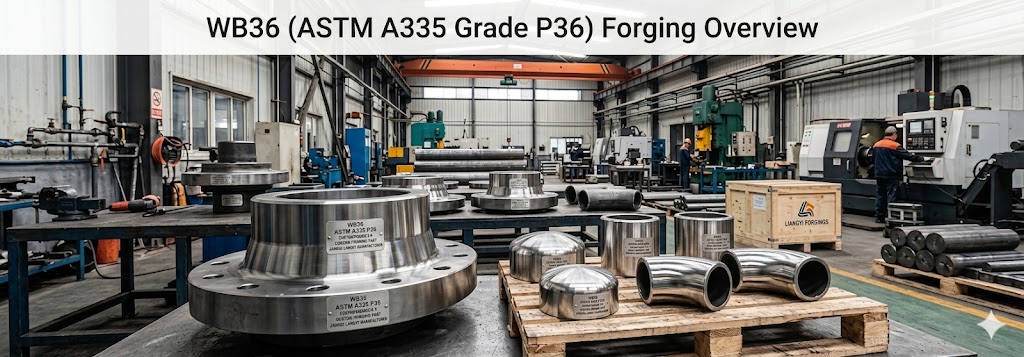
Jiangsu Liangyi is a professional manufacturer based in China with more than 20 years of experience in custom WB36 (15NiCuMoNb5-6-4, T36, P36, ASTM A335 Grade P36) open die forged parts, seamless rolled rings, precision machined parts and tailor-made forged steel products for key industrial fields worldwide. We have delivered over 10,000 tons of WB36 alloy steel forgings to more than 50 countries, cooperating with leading companies in the energy, petrochemical and nuclear industries.
WB36 is a high-performance niobium microalloyed low-alloy steel. It is widely acknowledged for outstanding high-temperature creep resistance, stable mechanical performance under heat, good low-temperature impact toughness and reliable corrosion resistance in water and steam service environments. This material is the best choice material for high-pressure and high-temperature working conditions in thermal power, nuclear power, petrochemical and oil and gas projects, fully conforming to European EN standards as well as American ASTM and ASME specifications.
Our WB36 forged parts are produced in our ISO 9001:2015 certified plant and fully comply with EN 10222-2, ASTM A335 and ASME requirements. All forgings come with complete material documents and NDT test reports following EN 10204 and EN 10228 series standards. We offer one-stop customized service covering raw material smelting through final finished machining, fully meeting the technical demands of global industrial projects. Explore our full range of forging materials for your project needs.
Understanding why WB36 (15NiCuMoNb5-6-4) outperforms conventional low-alloy steels in high-temperature service requires examining its four-component strengthening architecture — a combination that no single-mechanism steel can replicate at the same cost and weldability level.
1. Epsilon-Copper (ε-Cu) Precipitation Hardening: The Core Strength Mechanism
The most distinctive feature of WB36 compared to steels like P22 or P11 is its intentional addition of 0.50–0.80% copper. During the tempering cycle (580–680°C), copper — which has very limited solid solubility in the bcc ferrite matrix at service temperatures — precipitates as coherent, nanoscale epsilon-copper (ε-Cu) clusters with diameters typically between 2–5 nm. These coherent precipitates create lattice strain fields that impede dislocation movement, raising yield strength by approximately 80–120 MPa compared to a Cu-free steel of similar base composition.
These ε-Cu precipitates remain stable during long-term service up to approximately 480°C. Above this temperature, precipitate coarsening accelerates, which is why the upper recommended service limit of 500°C should be treated as a ceiling rather than a routine operating point. Our internal aging studies on WB36 forgings show that after simulated service of 100,000 hours at 450°C, tensile strength decreases by approximately 8–12% and yield strength by approximately 6–9% — values that responsible design codes account for through their elevated-temperature design stress curves.
Engineering Insight: Cu Content and FAC Corrosion Resistance
Beyond strength, the 0.5–0.8% Cu in WB36 provides a secondary but commercially critical benefit: significantly improved resistance to flow-accelerated corrosion (FAC) in deoxygenated high-temperature water and steam circuits. Research from European power utilities demonstrates that WB36 piping shows FAC wall-thinning rates 3–5× lower than plain carbon steel and about 2× lower than 0.3% Cr steel equivalents in boiler feedwater circuits at 150–250°C. This is why WB36 has largely replaced carbon steel in boiler feed pump suction pipework and extraction line piping throughout European power plants since the 1990s.
2. Niobium (Nb) Grain Refinement: The Toughness Enabler
The 0.015–0.045% niobium addition serves two interrelated functions. During hot forging and normalizing above 900°C, niobium forms fine Nb(C,N) carbonitride precipitates that pin austenite grain boundaries, preventing grain coarsening even during extended high-temperature forging operations. The result is a consistently fine austenite grain size (ASTM grain size 7–9), which directly translates to improved toughness in the final forged product.
During later tempering, leftover Nb(C,N) particles separate out in the ferrite structure and create extra secondary hardening. This effect works well with ε-Cu precipitation instead of counteracting it. This dual precipitation feature is unique to Nb-Cu steels such as WB36, and it is the main reason the material can reach high tensile strength above 590 MPa, keep elongation at no less than 16%, and maintain good low-temperature impact toughness of at least 40 J at −20 °C. Standard P22 steel cannot stably reach this balanced performance without sacrificing one mechanical property for another.
3. Nickel (Ni) Low-Temperature Toughness Stabilization
The 1.00–1.30% nickel content in WB36 serves primarily as a toughness stabilizer at sub-zero temperatures. Nickel lowers the ductile-to-brittle transition temperature (DBTT) of the ferritic matrix without significantly contributing to elevated-temperature creep strength. For WB36 forgings, this means consistent Charpy impact energy ≥27 J at −20°C is achievable even in large section forgings (wall thickness 100–300 mm), so that it is suitable for outdoor installations in cold-climate regions — a requirement many P22 forgings cannot meet without special heat treatment modifications.
4. Molybdenum (Mo) Solid Solution Creep Resistance
Molybdenum content at 0.25–0.50% strengthens the ferrite structure through solid solution hardening, and works especially well at high temperatures when regular dislocation strengthening becomes less effective. Mo atoms sit in replacement positions within the iron atomic grid and create small local structure distortions. These distortions slow down thermally activated dislocation movement, which is the main cause of creep deformation. When paired with strength hardening from ε-Cu precipitation, the solid solution effect of molybdenum lets WB36 keep steady creep strength up to 500°C. This performance is far better than the roughly 350°C practical limit of plain carbon steel, and also outperforms traditional 0.5% molybdenum steel used for steam pipeline parts.
Estimated Strengthening Contributions (NT State)
Ferrite base strength: ~280 MPa
Solid solution (Ni + Mo): +60–80 MPa
ε-Cu precipitation: +80–120 MPa
Nb grain refinement: +40–60 MPa
Typical total ReH: ~440–560 MPa
Key Alloying Elements and Primary Roles
Cu (0.50–0.80%): ε-Cu precipitation hardening + FAC resistance
Nb (0.015–0.045%): Grain refinement + secondary hardening
Ni (1.00–1.30%): Sub-zero toughness stabilization
Mo (0.25–0.50%): Solid solution creep resistance
WB36 vs. Alternative High-Temperature Alloy Steels: Direct Engineering Comparison
Selecting the right material for high-temperature pressure components requires understanding the specific trade-offs between candidate steels. The following comparison covers the four most commonly evaluated alternatives to WB36 in power generation and petrochemical engineering design:
WB36 vs Competing High-Temperature Alloy Steels — Key Engineering Parameters
| Parameter | WB36 / P36
(15NiCuMoNb5-6-4) | P22
(2.25Cr-1Mo) | P11
(1.25Cr-0.5Mo) | P91
(9Cr-1Mo-VNb) | Carbon Steel
(P265GH) |
|---|
| Max Recommended Temp. | 500°C | 580°C | 550°C | 625°C | 350°C |
| Creep Strength at 450°C (10⁵h) | ~100 MPa | ~75 MPa | ~55 MPa | ~180 MPa | <20 MPa |
| Carbon Equivalent Ceq (typical) | 0.42–0.50 | 0.60–0.70 | 0.45–0.55 | 0.65–0.80 | 0.30–0.40 |
| Preheat Required (≥25mm) | 100–150°C | 150–200°C | 100–150°C | 200–250°C | None / 50°C |
| PWHT Required? | Yes (580–680°C) | Yes (700–760°C) | Yes (650–700°C) | Yes (730–780°C) | Optional |
| Low-Temp Toughness (−20°C) | Excellent (≥27 J) | Moderate | Moderate | Limited | Good |
| FAC Corrosion Resistance | Very Good (Cu effect) | Poor | Poor | Good (Cr effect) | Very Poor |
| Type IV Cracking Risk | None | None | None | Significant | None |
| Relative Material Cost | Medium | Medium | Low-Medium | High | Low |
| Typical Application Window | Feedwater, boiler piping, FW heaters <500°C | Steam piping, reactor vessels 480–580°C | Low-alloy steam lines <550°C | Main steam >550°C | General pressure vessels <350°C |
Design Note: WB36 is not a universal replacement for P91 in main steam lines above 530°C. Its optimal application window is precisely the 400–500°C range where ε-Cu precipitation strengthening is most effective and where P91's more complex PWHT requirements and Type IV cracking risks are undesirable. For components in this temperature window with wall thicknesses under 150 mm, WB36 typically delivers the best combination of performance, fabricability, and cost.
When to Choose WB36 Over P22
The most common material selection decision our customers face is WB36 versus P22 for boiler and heat exchanger components in the 400–500°C range. In our 20+ years of supply experience, WB36 is the superior choice when: (1) the component contacts deoxygenated feedwater or condensate, as P22's near-zero copper content makes it vulnerable to FAC; (2) the installation site has winter temperatures below −10°C, where P22's toughness is less reliable; (3) the fabricator needs simpler welding procedures with lower preheat, as WB36's lower Cr content reduces hardenability; or (4) the design code requires compliance with EN 13480-3 or AD 2000 rules, where WB36's published design stress tables are directly available.
Full Range of WB36 Forging Products We Supply
We provide fully customized WB36 (ASTM A335 Grade P36) forged components tailored to your engineering drawings and project specifications. Our main product range includes:
🔧
Valve Forgings
WB36 forged valve bodies, bonnets, stems, seat rings, and discs for high-pressure gate valves, globe valves, check valves, power plant steam valves, and gas turbine bypass valves.
⭕
Rolled Rings & Flanges
T36 P36 Seamless Rolled Rings, Integral Flanges, Weld Neck Flanges, Double Studded Adapter Flanges and Custom Ring Forgings for Pressure Vessels and Piping Systems.
📏
Forged Bars & Shafts
WB36 forging round bars, square bars, flat bars, pump shafts, valve stems, and step shafts, with full ultrasonic testing to international standards.
- Pump Forged Components: ASTM A335 Grade P36 forged pump casings, impellers, housings, seal chambers, wear rings and suction jackets for high pressure industrial pumps and nuclear reactor coolant pumps.
- Pressure Vessel & Piping Forgings: WB36 forged pipes, tube sheets, nozzles, channel flanges, pressure vessel shells, lateral tees, T-pieces, wyes and reducers for high-pressure heat exchangers and boiler piping systems.
- Custom Special-Shaped Forgings: Hubs, sleeves, bushes, discs, blocks, plates, transition cones, venturi meter bodies and other custom machined components fully manufactured to your engineering drawings.
All WB36 forged parts can be supplied in as-forged, heat-treated, rough-machined, or fully finish-machined conditions. View our advanced forging and machining equipment to learn more about our production capabilities.
Why Open Die Forging Is the Correct Manufacturing Method for WB36 Components
Many procurement engineers ask why WB36 valve bodies, pump casings, and nozzle forgings should be specified as open die forgings rather than cast equivalents or plate-machined parts. The answer lies in the fundamental difference in microstructure that forging creates — and how that microstructure interacts with WB36's specific alloying system.
Forge Ratio and Its Effect on WB36 Mechanical Properties
Forging ratio — the ratio of cross-sectional area reduction from ingot to final forged section — is the primary variable controlling forged product quality. For WB36, our standard minimum forge ratio is 4:1, meaning the cross-sectional area is reduced to at least one-quarter of its original ingot area. This level of reduction serves three specific purposes for WB36:
- Elimination of dendritic Cu segregation: Dendritic segregation of Cu, Ni and Mo is observed in as-cast WB36 ingots. Copper is enriched in the interdendritic regions due to the much lower solidification temperature of copper with respect to iron, with local Cu enrichment reaching up to 1.5× the nominal, hampering uniform ε-Cu precipitation during heat treatment. A forge ratio of 4:1 effectively homogenizes these segregations through mechanical deformation and thermal diffusion to produce a chemically homogeneous cross-section which will respond predictably to heat treatment.
- Grain flow alignment: Forging produces a directional fibrous grain flow which follows the contours of the finished part. In valve bodies, the grain flow is typically aligned with the pressure boundary wall, which gives 15–25% better resistance to fatigue crack initiation perpendicular to the primary stress axis compared with machined-from-bar or cast counterparts. This is particularly significant for cyclic service applications such as steam turbine bypass valves which undergo thousands of thermal cycles in their service life.
- Closure of internal porosity: Even with advanced VD (vacuum degassing) melting, low-level porosity is unavoidable in as-cast ingots. The 4:1 forge ratio mechanically closes these voids under compressive deformation at forging temperature (1050–1200°C), creating a fully dense, defect-free structure that passes EN 10228-3 Class 3 or Class 4 ultrasonic acceptance criteria.
Optimal Forging Temperature Range for WB36
Forging WB36 correctly needs careful temperature management specific to its Cu-bearing composition. The recommended forging temperature window is 1050–1200°C at start and must be completed above 900°C. Starting below 1050°C risks incomplete Nb(C,N) dissolution and inadequate homogenization of Cu segregation. Finishing below 900°C risks strain hardening in the austenite that cannot be fully recovered during normalizing, producing coarser, less uniform grain structures.
A critical handling rule specific to WB36 is the copper precipitation window during cooling: between approximately 900°C and 700°C, free copper begins to diffuse to austenite grain boundaries if cooling is too slow. We control post-forging cooling rates using thermocoupled monitoring systems to ensure cooling through this range is completed uniformly. Large cross-section forgings (diameter >500 mm) are cooled in insulated boxes after forging to prevent excessive surface chilling, then transferred to preheat furnaces for subsequent heat treatment without full cooling — eliminating thermal shock risk and minimizing residual stress in large WB36 valve body forgings.
Forged vs. Cast WB36 — What Our Production Testing Shows
Based on comparative testing across more than 200 paired production lots over 15 years, our WB36 forgings consistently outperform cast equivalents on two critical metrics: (1) Charpy impact energy at −20°C averages 42–55 J for forgings versus 22–30 J for equivalent cast grades — a 70–90% improvement directly attributable to refined grain structure; and (2) UT rejection rate (EN 10228-3 Class 3) for forgings runs below 0.3% versus 2–4% for castings, dramatically reducing project risk for critical path components with long lead times.
Our Manufacturing Capabilities for WB36 Forgings
We have advanced in-house forging equipment, CNC machining centers, full-automatic heat treatment furnaces, and professional NDT testing labs to meet your custom WB36 forging needs from small precision prototypes to large heavy industrial forgings:
WB36 Forging Manufacturing Capabilities by Product Type
| Product Type | Max Manufacturing Range | Key Process Capabilities |
|---|
| Forged Bars/Rods/Shafts | Max weight: 25 tons; Max diameter: 1200mm; Max length: 16000mm | Open die forging, full UT, straightening, rough/fine machining, heat treatment |
| Seamless Rolled Rings | Max OD: 5000mm; Max height: 800mm; Max weight: 15 tons | Radial-axial ring rolling, seamless forming, heat treatment, full machining, NDT |
| Custom Shaped Forgings | Max weight: 30 tons; Max size: 8000mm | Open die forging, near-net shape forming, full-process customization, precision CNC |
| Full-Process Services | Raw material to finished product one-stop | EAF+LF+VD smelting, forging, heat treatment, machining, NDT, inspection, global delivery |
Dimensional Tolerances and Machining Allowances
Our standard machining allowances and dimensional tolerances for WB36 forgings minimize material waste while ensuring adequate stock for final machining and NDT inspection. Typical rough-machined dimensional tolerances: ±0.5 mm for diameters up to 500 mm; ±1.0 mm for 500–1200 mm; ±1.5 mm for above 1200 mm. Flatness of machined faces maintained within 0.1 mm/100 mm of surface length. For finish-machined components supplied to drawing dimensions, we achieve tolerances as tight as ±0.05 mm for critical bore and seat face dimensions on valve body forgings, verified by CMM coordinate measurement. All dimension inspection reports are included in the delivery documentation package.
WB36 Weldability, Preheat & Post-Weld Heat Treatment (PWHT) Engineering Guide
Weldability is a critical selection criterion for pressure components, and WB36's welding behavior differs meaningfully from both low-alloy chromium steels like P22 and high-chromium steels like P91. This section provides detailed, practical welding engineering guidance based on our fabrication experience and the requirements of EN ISO 15614-1, EN 13480-4, and ASME BPVC Section IX.
Carbon Equivalent and Cold-Cracking Risk Assessment
The carbon equivalent (Ceq) of WB36, calculated by the IIW formula [Ceq = C + Mn/6 + (Cr+Mo+V)/5 + (Ni+Cu)/15], typically falls between 0.42 and 0.50 for standard production heats. This places WB36 in the "moderate" cold-cracking risk category — lower than P22 (Ceq typically 0.60–0.70) but slightly higher than plain carbon steels. WB36 welds require controlled preheat and interpass temperature management but are significantly more tolerant of welding procedure deviations than Cr-Mo steels.
The specific contribution of Cu and Ni to the Ceq formula is worth noting. Because Cu and Ni appear in the denominator term "(Ni+Cu)/15" — far less critical than the "Cr/5" term — WB36's relatively high Ni+Cu content contributes much less to cold-cracking risk than an equivalent amount of chromium would. This is why WB36 behaves more like a 0.5% Mo steel than a 2.25Cr-1Mo steel in terms of welding procedure complexity, despite its higher overall alloy content.
WB36 Welding Parameters Reference Guide (EN 13480-4 / ASME B31.1 Basis)
| Parameter | Thin Section (<25 mm) | Medium Section (25–75 mm) | Heavy Section (>75 mm) |
|---|
| Preheat Temperature | 50–100°C | 100–150°C | 150–200°C |
| Max Interpass Temperature | 250°C | 250°C | 250°C |
| PWHT Temperature | 580–640°C | 600–660°C | 620–680°C |
| Min PWHT Hold Time | 1 hour | 1 hr/25mm (min 2h) | 1 hr/25mm (min 3h) |
| Heating Rate (above 300°C) | Min 80°C/hour for section >50mm; 150°C/hour for <50mm |
| Cooling Rate (to 300°C) | Max 100°C/hour for section >50mm; free cooling for <50mm |
| Recommended Filler (GTAW/TIG) | ER80S-Ni1, AWS A5.28, or matching WB36 composition wire |
| Recommended Electrode (SMAW) | E8018-G (AWS A5.5) low hydrogen, dried 350–400°C/1h before use |
| Post-PWHT Hardness Limit | Max 250 HV10 across weld, HAZ, and base metal (EN ISO 15614-1) |
The PWHT Embrittlement Window: A Critical Processing Detail
A welding engineering detail rarely documented in general WB36 data sheets — but essential for fabricators — is the copper precipitation embrittlement risk during PWHT temperature ramp-up. When WB36 weldments are heated slowly through the 350–550°C range, copper retained in supersaturated solid solution begins to precipitate at a rate that creates coarser, less coherent Cu precipitates than the optimal fine ε-Cu distribution achieved by rapid heating to the PWHT setpoint. This results in localized hardness increases of 15–25 HB in the heat-affected zone (HAZ), and in thick-section joints with high restraint, can contribute to stress relaxation cracking.
Our standard PWHT procedure for WB36 forgings and weldments specifies a controlled rapid heating rate of at least 80°C/hour through the 300–580°C range, followed by a controlled soak at 580–680°C. Post-PWHT components are examined by hardness traversal (HV10 across weld, HAZ, and base metal) to verify maximum hardness remains below 250 HV — the EN ISO 15614-1 acceptance limit for ferritic steel welds intended for pressure service.
Fabrication Alert for Heavy-Wall Components: For WB36 forgings with wall thickness exceeding 100 mm (typical for large valve bodies and pump casings), pre-weld buttering of weld preparation faces with a Ni-base butter layer (e.g., Alloy 82 or equivalent) is recommended when the component will later be welded to dissimilar stainless steel or Ni-alloy components. This buttering practice prevents diffusion of Cr from stainless filler into the WB36 HAZ during service, which can create a narrow carbide-enriched band accelerating Type II interface cracking in long-term elevated-temperature service. Please consult our technical team for specific buttering procedure recommendations for your application.
WB36 Allowable Design Stress Values Under Major Pressure Equipment Codes
One of the most practically useful — and rarely consolidated — pieces of information for pressure equipment designers is the allowable design stress values for WB36 under different international design codes. The following table compiles design stress values from EN 13480-3 (industrial piping), EN 13445-2 (pressure vessels), and AD 2000 Merkblatt W0/W10 (German pressure vessel code), which together govern the majority of WB36 applications in European power and process plants.
How to Use These Design Stress Values
The nominal design stress (f) values below represent the maximum allowable membrane stress at the specified temperature for standard base material, before any weld joint efficiency factors (z) or design pressure safety factors are applied. These values apply to normalized-and-tempered (NT) condition forgings meeting the minimum mechanical property requirements of EN 10222-2. Note that weld joint efficiency factors typically apply: z = 0.85 for single-sided welds without full RT, z = 1.0 for full-penetration double-sided welds with 100% RT examination.
WB36 Nominal Design Stress f (MPa) — EN 13480-3 / EN 13445-2 / AD 2000 W0 Basis (NT Condition)
| Temperature (°C) | EN 13480-3
(Industrial Piping) | EN 13445-2
(Pressure Vessels) | AD 2000 W0
(German PV Code) | Governing Design Criterion |
|---|
| 20°C | 186 | 167 | 175 | Rm / 2.4 or ReH / 1.5 |
| 100°C | 178 | 160 | 167 | Rp0.2(T) / 1.5 |
| 200°C | 165 | 149 | 156 | Rp0.2(T) / 1.5 |
| 300°C | 155 | 139 | 147 | Rp0.2(T) / 1.5 |
| 350°C | 148 | 133 | 141 | Rp0.2(T) / 1.5 |
| 400°C | 140 | 126 | 133 | Rp0.2(T) / 1.5 or creep (begins to govern) |
| 450°C | 112 | 101 | 107 | Creep limit controls |
| 480°C | 94 | 85 | 90 | Creep limit controls |
| 500°C | 83 | 75 | 79 | Creep limit controls |
Note: Values above are indicative reference values based on published EN and AD 2000 standard data for WB36 / 15NiCuMoNb5-6-4 in NT condition. Always verify against the current edition of the applicable design code and your notified body's requirements for the specific component class. For ASME applications (SA335 P36), consult ASME BPVC Section II Part D allowable stress tables directly.
Practical Wall Thickness Design Example: WB36 vs P22
As an example of the practical significance of these values, take a DN250 high pressure feedwater pipe operating at 200 bar design pressure and 430°C design temperature, made from WB36 forgings to EN 13480-3. An interpolated allowable design stress of about 125 MPa at 430°C and the standard pipe wall thickness formula (e = PD/2f + c, where c is the corrosion/erosion allowance of 3 mm) result in a needed minimum wall thickness of about 29 mm for an outer diameter of 323.9 mm.The equivalent calculation using P22 at 430°C (allowable stress approximately 100–105 MPa) yields approximately 34–35 mm required wall thickness — confirming that WB36's superior creep strength at this temperature directly translates to a 15–17% reduction in wall thickness, forging weight savings, and material cost reduction that can be significant across large piping systems.
Long-Term Service Performance and Microstructural Aging of WB36 Forgings
Power plant and petrochemical plant components made from WB36 are designed to operate for 30–40 years with minimal maintenance. Understanding how WB36's microstructure evolves during decades of elevated-temperature service is essential for plant life extension (PLEX) assessments, now routine for aging power plant fleets in Europe and North America.
Three Progressive Microstructural Processes During Long-Term Service
- ε-Cu Precipitate Coarsening (Rate-Controlling Process at 400–500°C): The nanoscale ε-Cu precipitates that provide WB36's primary strengthening mechanism coarsen during service according to Ostwald ripening kinetics. At 450°C, analysis of ex-service materials from European power plants indicates that precipitate radii grow from approximately 2–4 nm (as-heat-treated) to 8–15 nm after 100,000 hours. As precipitates coarsen beyond approximately 6–8 nm, their coherency with the iron matrix decreases, reducing dislocation-pinning effectiveness. The net effect is a gradual reduction in tensile strength of approximately 8–12% and yield strength of 6–9% over 100,000 hours at 450°C. These reductions are anticipated in design stress curve derivations and do not represent unexpected degradation.
- Nb(C,N) Stability — the Toughness Preservation Mechanism: Unlike M23C6 carbides in Cr-Mo steels that progressively coarsen during service, Nb(C,N) precipitates in WB36 are thermodynamically stable at temperatures below 550°C. Their contribution to grain boundary pinning remains largely intact throughout service life at 500°C and below. This is a key reason why WB36 does not experience the progressive loss of low-temperature toughness that affects some long-running P22 components — a factor that is increasingly important as aging European power plants conduct life extension assessments.
- Temper Embrittlement Monitoring: WB36, like most low-alloy ferritic steels, is susceptible to temper embrittlement if residual levels of phosphorus and antimony are elevated. Our steel melting specifications control P to ≤0.015% and Sb to ≤0.003% — significantly below the levels that accelerate temper embrittlement. For safety-critical applications requiring documented PLEX assessment, we provide the Bruscato J-factor [J = (Mn+Si)(P+Sn)×10⁴] and Watanabe X-factor values for specific heats on request, enabling engineering assessment of remaining toughness margin for plant life decisions.
Typical Strength Change After Long-Term Service at 450°C
10,000 hours: <3% strength reduction
30,000 hours: 3–5% reduction
60,000 hours: 5–8% reduction
100,000 hours: 8–12% reduction
Impact toughness: typically unchanged or slight improvement due to stress relaxation of residual stresses
Recommended Inspection Plan for WB36 Components (PLEX)
At 20 years / 150,000 MWh equivalent: Hardness survey, UT thickness measurement
At 30 years: Replication metallography + hardness, UT Class 3
At 40 years: Full NDE + temper embrittlement (J-factor) assessment
Ex-service material test certificate support available on request for PLEX assessments
Global Industry Applications & Verified Project Cases
WB36 (ASTM A335 Grade P36) forged parts are the main material choice for extreme industrial scenarios with strict requirements for high-temperature resistance, pressure resistance, and long-term safety. Following are real application cases from our 50+ country supply history:
Case 1: WB36 Forgings for European Supercritical Thermal Power Plants
We supplied custom WB36 forged valve bodies, bonnets, seamless forged pipes, and heat exchanger components for multiple 600MW+ supercritical thermal power plant projects of Germany, France, Poland, and the Netherlands. Components are used for high-pressure main steam and feedwater systems, and they will work for a long time at high temperatures up to 500°C. All products fully meet EN 10222-2 material standards and are supplied with EN 10204 3.1 inspection certificates. Selection of WB36 over P22 in feedwater circuits specifically deleted FAC-related maintenance events that had affected earlier carbon steel installations in the same plant zones. Components have been in stable operation for more than 10 years based on customer feedback.
Case 2: ASTM A335 Grade P36 Forgings for North American Nuclear Power Projects
Our ASTM A335 Grade P36 forged pump casings, seal chambers and shafts act as key parts for nuclear reactor coolant pump systems used in U.S. and Canadian projects. This material delivers dependable low-temperature impact performance with energy no less than 40 J at −20°C, and maintains stable structural performance under extreme working conditions to meet strict nuclear safety standards. All products undergo full 100% volumetric ultrasonic testing following ASME NB-2530 acceptance rules.We provide complete full-process material traceability records from raw melting to finished parts, including Bruscato J-factor data for temper embrittlement evaluation, which fully meet ASME regulatory guide requirements.
Case 3: WB36 Forged Components for Middle East Petrochemical & Oil & Gas Projects
We provided a full range of WB36 forged parts including tube sheets, channel flanges, high-pressure tees, and custom flanges for high-pressure heat exchangers and pipeline systems of large-scale petrochemical and crude oil transmission projects in Saudi Arabia, the UAE, and Oman.Components have to resist 350 bar operating pressures at up to 460°C continuous service. EN 10204 3.1 inspection certificates and customer-arranged third-party inspection are available per request. Design service life: 30 years with planned inspection intervals at 10-year intervals.
Case 4: T36 P36 Forgings for Global Industrial Flow Control & Measurement Equipment
We provide T36 P36 forged valve components, venturi cone meter bodies, and ultrasonic flow meter bodies to global leading flow control and measurement equipment manufacturers of Europe, North America, and Asia Pacific. The precision-forged WB36 components keep stable dimensional accuracy and mechanical properties under frequent temperature and pressure fluctuations. WB36's machinability (Brinell hardness 180–220 HB in NT condition) is well-suited to the tight bore tolerances (±0.05 mm) needed for flow measurement internals, which guarantees reliable operation of important industrial control and measurement systems with documented calibration stability over extended service periods.
WB36 (ASTM A335 Grade P36) Material Specifications
Steel Making Process
Our WB36 steel is produced via the advanced electric furnace (EAF) + ladle refining (LF) + vacuum degassing (VD) process, fully killed steel. The VD treatment is especially important for WB36: vacuum degassing removes dissolved hydrogen to below 2 ppm, preventing hydrogen-induced cold cracking in heavy-section forgings, and reduces total oxygen content to below 20 ppm, minimizing oxide inclusion density that could serve as fatigue crack initiation sites in cyclic service. Calcium treatment (Ca-Si wire injection) is applied where specified to modify MnS inclusions to globular CaS morphology, reducing anisotropy in impact properties for extra-thick sections. All raw materials are subject to strict incoming inspection with full heat-number traceability from melting to finished products.
Chemical Composition (Melting Charge, Weight %)
WB36 / 15NiCuMoNb5-6-4 Chemical Composition per EN 10222-2
| Element | EN 10222-2 Required Range | Our Factory Typical Control | Role in Alloy System |
|---|
| C (Carbon) | Max 0.17 | 0.10–0.15 | Base strength; kept low to optimize weldability and toughness |
| Si (Silicon) | 0.25–0.50 | 0.30–0.40 | Deoxidation; solid solution strengthening |
| Mn (Manganese) | 0.80–1.20 | 0.90–1.10 | Solid solution strengthening; hardenability |
| Ni (Nickel) | 1.00–1.30 | 1.05–1.20 | Low-temperature toughness; lowers DBTT |
| P (Phosphorus) | Max 0.025 | Max 0.015 | Residual; controlled low to minimize temper embrittlement |
| S (Sulfur) | Max 0.010 | Max 0.005 | Residual; controlled low to minimize MnS inclusion density |
| Cr (Chromium) | Max 0.30 | Max 0.20 | Residual; kept low to maintain weldability |
| Mo (Molybdenum) | 0.25–0.50 | 0.30–0.45 | Solid solution creep resistance at 400–500°C |
| Nb (Niobium) | 0.015–0.045 | 0.020–0.040 | Grain refinement via Nb(C,N) pinning; secondary hardening |
| Cu (Copper) | 0.50–0.80 | 0.55–0.75 | ε-Cu precipitation hardening; FAC corrosion resistance |
| Al (Aluminum) | Max 0.015 | Max 0.010 | Deoxidation; grain refinement; kept low to avoid Al₂O₃ inclusions |
| N (Nitrogen) | Max 0.020 | Max 0.015 | Nb(C,N) precipitate formation; controlled with Al addition |
| H (Hydrogen) | Not specified in standard | Max 2 ppm (VD control) | Minimized by VD to prevent flaking in heavy sections |
Mechanical Properties After Standard Heat Treatment
Normalized and Tempered (+NT) State
WB36 Mechanical Properties — Normalized and Tempered State
| Mechanical Property | EN 10222-2 Minimum Requirement | Our Factory Typical Guarantee |
|---|
| Tensile Strength (Rm) | 590–780 MPa | 610–750 MPa |
| Yield Strength (ReH / Rp0.2) | ≥420 MPa | ≥440 MPa |
| Elongation (A5) | ≥16% | ≥20% |
| Reduction of Area (Z) | ≥40% | ≥50% |
| Impact Energy (KV, +20°C) | ≥40 J | ≥60 J |
| Impact Energy (KV, 0°C) | ≥34 J | ≥50 J |
| Impact Energy (KV, −20°C) | ≥27 J | ≥40 J |
| Hardness | ≤240 HB | 180–220 HB |
| ASTM Grain Size | Not specified (EN) | ≥7 (typically 7–9) |
Quenched and Tempered (+QT) State
WB36 Mechanical Properties — Quenched and Tempered State
| Mechanical Property | EN 10222-2 Minimum Requirement | Our Factory Typical Guarantee |
|---|
| Tensile Strength (Rm) | 580–740 MPa | 600–720 MPa |
| Yield Strength (ReH / Rp0.2) | ≥410 MPa | ≥430 MPa |
| Elongation (A5) | ≥16% | ≥20% |
| Reduction of Area (Z) | ≥40% | ≥55% |
| Impact Energy (KV, +20°C) | ≥40 J | ≥65 J |
| Impact Energy (KV, −20°C) | ≥27 J | ≥45 J |
| Hardness | ≤230 HB | 170–210 HB |
High-Temperature Creep & Stress Rupture Properties (Reference Values)
WB36 High-Temperature Creep and Stress Rupture Properties
| Temperature (°C) | 1% Creep Limit (10⁴h, MPa) | 1% Creep Limit (10⁵h, MPa) | Stress Rupture Strength (10⁴h, MPa) | Stress Rupture Strength (10⁵h, MPa) |
|---|
| 400°C | 324 | 294 | 402 | 373 |
| 420°C | 306 | 263 | 368 | 325 |
| 450°C | 265 | 206 | 304 | 245 |
| 470°C | 212 | 151 | 242 | 175 |
| 500°C | 120 | 60 | 150 | 80 |
Recommended Long-Term Operating Temperature Range: −10°C to 500°C (14°F to 932°F)
Standard Heat Treatment Process for WB36 Forgings
We strictly control the full heat treatment process in our in-house fully-automatic heat treatment workshop to make sure WB36 forgings meet required mechanical properties, microstructure uniformity, and residual stress elimination requirements.
WB36 Standard Heat Treatment Process Parameters
| Heat Treatment Stage | Standard Temperature Range | Cooling Method | Key Metallurgical Control Points |
|---|
| Normalizing | 880–960°C (1616–1760°F) | Uniform air cooling | Uniform heating for full austenitization; Nb(C,N) partial dissolution; sufficient hold time for thick sections (>2 min/mm) |
| Quenching / Hardening | 880–960°C (1616–1760°F) | Water or oil quench | Fast, uniform cooling rate; full martensite transformation; monitor quench uniformity for thick sections to avoid banding |
| Tempering | 580–680°C (1076–1256°F) | Air cooling (controlled rate) | Hold time ≥2 hours; optimized ε-Cu precipitation and Nb(C,N) secondary hardening; avoid slow cooling through 300–550°C embrittlement window |
| Stress Relief Annealing (PWHT) | 550–585°C (1022–1085°F) | Slow controlled cooling | Post-weld or post-machining residual stress relief; verify max hardness <250 HB after treatment; rapid heating through 300–550°C range |
For components with wall thickness exceeding 200 mm, we extend normalizing and tempering hold times proportionally and use thermocoupled load monitoring to verify every point within the cross-section reaches the specified temperature range — an important control point that directly affects the uniformity of ε-Cu precipitation across thick sections. Furnace loading arrangements are designed to ensure uniform gas circulation and avoid radiation hot-spots from adjacent heater elements. All heat treatment cycles are archived with full temperature-time charts as part of the permanent quality record for each forging lot.
Full-Process Quality Control for WB36 Forgings
We use a strict 5-step quality control system in the entire production process to make sure every WB36 forging part meets your specifications and international standards:
- Raw Material Inspection: Complete chemical composition analysis (OES spectrometer) Ultrasonic test of raw steel ingots according to EN 10228-4 Mill certificates and heat number traceability EAF+LF+VD steelmaking Verification of hydrogen content (<2 ppm) for heavy sections
- Forging Process Control: Minimum 4:1 forge ratio verified by dimension logging, infrared pyrometer temperature monitoring throughout forging operation, post-forging dimensional check before heat treatment; cooling rate monitoring through the 900–700°C Cu precipitation window
- Heat Treatment Control: Fully-automatic PID temperature control furnaces with ±5°C accuracy; type K thermocouple load monitoring for thick sections; full time-temperature chart recording archived with each batch; post-PWHT hardness verification across all surfaces
- Machining & Dimensional Inspection: CNC precision machining to drawing tolerances; full dimensional inspection report per drawing; CMM coordinate measurement for complex valve body geometries; surface finish (Ra) verification for sealing faces and bore surfaces
- Final NDT & Performance Testing: 100% UT per EN 10228-3 Class 3 or Class 4; MT or PT for surface/near-surface defects; full mechanical test report (tensile, impact, hardness); elevated-temperature Rp0.2 testing available; final visual and dimension test before packing; Bruscato J-factor report available for PLEX projects
All WB36 forgings are 100% inspected before delivery, with complete quality documentation guaranteeing full traceability and compliance with your project requirements.
Inspection Standards & Quality Certifications
Applicable Production and Inspection Standards
For all WB36 (ASTM A335 Grade P36) forging parts, we strictly control the quality throughout the whole process, from raw material incoming inspection to finished product delivery. Our production and inspection is governed by the following international standards:
- EN 10222-2: Steel forgings for pressure purposes — Ferritic and martensitic steels with specified elevated temperature properties (primary material standard)
- ASTM A335 / ASME SA335: Standard Specification for Seamless Ferritic Alloy-Steel Pipe for High-Temperature Service
- EN 10228-1/-2/-3/-4: Non-destructive testing of steel forgings (MT, PT, UT, UT for austenitic stainless)
- EN ISO 6892-1/-2: Metallic materials — Tensile testing at ambient and elevated temperatures
- EN ISO 148-1: Metallic materials — Charpy pendulum impact test
- EN ISO 6506: Metallic materials — Brinell hardness test
- ISO 9001:2015: Quality management systems requirements
- EN 10204: Inspection documents (3.1 Manufacturer Certificate as standard; 3.2 Third-Party Certificate available upon customer arrangement with an accredited inspection body)
Official Inspection Documentation Provided
We provide complete quality documentation for all finished WB36 forged parts, including:
- EN 10204 3.1 Manufacturer Inspection Certificate as standard. EN 10204 3.2 Third-Party Inspection Certificate available upon customer arrangement with their preferred accredited inspection body (e.g. Bureau Veritas, SGS, TÜV, or equivalent)
- Full chemical composition analysis report (melting analysis + product check analysis by independent laboratory)
- Complete mechanical property test report (tensile, impact at −20°C, hardness, elevated-temperature Rp0.2 at service temperature if required by code)
- Full heat treatment report with time-temperature records for every furnace load
- 100% NDT reports: UT (EN 10228-3), MT or PT (EN 10228-1/-2) per order specification and acceptance class
- Full dimension test report and material traceability chain from ingot heat number to finished forging serial number
- Bruscato J-factor and Watanabe X-factor report for temper embrittlement assessment (available on request for PLEX/life extension projects)
- Weld procedure qualification records (WPS/PQR per EN ISO 15614-1 or ASME IX) if weld repairs are performed
Our manufacturing facility holds ISO 9001:2015 Quality Management System certification. We supply complete material and inspection documentation per EN 10204 and EN 10228 series standards, supporting our customers' own PED and ASME compliance obligations.
Frequently Asked Questions About WB36 Forgings
What is WB36 (ASTM A335 Grade P36) steel, and what makes it different from other low-alloy steels?
WB36 (15NiCuMoNb5-6-4, ASTM A335 Grade P36) is a niobium-microalloyed, copper-bearing low-alloy high-temperature steel. Its defining characteristic is a four-component strengthening mechanism: (1) ε-Cu nanoscale precipitation hardening from its 0.50–0.80% Cu addition, providing 80–120 MPa additional yield strength compared to Cu-free steels; (2) Nb(C,N) grain refinement ensuring fine austenite grain size (ASTM 7–9) and superior low-temperature toughness; (3) Ni solid solution strengthening for sub-zero impact performance down to −20°C; and (4) Mo solid solution creep resistance at 400–500°C. No other common pressure steel alloy combines all four mechanisms at WB36's cost and weldability level. The Cu content additionally provides documented resistance to flow-accelerated corrosion (FAC) in boiler feedwater systems — a benefit unavailable in Cr-Mo steels like P22 or P11.
What is the difference between WB36, P36, T36, and 15NiCuMoNb5-6-4?
All four designations describe the same alloy composition, just under different standard systems. WB36 and 15NiCuMoNb5-6-4 are European EN standard designations (EN 10222-2 for forgings, EN 10216-2 for seamless tubes). ASTM A335 Grade P36 is the American standard designation for seamless pipe and forged components. T36 (per ASTM A213) refers to seamless tubes of the same composition — the "T" prefix indicates tubes, "P" indicates pipe or forgings. Chemical composition and mechanical property requirements are essentially identical across EN and ASTM designations, with minor differences only in inspection documentation format. For ASME-coded equipment (BPVC Section VIII vessels, B31.1 piping), reference ASME SA335 P36. For EN 13480 or PED-certified equipment, reference EN 10222-2 / 15NiCuMoNb5-6-4. We can produce dual-standard certified forgings satisfying both EN and ASTM requirements simultaneously.
What is the maximum operating temperature for WB36 steel?
The recommended long-term operating range for WB36 is −10°C to 500°C (14°F to 932°F). At 500°C, the EN 13480-3 nominal design stress is approximately 83 MPa — the point at which creep limits fully govern the design. For applications routinely approaching 480–500°C, we recommend using the 500°C design stress value (rather than interpolating) to maintain conservative safety margins. Above 510°C, ε-Cu precipitate coarsening accelerates significantly, available creep strength drops steeply, and P91 (9Cr-1Mo-VNb) steels should be evaluated instead. At the lower end, WB36's Ni content ensures reliable impact toughness (≥27 J minimum; typically ≥40 J from our factory) at −20°C, with QT condition forgings sometimes qualifying down to −40°C for cold-climate outdoor installations after specific impact test qualification.
How does WB36 compare to P22 (2.25Cr-1Mo) for boiler and heat exchanger applications?
WB36 offers three specific advantages over P22 in the 400–500°C service range: (1) Higher creep strength — WB36's 1% creep limit over 10⁵ hours at 450°C is approximately 206 MPa versus ~160 MPa for P22, enabling 15–17% thinner walls and lighter components at the same design pressure; (2) FAC resistance — P22's near-zero Cu content gives no protection against flow-accelerated corrosion in deoxygenated water, while WB36's 0.5–0.8% Cu reduces FAC rates by 3–5× in identical boiler feedwater service conditions; (3) Easier welding — WB36's lower Ceq (~0.45 vs P22 ~0.65) allows lower preheat (100–150°C vs 150–200°C) and shorter PWHT cycles, reducing fabrication cost. P22 retains advantage over WB36 only above 500°C, where its higher Cr content provides superior creep strength — which is exactly why WB36 and P22 are often used in the same piping system, with WB36 for the feedwater circuits and P22 for the higher-temperature steam lines.
What are the WB36 preheat, interpass temperature, and PWHT requirements for welding?
WB36 welding parameters (EN 13480-4 basis): Preheat — 50–100°C for sections under 25 mm; 100–150°C for 25–75 mm; 150–200°C for over 75 mm. Maximum interpass temperature: 250°C. PWHT: 580–680°C, hold time 1 hour per 25 mm of wall thickness (minimum 2 hours). Critical processing requirement: heat through the 300–580°C range at a minimum rate of 80°C/hour to avoid the copper precipitation embrittlement window at 350–550°C. Recommended filler metals: ER80S-Ni1 or matching WB36 composition wire for GTAW/TIG; E8018-G low-hydrogen electrode (dried 350–400°C/1h) for SMAW. Post-PWHT hardness verification required: maximum 250 HV10 across weld, HAZ, and base metal. Weld procedures must be qualified per EN ISO 15614-1 or ASME BPVC Section IX for all pressure-retaining welds. For dissimilar-metal welds to stainless or Ni-alloy components, additional buttering procedure may apply — consult our technical team.
What design stress values are allowed for WB36 under EN 13480-3 and AD 2000?
Indicative nominal design stress (f) values for WB36 NT condition: EN 13480-3 — 186 MPa at 20°C, 165 MPa at 200°C, 155 MPa at 300°C, 140 MPa at 400°C, 112 MPa at 450°C, 83 MPa at 500°C. AD 2000 W0 — 175 MPa at 20°C, 156 MPa at 200°C, 133 MPa at 400°C, 107 MPa at 450°C, 79 MPa at 500°C. Above approximately 420°C, creep criteria govern rather than yield strength. These values apply before weld joint efficiency factors (z = 0.85 to 1.0 depending on weld class and radiography). For ASME applications (BPVC Section VIII), consult current Section II Part D tables for SA335 P36. Always verify values against the current edition of the applicable code for your specific component class and approval authority.
What happens to WB36 forgings during long-term service — is the material stable?
WB36 undergoes three predictable microstructural processes during long-term elevated-temperature service: (1) ε-Cu precipitate coarsening, which reduces tensile strength by approximately 8–12% and yield strength by 6–9% over 100,000 hours at 450°C — these reductions are anticipated in design code stress curves and do not represent unexpected degradation; (2) Nb(C,N) precipitate stability, which unlike M23C6 carbides in Cr-Mo steels remains largely intact below 550°C, preserving grain boundary pinning and low-temperature toughness throughout service life; (3) Potential temper embrittlement if residual P and Sb are elevated — we control P ≤0.015% and Sb ≤0.003% to minimize this risk, and provide Bruscato J-factor values for PLEX assessment on request. Overall, WB36 is a well-characterized, mature alloy with an extensive body of long-term service experience from European power plants dating back to the 1980s.
Why is WB36 preferred over carbon steel for boiler feedwater circuits?
The primary reason is flow-accelerated corrosion (FAC) resistance. In deoxygenated high-temperature water and steam (the condition in most boiler feedwater systems), carbon steel and low-Cr steels dissolve progressively at the pipe wall, creating wall thinning rates that can reach 1–3 mm/year at turbulent flow zones — elbows, tees, reducers, and orifice-downstream sections. WB36's 0.5–0.8% Cu content forms a protective adherent Cu₂O / Cu passive film on the steel surface in contact with deoxygenated water, reducing the dissolution rate by 3–5× compared to carbon steel in the same service condition. For typical feedwater piping with 20–25 mm original wall thickness, this difference can mean the gap between needing wall thickness inspection at 10-year intervals versus annual inspection and replacement planning — a significant difference in maintenance cost and plant availability over a 30-year plant life.
What NDT methods apply to WB36 forgings?
NDT methods applied to WB36 forgings per EN 10228 series: (1) Ultrasonic Testing (UT) — 100% volumetric UT per EN 10228-3, Class 3 (standard pressure equipment) or Class 4 (nuclear and critical applications); sensitivity calibrated using flat bottom hole (FBH) reference reflectors; (2) Magnetic Particle Testing (MT) — surface and near-surface defect detection per EN 10228-1; WB36's ferritic microstructure is well-suited for MT examination; (3) Liquid Penetrant Testing (PT) — surface-breaking defect detection per EN 10228-2; used for complex geometries or areas with limited MT pole-spacing access; (4) Hardness Testing — Brinell hardness survey (HBW) with minimum 5 indentations per piece across all accessible surfaces; (5) Radiographic Testing (RT) — available for specific geometries where weld area volumetric evaluation is required by code. All NDT performed by EN ISO 9712 Level 2 or Level 3 certified personnel with written, pre-approved NDT procedures reviewed against the applicable acceptance standard for each order.
Can you supply WB36 forgings to both EN 10222-2 and ASTM A335 P36 simultaneously?
Yes. The chemical composition and mechanical property requirements of EN 10222-2 (15NiCuMoNb5-6-4) and ASTM A335 P36 / ASME SA335 P36 are essentially equivalent. We can make one heat that will meet both standards at the same time and provide dual-stamped inspection certificates for both EN 10222-2 and ASTM A335 specifications. This is particularly valuable in worldwide EPC projects where the same component is required to meet the European (PED) and American (ASME) code requirements – a common requirement in LNG, refinery and nuclear projects with multi-jurisdiction regulatory compliance needs. Please specify dual-standard requirements at the RFQ stage so that we can confirm the exact certificate format and amend the inspection plan if necessary.
What is the lead time for custom WB36 forging parts?
Lead times depend on complexity, quantity, and inspection requirements.For normal forged bars and rings (rough-machined, 3.1 certificate), the lead time is 15–20 working days.For complex custom components with finish machining, CMM dimensional report, and 3.2 third-party inspection, the lead time is 25–35 working days.For large heavy forgings (weight >5 tons) that need extended heat treatment and UT per EN 10228-3 Class 4, the lead time is 35–50 working days. We also can speed up production for urgent orders.Lead time commences from receipt of confirmed purchase order, approved drawings, and initial payment.We strongly recommend early-stage engagement for critical-path items to allow schedule optimization within project timelines.
What is the minimum order quantity (MOQ) for WB36 forgings?
MOQ for custom components is 1 piece – we regularly support single piece prototype orders for development projects and supplier qualification trials. The price is quantity dependent on repeat production orders. We support single-piece engineering samples with full EN 10204 3.1 certification and large-scale continuous supply contracts for long-term EPC project procurement. Customers with ongoing WB36 requirements across multiple projects or maintenance programmes can call off contracts with agreed annual volume pricing.
What standards and certifications do your WB36 forgings comply with?
Our forging parts for WB36 meet EN 10222-2, ASTM A335, ASME SA335 and related international standards and are produced in accordance with our ISO 9001:2015 certified quality management system. All forgings are manufactured under our ISO 9001:2015 certified quality management system. Standard EN 10204 3.1 inspection certificates are provided and EN 10204 3.2 third party certificates can be provided on request with your choice of accredited independent bodies.Full NDT reports per EN 10228 series are provided. Bruscato J-factor (temper embrittlement) reporting is available for PLEX and life-extension project applications upon request.
What about packaging and shipping for WB36 forged parts?
We provide export-standard wooden cases, pallets, or crates with VCI (volatile corrosion inhibitor) anti-rust treatment suitable for sea, air, and land transport. Critical machined surfaces are protected with rust-preventive oil and foam padding; threaded connections are plastic-capped. For oversized forgings (single piece >3 tons), we arrange custom cribbing and blocking in open-top or flat-rack containers. We keep long-term freight partnerships for routes to Europe, North America, and the Middle East, and can arrange CIF, DDP, or DAP incoterms with door-to-door delivery to your factory or project site. Full shipping documentation package: commercial invoice, packing list, certificate of origin, all quality and inspection reports, and customs export declaration — ready to submit for any project import clearance requirements.
Inquire About Your Custom WB36 Forging Requirements Today
Send us your detailed engineering drawings and specifications — our professional technical and sales team will provide a competitive quote and full technical support within 24 hours.
Get a Free Custom Quote Now