UNS N08028 (Alloy 28 / Sanicro 28) Forging Parts | China Jiangsu ISO-Certified Manufacturer
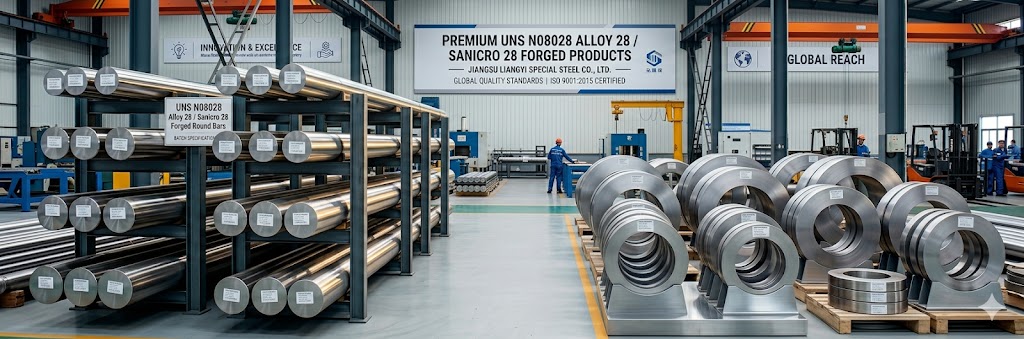
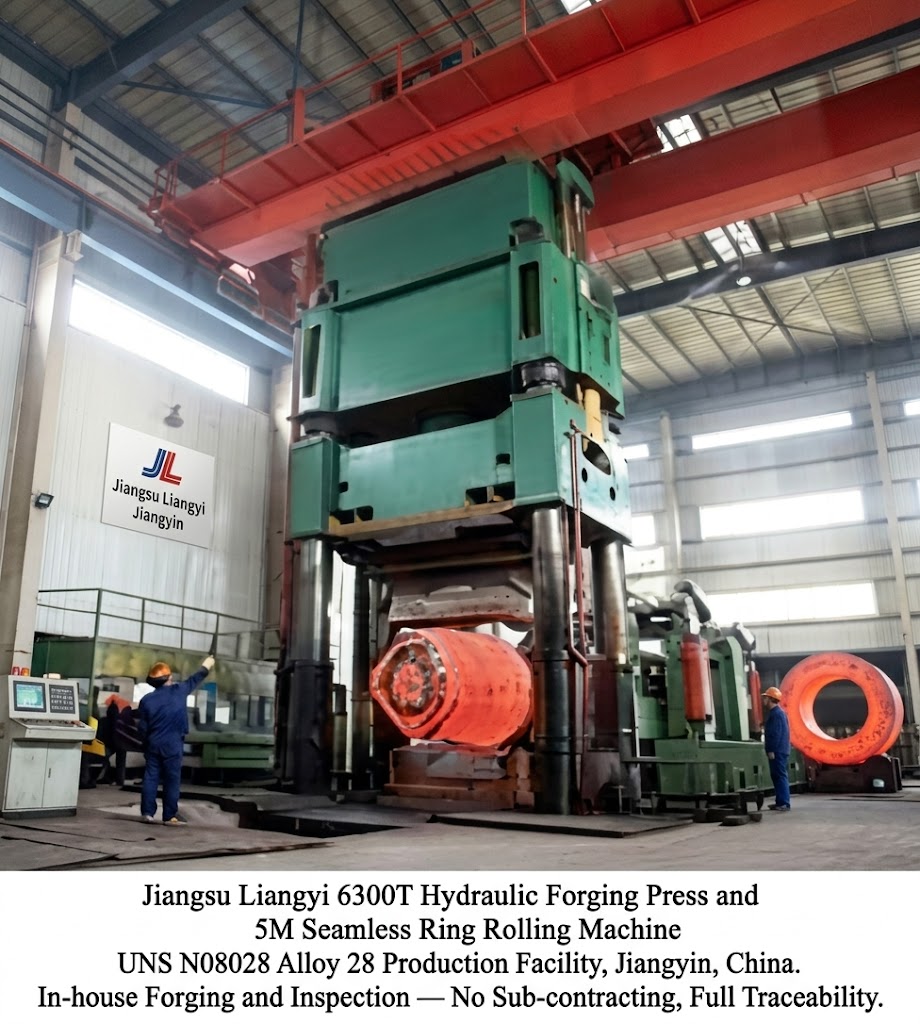
Jiangsu Liangyi Co., Limited is an ISO 9001:2015 certified open die forging manufacturer located in Jiangyin, Jiangsu Province, China. We produce UNS N08028 (Alloy 28 / Sanicro 28) forgings in-house from ingot melting through final NDT — no subcontracting at any stage. Our production equipment includes three hydraulic presses (2,000T, 4,000T, 6,300T), a 30T EAF–LF–VOD melting line, and five seamless ring rolling machines (1M to 5M). Single-piece weight range: 30 kg to 30 tons. We have been supplying corrosion-alloy forgings to industrial clients across 50+ countries for over 25 years.
✉ Request a Free Quotation TodayAbout UNS N08028 (Alloy 28 / Sanicro 28) Nickel-Based Alloy
UNS N08028 — Quick Reference Facts
- UNS Designation
- N08028
- Common Trade Names
- Alloy 28, Sanicro 28
- Material Type
- High-alloy austenitic nickel-iron-chromium alloy
- Ni Content
- 30.0 – 32.0%
- Cr Content
- 26.0 – 28.0%
- Mo Content
- 3.0 – 4.0%
- PREN
- ≥ 38 (vs. 316L ~26, 2205 ~34)
- Max Continuous Temp.
- 350°F (175°C)
- Min Tensile Strength
- ≥ 500 MPa (72.5 ksi)
- Min Yield Strength
- ≥ 214 MPa (31 ksi)
- Sour Service Standard
- NACE MR0175 / ISO 15156
- Material Standard
- ASTM B668 / ASME SB668
UNS N08028 is an austenitic nickel-iron-chromium alloy sold commercially as Alloy 28 and as Sanicro 28™ (a registered trademark of Outokumpu). It is positioned between 2205 duplex and Alloy 625 in the corrosion-alloy hierarchy: higher chloride and sour-gas resistance than 316L or 2205, at a lower cost per kilogram than Alloy 625 or 276. The composition is built around four elements: 30–32% Ni for austenite stability and acid resistance; 26–28% Cr for passive film stability in H₂S and chloride environments; 3–4% Mo for crevice corrosion resistance in reducing acids; and 0.6–1.4% Cu, which reduces anodic dissolution rates in sulfuric and phosphoric acid. Material performance depends on correct forging reduction ratio, controlled heat treatment cooling rate, and proper HAZ thermal management during any subsequent welding.
Technical Basis for Selecting Alloy 28 Over Lower-Alloy Alternatives
UNS N08028 is specified when 316L or 2205 duplex have failed in service or are disqualified by NACE MR0175 hardness limits. The four performance characteristics that differentiate it are:
- Sour service resistance — The 26–28% Cr content forms a stable passive film that limits hydrogen uptake at the metal surface, reducing susceptibility to SSC and SOHIC. In the solution-annealed condition (HRC ≤33), the alloy meets ISO 15156 Part 3 requirements for H₂S environments without the cold-working restrictions applied to some other alloys. It passes NACE TM0177 Method A and Method D testing at H₂S partial pressures that cause conditional or outright failures in duplex grades.
- Pitting and crevice corrosion resistance — PREN (= %Cr + 3.3×%Mo + 16×%N) for N08028 is ≥38, compared with ~26 for 316L and ~34 for 2205. In standardised 6% FeCl₃ testing, the alloy does not initiate pitting at temperatures where both 316L and 2205 fail. CPT (Critical Pitting Temperature) is 40–50°C, giving useful passive-film stability in seawater cooling circuits and chloride-containing process streams at near-ambient temperatures.
- Mineral acid resistance — The 0.6–1.4% Cu addition suppresses anodic dissolution in sulfuric and phosphoric acid environments. This is particularly relevant in wet-process phosphoric acid (WPA) service, where the combined H₃PO₄–HF–Cl⁻ stream at 70–85°C produces corrosion rates in N08028 that are consistently 20–40× lower than 316L under equivalent conditions. Measured corrosion rate in 55% H₃PO₄ at 80°C with HF and Cl⁻: <0.1 mm/year for N08028, vs 2–8 mm/year for 316L.
- Hot workability in heavy sections — N08028 forges consistently at section sizes up to 600 mm equivalent diameter on our 6,300T press. A multi-step forging sequence is used to achieve ≥4:1 reduction ratio through the full cross-section, not only at the surface. This is verified by measuring before and after cross-sectional dimensions and recording the calculated reduction ratio on the route card for each piece.
UNS N08028 vs. Common Alloy Alternatives — Performance Comparison
| Property | UNS N08028 (Alloy 28) | 316L Stainless Steel | 2205 Duplex | Alloy 825 (N08825) |
|---|---|---|---|---|
| PREN (Pitting Resistance) | ≥ 38 | ~26 | ~34 | ~32 |
| Ni Content | 30–32% | 10–14% | 4.5–6.5% | 38–46% |
| Sour Service (NACE MR0175) | ✓ Excellent | Limited | Good | Good |
| H₂SO₄ / H₃PO₄ Resistance | Excellent | Poor–Moderate | Moderate | Good |
| Max Continuous Temp. | 175°C (350°F) | 800°C* | 280°C | 450°C |
| Min Tensile Strength | 500 MPa | 485 MPa | 620 MPa | 586 MPa |
* 316L retains oxidation resistance at high temperatures but loses corrosion resistance in sour/chloride environments. PREN comparison is for corrosion-critical applications.
Chemical Composition of UNS N08028 (Alloy 28)
Chemical composition is verified at two points: at the furnace tap using a direct-reading optical emission spectrometer, and again on the cast billet before forging begins. Both results are referenced on the EN 10204 3.1 certificate. Composition limits below are per ASTM B668 and ASME SB568. The function column identifies the primary corrosion mechanism each element controls:
| Chemical Element | Weight Percentage Range | Core Technical Function |
|---|---|---|
| Ni (Nickel) | 30.0 – 32.0% | Enhances austenite stability, improves acid corrosion resistance, and mitigates stress corrosion cracking |
| Cr (Chromium) | 26.0 – 28.0% | Improves oxidation resistance, H₂S resistance, and pitting corrosion resistance in chloride environments |
| Fe (Iron) | 21.0 – 22.0% | Balances material cost while maintaining structural strength and thermal stability |
| Mo (Molybdenum) | 3.0 – 4.0% | Enhances crevice corrosion resistance and improves strength in reducing acid environments |
| Cu (Copper) | 0.6 – 1.4% | Significantly improves corrosion resistance in sulfuric acid and phosphoric acid media |
| C (Carbon) | Max 0.02% | Ultra-low carbon to avoid intergranular corrosion after welding and heat treatment |
| Mn (Manganese) | Max 2.0% | Improves hot workability and deoxidation performance during steelmaking |
| S (Sulfur) | Max 0.03% | Low sulfur ensures material purity, weldability, and fatigue resistance |
| Si (Silicon) | Max 0.70% | Acts as a deoxidizer, improves molten steel fluidity, and enhances material cleanliness |
Mechanical Properties of Forged UNS N08028 (Sanicro 28)
Minimum values below are per ASTM B564 / ASME SB564 and EN 10222-5 for the solution-annealed condition. The annealed yield strength (≥214 MPa) is lower than cold-worked 316L or 2205 duplex — this is correct for the fully austenitic, low-carbon microstructure, and both the tensile-to-yield ratio and elongation meet ASME BPVC Section VIII Division 1 allowable stress requirements. Test coupons are taken from the forging itself at the ¼-thickness location, not from a separate test block:
| Mechanical Property | Metric Unit Value | Imperial Unit Value | International Test Standard |
|---|---|---|---|
| Tensile Strength (Annealed) | ≥ 500 MPa | ≥ 72.5 ksi | ASTM E8 / EN ISO 6892-1 |
| Yield Strength (Annealed, 0.2% Offset) | ≥ 214 MPa | ≥ 31 ksi | ASTM E8 / EN ISO 6892-1 |
| Elongation at Break | ≥ 40% (Annealed) / ≥ 15% (Cold Worked) | ≥ 50% (Annealed) / ≥ 15% (Cold Worked) | ASTM E8 / EN ISO 6892-1 |
| Modulus of Elasticity | 200 GPa | 29,000 ksi | ASTM E111 |
| Hardness (Annealed) | HRB 80–90 / HRC ≤ 33 | ASTM E18 | |
Physical & Thermophysical Properties of UNS N08028 (Alloy 28)
All values are for the solution-annealed condition at 20°C unless noted. Two parameters are particularly relevant for equipment design: thermal conductivity (12.0 W/(m·K)) is approximately one-third of carbon steel, which affects furnace soak time calculations and heat exchanger duty; thermal expansion coefficient (14.7 × 10⁻⁶/°C) is roughly 30% higher than carbon steel, which must be accounted for in flange and piping connection design where N08028 components mate with carbon steel:
| Physical Property | Value (Metric) | Value (Imperial) | Notes |
|---|---|---|---|
| Density | 8.1 g/cm³ | 0.293 lb/in³ | Annealed condition, 20°C |
| Melting Range | 1,330 – 1,390°C | 2,426 – 2,534°F | Solidus to liquidus |
| Thermal Conductivity | 12.0 W/(m·K) at 20°C 16.5 W/(m·K) at 200°C |
6.9 BTU/(hr·ft·°F) at 68°F 9.5 BTU/(hr·ft·°F) at 392°F |
Increases with temperature |
| Thermal Expansion Coefficient | 14.7 × 10⁻⁶ /°C (20–100°C) 15.3 × 10⁻⁶ /°C (20–200°C) |
8.2 × 10⁻⁶ /°F (68–212°F) 8.5 × 10⁻⁶ /°F (68–392°F) |
Mean value over range |
| Specific Heat Capacity | 500 J/(kg·K) at 20°C | 0.12 BTU/(lb·°F) | Annealed, room temperature |
| Electrical Resistivity | 1.00 μΩ·m (1.00 × 10⁻⁶ Ω·m) | 39.4 μΩ·in | At 20°C, annealed |
| Modulus of Elasticity (E) | 200 GPa at 20°C 185 GPa at 200°C |
29,000 ksi at 68°F 26,800 ksi at 392°F |
Decreases with temperature |
| Magnetic Permeability | ≤ 1.005 (non-magnetic) | ≤ 1.005 | Fully austenitic, non-magnetic |
| Poisson's Ratio | 0.30 | 0.30 | Room temperature |
Note on furnace soak time: At 12 W/(m·K) thermal conductivity, a 400 mm diameter N08028 forging requires significantly longer furnace soak than an equivalent carbon steel section to reach temperature uniformity through the cross-section. Our heat treatment procedure specifies alloy-specific soak times; furnace data loggers verify that the centre-to-surface temperature differential is within ±15°C before quench initiation.
Heat Treatment Specifications for UNS N08028 (Alloy 28 / Sanicro 28) Forgings
N08028 corrosion resistance depends entirely on the solution-annealed microstructure. If the forging is cooled too slowly through the 540–870°C sensitization range, chromium carbide precipitates at grain boundaries and the passive film is locally degraded. Each furnace run is assigned a heat treatment engineer responsible for the procedure and record. Continuous temperature-time curve recording is standard on every load. Third-party witness (DNV, TUV, BV) is available on request.
Solution Annealing
For any N08028 forging intended for corrosive service — sour gas, phosphoric acid, seawater, or chloride-bearing streams — the final heat treatment must be a full solution anneal followed by rapid quench. Partial annealing or stress relief without a subsequent solution anneal does not restore the PREN ≥38 passive film. Parameters:
| Parameter | Specification | Notes |
|---|---|---|
| Treatment Type | Solution Annealing | Fully dissolves carbides and sigma phase |
| Temperature Range | 1,090 – 1,150°C (1,994 – 2,102°F) | ASTM B668 / EN 10222-5 compliant |
| Hold Time | 1 min/mm of section thickness (min. 30 min) | Ensure full temperature soak throughout cross-section |
| Cooling Method | Rapid water quench or forced air cooling | Must cool through 870–540°C range in < 3 min to prevent sensitization |
| Atmosphere | Air, inert gas, or controlled atmosphere | Avoid sulfur-containing atmospheres |
| Post-Treatment Inspection | Hardness check + intergranular corrosion test (ASTM A262 Practice E) | Performed per client specification |
Intermediate Stress Relieving
Stress relief of rough-machined forgings prior to finish machining is sometimes requested to minimise dimensional distortion. This is acceptable as an intermediate step only — it must be followed by a full solution anneal before the part enters corrosive service. Do not use stress relief as the final heat treatment:
- Temperature: 900–950°C (1,652–1,742°F) — stays above the peak sensitization range but must be followed by a full solution anneal before the part enters corrosive service
- Hold Time: 2 hours minimum; scale with section thickness for heavy forgings
- Cooling: Slow furnace cool to <315°C, then air cool — the slow cool here is intentional and acceptable because this is not the final treatment
Temperature Zones to Avoid
Two temperature ranges cause irreversible metallurgical damage and must be avoided during heat treatment and in-service operation:
- Sensitization zone: 540–870°C (1,004–1,598°F) — In this range, carbon migrates to grain boundaries and precipitates as chromium carbide, locally depleting Cr and creating a low-PREN zone susceptible to intergranular corrosion. Cooling through this range after solution annealing must take <3 minutes. This is enforced by our water quench procedure and verified by furnace chart review.
- Sigma phase zone: 600–900°C (1,112–1,652°F) — Prolonged isothermal exposure precipitates sigma phase, a brittle Cr- and Mo-rich intermetallic that reduces toughness and depletes the matrix of its primary corrosion-resistant elements. Sigma phase cannot be removed without re-solution annealing. Service design should keep N08028 components well below this range.
Welding Guidelines for UNS N08028 (Alloy 28 / Sanicro 28) Forgings
N08028 can be welded using standard austenitic welding practice. The high Cr content that gives it corrosion resistance also makes HAZ sensitization the primary welding risk: if interpass temperature exceeds 150°C or heat input exceeds ~1.5 kJ/mm, the HAZ may sensitize and lose corrosion resistance in service. The following parameters apply to production welding of N08028 forged components:
Filler Metal Selection
| Welding Process | Recommended Filler Wire / Electrode | AWS Classification | Notes |
|---|---|---|---|
| GTAW (TIG) | Alloy 28 / Sanicro 28 matching filler wire | ERNiCrMo-3 (Alloy 625) as alternative | Preferred for root passes; use matching filler for corrosion-critical joints |
| GMAW (MIG) | Alloy 28 solid wire | ERNiCrMo-3 as alternative | Use argon-rich shielding gas (Ar + 2% O₂ or Ar + 2% CO₂) |
| SMAW (Stick) | Alloy 28 / Sanicro 28 coated electrode | ENiCrMo-3 as alternative | Use low-heat-input technique; keep interpass temp below 150°C |
| SAW (Submerged Arc) | Alloy 28 wire + matching flux | ERNiCrMo-3 | Limited to non-corrosion-critical applications; preheat not required |
Key Welding Parameters
- Preheat: Not required for sections ≤25 mm under normal restraint. For heavier sections or high-restraint joints, apply 50–100°C. Do not use carbon steel preheat temperatures (>200°C), which risk sensitizing the base metal adjacent to the weld.
- Interpass temperature: 150°C maximum. Measure with a contact thermocouple — infrared readings on oxidized austenitic surfaces are unreliable. This is the most commonly violated parameter in field welding of N08028.
- Heat input: <1.5 kJ/mm. Use stringer beads. For sour service joints, target <1.0 kJ/mm on root and hot pass.
- Post-weld heat treatment (PWHT): Full solution anneal at 1,090–1,150°C with rapid water quench is required to restore corrosion resistance in the HAZ for phosphoric acid and sour service applications. Stress relief alone is not an acceptable final PWHT for corrosion service. PWHT may be omitted for non-corrosion-critical structural welds by written client agreement.
- Shielding gas: High-purity argon (≥99.999%) for GTAW. Nitrogen-bearing backing gas is not permitted.
- Surface preparation: Clean to bright metal within 50 mm of the weld line using tools dedicated to N08028 — iron contamination from carbon steel grinding equipment creates pitting initiation sites.
- Joint design: 60–70° V-groove for sections ≤40 mm; U-groove for heavier sections. Root gap 2–3 mm.
Weld Repair Protocol for Alloy 28 Forged Components
Pre-shipment NDT rejections on N08028 forgings are repaired under a defined procedure: defect mapping by PT or UT, grinding to ≥3 mm below the deepest confirmed indication, PT re-verification of the excavation, GTAW repair under the same heat input and interpass temperature controls used in production, followed by full solution annealing for corrosion-service parts. A complete re-NDT (UT + PT + dimensional) is conducted after repair. The repair record is attached as a supplementary document to the EN 10204 3.1 certificate.
Corrosion Performance Data — UNS N08028 vs. Competing Alloys
All values are for solution-annealed N08028 tested under the stated conditions. Ranges reflect variation across published test campaigns; actual service rates depend on flow velocity, dissolved oxygen, temperature cycling, and inhibitor chemistry. Contact us with your specific fluid composition and temperature profile for an application assessment:
Corrosion Rate Comparison in Key Industrial Media
| Corrosive Medium | Test Condition | N08028 (Alloy 28) mm/yr | 316L SS mm/yr | 2205 Duplex mm/yr |
|---|---|---|---|---|
| Sulfuric Acid (H₂SO₄) 30% | 60°C (140°F), aerated | < 0.05 | 0.8 – 2.5 | 0.5 – 1.2 |
| Sulfuric Acid (H₂SO₄) 60% | 80°C (176°F), aerated | < 0.1 | > 5.0 | > 3.0 |
| Phosphoric Acid (H₃PO₄) 55% (Wet Process) | 80°C (176°F), with HF + Cl⁻ | < 0.1 | 2.0 – 8.0 | 1.0 – 3.0 |
| Nitric Acid (HNO₃) 65% | Boiling | < 0.05 | < 0.1 | < 0.1 |
| Sodium Chloride (NaCl) 3.5% (Simulated Seawater) | RT, deaerated, 1,000 hrs | No pitting observed | Pitting initiated | Minor pitting |
| H₂S Sour Brine (per NACE MR0175) | 24°C, pH 3.5, 0.1 MPa H₂S partial pressure | No SSC / HIC observed | SSC failure | Conditional pass |
| Acetic Acid (CH₃COOH) 50% | Boiling | < 0.02 | 0.05 – 0.2 | 0.03 – 0.1 |
Note: Corrosion rates are indicative values from published literature and industry testing. Actual rates depend on specific process conditions, flow rates, temperature gradients, and inhibitor presence. Contact our engineering team for application-specific corrosion data.
Critical Pitting Temperature (CPT) & Critical Crevice Temperature (CCT)
| Alloy | PREN | CPT in 6% FeCl₃ (°C) | CCT in 6% FeCl₃ (°C) |
|---|---|---|---|
| UNS N08028 (Alloy 28) | ≥ 38 | 40 – 50 | 30 – 40 |
| 316L Stainless Steel | ~26 | 0 – 10 | < 0 |
| 2205 Duplex (UNS S31803) | ~34 | 25 – 35 | 15 – 25 |
| Alloy 825 (UNS N08825) | ~32 | 30 – 40 | 20 – 30 |
| Alloy 625 (UNS N06625) | ~51 | > 85 | > 60 |
Corrosion rate data compiled from published ISO 9400-series test results, Outokumpu Corrosion Handbook, and industry field studies. Values represent typical measured results; actual service rates depend on flow velocity, dissolved oxygen, temperature cycling, and inhibitor chemistry. For a specific process stream, contact our engineering team with your exact fluid composition and temperature profile for an application-specific assessment.
CPT and CCT Interpretation
The Critical Pitting Temperature (CPT) is the temperature above which pitting initiates in 6% FeCl₃ under standardised test conditions. It provides a consistent basis for alloy ranking in chloride service, measured directly from electrochemical behaviour rather than calculated from composition. For N08028, a CPT of 40–50°C indicates passive film stability in most ambient-temperature chloride process streams, including seawater cooling circuits at 25–35°C. For service above 50°C in concentrated chloride, higher-alloy grades such as N06625 should be evaluated:
Alloy 28 (N08028) vs. Alloy 825 (N08825) — Selection Criteria
Specify N08028 when the primary failure mode is chloride pitting, crevice corrosion, or H₂S-induced SSC. Its higher Cr (26–28% vs. 19.5–23.5%) gives a PREN advantage of ~6 points and a CPT advantage of 10–15°C over N08825. Specify N08825 when the dominant threat is concentrated reducing acid (particularly H₂SO₄ above 50%) with minimal chloride content, where the higher Ni content (38–46%) provides marginally better performance. N08028 typically costs 15–25% less per kilogram than N08825 due to its lower Ni content:
| Comparison Factor | UNS N08028 (Alloy 28) | UNS N08825 (Alloy 825) |
|---|---|---|
| Ni Content | 30 – 32% | 38 – 46% |
| Cr Content | 26 – 28% | 19.5 – 23.5% |
| PREN | ≥ 38 | ~32 |
| Chloride Pitting Resistance | Superior (higher Cr & Mo) | Good |
| H₂SO₄ Resistance | Excellent (with Cu addition) | Excellent (higher Ni) |
| Sour Service (NACE MR0175) | Preferred choice | Acceptable |
| Cost | Lower (less Ni) | Higher |
| Typical Applications | HPHT sour wells, H₃PO₄ plants, seawater systems | Sulfuric acid pickling, nuclear waste, flue gas desulfurization |
International Standards Reference — UNS N08028 / Alloy 28 / Sanicro 28 Forgings
Our production and documentation system covers the following standards concurrently on a single production run. The table maps each standard to its scope as it applies to N08028 forgings:
| Standard Body | Standard Number | Scope / Application |
|---|---|---|
| ASTM | ASTM B668 | Standard specification for UNS N08028 seamless pipe and tube (chemistry basis for forgings) |
| ASME | ASME SB668 / BPVC Section VIII | Boiler and pressure vessel code — approved material for pressure-retaining components |
| ASTM | ASTM B564 | Standard specification for nickel alloy forgings (covers open die forgings of N08028) |
| ASME | ASME SB564 | ASME equivalent of ASTM B564 for BPVC applications |
| EN | EN 10222-5 | Steel forgings for pressure purposes — Part 5: Stainless and heat-resisting steels (Grade 1.4563) |
| EN | EN 10204 | Metallic products — Types of inspection documents (3.1 and 3.2 MTC) |
| API | API 6A | Specification for wellhead and Christmas tree equipment — material class EE/FF/HH |
| API | API 6D | Specification for pipeline and piping valves — body and bonnet forgings |
| NACE | NACE MR0175 / ISO 15156 | Materials for use in H₂S-containing environments in oil and gas production (sour service) |
| NACE | NACE TM0177 | Laboratory testing of metals for resistance to SSC and SCC in H₂S environments |
| NACE | NACE TM0284 | Evaluation of pipeline and pressure vessel steels for resistance to HIC |
| PED | PED 2014/68/EU | EU Pressure Equipment Directive — governs CE marking applications requirements; we supply the EN 10222-5 / EN 10204 3.1 material documentation required by your Notified Body for CE marking applications |
| NORSOK | NORSOK M-630 / M-650 | Material data sheet and qualification of manufacturers for Norwegian offshore projects (NORSOK MDS D47) |
| ISO | ISO 9001:2015 | Quality management system — production facility certification |
| ISO | ISO 15156 (Parts 1–3) | Petroleum and natural gas industries — materials for use in H₂S environments (equivalent to NACE MR0175) |
| API | API Q1 | Specification for quality management system requirements for oil & gas manufacturing — informational reference; some project owners require their suppliers to hold API Q1 certification |
| DIN | DIN 17744 / DIN 17752 | German standard for nickel alloys — strips, sheets, plates, and bars |
| JIS | JIS G4902 / G4903 | Japanese industrial standard for corrosion-resisting and heat-resisting superalloy plates, sheets, and strips |
| Third-Party Inspection | TUV / DNV / BV / Lloyd's / ABS / GL / RINA / RMRS | EN 10204 3.2 third-party inspection and certification available on request |
What We Actually Produce — UNS N08028 Forged Product Capabilities
All products below are manufactured in-house from ingot melting through final NDT. Weight range: 30 kg to 30 tons per piece. All dimensions are made-to-drawing. Minimum forging reduction ratio: 4:1 for pressure-retaining and corrosion-service applications, recorded on the route card and verifiable by cross-section macro on request:
1. Forged Bars & Rods
Round bars, square bars, flat bars, step shafts, gear shafts, and custom-profiled rods. Max forged diameter: 2,000 mm. Max length: 15 m. Max weight: 30 tons. All bars are 100% UT-scanned per ASTM E428 / EN 10308 before release. Typical applications: valve stems and trim (sour service), ESP motor shafts, pump shafts for acid service, structural tie rods.
2. Seamless Rolled Forged Rings
Seamless rolled rings and open die forged rings. OD range: 300 mm to 6,000 mm. Height: up to 1,500 mm. Max weight: 30 tons. Profiles: flat-face, T-section, L-section, contoured. Applications: flange ring blanks, gear rings, bearing rings, valve body blanks, pressure vessel shell rings. Standards: EN 10222-5 Grade 1.4563, ASTM B564, ASME SB564.
3. Forged Sleeves, Hollow Bars & Heavy-Wall Pipes
Forged sleeves, hollow bars, bushes, casings, and heavy-wall pipe sections. Bored and trepanned from solid press forgings. OD: up to 3,000 mm. Wall thickness: 20–500 mm. Length: up to 12 m. The forged hollow section provides a fully worked microstructure through the entire wall cross-section and superior internal soundness compared to tube-mill pierced product. Applications: downhole packer mandrels, reactor coolant pump seal housings, high-pressure heat exchanger shells.
4. Forged Discs, Tube Sheets & Thick Plates
Forged discs, tube sheets, baffle plates, blind flanges, cover plates, and custom blanks. Max OD: 4,000 mm. Max thickness: 800 mm. Tube sheet forgings are 100% UT-inspected per ASTM A388 and EN 10160 Level S1/E1. Applications: shell-and-tube heat exchanger tube sheets (phosphoric acid, sour gas), pressure vessel heads, flange blanks.
5. Forged Valve Bodies, Bonnets & Fluid Control Components
Forged valve bodies, bonnets, balls, stems, seat rings, and closures. Material requirements per API 6A and API 6D. Pressure class coverage: ANSI 150 to 10,000 psi working pressure. Valve types: ball, gate, globe, check, butterfly, safety/relief. Also produced: venturi cone meter bodies, ultrasonic flow meter spool pieces, orifice plate carriers. In-house near-net machining available.
6. Sour Service Downhole & Wellhead Components
Forged downhole and wellhead components for HPHT sour service: drill collars, packer mandrel bodies, mud motor splined drive shafts, ESP motor shafts and housings, riser connector subs, flexible joint bodies, casing heads, tubing heads, casing hangers, tubing hangers, casing and tubing spools, spacer spools, and Christmas tree body forgings. NACE TM0177 and TM0284 test documentation available on request. Material qualifies under NACE MR0175 / ISO 15156 Part 3.
7. Pump, Compressor & Power Generation Components
Forged pump and turbomachinery components: pump casings, volutes, impellers, wear rings, shaft sleeves, and barrel assemblies for chemical process and oilfield injection pumps. Compressor components: impeller blanks and diaphragm ring forgings for acid gas injection service. Power generation: reactor coolant pump casing sections and impeller forgings, gas turbine tie-rod components, boiler pressure vessel drum forgings for geothermal and industrial power applications.
Regional Market Requirements & What They Mean for Your Order
Documentation requirements for N08028 forgings vary significantly by destination market and project type. The sections below outline what each major market requires at the PO and ITP stage:
North America (USA, Canada, Mexico) — ASME, API, NACE
Material specifications: ASME SB668 / SB564 (Section II Part B) for forgings; ASME BPVC Section VIII Div. 1 or Div. 2 for pressure vessels. Wellhead and valve forgings: API 6A and API 6D. Sour service: NACE MR0175 / ISO 15156 compliance documentation identifying the applicable Part 3 table and row for the stated H₂S partial pressure and temperature. We supply dual-marked ASTM/ASME MTRs with full heat and lot traceability. Production records are formatted for submission to ASME Authorised Inspection Agencies. BSEE equipment submittal packages are supported for US Outer Continental Shelf projects.
Europe (Germany, Norway, UK, France, Netherlands) — EN, PED, NORSOK
Material standard: EN 10222-5 Grade 1.4563 (European designation for N08028). We supply dual certification to ASTM B564 and EN 10222-5 on the same EN 10204 3.1 certificate. Certificates are formatted to European Notified Body requirements for PED 2014/68/EU documentation packages. For Norwegian Continental Shelf projects requiring NORSOK M-650 compliance, we work with the client's appointed TPI body (DNV, BV) to meet MDS D47 documentation requirements on a project-specific basis.
Middle East (Saudi Arabia, UAE, Kuwait, Qatar, Oman) — Aramco, ADNOC, Owner Specs
NOC owner specifications in this region add requirements beyond API and NACE, including SSC test witnessing, well-condition-specific certificate traceability, and in some cases additional hardness testing at cross-section locations not covered by ASTM. ADNOC projects typically require NORSOK M-650 compliance in addition to API; KOC and PDO projects carry their own supplementary qualification requirements. We can discuss our production and documentation capabilities for a specific project during the enquiry stage.
Asia Pacific (Japan, South Korea, Australia, Southeast Asia) — JIS, AS, Owner ITP
Nuclear power projects in this region require Level III-witnessed UT acceptance, metallographic examination of production run samples, and full weld procedure qualification for any repair welding. Japanese projects often specify JIS B 8265 for pressure vessels alongside ASTM material standards; our certificates cross-reference applicable JIS equivalent grades on request. Australian projects typically combine AS/NZS structural standards with ASME BPVC materials. HS code classification and import documentation support are provided as standard.
South America & Africa (Brazil, Angola, Nigeria, South Africa) — Pre-Salt, Deepwater, Local Content
Brazilian pre-salt projects (Petrobras N-2786, N-2631 material standards) require Charpy impact testing at sub-zero temperatures, corrosion fatigue data, and third-party inspection by INMETRO-accredited bodies. West African offshore projects typically require NACE MR0175 compliance combined with DNV or Lloyd's Register 3.2 inspection. We handle export customs at Shanghai or Ningbo and provide documentation sets formatted for the receiving port's customs requirements.
Application Case Studies — UNS N08028 Forgings
Client names are not published without written permission. The following describes the technical problem, our production approach, and the outcome in each case:
Case 1: Onshore Sour Gas Development, Middle East — 12% H₂S at 160°C
Application: downhole conditions of 12% H₂S partial pressure, 5% CO₂, 35,000 ppm Cl⁻ brine, 160°C reservoir temperature. Field repair was not an option after installation; all components required NACE TM0177 Method A and Method D qualification before shipment. Scope: approximately 1,200 pieces across 14 part numbers — packer mandrel bodies, ESP motor shaft forgings, wellhead spool bodies, and API 6A ball valve bodies ranging from 45 kg to 2,800 kg. Approach: three production heat qualifications were run before committing to full production, varying forging reduction ratio (4:1 to 6:1) and quench position, with NACE TM0177 coupon testing on each qualification heat. The 5:1 reduction / centre-quench parameter set gave the best SSC and SOHIC performance and was locked in as the production procedure, witnessed by DNV. The client's five-year field inspection confirmed no anomalies; a repeat order was placed for the next development phase.
Case 2: Phosphoric Acid Heat Exchanger Tube Sheets, Germany
Process stream: 55% H₃PO₄ at 78°C with 1.8% HF and 4,200 ppm Cl⁻. The existing 316L tube sheets had corroded at approximately 3.2 mm/year, requiring replacement every 18 months with an associated 10-day shutdown each time. The materials engineer's primary question before approving N08028 as the replacement: would galvanic coupling between an N08028 tube sheet and 316L tubes create accelerated corrosion at the joint interface? We conducted a six-week immersion galvanic couple test in a simulated WPA stream, measuring current density at the joint. The galvanic current at the N08028–316L interface in 55% H₃PO₄ was below the threshold for accelerated attack on either alloy. The N08028 tube sheets were installed and have been in continuous service for 63 months. The most recent UT wall-thickness survey recorded <0.08 mm total metal loss, corresponding to a corrosion rate of <0.015 mm/year.
Case 3: Deepwater Drill Collars and Riser Connector Subs, Gulf of Mexico
Application: 15,000 psi wellbore pressure at 140°C, sour service. Scope: N08028 forged drill collar and riser connector sub components for a deepwater well programme on the US Outer Continental Shelf. BSEE registration required a materials qualification package linking heat number to each physical piece, including heat-specific mechanical test data and NDT records. Our standard quality system output — heat number stamp on every piece, digital UT scan records archived with the certificate, and documentation formatted to BSEE template — satisfied the registration requirements without modification. API 6A PR2 pressure testing was completed at our facility. The qualification package was submitted and approved within the project schedule.
How We Control Quality — What Happens to Your Forging Between Order and Shipment
Our ISO 9001:2015 system defines eighteen inspection hold points from ingot receipt to shipping release. The following describes what is verified at each hold point for a standard N08028 forging order:
Production Sequence and Inspection Hold Points
Melting & Ingot Stage
- Chemistry verification: Two independent spectrometer readings — furnace tap and solidified billet — must both conform to ASTM B668. Non-conforming heats are quarantined. Target Mo is held within 3.2–3.8% (tighter than the 3.0–4.0% specification limit).
- Ingot crop inspection: Top and bottom crop cuts are macro-etched and examined for pipe, segregation, and inclusion clusters before crop dimensions are confirmed.
Forging Stage
- Furnace control: Alloy-specific heat-up rate (max 100°C/hr for sections >300 mm equivalent diameter). Billet surface temperature confirmed by optical pyrometer before press contact. Forging temperature range: 1,050–1,200°C.
- Forging ratio verification: Before/after cross-sectional dimensions measured and reduction ratio calculated, recorded on the route card. Minimum 4:1; 5:1 targeted for tube sheets and heavy discs.
- Post-forging dimensional check: Rough dimensions measured while warm and compared against the forging drawing envelope to confirm adequate machining stock.
Heat Treatment Stage
- Solution anneal: Computerised furnace control generates a time-temperature chart per load, showing furnace temperature, load thermocouple reading, and quench start time. Furnace-exit to full quench-immersion time is verified at <60 seconds per load.
- Post-anneal hardness: Brinell tested at a minimum of three locations per piece (OD, mid-radius, bore face if hollow). Required range: HRB 80–90 / HRC ≤33. Out-of-range results trigger investigation before the lot proceeds to NDT.
NDT & Final Inspection Stage
- UT: 100% volumetric per ASTM A388 for all pressure-retaining and sour service forgings. Operators hold ASNT Level II; Level III review available for API 6A Class 3 and NORSOK-specified forgings. Scan records retained digitally for 10 years.
- Surface NDT: Liquid penetrant testing (PT) per ASTM E165 on finished machined surfaces. Note: magnetic particle testing (MT) is not applicable to N08028 — it is non-magnetic. RT available on request for complex geometry.
- Mechanical testing: Tensile and yield strength (ASTM E8), Charpy V-notch impact (ASTM E23 at specified temperature), hardness (ASTM E18 or E10). Coupon locations recorded on the inspection certificate with cross-reference to the forging drawing.
- Intergranular corrosion test: ASTM A262 Practice E screening (oxalic acid etch) with Practice B Streicher test for confirmation, for corrosion-critical applications requiring formal sensitization exclusion.
- NACE SSC/HIC testing: NACE TM0177 Method A (constant load) and Method D (double cantilever beam) for sour service qualification lots. Performed in-house or at accredited third-party laboratories; witnessed inspection available.
What Your EN 10204 3.1 Certificate Contains
The EN 10204 3.1 MTC issued for each N08028 forging order contains: heat number, ingot/billet identification, ladle and product chemical analyses, forging reduction ratio, heat treatment parameters (temperature, hold time, cooling method, furnace chart reference), all mechanical test results with specimen location identification, UT and PT acceptance statements, dimensional inspection statement, applicable standard references, and the certifying engineer's name and signature. For 3.2 orders, a representative of the appointed TPI body (TUV, DNV, BV, GL, ABS, Lloyd's, RINA, RMRS) co-signs after witnessing or reviewing all test results.
Frequently Asked Questions — UNS N08028 / Alloy 28 / Sanicro 28
Yes — all three names refer to the same alloy with identical chemistry and properties. UNS N08028 is the ASTM Unified Numbering System designation, used in American material specifications (ASTM B668, ASME SB668) and in NACE MR0175 qualification tables. Alloy 28 is the generic commercial name used by most Western distributors and EPC specification documents when they do not want to tie the spec to a single mill trademark. Sanicro 28 is a registered trademark of Outokumpu (formerly Sandvik) for their production of the same alloy. When you specify any of these three in a purchase order, we produce to the same ASTM B668 chemistry limits and the same heat treatment procedure — there is no difference in the delivered product.
The answer depends on what "operating temperature" means for your specific application. For corrosion resistance, the practical upper limit in most sour or chloride service is 175°C (350°F) continuous — above this temperature, the passive film stability decreases and localised corrosion risk increases measurably. For mechanical strength, Alloy 28 can be used at higher temperatures, but ASME BPVC allowable stress values decrease with temperature and must be checked against Section II Part D tables for your design pressure. For intermittent excursions (e.g., steam-out cleaning cycles), 205°C (400°F) for short durations does not cause permanent damage if the part is cooled back to below 175°C before returning to corrosive service. What Alloy 28 cannot tolerate is sustained exposure at 540–870°C (sensitization zone) — that range permanently damages corrosion resistance unless a subsequent full solution anneal is performed.
Yes, and it is one of the most cost-effective austenitic alloy choices for this application. UNS N08028 appears in NACE MR0175 / ISO 15156 Part 3, Table A.3 (nickel alloys) and is qualified for use in H₂S-containing oilfield environments when the product hardness is ≤33 HRC (which our solution-annealed forgings always achieve — typically HRB 80–90, well below the HRC 33 limit). The qualifying conditions include unlimited H₂S partial pressure in production environments when the requirements of Table A.3 are met, making it suitable for very high H₂S concentrations (we have supplied to projects with up to 30% H₂S partial pressure) that rule out most stainless steel and duplex grades. For Acid Gas Injection wells — which can approach 100% CO₂ + H₂S injection streams — Alloy 28 is frequently the most economical NACE-compliant choice above the threshold where 2205 duplex is no longer qualified.
Yes. We export to over 50 countries. Practically, what that means is that our documentation team handles export customs classification (HS code 7326.19 for most forged parts), prepares commercial invoices with ECCN classification for US re-export compliance, generates packing lists with individual piece weights and dimensions for freight planning, and can produce certificates of origin in the format required by the destination country's customs authority. For Saudi Aramco projects, we are familiar with the Aramco direct billing and vendor registration process. For European projects involving CE-marked pressure equipment, we supply the required material documentation (EN 10204 3.1/3.2 MTC, EN 10222-5 conformity) that your equipment manufacturer or Notified Body needs to complete the CE marking process. Shipment terms: EXW Jiangyin, FOB Shanghai/Ningbo, or CIF destination port — all negotiable. Typical transit time: 20–30 days sea freight to European and Middle Eastern ports, 25–35 days to US East Coast.
Yes — custom-to-drawing work is our core business, not a secondary service. Send us your DXF, DWG, PDF, or STEP file along with the applicable material specification, applicable NDT standard and acceptance level, and your required certification level (3.1 or 3.2, and if 3.2, which TPI body). We will return a forging drawing showing the proposed as-forged envelope with machining stock allocation, a heat and process route plan, and a detailed quotation typically within 3–5 business days. Minimum order: 1 piece. We have produced single custom pieces as light as 35 kg (a valve stem forging for a North Sea project) and as heavy as 28,600 kg (a tube sheet blank for a Middle East desalination plant) in UNS N08028. There is no geometric complexity threshold we decline to quote — if it can be open die forged or ring rolled in Alloy 28, we can produce it.
The required heat treatment is solution annealing at 1,090–1,150°C, held for at least 1 minute per millimetre of governing section thickness (minimum 30 minutes total), followed by rapid water quench. To verify it was done correctly, request the following from your supplier — and walk away if they cannot provide all four: (1) the furnace chart showing temperature vs. time for both the furnace and the load thermocouple, with the soak period and quench trigger point marked; (2) the calculated cooling rate through 870–540°C in minutes per the cross-section of the actual piece, not a generic datasheet claim; (3) post-anneal hardness results from at least three locations per piece confirming HRB ≤93 / HRC ≤33; and (4) if corrosion criticality justifies it, ASTM A262 Practice E intergranular corrosion screening result. At Jiangsu Liangyi, all four are standard outputs on every Alloy 28 order.
The wet-process phosphoric acid (WPA) environment is exceptionally aggressive because it is not simply a phosphoric acid corrosion problem — it is a combined attack from H₃PO₄ (oxidising, moderately concentrated), HF (highly aggressive to passive films), Cl⁻ (pitting initiator), SO₄²⁻ (contributing to localised corrosion), and suspended abrasive solids, all simultaneously at 70–85°C. 316L fails rapidly in this environment because its PREN of ~26 is insufficient to maintain a stable passive film against the combined HF + Cl⁻ attack, and because its low molybdenum content (2–3%) provides inadequate resistance to reducing acid conditions. Alloy 28 succeeds because its 26–28% chromium maintains passive film stability even in the presence of HF, its 3–4% molybdenum provides specific protection in reducing acid conditions, and — critically — its 0.6–1.4% copper addition suppresses the anodic dissolution rate in phosphoric and sulfuric acid in a way that no amount of additional chromium or molybdenum can replicate. The result is corrosion rates typically 20–80× lower than 316L under identical WPA conditions.
No, Alloy 28 is not magnetic — measured magnetic permeability ≤1.005 in the annealed condition, and it remains non-magnetic even after significant cold working (unlike austenitic stainless steels such as 304 or 316, which can develop measurable ferromagnetism after heavy cold work due to strain-induced martensite). This matters in three practical situations: (1) downhole MWD/LWD tools, where ferromagnetic components near magnetometer sensors cause compass deviation errors — Alloy 28 drill collar subs are specified for this exact reason; (2) subsea control systems and instrumentation housings where magnetic interference affects electronic sensor performance; and (3) magnetic particle testing (MT) — Alloy 28 cannot be MT-inspected precisely because it is non-magnetic. Specify dye penetrant (PT) for surface inspection of Alloy 28 forgings; UT for volumetric inspection. Do not specify MT on a purchase order for Alloy 28 — it will not work.
The European material number for UNS N08028 is EN 1.4563. For forgings intended for pressure equipment under PED 2014/68/EU, the governing standard is EN 10222-5 (pressure-purpose forgings, Part 5: stainless and heat-resisting steels), Grade X1NiCrMoCu31-27-4 (EN 1.4563). For plate and other product forms, EN 10088-2 and EN 10088-3 also cover this grade. Dual certification — a single EN 10204 3.1 or 3.2 inspection certificate that references both UNS N08028 per ASTM B668/B564 and EN 1.4563 per EN 10222-5 simultaneously — is standard practice for our European export orders and is issued without additional charge. The only prerequisite is that the chemical composition and mechanical properties must simultaneously satisfy both standards, which they always do for Alloy 28 since the two specifications are harmonised at the chemistry and mechanical property level.
UNS N08028 forging price is primarily driven by LME nickel (the largest cost component at 30–32% Ni content) and to a lesser extent by LME molybdenum. As a rough orientation for budgeting: ex-factory price for solution-annealed Alloy 28 forged bars or discs in standard dimensions with EN 10204 3.1 certification typically falls in the range of USD 35–70/kg depending on weight, complexity, and order quantity. Add 15–25% for machining to near-net dimensions, 10–15% for EN 10204 3.2 third-party inspection, and 20–40% for NACE TM0177 SSC/HIC testing on qualification lots. The price is highly weight-sensitive: a 2,000 kg forging will cost significantly less per kilogram than a 50 kg forging of the same geometry, because fixed setup costs (press change-over, furnace charge, NDT setup) are spread over more metal. For an accurate quote, send us your drawing, weight estimate, specification, and required delivery date to sales@jnmtforgedparts.com.
📧 Request a Quotation 💬 WhatsApp Us
Contact Jiangsu Liangyi — UNS N08028 Alloy 28 Forgings
Jiangsu Liangyi Co., Limited — ISO 9001:2015 Certified Manufacturer of UNS N08028 (Alloy 28 / Sanicro 28) Forging Parts
📧 Email: sales@jnmtforgedparts.com
📞 Phone / WhatsApp: +86-13585067993
🌐 Website: https://jnmtforgedparts.com
📍 Address: Chengchang Industry Park, Jiangyin City, Jiangsu Province, 214400, China