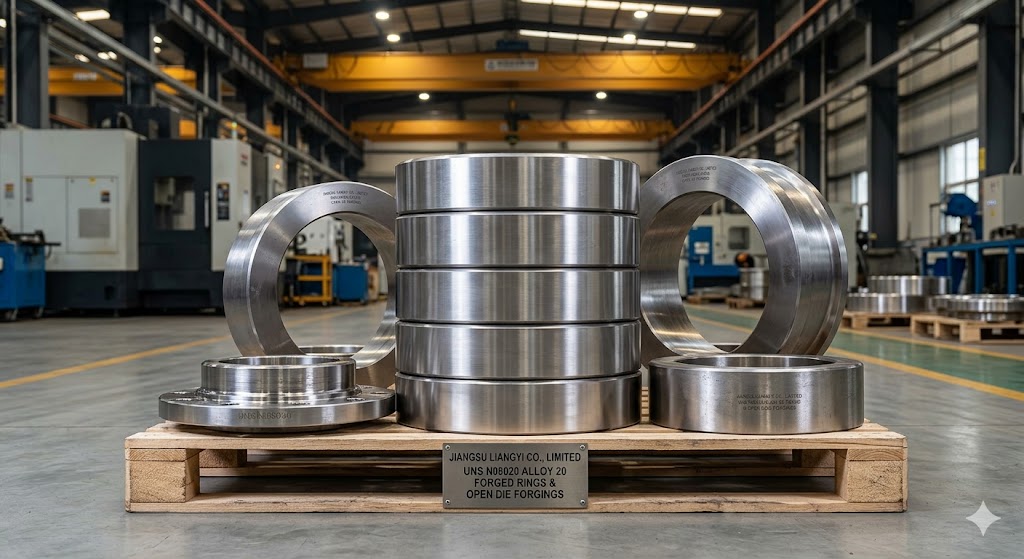
UNS N08020 (Alloy 20) Forging Parts | China ISO-Certified Manufacturer
Jiangsu Liangyi — UNS N08020 (Alloy 20) Forging Manufacturer Since 1997
Jiangsu Liangyi Co., Limited has manufactured UNS N08020 (Alloy 20) open die forgings, seamless rolled rings and custom forged components since 1997. Our facility is located in Jiangyin City, Jiangsu Province, China, an established industrial centre for large-scale forging production. The plant covers 80,000 m² and operates press, ring rolling, heat treatment, NDT and CNC machining departments under one roof, giving us direct control over every production stage. Annual forging capacity across our hydraulic press fleet exceeds 120,000 metric tons, with individual piece weights ranging from 30 kg to 30 tons.
We hold ISO 9001:2015 certification. All UNS N08020 forgings are manufactured to ASTM B462 / B472 and ASME SB-462 / SB-472, and are produced to meet the technical requirements of NACE MR0175 / ISO 15156 for sour-service applications and API 6A for oil and gas wellhead equipment. Every shipment includes a full EN 10204 3.1 Mill Test Certificate covering chemical composition, mechanical test results and heat treatment records. EN 10204 3.2 certification with customer-nominated third-party witness inspection is available on request.
Export experience: Jiangsu Liangyi supplies UNS N08020 forged components to customers in more than 50 countries. We have maintained supply agreements with European chemical plant contractors and North American valve manufacturers for over 12 years, and regularly support projects in the Middle East, Southeast Asia and Oceania.
UNS N08020 (Alloy 20) Forged Product Range — Geometry, Size & Surface Capability
Our press shop and ring mill operate with sufficient capacity flexibility to produce virtually any wrought geometry in UNS N08020 from a single blank. The descriptions below reflect our current production envelope; parts outside these ranges should be discussed with our engineering team, as oversized or complex configurations are sometimes achievable through process engineering adjustments.
Open Die Forged Bars, Shafts & Blocks
Round bars, square bars, flat bars, step shafts, rectangular blocks and custom profiled blanks forged to ASTM B472, with chemical and mechanical certification per heat. Our bar stock spans diameters from 60 mm up to 2,000 mm, lengths from 150 mm to 12,000 mm, and single-piece weights from 30 kg to 30 tons. Surface conditions available: as-forged black, rough-turned (Ra 12.5 µm), or precision-ground (Ra 1.6 µm). Straightness tolerance on shafts held to 1 mm/m as standard; tighter tolerances available with CMM verification.
Seamless Rolled Forged Rings
Our radial-axial ring mill rolls seamless rings from 300 mm to 6,000 mm outer diameter, in wall thicknesses from 20 mm to 800 mm, certified to ASTM B462. Standard cross-sections are rectangular (flat-face rings); contoured profiles — flanged rings, T-section rings, L-section rings, step-bore rings — are produced by profile rolling or subsequent CNC turning. Circumferential grain flow inherent in ring rolling gives these components superior fatigue resistance at the bore compared with disc forgings machined to ring geometry.
Seamless Hollow Forgings, Cylinders & Sleeves
Heavy-wall cylinders, pressure vessel shells, pump barrel blanks, sleeve forgings and bush blanks from 300 mm to 3,000 mm OD, bore diameters matched to your drawing, and lengths to 8,000 mm. Produced by mandrel forging on our press line, then bored and turned in our machining shop. Wall-thickness uniformity on hollow forgings is held within ±5% of nominal as standard.
Forged-to-drawing components including valve bodies, bonnets, gate and ball valve blanks, pump casings, impeller discs, tube sheets, baffle plates, flange blanks, reactor nozzles and bespoke machined forgings. We accept 2D drawings (PDF, DWG) or 3D CAD models (STEP, IGES, Parasolid) and return a manufacturability review within one business day. Die-less open die forging combined with CNC machining allows us to produce complex shapes in Alloy 20 without the tooling lead time or minimum order quantity constraints of impression-die forging.
Why Specify UNS N08020 (Alloy 20) for Corrosive Service?
UNS N08020 — also designated Alloy 20, Alloy 20 CB-3, or by the trade name Carpenter 20® (a registered trademark of Carpenter Technology Corporation) — is a nickel-iron-chromium austenitic alloy developed specifically for sulfuric acid and mixed-acid environments. It has been the standard material of choice for this service class for over six decades, based on three compositional features that distinguish it from 316L stainless steel.
First, nickel content is held at 32–38 wt%, which provides practical immunity to chloride stress corrosion cracking (SCC) — a failure mechanism that limits the service life of 316L in chloride-containing process environments. Second, copper is added at 3–4 wt%, creating a protective surface layer in reducing sulfuric acid that allows Alloy 20 to resist corrosion across all H₂SO₄ concentrations, including the 20–70% range where 316L corrodes rapidly. Third, carbon is stabilised with niobium (columbium) at a minimum Nb:C ratio of 8:1, preventing intergranular carbide precipitation during welding and eliminating the need for post-weld heat treatment.
Four Failure Modes Alloy 20 Eliminates vs. 316L Stainless Steel
Chloride stress corrosion cracking (SCC): Nickel content above 30% provides practical SCC immunity — 316L routinely cracks at chloride levels as low as 50 ppm at 60°C.
Sulfuric acid dissolution at 20–70% concentration: Cu and Mo additions protect the passive film across the full concentration range where 316L loses passivity and corrodes at >5 mm/yr.
Sensitisation-induced intergranular corrosion: Niobium stabilisation prevents carbide sensitisation in the heat-affected zone during welding — eliminating the need for post-weld solution annealing that adds cost and distortion risk.
Pitting and crevice corrosion in chloride-containing acids: The combined Mo (2–3%) and high-Ni content gives a pitting resistance equivalent number (PREN) well above the threshold for chloride-induced pitting in process environments where 316L fails within weeks.
Lifetime cost perspective: Industry experience from European chemical processing plants documents that replacing 316L stainless steel pump casings with UNS N08020 Alloy 20 forgings can extend mean time between replacements from under 18 months to over 6 years in sulfuric acid pickling duty. Even accounting for Alloy 20's higher material cost, the total lifecycle cost — including labour, downtime and lost production — is typically substantially lower per operating year when the replacement frequency difference is factored in.
UNS N08020 International Grade Equivalents — Complete Cross-Reference
UNS N08020 is covered by eleven distinct national or trade designation systems. When reviewing supplier quotations, import documentation or competitor mill certificates from different countries, the designations below should all refer to the same alloy composition — but always verify chemistry against your governing standard, since small differences in permissible ranges exist between designation systems.
UNS N08020 Alloy 20 — International Designation Cross-Reference
Standard / Issuing Body
Designation
Key Notes for Procurement
UNS (ASTM / SAE, USA)
N08020
Primary engineering designation; always use this UNS number in purchase orders to avoid ambiguity
DIN Werkstoff / EN (Europe)
2.4660
Appears on European mill certificates; full DIN name is NiCr20CuMo per DIN 17460 / 17752
Trade names (USA, global)
Carpenter 20® · Alloy 20 CB-3 · 20Cb-3
Carpenter 20® is a registered trademark of Carpenter Technology Corporation. "CB-3" denotes the columbium-stabilised version — the current standard form widely used generically in industry to describe this alloy type
ASME versions of corresponding ASTM standards; required for ASME-stamped pressure vessels
AMS (Aerospace, USA)
AMS 5750
Covers bars and forgings for aerospace applications; compositional requirements are identical to ASTM B472
BS (British Standard)
NA 20
Historical British Standard designation; largely superseded by EN/W.Nr. system in current UK practice
AFNOR (France)
NC 20 CD
French national designation; encountered on older French plant equipment certificates
JIS (Japan)
NCF 20
Japanese Industrial Standard; used by Japanese EPC contractors and equipment builders in Asia
ISO
NiCr20Cu4Mo2Nb
ISO compositional naming convention; useful for unambiguous cross-border technical communication
GOST (Russia / CIS)
ХН40МДТЮ (closest)
No direct GOST equivalent; Russian projects typically accept ASTM B462/B472 with Russian-language translated MTC
Procurement caution: Some suppliers list "Alloy 20" without specifying the columbium-stabilised CB-3 form. Non-stabilised Alloy 20 is an obsolete formulation that lacks the niobium addition and is susceptible to sensitisation during welding. Always confirm Nb content (8×C% minimum, 1.0% maximum) on the mill certificate before accepting material.
UNS N08020 Chemical Composition, Heat Treatment & Mechanical Data
Specified Chemical Composition — ASTM B462 / B472
The composition ranges below define the boundaries within which every heat of N08020 must fall. Our incoming spectrometer analysis verifies conformance for each heat; the MTC records both the specified limits and the actual measured values for every reported element.
UNS N08020 / Alloy 20 Chemical Composition — ASTM B462 / B472 Limits and Alloying Rationale
Element
ASTM Specified Range
Why This Element Matters
Nickel (Ni)
32.0 – 38.0 wt%
Drives SCC immunity above 30%; also lowers the alloy's activity in reducing acids
Chromium (Cr)
19.0 – 21.0 wt%
Forms the passive oxide film; raises resistance in oxidising and mixed-acid environments
Iron (Fe)
Balance (~31–44 wt%)
Matrix element; keeps material cost manageable vs. fully nickel-based alloys
Copper (Cu)
3.0 – 4.0 wt%
Creates CuSO₄-based surface protection in reducing sulfuric acid; the key differentiator vs. 316L
Preferentially combines with carbon to form stable NbC, denying carbon the opportunity to form intergranular Cr₂₃C₆ during thermal exposure
Carbon (C)
0.06 wt% max
Minimised to reduce sensitisation risk; the Nb:C ratio governs stabilisation efficiency
Manganese (Mn)
2.0 wt% max
Austenite stabiliser; improves hot ductility during open die forging operations
Silicon (Si)
1.0 wt% max
Deoxidant in the melt; controlled at low levels to avoid secondary phase precipitation
Phosphorus (P)
0.045 wt% max
Tightly limited; P segregation at grain boundaries reduces hot workability and corrosion resistance
Sulfur (S)
0.035 wt% max
Limited to prevent MnS inclusion formation, which initiates pitting in chloride environments
Mandatory Heat Treatment — Solution Annealing
Unlike many stainless steels where heat treatment is optional depending on service, solution annealing of Alloy 20 forgings is mandatory and non-negotiable. The purpose is to redissolve any niobium carbides or sigma-phase particles that may have precipitated during forging, and to restore the fully austenitic, corrosion-resistant structure. Our heat treatment protocol:
Heating rate: Controlled ramp to avoid thermal shock on heavy cross-sections; parts over 200 mm section thickness are brought up at ≤80°C/hr to equalise temperature through-thickness.
Soak temperature: 954–1,010°C (1,750–1,850°F), held for a minimum of 1 hour per 25 mm of maximum cross-section thickness.
Quench: Immediate water quench — transfer from furnace to quench tank in under 60 seconds — to suppress re-precipitation of detrimental carbide phases during cooling. Air cooling is not acceptable for this alloy.
Verification: Post-treatment hardness survey (maximum 217 HB), grain size check (ASTM No. 4 or finer), and sensitisation screening per ASTM A262 Practice E for critical corrosion-service parts.
Mechanical Properties at Room Temperature — Delivery Condition
UNS N08020 Alloy 20 — ASTM Specified Minimums vs. Jiangsu Liangyi Typical Achieved Values (Solution-Annealed Forgings)
Property
ASTM B462 / B472 Minimum
Jiangsu Liangyi Typical
Ultimate Tensile Strength
550 MPa (80 ksi)
620–640 MPa (90–93 ksi)
0.2% Proof Strength (Rp0.2)
240 MPa (35 ksi)
320–345 MPa (46–50 ksi)
Elongation A₅
30%
42–48%
Charpy V-Notch (CVN) at +20°C
203 J (150 ft·lbf)
260–290 J (192–214 ft·lbf)
Brinell Hardness (HBW)
≤217 HBW
155–190 HBW
Density
8.08 g/cm³ (0.292 lb/in³)
Physical & Thermal Properties — Design Reference Data
The values below are needed by process engineers sizing heat exchangers, designing expansion joints, and calculating thermal stresses in piping systems fabricated from Alloy 20 forgings. Note that thermal conductivity is significantly lower than carbon steel — a factor that must be compensated in heat transfer area calculations.
UNS N08020 Alloy 20 — Physical and Thermal Properties (Solution-Annealed Condition)
Property
Value
Unit
Density
8.08
g/cm³
Melting range
1,340 – 1,400
°C
Specific heat capacity (20°C)
502
J / (kg·K)
Thermal conductivity (100°C)
12.0
W / (m·K)
Mean thermal expansion (20–100°C)
15.7 × 10⁻⁶
/ °C
Mean thermal expansion (20–500°C)
17.5 × 10⁻⁶
/ °C
Electrical resistivity (20°C)
1.03
µΩ·m
Relative magnetic permeability
~1.007
— (essentially non-magnetic)
Modulus of elasticity (E)
196
GPa
Poisson's ratio (ν)
0.31
—
Max continuous service temperature
538 (1,000)
°C (°F)
Corrosion Resistance of UNS N08020 (Alloy 20) — Engineering Data by Environment
Sulfuric Acid (H₂SO₄) — The Primary Design Environment
No other common engineering alloy matches UNS N08020's consistency across the full sulfuric acid concentration spectrum. The underlying mechanism changes by concentration zone — at low concentrations Cr-based passivation dominates; in the intermediate 20–70% range the Cu-CuSO₄ mechanism takes over where chromium passivity collapses; at concentrations above 80% the acid becomes strongly oxidising and both mechanisms contribute. The table below shows approximate static immersion rates. In practice, flow velocity and temperature have significant effects and specific laboratory testing for your exact process conditions is recommended for new applications.
Note: Values below are indicative reference figures based on published industry corrosion data (NACE, Dechema Corrosion Handbook, ASM Handbooks). Actual corrosion rates depend on temperature, flow velocity, aeration, contaminating ions and other process conditions. For critical applications, material selection should be confirmed by laboratory coupon testing in the actual service environment.
UNS N08020 Alloy 20 — Approximate Corrosion Rate in H₂SO₄ at ~25°C vs. 316L Stainless Steel
H₂SO₄ Concentration
Alloy 20 Rate (mm/yr)
316L SS Rate (mm/yr)
Reliability Assessment
<5% (dilute)
<0.10
0.4–1.0
Alloy 20 suitable; 316L marginal at higher temperatures
10–20%
<0.13
5–25
Alloy 20 reliable; 316L experiences active dissolution
30–50%
<0.25
Severe — not applicable
Alloy 20 the standard choice; 316L not recommended
60–70%
<0.50
Severe — not applicable
Alloy 20 functions well; this zone destroys 316L rapidly
80–93%
<0.25
0.5–2.0
Both alloys passivate; Alloy 20 more consistent under thermal cycling
98% (oleum zone)
<0.10
<0.15
Both suitable at ambient; Alloy 20 preferred for fluctuating concentrations
All figures are indicative for reference purposes. Process-specific testing is recommended before final material selection for critical corrosive service.
Resistance Profile in Other Industrial Environments
Phosphoric acid (H₃PO₄): Outstanding performance up to 85% concentration at temperatures below 80°C. The alloy's combination of Mo and Cu effectively handles the fluoride and chloride contaminants typically present in wet-process phosphoric acid streams that attack less-alloyed materials.
Mixed acid systems (H₂SO₄ + HNO₃, H₂SO₄ + HCl): Alloy 20 performs well in dilute mixed-acid pickling baths such as those used in stainless steel surface finishing. Its resistance in these systems outperforms 316L and 317L, though Hastelloy C-276 may be preferred where HCl exceeds 2% at elevated temperature.
Organic acids — acetic, formic, lactic: Exceptional resistance across the concentration range at process temperatures. Widely specified for pharmaceutical and food-grade processing equipment where high purity combined with chemical resistance is required.
Chloride-containing process streams: Unlike austenitic stainless steels, Alloy 20 does not require a minimum temperature threshold to avoid SCC; it resists chloride cracking from ambient temperatures upward, making it appropriate for equipment that experiences shutdown-restart cycles or thermal transients.
H₂S / sour gas environments: Qualified without restriction per NACE MR0175 / ISO 15156. Alloy 20 forgings are used for wellhead components, subsea valve bodies and downhole tools in fields with high H₂S partial pressures where carbon and low-alloy steels require inhibition and monitoring.
Seawater and coastal marine environments: Alloy 20's Mo content puts its critical pitting temperature well above the operating range for seawater-cooled heat exchangers and marine pump casings; it is routinely specified where 316L or 317L have shown pitting failures within 12–18 months of installation.
Alloy 20 vs. 316L, 904L & Hastelloy C-276 — Decision Framework for Material Selection
Four alloys appear repeatedly in competitive bids for corrosion-resistant process equipment. Understanding precisely where each sits in the performance-cost matrix helps procurement engineers avoid both under-specification (early failure) and over-specification (unnecessary cost). The comparison below reflects our engineering team's 28 years of application experience across multiple industries and geographies.
Material Selection Comparison: Alloy 20 (N08020) vs. 316L vs. 904L vs. Hastelloy C-276 (N10276)
Criterion
Alloy 20 (N08020)
316L (S31603)
904L (N08904)
Hastelloy C-276 (N10276)
Nickel content (wt%)
32–38
10–14
23–28
~57 (balance)
Molybdenum (wt%)
2–3
2–3
4–5
15–17
Copper addition
3–4% ✔
None ✘
1–2% ✔
None ✘
Nb stabilisation
Yes ✔
No ✘
No ✘
No ✘
H₂SO₄ resistance (20–70%)
Excellent
Poor — fails rapidly
Good
Good
Chloride SCC immunity
Excellent
Poor
Good
Excellent
PWHT after welding
Not required ✔
Recommended
Recommended
Not required ✔
NACE MR0175 / ISO 15156
Qualified — no restrictions
Conditional
Conditional
Qualified
Relative material cost index
Medium-high (~3.5×316L)
Baseline
Medium (~2.5×316L)
Very high (~8×316L)
Forgeability & machinability
Excellent
Excellent
Excellent
Good — requires slower cutting speeds
Typical forging lead time
15–20 days (stock)
10–15 days
20–30 days
35–60 days
Optimal application zone
H₂SO₄ + Cl⁻ + sour gas environments
Mild aqueous, low-chloride, non-acid
Strong reducing acids, phosphoric acid
Severe mixed acid, HCl above 2% at high temperature
The decision boundary between Alloy 20 and Hastelloy C-276: If your process involves HCl above 2% at temperatures above 50°C, or nitric-hydrochloric acid mixtures (aqua regia type), Hastelloy C-276 becomes justified despite its cost premium. For everything else in the sulfuric acid and mixed sulfuric/chloride domain — which covers the vast majority of chemical processing, oil and gas and power generation applications — Alloy 20 delivers equivalent corrosion performance at 40–50% of the material cost. Our application engineers can help you place your specific process conditions on this decision boundary.
UNS N08020 Open Die Forging Process — Eight Production Steps
The mechanical and corrosion properties of UNS N08020 forgings are directly dependent on microstructural condition at delivery, which in turn depends on consistent execution of each production step. The following describes our standard production sequence for Alloy 20 forgings.
1
Ingot and Billet Qualification
N08020 master alloy arrives as vacuum-melted or electroslag-remelted (ESR) billets from qualified mills. Each heat is spectrometer-analysed against ASTM B462/B472 on arrival; heats that fail any element check are quarantined and returned. The Nb:C ratio is verified specifically — the columbium stabilisation that defines this alloy's corrosion behaviour depends on this ratio being within a narrow window above 8:1.
2
Furnace Heating and Temperature Uniformity
Billets are heated in gas-fired furnaces fitted with calibrated thermocouple grids. Soak time is calculated from the actual billet cross-section to ensure through-thickness temperature uniformity before pressing begins. Large billets above 400 mm section thickness require extended soak periods to bring the core temperature within 15°C of the surface reading; pressing before thermal equilibrium is reached results in non-uniform deformation and inconsistent grain structure.
3
Multi-Pass Open Die Forging
Multi-directional deformation passes — axial, radial and tangential — are applied using our 3,150-ton and 5,000-ton hydraulic presses to achieve a minimum forging reduction ratio of 4:1 through the billet cross-section. This level of reduction is required to break down solidification segregation bands, close residual microporosity, and refine grain size to ASTM No. 4 or finer. A single reduction pass to near-net shape, without adequate interior working, is insufficient to achieve consistent mechanical properties in pressure-service forgings.
4
Ring Rolling (for Seamless Ring Products)
Ring blanks are transferred hot from the press to our radial-axial ring mill. Circumferential rolling produces a continuous grain flow pattern aligned with the ring circumference, which improves fatigue performance at the bore relative to rings machined from disc forgings. This grain orientation aligns the strongest material direction with the primary hoop stress direction in service.
5
Solution Annealing and Immediate Water Quench
Every Alloy 20 forging is solution-annealed at 954–1,010°C and water-quenched within 60 seconds of leaving the furnace. The quench tank volume and water temperature are monitored to ensure the part reaches below 400°C rapidly enough to prevent carbide re-precipitation. Furnace charts with part ID, soak time and measured temperature are archived in our quality management system and reproduced on the MTC.
6
In-Process and Final NDT
Forgings undergo phased array UT scanning per ASTM A388 for internal volumetric defect detection, followed by magnetic particle or liquid penetrant testing on all accessible surfaces. Our NDT personnel are qualified in accordance with ISO 9712. For safety-critical applications, ASME Section V examination procedures and enhanced inspection scope are available on request.
7
Destructive Testing and MTC Generation
Test coupons machined from the prolongation or sacrificial material of each lot undergo tensile testing, Brinell hardness survey, Charpy impact testing and ASTM E112 grain size measurement. Results are compared against ASTM B462/B472 minima before the lot is approved for machining. The complete dataset — chemistry, heat treatment records, mechanical tests, NDT reports and dimensional inspection — is consolidated into the EN 10204 3.1 MTC.
8
CNC Machining, Marking and Export Packaging
Finish machining on CNC lathes, machining centres and boring mills to your drawing tolerances, with CMM dimensional verification. Each part is electrochemically or low-stress stamp-marked with heat number, material designation (UNS N08020), part number and our traceability code. Export packaging uses VCI-film inner wrap, anti-rust compound on machined surfaces, and ISPM-15 compliant timber crates — sized to the part geometry and rated for the shipping mode and destination port.
Forgings vs. castings for Alloy 20 pressure components: Cast Alloy 20 contains micro-segregation from ingot solidification — localised zones depleted in Cu and Mo where corrosion resistance is reduced relative to the nominal composition. Open die forging redistributes these elements through thermomechanical deformation, producing a more uniform microstructure throughout the cross-section. Published metallurgical literature on nickel alloys confirms that wrought microstructures show lower corrosion rates in acidic environments than as-cast equivalents, in addition to the well-documented improvements in tensile strength, fatigue life and impact toughness that forging provides.
Application Cases — UNS N08020 (Alloy 20) Forgings in Service Worldwide
The following project cases are drawn from our supply history. Customer identities and precise order volumes are withheld under standard confidentiality terms. Technical details — material specifications, inspection requirements, product types and service environments — accurately reflect the programmes described.
Case 1: Sulfuric Acid Pickling Line — Southeast Asia
Background: A steel processing facility in Southeast Asia was constructing a continuous strip pickling line operating with 15–25% H₂SO₄ at 60–75°C. The contractor had used 316L stainless steel in a pilot facility; these components developed through-wall corrosion within 14 months of commissioning. For the full-scale line, the materials engineer specified UNS N08020 for all acid-wetted forged components based on published NACE and Dechema corrosion data.
Scope of supply: Jiangsu Liangyi manufactured open die forged heating coil end caps, pump casing and impeller disc forgings, heat exchanger tubesheet blanks in multiple diameter/thickness combinations, tank nozzle forgings and flange blanks — all in UNS N08020 to ASTM B472, solution-annealed, EN 10204 3.1 MTC. Delivery was staged over 18 months to match the construction schedule. Customer-nominated third-party inspection was conducted at our factory prior to each shipment.
Outcome: The Alloy 20 components passed pre-commissioning pressure and leak tests without issue. After more than five years of continuous operation in the same service conditions that destroyed the 316L components in the pilot line, no corrosion-related maintenance has been required. The plant's most recent periodic inspection confirmed no measurable wall loss on any Alloy 20 forged component.
Case 2: Shell-and-Tube Heat Exchangers — European Specialty Chemicals
Background: A specialty chemicals manufacturer in central Europe operates a heat exchange process in a variable-concentration H₂SO₄ stream (40–75% H₂SO₄) with periodic temperature excursions. Previous 904L stainless steel tube sheets showed localised corrosion at weld heat-affected zones after approximately 30 months of service, caused by sensitisation during fabrication welding without post-weld heat treatment.
Scope of supply: Jiangsu Liangyi supplied forged UNS N08020 tube sheet blanks in multiple dimensions to ASTM B462 and EN 10204 3.1, with full UT inspection per EN 10228-3 on all pieces. The Alloy 20 material's niobium stabilisation eliminates sensitisation at the HAZ during fabrication welding, removing the need for post-weld solution annealing that had complicated the 904L programme.
Outcome: The fabricator reported straightforward welding performance with ERNiCrMo-3 filler. The plant operator extended the first inspection interval from 24 months to 36 months based on favourable in-service results, reducing planned maintenance downtime compared with the 904L units replaced.
Case 3: Sour Gas Wellhead and Completion Equipment — Middle East
Background: A gas field development project in the Middle East required completion valve bodies, choke bodies and wellhead spool forgings for production wells with H₂S content high enough to mandate NACE MR0175 / ISO 15156 qualification. Elevated H₂S partial pressure, chloride-containing formation water and high wellhead pressure ruled out carbon steel and low-alloy steel options. UNS N08020 was selected as the corrosion-resistant alloy for contact-service forgings based on its unrestricted qualification in NACE MR0175 / ISO 15156 Part 3 Annex A.
Scope of supply: Jiangsu Liangyi manufactured valve body and bonnet blanks, choke body forgings, wellhead spool body forgings and flange blanks in UNS N08020 to ASTM B462, solution-annealed, with 100% UT (ASTM A388) and PT on all machined surfaces. Hardness surveys confirmed NACE MR0175 compliance across the full cross-section. NACE compliance statements formatted to the field operator's ITP requirements accompanied each delivery lot. Products were manufactured to meet API 6A technical requirements.
Outcome: All forged components passed the operator's incoming inspection without rejections. Engineering feedback after multiple years of field service confirmed no incidents of sulphide stress corrosion cracking, hydrogen-induced cracking or pitting corrosion on any of the Alloy 20 forged components — consistent with the alloy's qualification for the recorded service conditions.
Case 4: Subsea Valve Forgings — North America
Background: A subsea valve manufacturer in North America required UNS N08020 forged gate valve bonnet and body blanks for a deepwater isolation valve programme. The service environment combined seawater exposure, produced fluids containing H₂S and CO₂, and cyclic pressure loading. The OEM had previously sourced these forgings domestically but experienced lead-time and dimensional consistency problems during a period of peak demand.
Scope of supply: Jiangsu Liangyi supplied UNS N08020 bonnet and body blanks to ASTM B472, EN 10204 3.1 MTC, with phased array UT and 100% PT to customer-specified acceptance criteria. CMM dimensional inspection reports were provided for each piece. A buffer stock of semi-finished blanks was held at our facility against the customer's call-off forecast, reducing effective lead time from order to machining-ready receipt.
Outcome: Zero dimensional rejections were recorded across the supply programme. The buffer-stock supply arrangement has been continued for subsequent valve programmes by the same customer.
Case 5: Reactor Coolant Pump Components — Nuclear Power (Asia)
Background: A nuclear power plant project in Asia required UNS N08020 forged pump casing blanks and impeller disc blanks for reactor coolant system auxiliary circulating pumps. The application required both corrosion resistance to the process fluid chemistry and full compliance with the plant quality documentation requirements, including 100% volumetric inspection and CMM-verified dimensional reporting with full heat-number traceability.
Scope of supply: Jiangsu Liangyi manufactured forged casing blanks and impeller disc blanks in UNS N08020, solution-annealed and water-quenched, with phased array UT on all pieces and PT on all accessible machined surfaces. Full CMM dimensional inspection reports, heat treatment records with time-temperature charts, per-lot mechanical test certificates and per-heat spectrometer analysis reports were provided. The plant QA team conducted a factory audit and witnessed final inspection prior to release.
Outcome: All pieces were accepted without rejection at first inspection. The QA team confirmed that the material certification package met the project's documentation requirements in full.
Case 6: Chemical Pump OEMs — Long-Term Framework Supply
Background: Several pump manufacturers in Europe and North America that supply acid-service centrifugal pumps to chemical processing plants require a reliable, consistent source of UNS N08020 forged pump casing blanks and impeller disc blanks. Acid-service pump casings and impellers are regularly replaced components; supply consistency, dimensional repeatability and short call-off lead times are commercial priorities for these OEMs.
Scope of supply: Jiangsu Liangyi maintains framework supply agreements covering standard UNS N08020 forged blank sizes to ASTM B472, EN 10204 3.1. Stock of common sizes is maintained at our facility and released against customer call-offs, typically within 5–7 working days of order. Fixed inspection plans — agreed between our quality department and the customer — allow the customer's machining operation to begin without incoming dimensional re-inspection.
Outcome: End-user feedback reported by OEM customers indicates that pump casings machined from Jiangsu Liangyi Alloy 20 forgings consistently outperform the 316L stainless steel components previously used in sulfuric acid pickling duty, with significantly extended service life. Several OEM customers have standardised their full acid-service pump range on Alloy 20 as a result of the comparative performance data gathered over multiple service cycles.
Quality System and Inspection Requirements for UNS N08020 Forgings
The following describes the inspection and testing carried out at each production stage for UNS N08020 forgings as standard. Additional or alternative inspection requirements specified by customers or applicable project standards take precedence and are accommodated within our quality plan.
Raw Material Stage — Before Any Heat Is Used
Optical emission spectrometry on a minimum of three samples from each incoming heat of billet; the Nb/C ratio is calculated explicitly and recorded. Heats with Nb/C below 7.5 are rejected regardless of other element conformance.
Billet surface inspection for laps, seams, and deep decarburisation that would become surface defects in the finished forging.
Incoming dimension check to confirm usable forging yield can meet your part size with adequate excess for test coupons.
Post-Forge Stage — Before Heat Treatment
Visual and dimensional check to confirm the forging blank has met the pre-machining size requirements with sufficient stock for finish machining and test coupons.
Surface condition inspection; cracks or laps at this stage trigger evaluation for forge-weld repair or rejection.
Post-Heat Treatment Stage — Before NDT and Machining
Per-lot hardness survey: minimum five readings per piece, distributed to cover both the body and extremities. Maximum 217 HBW per ASTM B462; readings above this trigger investigation and re-annealing.
Grain size verification per ASTM E112; ASTM No. 4 or finer required for standard supply; finer grain specifications available on request.
One set of tensile specimens and one set of impact specimens machined from the test coupon and tested per ASTM E8 and ASTM E23 respectively; results recorded on the MTC.
Sensitisation screening per ASTM A262 Practice E for any order designated for critical corrosion service, particularly if the customer's process involves concentrated sulfuric acid above 60°C.
NDT Stage — 100% Coverage for Critical Forgings
UT: Phased array ultrasonic scan per ASTM A388 or EN 10228-3 on all forgings above 50 kg. Acceptance criteria per the applicable quality class specified by the customer; Class 1 (no recordable indications) is our default for valve and pump components.
MT or PT: 100% of accessible surfaces per ASTM A275 (MT) or ASTM A165 (PT). MT for ferritic-containing zones; PT for fully austenitic surfaces.
RT: Available for weld-critical parts or customer-specified components; qualified Level II radiographers and digital imaging equipment on-site.
NACE MR0175 / ISO 15156 Compliance Documentation
For oil and gas orders, we issue a NACE compliance statement that records the specific NACE MR0175 / ISO 15156 Part 3 Annex A table entry under which UNS N08020 is qualified, confirms the heat treatment condition (solution-annealed), confirms the hardness results, and identifies the production lot covered. This document travels with the MTC and is formatted to satisfy the inspection hold point requirements of most major oil and gas operator ITPs.
Certifications and Third-Party Support
ISO 9001:2015 — currently certified; ISO 9001 quality management system first implemented in 2004, upgraded progressively to the current 2015 edition
EN 10204 3.1 MTC — issued as standard with all shipments (EN 10204 is a document format standard, not a body-issued certification; our QC department issues 3.1 inspection documents for all orders)
EN 10204 3.2 — available when your nominated third-party inspection body witnesses production testing and co-signs the certificate independently
Products manufactured to meet API 6A technical requirements for oil and gas wellhead equipment. Important notice: Jiangsu Liangyi does not currently hold the API Monogram Programme licence. Customers whose project specifications require API Monogram-stamped products should advise us at enquiry stage; we will confirm the applicable supply route.
All quality records retained for a minimum of 10 years; full traceability by heat number, lot number and order number
Packaging, Marking and International Shipping
All UNS N08020 forgings are prepared for export in accordance with the following standard protocol. Customer-specific packaging requirements, marking standards or shipping instructions take precedence and should be specified at order placement.
Part Marking
Every forging is individually marked with heat number, UNS N08020 material designation, our company code, part number and net weight. Low-stress electrochemical etching is used on pressure-boundary surfaces; for parts where any marking could constitute a stress concentration, adhesive labels backed by a permanently attached metal tag are used instead. Marking location is agreed with the customer before production and documented on the inspection record.
Corrosion Protection
All machined surfaces receive a coat of water-displacing, VCI-compatible rust-preventive oil (NSF-approved grade for food-grade orders). The part is then wrapped in VCI poly film — the vapour-phase inhibitor provides active corrosion protection for up to 24 months in closed packaging. Threaded connections and bore surfaces receive additional plastic thread protectors rated to 80°C for containers that may pass through hot-climate ports.
Export Crating
Forgings below 500 kg are crated in ISPM-15 heat-treated plywood cases with internal foam blocking sized to immobilise the part against all six internal surfaces. Forgings above 500 kg are skidded on timber bearers and banded, with corner protectors on all edges. Parts above 5 tons are loaded in open-top containers with crane lifting confirmed before dispatch. Gross weight and centre-of-gravity markings are applied to the outside of all crates over 500 kg.
Shipping Terms and Transit Times
We quote and ship on FOB Tianjin, FOB Shanghai, CIF, CFR and DDP Incoterms 2020. Typical sea freight transit times from Shanghai: Northern Europe 28–32 days; US Gulf Coast 30–35 days; UAE / Saudi Arabia 18–22 days; Singapore / Malaysia 7–10 days. Air freight is arranged for urgent orders — typical air transit 3–5 days to any major hub. All shipments are insured under our open marine cargo policy; additional insurance to declared value available on request.
Documentation shipped with every order: Commercial invoice and packing list · Bill of lading / AWB · EN 10204 3.1 MTC (or 3.2 if specified) · NDT reports (UT, MT/PT scan sheets) · Dimensional inspection report with CMM printout · Heat treatment chart · Forging process record · NACE compliance statement (oil & gas orders) · Country of origin certificate · Any additional third-party inspection certificates
Frequently Asked Questions — UNS N08020 (Alloy 20) Forgings
What makes Alloy 20 fundamentally different from 316L stainless steel in corrosive service?
The decisive difference lies in nickel content: Alloy 20 carries 32–38%, while 316L sits at 10–14%. Above roughly 30% nickel, chloride stress corrosion cracking becomes thermodynamically unfavourable — a threshold 316L never reaches. Beyond SCC immunity, Alloy 20's copper addition (3–4%) creates a copper sulfate surface layer in sulfuric acid that dramatically slows corrosion at the metal interface across all H₂SO₄ concentrations from dilute to 98%. 316L has no equivalent mechanism and undergoes rapid active dissolution in the 20–70% H₂SO₄ range. Finally, Alloy 20's niobium stabilisation eliminates the need for post-weld heat treatment — a cost and logistics advantage in field fabrication. Refer to our alloy comparison section for quantitative data.
What is W.Nr. 2.4660 and how does it relate to UNS N08020?
W.Nr. 2.4660 is the German Werkstoff number for UNS N08020 per DIN 17460, with the full compositional name NiCr20CuMo. European mill certificates, equipment drawings and procurement specifications from Germany, the Netherlands and Scandinavia frequently use this designation rather than the UNS number. The composition limits are essentially identical to ASTM B462/B472; we manufacture and certify to ASTM as the governing standard, and can annotate the W.Nr. designation on the MTC for European customers. See our full international grade cross-reference table for all eleven designation systems.
Under what conditions does NACE MR0175 / ISO 15156 allow UNS N08020 without restrictions?
NACE MR0175 / ISO 15156 Part 3 Annex A lists UNS N08020 as a qualified CRA with no H₂S partial pressure ceiling, no chloride concentration limit, and no hardness restriction for the base material in the solution-annealed condition. This means it covers the full environmental envelope of sour oil and gas production without the additional qualification testing that is required for many carbon and low-alloy steels. For weldments, the requirement is that filler metal must also be a qualified material — typically ERNiCrMo-3 per AWS A5.14 — and no post-weld heat treatment is required. We issue a NACE compliance statement with all oil and gas orders, formatted to satisfy ITP hold points at major operators.
Which welding filler metal is correct for UNS N08020 and why?
ERNiCrMo-3 (AWS A5.14) for GTAW/GMAW and ENiCrMo-3 for SMAW are the standard recommendation. This filler class is commercially available under various brand names including Inconel® 625 (Inconel® is a registered trademark of Special Metals Corporation) from multiple qualified suppliers. The logic is dilution management: when the weld pool mixes base metal with filler, the effective alloy content of the deposit is reduced. Using a filler with higher Mo (9%) and Cr (21%) than the base metal compensates for this dilution and ensures the deposited weld metal achieves corrosion resistance comparable to the parent Alloy 20 in service. Using matching Alloy 20 filler (ER320LR) is technically permissible for non-critical joints but risks under-alloyed fusion zones in multi-pass welds with high dilution. No PWHT is required for either filler choice — this is one of Alloy 20's key fabrication advantages over unstabilised austenitic stainless steels.
How does Alloy 20 perform in the 50–70% H₂SO₄ range where most stainless steels fail?
The 50–70% H₂SO₄ window at elevated temperature is the most damaging zone for austenitic stainless steels because the acid's character shifts from weakly oxidising to strongly reducing — conditions where chromium-oxide passive films dissolve rather than protect. Alloy 20's 3–4% copper addition generates a Cu²⁺-containing surface film specifically effective in this concentration range, acting as a secondary corrosion barrier independent of the chromium-based passivation mechanism. Our corrosion data table shows rates below 0.5 mm/yr for Alloy 20 across this concentration range at 25°C; at 60°C the rate rises but remains below 1.2 mm/yr in most documented cases. By contrast, 316L's dissolution rate in this range is sufficiently high (often >5 mm/yr at 40°C) that it is simply not considered a viable material by corrosion engineers. See our corrosion data section for full tabular data.
What physical and thermal data do design engineers need when specifying Alloy 20 for heat exchanger or piping design?
The values most frequently requested are: density 8.08 g/cm³; elastic modulus 196 GPa; mean thermal expansion 15.7 × 10⁻⁶ /°C from 20 to 100°C (rising to 17.5 × 10⁻⁶ /°C at 500°C, relevant for expansion loop sizing in hot piping); thermal conductivity 12.0 W/(m·K) at 100°C — considerably lower than carbon steel's ~50 W/(m·K), a factor that requires compensating heat transfer area in exchanger design. The alloy is essentially non-magnetic (permeability ~1.007), relevant for flow meter compatibility. Maximum recommended continuous operating temperature is 538°C (1,000°F). Full data is tabulated in our technical specifications section.
Why do forged Alloy 20 components outperform cast equivalents in corrosive service?
Cast Alloy 20 contains macro-segregation from ingot solidification — local zones depleted in Cu and Mo that perform like a lower-alloy material. These segregation zones are not detectable by standard incoming inspection but manifest as premature pitting or accelerated weight loss in service. Open die forging mechanically homogenises the chemistry through repeated thermomechanical deformation, collapsing the dendritic segregation structure and distributing the alloying elements more uniformly. Additionally, forging eliminates shrinkage microporosity — voids that function as crevice corrosion initiation sites. The net effect is measurably more consistent corrosion behaviour across the entire cross-section, and mechanical properties (tensile, impact, fatigue) 20–35% above cast equivalents from the same heat of material.
What is your realistic lead time, and what factors compress or extend it?
For geometries producible from our standing N08020 billet stock, the realistic door-to-dock timeline for forging, solution annealing, UT/PT, destructive testing and rough machining is 15–20 working days. Custom melt orders — required for very large cross-sections or compositions closer to one end of the ASTM range — add a 12–18 working day ingot lead time, bringing total lead time to 30–45 working days. The most reliable lead time compressor is early drawing submission: we can often identify a larger stock size that forges to your near-net shape without re-melting. Third-party inspection scheduling and the customer's own HOLD POINT release response times are the most common sources of schedule slip on our side of the interface — we build these into the production schedule when customers give us the inspection agency contact and approval lead time in advance.
What does your EN 10204 3.2 MTC process look like in practice?
When a customer specifies EN 10204 3.2, we contact the nominated inspection body (SGS, Bureau Veritas, TUV or the customer's own inspector) at order placement and agree a production inspection and test plan. The third party attends three mandatory hold points: raw material chemical analysis review; mechanical test witness (tensile and impact); and final dimensional and NDT inspection. The inspection body issues the 3.2 declaration independently of our own quality department — their signature and stamp on the certificate constitutes the independent validation. The complete package — our 3.1 data plus the third-party 3.2 declaration — is typically available within 3–5 working days of the final inspection being completed and signed off. Inspection by the customer's own team at our factory is also welcome; we provide a dedicated QC liaison engineer and inspection room access throughout the production programme.
Can you support plant shutdown maintenance orders with partial deliveries on short notice?
Yes — this is a scenario we encounter regularly, particularly from chemical plant operators who discover failed Alloy 20 components during a scheduled or emergency shutdown window. We maintain a rolling stock of N08020 forged bar and ring blanks in our most common size groups precisely for these situations. For an emergency order, send us the part drawing and your required-on-site date; our production planning team will assess whether we can deliver machined near-net shapes within your window, possibly with finish machining completed at a local shop closer to your plant. Air freight to European, Middle Eastern and Asian destinations typically achieves 3–5 working days from our factory. For repeat maintenance-parts customers we can also hold consignment stock — forged and heat-treated blanks pre-positioned to your drawing requirements — that can be finish-machined and shipped within 5–7 working days of a call-off. Contact our sales team to discuss a stocking arrangement.