Trademark Notice: "Nitronic®" is a registered trademark of ATI (Allegheny Technologies Inc.). This page uses the name solely to identify the alloy specification (UNS S21800 / Alloy 218) of products manufactured by Jiangsu Liangyi Co., Limited. Jiangsu Liangyi is not affiliated with or endorsed by ATI.
Quick Facts: Nitronic 60 / UNS S21800 Forging Parts by Jiangsu Liangyi
- Material:
- Nitronic® 60 / UNS S21800 — also called Alloy 218; nitrogen-strengthened austenitic stainless steel
- Key Properties:
- Great anti-galling, wear resistance, corrosion resistance exceeding 316 SS; operating range −196 °C to 870 °C
- Products:
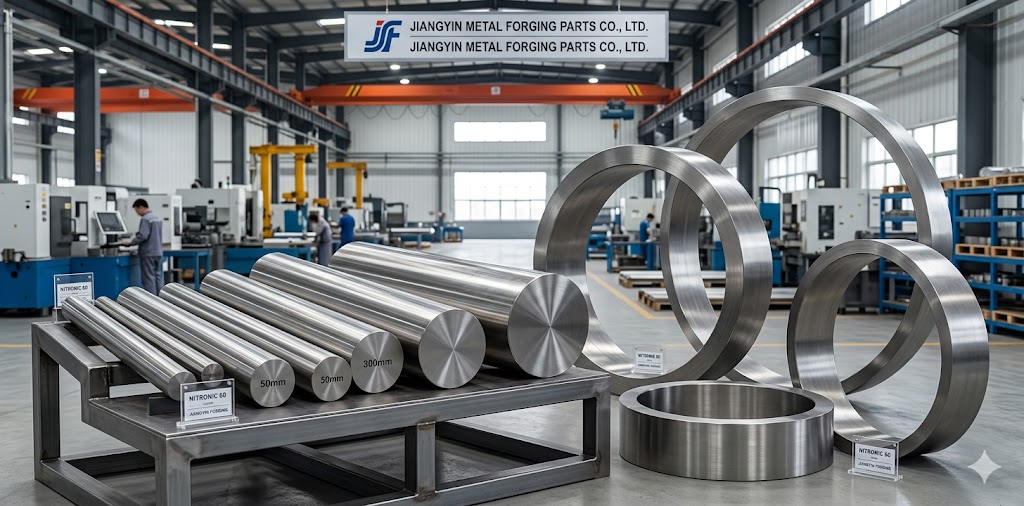
- Open die forged bars, seamless rolled rings (up to 6 m Ø), hollow components, flat discs, tubular parts, custom forgings
- Weight Range:
- 30 kg – 30,000 kg per piece; annual capacity 120,000 tons
- Lead Time:
- 4–6 weeks (raw forging); 6–8 weeks (fully machined)
- Standards:
- ASTM, API 6A, DIN, EN, JIS; EN 10204 3.1 MTC standard; 3.2 with client-nominated TPI; NACE MR0175 / ISO 15156 hardness documentation
- Certification:
- ISO 9001:2015; EN 10204 3.1 standard / 3.2 with client-nominated TPI (SGS, BV, TÜV, Lloyd's Register, DNV supported)
- Manufacturer:
- Jiangsu Liangyi Co., Limited — Jiangyin, Jiangsu, China (founded 1997; exporting to more than 50 countries)
- Contact:
- sales@jnmtforgedparts.com | +86-13585067993
What is Nitronic® 60 / UNS S21800 Steel?
Nitronic® 60 / UNS S21800 (also known as Alloy 218) is a high-manganese, nitrogen-strengthened austenitic stainless steel specifically engineered for excellent anti-galling and wear resistance. Developed as a cost-effective alternative to expensive cobalt-bearing alloys and high-nickel superalloys, Nitronic 60 / UNS S21800 has become the best choice material for abrasive, corrosive and high-temperature environments around the world.
According to ASTM and AMS material specifications, Nitronic 60 contains 7–9% manganese, 3.5–4.5% silicon, 16–18% chromium and 8–9% nickel, with nitrogen additions of 0.08–0.18% that provide substantially higher strength than conventional 300-series stainless steels. Its fully austenitic microstructure ensures it remains non-magnetic even after extensive cold working — a critical requirement in many instrumentation and subsea applications.
Manufactured at our advanced facility in Jiangyin, Jiangsu, China, our Nitronic 60 forgings combine great metallurgical properties with competitive pricing, making them the best choice material for engineers and procurement managers across the globe.
Page reviewed and updated: · Technical content by Jiangsu Liangyi Engineering Team, Jiangyin, China.
Key Advantages of Nitronic® 60 Over Conventional Steels
- Superior Anti-Galling Properties: It outperforms 304 and 316 stainless steel by a factor of 10 in metal‑to‑metal contact applications, effectively preventing seizing and significantly lowering maintenance costs.
- Excellent Corrosion Resistance: Exceeds the corrosion resistance of both 304 and 316 stainless steel, with a PREN of approximately 24 — superior to 316 SS (~23) — providing reliable protection in chloride-containing environments, seawater, and mildly acidic process streams.
- Wide Temperature Range: Maintains excellent mechanical properties from cryogenic temperatures (-196°C / -321°F) up to 870°C (1600°F)
- Cost-Effective Solution: 30–50% lower cost than cobalt-based anti-galling alloys such as Stellite® and Haynes® alloys, with comparable or better anti-galling performance in most industrial applications
- Non-Magnetic Properties: Fully austenitic matrix remains non-magnetic even after extensive cold working
- High Mechanical Strength: It has significantly higher tensile and yield strength compared to conventional 300-series stainless steels
Nitronic 60 / UNS S21800 vs. Common Stainless Steels Performance Comparison
| Property | Nitronic 60 / UNS S21800 | 304 Stainless Steel | 316 Stainless Steel |
|---|---|---|---|
| Anti-Galling Resistance | Excellent | Poor | Fair |
| Chloride Pitting Resistance (PREN) | ~24 | ~19 | ~23 |
| Ultimate Tensile Strength (MPa) | 655 | 515 | 515 |
| Yield Strength (MPa) | 345 | 205 | 205 |
| Elongation (%) | 35 | 40 | 40 |
| Maximum Operating Temperature (°C) | 870 | 815 | 815 |
| Relative Cost | Medium | Low | Medium |
Nitronic 60 vs. Cobalt Alloys (Stellite® / Haynes®): Cost Perspective
Nitronic 60 generally costs 30–50% less than cobalt-based anti-galling alloys like Stellite® 6 (a registered trademark of Kennametal Inc.) and Haynes® 25 (a registered trademark of Haynes International Inc.), while providing comparable or even better anti-galling performance in most industrial applications. In applications where cobalt must be prohibited, such as food processing and certain process industries, Nitronic 60 is often the only commercially practical choice that combines excellent anti-galling properties, non-magnetic characteristics, and stable performance across a wide temperature range.
Nitronic® 60 Forging Capabilities: What Can Jiangsu Liangyi Manufacture?
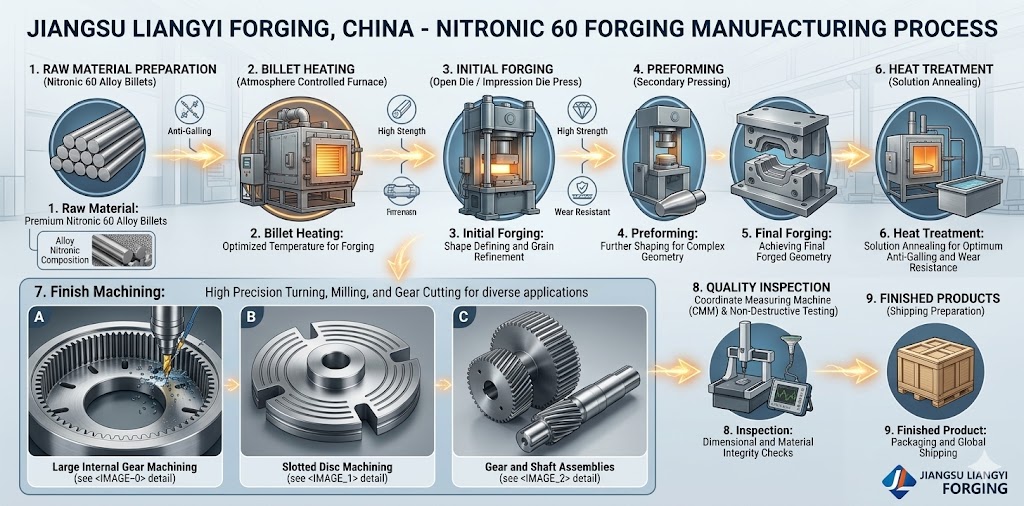
With over 25 years of experience manufacturing custom Nitronic 60 forged parts ,Liangyi has supplied customers around the world. Our factory covers 80,000 square meters and has modern equipment for forging, machining and testing .We can make Nitronic 60 Forging with weight range from 30 kg to 30,000 kg. We offer a full range of service from steel melting and forging ,heat treatment, machining to final inspection, they are all performed in-house to make sure the quality of every parts is strictly controlled. Our full Nitronic 60 forging capabilities include:
- Nitronic 60 Forged Bars: Round bars, square bars, flat bars, rectangular bars and rods with diameters up to 2 meters and a minimum forging ratio of 3:1
- Nitronic 60 Seamless Rolled Rings: Custom forged rings up to 6 meters in diameter and 30 tons in weight for pressure vessels and rotating equipment
- Nitronic 60 Hollow Components: Hubs, housings, shells, sleeves, bushes, cases and hollow bars with outer diameters up to 3 meters
- Nitronic 60 Flat Products: Discs, disks, blocks and plates up to 3 meters in diameter and 20 tons in weight
- Nitronic 60 Tubular Products: Pipes, tubes, tubings, piping shells, casings, barrels and housings for high-pressure applications
- Custom Nitronic 60 Forgings: Provide custom shapes and parts based on clients drawings and specifications
Nitronic 60 Forged Product Quick-Reference: Dimensions & Weights
| Product Type | Max Diameter / Size | Max Weight | Typical Applications |
|---|---|---|---|
| Forged Round Bars | Up to 2,000 mm Ø | 30,000 kg | Shafts, spindles, pump rods, valve stems |
| Seamless Rolled Rings | Up to 6,000 mm Ø | 30,000 kg | Flanges, pressure vessel shells, bearing rings |
| Hollow Components | Up to 3,000 mm OD | 20,000 kg | Sleeves, bushes, housings, pump casings |
| Flat Discs / Blocks | Up to 3,000 mm Ø | 20,000 kg | Impellers, tube sheets, baffle plates |
| Tubular / Pipe Sections | Custom OD × wall | 15,000 kg | High-pressure piping, barrels, casings |
| Custom Shapes | Per drawing | 30,000 kg | Complex structural and rotating components |
What Melting Processes Are Used for Nitronic® 60 Forgings?
All our Nitronic 60 forged materials are produced using advanced melting processes to get the excellent purity needed for important industrial applications. We offer two premium melting options for Nitronic 60:
- Triple Melted Nitronic 60: VIM (Vacuum Induction Melting) + ESR (Electroslag Remelting) + VAR (Vacuum Arc Remelting) –This process delivers the highest material purity, making it ideal for aerospace, critical safety parts, and high‑integrity applications that need maximum cleanliness and full ingot‑to‑part traceability.
- Double Melted Nitronic 60: VIM (Vacuum Induction Melting) + VAR (Vacuum Arc Remelting) – it is suitable for most oil and gas, power generation and marine applications
Why Our 3:1 Minimum Forging Ratio Matters
Every Nitronic 60 forged bar we produce withstands a minimum 3:1 forging ratio, which breaks down the cast distribution, refines the grain size, and improves mechanical properties such as strength, ductility and impact toughness. This makes sure our Nitronic 60 forgings can work well the extreme conditions and meet the international standards including ASTM, AMS, API 6A, DIN, EN and JIS.
Microstructure & Quality Specifications
Our Nitronic 60 forged products are given rigorous microstructure testing to make sure every part has consistent quality and performance. The microstructure must be uniform, devoid of significant segregation, inclusions, and other types of inhomogeneity. The EN ISO 643 standards are used to check the size of the grains.
- Sheets and plates get a mean grain size of 2-6
- Bars and shafts get a grain size of 5 or coarser
Nitronic 60 Chemical Composition (UNS S21800) — Per Standard Specification
| Element | Minimum (%) | Maximum (%) |
|---|---|---|
| Carbon (C) | — | 0.10 |
| Manganese (Mn) | 7.0 | 9.0 |
| Silicon (Si) | 3.5 | 4.5 |
| Phosphorus (P) | — | 0.04 |
| Sulfur (S) | — | 0.03 |
| Chromium (Cr) | 16.0 | 18.0 |
| Nickel (Ni) | 8.0 | 9.0 |
| Nitrogen (N) | 0.08 | 0.18 |
| Molybdenum (Mo) | — | 0.75 |
| Copper (Cu) | — | 0.75 |
Nitronic 60 Mechanical Properties: What Are the Minimum Specifications?
| Mechanical Property | Minimum Value |
|---|---|
| Ultimate Tensile Strength | 655 MPa (95,000 psi) |
| Yield Strength (0.2% Offset) | 345 MPa (50,000 psi) |
| Elongation (2" Gauge Length) | 35% |
| Reduction in Area | 55% |
| Brinell Hardness | 241 HBW maximum |
Nitronic 60 / UNS S21800 Physical Properties — What Engineers Need to Know
Beyond mechanical strength, the physical and thermal properties of Nitronic 60 / UNS S21800 directly affect component design, joining techniques, and in-service performance. The table below links each property to its real-world engineering meaning — insight gained from over 25 years of forging production experience, not just textbook data.
| Physical Property | Value (at 20°C / 68°F) | Why It Matters for Your Forged Component |
|---|---|---|
| Density | 7.67 g/cm³ (0.277 lb/in³) | ~5% denser than 304/316 SS — factor this into rotating equipment mass balance and buoyancy calculations for subsea components |
| Melting Range | 1,400–1,450°C (2,550–2,640°F) | Narrow melting window combined with 7–9% Mn requires precise furnace control during our forging process to avoid hot-shortness; our 3:1 forging ratio is calibrated to this range |
| Elastic Modulus (Young's Modulus) | 197 GPa (28.6 × 10⁶ psi) | Slightly higher than 304 SS (193 GPa) — gives marginally better deflection resistance; important for long shaft and spindle applications |
| Thermal Conductivity | 14.0 W/m·K (97 BTU·in/hr·ft²·°F) | Roughly half that of carbon steel — heat dissipates slowly, so design cooling channels into high-cycle applications like pump casings and compressor impellers |
| Thermal Expansion (20–100°C) | 16.2 μm/m·°C (9.0 μin/in·°F) | Higher than 316 SS — critical for flanged assemblies, press-fit hubs and any component mating with dissimilar metals over a wide temperature range |
| Specific Heat Capacity | 500 J/kg·K (0.12 BTU/lb·°F) | Similar to 304 SS — relevant for heat exchanger sizing and thermal cycling fatigue analysis |
| Electrical Resistivity | 0.82 μΩ·m | Higher resistivity than 316 SS — reduces eddy current losses in electromagnetic applications; confirms the non-magnetic austenitic matrix remains stable after forging |
| Magnetic Permeability | < 1.005 (fully non-magnetic) | Remains non-magnetic even after severe cold working or forging deformation — a decisive advantage over 17-4 PH and duplex grades in MRI, defence and subsea sensor housings |
| Poisson's Ratio | 0.28 | Standard for FEA modelling of pressure vessels, rotating rings and complex structural forgings |
Nitronic 60 / UNS S21800 Heat Treatment for Forgings — Forging-Specific Protocol
Heat treatment of Nitronic 60 / UNS S21800 forgings differs from plate or bar stock because the forging process itself introduces internal stress patterns and directional grain flow that must be properly managed. The following protocol is based on Jiangsu Liangyi's production experience and is calibrated specifically for open-die forgings and seamless rolled rings — not generic wrought product.
Why Forging Heat Treatment Differs from Standard Mill Product
Even when rolled bars and forged bars use the exact same Nitronic 60 / UNS S21800 chemistry, they behave differently during heat treatment. The forging process forms a directional fibrous grain structure that concentrates residual stress at geometric changes such as shoulders, bores, and ring radii. Our heat treatment parameters are specially adjusted to account for these stress concentrations and the larger cross-sections typical of forgings, guarantees complete recrystallization through the entire part thickness rather than only near the surface. Generic thin-plate property data from standard material websites does not apply to heavy-section forgings.
| Heat Treatment Condition | Temperature Range | Cooling Method | Typical Application | Effect on Properties |
|---|---|---|---|---|
| Full Anneal | 1,040–1,095°C (1,900–2,000°F) | Rapid water quench immediately after withdrawal | General corrosion service, standard oil & gas components | Maximum corrosion resistance; full stress relief; softens work-hardened surface layers from forging |
| Solution Anneal (High-Temperature) | 1,050–1,120°C (1,920–2,050°F) | Water quench or forced rapid air cool (section-dependent) | Nuclear, cryogenic, high-purity process applications | Complete dissolution of any secondary phases; finest grain size; highest low-temperature toughness (Charpy impact >200 J at −196°C) |
| Stress-Relief Anneal | 870–925°C (1,600–1,700°F) | Slow furnace cool to 600°C, then air cool | Large-section rings and hubs where dimensional stability after machining is critical | Reduces machining distortion without fully recrystallising — specify only when dimensional stability takes priority over maximum corrosion resistance |
| As-Forged (No Heat Treatment) | Final forging finish above 950°C (1,740°F) | Air cool | Wear plates, tooling, non-critical structural applications | Higher hardness due to retained forging strain; corrosion resistance below annealed condition — not recommended for aggressive chemical environments |
Forging temperature window: Our open-die forging of Nitronic 60 / UNS S21800 is conducted between 1,150°C and 950°C (2,100°F–1,740°F). Finishing above 950°C is strictly maintained to avoid deformation-induced martensite and to make sure the austenitic matrix is preserved throughout the forged cross-section. Soaking time per 25mm of section thickness: minimum 30 minutes in our gas-fired furnaces.
Which Alloy Should You Choose? Nitronic 60 / UNS S21800 vs. Key Alternatives — Engineering Decision Matrix
Generic comparison tables only list material properties and figures, while this selection matrix helps you determine exactly which alloy to order, based on the failure modes you aim to prevent — insights drawn from our experience supplying forgings to over 50 countries. No two applications are exactly the same, but material selection typically comes down to five key failure modes: galling, corrosion, strength, temperature resistance, and magnetism.
| Failure Mode / Requirement | Nitronic 60 / UNS S21800 | Nitronic 50 / UNS S20910 | 17-4 PH / UNS S17400 | Duplex 2205 / UNS S31803 |
|---|---|---|---|---|
| Anti-galling / seizure prevention | 🏆 Best choice — purpose-designed | Good — moderate Si content helps | Poor — work-hardens but still galls | Fair — better than 316, worse than N60 |
| High chloride corrosion (seawater) | Good (PREN ~24) | Very good (PREN ~38) | Moderate — avoid immersion | 🏆 Excellent (PREN ~35) — first choice |
| Maximum tensile strength needed | Moderate (655 MPa UTS min) | High (690 MPa UTS min) | 🏆 Up to 1,310 MPa after H900 aging | High (620 MPa UTS min, higher yield) |
| Cryogenic service (below −100°C) | 🏆 Excellent — Charpy impact >200J at −196°C | Very good | Poor — brittle below −50°C | Fair — limited to −50°C in ASME codes |
| Non-magnetic requirement | 🏆 Fully non-magnetic (<1.005 μ) | 🏆 Fully non-magnetic | Slightly magnetic after aging | Magnetic (ferritic phase ~45%) |
| Nuclear / cobalt-free requirement | 🏆 Cobalt-free, radiation-stable | 🏆 Cobalt-free | 🏆 Cobalt-free | 🏆 Cobalt-free |
| Relative material cost | Medium | Medium-high (more Mo, Nb) | Medium (Cu precipitation hardened) | Medium-high (high Mo) |
| Forging machinability | Moderate — high Si causes tool wear | Moderate | Good in annealed condition | Moderate — dual-phase work-hardens |
Jiangsu Liangyi's recommendation rule: If your main concern is galling between mating surfaces, Nitronic 60 / UNS S21800 is the suitable starting point. If chloride pitting in seawater is your primary issue and galling is secondary, Duplex 2205 is a suitable choice. For applications needing high strength combined with non-magnetic properties, Nitronic 50 is worth evaluating. When strength is the top priority and the service environment is only mildly corrosive, 17-4 PH can help lower costs. Our technical team can review your application drawings and recommend the best alloy along with the proper heat treatment — feel free to contact us for a free engineering consultation.
Welding Nitronic 60 / UNS S21800 Forgings — Post-Forging Assembly Guidance
Most published welding data for Nitronic 60 / UNS S21800 is developed for sheet and plate production. Welding heavy-section forgings involves completely different challenges, including larger heat‑affected zones, residual stress from the forging process, and the need to preserve anti‑galling performance across the weld interface. The guidance below is based on our experience welding assemblies using Jiangsu Liangyi forgings and is not available in standard material datasheets.
Recommended Welding Processes & Filler Metals for Nitronic 60 / UNS S21800 Forgings
| Welding Process | Recommended Filler Metal | Notes Specific to Heavy-Section Forgings |
|---|---|---|
| GTAW (TIG) — preferred for root passes | ER219 (matching Nitronic 60 composition) | Use for precision root passes on machined forging surfaces. Low heat input preserves anti-galling properties at the weld interface. Argon shielding; no backing gas required for wall thickness >12mm. |
| GMAW (MIG) | ER219 or ER316L (if anti-galling in weld zone is non-critical) | ER316L acceptable for structural welds where the weld zone is not a sliding contact surface. ER219 mandatory if the welded joint itself will experience metal-to-metal contact. |
| SMAW (Stick) | E316L-16 (field repair only) | Use only for field repair. Lower manganese and silicon in E316L electrodes mean reduced anti-galling properties in the deposited weld metal — document this deviation in the MTC. |
| SAW (Submerged Arc) | ER219 wire + matching flux | Suitable for large ring-to-flange welds in pressure vessel assemblies. Control heat input strictly: max 35 kJ/cm. Excess heat input in heavy-section forgings risks sensitisation at grain boundaries. |
The Sensitisation Risk Most Engineers Overlook in Nitronic 60 Forgings
Nitronic 60 / UNS S21800 has a maximum carbon content of 0.10%, which is higher than that of 316L (0.03% max). This is seldom an issue with thin plates, but in heavy-section forgings, if interpass temperature is not controlled, the center of the heat-affected zone in thick sections may cool slowly through the sensitisation range (600–850°C). Jiangsu Liangyi recommends the following: (1) maintain interpass temperature below 150°C for sections over 75 mm; (2) use stringer beads instead of weave patterns; (3) specify post-weld heat treatment (PWHT) consisting of solution annealing at 1040°C followed by water quenching for pressure-containing forgings used in aggressive chloride environments. This is particularly critical for pressure-retaining forgings manufactured in accordance with ASME Section VIII Div.2 or PED 2014/68/EU, where the weld procedure qualification must be revalidated after PWHT.
Machining Nitronic 60 / UNS S21800 Forgings — 5 Critical Differences from Machining Standard Stainless Steel
Customers who machine Nitronic 60 / UNS S21800 forgings for the first time often use the same parameters as for 316 stainless steel — and run into unexpected tool wear, surface chatter, or dimensional drift. The root cause lies in its silicon content (3.5–4.5%) combined with a nitrogen-strengthened microstructure. These five practical insights come directly from CNC machining feedback shared by our customers after processing forgings supplied from our Jiangyin facility.
Difference 1 — Work Hardening Rate is Non-Linear
Nitronic 60 / UNS S21800 work-hardens faster than 316 SS in the first 0.5mm depth of cut, then stabilises. Engineers who use multiple light passes to "sneak up" on a dimension drive the tool into progressively harder material with each pass. Correct approach: one heavy, aggressive roughing cut of ≥2mm depth to stay below the work-hardened layer, followed by a single finishing pass. This reduces total cutting time and tool consumption by 30–40% compared to multi-light-pass strategies.
Difference 2 — Silicon Abrades Uncoated Carbide Rapidly
The 3.5–4.5% silicon content in Nitronic 60 / UNS S21800 delivers its excellent anti-galling performance, but this hard silicon phase quickly wears down the cutting edge of uncoated carbide inserts in just minutes. We always recommend TiAlN or AlTiN PVD‑coated carbide inserts: ISO P25–P40 grades for roughing and P10–P15 for finishing. HSS tools are not recommended except for low‑speed drilling of small holes under 8 mm in diameter. Indexable insert tools last 3–5 times longer than brazed tools when machining this material.
Difference 3 — Coolant Delivery Direction Matters
Flood coolant is mandatory when machining Nitronic 60 / UNS S21800 — and the coolant direction is important.This alloy has low thermal conductivity (only 14 W/m·K), so heat does not dissipate into the workpiece as fast as it does with carbon steel.Aim the coolant jet directly at the insert rake face, not the flank. This breaks the chip and removes heat before it can anneal‑harden the next chip.For deep drilling, use high‑pressure through‑tool coolant (70–150 bar) to greatly reduce work‑hardening and chip packing inside holes.
Difference 4 — Forging Skin Requires a Pre-Pass
Unlike bar stock, our forgings may have a decarburized surface layer of 0.5–2.0 mm (depending on forging temperature and atmosphere), along with surface scale that is harder than the base material. Never take your first cut to your final target dimension — always run a pre-pass of at least 3 mm to cut through this hard surface layer and reach the consistent forged grain matrix. This is why we supply forgings with defined machining allowances per order (usually more than 5 mm per face for rough forgings and more than 2 mm for semi-machined parts). Our technical team includes recommended machining allowances on every forging drawing.
Difference 5 — Dimensional Stability After Rough Machining
Large-section Nitronic 60 / UNS S21800 forgings — such as rings over 500 mm outer diameter and bars over 300 mm in diameter — may show dimensional movement of 0.1–0.5 mm between rough and finish machining as residual forging stresses relax.For tight-tolerance parts needing ±0.05 mm or better, we recommend a stress-relief anneal at 870°C after rough machining and before finish machining.Please mention this requirement during the quotation stage so Jiangsu Liangyi can include it in the heat treatment process. While it adds some lead time, it completely deletes scrap risk on high-value forgings.
Nitronic 60 / UNS S21800 Standards & Specifications — Which Standard Do You Need?
One of the most common questions from procurement engineers is: “Which standard should I specify for Nitronic 60 / UNS S21800 forgings?” The answer depends on your industry, end-user region, and the type of forged product. The guide below matches each major standard to its scope and target customer profile — a practical resource developed from processing thousands of purchase orders.
| Standard | Product Form | Typical User | Key Requirement Unique to This Standard |
|---|---|---|---|
| ASTM A276 / A276M | Bars, shapes | US oil & gas, general engineering | Specifies condition (annealed or cold-finished) and test direction; most widely accepted for valve stems and pump shafts |
| ASTM A479 / A479M | Bars for pressure vessel and high-integrity service | ASME pressure vessel engineers, high-integrity structural applications | Stricter surface condition requirements; mandatory proof test; pairs with ASME SA-479 for coded pressure equipment |
| AMS 5848 | Bars and forgings (incl. VAR re-melt requirement) | Aerospace and defence procurement teams | Requires VAR re-melt stock; 100% UT per AMS 2631; tighter chemistry tolerances than ASTM. Jiangsu Liangyi can supply forgings from AMS 5848-compliant VAR stock sourced from qualified melt shops — confirm melt and UT traceability requirements at enquiry stage. |
| API 6A / API 6D | Valve bodies, bonnets, flanges, fittings | Wellhead, Christmas tree, pipeline equipment OEMs | PSL 2/3/3G levels add charpy testing, hardness maps and additional NDT; NACE MR0175 / ISO 15156 compliance typically mandatory at PSL 2+ |
| EN 10250-4 / EN 10222-5 | Forgings for general and pressure vessel service | European EPC contractors, PED-regulated equipment | Requires CE marking on the MTC; EN 10204 3.1 or 3.2 certification; closest European equivalent to UNS S21800 is designated X2CrMnNiN17-8-8 |
| NACE MR0175 / ISO 15156 | Any product form for sour service | H₂S-containing oil & gas environments | Not a dimensional standard — a material qualification standard. Nitronic 60 / UNS S21800 is qualified under ISO 15156-3 Table A.2 for sour service at hardness ≤241 HBW |
| RCC-M / ASME Section III | Nuclear-grade forgings (reference only) | Engineering reference for nuclear procurement teams | Requires triple-melt (VIM+ESR+VAR) traceability; Level 1 witness inspection; full ingot-to-part traceability. These specifications require nuclear vendor qualification by the end-user's quality authority — please consult your project quality plan before referencing these codes in your purchase order. |
Jiangsu Liangyi's approach: We do not ask customers to guess which standard applies. Send us your application description and end-user country, and our technical team will confirm the correct standard and MTC level — at no extra cost during the quotation process.
Nitronic 60 / UNS S21800 Forging Delivery Cases — Four Industries, Four Formats, One Standard of Quality
Each project below is shown in a unique format, since every customer faced different challenges, followed different inspection requirements, and held different priorities. By reviewing all four cases, you will gain a complete understanding of how Jiangsu Liangyi manages custom Nitronic 60 / UNS S21800 forgings — from initial inquiry to final MTC approval — serving the oil & gas, petrochemical, cryogenic, and downhole pump industries.
Case 1 / Subsea Gate Valve Stems — Norwegian North Sea | Format: Failure-to-Fix Field Record
This case is presented as a field failure record—beginning with the breakdown incident, tracing the root cause of the issue, and concluding with the verified solution. Order details are woven into the narrative rather than listed in a specification table, as the customer’s procurement decision was driven entirely by the failure analysis, not a routine material upgrade.
The Failure That Triggered the Order
Over 18 months after installation, three galling and seizure issues occurred on the stems of existing 316 stainless steel (316 SS) gate valves. These valves were installed at a water depth of 320 meters on the Norwegian Continental Shelf. Each issue needed underwater robot (ROV)-assisted well intervention to cut and recover the damaged valve stems. The average cost for each intervention, including vessel deployment, was between USD 650,000 and 900,000. The operator’s independent failure analysis report found that adhesive wear started at the contact area between the valve stem and the packing during peak operation of the ROV torque tool. The tool applied a torque of 1,850 N·m at a speed of 0.8 revolutions per minute (rpm). Small welds formed between the outer surface of the 316 SS valve stem and the 316 SS packing follower. When these welds broke, they left torn craters 4 to 6 millimeters deep on the stem surface. The measured hardness at the failure area was 156 to 162 HBW.The main cause of the problem was that two identical alloys were in sliding metal-to-metal contact under high load, with no anti-galling protection.
Why Nitronic 60 / UNS S21800 — and What Was Ordered
Nitronic 60 was chosen for the replacement valve stems. Its silicon content (3.5–4.5%) creates a continuous composite oxide film (SiO₂/MnO) on the contact surface. This film prevents the micro-welding issue that damaged the 316 stainless steel stems—no extra coating, plating, or hardening treatment is needed. When annealed, this alloy also meets the requirements of NACE MR0175 / ISO 15156-3 Table A.2 (hardness ≤ 241 HBW), which is needed because the produced gas stream contains 42 ppm of H₂S. What Jiangsu Liangyi provided: 48 open-die forged stepped round bars, rough-machined (outer diameter peeled, faces squared). These bars were delivered in two batches of 24 pieces each, with an 8-week interval between batches. Purchase order number: PO-NO-2022-0317, total amount: USD 87,400. Incoterms: CIF Rotterdam. EN 10204 3.2 Material Test Certificate (MTC) was countersigned by an independent third-party inspection (TPI) inspector nominated by the client.
Critical Dimensions — What the Drawing Required, What We Delivered
| Drawing Feature (DWG JV-2500-STM-04 Rev.C) | Required | Delivered (worst piece, Batch 1) | Result |
|---|---|---|---|
| Main stem body OD — Section A (rough-peeled) | Ø 178 mm +2.0/−0 | Ø 179.4 mm | ✔ |
| Lower journal OD — Section B (rough-peeled) | Ø 95 mm +2.0/−0 | Ø 96.8 mm | ✔ |
| Overall forged length | 1,248 mm +5/−0 | 1,251 mm | ✔ |
| Shoulder step position (A-to-B from lower face) | 320 mm ±3 | 321 mm | ✔ |
| Straightness — full length | ≤ 0.30 mm/m | 0.18 mm/m | ✔ |
| Surface roughness Ra (peeled OD) | ≤ 6.3 μm | 3.9 μm | ✔ |
MTC Results — Heat LY-22-0317, Batch 1 of 2 (EN 10204 3.2, client-nominated TPI countersigned)
Mechanical Properties
UTS: 724 MPa (min 655) ✔
0.2% YS: 398 MPa (min 345) ✔
Elongation: 44% (min 35%) ✔
Reduction of Area: 68% (min 55%) ✔
Hardness: 185–191 HBW (max 241, NACE) ✔
NDT & Chemistry Highlights
UT per ASTM A388 Level C: 0 recordable indications (24/24 pcs) ✔
PT per ASTM E165 Type II: 0 relevant indications ✔
Si actual: 3.92% (spec 3.50–4.50%) ✔
Co actual: 0.031% (customer limit ≤ 0.10%) ✔
Field outcome: During the 24-month monitoring period after installation, no galling or seizure issues were reported. According to the operator’s latest revised integrity management plan, the replacement interval for the subsea tree valve stems has been extended from 18 months (for 316 stainless steel stems) to the full design life of the subsea tree, which is 25 years.
Case 2 / High-Pressure Amine Absorber Nozzle Rings — Indian Petrochemical Refinery | Format: Engineering Project Data Sheet
This case is presented as a project data sheet — the format the customer's procurement and engineering teams used in their internal hand-over documentation. It front-loads every main number so an engineer can assess manufacturability and compliance at a glance, before reading the narrative.
Product Form
Seamless Rolled Rings
Rough-machined (+8 mm all faces)
Quantity & Weight
6 rings
≈ 1,420 kg each as rough-machined
Order Value & Terms
USD 148,200
CFR Nhava Sheva (JNPT), PO-IN-2022-0588
Melt Route
VIM + ESR + VAR
Full ingot-to-ring traceability
MTC Level
EN 10204 Type 3.1
Customer QC inspector attended final inspection
Special Requirement
NACE MR0175 hardness
≤ 241 HBW, 9 points per ring on MTC
Ring Geometry — Drawing AGT-NZL-RING-218-Rev.B
OD: Ø 1,048 mm +8/−0 mm | ID: Ø 820 mm +0/−8 mm | Height: 185 mm +8/−0 mm | Radial wall (rough state min.): 122 mm | Ovality limit: ≤ 6 mm | Face flatness: ≤ 2.0 mm full face. Grain size: ASTM No. ≥ 3. Forging reduction ratio ≥ 3:1 documented.
During the design review, the drawing note was resolved: the customer’s weld-backing ring groove on the inner diameter (ID) surface—measuring 30 mm wide × 8 mm deep—fell within the minimum finished-wall area. Jiangsu Liangyi adjusted the rough inner diameter to 812 mm and obtained written engineering approval from the customer before proceeding with the rolling process. This adjustment avoided a potential Non-Conformance Report (NCR) during the fabricator’s machining stage.
Engineering Challenge — Why the Previous 316L Flange Rings Failed
18 months earlier, the same refinery had commissioned a sister AGT unit, which used standard 316L stainless steel nozzle flange rings. These flange rings were in service under 82 bar pressure and 120°C temperature, with H₂S-laden gas on the shell side. During the start-up and shutdown processes, thermal cycling gradually caused galling on the mating faces of the 316L stainless steel flanges. Over 14 months, there were six emergency shutdowns to re-face the flanges—each shutdown lasted an average of 31 hours, and the estimated production loss per shutdown was USD 700,000.
Metallographic inspection confirmed that cold-welded micro-junctions sheared during each thermal expansion cycle, leaving increasingly deep craters that eventually damaged the gasket seating integrity. The total cost caused by the 316L stainless steel failure was approximately USD 4.2 million, including lost throughput and maintenance labor costs.
Nitronic 60 / UNS S21800 solved both existing failure modes at the same time: the SiO₂/MnO oxide film prevents adhesive micro-welding on the flange contact surface; the VIM+ESR+VAR triple-melt process reduces the sulfur content to ≤ 0.010% (actual value: 0.007%), eliminating the MnS inclusions that act as H₂S-assisted stress corrosion initiation points in conventional austenitic stainless steel under sour service conditions.
Test Results — All 6 Rings, EN 10204 3.1 MTC
| Property | Spec Min/Max | Ring 1 | Ring 3 | Ring 6 | All Pass? |
|---|---|---|---|---|---|
| UTS (MPa) | ≥ 655 | 718 | 712 | 721 | ✔ All 6 |
| 0.2% YS (MPa) | ≥ 345 | 394 | 388 | 401 | ✔ All 6 |
| Elongation (%) | ≥ 35 | 46 | 44 | 48 | ✔ All 6 |
| Hardness (HBW) — NACE limit ≤ 241 | ≤ 241 | 182–189 | 177–186 | 180–191 | ✔ All 6 |
| Grain Size ASTM No. | ≥ 3 | No.4 | No.5 | No.4 | ✔ All 6 |
| UT — ASTM A388 Class C | No recordable ind. | 0 | 0 | 0 | ✔ All 6 |
| S content (VAR controlled) | ≤ 0.030% | 0.007% (single heat) | ✔ | ||
12-month field follow-up: The customer’s own quality survey confirmed that there were no galling incidents on any of the six nozzle flange joints. In the first year of operation of the new AGT unit, no emergency shutdowns related to flange integrity were recorded.
Case 3 / Cryogenic Valve Shafts for Air Separation Unit — South Korea | Format: Supplier Comparison & Lessons Learned
This case is structured as a supplier comparison, as the customer turned to Jiangsu Liangyi after an unsuccessful first order with another supplier. The most valuable information here is not our dimensions or test results—both of which are straightforward—but the specific process decisions that explain why we succeeded where the previous supplier failed.
Order Snapshot
Application: Cryogenic butterfly valve shafts for liquid nitrogen (LN₂) and liquid oxygen (LOX) service at −196°C / 16 bar in an air separation unit expansion at a Korean integrated steel complex.
Geometry: Three-step forged round bar — Ø 97 mm (drive end, L=120 mm) → Ø 68 mm (disc mount zone, L=380 mm) → Ø 47 mm (tail end, L=146 mm) — total length 686 mm, straightness ≤ 0.50 mm/m, Ra ≤ 3.2 μm all OD.
Quantity & value: 120 pieces, USD 134,600, CIF Busan. PO-KR-2023-1142.
Key specifications: ASTM A276/A276M-22 UNS S21800, VIM+ESR+VAR triple-melt, solution anneal + water quench. Charpy KV ≥ 80 J at −196°C (transverse). Magnetic permeability μ ≤ 1.01 (LOX ignition risk control). EN 10204 3.1 MTC + customer-countersigned cryogenic test supplement.
What the Previous Supplier Got Wrong — and Why It Matters
| Process Variable | Previous Supplier (Failed Lot) | Jiangsu Liangyi (This Order) | Why It Matters at −196°C |
|---|---|---|---|
| Mn content | 7.08% (low end, within ASTM) | 7.88% (aim 7.70–8.40%, VIM-controlled) | Mn stabilises the austenite matrix at cryogenic temperatures; low Mn → reduced stacking fault energy → martensite transformation → brittle fracture path |
| Phosphorus | 0.038% (within ASTM ≤ 0.040%) | 0.016% (VAR-controlled) | P segregates to grain boundaries; even sub-limit P embrittles boundaries at −196°C, reducing impact energy by 20–35% in heavy-section forgings |
| Solution anneal soak time | 20 min short of specification (not documented) | Calculated per cross-section: 1 min/mm of equivalent section; formally documented in Manufacturing Process Plan before production | Incomplete anneal leaves residual forging strain in the core; deformation-induced hardening reduces impact toughness 15–25% in the under-annealed zone |
| Straightness after quench | Bending correction applied cold after HT | Rotary straightening within 2 hr of quench, above 450°C core temp; no cold correction required | Cold straightening introduces residual bending stress that can initiate fracture at stress raisers (step shoulders) under cryogenic shock loading |
| Cryogenic test frequency | 1 test set per heat | 1 test set per 10 pieces, 12 sets total for 120 pcs | Heat-level testing missed the within-heat variation caused by the short anneal; per-lot testing catches process drift before it affects the full order |
Test Results — 12 Representative Sets from 120 Pieces
UTS: 697–738 MPa (min 655 ✔) | 0.2% YS: 372–411 MPa (min 345 ✔) | Elongation: 42–51% (min 35% ✔)
Charpy KV at −196°C (transverse, sets of 3): avg 196 J — minimum single specimen 183 J (customer requirement: avg ≥ 80 J, min single ≥ 65 J ✔ — actual margin: 2.4× the minimum)
Magnetic permeability μ: 1.0024–1.0031 (limit ≤ 1.01 ✔) | Hardness: 177–192 HBW (max 241 ✔) | PT 100%: 0 relevant indications ✔
Straightness (all 120 pcs): max 0.31 mm/m (limit ≤ 0.50 ✔)
Schedule outcome: The customer's valve assembly line operated continuously without any interruptions. The commissioning of the ASU (Air Separation Unit) was completed on the contracted milestone date — the 11-week delay penalty that occurred in the previous order did not happen again.
Case 4 / ESP Pump Wear Rings, Gulf of Mexico Deepwater — USA | Format: Material Qualification Test Record
This case is presented as a material qualification record, as the customer’s procurement process required a formal trial batch along with ASTM G98 galling test approval prior to the release of the full production order. Consequently, the qualification data serves as the primary documentation for this order, rather than the Material Test Certificate (MTC).
Qualification Test — ASTM G98 Galling Threshold (Customer-Nominated Third-Party Laboratory, USA)
Test configuration: Nitronic 60 / UNS S21800 button (rotating) is in direct contact and sliding against Nitronic 60 / UNS S21800 block (stationary). Three specimens were taken from the trial batch rings.Acceptance criterion: The ungalled threshold stress must be at least 207 MPa (this is the maximum contact stress calculated by the customer under the peak sand ingress condition in the Stage 5 ESP centrifugal pump).For comparison, the previous baseline using 17-4 PH stainless steel in the same test setup had an ungalled threshold of 103 MPa.
| Contact Stress Applied | Specimen 1 | Specimen 2 | Specimen 3 | 17-4 PH Baseline |
|---|---|---|---|---|
| 69 MPa (10 ksi) | No galling | No galling | No galling | No galling |
| 103 MPa (15 ksi) | No galling | No galling | No galling | GALLED ← 17-4 PH limit |
| 138 MPa (20 ksi) | No galling | No galling | No galling | Not tested |
| 207 MPa (30 ksi) ← Customer minimum | No galling | No galling | No galling | Not tested |
| 276 MPa (40 ksi) | No galling | No galling | No galling | Not tested |
| Ungalled Threshold Stress | ≥ 276 MPa — test stopped; no galling observed at maximum stress applied | 103 MPa | ||
Qualification outcome: The ungalled threshold of self-mated Nitronic 60 / UNS S21800 exceeds the customer’s minimum requirement by 33% and is 168% higher than the 17-4 PH baseline. The customer issued Purchase Order B (for 280 pieces) within 3 days after receiving the ASTM G98 test report.
Dimensional Precision — CMM Results (Zeiss Contura, 100% of Trial Batch, 40 Pieces)
Ring geometry: outer diameter (OD) is Ø 167.800 mm (h6 tolerance, finish-ground), inner diameter (ID) is Ø 140.050 mm (H7 tolerance, finish-bored), and face width is 32.00 mm ±0.05 mm.The running clearance during assembly is 0.025–0.075 mm, which is compensated for the 120°C downhole fluid temperature to account for thermal expansion.The ring is finish-machined according to the design drawing, so no additional machining by the customer is needed.
| Critical Feature | Tolerance | Worst Case (40 pcs) | Cpk |
|---|---|---|---|
| OD — h6 (finish-ground) | −0.025 / +0 mm | −0.019 mm | 1.68 |
| ID — H7 (finish-bored) | +0 / +0.025 mm | +0.018 mm | 1.54 |
| Face width | ±0.05 mm | +0.032 mm | 2.11 |
| Cylindricity OD ⌭ | ≤ 0.010 mm | 0.006 mm | — |
| Concentricity ID to OD ◎ | ≤ 0.020 mm TIR | 0.012 mm | — |
| OD surface roughness Ra | ≤ 0.8 μm | 0.52 μm | — |
All important features are well within the specified tolerance range. The customer’s minimum requirement for the Process Capability Index (Cpk) is 1.33. The actual test results show: Cpk for outer diameter (OD) is 1.68, Cpk for inner diameter (ID) is 1.54, and Cpk for face width is 2.11 — all of which exceed the customer’s requirement by a considerable margin.
Why the Previous 17-4 PH Rings Kept Failing — and Why This Order Context Matters
Before this order, the customer used 17-4 PH stainless steel wear rings (in H1025 condition, with a hardness of 330–360 HBW) for their Stage 5 ESP (Electric Submersible Pump) stages. In wells where the sand production index was above 0.15 g/L, the average lifetime before galling and seizure occurred was 11 months, equivalent to approximately 2,500 operating hours.The cause of the seizure was as follows: fine quartz sand particles (with a size of 50–200 μm and a Mohs hardness of 7) scratched both mating surfaces. When the flow rate temporarily decreased, the parallel scratches led to metal-to-metal contact. The 17-4 PH material, which has a Ni-Cu-enriched matrix, caused adhesive metal transfer between the two surfaces. This resulted in the impeller seizing, overloading the 680 kW / 5,000 V downhole motor and leading to thermal burnout. The average cost for each workover (repair) was USD 180,000, plus 18 days of lost production at a rate of 1,400 barrels of oil per day (BOPD).
Nitronic 60 prevents the final step in this failure chain — the adhesive metal transfer. Even after the surface is scratched by sand, the SiO₂/MnO oxide film on its surface can reform continuously. This film acts as a chemical barrier between the metal surfaces throughout the sand-induced wear process. After 14 months of downhole service (totaling 10,200 operating hours, with an average sand production index of 0.22 g/L), there were zero seizure events. Compared to the 17-4 PH baseline, the degradation rate of the impeller clearance was reduced by 78%, and the expected pull interval (replacement cycle) was extended from 11 months to more than 36 months. Since then, the customer has standardized the use of Nitronic 60 (UNS S21800) for both their Stage 5 and Stage 7 wear ring product lines.
How Is Nitronic® 60 Forging Quality Tested and Certified?
At Jiangsu Liangyi, quality is our top priority. Every piece of Nitronic 60 forging we produce is given full testing at our in-house quality control laboratory to make all parts meet international standards and customer requirements. Our advanced testing capabilities include:
Non-Destructive Testing (NDT)
- 100% Visual inspection
- Precision dimensional verification
- Ultrasonic testing (UT) per ASTM A388
- Dye penetrant testing (PT) per ASTM E165
- Magnetic particle testing (MPT) per ASTM A275
Destructive Testing & Material Analysis
- Room and high-temperature tensile testing
- Brinell and Rockwell hardness testing
- Charpy impact resilience testing
- Creep and stress rupture testing
- Metallographic examination and grain size analysis
- Precision chemical composition analysis using spectrometry
All our Nitronic 60 forged products are supplied with EN 10204 Type 3.1 Mill Test Certificates (MTC) as standard. These certificates are issued by Jiangsu Liangyi's own authorized Quality Inspector under our ISO 9001:2015 quality management system.
EN 10204 Type 3.2 MTC, which is countersigned by an independent third-party inspector, is available on the condition that a client-nominated or mutually agreed Third-Party Inspection (TPI) agency is appointed before production starts. We actively provide access for inspection to recognized institutions including SGS, BV, TÜV, Lloyd's Register and DNV.
Why Choose Jiangsu Liangyi as Your Nitronic® 60 Forging Manufacturer in China?
more than 25 Years of Forging Expertise
Since 1997, we have been specializing in manufacturing high-quality open die forgings and seamless rolled rings for industrial customers around the world
Complete In-House Capabilities
From steel melting and forging to heat treatment, machining and testing – all processes are performed in-house for the highest quality
Advanced Manufacturing Equipment
We have 6300T hydraulic presses, 5M seamless rolling machines and state-of-the-art testing equipment.
International Quality Standards
We are ISO 9001:2015 certified and our products meet ASTM, AMS, API 6A, DIN, EN and JIS standards.
Competitive Pricing
As a direct manufacturer in Jiangyin, China, we offer the most competitive prices without compromising on quality.
Global Customer Support
We export to over 50 countries and provide dedicated English-speaking customer support for a seamless experience.
Frequently Asked Questions About Nitronic® 60 Forgings (FAQ)
All relevant hardness test results are included on the EN 10204 3.1 Mill Test Certificate, along with a clear statement confirming the material meets the hardness requirements of ISO 15156‑3 Table A.2.
Please note that NACE does not issue individual product certificates. Compliance is proven through the hardness test documentation shown on the MTC.
(1)Alloy type – Nitronic 60 / UNS S21800 / Alloy 218 (already confirmed).(2)Product shape – bar, ring, disc, hollow part, or custom shape.(3)Dimensions – outer diameter, inner diameter (if hollow), length or height, including tolerances.(4)Heat treatment condition – annealed, solution-treated, or as-forged.(5)Testing requirements – NDT methods (UT, PT, MT) and MTC level (standard EN 10204 3.1, or 3.2 with customer-nominated third-party inspection).(6)Applicable standard – ASTM A276, API 6A, EN 10250, or your company specification.(7)Melting process – our standard is VIM+ESR+VAR triple melt.(8)Order quantity and required delivery date(9)Any special requirements – NACE MR0175 hardness certification, third-party inspection by SGS, BV, TÜV or DNV
Your 8-Point RFQ Checklist for Nitronic 60 / UNS S21800 Forgings
Experienced procurement engineers can shorten quotation lead time and avoid expensive order changes by preparing a complete technical inquiry from the beginning.Based on the most common causes of quotation delays or post-order specification changes for Nitronic 60 / UNS S21800 forging projects, Jiangsu Liangyi has created this checklist — built from our experience handling more than 3,000 special alloy forging orders since 1997.
✅ Point 1 — Alloy Designation
Please list all applicable material names: Nitronic 60 / UNS S21800 / Alloy 218.If your internal drawing only uses a trade name, include the UNS number as a cross-reference to prevent alloy substitution mistakes.
If you need triple‑melt (VIM+ESR+VAR) material for aerospace, high‑integrity, or sour‑service applications, state this clearly — it directly affects raw material lead time.
✅ Point 2 — Product Form and Dimensional Tolerances
Please specify the product form (bar, ring, disc, hollow, or custom shape), and include not only nominal dimensions but also tolerance classes.For forged rings, indicate whether the OD or ID is the datum surface.For forged bars, specify whether the tolerance applies to the diameter or to the centerline.Our standard forging tolerances follow EN 10243‑1 for closed‑die forgings and ASTM A788 for open‑die forgings. Please state if your project requires tighter tolerances than these standards.
✅ Point 3 — Heat Treatment Condition on Delivery
State the required condition: annealed (1,040–1,095°C + water quench), solution-annealed (1,050–1,120°C + WQ), or as-forged. If you plan to do your own heat treatment after machining, simply write “as-forged, customer to heat treat” so we can ship your order without extra annealing costs. If you are not sure which condition to choose, we can suggest the best option based on your working environment.
✅ Point 4 — Testing Scope and MTC Level
Specify every required test: tensile (room temperature and/or high temperature), hardness (Brinell/Rockwell), Charpy impact (temperature, orientation, minimum energy), corrosion test (IGC according to ASTM A262 Practice E), UT class (SA/B/C/D per ASTM A388), PT/MT, and dimensional inspection. Also state the MTC level you need: EN 10204 2.1 (compliance certificate), 2.2 (factory certificate), 3.1 (inspection certificate by our QC), or 3.2 (with independent third‑party inspector). Not providing clear testing requirements is the main reason shipments get rejected during later certification processes.
✅ Point 5 — Applicable Standard and Edition Year
Reference the full standard number and edition: For example, please write “ASTM A479/A479M-22” instead of only “ASTM A479”. Standards get updated regularly, and requirements for chemical composition, testing, and tolerances can differ between versions. You should also include the UNS number S21800 with the standard to avoid using similar but not matching materials.
✅ Point 6 — Delivery Condition (Forged Only vs. Rough-Machined vs. Finish-Machined)
Clearly state whether you need: (a) forged only with forge scale, which offers the lowest cost and shortest lead time; (b) rough‑machined with a set machining allowance on each surface, recommended for better shipping efficiency and your own in‑house finish machining; or (c) finish‑machined to your drawing with specified surface roughness Ra. Jiangsu Liangyi provides all three services, and option (b) is the most popular for Nitronic 60 / UNS S21800 because it lowers shipping weight and lets you finish tight‑tolerance features in your own certified machining shop.
✅ Point 7 — NACE / Sour Service Declaration
If your part will be used in environments with H₂S such as sour gas, sour crude, or acid gas injection, please include “NACE MR0175 / ISO 15156-3 compliance required” in your inquiry. This lets us perform hardness checks to meet the ≤241 HBW requirement in ISO 15156-3 Table A.2, create the necessary official documents, and follow the correct heat treatment process. This does not add much cost but requires a complete set of special documents. If you do not state this requirement in advance, we cannot update the MTC later.
✅ Point 8 — Third-Party Inspection Requirement and Inspector Access
If your quality plan needs third-party inspection (from SGS, BV, TÜV, Lloyd's, DNV, or an inspector you nominate), please state this in your RFQ. Jiangsu Liangyi’s Jiangyin facility has a dedicated inspection area where inspectors have full access, and we work directly with SGS, Bureau Veritas, and TÜV Rheinland on a regular basis. For projects with witness points, specify the inspection level required for each critical test (H = Hold point, R = Review point, W = Witness point) so we can schedule accordingly. We can’t always meet last-minute inspection requests during forging or heat treatment—please give us at least 5 working days’ advance notice.
Request a Free Quotation for Nitronic® 60 Forging Parts
Jiangsu Liangyi is your trusted Nitronic 60 forging manufacturer in Jiangyin, Jiangsu, China. We offer custom manufacturing solutions based on your specific requirements, from small samples to large-scale production runs.
Contact us today to get the best price and superior quality Nitronic 60 forging materials for your industrial applications. Please send your custom drawings, material specifications and quantity requirements for a detailed quotation within 24 hours.