Nimonic 86 Alloy Forgings | Alloy 86 Forged Parts | China Jiangsu Liangyi
Quick Summary (TL;DR)
Nimonic 86 (Alloy 86, UNS N07086, Werkstoff 2.4951) is a nickel-chromium-molybdenum solid-solution-strengthened superalloy with a cerium micro-addition (0.02–0.05%), rated for continuous service up to 1050°C (1920°F) with outstanding cyclic oxidation and scaling resistance. Jiangsu Liangyi Co., Limited is an ISO 9001:2015 certified Chinese manufacturer (est. 1997, Jiangyin, Jiangsu) producing custom Nimonic 86 open die forgings, seamless rolled rings, turbine blades, valve components, and nuclear-grade forgings from 30 KG to 30,000 KG, with EN10204 3.1/3.2 mill test certificates available and export experience covering clients in 50+ countries.
Jiangsu Liangyi Co., Limited , which was founded in 1997, is an ISO 9001:2015 certified manufacturer of Nimonic 86 (Alloy 86, UNS N07086) open die forging parts and seamless rolled steel forged rings. It is located in Jiangyin, Jiangsu, China, which is part of the high-end forging industrial cluster of the Yangtze River Delta. We have been forging nickel superalloys for more than 25 years.We can make Nimonic 86 forgings that weigh anywhere from 30 to 30,000 kilograms per piece. We can handle both prototype and serial orders because we have enough production capacity. We have worked with clients in more than 50 countries in Europe, North America, Asia, the Middle East, and Oceania.
All our Nimonic 86 forged parts are manufactured in accordance with international standards and customer drawings, with full material traceability and EN10204 3.1 / 3.2 mill test certificates (MTC) available on request. Every batch undergoes in-house inspection and is checked for cracks, flakes, seams, segregation, non-metallic inclusions, and other defects that may compromise service performance in extreme high-temperature environments.
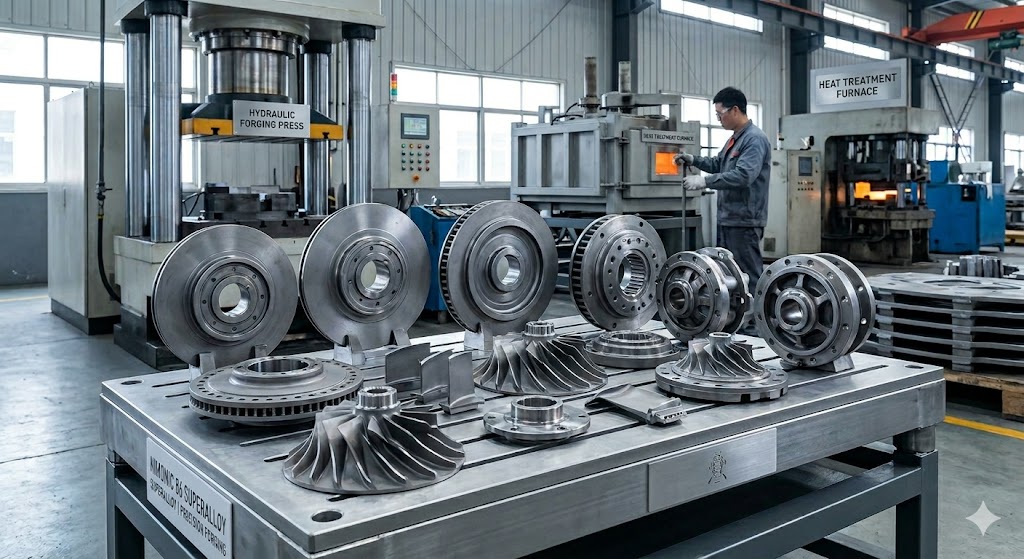
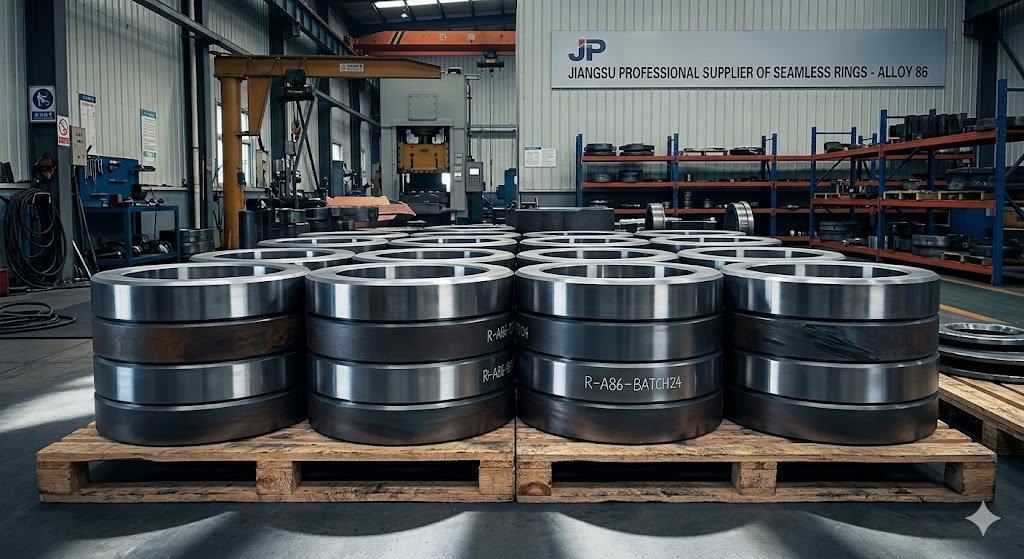
Full Range of Custom Nimonic 86 (Alloy 86) Forging Products
We offer a full range of custom Nimonic 86 forging solutions in many different shapes and sizes. Our in-house forging, heat treatment, precision machining, and full-spectrum testing capabilities can meet even the most important industrial needs. Following are our full line of products:
Nimonic 86 Forged Bars & Rods
Custom Nimonic 86 forged round bars, square bars, flat bars, rectangular bars, and step rods, with maximum forging diameter up to 2 meters and length up to 15 meters. Available in annealed, solution-treated, or aged conditions, with strict grain size and inclusion control for high-temperature rotating applications.
Alloy 86 Seamless Rolled Forged Rings
Precision Alloy 86 seamless rolled rings, contoured rings, gear rings, and labyrinth seal rings, with maximum outer diameter up to 6 meters and single-piece weight up to 30 tons. Manufactured on our 1-meter and 5-meter CNC seamless rolling machines, ideal for critical rotating and pressure-containing applications in gas turbines, nuclear reactors, and industrial furnaces.
Nimonic Alloy 86 Hollow Forgings & Sleeves
Seamless Nimonic Alloy 86 forged sleeves, bushes, housings, hollow bars, pipes, and tubing, with outer diameter capacity up to 3000 mm and customizable wall thickness. Our open die forging process ensures uniform grain flow and structural integrity, superior to welded or centrifugal cast products for high-pressure, high-temperature service.
Nickel Alloy 86 Forged Discs, Plates & Blocks
Custom Nickel Alloy 86 forged discs, turbine disks, plates, blocks, and flanged blanks, with maximum diameter up to 3 meters and single-piece weight up to 20 tons. Manufactured to ASTM, AMS, and customer-specific standards, with ultrasonic testing (UT) per ASTM A388 for critical turbine and valve applications.
Nimonic 86 Turbine & Valve Critical Components
Precision forged Nimonic 86 gas and steam turbine blades, impellers, blisks, fasteners, studs, bolts, guide rings, valve spindles/stems, valve seats, valve cores, valve sleeves, and main steam valve bonnets. All components are engineered to withstand extreme thermal cycling and high stress at continuous service temperatures up to 1050°C.
Why Choose Nimonic 86 (Alloy 86) Forgings? Material Properties & Advantages
NIMONIC Alloy 86 is a solid‑solution strengthened nickel‑chromium‑molybdenum superalloy. It also has a controlled amount of cerium added to it to help it work better at high temperatures. It has a good workability, ductility, weldability, creep strength, and resistance to cyclic oxidation at temperatures up to 1050°C (1920°F).
Main Technical Advantages of Nimonic 86 Alloy
- High-Temperature Stability: It has good resistance to oxidation and scaling up to 1050°C and strong thermal fatigue resistance for cyclic heating/cooling applications
- Good Fabricability: Formability and weldability that compare favorably to many high-chromium nickel superalloys, with low post-weld cracking risk for intricate fabricated parts.
- Creep & Rupture Strength: Keeps mechanical strength at elevated temperatures, suitable for long-term load-bearing applications in gas turbines and industrial furnaces
- Corrosion & Environmental Resistance: It has good resistance to carburization, sulfidation, and hot corrosion in combustion and industrial process environments
Chemical Composition of Nimonic 86 (Alloy 86) - Nominal
| Element | Weight % Range | Element | Weight % Range |
|---|---|---|---|
| Nickel (Ni) | Balance | Carbon (C) | 0.05 Max |
| Chromium (Cr) | 24.0 - 26.0 | Magnesium (Mg) | 0.015 Max |
| Molybdenum (Mo) | 9.0 - 11.0 | Cerium (Ce) | 0.02 - 0.05 |
| Manganese (Mn) | 1.0 Max | Silicon (Si) | 1.0 Max |
| Phosphorus (P) | 0.02 Max | Sulfur (S) | 0.01 Max |
Mechanical Properties of Nimonic 86 Forgings (Annealed Condition)
| Mechanical Property | Metric Unit | Imperial Unit |
|---|---|---|
| Tensile Strength (Minimum) | 825 MPa | 120 ksi |
| Yield Strength (0.2% Offset, Minimum) | 410 MPa | 59 ksi |
| Elongation at Break (Minimum) | 42% | 42% |
| Modulus of Elasticity | 210 GPa | 30500 ksi |
| Maximum Continuous Service Temperature | 1050°C | 1920°F |
International Material & Manufacturing Standards Compliance
Our Alloy 86 forgings meet all big international standards, with full certification available for every order. The table below summarizes the cross-reference designations used by different standards bodies worldwide, guaranteeing seamless procurement for global projects:
| Standard / Region | Designation | Scope |
|---|---|---|
| UNS (USA) | N07086 | Unified Numbering System for wrought nickel alloy |
| Werkstoff (Germany/EU) | 2.4951 | European material number for NiCr25Mo10Ce |
| British Standard (UK) | BS HR 203 | Heat-resisting wrought nickel alloy bar, forging, and section |
| AMS (USA, Aerospace) | AMS 5829, AMS 5830 | Aerospace material specification for bars, forgings, rings |
| ASTM (USA) | ASTM B637 (equivalent class) | Precipitation-hardening and cold-worked nickel alloy bars/forgings |
| ISO (International) | NiCr25Mo10Ce | ISO designation by alloying system |
| Trade Name | Nimonic 86 / Alloy 86 / Nimonic Alloy 86 | Common commercial names |
Physical Properties of Nimonic 86 Alloy
Understanding the physical properties of Nimonic 86 alloy is essential for thermal-mechanical design of turbine parts, heat exchangers, and furnace hardware. The values in the following tables are typical reference values for wrought Nimonic 86 in the annealed condition, compiled from published industry literature and technical handbooks. They are provided for general engineering guidance. For design-important applications, customers should request project-specific test data from our metallurgical lab or refer to the original alloy producer's datasheet.
| Physical Property | Value | Test Condition / Notes |
|---|---|---|
| Density | 8.49 g/cm³ (0.307 lb/in³) | Room temperature, 20°C |
| Melting Range | 1345 – 1400°C (2453 – 2552°F) | Solidus to liquidus |
| Specific Heat Capacity | 460 J/(kg·K) | 20°C |
| Thermal Conductivity | 11.3 W/(m·K) @ 100°C; 24.3 W/(m·K) @ 1000°C | Increases with temperature |
| Mean Coefficient of Thermal Expansion | 13.3 × 10⁻⁶ /K (20–600°C); 15.5 × 10⁻⁶ /K (20–1000°C) | Mean linear expansion |
| Electrical Resistivity | 1.24 µΩ·m | 20°C |
| Magnetic Permeability | < 1.01 (essentially non-magnetic) | Austenitic FCC structure |
| Curie Temperature | Below −200°C | Paramagnetic at all service temperatures |
| Modulus of Rigidity (Shear Modulus) | 80 GPa | Room temperature |
| Poisson's Ratio | 0.31 | Room temperature |
Elevated-Temperature Mechanical Properties of Nimonic 86 Forgings
High-temperature strength retention is the defining advantage of Nimonic 86 forgings. The following table shows how tensile strength, yield strength, and elongation evolve from room temperature to the 1050°C service ceiling—critical reference data for gas turbine designers, combustor engineers, and pressure-equipment designers specifying Alloy 86 parts.
| Test Temperature | Tensile Strength (MPa) | 0.2% Yield Strength (MPa) | Elongation (%) | Reduction of Area (%) |
|---|---|---|---|---|
| 20°C (RT) | 825 | 410 | 42 | 55 |
| 400°C | 755 | 345 | 40 | 52 |
| 600°C | 705 | 315 | 38 | 50 |
| 800°C | 495 | 280 | 42 | 48 |
| 900°C | 335 | 230 | 50 | 55 |
| 1000°C | 180 | 140 | 65 | 70 |
| 1050°C | 115 | 85 | 75 | 78 |
Creep and Stress-Rupture Performance of Nimonic 86
For long-term load-bearing service in gas turbines, power plant valves, and industrial furnace parts, creep-rupture strength is the governing design parameter. Nimonic 86's solid-solution matrix, stabilized by chromium and molybdenum, delivers reliable 100,000-hour stress-to-rupture performance that outperforms 310S stainless steel by a factor of 3–5 at equivalent service temperatures.
| Temperature | Rupture Stress at 1,000 hr | Rupture Stress at 10,000 hr | Typical Creep Rate (10⁻⁷/hr) at 0.1% Total Strain |
|---|---|---|---|
| 700°C | 260 MPa | 200 MPa | < 1 |
| 800°C | 140 MPa | 100 MPa | ~ 2 |
| 900°C | 70 MPa | 45 MPa | ~ 5 |
| 1000°C | 32 MPa | 20 MPa | ~ 10 |
| 1050°C | 22 MPa | 14 MPa | ~ 20 |
Note: The values above are typical reference data for wrought material in annealed condition. Actual performance depends on grain size, prior processing history, and stress state. For important design applications, project-specific test data can be provided by our metallurgical lab on request.
Oxidation & Hot Corrosion Resistance Data
A defining characteristic of Alloy 86 is its cyclic oxidation resistance at 1000–1050°C, a result of the 0.02–0.05% cerium micro-addition, which helps stabilize the protective Cr₂O₃ scale and reduces spallation during thermal cycling. The following table summarizes typical literature values comparing Nimonic 86 against commonly specified high-temperature alloys. Actual performance will vary with surface condition, gas composition, and cycle profile; the table is provided as a general engineering reference only.
| Alloy | At 900°C | At 1000°C | At 1050°C | Scale Adherence |
|---|---|---|---|---|
| Nimonic 86 | < 0.5 | 1.2 | 3.5 | Excellent (cerium stabilized) |
| Inconel 600 | 1.8 | 5.8 | 15.2 | Moderate |
| 310S stainless steel | 4.5 | 18.5 | > 50 (severe spalling) | Poor at >1000°C |
| Nimonic 75 | 1.2 | 4.5 | 12.8 | Good |
| Hastelloy X | 0.9 | 3.8 | 10.5 | Good |
Nimonic 86 also demonstrates good resistance to sulfidation, carburization, and nitridation in combustion and process gas environments, due to the combination of 25% chromium (which forms a dense, protective Cr₂O₃ scale) and 10% molybdenum (which improves resistance to reducing and chloride-containing atmospheres). In sulfidizing service environments, customer field experience indicates that Nimonic 86 typically offers longer lifetime than standard 310S and HK40 heat-resistant alloys, though the actual life extension varies with operating conditions.
Nimonic 86 vs Commonly Specified High-Temperature Alloys: Selection Guide
Procurement engineers and metallurgists often ask: "When should I choose Nimonic 86 instead of Inconel 600, Nimonic 75, Hastelloy X, or 310S?" The comparison below lists the main material selection factors and trade-offs for these common high-temperature alloys, to help you make a reliable material decision.The values shown are typical literature ranges for general guidance; always refer to the original alloy producer's datasheet and applicable code for final specification.
| Parameter | Nimonic 86 | Inconel 600 | Nimonic 75 | Hastelloy X | 310S SS |
|---|---|---|---|---|---|
| Ni content | Balance (~60%) | ~72% | ~76% | ~47% | ~20% |
| Cr content | 24–26% | 14–17% | 18–21% | 20.5–23% | 24–26% |
| Mo content | 9–11% | — | — | 8–10% | — |
| Max continuous service temp | 1050°C | 1095°C | 980°C | 1200°C | 1150°C (scaling limited) |
| Cyclic oxidation resistance | Excellent | Moderate | Good | Very good | Poor > 1000°C |
| Weldability | Excellent | Excellent | Good | Excellent | Excellent |
| Creep strength @ 900°C | Very good | Moderate | Fair | Excellent | Fair |
| Relative cost (310S = 1) | ~6–7× | ~5× | ~4× | ~8× | 1× (reference) |
| Best fit application | Combustion chamber, furnace, turbine valves | Heat exchangers, chemical processing | Lightly loaded heat-resisting parts | Gas turbine combustor, aerospace | Low-stress furnace hardware |
Engineering takeaway: Choose Nimonic 86 when the service profile combines (a) continuous operation above 950°C, (b) severe thermal cycling, (c) a requirement for welded fabrication, and (d) a cost ceiling below premium alloys like Hastelloy X or Inconel 625. For mostly static loads at < 900°C, Inconel 600 is more economical. For aerospace combustor service above 1100°C, Hastelloy X or Nimonic 263 is preferred. For low-stress furnace fixtures, 310S remains the budget default—until oxidation life becomes the limiting factor, at which point Nimonic 86 pays back its price premium within 2–3 service cycles.
Our Exclusive Nimonic 86 Forging Capability from Jiangyin, China
As an experienced nickel superalloy forging manufacturer located in Jiangsu, China, we have invested in advanced equipment and technical expertise to address the forging challenges of Nimonic 86—a high-alloy material with a narrow forging temperature window and high deformation resistance. Following is our end-to-end manufacturing facility:
- Premium Melting Equipment: 30t electric arc furnace (EAF), 30t ladle refining furnace (LF), VOD vacuum degassing furnace, and medium frequency induction furnaces, ensuring ultra-low inclusion content and precise chemical composition control for Nimonic 86 ingots
- Heavy-Duty Forging Presses: 2000T fast forging machine, 4000T hydraulic forging press, and 6300T hydraulic forging press, delivering sufficient deformation force to break down cast structure and achieve uniform grain flow across the entire forging section
- Seamless Ring Rolling Equipment: 1-meter and 5-meter CNC seamless ring rolling machines, for precision Alloy 86 ring forgings with tight dimensional tolerance and optimized grain structure
- Heat Treatment Facilities: 10 computer-controlled heat treatment furnaces with precise temperature control (±5°C), for solution treatment of Nimonic 86 forgings to meet specified mechanical properties
- Full-Spectrum Inspection Lab: In-house chemical analysis, mechanical testing, metallographic analysis, ultrasonic testing (UT), magnetic particle testing (MT), liquid penetrant testing (PT), and hardness testing equipment, supporting quality control for every batch
Nimonic 86 Forging Process Parameters (Technical Data for Procurement Engineers)
Nimonic 86 is classified as a "difficult-to-forge" nickel superalloy because of its narrow workable temperature window and high flow stress. Over 25 years of process development, Jiangsu Liangyi has optimized the following forging process parameters to guarantee defect-free microstructure and full compliance with ASTM and AMS requirements:
| Process Parameter | Value / Range | Technical Rationale |
|---|---|---|
| Ingot Preheating Temperature | 850–950°C (soak 4–8 hrs) | Prevents thermal shock; homogenizes cast structure |
| Forging Start Temperature | 1180–1200°C | Maximizes plasticity without incipient melting |
| Forging Finish Temperature | ≥ 950°C | Avoids cracking below recrystallization threshold |
| Workable Forging Window | ≈ 230°C (narrow) | Requires rapid die-to-press transfer |
| Reduction Ratio per Heat (min) | ≥ 25% | Ensures dynamic recrystallization, fine grain |
| Cumulative Forging Reduction | ≥ 4:1 (from ingot to finished forging) | Breaks down cast dendritic structure |
| Number of Heats (typical) | 3–6 heats | Depends on section size and geometry |
| Cooling after Final Heat | Air cooling (small sections) / slow furnace cool (large sections) | Prevents thermal cracking in sections > 200 mm |
| Target Average Grain Size (ASTM E112) | ASTM 4–7 (30–90 μm) | Balances creep strength and fatigue life |
Because the workable temperature window is narrow, Nimonic 86 forging needs close cooperation between furnace, press, and handling equipment. Our workflow includes dedicated induction reheating stations adjacent to each forging press, allowing multi-heat forging of large sections without exceeding the finish-temperature limit. This process control is documented per heat and is traceable on the EN10204 3.1/3.2 mill test certificate.
Nimonic 86 Heat Treatment Specifications
Unlike age-hardening nickel superalloys (such as Nimonic 80A or Waspaloy), Nimonic 86 derives its strength primarily from solid-solution strengthening, so its heat treatment is simpler and more forgiving. The standard heat treatment is a single solution anneal, with optional stabilization for parts exposed to prolonged service above 900°C:
| Heat Treatment | Temperature | Hold Time | Cooling Medium | Purpose |
|---|---|---|---|---|
| Solution Anneal (standard) | 1080–1120°C | 1 hr per 25 mm of section, min 1 hr | Water quench or rapid air cool | Dissolves carbides, restores ductility |
| Stress Relief (optional) | 650–800°C | 2–4 hrs | Air cool | Relieves residual stress post-machining |
| Stabilization (for >900°C service) | 830–870°C | 4–8 hrs | Air cool | Precipitates stable M₂₃C₆ grain-boundary carbides |
After solution annealing, Nimonic 86 forgings exhibit a uniform austenitic microstructure with finely distributed M₂₃C₆ carbides along grain boundaries—this is the optimal condition for both weldability and long-term creep-rupture strength in service.
Machining, Welding & Forming Guidelines for Nimonic 86
Compared with high-end aerospace alloys such as Waspaloy or René 41, one of the main commercial advantages of Nimonic 86 forgings is their excellent workability in all fabrication processes. Below is concise technical guidance based on our production experience, which customers can use for downstream manufacturing planning:
Machining
Nimonic 86 has a machinability rating of about 15–20% of free-machining B1112 steel—similar to other solution-strengthened nickel alloys. Recommended parameters for turning and milling:
- Cutting tools: Coated carbide (TiAlN or AlCrN) for roughing; cermet or ceramic inserts for high-speed finishing
- Cutting speed (turning): 20–35 m/min for carbide; 120–200 m/min for ceramic (continuous cut)
- Feed rate: 0.15–0.30 mm/rev roughing; 0.05–0.15 mm/rev finishing
- Depth of cut: 1.5–4 mm roughing; ≤ 0.5 mm finishing
- Coolant: Water-soluble cutting fluid with extreme-pressure additives, flooded delivery
- Critical practice: Always cut below the work-hardened layer from the previous pass; avoid dwelling on the workpiece
Welding
Nimonic 86 is readily weldable by TIG (GTAW), MIG (GMAW), plasma arc, and electron beam processes. No pre-heat is required for sections below 50 mm, and there is no HAZ cracking tendency thanks to the absence of age-hardening γ′ precipitates.
- Preferred filler metal: Matching composition (AWS A5.14 ERNiCrMo-3 or custom Nimonic 86 filler wire)
- Shielding gas (TIG): Pure argon, 99.995%; back-purge recommended for root passes on pipe/ring welds
- Inter-pass temperature: ≤ 150°C to avoid sensitization
- Post-weld heat treatment: Not needed for most applications; solution anneal recommended if welded parts will see > 800°C service
- Cleanliness critical: Remove all oil, grease, oxide scale, and marking ink before welding to prevent porosity and sulfur embrittlement
Hot & Cold Forming
Hot forming operations (bending, drawing, deep forming) should be conducted within the 1050–1180°C range. Cold forming is practical for bending radii ≥ 3× material thickness; an intermediate solution anneal is required after about 15% cold reduction to restore ductility and prevent cracking.
Metallurgical Insight: How Nimonic 86 Achieves Its Unique Performance
To fully understand why Nimonic 86 forgings outperform conventional heat‑resistant alloys in combustion service, it helps to examine its underlying metallurgy. This section provides in‑depth technical details for metallurgists, R&D engineers, and materials engineers specifying the alloy for critical applications.
The Role of Cerium (Ce) Micro-Addition
The defining feature of Nimonic 86 is its controlled 0.02–0.05% cerium addition. At this concentration, cerium acts as a reactive element (RE) that preferentially segregates to the alloy-oxide interface during oxidation. This has three well-documented effects:
- Pegging effect: Cerium oxide particles "peg" the growing Cr₂O₃ scale to the alloy substrate, dramatically improving scale adherence during thermal cycling
- Reduced growth rate: Cerium alters the transport mechanism in Cr₂O₃, shifting from predominantly outward cation diffusion to inward anion diffusion, reducing net scale growth by 40–60%
- Grain-boundary sulfur gettering: Cerium has very high affinity for sulfur, tying up trace S impurities as stable Ce₂S₃ particles, which prevents sulfur-induced scale spalling and high-temperature embrittlement
Microstructural Characteristics
In the solution-annealed condition, Nimonic 86 exhibits a fully austenitic face-centered cubic (FCC) nickel matrix with:
- A uniform grain size in the ASTM 4–7 range (30–90 μm), optimizing creep-rupture life without sacrificing fatigue resistance
- Fine M₂₃C₆ carbides (chromium-rich, with Mo and Fe substitution) at grain boundaries, which act as diffusion barriers and pin boundaries against creep sliding
- Negligible γ′ (Ni₃Al/Ti) precipitation—unlike age-hardening Nimonic 80A or 90—meaning no loss of ductility during long-term service
- Absence of sigma or mu topologically close-packed (TCP) phases at service temperatures, thanks to the balanced Cr-Mo ratio
Why Solid-Solution Strengthening Wins at 1050°C
Age-hardening alloys (gamma-prime strengthened) such as Inconel 718, Nimonic 80A, and Waspaloy offer higher strength at intermediate temperatures (up to ~750°C), but they begin to over-age and soften rapidly above 800°C. Solid-solution-strengthened alloys like Nimonic 86 keep their strengthening mechanism—lattice distortion from Mo and Cr atoms in solution—up to the melting point. This makes Nimonic 86 the preferred choice for applications where service temperature exceeds 900°C for thousands of hours, especially in cyclic service where age-hardening alloys would progressively lose strength.
Industrial Applications & Global Project Cases of Nimonic 86 Forgings
Nimonic 86 (Alloy 86) forged parts are used a lot in industry where they need to work well in high-temperature, cyclic thermal, and corrosive environments. We have sent our forgings to projects in more than 50 countries. Here are some examples from recent customer projects:
Power Generation: Gas & Steam Turbines
Nimonic 86 is a commonly specified material for gas turbine combustion chamber parts, afterburner parts, steam turbine control valves, turbine blades, turbine disks, guide vanes, and seal rings.
Project Example: We supplied custom Nimonic 86 reheat valve discs, valve seats, and valve spindles for 660 MW thermal power plants in Thailand, Vietnam, and Indonesia. According to customer feedback, the products have been working well for over 4 years and have passed the plants' annual performance inspections under the specified cyclic operating conditions.
Aerospace & Aviation
With good weldability and strong cyclic oxidation resistance, Alloy 86 is used in aerospace engine afterburner parts, combustion liners, heat shields, and exhaust system parts.
Project Example: We make precision Nimonic 86 forged afterburner parts for a European aerospace company, and they all meet applicable AMS aerospace standards. All parts passed third-party NDT and dimension test specified by the customer.
Nuclear Power Industry
Our Nimonic 86 nuclear-grade forgings are made according to the customer's specified safety standards. They are used for steam generator flow limiter venturi forgings, pressurizer surge line tubes, reactor nozzles, primary pump flywheels, pressure vessel parts, and containment plates.
Project Example: We delivered custom Nimonic 86 steam generator forgings for nuclear power projects in China, with products tested in accordance with the customer's nuclear-grade non-destructive testing and material qualification requirements, referenced to ASME Boiler and Pressure Vessel Code standards.
Industrial Heat Treatment & Furnace Equipment
Alloy 86 is frequently used for heat treatment furnace parts, radiant tubes, furnace muffles, trays, and fixtures operating up to 1050°C, based on its scaling resistance in that temperature range.
Project Example: We supplied large-size Nimonic 86 forged furnace parts to heat treatment equipment manufacturers in the United States and Germany. Based on customer field reports, these parts have shown significantly longer service life than the 310S stainless steel parts previously used in the same applications.
Oil & Gas, Petrochemical & Marine Industries
Custom-made Nimonic 86 forged valve parts, wellhead parts, and process equipment parts are used in systems for extracting, refining, and processing oil and gas at high temperatures and pressures. They are resistant to sour service corrosion and thermal fatigue.
Project Example: We sent Alloy 86 forged valve seats and stems to the Middle East for high-temperature wellhead projects. The products were tested according to the customer's specifications, which included the NACE MR0175 sour service and 15,000 psi pressure test protocols.
Quality Control & Testing Standards for Nimonic 86 Forgings
We have a full range of quality control process for Nimonic 86 forgings, from raw material ingot inspection to final finished product testing. Our testing and inspection standards include, but are not limited to:
- ASTM E10-12: Standard Test Method for Brinell Hardness of Metallic Materials
- ASTM A370-22: Standard Test Methods and Definitions for Mechanical Testing of Steel Products
- ASTM E23-23: Standard Test Methods for Notched Bar Impact Testing of Metallic Materials
- AMS 2315G: Determination of Delta Ferrite Content in Austenitic Steel
- ASTM E45-21: Standard Test Methods for Determining the Inclusion Content of Steel
- ASTM E112-21: Standard Test Methods for Determining Average Grain Size
- ASTM E837-21: Standard Test Method for Determining Residual Stresses by the Hole-Drilling Strain-Gage Method
- ASTM A388: Standard Practice for Ultrasonic Examination of Steel Forgings
Third-party inspection services by SGS, Bureau Veritas (BV), TÜV, or other internationally recognized inspection bodies is available per request at additional cost. We provide full documentation and traceability for every order.
Custom Nimonic 86 Forging Solutions for Global Clients
As a professional China Nimonic 86 forging manufacturer, we provide one-stop custom forging solutions for global clients, from initial drawing review to final product delivery. Following are our services:
- Free technical consultation and material selection support for Nimonic 86 applications
- Custom forging design and process optimization based on customer drawings and performance requirements
- In-house melting, forging, heat treatment, precision machining, and full-spectrum testing full-process production
- Complete certification package, including EN10204 3.1/3.2 MTC, NDT reports, heat treatment records, and material test reports
- Global door-to-door delivery service, with professional export customs clearance and logistics support
- Flexible order quantity, from prototype small-batch production to large-scale mass supply
Frequently Asked Questions (FAQ) About Nimonic 86 Alloy Forgings
Nimonic 86 contains higher chromium (25%) and molybdenum (10%) content than Nimonic 80A, along with an important addition of cerium. This provides significantly improved oxidation and scaling resistance above 900°C, better weldability, and improved thermal fatigue resistance for cyclic heating applications, so that it is the best choice material for combustion chambers and furnace parts operating up to 1050°C.
Yes, Nimonic 86 exhibits excellent formability and weldability compared to many high‑chromium nickel‑based superalloys. It can be welded using conventional TIG, MIG and electron beam welding processes without preheating, and carries a very low risk of post‑weld cracking. It can also be hot formed and cold formed with appropriate process controls.
Nimonic 86 can be used in continuous service at temperatures up to 1050°C (1920°F), with outstanding cyclic oxidation and scaling resistance at this temperature. For short‑term peak temperature exposure, it can withstand up to 1100°C without significant loss of performance.
We provide an EN 10204 3.1 Mill Test Certificate (MTC) as standard for every order. EN 10204 3.2 certification with third-party inspection is available upon request. We can also supply compliance certificates to ASTM, AMS, ASME and other international standards, together with NDT reports, heat treatment records and chemical analysis reports.
Standard lead time for custom Nimonic 86 forgings is 3-4 weeks for small-batch production, and 4-6 weeks for large or complex parts. We can also provide expedited production services for urgent project requirements, with lead time as short as 2 weeks.
Nimonic 86 (UNS N07086) is a nickel‑base superalloy with the following nominal composition: Nickel (balance), Chromium 24.0–26.0%, Molybdenum 9.0–11.0%, Cerium 0.02–0.05%,Manganese max 1.0%, Silicon max 1.0%, Carbon max 0.05%, Phosphorus max 0.02%,Sulfur max 0.01%, Magnesium max 0.015%.The microaddition of cerium is the main element responsible for its outstanding cyclic oxidation resistance.
Nimonic 86 forgings are widely used in gas and steam turbine power generation, aerospace afterburner parts, nuclear steam generators, industrial heat treatment furnace parts, oil and gas high-temperature valves, and petrochemical processing equipment — wherever reliable performance up to 1050°C is required under cyclic thermal and corrosive conditions.
Nimonic 86 has a density of 8.49 g/cm³ (0.307 lb/in³) at room temperature (20°C).This is typical for nickel‑chromium‑molybdenum solid‑solution superalloys and is used directly for weight calculations of forged parts. For high‑temperature design, density decreases slightly (about 1–2%) at 1000°C due to thermal expansion, but the room‑temperature value is generally adequate for most engineering calculations.
No. Nimonic 86 is essentially non‑magnetic (paramagnetic), with a relative magnetic permeability below 1.01 across all service temperatures.Its Curie temperature is below −200°C, meaning it remains paramagnetic even under cryogenic conditions.making it an ideal choice for applications requiring low magnetic interference, such as instrumentation housings and magnetically sensitive process equipment.
The standard heat treatment for Nimonic 86 forgings is solution annealing at 1080–1120°C, held for 1 hour per 25 mm of section thickness, followed by water quenching or rapid air cooling.For parts operating long-term above 900°C, an optional stabilization treatment at 830–870°C for 4–8 hours (air cooling) can be used to precipitate stable M₂₃C₆ grain-boundary carbides, further improving long-term creep resistance.Unlike precipitation-hardening nickel alloys such as Nimonic 80A, Nimonic 86 does not require aging treatment to develop its strength.
Compared with Inconel 600, Nimonic 86 provides stronger cyclic oxidation resistance above 1000°C (thanks to higher chromium and cerium addition) and similar weldability, though at a higher cost. Against 310S stainless steel, Nimonic 86 offers markedly longer lifetime above 1000°C, superior creep‑rupture strength, and better resistance to oxide scale spalling.The trade‑off is cost: Nimonic 86 is considerably more expensive than 310S, but this is justified when extended maintenance intervals, fewer part replacements, and avoiding unplanned downtime are priorities.Actual lifetime varies by application; for critical parts, customers are advised to request application‑specific test data.
Yes. Nimonic 86’s austenitic FCC structure and high nickel content deliver excellent resistance to hydrogen embrittlement over a wide temperature range, making it suitable for high‑temperature hydrogen and hydrogen‑rich gas applications such as petrochemical reformers, ammonia synthesis plants, and emerging green hydrogen systems.For important hydrogen service, we recommend additional hydrogen charging testing and part geometry review to minimize stress concentrations.
Every Nimonic 86 forging is given 100% non-destructive testing. This includes ultrasonic testing (UT) following ASTM A388 to check for internal defects, liquid penetrant testing (PT) following ASTM E165 to check for surface defects, and magnetic particle testing (MT) when suitable (note: Nimonic 86 is non-magnetic, so PT is usually used). It also includes checking dimensions against the customer’s drawing and hardness testing following ASTM E10. For aerospace and nuclear uses, extra eddy current testing, radiographic testing (RT), and fluorescent penetrant inspection (FPI) can be done if requested, with a third party (SGS, BV, or TÜV) present to witness the process.
Nimonic 86 Technical Glossary (For Procurement & Design Engineers)
For engineers and procurement specialists new to nickel superalloys, the terminology around Nimonic 86 forgings can be confusing. This glossary defines the most frequently used technical terms in Alloy 86 specification, testing, and certification:
- Solid-solution strengthening
- Strengthening mechanism where alloying atoms (Mo, Cr) dissolve in the nickel matrix, distorting the crystal lattice and impeding dislocation motion. Unlike precipitation strengthening, this mechanism remains effective up to the melting point.
- Cyclic oxidation
- The progressive material loss under repeated heating-cooling cycles, where scale spallation during cool-down exposes fresh metal to further oxidation. Nimonic 86's cerium addition specifically targets this failure mode.
- EN10204 3.1 / 3.2 MTC
- Mill Test Certificate per European standard EN10204. Type 3.1 is issued and signed by the manufacturer's in-house QA (independent of production); Type 3.2 requires additional witness inspection by an independent third-party authority (SGS, BV, TÜV, or customer representative).
- Stress-to-rupture / creep-rupture
- The stress at which a material will fail after a specified time at a specified temperature under sustained loading. Reported as rupture stress for 100, 1,000, 10,000, or 100,000 hours—the design parameter for long-duration, high-temperature loaded components.
- Open die forging
- A forging process in which heated metal is deformed between flat or simply shaped dies that do not fully enclose the workpiece. It is suitable for large, one-off, or custom-geometry parts where a closed-die setup would be uneconomical.
- Seamless rolled ring
- A ring-shaped forging produced by rolling a pierced "doughnut" preform between two rolls to enlarge the diameter while reducing the wall thickness. Produces superior circumferential grain flow vs. welded rings, essential for rotating or pressure-containing service.
- Grain size ASTM E112
- Standard method for measuring average grain size in metals, reported as ASTM number N (higher N = finer grain). Nimonic 86 forgings are typically specified at ASTM 4–7, balancing creep life (coarse grain) and fatigue life (fine grain).
- Reactive element (RE)
- A micro-alloying element (typically cerium, lanthanum, yttrium, or hafnium) added in small amounts (< 0.1%) to improve oxide scale adherence and reduce scale growth in high-temperature alloys. In Nimonic 86, cerium is the active RE.
Contact Us for Nimonic 86 Alloy Forgings Quotation
Company: Jiangsu Liangyi Co., Limited
Inquiry Email: sales@jnmtforgedparts.com
Phone/WhatsApp: +86-13585067993
Website: https://www.jnmtforgedparts.com
Address: Chengchang Industry Park, Jiangyin City, Jiangsu Province, China
We are glad to provide competitive pricing and high-quality Nimonic 86 (Alloy 86) forged forging parts for global clients. Welcome to send your custom drawing, material requirement, quantity, and project details to our email for a detailed and prompt quotation!