Monel R-405 (UNS N04405 / AMS 4674) Forging Parts | China Jiangsu Manufacturer – Jiangsu Liangyi
Jiangsu Liangyi Forging, located in Jiangyin City, Jiangsu Province – the core manufacturing hub of the Yangtze River Delta – is an ISO 9001:2015 certified professional manufacturer of Monel R-405, UNS N04405, and AMS 4674 open-die forgings and seamless rolled rings. With over 25 years of specialization in nickel alloy forging, we deliver high-performance Monel R-405 forged parts that meet international standards and customized client requirements, exported to more than 50 countries worldwide.
🔍 Quick Facts: Monel R-405 Forgings by Jiangsu Liangyi
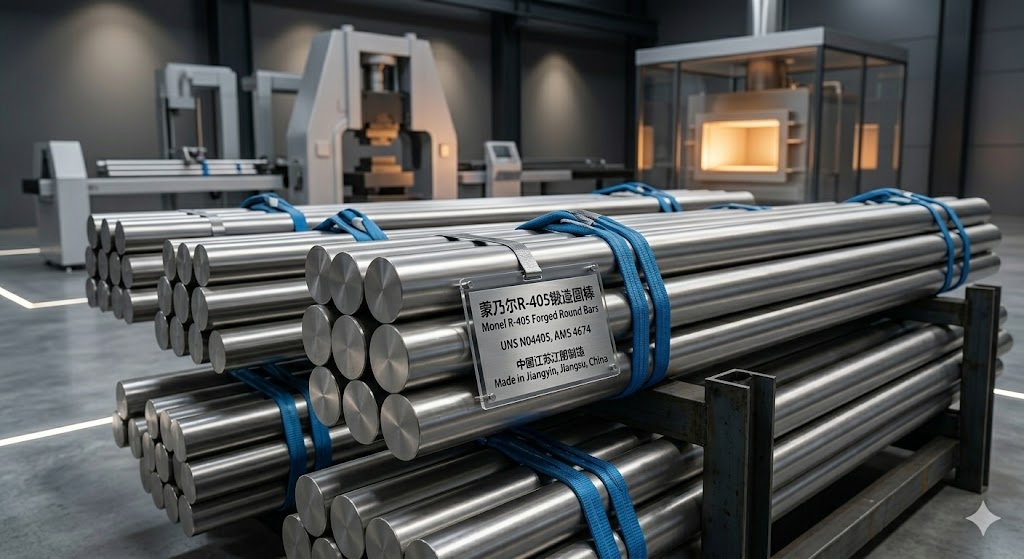
Monel R-405 (UNS N04405) Forged Round Bars – Jiangyin, Jiangsu, China
Manufacturing Advantage: We provide a full range of service from raw material melting, forging, heat treatment to CNC machining. We manufacture custom Monel R-405 parts from 30 kg to 30,000 kg per piece with an annual capacity of 120,000 tons.
Request a Free Monel R-405 Forging Quote
Send us your drawings, material specifications, and quantity for a fast and competitive factory-direct quotation.
Get Your Free Quote →Monel R-405 Forged Product Forms & Custom Capabilities
As a top Monel R-405 forging supplier in Jiangsu, China, Jiangsu Liangyi produces a full range of UNS N04405 forgings in all kinds of shapes and sizes for global industrial applications. All AMS 4674 Monel R-405 products can be machined to your engineering drawings.
- Forged Bars: Monel R-405 round bars, square bars, flat bars, and stepped bars
- Seamless Rolled Rings: UNS N04405 seamless rings up to 6,000 mm in diameter
- Hollow Components: Hubs, shells, sleeves, bushes, and cylinders
- Forged Discs & Blocks: AMS 4674 flat forgings for valves and pumps
- Shafts: Custom Monel R-405 pump shafts, valve stems, and drive shafts up to 15 m long
- Custom Net-Shape Parts: Flanges, impellers, wear rings, and intricate machined parts
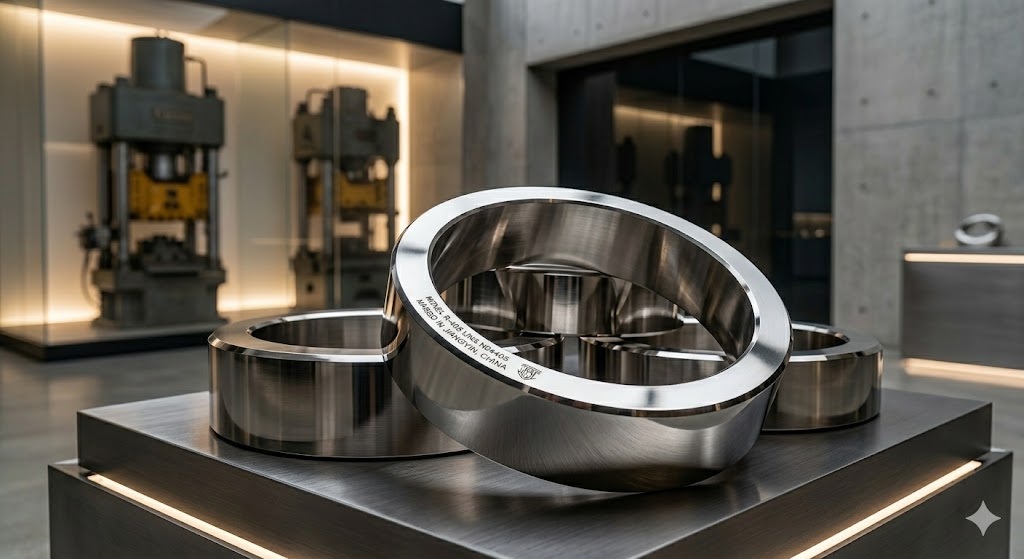
Monel R-405 Seamless Rolled Rings – Available up to 6 Meters Diameter
What Is Monel R-405? Material Properties & Overview
Monel R-405 (UNS N04405 / AMS 4674) is a free-machining nickel-copper alloy with a controlled sulfur content of 0.025–0.060%. This sulfur addition significantly improves chip-breaking during machining, making it the preferred grade for automated screw-machine production and precision-machined parts, while keeping the same outstanding corrosion resistance as standard Monel 400.
- Superior corrosion resistance in seawater and brine environments
- Excellent resistance to stress corrosion cracking
- High strength and good ductility at moderate temperatures
- Effective resistance to de-aerated hydrofluoric and hydrochloric acids
- Improved machinability compared to standard Monel 400 – primary advantage
- Non-magnetic at all temperatures
- Good weldability with compatible filler metals
Monel R-405 (UNS N04405) Chemical Composition
The table below shows the chemical composition limits for Monel R-405 per ASTM B164 and AMS 4674. The controlled sulfur range (0.025–0.060%) is the main differentiator from Monel 400.
| Element | Min % | Max % |
|---|---|---|
| Ni + Co | 63.0 | Balance |
| Cu | 28.0 | 34.0 |
| C | – | 0.30 |
| Mn | – | 2.0 |
| Fe | – | 2.5 |
| S | 0.025 | 0.060 |
| Si | – | 0.5 |
Monel R-405 (AMS 4674) Mechanical Properties
Typical mechanical properties of Monel R-405 forgings in annealed and hot-forged condition are listed below. Actual values may vary based on section size and heat treatment.
| Condition | Tensile Strength (MPa) | Yield Strength (MPa) | Elongation % | Hardness (HB) |
|---|---|---|---|---|
| Annealed | 482 – 586 | 172 – 275 | 35 – 50 | 110 – 149 |
| Hot-Forged | 517 – 620 | 241 – 413 | 30 – 45 | 130 – 180 |
Applicable Standards for Monel R-405 Forgings
| Standard | Designation | Scope |
|---|---|---|
| UNS | N04405 | Unified Numbering System – alloy identity |
| AMS | 4674 | Aerospace Material Specification – bars, rods, wire |
| ASTM | B164 | Rod, bar, and wire |
| ASTM | B472 | Forgings |
| ASTM | B564 | Nickel alloy forgings |
| EN | 10204 3.1 / 3.2 | Material test certificate (MTC) |
Monel R-405 Physical & Thermal Properties
Beyond tensile strength, engineers choosing alloys for demanding environments need thermal and physical data to evaluate heat dissipation, thermal expansion compatibility, and electromagnetic behavior. The values below represent typical properties for Monel R-405 (UNS N04405) bar and forging stock in annealed condition, measured at or near room temperature unless stated otherwise.
| Property | Value | Unit | Test Condition |
|---|---|---|---|
| Density | 8.80 | g/cm³ | 20°C |
| Melting Range | 1 300 – 1 350 | °C | – |
| Modulus of Elasticity (E) | 179 | GPa | 20°C |
| Poisson's Ratio | 0.32 | – | 20°C |
| Thermal Conductivity | 21.8 | W/m·K | 100°C |
| Specific Heat Capacity | 427 | J/kg·K | 20°C |
| Coefficient of Thermal Expansion | 13.9 | μm/m·°C | 20–100°C |
| Coefficient of Thermal Expansion | 14.8 | μm/m·°C | 20–300°C |
| Electrical Resistivity | 0.510 | μΩ·m | 20°C |
| Magnetic Permeability | < 1.001 | μr | 20°C (non-magnetic) |
| Shear Modulus (G) | 66 | GPa | 20°C |
Monel R-405 Corrosion Resistance: Media-by-Media Engineering Guide
Unlike generic material datasheets that state only "excellent corrosion resistance," buyers and engineers need to know which media, at what concentration, and under what temperature Monel R-405 (UNS N04405) performs reliably. The table below is organized by corrosive medium based on field experience from oil refinery, chemical plant, and marine applications.
| Corrosive Medium | Concentration / Condition | Temperature Limit | Rating | Key Engineering Notes |
|---|---|---|---|---|
| Hydrofluoric Acid (HF) | All concentrations, de-aerated | Up to 150°C | Excellent | One of the few alloys effective in anhydrous and aqueous HF; widely used in HF alkylation units |
| Seawater & Brine | Natural seawater, flow velocity ≤ 8 m/s | Continuous service | Excellent | No pitting or crevice corrosion under normal flow; velocity above 8 m/s may cause erosion-corrosion |
| Hydrochloric Acid (HCl) | ≤ 10%, de-aerated | Below 60°C | Good | Performance drops rapidly if oxidizing agents (FeCl₃, CuCl₂) are present; avoid aerated HCl above 5% |
| Sulfuric Acid (H₂SO₄) | ≤ 80%, non-oxidizing | Below 85°C | Good | Avoid in hot concentrated H₂SO₄ or where oxidizing impurities exist; use only in reducing conditions |
| Phosphoric Acid (H₃PO₄) | All concentrations, reagent grade | Up to 130°C | Excellent | Widely used in phosphate fertilizer production equipment; sulfate and fluoride impurities acceptable |
| Caustic Soda (NaOH) | Up to 75% concentration | Below 315°C | Good | Avoid high-temperature caustic above 315°C; stress corrosion cracking risk increases with stress and concentration |
| Ammonia (NH₃) | Anhydrous or aqueous, all concentrations | All temperatures | Excellent | Resistant in both liquid and gaseous NH₃; suitable for ammonia refrigeration and fertilizer production |
| Chlorine Gas (Cl₂) – Dry | Dry, moisture < 0.005% | Up to 200°C | Fair | Acceptable in strictly dry conditions; even trace moisture converts performance to "Poor" |
| Wet Chlorine / Hypochlorite | Any moisture content | – | Avoid | Wet chlorine causes rapid pitting and intergranular attack; use Hastelloy C-276 or titanium instead |
| Neutral & Alkaline Salts | Most chloride and sulfate solutions | Ambient to 200°C | Excellent | Highly resistant to most neutral salt solutions; non-magnetic nature adds value in sensor-adjacent applications |
| Organic Acids (Acetic, Citric) | All dilutions | Up to 100°C | Excellent | Broadly resistant to organic acids; suitable for food processing and pharmaceutical equipment |
| Oxidizing Acids (Nitric HNO₃) | Any concentration | – | Avoid | Monel R-405 corrodes rapidly in oxidizing acids; specify Inconel 625 or 316L SS for nitric acid service |
Monel R-405 vs Monel 400 vs Monel K-500: Which Grade Do You Need?
The three Monel grades are frequently confused because they share the same nickel-copper base. In practice, each was engineered for a different manufacturing or service requirement. The decision point is straightforward: if your process demands extensive machining, choose R-405; if maximum strength is non-negotiable, choose K-500; for general fabrication and welded assemblies, Monel 400 remains the workhorse.
| Property / Factor | Monel R-405 (UNS N04405) | Monel 400 (UNS N04400) | Monel K-500 (UNS N05500) |
|---|---|---|---|
| Key Alloying Addition | Sulfur 0.025–0.060% (controlled) | None (base Ni-Cu) | Al 2.3–3.15% + Ti 0.35–0.85% |
| Machinability Rating* | ~40% (vs free-cutting brass) | ~22% | ~15% |
| Tensile Strength (Annealed) | 482–586 MPa | 480–590 MPa | 690–965 MPa (age-hardened) |
| Yield Strength (Annealed) | 172–275 MPa | 170–280 MPa | 483–690 MPa (age-hardened) |
| Age Hardenable? | No | No | Yes (precipitation hardening) |
| Corrosion Resistance | Excellent (same as Monel 400) | Excellent | Excellent (slight advantage in eroded conditions) |
| Weldability | Good (watch dilution >40%) | Excellent | Good (requires post-weld aging) |
| Magnetic Behavior | Non-magnetic | Non-magnetic | Non-magnetic |
| Relative Material Cost | Low ▲ (similar to 400) | Base reference | High ▲▲▲ (Al+Ti + aging treatment) |
| Primary Use Case | Screw-machine parts, pump shafts, valve stems requiring close tolerances | Welded vessels, piping, heat exchanger tubes, sheet/plate | High-strength shafts, springs, fasteners, chains in aggressive media |
| Typical Standards | UNS N04405, AMS 4674, ASTM B164 | UNS N04400, ASTM B127/B163/B165 | UNS N05500, AMS 4676, ASTM B865 |
*Machinability rating relative to AISI C36000 free-cutting brass = 100%. Values are typical industry benchmarks and vary with cutting parameters.
Monel R-405 Heat Treatment Specifications
Monel R-405 (UNS N04405) cannot be strengthened by heat treatment—it is a solid-solution alloy, not a precipitation-hardening one. Heat treatment is used exclusively to restore ductility, relieve residual stress, and control grain size after forging or cold working. Understanding the important temperature zones is essential for avoiding embrittlement from sulfide precipitation.
Full Annealing
Temperature: 871–982°C (1,600–1,800°F)
Holding Time: Minimum 15 minutes per 25 mm of section thickness, up to 2 hours for large forgings
Cooling: Water quench (preferred for forgings >25 mm) or rapid air cool
Purpose: Recrystallizes the grain structure, fully dissolves precipitates, restores maximum corrosion resistance and ductility
Stress Relief (Without Full Recrystallization)
Temperature: 480–540°C (900–1,000°F)
Holding Time: 1–4 hours depending on section size
Cooling: Air cool
Purpose: Reduces residual machining or fabrication stresses without significantly changing grain structure. Used when dimensional stability after machining is critical.
Forging Temperature Range
Heating Temperature: 1,050–1,200°C (1,920–2,190°F)
Minimum Finish Forging Temperature: 870°C (1,600°F)
Note: Forging below 870°C causes excessive work hardening and may initiate surface cracking. All Jiangsu Liangyi Monel R-405 forgings are produced within this controlled temperature envelope using automated pyrometer monitoring.
Monel R-405 Machinability: Why It Exists and How to Machine It
Monel R-405 was created specifically because standard Monel 400, despite its excellent corrosion properties, produces long, stringy chips that wrap around cutting tools, cause built-up edge (BUE) on carbide inserts, and result in poor surface finishes on automated screw machines. The addition of controlled sulfur creates manganese sulfide (MnS) inclusions in the internal matrix, which act as internal chip-breakers, reducing cutting forces and extending tool life dramatically.
Machinability Comparison (Relative to Free-Cutting Brass = 100%)
Monel R-405 machines approximately 80% faster than standard Monel 400 under equivalent conditions.
Recommended Machining Parameters for Monel R-405 Forgings
| Operation | Cutting Speed (m/min) | Feed Rate (mm/rev) | Depth of Cut (mm) | Tool Recommendation |
|---|---|---|---|---|
| Rough Turning | 60 – 90 | 0.20 – 0.35 | 2.0 – 5.0 | Coated carbide (TiAlN), CNMG insert grade |
| Finish Turning | 90 – 130 | 0.10 – 0.20 | 0.5 – 1.5 | Uncoated fine-grain carbide or CBN for Ra ≤ 1.6 μm |
| Drilling | 20 – 40 | 0.10 – 0.20 | Full diameter | HSS-Co or solid carbide; use pecking cycle for L/D > 3 |
| Milling | 50 – 80 | 0.08 – 0.15 mm/tooth | ≤ 3.0 axial | Coated carbide end mill; climb milling preferred |
| Threading / Tapping | 5 – 15 | Per pitch | Full thread depth | HSS-Co taps with sulfurized cutting oil; form taps preferred |
| Grinding | 25 – 35 m/s (wheel) | Light passes | 0.01 – 0.05 | Aluminum oxide wheel; avoid heat buildup; flood coolant |
Monel R-405 Welding Guidelines & Filler Metal Selection
Monel R-405 is weldable, but needs more care than standard Monel 400 due to the sulfur content. Sulfur, which improves machinability, simultaneously increases susceptibility to weld hot cracking (solidification cracking) when base metal dilution into the weld pool exceeds about 40%. The practical rule is: keep the filler-to-base-metal dilution low, use correct filler metal, and control inter-pass temperature. Following these three rules eliminates hot cracking risk in virtually all joint configurations.
Process-Specific Welding Notes
- GTAW (TIG) – Preferred for precision welds: Use DC electrode negative (DCEN), pure tungsten or 2% thoriated tungsten, and keep a short arc length (< 3 mm). Best choice for root passes and thin-wall sections below 10 mm.
- GMAW (MIG) – For higher deposition rates: Use spray transfer mode (22–28 V, 180–240 A). Short-circuit transfer is acceptable for positional welding on sections 6–20 mm. Avoid globular transfer which increases spatter and base metal dilution.
- SMAW (Stick) – For field repairs: Keep electrodes dried at 150°C for 1 hour before use. Use low hydrogen practice and stringer beads rather than wide weave passes to control dilution and heat input.
- No CO₂ shielding gas: CO₂ and mixed Ar/CO₂ gases cause excessive oxidation of the nickel-rich weld pool. Use only pure Argon or Ar/He blends.
- Joint preparation: Machine or grind joint faces to metallic brightness; oil and contaminants cause porosity. For butt joints, a 60–70° included angle with a 2 mm root gap and 1.5 mm root face is recommended.
Monel R-405 Forging Applications & Industry Use Cases
Monel R-405 is widely used in important, high-value applications where both corrosion resistance and precision machining are needed. Our China-manufactured Monel R-405 forgings are exported to over 50 countries.
Oil & Gas Industry
- Downhole drilling tools and splined drive shafts
- ESP pump shafts for offshore and onshore wells
- Wellhead equipment, valves, and flanges
- Refinery piping and heat exchanger parts
Marine & Shipbuilding
- Seawater system valves, pumps, and shafts
- Propeller shafts and marine heat exchangers
- Seawater scrubbers and brine heaters
- Offshore platform structural parts
Power & Nuclear Industry
- Reactor coolant pump (RCP) shaft parts
- Steam generator tube fittings and compressor parts
- Turbine and turbomachinery precision parts
Valve & Pump Manufacturing
- Monel R-405 valve stems, balls, discs, seats, and bodies
- Pump shafts, impellers, casings, and wear rings
- Cryogenic and high-performance valve parts
Chemical Processing
- Acid handling equipment and heat exchangers
- HF alkylation unit components
- Corrosion-resistant pumps and valve internals
Monel R-405 Forging Process & Quality Control
Our Jiangyin, Jiangsu factory follows a rigorous 7-stage manufacturing and quality control process to make sure every Monel R-405 forging meets global standards including ASTM B564, AMS 4674, and EN 10204.
- Raw material incoming inspection & certified chemical analysis (OES/XRF)
- Precision induction heating with automated temperature monitoring
- Open-die forging on 2,000–6,300-ton hydraulic presses
- Controlled heat treatment (annealing / solution treatment) for target mechanical properties
- CNC precision machining to dimensional tolerances per customer drawings
- Non-destructive testing: UT, MT, PT per ASTM standards
- Final dimension test, MTC documentation, and secure global packaging
Quality Assurance & Certifications
Jiangsu Liangyi Forging holds ISO 9001:2015 certification as its primary quality management system certification. All Monel R-405 (UNS N04405 / AMS 4674) forgings are supplied with a Mill Test Certificate (MTC) issued per EN 10204 3.1 as standard — meaning the manufacturer's own laboratory certifies the chemical and mechanical test results. EN 10204 3.2 certificates, which need a third-party inspector to co-witness and co-sign testing, are available when the customer arranges an approved third-party inspection body. We support and fully cooperate with third-party inspection arranged by the customer through SGS, Bureau Veritas (BV), TUV, Lloyd's Register, DNV, or other approved inspection bodies. We do not hold independent certifications from these organizations.
- Heat number traceability, chemical analysis reports, and mechanical test certificates (EN 10204 3.1 standard)
- Ultrasonic testing (UT), magnetic particle testing (MT), liquid penetrant testing (PT) — per ASTM/EN standards
- Full dimensional inspection and CMM measurement reports
- EN 10204 3.2 dual-witness MTC available when third-party inspector is present on-site
- ISO 9001:2015 certified quality management system (our held certification)
Why Choose Jiangsu Liangyi for Monel R-405 Forgings
Established nickel alloy forging specialist in Jiangsu, China since 1998.
Melting → forging → heat treatment → CNC machining under one roof.
Wide weight range with annual capacity of 120,000 tons.
Our held quality certification. MTC issued per EN 10204 3.1 as standard; 3.2 available with customer's inspector.
All products manufactured to client specifications and engineering drawings.
Exported to 50+ countries with reliable logistics and on-time delivery.
Frequently Asked Questions – Monel R-405 Forgings
Monel R-405 contains controlled sulfur (0.025–0.060%) to significantly improve chip-breaking and machinability during turning, milling, and drilling. Standard Monel 400 has no sulfur specification. Both alloys share the same Ni-Cu base composition and essentially identical corrosion resistance. Monel R-405 (UNS N04405) is the best grade for high-volume, precision-machined parts such as valve stems, pump shafts, and fasteners.
Jiangsu Liangyi produces Monel R-405 forgings ranging from 30 kg to 30,000 kg per piece. Seamless rolled rings are available up to 6,000 mm (6 meters) in diameter. Shafts and bars can be produced up to 15,000 mm (15 meters) in length. Custom profiles and dimensions are available per customer drawings.
Yes. We fully cooperate with third-party inspections arranged by the customer. Commonly used inspection bodies include SGS, Bureau Veritas (BV), TUV, Lloyd's Register, and DNV. When a customer-appointed inspector is present on-site during testing, we can supply an EN 10204 3.2 co-signed MTC. Please note that we do not independently hold certifications from these organizations — they are engaged by the customer as needed. Standard shipments include EN 10204 3.1 MTC by default.
Monel R-405 forgings from Jiangsu Liangyi are manufactured based on UNS N04405, AMS 4674, ASTM B564, ASTM B472, ASTM B164, and EN 10204 3.1/3.2. Chemical and mechanical properties conform to these internationally recognized standards.
Primary industries include: Oil & Gas (ESP pump shafts, downhole tools), Marine (seawater valves, propeller shafts), Nuclear Power (reactor coolant pump parts), Chemical Processing (HF acid handling, heat exchangers), and Valve & Pump Manufacturing (valve stems, impellers). Monel R-405 is suitable for all applications needing corrosion resistance coupled with high-precision machining.
Standard lead time is 4–8 weeks depending on part geometry, weight, and required processing. We can also speed up production for urgent orders. Contact sales@jnmtforgedparts.com for a confirmed delivery schedule based on your specific requirements.
Monel R-405 should be annealed at 871–982°C (1,600–1,800°F) with a minimum hold time of 15 minutes per 25 mm of section thickness, followed by water quench or rapid air cool. Avoid slow cooling through the 425–650°C range, which causes sulfide precipitation at grain boundaries and embrittlement.
ERNiCu-7 (Monel 60) is the standard filler for GTAW/GMAW welding of Monel R-405. For SMAW, use ENiCu-7 electrodes. Base metal dilution must be kept below 40% to prevent weld hot cracking caused by the sulfur content in R-405. Shielding gas must be pure Argon or Ar/He — never CO₂.
Monel R-405 shows excellent resistance to hydrofluoric acid (HF) in all concentrations under de-aerated conditions, up to about 150°C. It is one of the few engineering alloys rated for service in both anhydrous and aqueous HF, making it widely specified for HF alkylation unit parts in oil refinery applications.
Partner With China's Leading Monel R-405 Forging Supplier
Contact us today for high-quality Monel R-405 forgings, competitive factory-direct pricing, and reliable global delivery from Jiangsu, China.
Contact Us Now →Contact Jiangsu Liangyi Forging Co., Ltd.
We provide high-quality Monel R-405 (UNS N04405 / AMS 4674) forgings at factory-direct prices from Jiangyin, Jiangsu, China. Submit your drawings and specifications for a professional technical quotation within 24 hours.
sales@jnmtforgedparts.com
+86-13585067993
www.jnmtforgedparts.com
Chengchang Industry Park, Jiangyin City,
Jiangsu Province, China