Alloy K500 (UNS N05500 / Monel® K-500) Forged Parts | China Jiangsu Liangyi
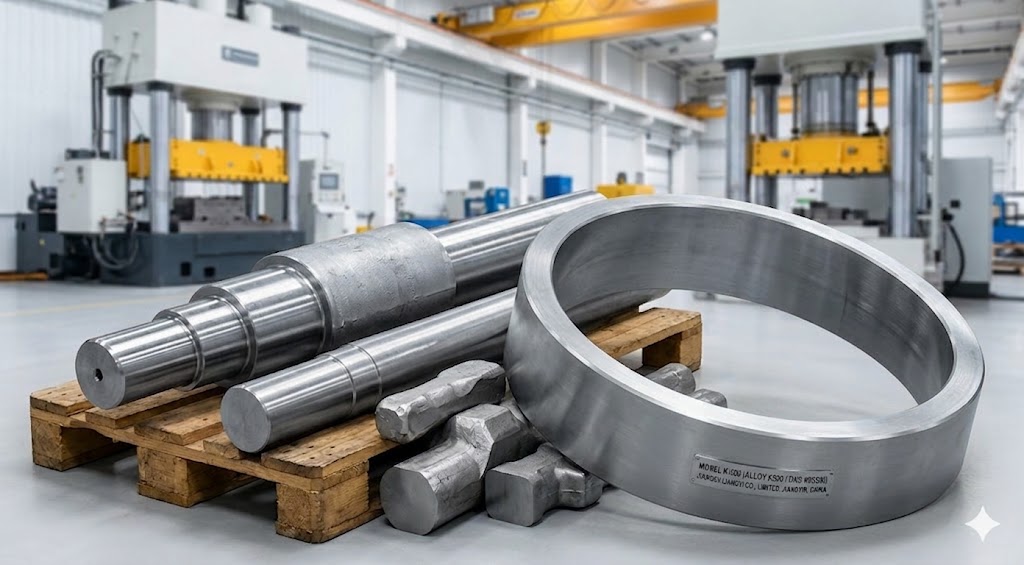
Located in Jiangyin City, Jiangsu Province — the geographical heart of China's Yangtze River Delta forging industry — Jiangsu Liangyi Co., Limited is an ISO 9001:2015 certified, 25+ year experienced manufacturer of premium Alloy K500 (UNS N05500, AMS 4676) — also widely known as Monel® K-500 — open-die forgings, seamless rolled rings, custom bars, shafts, and precision components. Our products are manufactured to ASTM B865, AMS 4676, and EN 10204 3.1/3.2 mill test certificate standards, and are in active service across 50+ countries in North America, Europe, the Middle East, and Asia-Pacific. Send your drawings and requirements today for a free detailed quotation.
Monel K-500 (Alloy K500 / UNS N05500) — At-a-Glance Technical Data
Note: "Monel®" is a registered trademark of Special Metals Corporation. The generic industry designations for this alloy are Alloy K500 and UNS N05500. Technical data provided is for reference only; verify against the applicable material standard for all engineering design purposes.
Core Advantages of Jiangsu Liangyi Monel K-500 Forgings
Why Choose Our China-Based Monel K500 Forging Solutions
- Full in-house production chain: vacuum/induction melting → open-die forging → ring rolling → controlled heat treatment → CNC machining → multi-method NDT inspection. Zero outsourcing; complete heat-lot traceability from melt to finished part.
- Heavy forging capability: 2000T–6300T hydraulic presses, 1–5T electro-hydraulic hammers, 5M seamless ring rolling machines, and 10+ calibrated heat treatment furnaces — all under one roof in Jiangyin.
- Rigorous third-party quality: in-house ICP/OES spectroscopy, ASTM A370 mechanical testing lab, and 100% UT per ASTM A388 / EN 10308. EN 10204 3.1/3.2 mill test certificates available for every order.
- Wide size and weight range: single-piece weight 30 kg–30 tons, ring OD up to 6,000 mm, shaft length up to 15,000 mm — from precision sub-100mm components to 30-ton heavy forgings.
- 25+ years of proven global export: active supply to EPC contractors and valve/pump OEMs in the US, Germany, UK, Japan, Australia, and the Middle East, with customers in oil & gas, power generation, and marine industries.
- Responsive technical support: dedicated material engineers provide alloy selection guidance, drawing review, and pre-production technical meetings for all custom orders.
What Is Monel K-500? (Alloy K500 / UNS N05500)
Monel K-500 (Alloy K500, UNS N05500) is a premium age-hardenable nickel-copper alloy developed to overcome the strength limitation of standard Monel 400 while retaining its world-class corrosion resistance. The key metallurgical breakthrough is the addition of aluminum (2.30–3.15 wt%) and titanium (0.35–0.85 wt%), which form fine, coherent Ni₃(Al,Ti) gamma-prime (γ′) precipitates within the nickel-copper matrix during the aging heat treatment cycle. These nano-scale precipitates pin dislocation movement, dramatically increasing yield strength without sacrificing ductility or toughness.
The result is a forging alloy that delivers approximately 3× the yield strength and 2× the tensile strength of annealed Monel 400, while retaining equivalent — sometimes superior — corrosion performance in seawater, reducing acids, hydrofluoric acid, alkalis, and neutral salt environments. Combined with an exceptionally low magnetic permeability of ≤1.01 (effectively non-magnetic even after age hardening), Monel K-500 occupies a unique design space that no standard stainless steel or carbon steel alloy can fill.
From a designation standpoint, Monel K-500, Alloy K500, UNS N05500, AMS 4676, QQ-N-286, ISO 9723 Grade NW5500, and JIS NW5500 all refer to the same alloy system — engineers should verify the applicable procurement standard for their project jurisdiction when specifying material.
Chemical Composition of Monel K-500 (ASTM B865 / AMS 4676)
Every heat of Monel K-500 we produce is verified by in-house ICP/OES spectroscopic analysis against the following composition limits. Batch-by-batch chemical reports are included in the EN 10204 3.1 mill test certificate supplied with every order.
| Element | Symbol | Content Range (wt%) | Role in Alloy |
|---|---|---|---|
| Nickel + Cobalt | Ni+Co | 63.0 Min | Primary matrix; corrosion resistance, non-magnetic character |
| Copper | Cu | 27.0 – 33.0 | Corrosion resistance in reducing acids and seawater |
| Aluminum | Al | 2.30 – 3.15 | Forms Ni₃(Al,Ti) γ′ precipitates → primary strengthening agent |
| Titanium | Ti | 0.35 – 0.85 | Refines γ′ precipitate size; improves creep resistance |
| Iron | Fe | 2.0 Max | Incidental; controlled to minimize galvanic effects |
| Manganese | Mn | 1.5 Max | Deoxidizer during melting; residual element |
| Carbon | C | 0.18 Max | Controlled to prevent sensitization and intergranular corrosion |
| Silicon | Si | 0.50 Max | Deoxidizer; residual element |
| Sulphur | S | 0.015 Max | Strictly controlled — sulfides are detrimental to hot workability |
| Phosphorus | P | 0.020 Max | Controlled to prevent grain boundary embrittlement |
| Lead | Pb | 0.006 Max | Trace; controlled for weldability and hot ductility |
| Tin | Sn | 0.006 Max | Trace; controlled for weldability and hot ductility |
| Zinc | Zn | 0.020 Max | Controlled to prevent stress corrosion cracking in marine service |
Jiangsu Liangyi note: Aluminum and titanium are the two most technically critical trace elements in Monel K-500. Their ratio and absolute concentration directly govern the volume fraction of γ′ precipitates formed during aging, and therefore the final hardness and strength achieved. We control Al and Ti to the tightest achievable tolerance within the specification band — not merely to the specification limit — to ensure maximum consistency in age-hardened properties across large production runs.
Mechanical Properties of Monel K-500 Age-Hardened Forgings
All mechanical property testing is performed per ASTM A370 or equivalent ISO 6892 / ISO 148 specifications, with every production batch tested to meet the following minimum requirements in the final age-hardened condition:
| Property | Minimum Requirement | Test Standard |
|---|---|---|
| Tensile Strength, Ultimate | 140 ksi (965 MPa) | ASTM A370 / ISO 6892 |
| Yield Strength (0.2% Offset) | 100 ksi (690 MPa) | ASTM A370 / ISO 6892 |
| Elongation in 4D | 17% | ASTM A370 / ISO 6892 |
| Reduction of Area | 25% | ASTM A370 / ISO 6892 |
| Hardness (Maximum) | 35 HRC (315 BHN) | ASTM E18 / ISO 6506-1 |
| Charpy V-notch Impact (Average, −29°C) | 20 ft·lbs (27 J) | ASTM A370 / ISO 148 |
| Charpy V-notch Impact (Single Min., −29°C) | 15 ft·lbs (20 J) | ASTM A370 / ISO 148 |
| Magnetic Permeability (Max, Room Temp.) | 1.01 | ASTM A342 Method 3 |
Engineer's note on hardness limit: The 35 HRC (315 BHN) maximum hardness requirement is not a quality floor — it is a ceiling mandated by NACE MR0175 / ISO 15156-3 to prevent hydrogen-induced cracking (HIC) and sulfide stress cracking (SSC) in sour service environments. Over-aging or using a non-standard aging cycle can drop hardness below the strength minimum while still causing SSC susceptibility through residual microstructural defects. Always verify both the hardness and the complete heat treatment record when sourcing NACE-compliant Monel K-500 forgings.
Physical Properties of Monel K-500 (UNS N05500)
The following physical property data for Monel K-500 is provided as engineering reference for design calculations. Properties vary with temperature; values at elevated temperatures are available on request for specific design conditions.
| Physical Property | Value at 21°C (70°F) | Value at 260°C (500°F) | Value at 538°C (1000°F) |
|---|---|---|---|
| Density | 8.44 g/cm³ (0.305 lb/in³) | 8.33 g/cm³ (approx.) | 8.18 g/cm³ (approx.) |
| Elastic Modulus (Young's) | 179 GPa (26.0 × 10⁶ psi) | 172 GPa (24.9 × 10⁶ psi) | 158 GPa (22.9 × 10⁶ psi) |
| Shear Modulus | 66 GPa (9.6 × 10⁶ psi) | — | — |
| Poisson's Ratio | 0.32 | — | — |
| Thermal Conductivity | 17.5 W/m·K (121 BTU·in/ft²·h·°F) | 19.5 W/m·K (approx.) | 23.0 W/m·K (approx.) |
| Mean Thermal Expansion (21–260°C) | 13.7 µm/m·°C (7.6 µin/in·°F) | ||
| Mean Thermal Expansion (21–538°C) | 14.4 µm/m·°C (8.0 µin/in·°F) | ||
| Specific Heat Capacity (Cp) | 419 J/kg·K (0.10 BTU/lb·°F) | — | — |
| Electrical Resistivity | 615 nΩ·m (370 µΩ·in) | — | — |
| Magnetic Permeability (age-hardened) | ≤1.01 | — | — |
| Melting Range | 1315–1350°C (2400–2460°F) | ||
The relatively low thermal conductivity of Monel K-500 (approximately one-quarter that of carbon steel) means that heat builds up rapidly during machining — a key factor in tooling selection. The alloy's high elastic modulus (comparable to austenitic stainless steel) and low thermal expansion coefficient (lower than austenitic grades) make it dimensionally stable in thermal cycling service, an advantage for precision valve and pump components operating across wide temperature swings.
Corrosion Resistance of Monel K-500 in Key Industrial Environments
Monel K-500 inherits its corrosion resistance from its high nickel-copper base, which is thermodynamically stable across a wide range of electrochemical conditions. Unlike passive-film alloys (stainless steel, titanium), the nickel-copper matrix forms a dense, adherent oxide layer that resists both general and localized corrosion without relying on a fragile passive film that can break down under mechanical damage or oxidizing chloride attack.
Corrosion Resistance by Environment — Summary Rating
The table below reflects Jiangsu Liangyi's engineering assessment based on published corrosion rate data and decades of application feedback from the field. Ratings apply to the age-hardened condition at ambient to moderate temperatures (up to ~150°C) unless noted.
| Corrosive Medium | Concentration / Condition | Corrosion Resistance Rating | Typical Corrosion Rate | Key Limitation |
|---|---|---|---|---|
| Seawater / Brine | Natural, flowing or static, ambient–80°C | <0.025 mm/yr (1 mpy) | Crevice corrosion at very high stagnant temperatures >120°C | |
| Hydrofluoric Acid (HF) | All concentrations, below boiling point | <0.05 mm/yr | Avoid aerated HF >70°C with tensile stress (SCC risk) | |
| Sulfuric Acid (H₂SO₄) | Dilute (<10%), non-aerated, ambient | 0.05–0.25 mm/yr | Resistance drops sharply in aerated or hot concentrated acid | |
| Hydrochloric Acid (HCl) | Dilute, non-oxidizing, ambient | 0.1–0.5 mm/yr | Avoid Fe³⁺ or Cu²⁺ contamination (accelerates corrosion) | |
| Caustic Alkalis (NaOH, KOH) | All concentrations, including hot concentrated | <0.025 mm/yr | Superior to stainless steel in hot caustic — no SCC risk | |
| H₂S Sour Gas / Brine (NACE) | Per NACE MR0175 / ISO 15156, age-hardened ≤35 HRC | Resistant — no HIC/SSC at ≤35 HRC | Hardness must not exceed 35 HRC; do not use cold-worked condition | |
| Phosphoric Acid (H₃PO₄) | Up to 85%, non-contaminated | 0.05–0.15 mm/yr | Degraded by fluoride or chloride contamination in phosphoric | |
| Organic Acids (Acetic, Citric) | All concentrations, ambient to moderate temperature | <0.025 mm/yr | Suitable for food, pharmaceutical, and fine chemical service | |
| CO₂ / Carbonic Acid | High-pressure downhole, oil & gas | Negligible | Far superior to carbon/low-alloy steel and standard stainless | |
| Nitric Acid (HNO₃) | All concentrations | High — rapid attack | Do not use Monel K-500 in nitric acid service; select Alloy 600 or Ti | |
| Dry Fluorine / Chlorine Gas | Ambient, dry conditions only | Protective fluoride film forms — wet conditions accelerate attack | Never use in wet halogen gas service without expert review |
Rating legend: ●●●●● Excellent (<0.1 mm/yr) | ●●●●○ Very Good | ●●●○○ Good | ●●○○○ Moderate | ●○○○○ Poor
Monel K-500 vs Competing Alloys: Which Should You Choose?
Monel K-500 excels in a specific set of design conditions. The comparison below — drawn from our application engineering experience — is intended to help procurement and design engineers quickly identify whether Monel K-500 is the optimal forging alloy for their project, or whether an alternative should be considered.
Monel K-500 (UNS N05500) This Page
Monel 400 (UNS N04400)
Inconel 718 (UNS N07718)
| Performance Parameter | Monel K-500 (Age-Hardened) | 17-4PH Stainless (H900) | Super Duplex 2507 (UNS S32750) |
|---|---|---|---|
| Min. Tensile Strength | 965 MPa (140 ksi) | 1310 MPa (190 ksi) | 795 MPa (115 ksi) |
| Min. Yield Strength | 690 MPa (100 ksi) | 1170 MPa (170 ksi) | 550 MPa (80 ksi) |
| NACE MR0175 Material Requirement | Listed in NACE MR0175 / ISO 15156-3 at ≤35 HRC (age-hardened) | Listed — limited conditions only | Listed — ≤36 HRC condition |
| HF Acid Resistance | Excellent ●●●●● | Poor — attacks martensitic SS ●○○○○ | Limited ●●○○○ |
| Seawater Pitting/Crevice | Excellent ●●●●● | Susceptible ●●○○○ | Excellent (PREN >42) ●●●●● |
| Magnetic Permeability | ≤1.01 (non-magnetic) | ~50–80 (strongly magnetic) | ~1.2–3 (slightly magnetic) |
| Max Service Temp. (continuous) | ~480°C (900°F) | ~315°C (600°F) | ~260°C (500°F) |
| Relative Forging Difficulty | Moderate (narrow temp window) | Moderate | Moderate (requires tight Cr balance) |
Design guidance from our engineering team: Choose Monel K-500 when your component simultaneously requires non-magnetic behavior, resistance to HF acid or sour gas, and a minimum yield strength of 690 MPa. If only strength is required and the environment is non-corrosive, 17-4PH is more cost-effective. If only corrosion resistance is needed without the strength requirement, Monel 400 is the economical choice. When unsure, contact our technical team — we provide free alloy selection consultation for qualified project inquiries.
Full Product Range & Standard Size Specifications
The following table summarizes the standard manufacturing size range for our Monel K-500 forged products. All dimensions can be extended or modified for custom project requirements — contact us with your specific drawing for a tailored quotation.
| Product Form | Diameter / OD Range | Length / Height Range | Wall / ID Notes | Single-Piece Weight | Typical Supply Condition |
|---|---|---|---|---|---|
| Forged Round Bar / Rod | 25 mm – 2,000 mm | Up to 15,000 mm (15 m) | Solid; no bore | 30 kg – 30 tons | Hot forged / rough turned / finish machined + age-hardened |
| Seamless Rolled Ring | OD: 200 mm – 6,000 mm | Height: 50 mm – 3,000 mm | ID: custom; min wall ~50 mm | 5 kg – 30 tons | Hot rolled + annealed / age-hardened; rough or finish machined |
| Hollow Forging / Sleeve | OD: 100 mm – 3,000 mm | Length: up to 8,000 mm | Wall: 30 mm – 500 mm; ID bored or pierced | 50 kg – 25 tons | Hot forged + bored; age-hardened; rough or finish machined |
| Forged Disc / Plate / Block | OD/Width: 100 mm – 4,000 mm | Height/Thickness: 20 mm – 1,500 mm | Solid; custom step or taper available | 10 kg – 30 tons | Hot forged + age-hardened; rough surface or flat-faced machined |
| Step Shaft / Gear Shaft | Max OD: up to 1,500 mm | Up to 15,000 mm overall length | Multiple steps per drawing; keyways, journals available | 30 kg – 20 tons | Fully machined per drawing; age-hardened; ground journal surface available |
| Custom Machined Component | Fully per customer drawing — flanges, nozzles, impellers, valve bodies, tube sheets, baffle plates, etc. | 30 kg – 30 tons | One-stop: forging + heat treatment + CNC machining + NDT + MTC | ||
Monel K-500 Forged Bars & Rods
Monel K-500 forged round bars, square bars, flat bars, step shafts, gear shafts, and pump shafts — available from 25 mm to 2,000 mm diameter and up to 15 m length, with single-piece weight up to 30 tons. Supplied in hot-forged, rough-machined, or fully finish-machined conditions with EN 10204 3.1 MTC.
Alloy K500 Seamless Rolled Forged Rings
UNS N05500 seamless rolled rings, contoured rings, gear rings, valve seat rings, and flange blanks from 200 mm to 6,000 mm OD, single-piece weight up to 30 tons. Ideal for rotating and pressure-bearing applications in oil & gas, power generation, and petrochemical industries. Manufactured to ASTM B865 and compatible with project requirements referencing API 6A and ASME standards. See our full seamless rolled rings capabilities page.
UNS N05500 Hollow Forgings & Sleeves
Monel K-500 hubs, shells, sleeves, bushes, casings, heavy-wall cylinders, seamless pipe, and hollow bars — OD up to 3,000 mm, wall from 30 mm. Uniform grain structure guaranteed through controlled open-die forging; suitable for high-pressure valve bodies, pump casings, and heat exchanger shells.
Custom Monel K-500 Precision Components
Custom-machined Alloy K500 tube sheets, baffle plates, flanges, nozzles, impellers, valve bodies, and other CNC-finished components — manufactured fully per your engineering drawings from forged billet. We provide one-stop forging, heat treatment, machining, and full inspection to reduce your supply chain lead time and cost.
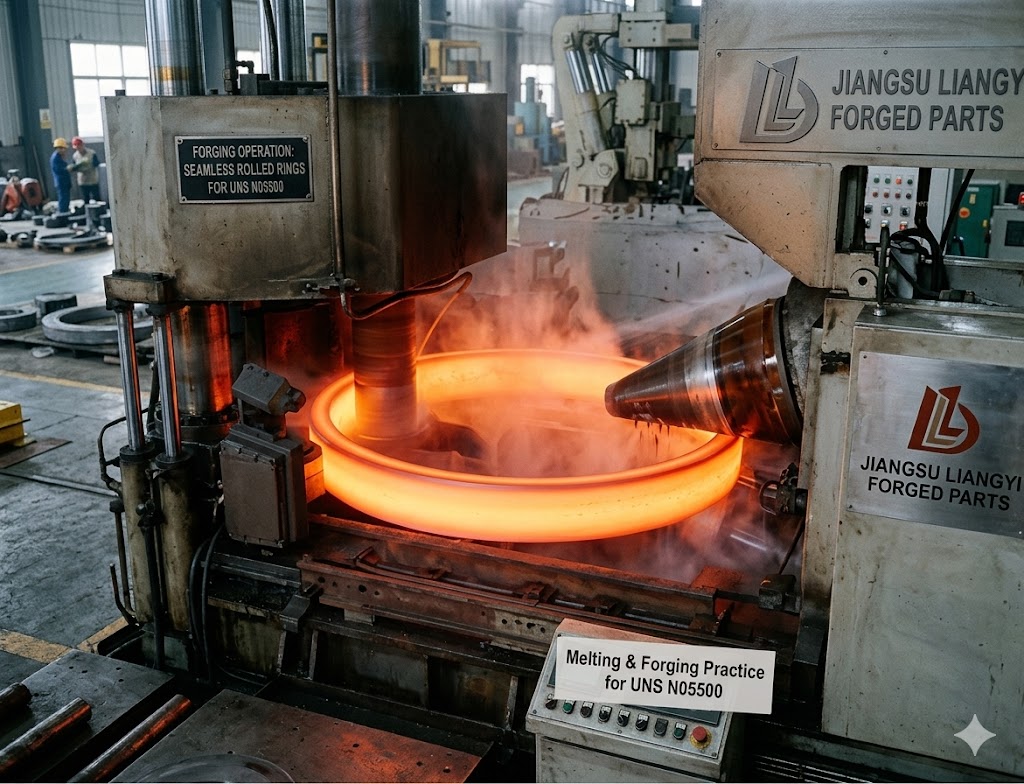
Melting & Forging Practice for UNS N05500
Melting Practice
All Monel K-500 material we process originates from vacuum induction melting (VIM) under protective atmosphere, ensuring minimal oxygen, nitrogen, and hydrogen pickup that would otherwise form non-metallic inclusions and reduce fatigue performance. For critical applications — nuclear, aerospace, and sub-sea — we source ESR (electroslag remelted) ingots that deliver the highest possible cleanliness index, tightest segregation control, and most isotropic mechanical properties.
All forging material is subject to a minimum hot-work reduction ratio of 4:1, with mandatory water quenching from a minimum temperature of 800°C (1500°F) immediately after the final hot-working pass. The 4:1 reduction requirement closes casting porosity, refines grain size, and breaks up any residual dendritic segregation from the ingot structure — it is automatically met for all finished diameters ≤150 mm (6 inches).
Forging Practice
All Alloy K500 hot forging and ring rolling operations are conducted within the strictly controlled temperature window of 1150°C to 900°C (2100°F to 1700°F). Working below 900°C risks strain-induced precipitation of Al-Ti second phases at grain boundaries, causing hot-short cracking. Working above 1150°C risks abnormal grain growth that permanently degrades impact toughness. Our press operators monitor forging temperature with inline pyrometers at 30-second intervals throughout each working pass.
Our in-house forging workshop houses 2000T–6300T hydraulic forging presses, 1–5T electro-hydraulic hammers, and a 5-meter diameter seamless ring rolling machine — all within a single climate-controlled forge bay, eliminating the temperature drop risk that occurs when transferring work-pieces between outside contractors.
Heat Treatment Specifications for Monel K-500 Forgings
Heat treatment is the most critical variable governing the final mechanical properties of Monel® K-500 (Alloy K500 / UNS N05500) forgings, and the primary factor in meeting the ≤35 HRC hardness limit required by NACE MR0175 / ISO 15156 for sour service material qualification. All our heat treatment furnaces are calibrated per AMS 2750 (pyrometry standard), and every load is recorded with calibrated time-temperature data loggers — charts are included in the EN 10204 3.1 MTC documentation.
Step 1: Solution Annealing
Solution annealing dissolves any Al-Ti precipitates formed during hot working, and homogenizes the microstructure to ensure a uniform aging response. Required for all cold-worked material; strongly recommended for all hot-worked material >50 mm section thickness.
- Temperature: 980°C to 1040°C (1800°F to 1900°F)
- Hold time: Minimum 20 minutes per inch (1 min/mm) of maximum cross-section thickness
- Quench: Rapid water quench immediately upon removal from furnace — delay must not exceed 30 seconds to prevent re-precipitation
Step 2: Aging (Precipitation Hardening)
Aging causes the controlled precipitation of fine, coherent Ni₃(Al,Ti) γ′ particles within the austenitic matrix — this is the mechanism responsible for the dramatic strength increase from ~220 MPa to ≥690 MPa yield strength. Two standard cycles are qualified; both produce equivalent final properties:
- Cycle A (Standard — preferred for thick sections >100 mm): 580–610°C (1080–1130°F), held 4–16 hours, furnace cooled at ≤12°C/hour (20°F/hour) to 480°C (900°F), then air cooled to room temperature
- Cycle B (Accelerated — suitable for sections ≤75 mm): 640°C ±15°C (1180°F ±25°F), held 2 hours, furnace cooled at ≤16°C/hour (28°F/hour) to 480°C (900°F), then air cooled to room temperature
Critical process note: The controlled furnace-cooling rate during aging is not optional. Rapid cooling after aging (e.g., water quench or air blast) freezes the γ′ precipitates in a coarse, over-aged state that reduces hardness and strength, and may push hardness outside the ≤35 HRC limit required by NACE MR0175 / ISO 15156-3 for sour service material qualification. Slow furnace cooling allows the γ′ to reach the optimal size distribution for maximum strengthening with minimum internal stress.
Welding Monel K-500: Process Guide & Filler Metal Selection
Alloy K500 (UNS N05500) is weldable but requires more care than standard austenitic stainless steels due to its precipitation hardening response and the presence of aluminum, which promotes oxide formation in the weld pool. The following guidance is based on AWS D1.1 equivalent procedures and our production welding experience on Monel® K-500 assemblies for oil & gas and valve industry customers.
Recommended Welding Processes
- GTAW (TIG) — Preferred for all critical welds: Provides the cleanest shielding, best oxide control, and lowest heat input. Use DCEN polarity, argon or argon/helium shielding gas (min. 99.998% purity). Suitable for all wall thicknesses with appropriate joint preparation.
- GMAW (MIG) — Acceptable for groove welds in thicker sections (>12 mm): Higher deposition rate reduces overall heat input per unit length. Use spray or pulsed-spray transfer mode; never short-circuit transfer for critical welds. Argon/helium blend shielding recommended.
- SMAW (Stick) — Suitable for repair and field welds: Lower quality than GTAW/GMAW due to flux entrapment risk; only use qualified AWS-certified Monel K-500 electrodes. Requires careful slag removal between passes.
Filler Metal Selection
| Welding Process | AWS Designation | Common Trade Name | Notes |
|---|---|---|---|
| GTAW (TIG wire) | ERNiCu-7 | Monel Filler Metal 60 | Standard choice for K-500 to K-500 or K-500 to Monel 400 joints |
| GMAW (MIG wire) | ERNiCu-7 | Monel Filler Metal 60 | Same filler; adjust wire diameter and parameters for GMAW mode |
| SMAW (Electrode) | ENiCu-7 | Monel Electrode 190 | Flux-coated; suitable for field repair; requires dry rod storage |
| Dissimilar weld to SS | ERNiCrMo-3 | Inconel Filler 625 | Use when joining K-500 to austenitic SS (e.g., 316L) to prevent dilution issues |
Pre-weld, In-process & Post-weld Requirements
- Pre-heat: Not required for base metal below 25 mm thickness at ambient temperatures above 10°C. For thicker sections in cold environments (<10°C), a mild 50–80°C pre-heat reduces the risk of hydrogen-assisted cracking from atmospheric moisture.
- Interpass temperature: Maximum 150°C (300°F) between weld passes. Exceeding this limit causes heat buildup that can trigger incipient γ′ precipitation in the HAZ, reducing toughness and promoting cracking on cooling.
- Joint cleanliness: Remove all scale, oxide, grease, and moisture from the joint area to at least 50 mm either side of the weld groove before welding. Aluminum in the alloy makes it more oxide-sensitive than standard Monel 400.
- Post-weld aging (PWAT): For joints requiring full age-hardened strength in the HAZ, perform a post-weld aging treatment at 593°C (1100°F) for 4–8 hours, air cooled. Note: this will re-harden the entire weldment — ensure the geometry can tolerate the resulting dimensional change.
- PWAT for sour service projects: If the weld is intended for sour service environments governed by NACE MR0175 / ISO 15156-3, post-weld aging is recommended to normalize HAZ hardness at or below 35 HRC — the hardness limit referenced in the standard for Alloy K500. As-welded HAZ in K-500 can be softer than the base metal (due to re-solution of γ′) but can also show local hardness spikes depending on heat input — PWAT normalizes both.
Machining Monel K-500: Parameters & Tooling Guide
Monel K-500 is classified as a difficult-to-machine material in the same category as Inconel 718 and titanium alloys. The primary challenges are work-hardening rate, built-up edge (BUE) formation on cutting tools, and heat generation due to the alloy's low thermal conductivity. With correct tooling and parameters, however, excellent surface finishes (Ra <0.8 µm) and tight tolerances (±0.01 mm) are routinely achieved in our machining workshop.
Recommended Starting Machining Parameters
| Operation | Tool Material | Cutting Speed (Vc) | Feed Rate (f) | Depth of Cut (ap) | Coolant |
|---|---|---|---|---|---|
| Rough Turning | Uncoated or TiAlN-coated carbide (K20–K30) | 20–40 m/min | 0.2–0.4 mm/rev | 2.0–5.0 mm | Flood coolant (min. 6% emulsion), high flow rate |
| Finish Turning | PVD TiAlN carbide insert (sharp edge, K10–K20) | 30–50 m/min | 0.05–0.15 mm/rev | 0.3–1.0 mm | Flood coolant; avoid intermittent application |
| Rough Milling | TiAlN-coated carbide end mill (4-flute) | 20–35 m/min | 0.05–0.12 mm/tooth | ap: 1×D max; ae: 30–50% D | Flood or high-pressure through-tool coolant |
| Finish Milling | Fine-grain carbide, sharp edge, TiAlN coating | 30–45 m/min | 0.03–0.08 mm/tooth | ap: 0.3–1.0 mm; ae: 10–20% D | Flood coolant, consistent application |
| Drilling | Solid carbide drill (TiAlN coated) | 15–25 m/min | 0.05–0.15 mm/rev (D-dependent) | Full diameter per pass | High-pressure through-tool coolant mandatory |
| Grinding (finish) | CBN or vitrified aluminum oxide wheel | 20–30 m/s wheel speed | 0.01–0.03 mm/pass | Dress frequently | Flood grinding fluid; prevent thermal damage to hardness |
Key Machining Tips from Our Production Floor
- Never dwell the cutting tool: Monel K-500 work-hardens rapidly — pausing a stationary tool on the workpiece surface instantly creates a hardened layer that breaks inserts and ruins the surface. Keep the tool moving at all times.
- Maintain sharp cutting edges: Change inserts proactively at approximately 70% of expected tool life. A dull edge generates excessive heat and accelerates work hardening ahead of the cut — the leading cause of premature tool failure in Monel machining.
- Use positive-rake geometry: In this tough alloy, positive-rake inserts (with a rake angle of 10° to 15°) generate significantly lower cutting forces than neutral or negative-rake tooling. This makes the tool last longer and gives the surface a better finish.
- Avoid interrupted cuts where possible: Interrupted cuts cause thermal cycling at the cutting edge and rapid built-up edge formation. Use full-width cuts in milling and avoid stopping mid-cut in turning when machining across hard spots or inclusions.
- Pre-machining stress relief for large forgings: For precision components with final tolerances tighter than ±0.05 mm, a pre-machining stress relief at 480–510°C (900–950°F) for 2–4 hours (below the aging temperature to avoid property change) followed by slow furnace cooling reduces residual stress-driven distortion after rough machining.
From our CNC machining team: Achieving Ra ≤0.8 µm seating surfaces on Monel K-500 valve balls and stems consistently requires the combination of a fresh, sharp carbide insert, cutting speed below 40 m/min, continuous flood coolant at ≥50 bar, and a single final finishing pass with minimum depth of cut. Attempting to achieve fine finish in two passes using identical parameters typically degrades, rather than improves, the surface due to the work-hardening generated by the first finish pass.
Industry Applications & Global Project Track Record
Our Monel K-500 forged parts are in active service in critical industrial applications worldwide, with a proven track record across 50+ countries. Our core application industries include:
Oil & Gas Upstream & Downstream
We have supplied Alloy K500 (UNS N05500) forged components for major onshore and offshore oilfield projects in the Middle East, North America, and Southeast Asia — including drill collars, mud motor splined drive shafts, ESP motor shafts, wellhead Christmas tree spool bodies, casing heads, tubing heads, casing hangers, tubing hangers, and high-strength fasteners & bolting. These components are manufactured to ASTM B865 / AMS 4676 material standards, with age-hardened hardness controlled to ≤35 HRC to satisfy NACE MR0175 / ISO 15156 material requirements for sour service, and working pressures up to 15,000 psi.
Valve & Flow Control
Our Alloy K500 forged valve components — balls, bonnets, bodies, stems, seat rings, trim, cores, and discs — serve 2-way, ball, check, gate, butterfly, cryogenic high-performance valves, and ultrasonic flow meter bodies for global valve OEMs in Europe, the US, and Asia. Machined seating surfaces up to Ra 0.8 µm; optional Stellite 6/21 hardfacing for extended trim life in erosive or abrasive flow service.
Marine & Shipbuilding
Our UNS N05500 marine propeller shafts, butterfly valve spindles, non-magnetic housings, mechanical seal discs, and shipboard piping components serve international shipyards in Europe and Asia. These forgings have long-term seawater corrosion resistance, ≤1.01 magnetic permeability, and excellent corrosion fatigue performance in offshore environments. Material documentation is provided to support project-level DNV and ABS class certification processes as needed by the shipyard or classification society.
Nuclear Power & Power Generation
We manufacture Alloy K500 (UNS N05500) forged impellers, rotors, casings, seal chambers, and pressure-boundary components for nuclear reactor coolant pumps, and rotor shafts for gas and steam turbines supplied to thermal and nuclear power plants across Asia. Full heat-lot traceability document, calibrated heat treatment records, and third-party inspection are available upon request.
Petrochemical & Process Industry
Our Alloy K500 tube sheets, baffle plates, pressure vessel shells, reactor nozzles, channel flanges, and heat exchanger components serve large-scale refining, chemical, and fertilizer projects worldwide — delivering outstanding resistance to sulfuric acid, hydrofluoric acid, strong alkalis, and high-temperature corrosive media. Material is manufactured to ASTM B865 / AMS 4676, and we provide EN 10204 3.1 MTCs suitable for ASME Section VIII pressure vessel design and fabrication projects.
Pump & Rotating Machinery
Custom Monel K-500 pump casings, impellers, shafts, wear rings, compressor rotors, turbomachinery centrifugal impellers, and gear shafts are engineered to deliver long service life in high-speed rotating equipment handling corrosive media, leveraging the alloy's outstanding resistance to corrosion fatigue and erosion.
Global Market Documentation & Regional Standard References
With 25+ years of global export experience, we are familiar with the material standards, documentation formats, and third-party inspection protocols of every major industrial market. We manufacture to ASTM B865 / AMS 4676 and provide EN 10204 3.1 mill test certificates as standard with every order. The following summarises how our documentation supports regional project requirements:
- North America (USA & Canada): Material manufactured to ASTM B865, AMS 4676, and QQ-N-286 composition and mechanical property requirements. EN 10204 3.1 MTC provided; material properties satisfy the composition and hardness limits referenced in NACE MR0175 / ISO 15156-3 and ASME Section VIII material tables for Alloy K500 / UNS N05500. Third-party inspection by customer-nominated agency available.
- European Union & UK: EN 10204 3.1/3.2 mill test certificates available as standard (3.2 requires advance notice for third-party witness). Material complies with EN/ISO composition requirements for NW5500. We can provide documentation packages supporting CE marking and PED 2014/68/EU compliance processes — the CE marking and PED approval itself is the responsibility of the equipment manufacturer (OEM/fabricator), not the raw material supplier.
- Middle East (Saudi Arabia, UAE, Qatar, Kuwait, Oman): Full heat and lot traceability documentation provided with every order. Material hardness and composition records support NACE MR0175 material qualification for sour service projects. Third-party inspection by Bureau Veritas, TÜV, Lloyds, or SGS can be arranged on request.
- Asia-Pacific (Japan, Australia, South Korea, Southeast Asia): Material manufactured to JIS G4553 NW5500 and equivalent composition limits. AS-standard compatible documentation available for Australia. Flexible Incoterms (FOB / CIF / DDP) and packaging options available.
Quality Control, Inspection & Documentation
All Monel K-500 forged material is guaranteed to be homogenous, free of injurious seams, laps, voids, or other defects detrimental to quality, mechanical performance, or machining behavior. Welding by the supplying mill is strictly prohibited — any weld repair on forgings is a non-conformance requiring mandatory customer notification and disposition review.
Nondestructive Examination (NDE)
After all hot/cold working and final heat treatment, every Monel K-500 forging with diameter exceeding 1½ inches (38 mm) undergoes 100% automated ultrasonic testing (UT) per ASTM A388 NDE-31 or EN 10308 Quality Class 3. We also perform magnetic particle testing (MT), liquid penetrant testing (PT), and radiographic testing (RT) per customer PO specifications, with full written inspection reports provided with every shipment.
Documentation Package (Standard with Every Order)
- EN 10204 3.1 Mill Test Certificate (MTC) with heat number and lot traceability to original ingot
- Full chemical composition heat analysis (ICP/OES spectrometer report) for all specified elements
- Complete mechanical property test results: tensile, yield, elongation, reduction of area, hardness, Charpy impact
- Magnetic permeability test report (ASTM A342 Method 3)
- 100% ultrasonic testing acceptance statement with scan record
- Full heat treatment process record with calibrated time-temperature recorder chart
- Dimensional inspection report per customer drawing
- Formal statement of compliance with all applicable material specifications and customer PO requirements
EN 10204 3.2 (third-party witnessed inspection) is available upon request with advance notice for inspector scheduling. Third-party inspection by Bureau Veritas, TÜV, SGS, Lloyds, or customer-nominated inspection agency can be arranged; all associated costs and scheduling lead time are borne by the customer.
Lead Time, MOQ & Supply Chain Information
Our standard production lead times for custom Monel K-500 forgings from order confirmation are summarized below. All timelines assume complete technical documentation (drawing, material specification, inspection requirements) provided at order placement.
VIM ingot / billet confirmed
Pressing / ring rolling
Anneal + age + MTC record
UT / MT / PT + dimensional
CNC per drawing
VCI + crate + docs
| Order Type | Typical Lead Time | MOQ | Notes |
|---|---|---|---|
| Standard forged bar / ring (rough machined) | 25–35 working days | 1 piece | From order confirmation + approved drawing |
| Fully machined component (CNC per drawing) | 35–55 working days | 1 piece | Depends on machining complexity and tolerances |
| Large heavy forgings (>5 tons / OD >2,000 mm) | 45–70 working days | 1 piece | Ingot sourcing and multiple forging heats may be required |
| Repeat orders (same drawing, same spec) | 20–30 working days | 1 piece | Expedited available for framework contract customers |
| Third-party inspection required | +5–10 working days | — | Inspector scheduling to be coordinated in advance |
Packaging & Shipping
All Monel K-500 finished parts are marked with material grade, UNS designation, heat number, heat treatment condition, and purchase order number on each individual piece. Protective packaging includes reinforced wooden export crates, multi-layer VCI (volatile corrosion inhibitor) wrapping, end caps and foam padding for machined surfaces, and silica gel desiccant inside sealed polyethylene liners. Custom steel skid packaging, fumigation-free plywood crates (ISPM-15 compliant), and partial container (LCL) consolidation service are available. We ship via FOB Tianjin, Shanghai, or Ningbo on CIF/DDP Incoterms by customer preference.
Identification & Marking
All finished Monel K-500 forgings are clearly identified per applicable standard requirements and customer PO markings, including: alloy designation (Monel K-500 / UNS N05500), heat number, heat treatment condition (AH = age-hardened), size, Jiangsu Liangyi manufacturer mark, and customer PO number / item number. Marking is applied by low-stress vibro-engraving on non-critical surfaces (per customer drawing) or paint stencil for ring outer faces. Electro-chemical etching is available for surfaces that cannot tolerate any mechanical marking stress.
Frequently Asked Questions About Monel K-500 Forgings
Alloy K500 (UNS N05500) — also known as Monel® K-500 — is widely used for high-load, corrosion-resistant components where standard stainless steels are inadequate. Primary applications include oil & gas downhole drill collars, mud motor drive shafts, ESP motor shafts, wellhead components (where NACE MR0175 / ISO 15156 material requirements apply), valve stems and seats, pump shafts, marine propeller shafts, nuclear reactor coolant pump components, and chemical processing equipment in HF acid and caustic alkali service.
The density of Monel K-500 (UNS N05500) is 8.44 g/cm³ (0.305 lb/in³). This is useful for weight estimation when designing forging-intensive assemblies such as downhole BHA strings or large valve bodies where total weight directly affects installation handling requirements.
Monel K-500 has very low magnetic permeability of ≤1.01 in the age-hardened condition at room temperature — making it effectively non-magnetic for engineering purposes. This property is critical for MWD/LWD downhole navigation tools, marine compass housings, nuclear flux measurement components, and any application where ferromagnetic materials would distort electromagnetic fields or interfere with sensor readings.
Monel K-500 contains aluminum (2.30–3.15 wt%) and titanium (0.35–0.85 wt%) not present in Monel 400. These elements form Ni₃(Al,Ti) precipitates during aging heat treatment, increasing yield strength approximately 3× (690 MPa vs 220 MPa) and tensile strength approximately 2× (965 MPa vs 550 MPa) compared to annealed Monel 400, while retaining equivalent corrosion resistance in seawater, reducing acids, and alkalis. Monel 400 is chosen when corrosion resistance is the primary requirement and structural load is low; Monel K-500 is chosen when both high strength and corrosion resistance are simultaneously required.
Yes — as a material. Alloy K500 (UNS N05500) is listed in NACE MR0175 / ISO 15156-3 Table B.5 for use in sour (H₂S-containing) oil & gas production environments, provided the material is in the age-hardened condition with a maximum hardness of 35 HRC (315 BHN). Important distinction: NACE MR0175 certifies a material condition, not a manufacturer. We supply full EN 10204 3.1 mill test documentation — including age-hardened hardness results and heat treatment records — enabling the project engineer or third-party inspector to verify that the supplied material meets NACE MR0175 / ISO 15156-3 material requirements.
Yes, Alloy K500 (UNS N05500) is weldable using GTAW (TIG) or GMAW (MIG) processes with ERNiCu-7 (Monel® Filler Metal 60) or ENiCu-7 filler metals. No pre-heat is required for sections below 25 mm at ambient temperature. Post-weld aging at 593°C (1100°F) for 4–8 hours is strongly recommended for sour-service welds where NACE MR0175 / ISO 15156 material requirements apply, to normalize HAZ hardness at or below the 35 HRC limit.
Jiangsu Liangyi can produce Monel K-500 forgings from 30 kg to 30 tons single-piece weight. Maximum OD is 6,000 mm for seamless rolled rings, maximum length is 15,000 mm for shafts and bars, and maximum OD is 3,000 mm for hollow forgings and sleeves. For extremely large or non-standard geometries, contact us for a project-specific feasibility assessment.
Monel K-500 has a thermal conductivity of about 17.5 W/m·K and an elastic modulus (Young's modulus) of 179 GPa (26 × 10⁶ psi) at room temperature (21°C). Because it doesn't conduct heat as well as carbon steel (about one-fourth as well), heat builds up quickly during machining, so high-pressure flood coolant is always needed.
The high elastic modulus is comparable to austenitic stainless steel, making Monel K-500 dimensionally stiff and suitable for precision shaft and valve applications.
Monel K-500 age hardening involves two steps: (1) Solution annealing at 980–1040°C (1800–1900°F) followed by water quench, to dissolve all prior precipitates and homogenize the matrix; then (2) Aging at 580–610°C (1080–1130°F) for 4–16 hours with controlled furnace cooling at ≤12°C/hr to 480°C, then air cool — or alternatively at 640°C ±15°C for 2 hours with controlled furnace cooling. Both aging cycles produce Ni₃(Al,Ti) gamma-prime precipitates responsible for the alloy's high strength.
Contact Jiangsu Liangyi for Custom Monel K-500 Forging Solutions
As a top China manufacturer of Monel K-500 (Alloy K500, UNS N05500) forged parts from Jiangyin, Jiangsu Province, we are ready to provide products with competitive pricing and great quality for your global industrial projects. Send us your drawings, material specification, quantity, and project timeline for a free detailed technical quotation — typically returned within 24 business hours.
Inquiry Email: sales@jnmtforgedparts.com
Phone / WhatsApp: +86-13585067993
Official Website: https://www.jnmtforgedparts.com
Factory Address: Chengchang Industry Park, Jiangyin City, Jiangsu Province, China 214400