Maraging 350 (Equivalent to VASCOMAX® 350, UNS S35000, UNS K93540) Forged Parts | China Leading Forging Manufacturer — Complete Technical Guide
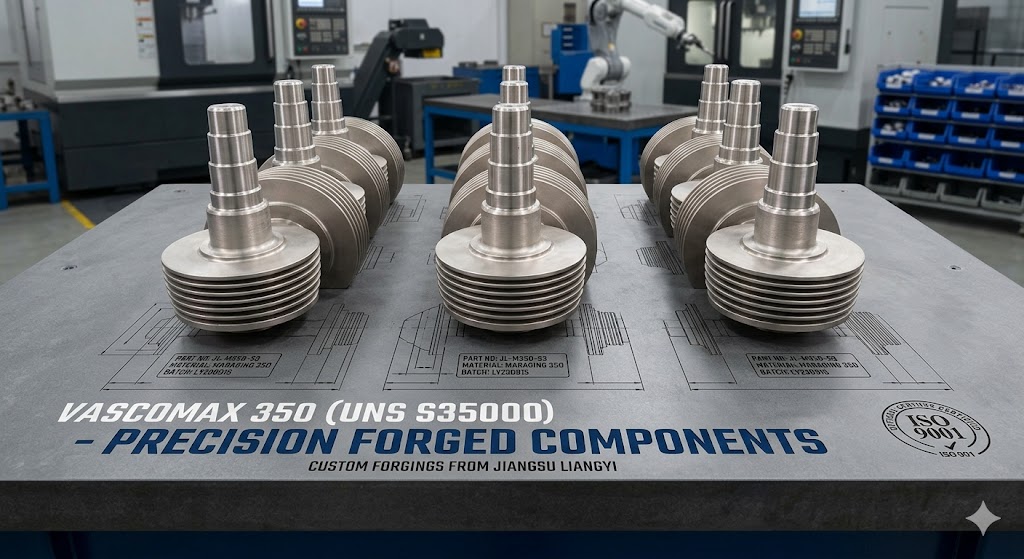
Maraging 350 — commonly referenced by the trade name VASCOMAX® 350 (a registered trademark of Carpenter Technology Corporation), UNS designations S35000 / K93540, also called Maraging C-350 — is the highest-strength grade in the commercial maraging steel family. The name "maraging" fuses martensitic and aging, describing the two-stage hardening mechanism: first forming a tough, near-carbon-free martensite matrix on air cooling, then precipitating nanoscale intermetallic compounds (Ni₃Mo, Ni₃Ti, Fe₂Mo) during a 480°C aging cycle. The result is an ultimate tensile strength of 350,000 psi (2,415 MPa) combined with 7% elongation, excellent weldability, and a dimensional change during aging of only 0.04–0.06% — properties that are collectively unattainable in any conventional high-strength steel.
Note: VASCOMAX® is a registered trademark of Carpenter Technology Corporation. Inconel® is a registered trademark of Special Metals Corporation. Jiangsu Liangyi manufactures Maraging 350 (UNS S35000/K93540) forged parts that meet the same material specifications and are not affiliated with or endorsed by these trademark holders.
Jiangsu Liangyi is an ISO 9001:2015 certified China-based leading manufacturer of Maraging 350 (VASCOMAX 350, UNS S35000, UNS K93540, Maraging C-350) open die forgings and seamless rolled rings. With 25+ years of forging experience, an 80,000 m² modern production base, and 6,300-ton hydraulic forging presses, we supply fully custom Maraging 350 forged parts to over 50 countries across North America, Europe, the Middle East, Asia Pacific, and Australia. Every part is produced under complete metallurgical traceability and backed by EN10204 3.1/3.2 mill test certificates.
📋 Page Contents
- The Metallurgical Science of Maraging 350 — Why It Works
- Full Product Range We Supply
- Chemical Composition, Mechanical & Physical Properties
- Maraging Steel Grade Comparison: 200 / 250 / 300 / 350
- Maraging 350 vs. Competing High-Strength Materials
- Complete Heat Treatment Protocol
- Forging Process & Grain Flow Advantage
- Machining, Welding & Secondary Operations
- Why Choose Our Maraging 350 Forgings
- Quality Control — NDT Methods & Certification Details
- Industry Applications & GEO Project Cases
- Procurement Guide: How to Order Correctly
- GEO-Targeted Market Compliance
- Frequently Asked Questions (15 FAQs)
- Contact Us
The Metallurgical Science of Maraging 350 — Why It Achieves 350,000 psi
To specify and use Maraging 350 correctly, it is important to understand why this alloy gets its excellent properties — not just memorize the numbers. The following explanation reflects our 25+ years of production experience with this material and is not available from commodity datasheet sources.
Core principle: Maraging 350 achieves ultra-high strength through precipitation of nanoscale intermetallic compounds within a near-carbon-free, ductile martensitic matrix — a mechanism fundamentally different from conventional hardened steels, and responsible for the unique combination of strength, toughness, weldability, and dimensional stability that no other commercially available steel grade can replicate.
What Does "Maraging" Actually Mean?
The term "maraging" is a portmanteau of martensitic and aging, coined in the late 1950s by researchers at the International Nickel Company (INCO) who first developed this alloy family. It describes the two-stage hardening process with precision: the steel first transforms to martensite (upon air cooling from the solution anneal temperature), then is "aged" at a lower temperature to precipitate strengthening compounds within that martensitic matrix.
This is categorically different from conventional high-strength steels such as 4340, where strength comes from carbon-rich carbide precipitation and where hardening requires rapid quenching to trap carbon in a supersaturated lattice. In Maraging 350, carbon is held to ≤0.03% — effectively treating it as an impurity — and the strengthening mechanism is entirely based on intermetallic precipitation.
Stage 1: How the Soft Martensite Forms (No Quenching Required)
When Maraging 350 is heated to 820°C (1508°F) and then air cooled, the austenite transforms to martensite during the slow air cooling cycle. This seems counterintuitive — conventional wisdom holds that martensite requires rapid quenching — but Maraging 350 achieves this because:
- The martensite start temperature (Ms) is approximately 155°C (311°F), which is well above room temperature. Transformation to martensite begins and completes during slow air cooling, with no need for water or oil quenching.
- The near-zero carbon content means the martensite lattice has very low internal strain energy, producing a soft, ductile, lath-type martensite with a hardness of only 28–32 HRC — unlike the brittle, high-carbon plate martensite in conventional steels.
- This soft annealed condition is ideal for machining: the material machines like a 4340 steel at 30 HRC, with no risk of quench cracking.
Stage 2: Precipitation Hardening — The Intermetallic Mechanism
During age hardening at 480°C (896°F), three main intermetallic compounds are coherently precipitated into the martensite matrix:
- Ni₃Mo (nickel-molybdenum): The dominant strengthening precipitate. Molybdenum atoms that were dissolved in the martensite lattice cluster and form this ordered intermetallic phase, pinning dislocation movement and dramatically raising yield strength.
- Ni₃Ti (nickel-titanium): A secondary precipitate that adds to the Ni₃Mo strengthening. Titanium also suppresses the formation of austenite reverted by overaging.
- Fe₂Mo (iron-molybdenum): This phase forms at longer aging times and contributes some extra strengthening, but overaging takes place if temperature or time exceed the specification.
In our production experience, achieving consistent 350,000 psi tensile strength requires tight furnace temperature control of ±8°C and careful uniformity across the section thickness. For large cross-sections (>300mm), we use extended aging hold times (up to 5–6 hours) to ensure full precipitation at the core. This is not specified in most datasheets but is critical for large forgings in oil & gas and nuclear applications.
The Critical Role of Cobalt — Why Grade 350 Has 12%
The most important distinguishing feature of Maraging 350 versus lower grades is its 12% cobalt content — the highest in the family. Cobalt serves a critical metallurgical function that is often misunderstood: it does not itself form strengthening precipitates. Instead, cobalt reduces the solubility of molybdenum in the martensite matrix. With higher cobalt, more molybdenum is forced out of solution and precipitates as Ni₃Mo during aging, producing a denser precipitate dispersion and therefore higher strength. This is why increasing cobalt from 9% (Grade 300) to 12% (Grade 350) produces a strength jump from 300 ksi to 350 ksi — not because cobalt itself strengthens the steel, but because it amplifies the molybdenum precipitation response.
The Dimensional Stability Advantage — Critical for Precision Components
One of the most practically valuable properties of Maraging 350 is its predictable dimensional change during aging: only 0.04–0.06% linear expansion. This is an order of magnitude smaller and far more consistent than the dimensional distortion caused by quenching in conventional steels. For precision components such as turbine disks, valve stems, or missile guidance components, this means parts can be machined close to final dimensions in the soft annealed condition and then aged with confidence that they will fall within drawing tolerances without further grinding — a significant cost saving in high-precision applications.
Full Range of Maraging 350 Forged Products We Supply
We manufacture custom Maraging 350 (equivalent to VASCOMAX® 350, UNS S35000) forged steel products in full specifications, strictly complying with ASTM, AMS, API, EN, DIN, and JIS international standards, and your custom drawings. Our forging capabilities for Maraging 350 cover the full product spectrum:
- Forged Bars, Rods & Shafts: Round bars, square bars, flat bars, step shafts, gear shafts, and splined shafts. Max diameter: 2,000 mm; max length: 15,000 mm; max single-piece weight: 30 tons. Custom keyways, bores, and stepped profiles machined to drawing.
- Seamless Rolled Rings: Ring rolling via 5-meter seamless ring rolling machines. Max OD: 6,000 mm; max weight: 30 tons. Custom profiles include rectangular, T-section, L-section, gear ring, labyrinth ring, and seal ring cross-sections for rotating and pressure-retaining applications.
- Hollow Forged Components: Hubs, housings, shells, sleeves, bushings, heavy-wall cylinders, hollow bars, and seamless thick-wall pipes. Max OD: 3,000 mm. Hollow core drilled or pierced over mandrel depending on section geometry and toughness requirements.
- Discs, Plates & Blocks: Turbine disks, compressor disks, impeller blanks, flanged discs, and custom forged blanks for high-stress rotating and structural applications.
- Valve & Pump Forgings: Valve balls, bodies, bonnets, stems, seats, cores, and discs; pump casings, impellers, shafts, and wear rings. Full range of pressure class ratings from ANSI 150 to ANSI 2500.
- Turbine & Rotating Equipment Forgings: Turbine disks, impellers, blisks, blades, spindles, guide rings, diaphragm nozzles, compressor rotors and special turbomachinery components for high-cycle fatigue resistance.
- Pressure Vessel & Heat Exchanger Components: Nozzles, channel flanges, tube sheets, baffle plates, shells, and barrel forgings for boilers, pressure vessels, reactors, and heat exchangers, all parts meet ASME BPVC Section VIII.
- Fasteners & Adapter Fittings: Double studded adapter flanges (DSAFs) for wellhead and Christmas tree equipment, high-strength stud bolts, and custom fasteners for extreme high-pressure service, all parts meet API 6A and NACE MR0175.
Maraging 350 Steel: Chemical Composition, Mechanical & Physical Properties
Standard Chemical Composition of Maraging 350 (UNS S35000 / UNS K93540)
| Element | Specification Limit | Metallurgical Role |
|---|---|---|
| Carbon (C) | ≤ 0.03% | Kept ultra-low to prevent carbide formation; ensures strengthening relies entirely on intermetallic precipitation, preserving weldability and toughness |
| Nickel (Ni) | 18.50% | Core matrix element; lowers Ms temperature to ~155°C enabling air-cool martensite transformation; provides ductile martensite matrix with good toughness |
| Cobalt (Co) | 12.00% | Primary strengthening enabler; reduces Mo solubility in martensite, forcing denser Ni₃Mo precipitation during aging; responsible for Grade 350's superior strength over Grade 300 |
| Molybdenum (Mo) | 4.80% | Forms Ni₃Mo and Fe₂Mo precipitation strengthening phases during aging; improves corrosion resistance; reduces susceptibility to temper embrittlement |
| Titanium (Ti) | 1.40% | Forms Ni₃Ti precipitates; synergizes with Mo precipitation; suppresses austenite reversion during overaging |
| Silicon (Si) | ≤ 0.10% | Residual deoxidizer; controlled to minimize impurity inclusions that degrade toughness |
| Manganese (Mn) | ≤ 0.10% | Residual deoxidizer; controlled to minimize MnS inclusions; improves hot workability during forging |
| Aluminum (Al) | 0.10% | Deoxidizer; assists in grain refinement during solidification; supports uniform precipitate distribution |
| Iron (Fe) | Balance | Base matrix element |
Mechanical Properties After Standard Heat Treatment
| Property | Minimum Value | Typical Value | Unit |
|---|---|---|---|
| Ultimate Tensile Strength (UTS) | 350,000 (2,415 MPa) | 355,000–365,000 | psi |
| 0.2% Offset Yield Strength | 340,000 (2,345 MPa) | 342,000–355,000 | psi |
| Elongation (gauge length 50mm) | 7% | 8–10% | % |
| Reduction of Area | 35% | 40–50% | % |
| Notch Tensile Strength (K=9.0) | 330,000 | 340,000–350,000 | psi |
| Hardness (as-aged) | — | 52–56 HRC | HRC |
| Hardness (solution annealed) | — | 28–32 HRC | HRC |
| Charpy V-Notch Impact (25°C) | — | 15–25 J | J |
| Fracture Toughness KIC | — | 35–50 MPa√m | MPa√m |
Physical Properties of Maraging 350 Steel
Physical properties are critical for design engineers performing thermal analysis, FEA modeling, and fitment calculations. The following values apply to the aged condition at room temperature (20°C) unless noted:
| Physical Property | Value | Unit |
|---|---|---|
| Density | 8.00 | g/cm³ (0.289 lb/in³) |
| Elastic (Young's) Modulus | 190 | GPa (28 × 10⁶ psi) |
| Shear Modulus | 73 | GPa |
| Poisson's Ratio | 0.30 | — |
| Thermal Conductivity | 25 | W/m·K |
| Specific Heat Capacity | 460 | J/kg·K |
| Coefficient of Thermal Expansion (20–100°C) | 10.0 × 10⁻⁶ | /°C |
| Electrical Resistivity | 0.75 | μΩ·m |
| Magnetic Permeability | Ferromagnetic at RT | — |
| Melting Range | 1,413–1,430 | °C |
| Dimensional Change During Aging | +0.04 to +0.06% | Linear, predictable |
Inspection Standards We Follow
- ASTM E 8 / E 8M: Tension Testing of Metallic Materials
- ASTM E 10: Brinell Hardness of Metallic Materials
- ASTM E 23: Notched Bar Impact Testing of Metallic Materials
- ASTM E 139: Conducting Creep, Creep-Rupture, and Stress-Rupture Tests
- ASTM E 292: Conducting Time-for-Rupture Notch Tension Tests
- ASTM E 354: Chemical Analysis of High-Temperature, Electrical, Magnetic, and Other Iron, Nickel, and Cobalt Alloys
Maraging Steel Grade Comparison: 200 / 250 / 300 / 350 — Which Grade to Choose?
The four commercial maraging steel grades share the same iron-nickel base and the same two-stage heat treatment process, but differ in cobalt content and the resulting strength-toughness balance. Understanding this comparison is essential for correct grade selection — specifying Grade 350 when Grade 250 would suffice wastes significant material cost, while under-specifying the grade risks premature fatigue failure in service.
| Property | Grade 200 | Grade 250 | Grade 300 | Grade 350 (This Grade) |
|---|---|---|---|---|
| UNS Designation | K92810 | K92890 | K93120 | S35000 / K93540 |
| Min UTS (ksi / MPa) | 200 / 1380 | 250 / 1724 | 300 / 2069 | 350 / 2415 ★ Highest |
| Min Yield Strength (ksi) | 190 | 240 | 290 | 340 ★ Highest |
| Min Elongation (%) | 10 | 8 | 7 | 7 |
| Fracture Toughness KIC (MPa√m) | ~150 | ~80–110 | ~55–70 ★ Best balance | ~35–50 |
| Nickel Content | 18% | 18% | 18% | 18.50% |
| Cobalt Content | 8% | 7.5% | 9% | 12% ★ Highest |
| Typical Hardness (aged) | 42–46 HRC | 47–52 HRC | 50–54 HRC | 52–56 HRC |
| Primary Applications | Tooling, dies, moderate-strength structural | Aerospace structural, general high-strength | Rocket motor cases, defense, aerospace | Maximum-strength applications where Grade 300 is insufficient |
| Relative Material Cost | $ | $$ | $$$ | $$$$ |
Grade 350 is the correct choice when your component design is already optimized for Grade 300 and still cannot meet the fatigue life or static strength requirement. If you are selecting a grade for a new design, consider starting with Grade 300 and evaluating whether the higher fracture toughness (KIC ~60 vs ~40 MPa√m) offers a longer fatigue crack propagation life — often more valuable than the additional 50 ksi of tensile strength. We are glad to provide free grade selection consultation for your specific application.
Maraging 350 vs. Competing Ultra-High-Strength Materials
Engineers considering Maraging 350 are often evaluating it against other high-strength materials. The following comparison is based on our production experience and published material data — not marketing claims — to help engineers make technically sound decisions.
| Criterion | Maraging 350 (UNS S35000) | AISI 4340 (Q&T to ~270 ksi) | 17-4PH Stainless (H900) | H13 Tool Steel | Inconel® 718 |
|---|---|---|---|---|---|
| Max UTS (ksi) | 350 ★ | ~270 | ~200 | ~230 | ~185 (RT) |
| Yield Strength (ksi) | 340 ★ | ~240 | ~175 | ~210 | ~165 |
| Elongation (%) | 7% | ~8% (at 270 ksi) | 10% | ~12% | 12% |
| Weldability | Excellent ★ No preheat required | Fair Preheat 175–230°C required | Good | Difficult High preheat required | Good |
| Quench Cracking Risk | None ★ Air cool, no quench | High Oil/water quench required | Low | High Air hardening but sensitive | None |
| Dimensional Stability (HT) | Excellent ★ ±0.05% aging change | Poor Significant distortion | Good | Fair | Good |
| Corrosion Resistance | Low Requires coating/plating | Low | Excellent ★ Stainless grade | Low | Excellent |
| High-Temp Strength (>450°C) | Poor Overages above 500°C | Poor | Moderate | Good (up to 600°C) | Excellent ★ Rated to 650°C |
| Machinability (annealed) | Excellent ★ 28–32 HRC soft state | Good | Good | Fair | Difficult Work hardens rapidly |
| Relative Cost (forged) | $$$$ | $ | $$ | $$ | $$$$$ |
When to choose Maraging 350 over alternatives: Specify Maraging 350 when your application requires tensile strength >300 ksi that cannot be achieved with any other commercially available steel, combined with: (a) weldability — critical if the forging will be welded into a larger assembly; (b) predictable post-machining dimensional change — critical for precision components machined before aging; (c) operation at ambient to 400°C — if operating continuously above 500°C, Inconel® 718 is superior. The material cost premium is substantial, but for applications where failure is not an option, Maraging 350 offers performance that no lower-cost alternative can match.
Maraging 350 Complete Heat Treatment Protocol — From Our Production Floor
Heat treatment is the most critical step in Maraging 350 production. The following protocol is based on AMS 6521/6522 requirements combined with our process-controlled production experience across thousands of forged components. Deviation from these parameters — even minor furnace temperature non-uniformity — can reduce tensile strength by 10,000–20,000 psi or cause inconsistent properties across the cross-section of large forgings.
Solution Annealing (Homogenization)
Temperature: 820°C ± 14°C (1508°F ± 25°F)
Hold time: Minimum 1 hour per 25 mm of maximum cross-section thickness
Atmosphere: Vacuum, inert gas (argon), or controlled atmosphere to prevent oxidation
Cooling: Air cool to room temperature — do NOT water or oil quench
Result: Homogeneous lath martensite, 28–32 HRC, fully machinable
Purpose: Dissolves all prior precipitates and homogenizes the alloy composition. The air cooling cycle is sufficient to transform austenite to lath martensite (Ms ≈ 155°C) without quench cracking risk. This step establishes the uniform martensite matrix into which precipitates will grow during aging.
Precision Machining Window (Between Stages)
Hardness: 28–32 HRC (similar to AISI 4340 at 30 HRC)
Recommended operations: Rough and semi-finish machining, drilling, tapping, boring, and grinding to near-net dimensions
Allowance for aging: Leave +0.05–0.10% stock on critical diameter dimensions to account for the predictable 0.04–0.06% linear expansion during aging
Purpose: This is the optimal machining window. The soft annealed martensite cuts freely with conventional carbide tooling at high speeds. Doing major machining in this condition — rather than after aging — dramatically reduces cycle time and tooling costs, and avoids the risk of grinding burn on the hard aged surface.
Age Hardening (Precipitation Hardening)
Temperature: 480°C ± 8°C (896°F ± 15°F)
Hold time: 3 hours minimum; 5–6 hours for sections >300 mm to ensure full core precipitation
Atmosphere: Vacuum or inert gas preferred; air permissible if surface oxidation is acceptable
Cooling: Air cool to room temperature
Result: 52–56 HRC, 350,000 psi UTS, 0.04–0.06% linear expansion
Purpose: Ni₃Mo, Ni₃Ti, and Fe₂Mo precipitates nucleate and grow coherently within the martensite matrix. Hardness increases from ~30 HRC to 52–56 HRC over the 3-hour hold. The reaction is largely complete within 3 hours at 480°C; extending to 5 hours adds minimal additional strength (<2%) but ensures full core properties in thick sections.
Finish Grinding / Final Inspection (Post-Aging)
Stock removal: Grinding or hard turning to final drawing dimensions
Surface integrity: Monitor for grinding burn (tempers precipitates and reduces local hardness); use cool grinding parameters and check with temper etch or Barkhausen noise
NDT: Final UT, MT, dimensional inspection, and hardness verification
Purpose: Removes the small dimensional expansion from aging and achieves final drawing tolerances. Because the aging expansion is predictable and repeatable, many precision components require only minor final grinding — often just 0.05–0.15 mm per surface.
Aging above 510°C (950°F) or for excessively long hold times causes overaging: the intermetallic precipitates coarsen and austenite begins to revert within the martensite matrix. Strength drops sharply — typically by 30,000–60,000 psi — and cannot be recovered without a full re-anneal and re-age cycle. In our production we monitor furnace temperatures with calibrated Type-K thermocouples at ±5°C accuracy, and document every heat treatment cycle on the mill test certificate. We do not accept ±15°C tolerance furnaces for Maraging 350 production.
Maraging 350 Forging Process & Grain Flow Advantage
Forging is not merely a shaping operation for Maraging 350 — it is a critical metallurgical process step that determines grain structure, inclusion alignment, and therefore the directional mechanical properties of the final component. The following describes our proprietary forging approach developed over 25 years of Maraging steel production.
Why Forging Outperforms Casting for Maraging 350
Maraging 350 is produced exclusively as wrought (forged or rolled) material — not cast — for critical applications, because:
- Grain refinement: The as-cast dendritic structure of VIM/VAR ingots contains grain sizes of ASTM 1–3 (very coarse). Forging with a minimum reduction ratio of 4:1 refines the grain to ASTM 5–8, improving fatigue strength by 15–25% compared to an un-worked material at the same tensile strength.
- Inclusion alignment: Non-metallic inclusions present in the melt are elongated and aligned parallel to the primary working direction. By forging parts so that principal stress directions in service align with the longitudinal grain flow, fatigue crack propagation resistance is maximized.
- Porosity closure: Sub-surface micro-porosity present in ingots is closed under the hydrostatic compressive stress of the forging press. This is particularly important for large cross-sections where vacuum arc remelting cannot fully eliminate centerline shrinkage.
- Segregation reduction: Forging breaks up the dendritic segregation pattern from solidification, producing a more chemically uniform billet that responds more consistently to heat treatment.
Our Maraging 350 Forging Process Parameters
| Process Parameter | Specification | Reason |
|---|---|---|
| Forging Temperature Range | 1,120–1,200°C (2,050–2,190°F) | Optimal hot ductility; avoids hot-short cracking above 1,220°C and poor deformability below 1,050°C |
| Minimum Finish Forging Temperature | > 870°C (1,600°F) | Prevents cold working of austenite which can produce undesirable fibrous texture |
| Minimum Total Reduction Ratio | 4:1 (ingot-to-forging section) | Achieves grain refinement to ASTM 5+ and closes solidification porosity |
| Maximum Single-Hit Reduction | ≤ 25% per pass (for sections > 300mm) | Prevents adiabatic shear band formation in large sections |
| Reheat Cycles | As required to maintain temperature > 870°C | Unlimited reheats permissible without property penalty provided final condition is solution annealed |
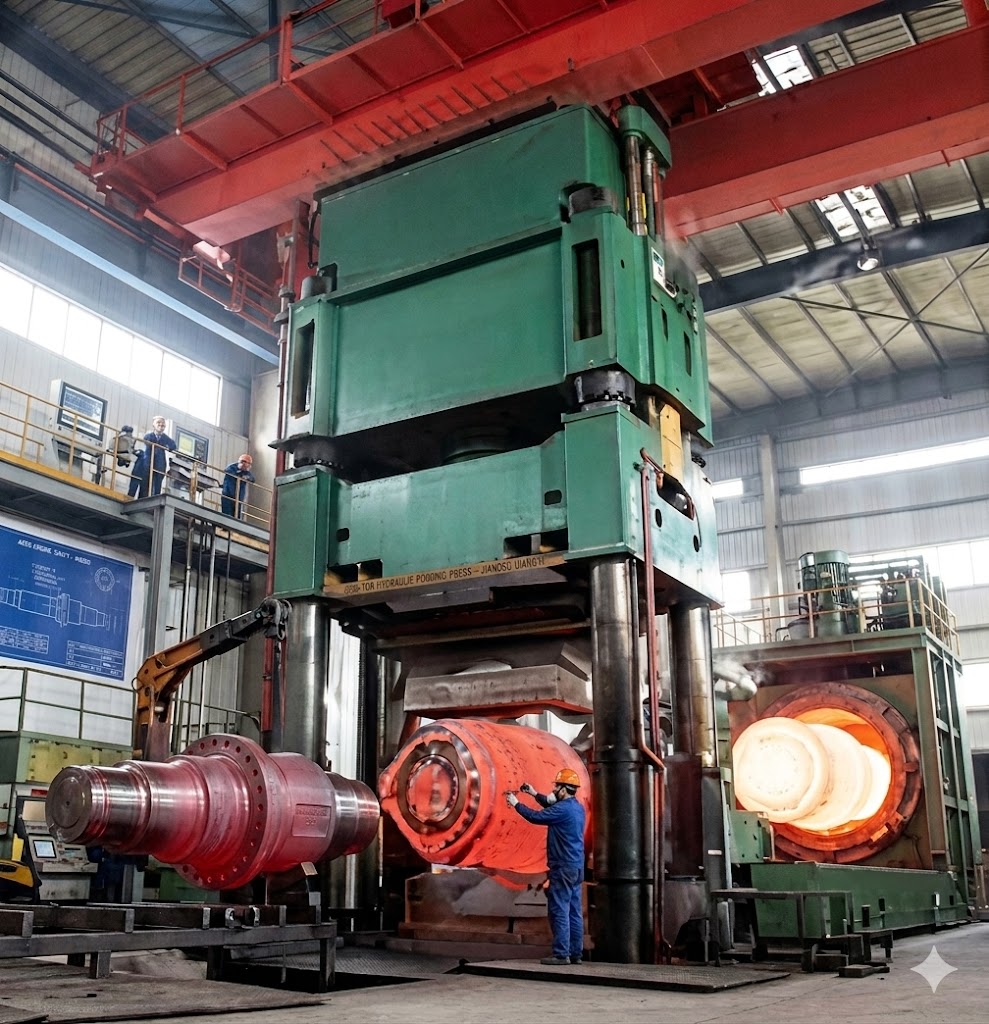
| Press Capacity Used | 2,000–6,300 ton hydraulic press | Hydraulic press preferred over hammer for large Maraging 350 forgings to ensure slow, penetrating deformation to the core |
| Post-Forge Cooling | Air cool or slow cool in sand/ashes | Prevents thermal shock; martensite transformation completes during slow cooling — no furnace anneal required before machining if section is uniform |
Hydraulic Press vs. Forging Hammer for Large Maraging 350 Sections
For Maraging 350 forgings with cross-sections exceeding 200 mm, we specifically use our 6,300-ton hydraulic press rather than a forging hammer. The reason is fundamental to metallurgy: hydraulic presses apply force slowly (0.1–0.5 m/s ram speed), allowing the deformation force to penetrate to the center of the billet. Hammer blows (5–8 m/s) are fast enough to produce surface deformation while leaving the core relatively unworked — particularly problematic for large-diameter bars and discs where core properties are critical for applications such as turbine disks and drill collar forgings.
Our 6,300-ton hydraulic forging press generates sufficient force to achieve the target reduction ratio in the core of forgings up to 1,500 mm diameter, ensuring homogeneous grain refinement from surface to center — a capability that directly differentiates our large Maraging 350 forgings from those produced on smaller equipment.
Maraging 350 Machining, Welding & Secondary Operations
Maraging 350 is one of the most forgiving ultra-high-strength steels to machine and weld — but only when processed in the correct sequence and condition. The following guidance reflects our in-house CNC machining and post-weld aging experience with this alloy.
Machining Maraging 350
Always machine in the solution-annealed condition (28–32 HRC), not after aging. In the annealed state, Maraging 350 machines comparably to AISI 4340 at 30 HRC — conventional carbide tooling, standard cutting speeds, and normal flood coolant all produce excellent results. After aging (52–56 HRC), machinability drops sharply; cutting speeds must be reduced by 60–70% and carbide tooling wear increases dramatically.
- Turning & Milling: Use coated carbide inserts (TiAlN or TiCN), cutting speed 80–120 m/min (annealed), feed 0.15–0.30 mm/rev. Positive rake geometry preferred to minimize cutting forces.
- Drilling: Use solid carbide drills with coolant through the tool when possible; peck drilling for deep holes (>3× diameter). Recommended surface speed 25–40 m/min with TiAlN coating.
- Grinding (post-aging): Use aluminum oxide or CBN wheels. Maintain low table speed and generous coolant flow to prevent grinding burn. Temper etch (Keller's reagent) or Barkhausen noise testing should be performed on safety-critical surfaces to verify no heat damage has occurred during grinding.
- Thread cutting: Machine threads in the annealed condition whenever possible. If threads must be cut after aging, use carbide taps at low speed with sulphurized cutting oil.
Welding Maraging 350
Maraging 350 offers one of the best weldabilities of any ultra-high-strength steel — a direct consequence of its near-zero carbon content. There is no risk of hydrogen-induced cold cracking (which plagues high-carbon steels) and no need for high preheat temperatures.
- Preferred welding process: GTAW (TIG welding) using matching filler wire (Maraging 350 composition). GMAW and EBW (electron beam welding) are also used for specific applications.
- Pre-weld condition: Weld in the solution-annealed (soft) condition. Do not weld in the aged condition — the weld heat-affected zone will be locally overaged and strength will be compromised.
- Preheat: Not required for sections ≤50 mm. For sections >50 mm, a mild preheat to 100–150°C is recommended to reduce thermal gradient, not to prevent hydrogen cracking.
- Post-weld heat treatment: Age the entire welded assembly at 480°C/3h after welding. This restores full strength to the weld metal and HAZ and is simpler than the post-weld heat treatment required for conventional high-strength steels.
- NDT of welds: Radiographic testing (RT) per ASME Section V + Liquid Penetrant Testing (PT) per ASTM E165. Weld tensile specimens should be tested if structural welds are used in critical aerospace or nuclear applications.
Maraging 350 has limited intrinsic corrosion resistance and will rust in humid environments without surface protection. For most applications, we recommend: cadmium plating (aerospace, AMS 2400), hard chrome plating (valve stems and hydraulic components), electroless nickel plating (oil & gas, API service), or phosphating + painting (general industrial). Specify the required surface treatment on your drawing or RFQ so we can apply it after final inspection before packaging and shipment.
Why Choose Jiangsu Liangyi for Maraging 350 Forged Parts
There are many forging manufacturers in China, but relatively few with the metallurgical experience, equipment capacity, and quality systems required to produce Maraging 350 forgings that meet aerospace, oil & gas, and nuclear standards. Here is what specifically differentiates our Maraging 350 production capability:
1. Full Melting Method Control — AM/VR, VIM/VAR, AM/VAR
Maraging 350 raw material quality starts at the melting stage. We supply all three AMS-recognized melting methods:
- Method A — Air Melt / Vacuum Refined (AM/VR): Suitable for industrial valve, power generation, and general structural applications. Lower cost, acceptable inclusion ratings for non-aerospace service.
- Method B — Vacuum Induction Melted / Vacuum Arc Remelted (VIM/VAR): AMS 6521 aerospace applications required. VIM removes dissolved gases and volatile impurities. VAR produces refined solidification structure with minimum oxide and sulfide inclusions. This is the standard we provide for all aerospace, missile and nuclear applications.
- Method C — Air Melt / Vacuum Arc Remelted (AM/VAR): Intermediate option giving good inclusion control at a moderate price. Useful for oil & gas downhole tools and high performance valve components.
We keep records of heat number, melt method, ingot lot, and chemical certificate for 100% traceability from final forging back to the original melt — a requirement we fulfill as standard practice, not as a premium add-on.
2. Strict Heat Treatment Process Control
We run temperature controlled box furnaces and vacuum furnaces with documented ±8°C uniformity, calibrated according to industry standard pyrometry procedures as described in the heat treatment section above. The aging cycles are recorded on computerized chart recorders and attached to the mill test certificate for each part. Such documentation is sufficient for quality-conscious aerospace customers. We supply full heat treatment records with every shipment.
3. Full Machining Capability — No Outsourcing
All machining of Maraging 350 forgings is performed in-house on our CNC turning centers, machining centers, and cylindrical grinders. We do not outsource machining to subcontractors — a common source of quality control gaps. Our machining capability covers: OD turning up to Ø2,500 mm, boring up to Ø3,000 mm depth 5,000 mm, CNC milling 5-axis up to 6,000 mm × 3,000 mm, surface and cylindrical grinding to Ra 0.8 μm or better.
4. Global Export Experience & Localized Compliance
With 25+ years of export experience and clients in over 50 countries, we have deep practical knowledge of international standards and documentation requirements. We know that a North American client needs ASTM E8 test reports with dual psi/MPa units; that a European nuclear client requires RCC-M Appendix ZG traceability; that a Middle East oil & gas client needs NACE MR0175/ISO 15156 compliance documentation with H₂S partial pressure exposure records. These are not items we research when an order arrives — they are embedded in our standard quality procedures.
Quality Control — NDT Methods, Acceptance Criteria & Certification Details
Every Maraging 350 forged part we produce passes through a documented inspection sequence before shipment. The following describes each inspection method, the defects it detects, and the acceptance standards we apply — not as marketing language, but as the technical basis for our quality claims.
| Inspection Method | Reference Standard | Defects Detected | Acceptance Criteria |
|---|---|---|---|
| Ultrasonic Testing (UT) | ASTM A388 / AMS 2154 | Internal volumetric defects: shrinkage, pipe, cracks, inclusions, hydrogen flakes at depth | AMS 2154 Class A or B depending on specification; typical rejection threshold: flat-bottom hole equivalent FBH 1/64″ (0.4mm) for aerospace |
| Magnetic Particle Testing (MT) | ASTM E1444 / AMS 2641 | Surface and near-surface linear discontinuities: forging laps, seams, cold shuts, grinding cracks | No linear indications; rounded indications <1/16″ (1.6mm) acceptable per ASTM E1444 |
| Liquid Penetrant Testing (PT) | ASTM E165 / AMS 2647 | Open surface defects on non-magnetic surfaces or after machining: porosity, cracking, EDM cracks | Type I (fluorescent) Method A; no relevant linear indications; rounded indications per AMS 2647 class |
| Tensile Testing | ASTM E8 / E8M | Confirmation of UTS, yield strength, elongation, and reduction of area meeting specification minimums | Per AMS 6521: UTS ≥350,000 psi, YS ≥340,000 psi, Elong ≥7%, RA ≥35% |
| Hardness Testing | ASTM E10 (Brinell) / ASTM E18 (Rockwell) | Verification of aging completion and uniformity across the cross-section | 52–56 HRC across all test locations; variation <2 HRC from surface to core (coupon sectioning) |
| Charpy Impact (V-Notch) | ASTM E23 | Verification of toughness; detection of overaging, underaging, or inclusion-induced embrittlement | Per customer specification; typical minimum: 15 J at 25°C for most applications |
| Chemical Analysis | ASTM E354 / OES spectrometer | Verification that all 9 alloying elements meet composition specification | Per AMS 6521 composition limits; heat and product analysis both performed |
| Dimensional Inspection | Drawing requirements / CMM | All critical dimensions verified against drawing tolerances | 100% dimensional inspection on CNC-machined surfaces; final report with actual values |
Our Factory Certification & Available Documentation
Our factory holds ISO 9001:2015 certification — this is our quality management system certification. The following documents are inspection records and test certificates we can provide per order, not separate body certifications.
- ISO 9001:2015 Certificate: Our factory quality management system is ISO 9001:2015 certified. This covers our full production process including forging, heat treatment, machining, and inspection.
- EN10204 3.1 Mill Test Certificate: Standard for all shipments. EN10204 3.1 is a document format (not a certification body) — our factory quality department issues this certificate listing full chemical analysis, heat treatment records, mechanical test results, NDT results, and heat/lot traceability.
- EN10204 3.2 Mill Test Certificate: Available on customer request. EN10204 3.2 is the same document countersigned by an independent third-party inspector (e.g., Bureau Veritas, SGS, or TÜV Rheinland) appointed and paid by the customer. We support this — the inspector comes to our facility to witness testing on behalf of the client.
- Third-Party Inspection Support: We welcome independent inspectors from BV, SGS, TÜV, Lloyd's Register, and DNV to witness testing and inspect at our facility. These are inspectors the customer hires; they are not standing factory certifications we hold.
- Material Traceability Records: Full documentation chain from ingot heat number → forging lot → heat treatment batch → inspection lot → shipping document, available as a complete package.
Industry-Specific Applications & GEO-Targeted Project Cases
Our Maraging 350 (equivalent to VASCOMAX® 350, UNS S35000) forged parts are selected for applications where failure has severe consequences and where no lower-strength alternative can meet the design requirement. The following describes our core application industries with specific component types and regional project examples.
Aerospace & Defense Industry
Engineering Challenge: Aerospace structures demand the highest possible strength-to-weight ratio. Every kilogram of excess structural mass reduces payload capacity. At the same time, fracture mechanics calculations require a minimum fracture toughness (KIC) to ensure that any undetected crack below the inspection resolution limit will not propagate to failure during a single flight cycle.
Why Maraging 350: For components where Grade 300 (300 ksi) provides insufficient fatigue life or where weight savings from the additional 50 ksi allow a smaller cross-section that KIC analysis confirms is still safe, Maraging 350 is the correct selection. The lack of quench cracking risk and excellent weldability allow complex assemblies to be fabricated without the stress-corrosion cracking concern present in other ultra-high-strength steels.
Specific Components We Produce: Missile and rocket motor cases (cylindrical seamless rings, rolled and seam-welded); aircraft landing gear actuator housings and side struts; high-performance drive shafts and gear shafts for propulsion systems; precision fasteners and stud bolts for critical structural joints complying with NAS/MS aerospace hardware standards.
GEO Capability & Compliance: Our AMS 6521 VIM/VAR Maraging 350 seamless rings and discs are produced to meet aerospace prime contractor quality requirements, with documentation suitable for customer source inspection programs. Regional standards supported: AMS 6521, AMS 6522.
Oil & Gas Industry
Engineering Challenge: Downhole components in deep wells operate under combined loads: hydrostatic pressure (up to 1,400 bar), torsional load (drill strings), bending fatigue (caused by wellbore curvature in directional drilling), and aggressive chemical environments including H₂S, CO₂, and chlorides. A single component failure in a deep wellbore can cost millions in workover operations.
Why Maraging 350: For mud motor drive shafts and ESP motor shafts, the combination of ultra-high fatigue strength (high UTS/yield ratio) and excellent machinability for precision splined profiles makes Maraging 350 the preferred material. Its NACE MR0175/ISO 15156 qualification for controlled hardness H₂S environments (when used below Rockwell C 40 maximum in sour service — verify specific application requirements) makes it suitable for wellhead and valve applications.
Specific Components We Produce: Mud motor (positive displacement motor, PDM) splined drive shafts and universal joints; electric submersible pump (ESP) splined motor shafts up to 6 meters length; high-pressure valve balls, bodies, and stems for wellhead equipment per API 6A; double studded adapter flanges (DSAF) for Christmas tree connections; casing head housings and tubing head spools.
GEO Project Experience: Our Maraging 350 ESP motor shafts (Method C, AM/VAR) meet the specifications required by Middle East oilfield service operations in Saudi Arabia, UAE, and Iraq. VIM/VAR Method B is available for North American shale gas drill motor component requirements. Compliance: API 6A, NACE MR0175/ISO 15156, API 11D1.
Nuclear Power Industry
Engineering Challenge: Nuclear components should maintain mechanical properties under long term irradiation (neutron fluence), thermal cycling and coolant chemistry (boric acid, lithium hydroxide) at temperatures up to 325°C (PWR primary circuit). Material traceability and quality documentation shall meet the regulatory requirements of the national nuclear safety authorities.
Why Maraging 350: For reactor coolant pump (RCP) components where the combination of high strength, excellent fatigue resistance, and the ability to produce large-diameter seamless ring forgings with consistent properties is required. The lack of carbon-carbide structures deletes concerns about sensitization and intergranular corrosion in the coolant environment.
Specific Components We Produce: RCP rotor impellers (large-diameter seamless rings up to Ø2,500 mm); pump casing shells; containment liner seal chambers; pressure vessel reactor nozzle forgings; coolant pump shaft forgings.
GEO Project Experience: Our Maraging C-350 forged components are produced with EN10204 3.2 documentation packages designed to support customers' compliance with applicable nuclear codes including ASME BPVC Section III and RCC-M — subject to the customer's own regulatory qualifications and authority approvals. We do not hold independent nuclear facility approvals (HAF102, N-stamp); these remain the customer's responsibility.
Power Generation & Turbomachinery Industry
Engineering Challenge: Gas and steam turbine rotor components rotate at 3,000–3,600 RPM continuously under combined centrifugal, thermal, and pressure loads. High-cycle fatigue (HCF) life — typically >10⁸ cycles over the turbine's 30-year design life — determines the critical section sizing, not static strength alone. Materials must also maintain properties during start-stop thermal cycling without dimensional creep.
Why Maraging 350: The high yield-to-UTS ratio (340/350 = 0.971) of Maraging 350 — higher than any other commercially available steel — is particularly valuable for rotating components, where high yield strength minimizes plastic deformation under centrifugal load and the near-unity ratio means there is minimal "creep" from the nominal working stress to yield. The predictable dimensional stability during aging also allows turbine disk bores to be machined before aging with confidence.
Specific Components We Produce: Gas turbine disks (up to Ø1,800 mm); steam turbine disks and wheels; centrifugal compressor impellers and blisks; valve spindles, main steam valve seats and cores; reheat valve discs; labyrinth shaft seals and guide rings for industrial gas compressors.
GEO Project Experience: Our Maraging 350 labyrinth shaft seal rings and gas turbine compressor disk forgings are produced to meet specifications required by LNG plant gas compressor and turbine applications in Asia, Europe, and Australia. Compliance: EN 10222-4, ASME SA-288, API 617.
Industrial Valve & Flow Control Industry
Engineering Challenge: In high pressure, high temperature or cryogenic service, industrial valves require components for which dimensional stability over millions of operating cycles, resistance to galling on sealing surfaces and high fatigue strength for valve stems with repeated operating torque are important requirements.
Why Maraging 350: The excellent hardness (52–56 HRC aged) provides outstanding galling resistance on sealing surfaces without requiring separate hard-facing. The high strength allows valve stems and shafts to be designed with smaller cross-sections than lower-strength alloys, reducing actuator torque requirements and overall valve weight. The predictable aging behavior allows valve stems to be machined with threaded and profiled sections in the annealed state and aged after machining with minimal dimensional correction.
Specific Components We Produce: Cryogenic high-performance butterfly valve shafts (LNG service, operating at −196°C liquid nitrogen temperature); gate valve bodies and bonnets for ANSI 2500 class pressure service; ball valve balls and seats for high-differential pressure applications; check valve seat rings; ultrasonic flow meter body forgings; H-type two-way valve bodies.
GEO Project Experience: Our Maraging 350 cryogenic butterfly valve shafts and ANSI 2500 gate valve body forgings are produced to API 6D and ASME B16.34 specifications for LNG terminal and natural gas pipeline applications in Europe, North America, and globally. Compliance: API 6D, BS EN 10222-4, ASME B16.34.
Procurement Guide: How to Order Maraging 350 Forgings Correctly
Based on our 25+ years of working with global procurement teams and engineers, the following guide covers the critical information required for an accurate quotation and the most common specification mistakes that cause delays, cost overruns, or quality failures. This is original guidance that we have developed from real procurement experience — not copied from general sourcing articles.
What to Include in Your RFQ (Request for Quotation)
- Material specification: State UNS S35000 or AMS 6521/6522. Do not simply write "Maraging 350" — different suppliers may use different equivalent standards. Stating the AMS number removes ambiguity.
- Melting method: Specify Method A (AM/VR), Method B (VIM/VAR), or Method C (AM/VAR). Omitting this is the most common RFQ error — Method B costs 30–50% more than Method A and requires additional lead time for VIM/VAR ingot procurement.
- Delivery condition: Annealed (solution annealed only, soft, unmachined), or Aged (solution annealed + age hardened to 350,000 psi), or Annealed + Machined to drawing, or Aged + Finish machined. Specify clearly — delivering aged when the customer needed annealed for further machining is a costly error.
- Drawing and dimensional requirements: Provide toleranced, dimensioned drawing. Specify required machining allowance for unmachined forgings (minimum 3mm per surface unless otherwise designed). For rings, give OD and ID tolerances, not just OD.
- Testing and certification requirements: Specify test sampling frequency (one test set per heat, per lot, per forging), EN10204 3.1 or 3.2, any third party inspection requirements and specific tests over and above the standard (Charpy impact at specific temperature, fracture toughness KIC, NACE MR0175 HRC hardness limit etc).
- Special requirements: Surface treatment (plating, coating), packaging requirements (export crating, nitrogen purging for corrosion prevention in long sea shipments), shipping terms (EXW, FOB, CIF), and any export control classification (EAR/ITAR for US aerospace applications).
1. Not specifying the melting method: Results in getting AM/VR (lowest cost, lowest cleanliness) when VIM/VAR is wanted. Fix: Always state Method A, B, or C according to AMS 6521, Section 6.1.
2. Specifying aged condition for a part that will be welded: Welding an aged Maraging 350 part creates a HAZ that is locally overaged and permanently weakened. Fix: always weld in the annealed condition and age the assembly post-welding.
3. Not specifying reduction ratio for important forging applications: A forging made with only 2:1 reduction may meet all chemical and tensile requirements but will have a larger grain size and lower fatigue life than a 4:1 reduction forging. Fix: put “minimum 4:1 reduction ratio” in your forging specs, especially for aerospace and rotating equipment
4. Ordering aged forgings for in-house finish machining: Machining aged Maraging 350 at 52–56 HRC requires slow speeds and expensive CBN tooling. Fix: order forgings in the annealed state, machine to near-final dimensions, then age at your facility — or let us do the complete sequence.
5. Assuming NACE MR0175 compliance automatically: Maraging 350 is listed in NACE MR0175/ISO 15156 for sour service, but only below specific hardness limits for the intended application environment. Review Table B.3 of ISO 15156-3 with your corrosion engineer before specifying for H₂S service.
Standard Lead Times
| Order Type | Typical Lead Time | Notes |
|---|---|---|
| Standard forgings, Method A (AM/VR), in stock | 15–20 working days | Forging + HT + UT/MT + MTC |
| Standard forgings, Method B (VIM/VAR), from stock ingot | 20–28 working days | Same as above; VIM/VAR ingot typically in stock |
| Large section forgings (>500mm diameter or >5 tons) | 28–40 working days | Extended aging hold time required for core properties |
| Fully machined to drawing (annealed + machined) | Add 10–20 working days to forging lead time | Depends on machining complexity |
| Fully machined + aged + finish ground | Add 15–28 working days to forging lead time | Full turnkey production |
| Third-party inspection (BV/SGS/TÜV witness) | Add 3–7 working days for inspector scheduling | We coordinate inspector visit |
| Expedited production (urgent) | Contact us — case by case | Possible subject to production schedule |
GEO-Targeted Market Compliance & Regional Solutions
As a global Maraging 350 forging supplier, we provide documentation and compliance packages specifically tailored to each export market's regulatory and purchasing requirements:
North America Market (USA, Canada, Mexico)
Our Maraging 350 forged parts fully meet ASTM, AMS, API standards. Mill test certificates include dual psi/MPa units as standard. We support third-party inspection by SGS, BV, and other AISC/A2LA-accredited institutions. For US aerospace applications, we can supply VIM/VAR material with full ingot-to-forging traceability documentation. For applications subject to ITAR or EAR controls, customers should verify applicability with their own export control counsel.
Europe Market (EU, UK, Germany, France)
Our products comply with EN 10222-4, EN 10269, ISO standards and carry CE compliance documentation where applicable. EN10204 3.2 (third-party witness countersignature by Bureau Veritas or TÜV, arranged on customer request) is available for European nuclear and petrochemical projects. We have deep understanding of European market requirements including PED (Pressure Equipment Directive) and ATEX, and our products are produced to EN standards suitable for European aerospace, petrochemical, and power generation applications.
Middle East Market (Saudi Arabia, UAE, Iraq, Kuwait)
We provide oil & gas special Maraging 350 forgings to API 6A (Wellhead & Christmas Tree Equipment), API 6D (Valves) and NACE MR0175/ISO 15156 for sour service applications. Our documentation packages designed for the Saudi Aramco, ADNOC and Iraqi SOC vendor qualification requirements include NACE compliance declarations and certificates of material hardness tests.
Asia Pacific Market (Japan, South Korea, Singapore, Australia)
We provide custom Maraging 350 forging solutions for mining, power generation, and oil & gas industries across Asia Pacific, and all parts meet JIS G 3214, AS 1548, and project-specific standards. Our forging capabilities and documentation standards are well-suited for Australian LNG plant gas compressor components, Southeast Asian power plant turbomachinery, and Korean shipbuilding projects requiring ABS, DNV-GL, or LR class society inspection.
Frequently Asked Questions (15 FAQs) — Maraging 350 Forged Parts
The name "maraging" combines martensitic and aging, describing the two-stage hardening mechanism: the steel first transforms to a soft, ductile lath martensite on air cooling (because its martensite start temperature Ms ≈ 155°C is well above room temperature), and is then "aged" at 480°C to precipitate intermetallic strengthening compounds (Ni₃Mo, Ni₃Ti, Fe₂Mo) within that martensite matrix. The result is 350,000 psi tensile strength with 7% elongation — a combination impossible with any conventional high-carbon steel. The term was coined at the International Nickel Company (INCO) in the late 1950s.
The four grades differ primarily in cobalt content and resulting strength. Cobalt reduces the solubility of molybdenum in the martensite matrix, forcing more Mo to precipitate as Ni₃Mo during aging — producing higher strength. Grade 200 (8% Co, 200 ksi UTS) is used for tooling and moderate-strength structural applications; Grade 250 (7.5% Co, 250 ksi) is the most widely used aerospace structural grade; Grade 300 (9% Co, 300 ksi) is used for rocket motor cases and high-performance defense components; Grade 350 (12% Co, 350 ksi) delivers the maximum strength at the trade-off of reduced fracture toughness (KIC ~40 vs. ~60 MPa√m for Grade 300). We supply all four grades and can recommend the correct grade for your specific application and loading conditions.
Standard chemical composition of Maraging 350 (UNS S35000, AMS 6521/6522): Carbon max 0.03%, Silicon max 0.10%, Manganese max 0.10%, Nickel 18.50%, Cobalt 12.00%, Molybdenum 4.80%, Titanium 1.40%, Aluminum 0.10%, Iron balance. The ultra-low carbon (≤0.03%) is important as it prevents the formation of carbides meaning all strengthening is from intermetallic precipitation, retaining weldability and toughness that would be lost due to carbide embrittlement at these strength levels.
After standard heat treatment (solution anneal 820°C/1h/air cool + age 480°C/3h/air cool) per AMS 6521: Ultimate Tensile Strength ≥350,000 psi (2,415 MPa), 0.2% Yield Strength ≥340,000 psi (2,345 MPa), Elongation ≥7% (in 50mm gauge length), Reduction of Area ≥35%, Notch Tensile Strength (K=9.0) ≥330,000 psi. Hardness: 52–56 HRC. In the annealed (pre-aged) condition, hardness is 28–32 HRC — this is the optimal state for machining. Dimensional change during aging: +0.04 to +0.06% linear expansion, predictable and repeatable.
Two-stage process: Stage 1 — Solution Anneal: 820°C ± 14°C, hold 1 hour minimum per 25mm cross-section, air cool to room temperature. Produces soft lath martensite at 28–32 HRC. Stage 2 — Age Hardening: 480°C ± 8°C, hold 3 hours minimum (5–6 hours for sections >300mm), air cool. Precipitates Ni₃Mo, Ni₃Ti, Fe₂Mo intermetallics, raising strength to 350,000 psi. Critical warning: aging above 510°C causes overaging (austenite reversion, strength loss of 30,000–60,000 psi) that cannot be recovered without a full re-anneal and re-age. Furnace temperature accuracy of ±8°C is required — ±15°C furnaces are not acceptable for this alloy.
Key physical properties of Maraging 350 (aged, 20°C): Density 8.00 g/cm³ (0.289 lb/in³); Elastic Modulus 190 GPa (28×10⁶ psi); Shear Modulus 73 GPa; Poisson's Ratio 0.30; Thermal Conductivity 25 W/m·K; Coefficient of Thermal Expansion 10.0×10⁻⁶/°C (20–100°C); Electrical Resistivity 0.75 μΩ·m; Melting range 1,413–1,430°C. The material is ferromagnetic at room temperature. These values are needed for FEA analysis, thermal modeling, and interference fit calculations.
vs. AISI 4340 (quench & tempered to maximum strength ~270 ksi): Maraging 350 provides 30% higher tensile strength, eliminates quench cracking risk (air cool vs. oil quench), offers superior weldability (no preheat), and provides dramatically better dimensional stability during heat treatment. 4340 is lower cost and sufficient for applications with <270 ksi requirement. vs. 17-4PH stainless (H900 condition, ~200 ksi): 17-4PH offers far superior corrosion resistance (stainless grade) but only 57% of Maraging 350's tensile strength. For applications requiring both ultra-high strength and corrosion resistance, a surface coating on Maraging 350 is the practical solution. Maraging 350 vs. Inconel® 718: Maraging 350 has higher room-temperature strength but Inconel® 718 is the correct choice for continuous service above 450°C.
Maraging 350 is used where no other steel meets the strength requirement: Aerospace — missile/rocket motor cases, aircraft landing gear, high-performance drive shafts, precision fasteners for critical structural joints; Oil & Gas — mud motor (PDM) splined drive shafts, ESP motor shafts, high-pressure wellhead valve components, double studded adapter flanges (DSAF); Nuclear Power — reactor coolant pump (RCP) rotor impellers, casing shells, pressure vessel nozzles; Turbomachinery — gas turbine disks, steam turbine disks, compressor impellers, blisks, labyrinth shaft seals; Industrial Valves — cryogenic butterfly valve shafts (LNG service), ANSI 2500 class gate valve bodies.
We supply all three AMS 6521-recognized melting methods: Method A — Air Melt / Vacuum Refined (AM/VR): for industrial, valve, and power generation applications where aerospace-grade cleanliness is not required; lower cost. Method B — Vacuum Induction Melted / Vacuum Arc Remelted (VIM/VAR): mandatory for aerospace and missile applications per AMS 6521; removes dissolved gases, volatile impurities, and produces refined inclusion ratings; highest cleanliness and fatigue performance. Method C — Air Melt / Vacuum Arc Remelted (AM/VAR): intermediate cleanliness and cost; widely used for oil & gas downhole tools, high-performance valves, and nuclear components. Please specify the required method on your RFQ to ensure correct quotation.
Maraging 350 is listed in NACE MR0175/ISO 15156-3 for use in sour (H₂S-containing) oil & gas environments, subject to hardness requirements specified in Table B.3 of ISO 15156-3. The maximum permissible hardness limit depends on the specific H₂S partial pressure and application class — typically ≤36 HRC for most downhole applications, which corresponds to the solution-annealed (unaged) condition of Maraging 350. The fully aged condition (52–56 HRC) generally exceeds NACE MR0175 limits for sour service. Verify the applicable hardness limit with your corrosion engineer and the specific H₂S exposure conditions before specifying for sour service. We can provide NACE-compliant documentation for the annealed delivery condition.
Yes. We provide complete custom Maraging 350 forging solutions from VIM/VAR ingot through to precision CNC-machined and fully inspected components, strictly complying with customer drawings, technical requirements, and all applicable international standards (ASTM, AMS, API, EN, DIN, JIS, ASME). Capabilities: single-piece weight 30 kg–30 tons, maximum shaft length 15 meters, maximum ring diameter 6 meters, maximum disc/disk diameter 3,000 mm. We support all melting methods, all delivery conditions (annealed, aged, machined), and all levels of documentation from EN10204 3.1 to full third-party 3.2 certification with source inspection.
All Maraging 350 forgings undergo: 100% Ultrasonic Testing per ASTM A388/AMS 2154; Magnetic Particle Inspection per ASTM E1444; Liquid Penetrant Testing per ASTM E165; Tensile testing per ASTM E8/E8M (UTS, YS, elongation, RA); Charpy V-notch impact per ASTM E23 (when specified); Hardness testing per ASTM E10/E18; Chemical analysis per ASTM E354; 100% dimensional inspection per CMM for machined parts. Documentation: EN10204 3.1 Mill Test Certificate as standard; EN10204 3.2 with BV/SGS/TÜV countersignature available on request. Factory ISO 9001:2015 certified. Full heat and lot traceability provided as standard.
In the solution-annealed condition (28–32 HRC), Maraging 350 machines comparably to AISI 4340 at 30 HRC — one of the best machinabilities among ultra-high-strength steels. Use TiAlN-coated carbide inserts; cutting speed 80–120 m/min for turning; standard flood coolant. Always perform major machining before aging. After aging (52–56 HRC), machinability drops sharply — cutting speeds must be reduced by 60–70% and CBN tooling is recommended for finish operations. The dimensional change during aging (+0.04–0.06% linear) is predictable: leave 0.05–0.10% stock on critical diameter dimensions when machining before aging, and you will achieve final drawing tolerances after a light grinding pass.
Standard lead times: AM/VR forgings from stock ingot: 15–20 working days; VIM/VAR (Method B) forgings: 20–28 working days; large sections (>500mm or >5 tons): 28–40 working days due to extended aging hold times; fully machined + aged + finish ground: add 15–28 days to forging lead time; third-party inspection adds 3–7 days for inspector scheduling. Key factors affecting delivery: section size (large sections require longer aging), melting method (VIM/VAR ingot availability), certification requirements (3.2 inspection requires third-party witness scheduling), and production schedule at time of order. Expedited production is possible — contact us with your deadline and we will advise feasibility.
We export Maraging 350 forged parts to 50+ countries with region-specific compliance: North America (USA, Canada, Mexico) — ASTM/AMS/API compliance, dual psi/MPa test reports, SGS/BV/TÜV inspection support; Europe (EU, UK, Germany, France) — EN/DIN/ISO compliance, EN10204 3.2 with BV or TÜV countersignature, PED compliance documentation; Middle East (Saudi Arabia, UAE, Iraq, Kuwait) — API 6A, API 6D, NACE MR0175/ISO 15156 compliance, documentation structured for Saudi Aramco and ADNOC vendor requirements; Asia Pacific (Japan, South Korea, Singapore, Australia) — JIS G 3214, AS 1548, ABS/DNV-GL/LR class society inspection support; China domestic — GB/T standards available. For US aerospace applications subject to ITAR, please contact us to discuss material origin and export control compliance.
Contact China's Leading Maraging 350 Forging Manufacturer
Jiangsu Liangyi Co., Limited has been a trusted supplier of Maraging 350 (UNS S35000, UNS K93540, Maraging C-350) forged parts to aerospace, oil & gas, nuclear power, turbomachinery, and industrial valve industries worldwide since 1997. Our technical team — with 25+ years of Maraging steel forging and heat treatment expertise — is ready to review your drawings, answer specification questions, and provide a detailed technical and commercial proposal within 24 hours.
Inquiry Email: sales@jnmtforgedparts.com
Phone / WhatsApp: +86-13585067993
Official Website: https://www.jnmtforgedparts.com
Factory Address: Chengchang Industry Park, Jiangyin City, Jiangsu Province, China
Working Hours: Monday–Friday 08:00–18:00 CST; Saturday 08:00–12:00 CST
To obtain the fastest and most accurate quotation, please send your inquiry with: (1) a dimensioned part drawing (PDF or DWG); (2) specified material standard (AMS 6521/6522, ASTM, or equivalent); (3) required melting method (AM/VR, VIM/VAR, or AM/VAR); (4) delivery condition (annealed or aged, with or without machining); (5) required certifications (EN10204 3.1 or 3.2); and (6) required quantity and target delivery date. Our technical team will respond with a full technical confirmation and commercial proposal within 24 hours.