Invar 42 (ALLOY 42 / UNS K94100 / NILO 42) Forging Parts | China Professional Forging Manufacturer & Global Supplier
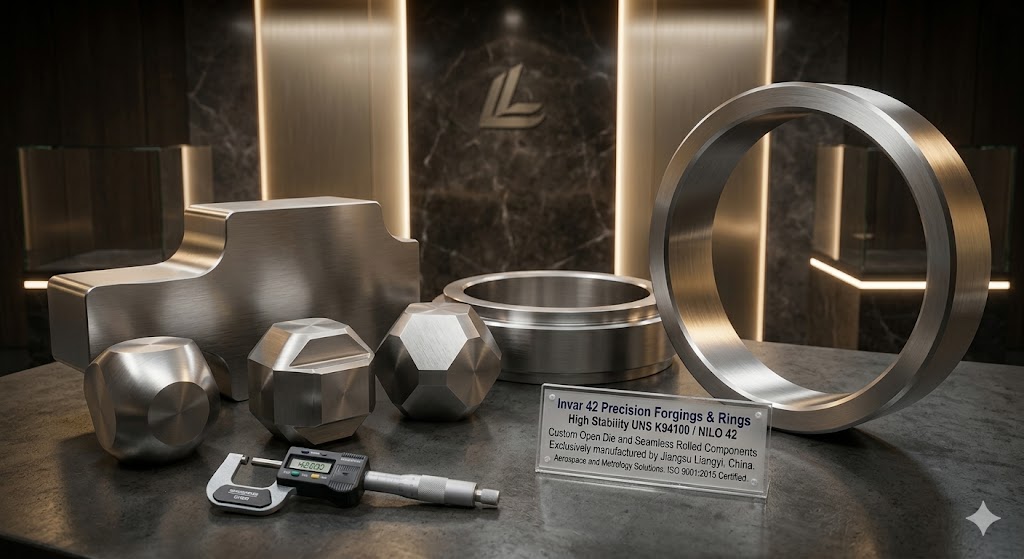
High-precision Invar 42 forged components manufactured by Jiangsu Liangyi — serving aerospace, automotive, medical and energy sectors in 50+ countries
About Invar 42 (Alloy 42) Controlled Expansion Alloy
Jiangsu Liangyi Co., Limited is a professional ISO 9001:2015 certified China manufacturer of Invar 42 (also universally known as ALLOY 42, UNS K94100, NILO 42, EN 1.3817, DIN 17745 Werkstoff Nr. 1.3817) open die forging parts and seamless rolled steel forged rings. With over 25 years of specialized forging experience, we supply high-precision, high-purity Invar 42 forged products to industrial customers in more than 50 countries across North America, Europe, Asia Pacific, the Middle East, and Australia.
Invar 42 is a binary 41% nickel–iron (Fe-41Ni) controlled expansion alloy, globally recognized for its precisely engineered low thermal expansion properties that closely match the coefficient of thermal expansion (CTE) of a wide range of commercial glass, ceramic, and enamel materials. This unique characteristic makes it the industry-preferred material for critical hermetic glass-to-metal sealing applications, where thermal expansion mismatch between the metal pin and the glass bead is the primary root cause of premature seal failure under thermal cycling.
While its thermal expansion properties most closely match 1075 soda-lime glass (CTE ≈ 4.6 × 10⁻⁶/°C), our Invar 42 forgings are also widely validated for use in seals with 0120 and 0010 glasses. For hard borosilicate glass applications requiring a lower CTE match, it delivers reliable performance when manufactured into thin-edged tubular compression seals. For seals that do not undergo hydrogen annealing prior to assembly, we also supply a modified titanium-added grade (Glass Sealing 42 Gas-Free / Invar 42 Ti) to eliminate dissolved gas porosity and ensure bubble-free, leak-proof sealing integrity throughout the service life.
The Metallurgical Science: Why 41% Nickel Produces a Uniquely Matched CTE
To truly understand why Invar 42 performs so reliably in glass-to-metal sealing, it is necessary to understand the underlying physical metallurgy — knowledge that directly guides our production process decisions and quality controls.
The Invar Effect and the Ni–Fe Phase Diagram
The family of low-expansion Ni–Fe alloys, commonly called "Invar alloys," derives its anomalously low thermal expansion from a quantum-mechanical phenomenon known as magnetovolume coupling (also called the "Invar effect"). In ferromagnetic body-centered cubic (BCC) and face-centered cubic (FCC) Fe–Ni phases, the spontaneous magnetization of the lattice creates a negative contribution to the overall thermal volume change. As temperature rises toward the Curie point, this magnetic contribution diminishes, partially cancelling the normal positive thermal expansion — resulting in a net CTE far lower than either pure iron or pure nickel alone.
The magnitude of this cancellation is critically dependent on nickel content:
- At ~36% Ni (Invar 36), the magnetic volume effect nearly completely cancels thermal expansion near room temperature, producing a CTE as low as 1.2 × 10⁻⁶/°C — the alloy's signature near-zero expansion characteristic.
- At ~41% Ni (Invar 42), the balance shifts: the magnetic contribution is slightly reduced, resulting in a CTE of approximately 4.3–4.9 × 10⁻⁶/°C in the 20–300°C range — precisely matching the expansion of most commercial soda-lime and lead glasses used in hermetic sealing packages.
- At ~48–52% Ni (Alloy 48, Alloy 52), the Invar effect further diminishes, producing CTEs of 8–9 × 10⁻⁶/°C, matched instead to soft borosilicate glasses.
Key Insight for Engineers
The CTE of Invar 42 is not a fixed constant — it varies with temperature, heat treatment condition, and residual stress state. In its annealed condition (900°C, furnace cool), the CTE is most consistent and reproducible. Cold working or improper heat treatment can shift the CTE by ±0.3 × 10⁻⁶/°C, which — while small in absolute terms — is enough to cause measurable stress cracking in thin glass seal beads. This is why our production heat treatment process is tightly controlled and documented with every batch.
Effect of Tramp Elements on CTE Stability
One of the most important — and least discussed — aspects of Invar 42 production is the influence of tramp (residual) elements on long-term CTE stability and sealing reliability. Our production experience shows:
- Carbon (C) above 0.03%: Forms iron carbide precipitates at grain boundaries during cooling, which mechanically pin grain boundary movement and introduce micro-stresses that can alter local CTE by up to ±0.5 × 10⁻⁶/°C. This is why we control C to ≤0.03% — significantly tighter than the standard 0.05% limit.
- Sulfur (S) above 0.005%: Forms MnS inclusions that act as crack initiation sites under thermal cycling, the primary cause of premature hermetic seal failure in demanding applications. Our VIM process achieves S ≤ 0.005% routinely.
- Silicon (Si) above 0.15%: Can promote SiO₂ surface films during oxidation annealing that interfere with glass wetting and adhesion during the sealing process. Our Si ≤ 0.15% control ensures clean glass bonding interfaces.
- Phosphorus (P) above 0.010%: Segregates to grain boundaries and significantly reduces ductility, especially in thinner walled tubular seal forms. Our P ≤ 0.010% control maintains adequate ductility margins.
This level of tramp element control is only achievable through Vacuum Induction Melting (VIM) as the first melt stage, which removes dissolved gases and volatile impurities under vacuum, combined with Electroslag Remelting (ESR) or Vacuum Arc Remelting (VAR) for further segregation refinement and inclusion removal.
Complete Physical & Thermal Properties of Invar 42 (UNS K94100)
The following comprehensive property data covers Invar 42 in its fully annealed condition (900°C anneal, furnace or air cool), which is the standard delivery condition for forged components from Jiangsu Liangyi. Properties can vary significantly with cold work, heat treatment variation, or off-specification nickel content.
Physical Properties Table
| Physical Property | Value | Test Condition / Notes |
|---|---|---|
| Density | 8.11 g/cm³ | At 20°C, annealed condition |
| CTE — Mean (20°C to 100°C) | 4.3 × 10⁻⁶/°C | Annealed; matches 1075 glass at low temp |
| CTE — Mean (20°C to 200°C) | 4.6 × 10⁻⁶/°C | Annealed; primary sealing temperature range |
| CTE — Mean (20°C to 300°C) | 4.9 × 10⁻⁶/°C | Approaches Curie transition effect |
| CTE — Mean (20°C to 450°C) | 6.8 × 10⁻⁶/°C | Above Curie temp; higher expansion rate |
| Electrical Resistivity (20°C) | 0.42 μΩ·m | Annealed; relevant for lead frame applications |
| Thermal Conductivity (20°C) | ~12 W/(m·K) | Lower than stainless steel; relevant for heat dissipation design |
| Specific Heat Capacity | ~0.51 J/(g·K) | At 20–100°C |
| Curie Temperature | ~300°C | Ferromagnetic below; paramagnetic above |
| Melting Point (Solidus) | ~1430°C | Approximate; depends on exact composition |
| Elastic Modulus (E) | ~148 GPa (21.5 × 10⁶ psi) | Annealed condition; relevant for spring-back in forging |
| Magnetic Behavior | Ferromagnetic (below 300°C) | Must be considered in sensor and relay applications |
| Corrosion Resistance | Good — moist air, salt spray | Susceptible to strong acids; nickel passivation layer |
* CTE values represent Jiangsu Liangyi's measured averages across 500+ production batches in annealed condition. Values are reference data for design engineers; actual values are certified per batch in the Mill Test Certificate.
Mechanical Properties (Annealed Delivery Condition)
| Mechanical Property | Standard Minimum (ASTM F30 / AMS 7725) | Our Typical Tested Value | Test Method |
|---|---|---|---|
| 0.2% Yield Strength | 248 MPa (36 KSI) | 275 MPa (40 KSI) | ASTM E8 |
| Ultimate Tensile Strength | 490 MPa (71 KSI) | 517 MPa (75 KSI) | ASTM E8 |
| Elongation (50mm gauge) | ≥40% | ≥45% | ASTM E8 |
| Reduction of Area | ≥65% | ≥70% | ASTM E8 |
| Hardness | HB 130 (nominal) | HB 120–135 | ASTM E10 (Brinell) |
| Charpy Impact (0°C) | Not specified in ASTM F30 | >80 J typical | ASTM E23 (V-notch) |
| Grain Size (ASTM) | Not specified | ASTM 3–5 (typical) | ASTM E112 |
All mechanical property data is verified by our in-house laboratory per batch. Full test reports included with Mill Test Certificate (EN 10204 3.1 / 3.2).
Complete Alloy Selection Guide: Invar 42 vs. Kovar vs. Invar 36 vs. Alloy 48 vs. Alloy 52
Engineers frequently face the challenge of selecting the correct low-expansion or glass-sealing alloy for their specific application. The following comparison table — based on our 25+ years of supplying all these alloy families — provides a definitive engineering reference for alloy selection decisions:
| Property / Alloy | Invar 42 (UNS K94100) | Kovar (UNS K94610 / ASTM F15) | Invar 36 (UNS K93600) | Alloy 48 (UNS N14080) | Alloy 52 (UNS N14052) |
|---|---|---|---|---|---|
| Nominal Composition | Fe–41% Ni | Fe–29% Ni–17% Co | Fe–36% Ni | Fe–48% Ni | Fe–52% Ni |
| CTE (20–300°C) | 4.3–4.9 × 10⁻⁶/°C | ~5.1 × 10⁻⁶/°C | ~1.2 × 10⁻⁶/°C | ~8.5 × 10⁻⁶/°C | ~9.4 × 10⁻⁶/°C |
| Matched Glass Type | Soda-lime (1075, 0120, 0010) | Hard borosilicate (7052, 7040) | Not for standard sealing | Soft lead glass | Soft lead / soda glass |
| Seal Type Suitability | Matched & compression seals | Matched seals (hard glass) | Precision instruments only | Compression seals | Compression seals |
| Cobalt Content | None (cost advantage) | ~17% (higher cost) | None | None | None |
| Forgeability | Excellent | Good (Co reduces hot ductility) | Excellent | Excellent | Excellent |
| Machinability | Good (annealed) | Moderate | Good (annealed) | Good | Good |
| Key Standards | ASTM F30, AMS 7725, EN 1.3817 | ASTM F15, AMS 7726 | ASTM F1484, AMS 7727 | ASTM F30 (Class 2) | ASTM F30 (Class 3) |
| Relative Cost | Moderate | High (Co premium) | Moderate | Moderate–High | High |
| Primary Industries | Automotive, aerospace, telecom, medical | Aerospace, hermetic packages | Precision instruments, tooling | Vacuum tubes, microwave | Power rectifiers, vacuum |
Our Engineering Recommendation
Choose Invar 42 when your application requires: (1) hermetic sealing to soda-lime or soft glass, (2) moderate-cost solution without cobalt, (3) large forged components (>5 kg) where Kovar's higher cost becomes prohibitive, or (4) automotive/industrial environments with temperature cycles between -40°C and +200°C.
Choose Kovar only when: your glass is hard borosilicate (e.g., Corning 7052/7040), the seal geometry demands a very precise CTE above 5.0 × 10⁻⁶/°C, or the application is a small-volume precision electronic package where the cost premium is acceptable.
Full Range of Invar 42 Forged Product Forms
We manufacture custom Invar 42, ALLOY 42, UNS K94100, NILO 42 forging materials in a complete range of shapes and dimensions, fully compliant with international standards and customer drawings. All product forms are available in standard or gas-free titanium-added grade. Our core product range includes:
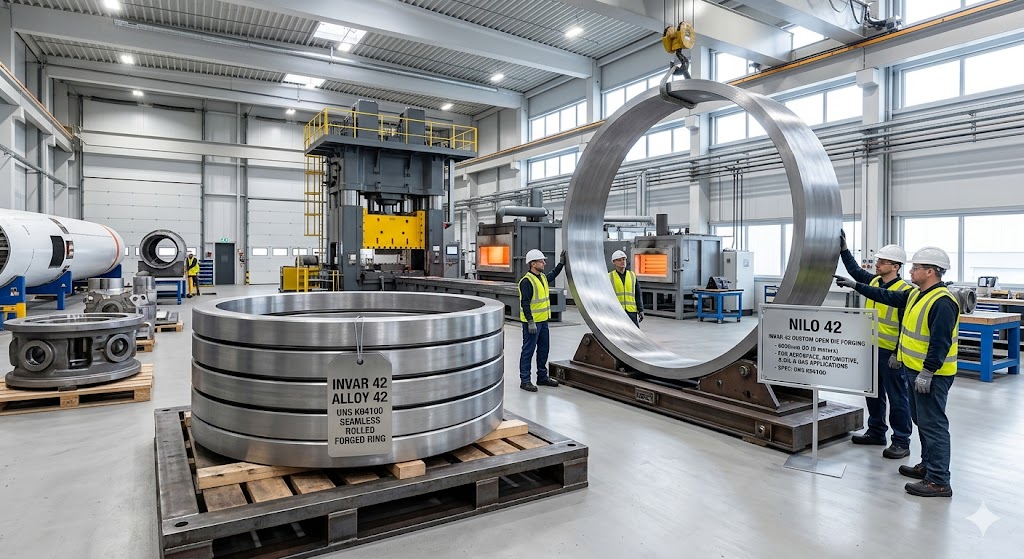
Alloy 42 seamless rolled forged rings manufactured by Jiangsu Liangyi — max OD up to 6 meters
Forged Bars & Rods
ALLOY 42 forged steel round bars, square bars, flat bars, rectangular bars, and step rods. We offer max forging diameter up to 2 meters, max length up to 15 meters, and single-piece weight up to 30 tons, with tight tolerance control for precision machining applications. All bars are produced with fully controlled grain flow along the bar axis, ensuring isotropic thermal expansion performance. Surface conditions available include: as-forged (black), rough-turned (RT), and precision-machined (PM). Our UNS K94100 forged bars are widely used in aerospace electronic housings, automotive sensor components, and industrial electrical equipment across North America and Europe.
Seamless Rolled Forged Rings
Invar 42 seamless rolled rings, contoured forged rings, and gear rings, with max outer diameter up to 6 meters and single-piece weight up to 30 tons. Produced by our radial-axial ring rolling mill — which applies biaxial compressive deformation — our NILO 42 forged rings develop circumferentially oriented grain flow that delivers superior hoop-direction mechanical properties and more consistent CTE in the radial direction compared to cut-from-bar alternatives. Our rings are ideal for critical rotating components, pressure vessel seals, and structural parts. Additional testing to support customer API 6A supplementary material requirements is available on request for oil and gas applications in the Middle East.
Custom Forged Hollow Components
UNS K94100 forged hubs, housing shells, sleeves, bushes, bushings, cases, hollow bars, seamless pipes, tubing, casings, and pressure vessel shells. We manufacture custom hollow forgings via piercing and mandrel forging — a process that preserves continuous, void-free grain flow around the bore, eliminating the weak longitudinal parting plane that would exist in split-die cast or welded alternatives. This makes our hollow forgings ideal for hermetic sealing housings in medical, telecom, and aerospace industries where bore integrity is critical.
Forged Discs, Plates & Blocks
1.3817 (Alloy 42) forged steel discs, disks, blocks, plates, and tooling blanks. We supply forged plates with max thickness up to 800mm and max width up to 2500mm, fully heat treated and surface finished. All plate and block forgings include a guaranteed minimum reduction ratio of 4:1, ensuring full elimination of as-cast porosity and dendritic segregation from the input ingot. Widely used in optoelectronic equipment, semiconductor manufacturing tooling, and precision calibration fixtures across the Asia Pacific region.
Chemical Composition of Invar 42 (UNS K94100) Forged Steel
All our Invar 42 forged materials strictly comply with UNS K94100, ASTM F30, and EN 1.3817 standard chemical composition requirements. Our in-house spectrometer (OES — Optical Emission Spectroscopy) and ICP-MS (Inductively Coupled Plasma Mass Spectrometry) laboratory performs full element analysis — including all 30+ tramp elements — on every heat, ensuring batch-to-batch CTE consistency and sealing reliability. Our production control limits are significantly tighter than standard requirements to ensure zero non-conformance risk for our customers.
| Chemical Element | ASTM F30 / UNS K94100 Limit | Our Production Control Limit | Why It Matters |
|---|---|---|---|
| Nickel (Ni) | 40.5%–41.5% Nominal | 40.8%–41.2% | Controls CTE within ±0.2 × 10⁻⁶/°C of target |
| Iron (Fe) | Balance | Balance | Matrix element; purity determines baseline CTE |
| Carbon (C) | 0.05% Maximum | ≤0.03% | Prevents grain boundary carbides; protects ductility |
| Silicon (Si) | 0.20% Maximum | ≤0.15% | Controls SiO₂ surface film; ensures glass wettability |
| Manganese (Mn) | 0.40% Maximum | ≤0.30% | Binds S as MnS; limits inclusion count |
| Sulfur (S) | 0.025% Maximum | ≤0.005% | Low S = fewer MnS inclusions = better fatigue life |
| Phosphorus (P) | 0.025% Maximum | ≤0.010% | Prevents grain boundary embrittlement in thin sections |
| Chromium (Cr) | Not specified | ≤0.20% | Residual from scrap; can shift CTE if excessive |
| Cobalt (Co) | Not specified | ≤0.10% | Controlled to prevent Kovar-like CTE drift |
| Copper (Cu) | Not specified | ≤0.10% | Monitored for corrosion and electrical property stability |
Full spectrographic analysis (30+ elements) is included in every EN 10204 3.1 / 3.2 Mill Test Certificate. Customers may also request 3.2 inspection with third-party witness (SGS, Bureau Veritas, TÜV, Intertek).
Our Invar 42 Melting, Forging & Heat Treatment Process — Step by Step
The quality of an Invar 42 forging is determined long before the press applies the first load. Our full in-house production process — from primary melting through final inspection — is designed to maximize CTE consistency, mechanical reliability, and dimensional repeatability for every forging we produce.
Primary VIM (Vacuum Induction Melting)
All Invar 42 production begins with VIM in our 10-ton and 25-ton vacuum furnaces. The vacuum environment (typically <1 Pa) removes dissolved oxygen, nitrogen, and hydrogen from the melt, eliminates sulfur and phosphorus through vacuum degassing reactions, and allows precise adjustment of the Ni/Fe ratio to within ±0.1% of target. VIM also removes volatile tramp elements (Pb, Bi, Sb, Sn) that can cause catastrophic hot shortness during forging if present above trace levels. VIM ingots are cast into electrode or mold shapes for subsequent remelting steps.
Secondary Remelting — ESR or VAR (Application-Dependent)
For standard-grade Invar 42 (most industrial forgings): VIM + VAR (Vacuum Arc Remelting) double melting is applied. VAR remelts the VIM electrode under vacuum using a consumable arc, producing a highly homogeneous ingot with controlled solidification structure and minimal macro-segregation of Ni vs. Fe.
For high-purity / gas-free grades (medical devices, space-grade hermetic seals): VIM + ESR + VAR triple melting is applied. ESR (Electroslag Remelting) adds an intermediate slag-refining step that removes oxide inclusions to rating A0 (per ASTM E45), reduces sulfide inclusions to below detection limits, and produces a smoother as-cast surface for improved ultrasonic inspectability. The subsequent VAR step further removes dissolved gases and refines the macrostructure.
Ingot Homogenization (Soaking)
Prior to forging, all ingots and billets are homogenized at 1150–1200°C for 8–24 hours (depending on ingot size) in our computer-controlled gas-fired furnaces with uniform atmosphere control. This soaking cycle eliminates the Ni–Fe dendritic segregation that forms during solidification, ensuring a uniform 41% Ni distribution throughout the billet cross-section before deformation begins. Without proper homogenization, CTE can vary by ±0.8 × 10⁻⁶/°C between the center and surface of a large forging — unacceptable for hermetic seal applications.
Hot Forging (Open Die or Ring Rolling)
Invar 42 is hot forged in the temperature range of 900°C to 1180°C — a relatively narrow window compared to carbon steels. The lower bound (900°C) is set by the alloy's rapid work-hardening rate below this temperature (which risks cracking in thick sections), while the upper bound (1180°C) is set to avoid incipient grain boundary melting of manganese sulfide films. Our press capacity is from 1,000 to 12,500 metric tons for open die forgings, with sufficient capacity to achieve the minimum 4:1 reduction ratio for complete internal soundness. In ring rolling, we control the rate of wall thickness reduction and ring expansion in our radial-axial mill to keep the surface temperature above 900°C throughout the rolling cycle. Multiple reheating cycles are used for complex shapes to maintain forging temperature compliance.
Solution Annealing (Critical for CTE Control)
After forging, all Invar 42 parts are solution annealed at 900°C ± 10°C in a controlled atmosphere furnace (neutral or slightly reducing nitrogen-hydrogen blend to prevent oxidation-induced surface depletion). Holding time is calculated as minimum 1 hour per 25mm of maximum section thickness. Cooling rate is controlled: air cool for standard parts; furnace cool for maximum softness and minimum residual stress in large thick-section forgings. This heat treatment dissolves all forging-induced carbide precipitates, relieves deformation-induced residual stresses that could distort thin-wall machined parts, and recrystallizes the microstructure to produce a uniform equiaxed grain structure with ASTM grain size 3–5. Critically, it re-establishes the equilibrium magnetic domain structure that governs CTE consistency. Heat treatment records (furnace chart, temperature uniformity verification, atmosphere composition log) are archived and referenced in the Mill Test Certificate.
Descaling, Machining & Surface Finishing
After heat treatment, parts are descaled by shot blasting or acid pickling (HNO₃ + HF solution for Ni-Fe alloys), then rough-turned or precision-machined to customer drawing dimensions. Our CNC turning centers and machining centers handle tolerances to ±0.05mm for standard work and ±0.01mm for precision-grade parts with specialized fixturing. All machined surfaces are documented with full dimensional inspection reports (CMM — Coordinate Measuring Machine) included in the delivery package.
Full NDT Inspection & Final Certification
Before shipment, every Invar 42 forging is given the full NDT scope: Ultrasonic Testing (UT per ASTM A388 or EN 10228-3), Liquid Penetrant Testing (PT per ASTM E165), Magnetic Particle Testing (MT per ASTM E1444), and Visual Inspection (VT). For important applications, Radiographic Testing (RT per ASTM E94) and Eddy Current Testing (ET) are also available. The complete Mill Test Certificate (EN 10204 3.1 or 3.2) is generated, covering every test result, heat number traceability, dimensional inspection, and heat treatment record — and provided to the customer with shipment.
Important Machining Note for End Users
Invar 42 has a tendency to work-harden during machining, similar to austenitic stainless steels. For optimal results when machining our Invar 42 forgings: (1) Use sharp carbide tools with a positive rake angle; (2) Maintain continuous chip contact — avoid interrupted cuts on thin walls; (3) Use cutting speeds 20–30% lower than for stainless steel; (4) Apply copious flood coolant to prevent heat build-up, which can alter surface residual stress state and affect CTE in thin-wall sections; (5) If precision CTE conformance is required after machining, a final low-temperature stress relief at 300–350°C (below Curie temperature to avoid magnetic domain disruption) for 2 hours is recommended before final dimensional inspection.
Glass-to-Metal Seal Design Guide: How to Specify Invar 42 for Your Sealing Application
Invar 42's primary application is as the metal component in hermetic glass-to-metal seals (GTMS). Our engineers regularly support customers' seal design and material selection processes. This section provides practical engineering guidance based on our direct production experience with hundreds of seal configurations globally.
The Three Types of Glass-to-Metal Seals and When to Use Invar 42
| Seal Type | CTE Relationship | Invar 42 Suitability | Typical Applications |
|---|---|---|---|
| Matched Seal | Metal CTE ≈ Glass CTE (within ±0.3 × 10⁻⁶/°C) | ✅ Primary use — with 1075, 0120, 0010 glasses | Sensor lead pins, relay headers, ECU connectors, precision instruments |
| Compression Seal | Metal CTE > Glass CTE (metal compresses glass on cooling) | ✅ Secondary use — Invar 42 paired with lower-CTE glass like borosilicate | High-pressure connectors, downhole instrument headers, explosion-proof feedthroughs |
| Tension Seal | Metal CTE < Glass CTE (glass compresses metal on cooling) | ❌ Not recommended — glass in tension, high failure risk | Avoided in critical applications |
Glass CTE Reference — Selecting the Right Glass for Your Invar 42 Seal
| Glass Type | CTE (× 10⁻⁶/°C, 0–300°C) | Match Quality with Invar 42 | Notes |
|---|---|---|---|
| Corning 1075 (Soda-lime) | 4.6 | ✅ Excellent matched seal | Primary reference glass for Invar 42 |
| Corning 0120 (Lead-silicate) | 4.6 | ✅ Excellent matched seal | Widely used in military connectors |
| Corning 0010 (Potash-soda lead) | 4.6 | ✅ Excellent matched seal | High electrical resistivity grade |
| Schott 8250 (Special sealing) | 4.5 | ✅ Excellent matched seal | European sealing glass standard |
| Corning 7052 (Borosilicate) | 4.6 | ✅ Good matched seal | Commonly used with Kovar too |
| Corning 7040 (Borosilicate) | 3.5 | ⚠️ Compression seal possible | Requires careful stress analysis |
| Pyrex 7740 (Borosilicate) | 3.3 | ⚠️ Compression seal only | Invar 42 compresses glass on cooling |
| Quartz / Fused Silica | 0.5 | ❌ Not compatible | CTE mismatch too large; use graded seals |
Gas-Free (Titanium-Added) Grade — When and Why to Specify It
When glass-to-metal seals are assembled without a final hydrogen-firing (reduction annealing) step — which is the case for many automated high-volume assembly processes — dissolved gas trapped at the metal-glass interface can nucleate micro-bubbles during the sealing heat cycle. Even a single bubble in a critical seal bead can reduce leak-tightness by two to three orders of magnitude (from <10⁻¹⁰ atm·cc/s He leak rate to >10⁻⁷).
Our Gas-Free Invar 42 (Ti-added grade) addresses this by incorporating a controlled 0.10–0.25% titanium addition to the melt. Titanium acts as a strong getter for dissolved oxygen, nitrogen, and carbon — reacting to form stable TiN, TiO₂, and TiC precipitates within the bulk alloy rather than at the metal-glass interface. The result: gas-free sealing performance without requiring a hydrogen annealing step in the customer's assembly process. This grade is mandatory for: implantable medical device feedthroughs, space-grade hermetic connectors, and any application requiring MIL-spec He leak test conformance to better than 1 × 10⁻¹⁰ atm·cc/s.
Common Hermetic Seal Failure Modes — and How Our Forgings Prevent Them
| Failure Mode | Root Cause | How Our Production Prevents It |
|---|---|---|
| Thermal crack (glass cracking during seal formation) | CTE mismatch >0.5 × 10⁻⁶/°C due to off-spec Ni content | Tight Ni control (40.8–41.2%); per-batch CTE verification |
| Interface delamination under thermal cycling | SiO₂ surface film from high-Si metal blocking glass wetting | Si ≤0.15%; clean surface after annealing; no oxidizing atmosphere |
| Micro-bubble leak path | Dissolved gas released from metal during sealing heat cycle | Gas-Free Ti-added grade; VIM degassing under <1 Pa vacuum |
| Fatigue crack at seal root (thermal cycling) | High MnS inclusion count acting as crack initiation sites | S ≤0.005%; ESR refining eliminates sulfide strings; NDT inspection |
| CTE drift after long-term service (>10 years) | Carbide precipitation at grain boundaries changing magnetic domain structure | C ≤0.03%; proper annealing dissolves carbides; documented heat treatment |
Why Choose Invar 42 Forgings From Jiangsu Liangyi?
Main Advantages of Our Invar 42 Forged Components
- Full Traceability & Global Compliance: All materials meet ASTM, AMS, EN, DIN, and JIS international standards, with full mill test certification (EN 10204 3.1 / 3.2) for every batch, meeting the strict requirements of North American aerospace, European automotive, and global industrial markets.
- Ultra-High Purity Melting Technology: Advanced double (VIM+VAR) and triple (VIM+ESR+VAR) melting techniques with strict control of tramp elements and non-metallic inclusions are used to guarantee repeatable expansion coefficient and hermetic sealing result as required for high-reliability applications.
- Full Customization Capability: We produce all kinds of fully custom Invar 42 parts from 30KGS small precision forging to 30000KGS heavy duty forged component based on your drawing and technical specification. All in-house production from melting, forging, heat treatment to precision machining.
- Comprehensive Quality Testing: Every Invar 42 forging is given full non-destructive testing (UT/RT/PT/MT) and mechanical property verification in our in-house laboratory, guaranteeing zero defects . All parts fully meet your project requirements before delivery.
- Global Export & Logistics Support: We have more than 25 years export experience and we provide door to door delivery, customs clearance support and localized technical service to customers all over the world with fast lead times for both prototype and mass production order
- Dedicated Technical Support: Our metallurgical engineering team provides pre-order alloy selection consultation, drawing review for forgeability and dimensional achievability, and post-delivery troubleshooting support — at no additional charge for qualified projects.
Invar 42 vs. Other Controlled Expansion Alloys
Unlike Invar 36 (which has an ultra-low expansion coefficient for room temperature applications), Invar 42 offers a tailored expansion coefficient that perfectly matches most commercial glasses, making it far more suitable for glass-to-metal sealing applications. It also delivers better mechanical strength and machinability than pure nickel or other low-expansion alloys, while maintaining long-term dimensional stability across a wide operating temperature range (-60°C to 450°C).
Our Certification & Material Standard Compliance
Jiangsu Liangyi holds ISO 9001:2015 Quality Management System certification — our core quality credential covering the full production scope from melting through final inspection. In addition, our Invar 42 forged products are produced and tested to conform to the following internationally recognized material and inspection standards. Please note: the standards listed below are material conformance standards applied to our products, not independent body certifications held by our company unless explicitly stated.
- ISO 9001:2015 — Held Certification — Our quality management system is formally certified to ISO 9001:2015. Certification documentation available on request. ISO 9001:2015 ✓ Certified
- ASTM Material Standards — Product Conformance — Our Invar 42 forgings are produced and tested to conform to ASTM F30 (Iron-Nickel Sealing Alloys), ASTM A950, and ASTM A388 (UT inspection) requirements. Conformance is documented per batch in the Mill Test Certificate. ASTM F30 ASTM A950
- EN & DIN Standards — Product Conformance — Our Invar 42 forgings conform to EN 1.3817, DIN 17745, and EN 10228 material and inspection requirements for European markets. EN 1.3817 DIN 17745
- AMS 7725 — Product Conformance — Our Invar 42 material chemistry and mechanical properties are produced and tested to satisfy AMS 7725 (SAE Aerospace Material Specification) requirements. Full test reports provided per batch. AMS 7725
- API 6A Supplementary Testing — On Customer Request — We do not hold API Monogram licensing. But our Invar 42 forgings can be supplied with additional testing and documentation to support our customers’ API 6A procurement requirements including additional mechanical testing, impact testing and full traceability as specified in the customers’ purchase order.API 6A — Per PO
- Automotive Supplier Quality Awareness — Our production process controls and quality documentation structure are designed to be compatible with IATF 16949 customer supply chain requirements. We do not hold IATF 16949 certification, but are experienced in supporting automotive Tier 1 and OEM customers with PPAP, FMEA, and supplier audit requirements.
- Military & Defense Documentation Support — We do not hold any MIL-spec certifications. Our full material traceability system (heat number, chemistry, mechanical test, NDT, heat treatment records) is structured to be compatible with the documentation requirements of US defense and aerospace procurement, subject to customer review and approval.
Third-Party Witness Inspection — Available on Request
We fully support customer-arranged third-party witness inspection and EN 10204 3.2 certification for all Invar 42 forging orders. Third-party inspectors from agencies including SGS, Bureau Veritas, TÜV, and Intertek are welcome to witness testing and sign off on inspection reports at our Jiangyin facility — arranged and coordinated by our customers according to their project requirements. For first-time customers, we also welcome factory visits and pre-qualification audits.
Quality Control & Testing Assurance
Our quality control system is built on our state-of-the-art in-house metallurgy and chemistry laboratories, equipped with advanced inspection and testing equipment. For each batch of Invar 42 forgings we carry out an extensive range of tests to fully comply with international standards and customer specifications:
Full Testing Scope
- Chemical composition analysis — OES (Optical Emission Spectroscopy) for major elements + ICP-MS for full 30+ element tramp analysis, including dissolved gas (N, O, H) content measurement for gas-free grade verification
- Mechanical property testing — tensile strength, 0.2% yield strength, elongation, reduction of area (ASTM E8), Brinell hardness (ASTM E10), and Charpy impact at specified temperature (ASTM E23)
- Metallographic analysis — grain size rating (ASTM E112), inclusion rating (ASTM E45 A, B, C, D types), microstructure verification (carbide distribution, grain boundary condition)
- Thermal expansion coefficient (CTE) testing — Dilatometer measurement (ASTM E228) confirming CTE within customer-specified range for the exact glass material to be sealed. Available as optional or standard depending on order specification.
- Full non-destructive testing (NDT): Ultrasonic Testing (UT per ASTM A388 / EN 10228-3), Radiographic Testing (RT per ASTM E94), Penetrant Testing (PT per ASTM E165 / EN 10228-2), Magnetic Particle Testing (MT per ASTM E1444), Visual Testing (VT per EN 970)
- Dimensional inspection — full 3D measurement with CMM (Coordinate Measuring Machine) for complex custom parts; instruments calibrated through CNAS-accredited calibration laboratories with traceability to national metrology standards
Every delivery is accompanied by a complete Mill Test Certificate (MTC) EN 10204 3.1 / 3.2, which includes the following full details:
- Heat Number, ingot number, and melting process type (VIM+VAR or VIM+ESR+VAR)
- Full dimensional inspection results with drawing reference
- Complete heat treatment cycle details (time, temperature, atmosphere, cooling rate)
- Full chemical analysis results (OES + ICP-MS where specified)
- All mechanical property test results with specimen location identification
- NDT testing reports with evaluation standard and acceptance criteria
- Visual and surface inspection confirmation
- CTE test report (where specified by customer)
- Results of any additional customer-specified tests (third-party witness, MIL-spec, customer-specific ITPs)
Global Industry Applications & GEO-Targeted Project Cases
Our Invar 42 forging parts are widely deployed in global industrial applications that demand strict thermal expansion control, reliable hermetic sealing, and long-term dimensional stability. The following cases represent our direct supply experience across six continents:
Aerospace & Defense Electronics (Europe & North America)
We supply custom Invar 42 forged components to leading European aerospace companies and North American defense contractors, including electronic packaging housings, relay enclosures, and hermetic seals for avionics control systems. Our Alloy 42 forgings meet strict AMS 7725 aerospace standards and deliver stable sealing performance in the extreme temperature fluctuations of flight environments (typically -55°C to +125°C operational range, with thermal shock capability to ±150°C). A key engineering requirement from our aerospace customers is traceability to the original VIM heat number — a capability we support for every forging through our documented heat code system.
Automotive Electronics & Sensors (North America, Europe & Asia Pacific)
Our UNS K94100 forged parts are the preferred material for global automotive Tier 1 and OEM manufacturers, used in oxygen sensors (λ-sensors), exhaust gas temperature sensors, ignition modules, electronic control unit (ECU) housings, and battery management system (BMS) components. The key engineering requirement is seal reliability across an aggressive thermal cycle: -40°C to +150°C, repeated 500,000+ times over the vehicle's service life. Our tight Ni chemistry control (40.8–41.2%) ensures CTE variance between production batches is below ±0.15 × 10⁻⁶/°C — a level of batch-to-batch consistency that directly translates to zero thermally-induced seal failures in production.
Telecommunications & Optoelectronics (Asia Pacific, Europe & North America)
We supply Invar 42 forged components to leading telecom equipment manufacturers across Asia Pacific, Europe, and North America, including fiber optic connector ferrule substrates, laser diode packages, 5G base station hermetic housing components, and optical bench alignment fixtures. In fiber optic applications, dimensional stability under thermal variation is paramount: a 1 μm lateral displacement of an optical fiber — caused by differential thermal expansion between the fiber sleeve and the metal housing — is sufficient to produce 0.5 dB insertion loss in a single-mode connector. Our Invar 42 components, matched in CTE to the glass fiber itself (~0.5 × 10⁻⁶/°C for fused silica), minimize this thermally induced misalignment to sub-micron levels.
Oil & Gas Industry (Middle East & North America)
Our custom Invar 42 seamless rolled rings and forged pressure components are used in downhole instrumentation, wellhead equipment, and sensor housings for oil and gas exploration and production projects in Saudi Arabia, UAE, Qatar, and the United States Permian Basin. The operating environment — downhole temperatures up to 175°C, pressures up to 140 MPa (20,000 psi), and exposure to H₂S-containing brines — places extreme demands on both the metal and the glass-to-metal seal integrity. Our Invar 42 forgings can be produced with additional testing and documentation to support our customers' API 6A supplementary material requirements, and can be tested to NACE MR0175 / ISO 15156 sour service requirements upon customer request. Please specify all required test standards in your purchase order.
Power Generation & Industrial Electrical (Asia & Europe)
Our Alloy 42 forged parts are deployed in thermal power plants across Asia and renewable energy projects in Europe, used in high-voltage switchgear, SF₆ gas-insulated transformer bushings, smart grid sensor housings, and wind turbine condition-monitoring sensor pods. The combination of Invar 42's controlled CTE and excellent compatibility with glass and ceramic insulators makes it ideal for electrical feedthroughs that must maintain hermetic integrity under continuous high-voltage stress and outdoor temperature cycling from -30°C to +85°C.
Medical Device Hermetic Sealing (North America, Europe & Japan)
Our high-purity Invar 42 forgings are used by leading medical device manufacturers in the United States, Germany, and Japan for implantable cardiac pacemaker feedthroughs, cochlear implant connectors, neurostimulator housings, and diagnostic equipment hermetic seals. Our triple-melted gas-free Invar 42 contains no lead, cadmium, or other regulated toxic elements — a material purity profile that supports our customers' biocompatibility evaluation processes under ISO 10993. (Note: ISO 10993 biocompatibility testing is performed by the device manufacturer on finished devices; we provide full material composition data and certificates to support that process.) Full traceability from ingot to finished part — essential for FDA 510(k) and CE marking technical file submissions — is provided as standard for medical orders.
How to Specify Your Invar 42 Forging Order: A Practical Checklist
To receive an accurate, fast quotation for your custom Invar 42 forging requirement, please prepare the following information. Our technical sales team will review your submission and respond within 24 hours with a detailed technical quotation and delivery schedule.
| Specification Item | Information Required | Why It Matters |
|---|---|---|
| Material Grade | Invar 42 / Alloy 42 / UNS K94100 / NILO 42 / 1.3817 — standard or gas-free (Ti-added) | Determines melting route (double or triple melt) and cost |
| Material Standard | ASTM F30, AMS 7725, EN 1.3817, DIN 17745 or customer standard | Determines test scope, certifications, and reporting format |
| Part Drawing / Dimensions | CAD file (STEP, DWG, PDF) or sketch with all critical dimensions and tolerances | Required to determine forging die complexity, achievable tolerances, and machining stock |
| Delivery Condition | As-forged (black), rough-turned, precision-machined; heat treatment condition | Affects price, lead time, and CTE verification applicability |
| Quantity | Prototype (1–5 pcs) or production quantity (MOQ and annual volume) | Determines whether open-die or impression-die process is more economical |
| Inspection Requirements | EN 10204 3.1 or 3.2, NDT scope, CTE testing, third-party agency | Determines testing time, certification cost, and scheduling |
| Application Details (optional) | Industry, glass type to be sealed, service temperature range, critical leak rate | Allows our engineers to proactively flag compatibility issues and recommend optimized grade |
| Delivery Destination | Country, port, Incoterms preference (FOB, CIF, DAP, DDP) | Determines logistics routing, customs classification, and total landed cost estimate |
Send your drawings and specifications to sales@jnmtforgedparts.com and our technical sales team will respond with a complete quotation within 24 hours on business days.
Frequently Asked Questions (FAQs) About Invar 42 Forgings
Invar 42 (also known as Alloy 42, UNS K94100, NILO 42, or EN 1.3817) is a binary iron–nickel alloy containing approximately 41% nickel. Its defining characteristic is a precisely controlled thermal expansion coefficient (CTE) of approximately 4.3–4.9 × 10⁻⁶/°C in the 20–300°C range — closely matching the CTE of most commercial soda-lime glasses. This makes it the industry-standard material for hermetic glass-to-metal sealing applications in aerospace electronics, automotive sensors, 5G and fiber optic telecom components, medical devices, and oil & gas instrumentation. It is also used in precision instruments and structural components where controlled, predictable thermal expansion is a design requirement.
The CTE of Invar 42 is not a single fixed value — it varies with temperature and heat treatment condition. In the fully annealed condition (ASTM F30 / AMS 7725 standard delivery condition): mean CTE from 20°C to 100°C ≈ 4.3 × 10⁻⁶/°C; from 20°C to 200°C ≈ 4.6 × 10⁻⁶/°C; from 20°C to 300°C ≈ 4.9 × 10⁻⁶/°C. Above the Curie temperature (~300°C), the CTE increases significantly to approximately 6.8–10 × 10⁻⁶/°C as the Invar effect disappears. Cold working or off-specification heat treatment can shift the CTE by ±0.3–0.5 × 10⁻⁶/°C. For critical sealing applications, we recommend specifying CTE testing per ASTM E228 as part of the order acceptance criteria, which we perform in-house with dilatometer equipment.
Invar 36 (36% Ni, UNS K93600) and Invar 42 (41% Ni, UNS K94100) are both members of the iron–nickel low-expansion alloy family, but they serve very different engineering functions. Invar 36 has an extremely low CTE of approximately 1.2 × 10⁻⁶/°C near room temperature — near-zero expansion — making it ideal for precision measuring instruments, geodetic standards, clock pendulums, laser mirror mounts, and structural tooling where dimensional stability over temperature is paramount. Invar 42, by contrast, has a CTE of ~4.5 × 10⁻⁶/°C, deliberately engineered to match soda-lime glass. This makes Invar 42 the preferred choice for glass-to-metal sealing headers, relay pins, connector feedthroughs, and sensor housings — applications where matched CTE to the glass bead is the critical requirement. Invar 36 is not suitable for glass sealing because its CTE is far too low and would put the glass in severe tension upon cooling from the sealing temperature.
Invar 42 (Fe–41Ni) and Kovar (Fe–29Ni–17Co, ASTM F15 / UNS K94610) are both glass-sealing alloys, but they are matched to different glass types and have different cost profiles. Invar 42 CTE (~4.5 × 10⁻⁶/°C) matches soda-lime and lead glasses (1075, 0120, 0010). Kovar CTE (~5.1 × 10⁻⁶/°C) matches hard borosilicate glasses (Corning 7052, 7040). The key practical differences: (1) Kovar contains ~17% cobalt, making it significantly more expensive than Invar 42; (2) Invar 42 is more suitable for large forged components where Kovar's high cost becomes prohibitive; (3) Kovar is preferred when the assembly process requires resistance to hydrogen reduction atmospheres in muffle furnace sealing (Kovar forms more stable and adherent oxide layers). For the main industrial sealing applications using soda-lime glass, Invar 42 is the best and more cost-effective choice.
Invar 42 (Alloy 42) is covered by the following international standards: ASTM F30 (Standard Specification for Iron-Nickel Sealing Alloys — Class 1 for 42% Ni); ASTM A950 (Standard Specification for Alloy Steel Forgings for Pressure and High-Temperature Parts); AMS 7725 (SAE Aerospace Material Specification for Alloy 42 — aerospace grade); EN 1.3817 (European designation — DIN 17745 Werkstoff Nr.); DIN 17745 (German standard for temperature-resistant Ni-Fe alloys); UNS K94100 (Unified Numbering System designation). For military and defense applications, MIL-I-23011 provides supplementary requirements. Jiangsu Liangyi's Invar 42 forgings are produced and tested to comply with all of the above standards, with full certification packages for each market.
Gas-Free Invar 42 (also called Invar 42 Ti, Glass Sealing 42 GF, or Alloy 42 Grade GF) is a modified version of standard Invar 42 that contains a small addition of titanium (typically 0.10–0.25%) as a gas-gettering agent. During normal VIM melting, small quantities of oxygen, nitrogen, and carbon remain dissolved in the alloy matrix. In standard glass-to-metal sealing, a final hydrogen-firing step (reduction annealing in a H₂ atmosphere at 900–1000°C) before seal assembly reduces these dissolved gases, preventing bubble formation during the sealing heat cycle. However, many modern automated sealing processes omit this hydrogen annealing step for cost and cycle time reasons. In these cases, standard Invar 42 can release gas during the sealing heat cycle, forming micro-bubbles in the glass bead that compromise hermetic integrity. In the Gas-Free grade, titanium is added to react with the dissolved O, N and C to form stable precipitates (TiO₂, TiN, TiC) in the metal bulk - so that dissolved gas is permanently removed without the need for hydrogen annealing. Specify Gas-Free grade for implantable medical devices, space-grade hermetic connectors, MIL-spec feedthroughs requiring He leak rate <1 × 10⁻¹⁰ atm·cc/s and any assembly process that does not include a hydrogen reduction annealing step.
Yes. We can manufacture custom Invar 42 forgings from 30 KGS to 30,000 KGS according to your CAD drawing and technical specification (STEP, DWG, PDF or sketch accepted). Our engineering team performs a forgeability review on all submitted drawings to verify dimensional achievability, minimum wall thickness, and machining stock requirements before providing the quotation — this review is provided free of charge. We provide full in-house support from prototype development (typically 2–3 pcs for first article inspection) through mass production, with complete in-house capabilities for melting, forging, heat treatment, NDT, machining, and dimensional inspection. First article inspection (FAI) reports are available to customer-specified format.
The real lead times depend on part drawings, weight, heat treatment requirements, and inspection scope. For prototype / First Article orders (1–5 pieces), the lead time is 3–5 weeks from drawing approval, including first article inspection. For standard production orders (no dies needed — open die forgings), the lead time is 5–8 weeks from purchase order. For complex precision-machined orders with full NDT and third-party witness inspection, the lead time is 8–12 weeks. For ring rolling orders for large OD rings (>2 meter OD), the lead time is 6–10 weeks. We also can speed up production for urgent orders— please contact our sales team to discuss. Lead times for repeat orders of previously produced parts can be significantly shorter as forging parameters and heat treatment procedures are already qualified.
Invar 42 is weldable by TIG (GTAW), MIG (GMAW), and electron beam welding. Key considerations for successful welding: (1) Use matching filler wire (common choices are ERNi-1 or ER70S-2 — consult your welding engineer for guidance specific to your application); (2) Clean the joint area thoroughly with acetone or MEK before welding (to remove all oils, oxide films, and moisture). Invar 42 is sensitive to hydrogen porosity from contaminated surfaces; (3) Use minimum heat input consistent with achieving full penetration. Excess heat input increases the heat-affected zone (HAZ) width and can locally change the CTE in the HAZ region; (4) For critical applications, post-weld annealing at 900°C for 1–2 hours is recommended to restore uniform microstructure and relieve welding residual stresses; (5) The CTE of the weld bead and HAZ will be different than the CTE of the base metal — for hermetic seal applications, avoid placing glass seals directly next to weld areas. Our technical team can provide weld procedure specifications (WPS) for common welding scenarios upon request.
We are flexible on minimum order quantity to accommodate both prototype and mass production customers: Prototype orders for a single piece (1 pc) are available for first article inspection and initial development. Our practical minimum order weight for production orders is usually 100-300 KGS per order (around 5-20 pieces depending on part size). This is the minimum to justify one VIM heat run and receive full chemistry certification. Through blanket purchase orders and scheduled releases, customers can enjoy volume pricing and control their inventory levels through annual contract arrangements. There is no minimum on repeat orders of previously qualified parts. Discuss your production volume and schedule with our sales team to determine the best ordering setup for your needs.
Contact Us For Custom Invar 42 Forging Quotation
Jiangsu Liangyi Co., Limited supplies premium Invar 42, Alloy 42, UNS K94100 and NILO 42 forged products at competitive prices. We support both one sample orders and large-volume mass production orders to meet your exact technical requirements.
Welcome to send your custom CAD drawings, material specifications, and order quantity to us for a detailed, no-obligation quotation. Our technical sales team will respond to your inquiry within 24 hours on business days.
Official Contact Information
Inquiry Email: sales@jnmtforgedparts.com
Phone / WhatsApp: +86-13585067993
Official Website: https://www.jnmtforgedparts.com
Factory Address: Chengchang Industry Park, Jiangyin City, Jiangsu Province, China
Tel / Fax: +86-510-86107550