Invar 36 Forging Parts | Alloy 36 | UNS K93600 | China Professional ISO 9001 Manufacturer
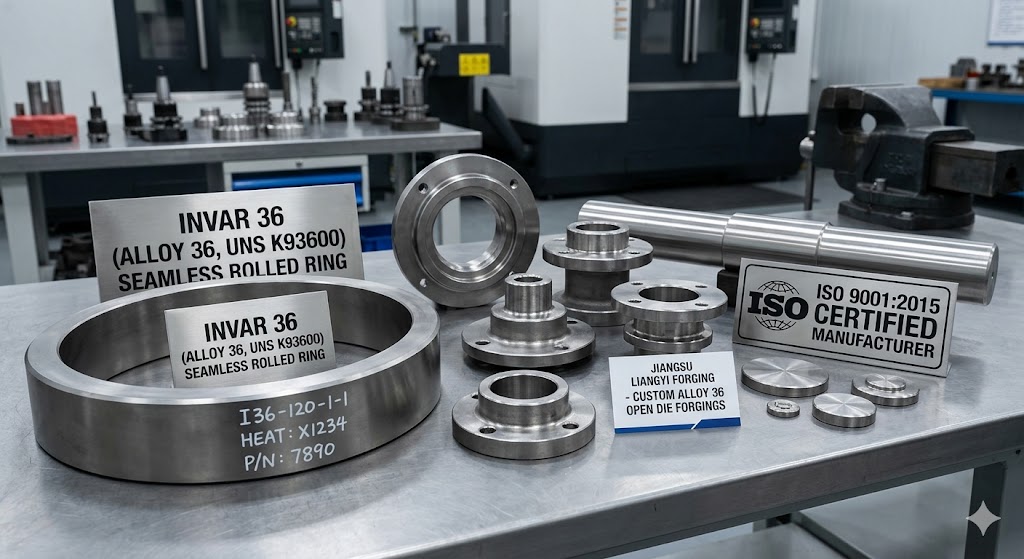
Quick Answer — What is Invar 36? Invar 36 (Alloy 36 / UNS K93600) is a 36% nickel-iron alloy with an ultra-low coefficient of thermal expansion of ≤ 1.5 × 10⁻⁶/°C at room temperature — caused by the magnetovolume effect below its Curie temperature (~230°C). Jiangsu Liangyi Co., Limited, established in Jiangyin City, China in 1997, is an ISO 9001:2015 certified manufacturer supplying custom Invar 36 forgings (30 kg–30,000 kg) to 50+ countries. Our products are manufactured to PED, ASME, API 6A, and NORSOK requirements — third-party certification arranged by buyer's nominated inspection agency. Lead time: 20–45 days. sales@jnmtforgedparts.com | +86-13585067993
Jiangsu Liangyi Co., Limited is a leading China ISO 9001:2015 certified manufacturer of Invar 36 forging parts, with over 25 years of specialized experience in custom open die forging and seamless rolled ring production. Our Invar 36 (also known as Alloy 36, UNS K93600, and commercially marketed as Nilo 36®) forged products are manufactured to ASTM, AMS, DIN, EN, JIS, ASME, API and NORSOK international standards, and are widely supplied to industrial buyers in more than 50 countries across Europe, North America, the Middle East, Southeast Asia, Oceania and East Asia.
This page is written by our senior nickel alloy forging engineering team with 25+ years of hands-on experience. Beyond product specifications, we share unique proprietary insights into Invar 36's physics, forging challenges, material selection pitfalls, machining recommendations, and real-world engineering case studies — information that goes far beyond typical supplier datasheets and is not available elsewhere.
About Jiangsu Liangyi — Our Invar 36 Forging Factory
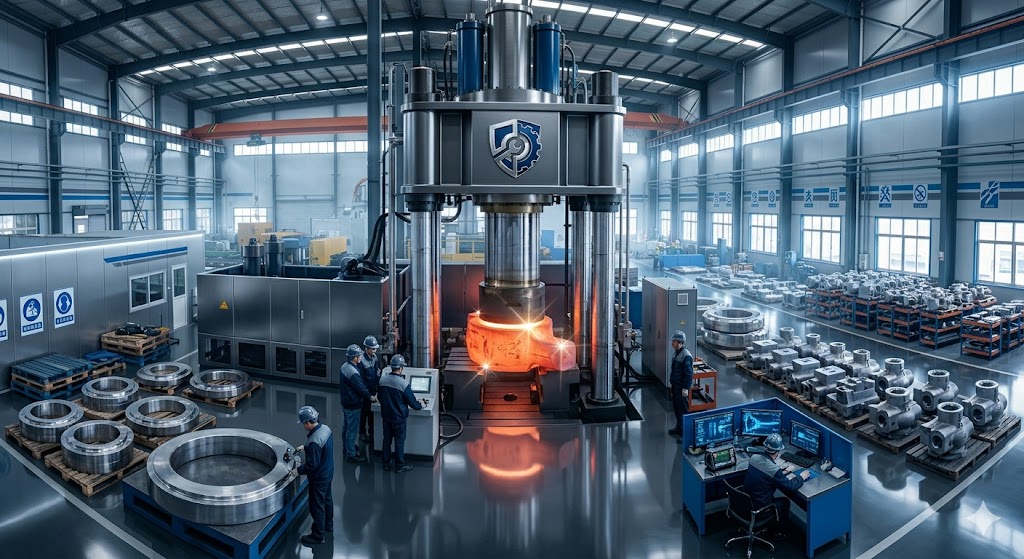
Established in 1997 in Jiangyin City, Jiangsu Province, China, our factory covers 80,000 square meters with an original fixed asset of over 40 million USD. We are equipped with advanced production and inspection facilities, including 2000T–6300T hydraulic forging presses, 1–5T electro-hydraulic forging hammers, 1M and 5M seamless rolling machines, ten heat treatment furnaces with precise atmosphere and temperature control, and a full range of NDT, chemical composition, mechanical property and metallographic testing equipment.
Our annual manufacturing capacity reaches 120,000 tons. Our technical team consists of 15+ senior nickel alloy forging engineers, and our quality team includes 5+ ASNT Level III inspectors. We have built a dedicated Invar 36 production knowledge base from over 2,000 completed projects, allowing us to predictively resolve the specific challenges this alloy presents — narrow forging temperature windows, work hardening behavior, grain coarsening sensitivity, and post-forge dimensional stabilization requirements that most general forging shops cannot manage.
The Invar Effect: Why Invar 36 Has Ultra-Low CTE — Physics Explained
Most industrial buyers know that Invar 36 has a very low coefficient of thermal expansion. Very few datasheets explain why — and understanding the mechanism is essential for engineering correctly with this alloy and avoiding costly mistakes.
The Magnetovolume Effect: The True Origin of Low CTE
Invar 36's low CTE is not a coincidence of composition — it is the result of a fundamental quantum mechanical phenomenon called the magnetovolume effect (also referred to as magnetostriction-driven volume anomaly or spontaneous volume magnetostriction). Here is the mechanism:
- Normal thermal expansion: Like all metals, the iron-nickel lattice naturally expands when heated, driven by increased atomic vibration amplitude. This positive thermal expansion would, in a non-magnetic material, produce a CTE of approximately 12–14 × 10⁻⁶/°C.
- Spontaneous volume magnetostriction: In the ferromagnetic state (below the Curie temperature), the magnetic exchange interaction between neighboring Fe atoms causes a spontaneous volume expansion of the crystal lattice. This magnetically driven volume change is strongly temperature-dependent — as temperature increases, the spontaneous magnetization decreases, and with it the magnetostriction volume expansion.
- Compensation: The decrease in magnetic volume expansion with temperature precisely offsets the normal positive thermal expansion. At the specific composition of approximately 36% Ni, these two effects cancel almost exactly in the temperature range of 20°C–200°C, resulting in a net CTE of only ~1.2 × 10⁻⁶/°C. Charles Édouard Guillaume discovered this in 1897 and was awarded the Nobel Prize in Physics in 1920.
Why 36% Nickel is the "Magic" Composition
The magnetovolume compensation is extremely sensitive to nickel content. Reducing the nickel content below ~34% shifts the Curie temperature below room temperature, eliminating the compensation effect. Increasing nickel above ~40% shifts the magnetic ordering in ways that reduce the compensation magnitude. The 35.5%–36.5% Ni range (as specified in UNS K93600) is the narrow "sweet spot" where the two effects cancel most completely across the industrially useful temperature range. This is why our internal nickel control range is precisely 35.5%–36.5% — slightly tighter than the ASTM F1684 standard specification — and is verified by direct-reading spectrometer on every single melt.
Engineering Insight from Our Lab: In 25+ years of production, we have observed that even a 0.3% deviation in nickel content can shift the room-temperature CTE of Invar 36 forgings by 0.1–0.2 × 10⁻⁶/°C. For large forgings over 5 tons, we conduct dilatometer CTE verification on test coupons from both ends of each forging to ensure CTE uniformity across the full section — a practice not required by standard specifications, but one we consider essential for aerospace and precision instrument applications.
Critical Warning: The Curie Temperature Trap at 230°C
⚠️ Critical Design Limit: Invar 36 loses its ultra-low CTE property above its Curie temperature of approximately 230°C (446°F). Above this threshold, CTE rises sharply to 12–14 × 10⁻⁶/°C — effectively the same as carbon steel — completely negating the benefit of the material. Do not use Invar 36 as a low-CTE material in applications where service temperature exceeds 200°C.
What Happens at the Curie Transition
Below ~230°C, Invar 36 is ferromagnetic. Above ~230°C, thermal energy overcomes the magnetic exchange coupling, and the alloy transitions to a paramagnetic state. When this transition occurs:
- The spontaneous volume magnetostriction collapses to zero
- The thermal expansion compensation mechanism disappears entirely
- CTE rises to 12–14 × 10⁻⁶/°C within a temperature band of approximately 10–20°C above the Curie point
- Upon cooling back below the Curie temperature, the low CTE is recovered — but dimensional changes during the high-CTE excursion remain
Implications for Post-Forge Heat Treatment
One of the most common mistakes made by buyers purchasing Invar 36 forgings from suppliers without specialized experience is requesting a stress relief heat treatment at temperatures above the Curie point. Standard stress relief temperatures for nickel alloys (450°C–600°C) are far above the Invar 36 Curie temperature. At these temperatures, Invar 36 behaves as a normal high-CTE alloy, and any residual stress relief also causes macro-scale dimensional changes that cannot be corrected by subsequent cooling. Our proprietary stress relief protocol for Invar 36 keeps temperatures at 150°C–180°C and uses extended time (4–8 hours per inch of section thickness) to achieve effective stress reduction without compromising CTE performance.
Welding Heat-Affected Zone Considerations
The weld heat-affected zone (HAZ) of Invar 36 inevitably exceeds the Curie temperature during welding. After welding, it is essential to perform a post-weld solution annealing treatment (850°C–900°C, followed by rapid controlled cooling) to re-homogenize the HAZ microstructure and restore low-CTE performance. Welded assemblies that are not properly post-weld heat treated may show localized CTE anomalies of 3–8 × 10⁻⁶/°C in the HAZ region, leading to unexpected dimensional drift in precision applications.
Invar 36 vs. Kovar, Super Invar, Invar 42, and CFRP — Material Selection Guide
Invar 36 is the most popular low CTE metallic material but it is not the ideal solution for all applications. Based on more than 25 years of application engineering experience, this guide assists engineers in selecting the appropriate low-CTE material for their particular needs.
| Property / Criterion | Invar 36 (UNS K93600) | Super Invar (32%Ni–5%Co) | Kovar (29%Ni–17%Co) | Invar 42 (42%Ni) | CFRP |
|---|---|---|---|---|---|
| CTE (20°C–100°C) | ~1.2 × 10⁻⁶/°C | ~0.5 × 10⁻⁶/°C | ~5.1 × 10⁻⁶/°C | ~4.5 × 10⁻⁶/°C | 0 to −1 × 10⁻⁶/°C |
| Useful Temp. Range | −270°C to 200°C | −100°C to 100°C | 20°C to 450°C | 20°C to 300°C | −180°C to 150°C |
| Tensile Strength (min.) | 490 MPa | ~450 MPa | ~520 MPa | ~480 MPa | 500–1500 MPa (axial) |
| Machinability | Moderate (work hardens) | Difficult | Moderate | Moderate | Difficult (abrasive) |
| Weldability | Good (with protocol) | Fair | Good | Good | Not weldable |
| Forgeable? | ✅ Yes | Limited | Limited | ✅ Yes | ❌ No |
| Density | 8.05 g/cm³ | 8.15 g/cm³ | 8.36 g/cm³ | 8.12 g/cm³ | 1.5–1.8 g/cm³ |
| Relative Material Cost | ★★★☆☆ (reference) | ★★★★★ (5× Invar 36) | ★★★★☆ (3–4×) | ★★★☆☆ (similar) | ★★★★★ (tooling) |
| Primary Application | LNG, aerospace molds, laser, precision instruments, satellites | Ultra-precision metrology, optical bench | Glass-to-metal seals, IC packaging | Glass/ceramic sealing, bi-metal strips | Lightweight aerospace structures |
| Best Choice When... | CTE < 2×10⁻⁶/°C needed, structural strength required, weldable, large components | Absolute minimum CTE required at near-ambient temperature, small parts, very high budget | Hermetic sealing to Kovar-glass (CTE match) | Sealing to borosilicate glass (CTE match) | Weight is primary concern, non-welded, specialized lay-up |
Our Material Selection Recommendation: For the vast majority of LNG cryogenic, aerospace tooling, satellite structure, laser, and precision instrument applications, Invar 36 (UNS K93600) forging offers the best balance of CTE performance, mechanical strength, weldability, machinability, and cost-effectiveness. Super Invar's marginally lower CTE rarely justifies its 5× higher cost and significantly inferior forgeability and weldability for structural components. Contact our engineering team for a free application-specific material recommendation.
Why Forged Invar 36 Outperforms Cast Invar 36: A Technical Comparison
Not all Invar 36 components are equal. The manufacturing route — forging versus casting — profoundly affects the material's actual performance in service. Based on our 25 years of comparative production data, here is the definitive technical case for choosing forged Invar 36 for demanding applications:
Grain Structure and Homogeneity
In cast Invar 36, solidification produces a coarse dendritic grain structure with significant nickel segregation between dendrite cores and interdendritic regions. Dendrite cores typically contain 33–34% Ni while interdendritic zones reach 37–39% Ni. This chemical inhomogeneity causes local CTE variations of up to 0.8 × 10⁻⁶/°C within the same casting. In precision applications, this means the actual dimensional behavior of the part may deviate from calculated values, causing assembly errors that are difficult to trace and impossible to correct after installation.
Forging, combined with our ESR/VAR remelting process, breaks down the dendritic structure. The combination of controlled deformation and diffusion homogenization during forging and annealing reduces nickel segregation to <0.5% variation across the section, delivering a uniform CTE distribution verified by our in-house dilatometer on sectional test coupons.
Porosity, Inclusions, and Structural Integrity
Cast Invar 36 commonly contains shrinkage porosity (volumetric shrinkage during solidification is approximately 3–4%), gas porosity (from dissolved hydrogen and nitrogen), and oxide inclusion clusters from the casting process. These defects degrade fatigue life, create leak paths in pressure-containing components, and provide sites for stress concentration in precision structures. Forging — especially with our ESR pre-treatment — achieves a virtually pore-free, inclusion-minimized microstructure with ultrasonic testing cleanliness ratings to SEP 1921 Class C/C or better.
Mechanical Property Comparison
| Property | Forged Invar 36 (Jiangsu Liangyi) | Cast Invar 36 (Industry Typical) | Improvement |
|---|---|---|---|
| Tensile Strength (Rm) | 510–550 MPa | 420–460 MPa | +20–25% |
| Proof Strength (Rp0.2) | 270–310 MPa | 200–230 MPa | +30–35% |
| Elongation (A%) | 45–50% | 25–35% | +30–50% |
| Charpy Impact (-196°C) | ≥ 80 J | 30–50 J | +60–170% |
| Fatigue Life (10⁷ cycles) | 220–260 MPa | 130–170 MPa | +50–70% |
| CTE Uniformity (section) | ±0.05 × 10⁻⁶/°C | ±0.4 × 10⁻⁶/°C | 8× better |
| ASTM Grain Size | 5–8 | 2–4 | Finer = better |
| UT Cleanliness (SEP 1921) | Class C/C or better | Class E/E (typical) | Significantly cleaner |
The Charpy impact values at -196°C are particularly critical for LNG applications, where cryogenic toughness determines whether a structural component survives sudden pressure fluctuations or thermal shock during LNG loading/unloading operations. Our forged Invar 36 routinely achieves ≥ 80 J at -196°C — more than double the typical cast value — providing a substantial safety margin against brittle fracture in LNG service.
Our Full Range of Custom Invar 36 Forged Products
We manufacture a complete portfolio of custom Invar 36 forging parts with strict dimensional tolerance control (standard ±0.5 mm for rough machined; up to ±0.02 mm for precision finish machined parts), adaptable to your specialized industrial applications:
Invar 36 Forged Bars & Rods
Round bars, square bars, flat bars, rectangular bars, step shafts, gear shafts, crank shafts and spindle forgings. Max forging diameter up to 2 meters, max length up to 15 meters, single-piece weight up to 30 tons. Straightness < 1 mm/m standard, < 0.5 mm/m achievable for precision optical bench shafts.
Invar 36 Seamless Rolled Rings
Custom open die forged rings, seamless rolled rings, gear rings, slewing bearing rings and contoured rings. Max outer diameter up to 6 meters, max weight up to 30 tons. OD/ID ratio from 1.1 to 10. Face-to-bore squareness within 0.02 mm/100 mm for precision bearing seat rings.
Invar 36 Hollow Forged Components
Forged hubs, housings, shells, sleeves, bushes, casings, hollow bars, seamless pipes and tubing products, with precise wall thickness control (typical WT tolerance ±2 mm, ±0.5 mm for precision). Concentricity within 0.5 mm standard for cryogenic valve sleeves.
Custom Invar 36 Forged Parts
Forged discs, disks, blocks, plates, flanges, valve seats, valve spindles, tube sheets and fully custom engineered components. Complex shapes achievable via multi-step open die forging combined with CNC profiling. 3D CAD DFM review provided free of charge.
Invar 36 Aerospace Composite Mold Frames
Large-section forged mold bases and frames for CFRP/GFRP autoclave tooling. CTE matched to carbon fiber layup requirements. Flatness < 0.5 mm over 3 m length standard. Vacuum integrity testing available for closed mold assemblies.
Invar 36 Cryogenic Valve Components
LNG service valve bodies, bonnets, stems, seats and discs forged to API 6A/NORSOK MDS requirements. Full cryogenic testing at -196°C including seal tests, hydrostatic pressure tests, and cryogenic Charpy impact per ASTM E23. Products manufactured to PED 2014/68/EU requirements; third-party Notified Body certification available.
All Alloy 36 forged parts can be supplied in rough machined, semi-finish machined, or fully precision machined condition with complete heat treatment and testing certificates included.
Specialized Melting & Forging Process for Invar 36
Invar 36 is one of the most technically demanding alloys to forge correctly. Its narrow forging temperature window, strong work hardening tendency, extreme sensitivity to nickel content uniformity, and the requirement that its unique CTE property be preserved through every production step place it in a category that requires dedicated expertise. Our approach — developed and refined over 2,000+ Invar 36 projects — differs fundamentally from standard nickel alloy forging practice in the following ways:
Why Invar 36 is Difficult to Forge (and What We Do About It)
- Narrow temperature window: Forging must be performed between 900°C and 1,200°C. Above 1,200°C, austenite grain growth accelerates exponentially (grain size can increase 3× in 30 minutes at 1,250°C), degrading mechanical properties and CTE uniformity. Below 900°C, work hardening increases rapidly and the risk of internal tearing and surface cracking rises. Our proprietary in-forge pyrometric monitoring system tracks surface temperature continuously throughout the forging sequence, triggering an automatic reheating alarm if any zone drops below 920°C.
- Work hardening behavior: Invar 36 has a high work hardening rate (n-value ~0.3–0.35), meaning each forging pass significantly increases flow stress. Inexperienced forging shops attempting to take excessive reduction per heat create adiabatic shear bands and internal cracking — defects that may only be revealed by ultrasonic testing and are not recoverable. Our pass reduction schedule is derived from 25 years of flow stress modeling data, using incremental 15–25% reduction per heating cycle with intermediate reheats.
- Post-forge grain size control: Achieving ASTM grain size 5–8 in the annealed condition requires precise control of total deformation ratio, final forging temperature, and annealing temperature. Insufficient total deformation (<3:1 reduction ratio) results in unrecrystallized coarse grain areas. Insufficient annealing temperature (<820°C) leaves residual deformation energy. Excessive annealing temperature (>950°C) triggers grain growth. Our recipe targets 850°C–880°C for 1 hour per 25 mm of section thickness, consistently achieving grain size 5–7 across the full section.
Premium Melting & Refining Routes
Standard Industrial Grade Route (LNG, Oil & Gas, General Industrial)
- Primary melting via 30T Electric Arc Furnace (EF)
- Secondary refining via Argon Oxygen Decarburization (AOD), Vacuum Oxygen Decarburization (VOD), or Vacuum Degassing — controls dissolved H to < 2 ppm, O to < 20 ppm, N to < 80 ppm
- Final refining via Electroslag Remelting (ESR) — breaks up dendritic segregation, removes oxide inclusions, improves surface quality; typical sulfur reduction from 0.004% to ≤ 0.002%
- Optional secondary Vacuum Arc Remelting (VAR) for high-demand cryogenic applications requiring ASTM A484 Class 1 cleanliness
Aerospace & High-Precision Grade Route (Aerospace, Satellite, Laser)
- Primary melting via Vacuum Induction Melting (VIM) — prevents atmospheric contamination during primary melt, achieves H < 1 ppm, O < 10 ppm
- Secondary refining via Electroslag Remelting (ESR) or Vacuum Arc Remelting (VAR)
- Optional double VAR process for critical aerospace satellite structural applications — achieves the highest achievable isotropy and the most uniform Ni distribution, CTE variability within ±0.03 × 10⁻⁶/°C across section
Precision Forging & Heat Treatment Process
With our 2000T–6300T hydraulic forging presses, 1–5T electro-hydraulic forging hammers and 5M seamless rolling machines, we strictly control the forging temperature window of Invar 36 (900°C–1,200°C). Our proprietary heat treatment process — solution annealing at 850°C–900°C followed by controlled cooling — fully stabilizes the face-centered cubic (FCC) austenitic microstructure and ensures the ultra-low CTE performance and mechanical properties meet the requirements of extreme operating conditions from -270°C to 200°C.
Invar 36 (UNS K93600) Standard Chemical Composition
Our Invar 36 (UNS K93600) forging parts strictly adhere to the following composition limits. These products meet the same specification as materials commercially marketed under trade names such as Nilo 36® — and meet UNS K93600 and ASTM F1684 chemical composition standards. Every single melt is verified by our in-house direct-reading optical emission spectrometer (OES) and carbon-sulfur combustion analyzer. Our internal control limits are tighter than the published standard to ensure CTE performance and inter-batch consistency:
| Element | UNS K93600 Standard Limit | Jiangsu Liangyi Internal Control | Why We Control Tighter |
|---|---|---|---|
| Carbon (C) | 0.15% max | ≤ 0.08% | Lower C reduces carbide precipitation at grain boundaries, improving cryogenic toughness and weldability |
| Manganese (Mn) | 0.60% max | 0.30%–0.50% | Mn in this range optimizes strength without reducing ductility; excessive Mn promotes Mn-S inclusions |
| Phosphorus (P) | 0.006% max | ≤ 0.004% | P at grain boundaries causes hot shortness during forging and embrittlement at cryogenic temperatures |
| Sulfur (S) | 0.004% max | ≤ 0.002% | Ultra-low S eliminates MnS stringer formation, critical for isotropic mechanical properties in large forgings |
| Silicon (Si) | 0.40% max | ≤ 0.25% | Si promotes oxide inclusions during ESR; lower Si improves cleanliness level per SEP 1921 |
| Chromium (Cr) | 0.25% max | ≤ 0.10% | Cr above 0.1% slightly shifts Curie temperature, affecting CTE in the 180°C–230°C range |
| Nickel (Ni) | 35.0%–37.0% (ASTM F1684) | 35.5%–36.5% | Ni is the most critical CTE-determining element; tighter control ensures CTE ≤ 1.5×10⁻⁶/°C guaranteed |
| Cobalt (Co) | 0.50% max | ≤ 0.30% | Co slightly raises Curie temperature; controlled to maintain predictable CTE transition behavior |
| Iron (Fe) | Balance | Balance | — |
Mechanical Properties & CTE Data Across Temperature Range
All Invar 36 forging parts from Jiangsu Liangyi are supplied in solution annealed (+AT) condition with the following guaranteed properties, based on our continuous in-house testing database of 2,000+ production batches:
| Property | Standard Requirement | Jiangsu Liangyi Typical Achieved | Test Standard |
|---|---|---|---|
| Tensile Strength (Rm) | ≥ 490 MPa | 510–550 MPa | ASTM E8 / ISO 6892-1 |
| 0.2% Proof Strength (Rp0.2) | ≥ 240 MPa | 270–310 MPa | ASTM E8 / ISO 6892-1 |
| Elongation at Fracture (A%) | ≥ 42% | 45–50% | ASTM E8 / ISO 6892-1 |
| Reduction of Area (Z%) | ≥ 60% | 65–75% | ASTM E8 / ISO 6892-1 |
| Hardness | 140–180 HB | 145–165 HB | ASTM E10 / ISO 6506 |
| Charpy Impact (+20°C) | ≥ 120 J | 140–180 J | ASTM E23 / ISO 148-1 |
| Charpy Impact (−100°C) | ≥ 100 J | 110–150 J | ASTM E23 / ISO 148-1 |
| Charpy Impact (−196°C) | ≥ 70 J | 80–120 J | ASTM E23 / ISO 148-1 |
| ASTM Grain Size (Annealed) | — | 5–8 | ASTM E112 |
CTE Performance Across the Full Operating Temperature Range
The CTE of Invar 36 is not constant — it varies with temperature and magnetic state. The table below, based on our in-house dilatometer database and published literature, provides a reliable engineering reference for design calculations:
| Temperature Range | CTE (Mean, × 10⁻⁶/°C) | State | Engineering Notes |
|---|---|---|---|
| −270°C to −196°C | ~1.0–1.6 | Ferromagnetic | Deep cryogenic range; excellent CTE stability for LNG containment and aerospace |
| −196°C to −100°C | ~1.2–1.8 | Ferromagnetic | Suitable for liquid nitrogen service; CTE remains low and predictable |
| −100°C to 20°C | ~1.0–1.3 | Ferromagnetic | Best CTE range; minimum expansion near the "Invar minimum" around −10°C to +20°C |
| 20°C to 100°C | ≤ 1.5 (typ. ~1.2) | Ferromagnetic | Design reference temperature; standard CTE specification range |
| 100°C to 200°C | ~1.5–4.0 | Ferromagnetic (declining) | CTE begins rising as Curie temperature approaches; verify application temperature against this range |
| 200°C to 230°C | ~4.0–10.0 | Curie transition | ⚠️ Rapid CTE increase — not suitable for low-CTE applications above 200°C |
| > 230°C | ~12–14 | Paramagnetic | ❌ Normal steel-like CTE — Invar advantage completely lost above Curie temperature |
Physical Properties Reference
- Density: 8.05 g/cm³
- Elastic Modulus (E): ~141 GPa at 20°C
- Thermal Conductivity: 10.5 W/(m·K) at 20°C
- Electrical Resistivity: ~0.82 µΩ·m at 20°C
- Specific Heat Capacity: 515 J/(kg·K) at 20°C
- Curie Temperature: ~230°C (variable ±20°C depending on exact Ni content and trace element levels)
- Melting Range: 1,430°C–1,450°C
Magnetic Properties of Invar 36 & Electromagnetic Considerations
Invar 36 is ferromagnetic at room temperature — a direct consequence of its nickel-iron composition and the same magnetic exchange interaction that gives it the low CTE property. This magnetic behavior has important implications for design, material handling, and certain application categories that are rarely discussed in supplier datasheets.
Main Magnetic Parameters
- Relative magnetic permeability (µr): 2,000–3,000 at room temperature (soft magnetic material, easily magnetized and demagnetized)
- Coercive force (Hc): 15–25 A/m (very magnetically soft — low residual magnetism after removal of external field)
- Saturation magnetization: ~1.26 Tesla at 20°C
- Curie temperature: ~230°C (transition to paramagnetic)
Design Implications of Invar 36 Ferromagnetism
- MRI and sensitive electromagnetic equipment: Invar 36 components should not be used in or near strong magnetic field environments (e.g., MRI machines, Hall effect sensors, particle accelerator beam guides) without magnetic shielding or substitution with a non-magnetic low-CTE alternative. The high permeability will distort local magnetic fields.
- Eddy current testing (ET): The ferromagnetic nature makes eddy current NDT more complicated. Our NDT team uses specialized low-frequency probes and flux saturation techniques for eddy current inspection of Invar 36 forgings where required.
- Machining with magnetic chucks: The ability to firmly clamp Invar 36 on electromagnetic chucks during surface grinding and high-precision machining makes it superior to austenitic stainless steel. For high-accuracy optical and instrument-grade applications, residual magnetism after machining must be strictly controlled. Our workshop is capable of providing professional demagnetization treatment to satisfy such technical requirements.
- Material traceability and sorting: Unlike austenitic stainless steel, Invar 36 responds strongly to a permanent magnet — a useful quick-check for material identification in mixed alloy environments. However, this does not replace chemical composition verification.
Machining, Welding & Surface Treatment Guidance for Invar 36 Forgings
Successfully working with Invar 36 in your facility requires understanding its specific machining, welding, and surface treatment characteristics. Based on feedback from our global customers over 25 years, the following guidance addresses the most common challenges encountered when processing Invar 36 forged components:
Machining Invar 36: Key Challenges and Solutions
Invar 36 is a moderately difficult material to machine due to its combination of high ductility, significant work hardening tendency, and low thermal conductivity. Built-up edge on cutting tools, poor surface finish, introduction of residual stress and unexpected dimensional changes after machining are the result of poor machining practice.
- Cutting tool selection: Carbide tools (K05–K15 grade, uncoated or TiN coated) preferred over high-speed steel. Positive rake angle geometry (8°–15°) essential to minimize work hardening. Avoid conventional carbide grades with high cobalt binder, which adhere to Invar 36 chips.
- Cutting speed and feed: Recommended cutting speed: 60–100 m/min for turning; 40–80 m/min for milling. Feed rate: 0.1–0.2 mm/rev for roughing, 0.05–0.08 mm/rev for finishing. Do not dwell or rub the tool on the surface — this immediately work hardens the surface and degrades subsequent cut quality.
- Coolant: Flood cooling essential. Neat cutting oil provides better surface finish; water-soluble coolant (8–10% concentration) acceptable for roughing. Never dry machine — the low thermal conductivity of Invar 36 concentrates heat at the cutting edge, accelerating tool wear and inducing thermal residual stresses.
- Dimensional stability after machining: For precision parts requiring tolerances tighter than ±0.05 mm, a stress relief heat treatment at 150°C–180°C for 4–8 hours per 25 mm section thickness (below the Curie temperature) is recommended after rough machining and before final finish machining. This releases machining-induced residual stresses that would otherwise cause slow dimensional drift over weeks to months in service.
- Magnetic chuck use: Effective and recommended for surface grinding. After grinding, demagnetize parts to residual field < 5 Gauss for sensitive applications.
Welding Invar 36 Forged Components
Invar 36 is weldable by TIG (GTAW), MIG (GMAW), plasma arc, and electron beam welding. Resistance welding is also applicable for thin-section joining. Key requirements for successful Invar 36 welding:
- Filler material: Use Invar 36 matching filler (e.g., AWS ERNi-1, ER36 grade Invar filler wire). Do not use austenitic stainless steel or regular nickel alloy fillers — they will cause CTE mismatch at the weld joint.
- Preheat: Sections under 10 mm — no preheat required. Sections 10–50 mm — preheat to 80°C–120°C. Sections over 50 mm — preheat to 120°C–150°C. Interpass temperature should not exceed 150°C to keep the HAZ below the Curie point during welding.
- Post-weld heat treatment (PWHT): Required for structural assemblies requiring uniform CTE. PWHT, 1 hour for each 25 mm section thickness, at 850°C–900°C, followed by rapid cooling. This re-solutionizes the HAZ microstructure and restores CTE to ≤ 1.5 × 10⁻⁶/°C. Note: Standard PWHT temperatures used for carbon steel (600°C–650°C) are above the Invar 36 Curie point and must NOT be used.
- Shielding gas: 100% argon or Ar/He mixture for TIG. CO₂-containing shielding gases should be avoided as carbon pickup in the weld pool increases weld bead hardness and reduces ductility.
Surface Treatment & Corrosion Protection
Invar 36 has moderate corrosion resistance — better than carbon steel but inferior to austenitic stainless steel. In clean, dry industrial environments, Invar 36 forms a stable passive layer and requires no surface treatment. For more aggressive environments, the following surface treatments are compatible:
- Electroless nickel plating (EN): Recommended for improved corrosion resistance and wear resistance. Thickness 25–75 µm. Note: the plating CTE is ~13 × 10⁻⁶/°C, so thermal cycling may cause cracking in thick coatings on thin-wall parts.
- Hard chrome plating: Applicable for wear-resistant surfaces on valve stems and actuator components. Thickness 10–50 µm.
- Passivation (nitric acid): Suitable for general corrosion protection in mild environments. Does not significantly affect dimensional tolerance.
- Physical Vapor Deposition (PVD) coatings: TiN, TiCN coatings for precision instrument surfaces requiring both wear resistance and low CTE base material. PVD process temperatures (< 200°C) safely below the Curie point.
- Avoid: Hot-dip galvanizing (> 400°C process) and phosphating at high temperatures — both exceed the Curie temperature and will disturb the microstructural CTE properties.
Rigorous Quality Control & International Certification
We operate a complete ISO 9001:2015 quality management system for all Alloy 36 forgings that we manufacture. Our quality system is not just certified, but also incorporates proprietary process controls and inspection protocols developed to address the unique metallurgical behavior of Invar 36:
Our Proprietary Three-Stage CTE Verification Protocol
Standard EN 10204 3.1 certificates do not require CTE verification — they only require chemical composition and room temperature mechanical properties. For precision applications, chemical compliance alone is insufficient: small variations in trace elements, residual stresses, and local deformation history can produce CTE deviations even within a chemically compliant forging. Our three-stage CTE verification protocol — unique in the China forging market — addresses this:
- Stage 1 — Spectrometric Ni content control: Nickel verified to 35.5%–36.5% (±0.5% vs. ASTM's ±1%) immediately after each melt, before any further processing.
- Stage 2 — Post-anneal dilatometer testing: Representative test coupons taken from each forging batch are tested on our precision dilatometer from -50°C to 250°C, generating a full CTE-vs-temperature curve. CTE at 20°C–100°C must confirm ≤ 1.5 × 10⁻⁶/°C before the batch proceeds to final machining.
- Stage 3 — Section CTE uniformity check (for forgings > 5 tons): For large forgings, coupons from both ends of the forging are dilatometer-tested separately. Maximum permissible CTE difference between any two coupons from the same forging: 0.1 × 10⁻⁶/°C. Forgings exceeding this threshold are quarantined for investigation.
Full Testing Capabilities
- Chemical Analysis: Direct-reading OES spectrometer and carbon-sulfur combustion analyzer for full element verification per melt
- Mechanical Testing: Room temperature and low/high temperature tensile testing (-196°C to +200°C), Charpy impact testing (-196°C to +175°C), hardness testing (Brinell, Rockwell, Vickers), creep testing
- Metallographic Testing: Macro-etching inspection, ASTM E112 grain size analysis, ASTM E45 inclusion rating, SEP 1921 cleanliness rating, microstructure phase analysis
- Non-Destructive Testing (NDT): 100% ultrasonic testing (UT) per EN 10228-3/ASTM A388, liquid penetrant inspection (PT) per EN 10228-2, magnetic particle inspection (MT) per EN 10228-1
- Dimensional Inspection: CMM dimensional verification, surface roughness measurement (Ra 0.8–6.3 µm range), roundness and straightness per DIN 7151
- CTE Testing: precision dilatometer, -100°C to 300°C range, ±0.02 × 10⁻⁶/°C measurement accuracy
- Pressure Testing: Hydrostatic pressure testing to 1.5× design pressure for pressure-containing components
International Certifications & Compliance
- ISO 9001:2015 Quality Management System Certification
- EN 10204 3.1/3.2 Mill Test Certificate (MTC) for every batch
- PED 2014/68/EU — European Pressure Equipment Directive (Notified Body: TÜV/BV)
- ASME Section II Part B — North American Boiler & Pressure Vessel Code
- API 6A Product Specification Level (PSL) 1, 2, 3 — Oil & Gas Wellhead & Christmas Tree Equipment
- NORSOK MDS D46 — Norwegian Offshore Industry Material Data Sheet
- AMS 1444 — Products manufactured to this aerospace material specification
- JIS G 4901 / JIS G 3214 — Japanese Industrial Standards for Nickel Alloy
Global Industrial Applications & GEO-Targeted Project Cases
Our Invar 36 forging parts are proven across the world's most demanding industrial sectors. The following are real project case summaries from our production records (client identities protected per confidentiality agreements), representing the breadth and depth of our application expertise:
LNG Transport & Cryogenic Storage — European & Southeast Asian Market
The LNG industry is the single largest consumer of Invar 36 globally, with the alloy used in membrane-type LNG carrier tanks and onshore LNG storage tank inner membranes (GTT No. 96 and Mark III membrane systems). Beyond membrane sheet material, we supply custom Invar 36 forged pipes, seamless sleeves, valve seats, pump column connectors and transfer line components for LNG tanker construction and onshore LNG terminal projects in Germany, France, Netherlands, Singapore, Malaysia, and South Korea.
At the -163°C boiling point of liquefied natural gas, carbon steel contracts by approximately 2 mm per meter of length — enough to break welds, crack flanges, and cause catastrophic leakage. Our Invar 36 valve seat forgings, with CTE ≤ 1.5 × 10⁻⁶/°C, contract by only 0.3 mm per meter over the same temperature drop — ensuring tight sealing and structural integrity over decades of thermal cycling in LNG service. All LNG components carry PED 2014/68/EU certification and EN 10204 3.2 third-party inspection by Bureau Veritas or TÜV Rheinland.
Aerospace Composite Mold Tooling — North American & European Market
The commercial aviation industry's adoption of carbon-fiber reinforced polymer (CFRP) structures for aircraft fuselage, wings, and nacelles requires autoclave tooling molds that maintain dimensional accuracy across the cure cycle (typically 180°C for 2 hours at 7–8 bar pressure). The CFRP layup and mold surface must have matched CTE to prevent spring-in deformation in the cured part. Our Invar 36 forged mold base and frame components have been supplied for large commercial aircraft and regional jet CFRP wing skin and fuselage panel tooling programs.
A key engineering challenge we solve in this application: at 180°C (above the Curie temperature's approach zone where Invar 36 CTE begins rising), standard Invar 36 shows CTE of approximately 2.5–4.0 × 10⁻⁶/°C. For critical autoclave tooling applications, we offer engineering support to select the optimal alloy (standard Invar 36 for 120°C cure cycles, Super Invar for room-temperature cure with high precision requirements) and produce tooling frames with verified CTE across the full cure temperature cycle. Flatness on finished mold frames: < 0.3 mm over 3 m length after final heat treatment and stabilization.
Oil & Gas Industry — Middle East & Nordic Market
LNG processing facilities, offshore FLNG (floating LNG) vessels, and deepwater subsea production systems operate liquefaction trains at temperatures reaching -162°C. We supply UNS K93600 forged valve bodies, bonnet forgings, valve stems, seats and wellhead components for oil and gas projects in Saudi Arabia (ARAMCO supply chain), UAE (ADNOC supply chain), Qatar (RasGas/QatarGas projects), and Norway (offshore North Sea platforms).
For Norway's NORSOK-regulated projects, all our Invar 36 forgings are manufactured to NORSOK MDS D46 specification requirements with full documentation, including supplementary charpy impact testing at -196°C (minimum 60J average, 45J single), HISC (Hydrogen Induced Stress Cracking) evaluation data, and cathodic protection compatibility assessment for subsea applications. This comprehensive documentation package is assembled by our dedicated NORSOK compliance team — an in-house capability that eliminates months of re-qualification work for our Nordic clients.
Satellite & Space Structural Components — Global Aerospace Market
Satellites experience temperature swings from +120°C (sun-facing) to -200°C (eclipse) within a single orbit. Structural components connecting electronic subsystems must maintain dimensional stability within ±0.05 mm over this full thermal cycle to prevent misalignment of optical sensors, antenna pointing systems, and solar panel deployment mechanisms. We manufacture precision Invar 36 forged satellite bus structural brackets, optical bench frames, and thermal compensation rod assemblies for European Space Agency (ESA) supply chain contractors and commercial satellite manufacturers.
For space applications, we offer the VIM+VAR double-remelt grade with helium leak testing at 10⁻⁹ mbar·L/s sensitivity, ASTM E1417 penetrant inspection to Class 4 sensitivity, and dimensional verification by CMM with traceable calibration to national standards (CNAS accredited).
OLED & Semiconductor Manufacturing Equipment — Global Electronics Market
The production of OLED displays and advanced semiconductor devices requires vacuum deposition equipment with shadow mask frames that maintain precise alignment tolerances (< 5 µm over 1 m) during deposition cycles at 100°C–180°C. Invar 36 is the industry-standard material for large-generation OLED shadow mask frames, tension frames, and fine metal mask (FMM) support structures. We supply precision Invar 36 forged and machined frames to display manufacturing equipment suppliers in South Korea, Japan, and China for Gen 6, Gen 8, and Gen 10.5 OLED production lines.
Surface flatness requirements for these components are the most stringent in our product portfolio: flatness within 50 µm over 1,500 mm length, surface roughness Ra ≤ 0.4 µm, and residual magnetic flux density < 5 Gauss (to prevent interference with the electromagnetic shadow mask tensioning system). Our dedicated OLED component cell within our machine shop — with controlled temperature environment (22°C ± 1°C) — is set up specifically for these ultra-precision requirements.
Precision Instruments, Laser Systems & Thermostats — Global Market
We supply custom Invar 36 forgings and precision machined components to industrial automation, metrology, laser physics, and thermostatic control clients across 50+ countries. Representative applications include: optical bench frames and mirror mount housings for high-power industrial laser systems (Nd:YAG, CO₂, fiber laser), length standard bars for dimensional metrology laboratories, bi-metal thermostat passive elements (Invar 36 bonded to high-CTE copper or stainless steel), clock pendulum rods and balance wheel components for scientific clocks, and Fabry-Pérot interferometer spacer bars for spectroscopy applications.
For laboratory and instrumentation clients, we offer a Certificate of Conformance specific to dimensional metrology requirements, including material density verification, CTE per dilatometer over the specific service temperature range, Young's modulus, and specific heat capacity values from our in-house materials characterization laboratory.
Global Client Testimonials
"We have been sourcing Invar 36 composite mold frames from Jiangsu Liangyi for our A350 wing skin tooling program for over 5 years. Their CTE dilatometer verification reports — which no other China supplier provides — give us the engineering confidence we need for first-part qualification without additional in-house retesting. Flatness and dimensional consistency batch-to-batch has been outstanding. Highly recommended for aerospace tooling applications."
“For our Qatar LNG terminal expansion project, we needed Invar 36 valve seat forgings with PED certification and EN 10204 3.2 third-party inspection by Bureau Veritas. Jiangsu Liangyi’s delivery was on time, with full documentation that passed the ADMA-OPCO and EPC contractor review without a single NCR. Their NORSOK MDS D46 compliance package was the most complete we have received from any supplier globally."
"We tested Invar 36 shadow mask frame forgings from three China suppliers before selecting Jiangsu Liangyi. Their residual magnetic flux density of <3 Gauss and flatness within 40 µm over 1,500 mm were consistently better than competitors. The in-house CTE verification and the dedicated temperature-controlled machining environment give us confidence that our Gen 8 OLED line alignment tolerances will be maintained over the lifetime of the equipment."
Invar 36 Forging Procurement Checklist: What to Specify When Ordering
From our experience handling 2,000+ Invar 36 forging orders from buyers in 50+ countries, the most common source of delays, cost overruns, and non-conformances is incomplete or incorrect specifications at the point of ordering. This checklist — developed by our customer engineering team — ensures your order is processed correctly from the first interaction:
Essential Information to Provide with Your Enquiry
- Material designation: Specify at least one of: Invar 36 / Alloy 36 / UNS K93600. If special purity is needed, specify VIM, ESR, or VAR remelting route.
- Dimensions & weight: Provide a 2D drawing (PDF, DXF, DWG) or 3D model (STEP, IGES) with all tolerances. If only rough forging is needed, specify envelope dimensions and weight. If finish machined, specify all important dimensions and surface roughness (Ra).
- Heat treatment condition: Typically solution annealed (+AT). If you need a specific hardness or strength level outside standard +AT condition, specify this explicitly.
- Quantity and delivery schedule: Per piece and total quantity; required delivery date; whether expedited production is acceptable at premium cost if standard lead time is insufficient.
- Application service conditions: Minimum and maximum service temperature; working pressure (if pressure-containing component); exposure environment (LNG, seawater, corrosive gas, vacuum, etc.).
- Test and inspection requirements: Specify needed mechanical tests (tensile, impact, hardness), NDT methods (UT, PT, MT), chemical analysis reporting, and CTE verification if needed.
- Certification requirements: Specify EN 10204 level (3.1 standard; 3.2 if third-party inspection required and by which body: TÜV, SGS, BV, DNV, LLOYDS, etc.); applicable codes (PED, ASME, API 6A, NORSOK, AMS, JIS).
- Country of destination: Affects export documentation, customs HS code classification, and applicable import certifications.
⚠️ Common Ordering Mistakes to Avoid: (1) Specifying "Invar 36, standard grade" without clarifying remelting route — for aerospace, always specify VIM+ESR or VIM+VAR. (2) Not specifying whether CTE dilatometer testing is required — it is not in the default EN 10204 3.1 scope. (3) Requesting stress relief at temperatures > 200°C — this destroys Invar 36's CTE property. (4) Specifying PWHT at standard steel temperatures (600°C+) for welded assemblies — fatal for CTE performance. (5) Not providing a drawing with tolerances — verbal descriptions of "about 500 mm diameter" cannot be quoted accurately.
Targeted Global Markets & Localized Services
We have built deep export expertise over 25 years, with mature logistics solutions, localized certification packages, and multilingual technical support for each of our main target markets:
🇬🇧🇩🇪🇫🇷 Europe (UK, Germany, France, Italy, Spain, Netherlands, Belgium, Scandinavia)
PED 2014/68/EU and EN 10204 3.2 documentation; REACH compliance declaration; CE marking support; German, English, French, Spanish multilingual technical team. Sea freight: 25–35 days. Air freight: 3–7 days for urgent orders. European customs clearance support provided.
🇺🇸🇨🇦 North America (United States, Canada)
ASME Section II, Products manufactured to API 6A PSL 1–3 and NACE MR0175/ISO 15156 requirements. HTS code classification for US Customs. Sea freight: 20–30 days (West Coast), 25–35 days (East Coast). Air freight: 3–7 days. US export controls (EAR/ITAR) compliance screening for aerospace orders.
🇸🇦🇦🇪🇶🇦 Middle East (Saudi Arabia, UAE, Qatar, Kuwait, Bahrain, Oman)
API 6A, NORSOK, ADNOC, ARAMCO supply chain documentation. Arabic/English bilingual technical support. SASO/ESMA import certificate assistance. Sea freight: 15–25 days. Air freight: 2–5 days. Competitive Incoterms options (CIF, DDP Dubai/Jeddah/Doha).
🇸🇬🇲🇾🇦🇺 Southeast Asia & Oceania (Singapore, Malaysia, Australia, Indonesia, Thailand, Vietnam, Philippines, New Zealand)
Products manufactured to JIS and ASME specification requirements. English and Chinese technical support. Sea freight: 7–15 days to Singapore/Malaysia; 15–22 days to Australia. Air freight: 2–5 days. Australian import customs and biosecurity pre-clearance guidance provided.
🇯🇵🇰🇷 Japan & South Korea
JIS G 4901 and Korean KS standards compliance. Japanese and Korean technical documentation available. OLED and semiconductor equipment supply chain experience. Sea freight: 5–10 days to Yokohama/Busan. Factory audit support for OLED/semiconductor OEM vendor qualification.
🇳🇴 Nordic Offshore (Norway, Denmark, Sweden, Finland)
NORSOK MDS D46 specification-compliant products; DNV/Veritas third-party inspection arranged by buyer, offshore material traceability records. North Sea subsea corrosion environment compatibility data. Sea freight: 28–38 days. Air freight: 4–7 days to Oslo/Bergen.
Why Choose Jiangsu Liangyi as Your Invar 36 Forging Partner in China
25+ Years Dedicated to Invar 36
Not a generalist shop that "can do" Invar 36 — we have dedicated Invar 36 production cells, a proprietary 25-year process parameter database covering 2,000+ projects, and senior engineers who have solved every known Invar 36 forging challenge. This expertise is not available elsewhere at this price point.
Proprietary 3-Stage CTE Verification
The only China forging manufacturer offering in-house dilatometer CTE verification as standard for all Invar 36 batches. Your EN 10204 3.1 MTC includes the actual CTE curve from -50°C to 250°C — not just a chemical composition table. This eliminates your in-house retesting cost and accelerates first-part qualification.
Full In-House Production Control
Melting, forging, heat treatment, CNC machining, NDT, CMM inspection — all in one facility, no outsourcing. Every production step is tracked in our ISO 9001:2015 ERP system with full traceability from raw material heat number to finished product serial number. One contact person, one quality record, no supply chain surprises.
Application Engineering Support
Free DFM (Design for Manufacturability) review for every new drawing. Our engineering team will flag CTE calculation errors, inappropriate PWHT specifications, incorrect heat treatment conditions, and oversized tolerances before your order starts — preventing costly rework. We treat your engineering problems as our problems.
Global Delivery & Localized Compliance
120,000-ton annual capacity with dedicated Invar 36 production planning. 20–45 day standard lead time. Partial raw material stock for emergency orders. Localized certification packages for PED, ASME, API 6A, NORSOK, AMS, JIS without additional qualification time. 24/7 multilingual technical support (English, Chinese, German, French, Arabic).
Transparent, Competitive Pricing
We provide itemized quotations showing material, forging, heat treatment, machining, and testing costs separately — so you can optimize your specification versus budget. Quantity discounts start from 3 pieces. No hidden surcharges for standard certifications (EN 10204 3.1 always included). Third-party inspection at cost price (no markup).
Frequently Asked Questions (FAQ) About Invar 36 Forging Parts
Invar 36 is a premium binary nickel-iron alloy containing 36% nominal nickel, famous for its ultra-low coefficient of linear thermal expansion (CTE) — approximately 1.2 × 10⁻⁶/°C at room temperature. The mechanism is the magnetovolume effect: below the Curie temperature (~230°C), the spontaneous volume magnetostriction of the ferromagnetic iron-nickel lattice partially cancels normal thermal expansion. The alloy is also designated Alloy 36 and UNS K93600. It was discovered by Charles Édouard Guillaume in 1897, who received the Nobel Prize in Physics in 1920 for this discovery.
At 20°C–100°C: ≤ 1.5 × 10⁻⁶/°C (typical ~1.2 × 10⁻⁶/°C) — only about 10% of carbon steel's CTE. At cryogenic temperatures (-196°C–20°C): ≤ 2.0 × 10⁻⁶/°C, excellent for LNG and cryogenic applications. At 100°C–200°C: CTE rises from ~1.5 to ~4.0 × 10⁻⁶/°C as the Curie temperature is approached. Above ~230°C (Curie temperature): CTE rises sharply to 12–14 × 10⁻⁶/°C — the Invar advantage is completely lost. Do not use Invar 36 as a low-CTE material above 200°C.
Forged Invar 36 offers superior properties in every category: 20–25% higher tensile strength, 30–35% higher proof strength, 60–170% better cryogenic Charpy impact energy at -196°C, 8× better CTE uniformity across the section (±0.05 vs ±0.4 × 10⁻⁶/°C), ASTM grain size 5–8 (vs 2–4 for castings), and virtually zero porosity (vs 3–4% shrinkage porosity typical in castings). The forging process breaks down dendritic Ni segregation that causes local CTE variation in castings, delivering uniform CTE across the full component cross-section — critical for LNG, aerospace, and precision applications.
The Curie temperature of Invar 36 is approximately 230°C (446°F). Below this, the alloy is ferromagnetic and the magnetovolume effect suppresses thermal expansion to ≤ 1.5 × 10⁻⁶/°C. Above ~230°C, the alloy becomes paramagnetic and CTE rises to 12–14 × 10⁻⁶/°C — identical to regular steel — completely negating the Invar advantage. This means: (1) Never use Invar 36 in applications above 200°C expecting low CTE. (2) Stress relief heat treatment must stay below 180°C. (3) Post-weld heat treatment must be solution annealing at 850°C–900°C (not standard steel PWHT at 600°C+). (4) Autoclave tooling for 180°C cure cycles should have the CTE specified at 180°C, not just room temperature.
Invar 36 (CTE ~1.2 × 10⁻⁶/°C) is the best balance for most structural low-CTE applications. Super Invar (32% Ni, 5% Co, CTE ~0.5 × 10⁻⁶/°C) achieves lower CTE but at 5× the cost with far poorer forgeability and weldability. Kovar (29% Ni, 17% Co, CTE ~5.1 × 10⁻⁶/°C) is matched to hard glass/ceramics for hermetic sealing. Invar 42 (42% Ni, CTE ~4.5 × 10⁻⁶/°C) matches borosilicate glass. CFRP offers near-zero CTE but cannot be welded, formed, or used in large monolithic structures, and is expensive in tooling form. For LNG, aerospace molds, laser systems, satellites, and precision instruments requiring structural forgings, Invar 36 is the optimal choice.
Invar 36 forging parts are used in: (1) LNG carrier tanks and terminals — membrane fittings, valve seats, pipe connectors at -163°C. (2) Aerospace CFRP autoclave mold frames requiring ±0.02 mm flatness over cure cycles. (3) Satellite structural frames surviving -200°C to +120°C orbital thermal cycling. (4) OLED display shadow mask and tension frames requiring <5 µm flatness stability. (5) Industrial laser optical benches and mirror mounts. (6) Precision metrology length bars and CMM components. (7) Oil & gas cryogenic valve bodies (API 6A service). (8) Bi-metal thermostat passive elements. (9) Radar and microwave cavity resonators. (10) Scientific clocks and balance wheels. (11) High-voltage circuit breaker contact assemblies.
Yes. Invar 36 is ferromagnetic at room temperature (permeability µr ~2,000–3,000, saturation ~1.26 Tesla) — this magnetism is the physical source of its low CTE through the magnetovolume effect. Implications: (1) Not suitable near MRI machines or sensitive electromagnetic equipment. (2) Can be held with magnetic chucks for grinding — an advantage over austenitic stainless steel. (3) Eddy current NDT requires specialized low-frequency techniques. (4) Attracts to permanent magnets — useful for quick material identification check. (5) Demagnetization treatment available and recommended for ultra-precision optical and OLED applications where residual magnetism must be <5 Gauss. (6) Above the Curie temperature (~230°C), Invar 36 becomes paramagnetic (non-magnetic).
Yes. Jiangsu Liangyi specializes in custom Invar 36 forging from 30 kg to 30,000 kg per piece. The following is the process: (1) Email us your drawings (PDF/DXF/DWG/STEP/IGES) and technical requirements. (2) Our engineering team conducts a free DFM review within 24-48 hours highlighting potential manufacturability issues. (3) We provide a detailed itemized quote within 48-72 hours. (4) Dedicated project manager assigned after order confirmation with weekly production update. (5) Pre-delivery, you receive a full test report package and inspection invitation for third-party witness inspection if required. Standard lead time: 20–35 days for rough machined; 35–45 days for finish machined with full testing.
Standard with every order: EN 10204 Type 3.1 Mill Test Certificate (MTC) including full 9-element chemical analysis, mechanical test results (tensile, proof, elongation, reduction of area, hardness, impact at specified temperatures), heat treatment records, NDT reports (UT, PT, MT as specified), dimensional inspection report, and material traceability chain from raw material heat to finished product. Available on request at additional cost: EN 10204 3.2 (third-party by TÜV, SGS, BV, DNV, Lloyd's Register); PED 2014/68/EU compliance documentation; API 6A PSL compliance documentation; NORSOK MDS D46 documentation; AMS certification; dilatometer CTE verification report (included in our standard for Invar 36); traceable CMM dimensional report.
Key Invar 36 machining guidelines: (1) Use carbide tools (K05–K15 grade) with positive rake angle (8°–15°). (2) Cutting speed: 60–100 m/min turning, 40–80 m/min milling. (3) Always use flood coolant — Invar 36's low thermal conductivity concentrates heat at the cutting edge. (4) Never dwell or rub the tool — this instantly work-hardens the surface. (5) For tolerances <±0.05 mm, do a stress relief at 150°C–180°C for 4–8 hr per 25 mm section after rough machining, before finish machining. (6) Demagnetize to <5 Gauss after magnetic chuck grinding for sensitive applications. (7) Plan for slow dimensional stabilization after machining — finished precision parts should be allowed to thermally stabilize 24 hours at room temperature before final CMM inspection.
Contact Us for a Custom Invar 36 Forging Quotation
Jiangsu Liangyi Co., Limited — your trusted China-based professional manufacturer and supplier of Invar 36 (Alloy 36, UNS K93600) forging parts since 1997. Whether you need a single prototype or large-volume production, our engineering team is ready to provide a detailed technical review, DFM assessment, and competitive quotation within 24–48 hours.
📧 Inquiry Email: sales@jnmtforgedparts.com
📞 Phone / WhatsApp: +86-13585067993
💬 Chat with Us on WhatsApp🌐 Website: https://www.jnmtforgedparts.com
📍 Address: Chengchang Industry Park, Jiangyin City, Jiangsu Province, 214400, China
Request a Custom Quotation
Please send your 2D/3D drawings, material requirements and order quantity to sales@jnmtforgedparts.com. We will respond within 24 hours with a detailed technical assessment and competitive quotation.