Inconel 718 (Alloy 718, UNS N07718) Forging Parts | China ISO-Certified Forging Manufacturer
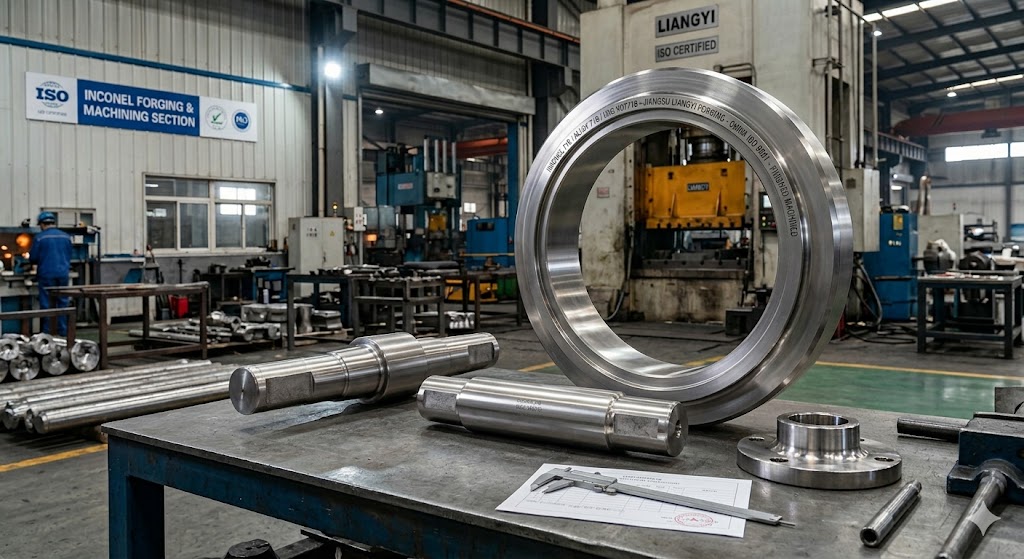
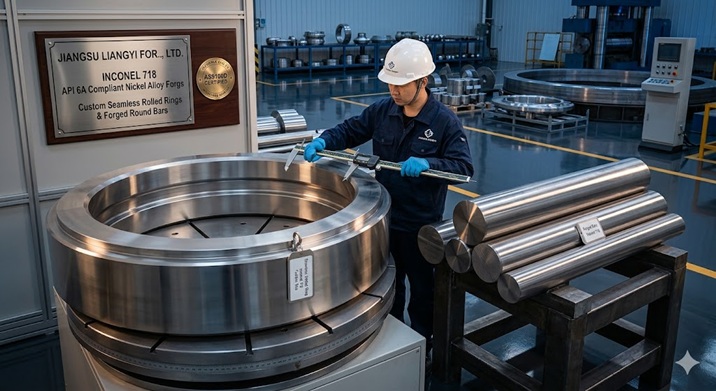
- 25+ years of professional manufacturing experience in nickel alloy and superalloy forgings
- ISO 9001:2015 certified; products meet ASTM B637, AMS 5662/5663, API 6A, and EN specification requirements as verified by EN 10204 3.1/3.2 inspection certificates
- Custom Inconel 718 forging solutions from 30 kg to 30 tons, exported to more than 50 countries worldwide
- Full range of production process from steel melting, forging, heat treatment, CNC machining to third-party inspection (BV, SGS, TÜV available)
Key Takeaways: Inconel 718 Forgings at a Glance
- Material Identity: Inconel 718, Alloy 718, and UNS N07718 are identical materials — a precipitation-hardening nickel-chromium superalloy containing 50–55% Ni, 17–21% Cr, 4.75–5.50% Nb, and 2.80–3.30% Mo.
- Operating Range: Keeps mechanical integrity from −253 °C (−423 °F) cryogenic conditions up to 700 °C (1292 °F) continuous service, with short-term resistance up to 980 °C (1800 °F).
- Room-Temperature Strength: Solution-annealed and aged forgings get a minimum 0.2% proof strength of 1034 MPa, tensile strength of 1276 MPa, and hardness of 331–450 HB per ASTM B637.
- Sour Service Compliance: Fully meet NACE MR0175 / ISO 15156 for H₂S sour service oil and gas environments.
- API 6A Specification: Products manufactured based on API 6A specification requirements, PSL1 through PSL4 quality levels, 120KSI yield strength class, for wellhead and Christmas tree equipment.
- Size Range: Forged bars up to 2000 mm diameter, seamless rolled rings up to 6 m OD, single-piece weight up to 30 metric tons; minimum order 30 kg.
- Lead Time: Standard production lead time is 25–35 days from order confirmation with full material certification.
Why Choose Inconel 718 (Alloy 718, UNS N07718) Forgings?
Inconel 718 (also designated Alloy 718, UNS N07718) is a precipitation-hardening nickel-chromium superalloy widely recognized as the gold standard for important industrial forgings. Compared to stainless steel and other nickel alloys, Inconel 718 forgings has excellent performance advantages in demanding environments:
- Exceptional High-Temperature Performance: It keeps stable mechanical strength and creep resistance from −253 °C to 700 °C, suitable for extreme temperature fluctuations in turbine and downhole applications. The gamma-prime (γ') and gamma-double-prime (γ'') precipitation hardening phases remain stable up to 650 °C, enabling long-term structural integrity.
- Superior Corrosion & Oxidation Resistance: It has excellent resistance to sour gas (H₂S), seawater, acids, and alkali corrosion, and fully meet NACE MR0175 / ISO 15156 sour service standards for the oil and gas industry. The high chromium content (17–21%) provides a self-repairing passive oxide film in aggressive environments.
- Outstanding Weldability & Formability: It has excellent forging and machining performance, allowing intricate custom geometries without cracking , so that it is the best choice material for open die forgings and seamless rolled rings. Unlike many nickel superalloys, Alloy 718 resists post-weld heat treatment cracking due to the slow aging kinetics of the γ'' phase.
- High Fatigue & Stress Rupture Strength: It can last for more than 20 years in nuclear power, aerospace, and power generation applications, even in high-pressure, high-stress work environments.. Stress rupture life at 649 °C / 689 MPa exceeds 23 hours per ASTM B637.
Inconel 718 vs Other Common Nickel Alloys — Property Comparison
Engineers can choose the best material for each job if they know how Inconel 718 compares to other nickel alloys. The table below shows the key properties of the nickel superalloys most commonly used for industrial forgings:
| Property | Inconel 718 (UNS N07718) | Inconel 625 (UNS N06625) | Hastelloy C-276 (UNS N10276) | Monel 400 (UNS N04400) |
|---|---|---|---|---|
| Ni Content (%) | 50–55 | 58 min | 57 min | 63–70 |
| Max Service Temp. (°C) | 700 | 980 | 1040 | 480 |
| 0.2% Proof Strength (MPa) | 1034 (aged) | 276–690 | 283–690 | 170–310 |
| Tensile Strength (MPa) | 1276 (aged) | 690–1034 | 690–1034 | 480–550 |
| Hardening Mechanism | Precipitation (γ''/γ') | Solid solution | Solid solution | Solid solution |
| H₂S Sour Service | Excellent (NACE MR0175) | Excellent | Excellent | Good |
| Weldability | Excellent | Excellent | Excellent | Good |
| API 6A Qualified | Yes (120KSI) | Yes | Yes | Limited |
| Typical Applications | Oil & gas, turbines, nuclear, aerospace | Marine, chemical, offshore risers | Chemical processing, FGD systems | Marine, dilute acids |
Product Overview & Manufacturing Capabilities
Jiangsu Liangyi Co., Limited is a top professional manufacturer based in China, specializing in high-quality Inconel 718 (Alloy 718, UNS N07718) open die forging parts and seamless rolled forged rings.We have an 80,000 m² modern production facility and an advanced 6300-ton hydraulic forging press, and have provided custom Inconel 718 forged parts to customers across Europe, North America, the Middle East, Southeast Asia, and Australia.
Our products are made based on the chemical, mechanical, and dimensional requirements of international industry standards, including ASTM B637, AMS 5662, AMS 5663, API 6A, and NACE MR0175.Full quality verification is provided through EN 10204 3.1/3.2 inspection certificates, supported by our ISO 9001:2015 certified quality management system. Our Inconel 718 forgings are widely used for high-performance important applications, including onshore and offshore oil & gas, thermal and nuclear power generation, aerospace, chemical processing, marine engineering, and mining industries.
Explore our complete range of forged products, including bars, rings, shafts, and custom parts.
Full Range of Inconel 718 Forged Product Shapes & Specifications
We manufacture custom Inconel 718 (Alloy 718, UNS N07718) forging products in all kinds of shapes and dimensions, strictly per customer drawings and technical requirements. The following product types are available from stock billets or full custom production:
- Inconel 718 Forged Bars & Rods: Round bars, square bars, flat bars, rectangular bars and step shafts; The max diameter is up to 2000 mm, the max length is up to 15 m, single piece weight is up to 30 metric tons
- Alloy 718 Seamless Rolled Rings: Forged seamless rings, gear rings and contoured rolled rings; The max outer diameter is up to 6 m, single piece weight is up to 30 metric tons .They are the best choice material for rotating and pressure-bearing applications
- UNS N07718 Forged Hollow Parts: Hubs, housings, shells, sleeves, bushes, casings, hollow bars and heavy-wall cylinders; The max OD is up to 3000 mm
- Inconel 718 Forged Discs & Plates: Forged discs, disks, blocks, plates and flanged blanks; The max diameter is up to 3000 mm, single piece weight is up to 20 metric tons
- Alloy 718 Forged Valve & Flow Control Parts: Valve bodies, bonnets, balls, stems, seat rings, cores, and discs for ball valves, gate valves, check valves, and butterfly valves
- Custom Machined Inconel 718 Forgings: Turbine rotors, impellers, blades, wellhead equipment, downhole tools, pump parts, and other custom forged parts per customer drawings
Available Surface Conditions & Delivery States — How to Order the Right Finish
One of the most frequent points of confusion in procurement is specifying the correct delivery condition for Inconel 718 forgings.Ordering an overly refined surface finish adds unnecessary cost and lead time, while selecting an overly rough condition may result in far greater material removal than your machining budget allows.The table below defines each delivery condition offered at our factory and helps you select the most suitable option for your application.
| Delivery Condition | Code | Surface Description | Dimensional Tolerance | Typical Machining Stock Remaining | Best Suited For |
|---|---|---|---|---|---|
| As-Forged | AF | Black oxide / scale surface from forging and heat treatment; surface may have minor draft marks and irregular profile | ±3–5% of nominal dimension | 10–25 mm per surface | Customers with heavy-duty machining capacity who want the lowest base price; also for test blanks and destructive test coupons |
| Shot-Blasted | SB | Consistent matte grey surface; all forge scale removed by steel shot blasting; surface ready for NDT (PT, MT) | ±3–5% of nominal dimension | 10–25 mm per surface | Orders needing surface NDT inspection before final machining; also where customer's paint or coating adhesion on forging surfaces is required |
| Turned / Peeled | TP | Smooth, bright metallic surface from lathe turning; all scale and decarburisation removed; Ra typically 3.2–6.3 µm | ±1.5–3 mm on OD/ID | 5–10 mm per surface | Bars and rings destined for further precision machining at your facility; also when UT (ultrasonic testing) of full cross-section is needed (scale-free surface necessary for reliable UT coupling) |
| Rough Machined | RM | All big surfaces CNC-machined to approximate drawing geometry with 3–5 mm stock left on all critical faces; all internal features rough-bored | +3 to +6 mm stock on drawing dimensions | 3–5 mm per surface | Customers with limited heavy-machining capability who want minimum material removal in-house; reduces your machining time by 60–70% vs. machining from as-forged |
| Finish Machined | FM | All surfaces machined to final drawing dimensions; standard surface finish Ra ≤ 3.2 µm unless specified; all holes, threads, grooves, and keyways completed | Per customer drawing tolerances | Zero — ready for assembly | Customers without Inconel 718 machining capability; turnkey supply of ready-to-install parts; API 6A wellhead parts needing full dimension test and certification before shipment |
| Finish Machined + NDT | FM+NDT | Finish machined to final dimensions + 100% UT + PT or MT surface inspection; all results reported in NDT certificates | Per customer drawing tolerances | Zero — inspected and certified | Aerospace AMS, API 6A PSL3–PSL4, and nuclear-grade applications requiring complete inspection before release. Third-party witnessed inspection (BV, SGS, TÜV) available at this stage. |
Not sure which condition to specify? Please send us your drawing and application description. Within 24 hours, our engineering team will suggest the best delivery condition and give you a cost breakdown for each option.
Inconel 718 (UNS N07718) Chemical Composition
Our Inconel 718 forging material strictly follows the standard chemical composition requirements of UNS N07718, ASTM B637, and API 6A specifications, with strict element control to guarantee stable mechanical properties and corrosion resistance in harsh environments. View our complete material grades covering carbon steel, alloy steel, stainless steel, and nickel alloys.
Standard UNS N07718 Chemical Composition Limits (ASTM B637)
| Element | C | Si | Mn | P | S | Cr | Ni | Mo | Nb | Ti | Al |
|---|---|---|---|---|---|---|---|---|---|---|---|
| % Min | — | — | — | — | — | 17.0 | 50.0 | 2.80 | 4.75 | 0.65 | 0.20 |
| % Max | 0.08 | 0.35 | 0.35 | 0.015 | 0.015 | 21.0 | 55.0 | 3.30 | 5.50 | 1.15 | 0.80 |
| Element | Co | Ta | B | Cu | Pb | Bi | Se | Fe |
|---|---|---|---|---|---|---|---|---|
| % Min | — | — | — | — | — | — | — | Balance |
| % Max | 1.00 | 0.05 | 0.006 | 0.30 | 0.0005 | 0.00003 | 0.0003 | Remainder |
API 6A 120KSI Compliant Chemical Composition Limits
For oil and gas wellhead applications, our Inconel 718 forgings meet the strict API 6A 120KSI specification, with tighter element control for sour service environments. The API 6A specification tightens the Nb+Ta range and restricts Co, Mn, and Si to improve resistance to sulfide stress cracking (SSC) and hydrogen-induced cracking (HIC):
| Element | Ni | Cr | Nb+Ta | Mo | Ti | Al | C | Co | Mn | Si |
|---|---|---|---|---|---|---|---|---|---|---|
| % Min | 50.0 | 17.0 | 4.87 | 2.80 | 0.80 | 0.40 | — | — | — | — |
| % Max | 55.0 | 21.0 | 5.20 | 3.30 | 1.15 | 0.60 | 0.045 | 1.00 | 0.35 | 0.35 |
Mechanical Properties & Heat Treatment Process
All our Inconel 718 forgings are given solution annealing and aging heat treatment in our in-house heat treatment furnaces to get the needed mechanical properties for different service conditions.Complete heat treatment records and mechanical test reports are provided for every batch, with full traceability maintained for a minimum of 15 years after delivery.
Room & High Temperature Mechanical Properties
The mechanical properties of our solution-annealed and aged Inconel 718 (Alloy 718, UNS N07718) forgings meet and exceed ASTM B637 standard requirements:
| Product Shape | Test Temperature | 0.2% Proof Strength (MPa) Min | Tensile Strength (MPa) Min | Elongation A₄ (%) Min (L/T) | Reduction of Area Z (%) Min (L/T) | Hardness HB Min |
|---|---|---|---|---|---|---|
| Forged Bar | 20 °C (Room Temperature) | 1034 | 1276 | 12/6 | 15/8 | 331 |
| Forged Bar | 650 °C (High Temperature) | 862 | 1000 | 12/6 | 15/8 | — |
| Open Die Forging | 20 °C (Room Temperature) | 1034 | 1241 | 12/10 | 15/12 | 331 |
| Open Die Forging | 650 °C (High Temperature) | 862 | 965 | 12/10 | 15/12 | — |
Note: L = Longitudinal, T = Transverse; Hardness range 331–450 HB (40–45 HRC) for standard products.
Stress Rupture Performance
Our Inconel 718 forged parts meet strict stress rupture requirements for high-temperature turbine and power generation applications, guaranteeing long-term stable performance under continuous high stress. Stress rupture testing is conducted per ISO 204 (uniaxial creep and stress rupture testing):
| Test Condition | Temperature | Minimum Stress | Minimum Time to Rupture | Minimum Elongation After Fracture |
|---|---|---|---|---|
| Solution Annealed & Aged | 649 ± 2 °C | 689 MPa | 23 Hours | 4% |
Note: Both notched and smooth specimens are tested; notched specimens shall not rupture before smooth specimens.
Physical & Thermal Properties of Inconel 718 Forgings — With Engineering Implications
The physical and thermal properties of Inconel 718 directly determine forging process design, heat treatment furnace programming, machining parameter selection, and part engineering.The table below lists measured property values for solution‑annealed and aged wrought Inconel 718 forgings, along with our factory’s engineering insights — developed from over 25 years of daily production experience with this alloy.
| Property | Value (20 °C unless noted) | Unit | Engineering Implication for Forging & Design |
|---|---|---|---|
| Density | 8.19 | g/cm³ | ~4% heavier than 316L stainless steel (7.99 g/cm³). Important for weight budgeting in rotating turbine disc applications where every gram affects centrifugal loading calculations. |
| Melting Range | 1260 – 1336 | °C | Narrows the forging window. Billet surface must never exceed 1250 °C during heating, or incipient melting of Laves phase grain boundaries will occur, causing irreversible internal cracking invisible to the eye. |
| Elastic Modulus (20 °C) | 211 | GPa | Higher than austenitic stainless steel (193 GPa). Means ring-rolled Inconel 718 parts have less elastic spring-back than stainless rings of the same geometry — our tooling allowances are set 8–12% tighter accordingly. |
| Elastic Modulus (650 °C) | 172 | GPa | 18.5% reduction from room-temperature value. Thermal expansion stresses in turbine discs and valve parts must be recalculated at operating temperature using this reduced modulus, not the room-temperature value. |
| Poisson's Ratio | 0.294 | — | Essential for FEA stress modelling of forged pressure vessel nozzles and wellhead parts. Slightly higher than carbon steel (0.27–0.30), requiring adjustment of biaxial stress models in API 6A pressure containment calculations. |
| Thermal Expansion (20–100 °C) | 13.0 | µm/m·°C | Thermal expansion grows non-linearly with temperature — 13.0 µm/m·°C at low temperatures rising to 15.1 µm/m·°C near 760 °C. For turbine disc bore fits and gas turbine seal clearances, designers must use the temperature-specific value, not an averaged figure. Our technical team provides full thermal growth calculation worksheets on request. |
| Thermal Expansion (20–315 °C) | 13.7 | µm/m·°C | |
| Thermal Expansion (20–540 °C) | 14.4 | µm/m·°C | |
| Thermal Expansion (20–760 °C) | 15.1 | µm/m·°C | |
| Thermal Conductivity (20 °C) | 11.4 | W/m·K | Thermal conductivity of Inconel 718 is low — about 16.7 W/m·K, about one‑third that of carbon steel (50 W/m·K) — and rises with increasing temperature.This is the primary reason Inconel 718 forgings demand extremely slow, consistent furnace heating during solution annealing: rapid heating creates thermal gradients over 50 °C across heavy sections, leading to differential thermal stress that can cause cracking in large billets.For sections thicker than 150 mm, our furnace heating rate is limited to a maximum of 80 °C per hour. |
| Thermal Conductivity (200 °C) | 13.4 | W/m·K | |
| Thermal Conductivity (400 °C) | 16.0 | W/m·K | |
| Thermal Conductivity (600 °C) | 18.7 | W/m·K | |
| Specific Heat Capacity (20 °C) | 435 | J/kg·°C | About 28% lower than 316L stainless steel (500 J/kg·°C). Combined with low thermal conductivity, this means heat builds up rapidly in the cutting zone during machining — flood coolant is not optional on Inconel 718; it is mandatory. |
| Electrical Resistivity (20 °C) | 1.25 | µΩ·m | ~7× higher than copper, ~5× higher than carbon steel. Relevant for EDM (Electrical Discharge Machining) operations on complex Inconel 718 cavities — higher resistivity requires recalibration of EDM pulse parameters compared to tool steels. |
| Magnetic Permeability | < 1.001 | µ (relative) | Essentially non-magnetic in all heat treatment conditions. This confirms Inconel 718 forgings are suitable for MRI equipment housings and subsea sensing parts where magnetic interference must be eliminated. It also means magnetic particle testing (MT) cannot detect surface defects — liquid penetrant testing (PT) is the mandatory NDT method for surface inspection. |
Note: All values are for wrought, solution-annealed and aged forgings. Properties of cast or powder metallurgy Inconel 718 differ significantly and should not be substituted for forging design calculations.
Standard Heat Treatment Process for Inconel 718 Forgings
We use the 2-4-2 double aging heat treatment process that is standard in the industry for our Inconel 718 forgings. This process gives us the best precipitation hardening and stable mechanical properties.This process helps the nickel matrix form γ'' (Ni₃Nb) and γ' (Ni₃Al/Ti), which are strengthening phases.
- Solution Annealing: Heat to 941–1010 ± 14 °C; holding time commensurate with material thickness (minimum 1 hour per 25 mm of thickness); followed by air cooling or faster quenching to dissolve carbides and homogenize the microstructure.
- Two-Step Ageing Treatment (Double Ageing): First stage — heat to 720 ± 8 °C, hold for 8 hours, then furnace cool to 620 ± 8 °C at a controlled rate; hold at 620 ± 8 °C for a total ageing time of 18 hours, followed by air cooling to room temperature.
API 6A 120KSI Compliant Heat Treatment Process
For API 6A 120KSI compliant Inconel 718 oil and gas forgings, we follow the strict heat treatment process specified in the API 6A standard. This specific process optimizes resistance to sulfide stress cracking while maintaining the required 120KSI (827 MPa) minimum yield strength:
| Heat Treatment Process | Holding Temperature Range | Standard Holding Time | Cooling Medium |
|---|---|---|---|
| Solution Annealing | 1021 °C – 1052 °C (1870 °F – 1925 °F) | 1 to 2.5 hours | Air cool or faster quenching |
| Age Hardening | 774 °C – 802 °C (1425 °F – 1475 °F) | 6 to 8 hours | Air cool to room temperature |
Inconel 718 Machinability & Welding Guidelines
Inconel 718 is regarded as adifficult-to-machine material, yet with proper methods, it can be machined consistently and reliably.Main challenges are well recognized: a very high work-hardening rate (3–4 times faster than 316L stainless steel), high cutting forces, rapid tool wear caused by abrasive niobium-rich carbides, and low thermal conductivity that concentrates heat at the cutting edge.
The guidelines below are derived directly from our in-house CNC machining operations, where our team machines Inconel 718 forgings for global customers every working day.
Machinability Index: Inconel 718 vs Common Engineering Materials
The machinability index compares achievable cutting speed at equivalent tool life, relative to AISI 1212 free-cutting steel (index = 100). A lower number means slower, more demanding cutting conditions:
| Material | Machinability Index (%) | Primary Machining Challenge | Relative Tooling Cost vs. Carbon Steel |
|---|---|---|---|
| AISI 1212 Free-Cutting Steel | 100 (baseline) | None significant | 1× |
| 316L Austenitic Stainless Steel | ~45 | Work hardening, built-up edge on tool | 2–3× |
| Titanium Grade 5 (Ti-6Al-4V) | ~22 | Low thermal conductivity, elastic spring-back | 4–5× |
| Inconel 718 — Aged (hardened) | ~12–18 | Extreme work hardening + abrasive Nb carbides + heat build-up | 6–10× |
| Inconel 718 — Annealed only (pre-age) | ~22–28 | Work hardening, ductility causes smearing on tool face | 4–6× |
Our in-house recommendation: Perform heavy rough-machining on Inconel 718 in the solution-annealed condition, then final precision finishing after ageing heat treatment. Machining only in the fully aged condition increases tool consumption by 30–50% with no improvement in dimensional accuracy.
Recommended CNC Cutting Parameters for Inconel 718 Forgings
These parameters are verified through daily production machining of Inconel 718 forgings at our facility. They represent a realistic balance between tool life, surface quality, and efficiency — not theoretical textbook numbers:
| Operation | Insert Grade / Type | Cutting Speed (m/min) | Feed Rate (mm/rev) | Depth of Cut (mm) | Coolant Requirement |
|---|---|---|---|---|---|
| Turning — Rough | Carbide ISO P30–P40 / TiAlN coated | 18–25 | 0.15–0.30 | 2.0–5.0 | Flood coolant, min 40 L/min |
| Turning — Finish | Carbide ISO K10 / CBN (aged material) | 30–50 | 0.08–0.15 | 0.3–1.0 | Flood or high-pressure through-tool coolant |
| Milling — Rough | Carbide 4-flute end mill, TiAlN coated | 20–35 | 0.04–0.10 per tooth | 1.5–4.0 axial, 20–30% radial engagement | High-pressure coolant, min 70 bar preferred |
| Milling — Finish | Carbide 4–6 flute, fine pitch | 35–55 | 0.02–0.06 per tooth | 0.3–1.0 axial | High-pressure coolant or MQL |
| Drilling | Solid carbide, 140° point angle | 5–10 | 0.02–0.06 | Peck drill: max 1× diameter per peck | Through-tool coolant at min 70 bar — mandatory |
| Threading | Thread milling preferred over tapping | 8–15 (thread mill) | Per helix pitch | Single pass on finish diameter | Flood coolant; avoid tapping in fully aged material |
| Grinding | CBN or vitrified alumina, 46–60 grit | Wheel surface speed 20–28 m/s | 0.003–0.008 per pass | 0.005–0.02 | Flood coolant mandatory — dry grinding induces tensile surface stress and reduces fatigue life |
Critical shop-floor rule: Never allow a cutting tool to dwell or rub on the Inconel 718 surface without cutting. Even a momentary dwell creates a work-hardened skin (up to 600 HV) that will destroy the next insert instantly. Always keep the tool moving, and never re-enter a roughed pocket without first clearing all chips completely.
Welding Inconel 718 Forgings — Process Selection & Practical Parameters
Inconel 718 has an important, often overlooked advantage over other precipitation-hardened superalloys:it has excellent resistance to post-weld heat treatment (PWHT) cracking. Its main strengthening phase γ'' (Ni₃Nb) precipitates slowly, providing a far wider processing window compared to alloys such as Waspaloy (UNS N07001) or René 41 — both of which tend to crack easily without tight PWHT control.The following welding parameters have been qualified and verified for forged Inconel 718 parts:
| Welding Parameter | Recommended Practice | Reason / Consequence of Non-Compliance |
|---|---|---|
| Preferred Welding Process | GTAW (TIG) — primary; GMAW (MIG) and SAW for heavy sections | GTAW gives finest heat input control and lowest contamination risk. GMAW/SAW are acceptable for large structural welds but require stricter interpass temperature monitoring. |
| Filler Metal | ERNiFeCr-2 (Alloy 718 matching filler, AWS A5.14) | Matching composition filler prevents galvanic corrosion at the fusion line. Do not substitute ERNiCrMo-3 (Inconel 625 filler) unless explicitly approved by the engineering authority. |
| Pre-weld Surface Preparation | Degrease with acetone; wire brush with a dedicated stainless steel brush only | Sulphur, lead, zinc, and copper contamination — even in trace quantities — cause catastrophic low-melting-point hot cracking at nickel alloy grain boundaries. Never use shared brushes or tools that have contacted copper alloys or zinc-coated surfaces. |
| Preheat Temperature | Not required for sections < 16 mm; 50–93 °C for sections > 16 mm | Preheat is not needed to prevent hydrogen cracking (unlike carbon steel), but gentle warmup eliminates condensation moisture and reduces thermal shock on heavy forgings before arc striking. |
| Maximum Interpass Temperature | 93 °C (200 °F) | Exceeding this limit promotes delta-phase (δ) precipitation at grain boundaries, reducing post-weld ductility and impact toughness. Actively cool heavy-section welds between passes using forced air or water-cooled fixtures. |
| Shielding / Purge Gas | 100% Argon (purity ≥ 99.998%); back-purge root pass with Argon | CO₂-containing gas mixtures must never be used on nickel alloys — they cause oxidation and chromium depletion from the weld metal. Nitrogen pickup causes intergranular nitride precipitation and embrittlement. |
| Post-Weld Heat Treatment (PWHT) | Option A — Stress relief: 718–760 °C × 6–8 hr, air cool. Option B — Full re-age: solution anneal + double age per ASTM B637. | Option A restores ductility without fully dissolving the strengthened microstructure — suitable for repair welds on in-service parts. Option B gets maximum mechanical properties and is mandatory for new weldments intended for API 6A or aerospace certification. |
Quality Control & Inspection Standards
We have a full range of quality control system for every batch of Inconel 718 (Alloy 718, UNS N07718) forging parts, from raw material melting to final delivery. All inspection documents are written in English with SI unit measurements, and full material traceability is maintained for a minimum of 15 years after delivery.
Premium Melting Process Control
we produce our Inconel 718 forging material in advanced vacuum melting processes to get high material purity, consistent internal matrix, and stable performance,
- Triple Melted Material (VIM + ESR + VAR): For important aerospace and nuclear power applications — delivers maximum cleanliness, minimal segregation, and the tightest compositional control.
- Double Melted Material (VIM + VAR): For standard industrial and oil and gas applications — provides excellent purity and microstructural homogeneity at optimized cost.
All material is thoroughly hot worked with a minimum forging ratio of 3.75:1, guaranteeing a fully homogeneous wrought matrix, free from blisters, cracks, segregation, and harmful slag inclusions.
International Inspection Standards Applied
Our Inconel 718 forging parts are inspected and tested based on the following international standards:
- ASTM A604: Macroetch testing for consumable electrode remelted steel bars and billets
- ASTM E112: Average grain size determination — needed ASTM No.5 or finer
- EN ISO 6892-1: Tensile testing at ambient and elevated temperatures
- ISO 204: Uniaxial creep and stress rupture testing
- EN 10204: Metallic products inspection documents (3.1/3.2 certification available)
- API 6A: Wellhead and Christmas Tree Equipment specification (PSL1–PSL4 compliant)
- ASTM A388: Ultrasonic testing for steel forgings
- ASTM A370: Mechanical testing of steel products
Mandatory Delivery Inspection & Testing
Every batch of Inconel 718 forgings must pass all of the following inspections before shipment:
- Chemical composition analysis (heat analysis and product analysis by OES spectrometer)
- Room temperature and high temperature tensile testing per EN ISO 6892-1
- Hardness testing — 100% inspection for each individual forging
- Creep and stress rupture testing (per customer requirements)
- Charpy V-Notch (CVN) impact testing at −60 °C (for API 6A applications)
- 100% ultrasonic testing (UT) for internal defects per ASTM A388
- Magnetic particle testing (MT) and liquid penetrant testing (PT) for surface defects
- Macroetching and microstructure analysis per ASTM A604
- Grain size inspection (ASTM E112) and intergranular corrosion testing
- Dimension test and surface finish verification per customer drawings
Material Certification & Traceability
We provide full official certification for all Inconel 718 forging products, including:
- EN 10204 3.1/3.2 Inspection Certificate — with full heat analysis and mechanical test results
- Heat Treatment Certificate — with detailed temperature, holding time, and cooling process records
- Declaration of Conformity per EN ISO/IEC 17050 (upon customer request)
- Non-Destructive Testing (NDT) reports for all inspections performed
Industry Applications & Global Project Cases
Our Inconel 718 (Alloy 718, UNS N07718) forging parts are widely used in important industrial applications worldwide, with proven performance in the harshest working environments. Below are our main application areas and representative global project cases:
Oil & Gas Industry (Onshore & Offshore)
Inconel 718 is the most widely used superalloy in the oil and gas industry.And it is the best choice material for HPHT and sour service (H₂S) environments. It meets both API 6A and NACE MR0175 ,so that it is suitable for wellhead equipment. Our global project references include:
- Middle East Onshore Wellhead Projects: We provided UNS N07718 forged tubing heads, casing hangers, Christmas tree bodies, and blowout preventer (BOP) parts for big national oil company onshore oil fields in the UAE and Saudi Arabia. All parts were made to meet the requirements of API 6A PSL4, and they worked well at 15,000 psi in sour service conditions.
- North America Offshore Deep-Water Drilling Projects: We made custom Alloy 718 forged drill collars, mud motor splined drive shafts, electrical submersible pump (ESP) parts, and riser connectors for deep-water drilling operations in the Gulf of Mexico.All parts have excellent corrosion resistance in seawater and downhole corrosive environments.
- Southeast Asia Pipeline & Flow Control Projects: We provided Inconel 718 forged valve bodies, balls, stems, seat rings, and double-studded adapter flanges for high-pressure long-distance gas transmission pipelines in Malaysia and Indonesia.All parts were made to meet the chemical and mechanical requirements of NACE MR0175 / ISO 15156 sour service standards.
Power Generation & Gas Turbine Industry
Our Inconel 718 forgings are widely used for gas turbines, steam turbines, and power generation equipment worldwide. The alloy's combination of high-temperature strength and oxidation resistance makes it the preferred material for rotating turbine parts operating at elevated temperatures. Main project deliveries include:
- Asian Thermal Power Plant Projects: We made forged steam turbine valve spindles, seats, discs, and rotor parts out of Inconel 718 for ultra-supercritical thermal power units with 600 MW and 1000 MW in China, Vietnam, and Thailand.They all had great resistance to creep at high temperatures and lasted a long time.
- European Industrial Gas Turbine Projects: We made UNS N07718 forged turbine discs, impellers, blades, labyrinth seals, and tie rods for industrial gas turbines used in combined-cycle power plants in Germany and Italy. All parts met the chemical and mechanical requirements of the applicable GE and Siemens material specifications as provided by the customer.
- Renewable Energy Compression Projects: We supplied Alloy 718 forged gas compressor rotors, impellers, and casings for biogas and hydrogen compression systems in Australia, and they all had excellent corrosion resistance and mechanical strength under dynamic working conditions.
Nuclear Power Industry
Our Inconel 718 forgings are provided for nuclear power plant applications, with strict quality control, full material traceability, and comprehensive documentation. The alloy has radiation resistance, dimensional stability, and low cobalt content , so that it is a candidate material for reactor-adjacent and coolant system parts, subject to customer-led qualification and applicable nuclear regulatory requirements. Key project references include:
- Domestic Nuclear Power Plant Projects: We made UNS N07718 forged coolant pump casings, rotors, impellers, and seal chambers for nuclear power units, produced under ISO 9001:2015 quality management with full heat number traceability from melting to final inspection. All applicable nuclear regulatory requirements and customer qualification procedures were fulfilled prior to delivery.
- European Nuclear Power Plant Retrofit Projects: We supplied custom Alloy 718 forged pressure vessel nozzles, tube sheets, and flanges for nuclear power plant retrofit projects in France and the UK, and they were tested by ultrasonic and fully traced from melting to delivery, subject to customer engineering authority approval.
Aerospace Industry
We supply triple‑melted (VIM + ESR + VAR) Inconel 718 forgings for aerospace customers, including forged turbine disks, compressor blades, engine mounts, and structural parts for commercial aircraft and aero engines.Our material meets the chemical and mechanical requirements of AMS 5662 and AMS 5663, certified with EN 10204 3.1/3.2 test reports. Aerospace-grade material features an ASTM E112 grain size No.7 or finer.We fully satisfy all final qualification, first‑article inspection, and regulatory approval requirements based on the customer’s engineering specifications and applicable aerospace certification processes.
Chemical & Petrochemical Industry
Our Inconel 718 forgings are the best choice material for harsh chemical processing environments where a combination of corrosion resistance, mechanical strength, and thermal stability is required. Main applications include:
- Custom forged extrusion dies, stems, and press container liners for copper, aluminum, and magnesium extrusion operations
- Forged tube sheets, baffles, nozzles, and shells for high-pressure heat exchangers and chemical reactors
- Forged pump casings, impellers, shafts, and wear rings for corrosive chemical transfer pumps
Our Core Advantages as China Inconel 718 Forging Manufacturer
- Full In-House Production Chain: Provide a full range of service from steel melting, forging, heat treatment to CNC machining and inspection, all processes are completed in our factory, guaranteeing full quality control and fast delivery (standard lead time 25–35 days from order confirmation).
- Advanced Production Equipment: We have modern equipment, such as a 6300-ton hydraulic forging press, 5-meter seamless ring rolling machine, 10+ programmable heat treatment furnaces, and a full set of 4-axis and 5-axis CNC machining centers, so that we can produce large and intricate Inconel 718 forgings up to 30 metric tons per piece.
- Strict Quality Control System: ISO 9001:2015 certified, with in-house chemical analysis lab (OES), mechanical testing lab (tensile, impact, hardness), metallographic lab, and full NDT inspection suite, ensuring every forging meets international standards before shipment.
- Rich Global Export Experience: We have exported to more than 50 countries including Germany, USA, UAE, Saudi Arabia, Australia, Singapore, and South Korea, and we also have a lot of experience in international logistics, customs clearance, and third-party inspection coordination (BV, SGS, TÜV, Intertek available).
- Custom Forging Solutions: Fully custom production according to customer drawings and technical requirements. Our professional engineering team provides material selection, process optimization, and DFM (Design for Manufacturability) support at no additional charge.
Export Packaging & Shipping: From Our Furnace to Your Job Site
Most manufacturers view packaging as an afterthought. We regard it as the final quality step. An Inconel 718 forging that passes every mechanical test can still arrive damaged, corroded, or mislabeled. And a misidentified high-value superalloy part in a mixed shipment creates a traceability disaster for any quality system.Below is our exact process for your Inconel 718 forging between final inspection and container loading:
Step-by-Step Export Packaging Process
| Step | What We Do | Why It Matters |
|---|---|---|
| 1. Final Cleaning | All machined surfaces cleaned with industrial degreaser; grinding dust and coolant residue fully removed; compressed air blown through all bores and threaded holes | Coolant residue left on Inconel 718 surfaces causes staining and localised pitting under packaging film during sea freight (typically 25–45 days at sea in high-humidity containers) |
| 2. VCI Protection | All bare metal surfaces wrapped with VCI (Vapor Corrosion Inhibitor) paper — VCI-2000 grade or equivalent; machined bores plugged with VCI foam inserts | VCI molecules form a monomolecular protective film on all metal surfaces within the packaging, delivering up to 24 months of corrosion protection without direct contact coatings.This is especially critical for partially machined surfaces with exposed oxide-free metal. |
| 3. Cushioning & Surface Protection | Precision-machined surfaces and threads protected with closed-cell foam sheets or rubber pads; sharp corners covered with edge protectors; heavy forgings placed on hardwood saddles inside crate to prevent rolling | Inconel 718 is hard (331–450 HB) but a finish-machined surface scratched by another forging during transit can cause stress concentration and fatigue initiation. Thread damage requires costly re-machining and potentially re-inspection. |
| 4. Individual Part Labelling | Each forging receives a durable metal or plastic tag stamped or laser-etched with: heat number, part number, drawing number, net weight, gross weight, and batch ID. Tag is secured with stainless steel wire that cannot detach during handling. | Inconel 718 cannot be verified by visual inspection alone — two forgings with similar geometry may have entirely different heat treatments and material certifications.Tag-to-MTC traceability is mandatory for API 6A PSL3/PSL4 and nuclear-grade shipments. |
| 5. Wooden Crating | Custom-built wooden crates or pallets manufactured from ISPM-15 heat-treated lumber (HT marked); crate rated for ≥ 120% of gross cargo weight; strapping with steel or polyester bands at min 3 positions per crate | ISPM‑15 certification is mandatory for wooden packaging imported into the United States, EU, Australia, Canada, and most other countries.Non-compliant timber will be seized and destroyed at the port of entry, resulting in shipment delays of 2–6 weeks. |
| 6. Moisture Control | Silica gel desiccant bags (min 250g per m³ crate volume) placed inside each closed crate; crate interior lined with PE moisture barrier film before final closure | Container humidity during sea freight can exceed 90% RH in tropical routes. Condensation on cold Inconel 718 surfaces inside a sealed crate causes rust on the wooden fixtures and staining on unprotected metal areas. |
| 7. Document Pack Preparation | Full document set assembled: EN 10204 3.1/3.2 MTC, Heat Treatment Certificate, NDT Reports, Packing List, Commercial Invoice, Certificate of Origin (Form A or CO), Bill of Lading / Airway Bill | Customs clearance in EU, USA, and Middle East requires complete documentation. Missing or inconsistent documents cause holds at customs, demurrage charges, and in some jurisdictions, mandatory laboratory re-testing of the material at the buyer's cost. |
Shipping Options & Container Types for Inconel 718 Forgings
| Shipment Type | Suitable For | Typical Transit Time (China → Europe/USA) | Notes |
|---|---|---|---|
| Sea Freight — FCL (Full Container Load) | Orders > 3,000 kg or multiple large forgings | 25–40 days (sea) + 5–10 days customs | Most economical for heavy orders; 20-foot container carries up to ~25 tons, 40-foot up to ~26 tons gross |
| Sea Freight — LCL (Less-than-Container Load) | Orders 200–3,000 kg (shared container) | 30–50 days total (additional consolidation time) | Good for medium-weight orders; slightly higher risk of crate damage from co-loading; we use reinforced crates for all LCL shipments |
| Air Freight | Urgent small orders (< 300 kg) or time-critical prototype components | 3–7 days door-to-door | Approx 8–12× cost of sea freight per kg; recommended for prototype qualification samples where faster testing reduces overall project timeline cost |
| Express Courier (DHL / FedEx) | Small samples, test coupons, certificates only (< 70 kg) | 3–5 business days | Not suitable for heavy industrial forgings; useful for sending material certs, first-article inspection samples, or machined test bars ahead of the main shipment |
| Rail Freight (China–Europe) | Medium-to-large orders for European destinations | 18–25 days (faster than sea, cheaper than air) | Via China–Europe railway (Belt & Road routes through Russia or Kazakhstan); available for Germany, Netherlands, Poland, Italy; recommended when lead time is tight but air freight budget is unavailable |
Frequently Asked Questions (FAQ) About Inconel 718 Forgings
After standard solution annealing and double aging treatment, Inconel 718 forgings typically reach a hardness of 331–450 HB (36–45 HRC).For API 6A 120 ksi applications using a specialized higher‑temperature aging cycle (774–802 °C), hardness is controlled to 298–363 HBW (32–40 HRC) to satisfy the impact resistance requirements for NACE MR0175 sour service qualification.Hardness is 100% inspected on every forging prior to shipment.
Inconel 718 is the preferred choice where high strength is critical, such as wellheads and turbine disks.Inconel 625 is selected for maximum corrosion resistance in flexible risers, cladding, and marine applications.