Inconel 625 Forging Parts | Alloy 625 | UNS N06625 | China Professional Forging Manufacturer
Quick Reference: Inconel 625 Forging Parts at a Glance
Inconel 625 (also referred to as UNS N06625, EN 2.4856, DIN NiCr22Mo9Nb, and AMS 5666) is a nickel‑chromium‑molybdenum‑niobium solid‑solution strengthened superalloy. It is widely recognized for its exceptional corrosion resistance, high‑temperature strength up to 980 °C, and excellent weldability, with no post-weld heat treatment needed for most applications. Jiangsu Liangyi Co., Limited produces custom Inconel 625 open die forgings and seamless rolled rings for global oil and gas, power generation, marine, and petrochemical projects.
Material
Inconel 625 / Alloy 625 / UNS N06625
Key Standards
ASTM B564, NACE MR0175, AMS 5666 (ISO 9001 Certified)
Max Forging Weight
30,000 kg / 30 Metric Tons
Max Ring Diameter
6,000 mm / 6 Meters
Forging Equipment
2000T – 6300T Hydraulic Press
Heat Treatment
Solution Annealing 980 °C ± 15 °C
Certification
ISO 9001:2015 | EN 10204 3.1/3.2 MTC
Delivery
15–25 days (standard) | 30–45 days (custom)
Export Markets
50+ Countries — North America, Europe, Middle East, Asia
Max Hardness (Sour Service)
≤ 35 HRC (NACE MR0175 Compliant)
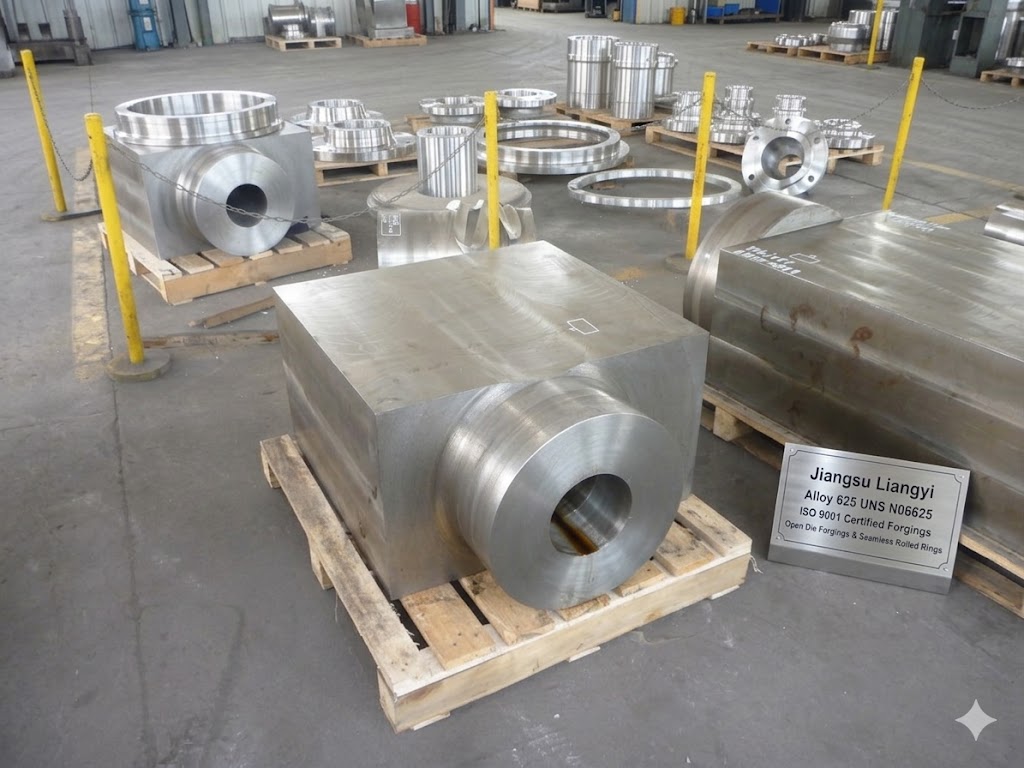
Premium Inconel 625 Forgings From ISO 9001 Certified China Manufacturer
Jiangsu Liangyi Co., Limited is a leading professional manufacturer of Inconel 625 open die forging parts and seamless rolled forged rings in China. With over 25 years of superalloy forging experience, an 80,000 ㎡ modern production base located in Jiangyin, Jiangsu, and advanced forging and inspection equipment, we supply high-quality custom Inconel 625 forged parts that meet ASTM B564, API 6A, EN, DIN, NACE MR0175/ISO 15156 and other international material standards.
Our Inconel 625 forgings are exported to more than 50 countries and regions, with a strong market presence in North America (USA, Canada), Europe (Germany, UK, France, Norway), Middle East (Saudi Arabia, UAE, Kuwait), Southeast Asia (Indonesia, Thailand, Vietnam), and Oceania (Australia, New Zealand). We support important projects in oil and gas, nuclear power, thermal power, marine shipbuilding, petrochemical processing and other heavy industries, and we provide a full range of services from melting, open die forging, seamless ring rolling, heat treatment, machining to full inspection. All products are customized to your drawings and technical specifications.
Material Advantages of Inconel 625 (UNS N06625) Forging Alloy
Inconel 625 is a nickel-chromium-molybdenum-niobium superalloy, widely recognized as the preferred material for important forgings in harsh and corrosive environments. Its main performance advantages include:
- Exceptional Corrosion Resistance: Excellent resistance to pitting corrosion, crevice corrosion, and chloride-induced stress corrosion cracking (SCC), with excellent stability in a wide range of organic acids, mineral acids, alkaline media, and seawater, fully meets NACE MR0175/ISO 15156 for sour service applications.
- Superior High-Temperature Performance: Excellent high-temperature strength, oxidation resistance, and creep rupture strength up to 980 °C, keeping stable mechanical properties in long-term high-temperature and high-pressure working conditions.
- Excellent Forging & Weldability: Good hot workability, weldability, and formability, suitable for intricate custom forging processes, with a minimum forging ratio of 3:1 to ensure uniform and stable internal structure of forgings. Unlike precipitation-hardened alloys, Inconel 625 does not require post-weld heat treatment for most applications.
- Wide Temperature Adaptability: Keeps excellent toughness and mechanical properties from cryogenic temperatures (−253 °C) to high temperatures, suitable for both LNG cryogenic equipment and high-temperature turbine parts.
To guarantee the highest material purity and performance for critical applications, all our Inconel 625 forged materials are produced with strict melting process control, available in two premium melting options: Double Melted (VIM+VAR) and Triple Melted (VIM+ESR+VAR), eliminating internal defects and guaranteeing consistent chemical composition.
A common question we receive is:"Is triple-melted (VIM+ESR+VAR) always better than double-melted?"
From a forging engineering perspective, the answer is: it depends on the application — and specifying triple melting unnecessarily increases material cost by 8–15% . Triple melting delivers superior ultra‑fine inclusion control, making it the best choice material for rotating aerospace parts and important fatigue‑loaded parts where purity is important. For stationary pressure parts, subsea structures, and valve bodies — the majority of oil and gas applications — VIM+VAR double‑melted Inconel 625 fully satisfies ASTM B564 and NACE MR0175 requirements.
We help our customers select the appropriate melting process based on their actual specifications, rather than defaulting to the most expensive option.
Inconel 625 vs. Alternative Alloys — Forging-Specific Comparison
Material selection for important forgings is rarely straightforward. The table below compares Inconel 625 (UNS N06625) with its six most common alternative alloys, using criteria that are especially relevant for forged parts. Unlike generic material datasheets, this comparison includes forging-specific parameters that only a manufacturer can evaluate — such as hot workability range, die wear rate, and needed reheating frequency during forging.
| Parameter | Inconel 625 (UNS N06625) | Inconel 718 (UNS N07718) | Hastelloy C-276 (UNS N10276) | 316L Stainless (UNS S31603) | 2205 Duplex (UNS S32205) | Titanium Gr.5 (UNS R56400) |
|---|
| Alloy Type | Ni-Cr-Mo-Nb solid solution | Ni-Cr-Fe-Mo precipitation hardened | Ni-Mo-Cr solid solution | Austenitic stainless steel | Duplex (austenite + ferrite) SS | Alpha-beta titanium alloy |
| Pitting Resistance (PREN) | ~51 (excellent) | ~32 (moderate) | ~72 (superior) | ~24 (limited) | ~35 (good) | Immune (oxide layer) |
| Chloride SCC Resistance | Excellent (NACE MR0175) | Moderate (varies by HT) | Excellent | Poor (>60 °C risk) | Good (limit <250 °C) | Excellent |
| Max Service Temp. (Oxidizing) | 980 °C | 700 °C (high strength) | 1040 °C | 870 °C (lower strength) | 315 °C (embrittlement risk) | 315 °C (oxidation limit) |
| High-Temp. Strength (RT → 650 °C) | Good (solid solution) | Excellent (precipitation) | Good (solid solution) | Moderate | Drops sharply >300 °C | Moderate |
| Weldability | Excellent — no PWHT needed | Complex — PWHT required | Excellent | Excellent | Good (heat input control) | Good (inert atmosphere) |
| NACE MR0175 Compliance | Yes (Part 3, ≤35HRC) | Yes (with restrictions) | Yes (Part 3) | No (for sour service) | Yes (Part 2, limited) | Conditional (Part 3) |
| Hot Forging Temp. Window | 950–1200 °C (250 °C range) | 980–1120 °C (tight, 140 °C) | 1050–1200 °C (150 °C range) | 1100–1250 °C (easy) | 1100–1250 °C | 850–980 °C (narrow, precise) |
| Work-Hardening Rate (Forging) | High — frequent reheating needed | Very high | High | Moderate | Low to moderate | High |
| Relative Raw Material Cost | High (Ni ~58%, Mo ~9%) | High + Nb premium | Very high (Mo ~16%) | Low (baseline) | Low-moderate | High |
| Best Application Fit | Corrosive + moderate-high temp. | High-load rotating at elevated temp. | Extreme chemical corrosion | General low-corrosion service | Chloride + moderate temp. | Lightweight + corrosive |
Why Inconel 625 wins for most HPHT oil & gas forgings vs. Hastelloy C-276: Although C‑276 has better inherent pitting resistance, it is seldom specified for large forgings weighing more than 500 kg. The reason is practical: C‑276’s high molybdenum content (15–17%) makes it much more susceptible to secondary phase precipitation during slow cooling of heavy‑section forgings — an issue that does not occur with Inconel 625, which contains only 8–10% Mo.
For large valve bodies, BOP parts, and wellhead Christmas trees, Inconel 625 provides comparable in‑service performance, along with better manufacturing stability and lower overall cost. C‑276 remains ideal for thin‑wall tubing and sheet products, where fast quenching can be easily achieved.
Inconel 625 vs. Inconel 718 — the forger's view: Inconel 718 relies on precipitation hardening, which demands strict control over the δ‑phase temperature window. During heavy open‑die forging, if any section cools into the 900–1010 °C δ‑solvus range before forging is finished, localized heterogeneous microstructure and potential cracking can occur. Inconel 625’s solid‑solution strengthening mechanism is much more forgiving: it has no δ‑phase risks. This makes it the safer choice for intricate geometries and very large single‑piece forgings over 5,000 kg.
When to Specify Inconel 625: Material Selection Decision Guide
The following decision guide uses practical engineering thresholds to assist process engineers and procurement teams in determining whether Inconel 625 forgings are the appropriate material choice for a given application. These threshold values are derived from our 25 years of field experience across global oil & gas, power generation, and chemical processing projects.
| Operating Condition | Threshold / Criteria | Specify Inconel 625? | Engineering Rationale |
|---|
| Chloride concentration | Cl⁻ > 1,000 ppm at T > 60 °C | ✔ Yes — mandatory | 316L and 2205 duplex face SCC risk above this threshold. Inconel 625 is immune to chloride SCC at all practical service temperatures. |
| H₂S partial pressure (sour gas) | pH₂S > 0.0035 MPa per NACE MR0175 | ✔ Yes — with hardness ≤ 35HRC | Meets NACE MR0175/ISO 15156 Part 3 for sulfide stress cracking prevention. Hardness must be verified per heat and per thickness location. |
| CO₂ partial pressure | pCO₂ > 0.2 MPa in aqueous environment | ✔ Yes — preferred | CO₂ forms carbonic acid (H₂CO₃), accelerating general and pitting corrosion of carbon and low-alloy steels. Inconel 625 is unaffected across the full CO₂ range seen in oilfield service. |
| Service temperature | Sustained T > 600 °C | ✗ Consider Inconel 718 or Haynes 282 | Above 700 °C, Inconel 625's solid-solution strengthening declines more rapidly than precipitation-hardened alloys. For rotating components above 650 °C, Inconel 718 offers significantly higher creep strength. |
| Service temperature | Cryogenic service down to −196 °C (LNG) | ✔ Yes — fully qualified | Inconel 625 maintains excellent Charpy impact values at −196 °C (typically > 100 J), making it fully qualified for LNG cryogenic valve and pressure vessel service without additional testing requirements. |
| Seawater exposure | Continuous immersion or splash zone, unrestricted | ✔ Yes — gold standard | Inconel 625 is one of very few alloys that can be used in seawater at all temperatures without the need for cathodic protection. It exhibits exceptionally high resistance to crevice corrosion, with no attack observed at 35 °C for more than 6,000 hours under ASTM G48 Method B testing. |
| Strong acid media (HCl, H₂SO₄) | HCl > 5% concentration at RT; H₂SO₄ > 10% concentration | ✗ Consider Hastelloy C-276 or B-3 | In strongly reducing acid environments (concentrated HCl, H₂SO₄ without oxidizing agents), Hastelloy B‑3 or C‑276 outperform Inconel 625. Inconel 625 performs best in oxidizing or mixed corrosion conditions. |
| Component wall thickness | Section thickness > 300 mm (heavy forgings) | ✔ Yes — best-in-class hardenability | Inconel 625’s solid‑solution structure avoids the through‑thickness hardness gradient typical of precipitation‑hardened alloys. Heavy‑section forgings maintain uniform mechanical properties from surface to core, as verified by subsurface mechanical testing. |
| Weld repair / field welding required | On-site welding without PWHT capability | ✔ Yes — PWHT not required | Inconel 625 can be welded using ERNiCrMo‑3 filler metal (AWS A5.14) without preheating or post‑weld heat treatment for most non‑sour service applications, allowing cost‑effective on‑site repairs. This represents a big advantage over Inconel 718. |
| Budget constraint (vs. performance) | Cost is primary driver; corrosion requirement is mild | ✗ Consider 316L, 2205, or Alloy 825 | When H₂S partial pressure is below NACE thresholds and chloride levels are moderate (< 500 ppm), duplex stainless or Alloy 825 (UNS N08825) offers 40–60% cost saving vs. Inconel 625 with adequate performance. |
One threshold that experienced engineers often overlook: The NACE MR0175 Part 3 hardness limit of 35 HRC applies to the finished part. However, for heavy-section forgings over 150 mm in diameter, achieving ≤35 HRC at the core demands extremely precise control over solution annealing temperature and cooling rate. A forging showing 30 HRC at the surface may still reach 38 HRC at the center if the heat treatment cycle is not tailored to its cross-section.
We conduct hardness mapping at multiple depths — surface, T/4, and T/2 — for all NACE‑critical heavy‑section forgings, a quality control step most suppliers omit. If your supplier cannot provide center‑section hardness data, request it — or let us do it for you.
Full Range of Custom Inconel 625 Forging Products
We manufacture a full range of custom Inconel 625 (Alloy 625, UNS N06625) forging products in all kinds of shapes, dimensions, and specifications fully based on your project requirements. Our main product range includes:
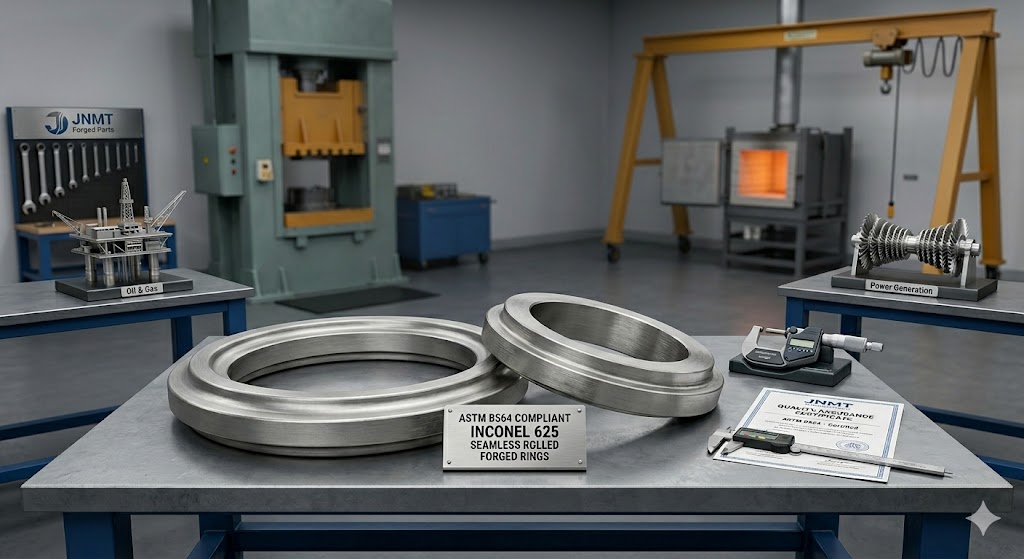
Inconel 625 Forged Bars & Rods
Custom Inconel 625 forged products include round bars, square bars, flat bars, rectangular bars, step shafts, splined shafts, and gear rods. We guarantee a minimum forging ratio of 3:1, with maximum diameter up to 2000 mm, maximum length up to 15 meters, and single-piece weight up to 30 tons. Parts are supplied in fully heat-treated condition, with 100% ultrasonic testing and EN 10204 3.1/3.2 certification available.
Inconel 625 Seamless Rolled Forged Rings
Alloy 625 seamless rolled rings, open‑die forged rings, profiled rolled rings, gear rings and seal rings. The maximum outer diameter is up to 6 meters, the maximum height is up to 800 mm, and single‑piece weight is up to 30 tons. They are the best choice material for important rotating and pressure‑retaining applications in turbines, compressors, valves and wellhead equipment. All of them fully meet ASTM B564.
Inconel 625 Hollow Forgings, Sleeves & Pipes
UNS N06625 seamless hollow forgings, forged sleeves, bushes, casings, heavy‑wall pipes, tubing, hollow bars and cylinder shells. The outer diameter is up to 3000 mm, wall thicknesses range from 20 mm to 500 mm. They are suitable for high‑pressure fluid handling systems, reactor pressure vessels and downhole oilfield equipment.
Inconel 625 Forged Discs, Plates & Blocks
Inconel 625 forged discs, blanks, plates, blocks and flanged blanks. The maximum diameter is up to 3000 mm, thickness is up to 500 mm, and single-piece weight is up to 20 tons. They are widely used for turbine discs, valve bonnets, heat exchanger tube sheets and pressure vessel end caps, with 100% ultrasonic testing in accordance with ASTM A388.
Inconel 625 Valve & Flow Control Forgings
Custom Inconel 625 forged valve parts, including valve bodies, valve bonnets, valve stems, valve balls, valve seat rings, valve cores, valve discs, and butterfly valve spindles. They are suitable for ball valves, gate valves, check valves, globe valves, cryogenic valves, and high-pressure control valves, and all meet API 6D and API 6A standards.
Inconel 625 Turbine, Compressor & Pump Forgings
Alloy 625 forged turbine parts, including turbine rotors, impellers, blades, discs, diaphragm nozzles, guide rings, and labyrinth seals. Also supply forged pump casings, pump impellers, pump shafts, pump housings, and compressor rotors for industrial gas turbines, steam turbines, nuclear reactor coolant pumps, and gas compressors.
Custom Inconel 625 Forged Components
We also produce fully custom Inconel 625 forgings to your drawings, including wellhead Christmas tree parts, casing heads, tubing hangers, BOP bodies, flanges, fasteners, reactor nozzles, and other special‑shaped forgings for heavy industrial applications.
Chemical Composition of Inconel 625 (UNS N06625) Alloy
All our Inconel 625 forging materials are subject to heat-based chemical analysis, with values expressed in mass fraction percentage, they all fully meet ASTM B564, ASTM B443, and AMS 5666 standards. The chemical composition range is as follows:
| Element | Standard Value Range | Compliance Standard | Element | Standard Value Range | Compliance Standard |
|---|
| Carbon (C) | 0.10% Maximum | ASTM Standard | Phosphorus (P) | 0.015% Maximum | ASTM Standard |
| Manganese (Mn) | 0.5% Maximum | ASTM Standard | Sulfur (S) | 0.015% Maximum | ASTM Standard |
| Silicon (Si) | 0.5% Maximum | ASTM Standard | Niobium + Tantalum (Nb+Ta) | 3.15% – 4.15% | ASTM Standard |
| Molybdenum (Mo) | 8.0% – 10.0% | ASTM Standard | Chromium (Cr) | 20.0% – 23.0% | ASTM Standard |
| Nickel (Ni) | 58.0% Minimum (Balance) | ASTM Standard | Iron (Fe) | 5.0% Maximum | ASTM Standard |
| Aluminum (Al) | 0.4% Maximum | ASTM Standard | Titanium (Ti) | 0.4% Maximum | ASTM Standard |
Mechanical Properties & Heat Treatment Specifications
All Inconel 625 forged parts are delivered in the solution‑annealed condition. Mechanical properties are tested at room temperature following the final heat treatment, fully complying with ASTM B564, ASTM A370, ASTM E8, and ISO 6892‑1.
| Section Size (Diameter/Thickness) | Min. Yield Strength (0.2% Offset) | Min. Tensile Strength | Min. Elongation | Min. Reduction of Area |
|---|
| Up to 4 Inches (101.6 mm) | 414 MPa | 827 MPa | 30% | 50% |
| Over 4 Inches up to 10 Inches (254 mm) | 345 MPa | 758 MPa | 25% | 50% |
Extended Physical Properties of Inconel 625 at Elevated Temperatures
The following temperature‑dependent physical properties are important for structural design calculations, finite element analysis (FEA), and thermomechanical fatigue evaluation. These values represent typical data from public technical datasheets of leading material suppliers (Special Metals Corporation, Precision Castparts Corp.) and industry standard references. Actual batch‑specific room‑temperature mechanical properties are fully certified per ASTM B564 for every production lot. Elevated‑temperature mechanical testing can be provided upon request, in accordance with ISO 783 and ASTM E21.
| Property | Unit | 20 °C (RT) | 200 °C | 400 °C | 600 °C | 800 °C |
|---|
| Density | g/cm³ | 8.44 | 8.40 | 8.34 | 8.28 | 8.22 |
| Young's Modulus (E) | GPa | 208 | 196 | 183 | 169 | 152 |
| Shear Modulus (G) | GPa | 79 | 74 | 69 | 64 | 57 |
| Poisson's Ratio (ν) | — | 0.308 | 0.315 | 0.322 | 0.320 | 0.330 |
| Thermal Expansion Coefficient (α) | 10⁻⁶/°C | 12.8 | 13.1 | 13.5 | 14.0 | 14.8 |
| Thermal Conductivity (λ) | W/m·K | 9.8 | 12.5 | 15.6 | 18.8 | 22.5 |
| Specific Heat Capacity (Cp) | J/kg·K | 410 | 435 | 460 | 490 | 530 |
| Electrical Resistivity | μΩ·cm | 129 | 133 | 138 | 141 | 144 |
| 0.2% Yield Strength | MPa | ≥414 | ~365 | ~330 | ~310 | ~275 |
| Tensile Strength | MPa | ≥827 | ~790 | ~760 | ~720 | ~620 |
| Fatigue Strength (10⁸ cycles, R=−1) | MPa | ~345 | ~305 | ~275 | ~240 | ~190 |
Note: Elevated-temperature mechanical properties shown are typical values for annealed bar stock with diameter ranging from 25 to 100 mm. All forgings we deliver are tested at room temperature according to ASTM B564. High-temperature testing to ISO 783 or ASTM E21 can be provided upon request for important high-temperature applications.
Additional Quality & Testing Specifications
- Maximum Hardness: ≤ 35 HRC, fully compliant with NACE MR0175/ISO 15156 Part 3 for sour oilfield service.
- Impact Testing: V-notch Charpy impact test per ASTM A370 or ISO 148-1; average of 3 specimens must meet project specification.
- Non-Destructive Testing (NDT): 100% ultrasonic testing (UT) per ASTM A388; magnetic particle testing (MT) and liquid penetrant testing (PT) available on request.
- Re-test Policy: If initial tensile test results do not meet standard requirements, two additional retests from the same test coupon can be performed for material qualification.
Inconel 625 Forging Process & Manufacturing Capability
We have mastered the mature hot forging process for Inconel 625 superalloy, with strict control over the entire production process to guarantee the internal quality and mechanical properties of forgings. Our main manufacturing process includes:
1. Premium Melting Process
We use premium raw materials for Inconel 625 alloy melting, with double melting (VIM + VAR) and triple melting (VIM + ESR + VAR) options. This process effectively reduces gas content, non-metallic inclusions, and element segregation, so that the material has the high purity and consistency needed for important applications.
2. Precision Open Die Forging Process
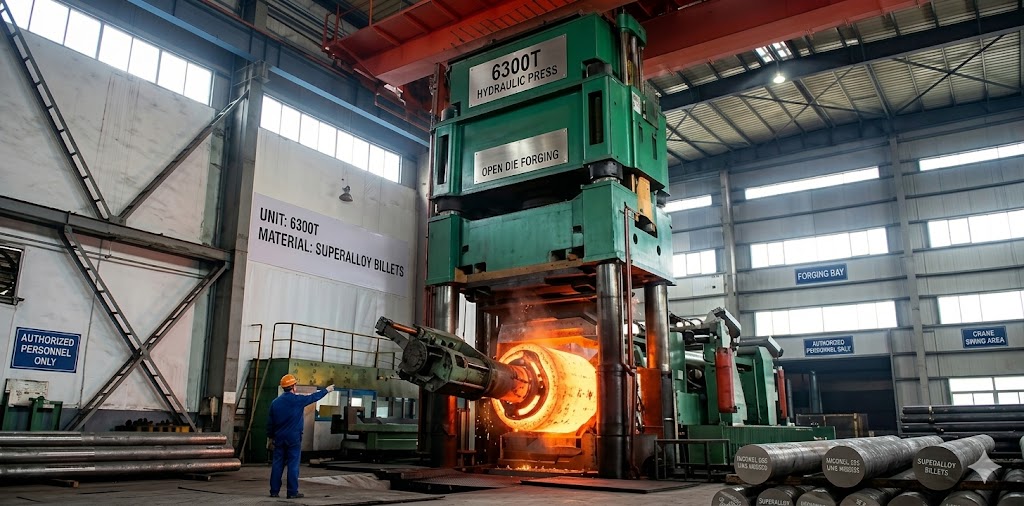
Our Inconel 625 forgings are manufactured using the open‑die forging process, equipped with 2000T, 4000T and 6300T hydraulic forging presses, as well as 1T–5T electro‑hydraulic forging hammers. We maintain strict control over the forging temperature window of 950 °C–1200 °C, with a minimum forging ratio of 3:1 for all forged bars and up to 6:1 for critical parts. This process breaks up the as‑cast microstructure, refines grain size, and eliminates internal defects, making sure the forgings get consistent and stable mechanical properties in all directions.
The sensitization zone risk — what most suppliers won't tell you: Inconel 625 has an important temperature range of about 700 °C to 900 °C, where M₆C and M₂₃C₆ carbides tend to precipitate at grain boundaries if the material is held or slow-cooled in this interval — a phenomenon known as sensitization. A sensitized forging may still meet all room‑temperature mechanical requirements (yield strength, tensile strength, elongation) yet show significantly reduced intergranular corrosion resistance in service, especially in H₂S‑containing sour service environments. Our manufacturing process strictly avoids this critical range:we control intermediate reheating cycles to pass through 700–900 °C as quickly as possible, and all solution annealing treatments conclude with a controlled rapid quench (water or forced air, based on section thickness) specifically engineered to prevent carbide precipitation. Full time‑temperature records for every heat treatment cycle are available upon request.
Work-hardening management: Inconel 625 work-hardens about twice as fast as 316L stainless steel during hot forging. For intricate shapes needing multiple forging passes, we implement more frequent intermediate reheating cycles than for equivalent‑size stainless steel forgings.
This increases furnace time but is essential to achieve the consistent grain matrix needed for NACE MR0175 compliance in heavy‑section parts.
3. Seamless Ring Rolling Process
We employ 1M and 5M CNC seamless ring rolling machines to produce Inconel 625 seamless rolled rings, with precise control over rolling temperature, reduction ratio and dimensional accuracy. This process guarantees continuous and consistent grain flow lines throughout the ring, greatly improving its fatigue resistance and load‑carrying capacity. This makes it the preferred material for high‑pressure and high‑speed rotating applications.
4. Standardized Heat Treatment Process
All Inconel 625 forgings are given standardized solution annealing in our 10 heat treatment furnaces. The standard process involves heating to 980 °C ± 15 °C, holding for a time determined by section thickness (minimum 1 hour per 25 mm of cross-section), followed by rapid quenching. This treatment fully dissolves precipitated phases, relieves residual stress, and makes sure the forgings get an improved balance of strength, toughness, and corrosion resistance.
5. Precision Machining & Finishing
We offer in-house CNC machining services with strict tolerance up to IT7 and surface finish as fine as Ra 0.8 μm. We can conduct the full production flow from forged blank to finished machined part directly to your drawings, shortening your procurement lead time and lowering overall costs.
Step-by-Step Quality Control Process & Rejection Criteria
Our quality management system does a lot more than just give out mill test certificates. Every Inconel 625 forging goes through eight required quality control gates, each with clear rules for what is acceptable and what is not. This process is the same for every order, whether it's a prototype or a full production batch, and it can't be skipped.
Incoming Raw Material Verification
All incoming Inconel 625 ingots and billets are inspected prior to production. This includes PMI (Positive Material Identification) via XRF spectrometer to verify the exact alloy grade, plus dimensional and visual inspection to guarantee no surface defects, centerline segregation, piping, or excessive porosity from the original casting.
Rejection: XRF result deviation > 0.5% from spec on any major element (Ni, Cr, Mo) Pass: Full element profile within ASTM B443/B564 range + original melt MTC reviewed Pre-Forging Heating Temperature Verification
Prior to each forging heat, furnace temperature is verified using calibrated Type‑S thermocouples with calibration traceable to NIST. Billet surface temperature is also measured at the furnace exit using an optical pyrometer. Forging commences only after confirming the billet is within the working range of 1050–1200 °C.
Rejection: Billet surface temperature < 1000 °C or > 1220 °C at forge start; no forging without verification Pass: Surface temperature 1050–1200 °C confirmed; time-temperature records logged per heat In-Process Forging Ratio Verification
Forging ratio is calculated by comparing the cross‑sectional area of the ingot or billet to that of the final forged product. To meet ASTM B564 requirements, the minimum total forging reduction is 3:1 for bars and 4:1 for rings. Forging records — including number of strokes and intermediate dimensions — are kept and filed with the order traveler.
Rejection: Calculated forging ratio < 3:1 (bars) or < 4:1 (rings) at any cross-section location Pass: Forging ratio meets or exceeds specification; recorded on order traveler Heat Treatment Cycle Verification (Solution Anneal + Quench)
All Inconel 625 forgings are solution annealed at 980 °C ± 15 °C in calibrated furnaces. Hold time is at least 1 hour per 25 mm of maximum section thickness, calculated from the actual forging dimensions. Quenching is completed within 60 seconds of removal from the furnace. Full time‑temperature data logger records (chart or digital log) are archived for each batch.
Rejection: Peak temperature < 965 °C or > 995 °C; hold time insufficient; quench delay > 90 seconds Pass: Complete time-temperature record within specification; quench time verified by operator log Chemical Analysis (Heat-Based Certification)
One set of chemical analysis samples is taken per heat (melt batch). Analysis is carried out using optical emission spectrometry (OES) on calibrated equipment. All 12 elements required by ASTM B564 are reported and compared against the specification limits. The complete chemical composition is documented on the EN 10204 3.1 mill test certificate.
Rejection: Any element outside ASTM B564/B443 specification; Nb+Ta < 3.15% or > 4.15% are the most commonly failed elements in substandard material Pass: All elements within ASTM specification; results recorded on MTC with laboratory instrument ID Room Temperature Mechanical Testing
One tensile test specimen and three Charpy impact specimens are prepared from a test coupon from the same heat‑treatment batch. Tensile testing is performed to ASTM E8 / ISO 6892‑1, and Charpy impact testing to ASTM A370 / ISO 148‑1.
For parts intended for NACE MR0175 sour service, Brinell or Rockwell hardness is also measured at the surface, T/4 depth, and T/2 (center) positions using cross‑section samples from representative forgings.
Rejection: Tensile strength < 827 MPa (≤4" section); yield < 414 MPa; elongation < 30%; hardness > 35HRC at any location for NACE parts Pass: All values at or above ASTM B564 minima; NACE hardness confirmed ≤35HRC at surface AND center 100% Ultrasonic Testing (UT) per ASTM A388
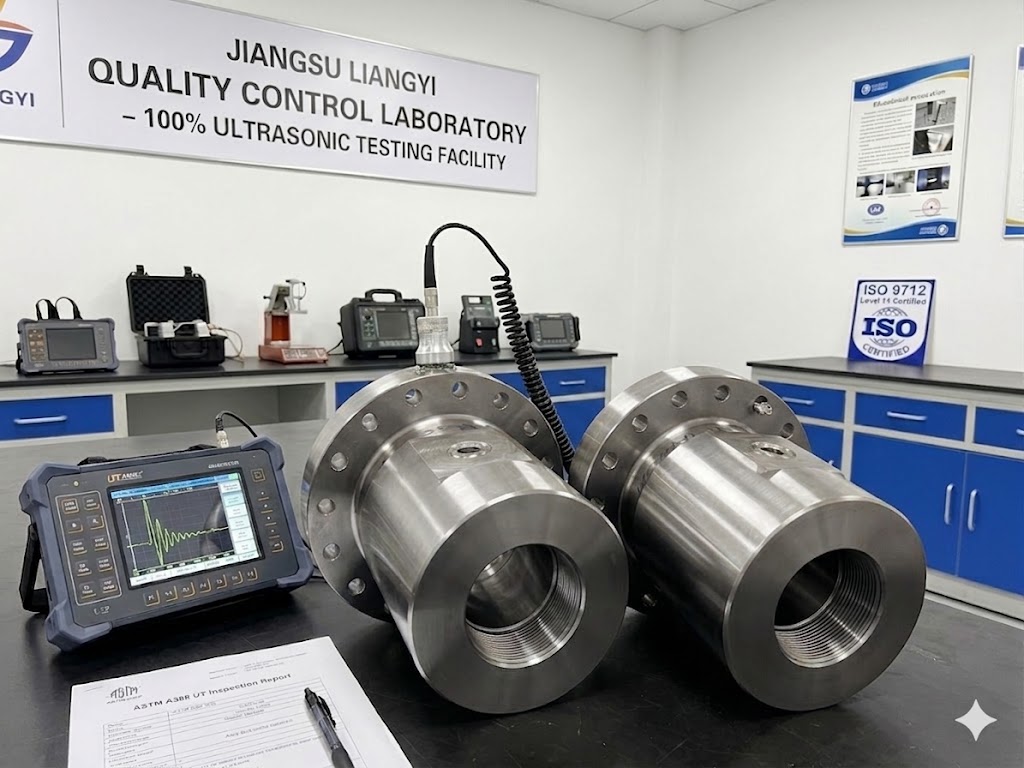
Every Inconel 625 forging is given 100% ultrasonic testing by certified Level II UT technicians (per SNT‑TC‑1A or ISO 9712), using calibrated straight‑beam and angle‑beam probes. Testing uses a side‑drilled hole (SDH) reference block made from the same or equivalent alloy. All indications exceeding the reference notch amplitude are assessed and documented. Full UT inspection reports are available on request.
Rejection: Any single discontinuity indication exceeding 100% of the calibration reflector amplitude; any linear indication; any area showing back-reflection loss > 6dB from nominal Pass: Zero rejectable indications per ASTM A388 acceptance criteria; scan coverage report signed and dated Dimension test and Final Document Review
Final dimension test is carried out using calibrated measuring equipment (CMM, vernier calipers, micrometers, gauge blocks) against approved drawings or specifications. All critical dimensions are documented in a dimensional inspection report. The full documentation package — including MTC, UT report, heat treatment chart, dimensional report, and order conformance statement — is reviewed and approved by our QC manager prior to shipment release.
Rejection: Any dimension outside drawing tolerance; missing or incomplete documentation; MTC not signed by responsible party Pass: All dimensions conforming; complete documentation package issued; EN 10204 3.1 MTC signed Third-Party Inspection (EN 10204 Type 3.2): For orders needing third‑party witness inspection (SGS, Bureau Veritas, Intertek, Lloyd's Register, DNV, TÜV, etc.), we coordinate directly with the inspection authority from order acknowledgment through to final release.
Type 3.2 certificates need the third‑party inspector to be physically present during mechanical testing and to countersign the MTC. Please inform us of EN 10204 3.2 requirements at order placement — adding 3.2 inspection after production has started will significantly impact lead time and cannot always be accommodated.
Understanding Inconel 625 Forging Failures: Root Causes & Prevention
Inconel 625 has an excellent service track record in demanding environments. However, failures can still occur — and nearly all can be traced back to processing deviations, design oversights, or specification mismatches, rather than inherent material limitations. We are a manufacturer with more than 25 years of experience making superalloy forgings. We have looked into and studied the following failure modes that we have seen in parts that were sent back to us or that were found during customer inspections. We share this information freely because knowing how things might go wrong is just as important as knowing how well they should work.
Failure Mode 1: Intergranular Corrosion (Sensitization)
Description
Accelerated corrosion along grain boundaries, resulting in material loss or cracking preferentially at grain interfaces rather than through grains.
Root Cause
Exposure of the forging to the sensitization temperature range (700–900 °C) during forging, heat treatment, or subsequent welding — causing Cr-rich M₂₃C₆ carbide precipitation and creating Cr-depleted zones adjacent to grain boundaries.
Identifying Markers
ASTM G28 Method A or B intergranular corrosion test reveals accelerated weight loss; metallographic examination shows grain boundary attack in etched cross-sections.
Prevention at Jiangsu Liangyi
Strict time-temperature-deformation scheduling to avoid the sensitization zone; all solution annealing cycles end with mandatory rapid quench; heat treatment records reviewed per batch.
Failure Mode 2: Stress Corrosion Cracking (SCC) in High-Chloride Service
Description
Cracking under the combined action of tensile stress, a corrosive chloride environment, and elevated temperature. Cracks typically initiate at surface features (thread roots, weld toes, sharp corners) and propagate transgranularly or intergranularly.
Root Cause
This issue most often stems from parts labeled as Inconel 625 but failing to satisfy NACE MR0175 hardness requirements at the center of heavy sections. Failed components have shown hardness readings of 38–42 HRC in the core, even with acceptable surface hardness, because some suppliers do not perform testing at T/2 mid‑thickness.
Prevention at Jiangsu Liangyi
Three-point hardness testing (surface, T/4, T/2) for all NACE-designated forgings above 75 mm section thickness. Center hardness must be ≤35HRC without exception before shipment.
Failure Mode 3: Hydrogen-Induced Cracking (HIC) in HPHT Wells
Description
Subsurface cracking caused by atomic hydrogen absorption in H₂S-rich environments. Unlike SCC, HIC typically does not need applied tensile stress and can occur in forgings under low-stress or even compressive residual stress conditions.
Root Cause
Carbon content above 0.08% (near the 0.10% maximum limit), paired with an incompletely annealed microstructure, can form carbide‑matrix interfaces that act as hydrogen traps. This issue is further worsened by residual hydrogen from melting if VIM vacuum degassing was insufficient.
Prevention at Jiangsu Liangyi
For sour service applications, we control carbon to ≤0.06% (well below the specification maximum of ≤0.10%). VIM vacuum degassing is strictly monitored to achieve <5 ppm hydrogen in the molten alloy. All high-pressure/high-temperature (HPHT) forgings receive a hydrogen bake-out treatment at 250 °C for a minimum of 4 hours after final machining where applicable.
Failure Mode 4: Hot Tear / Forging Crack from Inadequate Preheat
Description
Visible or subsurface longitudinal or transverse cracking in the forging, detected at UT or surface inspection. Usually appears as sharp-edged linear indications on UT, or visible surface ruptures.
Root Cause
Forging initiated at too low a temperature (below 980 °C) —either from insufficient soaking time to get consistent through‑thickness heating,or from excessive delay between removing the billet from the furnace and the first forging stroke.
Due to Inconel 625’s high work‑hardening rate, cold regions in thick billets can lead to severe, catastrophic tearing when pressure is applied to improperly soaked sections.
Prevention at Jiangsu Liangyi
Minimum soak time of 1.5 hours per 100 mm of billet diameter at 1150 °C before forging; maximum allowable time from furnace to first press stroke is 45 seconds for billets > 300 mm diameter; pyrometer check at press entry is mandatory.
Welding & Joining Guide for Inconel 625 Forgings
Inconel 625 is among the most weldable nickel‑based superalloys, which is a primary reason it dominates applications requiring field repairs, weld overlay cladding, or dissimilar metal joining. The welding specifications below are derived from our manufacturing experience and comply with AWS, ASME, and NACE requirements.
Recommended Welding Processes
| Process | Standard Designation | Filler Metal | AWS Classification | Best Application | PWHT Required? |
|---|
| GTAW (TIG) | AWS D1.1 / ASME Section IX | ERNiCrMo-3 | AWS A5.14 | Root passes, thin-wall, precision components | No (most applications) |
| GMAW (MIG) | AWS D1.1 / ASME Section IX | ERNiCrMo-3 | AWS A5.14 | Fill and cap passes, higher deposition rate | No (most applications) |
| SMAW (Stick) | AWS D1.1 / ASME Section IX | ENiCrMo-3 | AWS A5.11 | Field repair, limited access joints | No (most applications) |
| SAW | ASME Section IX | ERNiCrMo-3 | AWS A5.14 | Heavy weld overlay on CS pressure vessels | Consult application engineer |
| PAW | ASME Section IX | ERNiCrMo-3 | AWS A5.14 | Keyhole welding of heavy wall pipes | No (most applications) |
Critical Welding Practice Notes
- No Pre-Heat Required: Unlike many high-strength steels, Inconel 625 does not need pre-heating before welding for standard structural applications. For very thick sections (> 75 mm) in cold ambient conditions (< 5 °C), a mild pre-heat to 50 °C is recommended to remove moisture only — not for metallurgical reasons.
- Inter-Pass Temperature: Maximum inter-pass temperature should be controlled to ≤ 150 °C to prevent sensitization and maintain corrosion resistance. Allow cooling between passes as necessary when welding in the flat or horizontal position.
- Avoid the 700–900 °C Sensitization Zone: Do not allow extended time in this temperature range — this applies during welding of heavy sections where slow cooling through this zone can occur. For critical sour service components, a post-weld solution anneal at 980 °C + rapid quench is recommended.
- Dissimilar Welds to Carbon Steel: When joining Inconel 625 forgings to carbon or low-alloy steel parts, ERNiCrMo-3 filler is the standard choice. It provides adequate dilution resistance and prevents carbon migration into the Inconel side of the joint. A buttering pass on the steel side is recommended for wall thicknesses above 40 mm.
- PWHT for NACE Sour Service: While PWHT is not needed for mechanical integrity in most applications, NACE MR0175/ISO 15156 Part 3 requires that the hardness of the weld and heat-affected zone (HAZ) must also satisfy ≤ 35HRC. We recommend performing a hardness survey of the weld cross-section for any NACE-designated welded assembly. If HAZ hardness exceeds 35HRC, a post-weld solution anneal is mandatory.
- Shielding Gas: Use pure Argon (Ar 99.999%) or Ar/He mixtures for GTAW. Avoid CO₂-containing shielding gases, which increase carbon pickup in the weld metal and can initiate sensitization.
Why ERNiCrMo-3 and not the base alloy composition? ERNiCrMo‑3, the matching filler metal for Inconel 625, is not identical to the base alloy. It is slightly enriched in niobium (Nb) and has lower carbon (C) content, specifically to counteract dilution effects and reduce hot cracking susceptibility in the weld pool. Using non‑standard filler metals — such as pure nickel or low‑chromium‑molybdenum alternatives — is a frequent root cause of field failures we have analyzed for customers. We strongly recommend only using certified ERNiCrMo‑3 filler wire with full mill certification complying with AWS A5.14.
What Drives the Price of Custom Inconel 625 Forgings?
Inconel 625 forgings represent a substantial investment in any procurement budget. Transparent cost communication is one of our main principles — we believe you should fully understand what your budget covers. The following breakdown outlines the typical cost structure for custom Inconel 625 forgings at Jiangsu Liangyi,along with practical guidance on where cost can and cannot be reduced without compromising quality and performance.
Raw Material (Ni + Mo + Nb) NDT, Testing & Certification CNC Machining (if applicable) Packaging, Export & Overhead Six Cost Drivers Explained — And How to Optimize Each
- Raw Material (47% of cost): Nickel (about 58% of the alloy composition) and molybdenum (around 9%) are exchange-traded commodities with highly volatile spot prices. Nickel alone can fluctuate between USD 12,000/t and USD 35,000/t within a single year.
To lock in favorable pricing, we source raw materials back-to-back with your order. Purchasing during a nickel price low can lower your total forging cost by 15–20%. We can provide real-time market trend analysis upon your request.
- Melting Grade (within raw material): Specifying triple-melted (VIM+ESR+VAR) instead of double-melted (VIM+VAR) adds 8–15% to material cost alone. For most oil and gas valve and wellhead parts, VIM+VAR is fully sufficient. Triple melting is only justified for rotating parts with high fatigue demands. We recommend letting us review your application specification before defaulting to triple-melt.
- Forging Complexity: Simple round bars and symmetric rings are the most cost-effective shapes for Inconel 625. Intricate custom profiles with undercuts, flanges, or multiple diameter steps require custom tooling (typically USD 2,000–8,000 for die sets) and longer forging processes. For small-batch intricate parts, near-net forging plus CNC machining is often more economical than investing in closed-die tooling.
- Section Thickness and Forging Ratio: Very thick sections (over 300 mm) need larger starting ingots, more reheating cycles, and longer solution annealing soak times, which increase both furnace occupancy and energy costs. The 3:1 minimum forging ratio is a metallurgical requirement that cannot be lowered to save money. It makes sure that the grain is refined and that the mechanical properties are the same throughout the entire cross-section.
- Documentation Level (3.1 vs. 3.2): EN 10204 Type 3.1 (signed by our in-house inspection representative) is standard and included in our base price. Type 3.2 (countersigned by an independent third-party inspector) adds lab coordination, witness fees, and scheduling delays — typically increasing total order cost by 3–7% and lead time by 5–10 working days. Please clearly state your documentation requirement at order placement.
- Quantity and Delivery Schedule: As a direct manufacturer based in China, we apply no distributor markup. Our most competitive unit pricing is got at batch sizes of 500 kg and above per material heat. Expedite surcharges apply for urgent deliveries to cover overtime production and scheduling. Standard lead times (15–25 days for simple forgings) include no expedite premium.
The most common buyer mistake we see: Specifying “triple‑melted per AMS 2280 Class 1” on a purchase order for a static pressure vessel nozzle is often overengineered. AMS 2280 is an aerospace cleanliness standard intended for rotating aero‑engine discs, and is generally unnecessary for oil and gas structural forgings. It adds 12–18% to procurement cost and creates extra lead time for specialized melt qualification. If your specification includes this requirement, we recommend having your materials engineer review whether the original justification still applies to your actual operating conditions. We have helped many customers adjust over‑specified requirements and lower procurement costs without compromising safety or performance.
GEO-Targeted Industry Applications & Global Project Cases
Our Inconel 625 forging parts have been widely used in important industrial projects worldwide. Our main application industries and regional project cases are as follows:
| Target Region | Core Standards | Key Industries | Proven Project Cases |
|---|
| North America (USA, Canada) | ASTM, ASME, API 6A, API 6D, NACE MR0175 | Shale Gas, Offshore Oil & Gas, LNG Terminals, Nuclear Power | Supplied Inconel 625 forged BOP bodies, wellhead components, and valve parts for multiple shale gas projects in Texas, USA; Custom forged cryogenic valve components for Canadian LNG terminal projects, with 8+ years of stable service in harsh working conditions. |
| Europe (Germany, UK, France, Norway) | EN, DIN, NORSOK, ISO Standards (CE/PED documentation support available) | Nuclear Power, Offshore Wind, Marine Shipbuilding, Petrochemical | Supplied Inconel 625 nuclear reactor coolant pump forgings for European nuclear power plant projects; Custom forged turbine components and subsea equipment forgings for North Sea offshore oil & gas projects in Norway, fully compliant with NORSOK standards. |
| Middle East (Saudi Arabia, UAE, Kuwait) | API 6A material requirements, NACE MR0175, ASTM | Onshore and Offshore Oil & Gas, Petrochemical Refineries | Supplied Inconel 625 forged wellhead Christmas tree components, casing hangers, and high-pressure valve bodies for major onshore oilfield projects in Saudi Arabia; Custom forged heat exchanger forgings for refinery expansion projects in the UAE, adapted to high H₂S sour service environments per NACE MR0175. |
| Southeast Asia (Indonesia, Thailand, Vietnam) | ASTM, ASME, API Standards | Thermal Power Generation, LNG, Petrochemical | Supplied Inconel 625 steam turbine rotor forgings, valve components, and boiler parts for multiple coal-fired thermal power plant projects in Indonesia and Thailand; Custom forged pipeline components for petrochemical projects in Vietnam. |
| Oceania (Australia, New Zealand) | AS Standards, API, NACE MR0175 | Mining, Offshore Oil & Gas, LNG | Supplied Inconel 625 forged mining equipment components and corrosion-resistant valve parts for Australian hard-rock mining projects; Custom forged subsea pipeline forgings for Australian offshore gas field projects. |
Detailed Industry Application Scenarios
Oil and Gas Industry
Inconel 625 is the best choice material for oil and gas equipment operating in high H₂S, high CO₂, high chloride, and HPHT environments. Our Inconel 625 forged parts are widely used for Blowout Preventer (BOP) bodies and rams, wellhead Christmas tree parts, casing heads, tubing hangers, downhole drilling tools, mud motor shafts, ESP pump parts, high-pressure valve bodies and stems, risers, flanges, and subsea equipment.
Power Generation Industry
Inconel 625 forgings from Jiangsu Liangyi are used for thermal power, nuclear power, gas turbine and renewable energy projects, and they have reliable high-temperature performance. Typical applications include steam turbine rotors, impellers, blades, valve stems and seats, gas turbine compressor impellers, labyrinth seals, nuclear reactor coolant pump casings and impellers, boiler parts, and heat exchanger parts. These parts have excellent high-temperature oxidation resistance and long-term service stability.
Marine and Shipbuilding Industry
Featuring outstanding seawater corrosion resistance, our Inconel 625 forged parts are widely used in submarine auxiliary propulsion motor shafts, marine valve parts, seawater pipeline systems, shipboard heat exchangers, and offshore platform equipment. They are fully suitable for harsh marine environments with high salt spray, high humidity, and severe corrosive conditions.
Petrochemical and Chemical Processing Industry
Our Inconel 625 forgings are perfectly suited for harsh chemical processing environments. They are widely used in pressure vessel shells and nozzles, heat exchanger tube sheets, reactor parts, chemical pump bodies and impellers, pipeline flanges, and highly corrosion-resistant fittings, and they have excellent resistance to strong acids, alkalis, and organic corrosive media.
Real-World Application Stories: How Our Inconel 625 Forgings Performed
Below are anonymized summaries of real-world projects using our Inconel 625 forgings. Details have been generalized to protect customer confidentiality, but the technical challenges, solutions, and results are based on our actual project records.
Oil & Gas — North America HPHT Wellhead Components for Sour Gas Field, Texas USA
The Challenge
A North American EPC contractor required large forged wellhead Christmas tree parts for a HPHT sour gas well, with H₂S partial pressure 0.014 MPa and bottom-hole temperature 175 °C. Components from their previous supplier failed NACE MR0175 hardness requirements at the core of 200 mm wall-thickness sections, putting project commissioning at risk.
Our Solution
We developed a tailored heat treatment process: extending the holding time at 980 °C to 12 hours for 200 mm thick sections, combined with rapid water quenching, to ensure hardness ≤ 32 HRC at the T/2 center position. Hardness mapping was conducted at 9 measuring points on each forging cross-section, with full individual test reports provided for all 24 parts.
✔ All 24 parts passed NACE MR0175 hardness at center (max. 31.5HRC). Delivered within 38 days. No rework needed. Project commissioned on schedule.
Power Generation — Europe High-Integrity Pump Forgings for European Power Plant, Full Traceability Required
The Challenge
A European power plant equipment maker needed Inconel 625 forged shaft sleeves and impeller blanks for high-pressure coolant pump parts. They required triple-melted (VIM+ESR+VAR) material that can be traced from each billet to its certificate, 100% ultrasonic testing as per ASTM A388, 100% liquid penetrant testing (PT), and an EN 10204 Type 3.2 mill certificate signed by Bureau Veritas as a third party. The dimensional tolerances were stricter than normal (±0.5 mm on critical diameters).
Our Solution
We supplied VIM+ESR+VAR triple-melted Inconel 625 forgings with complete traceability from heat and forging to certificate. Each forging had a unique serial number that could be tracked to the original melt batch, ingot position, forging process, and heat treatment record. Our in-house ISO 9712 Level II certified technicians tested all of the parts with 100% UT and 100% PT. The mechanical tests were watched by Bureau Veritas, which then signed the EN 10204 Type 3.2 MTC certificate.
✔ Zero NDT rejections. EN 10204 Type 3.2 certificates accepted by the customer's QA department on first submission. All forgings met dimensional requirements without rework. Delivered within 38 days of order placement.
Petrochemical — Middle East Emergency Replacement Valve Bodies for Refinery Turnaround, UAE
The Challenge
During an unplanned maintenance shutdown, a petrochemical refinery in the UAE needed eight Inconel 625 high-pressure valve bodies as emergency replacements. The company that used to supply them couldn't meet the 25-day delivery deadline. Each valve body weighed between 180 kg and 420 kg, with intricate inner cavity shapes that needed rough machining to finished blanks before shipping.
Our Solution
We found available Inconel 625 VIM+VAR billet stock that matched the needed heat and rearranged our production schedule to prioritize this order. We finished forging, heat treatment, rough machining, full NDT testing including UT and PT, and issued the EN 10204 Type 3.1 certificate in just 22 days. An expedite fee was agreed upon when the order was placed. All digital documents were sent within 24 hours after shipping.
✔ All 8 valve bodies delivered in 22 days, 3 days ahead of the shutdown deadline. Refinery restart completed on schedule. The customer subsequently placed three follow-on orders for scheduled turnaround forgings.
Global Standards & Compliance Certification
Our Inconel 625 forging production and quality management system fully meet international and regional standards. Our main certifications and compliant standards include:
- Quality Management System: ISO 9001:2015 certified, with strict quality control throughout the whole production process.
- Material Standards: ASTM B564, ASTM B443, AMS 5666, EN 2.4856 and DIN NiCr22Mo9Nb
- Oil & Gas Industry Standards: API 6A, API 6D and NACE MR0175/ISO 15156 for sour service applications.
- European Market Material Compliance: Our products are made according to EN and DIN material standards used for European pressure equipment projects. We offer complete material documentation packages to help you with your CE/PED verification and NORSOK approval applications. These packages include EN 10204 material test certificates, dimensional reports, and NDT records. The pressure equipment manufacturer (our customer) is in charge of CE marking and PED notified-body certification, not the forging material supplier.
- Pressure Equipment Material Standards: Inconel 625 forging materials are supplied to ASTM B564 / ASME SB-564, which is the material specification referenced by the ASME Boiler & Pressure Vessel Code (BPVC) for nickel alloy forgings used in North American pressure vessel fabrication.
- Inspection & Documentation: All products are supplied with EN 10204 Type 3.1 Mill Test Certificate (MTC), with Type 3.2 third-party certified inspection documents available on request.
Packaging, Export Compliance & Shipping Guide
Inconel 625 forgings are high-value parts that need careful handling from our factory to your site. Below is our standard export process, document checklist, and packaging specification. We have shipped to more than 50 countries and have full experience with entry requirements in North America, Europe, the Middle East, Southeast Asia, and Oceania.
Packaging Standards
- Small parts (<100 kg): individual plastic wrapping + foam cushioning in wooden crate (fumigation-free plywood)
- Medium forgings (100–2,000 kg): rust-preventive oil coating + VCI (Volatile Corrosion Inhibitor) film wrap + wooden pallet with steel strapping
- Large/heavy forgings (>2,000 kg): heavy-duty steel pallet or custom-welded steel frame; 4-point lifting lug welded where required
- All crates marked with gross weight, dimensions, country of origin, and handling instructions (THIS SIDE UP, DO NOT STACK)
- ISPM 15 compliant fumigated wood packaging for all ocean freight shipments
Standard Export Documents
- Commercial Invoice (quantity, unit price, HS code, country of origin)
- Packing List (piece count, gross/net weight, dimensions per crate)
- Bill of Lading (B/L) or Airway Bill (AWB)
- Certificate of Origin (CO) — FORM A for EU GSP, or standard CO from Jiangyin CCPIT
- EN 10204 Type 3.1 Mill Test Certificate (MTC)
- UT Inspection Report, Heat Treatment Records (per order)
- Fumigation Certificate (for wooden packaging)
Incoterms and Shipping Options
- EXW (Ex Works Jiangyin): Customer arranges all freight; we prepare goods for pickup
- FOB (Free on Board Shanghai or Ningbo Port): Most common for ocean freight; we deliver to port and handle export customs
- CIF (Cost, Insurance, Freight): We arrange and pay for freight + marine insurance to destination port
- DAP (Delivered at Place): Door-to-door delivery to your facility; available for most countries
- Air freight available for urgent orders <500 kg; DHL / FedEx for samples and small parts
Import Compliance Notes by Region
- USA: HS Code 7326.19 or 7228.60 (forged nickel alloy bars/shapes); Section 232 steel tariffs do not apply to nickel alloys; ECCN EAR99 (no export license required for Inconel 625)
- EU: CN 7228.60 for forged bars; full EN 10204 material documents provided to support your CE/PED compliance checks. Inconel 625 forged parts are metal products and do not contain SVHC substances above the 0.1% weight limit under EU REACH Regulation (EC) No 1907/2006. REACH compliance papers are available upon request.
- Saudi Arabia / UAE: We provide complete technical documentation packages including material certificates, test reports, dimension test records and EN 10204 MTC to meet your local compliance requirements. Please note that SABER (Saudi Arabia) and ECAS (UAE) conformity registration is usually handled by the importer or system integrator, and we will supply all necessary technical documents on time.
- Australia: DIBP import permit not required; standard HS 7228.60; phytosanitary certificate for wood packaging upon request
Frequently Asked Questions (FAQ) About Inconel 625 Forgings
What is the difference between Inconel 625 and Inconel 718 for forging applications?
Inconel 625 (UNS N06625) is a solid-solution strengthened superalloy with excellent corrosion resistance, especially in chloride and H₂S sour environments. It also has good weldability, and most applications do not need heat treatment after welding. Inconel 718 (UNS N07718) is a precipitation-hardened superalloy with higher high-temperature strength up to 700 °C, used for high-load rotating parts such as turbine discs and aerospace parts. From a forger’s view, Inconel 625 has a wider and more flexible hot working temperature range of 950–1200 °C, while Inconel 718 only works at 980–1120 °C. The risk of delta-phase formation in 718 makes temperature control much more important. For large single-piece forgings over 5,000 kg, Inconel 625 is generally easier to produce with stable properties throughout the whole section.
What is the recommended forging temperature range for Inconel 625 alloy?
The recommended hot forging temperature range for Inconel 625 is 950 °C to 1200 °C. For heavy reduction forging, the temperature should be controlled between 1100 °C and 1200 °C. The final forging temperature should not be lower than 950 °C to prevent cracking. Importantly, Inconel 625 must never be formed or slow-cooled in the 700–900 °C sensitization range, where chromium-rich M₂₃C₆ carbides can form at grain boundaries and lower corrosion resistance during use. Jiangsu Liangyi strictly controls forging temperatures, reheating cycles, and cooling speeds to stay completely out of this temperature range.
Is Inconel 625 the same material as EN 2.4856, DIN NiCr22Mo9Nb, or NCF 625?
Yes. Inconel 625, Alloy 625, UNS N06625, EN 2.4856, DIN NiCr22Mo9Nb, W.Nr. 2.4856, NCF 625 (JIS G4902), and ERNiCrMo-3 (filler metal) all refer to the same nickel-chromium-molybdenum-niobium superalloy with nearly the same chemical makeup. The brand name “Inconel 625” was first registered by Special Metals Corporation; different names are used by standards organizations in different countries (UNS for the US, EN/W.Nr. for Europe, DIN for Germany, JIS for Japan). When checking a purchase order or specification, any of these names may be used as equivalent and interchangeable material terms, as long as the chemical composition meets your needed standard (such as ASTM B564, EN 10269, AMS 5666).
Can you provide custom Inconel 625 forgings according to our drawings?
Yes. We specialize in custom Inconel 625 forging parts fully made to your 2D/3D drawings, technical specs, and project needs. We provide a full range of services from material melting, forging, heat treatment, machining to complete inspection, and can handle everything from prototype development to mass production orders. Our engineering team will check your drawings and give professional forging process advice to improve product performance and lower procurement costs. We accept DXF, DWG, STEP, and PDF drawing formats.
What is the lead time for custom Inconel 625 forging parts?
Lead time for custom Inconel 625 forgings depends on product drawings, size, order quantity, and document requirements. For standard forged bars and simple rings, lead time is usually 15–25 days. For intricate custom forgings that need machining, lead time is normally 30–45 days. For orders needing EN 10204 Type 3.2 third-party inspection, add an extra 5–10 working days for inspection arrangement. We also can speed up production for urgent orders, with an agreed scheduling fee when placing the order.
Are your Inconel 625 forgings compliant with NACE MR0175 for sour oilfield service?
Yes. All Inconel 625 forging parts used for oil and gas sour service and they all fully meet NACE MR0175/ISO 15156 Part 3 requirements. We strictly control the material’s chemical composition, heat treatment process and hardness (≤35HRC). For heavy section forgings with diameter or thickness over 75 mm, we check hardness at the surface, T/4 depth and T/2 center position, not just the surface, to guarantee full compliance through the entire section. Test reports and certification papers are provided with every NACE order.
Does Inconel 625 require post-weld heat treatment (PWHT) after welding?
Inconel 625 usually does not need post-weld heat treatment (PWHT) to keep its mechanical strength — this is one of its main advantages over precipitation-hardened alloys like Inconel 718. However, for parts used in NACE MR0175 sour service where the weld HAZ hardness must also be ≤35HRC, we recommend a post-weld solution anneal at 980 °C followed by fast cooling. Also, for parts that need the highest corrosion resistance in harsh environments, post-weld annealing brings back the best grain boundary condition. Our engineering team gives custom PWHT advice for each welded assembly order.
What is the maximum forging size and weight you can produce in Inconel 625?
Our maximum production capacity for Inconel 625 forgings is as follows: single-piece weight up to 30,000 kg (30 metric tons); forged bars with a maximum diameter of 2,000 mm and maximum length of 15 meters; seamless rolled rings with a maximum outer diameter of 6,000 mm (6 meters) and maximum height of 800 mm; hollow forgings with an outer diameter up to 3,000 mm and wall thickness ranging from 20 mm to 500 mm; forged discs and blocks with a maximum diameter of 3,000 mm and thickness up to 500 mm. If your requirements go beyond these sizes, please contact our engineering team. We have manufactured extra-large parts using specially designed multi-heat forging processes.
What factors affect the price of custom Inconel 625 forgings, and how can I reduce costs?
The price of custom Inconel 625 forgings depends on six main factors:(1) Raw material cost – about 47% of the total price, affected by market prices of nickel and molybdenum;(2) Melting grade – VIM+VAR versus VIM+ESR+VAR increases material cost by 8–15%;(3) Forging complexity and tooling cost;(4) Heat treatment requirements and section thickness;(5) NDT and documentation level – EN 10204 3.2 adds 3–7% compared to standard 3.1;(6) Delivery speed.
Ways to lower costs include: using near-net forged shapes instead of fully machined parts; ordering in batches to spread setup costs; choosing VIM+VAR (double-melt) for parts that do not rotate; and using Type 3.1 MTC unless 3.2 is required by your end customer. Send us your specifications and we will find the most cost-effective solution without breaking compliance rules.
Can Inconel 625 forgings be used at cryogenic temperatures for LNG service?
Yes. Inconel 625 is fully suitable for cryogenic use down to −196 °C (liquid nitrogen) and −253 °C (liquid hydrogen). Unlike ferritic and martensitic steels, Inconel 625 does not become brittle at very low temperatures. It keeps excellent Charpy impact strength (usually above 100 J at −196 °C) with no special low-temperature treatment needed. It is widely used for LNG terminal valve bodies, cryogenic pump parts, liquefaction heat exchanger forgings, and LNG carrier tank structural parts. ASTM B564 and ASME Section VIII Division 1 allow Inconel 625 forgings in cryogenic pressure vessels without impact test temperature limits when supplied in the solution-annealed condition.
How do you handle quality control for NACE MR0175 sour service forgings with thick sections?
For Inconel 625 forgings used in NACE MR0175 sour service, we add three extra controls beyond standard ASTM B564 requirements:(1) We control carbon content at ≤0.06%, lower than the standard maximum of ≤0.10%, to reduce the risk of carbide formation;(2) Hardness is tested at three positions — surface, T/4 depth, and T/2 center — using cross-section samples from typical forgings in each batch, not just surface readings;(3) For parts with diameter or thickness over 200 mm, we lengthen the solution annealing hold time and check the cooling rate using quench thermocouple records to make sure the center cools properly through the sensitive temperature range. All these records are included in the document package for NACE-critical orders.
What is the difference between open die forging and seamless rolled ring for Inconel 625?
Open die forging and seamless ring rolling work well together but are designed for different shapes. Open die forging uses flat or shaped dies on a hydraulic press and is best for bars, blocks, discs, stepped shafts, and intricate custom parts. It creates high forging ratios from 3:1 to 6:1, which improves the cast matrix and makes the grain matrix even across the whole section. Seamless ring rolling begins with an open die forged blank, which is then formed on a ring rolling machine to reach the final diameter and height. This makes a constant circular grain flow that gives the hoop the most strength and makes it less likely to break. Seamless rolled rings work better than rings cut from plates or blocks for flange rings, turbine rings, and valve rings where circular strength is important. Jiangsu Liangyi offers both processes, and our engineers will help you choose the best one based on the shape and strength of your part.
Why Choose Jiangsu Liangyi for Your Inconel 625 Forging Requirements
- More than 25 Years of Superalloy Forging Expertise: Specialized in nickel-based superalloy forging for over 25 years, with extensive experience in Inconel 625 forging process optimization and quality control, serving more than 2,000 global customers across over 50 countries.
- Full In-House Production Capability: 80,000 ㎡ modern production base in Jiangyin, Jiangsu, China, with complete facilities for steel melting, open die forging, ring rolling, heat treatment, CNC machining, and full NDT inspection — one-stop service reducing your procurement complexity, lead time, and cost.
- Advanced Production and Inspection Equipment: Equipped with 2000T–6300T hydraulic forging presses, 5M CNC seamless ring rolling machines, 10 sets of precision heat treatment furnaces with calibrated thermocouples, and full-suite NDT equipment (UT, MT, PT, PMI, OES spectrometer, universal tensile testing machine, Charpy impact tester) to guarantee product quality at every step.
- Strict Quality Control and Full Traceability: ISO 9001:2015 certified quality management system, 8-step mandatory QC gate process, 100% UT inspection for every batch, full material traceability from melt heat to finished forging to EN 10204 3.1/3.2 MTC, and complete NACE MR0175 center-section hardness verification for sour service parts.
- Global Supply and Localized Service: A lot of project experience in North America (API, ASTM, ASME, NACE), Europe (EN, DIN, NORSOK, PED/CE), Middle East (API material requirements, NACE MR0175), Southeast Asia, and Oceania. We tailor documentation packages and compliance certifications to your regional and end-client requirements.
- Transparent Pricing and Flexible MOQ: As a direct China manufacturer with no distributor markup, we provide competitive ex-factory prices with full cost structure transparency. We support single-sample orders and large-volume mass production orders, and we actively guide customers toward right-specified (not over-specified) solutions to optimize value.