Inconel 617 Forging Parts | Alloy 617 | UNS N06617 | China Leading Forging Manufacturer
Jiangsu Liangyi Co., Limited is an ISO 9001:2015 certified Chinese manufacturer of Inconel 617 (UNS N06617 / Alloy 617 / EN 2.4663) open die forging parts and seamless rolled rings. Founded in 1997 and located in Jiangyin City, Jiangsu Province, the company supplies custom forged bars, rings, discs, valve components, and turbine parts — with single-piece weights from 30 kg to 30,000 kg — to customers in more than 50 countries. Products are manufactured and tested based on ASTM B564, AMS 5662, EN 2.4663, ASME Section VIII, API 6A/6D, and NACE MR0175 material requirements.
Jiangsu Liangyi Co., Limited is a professional ISO 9001:2015 certified manufacturer and supplier located in China, specializing in open die forgings and seamless rolled forged rings of Inconel 617 (also known as Alloy 617, UNS N06617, EN 2.4663).With over 25 years of experience in nickel alloy forging, we provide a full range of service from melting, precision forging and controlled heat treatment to CNC machining, and all parts fully meet ASTM, AMS, EN, ASME and other international standards. Our Inconel 617 forgings are widely exported to more than 50 countries,serving important applications in power generation, nuclear power, oil and gas, petrochemical and turbomachinery industries.
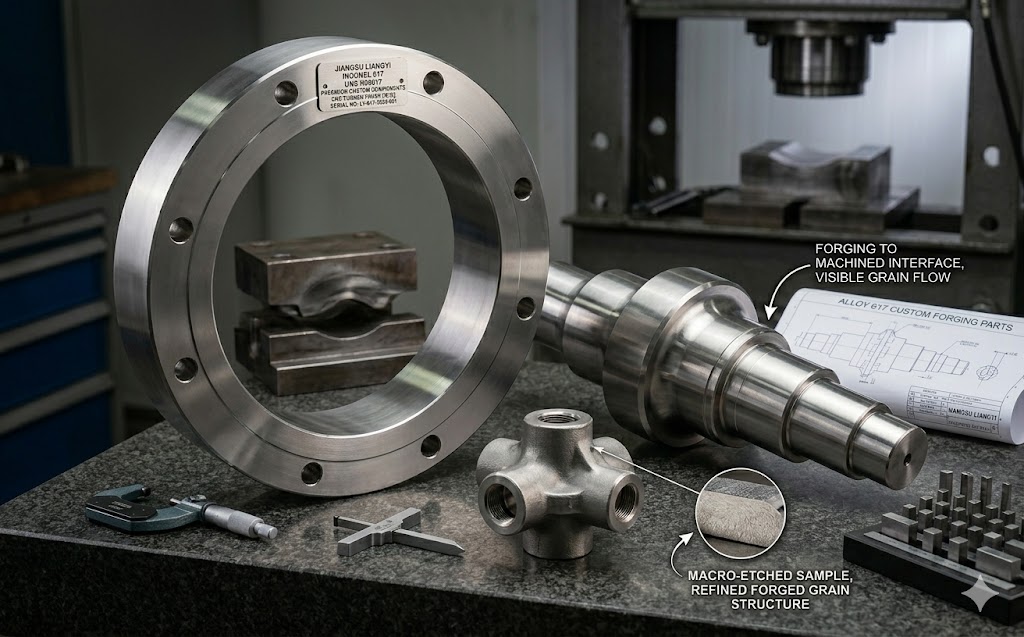
Why Choose Inconel 617 (Alloy 617 / UNS N06617) Forgings?
Inconel 617 is a solid‑solution‑strengthened nickel‑chromium‑cobalt‑molybdenum superalloy that is used for extreme high‑temperature and highly corrosive service. It has an excellent mix of performance advantages, making it the best choice material for important industrial parts.
Excellent High-Temperature Strength
It keeps excellent creep resistance and fatigue strength at continuous operating temperatures up to 1100 °C — far better than conventional stainless steels and other common nickel alloys. So that it is the best choice material for gas turbine and thermal power plant parts.
Great Oxidation and Corrosion Resistance
It has excellent resistance to high-temperature oxidation, sulfidation and carburization, even under cyclic heating and cooling. It also works well in acidic, sour service and harsh chemical environments for oil and gas and petrochemical applications.
Excellent Weldability & Fabricability
It has good formability and weldability in both annealed and aged conditions, guaranteeing custom forged shapes and precision machining, while preserving its mechanical properties after fabrication.
Outstanding Metallurgical Stability
Solid-solution strengthening provides stable internal matrix and mechanical properties during long-term high-temperature service, with no brittle phase precipitation. This guarantees long lifetime and reduced maintenance costs.
Full Range of Inconel 617 Forged Product Forms
We produce custom Inconel 617 forgings in a full range of shapes and sizes, and they all meet international standards and customer drawings. Our production capacity covers all open die forgings and seamless rolled rings, with single-piece weights ranging from 30 kg to 30 tons. Our available forged product forms include:
- Inconel 617 Forged Round Bars, Square Bars, Flat Bars, Rectangular Bars and Step Shafts
- Alloy 617 Seamless Rolled Rings, Contoured Rings, Gear Rings and Labyrinth Seal Rings
- UNS N06617 Forged Hubs, Housings, Shells, Sleeves, Bushes, Cases and Heavy Wall Hollow Bars
- Inconel 617 Forged Discs, Disks, Blocks, Plates, Flanged Blanks and Forged Wheels
- Alloy 617 Forged Pipes, Tubes, Tubings, Casing Barrels and Pressure Vessel Parts
- Custom Inconel 617 Forged Valve Parts: Valve Bodies, Bonnets, Stems, Seat Rings, Balls, Discs and Spools
- UNS N06617 Forged Turbine Parts: Turbine Discs, Impellers, Blades, Rotor Shafts, Guide Rings and Shroud Rings
- Custom Machined Inconel 617 Forged Parts for Special Industrial Applications
Chemical Composition of Inconel 617 (UNS N06617)
The ladle analysis (in weight %) of our Inconel Alloy 617 forged products strictly meets the standard requirements of ASTM B564, AMS 5662 and EN 2.4663 standards. The detailed composition range is shown in the table below:
| Element | Content Range (wt%) | Element | Content Range (wt%) |
|---|---|---|---|
| Carbon (C) | 0.05–0.10 | Silicon (Si) | ≤0.20 |
| Manganese (Mn) | ≤0.20 | Phosphorus (P) | ≤0.010 |
| Sulfur (S) | ≤0.010 | Aluminum (Al) | 0.70–1.40 |
| Chromium (Cr) | 20.00–23.00 | Cobalt (Co) | 11.00–14.00 |
| Copper (Cu) | ≤0.50 | Iron (Fe) | ≤2.00 |
| Molybdenum (Mo) | 8.5–10.0 | Titanium (Ti) | 0.20–0.60 |
| Boron (B) | ≤0.006 | Nickel (Ni) | Balance (Min 44.5%) |
Physical & Thermal Properties of Inconel 617 Forgings
The following physical and thermal properties are typical for solution‑annealed Inconel 617, in line with published data from alloy developers and standards bodies including Special Metals, ASM International and EN 10302.Our engineering team uses these values for forging process design and component qualification. Values for forged products may differ slightly from cast or sheet material due to the refined grain matrix from mechanical working. For important design calculations, always use values verified on test specimens taken from your actual delivery condition.
| Property | Value | Unit |
|---|---|---|
| Density | 8.36 | g/cm³ |
| Solidus Temperature | 1333 | °C |
| Liquidus Temperature | 1380 | °C |
| Melting Range | 1333–1380 | °C |
| Magnetic Permeability (RT) | 1.0006 | — |
| Electrical Resistivity (20°C) | 1.19 | μΩ·m |
| Electrical Resistivity (800°C) | 1.26 | μΩ·m |
| Temperature (°C) | Thermal Conductivity (W/m·K) | Specific Heat (J/kg·K) | CTE (×10⁻⁶/°C) |
|---|---|---|---|
| 20 | 13.5 | 419 | — |
| 200 | 15.8 | 440 | 12.8 |
| 400 | 18.6 | 461 | 13.3 |
| 600 | 21.8 | 490 | 13.8 |
| 800 | 25.2 | 524 | 14.4 |
| 1000 | 29.0 | 560 | 15.1 |
| Temperature (°C) | Young's Modulus E (GPa) | Shear Modulus G (GPa) | Poisson's Ratio ν |
|---|---|---|---|
| 20 | 211 | 82 | 0.29 |
| 400 | 196 | 76 | 0.29 |
| 600 | 185 | 72 | 0.28 |
| 800 | 167 | 65 | 0.28 |
| 1000 | 141 | 55 | 0.28 |
| Alloy | Mass Change (mg/cm²) | Scale Adherence |
|---|---|---|
| Inconel 617 | +0.8 | Excellent |
| Hastelloy X | +1.4 | Good |
| Haynes 230 | +1.1 | Very Good |
| 310 Stainless Steel | +4.2 | Moderate |
| Inconel 625 | +1.8 | Good |
Inconel 617 has relatively low thermal conductivity at room temperature: 13.5 W/m·K, compared to around 50 W/m·K for carbon steel. This is an important process parameter. During pre-forging heating, overly fast heating can create temperature gradients of more than 80°C between the surface and core of large billets, causing surface cracking or uneven deformation. Our 30T EAF + VOD melting and soaking furnace procedures are specially calibrated for this conductivity characteristic:we apply multi-stage heating with controlled holding periods at 650°C and 950°C before reaching the final forging temperature range of 950–1200°C.This makes sure our forgings get a fully consistent grain matrix across the whole cross-section, even for billets over 800mm in diameter.
Creep & Stress Rupture Properties of Inconel 617 Forgings
Creep resistance — rather than room-temperature tensile strength — is the defining performance criterion for Inconel 617 in actual service. The alloy was specifically engineered for outstanding resistance to time-dependent plastic deformation at high temperatures, which is the main failure mode for turbine disks, combustor liners and high-temperature valve bodies operating above 700°C. The stress-rupture data below are typical values for our solution-annealed open die forgings and seamless rolled rings, and demonstrate the advantages of the refined, equiaxed grain matrix obtained through our controlled multi-directional forging process.
| Test Temperature (°C) | 100 h Rupture Stress (MPa) | 1,000 h Rupture Stress (MPa) | 10,000 h Rupture Stress (MPa) | Primary Design Use Case |
|---|---|---|---|---|
| 700 | 310 | 230 | 170 | Steam turbine rotor shafts, high-temp flanges |
| 800 | 185 | 125 | 85 | Gas turbine discs, reheat valve bodies |
| 900 | 95 | 58 | 36 | Combustor liners, transition pieces |
| 950 | 65 | 38 | 22 | Turbine blade roots, guide ring sectors |
| 1000 | 35 | 18 | 10 | Extreme-temperature furnace components |
| Temperature (°C) | Applied Stress (MPa) | Minimum Creep Rate (%/1000 h) | Larson-Miller Parameter (×10³) |
|---|---|---|---|
| 800 | 100 | 0.008 | 26.1 |
| 850 | 80 | 0.020 | 26.8 |
| 900 | 60 | 0.055 | 27.5 |
| 950 | 40 | 0.18 | 28.1 |
| 1000 | 25 | 0.60 | 28.9 |
At temperatures above 800°C, Inconel 617 shows a well-documented inverse relationship between grain size and creep resistance: coarser grains (ASTM 2–4) achieve 15–30% longer 1,000-hour stress rupture life than finer grains (ASTM 6–8). This is because grain boundaries act as diffusion pathways accelerating creep deformation at high temperatures. For this metallurgical reason, our forging process targets a controlled average grain size of ASTM 2–6 for discs and rings, intentionally avoiding excessive grain refinement. We reject the common misconception that “finer is always better” — for Inconel 617 operating above 750°C, this practice directly reduces service life. Each heat treatment batch is grain-size tested based on EN ISO 643, and test results are included in the EN 10204 3.1 MTC provided with every order.
Forged vs. Cast Inconel 617: Why Forging Is the Right Choice for Critical Components
This comparison is rarely documented in detail by suppliers, since most material distributors offer both cast and forged products. As a forging‑only specialist with over 25 years focused on nickel superalloy processing, we provide a straightforward, data‑supported analysis of the performance difference between forged and cast Inconel 617 for industrial parts:
| Performance Criterion | Open Die Forging (Our Product) | Investment Casting | Impact on Component Life |
|---|---|---|---|
| Tensile Strength Rm (RT) | 700–780 MPa | 620–680 MPa | +10–15% higher load capacity |
| Yield Strength Rp0.2 (RT) | 300–360 MPa | 240–290 MPa | +20–25% resistance to plastic onset |
| Elongation A (%) | 30–45% | 8–15% | Forging absorbs overload; casting cracks |
| Charpy Impact Energy (RT) | 80–140 J | 15–40 J | Important for thermal shock resistance |
| Fatigue Life (10⁷ cycles, 700°C) | Significantly higher | Baseline | Defect-free grain matrix deletes crack initiation |
| 1000 h Rupture Stress (900°C) | 58 MPa | 42–50 MPa | +16–38% longer creep life |
| Internal Defect Risk | Near-zero (100% UT per AMS 2154 Class B) | Shrinkage porosity inherent | Casting porosity is #1 cause of premature failure |
| Grain Structure | Uniform equiaxed, ASTM 2–6 | Columnar / dendritic, variable | Isotropic properties in all loading directions |
| Repair Welding Allowed? | Prohibited (full integrity guaranteed) | Commonly used to mask defects | Welded repair zones are fatigue hot spots |
For non-important static structural parts operating below 600°C, casting can be a cost-effective choice. However, for rotating parts, pressure-retaining parts rated above ASME Class 600, or parts exposed to thermal cycling above 700°C — forging is not a premium option; it is a safety requirement .Nuclear-grade applications, API 6A wellhead equipment, and gas turbine parts universally specify forged material for this exact reason.
International Standards & Compliance
Our Inconel 617 forgings are produced and tested based on the following international industry standards.“Compliance” means our manufacturing processes, materials, testing methods and documentation fully meet the requirements of these standards. Product certificates are issued by our accredited in-house laboratory (ISO 9001:2015 certified), not directly by the standards bodies. The referenced standards include:
Inconel 617 vs. Alternative High-Temperature Alloys: Forging Manufacturer's Selection Guide
One of the most common engineering questions we receive from global customers is: "Why Inconel 617, and not one of the alternatives?” As a manufacturer that regularly forges all these alloys, we have direct production and field performance data for each. The comparison below is based on our forging experience, customer field feedback, and standard material specifications — designed specifically to help engineers make a right material choice.
| Criterion | Inconel 617 (UNS N06617) | Inconel 625 (N06625) | Inconel 718 (N07718) | Hastelloy X (N06002) | Haynes 230 (N06230) |
|---|---|---|---|---|---|
| Max Continuous Service Temp. | 1100°C | 815°C | 650°C | 1080°C | 1100°C |
| High-Temp Creep Resistance | ★★★★★ | ★★★ | ★★★★ (≤650°C only) | ★★★★ | ★★★★★ |
| Oxidation Resistance (>900°C) | ★★★★★ | ★★★ | ★★ | ★★★★ | ★★★★★ |
| Aqueous Corrosion Resistance | ★★★★ | ★★★★★ | ★★★ | ★★★★ | ★★★ |
| Sour Service (H₂S / NACE) | ★★★★ | ★★★★★ | ★★★ | ★★★ | ★★★ |
| RT Tensile Strength (Forged) | 700–780 MPa | 790–860 MPa | 1240–1380 MPa | 690–760 MPa | 710–770 MPa |
| Forging Difficulty | High (narrow window) | Moderate | High (age-hardened) | Moderate | High |
| Weldability | ★★★★ | ★★★★★ | ★★★ (PWHT required) | ★★★★ | ★★★★ |
| Nuclear Grade Suitability | ★★★★★ | ★★★★ | ★★★ | ★★★ | ★★★ |
| Relative Cost Index | High | High | High | High | Very High |
| Best Application Domain | Gas turbines, nuclear, high-temp power | Marine, chemical, cryogenic | Aerospace, tooling, high-strength parts ≤650°C | Combustors, industrial furnaces | Aerospace combustors, long-life furnace parts |
When to Choose Inconel 617 — Quick Selection Guide
Based on more than 25 years of custom forging experience, our engineers have distilled the chosen logic into the following field-tested decision guide:
Heat Treatment & Mechanical Properties
Controlled Solution Annealing Process
All our Inconel 617 forgings are supplied in the solution‑annealed condition as standard, to guarantee optimum mechanical properties and microstructural stability. The standard solution annealing is carried out within a precise temperature range of 1150°C to 1200°C, with adequate holding time based on section thickness — typically 30 minutes per 25 mm of thickness — followed by rapid air cooling or water quenching.
All heat treatment parameters are fully recorded and traceable, with complete temperature‑time charts included in the material test certificate.
Room Temperature Mechanical Properties
We test the mechanical properties of our Inconel 617 forgings on samples that are machined from the final products as they are delivered. We choose the sample and test them based on EN 10302 and ASTM E8 . The minimum room-temperature mechanical property requirements are as follows:
| Product Type | Thickness / Diameter (mm) | Yield Strength Rp0.2 (MPa) Min | Tensile Strength Rm (MPa) Min | Elongation A (%) Min | KV Impact Energy (J) Min |
|---|---|---|---|---|---|
| Hot Forged Plates | ≤50 | 300 | 700 | 35 | 80 |
| Forged Round Bars | ≤200 | 300 | 700 | 30 | 80 |
| Forged Round Bars | 200–320 | 270 | 650 | 30 | 80 |
| Seamless Rolled Rings | ≤300 | 270 | 650 | 25 | 60 |
Notes: Impact energy values are the average of 3 specimens; minimum single value is 56 J. For reduced-size 5mm specimens, average impact energy ≥40 J, minimum single value ≥28 J. Impact testing can be omitted for parts with thickness <5mm or diameter <16mm.
Elevated Temperature Mechanical Properties
The core advantage of Inconel 617 lies in its excellent high-temperature mechanical performance, which is the main reason for its widespread use in thermal power, gas turbine and aerospace applications. Typical high-temperature mechanical properties of our Inconel 617 forgings are as follows:
| Temperature (°C) | Yield Strength Rp0.2 (MPa) Typical | Tensile Strength Rm (MPa) Typical | Elongation A (%) Typical |
|---|---|---|---|
| 600 | 240 | 620 | 35 |
| 800 | 180 | 420 | 40 |
| 1000 | 80 | 130 | 60 |
Inconel 617 Forging Process Expertise
As a nickel‑based superalloy, Inconel 617 has high deformation resistance and a narrow forging temperature window, demanding strict process control to get great internal matrix and mechanical properties. With over 25 years of expertise in nickel superalloy forging, we have mastered the main processing technologies for Inconel 617 forgings:
- Precise Forging Temperature Control: We strictly control the forging temperature range of 950°C to 1200°C, with real-time temperature monitoring during the whole forging process, to avoid overheating or underheating that could affect material properties.
- Controlled Deformation Rate: We adopt multi-directional forging technology with a cumulative deformation rate of over 60%, to break down the cast structure, refine grain size, and guarantee consistent internal matrix and isotropic mechanical properties.
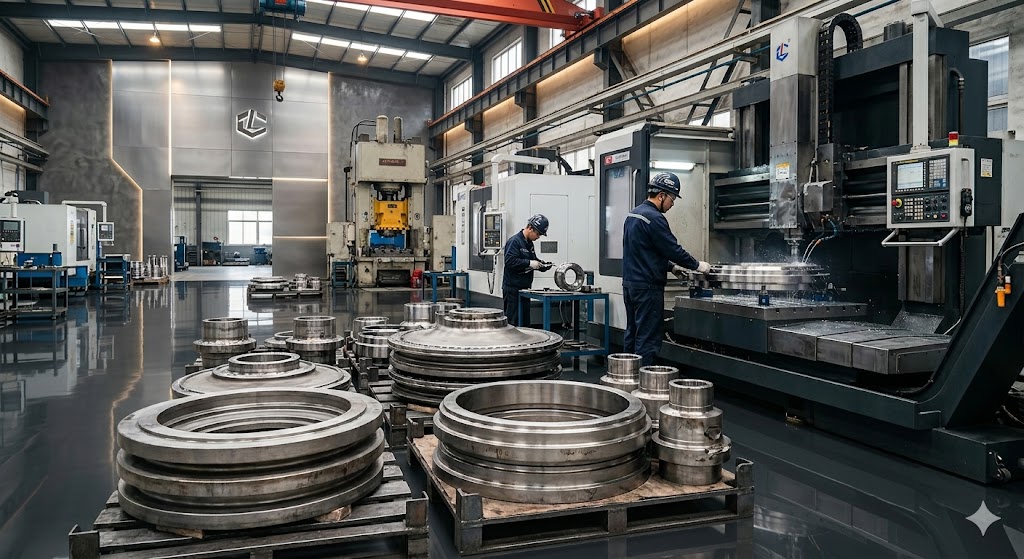
- Advanced Forging Equipment: Our forging facility has 2000T to 6300T hydraulic forging presses, 1M to 5M seamless ring rolling machines, and 1T to 9T electro-hydraulic forging hammers, and can produce Inconel 617 forgings up to 30 tons in weight and 6 meters in diameter.
- Integrated In-House Production: We provide a full range of production process from 30T EAF+VOD steel melting, forging, heat treatment, CNC machining to final inspection, making sure every production step is fully controlled and all products have high quality.
In-House Melting & Metallurgical Purity Control
The cleanliness and homogeneity of the starting billet are arguably the most important factors determining the final quality of a nickel superalloy forging — yet they are also the least visible to purchasers. Many forging facilities source pre-melted billets from external suppliers with no oversight of melting practices. Jiangsu Liangyi runs its own 30-ton Electric Arc Furnace (EAF) + Vacuum Oxygen Decarburization (VOD) in-house, allowing full direct control over every metallurgical variable from raw material charge to finished forging.
Our EAF + VOD Melting Route for Inconel 617
- EAF Charge Composition: We use high-purity virgin nickel cathode, electrolytic chromium, cobalt metal, ferro-molybdenum, ferro-titanium and aluminum master alloy — not recycled scrap — to guarantee controlled starting chemistry and minimum tramp element content (Pb <2 ppm, Bi <0.3 ppm, Tl <0.5 ppm).
- VOD Refining: Vacuum Oxygen Decarburization enables precise carbon control to the 0.05–0.10% target window, while simultaneously minimizing dissolved hydrogen (<2 ppm), nitrogen (<80 ppm) and oxygen (<20 ppm) content. Low gas content is essential to prevent porosity and hot tearing during solidification of large ingots.
- Ingot Solidification Control: We use bottom-poured killed ingot casting with hot-top risers sized to guarantee directional solidification from bottom to top, deleting centerline porosity and pipe defects in ingots up to 1200mm diameter × 3000mm length.
- Homogenization Anneal: All ingots get a full homogenization treatment at 1180°C for 20–40 hours prior to forging, to delete dendritic segregation of Co, Mo and Ti — the three elements most prone to micro-segregation in Inconel 617 during solidification.
- Full Heat Traceability: Every ingot is assigned a unique heat number, with full chemical analysis (optical emission spectrometry + combustion analysis for C and S), recorded and traceable through forging, heat treatment, and final inspection to the material certificate.
From our experience competing in quotations, the main cause of quality failures in Inconel 617 forgings is not the forging process itself — it is the raw billet. Ingots produced without VOD refining often have high hydrogen content (leading to hydrogen-assisted cracking during slow cooling) and excessive micro-segregation of molybdenum and cobalt, creating local hardness variations that cause inconsistent ultrasonic test results.
Such defects often only appear during machining or even in service, by which time replacement costs far outweigh any initial price savings. Our integrated EAF + VOD melting route eliminates these risks at the source.
Machining Inconel 617 Forgings: Practical Guidelines for CNC Shops
Inconel 617 is a hard material to machine (its machinability is about 15–20% of free-machining carbon steel). The main problems are work hardening (the material gets harder quickly in front of the cutting tool), high cutting force because it stays hard when hot, and built-up edge on the tool surface. The following guidelines are based on our own CNC machining experience with our Inconel 617 forged billets, and are given to help downstream machining shops avoid common issues:
| Operation | Tool Material | Cutting Speed (m/min) | Feed Rate (mm/rev) | Depth of Cut (mm) | Coolant |
|---|---|---|---|---|---|
| Rough Turning | Coated carbide (PVD TiAlN, ISO P25-M25 grade equivalent) | 25–40 | 0.25–0.40 | 2.0–5.0 | High-pressure flood (≥70 bar) |
| Finish Turning | Coated carbide (PVD TiAlN, ISO P20-M20 grade equivalent, tougher substrate) | 40–60 | 0.10–0.20 | 0.3–1.0 | High-pressure flood (≥70 bar) |
| Face Milling | Carbide (TiAlN coated, R390 geometry) | 20–35 | 0.10–0.20 fz | 1.5–3.0 | Flood + air blast |
| Drilling (solid carbide) | Solid carbide (TiAlN, 140° point) | 15–25 | 0.04–0.08 | Full drill diameter | Internal coolant preferred (≥50 bar) |
| Boring | CBN (for finishing) / Carbide (roughing) | 80–120 (CBN) | 0.05–0.15 | 0.1–0.5 (CBN) | Flood coolant essential |
| Thread Milling | Solid carbide thread mill (TiAlN) | 15–25 | Per helix pitch | Full thread profile | Flood coolant essential |
Important Machining Rules for Inconel 617
- Never Dwell or Stop the Tool Mid-Cut: Inconel 617 work hardens very quickly and strongly. If the cutting tool stays on the part surface even for just 1–2 seconds, it will harden the surface by 30–50 HV. This makes later cutting much harder and wears out tools faster. Use smooth, continuous tool paths in your program.
- Use Positive Cutting Geometry: Negative rake angle tools (common in general machining) create excessive compressive stress in Inconel 617, dramatically increasing cutting temperatures. Positive rake geometries (+5° to +15°) reduce cutting forces by 20–30%.
- High-Pressure Coolant Is Non-Negotiable: Standard flood coolant is insufficient. High-pressure coolant (≥70 bar at the cutting edge) is needed to prevent thermal softening of the tool, chip welding, and built-up edge formation. Without it, tool life on Inconel 617 drops by 70–80%.
- Order Forgings with Machining Stock Specified: When ordering custom forgings, specify the machining stock to be left per surface (typically 3–6mm per side for forged surfaces). Our engineering team will improve the forging shape to minimize stock and reduce your machining time and cost.
- Forged Surface vs. Machined Surface Hardness: The as-forged surface of Inconel 617 is harder than the interior due to surface chilling during forging. Always remove this surface layer (minimum 1.5mm) before precision machining to guarantee consistent material properties.
Welding Inconel 617 Forgings: Procedures, Filler Metals & Precautions
Although our Inconel 617 forgings come with a strict no-repair-welding rule (to make sure the forging is fully intact), many customers weld the forgings to other parts during manufacturing. The following welding guidelines are based on our knowledge of how the heat-affected zone (HAZ) of our products behaves, and they are meant to help fabricators get strong welds without hurting the forging's properties.
| Welding Process | Suitability | Recommended Filler Metal | Key Notes |
|---|---|---|---|
| GTAW / TIG | ✔ Preferred | ERNiCrCoMo-1 (AWS A5.14) — matching composition | Best heat control; preferred for root passes and precision joins |
| GMAW / MIG (Spray Transfer) | ✔ Suitable | ERNiCrCoMo-1 (AWS A5.14) | High deposition rate for fill passes; ensure inter-pass temp <100°C |
| SMAW / Stick (MMAW) | ⚠ Acceptable | ENiCrCoMo-1 (AWS A5.11) | Higher hydrogen risk; use low-hydrogen electrodes, preheat to 100°C |
| SAW (Submerged Arc) | ⚠ Conditional | ERNiCrCoMo-1 + neutral flux (do not use active flux) | Risk of flux contamination affecting Co and Al; not recommended for nuclear grade |
| Plasma Arc Welding (PAW) | ✔ Suitable | ERNiCrCoMo-1 (AWS A5.14) | Excellent for thin sections and precision joins; good keyhole control |
| Electron Beam (EBW) | ✔ Excellent | Autogenous (no filler) | Preferred for aerospace and nuclear joints; minimal HAZ distortion |
| Friction Stir (FSW) | ✗ Not Recommended | N/A | Tool wear is extreme on Inconel 617; not commercially viable |
Post-Weld Heat Treatment (PWHT) Guidelines
Post-weld heat treatment for Inconel 617 is generally not needed for aqueous corrosion applications. However, for high-temperature service above 700°C, a stress relief anneal is recommended to restore optimal creep properties in the heat-affected zone:
- Stress Relief (Optional): 980°C × 1 hour minimum + air cool. Restores approximately 85–90% of unwelded creep life in the HAZ.
- Full Solution Anneal (Maximum Property Restoration): 1150–1200°C × 30 min/25mm thickness + rapid air cool or water quench. Restores full creep properties. Required when specified by the nuclear-licensed fabricator per RCC-MR or ASME Section III; consult your nuclear QA plan.
- Inter-pass Temperature Control: Maximum inter-pass temperature 100°C. Exceeding this leads to sensitization of the HAZ and risk of intergranular corrosion in environments containing sulfuric or phosphoric acids.
- Dissimilar Metal Welds: When welding Inconel 617 to austenitic stainless steel (e.g., 316L), use Inconel 82 / 182 (ERNiCr-3) as a butter layer to manage the thermal expansion mismatch (CTE difference ≈1.5×10⁻⁶/°C between the two alloys).
Microstructure Control & Full-Cycle Quality Inspection
Microstructure and Grain Size Control
The matrix of our Inconel 617 forged parts is carefully controlled to be even, with no large segregation, inclusions or other uneven areas. We test grain size for every heat treatment batch following EN ISO 643 standards. For forged bars, we promise a grain size of 5 or coarser. For plates and rings, the average grain size is 2–6. This guarantees steady mechanical properties and good resistance to fatigue.
Non-Destructive Testing (NDT) and Quality Assurance
Every Inconel 617 forged part is given 100% non-destructive testing after final heat treatment, with full test reports and certificates provided. Our standard NDT procedures include:
- Visual Inspection (VT): Performed in accordance with EN 13018 standards, to check surface quality and dimensional conformity.
- Ultrasonic Testing (UT): Performed in accordance with SAE AMS 2154 Class B and ASTM A388 standards, for all forged bars ≥15mm diameter and flat bars ≥10mm thickness, to detect internal defects.
- Magnetic Particle Testing (MT) & Penetrant Testing (PT): Available on request, to check for surface and sub-surface defects.
Repair welding is strictly not allowed on any of our Inconel 617 forged parts, to guarantee the strength and safety of the finished part. All products meet a 3.1/3.2 material test certificate (MTC) following EN 10204 standards, with full traceable information including heat number, chemical composition, heat treatment records, mechanical test results, NDT reports and dimension test reports.
Industry Applications & Global Project References
Our Inconel 617 (Alloy 617 / UNS N06617) forged parts are widely used in important applications in industries around the world, and have proven reliable in extremely high-temperature, high-pressure and corrosive environments. We have supplied high-quality Inconel 617 forgings to customers in more than 50 countries. Following are the main project references:
Power Generation Industry
We have supplied Inconel 617 forged turbine discs, impellers, blades, guide rings, valve spindles and reheat valve discs for several Asian thermal power plants and combined-cycle power stations. These parts handle operating temperatures as high as 1100°C, providing excellent creep resistance and long lifetime. We also make Alloy 617 forged valve bodies, bonnets, seat rings and stems for main steam valves (MSV), control valves (CV) and reheat valves (CRV), making sure all parts work stably in high-pressure, high-temperature steam systems.
Nuclear Power Industry
We supply UNS N06617 forged reactor coolant pump casings, impellers, containment seal chambers and pressure vessel nozzles for nuclear power projects worldwide. Our Inconel 617 forgings are made with full material traceability and documents that meet nuclear plant supplier qualification reviews. All products come with EN 10204 3.1/3.2 material test certificates, complete heat treatment and NDT records, and can be produced under strict quality plans that satisfy RCC-MR or ASME NQA-1 standards as requested by customers. Nuclear grade qualification (such as ASME N-Stamp, 10CFR50 Appendix B) is handled by the end customer’s qualified nuclear supplier; we provide full production documents to support this process.
Oil and Gas and Petrochemical Industry
We make Inconel 617 forged valve balls, stems, seat rings, bonnets and bodies for ball valves, gate valves, check valves and back pressure valves used in onshore and offshore oil and gas wellhead equipment, pipeline transmission and petrochemical processing. These parts have excellent resistance to sour service (H₂S) and corrosive materials, meeting NACE MR0175 standards. We also produce Alloy 617 forged ultrasonic flow meter bodies, venturi cone meter bodies and oil measurement valve spools for petrochemical customers in the Middle East and Europe, guaranteeing accurate measurement and long lifetime in tough working conditions.
Turbomachinery & Industrial Compressor Industry
We supply UNS N06617 forged shrouded impellers, rotor shafts, labyrinth seals, diaphragm parts and casing parts for industrial gas compressors and centrifugal compressors used in petrochemical, natural gas processing and industrial gas applications. Our forgings meet the high strength, fatigue resistance and dimensional stability needs of high-speed rotating parts, and are exported to machinery makers in Europe and America.
Heat Exchanger & Pressure Vessel Industry
We manufacture Inconel 617 forged pipes, tubes, tube sheets, baffle plates, channel flanges and pressure vessel nozzles for high-temperature heat exchangers, waste heat boilers and process reactors used in chemical processing and power generation. All parts meet ASME Section VIII pressure vessel standards and work reliably in high-temperature, high-pressure and corrosive working environments.
Global Export and Custom Forging Capabilities
As a leading nickel alloy forging manufacturer in China, Jiangsu Liangyi has been serving global customers for over 25 years, with an annual production capacity of 120,000 tons. Our custom Inconel 617 forging capabilities include:
We offer complete global export services, including professional export documents, customs clearance support, and flexible shipping choices (ocean freight, air freight, express delivery). Third-party inspection services (BV, SGS, TUV) are available upon request. We welcome customers worldwide to send your custom drawings, material requirements and order quantity for a detailed quote.
Engineering Insights: Common Failure Modes in Inconel 617 Forging Applications
With over 25 years of technical work with global customers in power generation, oil and gas, and nuclear industries, our engineering team has recorded the most common failure types and specification mistakes related to Inconel 617 forgings. The examples below show typical industry problems, not specific customer projects, and are given as practical engineering guidance to help customers set correct requirements and make proper purchases.
Problem An Inconel 617 forged turbine disc bought from a low-cost supplier developed intergranular creep cracks at the blade root notches after only 8,200 operating hours, even though its design life was 60,000 hours. Discs from the same batch had a hardness difference of ±38 HV, which shows inconsistent solution annealing treatment.
Root Cause Metallurgical investigation revealed: (1) grain size scatter from ASTM 1 to ASTM 7 across the disc cross-section, indicating inadequate homogenization of the starting billet and non-uniform forging deformation; (2) residual Mo-rich dendritic segregation in the disc core, reducing local creep strength by about 22% compared to the nominal alloy; (3) solution annealing temperature logged at 1090°C — 60°C below the minimum required — with no temperature uniformity survey of the furnace.
Our Approach When the customer switched to Jiangsu Liangyi, we implemented: EAF+VOD melting with full homogenization at 1180°C/24h; multi-directional forging with ≥60% cumulative reduction; solution anneal at 1160°C with calibrated furnace certified to ±8°C uniformity; grain size 100% tested per lot, guaranteed ASTM 2–5 through full cross-section.
Result Replacement discs have now accumulated 41,000 operating hours in the same plant with zero indication of premature creep damage at last scheduled inspection.
Problem An Inconel 617 forged valve body used for sour gas service (H₂S partial pressure 0.8 bar, meeting API 6A requirements) failed NACE MR0175 qualification testing because of hydrogen-induced cracking. The cracks started at the machined inner bore surfaces and spread along grain boundaries.
Root Cause The main cause was high dissolved hydrogen in the forging billet (over 4 ppm, compared with the target of below 2 ppm), which came from melting in air without VOD degassing. When the deep inner bore was machined slowly without high-pressure coolant, heat built up and pushed leftover hydrogen to the machined surface. Tensile stress left by interrupted machining — the operator stopped cutting twice halfway — plus high local hydrogen caused the HIC cracks to start.
Our Approach We supplied replacement valve bodies with: VOD-degassed melting (H₂ <1.8 ppm, verified by vacuum hot extraction); a special machining process that requires continuous cutting, high-pressure coolant, and a limited maximum time between cuts; and post-machining hydrogen baking at 200°C for 4 hours before pressure testing. We also added an X-ray diffraction check for residual stress on the bore surface as part of final inspection.
Result All 12 replacement valve bodies passed NACE MR0175 / ISO 15156 qualification testing at first attempt. The customer has since standardized our Inconel 617 as their sole-source for sour service valve forgings in that facility.
Problem A European nuclear equipment manufacturer reported that Inconel 617 seamless rolled rings kept warping during rough machining. Ovality of the rings increased by 0.8–1.4 mm during the first turning cuts, leading to dimensional failures after machining, even though the rings were within size limits when delivered as forged.
Root Cause The rings were rolled at an extremely high temperature of 1190°C, close to the maximum limit, and did not go through enough final shaping passes below 1050°C. This left high internal stress trapped in the rings after quick cooling from rolling. When the outer layer was cut off during rough turning, the balanced stress was disturbed, making the rings bend out of shape and become oval.
Our Approach We redesigned the ring rolling process: the final 3 passes are done at 980–1020°C with a controlled thickness reduction of 8–12% each pass to create compressive stress on the surface. After rolling, we apply stress relief at 900°C for 1 hour before solution annealing. The solution annealing is carried out with each ring placed on a flat support fixture instead of being stacked, to avoid shape distortion caused by gravity during heat treatment.
Result Replacement rings showed less than 0.15 mm dimensional change during machining across the 24 rings supplied. The customer now lists our controlled rolling process as a needed item in their purchasing specifications.
Dimensional Tolerances, Delivery Conditions & Packaging
Standard Dimensional Tolerances (As-Forged)
| Product Form | Dimensional Parameter | Standard Tolerance | Tighter Tolerance (On Request) |
|---|---|---|---|
| Forged Round Bar | Diameter | +6 / −0 mm (≤200mm dia) +10 / −0 mm (200–500mm dia) | +3 / −0 mm with CNC roughing |
| Forged Round Bar | Length | +50 / −0 mm | +20 / −0 mm |
| Forged Round Bar | Straightness | ≤3 mm/m | ≤1.5 mm/m |
| Seamless Rolled Ring | OD | +8 / −0 mm (≤1000mm OD) +15 / −0 mm (1000–3000mm OD) | +4 / −0 mm with CNC turning |
| Seamless Rolled Ring | Wall Thickness | ±5% or ±5mm (whichever is greater) | ±3% or ±3mm with CNC |
| Seamless Rolled Ring | Height | +10 / −0 mm | +5 / −0 mm |
| Forged Disc / Plate | Diameter / Width | +8 / −0 mm (≤1000mm) +15 / −0 mm (1000–3000mm) | +4 / −0 mm |
| Forged Disc / Plate | Thickness | +8 / −0 mm (≤100mm T) +15 / −0 mm (100–300mm T) | +4 / −0 mm |
| CNC Machined (All Forms) | All Dimensions | IT7 as standard | IT6 (Ra ≤1.6μm surface finish) |
Delivery Conditions
- Standard Delivery Condition: Solution annealed (1150–1200°C + rapid air/water quench) with all mill scale and oxide layer removed by shot blasting and acid pickling (HF+HNO₃ solution). Parts are supplied bright surface finish.
- CNC Pre-Machined Condition: Available for customers requiring reduced machining stock — typically 3mm per surface. Parts are supplied with controlled surface roughness Ra ≤6.3μm and dimensional tolerance per IT7.
- Fully Machined to Drawing: Complete CNC machining to customer drawing with IT6 tolerance and Ra ≤1.6μm. All machined surfaces 100% dimensionally inspected with CMM report included.
- Minimum Order Quantity (MOQ): For standard forged bar and ring stock sizes, MOQ is 1 piece. For non-standard custom forgings needing dedicated tooling and forging program setup, MOQ is typically 2–3 pieces to amortize setup cost — contact our sales team for specific project quotes.
Packaging & Export Logistics
- Rust Prevention: All Inconel 617 forgings are surface-treated with water-soluble VCI (Volatile Corrosion Inhibitor) film and individually wrapped in VCI polyethylene bags before crating.
- Export Crating: Heavy forgings (≥200kg) are mounted on custom steel cradles welded to fumigated wooden crates, with anti-vibration foam padding to prevent surface damage during transit.
- Incoterms: We offer FOB Shanghai / Ningbo, CIF worldwide, DAP for most major ports. Main export ports: Shanghai Yangshan, Ningbo-Zhoushan, Tianjin.
- Export Documentation: We provide commercial invoice, packing list, material test certificates (EN 10204 3.1/3.2), country of origin certificate (Form A / CO), HS code classification support (HS: 7326.90 for forged parts, 7228.40 for forged bars), and customs clearance technical documentation upon request.
- Third-Party Inspection: BV (Bureau Veritas), SGS, TUV, Intertek and other independent inspection agencies can be arranged at any stage of production — melting, forging, heat treatment, machining, or final — with witness inspection available.
Common Specification Mistakes When Ordering Inconel 617 Forgings (And How to Avoid Them)
After reviewing thousands of needs for Inconel 617 forgings from customers worldwide over 25 years, our engineering team has found the most common specification mistakes. These errors lead to delivery delays, extra costs, or later quality problems. We share this list to help our customers get things correct from the start:
- Specifying only "Inconel 617" without a standard reference.
Inconel 617 has several different designations, such as UNS N06617, EN 2.4663, and AMS 5662, and their chemical composition limits differ a little across standards. If you do not state which standard applies, the supplier may choose the easiest specification to meet, which may not match the one your product qualification is based on.
✔ Fix: Always specify the governing standard explicitly (e.g., "per ASTM B564 / AMS 5662, UNS N06617") and include the heat treatment condition (solution annealed per AMS 2774 Class A, or equivalent).
- Ordering to tensile properties only, without specifying grain size.
A forging can pass ASTM B564 tensile requirements with a grain size of ASTM 1 (extremely coarse) or ASTM 8 (fine). For high-temperature creep service, these are not equivalent — fine-grained material has significantly lower creep life above 800°C.
✔ Fix: Always specify the needed grain size range per EN ISO 643 or ASTM E112. For service above 750°C, specify mean grain size ASTM 2–6. For sub-700°C high-strength applications, ASTM 5–8 may be specified.
- Requesting "minimum weight" forgings without considering testing coupon allowance.
Tensile, impact and creep test samples must be cut from extra material attached to the forging, or from separate test blocks forged from the same heat and heat treatment batch. If you order the forging at the minimum weight, there may not be enough material for needed destructive testing.
✔ Fix: When placing custom forging orders, discuss test coupon requirements with our engineering team upfront. We will design the forging geometry to include adequate test material without excessive weight penalty.
- Specifying PWHT (post-weld heat treatment) temperatures below the solution annealing temperature.
Some manufacturers need a post-weld heat treatment (PWHT) at 980°C, thinking this is a safe temperature. But at 980°C, Inconel 617 enters the sensitization range where carbide precipitation (M₂₃C₆ at grain boundaries) occurs. This lowers resistance to intergranular corrosion and can make heat-affected zones (HAZ) brittle in long-term use.
✔ Fix: For maximum property restoration after welding, use full solution anneal at 1150–1200°C. If only a stress relief is needed (e.g., dimensional stability for machining), limit PWHT to 900°C or below to remain below the M₂₃C₆ precipitation nose.
- Assuming UT acceptance criteria from carbon steel standards apply to Inconel 617.
Inconel 617 has very different sound speed and signal attenuation characteristics from carbon steel. Using ultrasonic test (UT) calibration blocks or acceptance standards designed for carbon steel (such as ASTM A578 for steel plates) on Inconel 617 forgings will produce unreliable results, usually showing too many false indications from grain scattering noise.
✔ Fix: Specify UT per SAE AMS 2154 Class B (for forgings) using Inconel alloy reference standard blocks for calibration. Our UT technicians are trained specifically for nickel alloy forgings and use alloy-matched calibration standards.
Frequently Asked Questions (FAQs) About Inconel 617 Forgings
Inconel 617 (also known as UNS N06617, Alloy 617 and EN 2.4663) is a solid-solution strengthened nickel-chromium-cobalt-molybdenum superalloy. Its typical composition includes at least 44.5% nickel, 20–23% chromium, 11–14% cobalt, 8.5–10% molybdenum and 0.7–1.4% aluminum. Designed for extreme high-temperature service up to 1100°C, it has excellent creep strength, oxidation resistance and microstructural stability. It is widely used in gas turbine parts, nuclear reactor parts, thermal power plant equipment, petrochemical valves and industrial compressor parts.
The main difference lies in their operating temperature ranges and alloy compositions. Inconel 617 contains cobalt and aluminum, which give it excellent high-temperature strength and oxidation resistance up to 1100°C, so that it is the best choice material for gas turbines and high-temperature power generation parts. Inconel 625 performs better in corrosive liquid environments, with a maximum continuous service temperature of 815°C, so it is more suitable for marine and chemical processing uses.
The standard heat treatment for Inconel 617 forgings is solution annealing at 1150°C to 1200°C, with holding time based on section thickness (usually 30 minutes per 25 mm of thickness), followed by rapid air cooling or water quenching. This process fully dissolves the alloying elements into the matrix, making sure all parts have stable internal matrix and the best balance of strength and ductility.
All our Inconel 617 forged parts come with an EN 10204 3.1 material test certificate (MTC) as standard, including complete chemical analysis, mechanical test results, heat treatment records, NDT reports and dimension test data. EN 10204 3.2 certificates with third-party inspection (BV, SGS, TÜV) are also available upon request.
Yes, we specialize in custom open die forgings and seamless rolled rings according to customer drawings and technical specifications. Our engineering team will review your drawings and provide a detailed quotation, including forging process, heat treatment, machining and testing requirements, to make sure the final product fully meets your application needs.
For custom Inconel 617 forgings,the standard lead time is 3–4 weeks for small batch orders, and 4–6 weeks for large or intricate parts. We can also speed up production for urgent orders, with lead time as short as 2 weeks, subject to material availability and production schedule.
Our Inconel 617 forgings comply with: ASTM B564, ASTM A388, ASTM A577; AMS 5662, AMS 2154 Class B; EN 2.4663, EN 10204, EN 10302, EN ISO 643, EN 13018; ASME Section VIII, ASME B16.34; API 6A, API 6D; NACE MR0175 / ISO 15156; and ISO 9001:2015.
Trademark Notice: Inconel® is a registered trademark of Special Metals Corporation. Hastelloy® and Haynes® are registered trademarks of Haynes International, Inc. These designations are used herein solely to identify the alloy type of the material being processed and do not imply any affiliation with, endorsement by, or authorization from the respective trademark owners. Jiangsu Liangyi Co., Limited is an independent manufacturer and is not affiliated with Special Metals Corporation or Haynes International, Inc.
Contact Us for Inconel 617 Forging Quotation
Jiangsu Liangyi is glad to provide competitive prices and great quality Inconel 617 (Alloy 617 / UNS N06617) forging parts for global clients. Whether you need standard forged bars and rings, or custom machined parts, we will provide you with a professional solution and detailed quotation. Welcome to send your custom drawings, material requirements and order quantity to our sales team!
Inquiry Email: sales@jnmtforgedparts.com
Phone / WhatsApp: +86-13585067993
Official Website: www.jnmtforgedparts.com
Factory Address: Chengchang Industry Park, Jiangyin City, Jiangsu Province, China 214400