Incoloy 27-7MO — formally designated UNS S31277 and commercially also known as Alloy 27-7MO — is a 7% molybdenum super austenitic stainless steel representing the apex of the conventional stainless steel family in terms of corrosion resistance. It was developed specifically to bridge the gap between standard 6% Mo super austenitic steels (such as 254SMO) and more expensive nickel-based alloys (such as Hastelloy C-276), providing an economically superior solution for environments where 254SMO falls short but a full nickel alloy is considered over-specified.
The alloy's defining feature is its combination of 26–28% nickel, 20.5–23% chromium, 6.5–8.0% molybdenum, 0.30–0.40% nitrogen, and 0.5–1.5% copper — a carefully balanced chemistry that achieves three simultaneous goals: a fully stabilized austenitic microstructure (no ferrite, no martensite under any service condition), a Pitting Resistance Equivalent Number (PREN) up to 55.8, and high strength through nitrogen solid-solution hardening. No other stainless steel grade achieves this combination at equivalent cost.
From a materials engineering perspective, PREN = Cr% + 3.3 × Mo% + 16 × N% is the industry-standard proxy for resistance to localized pitting corrosion in chloride environments. A PREN above 40 is typically required for North Sea offshore service (NORSOK M-001); above 50 is considered premium-grade. Incoloy 27-7MO's PREN of up to 55.8 places it among the top 5 stainless steel alloys ever commercially produced.
Jiangsu Liangyi Co., Limited is an ISO 9001:2015 certified Chinese manufacturer of Incoloy 27-7MO, Alloy 27-7MO, and UNS S31277 open die forgings and seamless rolled rings. Founded in 1998 with over 25 years of specialized super alloy forging experience, we manufacture products to meet API 6A, ASTM, ASME, EN, DIN, and JIS standards upon customer project requirements. We have shipped custom forged components to 50+ countries — including the United States, Germany, Saudi Arabia, the UAE, Norway, Australia, Singapore, Brazil, and Japan — serving clients in oil & gas, nuclear power, chemical processing, and precision engineering industries.
* Products can be manufactured and tested to meet these project-specific requirements upon order. Jiangsu Liangyi holds ISO 9001:2015 company certification; API 6A, NORSOK M-650, PED, and RCC-M are product/project qualifications arranged per individual contract.
To understand why engineers specify Incoloy 27-7MO over less expensive alternatives, it is necessary to look at what happens at the atomic and microstructural level when molybdenum content crosses the 6% threshold.
The Role of Molybdenum in Stainless Steel Corrosion Resistance
Molybdenum in stainless steel performs two distinct corrosion-protection functions. First, it enriches the passive film — the thin (2–5 nm) chromium oxide layer that forms spontaneously on stainless steel surfaces. Laboratory studies using X-ray photoelectron spectroscopy (XPS) have shown that Mo₆⁺ ions migrate into this passive film and form molybdate complexes (MoO₄²⁻) that preferentially occupy and stabilize defect sites in the oxide lattice. These defect sites, if left unguarded, are the nucleation points for pitting corrosion. Second, dissolved molybdenum increases the threshold chloride concentration required to break down passivity, directly raising the Critical Pitting Temperature (CPT) and Critical Crevice Temperature (CCT).
The practical consequence is non-linear: going from 6% to 7% Mo does not simply add 1/6th more protection — the enrichment effect on the passive film becomes significantly more pronounced above approximately 6.5% Mo, which is why 27-7MO's CPT of ≥ 60 °C (ASTM G48B, 6% FeCl₃) represents a step-change over 254SMO's approximately 45 °C, despite only a 1% difference in nominal Mo content.
The Role of 27% Nickel — Beyond Austenite Stabilization
The high nickel content in Incoloy 27-7MO (26–28% vs 18% in 254SMO) provides three independent engineering benefits that are often underestimated:
Stress Corrosion Cracking (SCC) immunity in chlorides: Austenitic stainless steels with nickel content above approximately 25% are essentially immune to transgranular chloride SCC. This is because high nickel raises the stacking fault energy (SFE), suppressing cross-slip and planar dislocation arrangements that are prerequisites for transgranular SCC crack initiation. 254SMO with 18% Ni has meaningful SCC susceptibility above 60 °C in high-chloride environments; 27-7MO at 27% Ni does not.
Resistance to reducing acids: Nickel specifically improves corrosion resistance in non-oxidizing (reducing) acids such as dilute hydrochloric acid, phosphoric acid, and sulfuric acid. Together with the 0.5–1.5% copper addition (which reduces the hydrogen evolution overpotential, inhibiting acid attack), 27-7MO's resistance in reducing acid environments significantly exceeds that of any chromium-molybdenum stainless steel with lower nickel content.
Resistance to hydrogen embrittlement: High-nickel austenitic alloys are significantly more resistant to hydrogen-induced cracking than ferritic, martensitic, or duplex stainless steels. This makes 27-7MO particularly suitable for sour service (H₂S) environments where hydrogen absorption is a concurrent risk alongside corrosion.
The Role of High Nitrogen (0.30–0.40%) — Strength Without Sacrificing Ductility
Nitrogen in super austenitic stainless steels fulfills dual roles that are uniquely complementary. As an interstitial solid-solution strengthener, nitrogen raises the yield strength significantly — the 414 MPa / 60 ksi minimum yield of 27-7MO is approximately 93% higher than 904L's 215 MPa / 31 ksi, achieved without cold working or heat aging. Simultaneously, nitrogen strongly stabilizes the austenitic phase (its austenite-forming power is approximately 25× that of nickel on a weight-percent basis), preventing sigma-phase and chi-phase precipitation during slow cooling or low-temperature service — intermetallic phases that are detrimental to both corrosion resistance and toughness.
Nitrogen also contributes directly to pitting resistance via the PREN formula (16 × N%), and recent electrochemical studies have shown that nitrogen acts as a local "corrosion inhibitor" at pit nucleation sites: when nitrogen-rich austenite begins to dissolve at a pit embryo, it releases NH₄⁺ ions into the pit solution, raising the local pH and suppressing further acidification — a self-inhibiting mechanism not available in nitrogen-free alloys like 904L.
Metallurgical Insight from 25+ Years of Manufacturing Experience
In our production of Incoloy 27-7MO forgings, we have consistently observed that nitrogen content near the upper end of specification (0.36–0.40%) produces a measurably finer solution-treated grain size (ASTM grain size 6–7 vs 4–5 at 0.30–0.33% N), which improves both fatigue strength and transverse impact energy. We routinely target 0.34–0.38% N in our production chemistry to balance corrosion performance, mechanical properties, and hot workability. This is process knowledge accumulated over hundreds of UNS S31277 forging heats that cannot be read from a material datasheet.
Why Sigma-Phase Control Is Critical in 27-7MO Forgings
With total alloying element content typically exceeding 45 wt%, Incoloy 27-7MO is thermodynamically prone to sigma-phase precipitation in the temperature range of approximately 650–1,000 °C if cooling is insufficiently rapid after forging or heat treatment. Sigma-phase (an Fe-Cr-Mo intermetallic) is doubly harmful: it selectively depletes the surrounding matrix of chromium and molybdenum, locally reducing PREN by 5–15 points, and it is inherently brittle, reducing room-temperature impact energy dramatically. The critical manufacturing control is therefore not simply "heat to 1,120 °C and quench" — it is ensuring that the cooling rate from forging temperature to below 900 °C occurs at ≥ 5 °C per second and that no part of the forging cross-section holds in the 650–1,000 °C range for more than approximately 15 minutes cumulative time. For heavy section forgings (thickness > 200 mm), this requires both process design (sequential forging passes with forced air cooling between passes) and post-quench metallographic verification.
⚠ Buyer's Caution: Some suppliers deliver UNS S31277 forgings that pass chemical composition and tensile testing but contain undetected sigma-phase precipitates due to inadequate cooling rate control. These forgings meet specification at the time of inspection but can exhibit premature localized corrosion and brittle fracture in service. Jiangsu Liangyi counters this by performing routine metallographic examination (ASTM A262 Practice A / Huey test) on production samples from each heat, in addition to standard mechanical testing.
Incoloy 27-7MO vs 254SMO vs 904L vs AL-6XN — Complete Alloy Comparison
Selecting the right super austenitic stainless steel requires comparing not just PREN, but the full suite of mechanical properties, corrosion behavior across different environments, cost-performance ratio, and forging availability. The table below provides a comprehensive side-by-side reference based on our production experience and published alloy datasheets.
Table 1. Incoloy 27-7MO vs Competing Super Austenitic Grades — Full Technical Comparison
Property
Incoloy 27-7MO (UNS S31277) Top
AL-6XN (UNS N08367)
254SMO (UNS S31254)
904L (UNS N08904)
Mo Content (wt%)
6.5 – 8.0 Highest
6.0 – 7.0
6.0 – 6.5
4.0 – 5.0
Ni Content (wt%)
26.0 – 28.0 Highest
23.5 – 25.5
17.5 – 18.5
23.0 – 28.0
Cr Content (wt%)
20.5 – 23.0
20.0 – 22.0
19.5 – 20.5
19.0 – 23.0
N Content (wt%)
0.30 – 0.40 Highest
0.18 – 0.25
0.18 – 0.22
≤ 0.10
Cu Content (wt%)
0.5 – 1.5
—
0.5 – 1.0
1.0 – 2.0
PREN (typical max)
≤ 55.8 Highest
≈ 47
≈ 43
≈ 35
CPT (ASTM G48B, °C)
≥ 60 Highest
≥ 50
≥ 45
≥ 20
CCT (ASTM G48C, °C)
≥ 35 Highest
≥ 25
≥ 20
≥ 0
Tensile Strength (min, MPa)
827 Highest
793
795
490
Yield Strength (min, MPa)
414 Highest
310
310
215
Elongation (min, %)
50
30
35
35
Chloride SCC Resistance
Excellent (27% Ni)
Good (24% Ni)
Moderate (18% Ni)
Good (25% Ni)
Reducing Acid Resistance
Excellent (high Ni + Cu)
Good
Good
Excellent (high Ni + Cu)
Forging Availability
Available — Jiangsu Liangyi
Limited
Available
Available
Relative Alloy Material Cost
High (justified by performance)
High
Medium-High
Medium
CPT = Critical Pitting Temperature; CCT = Critical Crevice Temperature. Values are indicative for mid-range compositions in solution-annealed condition. Project-specific corrosion testing is recommended for critical applications.
Engineer's Selection Guide — When to Specify UNS S31277
From our 25+ years of supplying forged components to global projects, we have developed the following practical guidance for materials engineers deciding whether to specify Incoloy 27-7MO versus alternative grades. The decision depends on the specific corrosion environment, mechanical requirements, temperature, and lifecycle cost considerations.
Operating temperature exceeds 60 °C in chloride-containing media
H₂S partial pressure > 0.05 bar in combination with chlorides (sour service)
Mixed acid environments: H₂SO₄ + HCl, HNO₃ + HF, or phosphoric acid with halide impurities
NORSOK M-001 or offshore specification requires PREN > 50
Component wall thickness is large (thick-wall forgings retain 27-7MO's strength advantage over alternative grades)
Lifecycle cost matters more than initial material cost (longer service life justifies premium)
SCC risk is unacceptable and nickel-based alloy is cost-prohibitive
Consider 254SMO instead when:
Chloride concentration is < 20,000 ppm and temperature < 50 °C
Budget constraints are primary and PREN ≥ 40 is sufficient
Component is thin-section, minimizing the impact of 27-7MO's strength advantage
No sour gas (H₂S) is present and SCC risk is low
Consider Hastelloy C-276 instead when:
Reducing acid concentrations are extremely high (e.g., >70% H₂SO₄, concentrated HCl)
Temperature exceeds 450 °C in corrosive media
Oxidizing chloride conditions above 80 °C with no cost constraint
Component is very small (where alloy cost premium per kg is less significant)
Engineering Perspective from Jiangsu Liangyi
In our experience, the most common engineering error we see is specifying 254SMO (UNS S31254) for applications that really require 27-7MO. The deciding factor is almost always the simultaneous presence of temperature above 50 °C and chloride concentration above 20,000 ppm — a combination that pushes 254SMO beyond its reliable service range. At that point, upgrading to 27-7MO adds approximately 30–45% to the raw material cost of forgings, but the service life improvement is typically 2–5× — a strongly favorable return on investment for any component requiring unplanned replacement or causing process shutdown.
Full Range of Incoloy 27-7MO Forged Products We Manufacture
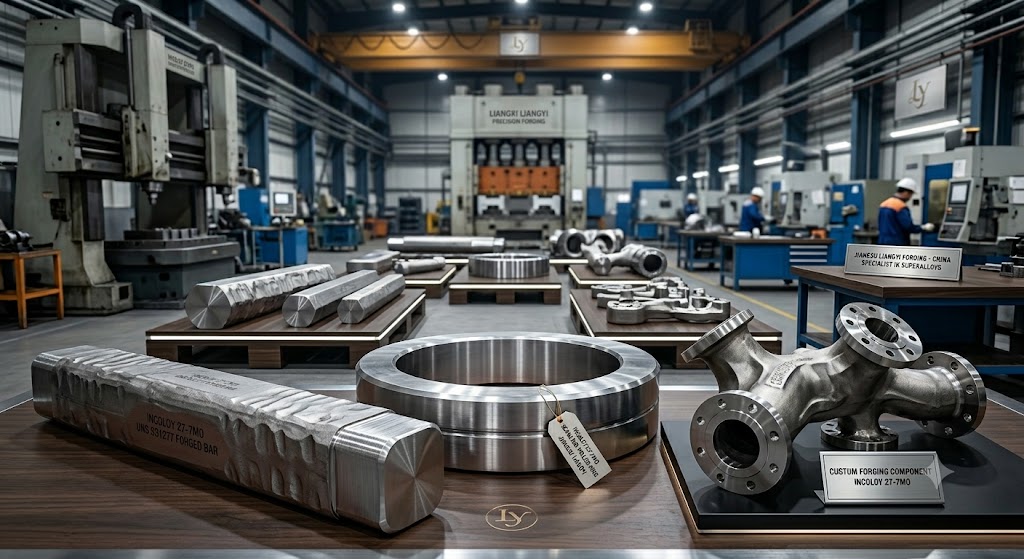
We custom manufacture a complete portfolio of UNS S31277 forging products in strict accordance with international standards and client engineering drawings. Our production capacity covers a single-piece weight range of 30 kg (66 lbs) to 30 tons (66,000 lbs), with the following standard product forms available:
Chemical Composition of Incoloy 27-7MO (UNS S31277) — Full Element Analysis
All our Alloy 27-7MO raw materials maintain strict chemical composition within specification, with full traceability from the original melting heat to the finished forging. We routinely perform OES (Optical Emission Spectrometry) and XRF (X-ray Fluorescence) analysis at three stages — melt, ingot, and finished forging — to detect and correct any compositional drift. Full mill test certificates to EN 10204 3.1 / 3.2 are issued for every batch.
Table 2. Chemical Composition of Incoloy 27-7MO / UNS S31277 (wt%) — with Engineering Notes
Element
Specification Range (wt%)
Jiangsu Liangyi Aim Range
Metallurgical / Engineering Role
Nickel (Ni)
26.0 – 28.0
26.5 – 27.5
Stabilizes austenite; provides SCC immunity above 25%; improves resistance to reducing acids, caustic environments, and hydrogen embrittlement
Chromium (Cr)
20.5 – 23.0
21.0 – 22.5
Forms the passive Cr₂O₃ film; primary contributor to oxidation resistance and PREN (1:1 weight factor); must exceed 20% to maintain PREN above 50 when Mo is at lower range
Molybdenum (Mo)
6.5 – 8.0
6.8 – 7.5
Primary pitting resistance element (3.3× PREN weight factor); enriches passive film with MoO₄²⁻; raises CPT and CCT non-linearly above 6.5%; controls reducing acid corrosion rate
Nitrogen (N)
0.30 – 0.40
0.34 – 0.38
Solid-solution strengthener (raises yield by ~120 MPa per 0.1% N); pitting resistance (16× PREN weight factor); stabilizes austenite (25× Ni equivalent); suppresses sigma-phase formation; local pH buffering at pit nucleation sites
Copper (Cu)
0.5 – 1.5
0.7 – 1.2
Reduces hydrogen evolution overpotential, inhibiting reducing acid attack; improves corrosion rate in H₂SO₄, H₃PO₄; does not contribute to PREN but provides significant supplementary corrosion protection
Iron (Fe)
Balance
Balance
Base matrix element; provides cost and formability benefits of steel versus nickel alloy
Carbon (C)
≤ 0.020
≤ 0.015
Ultra-low carbon prevents sensitization (Cr₂₃C₆ grain boundary precipitation) during welding and slow cooling; critical for maintaining corrosion resistance in the HAZ
Manganese (Mn)
≤ 3.00
≤ 2.00
Improves hot workability at high Ni content; partial austenite stabilizer; aids nitrogen solubility in the melt; must be controlled to avoid MnS inclusions that initiate pitting
Silicon (Si)
≤ 0.50
≤ 0.40
Deoxidizer; in the finished alloy controls non-metallic inclusion type and morphology; lower Si improves ultrasonic testing clarity and weldability
Phosphorus (P)
≤ 0.030
≤ 0.025
Residual impurity; must be minimized as it segregates to grain boundaries and reduces impact toughness and corrosion resistance; our ESR/VAR process achieves P typically < 0.020%
Sulfur (S)
≤ 0.010
≤ 0.005
Critical to minimize: MnS inclusions dissolve preferentially in chloride media, creating micro-pits that seed macroscopic pitting. Our ESR/VAR remelting achieves S typically < 0.003%, significantly improving CPT and UT quality
Why Our Aim Range Matters
You will notice our internal aim range is consistently tighter and more conservative than the published specification. For example, we target S ≤ 0.005% vs the specification's ≤ 0.010%, and N at 0.34–0.38% vs 0.30–0.40%. This is not marketing — it is the result of 25 years of correlation between production chemistry and field performance. At Jiangsu Liangyi, all UNS S31277 production heats are documented in our internal database with actual chemistry, forging parameters, and (for long-term clients) field performance feedback. This closed-loop quality system allows us to continuously tighten our process window in a way that is impossible for suppliers without long-standing client relationships.
Mechanical Properties of Incoloy 27-7MO Forgings — Solution Annealed Condition
All Jiangsu Liangyi UNS S31277 forgings undergo solution heat treatment, mandatory mechanical testing per ASTM E8 / ISO 6892-1, and hardness verification before release. Tensile and yield values are measured from a longitudinal test specimen cut from a location representative of the maximum cross-section of the forging. For ring forgings, both longitudinal and transverse testing is performed upon request.
Table 3. Mechanical Properties of UNS S31277 Forgings — Solution Annealed, Typical vs Minimum Requirements
Property
Min. Specified Value
Typical Achieved (Jiangsu Liangyi Production)
Test Method
Ultimate Tensile Strength (UTS)
827 MPa / 120 ksi
860 – 920 MPa
ASTM E8 / ISO 6892-1
0.2% Proof Yield Strength (Rp0.2)
414 MPa / 60 ksi
430 – 480 MPa
ASTM E8 / ISO 6892-1
Elongation at Break (GL = 50 mm)
≥ 50%
52 – 60%
ASTM E8 / ISO 6892-1
Reduction of Area
≥ 40%
55 – 70%
ASTM E8
Charpy V-Notch Impact Energy (−196 °C)
≥ 68 J (50 ft·lbf)
90 – 130 J
ASTM E23 / ISO 148-1
Hardness (Annealed)
≤ 95 HRB / ≤ 225 HV / ≤ 217 HBW
82 – 90 HRB
ASTM E18 / E384 / E10
Modulus of Elasticity (Young's Modulus)
—
138 GPa / 20,000 ksi
ASTM E111
Poisson's Ratio
—
0.29
ASTM E132
Fatigue Strength (10⁷ cycles, R = −1)
—
≈ 320 – 360 MPa
ASTM E466
Fracture Toughness K₁c (typical)
—
≥ 150 MPa·m½
ASTM E399
Typical achieved values are based on Jiangsu Liangyi production records for open die forgings and ring forgings tested in the solution-annealed condition. Individual heat properties may vary within specification. Additional tests (creep, fatigue, fracture toughness) available on request with extended lead time.
Physical & Thermal Properties of Incoloy 27-7MO
Physical and thermal properties are essential for FEA stress analysis, piping thermal expansion calculations, heat exchanger design, and heat treatment furnace loading calculations. The following values for UNS S31277 in the solution-annealed condition are provided for engineering reference.
Table 4. Physical and Thermal Properties of Incoloy 27-7MO (UNS S31277) — Solution Annealed, 20 °C unless noted
Property
Value
Units
Notes / Test Condition
Density
8.07
g/cm³ (0.292 lb/in³)
ASTM B311; comparable to 254SMO (8.00 g/cm³)
Thermal Expansion Coefficient (20–100 °C)
15.5 × 10⁻⁶
/°C (8.6 × 10⁻⁶ /°F)
ASTM E228; higher than duplex (13.0), similar to 254SMO
Thermal Expansion Coefficient (20–300 °C)
16.4 × 10⁻⁶
/°C
Relevant for high-temperature flange bolt calculations
Thermal Conductivity (20 °C)
11.5
W/(m·K)
ASTM E1225; lower than CS (50 W/m·K), typical for high-alloy austenitic
Thermal Conductivity (200 °C)
14.5
W/(m·K)
Important for heat exchanger tube sheet thermal gradient calculations
Specific Heat Capacity (20 °C)
485
J/(kg·K)
ASTM E1269
Electrical Resistivity (20 °C)
0.90
µΩ·m
ASTM B193
Magnetic Permeability (annealed)
≤ 1.02
µ/µ₀ (relative)
Fully non-magnetic in solution-annealed condition; stable austenite due to high Ni content
Melting Range
1,320 – 1,370
°C (2,408 – 2,498 °F)
Solidus to liquidus
Mean CTOD (ductile-to-brittle transition)
None observed
—
No DBTT; remains ductile to −196 °C due to stable austenite
Corrosion Resistance Data & Test Results for UNS S31277 Forgings
The following corrosion data summarizes both published test data and corrosion performance observed in our customers' applications over more than two decades of supplying Incoloy 27-7MO forgings to global projects. This section is intended to assist materials engineers in quantifying the corrosion performance advantage of UNS S31277 over alternative grades.
Pitting & Crevice Corrosion Resistance
Table 5. Localized Corrosion Resistance of UNS S31277 vs Competing Grades
Test
27-7MO (S31277)
AL-6XN (N08367)
254SMO (S31254)
904L (N08904)
ASTM G48 Method B — CPT (6% FeCl₃)
≥ 60 °C
≥ 50 °C
≥ 45 °C
≥ 20 °C
ASTM G48 Method C — CCT (6% FeCl₃)
≥ 35 °C
≥ 25 °C
≥ 20 °C
≥ 0 °C
ASTM G36 — Boiling 45% MgCl₂ SCC Test
Passes (no cracking)
Passes
Marginal
Passes
ISO 15156 / NACE MR0175 Sour Service (H₂S)
Qualified, all zones
Qualified
Qualified with limits
Qualified
Corrosion Rate in 10% H₂SO₄, 60 °C (mm/yr)
< 0.1
0.1 – 0.3
0.3 – 0.6
0.1 – 0.2
Corrosion Rate in 5% HCl, 20 °C (mm/yr)
< 0.5
0.5 – 1.0
0.8 – 1.5
0.5 – 1.0
NORSOK M-001 — Seawater Service at 30 °C
Fully qualified (PREN > 50)
Qualified
Marginally qualified
Not qualified
All corrosion data are indicative based on published literature and verified client application feedback. Actual corrosion performance depends on surface finish, heat treatment, and specific environment chemistry. Jiangsu Liangyi can arrange corrosion testing per ASTM G48 / ASTM G36 / NACE TM0177 for specific project qualification requirements.
Intergranular Corrosion Resistance
Due to its ultra-low carbon content (≤ 0.020%, with our production aim ≤ 0.015%), Incoloy 27-7MO exhibits excellent resistance to intergranular corrosion. ASTM A262 Practice E (Strauss test in H₂SO₄ + CuSO₄ solution) is routinely passed in the as-solution-annealed condition. For welded assemblies requiring maximum HAZ corrosion resistance, post-weld solution annealing is recommended. We perform ASTM A262 Practice B (Huey test in boiling 65% HNO₃) on production samples from critical batches.
Galvanic Compatibility
When designing assemblies combining Incoloy 27-7MO with other metals, the following galvanic compatibility guidance applies: 27-7MO is noble relative to carbon steel (avoid direct contact in wet environments); approximately equal to or slightly more noble than 316L and 317L (low galvanic risk); approximately equal to Alloy 625 and Hastelloy C-276 (no significant galvanic concern); and cathodic to titanium (acceptable pairing for seawater service with proper fastener sizing). In critical seawater applications, we recommend coating carbon steel contact surfaces or inserting non-metallic isolating gaskets.
Specialized 5-Step Manufacturing Process for Incoloy 27-7MO (UNS S31277) Forgings
Manufacturing Incoloy 27-7MO forgings to full specification is significantly more demanding than producing standard stainless steel forgings. The following describes Jiangsu Liangyi's complete process chain, with the specific process controls that distinguish quality production from marginal production.
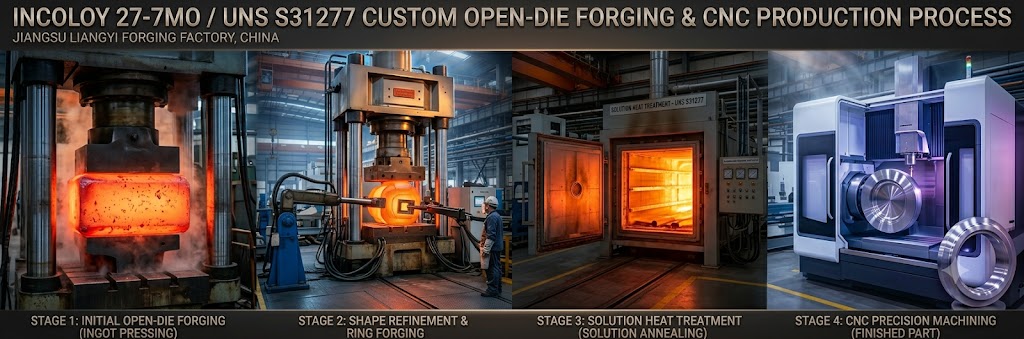
EAF/AOD + ESR/VAR Duplex Melting
All UNS S31277 material begins with primary melting via Electric Arc Furnace (EAF) + Argon Oxygen Decarburization (AOD) or Vacuum Oxygen Decarburization (VOD). This primary melt achieves the tight chemistry control required (particularly C ≤ 0.015% and N 0.34–0.38%) but inevitably contains some level of chemical segregation and macro-inclusions due to the nature of ingot solidification. For standard commercial applications, EAF/AOD-grade material is acceptable. For critical applications — nuclear components, deep-water subsea equipment, and high-pressure sour service — we apply secondary refining: Electroslag Remelting (ESR) or Vacuum Arc Remelting (VAR). ESR and VAR achieve oxygen content < 20 ppm, hydrogen < 2 ppm, and cleanliness grades of ≤ 1.0 per ASTM E45, while also eliminating macro-segregation through controlled directional solidification. The result is a chemically homogeneous, inclusion-free ingot that forges more uniformly and delivers more consistent NDT results. We clearly specify in our quotations whether material is EAF/AOD or ESR/VAR grade — buyers should require this transparency from all suppliers.
Hot Ingot Breakdown and Primary Forging
Incoloy 27-7MO ingots are charged to our pre-heating furnace at room temperature (cold charge) and heated to 1,150 °C at a controlled rate of ≤ 80 °C/hour for heavy sections (> 400 mm diameter) to avoid thermal shock and cracking. Primary forging (ingot breakdown) is performed at 1,100–1,150 °C using our 4,000T or 6,300T hydraulic forging presses. The objective of this stage is to break down the coarse as-cast dendritic grain structure through high deformation passes (each pass ≥ 20% reduction) with mandatory temperature monitoring between passes using a calibrated pyrometer. If the surface temperature drops below 980 °C during forging, the billet is returned to the furnace for reheating before the next pass. Forging at temperatures below 950 °C risks surface cracking on this high-alloy grade and must be strictly prohibited.
Precision Finish Forging / Seamless Ring Rolling
After breakdown forging, the forging billet is reheated to 1,080–1,120 °C for final shape forging. For open die forged bars, blocks, and flanges, we use our 2,000T–6,300T hydraulic presses with closed-die tooling for near-net shape production, achieving material yield rates of 65–85% versus raw ingot weight. For seamless rolled rings, the processed billet is first punched and reamed to form a ring blank, then transferred to our 1–5M radial-axial ring rolling machines for rolling to final dimensions. Ring rolling of 27-7MO requires a slightly higher rolling temperature than standard austenitic grades due to its higher flow stress at equivalent temperatures; we maintain 1,000–1,080 °C during ring rolling passes to ensure plastic deformation without surface oxidation or cracking. The minimum forging ratio (total cross-sectional area reduction ratio) for all our UNS S31277 forgings is 4:1 — this is the minimum needed to ensure full breakdown of as-cast structure, achieve ASTM grain size ≥ 4, and produce uniform mechanical properties across the full section.
Solution Heat Treatment at 1,120–1,150 °C + Rapid Water Quench
Solution heat treatment is the most critical post-forging process step for Incoloy 27-7MO, and also the step where the greatest number of quality failures occur in the industry. The purpose is to dissolve sigma-phase, chi-phase, and any carbide precipitates that may have formed during forging or during cooling from forging, and to produce a fully single-phase austenitic microstructure. Our process parameters: temperature 1,120–1,150 °C, hold time calculated as maximum section thickness (mm) × 2.5 minutes, minimum 60 minutes regardless of section size. Temperature uniformity is maintained at ±5 °C throughout the furnace loaded cross-section, verified by thermocouple surveys performed quarterly on each furnace. After the hold period, forgings are transferred to the water quench tank within 60 seconds and quenched until surface temperature falls below 200 °C — a quench rate requirement of ≥ 5 °C/second to 900 °C prevents any sigma-phase re-precipitation during cooling. We use completely automated furnace atmosphere control (nitrogen-purged to prevent surface oxidation) and computerized time-temperature logging — the resulting heat treatment chart is issued as part of every EN 10204 3.1 certificate package.
Comprehensive Inspection, Testing & Certification
Every Incoloy 27-7MO forging produced by Jiangsu Liangyi undergoes the following inspection sequence before release: (1) Visual and dimensional inspection — 100% of forgings checked against drawing tolerances. (2) Chemical analysis — OES spectrometric analysis from a test coupon cut from the forging body (not the heat report alone). (3) Mechanical testing — tensile test (UTS, Rp0.2, elongation, reduction of area) and hardness per ASTM / EN standards. (4) Metallographic examination — grain size evaluation per ASTM E112; corrosion test per ASTM A262 Practice A (oxalic acid etch) or Practice B (Huey test) for sensitization screening on critical batches. (5) 100% ultrasonic testing (UT) per ASTM A388 / EN 10228-3 to the agreed acceptance level (typically Level 3 for standard, Level 2 or Level 1 for critical components). (6) Surface NDE — liquid penetrant testing (PT) per ASTM E165 / EN 10228-2 (preferred for austenitic materials) or magnetic particle testing (MT) where applicable. (7) Corrosion testing per ASTM G48 Methods B and/or C when required by client specification (common for offshore and chemical industry clients). Full documentation package — including heat number traceability, chemical analysis report, mechanical test report, heat treatment chart, NDT records, and EN 10204 3.1 or 3.2 mill test certificate — is issued for every order.
Heat treatment of Incoloy 27-7MO is a non-trivial process that requires precise control of temperature, time, and cooling rate. Unlike standard austenitic stainless steels where moderate solution annealing parameters produce acceptable results, UNS S31277's high alloy content makes it thermodynamically sensitive to both over-treating and under-treating.
Why 1,120–1,150 °C (Not Lower)?
The minimum solution treatment temperature of 1,120 °C is established by the temperature at which sigma-phase and secondary carbides become fully soluble in the UNS S31277 austenite matrix within a reasonable hold time. Below 1,100 °C, complete dissolution of all sigma-phase requires impractically long hold times (> 8 hours) and is thermodynamically incomplete in most practical cases. Below 1,080 °C, carbide dissolution is also incomplete, risking sensitization in the HAZ of any subsequent weld. The upper limit of 1,150 °C is set by grain growth considerations: above 1,160 °C, abnormal grain growth can occur rapidly in UNS S31277, producing ASTM grain size < 3 (coarse grains that reduce both fatigue strength and ultrasonic testing resolution).
Why Rapid Water Quench (Not Air Cool or Slow Water)?
The time-temperature-transformation (TTT) behavior of UNS S31277 shows that sigma-phase begins to precipitate from the austenite matrix within approximately 5–10 minutes at temperatures between 800–900 °C in slowly cooled material. A forging being air-cooled after solution treatment will spend 15–30 minutes in this dangerous temperature window for section thicknesses above 50 mm — sufficient to precipitate measurable sigma-phase and locally deplete the matrix of Cr and Mo. Slow water quenching (inadequate agitation) can similarly allow this. Our process uses high-velocity water jets with forced agitation in our quench tanks to ensure the surface cooling rate exceeds 5 °C/second through the 1,000–650 °C window even for the heaviest section sizes in our production range (> 800 mm).
Stress Relieving — Caution Required
Many customers ask about stress relief heat treatment after machining. For UNS S31277, conventional stress relieving temperatures used for carbon or low-alloy steels (550–700 °C) are strictly contraindicated — this temperature range is exactly where sigma-phase precipitation rate is maximized. If dimensional stability after machining requires some stress reduction, the correct approach is either: (a) re-solution anneal at 1,120–1,150 °C + water quench (but this may distort finished machined surfaces); or (b) accept a small amount of residual machining stress, which is typically not structurally significant for the applications where 27-7MO is specified. We advise our clients accordingly and strongly caution against specification of any sub-critical stress relief on UNS S31277.
NDT Requirements, Acceptance Criteria & Quality Control
Non-destructive testing of Incoloy 27-7MO forgings presents specific challenges compared to lower-alloy grades due to the material's high acoustic attenuation (which reduces UT sensitivity) and coarser grain structure in heavily-alloyed heats. Jiangsu Liangyi has developed optimized UT frequency and scanning parameters specifically for UNS S31277 forgings, based on extensive experience with this grade.
Ultrasonic Testing (UT) — Volumetric
We perform contact UT per ASTM A388 or EN 10228-3 on 100% of forgings. For UNS S31277, we typically use 2.25 MHz or 4 MHz straight-beam probes (lower frequency than typical carbon steel UT to improve penetration in the coarse-grained austenitic matrix) with a high-viscosity couplant to ensure adequate coupling on the non-flat surfaces typical of open die forgings. Acceptance levels offered include: ASTM A388 Sound Class 1 through 5 (standard is Class 3); EN 10228-3 Quality Classes 1 through 4 (standard is Class 3). For nuclear and critical offshore applications, we can perform phased array UT (PAUT) with 64-element probes for enhanced flaw characterization and C-scan imaging.
Surface NDE — PT and MT
ASTM E165 / EN 571-1 liquid penetrant testing (PT) is the preferred surface NDE method for fully austenitic materials like UNS S31277 (magnetic particle testing requires a ferromagnetic material; relative permeability of 27-7MO ≤ 1.02 makes MT useless). We use fluorescent penetrant (Type I, Method D — electrostatic spray application) for maximum sensitivity and a minimum dwell time of 30 min and UV-A intensity ≥ 1,000 µW/cm² at the inspection surface. Acceptance criteria per ASME BPVC Section V Article 6 (Type I, Sensitivity Level 2) or equivalent client specification.
Corrosion Testing — ASTM G48
For offshore or chemical industry applications, additional acceptance tests are available such as ASTM G48 Method B (Critical Pitting Temperature test in 6% FeCl₃ solution) and Method C (Critical Crevice Temperature test). The test specimens are cut from the same test coupon as the mechanical test pieces, so that the test material is representative of the actual forging. Minimum acceptance CPT for UNS S31277 according to NORSOK M-650 revision 5 is ≥ 40 °C. Our production is normally ≥ 60 °C.
Welding & Fabrication Guidelines for Incoloy 27-7MO Forgings
Incoloy 27-7MO is considered weldable using all standard fusion welding processes, but its high alloy content requires careful attention to weld procedure development to avoid HAZ sensitization and sigma-phase precipitation. The following guidelines summarize Jiangsu Liangyi's recommendations based on our experience with welded fabrications incorporating our forgings.
Recommended Welding Processes & Consumables
GTAW (TIG) — preferred for root passes and thin sections. Filler metal: AWS ERNiCrMo-3 (Alloy 625, available as wire) or ERNiCrMo-10 (Alloy 622). These overmatching Ni-based fillers ensure the weld metal PREN is ≥ 45 and the weld metal is not susceptible to sigma-phase formation at post-weld heat treatment temperatures. Do not use matching UNS S31277 filler — it is not commercially available in standard wire sizes, and attempting to use matching composition results in hot-cracking susceptibility due to the high Mo + Ni content.
SMAW (MMA) — suitable for production welding of heavy sections. Electrode: AWS ENiCrMo-3 (Alloy 625 covered electrode). Dry storage in heated electrode oven required. Each electrode length should be consumed without stopping to avoid hydrogen cracking risk (not an issue with austenitic base metal, but best practice).
GMAW/FCAW — suitable for semi-automatic or robotic production welding. Wire: ERNiCrMo-3 in solid wire form for GMAW; Alloy 625 flux-cored wire for FCAW. Use Ar-30% He shielding gas for improved penetration in thick sections.
Critical Weld Procedure Parameters
Preheat: None required for base metal temperature ≥ +10 °C. Remove moisture from the joint area by gentle warming if ambient humidity is high.
Interpass temperature: Maximum 150 °C (302 °F) must be strictly adhered to. Otherwise it will cause excessive heat input into the HAZ and risks sigma-phase precipitation. Check with a calibrated contact thermometer or temperature-indicating crayon.
Heat input: Limit to ≤ 1.5 kJ/mm for thin sections (≤ 25 mm); ≤ 2.5 kJ/mm for thick sections. Excessive heat input causes HAZ grain coarsening and corrosion resistance reduction in the weld fusion boundary zone.
Back-purging: Mandatory for all root-pass GTAW welds. Use 99.995% pure argon at sufficient flow (typically 10–15 L/min) to maintain oxygen content < 50 ppm at the weld root. Inadequate purging causes oxidation of Mo and N at the root surface, locally destroying corrosion resistance.
Post-weld cleaning: Pickling with 20% HNO₃ + 3% HF mixture (or equivalent commercial pickling paste) is essential to remove the heat tint oxide (which is Cr-depleted beneath it) from the weld zone and adjacent HAZ. Passivation with 30% HNO₃ at 50 °C for 20 minutes follows pickling.
Post-Weld Heat Treatment (PWHT)
Full post-weld solution annealing at 1,120–1,150 °C followed by rapid water quenching is recommended for all structural applications where maximum corrosion resistance is required. This fully restores HAZ properties to base metal levels. Where PWHT is impractical (e.g., large assembled structures), the design should rely on the weld metal (Alloy 625) which does not require PWHT to maintain adequate corrosion resistance. Under no circumstances should sub-critical PWHT (e.g., 600–900 °C) be applied to welded Incoloy 27-7MO assemblies — this will precipitate sigma-phase and is more damaging than no PWHT at all.
Industry Applications & Verified Global Project Cases
Our UNS S31277 forged components are operating in demanding environments across four continents. The following cases are drawn from our verified project records; details are shared with client permission and in anonymized form where confidentiality is required.
Oil & Gas — Upstream, Midstream & Subsea
Incoloy 27-7MO is the industry's preferred upgrade material when 254SMO fails or is assessed as borderline for sour service, high-chloride produced water, or deepwater environments where elevated temperature and pressure combine with aggressive corrosion conditions. The alloy is qualified under NACE MR0175 / ISO 15156 for sour service in all three zones (SSC, SCC, HIC). Core applications include:
UNS S31277 forged wellhead Christmas trees, casing heads, tubing heads, spools, and hangers — rated to NACE MR0175 Zone 3
Alloy 27-7MO forged Blowout Preventer (BOP) bodies, RAM blocks, and annular components — API 6A PR2 rated
Jiangsu Liangyi supplied 228 sets of Incoloy 27-7MO wellhead and BOP forging components for a major operator's sour oilfield development in Saudi Arabia, covering Christmas trees, tubing heads, and casing head housings. All products were qualified to API 6A 17th Edition PR2, EE-NL material class for service at 120 °C (248 °F), 70 MPa (10,150 psi) working pressure, 15,000 ppm Cl⁻, and H₂S partial pressure of 0.8 MPa (116 psi). The project required NACE MR0175 Zone 3 certification and NORSOK M-650 Rev. 5 corrosion qualification (ASTM G48 Method C CCT ≥ 35 °C). After 7+ years of continuous service, zero pitting, SCC, or HIC failures have been reported — a result that the operator's materials engineer confirmed would not have been achievable with the originally proposed 254SMO specification.
Industrial Valves & Flow Control Equipment
Critical valve bodies, bonnets, and trim components handling corrosive fluids require both high mechanical strength (to maintain pressure containment) and high corrosion resistance (to survive the process fluid). Incoloy 27-7MO meets both requirements simultaneously at lower cost than Hastelloy C-276, and is approved by all major valve standards (API 6D, ASME B16.34, EN 13709). Our valve forging experience covers:
Incoloy 27-7MO forged ball valve bodies (1" to 24" equivalent bore) with API 6D full-bore and API 6A qualification
UNS S31277 forged gate valve bodies, bonnets, and backseat components for chemical and sour service
Alloy 27-7MO forged check valve bodies and swing discs for high-pressure acid injection service
UNS S31277 forged butterfly valve discs, stems, and seat rings for seawater and bleach service
Incoloy 27-7MO forged cryogenic valve bonnet extensions for LNG and liquefied gas service
Since 2017, Jiangsu Liangyi has been supplying Incoloy 27-7MO forged valve bodies (2" to 20"), bonnets, and ball forgings to a top-10 global valve manufacturer headquartered in the United States for their Premium Corrosion-Resistant Valve product line, marketed to chemical plants, refineries, and offshore platforms in North America and Europe. Products are manufactured and tested to API 6D and ASME B16.34 Class 900 and 1500 specifications. Over 8 years of continuous supply, we have delivered over 42,000 forging pieces with an exceptionally low field rejection rate, which our client has confirmed is among the lowest of any of their non-domestic suppliers for this alloy grade.
Nuclear Power Industry
Nuclear applications demand performance levels and documentation standards that exceed even the most demanding conventional industrial requirements. UNS S31277 forgings for nuclear service must be produced under nuclear quality assurance programs (ASME NQA-1 or equivalent) with full material traceability, witness points at all critical manufacturing stages, and non-destructive testing to nuclear acceptance levels. Following are the main nuclear applications:
Incoloy 27-7MO forged Reactor Coolant Pump (RCP) casings, diffuser rings, and bearing housings for PWR reactors
Alloy 27-7MO forged containment penetration sleeves and seal chambers for BWR primary containment
UNS S31277 forged valve bodies and bonnets for reactor cooling water system (RCWS) isolation valves
✔ Verified Project — 1,000 MW PWR Nuclear Power Plant, Asia
Jiangsu Liangyi produced UNS S31277 Reactor Coolant Pump casing forgings for a 1,000 MW pressurized water reactor project. The forgings are made to an ASME NQA-1 quality program utilizing VAR-remelted (vacuum arc remelted) ingot material to obtain the inclusion cleanliness level required for nuclear-grade components. SGS was the third party inspection authority for the owner and witnessed chemistry, mechanical properties and NDE. The products satisfied the RCC-M Level 1 Mc classification criteria, including ASTM A262 Practice B (Huey test) corrosion qualification. Installation and commissioning completed successfully, units in commercial operation 5+ years with zero component issues reported.
Chemical & Petrochemical Processing
Chemical processing environments combine multiple simultaneous corrosion challenges: concentrated acids, halide contamination, elevated temperatures, and alternating oxidizing/reducing conditions during batch production. Incoloy 27-7MO has a combination of high Mo, Ni, and Cu, so that it is one of the few stainless steel alloys capable of handling mixed acid and halide environments without localized corrosion. Core applications include:
UNS S31277 forged pressure vessel shells and nozzle forgings for HF alkylation unit vessels
Alloy 27-7MO forged heat exchanger tube sheets, channel flanges, and pass partition plate forgings for phosphoric acid service
Incoloy 27-7MO forged agitator shafts, impellers, and seal housing components for mixed acid reactors
UNS S31277 forged pump casings, impellers, and wear rings for sulfuric acid, hydrochloric acid, and bleach service
✔ Verified Project — Fine Chemical Plant, Germany (Mixed Acid Service)
A specialty chemical company in Germany supplied Jiangsu Liangyi with a detailed specification for heat exchanger tube sheet forgings, reactor nozzle forgings, and pump casing forgings to be used in a fine chemical production line handling mixtures of nitric acid (HNO₃ 15–30%), hydrofluoric acid (HF 2–5%), and sulfuric acid (H₂SO₄ 5–15%) at temperatures up to 180 °C (356 °F). The client had previously used 254SMO (UNS S31254) components that required replacement every 18–24 months due to localized pitting and crevice corrosion. After upgrading to Incoloy 27-7MO forgings supplied by Jiangsu Liangyi, the replacement interval extended to > 48 months — a service life improvement exceeding 100% compared to 254SMO, reducing annual maintenance shutdown duration by approximately 6 days and generating an estimated annual saving of €280,000 in maintenance and production loss costs for the client.
Turbomachinery, Pumps & General Industrial Applications
High-strength, corrosion-resistant forgings are essential in rotating equipment handling aggressive process fluids. Incoloy 27-7MO's combination of yield strength ≥ 414 MPa and PREN ≥ 50 makes it superior to 904L and comparable to solid nickel alloys at significantly lower cost per kilogram for components above 100 kg in weight.
Incoloy 27-7MO forged centrifugal compressor impellers (closed and open wheel) for gas processing
UNS S31277 forged axial and centrifugal pump impellers, diffusers, and volute casings for seawater injection service
Alloy 27-7MO forged labyrinth seal rings and balance drums for multi-stage pump applications
UNS S31277 forged turbine shaft components for geothermal and waste-to-energy power generation
Procurement Checklist — What to Send Us for a Complete Quotation
To receive an accurate, comparable quotation for Incoloy 27-7MO forgings from Jiangsu Liangyi, please include the following information in your initial RFQ. Incomplete RFQs typically require 2–3 rounds of back-and-forth clarification before a binding price can be issued; a complete RFQ enables a firm quotation within 24–48 hours and eliminates scope-of-supply disputes at the purchase order stage.
Material specification: UNS S31277, or equivalent (Incoloy 27-7MO, Alloy 27-7MO). Specify if ESR/VAR remelting is required.
Applicable product standard: ASTM A473 (stainless forgings), ASTM A182 (flanges), ASME SA182, EN 10250, or client-specific material specification.
Dimensional drawing (CAD or 2D PDF): Including all GD&T tolerances, surface finish requirements, and machining allowances if forgings are to be supplied in the as-forged or rough-machined condition.
Weight and quantity: Single-piece weight (kg or lbs) and total number of pieces. For rings and discs, specify OD, ID, and height.
Forging condition: As-forged, rough-machined (specify machining allowance per surface), or finish-machined (specify tolerances).
Heat treatment condition: Solution annealed + water quenched (standard); or raw as-forged (for subsequent in-house heat treatment — please note this is not recommended for UNS S31277 without prior discussion).
Mill test certificate requirement: EN 10204 3.1 (standard, included) or EN 10204 3.2 (requires nominated third-party inspection authority — specify organization and contact).
NDT requirements: Standard (UT + PT per ASTM A388 + ASTM E165 Class 3 / Quality Level 3) or enhanced (specify standard, acceptance level, and any witness requirements). Note if ASTM G48 corrosion testing is required.
Industry-specific qualification requirements: API 6A PR rating and material class . NORSOK M-650 CPT/CCT . RCC-M nuclear classification . NACE MR0175 sour service zone . PED pressure equipment category .
Third-party inspection: Specify if TPI is required, the inspection authority (BV, SGS, TÜV, DNV, Lloyd's Register, or other), and which hold points (witness or review) apply.
Required delivery date and destination port/country: This determines whether expedited production is feasible and allows us to provide accurate freight cost estimates.
Commercial terms preference: FOB Qingdao / Shanghai (standard); CFR / CIF destination port (available); DDP destination (available for most countries).
Our technical team includes metallurgical engineers with dedicated experience in UNS S31277 and related super austenitic grades. We are available to participate in technical alignment calls, review client inspection test plans (ITP), and provide material selection consultation at no charge for qualified project inquiries.
Incoloy 27-7MO (UNS S31277) is a 7% molybdenum super austenitic stainless steel with 26–28% Ni, 20.5–23% Cr, 0.30–0.40% N, and 0.5–1.5% Cu. Its defining characteristic is a Pitting Resistance Equivalent Number (PREN) of up to 55.8 — one of the highest of any commercially available stainless steel grade. This PREN level corresponds to a Critical Pitting Temperature (CPT) of ≥ 60 °C in ASTM G48B testing, making it suitable for the most severe chloride, sour gas, and mixed acid environments where 254SMO would fail. The high nickel content (27%) additionally provides essentially complete immunity to chloride stress corrosion cracking — a failure mode that limits 18% Ni stainless steels like 254SMO at elevated temperatures and chloride concentrations.
The key differences are: Mo content (7% vs 6%), Ni content (27% vs 18%), N content (0.35% vs 0.20%), and resulting PREN (up to 55.8 vs approximately 43). In practice, 27-7MO outperforms 254SMO in: (1) environments with > 50,000 ppm chlorides, (2) temperatures above 50–60 °C in chloride media, (3) mixed acid service (HNO₃ + HF combinations), (4) sour gas service with high H₂S partial pressure, and (5) applications where chloride SCC is a risk. Mechanical strength is also significantly higher in 27-7MO (UTS 827 MPa vs 795 MPa; yield 414 MPa vs 310 MPa), allowing more slender cross-sections in pressure-containing applications. The cost premium for 27-7MO forgings over 254SMO is typically 30–50%, but the service life improvement in suitable applications is typically 2–5×.
Jiangsu Liangyi holds ISO 9001:2015 company certification. Products are manufactured to comply with ASTM A473, ASTM A182 Grade F, ASME SA182, EN 10250 Parts 1–4, DIN 17440, and JIS G4303/4304 as standard documentation options. For project-specific requirements, products can be manufactured and tested to meet API 6A (17th Edition), API 6D, ASME B16.34, NORSOK M-650 Rev. 5, NACE MR0175/ISO 15156, and RCC-M specifications — these are product or project-level qualifications arranged per individual contract, not standing company certifications held by Jiangsu Liangyi. Mill certificates are issued per EN 10204 3.1 (standard) or 3.2 (with independent third-party inspection body). Third-party inspection by BV, SGS, TÜV Rheinland, DNV, or Lloyd's Register is supported.
Jiangsu Liangyi's production capacity for UNS S31277 forgings: single-piece weight 30 kg to 30 tons; maximum forged bar / shaft diameter 2,000 mm (78.7 in); maximum shaft length 15,000 mm (49.2 ft); maximum seamless rolled ring outer diameter 6,000 mm (236 in); maximum ring height 2,000 mm; maximum forged disc / plate diameter 2,500 mm; maximum pressure vessel shell inner diameter 2,500 mm. For sizes outside this standard range, please consult us directly — some dimensions can be achieved through special process arrangements.
Incoloy 27-7MO's high total alloy content (Ni + Cr + Mo + N typically > 45 wt%) creates two simultaneous constraints on hot working: (1) Above 1,150 °C, rapid grain coarsening occurs, and partial melting of segregated areas is possible in non-homogeneous ingots. (2) Below 950 °C, the material's high flow stress combined with reduced ductility from partial sigma-phase precipitation causes surface cracking during forging. The resulting window of 950–1,150 °C is approximately 200 °C narrow, compared to 350+ °C for standard 316L forgings. This window requires continuous pyrometer monitoring, strict reheating discipline, and purpose-built heavy forging equipment capable of deforming the material quickly within the permissible temperature range. Manufacturers without appropriate equipment and process controls cannot reliably produce Incoloy 27-7MO forgings that simultaneously pass all mechanical, corrosion, and NDT requirements.
The recommended filler metals for welding Incoloy 27-7MO (UNS S31277) are Alloy 625 (AWS ERNiCrMo-3 for GTAW, ENiCrMo-3 for SMAW) or Alloy 622 (AWS ERNiCrMo-10 for GTAW). Both are overmatching fillers with PREN significantly higher than the base metal requirement. Matching UNS S31277 filler is not recommended due to hot-cracking susceptibility of the Ni-Cr-Mo system at this composition level in restrained weld joints. Interpass temperature must not exceed 150 °C (302 °F). Post-weld solution annealing at 1,120–1,150 °C + water quench is recommended to fully restore HAZ corrosion resistance to base metal levels. Sub-critical stress relief (600–900 °C) must not be applied as it causes sigma-phase precipitation and is catastrophic to corrosion performance.
Standard lead time for custom Incoloy 27-7MO forgings is 25–35 working days from purchase order placement to completion of all inspection and documentation. This covers: raw material procurement and receipt verification (3–7 days), forging and initial inspection (5–10 days), solution heat treatment and quench (2–3 days), NDT (3–5 days), mechanical testing and chemical analysis (3–5 days), documentation and MTC issuance (2–3 days). For orders that need ESR/VAR remelting or nuclear-grade QA (RCC-M / NQA-1), add 15–20 days. We also can speed up production for urgent orders — please advise your required ship date in the RFQ. Shipping is typically arranged FOB Qingdao or Shanghai, with standard export packing (VCI paper, wooden crates for air and sea freight). Partial shipments and direct delivery to multiple destinations within a single purchase order can be arranged.
Yes . Other acceptance tests for offshore and chemical industry customers that can be performed by Jiangsu Liangyi include ASTM G48 Method B (Critical Pitting Temperature, CPT, in 6% ferric chloride solution) and Method C (Critical Crevice Temperature, CCT). The test specimens are machined from the same test coupon block from which the tensile test specimens are taken so that the material that is tested is representative of the real forging and not a different test plate. Our UNS S31277 forgings conform to the requirements of NORSOK M-650 Rev. 5 with CPT ≥ 60 °C and CCT ≥ 35 °C. EN 10204 3.1 / 3.2 certificate package will include ASTM G48 test results if requested. For those requiring NACE TM0177 (sour service susceptibility testing) or ASTM G36 (SCC testing in boiling MgCl₂) these tests can also be arranged through our accredited testing laboratory partners.
Contact Us — Request Incoloy 27-7MO Forging Quotation
Jiangsu Liangyi Co., Limited is your reliable China-based manufacturer and global supplier of premium Incoloy 27-7MO, Alloy 27-7MO, and UNS S31277 forging parts. Our technical sales team includes metallurgical engineers fluent in English with direct experience in API, NORSOK, ASME, and nuclear qualification requirements.
Submit your RFQ by email with your drawings, material specifications, quantity, required certifications, and delivery date to receive a detailed technical and commercial quotation within 24 hours. We welcome direct technical discussions before order placement and are happy to review your material selection logic, provide data sheets, and reference completed project cases in your industry.
 ✉ Request a Custom Incoloy 27-7MO Forgings Quote — Reply Within 24 Hours