Haynes 230 Alloy (UNS N06230) Forged Parts | China Leading Manufacturer
By Jiangsu Liangyi Engineering Team |
|
ISO 9001:2015 Certified Manufacturer
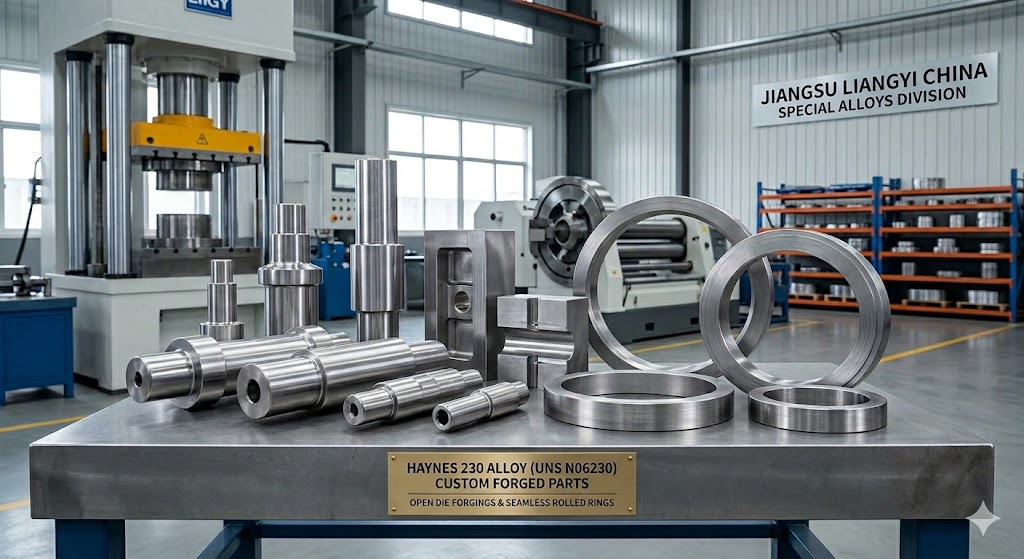
Jiangsu Liangyi Co., Limited is a professional ISO 9001:2015 certified manufacturer of Haynes 230 (Alloy 230, UNS N06230) open die forgings and seamless rolled rings. Our company is located in Jiangyin City, which is China's main forging industry cluster. With over of specialized forging experience, we can provide complete end-to-end custom forging solutions from premium steel melting, precision forging, controlled heat treatment to final CNC machining, 100% according to international standards. Our high-quality Haynes 230 forged parts are exported to more than 50 countries across Europe, North America, the Middle East, Southeast Asia and Australia.
Request a Free Quote Today What is Haynes 230 Alloy (UNS N06230)?
Haynes 230 is a high quality nickel-chromium-tungsten-molybdenum solid-solution strengthened superalloy, which is suitable for extreme high-temperature and corrosive industrial environments. It is globally recognized as the industry benchmark for superior nitriding resistance, exceptional long-term thermal stability, and outstanding oxidation resistance up to 1149°C (2100°F), significantly outperforming many competing high-temperature alloys in prolonged high-heat production conditions.
Unlike precipitation-hardened superalloys, Haynes 230 maintains its exceptional mechanical properties primarily through solid-solution strengthening, which can make it highly fabricable, weldable, and suitable for manufacturing complex custom forged components for the most demanding industrial applications. Explore our complete range of forged products to learn more about our capabilities.
Custom Haynes 230 Forged Product Range
As an experienced Chinese forging manufacturer, we produce custom Haynes 230 forged parts according to your precise CAD drawings and technical specifications, we can process the parts with a single-piece weight capacity ranging from 30kg up to 30,000kg. Below is the complete custom product range that we can process:
Main Forged Product Shapes
- Haynes 230 Forged Bars & Rods: Round bars, square bars, flat bars, rectangular bars, step shafts, gear shafts and turbine shafts, with maximum diameter up to 2000mm and maximum length up to 15 meters
- Alloy 230 Seamless Rolled Rings: Custom seamless rolled rings, gear rings, seal rings, contoured rings and custom forged rings, with maximum diameter up to 6 meters and maximum weight up to 30 tons
- UNS N06230 Hollow Forgings: Forged sleeves, bushes, bushings, pipes, tubes, heavy-wall cylinders, housings, shells and casings, with maximum outer diameter up to 3000mm
- Haynes 230 Forged Discs & Blocks: Forged discs, disks, blocks, plates, flanged blanks, valve discs, tube sheets and baffle plates, with maximum diameter up to 3000mm
- Custom Alloy 230 Forged Components: Complete custom forgings for non-standard shapes and complex geometries, with in-house precision CNC machining and complete NDT testing can be provided
We also focus on a wide range of nickel alloy forgings including Inconel, Incoloy, Hastelloy and Monel materials.
Main Material Properties & Advantages of Haynes 230 Alloy
Haynes 230 alloy has a unique and unparalleled combination of performance advantages which make it the best material choice for critical high-temperature applications across different industries all over the world:
- Exceptional High-Temperature Strength: Has excellent creep resistance and fatigue resistance at continuous operating with the temperatures up to 1149°C, that can make sure reliable long life cycle in demanding high-heat operations
- Outstanding Oxidation Resistance: Superior resistance to oxidizing environments up to 2100°F (1149°C) for prolonged exposures, with minimal scaling and grain boundary attack even under serious cyclic heating and cooling conditions
- Premier Nitriding Environment Resistance: Industry-leading resistance to nitriding attack among all commercial nickel alloys, which makes it virtually irreplaceable for nitriding furnace internals and ammonia-based high-temperature processes
- Excellent Long-Term Thermal Stability: Outstanding resistance to grain coarsening and detrimental intermetallic phase formation during prolonged high-temperature exposure, which can make sure consistent mechanical properties throughout the component's whole life cycle
- Low Thermal Expansion Characteristics: Lower thermal expansion coefficient compared to most high-temperature alloys, which can significantly reduce thermal stress and improve dimensional stability during rapid temperature fluctuations
- Superior Fabricability: Excellent formability, weldability and machinability compared to other high-performance superalloys, which enable the cost-effective production of complex custom forged components with tight tolerances
Haynes 230 Alloy (UNS N06230) Chemical Composition
The precise and carefully controlled chemical composition of Haynes 230 alloy ensures its exceptional high-temperature performance, with strict quality control of main alloying elements to meet all international standards:
Haynes 230 (UNS N06230) Chemical Composition – Weight % per AMS 5891 / ASTM B572
| Element | Weight % Range | Element | Weight % Range |
|---|
| Nickel (Ni) | 47.00 – 65.00 (Base Element) | Carbon (C) | 0.05 – 0.15 |
| Chromium (Cr) | 20.00 – 24.00 | Manganese (Mn) | 0.30 – 1.00 |
| Tungsten (W) | 13.00 – 15.00 | Silicon (Si) | 0.25 – 0.75 |
| Molybdenum (Mo) | 1.00 – 3.00 | Aluminum (Al) | 0.20 – 0.50 |
| Iron (Fe) | 3.00 max | Lanthanum (La) | 0.005 – 0.05 |
| Cobalt (Co) | 5.00 max | Phosphorus (P) | 0.03 max |
| Titanium (Ti) | 0.10 max | Sulfur (S) | 0.015 max |
| Copper (Cu) | 0.50 max | Boron (B) | 0.015 max |
Main Alloying Elements Function
- Chromium + Tungsten + Molybdenum: Synergistically enhance high-temperature strength, creep resistance, and oxidation/corrosion resistance through solid-solution strengthening
- Lanthanum: Significantly improves protective oxide layer adhesion, greatly enhancing cyclic oxidation resistance at extreme temperatures
- Carbon: Provides controlled solid-solution strengthening and improves high-temperature creep resistance without compromising fabricability and weldability
Manufacturing Process & Heat Treatment Specifications
Premium Melting & Precision Forging Process
All our Haynes 230 forgings are produced by using only premium raw material produced via industry-leading double-melting processes, which can make sure superior material purity, chemical uniformity and structural integrity:
- Standard Melting Process: Vacuum Induction Melting (VIM) + Electro-Slag Remelting (ESR) for optimal material cleanliness, structural uniformity and cost-effectiveness
- Premium Melting Process: Vacuum Induction Melting (VIM) + Vacuum Arc Remelting (VAR) for critical aerospace and high-pressure applications that require the highest material purity and structural integrity
Our state-of-the-art forging workshop is equipped with 2000T to 6300T hydraulic forging presses, 1–5T electro-hydraulic forging hammers, and 1–5 meter seamless ring rolling machines. We strictly control the forging temperature range, deformation rate, and grain flow direction throughout the whole forging process to achieve a uniform fine-grained microstructure, which can make sure optimal mechanical properties and fatigue resistance of the final Haynes 230 forged parts. Pls refer to production equipment to learn more about our production capabilities.
Heat Treatment Standards for Haynes 230 Forgings
Unless otherwise noted, all Haynes 230 forged parts come in the solution heat treated state. The heat treatment is processed according to AMS 5891 and ASTM B572 standards:
- Primary Solution Treatment: 1080°C (1975°F) holding for 8 hours, followed by rapid air cooling or oil/water quenching to lock in the improved microstructure
- High-Performance Solution Treatment Range: 1177°C to 1246°C (2150°F to 2275°F), with rapid water quenching for maximum high-temperature strength and oxidation resistance
- Precipitation Heat Treatment (BS HR2 Compliant): 700°C (1292°F) holding for 16 hours, followed by air cooling for specific applications which require better dimensional stability
Our in-house heat treatment workshop has 10 precision-controlled furnaces with complete temperature monitoring and recording, which can make sure complete traceability and 100% according to specified heat treatment cycle for every batch of Haynes 230 forgings.
Applicable International Standards & Specifications
Our Haynes 230 forged parts are produced according to following international material and quality standards. Material chemical composition and mechanical properties according to the requirements of these specifications; Any additional OEM specifications that are specific to the customer or project must be confirmed:
- Primary Material Standards: AMS 5891, ASTM B572, ASME SB572 — the principal specifications our production and quality control processes are built around
- OEM-Referenced Specifications: Our material chemistry and mechanical properties follow the material requirements referenced in specifications such as GE B50TF246 and PWA-1127D. Please note that formal compliance with OEM-specific qualification specifications requires OEM approval and is confirmed on a project-by-project basis — please provide your project specification requirements for our engineering team to review
- Oil & Gas: Material properties according to relevant NACE MR0175 / ISO 15156 sour service material requirements; project-specific API standard confirmed upon inquiry
- European Market: EN10204 material certification available; PED 2014/68/EU documentation support available through arrangement with EU Notified Bodies upon customer request
Weldability, Machinability & Fabrication Guidelines for Haynes 230 Forgings
One of Haynes 230's most commercially significant attributes — often underappreciated in material datasheets — is its genuine fabricability advantage is better than other high-performance nickel superalloys. Unlike precipitation-hardened grades such as Inconel 718 or Waspaloy, Haynes 230's solid-solution strengthened microstructure remains stable and does not require complex multi-stage age-hardening heat treatments, which significantly reduce downstream fabrication complexity and total cost of ownership.
Welding Haynes 230 Forgings – Recommended Methods & Procedures
Haynes 230 can be welded very well by all standard fusion welding methods whenspan style="white-space:normal;background-color:#FFFFFF;">hen properly prepared and carried out. The following procedures are recommended by our engineering team, our team has extensive production experience with Haynes 230 forged components:
- Primary Recommended Process – Gas Tungsten Arc Welding (GTAW / TIG): This method is the best process for high-integrity welds on Haynes 230 forgings which use 100% argon shielding gas with minimum 15 L/min flow rate. Haynes 230-W (AWS A5.14 ERNiCrWMo-1) is a recommended filler metal , which matches the base alloy composition and makes sure equivalent high-temperature performance in the weld zone. Pre-heat is generally not required for thicknesses up to 25mm; however, maintaining interpass temperature below 93°C (200°F) is essential to prevent heat-affected zone sensitization.
- Alternative Process – Gas Metal Arc Welding (GMAW / MIG): This method is suitable for higher-deposition-rate joining of Haynes 230 forged structures which use spray transfer or pulsed arc mode with 75% Ar / 25% He shielding gas mixture for best bead profile and penetration. Filler: Haynes 230-W wire. Clean joint surfaces to bare metal immediately before welding to prevent carbon contamination from machining fluids.
- Submerged Arc Welding (SAW): This method is best for heavy-section Haynes 230 forgings which need high deposition rates, such as thick flanges and large tube sheets.Select flux with low fluoride content to minimize hydrogen pickup. Keep the heat input low so that the temperatures between passes stay below 93°C.
- Electron Beam Welding (EBW) & Laser Beam Welding (LBW): These methods are best for applications that need a very small heat-affected zone and a very pure weld zone. Both methods work well with Haynes 230 forgings and make joints that work very well.
Critical Welding Note – Post-Weld Heat Treatment (PWHT): For most industrial applications, Haynes 230 welds do not require mandatory post-weld heat treatment. However, for components that will experience sustained service above 870°C (1600°F), a post-weld solution anneal at 1177°C (2150°F) for 15–30 minutes followed by rapid quenching is strongly recommended to homogenize the weld heat-affected zone microstructure and restore complete elevated-temperature performance. This is especially critical for nitriding furnace internals and turbine hot-section components. All our welded assemblies which involves Haynes 230 forgings are handled per this protocol as standard practice.
Machining Haynes 230 Forgings – Cutting Parameters & Tooling
Haynes 230 is a superalloy that is hard to machine because it hardens quickly, doesn't conduct heat well, and makes a lot of cutting heat. However, with the right tools and cutting settings—both of which our in-house CNC machining team has improved over 25 years of making Haynes 230—consistent dimensional accuracy and surface finish to Ra 1.6 µm or better are always achieved:
- Turning & Boring: Use uncoated or PVD TiAlN-coated carbide inserts (ISO grade P20–P30 equivalent). Recommended cutting speed: 30–45 m/min for rough turning, 45–60 m/min for finish turning. Feed rate: 0.15–0.25 mm/rev rough; 0.08–0.12 mm/rev finish. Depth of cut: 2–4mm rough; 0.3–0.8mm finish. Apply copious flood coolant at all times to manage heat generation.
- Milling: it is best to use solid carbide or carbide-tipped face mills with sharp cutting edges and positive rake angles. To reduce the work-hardening of the cut surface, climb milling (down-milling) is the best method. The best speed for cutting is 20 to 35 m/min. Change inserts before wear starts to chip the edges, which quickly weakens the surface.
- Drilling: When possible, use solid carbide drills with a 135° point angle and a through-tool coolant. Peck-drilling cycles are important for getting rid of chips and controlling heat in deep holes. 8 to 15 m/min. To keep the drill tip from getting too hard, use sharp drills and change them as soon as you notice an increase in cutting force.
- Grinding: Aluminum oxide or CBN (cubic boron nitride) wheels are recommended for precision grinding of Haynes 230 forged surfaces. Use light passes with adequate coolant flow to prevent thermal damage and surface tensile stress induction.
Mechanical Properties of Haynes 230 Forged Bars
We guarantee that all our Haynes 230 forged parts meet or exceed the minimum mechanical property requirements at room temperature, with comprehensive high-temperature mechanical testing available upon customer request:
Haynes 230 Minimum Room-Temperature Mechanical Properties (AMS 5891 / ASTM B572)
| Mechanical Property | Minimum Requirement (Room Temperature) |
|---|
| Ultimate Tensile Strength | 110 KSI min (760 MPa min) |
| Yield Strength (0.2% Offset) | 45 KSI min (310 MPa min) |
| Elongation (Break) | 40% min |
| Reduction of Area | 50% min |
| Hardness (Solution Treated) | HB 180–220 typical range |
Haynes 230 Elevated-Temperature Mechanical Properties
Haynes 230 alloy is one of the best engineering materials because it can keep its structural strength at temperatures where most other alloys start to fail. The following data shows the average values found on solution-annealed forged bar samples that were tested according to ASTM E21. These values are what our customers use as a standard when they choose Haynes 230 for turbine, furnace, and petrochemical applications:
Haynes 230 (UNS N06230) Elevated-Temperature Tensile Properties – Typical Values for Forged Bar (Solution Annealed, ASTM E21)
| Test Temperature | Ultimate Tensile Strength | 0.2% Yield Strength | Elongation (%) | Reduction of Area (%) |
|---|
| 21°C (70°F) – Room Temp | 800 MPa (116 KSI) | 355 MPa (51.5 KSI) | 47 | 58 |
| 538°C (1000°F) | 720 MPa (104 KSI) | 275 MPa (40 KSI) | 46 | 57 |
| 649°C (1200°F) | 655 MPa (95 KSI) | 255 MPa (37 KSI) | 48 | 60 |
| 760°C (1400°F) | 600 MPa (87 KSI) | 235 MPa (34 KSI) | 52 | 63 |
| 871°C (1600°F) | 510 MPa (74 KSI) | 215 MPa (31 KSI) | 55 | 67 |
| 982°C (1800°F) | 275 MPa (40 KSI) | 180 MPa (26 KSI) | 68 | 73 |
| 1093°C (2000°F) | 105 MPa (15 KSI) | 75 MPa (11 KSI) | 78 | 82 |
Engineering Insight: What sets Haynes 230 apart from Hastelloy X and Inconel 601 is not just its room-temperature properties, but the gradient of strength retention from 649°C to 1093°C. Haynes 230 retains approximately 81% of its room-temperature tensile strength at 649°C, versus roughly 73% for Hastelloy X at the same temperature — a margin that becomes critical in applications with prolonged cyclic thermal loading, such as gas turbine heat shields and nitriding furnace baskets. our engineering team can give you project-specific data on high temperatures as per your request.
Creep Rupture Strength of Haynes 230 Forgings
Creep rupture strength is the most important design factor for parts which have to work under constant stress at high temperatures, such as turbine discs, seal rings, and heat exchanger tube sheets. The Cr-W-Mo triad in Haynes 230's solid-solution strengthening mechanism gives it a better creep rupture life than most nickel alloys in the 871°C–1093°C service window:
Haynes 230 (UNS N06230) Typical Creep Rupture Strength – Stress to Rupture in 1,000 Hours
| Temperature | Stress for 100-Hour Rupture | Stress for 1,000-Hour Rupture | Relative Performance vs Hastelloy X |
|---|
| 871°C (1600°F) | 165 MPa (24 KSI) | 110 MPa (16 KSI) | ~35% higher rupture strength |
| 982°C (1800°F) | 72 MPa (10.4 KSI) | 45 MPa (6.5 KSI) | ~28% higher rupture strength |
| 1093°C (2000°F) | 28 MPa (4 KSI) | 16 MPa (2.3 KSI) | ~22% higher rupture strength |
Haynes 230 Alloy Physical & Thermal Properties
Beyond mechanical strength, the thermal and physical characteristics of Haynes 230 (UNS N06230) directly control component design decisions — from wall thickness calculations in pressure vessel engineering to thermal stress modeling in turbine casing design. The following properties are fundamental reference data used by our customers' engineers when specifying Haynes 230 forged parts:
Haynes 230 (UNS N06230) Physical and Thermal Properties at Room Temperature and Elevated Temperatures
| Physical Property | Value at 21°C (70°F) | Value at 538°C (1000°F) | Value at 871°C (1600°F) |
|---|
| Density | 8.97 g/cm³ (0.324 lb/in³) | 8.80 g/cm³ (est.) | 8.65 g/cm³ (est.) |
| Melting Temperature Range | 1301°C – 1371°C (2375°F – 2500°F) |
| Specific Heat Capacity | 397 J/kg·K (0.091 BTU/lb·°F) | 481 J/kg·K | 536 J/kg·K |
| Thermal Conductivity | 8.9 W/m·K (61.8 BTU·in/ft²·hr·°F) | 14.8 W/m·K | 19.7 W/m·K |
| Mean Thermal Expansion Coefficient (from 21°C) | – | 13.9 µm/m·°C (7.7 µin/in·°F) | 15.6 µm/m·°C (8.7 µin/in·°F) |
| Electrical Resistivity | 1.25 µΩ·m | 1.28 µΩ·m | 1.31 µΩ·m |
| Modulus of Elasticity (Young's Modulus) | 211 GPa (30.6 × 10⁶ psi) | 182 GPa | 138 GPa |
| Poisson's Ratio | 0.31 | – |
| Magnetic Permeability | 1.0003 (essentially non-magnetic) | Non-magnetic throughout full service range |
Design Note – Thermal Expansion: The mean thermal expansion coefficient of Haynes 230 is 13.9 µm/m·°C (21–538°C), which is much lower than that of Hastelloy X (14.8 µm/m·°C over the same range) and much lower than that of austenitic stainless steels (around 17–18 µm/m·°C). For engineers who make thermally-cycled assemblies like turbine casing bolt joints, heat exchanger shell-and-tube assemblies, or furnace retort flanges, this lower expansion coefficient means less differential thermal stress and better joint integrity over tens of thousands of thermal cycles.
Haynes 230 vs Competing High-Temperature Alloys
To choose the best high-temperature alloy, you need to know not only its peak temperature capability, but also the exact combination of corrosion mechanism, stress level, thermal cycling frequency, and service atmosphere that your part will be in. The following head-to-head comparison gives procurement engineers and metallurgists a structured way to compare Haynes 230 to the six most commonly specified competing alloys in global forging inquiries:
Haynes 230 (UNS N06230) vs Competing High-Temperature Alloys – Comprehensive 7-Grade Comparison for Forged Components
| Competing Alloy | Max Continuous Service Temp | Where Haynes 230 Wins | Where Competitor Has Edge | Haynes 230 Preferred Application Scenario |
|---|
| Inconel 600 / 601 (UNS N06600 / N06601) | ~1100°C (Inconel 601) | Superior nitriding resistance (critical in NH₃ atmospheres), higher creep rupture strength above 900°C, better long-term microstructural stability against σ-phase formation | Inconel 601 has slightly higher Al content for improved scaling resistance in some sulfidizing environments; lower material cost | Nitriding furnace retorts and baskets operating continuously at 950–1050°C in ammonia-based atmospheres; components requiring 3× or greater life cycle extension vs. Inconel 601 |
| Hastelloy X (UNS N06002) | ~1080°C | ~35% higher 1,000-hour creep rupture strength at 871°C; superior nitriding resistance; lower mean thermal expansion (reduces thermal fatigue in cyclic service); higher carbon content for better elevated-temperature creep via carbide strengthening | Hastelloy X has slightly higher Mo content (9%) for marginally better aqueous corrosion resistance at lower temperatures; wider weld filler availability | Industrial gas turbine combustion cans, transition ducts, and hot section structural rings where creep life is the primary design driver above 850°C |
| Inconel 718 (UNS N07718) | ~700°C (precipitation-hardened) | Dramatically superior service temperature (Haynes 230 usable to 1149°C vs. 718's 700°C practical limit); no γ″ phase dissolution concern; better oxidation and nitriding resistance above 750°C; no requirement for strict age-hardening heat treatment | Inconel 718 offers significantly higher room-temperature yield strength (1035 MPa vs. 355 MPa) and is better for lower-temperature, high-stress fastener and disk applications | All applications where production temperature exceeds 700°C; industrial furnace internals; gas turbine hot-section components requiring both high-temperature strength and corrosion resistance |
| Inconel 625 (UNS N06625) | ~980°C (oxidizing) | Substantially higher strength retention above 900°C; superior nitriding resistance; better resistance to grain boundary carbide embrittlement after prolonged thermal exposure at 870–1050°C | Inconel 625 has exceptional aqueous corrosion resistance (Mo+Nb synergy) making it superior in seawater, acidic, and crevice corrosion environments; better performance in chloride-containing media | High-temperature furnace internals, turbine components, and thermal processing equipment where production temperatures exceed 900°C and nitriding or oxidizing atmosphere resistance is paramount |
| Hastelloy C-276 (UNS N10276) | ~1040°C | Significantly better high-temperature strength and oxidation resistance above 850°C; superior nitriding resistance; better long-term thermal stability (C-276 is susceptible to precipitation of deleterious phases above 650°C) | Hastelloy C-276 provides outstanding resistance to pitting, crevice corrosion, and reducing acid attack at low-to-moderate temperatures; preferred for chemical processing and FGD systems below 650°C | High-temperature gas processing, furnace applications, and oxidizing high-heat environments where Hastelloy C-276's excellent ambient corrosion resistance is not required above 850°C |
| Haynes 188 (UNS R30188) | ~1100°C | Haynes 230 has higher creep rupture strength in the 871–1093°C range; lower density; better nitriding resistance; lower alloy cost due to lower Co content (Haynes 188 contains ~22% cobalt vs. Haynes 230's max 5% cobalt) | Haynes 188 has marginally better oxidation resistance in the 1050–1100°C range and higher thermal fatigue resistance under harsh cyclic conditions; better for aerospace combustor liner sheet applications | Industrial turbine forgings, furnace structural components, and high-temperature sealed environments where cost-to-performance ratio and nitriding resistance are the governing selection criteria |
| 310S Stainless Steel (UNS S31008) | ~1040°C (intermittent) | Far superior high-temperature creep strength, oxidation resistance, nitriding resistance, and microstructural stability; dramatically lower sigma-phase formation risk; longer component life cycle | 310S stainless steel is significantly less expensive per kilogram; easier to machine and weld; adequate for lower-stress, lower-temperature applications below 900°C | Any load-bearing component above 900°C where 310S components have failed prematurely due to sigma embrittlement, oxidation scaling, or creep deformation |
Material Selection Advisory: If your application needs continuous service above 900°C in an oxidizing, nitriding, or thermally cycled environment — particularly in gas turbines, industrial furnaces, or high-temperature process equipment — Haynes 230 consistently has the best combination of strength retention, environmental resistance, and long-term stability. Contact our engineering team for a free alloy selection suggestion which according to your specific operating conditions.
Industry Applications & Global Project Cases
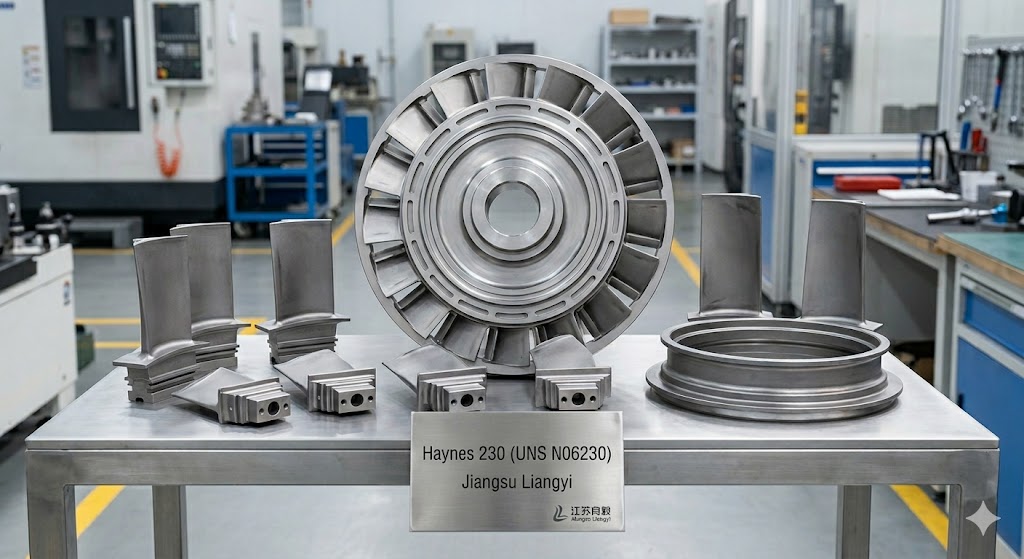
Haynes 230 alloy's unique combination of exceptional properties makes it the best material for critical components in the most demanding industrial sectors all over the world. Our products have been used in the following projects:
Power Generation: Gas & Steam Turbines
Haynes 230 is the established industry standard for critical gas and steam turbine components which can operate in extreme high-temperature and oxidizing environments, withstanding prolonged exposure to temperatures up to 1149°C.
- Gas compressor turbine blades, turbine disks, impellers and blisks
- Steam turbine double-ended studs, fasteners, bolts and bolting
- Turbine guide rings, seal rings, labyrinth rings, diaphragm seal rings and rotor end rings
- Turbine inner and outer heat shields, shrouds and diaphragm nozzles
- Gas turbine LPT 1st & 2nd stage turbine casings, steam turbine control reheat valve discs
- Turbine valve spindles, stems, rods, valve seats, valve cores, valve sleeves and main steam valve bonnets
Global Project Case: We supplied custom Haynes 230 steam turbine control reheat valve discs, turbine disks and seal rings for multiple 600MW+ thermal power plants in Southeast Asia. The components were produced with material chemistry and properties which can meet the customer's project specification requirements, withstood serious cyclic high-temperature oxidizing environments. These parts were processed according to EN10204 3.1 mill test certificates and comprehensive third-party dimensional and NDT inspection reports.
Oil & Gas and Petrochemical Industry
Haynes 230 has great high-temperature corrosion resistance and thermal stability which make it suitable for critical components in high-temperature, high-pressure petrochemical processing and oil and gas production.
- Heat exchanger tube sheets, baffle plates, nozzles and flanges for high-temperature process units
- High-pressure and high-temperature valve components, valve bodies, bonnets and seats
- Reformer tube components, furnace internals and cyclone separators for petrochemical plants
Global Project Case: We produced Haynes 230 forged tube sheets, baffle plates and flanges for high-temperature heat exchangers in a large-scale oil and gas project in the Middle East. All parts follow ASTM B572 and ASME SB572, standard, as well as NACE MR0175 sour service compliance. We can also provide complete EN10204 3.1 mill test certificates.
Industrial Furnace & Thermal Processing Equipment
Haynes 230 has the best nitriding resistance and long-term thermal stability in the industry, making it almost impossible to replace for parts in industrial furnaces that work in very hot, aggressive environments.
- Furnace retorts, chains, fixtures, burner flame shrouds and recuperator internals
- Nitriding furnace internals, heat-treating baskets, grates and trays
- Sparger tubes, thermocouple protection tubes and cyclone internals
- Hot working dies, tooling, die blocks and molds for high-temperature forming
Global Project Case: We provided custom Haynes 230 nitriding furnace internals, heat-treating baskets and thermocouple protection tubes for a leading industrial furnace manufacturer in North America. The parts took advantage of Haynes 230's best nitriding resistance, which meant they could handle being in ammonia-based nitriding environments at 1050°C for a long time. They lasted three times longer than the old Inconel 601 parts.
Aerospace & Industrial Gas Turbines
Haynes 230's exceptional high-temperature strength, oxidation resistance and fabricability make it commonly used in aerospace and industrial gas turbine components.
- Aerospace gas turbine blades, compressor components and structural parts
- Industrial gas turbine combustion liners, heat shields and fasteners
- Aircraft engine exhaust components and afterburner parts
Global Project Case: We provided Haynes 230 forged gas compressor turbine blades and structural components for a European aerospace component manufacturer. All parts were produced via VIM/VAR double melting process with material composition and properties which follow AMS 5891 chemical and mechanical requirements as specified by the customer, and passed strict ultrasonic and fluorescent penetrant inspection to the customer's inspection acceptance criteria.
Quality Assurance & Certification
We operate a complete-process quality control system for every batch of Haynes 230 forged parts, from raw material incoming inspection to final packaging and delivery. We can make sure each component meets your specified requirements and the applicable international material standards.
Full-Process Quality Control
- Raw material incoming inspection: Complete chemical composition analysis and full material traceability verification
- Forging process control: Strict real-time monitoring of forging temperature, deformation rate and grain flow direction
- Heat treatment traceability: Complete record of heat treatment cycle parameters for every production batch
- In-process dimensional inspection: Complete dimensional inspection at each machining stage to make sure compliance with drawing tolerances
- Final comprehensive inspection: Complete dimensional inspection, mechanical property testing, chemical analysis and non-destructive testing
Non-Destructive Testing (NDT) & Certification
We provide complete NDT testing services for all Haynes 230 forged parts, including Ultrasonic Testing (UT), Magnetic Particle Testing (MT), Liquid Penetrant Testing (PT) and Radiographic Testing (RT), all testing are performed by experienced NDT technicians.
All of our forged Haynes 230 parts come with EN10204 3.1 Mill Test Certificates that have been signed by our qualified inspection team. If you need an independent third-party inspection under EN10204 3.2, we can set up for internationally recognized third-party inspection agencies like TUV, DNV, Bureau Veritas (BV), ABS, Lloyd's Register, RMRS, and RINA to witness and sign off on the work. This will cost more and depend on the agency's schedule. Please tell us what third-party agency you need and what kind of inspection you need in your request.
Every EN10204 3.1 Mill Test Certificate includes the following complete details:
- Heat number, melting process type and complete material traceability
- Complete dimensional inspection report with all measurements
- Full heat treatment cycle details with temperature records
- Complete chemical analysis results including all tramp elements
- Complete mechanical test results including hardness test, with all individual values
- Ultrasonic test results and surface crack examination reports
- Visual inspection and verification confirmation
- Results of all additional tests required by customer drawings or orders
How to Order Haynes 230 Forgings – Complete Buyer's Guide
We understand that sourcing custom Haynes 230 forged parts from an overseas manufacturer involves careful evaluation of technical capability, quality reliability, and lead time. This section addresses every main procurement consideration our customers typically raise, from minimum order quantities through to delivery and payment terms:
Standard Ordering Parameters & Delivery Specifications
Haynes 230 Forgings – Standard Ordering Parameters, MOQ, Lead Times & Delivery Specifications by Jiangsu Liangyi
| Parameter | Standard Specification | Notes |
|---|
| Minimum Order Quantity (MOQ) | No strict MOQ – single piece orders accepted | We accept orders from a single piece forging up to complete production runs. Trial orders and sample orders are welcome. |
| Single-Piece Weight Range | 30 kg – 30,000 kg (30 tons) | Custom weight beyond this range available on request pending technical review |
| Forged Bar Maximum Diameter | Up to 2,000 mm (2 meters) | Larger sizes available via ring rolling for annular geometries |
| Seamless Ring Maximum Outer Diameter | Up to 6,000 mm (6 meters) | Wall thickness, height and contoured profiles to drawing; weight up to 30 tons |
| Delivery Condition (Standard) | Solution annealed (ATA condition), as-forged surface or rough-turned | Complete CNC-machined to final drawing dimensions available; aged condition (for BS HR2) on request |
| Surface Finish Options | As-forged / rough-turned / semi-finished / fully machined to Ra 1.6 µm or better | Shot-blasted, polished or coated surfaces on request |
| Dimensional Tolerance | Per drawing (±0.1 mm to ±2 mm typical); tighter tolerances on request | All machined dimensions verified by CMM coordinate measuring machine with complete inspection report |
| Melting Process Options | VIM+ESR (standard) / VIM+VAR (aerospace grade) | Melting process selected based on application requirements and customer specification |
| Material Certification | EN10204 3.1 Mill Test Certificate (standard, self-issued) | EN10204 3.2 third-party witness inspection arrangeable via TUV/DNV/BV/ABS/Lloyd's/RINA/RMRS at additional cost — specify required agency in your inquiry |
| NDT Options | UT standard for forgings >100mm; PT/MT/RT on request | NDT performed by our experienced in-house inspection team; third-party NDT witnessing arrangeable on request |
| Standard Lead Time (Rough Forging) | 6–10 weeks from drawing approval and deposit receipt | Varies with complexity and order quantity; complex machined parts: 10–16 weeks |
| Urgent / Expedited Orders | Available on request (4–6 week rush production possible) | Expedite surcharge applies; contact us to confirm schedule availability before placing urgent orders |
| Shipping & Incoterms | FOB Tianjin / Shanghai / Ningbo (standard); CIF, DDP available | Sea freight for heavy forgings; air freight for urgent small components; export wooden crating standard |
| Payment Terms | 30% T/T deposit with order; 70% T/T before shipment (standard) | L/C at sight available for orders >USD 50,000; other terms negotiable for established customers |
| Free Samples | Available for standard forged bar sections (Ø50mm × 100mm typical) | Sample cost covered by buyer; credited against first production order; contact us to arrange |
What to Include in Your Inquiry for the Fastest Response
To make sure our engineering team can provide you with an accurate technical proposal and competitive quotation within 24 hours, please provide the following information in your initial inquiry email:
- CAD drawings or sketches: 2D engineering drawings in PDF, DWG or DXF format preferred; 3D STEP or IGES files welcome for complex geometries
- Material specification: State "Haynes 230" or "UNS N06230" and reference standard (e.g., AMS 5891, ASTM B572) if applicable
- Required melting process: VIM+ESR (standard industrial) or VIM+VAR (aerospace/critical)
- Delivery condition required: As-forged, rough-turned, semi-finished, or fully CNC-machined to drawing
- Required certifications: EN10204 3.1 standard, or 3.2 with specific third-party agency (TUV, DNV, BV, etc.)
- Required NDT: Specify UT acceptance class (e.g., ASTM A388), PT, MT or RT requirements and applicable standard
- Order quantity and required delivery date: Including whether this is a prototype/trial order or production run
- Application description (optional but helpful): Operating temperature, pressure, atmosphere, and industry — enables our team to proactively flag any material or manufacturing considerations
Frequently Asked Questions (FAQ) | Haynes 230 Alloy Forgings
Haynes 230 alloy is often used for important components that need to work in very high temperatures and corrosive environments which include those in gas and steam turbines, industrial furnaces, nitriding furnaces, heat exchangers, aerospace engines, and high-temperature tools. It is especially useful for applications that need better nitriding resistance and long-term thermal stability up to 1149°C (2100°F).
The Unified Numbering System (UNS) designation for Haynes 230 alloy is UNS N06230. It is also commonly referred to as Alloy 230 or simply Haynes 230.
Haynes 230 alloy is very resistant to oxidation, even at high temperatures for long periods of time, up to 2100°F (1149°C). It can handle temperatures up to 1200°C for short periods of time and still have great structural stability and mechanical properties throughout its life cycle.
Haynes 230 has superior nitriding resistance, higher high-temperature strength, better oxidation resistance at temperatures above 1000°C, and excellent long-term thermal stability compared to Inconel 600. It is the best material choice for nitriding furnace internals and prolonged high-temperature service where Inconel 600 would degrade rapidly.
Our Haynes 230 forged parts are manufactured with chemical composition and mechanical properties compliant with primary international material standards including AMS 5891, ASTM B572, and ASME SB572. We also support projects by following API oil and gas standards and European EN standards. Please provide the specific specification for OEM parts such as those from aerospace or power generation OEMs in your inquiry and our engineering team will confirm applicability on a project-by-project basis.
We specialize in making custom Haynes 230 forged parts that are exactly what you want based on your CAD drawings, technical specs, and quantity needs. We provide complete end-to-end services, including high-quality melting, precise forging, controlled heat treatment, final precise CNC machining, and thorough NDT testing. We can handle pieces that weigh anywhere from 30 kg to 30 tons.
No, Haynes 230 alloy is not magnetic at all temperatures it can be used at. Its magnetic permeability is about 1.0003 at room temperature, which means it is paramagnetic. This is because it has an austenitic face-centered cubic (FCC) crystal structure that is stabilized by its high nickel and chromium content. This material stays non-magnetic from cryogenic temperatures all the way up to its highest service temperature of 1149°C (2100°F). Even when it is severely cold worked, it does not change to martensite. This makes Haynes 230 suitable for applications where magnetic neutrality is required, such as scientific instruments, MRI-adjacent equipment, and certain electronic industry furnace components.
Haynes 230-W is the best metal to use as a filler when welding Haynes 230 forgings. AWS A5.14 calls it ERNiCrWMo-1. This filler is made to match the composition of Haynes 230 base metal, so the weld deposit will have the same strength at high temperatures, resistance to oxidation, and resistance to nitriding as the forged material around it. If Haynes 230-W isn't available, you can use Inconel Filler Metal 625 (ERNiCrMo-3) instead. But the weld zone won't be as strong at temperatures above 900°C as a matched Haynes 230-W deposit. Don't use straight ERNiCr-3 (Inconel 82) fillers for high-temperature service above 900°C because they don't have as much tungsten, which makes the weld zone less resistant to creep.
We don't have minimum order quantity requirements for Haynes 230 forged parts. We can accept orders for single items, spare parts, engineering tests, and large production runs. The main factor governing order feasibility is total order weight and the associated raw material procurement. If the items are very small and weigh less than 50 kg each, we suggest putting several items in one order to make better use of the raw materials and lower the cost per unit. Please tell our sales team how many pieces you need and how heavy they are. Then, we'll tell you the best way to place your order so you can save money.
Standard lead time for Haynes 230 rough forgings (as-forged or rough-turned condition, with EN10204 3.1 certification) is typically 6 to 10 weeks from the date of drawing approval and receipt of deposit payment. For fully CNC-machined Haynes 230 components with tighter tolerances, NDT, and EN10204 3.2 third-party inspection, lead times of 10 to 16 weeks are typical depending on part complexity and current production scheduling. Expedited production with 4–6 week delivery is available for urgent orders subject to production capacity; please contact our sales team to confirm schedule availability before committing to an urgent timeline with your end customer.
Yes, we can provide material samples of Haynes 230 forged bar sections — typically a rough-turned cylinder of approximately Ø50mm × 100mm — for customer metallurgical evaluation, chemical analysis verification, or internal qualification testing. The sample material cost is covered by the buyer, but the cost is fully credited against your first production order. These samples are cut from certified heat-tracked VIM+ESR or VIM+VAR stock, supplied with EN10204 3.1 mill test certificates.
Haynes 230 and Haynes 282 are both high-quality nickel superalloys made for the components which work at high temperatures. However, they are very different in how they strengthen and when they work best. Haynes 230 (UNS N06230) is a solid-solution strengthened alloy that gets its strength from the Ni-Cr-W-Mo matrix. It works well from room temperature up to 1149°C (2100°F) and is very resistant to oxidation and nitriding. Haynes 282 (UNS N07208) is an alloy that gets its strength from the γ′ (gamma prime, Ni₃(Al,Ti)) precipitate phase. It has a much higher yield strength and creep resistance in the 650–900°C range, making it ideal for use in rotating turbine disks and blades. Haynes 282, on the other hand, needs a very specific two-stage aging heat treatment after solution annealing. It is also not as good for use above 950°C because γ′ dissolution takes away its strengthening advantage. Haynes 230 is still the best choice for applications that need better nitriding resistance or work at temperatures above 950°C. Haynes 282 may be better for high-stress rotating parts that work between 650 and 900 degrees Celsius because it has better yield and creep performance.
We can support European pressure equipment projects. Our Haynes 230 forged parts can be supplied with EN10204 3.1 mill test certificates as standard. For projects requiring PED 2014/68/EU compliance, we can provide the material documentation and arrange independent third-party inspection through EU Notified Bodies such as TUV Rheinland, Bureau Veritas (BV), or Lloyd's Register upon customer request. Formal PED Module compliance and CE marking are the responsibility of the pressure equipment manufacturer (our customer); we supply the compliant material and supporting documentation to enable this process. Please specify your PED Category, applicable Notified Body, and required documentation package when submitting your inquiry.
Our engineering team has been working in the field for 25 years, and we've heard from customers who switched to us from other suppliers. They say that the most common quality problems with Haynes 230 forgings from lower-quality manufacturers fall into five groups: (1) Wrong chemical makeup, especially if the tungsten content is less than 13%, which greatly lowers the creep performance at high temperatures. Jiangsu Liangyi stopped this by doing 100% incoming OES chemical analysis on every heat. (2) An inadequate forging reduction ratio results in a coarse, uneven grain structure that does not meet AMS 5891 grain size standards and has a short fatigue life. Our minimum forging reduction ratio of 4:1 guarantees a consistent ASTM 4 or finer grain size. (3) Wrong heat treatment, like a solution annealing temperature or hold time that isn't right, can leave undissolved carbides that make grain boundaries brittle. We keep full records of all our heat treatment cycles. (4) Undisclosed material substitution: providing cheaper alloys (like Hastelloy X or even 310S stainless steel) as Haynes 230. Our EN10204 3.1 certification with full heat traceability and optional third-party 3.2 verification stops this from happening. (5) Surface and internal flaws, such as laps, seams, and internal porosity caused by poor forging practices; our required UT and PT/MT inspection on all finished forgings finds and fixes these problems.