Hastelloy® G50 (Alloy G-50, UNS N06950) Forged Parts | Jiangyin China Leading Manufacturer
Jiangsu Liangyi Co., Limited, established in 1997 and located in Jiangyin City, Jiangsu Province, China—the heart of China's advanced forging industry hub—is a professional ISO 9001:2015 certified manufacturer of Hastelloy G50 (Alloy G-50, UNS N06950) open die forging parts and seamless rolled steel forged rings. With over 25 years of specialized experience in nickel alloy forging, we produce high-quality Hastelloy G50 parts that meet international standards including ASTM, AMS, API 6A, DIN, EN, and custom customer specifications.
Our factory covers 80,000 ㎡ and has 2000–6300 ton hydraulic forging presses and 5-meter seamless rolling machines. We can produce Hastelloy G50 forgings ranging from 30 kg to 30 tons in weight, with an annual production capacity of 120,000 tons. We serve customers from more than 50 countries around the world, providing reliable solutions for the most demanding industrial environments.
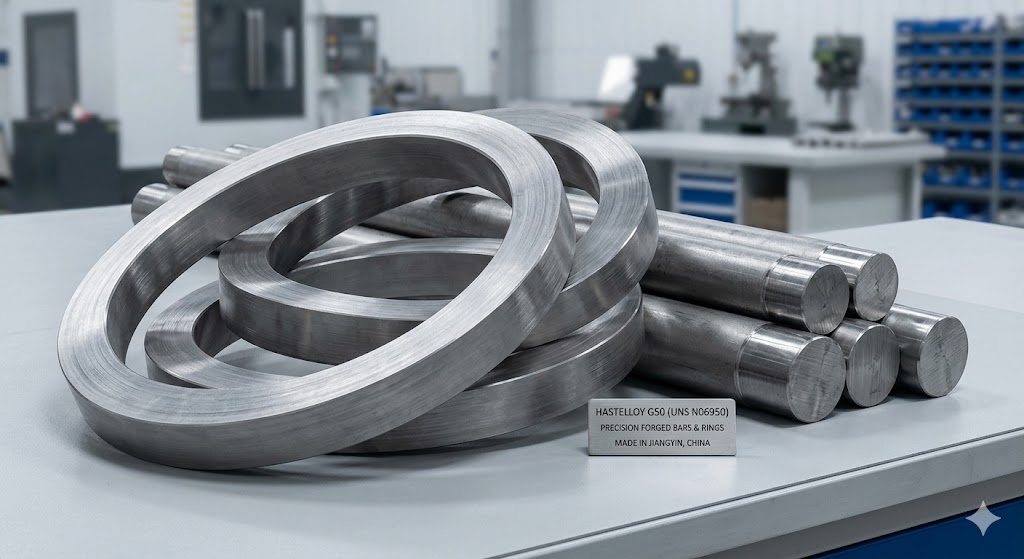
Why Choose Jiangsu Liangyi for Hastelloy G50 Forgings?
- We have more than 25 years of specialized nickel alloy forging experience in Jiangsu, China
- Provide a full range of service from steel melting to final CNC machining and inspection
- Have advanced triple/double melting processes (VIM+ESR+VAR / VIM+VAR) for great material purity
- Provide full range of NDT testing (UT, MT, PT) and comprehensive EN 10204 3.1/3.2 MTC certification
- Provide Competitive pricing with factory-direct supply from our Jiangyin manufacturing base
- Guarantee fast lead times and reliable global shipping via nearby Shanghai Port and Nanjing Port
Hastelloy G50 (UNS N06950) — Complete Quick Reference
- UNS Designation
- N06950
- Alternate Names
- Alloy G-50, Hastelloy G-50
- Alloy System
- Nickel-Chromium-Molybdenum-Iron (Ni-Cr-Mo-Fe) superalloy
- Nickel (Ni)
- Balance (~50% nominal)
- Chromium (Cr)
- 19–21 wt%
- Molybdenum (Mo)
- 8–10 wt%
- Iron (Fe)
- 15–20 wt%
- Density
- 8.17 g/cm³ (0.295 lb/in³)
- Melting Range
- 1300–1380°C (2372–2516°F)
- Tensile Strength (RT)
- ≥ 760 MPa (≥ 110,000 psi)
- Yield Strength 0.2% (RT)
- 700–860 MPa (102,000–125,000 psi)
- Elongation at Break
- ≥ 20%
- Young's Modulus (RT)
- ~200 GPa (29.0 × 10⁶ psi)
- Thermal Conductivity (100°C)
- 10.8 W/(m·K)
- Thermal Expansion (20–100°C)
- 12.6 µm/(m·°C)
- Heat Treatment
- Solution anneal at 1149°C (2100°F), rapid water quench
- Melting Route
- VIM + ESR + VAR (triple melt) or VIM + VAR (double melt)
- Primary Standard
- NACE MR0175 / ISO 15156 — sour gas (H₂S) service
- Other Standards
- ASTM B564, AMS 5765, API 6A PSL 3/4, DIN, EN
- Certification
- EN 10204 3.1 / 3.2 MTC; ISO 9001:2015
- Weight Range
- 30 kg – 30 tons per piece
- Max Ring OD
- 6,000 mm (seamless rolled)
- Max Bar Diameter
- 2,000 mm
- Manufacturer
- Jiangsu Liangyi Co., Limited — Jiangyin, Jiangsu Province, China (est. 1997)
Available Hastelloy G50 Forged Product Shapes & Sizes
We provide a full range of Hastelloy G50 (Alloy G-50, UNS N06950) forging products in all kinds of shapes and sizes to meet different industrial requirements. All our products can be custom machined according to your drawings and technical specifications.
- Forged Bars: Round bars (up to 2000 mm diameter), square bars, flat bars, rectangular bars, and rods
- Seamless Rolled Rings: Custom seamless rolled rings (up to 6000 mm outer diameter) and open die forged rings
- Hollow Components: Hubs, housing shells, sleeves, bushes, bushing cases, and hollow bars (up to 3000 mm OD)
- Flat Products: Discs, disks, blocks, and plates (up to 3000 mm diameter)
- Pipe Products: Pipes, tubes, tubings, piping shells, casings, case barrels, and housings
- Custom Components: Flanges, tube sheets, baffle plates, nozzles, and other custom forged parts
Explore our full range of forged steel products to find the perfect solution for your project.
Hastelloy G50 Forged Parts Applications & Industry Cases
Hastelloy G50 (UNS N06950) is a nickel-chromium-molybdenum-iron alloy that is used to resist corrosion by "sour gas" (hydrogen sulfide, H₂S) in oil well applications. It has an excellent combination of corrosion resistance, high strength, and toughness, so that it is the best choice material for the most demanding industrial environments where other alloys would fail prematurely.
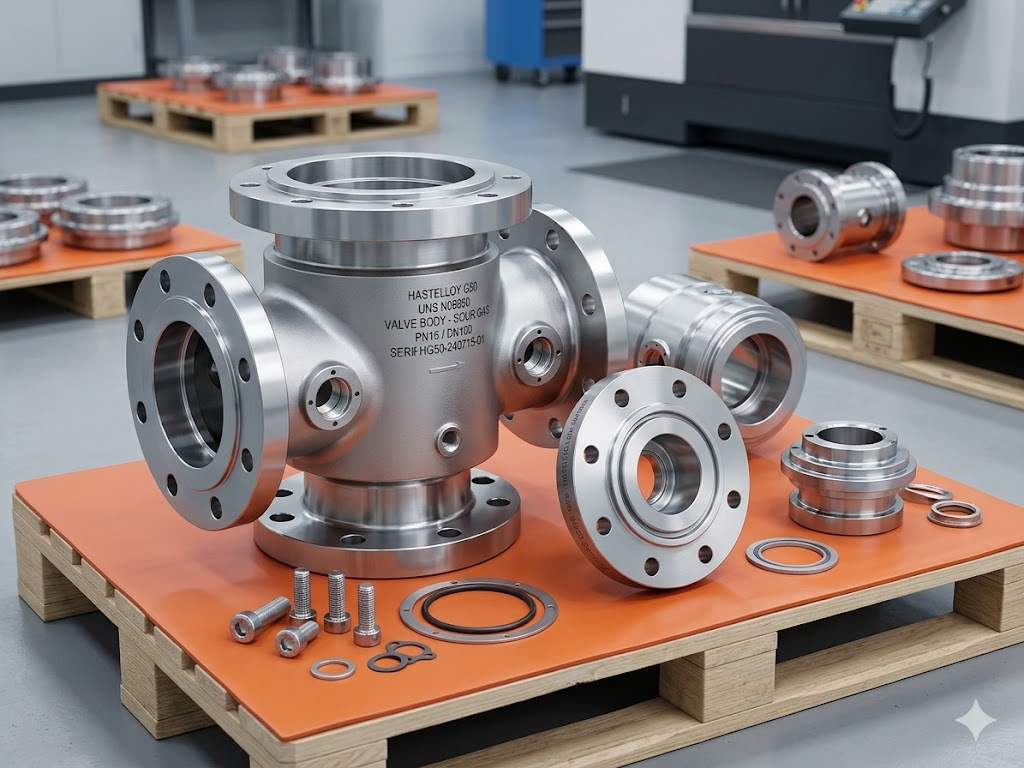
Industry-Specific Application Cases
Oil & Gas Industry (Primary Application)
Hastelloy G50 is the best choice material for sour service (NACE MR0175 / ISO 15156 compliant) oil and gas production, where it provides great resistance to sulfide stress cracking (SSC) and hydrogen-induced cracking (HIC). Our Hastelloy G50 parts have been used in Middle East sour gas projects and North American shale oil operations.
- Drilling pipes, tubes, drill rods, and drilling collars for onshore and offshore sour gas wells
- Drilling tools, risers, connectors, flexible joints, seals, flanges, and gaskets for subsea applications
- Downhole drilling tool components including mud motor splined drive shafts
- Electrical submersible pumps (ESP) motor splined shafts for corrosive well environments
- Casing heads, tubing heads, casing hangers, tubing hangers, tubing spools, and casing spools
- Double studded adapter flanges, integral mud flanges, and studded crosses
- Oil measurement valve spools and ultrasonic flow meter bodies
Valve Manufacturing Industry
Our Hastelloy G50 valve parts are widely used in high-pressure, high-temperature, and corrosive fluid handling systems for European petrochemical plants.
- Valve balls, valve bonnets, valve bodies, valve stems, valve closures, and valve seat rings
- Components for H-type two-way, one-way, and back pressure valves
- Ball valves, check valves, and gate valve parts for oil and gas pipelines
- Butterfly valve main shafts and spindles
- High-performance butterfly valve (HPBV) shafts for cryogenic applications
- Gas and steam turbine MSV/GV/CV/CRV valve seats, cores, and sleeves
Nuclear Power Industry
Hastelloy G50 has excellent corrosion resistance and mechanical properties at elevated temperatures, so that it is the best choice material for important nuclear power parts in Asia and Europe.
- Nuclear power reactor coolant pump rotors and impellers
- Reactor coolant pump casing shells and bodies
- Containment seal chambers for nuclear reactor coolant pumps
Why Choose Hastelloy G50? — Detailed Alloy Comparison
Most material selection guides present G50 in isolation. Having forged all five alloys below for clients across the Middle East, Europe, and Asia Pacific, Jiangsu Liangyi's metallurgical team offers the following field-informed comparison. The goal is to help you select the right alloy the first time, minimising costly material substitutions mid-project.
| Alloy (UNS) | Mo Content | Fe Content | SSC Resistance (H₂S) | Pitting in Cl⁻ Media | Primary Use Case vs G50 |
|---|---|---|---|---|---|
| Hastelloy G50 (N06950) | 8–10% | 15–20% | ★★★★★ Excellent (NACE MR0175) | ★★★★ Very good | — Reference alloy for sour gas service |
| Hastelloy G3 (N06985) | 6–8% | 18–21% | ★★★★ Good | ★★★ Moderate | Choose G50 when H₂S partial pressure exceeds ~0.3 MPa or SSC testing reveals marginal G3 performance |
| Hastelloy C276 (N10276) | 15–17% | 4–7% | ★★★ Moderate (not primary design intent) | ★★★★★ Outstanding | Choose C276 for severe pitting/crevice corrosion in hot chloride media; choose G50 when SSC is the primary failure mode |
| Inconel 625 (N06625) | 8–10% | ≤ 5% | ★★★ Moderate | ★★★★ Very good | Choose 625 for high-strength cryogenic or aerospace components; G50 preferred for downhole sour gas where SSC governs |
| Super Duplex 2507 (S32750) | 3.5–4.5% | Balance | ★★ Limited (susceptible at elevated temp) | ★★★★ Good (PREN ~43) | Choose 2507 for cost-effective seawater/sweetish environments; G50 mandatory when H₂S is present above NACE MR0175 threshold |
| 316L Stainless Steel (S31603) | 2–3% | Balance | ★ Very limited (fails in trace H₂S) | ★★ Limited | Not suitable for any sour service; G50 required wherever NACE MR0175 is invoked |
Hastelloy G50 (UNS N06950) — Complete Material Specifications
Melting Process
All our Hastelloy G50 forged materials are produced using advanced melting methods to guarantee the needed purity for important applications:
- Triple melted: VIM + ESR + VAR — for the most demanding nuclear, subsea, and high-H₂S sour service applications
- Double melted: VIM + VAR — for standard oil and gas and valve manufacturing applications
Macrostructure Requirements (ASTM A604)
Visual examination of transverse full cross-sections of Hastelloy G50 forged bars, billets, rings, and extrusions, etched in hot hydrochloric acid per ASTM A604, shows no pipe or cracks.
| Imperfection Type | Maximum Severity Class |
|---|---|
| Freckles | A |
| White Spots | A |
| Radial Segregation | A |
| Ring Pattern | B |
Chemical Composition (wt%)
| Element | Content (wt%) | Element | Content (wt%) |
|---|---|---|---|
| Nickel (Ni) | Balance (~50%) | Aluminum (Al) | 0.40 max |
| Chromium (Cr) | 19.0–21.0 | Carbon (C) | 0.020 max |
| Molybdenum (Mo) | 8.0–10.0 | Cobalt (Co) | 2.5 min |
| Iron (Fe) | 15.0–20.0 | Copper (Cu) | 0.50 max |
| Manganese (Mn) | 1.0 max | Niobium (Nb) | 0.50 max |
| Phosphorus (P) | 0.040 max | Silicon (Si) | 1.0 max |
| Sulfur (S) | 0.015 max | Tungsten (W) | 1.0 max |
Design note: G50 contains 15–20 wt% iron, the highest among major nickel alloys used in sour service.From our forging experience, this higher iron content offers two practical advantages: it lowers raw material costs compared to low‑iron alloys, and it slightly shortens the solidification temperature range, which reduces the risk of hot tearing during forging.The trade‑off is a small drop in general corrosion resistance compared to pure Ni‑Cr‑Mo alloys, but its great resistance to sulfide stress cracking (SSC) in sour service more than makes up for this.
Heat Treatment
Hastelloy G50 forgings are solution annealed at 1149°C (2100°F) followed by rapid cooling or quenching in water to get improved mechanical properties and corrosion resistance. Complete temperature-time charts are recorded for every heat treatment cycle and provided as part of the EN 10204 3.1/3.2 MTC documentation.
Room-Temperature Mechanical Properties (Delivery Condition: Solution Annealed + Water Quenched)
| Property | Metric (SI) | Imperial (US) |
|---|---|---|
| Tensile Strength (UTS) | ≥ 760 MPa | ≥ 110,000 psi |
| Yield Strength (0.2% offset) | 700–860 MPa | 102,000–125,000 psi |
| Elongation at Break (GL = 50 mm) | ≥ 20% | ≥ 20% |
| Young's Modulus (Elastic Modulus) | ~200 GPa | ~29.0 × 10⁶ psi |
| Hardness (typical) | ~90–95 HRB | ~90–95 HRB |
Elevated-Temperature Mechanical Properties (Typical Values)
For customers specifying G50 in nuclear power, high-temperature valve, or process equipment applications, the following table provides typical elevated-temperature tensile data. These values represent typical performance of solution-annealed forgings; for design-critical applications, elevated-temperature testing at specified conditions is recommended.
| Test Temperature | Tensile Strength (MPa) | Yield Strength 0.2% (MPa) | Elongation (%) |
|---|---|---|---|
| 23°C (Room Temperature) | ≥ 760 | 700–860 | ≥ 20 |
| 100°C (212°F) | ~730 | ~660 | ~22 |
| 200°C (392°F) | ~710 | ~635 | ~23 |
| 300°C (572°F) | ~690 | ~615 | ~24 |
| 400°C (752°F) | ~665 | ~595 | ~24 |
| 500°C (932°F) | ~640 | ~570 | ~25 |
| 600°C (1112°F) | ~600 | ~540 | ~26 |
Note: Values above are applicable to solution-annealed open die forgings produced by Jiangsu Liangyi. Actual values depend on forging reduction ratio, section size, and heat treatment parameters. Customer-specific elevated-temperature testing can be arranged upon request.
Physical & Thermal Properties
The following physical and thermal data support heat exchanger design, thermal stress calculations, and equipment sizing for Hastelloy G50 parts. All values are for the solution-annealed condition.
| Property | Value | Unit | Temperature |
|---|---|---|---|
| Density | 8.17 | g/cm³ (0.295 lb/in³) | 20°C |
| Melting Range | 1300–1380 | °C (2372–2516°F) | — |
| Specific Heat Capacity | 420 | J/(kg·K) | 20°C |
| Thermal Conductivity | 10.8 | W/(m·K) | 100°C |
| Thermal Conductivity | 14.2 | W/(m·K) | 500°C |
| Mean Thermal Expansion Coefficient | 12.6 | µm/(m·°C) | 20–100°C |
| Mean Thermal Expansion Coefficient | 13.8 | µm/(m·°C) | 20–500°C |
| Electrical Resistivity | 1.14 | µΩ·m | 20°C |
| Young's Modulus (Elastic Modulus) | 200 | GPa (29.0 × 10⁶ psi) | 20°C |
| Young's Modulus | ~185 | GPa | 400°C |
| Shear Modulus | ~76 | GPa | 20°C |
| Poisson's Ratio | ~0.31 | — | 20°C |
Hastelloy G50 Corrosion Resistance & Sour Service Qualification Data
The corrosion resistance of Hastelloy G50 (UNS N06950) is best understood not as a single property but as a layered performance profile: its primary design parameter is resistance to sulfide stress cracking (SSC) and hydrogen-induced cracking (HIC) in sour environments, supported by solid general corrosion resistance derived from its high Cr-Mo content, and further reinforced by its NACE MR0175 / ISO 15156-3 qualification status.
Pitting Resistance Equivalent (PREN) Analysis
The Pitting Resistance Equivalent Number (PREN) is calculated as: PREN = %Cr + 3.3 × %Mo + 16 × %N. This formula, originally developed for stainless steels, provides a useful comparative indicator for Ni-base alloys when applied consistently within the same alloy family.
Hastelloy G50 PREN Calculation (using nominal mid-range composition)
Using Cr = 20%, Mo = 9%, N ≈ 0% (not a primary alloying element in G50):
PREN (nominal) = 20 + (3.3 × 9) + 0 = 20 + 29.7 = 49.7
However, G50's significant iron content (15–20 wt%) dilutes the effective corrosion resistance relative to low-Fe nickel alloys. Applying an Fe-correction factor (a practice used by Jiangsu Liangyi's corrosion engineers for internal material selection):
PREN (Fe-adjusted) ≈ 49.7 − (Fe% ÷ 3) = 49.7 − 5.8 ≈ 44
This Fe-adjusted PREN of ~44 is comparable to Super Duplex 2507 (~43) in terms of pitting resistance in chloride media, while G50 retains a substantial SSC resistance advantage that 2507 cannot provide at elevated temperatures or above NACE threshold H₂S concentrations.
NACE MR0175 / ISO 15156-3 Sour Service Qualification
Hastelloy G50 (UNS N06950) meets NACE MR0175 / ISO 15156-3 and it is used for H₂S-containing environments in oil and gas production. Main qualification boundaries:
| Parameter | Qualification Limit | Notes |
|---|---|---|
| Minimum H₂S Partial Pressure (sour service threshold) | > 0.0003 MPa (0.05 psia) | NACE MR0175 definition; G50 required above this threshold |
| Maximum Application Temperature | 232°C (450°F) | Per NACE MR0175 Table 1 for nickel alloys in sour service |
| Minimum Application Temperature | −60°C (−76°F) | G50 retains adequate fracture toughness to cryogenic temperatures |
| Chloride Content | No upper limit specified for G50 | G50 resists SCC in combined H₂S + Cl⁻ environments where SSIs fail |
| Hardness Limit (for SSC resistance) | ≤ 35 HRC / ≤ 331 HV10 | NACE MR0175 general requirement; G50 solution annealed typically 90–95 HRB |
Corrosion Resistance in Specific Environments
| Corrosive Environment | Performance Rating | Engineering Commentary |
|---|---|---|
| H₂S (Sour Gas) — SSC Resistance | ★★★★★ Excellent | Primary design intent; NACE MR0175 compliant across full temperature range |
| H₂S — HIC Resistance | ★★★★★ Excellent | Triple-melt VIM+ESR+VAR process eliminates the hydrogen-trapping inclusions that initiate HIC |
| Chloride Stress Corrosion Cracking (Cl-SCC) | ★★★★★ Immune | Ni content >40% confers full immunity to Cl-SCC — a critical advantage over austenitic SS |
| Pitting Corrosion (NaCl, seawater) | ★★★★ Very Good | PREN ~44 (Fe-adjusted); resists pitting in seawater to ≥ 50°C |
| Crevice Corrosion (stagnant chloride) | ★★★★ Very Good | Mo content (8–10%) provides effective crevice protection; inferior to C276 in stagnant hot brine |
| General Acid Corrosion (H₂SO₄, HCl) | ★★★★ Very Good | Cr and Mo content provides effective resistance to dilute mineral acids; not intended for concentrated oxidising acid service |
| Oxidation at High Temperature | ★★★ Moderate | 20% Cr provides oxidation resistance to ~900°C; for continuous high-temperature oxidation, alloys with >25% Cr are preferred |
Hastelloy G50 Weldability & Machinability
When procurement engineers specify Hastelloy G50 (UNS N06950) in fabricated assemblies, they need to know how it behaves when welded and machined in order to make accurate cost estimates and quality plans. The following guidance is based on Jiangsu Liangyi's production experience and is not a substitute for project-specific welding procedure qualification (WPS/PQR).
Weldability Overview
Hastelloy G50 is readily weldable by standard fusion welding processes. Its 15–20% iron content, while sometimes overlooked in datasheets, is metallurgically advantageous for weldability: the elevated Fe narrows the solidification temperature range relative to lower-Fe nickel alloys, reducing hot-crack susceptibility in the weld pool. This makes G50 easier to work with during GTAW than alloys like Hastelloy C276, which has a wider solidus-liquidus range and needs stricter interpass temperature control.
| Parameter | Recommendation | Notes |
|---|---|---|
| Preferred Welding Process | GTAW (TIG) / PAW | GMAW acceptable for fillet welds; SMAW not recommended for thin sections |
| Primary Filler Metal | ERNiCrMo-3 (AWS A5.14) — Inconel 625-type | 8–10% Mo filler provides adequate corrosion resistance in the weld zone; widely available |
| Alternative Filler Metal | ERNiCrMo-10 (AWS A5.14) — C22-type | Higher Mo (12–14%) in filler; preferred when maximum weld zone corrosion resistance is critical |
| Shielding Gas | Pure Argon (99.99%) or Ar + 2–5% He | Helium addition improves penetration for thick sections; avoid CO₂ additions |
| Preheat Temperature | Not required (section thickness < 25 mm) | For thick sections (>50 mm), warm to 20°C minimum to avoid condensation |
| Maximum Interpass Temperature | 150°C (302°F) | Exceeding 175°C risks carbide precipitation at grain boundaries, reducing HAZ corrosion resistance |
| Post-Weld Heat Treatment (PWHT) | Optional — 1149°C (2100°F) + water quench | PWHT is not mandatory for most applications; perform when maximum HAZ corrosion resistance is required (e.g., high-H₂S sour service at > 150°C) |
| Backing Gas (for tube/pipe welding) | Pure Argon | Required for root passes to prevent oxidation of the weld root surface |
Machinability
Hastelloy G50 is a moderately difficult-to-machine alloy because it hardens quickly and causes built-up edge (BUE) on cutting tools. But it is easier to machine than Inconel 718 and about the same as Hastelloy C276. The following parameters are based on Jiangsu Liangyi's in-house CNC machining operations and feedback from customers machining our forgings.
| Operation | Cutting Speed (m/min) | Feed Rate | Key Practice |
|---|---|---|---|
| Rough Turning | 25–40 | 0.15–0.30 mm/rev | Use positive-rake uncoated or PVD-coated carbide; continuous cutting; flood coolant |
| Finish Turning | 30–50 | 0.08–0.15 mm/rev | Sharp, freshly-ground insert; avoid tool dwell (work hardening) |
| Drilling | 8–15 (surface speed) | 0.05–0.12 mm/rev | Short-flute cobalt HSS or solid carbide; peck-drill for depth > 3D; sulfur-free flood coolant |
| Milling (face/end) | 20–35 | 0.05–0.12 mm/tooth | Climb milling preferred; rigid setup; avoid interrupted cuts where possible |
| Grinding | — | — | Aluminium oxide or CBN wheel; generous coolant; avoid surface burn |
Cutting fluid: Always use sulfur-free, chloride-free water-soluble cutting fluid or neat cutting oil. Chloride-contaminated coolants can cause surface staining and, in extreme cases, initiate crevice corrosion during storage of partly-machined parts.
General principle: Never allow the tool to dwell on the workpiece surface — G50 work-hardens rapidly, and even a brief pause will harden the surface layer to a depth that blunts the following cut. Keep continuous chip flow and replace inserts before they reach end-of-life, not after.
Applicable Standards & Specifications for Hastelloy G50 Forgings
Hastelloy G50 (UNS N06950) forgings are produced based on a wide range of international standards. The table below maps product forms to their applicable specifications. Jiangsu Liangyi can supply material to any combination of the listed standards, as well as to proprietary customer specifications upon request.
| Product Form | Primary ASTM Standard | AMS | API / NACE | EN / DIN | Certification |
|---|---|---|---|---|---|
| Forgings (all forms) | ASTM B564 | AMS 5765 | API 6A PSL 3 / PSL 4 NACE MR0175 / ISO 15156-3 upon customer specification | EN 10216-5 / EN 10228 | EN 10204 3.1 / 3.2 MTC |
| Forged Bars & Rods | ASTM B564 / ASTM B166 | AMS 5665 | NACE MR0175 | DIN 17750 | EN 10204 3.1 / 3.2 MTC |
| Seamless Rolled Rings | ASTM B564 | AMS 5765 | API 6A PSL 3 / PSL 4 upon customer specification | EN 10228-4 | EN 10204 3.1 / 3.2 MTC |
| Pipes & Tubes (forged) | ASTM B622 / ASTM B619 | — | NACE MR0175 | EN 10216-5 | EN 10204 3.1 / 3.2 MTC |
| Flanges (forged) | ASTM B564 / ASME B16.5 | — | API 6A | EN 1092 | EN 10204 3.1 / 3.2 MTC |
| NDT Requirements | ASTM A388 (UT) ASTM E709 (MT) ASTM E165 (PT) | — | API 6A Annex B/C/D | EN 10228-3 (UT) EN 10228-1 (MT) | NDT inspector certification included |
| Chemical Analysis | ASTM E1473 (ICP-MS/OES) | — | — | EN ISO 15350 | Product analysis per heat |
Our Hastelloy G50 Manufacturing Capabilities in Jiangyin, China
At our Jiangyin, Jiangsu manufacturing factory, we have invested in advanced equipment to make sure Hastelloy G50 forgings have the highest quality :
Manufacturing Process — Step by Step
- Triple Melt: VIM + ESR + VAR Raw nickel alloy is Vacuum Induction Melted (VIM), Electroslag Remelted (ESR) to remove oxide inclusions, then Vacuum Arc Remelted (VAR) for maximum purity and internal matrix uniformity — the baseline for all sour service and nuclear-grade G50 forgings.
- Billet Heating in Computer-Controlled Furnaces VIM+ESR+VAR or VIM+VAR ingots are heated with ±5°C temperature uniformity to the optimal forging temperature range before pressing or rolling.
- Open Die Forging on 2000–6300 Ton Presses or Ring Rolling on 5 m Machines Multiple reduction passes guarantee refined grain size and mechanical property uniformity throughout the forging cross-section — important for large-diameter downhole tool parts where through-thickness SSC resistance must be guaranteed.
- Solution Annealing at 1149°C (2100°F) with Full T-t Chart Recording Precision heat treatment with complete temperature-time documentation; water quenching within 60 seconds to preserve the solution-annealed microstructure.
- Full NDT Inspection + Mechanical Testing UT, MT, PT, OES chemical analysis, tensile/hardness/impact testing, and dimension test — all performed in our in-house testing laboratory.
- Optional CNC Machining to Finished Dimensions CNC machining to customer drawings, followed by final dimensional, visual, and cleaning verification; EN 10204 3.1/3.2 MTC preparation and export packaging.
Forging Equipment
- 2000 Tons, 4000 Tons, and 6300 Tons Hydraulic Forging Presses
- 0.75 t, 1 t, 3 t, 5 t, and 9 t Electro Hydraulic Forging Hammers
- 1 Meter and 5 Meter Seamless Ring Rolling Machines
- Ten Heat Treatment Furnaces for precise temperature control
Smelting Facilities
- 30 t Electric Arc Furnace (EAF)
- 30 t Ladle Refining Furnace (LF)
- 30 t Vacuum Degassing Furnace (VOD)
- 2 t Medium Frequency Induction Furnace (IM)
Learn more about our advanced forging equipment capabilities.
Quality Assurance & Inspection for Hastelloy G50 Forgings
Quality assurance is our top priority at Jiangsu Liangyi. We have advanced inspection tools in our lab, and we test Hastelloy G50 forged products strictly at every stage to make sure that all of the parts meet international standards.
Quality Inspection Equipment
- Nondestructive Testing (NDT) Equipment — Ultrasonic (UT), Magnetic Particle (MT), Penetrant (PT)
- Optical Emission Spectrometer (OES) for full chemical composition analysis
- Mechanical Property Testing Equipment — Universal Tensile Testing Machine, Rockwell/Brinell/Vickers Hardness Testers, Charpy Impact Testing Machine
- Metallographic Testing Equipment — Optical Metallurgical Microscope, SEM
- High Temperature Tensile and Creep Testing Machines
- Coordinate Measuring Machine (CMM) for dimension test.
Comprehensive Inspection Reports
We provide full inspection reports with every shipment, including:
- Identification number, material number, and designation (UNS N06950 / Alloy G-50)
- Order number, drawing number, and specification number
- Heat number, heat chemical analysis, and melting method
- Product chemical analysis (OES, per ASTM E1473)
- Complete heat treatment certification with temperature-time graphs
- Nondestructive testing (NDT) records — UT, MT, PT
- Mechanical test results — tensile, yield, elongation, hardness, impact (if needed)
- Residual stress measurement results (for process qualification)
- Deviation reports (if applicable)
- NDT inspector certification
- Dimensional and visual inspection report
- Cleaning verification
All our products meet EN 10204 3.1 or 3.2 Mill Test Certificates (MTC) upon request. Third-party inspection by reputable organizations such as SGS, BV, and TUV is also available per request.
Packaging, Delivery & Lead Times for Hastelloy G50 Forgings
When procurement teams know about our packaging, shipping, and lead time, they can make better plans . The information below shows how we usually ship Hastelloy G50 (UNS N06950) forgings from our factory in Jiangyin, Jiangsu, to places all over the world.
📦 Packaging Standard
Seaworthy wooden crates or steel-reinforced pallets. Machined surfaces are coated with anti-rust oil. Each piece is wrapped individually in VCI (Volatile Corrosion Inhibitor) film with desiccant bags. Suitable for sea freight, air freight, and multimodal transport.
🔖 Marking & Traceability
Each forging is marked with Heat Number, UNS N06950 / Alloy G-50, Customer Order Number, Part Number, Weight (kg), and Jiangsu Liangyi batch code. Full traceability from ingot heat to finished forging maintained in our QMS.
🚢 Trade Terms Supported
FOB Shanghai Port, FOB Nanjing Port, CIF (any major global port), CFR, EXW Jiangyin factory. DDP is available for selected countries. We work with established freight forwarders for hazardous material and oversized cargo shipments.
⏱ Standard Lead Times
Simple geometries (bars, discs < 500 mm): 6–8 weeks. Standard custom forgings: 8–12 weeks. Large rings (> 3000 mm OD) or complex multi-step forgings: 10–14 weeks. All lead times from drawing confirmation and order placement. MOQ: 1 piece.
🔍 Third-Party Inspection
We welcome and facilitate TPI by SGS, Bureau Veritas (BV), TUV, Intertek, or customer-nominated inspectors. Inspection witness points (hold/witness/review) are defined in the Inspection & Test Plan (ITP) agreed at order placement.
📋 Document Package
Standard shipment documents: Commercial Invoice, Packing List, Bill of Lading, EN 10204 3.1/3.2 MTC, Certificate of Origin, and Export Customs Declaration. Additional documents (MSDS, Fumigation Certificate, Form E) available on request.
Frequently Asked Questions About Hastelloy G50 Forgings
A: Hastelloy G50 (UNS N06950, Alloy G-50) is a nickel-chromium-molybdenum-iron superalloy nominally containing ~50% Ni, 19–21% Cr, 8–10% Mo, and 15–20% Fe. With a density of 8.17 g/cm³ and room-temperature tensile strength of ≥ 760 MPa, it is used to resist sulfide stress cracking (SSC) and hydrogen-induced cracking (HIC) in sour gas (H₂S-containing) oil and gas environments per NACE MR0175 / ISO 15156.
A: The UNS designation for Hastelloy G50 is N06950. It is also referred to as Alloy G-50 and Hastelloy G-50 across ASTM, API, NACE, and customer specifications.
A: Hastelloy G50 (UNS N06950) has a density of 8.17 g/cm³ (0.295 lb/in³) and a melting point range of about 1300–1380°C (2372–2516°F).These numbers are true for the solution-annealed state.
A: In the solution annealed (1149°C / 2100°F + water quench) delivery condition: Tensile Strength ≥ 760 MPa (110,000 psi); Yield Strength (0.2% offset) 700–860 MPa (102,000–125,000 psi); Elongation ≥ 20%; Young's Modulus ~200 GPa. At elevated temperatures, tensile strength decreases to approximately 710 MPa at 200°C and 640 MPa at 500°C.
A: Yes. Hastelloy G50 (UNS N06950) is listed under NACE MR0175 / ISO 15156-3 as a qualified material for H₂S-containing sour gas environments. It is qualified for service from −60°C to 232°C (−76°F to 450°F) with no upper limit on chloride or H₂S partial pressure within this temperature envelope — provided hardness does not exceed 35 HRC.
A: Hastelloy G50 (UNS N06950) contains 8–10% Mo versus Hastelloy G3 (UNS N06985)'s ~6–8% Mo. This ~1.5–2.5% additional molybdenum in G50 provides meaningfully superior SSC resistance at high H₂S partial pressures (> 0.3 MPa). G50 also has a tighter carbon maximum (0.020 wt%) that reduces sensitization risk in weld heat-affected zones. The most common upgrade path we see is G3 → G50 when wells transition to higher H₂S concentrations.
A: The primary recommended filler is ERNiCrMo-3 (AWS A5.14) — Inconel 625-type — by GTAW/TIG. ERNiCrMo-10 (C22-type) is used when maximum weld zone corrosion resistance is needed. No preheat is needed for sections < 25 mm; maximum interpass temperature is 150°C. Post-weld solution annealing at 1149°C + water quench is optional but recommended for important sour service applications operating above 150°C.
A: Hastelloy G50 has a thermal conductivity of approximately 10.8 W/(m·K) at 100°C, increasing to about 14.2 W/(m·K) at 500°C. The mean coefficient of thermal expansion is 12.6 µm/(m·°C) over 20–100°C and 13.8 µm/(m·°C) over 20–500°C.
A: We produce Hastelloy G50 forgings from 30 kg to 30 tons per piece. Round bars up to 2000 mm diameter; seamless rolled rings up to 6000 mm OD; hollow bars and sleeves up to 3000 mm OD; flat products (discs, plates) up to 3000 mm diameter. Minimum order quantity (MOQ): 1 piece. All dimensions are available per customer drawings.
A: All Hastelloy G50 forgings are supplied with EN 10204 3.1 or 3.2 Mill Test Certificates (MTC). Jiangsu Liangyi is ISO 9001:2015 certified. We support third-party inspection by SGS, BV, TUV, and Intertek. Documentation covers OES chemical analysis, tensile/hardness/impact results, UT/MT/PT NDT records, heat treatment charts with temperature-time graphs, dimensional reports, and NDT inspector certifications.
A: Standard lead times from drawing confirmation and order placement. For simple geometries (bars, discs < 500 mm diameter), it is 6–8 weeks. For standard custom forgings,it is 8–12 weeks. For large seamless rolled rings (> 3000 mm OD) or custom multi-step forgings, it is 10–14 weeks. MOQ is 1 piece. Lead times are subject to raw material availability.
A: Hastelloy G50 forgings are shipped in seaworthy wooden crates or steel-reinforced pallets, with anti-rust oil coating, VCI film, and desiccant bags. Each piece is individually marked with heat number, UNS N06950, order number, and weight. Supported Incoterms: FOB Shanghai, FOB Nanjing, CIF, CFR, EXW. Full document package includes EN 10204 3.1/3.2 MTC, commercial invoice, packing list, B/L, and Certificate of Origin.
Contact Us for Hastelloy G50 Forging Quotations
Jiangsu Liangyi is your trusted partner for high-quality Hastelloy G50 (Alloy G-50, UNS N06950) forged parts. As a leading manufacturer in Jiangyin, China, we are committed to providing our customers with great products, competitive prices, and excellent service.
We welcome your inquiries and can provide custom solutions based on your drawings and specifications. Please contact us today to get a detailed quotation for your Hastelloy G50 forging project.
sales@jnmtforgedparts.com
+86-13585067993
www.jnmtforgedparts.com
Chengchang Industry Park, Jiangyin City, Jiangsu Province, China 214400