Forging Steel Valve Body Manufacturer in China for API 6A, API 6D Oriented and Severe-Service Valve Uses
If you need forged steel valve bodies for high-pressure, high-temperature, corrosive or low-temperature services, Jiangsu Liangyi Co., Ltd. is a Chinese custom forged steel valve body manufacturer integrating an open die forging, heat treatment, CNC machining and full inspection one-stop manufacturing chain. The following page is designed to help the purchasing team and engineers quickly understand capacity, materials, standards, applications, delivery times and project fit.
Established in 1997 and located in Jiangyin City, Jiangsu Province, China, we support custom forged steel valve body production from 30 kg to 30,000 kg for oil and gas, power generation, marine, offshore, petrochemical, mining and heavy-equipment projects, including API 6A forged valve body manufacturing, API 6D forged valve body machining and forged stainless steel valve body supply for corrosive service.
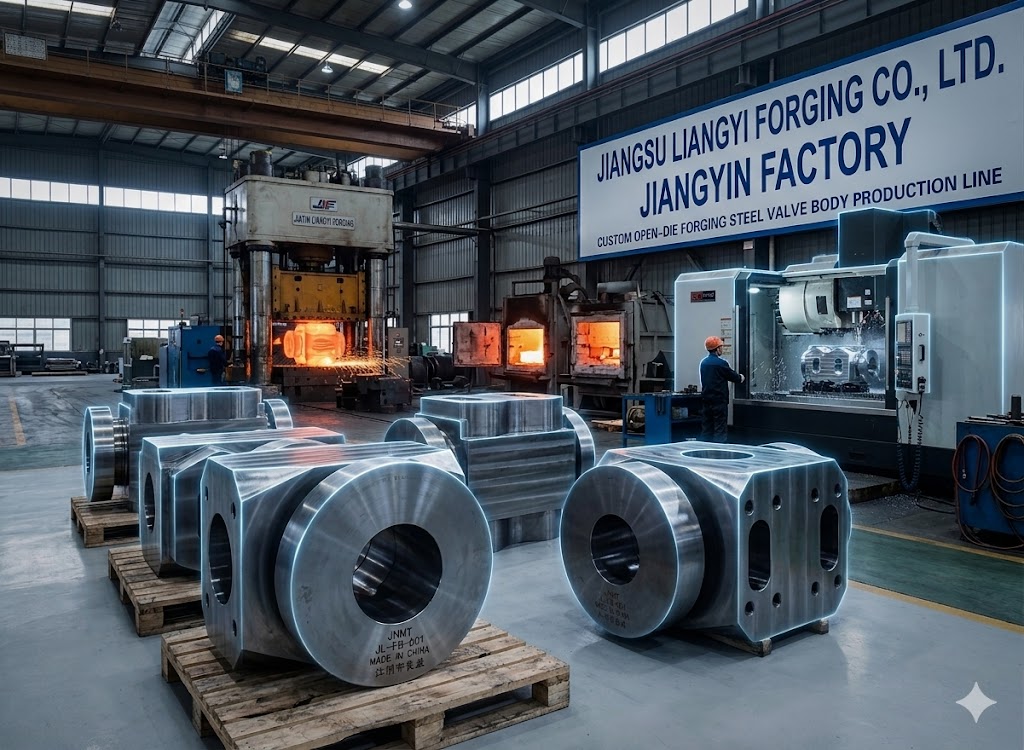
Open die forging, heat treatment and machining resources for custom forged steel valve body production.
25+ YearsForging and export experience
30 kg - 30,000 kgSingle-piece custom weight range
120,000 TonsAnnual manufacturing capacity
50+ CountriesGlobal project supply footprint
Quick Answer: What Is a Forged Steel Valve Body and When Should You Choose One?
The forged steel valve body is the pressure-holding main body of the valve manufactured by forging rather than casting. When buyers require higher structural integrity, better grain flow, stronger impact toughness, better fatigue resistance, and more reliable performance under harsh pressure, temperature or corrosive conditions, they usually choose forged valve bodies.
Compared with cast valve bodies, forged steel valve bodies are usually a better choice for wellhead equipment, API 6A pressure control components, high-pressure pipeline valves, main steam valves, offshore isolation valves and other safety-critical uses, where defect control, mechanical strength and service life are more important than the lowest initial cost.
Content publisher: Jiangsu Liangyi Co., Limited. Page focus: help industrial buyers, engineers and sourcing teams evaluate custom forged steel valve body options using manufacturing, material, quality-control and uses information presented on this page. Last substantive update: 2026-03-31.
Key Points for Buyers
Forged steel valve bodies are generally preferred over cast bodies for severe-service pressure containment, fatigue resistance and defect control.
Jiangsu Liangyi supports custom forged valve body production from 30 kg to 30,000 kg with steel melting, forging, heat treatment, machining and inspection in one chain.
Common standards addressed on this page include API 6A (oriented), API 6D (oriented), ASME B16.34, ASTM, DIN, EN, supporting PED 2014/68/EU documentation and NACE MR0175 / ISO 15156.
Main services include oil and gas, power generation, marine, offshore, petrochemical, mining and heavy-industry OEM projects.
Material choices should be based on pressure, temperature, corrosion profile, sour-service requirements, machining needs and certification scope.
Inspection scope may include UT, MT, PT, RT, chemical analysis, tensile testing, impact testing, hardness testing, metallography and size checks.
Normal lead time is 30 to 45 days for traditional alloy and carbon steel grades and 45 to 60 days for stainless, duplex and high-alloy grades.
To speed up quotation, buyers should send drawings, material grade, service condition, testing scope, quantity and destination port.
Professional Forging Steel Valve Body Solutions from China's Yangtze River Delta Forging Hub
Jiangsu Liangyi Co., Limited is an ISO 9001:2015 certified China-based manufacturer specializing in custom forged parts for demanding industries. Our forging steel valve body business is supported by a vertically integrated production route covering steel melting, open die forging, heat treatment, CNC finish machining and final inspection. This structure gives buyers better control over chemistry, grain flow, size stability, documents and delivery coordination.
Our factory is located in Jiangyin City, Jiangsu Province, inside the Yangtze River Delta manufacturing cluster and close to Shanghai Port, Zhangjiagang Port and Ningbo-Zhoushan Port. The position helps us support export shipments for the Middle East, Europe, North America, Southeast Asia, Australia and Africa with practical Incoterms such as FOB, CFR and CIF according to project requirements.
We support prototypes and batch projects. Whether the requirement is a one-time heavy-duty forged valve body or a repeated delivery of multi-stage industrial plans, our team can work based on customer drawings, pressure rating requirements, material specifications and inspection plans to provide a manufacturing route suitable for the expected usage conditions.
Forged Steel Valve Body Technical Summary
Product type
Custom forging steel valve body / forged steel valve body for severe-service valves / China forged steel valve body manufacturer
Manufacturing route
Steel melting, open die forging, heat treatment, rough machining, CNC finish machining, NDT, mechanical testing and size inspection
Single-piece weight
30 kg to 30,000 kg
Annual capacity
120,000 tons
Main standards
API 6A (oriented), API 6D (oriented), ASME B16.34, ASTM, DIN, EN, JIS, supporting PED 2014/68/EU documentation, NACE MR0175 / ISO 15156
Oil & gas, wellhead, pipeline, marine, offshore, thermal power, hydro power, petrochemical, mining and heavy machinery; suitable for custom forged valve body supplier projects, forged valve body for oil and gas service, and large forged valve body export orders
Quality documents
EN 10204 3.1 MTC as standard; 3.2 available upon request with TPI arrangement. NDT reports, chemical analysis, mechanical test reports and size records as required
Normal lead time
30-45 days for traditional grades, 45-60 days for stainless, duplex and high-alloy grades, faster schedules available for urgent projects
Common Buyer Pain Points When Sourcing a Custom Forged Steel Valve Body
Material Choice Risk
One of the most common sourcing problems is choosing a grade that looks acceptable on paper but does not match the real pressure, temperature, corrosion or sour-service condition. For an API 6A forged valve body manufacturer or an API 6D forged valve body supplier, wrong grade choice can lead to hardness nonconformance, low-temperature impact failure, poor chloride resistance or unstable elevated-temperature performance.
Unclear Lead Time and Capacity Matching
Buyers often receive quotations that do not clearly separate forging lead time, heat treatment, machining, NDT, third-party inspection and export packing. In practice, a custom forged steel valve body manufacturer should explain which steps drive the schedule, especially for duplex stainless steel, F91/F92, nickel alloy and large forged valve body projects.
Traceability and Documentation Gaps
For many EPC, OEM and end-user projects, the problem is not only whether the forging can be made, but whether every heat number, test record, NDT result and size checkpoint can be traced back in a clean document package. Missing EN 10204 certificates, incomplete NDT reports or weak material traceability may delay approval and shipment release.
Machining and Fit-Up Uncertainty
Buyers do not only care about forging blanks when it comes to forging valve body processing suppliers. They are also concerned about the machining allowance, flange sealing surface, reference control, cavity geometry, and the final fit with the valve interior or actuator assembly. Early drawing review and manufacturability feedback help reduce rework, dimensional deviations and costly assembly delays.
Inspection Scope Not Defined Early In Time
UT, MT, PT, RT, hardness, impact testing, corrosion-related requirements and witness points should be defined before production starts. When the inspection plan is added late, the result is usually rework, document revision or schedule pressure. This is especially important for forged steel valve body for oil and gas service, PED projects and sour-service valve body supply.
Export Coordination and Packaging Concerns
Large or finish-machined forged valve bodies require more than basic shipment planning. Buyers often need rust prevention, impact protection, lifting-point control, seaworthy packing and destination-mark consistency. A China forged steel valve body factory serving overseas markets should coordinate production release, packing and logistics as one process instead of treating them as separate tasks.
Forged Steel Valve Body vs Cast Steel Valve Body
Comparison point
Forged steel valve body
Cast steel valve body
Internal structure
Denser structure with more controlled grain flow after forging reduction and heat treatment
Can contain shrinkage, porosity or other casting-related discontinuities if process quality is not tightly controlled
Mechanical performance
Usually stronger in impact toughness, fatigue resistance and high-pressure reliability
Often acceptable for general service, but may offer lower structural margin in severe service
Best-fit uses
Wellhead, pipeline, main-steam, offshore, corrosive and other safety-critical conditions
Complex geometries or cost-sensitive uses where the service condition is less severe
Buyer priority
Longer service life, stronger safety margin and better traceable quality assurance
Lower initial manufacturing cost and flexible shape formation
Why Forged Steel Valve Bodies Are Preferred for Critical Service
Forged Valve Body Advantages
Denser internal structure with more favorable metal flow lines
Higher mechanical strength and impact toughness
Better fatigue resistance for cyclic pressure loading
Lower risk of shrinkage, porosity and other cast-related discontinuities
Better suitability for high-pressure, high-temperature and sour-service conditions
Stronger confidence in safety-critical valve parts
Main Buying Decision Logic
Choose a forged steel valve body when the project places more weight on structural reliability, defect control, long service life and traceable quality documents than on the lowest initial manufacturing cost. This is common in wellhead systems, high-pressure choke and gate valves, power station main steam valves, offshore process systems and corrosive fluid service.
A cast steel valve body may still be suitable for some lower-risk applications or complex shapes, but buyers usually prefer forging when failure consequences are high and the operating environment is severe.
How Do We Manufacture a Custom Forging Steel Valve Body
Step 1
Material and Specification Review
We will review the drawings, use conditions, standards, NACE requirements, pressure class, machining allowances and required testing range before confirming the process route.
Step 2
Steel Melting and Ingot Preparation
Independent melting and refining resources help control chemistry, cleanliness and internal quality before the forging cycle begins.
Step 3
Open Die Forging
The forging reduction route is designed to improve structure and grain flow while getting the geometry required for the finished valve body.
Step 4
Heat Treatment
Normalizing, quenching, tempering, annealing or solution treatment is selected according to material grade and service target.
Step 5
CNC Machining
Machining allowances, datum control and tolerance planning are managed to get size accuracy and fit-up quality for downstream valve assembly.
Step 6
Inspection and Documents
NDT, chemical analysis, mechanical testing, size checks and traceable records are completed in accordance with requirements before shipment release.
Factory and Product Image References
Open die forging production line for heavy custom valve body projects.
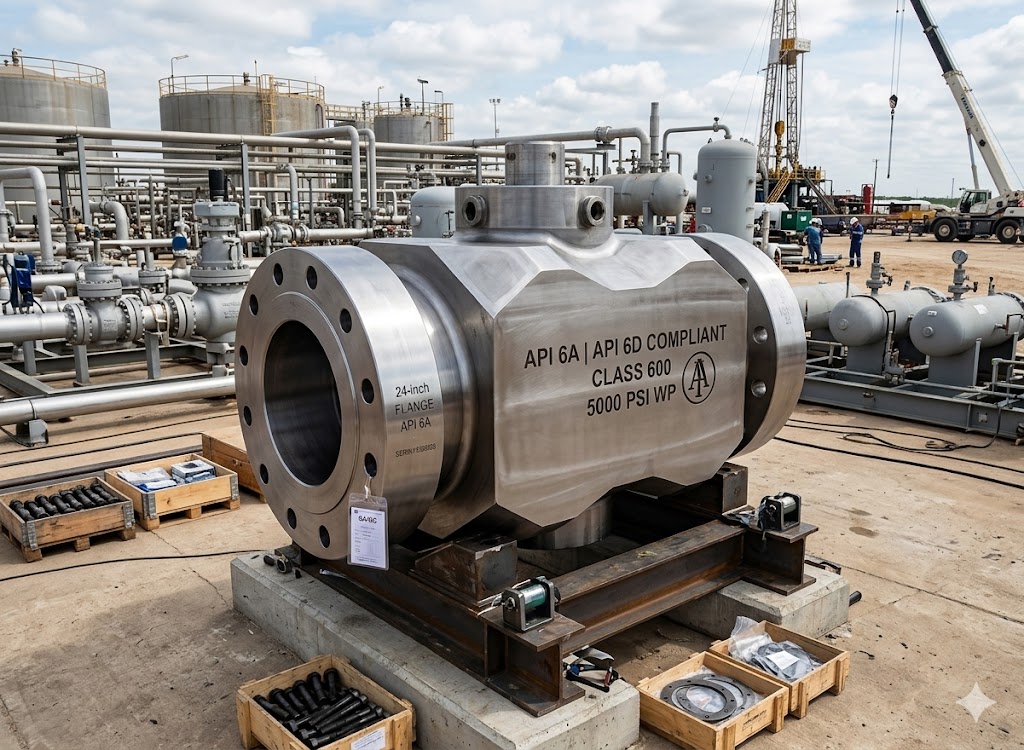
Forged valve body solution for API 6A / 6D oriented oil and gas applications.
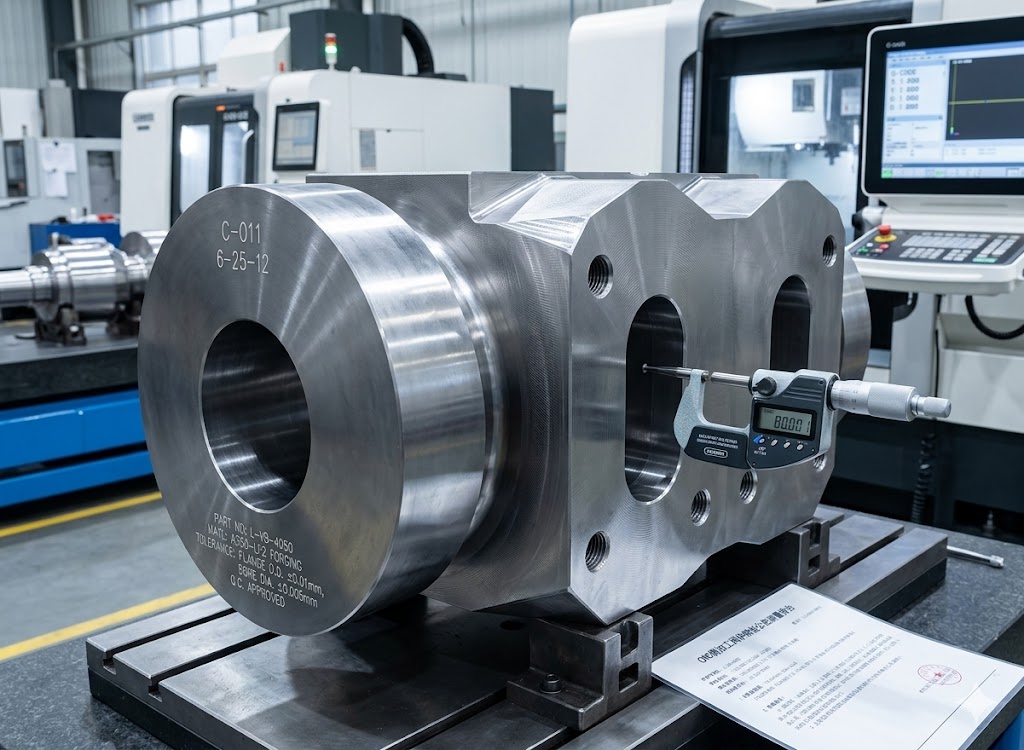
Finish-machined forged steel valve body with tight size control.
Advanced Forging Capabilities and Full-Process Quality Control
Industry-Leading Forging, Machining and Heat Treatment Resources
Our 80,000㎡ manufacturing base is configured to support heavy forged parts from raw material to final inspection. Buyers can review more equipment information on the Forging Equipment page. Main resources include:
2000T, 4000T and 6300T hydraulic forging presses for open die forging of large and complex forged steel valve bodies
0.75T to 9T electro-hydraulic forging hammers for smaller and medium-size forgings requiring precise shaping
10 computer-controlled heat treatment furnaces for quenching, tempering, normalizing, annealing and solution treatment
Large-scale CNC machining centers and precision finish machining resources capable of tight tolerance control
Independent steel melting workshop including 30T electric arc furnace, 30T ladle refining furnace and vacuum degassing furnace
Full Traceability and Inspection Coverage
Every forged steel valve body project is managed through a documented quality route with 100% traceability from material preparation to finished delivery. Inspection capability includes:
UT, MT, PT and RT non-destructive testing to identify internal and surface defects
Direct-reading spectrometer analysis for chemical composition control
Tensile, hardness, impact and elevated-temperature mechanical property testing
Metallographic examination for grain size, inclusions and microstructure evaluation
Size inspection and project-specific record packages
Available scope includes API 6A (oriented), API 6D (oriented), ASME B16.34, ASTM, DIN, EN, JIS, supporting PED 2014/68/EU documentation requirements and NACE MR0175 / ISO 15156, together with EN 10204 3.1 or 3.2 certification when required.
Comprehensive Material Grades for Forged Steel Valve Bodies
Material choice for a forged valve body should match temperature, pressure, corrosion profile, media chemistry, hardness limits, weldability needs and certification requirements. Our broader grade list can be reviewed on the Forging Materials page. Common options include:
Carbon and Low-Alloy Steel
Main grades include ASTM A182 F9, F11, F22, F91 and F92, A694 F42 / F52 / F60 / F65 / F70, 1045, 4130, 4140, 4340, 42CrMo4 and 34CrNiMo6. These are often chosen for pressure-containing parts in oil and gas, pipeline and power use.
Stainless and Duplex Stainless Steel
Common grades include 304 / 304L, 316 / 316L, 321, 347, 410, 420, 17-4PH, F6NM, duplex 2205 / F51 and super duplex 2507 / F53. These are preferred for corrosive process media, marine systems and chloride-rich environments.
High-Corrosion and High-Temperature Alloys
Monel 400 / K500, Hastelloy C276 / C22 / B2 / X, Inconel 600 / 625 / 718 and Incoloy 800 / 825 / 925 are suitable for aggressive corrosion and elevated-temperature requirements.
Application-Led Material Selection
For oil and gas projects with H₂S exposure, material hardness and sour-service suitability are reviewed carefully. For steam service, creep strength and long-term thermal stability become more important. For offshore systems, chloride resistance and low-temperature toughness are critical.
How to Choose the Right Forged Steel Valve Body for Your Project
A strong sourcing decision is not based on price alone. Buyers comparing a forged steel valve body manufacturer in China, a custom forged valve body supplier or a forged stainless steel valve body producer should review service conditions, process capability, document depth, machining accuracy, inspection standards and export execution together.
Start with Service Conditions
Define pressure class, operating temperature, media chemistry, corrosion risk, H₂S or chloride exposure, cyclic loading and any low-temperature impact requirements. These factors usually determine the first shortlist of viable material families and heat-treatment routes.
Match the Standard and Document Scope
Confirm which standards and documents are required for the order, such as API 6A, API 6D, ASME B16.34, PED, NACE or customer-specific inspection plans. The document package often affects the lead time and inspection planning as much as the forging itself.
Review Forging Size and Machining Allowance
Large-section valve bodies may require different forging reductions, heat-treatment cycles and machining strategies than smaller parts.Early inspection of weight, cross-sectional thickness and tolerance expectations can help avoid unnecessary costs or rework.
Plan for the Real Supply Scenario
Buyers should consider whether the project needs prototype support, batch supply, repeat releases, third-party witness inspection, special export packing or urgent delivery windows.The best suppliers not only have technical capabilities but also operate reliably throughout the project period.
Procurement Decision Checklist for a Forged Steel Valve Body Order
Technical Decision Points
Confirm whether the project needs an API 6A forged valve body, API 6D forged valve body, forged stainless steel valve body or another custom forged valve body configuration.
Review the design pressure, operating temperature, corrosion profile, h2s exposure, chloride level, low-temperature shock requirements and expected service life.
Check whether the forging route, heat treatment, machining allowance and NDT scope are matched to the final valve design.
Decide early whether third-party witness inspection, PED documentation support, NACE accordance or customer-specific hold points are required.
Commercial and Supply Decision Points
Ask whether the quotation clearly separates raw forging, rough machining, finish machining, testing, certification, export packing and logistics responsibilities.
Confirm the sample quantity, repeat order expectations, minimum batch economy, and whether to accept small-batch development orders.
Review the delivery time of the documents, including MTC, NDT records, size reports and the documents required before shipment.
Evaluate the response speed, the quality of drawing review and the ability of suppliers to discuss risks, not just the release price.
Buyer concern
What to verify before order confirmation
Why it matters
Supplier fit
Can the supplier act as a forged steel valve body manufacturer, machining supplier and documentation partner instead of only a forging source?
Reduces handoff risk between forging, machining, inspection and shipment.
Lead-time credibility
Is the promised delivery based on real capacity for forging, heat treatment, CNC machining and inspection?
Prevents schedule slippage and unrealistic promises on urgent projects.
Quality release
Are hold points, witness points, NDT acceptance standard and final document package defined before production?
Avoidance of approval delays, additional testing and transportation congestion.
Long-term cooperation
Can the supplier support prototype validation, batch repeatability and engineering changes over time?
Important for OEM valve programs and EPC projects with phased releases.
Where Forged Steel Valve Bodies Are Commonly Used
Oil and Gas
Wellhead equipment, Christmas trees, choke valves, gate valves, manifold systems and high-pressure process valves.
Power Generation
Main steam valves, control valves, boiler isolation valves and high-temperature pressure parts.
Marine and Offshore
Ball valves, globe valves and butterfly valves in ballast water, seawater and offshore process systems.
Petrochemical
Severe-service process lines involving corrosive media, temperature cycling and pressure fluctuation.
Mining and Heavy Industry
Wear-dense and impact-load services, structural integrity and robust material properties are of great significance.
Customized and EPC projects
Manufacture forging valve body solutions for specific projects based on customer drawings, standards and document packages.
Global Cases for Forging Steel Valve Body Supply
Below are representative project scenarios that show how forged steel valve body manufacturing requirements change by region, service condition and industry standard.
Middle East
Oil and Gas Wellhead Projects in Saudi Arabia and the UAE
We manufactured API 6A-oriented forged steel valve bodies for high-pressure wellhead Christmas tree equipment, choke valves and gate valves using AISI 4130 and ASTM A182 F22. This process route focuses on the stability of heat treatment, the consistency of non-destructive testing, and the applicability of acid services in high-temperature, high-pressure and high-sulfur environments.
For this category of project, buyers mainly pay close attention to SSCC resistance, hardness control, material traceability and inspection documents because failure risk is high and operating conditions are severe.
Europe
Marine and Offshore Projects in Germany and Norway
We custom-produced marine-grade forged steel valve bodies using duplex stainless steel 2205 and super austenitic 904L for ship ballast water systems, offshore oil and gas process lines and seawater desalination systems. Performance priorities included corrosion resistance, low-temperature toughness and PED-related requirements.
In these projects, forged valve body choice was driven by the need for stronger reliability in cold, high-humidity and salt-rich environments where cast defects and corrosion-related failures would create high lifecycle cost.
Asia
Thermal Power Projects in Thailand, Vietnam, Indonesia and China
We supplied ASTM A182 F91 and F92 heat-resistant forged steel valve bodies for large thermal power plants, including uses in high-pressure main steam globe valves, control valves and safety valves. Process design emphasized high-temperature creep resistance, thermal fatigue resistance and metallographic consistency.
For power generation buyers, the decisive factors are usually heat treatment control, long-term service stability above 600℃ and test data demonstrating reliable mechanical behavior under elevated temperature conditions.
Why choose Jiangsu Liangyi as your supplier of forged steel valve bodies
Integrated Manufacturing
Steel melting, forging, heat treatment, processing and inspection are coordinated in one production chain, reducing interface risks and helping to maintain quality consistency.
Heavy-Section Capability
Single-piece forging capability up to 30 tons supports both sample development and large-scale industrial projects.
International Standards Support
Manufacturing and documents can be in accordance with API-referenced, ASTM, ASME, DIN, EN, and NACE-related requirements. PED 2014/68/EU documentation support is available upon request.
Global Export Experience
Exported to over 50 countries, communication in packaging, documentation, inspection coordination and logistics planning has become smoother.
Engineering Customization
We support drawing review, material recommendation, process optimization and manufacturability advice, providing customers with specific valve body designs.
Location and Shipping Advantage
Jiangyin is close to major ports which helps shorten outbound logistics cycles and gives buyers practical flexibility on shipment planning.
Information Buyers Commonly Send When Requesting a Quote
This checklist is useful for buyers searching terms such as custom forged steel valve body manufacturer, API 6A forged valve body supplier, forged steel valve body machining factory or forged valve body exporter from China. The more complete the technical input, the faster the quotation becomes and the lower the risk of revision later.
2D drawings or 3D files such as STEP, IGES or STL
Material grade and applicable standard
Pressure class, operating temperature and fluid description
NDT scope and mechanical testing requirements
Machining scope, tolerances and surface finish expectations
Quantity, delivery schedule and destination port
Any sour-service, PED documentation or customer-specific project requirements
Providing these details early helps shorten quotation time and improves the accuracy of process planning, lead time estimation and quality-document preparation.
Frequently Asked Questions About Forging Steel Valve Body
What is the difference between forged steel valve body and cast steel valve body?
A forged steel valve body is formed under compressive force, which creates a denser structure with more favorable grain flow, higher strength, stronger impact toughness and better fatigue resistance. A cast steel valve body is made by pouring molten metal into a mold, which is useful for complex shapes and lower-cost production but generally offers a lower structural safety margin in severe service.
What materials are commonly used for forged steel valve bodies in oil and gas uses?
Common materials include 4130 and 4140 alloy steel for wellhead equipment, ASTM A182 F11 / F22 / F91 / F92 for elevated temperature service, and duplex stainless steel or nickel alloys for corrosive media with chlorides or hydrogen sulfide. Final material choice depends on pressure class, temperature, corrosion profile and relevant standards such as API and NACE.
Can you custom manufacture forged steel valve bodies according to our drawings?
Yes. We support custom production based on customer drawings and technical manuals. Our team can review 2D drawings and 3D files, evaluate manufacturability, suggest suitable material and prepare a process route that matches your service requirements.
What is the normal lead time for a custom forged steel valve body?
Normal lead time is 30 to 45 days for standard carbon steel and alloy steel projects, and 45 to 60 days for stainless, duplex or high-alloy materials. Urgent schedules can often be discussed after technical review and capacity confirmation.
Which inspections and certificates can be provided?
Depending on the order, we can provide EN 10204 3.1 certificates as standard, and EN 10204 3.2 certificates can be arranged upon request with third-party inspection coordination. We can also provide NDT reports, chemical composition reports, mechanical property reports, metallographic records and size inspection documents.
What payment currencies and shipment terms do you support?
USD, EUR and other major currencies can be discussed according to order arrangement. Common shipment terms include FOB, CFR and CIF, and the final logistics method can be matched to project budget, destination and delivery urgency.
Where is your factory located?
Our forging factory is located in Chengchang Industry Park, Jiangyin City, Jiangsu Province, China, in the Yangtze River Delta manufacturing region.
Can you support prototypes, small batches or trial orders before mass release?
Yes. Many buyers begin with a prototype or low-volume validation order to confirm material performance, machining feasibility, document format and supplier responsiveness before moving to a larger release. This is common for new valve development, EPC qualification and replacement of an existing forged valve body supplier.
Can third-party inspection or customer witness inspection be arranged?
Yes. Third-party inspection, customer witness points and project-specific quality hold points can be discussed during quotation and order review. Defining these checkpoints early helps on production planning, NDT scheduling, size verification and final document release.
Need a Custom Forged Steel Valve Body Quote?
Send your drawing, material requirement, quantity, delivery destination and inspection scope. Our team can review the project and return quotations, manufacturing suggestions, delivery time guidance and document options.