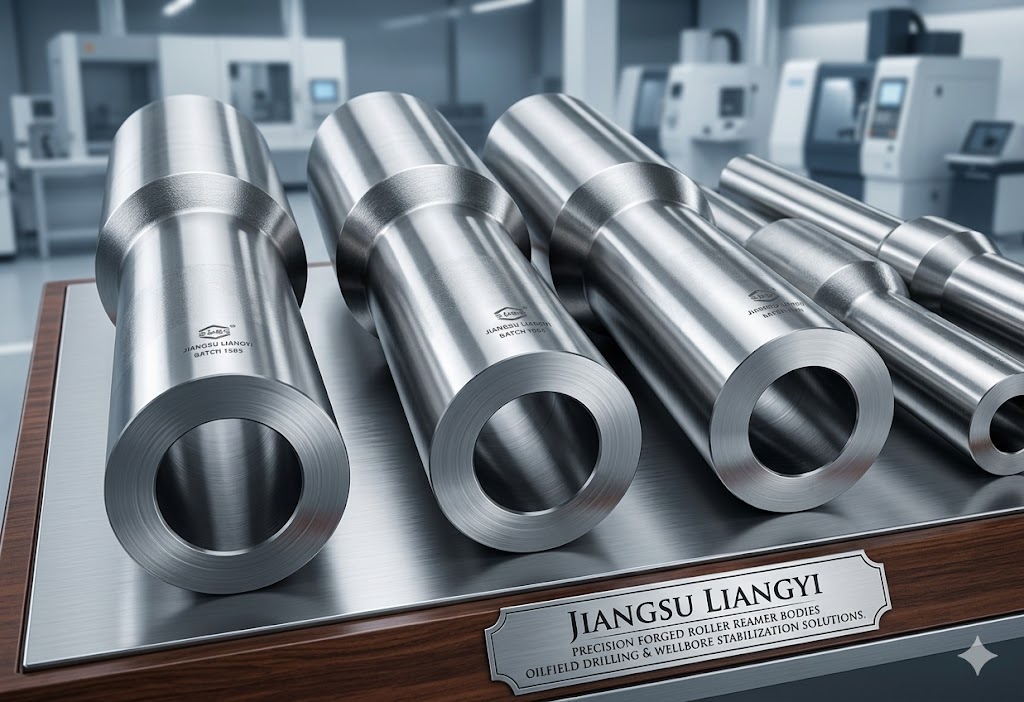
Forging Steel Roller Reamer Body | Manufactured to API 7-1 Specification | Oilfield Drilling & Wellbore Stabilization Tools
Product Overview & Core Value for Global Drilling Operations
Jiangsu Liangyi is an ISO 9001:2015 certified Chinese manufacturer with over 25 years of professional experience. We produce forged steel roller reamer bodies based on API specifications. We provide the high-performance forged steel roller reamer bodies, rotary reamer bodies for downhole drilling tools, serving onshore and offshore oilfield drilling projects in more than 50 countries around the world. Our forged steel roller reamer bodies are used for full‑range borehole reaming operations and important industry challenges, such as wellbore shrinkage, irregular wellbore shape, high drilling torque, fast tool wear, frequent tripping, and long drilling cycles. They are specially improved for wellbore stabilization in highly abrasive, hard, and tough formations, and are compatible with hole sizes from 6" to 28". Each forged steel roller reamer body can be easily adapted to a wide range of hole sizes through simple block adjustments and improved cutter selection, providing excellent versatility for conventional, directional, horizontal, and deepwater drilling applications.
Manufacturing Specifications & Global Market Adaptability
Our forging steel roller reamer bodies are made based on the technical requirements of internationally recognized specifications, including API 7-1 / 7-2 (North America global oilfield specification for rotary drill stem elements), EN 10204 3.1/3.2 (European mill test certificate requirements), ASTM material testing specifications, and NACE MR0175 / ISO 15156 material hardness and alloy requirements for sour service environments. Products can also meet the technical requirements of ARAMCO SAES-L-100 (Middle East), Petrobras (South America), and AS (Australia) project specifications on request. Note: ISO 9001:2015 is our independently certified quality management system. API 7-1/7-2, NACE MR0175, EN 10204, and ASTM refer to the technical specifications and standards our products are manufactured to meet — not separately held certifications.
Key Product Specifications at a Glance
| Specification | Details |
|---|---|
| Product Name | Forging Steel Roller Reamer Body (API 7-1 / API 7-2) |
| Size Range | 5-7/8" to 28" (149 mm – 711 mm); custom non-standard sizes available |
| Material Grades | AISI 4145H Mod, AISI 4330V MOD, Custom Alloy Steel, Stainless Steel, CRA |
| Hardness | 285 – 341 HBW (Brinell), precision controlled by quench & temper |
| Impact Toughness | ≥ 54 J at room temperature (AISI 4145H Mod); ≥ 80 J at −20°C (AISI 4330V MOD) |
| Tensile Strength | ≥ 930 MPa (AISI 4145H Mod); ≥ 1000 MPa (AISI 4330V MOD) |
| Yield Strength | ≥ 760 MPa (AISI 4145H Mod); ≥ 860 MPa (AISI 4330V MOD) |
| Forging Ratio | ≥ 3:1 |
| Weight Range | 30 kg – 30 tons (single piece) |
| Manufacturing Specification | Manufactured to API 7-1 / API 7-2 technical requirements; materials per ASTM A29/A322/A519; NACE MR0175 hardness and alloy requirements met for sour service grades |
| Quality Certification | ISO 9001:2015 (independently certified quality management system) |
| Roller Types | Narrow-teeth / Wide-flat-teeth / Inserted Tungsten Carbide Alloy |
| Thread Connection | API standard (NC26 ~ 7-5/8 REG and above); custom per drawing |
| Optional Surface Treatment | Cobalt-chromium alloy hardfacing on cutters; phosphatizing + anti-seize thread dope |
| Inspection & Test Reports | 100% UT/MT/PT per API 7-1 requirements; EN 10204 3.1/3.2 MTCs issued per order; Third-party inspection (BV, SGS, DNV) available on request |
| Export Markets | more than 50 countries: USA, Canada, Saudi Arabia, UAE, UK, Norway, Australia, Brazil, Malaysia ,Nigeria… |
| Manufacturer | Jiangsu Liangyi Co., Limited — ISO 9001:2015, founded 1997, Jiangyin, Jiangsu, China |
Why Forging, Not Casting: An Engineer-to-Engineer Analysis
Most product pages only state that “forging is better than casting.”We believe engineers deserve the actual data supporting this claim. The table below is based on our 25 years of manufacturing experience, comparative mechanical test records, and field failure analysis reports from clients who previously used cast reamer bodies before switching to our forged products.
⚠️ The Hidden Risk of Cast Roller Reamer Bodies in Hard Formation Drilling
Casting forms a dendritic grain matrix with internal micro‑porosity and segregation zones that standard UT inspection often cannot detect at diameters of 11 inches and smaller. Under high‑frequency torsional fatigue loading — typical in bottom‑hole assemblies operating at 80–200 RPM in hard formations — cracks start forming at these subsurface defects before any surface damage appears. Based on 25 years of client feedback collected by our engineering team, most premature body fractures in hard‑formation drilling reported to us originated from internal material defects typical of casting, not surface wear. This failure mode is widely documented in oilfield downhole tool metallurgy literature, and is one of the main reasons API 7‑1 and major operators need forged — not cast — materials for critical drill string parts.
| Performance Parameter | Open Die Forging (Liangyi) | Casting (Industry Average) | Difference |
|---|---|---|---|
| Grain Structure | Continuous fibrous grain flow, aligned with load axis; forging ratio ≥3:1 | Dendritic/random grain orientation; internal micro-porosity common | Forging superior |
| Tensile Strength | ≥ 930 MPa (4145H Mod) / ≥ 1000 MPa (4330V) | 750–850 MPa (typical cast 4140) | +15 to +25% |
| Fatigue Strength (10⁷ cycles) | ≥ 480 MPa (R=−1, rotating bending) | 320–360 MPa (cast 4140, same hardness range) | +33 to +50% |
| Charpy Impact (−20°C) | ≥ 80 J (4330V MOD), ≥ 54 J (4145H Mod) | 25–40 J (cast 4140, equivalent hardness) | +100 to +120% |
| Internal Soundness (UT) | Zero porosity accepted; full volumetric UT per API 7-1 | Inherent micro-porosity; limited UT penetration on thick sections | Forging superior |
| Dimensional Consistency | Precision machined post-forging to API tolerances | Dimensional variation from shrinkage during solidification | Forging superior |
| Sour Service Compliance | NACE MR0175 / ISO 15156 compliant with 4330V MOD | Most cast alloys cannot achieve NACE compliance reliably | Forging superior |
| Unit Cost (same size) | 10–20% higher raw material + process cost | Lower initial unit cost | Casting lower cost |
| Total Cost per 1,000m Drilled | Lower — due to 2–3× longer service life and fewer early failures | Higher — frequent replacement, NPT from early failure | Forging wins on TCO |
✅ Liangyi Engineering Perspective: Total Cost of Ownership
According to client feedback from projects in North America and the Middle East, forged roller reamer bodies show a clear total-cost-of-ownership (TCO) advantage over cast versions in medium-to-hard abrasive formations. Longer service life cuts down tripping frequency and reduces non-productive time. In soft formation drilling (UCS <30 MPa) with short planned drilling distances, the lifetime difference becomes much smaller. In these specific cases, cast bodies can be a cost-effective choice.
Our engineering team can help you evaluate which option best fits your well plan based on your formation data and planned footage. Contact us for a free, no-obligation technical consultation.
Formation-Based Roller Reamer Body Selection Guide
Choosing the wrong roller setup or material grade for a specific formation is one of the most common — and most expensive — mistakes in BHA design.
Drawing on 25 years of field data from global projects across more than 50 countries, the chosen matrix below represents Jiangsu Liangyi’s unified engineering recommendation framework. This is not a generic table: every parameter range is based on real field performance, matched to formation type, UCS (Unconfined Compressive Strength), and abrasivity index.
| Formation Type | UCS Range | Abrasivity | Recommended Roller Type | Material Grade | Hardness Target | Typical Service Life | Typical Global Regions |
|---|---|---|---|---|---|---|---|
| Soft shale / clay / unconsolidated sand | < 30 MPa | Low | Narrow-teeth | AISI 4145H Mod | 285–311 HBW | 2,500–4,000 m/trip | SE Asia, South America coastal basins |
| Medium shale / limestone / sandstone | 30–80 MPa | Medium | Wide-flat-teeth | AISI 4145H Mod | 311–331 HBW | 1,200–2,500 m/trip | North America shale, European onshore |
| Hard limestone / dolomite / tight sandstone | 80–150 MPa | High | Wide-flat-teeth or TC Alloy Insert | AISI 4145H Mod | 321–341 HBW | 800–1,500 m/trip | Middle East carbonate, North Sea chalk |
| Very hard abrasive sandstone / quartzite | 150–250 MPa | Very High | Inserted TC Alloy (WC-Co grade) | AISI 4330V MOD | 331–341 HBW | 500–1,200 m/trip | Middle East (Khuff / Arab D), Australian hard rock |
| Granite / basalt / igneous rock | > 250 MPa | Extreme | Inserted TC Alloy (premium PDC-grade WC) | AISI 4330V MOD | 331–341 HBW | 200–600 m/trip | Australian mining, geothermal, African basement |
| HTHP deepwater / sour service (H₂S) | Any | Any + corrosive | Per formation + NACE compliant materials | AISI 4330V MOD (meets NACE MR0175 material requirements) | 285–311 HBW (NACE cap) | Project-specific | GoM deepwater, North Sea, Caspian, Persian Gulf |
| Horizontal / directional shale gas wells | 40–120 MPa | Medium | Wide-flat-teeth (gauge-holding priority) | AISI 4145H Mod | 311–341 HBW | 1,500–3,000 m/trip | Permian Basin, Marcellus, Montney, Duvernay |
✅ How to Use This Matrix: Three Questions Before Ordering
Step 1 — Identify your formation UCS: If no lab data is available, a quick estimate from offset well logs (sonic slowness DT > 100 µs/ft = soft; 60–100 = medium; <60 = hard) provides a usable starting point.
Step 2 — Check for sour service flag: If H₂S partial pressure exceeds 0.0003 MPa (0.05 psi) anywhere in the well profile, NACE MR0175 compliance is mandatory — material hardness must not exceed 311 HBW regardless of formation hardness.
Step 3 — Match well type to gauge-holding priority: For directional and horizontal wells with dogleg severity >3°/30m, always specify wide-flat-teeth rollers regardless of formation softness — gauge holding is more important than cutting efficiency in these applications.
Three Core Roller Configurations — Engineering Details
We offer three main roller configurations for our forging steel roller reamer bodies to meet the needs of different geological conditions in oil and gas and mining areas. We can also make custom designs for specific regional formation characteristics.
- Narrow-teeth Type: Specially designed for high-efficiency hole wall cutting in soft, unconsolidated formations commonly found in onshore fields across Southeast Asia and South America. It provides stable reaming with minimal torque variation, less damage to the wellbore wall, and better cuttings removal. Tooth pitch: 8–14 mm. Optimal WOB: 20–40 kN per roller.
- Wide-flat-teeth Type: Improved for crushing, trimming, and gauge holding of borehole walls in medium and hard formations (common in North American shale fields, European onshore oilfields). Ensures consistent wellbore gauge, excellent wellbore stabilization, and reduced dogleg severity during directional and horizontal drilling. Contact area per tooth: 15–25 mm². Suited for rotary speeds of 60–150 RPM.
- Inserted Tungsten Carbide Alloy Type: Specially engineered for extremely hard, highly abrasive, and dense formations, typical of Middle Eastern sandstone fields and hard rock mining exploration in Australia. WC‑Co insert grade: K20–K30 (86–89% WC, 11–14% Co).Offers excellent wear resistance and impact toughness, with 3–5 times longer service life than standard steel rollers, greatly reducing tripping frequency and drilling costs in severe downhole conditions. Optional Stellite® 6 or Stellite® 12 cobalt‑chromium hardfacing on the roller body for extra wear protection.
5 Root-Cause Failure Modes: Engineering Lessons from 25 Years of Manufacturing
The following failure mode analysis is based on our engineering team’s 25 years of manufacturing experience, client field data, and root-cause investigations for roller reamer bodies used in global oilfield projects. Each failure mode includes its root cause, contributing factors, and the specific design or manufacturing solution we implement to prevent it from happening again. Occurrence trends reflect qualitative findings from client feedback, not statistically validated data.
Failure Mode #1: Premature Cutter Wear
Most frequently reported — particularly in Middle East and Australian hard rock projects where operators switch from TC inserts to steel rollers to reduce upfront cost.
Formation abrasivity index (CAI >3.5) exceeded the wear resistance of standard steel roller teeth. Often caused by operator downgrading from TC insert to steel rollers to reduce initial cost in abrasive sandstone formations.
High WOB (>80 kN), elevated rotary speed (>150 RPM), inadequate hydraulic cooling due to low flow rate.
Formation-specific roller selection protocol (see Selection Matrix above). For CAI >3, TC insert type is mandatory. All TC inserts run 100% interference fit check + drop-weight impact test before shipment.
Failure Mode #2: Thread Root Fatigue Fracture
Commonly reported in deep, high-deviation wells and extended-reach horizontals with high dogleg severity running at elevated RPM.
Insufficient hardness gradient at thread root zone (transition between thread OD and bore ID). Hardness drop >30 HBW across this 15–25mm zone creates a stress concentration that accelerates fatigue crack initiation under cyclic torsional + bending loading.
Inadequate quench rate during heat treatment (insufficient water/oil circulation), oversized bore-to-OD ratio (>0.6), BHA running in high dogleg severity sections (>5°/30m).
Mandatory hardness traverse test at thread root zone for all sizes ≤14". Maximum accepted hardness gradient: ≤20 HBW per 10mm. Bore-to-OD ratio controlled at ≤0.55 in standard designs. Thread root radius ground to Ra ≤1.6 µm to eliminate notch stress.
Failure Mode #3: Roller Seizure / Bearing Jamming
Frequently reported in HTHP deepwater and geothermal wells where bottom-hole temperature exceeds 150°C — often not anticipated in initial tool selection.
Thermal expansion of roller body in high-temperature wells (>150°C BHT) reduces the designed radial clearance between roller OD and body bore below the minimum running clearance, causing metal-to-metal contact and seizure. Accelerated by drilling fluid contamination of bearing lubricant.
BHT >150°C (deepwater or deep onshore wells), water-based mud with high solids content ingress into bearing cavity, insufficient seal effectiveness at high differential pressure.
For wells with a bottom hole temperature (BHT) above 120°C, we use thermally compensated bearing clearance — radial clearance is increased by 0.015–0.025 mm for every 50°C above the 80°C baseline. A labyrinth and lip seal combination is standard on all deepwater designs. The bearing cavity is pre-filled with high-temperature NLGI Grade 2 EP grease rated for service up to 200°C.
Failure Mode #4: Stress Corrosion Cracking (SCC)
Reported in sour gas fields in the Middle East and Caspian region where NACE-compliant materials were not specified at the inquiry stage.
Use of AISI 4145H Mod at hardness >311 HBW in H₂S-containing environments. NACE MR0175 / ISO 15156 limits maximum hardness to 311 HBW (30 HRC) for low-alloy steels in sour service. Material above this threshold undergoes hydrogen embrittlement-induced SCC within 50–200 hours of H₂S exposure.
H₂S partial pressure >0.0003 MPa, pH <3.5 in produced fluid, residual tensile stress from thread machining without stress-relief.
All sour service orders are automatically flagged to AISI 4330V MOD with controlled hardness 285–311 HBW. Full NACE MR0175 compliance documented in MTC. Thread machining followed by mandatory stress-relief shot peening on all sour service items.
Failure Mode #5: Wellbore Gauge Loss (Under-reaming)
Less common but high-impact — typically identified only after casing running difficulties or elevated overpull events during tripping.
Roller OD undersized at delivery due to machining tolerance stack-up, or gradual OD reduction during service without BHA monitoring. Results in wellbore gauge reduced below nominal drill bit diameter, causing bit balling, high overpull during tripping, and difficulty running casing.
Roller OD tolerance at upper end of API allowance (combined with bit OD at lower tolerance end), cumulative cutter wear in abrasive formations without caliper monitoring at surface.
All roller ODs are machined to the nominal +0.5mm / −0 tolerance as standard (tighter than API minimum), verified by 100% CMM dimensional check. We provide a written roller-wear monitoring protocol with each delivery: recommended maximum pull-out caliper check interval = every 500m in hard formations, every 1,000m in medium formations.
BHA Integration Guide: How to Position Roller Reamer Bodies for Maximum Performance
The performance of a roller reamer body is closely tied to its position in the bottom hole assembly (BHA).Even an optimally designed reamer body will provide far less benefit — and may even cause instability — if placed in the wrong BHA location.
The guidelines below are based on our engineering team’s accumulated BHA consulting experience across global drilling projects, covering a wide range of geological conditions and well types.
| Well Type | Recommended Placement | Spacing | Primary Function | Key Consideration |
|---|---|---|---|---|
| Vertical well, hard formation | Near-bit (0–3m above bit) + String (9–12m above bit) | Dual placement | Gauge maintenance + bit whirl suppression | Near-bit placement reduces bit vibration amplitude by up to 60% in hard formation; improves ROP by 15–25% |
| Directional well (KOP to build section) | String reamer, 1–2 drill collar lengths above MWD/LWD tool | Single placement | Wellbore gauge consistency for tool passage | Avoid near-bit placement in build sections — adds stiffness that increases DLS; string placement does not affect BUR |
| Horizontal well (lateral section) | Near-bit + String (spaced 12–18m apart) | Dual placement | Dogleg severity control + casing running clearance | Target DLS ≤0.5°/30m for long lateral completions; tight reamer gauge (+0.5mm on bit) is essential |
| Deepwater (riser section) | String reamer, above jars | Single placement | Borehole quality for riser running | Use AISI 4330V MOD; verify thermal clearance for BHT >120°C; confirm NACE compliance if any H₂S flag |
| Large-diameter surface hole (>17-1/2") | Near-bit only | Single placement | Gauge holding for conductor / surface casing | Large-diameter bodies (≥18") require custom block configuration; confirm bit-to-reamer gauge match within ±1mm at tender stage |
💡 BHA Design Support — Free of Charge
For challenging directional, HTHP deepwater, or large‑diameter drilling projects, Jiangsu Liangyi’s engineering team can provide a preliminary BHA roller reamer placement recommendation based on your well design data, including deviation profile, formation type, planned BHT/BHP, and drilling fluid type. This service is free with every order inquiry. Contact our sales team with your well technical data for a response within 24 hours.
Full Manufacturing Specifications & Material Capability
Size Range & Customization Capability
We mass-produce forged steel roller reamer bodies in a full size range from 5-7/8" to 28", covering more than 95% of conventional and unconventional drilling applications around the world. We also offer fully custom forged solutions for non-standard sizes, special thread connections, and extreme operating conditions, based on customer drawings and technical specifications. Our forged oilfield drilling tools manufactured to API specification support single-piece weights from 30 kg up to 30 tons, with complete in-house machining, heat treatment, and testing capabilities.
Premium Material Grades for Extreme Downhole Conditions
Our available material grades include industry-proven AISI 4145H Mod, AISI 4330V MOD, and other custom alloy steel, stainless steel, and corrosion-resistant alloy grades, and all of them are tested based on ASTM and international material specifications. Explore our full premium AISI 4145H & 4330V MOD forging materials library for custom project requirements.
- AISI 4145H Mod: Cr–Mo alloy steel, C 0.42–0.49%, Cr 0.75–1.20%, Mo 0.15–0.25%. Improved for balanced hardness, toughness, and wear resistance. Hardened and tempered to 285–341 HBW. The most widely used material for oilfield downhole tools globally.
- AISI 4330V MOD: Ni–Cr–Mo–V alloy steel, C 0.28–0.33%, Ni 1.65–2.00%, Cr 0.75–1.00%, Mo 0.35–0.50%, V 0.05–0.10%. Provides improved low-temperature impact toughness (≥80J at −20°C), great fatigue resistance, and NACE MR0175 compliance at <311 HBW — specifically designed for HTHP deepwater, sour service, and extreme hard formation drilling.
Full-Process In-House Manufacturing Technology
All our forged steel roller reamer bodies are produced in our 80,000 m² factory with full in-house production capabilities, from steel melting to final inspection. Our advanced open die forging equipment guarantees consistent product quality.
- Premium Steel Melting: Raw steel is melted in a 30‑ton electric arc furnace (EAF), then processed through ladle refining (LF) and vacuum degassing (VD) to achieve ultra‑low impurity levels (S ≤ 0.010%, P ≤ 0.015%), a consistent material matrix, and excellent mechanical properties. The steel is then cast either as bottom‑poured wide‑end‑up ingots or via continuous casting.
- Precision Open Die Forging: Forged with 2000T–6300T hydraulic forging presses and 1T–5T electro-hydraulic forging hammers. Minimum forging ratio 3:1 guarantees refined grain matrix, eliminated internal porosity, and maximized material density and mechanical performance.
- Controlled Heat Treatment: Quenching and tempering in ten dedicated heat treatment furnaces. Target: 285–341 HBW Brinell hardness, minimum impact energy 54J (4145H Mod) / 80J at −20°C (4330V MOD). Prevents tool failure under extreme downhole shock and vibration.
- Precision Machining & Surface Treatment: All threaded connections machined to API 7-2 standard tolerances. Phosphatizing surface treatment, premium anti-seize thread dope applied, heavy-duty thread protectors fitted. Optional cobalt-chromium alloy (Stellite® grade) hardfacing on cutter surfaces. All cutters individually heat treated and hardness-verified before assembly.
Rigorous Quality Control & Full Inspection System
Every finished forged steel roller reamer body is given full inspection by our in-house QC team prior to shipment, supported by complete test reports and EN 10204 3.1/3.2 material test certificates (MTC).For sizes ≤ 11" (280 mm), full-volume ultrasonic testing (UT) and 100% surface inspection are conducted in accordance with API 7-1. Where verified, mill test certificates may include the statement: "Ultra Sonic Testing Satisfactory, Confirming capability to API 7-1" .
Our full inspection scope includes:
- External visual examination & surface defect inspection
- Full dimensional verification and marking inspection (API standard)
- Chemical composition analysis via direct-reading spectrometer
- Full mechanical property testing (hardness, tensile strength, impact toughness, elongation, reduction of area)
- Macrostructure and microstructure metallographic examination
- Residual stress measurement (X-ray diffraction method)
- Ultrasonic non-destructive testing (UT) per API 7-1 / ASTM A388
- Magnetic particle testing (MT) & penetrant testing (PT)
- Periscopic testing for inner hole defects
- Thread profile, pitch, taper, and lead angle inspection (API 7-2 gauging)
Global Field Application Cases
Our forging steel roller reamer bodies have been applied in oil and gas drilling, geothermal drilling, and mineral exploration projects across more than 50 countries. The following application examples illustrate typical performance outcomes in representative global formation conditions. View our full global oilfield drilling project reference list for additional detail.
Onshore High-Abrasive Sandstone Formation Projects
Permian Basin & Montney Shale Horizontal Wells
HPHT Chalk & Hard Sandstone Offshore Wells
Australian Hard Rock Mining & SE Asia Soft Formation
Delivery Lead Times, Packaging & Logistics — Specific Information
We understand drilling schedules are non‑negotiable. Below is precise delivery information to help you plan your procurement timeline accurately. All lead times begin from order confirmation, receipt of the signed technical agreement, and advance payment.
| Size Range | Standard Lead Time | With TPI (BV/SGS/DNV) | Rush Order Available? | Typical MOQ |
|---|---|---|---|---|
| 5-7/8" – 9-5/8" (standard stock sizes) | 15–25 working days | +5–7 working days | Yes (10–15 days, surcharge applies) | 1 piece |
| 10-5/8" – 14" (medium custom range) | 25–40 working days | +5–7 working days | Yes (20–28 days, surcharge applies) | 1 piece |
| 14-3/4" – 17-1/2" (large range) | 35–50 working days | +7 working days | On request — depends on material stock | 1 piece |
| 18" – 28" (extra-large / custom) | 45–65 working days | +7 working days | Generally not available; advise early ordering | 1 piece |
Packaging Standards
- Thread protection: Heavy-duty API thread protectors (steel or HDPE) on all pin and box connections; torqued to API recommended make-up torque before shipment.
- Corrosion protection: All machined surfaces coated with rust-preventative compound (Tectyl® 506 equivalent or per customer spec); valid for 24 months under covered storage.
- Outer packaging: Industrial wooden crate (ISPM 15 heat-treated, fumigation certificate available); internal rubber blocking to prevent movement during ocean freight. Single items <200 kg may ship in heavy-duty steel-reinforced cardboard crate.
- Marking: Per API 7-1 marking requirements (size, grade, serial number, heat number, manufacturer's name, API monogram); additional customer-specific marking available.
Export Logistics & Incoterms
- Shipping ports: Shanghai Port (CNSHA) for most orders; Ningbo Port (CNNGB) for Zhejiang-destined or express freight consolidation; Qingdao (CNTAO) available for northern China shipment windows.
- Incoterms: FOB Shanghai / Ningbo (default), CIF destination port, EXW Jiangyin factory — all available. DDP on request for select countries.
- Freight options: FCL / LCL ocean freight (standard); air freight available for urgent small-quantity orders (≤500 kg per consignment); courier (DHL/FedEx/UPS) for documents and small samples.
- Payment terms: 30% T/T deposit + 70% T/T before shipment (standard); L/C at sight (SWIFT MT700) accepted for orders >USD 50,000; Escrow payment available for new clients on request.
Engineering Glossary: Key Terms for Roller Reamer Body Procurement
This glossary is designed specifically for procurement engineers, drilling engineers, and supply chain professionals who may be sourcing roller reamer bodies for the first time or comparing technical specifications across multiple suppliers. Each definition reflects the practical usage of the term in the context of forged oilfield downhole tool manufacturing.
Frequently Asked Questions — Forging Steel Roller Reamer Body
A forged steel roller reamer body is a rotating downhole part with active cutting parts (rollers) that continuously smooth the borehole wall to keep the correct size and lower friction. Unlike a fixed-blade stabilizer, which touches the wellbore wall with fixed blades that can cause drag and sudden torque changes, the rollers on a roller reamer body spin freely on their own bearing shafts. This greatly lowers rotating torque — usually by 15–30% compared to fixed blades in the same formation — reduces damage to the wellbore wall, and creates a self-cleaning cutting effect. Roller reamers are the better choice in hard formations, directional wells, and any use where wellbore quality or cutting NPT is the main goal.
Forged roller reamer bodies perform much better than cast ones in all key areas. Open die forging with a ratio of at least 3:1 creates a continuous fibrous grain structure that follows the part’s load-bearing direction. This gives 30–50% higher fatigue strength, more than twice the Charpy impact toughness at −20°C, and 15–25% higher tensile strength compared to cast alloy steel with the same material makeup. Casting forms a dendritic grain structure with tiny internal holes — a common failure cause in oilfield downhole parts, which is why API 7-1 requires forged material for critical drill stem parts. Even though forged roller reamer bodies cost more upfront, they usually lower the total cost per meter drilled in medium to hard abrasive formations because they last much longer.
Based on our engineering team's 25 years of accumulated client feedback and root-cause investigations, the five most frequently encountered failure modes are: (1) Premature cutter wear — most common in high-abrasivity formations (Middle East sandstone, Australian hard rock); caused by formation abrasivity exceeding roller hardness; solved by specifying TC insert type for CAI >3.0 formations. (2) Thread root fatigue fracture — commonly reported in deep high-deviation wells at elevated RPM; caused by insufficient hardness gradient at thread root zone; prevented by mandatory hardness traverse testing and controlled bore-to-OD ratio ≤0.55. (3) Roller seizure — reported in HTHP deepwater and geothermal wells where BHT exceeds 150°C; caused by thermal expansion reducing bearing clearance; solved by thermal-expansion-compensated bearing design. (4) Stress corrosion cracking (SCC) — reported in sour gas fields where NACE-compliant materials were not specified; prevented by mandatory AISI 4330V MOD specification and hardness cap at ≤311 HBW for all sour service orders. (5) Wellbore gauge loss — less common but high-impact; caused by roller OD tolerance stack-up or accumulated cutter wear without monitoring; prevented by machining to +0.5/−0mm tolerance and providing written wear monitoring protocols.
AISI 4145H Mod (Cr‑Mo alloy steel): tensile strength ≥930 MPa, yield strength ≥760 MPa, Charpy impact ≥54J at room temperature, hardness 285–341 HBW. Suitable for standard onshore and offshore drilling with bottom hole temperatures up to about 150°C.AISI 4330V MOD (Ni‑Cr‑Mo‑V alloy steel): tensile strength ≥1000 MPa, yield strength ≥860 MPa, Charpy impact ≥80J at −20°C, hardness 285–311 HBW (NACE limit). Required for HTHP deepwater drilling (above 150°C BHT), sour service (H₂S >0.0003 MPa), and formations needing resistance to UCS over 200 MPa. All mechanical properties are checked by 100% in‑house testing with full traceability to EN 10204 3.1/3.2 certificates.
API Specification 7-1 sets rules for rotary drill stem parts. For roller reamer bodies, meeting API 7-1 means:(1) Material makeup and mechanical properties meet or go beyond the values in API 7-1 tables;(2) Size tolerances (outside diameter, inside diameter, length, thread sizes) follow API 7-1 / 7-2 measuring rules;(3) Ultrasonic testing is done as required in API 7-1 Section 7 — full-volume UT is required for parts with outer diameter ≤280mm;(4) A material test certificate is provided with the note “Confirming capability to API 7-1”.API 7-2 specifically covers thread shapes (NC, REG, IF connections) and how to measure them. Other applicable standards include ASTM A29/A322/A519 for material composition, and NACE MR0175 for parts used in H₂S environments.
Standard lead times (from order confirmation): 5-7/8" to 9-5/8" = 15–25 working days; 10-5/8" to 14" = 25–40 working days; 14-3/4" to 17-1/2" = 35–50 working days; 18" to 28" = 45–65 working days. Third-party inspection adds 5–7 working days. Packaging includes heavy-duty API thread protectors, rust prevention coating equivalent to Tectyl® 506, and ISPM 15 heat-treated wooden crates with rubber inner supports. Goods are exported from Shanghai Port (CNSHA) or Ningbo Port (CNNGB) under FOB, CIF, or EXW Incoterms. Payment terms: 30% T/T deposit plus 70% balance before shipment; sight L/C is accepted for orders over USD 50,000.
For vertical hard formation wells: install near the bit (0–3m above the bit) and along the drill string (9–12m above the bit). This dual setup cuts bit vibration by up to 60% and raises rate of penetration (ROP) by 15–25%.For directional well build sections: use only a string reamer (1–2 drill collar lengths above the MWD part). Do not use a near-bit reamer here, as it makes the BHA stiffer and reduces the build rate. For horizontal laterals: use dual placement (near-bit and string reamer, 12–18m apart) to keep DLS at 0.5°/30m or lower for better compatibility with completion parts. For deepwater wells: install the string reamer above jars, using 4330V MOD material that meets NACE standards. Jiangsu Liangyi offers free BHA placement advice with all order inquiries. Contact our engineering team with your well deviation plan and formation data.
Jiangsu Liangyi exports forged steel roller reamer bodies to more than 50 countries, including the USA, Canada, Saudi Arabia, UAE, Iraq, Kuwait, UK, Norway, Germany, Netherlands, Australia, Malaysia, Indonesia, Brazil, Argentina, Nigeria, Angola and others. We can make our products to meet the technical rules of local operator standards such as ARAMCO SAES-L-100 and ADNOC project requirements upon request. Third-party inspection by Bureau Veritas (BV), SGS, DNV, TÜV and Lloyds Register is available for every order. We supply oilfield service companies and drilling contractors working in North America (Permian Basin, WCSB), the Middle East (GCC countries), the North Sea and the Asia Pacific region.
Inquiry & Customization for Global Projects
We welcome inquiries for custom forged steel roller reamer bodies built to your specific drilling needs, material standards, and project requirements. As a top open-die forging manufacturer in China with over 25 years of experience, we provide high-quality forged parts at competitive prices for global customers in oil and gas, power generation, marine, mining, and construction machinery industries.
We offer full technical support from product design to after-sales service, along with global logistics, multi-language support, and third-party inspection services (BV, SGS, DNV) upon request. Send your custom drawing, material requirement, quantity, and project details for a detailed quotation within 24 hours.
Contact Our Global Sales Team
📧 Inquiry Email: sales@jnmtforgedparts.com
📞 Phone / WhatsApp: +86-13585067993
🌐 Official Website: https://www.jnmtforgedparts.com
📍 Factory Address: Chengchang Industry Park, Jiangyin City, Jiangsu Province, China (31.9132°N, 120.2848°E)
🗺️ Sitemap: https://www.jnmtforgedparts.com/sitemap.xml