Forged crane wheels
Designed for overhead cranes, gantry cranes, ladle cranes and workshop cranes that require high impact resistance, controlled hardness and long tread life.
Established in 1997, Jiangsu Liangyi is a professional forged steel wheel manufacturer in China and custom forging supplier with 25+ years of experience in open die forging, heat treatment, CNC machining and inspection. We supply forged crane wheels, forged railway wheels, forged sheave wheels, transfer cart wheels, gantry crane wheels, port crane wheels and other custom industrial wheels for global customers who need reliable heavy-duty performance, traceable quality documents and stable lead time.
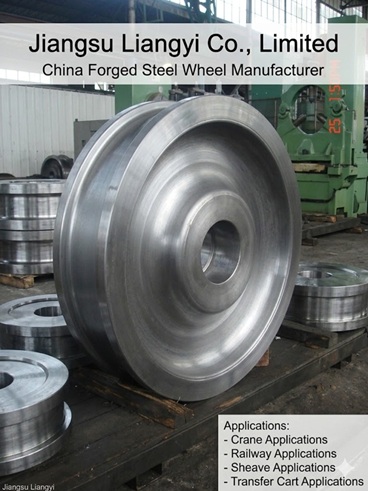
If you need custom forged steel wheels made in China for overhead cranes, gantry cranes, rail transfer carts, mining vehicles or sheave systems, Jiangsu Liangyi can supply wheels from small trial quantities to large industrial sizes up to 2 meters in diameter and 15 tons in weight, with heat treatment, CNC machining and non-destructive testing completed according to drawings and international standards.
We own full in-house production capacity from steel melting, open die forging, precision heat treatment and CNC machining to final quality inspection. This integrated route allows us to control metallurgy, grain flow, hardness distribution, size accuracy and inspection consistency instead of outsourcing the critical processes that decide service life.
Our workshop is equipped with advanced open die forging and heat treatment equipment, including 2000T / 4000T / 6300T hydraulic forging presses, 1T to 9T electro-hydraulic forging hammers, seamless rolling equipment and more than ten heat treatment furnaces, together with chemical analysis, metallography, mechanical property and NDE inspection facilities.
The product scope is separated by wheel type and use case so engineers, procurement teams and maintenance personnel can review the options quickly without losing technical detail.
Designed for overhead cranes, gantry cranes, ladle cranes and workshop cranes that require high impact resistance, controlled hardness and long tread life.
Used for mining rail vehicles, in-plant rail systems, transfer carts and heavy-duty transport platforms that work under high load and variable track conditions.
Custom forged sheave and pulley wheels for lifting systems where groove accuracy, wear resistance and reliable material soundness matter.
Large forged wheels for quay cranes and container handling equipment with strict fatigue life, size accuracy and delivery requirements.
Applied in stacker-reclaimers, travel mechanisms, reclaiming systems and heavy industrial handling equipment exposed to abrasive service conditions.
Production is carried out in accordance with customer drawings, special material requirements, hardness range, contour geometry, shaft interface and document requirements.
Our forging and heat treatment method is built for heavy industrial service where wheels face impact, rolling contact stress, flange friction and long operating cycles. The result is a forged wheel that is more resistant to sudden failure and more predictable over time than a typical cast alternative.
We can get controlled hardness on tread and flange wear surfaces while maintaining a tough and ductile core, helping the wheel resist shock loads during continuous operation.
The metal flow created during open die forging follows the wheel geometry more effectively than casting, improving tensile strength, fatigue resistance and impact toughness.
Our forged crane wheels are engineered to reduce the risk of flange fracture, abnormal wear, pitting and spalling. Surface quenching can be controlled to hardened depth up to 35 mm.
Production can follow DIN, ASTM, EN, JIS and customer standards, making the wheels suitable for projects in Europe, North America, Australia, Southeast Asia, the Middle East and other regions.
One of the most common sourcing questions is whether forged wheels are worth the additional manufacturing process. In heavy-duty, high-frequency and safety-critical service, the answer is usually yes because the internal structure and process reliability are fundamentally different.
| Performance index | Forged steel wheels | Cast steel wheels |
|---|---|---|
| Internal structure | Dense and fine grain structure with lower risk of porosity, shrinkage or inclusions after forging and heat treatment. | Higher risk of porosity, shrinkage cavities and inclusion-related defects introduced during casting. |
| Mechanical strength | Higher tensile strength, impact toughness and fatigue resistance, especially useful under sudden or repeated heavy loading. | Usually lower impact resistance and lower confidence under severe shock loading. |
| Wear resistance and service life | More uniform hardenability and longer service life under comparable working conditions. | More uneven hardness and faster wear in demanding service. |
| Load bearing range | Suitable for heavy-duty, high-frequency and continuous operation. | Better suited to lighter duty or lower-frequency uses. |
| Quality stability | Supports full-process inspection and traceable NDE reports with better batch consistency. | Quality can fluctuate more significantly between batches and defect risk is harder to control. |
As a China forged steel wheel exporter, we support standard and custom material grades based on service load, wear requirement, impact level, operating temperature and track or sheave conditions. The information below is organized for faster technical review while keeping the same engineering depth.
Reliable forged wheels depend on more than forging capacity. They also depend on metallurgy control, hardness verification, size inspection and documented non-destructive testing, because these items are critical for technical approval and supplier comparison.
Inspection packages can include chemical composition analysis, tensile and yield testing, elongation, impact toughness, hardness testing, metallography, size inspection and NDE reports. EN 10204 3.1 is provided as standard documentation, and EN 10204 3.2 can be arranged when third-party witness or other project control is required.
The case studies below keep the original use depth while presenting the industry background, service challenge, solution and result in a clearer engineering format.
Pain point: High temperature, heavy load and 24/7 operation caused fast tread wear, flange fracture and short life on cast wheels.
Solution: Custom forged crane wheels in 42CrMo4 with dual-hardness heat treatment, 450 to 520 HB surface hardness, 30 mm hardened depth and full UT / MT testing.
Result: Service life extended to 18 to 24 months, around 5 to 6 times longer than the previous cast wheels in similar duty conditions.
Pain point: Dust, abrasive particles, heavy load and frequent start-stop created pitting and spalling on track wheels for stacker-reclaimers and transfer carts.
Solution: AISI 4140 forged track wheels with full surface quenching plus optimized wheel profile design to reduce abnormal wear.
Result: Stable service for more than 12 months without obvious pitting or major wear compared with original wheels that failed within about 4 months.
Pain point: Quay cranes and gantry cranes required better fatigue resistance, large sizes and shorter lead time than imported wheels could provide economically.
Solution: Large forged port crane wheels with a diameter of up to 1.8 meters, made of 34CrNiMo6 alloy steel and produced in accordance with DIN 15078 standards.
Result: Production, testing and delivery completed within 25 days with significant cost reduction versus imported alternatives.
Pain point:Outdoor operations, uneven track conditions and impact loads require better resistance to breakage and corrosion.
Solution: Custom forged steel road wheel hubs and conveyor car wheel hubs, made of vacuum degassed fine-grained steel, UT/MT testing, and optional anti-corrosion treatment.
Result: Stable operation under harsh site conditions with no reported fracture or major deformation in service.
Uses range: Overhead cranes, hoisting equipment, process travel mechanisms, fertilizer plants, power plants and other general industrial equipment.
Delivery mode: Fully customized wheel design according to drawings, wheel profile, material selection, hardness target and certification package.
As a professional custom forging wheel manufacturer, we provide one-stop support from drawing review, material choice to forging route design, heat treatment, machining, inspection, packaging and export delivery, making communication faster and more reliable for buyers.
Production is carried out according to 2D drawings, 3D models, customer standards, performance requirements or approved samples.
Free advice on material choice, hardness route and basic process design based on working conditions and failure risk.
Small-batch trial production is supported, and regular custom orders are mainly delivered in 15 to 30 days depending on complexity.
EN 10204 3.1 / 3.2 MTC, NDE reports, hardness results, material inspection records and export documents can be prepared as required.
Sea freight, air freight and door-to-door arrangements can be coordinated for Europe, North America, Australia, Southeast Asia, the Middle East, South America and Africa.
Standard warranty period is 12 months from delivery, or according to the project contract and customer requirement.
Check our full range of forged products and forging materials if your project also needs shafts, rings, bars or custom open die forgings.
This checklist shows the main details required for a fast and accurate forged steel wheel quotation.
The FAQ below gives concise answers to the most common technical and commercial questions while staying consistent with the detailed content above.
The maximum outer diameter can reach up to 2 meters and the maximum single-piece weight can reach up to 15 tons. Larger custom sizes can be evaluated according to your project requirements.
Production can follow DIN 15078, DIN 15079, ASTM A-504, EN, JIS and other customer-specified standards depending on the use and destination market.
MOQ is flexible. Trial production can start from one piece, and batch orders are also supported when the project moves to regular supply.
The normal lead time is about 15 to 30 days depending on material, size, quantity, machining scope and inspection requirements. Urgent orders can be discussed.
Yes. EN 10204 3.1 MTC is provided, EN 10204 3.2 can be arranged, and UT / MT reports can be prepared according to contract or drawing requirements.
Yes. OEM and ODM support are both acceptable for wheel geometry, material route, process design, packaging and branding requirements.
Yes. We can coordinate sea freight, air freight and other export logistics methods, and provide customs clearance documents together with technical paperwork.
The standard warranty period is 12 months from the date of delivery, or according to the final technical and commercial agreement with the customer.
If you are sourcing forged steel wheels for heavy-duty crane, rail transfer or sheave uses, send your drawing, quantity, destination and technical requirements. We can review the project and reply with material suggestions, process advice and a detailed quotation.