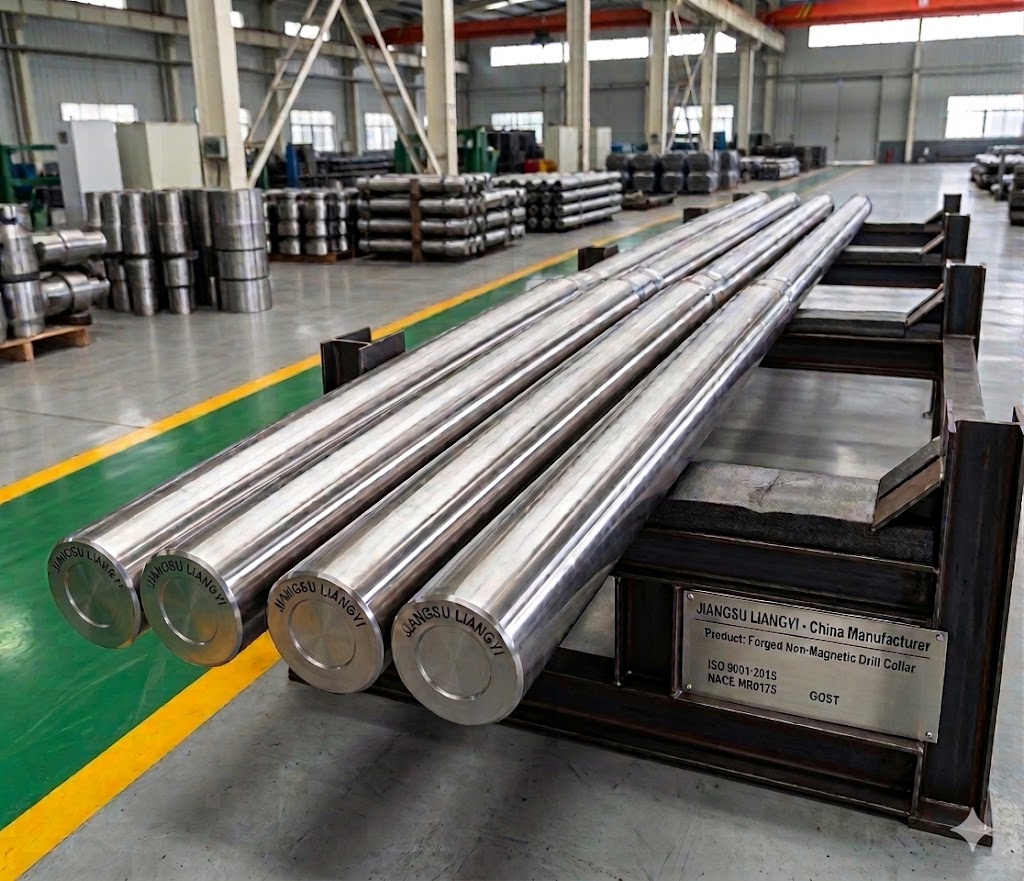
Forged Steel Non-Magnetic Drill Collar | Manufactured to API Spec 7-1 | ISO 9001:2015 Certified
Founded1997 · 25+ yrs
OD Range2‑7/8″ – 14″
Magnetic Permeability≤ 1.005 μr
Perm. Test Method5-Zone Full-Length
Annual Capacity120,000 tons
Export Markets50+ Countries
StandardAPI Spec 7-1
Max Single Piece30 tons
Why Choose Jiangsu Liangyi Forged Non-Magnetic Drill Collars
As a professional ISO 9001:2015 certified open die forging manufacturer established in 1997, we have 25+ years of experience producing high-performance forged steel non-magnetic drill collars, manufactured to API Spec 7-1, for the global oil & gas drilling industry. Our 80,000 m² factory is equipped with full in-house production lines, with an annual capacity of 120,000 tons, supporting custom production from 30 kg to 30 tons single-piece weight.
Full In-House Production Chain
From 30t EAF steel melting, LF refining, VOD vacuum degassing, 6300T hydraulic forging, heat treatment to CNC machining and 100% NDT inspection — full traceability for every collar, no outsourcing.
5-Zone Full-Length Permeability Mapping
Unlike competitors who test only the collar ends, we map magnetic permeability across 5 longitudinal zones along the full working length using a Forster Magnetomat 1.782, with a probe-spacing printout for each zone certified in the MTC.
Strict Global Compliance
Fully compliant with API Spec 7-1, ASTM, NACE MR0175, NORSOK, EN, GOST and other international standards. EN 10204 3.1/3.2 MTC, CE, GOST, DNV/BV/SGS third-party inspection all available.
True Engineering Customization
ODs 2‑7/8″ to 14″, custom ID, wall thickness, API / premium thread, special alloy grades, and composite reinforcement. We work directly from your drilling program and BHA design — not catalog sizes.
✅ ISO 9001:2015 Certified
Manufactured to API Spec 7-1
NACE MR0175 / ISO 15156 Reference
EN 10204 3.1/3.2 MTC Available
CE Documentation on Request
GOST Documentation on Request
NORSOK M-001 Reference
3rd-Party Inspection: DNV / BV / SGS
Product Overview & Core Function
Drill collars are the backbone of every bottom hole assembly (BHA). They provide the compressive weight-on-bit (WOB) that drives the drill bit through rock, and their heavy wall (typically 38–53 mm, 4–6× a standard drill pipe wall) gives the BHA enough bending stiffness to control wellbore trajectory. In a conventional drill string, all steel components above and below the bit generate a localized magnetic anomaly that blinds downhole navigation instruments.
A non-magnetic drill collar (NMDC) solves this by creating a magnetically neutral "window" around the MWD/LWD sensor package. Our collars maintain relative magnetic permeability ≤1.005 μr across the entire working length — verified by 5-zone Forster Magnetomat mapping — so the magnetometers inside the MWD tool see only the Earth's ambient field, enabling real-time, accurate measurement of inclination, azimuth, and magnetic toolface for directional and horizontal well steering.
Applications span onshore & offshore oil & gas, shale gas horizontal wells, coalbed methane, geothermal drilling, and deep mining exploration across all major producing basins worldwide.
Standard Dimensional & Weight Reference
The table below provides representative dimensional data for our standard API 7-1 non-magnetic drill collar series. All dimensions are customizable. Wall thickness, ID bore, connection type and length can be specified per your BHA design requirements. Custom ODs outside this table — including extra-large collars up to 14" OD — are accepted.
| OD (in) |
ID (in) |
Wall Thickness (mm) |
Approx. Weight (kg/m) |
Typical Connection |
Standard Length (m) |
Typical Application WOB Range (kN) |
| 2‑7/8" | 1‑1/4" | 38 | ~51 | 2‑3/8" API REG | 5.5 – 9.5 | 20–60 |
| 3‑1/2" | 1‑1/2" | 40 | ~73 | 2‑7/8" API REG | 7.6 – 9.5 | 40–100 |
| 4‑3/4" | 2" | 44 | ~135 | 3‑1/2" API REG | 8.8 – 9.5 | 80–180 |
| 6‑1/2" | 2‑13/16" | 46 | ~248 | 4‑1/2" API REG | 8.8 – 9.5 | 150–300 |
| 6‑3/4" | 2‑13/16" | 50 | ~272 | 4‑1/2" API REG | 8.8 – 9.5 | 180–340 |
| 8" | 3" | 51 | ~372 | 6‑5/8" API REG | 8.8 – 9.5 | 250–450 |
| 9‑1/2" | 3" | 53 | ~524 | 7‑5/8" API REG | 8.8 – 9.5 | 350–600 |
| 11" | 3‑1/2" | Custom | Custom | Custom | Custom | 500–900 |
| 14" | Custom | Custom | Custom | Custom | Custom | Custom |
* All weights are approximate theoretical values for austenitic stainless steel grade (254 SMO® (UNS S31254) / P550) at standard dimensions. Titanium grades are ~40% lighter; nickel alloys vary by density. Confirm exact weights with our engineering team per your order specifications.
Material Grade Performance Matrix
Selecting the wrong material grade is the single most common cause of premature non-magnetic drill collar failure. The table below gives the quantitative engineering properties that drive selection decisions — data that belongs in your drilling program, not just qualitative labels.
| Material Grade |
Min. Yield Strength (MPa) |
Min. Tensile Strength (MPa) |
Hardness (HRC) |
Max. Service Temp. (°C) |
Magnetic Perm. (μr) |
H₂S Resistance |
Relative Density (g/cm³) |
Primary Standard |
| AISI 4140 / 4145H MOD |
758 | 965 | 28–34 | ~200 | ~100–300 (magnetic) |
✗ Not suitable | 7.85 | API Spec 7-1 |
| P530 Austenitic SS |
530 | 760 | ≤28 | ~280 | ≤1.005 |
◑ Moderate | 7.90 | API Spec 7-1 |
| P550 Austenitic SS |
550 | 795 | ≤30 | ~300 | ≤1.005 |
◑ Moderate | 7.90 | API Spec 7-1 |
| P650 Austenitic SS |
650 | 900 | ≤34 | ~300 | ≤1.005 |
◑ Moderate | 7.92 | API Spec 7-1 |
| 254 SMO® (UNS S31254) (Super Austenitic) |
300 | 650 | ≤22 | ~300 | ≤1.003 |
✔ Excellent (NACE MR0175) | 8.00 | NACE MR0175 / API 7-1 |
| Inconel® 925 (UNS N09925) |
690 | 1000 | ≤35 | ~480 | ≤1.005 |
✔ Excellent | 8.14 | ASTM B805 / API 7-1 |
| Monel® K500 (UNS N05500) |
690 | 1035 | ≤36 | ~350 | ≤1.002 |
✔ Excellent | 8.44 | ASTM B865 / API 7-1 |
| Titanium 3Al-2.5V |
483 | 620 | ≤25 | ~260 | ≤1.0001 (diamagnetic) |
✔ Excellent (seawater) | 4.48 | ASTM B338 / NORSOK |
* Values represent minimum guaranteed properties for Jiangsu Liangyi production lots. Actual certified values per EN 10204 3.2 MTC are provided with each order. H₂S resistance classification follows NACE MR0175/ISO 15156 screening criteria.
Engineering Note — Why 254 SMO® (UNS S31254) Has Lower Yield Strength but is Still Preferred for Sour Service: 254 SMO® (UNS S31254)'s superior pitting resistance equivalent (PRE = 43+) and SSC/HIC immunity under NACE MR0175 make it the sour service standard regardless of its lower baseline strength. For sour wells, the failure mode is sulfide stress cracking, not tensile overload — so corrosion immunity outweighs yield strength in the selection hierarchy.
Material Grade Detail
Conventional Alloy Steel (AISI 4140 / 4130 / 4330V / 4145H MOD)
Fully compliant with API Spec 7-1. These grades are ferromagnetic and cannot function as non-magnetic drill collars. They are supplied for conventional heavyweight drill pipe, drill collar string weight, and stabilizer applications where magnetic isolation is not required. We list them here to prevent specification errors in BHA planning — a common and costly mistake when mixing collar types on multi-well programs.
Austenitic Stainless Steel Non-Magnetic Series (P530 / P550 / P650 / 254 SMO® (UNS S31254) / P655)
The austenitic microstructure (FCC crystal lattice) inherently cannot sustain permanent magnetism. Chromium and nickel contents are balanced to suppress martensite transformation under cold-working and downhole vibration — a common failure mode in cheaper non-magnetic grades that develop micro-martensite and drift above 1.010 μr after multiple runs. Our triple-melting process and controlled forging temperature protocol suppress this transformation mechanism by maintaining austenite phase stability throughout the full thermomechanical cycle.
Regional Adaptation: P550 is the workhorse grade for North America shale gas horizontal wells. 254 SMO® (UNS S31254) is the standard for Middle East sour service (H₂S partial pressures >0.3 kPa) and meets the material requirements of major Middle East national oil company purchase specifications.
Nickel Alloy & Monel Series (Inconel® 925 (UNS N09925) / Monel® K500 (UNS N05500))
Nickel-base alloys maintain their FCC austenitic structure at temperatures where conventional austenitic stainless grades begin to lose corrosion resistance and fatigue performance. Inconel® 925 (UNS N09925) (age-hardened Ni-Fe-Cr-Mo-Ti alloy) offers an exceptional combination of high strength, magnetic cleanliness (μr ≤1.005) and NACE qualification at elevated temperatures. Optional tungsten carbide (WC) hardfacing on the OD extends wear life in abrasive formations without any impact on the non-magnetic core properties.
Regional Adaptation: Standard specification for 300°C+ geothermal wells in Indonesia and the Philippines, ultra-deep HPHT wells in the Gulf of Mexico (TVD >6000 m, BHT >180°C), and ERD programs in Eastern Russia where well trajectories exceed 8,000 m measured depth.
Titanium Series (3Al-2.5V)
Titanium's FCC-adjacent HCP crystal structure is intrinsically diamagnetic (μr <1.0001), making it the most magnetically inert drill collar material available — so magnetically clean that MWD sensor placement can be optimized closer to the collar connection without isolation distance penalties. The primary selection driver is weight: at 4.48 g/cm³ versus 7.90 g/cm³ for austenitic steel, titanium collars reduce drill string tension by ~43% for equivalent OD. This allows larger-OD collars for increased bending stiffness without exceeding hook load limits on weight-constrained offshore rigs.
Regional Adaptation: Preferred specification for North Sea (NORSOK M-001), West Africa FPSO-based drilling, and South China Sea semi-submersible deep-water programs where rig hook load and variable deck load (VDL) constraints are critical design drivers.
Why Forged Drill Collars Outperform Bar-Stock Machined Collars: The Grain Flow Science
Most non-magnetic drill collar failures in the field are fatigue fractures at the connection upset zone — not material defects. The root cause is almost always grain flow discontinuity, a problem that forging solves and machining cannot.
In a bar-stock machined drill collar, the raw material is cut from a round billet whose internal grain structure runs axially along the bar's length. When the connection box and pin are machined out of this billet, the tool path cuts across the grain flow at the thread roots — exposing grain boundaries perpendicular to the primary bending stress direction. Under the cyclic bending loads of directional drilling (especially in dogleg sections), these transverse-cut grain boundaries act as micro-crack initiation sites. Thread root fatigue failure is the predictable result.
Our open-die forging process changes this fundamentally. Each collar is forged with a controlled axial reduction ratio of ≥4:1, using our 6300T hydraulic press combined with 2000T fast-forging machine and radial hammer. This forging sequence does three things simultaneously:
- Grain refinement: Large dendritic grains from the casting/ingot stage are broken down and refined to ASTM 5–8 grain size, improving fatigue strength significantly versus the same alloy in cast or lightly forged form.
- Grain flow alignment: Grains are elongated and oriented to flow continuously along the collar's axis and then wrap around the connection geometry at the upsets — so every thread root has grain flow running parallel to the primary stress vector, not across it.
- Closure of internal porosity: Residual casting porosity (micro-voids and shrinkage defects invisible to surface inspection) is mechanically welded shut under the triaxial compressive stress of the forging die, producing a fully dense microstructure that UT cannot distinguish from a "perfect" billet but that fracture mechanics shows to have dramatically higher crack initiation resistance.
| Performance Dimension |
Jiangsu Liangyi Forged NMDC |
Bar-Stock Machined NMDC |
| Grain Flow at Thread Root |
✔ Continuous, parallel to stress axis |
✗ Cut across, perpendicular to stress |
| Internal Porosity |
✔ Closed by forging compressive stress (≥4:1 reduction ratio) |
✗ Retained from billet; detectable by UT only at >2mm diameter |
| Fatigue Life at 10⁷ cycles |
✔ Superior fatigue life vs. equivalent machined grade (grain flow alignment at thread root reduces crack initiation risk) |
Baseline |
| Chemistry Uniformity |
✔ Triple-melt (EAF + LF + VOD) + 10-analysis verification |
Single/double melt typical; 2–3 analyses |
| Post-Machining Residual Stress |
✔ Controlled by precision heat treatment after forging; measured per lot |
✗ High surface tensile residual stress from deep-cut machining; seldom measured |
| Magnetic Permeability Stability Under Vibration |
✔ Stable; austenite phase maintained by controlled thermomechanical cycle |
✗ Risk of micro-martensite formation in cheaper grades under downhole vibration → μr drift above 1.010 |
| Traceability |
✔ Full heat-number to MTC chain; EN 10204 3.1/3.2 |
Typically 3.1 only; sub-supplier chain often opaque |
| Custom OD/ID/Length |
✔ Full custom per drawing; single-piece up to 30 tons |
Limited by available bar stock diameters |
Manufacturing Process: Triple-Melt, Precision-Forge, Full-Inspect
Step 1 — Triple Melting & 10-Point Chemistry Verification
Our melt shop operates a 30t Electric Arc Furnace (EAF) → 30t Ladle Refining Furnace (LF) → Vacuum Oxygen Decarburization (VOD) in sequence. EAF provides the primary melt from screened low-tramp scrap and virgin ferroalloys. LF refines chemistry, desulfurizes to S <0.005% and adjusts temperature. VOD degasses the melt under vacuum (<67 Pa), removes dissolved oxygen and hydrogen, and enables precise carbon control critical for austenitic grades (target C <0.03% for corrosion resistance in 254 SMO® (UNS S31254)).
During the LF and VOD stages, we perform 10 consecutive optical emission spectrometer (OES) analyses on the liquid steel, adjusting alloy addition in real time. This in-process verification eliminates the chemistry drift that causes magnetic permeability failures in batches that "passed" final product inspection but showed field drift after repeated thermal cycling.
For large-format ingots (OD ≥8"), we use a bottom-pouring teapot ladle system that feeds molten steel from below the dross layer, preventing oxide inclusions from entering the ingot mold — a critical step for achieving ASTM E45 inclusion cleanliness ratings of A1/B1/C0/D1 or better, which directly determines ultrasonic inspection acceptance rate and fatigue fracture toughness.
Step 2 — Precision Forging with Controlled Reduction Ratio
Ingots are reheated to the alloy-specific forging temperature window (e.g., 1100–1180°C for P550, 1050–1150°C for 254 SMO® (UNS S31254)) and forged in a controlled sequence: our 2000T fast-forging machine performs initial breakdown forging to refine the as-cast dendritic structure, followed by our 6300T main hydraulic press for shape and upset forming, and finally our radial hammer forge for precision OD and straightness control. Total forging reduction ratio is verified ≥4:1 for all non-magnetic drill collar production.
Forging temperature is monitored by calibrated contact thermocouples and infrared pyrometers at each press stroke. If any forging piece drops below the minimum forging temperature before completion, it is reheated before continuing — preventing the formation of deformation-induced martensite that would compromise non-magnetic performance.
Step 3 — Precision Heat Treatment (10 Furnaces, Full Graphic Records)
We operate 10 dedicated heat treatment furnaces across quench-and-temper, solution anneal, and aging cycles. For austenitic grades, solution annealing at 1050–1150°C followed by rapid water quench dissolves any sigma phase or carbide precipitation that could degrade corrosion resistance or cause magnetic permeability drift. For age-hardenable grades (Inconel® 925 (UNS N09925), Monel® K500 (UNS N05500)), a two-stage aging cycle develops the γ′/γ″ precipitation that delivers high strength without martensite. Full graphic temperature-time records for every furnace run are included in the MTC documentation package.
Step 4 — CNC Machining to Drawing Tolerance
Post-heat-treatment CNC turning and boring on our precision lathes achieves OD tolerance ±0.25mm and ID bore roundness <0.1mm TIR. API and premium thread forms (NC, REG, FH, XT, DSTJ and others) are cut on dedicated CNC thread-cutting machines with thread gauging after every pass. Connection makeup torque shoulders are surface-hardened and phosphate-coated per API Spec 7-1 recommendations to reduce galling risk during field makeup.
Non-Destructive Testing & Our Proprietary 5-Zone Full-Length Permeability Mapping Protocol
API Spec 7-1 requires magnetic permeability testing but does not mandate the number of test points or their distribution along the collar length. Most manufacturers test 2–4 points at the collar body midpoint and ends. We test at 5 defined longitudinal zones across the full collar working length — because experience shows that permeability hot spots occur most frequently in the mid-length zone and at the connection upset transition zones, not at the ends.
5-Zone Full-Length Permeability Mapping — Probe Position Schematic
Forster Magnetomat 1.782 · Each zone: 3 circumferential probe positions (0°, 120°, 240°) · Accept criterion: μr ≤ 1.005 at all 15 measurement points
Zone 1
Pin End
Zone 2
Pin Upset
Zone 3
Mid-Body
Zone 4
Box Upset
Zone 5
Box End
← Pin connection
Working length (collar body)
Box connection →
High-risk hot spot zones (connection upsets)
Intermediate monitoring zones
Mid-body reference zone
Why connection upset zones are highest risk: During forging, the upset zones experience the highest local deformation. In alloys with insufficient phase stability, this deformation can trigger martensite formation, raising local μr to 1.015–1.050 while the collar body tests clean. Our 5-zone protocol is specifically designed to catch this failure mode — a non-magnetic collar that passes a 2-point test but fails in field operation at the upset zone.
Each collar ships with a probe-testing printout showing the actual μr value recorded at all 15 measurement points (5 zones × 3 circumferential positions), signed by our Level 2 NDT inspector and appended to the EN 10204 3.2 MTC.
Complete NDT Protocol (100% of Every Finished Collar)
- Magnetic Permeability Inspection: 5-zone full-length Forster Magnetomat 1.782 probe mapping, 15 measurement points per collar, accept ≤1.005 μr. Full printout in MTC.
- Ultrasonic Testing (UT): 100% full-volume UT per ASTM E114 (latest edition), using calibrated immersion or contact transducers at frequency matched to wall thickness. Acceptance per API Spec 7-1 Annex A. Detects internal inclusions, laminations, cracks >2mm equivalent flat-bottom hole.
- Magnetic Particle Inspection (MPI): 100% full-surface MPI per ASTM E709 for surface and near-surface linear defects. Applied post-machining and post-thread cutting.
- Liquid Penetrant Testing (PT): Applied to connection thread forms and body OD surface after final machining per ASTM E165. Detects open surface defects not found by MPI (applicable to non-ferromagnetic grades where MPI is ineffective).
- Dimensional & Visual Inspection: Full dimensional check per API Spec 7-1 Table 1 criteria. OD, ID, length, straightness (≤1mm per 3m), thread pitch, form, taper and makeup shoulder contact verified. Calibrated instruments with current calibration certificates.
- Hardness Testing: Brinell or Rockwell hardness on both collar body and connection upset zones per lot, verified against heat treatment specification.
- Tensile & Impact Testing: Per-heat mechanical property test coupons per ASTM A370. Tensile (yield, UTS, elongation, RA), Charpy V-notch impact at test temperature specified by grade (−46°C for Arctic/GOST grades, −20°C standard, 0°C minimum for sour service grades).
Complete Documentation Package
Every order ships with a bound document package traceable to individual heat numbers and collar serial numbers, including:
- EN 10204 3.1/3.2 Mill Test Certificate (MTC) — signed by works inspector (3.1) or independent third-party inspector (3.2)
- Heat number, charge chemical analysis, final product chemical analysis
- Full heat treatment certificate with graphic temperature-time records for all thermal cycles
- 5-zone Forster Magnetomat permeability mapping printout (15 data points per collar)
- UT, MPI/PT inspection records and UT calibration block traceability
- Mechanical property test report (tensile + Charpy + hardness)
- Residual stress measurement (process qualification records)
- Dimensional and visual inspection report with inspector sign-off
- NDT inspector Level 2+ certification copies
- Cleaning verification and preservation/packaging certificate
- Country of origin certificate, packing list, commercial invoice
Industry Standards & Global Regional Compliance
- Global Core: API Spec 7-1 (Rotary Drill Stem Elements) — mandatory standard globally for all oilfield drill collar supply
- North America: API Spec 7-1, ASTM A276/A564, NACE MR0175/ISO 15156 for sour service; US shale operator supplemental specifications accommodated upon request
- Europe / North Sea: EN 10204, NORSOK M-001 Material Selection reference, NORSOK M-630 Material Data Sheets reference; CE documentation and DNV/BV third-party verification available upon request
- Middle East: NACE MR0175/ISO 15156, API Spec 7-1; Middle East national oil company sour service material requirements accommodated upon request
- Russia & CIS: GOST 1050, GOST 5632 (stainless), GOST R 53365; Charpy impact at −60°C available for extreme Arctic applications
- Southeast Asia / Geothermal: API Spec 7-1, ASTM B805 (Inconel® 925 (UNS N09925)); Southeast Asian national oil company project specifications accommodated upon request
MWD/LWD BHA Configuration & Non-Magnetic Isolation Distance Guide
This section explains how to determine how many non-magnetic drill collars your BHA requires and why — a calculation that directly affects survey accuracy and well placement. We provide this guidance free of charge as part of our pre-order engineering consultation.
Why Multiple NMDCs Are Always Required
A single non-magnetic drill collar creates a magnetically neutral zone, but the steel drill collars and drill pipe above and below the NMDC string still generate a magnetic anomaly that decays with distance. The rate of decay follows an inverse-cube law with distance from the steel source. The MWD magnetometer sensor package must be positioned at a distance from any ferromagnetic component where the residual interference field is below the instrument's azimuth measurement error budget — typically <25 nT in most MWD systems, corresponding to an azimuth error contribution of <0.1°.
Typical MWD/LWD BHA NMDC Stack — Recommended Configuration
Steel Drill Collars / HWDP (above)
↓
NMDC #1 — Upper Isolation Collar
Min. 1 × collar length magnetic separation
↓
NMDC #2 — MWD/LWD Sensor Host Collar
Sensor package centralized in this collar
↓
NMDC #3 — Lower Isolation Collar
Isolates sensor from stabilizer / motor (ferromagnetic)
↓
Stabilizer / Mud Motor (ferromagnetic)
↓
Drill Bit
* Minimum 2 NMDCs required. 3 NMDCs recommended when any of the following apply: dogleg severity >3°/30m, high-inclination wells (>60°), BHT >150°C, or azimuth accuracy requirement <±0.5°.
Simplified Isolation Distance Calculation
The required minimum NMDC string length (Lmin) between the MWD sensor and the nearest ferromagnetic component can be estimated using the following engineering formula, which we apply for every BHA consultation:
Lmin (m) = k × ODsteel (m) × [ μr,steel / (Δμr × Hearth / ΔHallow) ]1/3
Where: k = design safety factor (typically 1.3–1.5); ODsteel = outer diameter of adjacent steel collar; μr,steel = relative permeability of steel drill collar (~80–300); Δμr = permeability contrast between NMDC and steel; Hearth = local Earth's field magnitude (nT); ΔHallow = maximum allowable interference (typically 25 nT for ±0.25° azimuth error).
In practice, for a typical 6‑3/4" steel drill collar (μr ~200) adjacent to a P550 NMDC (μr ≤1.005) in a 50,000 nT field with 25 nT allowable interference, Lmin calculates to approximately 5.5–7.2 m — meaning 1 standard-length NMDC (9.5 m) provides adequate isolation, but we recommend 2 for safety margin in directional wells. We perform this calculation for free for every project order submission.
4-Axis Engineering Selection Framework
Non-magnetic drill collar specification errors are expensive. Wrong material in a sour service well means a corrosion failure at 1,000+ m depth. Wrong weight specification on an offshore platform means exceeding hook load limits mid-well. Use this 4-axis framework — the same process our engineering team follows in pre-order consultation — to narrow your specification before requesting a quotation.
① Axis 1: Well Type & Trajectory
Determine first
✦ Vertical / low-inclination directional: conventional length NMDCs, P530/P550
✦ High-inclination / horizontal (inclination >50°): enhanced fatigue resistance required, P550/P650 or nickel alloy
✦ Extended reach (MD/TVD >2.5): composite reinforcement or titanium for weight optimization
✦ Ultra-ERD (>8,000 m MD): P650 or Inconel® 925 (UNS N09925), triple melt mandatory
→ Defines: minimum yield strength, fatigue classification, weight budget
② Axis 2: Corrosion Environment
Critical filter
✦ Sweet (H₂S <0.3 kPa, CO₂ <2 bar): P530/P550 adequate
✦ Sour (H₂S ≥0.3 kPa partial pressure): 254 SMO® (UNS S31254) mandatory per NACE MR0175; P550 not qualified for SSC environments
✦ Seawater / offshore: Titanium 3Al-2.5V or Inconel® 925 (UNS N09925) for external corrosion resistance
✦ Geothermal / volcanic (H₂S + CO₂ + chlorides): Inconel® 925 (UNS N09925) or Monel® K500 (UNS N05500)
→ Defines: corrosion grade, NACE compliance requirement, sour service MTC
③ Axis 3: Temperature & Pressure
Eliminate unsuitable grades
✦ BHT <150°C, pressure <70 MPa: austenitic SS grades adequate
✦ BHT 150–300°C: verify mechanical property retention; Inconel® 925 (UNS N09925) strongly preferred above 200°C
✦ BHT >300°C (geothermal): Inconel® 925 (UNS N09925) or Monel® K500 (UNS N05500) mandatory; standard SS grades lose toughness
✦ Surface temp <−20°C (Arctic): low-temp Charpy impact testing required; P650 + GOST, or Ti 3Al-2.5V
→ Defines: alloy series (SS / nickel / titanium), Charpy test temperature
④ Axis 4: Weight & Rig Constraints
Final optimization
✦ Onshore, no hook load restriction: standard austenitic SS — optimal cost/performance
✦ Offshore semi-sub / jackup with VDL limits: calculate available hook load margin; if <20% remaining, consider titanium
✦ FPSO or weight-limited platform: titanium 3Al-2.5V standard specification; 43% weight reduction
✦ Deep-water riser weight constraint: titanium + composite reinforcement for maximum WOB with minimum string weight
→ Defines: material density class, OD optimization, final grade selection
Free Pre-Order Engineering Consultation: Submit your drilling program parameters (well type, BHT/BHP, H₂S partial pressure, hook load budget, OD constraint, string length) to our engineering team, and we will provide a formal material selection recommendation with supporting calculation within 48 hours — at no charge.
Total Collar Cost (TCC) Analysis: Why Premium Forged Grades Cost Less Per Well
Purchase price is typically only 35–50% of the true cost of a non-magnetic drill collar over its operational life. The remaining cost is borne in inspection & maintenance cycles, string replacement after failure, non-productive time (NPT), and re-survey costs when magnetic drift corrupts well trajectory data. The TCC model below is based on aggregated data from our customer base across three representative well programs.
| Cost Component |
Low-Cost Bar-Stock NMDC (ungraded SS) |
Jiangsu Liangyi P550 Forged NMDC |
Jiangsu Liangyi 254 SMO® (UNS S31254) Forged NMDC (sour service) |
| Purchase Price (per collar, relative) |
1.0× |
1.3–1.6× |
1.8–2.2× |
| Average Runs Before Retirement |
8–12 runs |
20–35 runs |
25–40 runs |
| In-Service μr Drift Failures |
~15% of collars after run 5+ |
~0.3% (5-zone mapping eliminates borderline units before delivery) |
~0.1% |
| NPT Cost per μr Drift Event (survey re-run) |
USD 45,000–120,000 per incident (rig rate × survey time + re-directional cost) |
Negligible (near-zero drift events) |
Negligible |
| Inspection & Reconditioning Cost (per collar / 5 runs) |
USD 800–1,200 (frequent thread galling; MPI rejection rate ~8%) |
USD 400–600 (WC thread protection; MPI rejection rate <2%) |
USD 500–750 |
| Corrosion-Related String Loss (sour service wells) |
Catastrophic failure risk; full string replacement required |
Low risk in sweet service; not recommended for sour |
Negligible; NACE MR0175 qualified for H₂S service life |
| Estimated TCC per 100 Directional Wells |
Highest (frequent replacement + NPT events) |
Significantly lower total program cost than low-cost option over full program life |
~35–50% lower vs. using wrong grade in sour service |
* TCC estimates are based on composite data from customer feedback across Middle East, North America and North Sea programs. Actual savings will vary by rig day rate, program length and well conditions. Contact our engineering team for a customized TCC analysis based on your specific drilling program parameters.
In-Service Inspection, Reuse Criteria & Collar Lifecycle Management
A non-magnetic drill collar that fails mid-well costs 10–50× its purchase price in NPT and re-directional expenses. Systematic in-service inspection — not just pre-delivery testing — is what separates a high-performance non-magnetic drill collar program from an unpredictable one.
Recommended In-Service Inspection Schedule
| Inspection Type |
Frequency |
Accept Criterion |
Action if Failed |
| Visual & Dimensional |
Every run |
No visible cracks, corrosion pitting >1mm, OD wear <3mm total |
Remove from service; assess for recut or scrap |
| Thread MPI / PT |
Every 3–5 runs (or after any fishing operation) |
No linear indications at thread roots; no cross-thread marks |
Recut connection; re-inspect before return to service |
| Magnetic Permeability Re-check |
Every 10 runs or annually |
Full-length μr ≤1.010; if any zone >1.010 → retire as NMDC |
Downgrade to standard (non-directional) drill collar service or scrap |
| Full-Volume Ultrasonic |
Every 15 runs or after any shock/high-vibration event |
Per API Spec 7-1 UT acceptance criteria; no new internal reflectors |
Phased array UT for characterization; retire if linear defect confirmed |
| Straightness Check |
Every 5 runs or after stuck-pipe / jarring event |
≤1mm/3m (API Spec 7-1 drift allowance) |
Straighten in press if within elastic range; scrap if plastic deformation exceeds OD × 0.3% |
Retirement & Reuse Decision Logic
A collar that exceeds the μr ≤1.010 threshold in any permeability re-check zone is no longer usable as a non-magnetic drill collar, but it may still have structural integrity for use as a standard (ferromagnetic acceptable) drill collar in non-directional well sections. This "downgrade reuse" decision requires OD and connection inspection to confirm structural fitness before reclassification and re-stamping. We provide technical consultation on this reclassification process for customers managing large collar inventories.
Magnetic Permeability Drift: The Silent NMDC Failure Mode. Unlike a broken connection (obvious) or corrosion perforation (detectable), μr drift above 1.010 is invisible to field inspection without a magnetometer. A collar that "looks fine" may be generating 40–80 nT of azimuth interference at the MWD sensor — enough to introduce 0.5–2° of azimuth error that compounds over a 3,000 m lateral section to a 25–100 m wellbore placement error. This is why our 5-zone pre-delivery mapping and periodic in-service re-check are non-negotiable in any serious directional drilling program.
Global Project Applications & GEO-Targeted Case Studies
Our forged steel non-magnetic drill collars operate in oil & gas, geothermal, mining and directional drilling projects across 50+ countries. The following cases present real engineering challenges, our specific technical responses, and quantified project outcomes.
Middle East · Saudi Arabia & UAE
254 SMO® (UNS S31254) · NACE MR0175
API 7-1 · MTC 3.2
Case 1: Onshore Sour Service Directional Drilling — Middle East
Engineering Challenge: Formation H₂S partial pressure 2.8–4.1 kPa (well above NACE MR0175 0.3 kPa SSC threshold). Client had experienced two SSC failures on competing P550 grade collars within 6 months. Strict national oil company material qualification required, with magnetic permeability ≤1.005 μr across full collar working length for accurate MWD azimuth in 65° high-inclination directional wells.
Our Solution: Supplied 254 SMO® (UNS S31254) super austenitic stainless steel forged NMDCs (OD 3‑1/2" to 9‑1/2", wall 40–53 mm). 254 SMO® (UNS S31254) was selected specifically for its PREN = 43+ (immune to pitting under downhole brine conditions) and NACE MR0175 qualification at H₂S partial pressures up to 10 kPa. All collars delivered with EN 10204 3.2 MTC (third-party DNV inspection), 5-zone Forster Magnetomat mapping printout, and full NACE compliance documentation per the client's material qualification requirements.
Quantified Outcome: Zero SSC incidents over 5+ years / 60+ well program. Client reduced average directional drilling cycle by 12% attributed to elimination of azimuth re-survey events (previous P550 collars had caused 3 magnetic drift NPT events per 20 wells). 254 SMO® (UNS S31254) now designated as client's standard NMDC specification for all H₂S-positive reservoirs in their Gulf operations.
North America · Texas USA & Alberta Canada
P550 High-Strength Austenitic
API 7-1 · NACE MR0175
Case 2: Shale Gas Extended Reach Horizontal Wells — North America
Engineering Challenge: Lateral sections averaging 4,200 m (13,800 ft) with dogleg severity up to 4.5°/30m in the curve section. Rotary steerable system (RSS) requires <0.25° azimuth accuracy throughout the full lateral for hydraulic fracturing stage placement accuracy. Client had budget pressure to reduce BHA day-rate costs by consolidating collar inventory across multiple rig spread.
Our Solution: Supplied P550 forged NMDCs in standardized 6‑3/4" OD × 2‑13/16" ID × 9.5 m length with 4‑1/2" API REG connections (compatible across all 6 rigs in client's spread). Fatigue life qualification included resonance frequency analysis at typical WOB 120–180 kN to confirm no operating speed coincides with collar natural frequency. Weight tolerance ±0.5% per collar enables precise BHA weight modeling for anti-torque / anti-shock calculations. Full traceability package enabled consolidation into client's inventory management system.
Quantified Outcome: 300+ ERD wells completed across the North America program with zero magnetic interference failures. Azimuth accuracy maintained ≤0.20° throughout all laterals measured against post-drill gyro confirmation surveys. Weight-consistent collar inventory reduced BHA configuration errors by 30% versus prior mixed-supplier program. Client awarded 3-year preferred supplier contract based on performance data.
Europe · UK & Norway North Sea
Titanium 3Al-2.5V
NORSOK · CE · DNV
Case 3: Offshore Deep-Water Drilling — North Sea
Engineering Challenge: Semi-submersible rig with variable deck load (VDL) limit constraining total BHA weight to 42 tonnes. Target TVD 4,800 m with 3,100 m lateral section required 3× NMDCs of 9‑1/2" OD — but standard steel P550 collars at this size weigh 524 kg/m × 9.5 m × 3 = 14,934 kg for the NMDC string alone, consuming 36% of VDL budget and leaving insufficient margin for BHA components above. Surface temperature −4°C to −12°C with seawater chloride concentration requiring offshore corrosion resistance.
Our Solution: Supplied Titanium 3Al-2.5V forged NMDCs, OD 9‑1/2" × custom bore × 9.5 m. Titanium density 4.48 g/cm³ versus P550 at 7.90 g/cm³ reduced NMDC string weight from 14,934 kg to 8,464 kg — a 6,470 kg saving that freed VDL budget for additional BHA componentry. Titanium's inherent diamagnetic nature (μr <1.0001) allowed the MWD sensor to be positioned with ≈30% less isolation distance than austenitic steel, improving BHA compactness. Full NORSOK M-001 material compliance, CE marking, DNV 3.2 inspection certification. Low-temperature Charpy impact tested at −46°C per NORSOK requirements.
Quantified Outcome: 8-year continuous supply relationship with European drilling contractor. NMDC string weight reduction enabled BHA redesign with a heavier stabilizer package within VDL margin, contributing to improved ROP. Total drill string weight was substantially reduced versus equivalent-OD steel collar configuration. Zero magnetic interference failures. Titanium 3Al-2.5V is now the standard NMDC specification for all VDL-constrained deepwater rigs in the client's North Sea fleet.
Southeast Asia · Indonesia & Philippines
Inconel® 925 (UNS N09925) + WC Reinforcement
API 7-1 · ASTM B805
Case 4: High-Temperature Geothermal Drilling — Southeast Asia
Engineering Challenge: Geothermal reservoir temperature 310–350°C with highly abrasive andesitic and basaltic volcanic rock. Previous austenitic stainless steel NMDCs (P550) suffered accelerated oxidation and corrosion at BHT >280°C, with measured μr drift from 1.004 to 1.018 after 4 runs at temperature — attributed to sigma phase precipitation in the SS matrix at sustained high temperature. LWD tool measurement gaps due to magnetic interference caused wellbore placement errors of 3–8 m, unacceptable for geothermal well array spacing.
Our Solution: Supplied Inconel® 925 (UNS N09925) forged NMDCs with tungsten carbide (WC) OD hardfacing in 6‑1/2" OD × 2‑13/16" ID configuration. Inconel® 925 (UNS N09925)'s Ni-Cr-Mo-Ti-Al chemistry maintains FCC austenitic stability to 480°C, preventing sigma phase formation and μr drift. WC hardfacing (HRC 65+) on the OD wearpad locations extends abrasion life in hard volcanic rock from ~4 runs (bare SS) to ~12 runs without OD wear reduction below API retirement limit. Full high-temperature mechanical property testing at 350°C included in MTC per ASTM B805 protocol.
Quantified Outcome: 50+ geothermal projects completed across Indonesia and Philippines. LWD tool operated without magnetic interference-induced data gaps in all wells. Service life substantially extended versus the previous P550 specification, with total NMDC program cost substantially reduced despite a higher per-collar purchase price, due to lower replacement frequency and elimination of NPT from magnetic drift events.
Russia · Western Siberia & Sakhalin
P650 · 4145H MOD · GOST
GOST · API 7-1 · Triple Melt
Case 5: Ultra-Long Extended Reach Drilling — Siberia, Russia
Engineering Challenge: Measured depth exceeding 8,400 m with a horizontal departure of 6,200 m — one of the longest ERD profiles in Eastern Russia at the time. Surface temperature −38°C, permafrost zone to 450 m depth. Client required non-magnetic drill collars with full GOST certification, Charpy impact values ≥50 J at −60°C (design margin above minimum ambient), and consistent μr ≤1.005 across the full working length to support gyroscopic and magnetic hybrid MWD survey at every 300 m survey station.
Our Solution: Supplied P650 high-strength austenitic SS forged NMDCs for the non-magnetic string, plus 4145H MOD drill collars for the weight-on-bit string above the NMDC zone. P650 grade was selected for its superior yield strength (650 MPa min.) and fatigue resistance required by the high-tension BHA loads in the ERD profile, combined with confirmed Charpy 54–67 J at −60°C across all production heats. Triple melt process and 10-analysis chemistry control ensured consistent μr ≤1.003 across the full 9.5 m collar length, verified by 5-zone mapping. Manufactured to GOST R 53365 requirements, with third-party inspection documentation arranged upon request.
Quantified Outcome: Accurate magnetic survey maintained at all 28 survey stations across the 8,400 m well. Zero fracture or magnetic performance failure incidents in 3 years of production operation. Now designated as long-term preferred NMDC supplier for this client's Siberian ERD program, with standing orders for annual supply across their West Siberia rig fleet.
FAQ About Forged Steel Non-Magnetic Drill Collars
What is the main function of a non-magnetic drill collar?
Two core functions: 1. Weight and rigidity — heavy wall (38–53 mm) provides stable WOB for efficient rock fragmentation and wellbore straightness control, reducing deviation risk; 2. Magnetic isolation — by maintaining μr ≤1.005 across the full working length, the NMDC creates a magnetically neutral window around MWD/LWD sensors so they measure only the Earth's ambient field, enabling accurate real-time inclination, azimuth and toolface measurement for directional well steering.
What is the acceptable magnetic permeability — and how do you test it?
API Spec 7-1 requires μr ≤1.010. For high-precision directional drilling, the industry-standard target is ≤1.005 μr. We test using a Forster Magnetomat 1.782 in our proprietary 5-zone full-length mapping protocol — 5 longitudinal zones (pin end, pin upset, mid-body, box upset, box end) × 3 circumferential probe positions (0°, 120°, 240°) = 15 certified data points per collar. All 15 points must pass ≤1.005 μr. The full printout is appended to the EN 10204 3.2 MTC. This differs from the industry-common 2-point (end-only) test, which misses the connection upset hot spots where μr drift most commonly occurs.
How many non-magnetic drill collars does a BHA need?
Minimum 2 NMDCs are required in most BHA designs; 3 are recommended when: dogleg severity >3°/30m, inclination >60°, BHT >150°C, or azimuth accuracy requirement <±0.5°. The required NMDC string length is determined by the magnetic isolation distance calculation — the distance required between the MWD sensor and the nearest ferromagnetic component (steel drill collar above, mud motor or stabilizer below) such that residual magnetic interference at the sensor is below the instrument's azimuth error budget (typically <25 nT). We provide this calculation free as part of our pre-order engineering consultation.
How do I select the right material grade?
Use our 4-axis framework: Axis 1 Well Type (vertical/directional/ERD/geothermal → defines strength requirement); Axis 2 Corrosion Environment (sweet/sour H₂S/seawater → if H₂S partial pressure ≥0.3 kPa, 254 SMO® (UNS S31254) is mandatory per NACE MR0175; P550 is not qualified for SSC environments); Axis 3 Temperature (BHT >200°C → Inconel® 925 (UNS N09925); >300°C → Inconel® 925 (UNS N09925) or Monel® K500 (UNS N05500) mandatory; surface <−20°C → low-temp Charpy testing, P650/GOST or titanium); Axis 4 Weight Budget (VDL-constrained offshore → titanium 3Al-2.5V for 43% weight reduction). Submit your drilling program parameters for a free engineering selection recommendation within 48 hours.
What OD sizes and custom configurations are available?
Standard OD range 2‑7/8" to 14", with custom ID bore, wall thickness, length (standard 9.5 m; custom from 5.5 m to 14 m), connection type (API REG, API IF, NC, FH, XT, DSTJ, proprietary premium threads), and any of our available material grades. Maximum single-piece weight 30 tons. Custom extra-large NMDCs outside standard table are accepted per client drawings. Minimum order quantity varies by grade — contact us for project-specific MOQ discussion.
What documentation and certification do you provide?
Standard documentation package includes: EN 10204 3.1 or 3.2 MTC (3.2 requires third-party inspector — DNV, BV, SGS, CCIC all available); heat number chemical analysis (10-point in-process + final product); full heat treatment certificate with graphic temperature-time records; 5-zone Forster Magnetomat 1.782 permeability test printout (15 data points per collar); 100% UT, MPI/PT inspection records; mechanical property test report (tensile + Charpy + hardness); dimensional and visual inspection report. Regional documentation on request: CE declaration of conformity, GOST compliance documentation, NORSOK M-001 reference documentation, and major NOC supplemental documentation — please specify regional requirements at order stage. All documents issued in English; Russian/Arabic/Chinese translations available on request.
When should a non-magnetic drill collar be retired from NMDC service?
Retire from NMDC service (not necessarily from all drill collar service) when: 1. Permeability re-check shows any zone exceeding μr >1.010; 2. OD wear reduces diameter below API Spec 7-1 minimum (ODoriginal − 3mm for body wear); 3. MPI/UT inspection reveals any linear defect at thread roots; 4. Straightness deviation exceeds 1mm per 3m after jarring or stuck-pipe event; 5. Connection shoulder contact area is damaged beyond remedial re-face limit. Collars failing μr re-check may be reclassified as standard (ferromagnetic) drill collars for non-directional use pending structural inspection — contact our engineering team for reclassification consultation.