Forged Steel Mechanical Press Intermediate Gear Shafts | Professional China Forging Manufacturer
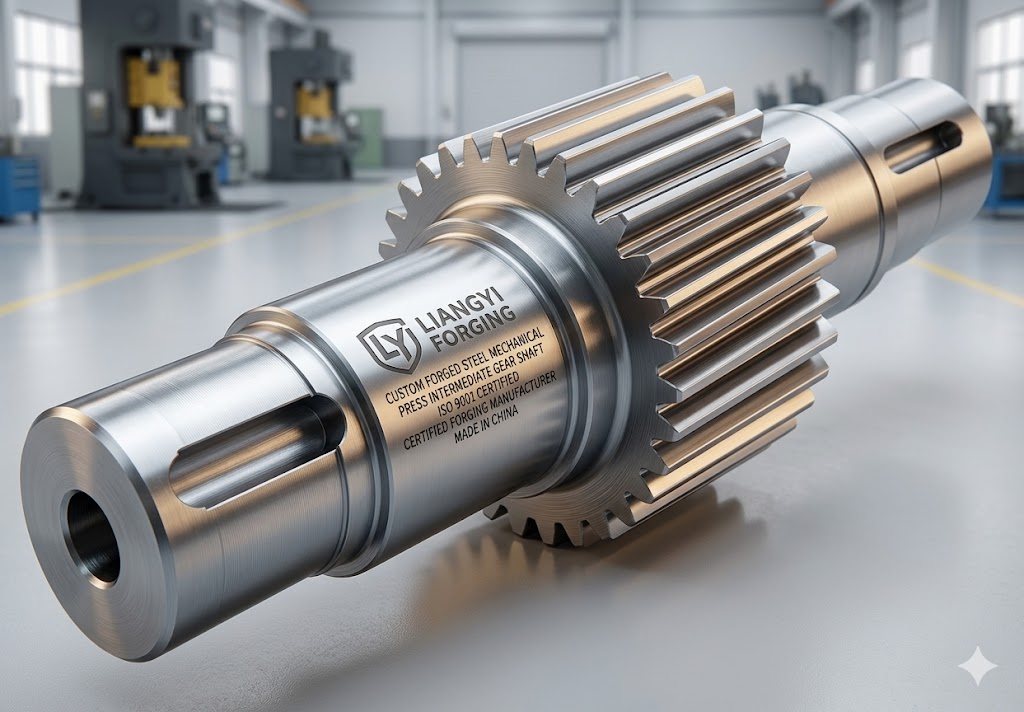
Overview of Our Mechanical Press Intermediate Gear Shafts
Jiangsu Liangyi Co., Limited was founded in 1997, which is a professional ISO 9001:2015 certified forging manufacturer strategically located in Jiangyin City, Jiangsu Province — China's main high-end forging industrial cluster with complete supply chain advantages. We specialize in the R&D and production of high-performance forged steel Mechanical Press Intermediate Gear Shafts. We provide products to global clients from more than 50 countries and regions across Asia, Europe, North America, and more.
Our Mechanical Press Intermediate Gear Shafts are main transmission components suitable for different mechanical press equipment, which is designed to withstand heavy load, high torque, long-term continuous operation, and harsh working conditions. We provide comprehensive one-stop solutions from raw material steel melting, precision open die forging, standardized heat treatment to final CNC finish machining, with all processes produced according to international standards including ASTM, AISI, DIN, EN, JIS, API, and client's custom technical drawings.
Main Manufacturing Advantages: Our modern factory has an area of 80,000 square meters with original fixed assets up to 40 million USD. We have advanced equipment including 6300T hydraulic forging presses, 2000T fast forging machines, 5M seamless ring rolling machines, 10+ professional heat treatment furnaces, and complete-set CNC machining centers. Our single-piece production capacity ranges from 30 kg to 30 tons, with a maximum length of 15 meters and maximum diameter of 1800 mm, supported by an annual production capacity of 12,000 tons.
What Is a Mechanical Press Intermediate Gear Shaft?
A Mechanical Press Intermediate Gear Shaft (also known as an intermediate transmission shaft or counter shaft in mechanical press drive systems) is a critical power transmission component positioned in the gear train between the motor-driven flywheel pinion shaft and the eccentric crankshaft of a mechanical press. Its main job is to lower the rotational speed and increase the torque across several reduction stages. It takes the high-speed, low-torque input from the drive motor and turns it into the low-speed, high-torque output needed to move the press ram.
In a typical mechanical stamping press, the intermediate gear shaft carries one or more helical gears that mesh with both the input gear (from the flywheel side) and the output gear (toward the crankshaft side). As a result, it is subjected simultaneously to high bending loads, cyclic torsional stress, axial thrust, and gear tooth contact fatigue which is often under continuous duty cycles at elevated temperatures. These demanding conditions make material selection, forging quality, heat treatment precision, and gear accuracy all critically important.
Main Performance Requirements for Mechanical Press Intermediate Gear Shafts
Forged intermediate gear shafts must meet the following performance standards which can make sure a long life cycle and reliable operation in mechanical press applications:
- High Core Toughness: Sufficient impact toughness (typically KV2 ≥ 27 J at working temperature) to resist shock loads from press blanking and deep drawing operations
- High Surface Hardness: Gear tooth surface hardness typically 55–62 HRC (carburized & quenched) or 280–320 HBW (quenched & tempered) for wear resistance and pitting resistance
- High Bending Fatigue Strength: Gear root bending fatigue resistance to withstand tens of millions of loading cycles over the press's operational life
- Dimensional Stability: Tight control of gear geometry (tooth profile, lead, pitch, runout) to DIN 3962 or AGMA 2000 accuracy grades after heat treatment and finish grinding
- Internal Soundness: Freedom from internal voids, segregation bands, and non-metallic inclusions verified by 100% UT inspection per ASTM A388
- Journal Bearing Surface Quality: Bearing journal surface finish Ra ≤ 0.8 μm and roundness within IT6 tolerance for proper bearing fit and lubrication film formation
At Jiangsu Liangyi, every forged Mechanical Press Intermediate Gear Shaft is engineered from the inside out — beginning with ultra-clean vacuum-degassed steel, refined through high-ratio open die forging, and precision heat treated and machined to meet or exceed these demanding performance requirements.
Manufacturing Capabilities & Technical Specifications
We can make Mechanical Press Intermediate Gear Shafts based on your drawings, technical needs, and real-world working conditions. We can also make sure that the dimensions and mechanical performance as per your needs. Our engineering team provides one-on-one technical support to help you choose the best materials and design the best processes for your needs.
Main Technical Parameters
- Shaft Diameter Range: 50 mm to 1800 mm (1.97 inches to 70.87 inches)
- Maximum Machining Length: Up to 15 meters (49.2 feet)
- Single-piece Weight Range: 30 kg to 30,000 kg (66 lbs to 66,138 lbs)
- Gear Module: completely customizable according to drawing requirements (DIN, AGMA, JIS standards)
- Machining Accuracy: Up to IT6 grade, surface roughness up to Ra 0.8 μm
- Forging Ratio: Minimum 3:1, up to 6:1 for heavy-duty applications, which can make sure compact grain structure and 30% higher fatigue resistance than cast products
- Non-Destructive Testing: 100% UT ultrasonic testing per ASTM A388, MT magnetic particle testing, PT penetrant testing available
Available Customization Options
- Right Hand & Left Hand Helix Gear Shafts with custom helix angle and pressure angle
- Step Shafts, Spline Shafts, Integrated Gear Shafts, and Eccentric Shafts for mechanical presses
- Different surface treatment options: Quenching & Tempering, Carburizing Quenching, Induction Hardening, Nitriding, Carbo-Nitriding, and more
- Completely according to international standards including ASTM, AISI, DIN, EN, JIS, API, ASME, and custom specifications
- Custom heat treatment profiles to achieve specific hardness, toughness, and wear resistance requirements
Steel Grade Selection Guide for Mechanical Press Intermediate Gear Shafts
We provide forged Mechanical Press Intermediate Gear Shafts in different kinds of high-performance carbon steel, alloy steel, and special alloy grades. All materials are sourced from qualified steel mills with complete mill test certificate traceability. Selecting the correct material grade directly determines the gear shaft's load capacity, surface hardness, core toughness, and life cycle— our metallurgical engineers provide grade-specific recommendations based on your press tonnage, stroke rate, operating environment, and required certification.
Most Commonly Used Steel Grades & Application Guide
| Grade | Equivalent Standards | Tensile Strength (MPa) | Hardness (Q&T) | Key Characteristics | Typical Application |
|---|---|---|---|---|---|
| AISI 1045 | C45 / DIN 1.0503 / S45C | 600–800 | 170–230 HBW | Good machinability, moderate strength, cost-effective | Light-duty presses, low-speed gear shafts with moderate torque requirements |
| AISI 4140 | 42CrMo4 / 1.7225 / SCM440 | 850–1100 | 248–302 HBW | Excellent strength-toughness balance, good hardenability, weldable | Medium-duty mechanical presses; the most commonly specified grade for intermediate gear shafts globally |
| 42CrMo4 (1.7225) | AISI 4140 / SCM440 / DIN 42CrMo4 | 900–1100 | 265–310 HBW | European standard equivalent to AISI 4140; slightly stricter composition control; excellent fatigue resistance | European OEM mechanical presses and stamping lines; CE-certified press replacement shafts |
| AISI 4340 | 34CrNiMo6 / 1.6582 / SNCM439 | 1000–1200 | 300–360 HBW | High strength with excellent core toughness due to Ni-Cr-Mo alloying; superior hardenability for large cross-sections | Heavy-duty and large mechanical presses (≥1600T); shafts with diameter >300 mm requiring through-hardened properties |
| 34CrNiMo6 (1.6582) | AISI 4340 / DIN 34CrNiMo6 / SNCM439 | 1000–1200 | 300–355 HBW | High Ni content for superior low-temperature impact toughness; excellent fatigue and bending strength | Heavy-duty press gear shafts; cold-climate export projects; European press OEM specifications |
| 18CrNiMo7-6 (1.6587) | DIN 18CrNiMo7-6 / 17CrNiMo6 | 1000–1300 (case hardened) | Case: 58–64 HRC / Core: 28–38 HRC | Case-carburizing grade; combination of ultra-hard gear tooth surface and very tough core; excellent contact fatigue life | High-speed, high-load precision stamping press gear shafts; automotive press line intermediate shafts requiring maximum fatigue life |
| 30CrNiMo8 (1.6580) | AISI 4330M / DIN 30CrNiMo8 | 1100–1300 | 320–380 HBW | High alloy content for very large cross-section hardenability; exceptional toughness at high strength levels | Very large press gear shafts (>500 mm diameter); mining & metallurgical heavy press applications |
| 50CrMo4 (1.7228) | AISI 4150 / DIN 50CrMo4 | 900–1100 | 265–320 HBW | Higher carbon than 42CrMo4; greater hardness and wear resistance; slightly lower toughness | Gear shafts requiring higher surface wear resistance without case hardening; medium-heavy press applications |
Our complete available material range also includes: 25CrMo4 (1.7218), 34CrMo4 (1.7220), 36CrNiMo4 (1.6511), 40NiCrMo7 (1.6563), 41CrAlMo7-10 (1.8509, nitriding grade), 30NiCrMo12, 18CrMoS4 (1.7243), S355J2G3 (1.0570), 39NiCrMo3 (1.6510), and custom formulations for low-temperature, high-temperature, or corrosion-resistant applications. All materials are produced under EAF+LF+VOD refining with complete chemical certification.
Advanced Manufacturing Process for Superior Performance
Our complete in-house production chain makes sure every Mechanical Press Intermediate Gear Shaft meets strict quality standards and has an exceptional life cycle, even in extreme working conditions. All processes are executed under our ISO 9001:2015 certified quality management system with complete batch traceability.
- Raw Material Smelting & Inspection: Premium raw materials produced via 30T EAF electric arc furnace + LF ladle refining + VOD vacuum degassing for superior steel purity. Complete chemical composition analysis and ultrasonic testing are performed before forging.
- Precision Open Die Forging: Forged on 2000T to 6300T hydraulic forging presses with strict control of forging ratio, heating temperature, and deformation process to refine internal grain structure, reduce internal defects, and improve mechanical properties.
- Standardized Heat Treatment: Processed in 10+ professional heat treatment furnaces, providing quenching & tempering, normalizing, annealing, surface hardening, carburizing, nitriding, and other processes to improve hardness, toughness, wear resistance, and fatigue strength.
- Precision CNC Machining: We have high-precision CNC lathes, milling machines, gear hobbing machines, gear shaping machines, and grinding machines, These machines can make sure the accuracy of dimensional, geometric tolerance, and surface treatment completely meet drawing requirements.
- Full Inspection & Certification: We can provide 100% non-destructive testing and dimensional inspection are performed before delivery, with complete quality documentation and certification provided for every shipment.
Forged vs. Cast Mechanical Press Intermediate Gear Shafts: Why Forging Wins
Engineers frequently evaluate forged versus cast options when sourcing Mechanical Press Intermediate Gear Shafts. For gear shafts in mechanical press drive systems — where cyclic shock loading, high torque reversals, and millions of duty cycles are the norm — open die forging is the universally preferred manufacturing method. Here is a direct technical comparison:
| Performance Factor | Forged Gear Shafts (Jiangsu Liangyi) | Cast Gear Shafts | Advantage |
|---|---|---|---|
| Internal Grain Structure | Refined, directionally aligned, continuous grain flow following shaft geometry | Random, coarse, dendritic solidification structure | Forging |
| Tensile Strength | Up to 30% higher tensile strength vs. equivalent cast grade | Baseline — limited by casting porosity and segregation | Forging |
| Impact Toughness (KV2) | Excellent — forging eliminates porosity and shrinkage cavities | Lower — porosity and inclusions act as stress concentrators | Forging |
| Fatigue Life | 30–50% longer fatigue life under cyclic loading (press duty cycles) | Shorter — internal defects initiate fatigue cracks earlier | Forging |
| Internal Defects | Near-zero porosity; 100% UT tested per ASTM A388 | Shrinkage cavities, gas porosity, and hot tears are common | Forging |
| Dimensional Accuracy | Near-net shape forging + precision CNC machining to IT6 | Requires significant machining allowance; less consistent | Forging |
| Certification Support | EN 10204 3.1 standard issued as standard; EN 10204 3.2 supported upon customer-arranged third-party inspection (TUV, BV, DNV, LR, etc.) | Certification available but with higher risk of non-conformance | Forging |
| Unit Cost | Higher per unit — offset by much longer service life and zero unplanned downtime | Lower initial cost — higher total lifecycle cost due to premature failure risk | Context-dependent |
| Lead Time | 25–30 days standard; expedited available | Similar to forging for custom castings | Similar |
| MOQ | No MOQ — from 1 piece | Pattern/tooling cost may enforce minimum quantities | Forging |
Industry Engineering Consensus: Leading mechanical press OEMs worldwide — including Schuler, Komatsu, Aida, Yangli, and Jier (brand names referenced for industry context only; Jiangsu Liangyi has no affiliation with or endorsement from these companies) — specify forged alloy steel for all intermediate gear shafts in their press drive trains. Forged parts have a longer fatigue life, better internal soundness, and more toughness. This means that presses will be up and running longer, need less maintenance, and cost less over their 20–30 year operational life.
Quality Control & International Certification
We have 25+ years of forging experience and achieve a global reputation for our excellent quality. Every finished Mechanical Press Intermediate Gear Shaft from Jiangsu Liangyi undergoes strict multi-stage inspection throughout the production process, and comes with a complete set of inspection reports which can guarantee product quality and full batch traceability from raw material to finished product.
Our comprehensive inspection items include:
- Chemical Composition Analysis: Spectrometer analysis sampled from both the part body and raw material ingot
- Mechanical Property Testing: Tensile strength, yield strength, elongation, reduction of area, and impact toughness testing
- Hardness Testing & Hardness Curve Mapping: To characterize and verify the surface hardened area
- Surface Roughness Measurement & Complete Dimensional Inspection: CMM and precision gauges for critical dimensions
- Metallurgical Analysis: Internal structure inspection, grain size assessment, and inclusion cleanliness evaluation
- Complete Heat Treatment Records: Complete documentation of heat treatment parameters and process records
- Non-Destructive Testing (NDT) Reports: UT ultrasonic testing per ASTM A388, MT magnetic particle testing, PT penetrant testing, and RT radiographic testing as required
Certification & Inspection Support: Our factory passed ISO 9001:2015 certification. We provide EN 10204 3.1 material test certificates — signed by our own qualified inspection representative — for every piece of gear shaft as standard. For projects requiring EN 10204 3.2 co-signed certificates, we support customer-arranged third-party inspection from your appointed inspection companies (such as T.U.V. SUD, DNV, LLOYD'S REGISTER, BUREAU VERITAS, GERMANISCHER LLOYD, or ABS) which is able to witness all testing at our factory and co-sign the certificate. Please note that we do not independently hold certifications issued by these third-party bodies; all such inspections are conducted under customer arrangement.
Applications & Industries We Help
Our high-performance forged Mechanical Press Intermediate Gear Shafts are commonly used in various mechanical press equipment and heavy industrial fields worldwide. We have a lot of experience making custom gear shafts for different types of presses, working conditions, and industry needs.
Our main application industries include:
- Mechanical Stamping Presses: Single-point, double-point, closed-type, open-type mechanical presses for metal stamping applications
- Hot Forging Presses & Cold Extrusion Presses: For automotive parts, hardware components, and precision engineering manufacturing
- Heavy Machinery & Metallurgical Equipment: For steel mills, mining operations, and mineral processing plants
- Automotive Manufacturing: Stamping lines for auto body parts, chassis components, engine parts, and transmission components
- Home Appliance & Hardware Stamping Industry: High-volume production of appliance components and hardware parts
- Aerospace Component Manufacturing: Precision forging presses for aerospace and aviation components
- Shipbuilding & Power Generation Equipment: For marine propulsion systems, thermal power plants, hydroelectric power, and renewable energy applications
- Oil & Gas, Petrochemical, and Mining Industries: Heavy-duty equipment for harsh working environments
We can provide targeted material selection, process design, and technical solutions according to your specific industry application and working condition requirements. Our engineering team will work closely with you to make sure the performance and reliability.
Packaging, Shipping & Delivery Information
Jiangsu Liangyi provides professional export-grade packaging for all forged Mechanical Press Intermediate Gear Shafts to make sure products arrive at your destination in perfect condition, according to international maritime and freight transport regulations. Our team can provide all documentation and process logistics coordination.
🪵 Standard Export Packaging
Heavy-duty wooden crates or steel frames lined with foam padding and moisture-proof paper. All the surfaces are covered with an oil coating which can keep rust from forming. All wooden packaging is made from heat-treated wood that meets ISPM 15 standards.
🧴 Rust & Corrosion Protection
All machined surfaces coated with long-term rust preventive oil (VCI + petroleum-based). Precision gear tooth flanks wrapped in VCI anti-corrosion film. Protection period: minimum 12 months under normal indoor storage conditions.
🚢 Shipping Methods
For most places, sea freight (FCL/LCL) is available. Small samples and urgent orders can be sent by air freight. We can accept FOB Tianjin, Shanghai, or Ningbo port, CFR, CIF, DAP, EXW, and other Incoterms 2020 terms.
📋 Export Documents We Can Provide
We can provide Export documents including commercial invoice, packing list, bill of lading (B/L), certificate of origin (CO / Form A / EUR1), EN 10204 3.1 / 3.2 material test certificate, NDT reports, inspection certificate, and any other documents that the destination country's customs may need.
⏱️ Standard Lead Time
The lead time is 25–30 working days for raw material on hand. Lead time for special grades or large batch orders will be confirmed upon order review. Sample or prototype orders of 1–2 pieces: typically 20–25 days. Expedited production available on request.
💳 Payment Terms
For standard orders, a T/T bank wire transfer is required (30% deposit and 70% before shipment). We accept L/C at sight for big orders. For long-term partnership accounts, we work with the payment structures that our clients prefer. We accept USD, EUR, and CNY.
Our logistics team is familiar with shipping large industrial forgings to customers in Europe, North America, Southeast Asia, the Middle East, and Australia. We arrange special OOG (Out-of-Gauge) sea freight for shafts that are longer than 6 meters or heavier than 5,000 kg. If you want to know the shipping costs from us, please contact our sales team to get a complete quotation.
Why Choose Jiangsu Liangyi as Your China Forged Gear Shafts Supplier
- 25+ Years of Professional Forging Experience: Our company focused on open die forgings, seamless rolled rings, and custom forged shafts since 1997, we can provide different industry applications to more than 50 countries all over the world.
- Complete In-House Production Chain: We can handle production from steel melting, forging, heat treatment to final machining. We don't outsource any of the work, so we have complete control over the quality and the production cycle. The standard lead time is 25–30 days.
- Competitive China Factory Pricing: Our company located in the Jiangyin forging industrial cluster with complete supply chain support, we can provide high-quality forged products at prices that are better than those of European and American suppliers.
- Strict Quality Management System: We have full-set advanced inspection equipment. We can do 100% inspection before delivery and we can provide complete quality documentation, and comprehensive international certification.
- 100% Customization Capability: We can make everything exactly how you want it, with no minimum order quantity (MOQ) limit. We will even accept sample orders of just one piece.
- Professional Technical Team: Our metallurgical and mechanical engineers have years of experience and can give you one-on-one technical support to help you choose the best materials and design the best processes to lower costs and improve product performance.
- Global Export Experience: We've shipped goods to more than 50 countries in Asia, Europe, North America, South America, Africa, and Oceania. We know how to follow export rules and do business with other countries.
Frequently Asked Questions (FAQs)
Can you produce Mechanical Press Intermediate Gear Shafts according to our custom drawings?
All of our gear shafts are made according to client's exact drawings, technical specs, and real-world working conditions. Our skilled engineering team will carefully look over your drawings and, if necessary, offer professional suggestions for how to make them better and reduce the costs.
What is the minimum order quantity (MOQ) for your forged gear shafts?
We have no strict minimum order quantity (MOQ) limitation. Sample orders from 1 piece are fully accepted. We can support both small-batch production and large-scale mass production according to your requirements.
What kind of certificates do you provide for the products?
We provide EN 10204 3.1 material test certificates that are signed by our own qualified inspection representative for every piece of product as standard. For projects requiring EN 10204 3.2 co-signed certificates, we can support customer-arranged third-party inspection: your appointed inspection body (e.g. TUV SUD, Bureau Veritas, Lloyd's Register, DNV, or ABS) is welcome at our factory to witness testing and co-sign the certificate. We do not independently hold certifications issued by these third-party bodies. Our factory holds ISO 9001:2015 certification. All documents include complete traceability information.
What is the standard lead time for custom forged gear shafts?
The standard lead time is 25 to 30 days. But the lead time might be different because of special materials and large orders. We can also speed up production for your urgent orders. Please contact us to provide your specific requirements.
Can you support third-party inspection?
We can support customer-arranged third-party inspection. Your appointed inspection body of choice — such as T.U.V. SUD, Bureau Veritas (BV), Lloyd's Register (LR), DNV, or ABS — is welcome to come to our Jiangyin factory to witness testing and co-sign the EN 10204 3.2 certificate. Please note that we do not independently hold certifications from these bodies; all third-party inspections are arranged and paid for by the customer.
What steel grades are available for Mechanical Press Intermediate Gear Shafts?
We have more than 20 kinds of steel grades, such as AISI 1045, AISI 4140, AISI 4340, 42CrMo4 (1.7225), 34CrNiMo6 (1.6582), 18CrNiMo7-6 (1.6587), 50CrMo4 (1.7228), and others. Custom material formulations for low-temperature, high-temperature, or corrosion-resistant applications are also available upon request.
What is the production size range for your forged gear shafts?
We can produce Mechanical Press Intermediate Gear Shafts weighing between 30 kg and 30,000 kg, have shaft diameters between 50 mm and 1800 mm, and can be as long as 15 meters. With 6300T hydraulic presses and 5M seamless ring rolling machines, the annual forging capacity is 120,000 tons.
What is the difference between AISI 4140 and 42CrMo4 for intermediate gear shafts?
AISI 4140 (American standard) and 42CrMo4 (European DIN/EN standard, designation 1.7225) are Cr-Mo alloy steels that are very similar chemically and can be used in almost any situation. Both have a tensile strength of 850 to 1100 MPa after being quenched and tempered, and they are both very hard and resistant to fatigue. The main difference is the controlling standard: ASTM A29/A108 says what AISI 4140 should be, and EN 10083-3 says what 42CrMo4 should be. European press OEMs usually ask for 42CrMo4, while clients in North America and Asia usually ask for AISI 4140. Jiangsu Liangyi can provide both with the right mill certification (ASTM or EN 10204 3.1) and can cross-certify as per your needs.
What heat treatment options are available for forged intermediate gear shafts?
Jiangsu Liangyi has a full range of heat treatment processes for Mechanical Press Intermediate Gear Shafts: (1) Quenching & Tempering (Q&T) is the standard process for most alloy steel grades, and it makes the core hardness range from 248 to 380 HBW, depending on the grade and section size; (2) Carburizing & Quenching is for grades like 18CrNiMo7-6, and it makes a hard case (58 to 64 HRC) over a tough core, which is best for maximum contact fatigue life; (3) Induction Hardening is for surface hardening of journal and gear tooth areas to 55 to 62 HRC while keeping a ductile core; (4) Nitriding / Gas Nitriding makes a very hard, wear-resistant surface layer (650 to 900 HV) with little distortion, which is good for grades like 41CrAlMo7-10; and (5) Normalizing or Annealing is for rough machining blanks or stress relief. We do all of our heat treatment in-house, with computerized furnace control and complete batch record keeping.
Can you provide gear hobbing, gear shaping, and gear grinding for intermediate gear shafts?
Jiangsu Liangyi can provide complete in-house gear machining production for Mechanical Press Intermediate Gear Shafts, including CNC gear hobbing, gear shaping, gear milling, and precision gear grinding. We can produce helical gears, spur gears, and herringbone gears according to DIN 3962, AGMA 2000, JIS B1702, or customer-specific requirements. After grinding the gears, precision gear measuring centers check the profile and lead of 100% of the gear teeth. Depending on the module and application requirements, gear accuracy grades can range from DIN 7 to DIN 4 (high-precision grinding).
How do I provide technical requirements for a custom forged intermediate gear shaft quotation?
To get an accurate quote for your custom Mechanical Press Intermediate Gear Shaft, please send the following information to sales@jnmtforgedparts.com: (1) an engineering drawing in PDF, DWG, DXF, or STEP format that shows the overall dimensions, gear tooth data (module, number of teeth, helix angle, pressure angle, accuracy grade), keyway or spline details, and surface finish callouts; (2) The material specification (grade, standard, and required mechanical properties); (3) The heat treatment requirement and target hardness; (4) The NDT requirements (UT class, MT, PT); (5) The required certification (EN 10204 3.1 or 3.2, third-party body if applicable); (6) The quantity needed and the target delivery date. Our team will check your needs and give you a complete quote within 24 hours.
Do you accept replacement / spare part orders for existing mechanical press gear shafts?
We make replacement and spare forged intermediate gear shafts for mechanical presses from any brand, including Schuler, Komatsu, Aida, Yangli, Jier, Qiqihar, Smeral, and other press makers. We only mention these brand names to show that our parts will work with them; we are not affiliated with or endorsed by these companies. If you give us the damaged original shaft (or its drawing or measurements), our engineers will figure out the geometry, find the right steel grade, and make an exact copy with the same or better material and heat treatment specifications. It usually takes 25 to 35 days to get replacement shafts which depends on the size and complexity. We take orders for single pieces without a minimum order requirement.
What is the forging ratio and why does it matter for gear shaft quality?
The forging ratio, which is also called the reduction ratio, is the ratio of the cross-sectional area of the original billet to the cross-sectional area of the finished forged piece. When the forging ratio is higher, it means that more mechanical work has been done on the steel. This breaks down the as-cast dendritic structure, fills in any voids or porosity, refines the grain size, and lines up the grain flow with the shaft axis. For Mechanical Press Intermediate Gear Shafts, Jiangsu Liangyi keeps the forging ratio at least 3:1. For heavy-duty or large-diameter shafts, the ratio can go up to 6:1. Research and industry standards indicate that forging ratios of 4:1 and above result in approximately 30% improvement in fatigue strength and 40–50% improvement in impact toughness compared to minimally worked forgings.Our process records keep track of all forging ratios, and customers can look at them.
How do you make sure the quality consistency of bulk orders for forged gear shafts?
Jiangsu Liangyi uses a batch traceability system to track Mechanical Press Intermediate Gear Shafts from the heat number of the raw materials to the serial number of the finished product.Each production batch is controlled by a dedicated process routing card that tracks all critical parameters: material heat analysis result, forging press tonnage and temperature logs, heat treatment furnace curve records, and inspection results for each piece. We just test a representative piece in each batch (or from each piece for critical applications) and check that the tensile strength, yield strength, elongation, reduction of area, and Charpy impact values to meet the specifications. The final quality dossier, which comes with the shipment, contains all of the test data. This allows you to trace everything back to our steel mill certificates from your production line.
What shipping ports does Jiangsu Liangyi use for exporting forged gear shafts?
Our factory is in Jiangyin City, Jiangsu Province, which is close to several major Chinese sea freight ports. We mostly ship through Shanghai Port (about 80 km), Ningbo-Zhoushan Port (about 200 km), and Tianjin Port (for routes to northern China). For European and North American destinations, we typically use Shanghai or Ningbo. We use the cheapest port for Middle Eastern, Southeast Asian, and African destinations based on the schedules of the ships. We handle all export formalities including customs declaration, commodity inspection (CIQ), and freight forwarding coordination. We can accept all Incoterms such as FOB, CFR, CIF, DAP, and EXW.
Contact Us for Custom Quotation
Jiangsu Liangyi commits to provide high-quality forged steel Mechanical Press Intermediate Gear Shafts to customers all over the world at prices that are competitive with those of Chinese factories. We are happy to answer your questions and look forward to working together for a long time.
Please feel free to send your custom drawings, material requirements, order quantity, and technical specifications to get a detailed and fast quotation for your Mechanical Press Intermediate Gear Shafts project. Our sales team will respond to your inquiry within 24 hours.
📧 Inquiry Email: sales@jnmtforgedparts.com
📞 Phone & WhatsApp: +86-13585067993
🌐 Official Website: https://www.jnmtforgedparts.com
📍 Factory Address: Chengchang Industry Park, Jiangyin City, Jiangsu Province, China