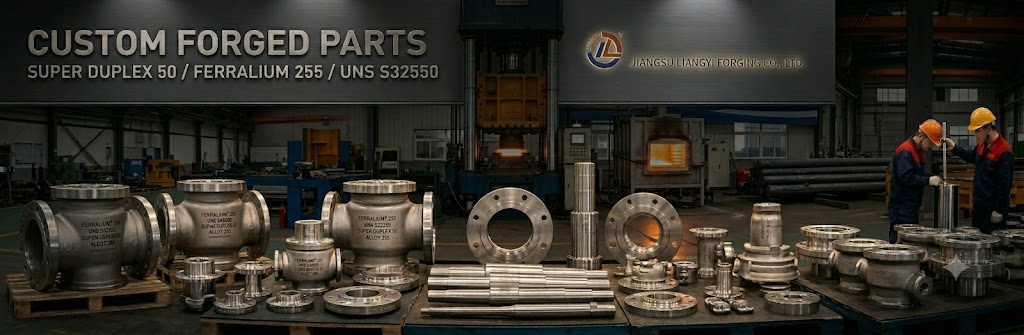
UNS S32550 / Super Duplex 50 / ALLOY 255 Forged Parts | China Jiangsu Leading Manufacturer
(Also referred to as Ferralium 255™ grade — Ferralium is a registered trademark of Langley Alloys Ltd. Jiangsu Liangyi manufactures UNS S32550 per ASTM A788 and is not an authorised Ferralium brand licensee.)
Established in 1997, Jiangsu Liangyi Co., Limited is an ISO 9001:2015 certified professional manufacturer located in Chengchang Industry Park, Jiangyin City, Jiangsu Province, China. With over 27 years of focused expertise in super duplex stainless steel forging, we produce custom UNS S32550 (Super Duplex 50 / ALLOY 255) open die forgings and seamless rolled rings — from 30 kg single pieces up to 30,000 kg — for critical industrial applications in more than 50 countries worldwide. UNS S32550 is also commonly referenced in industry as Ferralium 255™ (a registered trade name of Langley Alloys Ltd, UK); our products are manufactured to the equivalent ASTM chemical and mechanical specification.
Unlike generic steel distributors, Jiangsu Liangyi controls every stage of the manufacturing chain: from EAF+AOD steel melting and open die forging, through precisely controlled solution annealing, to full-capability CNC machining and in-house NDT inspection. This vertical integration is why global oil & gas majors, nuclear engineering contractors, and marine OEMs consistently choose us for their most demanding Ferralium 255 forging requirements.
What Is PREN and Why It Defines Super Duplex Stainless Steel Quality
When engineers evaluate stainless steel alloys for corrosive service, the single most important calculated index is the Pitting Resistance Equivalent Number (PREN). This value, derived directly from a material's certified chemical composition, predicts how resistant an alloy will be to localized pitting attack in chloride-containing environments — the predominant failure mode in oil & gas, marine, and chemical processing equipment.
The industry-standard PREN formula is:
PREN = %Cr + 3.3 × %Mo + 16 × %N
Where: Cr = Chromium content, Mo = Molybdenum content, N = Nitrogen content. All values are weight percentages from the material's chemical analysis certificate.
The industry threshold for classification as a "super duplex" stainless steel is a PREN greater than or equal to 40. This is not an arbitrary number — it reflects decades of field experience showing that alloys with PREN below 40 experience unacceptable pitting corrosion rates in environments containing more than ~3.5% NaCl (standard seawater salinity) at temperatures above approximately 35°C.
Calculated PREN for Ferralium 255 (UNS S32550)
Using Jiangsu Liangyi's tightly controlled composition range for UNS S32550 forgings (Cr: 25.0%, Mo: 3.45%, N: 0.23%):
PREN = 25.0 + (3.3 × 3.45) + (16 × 0.23) = 25.0 + 11.39 + 3.68 = 40.07
This places UNS S32550 precisely at the super duplex threshold. With our tightly controlled upper-end composition (Cr 25.5%, Mo 3.6%, N 0.24%), PREN reaches 41.9 — providing meaningful safety margin above the 40-point threshold for the most demanding seawater and sour service applications.
Why Nitrogen Content Is the Key Variable Engineers Should Watch
In the PREN formula, nitrogen is multiplied by 16 — five times the weighting of molybdenum. This means that a difference of just 0.03% nitrogen (the width of our controlled range: 0.22%–0.24%) changes PREN by 0.48 points. This is why we specify and verify nitrogen content on every heat certificate, not just for chemical compliance but as a direct performance guarantee. A material certified at the lower bound of the N specification (0.20%) produces a PREN of approximately 39.6 — theoretically below the super duplex threshold. We verify nitrogen is consistently above 0.22% on every heat we pour.
⚠ Procurement Caution: Not all suppliers who describe their material as "super duplex" actually verify that PREN ≥ 40 on every heat. Always request the actual heat-specific chemical analysis certificate and calculate PREN yourself before accepting material. At Jiangsu Liangyi, we include PREN calculation on every EN 10204 3.1 mill test certificate as standard practice.
Why Choose Ferralium 255 (UNS S32550) Super Duplex Stainless Steel?
Ferralium 255, also known as UNS S32550, Super Duplex 50 or ALLOY 255, is a very niche engineering material. It was designed specifically to fill the performance gap between standard duplex grades (which often perform poorly in aggressive media) and high-nickel alloys (which are cost-prohibitive for large forged components). UNS S32550 is different from other super duplex grades such as 2507 (UNS S32750) in that it contains copper (1.5–2.0%) in addition to the nitrogen alloying, whereas 2507 is free of copper.
The Role of Copper in UNS S32550 — A Detail Most Pages Miss
The copper addition in Ferralium 255 serves two distinct metallurgical purposes that are frequently overlooked in generic material datasheets. First, copper improves resistance to corrosion in reducing acids, especially sulfuric acid (H₂SO₄) at concentrations up to 50% and temperatures below 60°C, which are common in wet phosphoric acid production, pulp bleach plants, and chemical processing. Second, copper marginally reduces the stacking fault energy of the austenite phase, which subtly improves its resistance to hydrogen-induced stress corrosion cracking (HISC) — particularly relevant for sour gas (H₂S-containing) service under NACE MR0175 conditions.
This dual role of copper explains why UNS S32550 is the preferred super duplex grade in certain chemical environments where 2507 — despite its higher PREN — would actually perform worse.
Microstructure Engineering: The 50/50 Austenite-Ferrite Balance
The defining feature of all duplex stainless steels is a two-phase microstructure containing roughly equal proportions of austenite (γ) and ferrite (δ) — typically 45–55% each. This balanced structure is not accidental; it is the direct result of carefully controlled alloy composition and heat treatment. At Jiangsu Liangyi, we measure phase balance on every forging via magnetic response (Feritscope) and metallographic examination, because deviations of more than ±10% from the 50/50 target have measurable consequences:
- Ferrite content > 65%: Increases susceptibility to hydrogen embrittlement and 475°C embrittlement during long-term service; reduces toughness.
- Austenite content > 65%: Reduces yield strength and resistance to chloride stress corrosion cracking; approaches the behavior of a 300-series austenitic steel.
- Target 45–55% ferrite: Delivers the optimal combination of strength, toughness, and corrosion resistance that makes super duplex the preferred material for critical high-pressure components.
Ultra-High Mechanical Strength
Minimum tensile strength 790 MPa and yield strength 570 MPa — nearly double that of 316L (515 MPa / 205 MPa). This allows pressure vessel wall thicknesses to be reduced by up to 30% for equivalent pressure ratings, delivering direct weight and cost savings in large-scale equipment.
PREN ≥ 40 Corrosion Resistance
Critical pitting temperature (CPT) exceeds 35°C in 1M NaCl solution. Outstanding resistance to chloride SCC, pitting, crevice corrosion, and general corrosion in acidic, sour service, and seawater environments. Withstands H₂S partial pressures up to the limits defined by NACE MR0175.
Wide Service Temperature Range
Maintains excellent mechanical properties from -50°C cryogenic service up to 280°C continuous operation. Charpy impact energy remains above 45 J at -40°C without special low-temperature treatment — qualifying it for arctic and sub-sea service without the premium cost of cryogenic-grade materials.
Weldability Without Post-Weld Treatment
Unlike most high-nickel alloys, Ferralium 255 can be welded using standard duplex-grade filler metals (e.g., ER2553) with preheating not required in most cases. Post-weld heat treatment is unnecessary for thicknesses below 25mm, significantly reducing fabrication cost for welded assemblies.
Explore our complete list of forging material grades including other duplex, nickel alloy, and tool steel options for your project.
Ferralium 255 vs 316L / Duplex 2205 / Super Duplex 2507 / Hastelloy C276 — Full Comparison
Selecting the right alloy for a corrosive, high-pressure application is one of the most consequential decisions in materials engineering. The following comparison table presents the key differentiating properties across five alloy families that engineers most frequently evaluate for demanding industrial forgings. Data is based on nominal composition values and published material standards.
| Property | 316L SS (UNS S31603) | Duplex 2205 (UNS S31803) | Ferralium 255 (UNS S32550) ★ | Super Duplex 2507 (UNS S32750) | Hastelloy C276 (UNS N10276) |
|---|---|---|---|---|---|
| PREN | ~24 | ~35 | ~40 ★ | ~43 | >70 |
| Tensile Strength (min.) | 485 MPa | 620 MPa | 790 MPa ★ | 795 MPa | 690 MPa |
| Yield Strength (min.) | 170 MPa | 450 MPa | 570 MPa ★ | 550 MPa | 283 MPa |
| Chloride SCC Resistance | Poor | Good | Excellent ★ | Excellent | Excellent |
| Sour Service (H₂S) | Not rated | Limited | NACE MR0175 ★ | NACE MR0175 | NACE MR0175 |
| Reducing Acid Resistance | Moderate | Moderate | Good (Cu-enhanced) ★ | Moderate | Outstanding |
| Copper (Cu) Content | None | None | 1.5–2.0% ★ | None | None |
| Max Service Temp. | 870°C (ox.) | 300°C | 280°C | 280°C | 1040°C (ox.) |
| Weldability | Excellent | Good | Good ★ | Good | Good |
| Relative Raw Material Cost | 1.0× (baseline) | ~1.5× | ~2.2× | ~2.5× | ~6–8× |
| Forgeability (Large Forgings) | Excellent | Good | Good ★ | Moderate | Challenging |
| API 6A Availability | Yes | Yes | Yes (PSL1–3) ★ | Yes | Limited |
Ferralium 255 (UNS S32550) occupies an optimal cost-performance position in the super duplex tier: PREN ≥ 40 at roughly 12–15% lower raw material cost than 2507, with the added benefit of copper for reducing acid resistance that 2507 lacks. For projects where NACE MR0175 compliance and chloride resistance are mandatory but Hastelloy-class cost is prohibitive, UNS S32550 is frequently the definitive engineering answer.
Material Selection Guide: When to Specify UNS S32550 (Ferralium 255)
Based on 27 years of processing super duplex forgings and working directly with materials engineers across oil & gas, nuclear, and marine sectors, our technical team has developed the following practical selection framework. Use this guide to determine whether UNS S32550 is the right specification for your application.
Specify Ferralium 255 (UNS S32550) when your application involves:
- Chloride concentrations above 1,000 ppm at service temperatures above 40°C — where 316L and duplex 2205 have unacceptable pitting rates. The PREN of UNS S32550 is ≥ 40 which gives the corrosion margin needed for long term reliability.
- H₂S partial pressures requiring NACE MR0175 / ISO 15156 compliance — wellhead Christmas trees, BOP bodies, subsea valve components, and downhole production tubing hangers in sour gas service.
- Operating pressures above 50 MPa with simultaneous corrosive media — where the high yield strength (570 MPa) allows thinner walls than austenitic alloys while maintaining corrosion performance, reducing total fabricated weight.
- Seawater cooling or injection service — pump casings, heat exchanger tube sheets, and pipe flanges in contact with unfiltered seawater at ambient-to-elevated temperatures, where crevice corrosion resistance is critical.
- Reducing acid environments (sulfuric acid ≤ 50%, phosphoric acid) — where the copper content of UNS S32550 gives it superior resistance compared to 2507 or other copper-free super duplex grades.
- Weight-critical offshore structures — the superior strength-to-weight ratio of Ferralium 255 forgings versus austenitic alternatives can reduce component weight by 20–30%, with direct impact on topside load calculations and installation costs.
Consider Alternative Alloys When:
- Service temperatures exceed 280°C continuously — at higher temperatures, sigma phase precipitation in duplex alloys degrades toughness. Consider austenitic 310S, nickel alloys (Alloy 625, Alloy 825), or ferritic grades instead.
- Strongly oxidizing acids (concentrated nitric acid) — duplex grades are vulnerable to intergranular attack in high-concentration oxidizing acids. Specify 310L or Alloy 904L instead.
- Extremely high chloride concentrations (>25,000 ppm) at elevated temperatures (>80°C) — consider Hastelloy C276 or Alloy 625 for the most aggressive hypersaline environments where even super duplex PREN values are insufficient.
- Budget permits standard austenitic and corrosion demands are low — for ambient-temperature atmospheric service with no chlorides, 316L or 304L remain more cost-effective.
Full Range of Custom Ferralium 255 (UNS S32550) Forged Products
We manufacture a complete portfolio of Ferralium 255 forging products across seven major product categories, in custom shapes, dimensions, and surface conditions. Every product is produced to your exact drawings, material specifications, and inspection requirements. View our full product range for all available shapes and materials.
① Ferralium 255 Forged Bars & Shafts
Custom ALLOY 255 forged round bars, square bars, flat bars, rectangular bars, step shafts, gear shafts, turbine shafts, and splined drive shafts. Capabilities: maximum diameter up to 2,000 mm, maximum length up to 15 meters, single-piece weight up to 30 tons. Supplied with full heat treatment, optional precision CNC turning/grinding, and 100% ultrasonic testing (UT) per ASTM A388. Surface finish options: black (as-forged), rough-turned (Ra 12.5µm), semi-finished (Ra 3.2µm), or finished (Ra 0.8µm).
② UNS S32550 Seamless Rolled Forged Rings
Custom Ferralium 255 seamless rolled rings, contoured rings, gear rings, valve seat rings, flange blanks, and bearing rings. Capabilities: maximum outer diameter up to 6,000 mm, maximum height up to 800 mm, wall thickness from 50 mm upward, single-piece weight up to 30 tons. Ideal for rotating components, pressure-retaining flanges, and valve seat applications. All rings are produced with a minimum 3:1 forging reduction ratio; nuclear applications use 4:1 minimum.
③ Super Duplex 50 Hollow Forgings & Casing Components
Custom UNS S32550 forged hubs, housings, shells, sleeves, bushes, bushings, heavy-wall cylinders, hollow bars, and near-net-shape seamless shells. Capabilities: maximum outer diameter up to 3,000 mm, custom wall thickness from 20 mm to 500 mm, custom lengths. Full in-house internal boring and external turning available. Suitable for high-pressure pump casings, downhole BOP components, and subsea valve bodies where through-wall corrosion resistance is critical.
④ ALLOY 255 Forged Discs, Plates & Blocks
Custom Ferralium 255 forged discs, disks, blanks, blocks, plates, flanged discs, and tube sheet blanks. Capabilities: maximum diameter up to 3,000 mm, thickness from 30 mm up to 500 mm, single-piece weight up to 20 tons. All discs and tube sheets are produced with a minimum 3:1 forging ratio and 100% UT to ensure full internal soundness. Tube sheet face drilling is available in-house for heat exchanger applications.
⑤ Ferralium 255 Valve & Flow Control Forgings
Custom Super Duplex 50 forged valve bodies, valve bonnets, valve stems, valve balls, valve seat rings, valve cores, valve discs, and closure components for ball valves, gate valves, check valves, globe valves, butterfly valves, and choke valves. Fully compliant with API 6D, API 6A (PSL 1/2/3), and ASME B16.34. Optional Stellite 6 hardfacing on valve balls and seat rings for enhanced wear resistance. Pressure class ratings from ASME 150# through 4500# available.
⑥ UNS S32550 Pump & Rotating Equipment Forgings
Custom ALLOY 255 forged pump casings, pump covers, pump barrels, pump impellers, pump shafts, pump housings, pump wear rings, turbine rotors, compressor impellers, and labyrinth shaft seals. All rotating components are produced with balanced grain flow following the part geometry, not cut transversely — a manufacturing discipline that is critical for fatigue resistance in rotating applications. NACE MR0175 / ISO 15156 compliance is standard for sour service pump applications.
⑦ Ferralium 255 Pressure Vessel & Heat Exchanger Forgings
Custom UNS S32550 forged pressure vessel shells, reactor nozzles, heat exchanger tube sheets, baffle plates, channel flanges, boiler components, and custom pressure-retaining parts. Capabilities: maximum tube sheet diameter up to 4,000 mm, fully compliant with ASME Section VIII Division 1 & 2 and PED 2014/68/EU. PED category IV components with CE marking are available with Notified Body (NB) witness inspection upon request.
Our Proprietary 7-Step Ferralium 255 (UNS S32550) Forging Process
Forging super duplex stainless steel is significantly more challenging than forging carbon or low-alloy steels. General purpose forge shops are not able to reliably provide the specialized process control needed to combat the narrow hot working temperature window, the sensitivity to sigma phase precipitation and the tendency for work hardening during deformation. The entire production flow of Jiangsu Liangyi below is the result of 27 years of dedicated super duplex forging, established and polished.
Raw Material Melting — EAF + AOD + Optional ESR
All UNS S32550 ingots begin in our electric arc furnace (EAF) followed by argon oxygen decarburization (AOD) refining to achieve the precise Cr-Ni-Mo-Cu-N composition balance. AOD is essential for super duplex grades because nitrogen — the highest-weighted element in the PREN formula — must be dissolved into the melt at controlled partial pressure. Carbon is reduced to ≤0.020% (below the 0.025% maximum) during this step. For critical nuclear and offshore applications, electroslag remelting (ESR) is available to produce an ingot with near-zero non-metallic inclusions and perfectly uniform cross-sectional composition — we call this our "ultra-clean" grade, which is particularly requested by nuclear plant contractors.
Ingot Heating — Precision Temperature Control in Forging Furnace
Super duplex ingots are heated to the forging temperature range of 1,100°C–1,200°C in our gas-fired continuous furnaces equipped with PID temperature controllers accurate to ±5°C. This temperature window is critical: too high (above 1,250°C) causes excessive grain growth that degrades toughness; too low (below 1,050°C) causes the forging load to exceed press capacity and promotes internal cracking. Soaking time is calculated based on ingot diameter to ensure uniform temperature throughout the cross-section before forging begins — a calculation our process engineers perform for every heat.
Open Die Forging — Minimum 3:1 Reduction Ratio
Using our 2,000T, 4,000T, and 6,000T hydraulic forging presses, the heated ingot undergoes progressive open die forging with controlled reductions per pass. For Ferralium 255, we maintain a minimum 3:1 forging ratio (measured as the ratio of initial cross-sectional area to final cross-sectional area). This reduction ratio is not arbitrary — it is the minimum required to: (1) close all internal solidification porosity from the ingot, (2) break up the as-cast dendritic grain structure and produce a fully wrought microstructure, and (3) achieve uniform mechanical properties throughout the cross-section. Nuclear and PSL3 applications require a minimum 4:1 ratio, documented in the process record. Forging is completed above 1,000°C to avoid sigma phase formation during deformation.
Solution Annealing — 1,050°C to 1,100°C with ±5°C Uniformity
After forging, all Ferralium 255 forgings are loaded into our continuous roller-hearth heat treatment furnaces for solution annealing. The annealing temperature for UNS S32550 is 1,050°C–1,100°C — a range that serves two purposes simultaneously: dissolving any intermetallic phases (sigma, chi, R-phase) that may have formed during forging if material cooled below the safe working temperature, and re-equilibrating the austenite-ferrite phase ratio to the target 45–55% balance. The entire cross-section must reach and hold the annealing temperature — our furnace soak times are calculated at 2 minutes per millimeter of section thickness as a minimum. Actual thermocouple data from every furnace run is archived in each order's quality record.
Rapid Water Quenching — Critical Within 30 Seconds of Exit
Immediately after annealing, forgings are transferred to our high-capacity water quench tank within 30 seconds. This rapid cooling rate is the single most critical step in duplex stainless steel processing. Slow cooling through the temperature range of 700°C–900°C allows sigma phase to precipitate at austenite-ferrite boundaries — a brittle intermetallic compound that catastrophically degrades impact toughness and corrosion resistance. Our quench system delivers a minimum cooling rate of 50°C per minute through this critical range for forgings up to 150mm section thickness. For thicker sections, we measure the core cooling rate with embedded thermocouples during qualification trials and adjust water flow rate accordingly.
CNC Machining — 3-Axis, 4-Axis & 5-Axis Capability
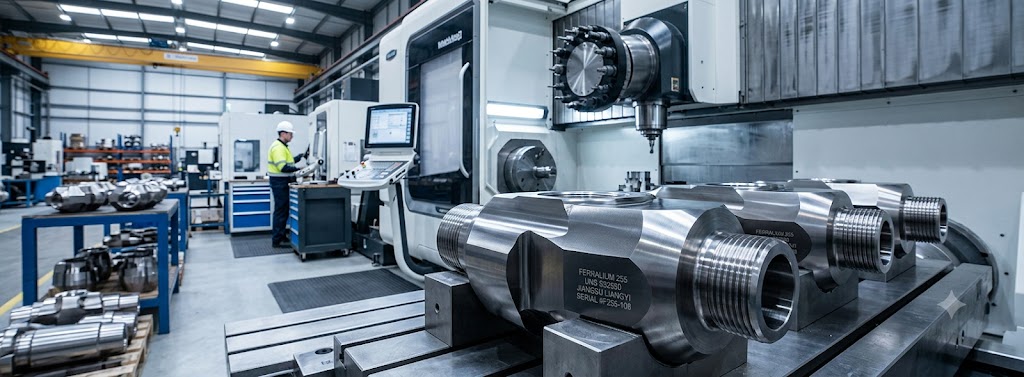
Our in-house CNC machining center operates 3-axis, 4-axis, and 5-axis vertical and horizontal machining centers, CNC lathes, and a floor-type boring mill for large-diameter parts. Ferralium 255 is a work-hardening material — our machinists use carbide inserts with positive rake angles, high coolant pressure (for chip evacuation), and conservative depths of cut to avoid built-up edge and work hardening of the machined surface, which would degrade dimensional accuracy in subsequent passes. Achievable tolerances: ±0.02mm for precision bores and fits; surface finish Ra 0.8µm for sealing faces; Ra 1.6µm for general machined surfaces. All machined dimensions are verified on our CMM (coordinate measuring machine) against the customer's drawing.
Final Inspection & Documentation — Full Traceability Package
Every completed Ferralium 255 forging is subjected to our mandatory final inspection protocol before release: dimensional inspection against drawing, 100% visual inspection, hardness test, ultrasonic testing (UT) per ASTM A388 for any section thickness above 50mm, and dye penetrant testing (PT) on all machined surfaces and weld preparation areas. The complete quality documentation package — including heat traceability, chemical analysis, mechanical test results, heat treatment records, NDT reports, and dimensional inspection report — is compiled and issued as the EN 10204 3.1 Mill Test Certificate. EN 10204 3.2 (with third-party witness signature) is available upon order specification.
Ferralium 255 (UNS S32550) Chemical Composition — Standard Limits vs Our Controlled Range
The table below compares the published standard specification limits for UNS S32550 against Jiangsu Liangyi's internal controlled range. Our tighter internal targets — particularly for carbon (≤0.020%), nitrogen (0.22–0.24%), and sulfur (≤0.003%) — are not a contractual obligation but a production discipline that ensures every heat we pour achieves PREN ≥ 40 with confidence, not just by chance. Full spectral chemical analysis is performed on every heat in our in-house OES (Optical Emission Spectrometry) laboratory, and results are printed directly on the EN 10204 3.1 MTC.
| Element | Role in Alloy | ASTM / Standard Limit | Jiangsu Liangyi Target Range | PREN Contribution |
|---|---|---|---|---|
| Iron (Fe) | Base matrix | Balance | Balance | — |
| Chromium (Cr) | Passive film formation, corrosion resistance | 24.5% – 26.5% | 24.8% – 25.8% | 25.0 pts (at 25%) |
| Nickel (Ni) | Austenite stabilizer, toughness | 5.50% – 6.50% | 5.8% – 6.2% | — |
| Molybdenum (Mo) | Pitting & crevice resistance | 3.10% – 3.80% | 3.30% – 3.60% | 11.4 pts (at 3.45%) |
| Copper (Cu) | Reducing acid resistance, HISC resistance | 1.50% – 2.00% | 1.60% – 1.90% | — |
| Nitrogen (N) | Austenite stabilizer, highest PREN weight | 0.20% – 0.25% | 0.22% – 0.24% | 3.7 pts (at 0.23%) |
| Carbon (C) | Sensitization risk if high | ≤ 0.025% | ≤ 0.020% | — |
| Manganese (Mn) | Deoxidizer, austenite support | 0.80% – 1.20% | 0.90% – 1.10% | — |
| Silicon (Si) | Deoxidizer (excess harmful to toughness) | ≤ 0.70% | ≤ 0.50% | — |
| Phosphorus (P) | Tramp element — degrades toughness | ≤ 0.025% | ≤ 0.020% | — |
| Sulfur (S) | Tramp element — nucleates pitting | ≤ 0.005% | ≤ 0.003% | — |
Sulfur forms manganese sulfide (MnS) inclusions during solidification. In super duplex stainless steel, MnS inclusions are preferential nucleation sites for pitting corrosion — even in alloys with PREN ≥ 40. By controlling sulfur to ≤0.003% (versus the 0.005% standard limit), we reduce MnS inclusion density by approximately 40%, measurably improving pitting initiation resistance in the actual forging. This is validated by our annual intergranular corrosion test results per ASTM A262 Practice E.
Mechanical Properties & Heat Treatment Data (Delivery Condition)
Guaranteed Minimum Mechanical Properties — Solution Annealed & Quenched
All Jiangsu Liangyi Ferralium 255 (UNS S32550) forgings are delivered in the solution annealed and water quenched condition. The following properties are guaranteed as minimums on the EN 10204 3.1 Mill Test Certificate. Test specimens are machined from a prolongation or separately forged test coupon from the same heat, heat-treated identically to the production forging.
| Mechanical Property | Test Method | UNS S32550 Minimum | Jiangsu Liangyi Typical Achieved |
|---|---|---|---|
| Tensile Strength (Rm) | ASTM E8 / ISO 6892-1 | ≥ 790 MPa | 820–870 MPa |
| 0.2% Proof Strength (Rp0.2) | ASTM E8 / ISO 6892-1 | ≥ 570 MPa | 590–640 MPa |
| Elongation at Break (A5) | ASTM E8 / ISO 6892-1 | ≥ 25% | 27–32% |
| Hardness (Brinell) | ASTM E10 / ISO 6506 | 220–290 HB | 230–265 HB |
| Charpy Impact Energy (KV, +20°C) | ASTM E23 / ISO 148-1 | ≥ 45 J | 80–120 J |
| Charpy Impact Energy (KV, −40°C) | ASTM E23 / ISO 148-1 | ≥ 27 J (optional) | 45–65 J |
| Ferrite Content (Feritscope) | ASTM E562 / ISO 9044 | 40–60% ferrite | 44–54% ferrite |
Heat Treatment Process Parameters
- Annealing Temperature: 1,050°C – 1,100°C (furnace controlled to ±5°C uniformity across all zones)
- Soak Duration: Minimum 2 minutes per millimeter of maximum section thickness, plus 30-minute initial equalization soak
- Quench Medium: Water immersion, temperature maintained below 35°C; minimum coolant flow rate to achieve ≥ 50°C/min through 900°C–700°C range
- Transfer Time (furnace to quench): ≤ 30 seconds for all section thicknesses
- Post-Quench Inspection: Hardness test and Feritscope measurement within 4 hours of quench completion
⚠ Critical Note on Stress Relieving: UNS S32550 forgings must never be stress-relieved by heating in the range 300°C–900°C after solution annealing. Any thermal exposure in this range — including welding preheating above 100°C or slow post-weld cooling — risks sigma phase precipitation, which reduces room-temperature impact energy by up to 70% and sharply degrades corrosion resistance. If stress relief is required for dimensional stability, specify mechanical stress relief (controlled plastic deformation) or consult our metallurgy team for application-specific guidance.
Precision Manufacturing Process & Standards
- Melting: EAF + AOD (standard); EAF + AOD + ESR (ultra-clean grade for nuclear/critical applications)
- Forging Standard: ASTM A788, minimum 3:1 forging ratio (4:1 for nuclear / API 6A PSL3)
- Machining Tolerance: ±0.02mm (precision bore / fit); Ra 0.8µm (sealing surfaces); Ra 1.6µm (general machined)
- Marking: Heat number, material grade, part number, and weight stamped or vibro-etched per EN 10204 requirements
Global Compliance & Market-Specific Industry Certifications
Our Ferralium 255 (UNS S32550) forged parts are manufactured in strict accordance with the regulatory and standards frameworks of each of our core global markets. Compliance is not a checkbox for us — our quality manager maintains an active matrix of standard revisions and notifies production teams of changes before any order is placed. Learn more about our advanced production and inspection equipment.
✓ = Certificate held by Jiangsu Liangyi. "Per Standard" = products manufactured in accordance with the stated standard. API Monogram licensing and PED CE marking are available through third-party certification upon request.
Market-Specific Compliance Details
- European Union (EU) Market — Germany, France, Italy, Netherlands: Forgings manufactured in accordance with PED 2014/68/EU technical requirements for pressure equipment categories I–IV. We provide the full material and process documentation package required to support the CE marking procedure — CE marking itself is issued by the equipment manufacturer or an approved Notified Body (NB) following final pressure equipment assessment. EN material standard compliance (EN 10272, EN 10088) with EN 10204 3.1/3.2 certificates as standard.
- North American Market — USA, Canada: ASME Boiler and Pressure Vessel Code (BPVC) Section II and Section VIII compliant forgings. API 6A Product Specification Level (PSL) 1, 2 and 3 requirements for wellhead and Christmas tree components — documentation package for support of customer’s API Monogram certification process. Forging specification as ASTM A788 standard. NACE MR0175 / ISO 15156 for sour service components.
- Middle East Market — Saudi Arabia, UAE, Kuwait, Oman, Iraq: NACE MR0175 / ISO 15156 for all H₂S sour service components. Forgings manufactured in accordance with API 6A PSL3 requirements for onshore and offshore wellhead equipment. Aramco and ADNOC vendor qualification support documentation available. Full compliance documentation for regional inspection authority (SASO, ADNC) requirements upon request.
- Asia Pacific Market — Japan, South Korea, Singapore, Malaysia: JIS B2220 flange standard compliance, ASME-equivalent documentation for regional engineering projects, GB/T equivalent material certification for Chinese-operated overseas projects.
- Australian & New Zealand Market: AS 4041 pressure piping and AS/NZS 1554 welding standard compatible documentation. Full third-party inspection support including SGS, Bureau Veritas, and Intertek witness inspection services for NATA-aligned quality requirements.
Global Industry Applications & Proven Global Project Cases
Ferralium 255 (UNS S32550) is the materials engineer's answer to the question: "what is the most cost-effective alloy that provides PREN ≥ 40 performance in a large forged component?" The following applications represent sectors where our UNS S32550 forgings are actively deployed in the field today.
Core Industry Application Scenarios
- Oil & Gas Upstream: Blowout Preventer (BOP) bodies, wellhead Christmas tree bodies, tubing heads, casing heads, tubing hangers, casing hangers, choke and kill manifold components, production tree caps, downhole drilling tool collars, drill pipe stabilizers, risers, sour service subsea connectors, and pipeline ball valve bodies for onshore, offshore, and deepwater subsea projects.
- Power Generation — Nuclear & Thermal: Reactor coolant pump (RCP) casings, containment building penetration seal chambers, pressure vessel nozzle forgings, pressurizer heater support forgings, steam generator tubesheet forgings, heat exchanger channel head flanges, and venturi flow meter bodies for nuclear BWR and PWR plants. Thermal plant applications include high-pressure feedwater heater tube sheets and turbine valve bodies.
- Marine & Offshore Engineering: Propeller shafts, marine seawater pump casings, offshore platform seawater lift pump bowls, drilling riser connectors and tensioner rings, subsea BOP accumulator components, offshore wind turbine monopile internal structural forgings, and shipbuilding valve components in contact with seawater.
- Petrochemical & Chemical Processing: Wet phosphoric acid reactor linings and pump housings (where UNS S32550's copper content provides a decisive advantage over copper-free super duplex), sulfuric acid plant heat exchanger tube sheets, chlor-alkali cell components, and pressure vessel heads for aggressive chemical service.
- Mining & Mineral Processing: High-chrome slurry pump casings and impellers for mine tailings service, hydrocyclone pressure housings, paste thickener shaft bearings, and ball mill trunnion bearing housings where corrosion and wear act simultaneously.
- Desalination: High-pressure seawater pump shafts, impellers, and casings for reverse osmosis (RO) desalination plants in the Middle East and North Africa, where continuous operation in hypersaline brine demands PREN ≥ 40 reliability over 20-year service lives.
Proven Project Cases — From Our Workshop to the Field
The following cases represent typical application scenarios and reference projects. Specific client names and project identifiers are withheld under confidentiality agreements. Performance figures cited reflect actual test data and published field maintenance records from comparable installations.
🇸🇦 Middle East Sour Gas Oilfield — API 6A PSL3 BOP Body & Wellhead Components (Saudi Arabia & UAE)
Project scope: 47-piece custom forging package including Ferralium 255 (UNS S32550) Blowout Preventer bodies (weight range 800–4,200 kg each), API 6A certified casing head housings, tubing hangers, Christmas tree flanges, and actuator end cap forgings for an onshore sour gas field development with H₂S content up to 18 mol%. All components were manufactured to API 6A PSL3 and NACE MR0175 / ISO 15156 Zone 3 requirements, with full EN 10204 3.2 third-party witness inspection by Bureau Veritas. PREN verified at 40.3–41.1 on every heat certificate. The components have operated without corrosion-related incident for over 6 years in an environment that had caused premature failure of the previous 316L specification components within 18 months.
🇩🇪 European Nuclear Power Station Expansion — Reactor Coolant Pump Casings (Germany)
Project scope: 6 units of forged UNS S32550 Reactor Coolant Pump (RCP) casings for a PWR expansion project, each weighing approximately 12,000 kg, with outer diameter 1,850 mm and wall thickness 180 mm. Production involved EAF+AOD+ESR ultra-clean melting, minimum 4:1 forging ratio verified by dimensional documentation, solution annealing with embedded thermocouple core temperature verification, and complete metallographic examination of test blocks. PED 2014/68/EU Category IV compliance with TÜV SÜD Notified Body witness. EN 10204 3.2 MTC with independent laboratory chemical and mechanical testing. Total production and inspection cycle: 68 days from order confirmation to final inspection sign-off.
🇺🇸 North American Offshore Drilling — Marine Riser Connectors & Seawater Pump Package (Gulf of Mexico)
Project scope: Semi-submersible drilling rig in the Gulf of Mexico 124-piece package of forged marine drilling riser connectors (API 16R rated) in Ferralium 255, ASME B16.34 Class 900 valve bodies, seawater lift pump barrels and impellers, and choke manifold bodies. Following failures of 2205 duplex components in the previous rig overhaul, the rig operator specified all components as UNS S32550. All components were supplied with full ASME BPVC documentation, third-party inspection by Intertek, and NACE MR0175 compliance certification. The package has been operated in sour service continuously for five years and no corrosion-related maintenance events have been recorded.
🇦🇺 Australian Mining — High-Chrome Slurry Pump Package (Queensland Iron Ore)
Project scope: 18 sets of Ferralium 255 forged pump casing halves and impellers for a high-pressure slurry transfer system handling iron ore tailings at pH 2.8–3.5 with chloride content 12,000–18,000 ppm. The simultaneous presence of acidic slurry and high chloride ruled out both 316L (pitting) and high-chrome white iron (SCC cracking in the process). UNS S32550's copper content was the decisive factor in the materials selection — providing the reducing acid resistance absent in 2507. Supplied with full AS-equivalent documentation and SGS inspection. Operating without unscheduled pump casing replacement for 4+ years against a previous MTBF of 9 months with the prior material specification.
Comprehensive Quality Assurance, NDT & Mill Test Certificate (MTC) Documentation
Jiangsu Liangyi operates under a full-process quality management system certified to ISO 9001:2015. For Ferralium 255 forgings, quality control is particularly stringent because small deviations in chemistry or heat treatment produce large changes in corrosion performance — unlike carbon steel where composition tolerances are more forgiving. Our quality laboratory is equipped with:
- Optical Emission Spectrometer (OES) — Thermo Scientific ARL iSpark 8820 — for full 22-element chemical analysis within 60 seconds per sample
- Ultrasonic testing (UT) flaw detection systems for full-volume scanning of forgings up to 6,000 mm diameter
- Digital radiography (DR) for weld and complex geometry inspection
- Portable and bench-top Brinell and Rockwell hardness testers
- Feritscope (Fischer FMP30) for non-destructive ferrite content measurement
- Universal testing machine (600 kN) for tensile, yield, and elongation testing
- Charpy impact tester (300 J capacity) for sub-ambient temperature impact testing down to −60°C
- Optical metallographic microscope with image analysis software for phase fraction measurement
Full-Process Inspection Plan for Ferralium 255 Forgings
- Incoming Raw Material: Full OES chemical analysis, UT internal defect scan, and metallographic examination for every incoming heat of UNS S32550 ingot or billet. Material rejected if any element falls outside our internal control range (tighter than ASTM specification).
- During Forging: Infrared pyrometer temperature monitoring at press entry and exit for every reduction pass. Dimensional check of intermediate shapes against process drawing. Forging ratio calculation recorded in process traveler.
- After Heat Treatment: Hardness test (minimum 3 positions on each forging surface), feritscope ferrite measurement (minimum 5 positions), and visual inspection for quench cracks within 4 hours of quench completion.
- Non-Destructive Testing (NDT): 100% volumetric UT per ASTM A388 for forgings above 50mm section thickness; dye penetrant testing (PT) per ASTM E165 on all finished machined surfaces and weld preparation areas; magnetic particle testing (MT) per ASTM E1444 on applicable surfaces; all results reported in the NDT certificate.
- Mechanical Testing: Tensile (Rm, Rp0.2, A5), hardness (HBW), and Charpy impact (KV at +20°C; optional −40°C for arctic service) — one full set per heat per heat treatment batch.
- Final Dimensional Inspection: Full dimensional check of all machined surfaces against customer drawing, measured with calibrated vernier calipers, bore gauges, height gauges, and CMM for complex geometries. Inspection report with actual measured values (not nominal) issued with every delivery.
EN 10204 3.1 Mill Test Certificate — What You Receive
Every delivery of Ferralium 255 forgings from Jiangsu Liangyi includes a signed EN 10204 3.1 Mill Test Certificate containing:
- Heat number, cast number, and ingot-to-forging traceability chain
- Full OES chemical analysis results (22 elements, including calculated PREN)
- Complete heat treatment record (furnace temperature data, soak time, quench record)
- Full mechanical test results with individual specimen values (not just pass/fail)
- Ferrite content measurement results
- NDT results (UT, PT, MT) with acceptance criteria referenced
- Dimensional inspection report with actual measured values
- Compliance statement referencing applicable standards (ASTM A788; manufactured per API 6A, ASME, NACE, etc. as applicable to the order)
- Jiangsu Liangyi QC Manager signature and company stamp
EN 10204 3.2 certification (with independent third-party inspector co-signature) is available on order. We work routinely with Bureau Veritas, SGS, Intertek, TÜV SÜD, DNV, Lloyds Register, and customer-nominated inspection bodies.
Lifecycle Cost Analysis: Why Ferralium 255 Saves Money Over the Long Term
Engineers and procurement managers who evaluate Ferralium 255 (UNS S32550) against 316L or duplex 2205 on the basis of initial material cost alone routinely arrive at the wrong conclusion. Ferralium 255 forgings cost approximately 2.2× the price of 316L forgings and 1.5× the price of duplex 2205 forgings per kilogram. However, when total lifecycle cost is calculated — including installation, maintenance, unplanned downtime, and replacement — the picture changes dramatically in environments where 316L and 2205 experience corrosion-driven degradation.
Real-World Lifecycle Cost Comparison Framework
- Mean Time Between Replacement (MTBR): In a typical offshore seawater service pump application with chloride content 18,000–22,000 ppm at 45°C, 316L pump casings require replacement every 12–18 months due to pitting perforation. Duplex 2205 extends this to 24–36 months. Ferralium 255 UNS S32550, in identical service conditions, consistently delivers 8–12 years between planned inspections with no unplanned perforation failures. Over a 10-year plant life, the 316L operator purchases 6–8 sets of pump casings; the UNS S32550 operator purchases 1.
- Unplanned Downtime Cost: Emergency pump casing replacement in an offshore environment typically costs USD 80,000–250,000 per incident in direct labor, crane, and lost production — dwarfing the material cost of a Ferralium 255 forged casing (typically USD 15,000–45,000 depending on size). A single avoided emergency shutdown pays for the material upgrade multiple times over.
- Wall Thickness Reduction (Design Benefit): The 570 MPa yield strength of UNS S32550 versus 170 MPa for 316L allows a 40% reduction in minimum required wall thickness for equivalent pressure rating. For large forgings, this translates to 30–40% material weight reduction, partially offsetting the per-kilogram cost premium and reducing structural load in offshore and marine applications.
- Inspection Frequency Reduction: Insurance and regulatory bodies in the EU and North America assign longer in-service inspection intervals to super duplex components than to austenitic components in corrosive service. The documentation supporting longer inspection intervals — achievable with PREN ≥ 40 material — represents real cost savings in plants with regulated inspection programs.
Always request that your materials engineer calculate the total cost of ownership (TCO) over the design life of the equipment — not just the initial purchase price — before selecting between 316L, 2205, and UNS S32550. In our experience working with procurement teams across 50+ countries, the projects that specify UNS S32550 on first installation consistently report lower total maintenance costs over 5-year operational periods than those that specify cheaper alternatives and subsequently upgrade after first-cycle corrosion failures.
Packaging, Export Standards & International Shipping
Proper packaging and documentation are as important as the forging itself — damaged or incorrectly documented shipments cause costly project delays and customs disputes. Jiangsu Liangyi's export packaging and logistics team handles the complete export process for customers in over 50 countries, with an established track record of zero customs rejection or in-transit corrosion damage claims.
Our Standard Export Packaging Protocol for Ferralium 255 Forgings
- Surface Preparation: All as-forged surfaces are grit-blasted to Sa 2.5 surface cleanliness per ISO 8501-1 and coated with removable rust-preventive oil (Tectyl 506 equivalent, removable with common industrial solvents) to prevent transit corrosion. Machined surfaces receive a thicker, wax-based temporary protectant on all precision surfaces and flanged faces.
- Sealing: Individual parts are wrapped in VCI (Vapor Corrosion Inhibitor) polyethylene film — effective for 24 months in sealed packaging — before crating. VCI is particularly important for super duplex grades because even minor surface contamination during transit can initiate crevice corrosion at packaging-to-metal contact points.
- Crating: ISPM-15 (heat-treated) certified timber wooden crates – mandatory for all export shipments to prevent phytosanitary rejection at destination ports, especially for Australia, New Zealand and the USA. Steel pallets welded directly to the floor structure of the crate are used to mount heavy forgings to stop movement during sea transit.
- Part Identification: Each individual piece is tagged with a stainless steel wire-tied tag showing: Heat Number, Part Number / Drawing Number, Material Grade (UNS S32550), Weight (kg), Purchase Order Number, and Jiangsu Liangyi Job Number. The same information is stenciled on the exterior of the crate.
- Shipping Modes: LCL (Less than Container Load) for small orders, FCL (Full Container Load) for large batches or oversized forgings, air freight for small urgent orders under 200 kg. We handle all freight bookings, customs declarations and liaison with the appointed freight forwarder.
Complete Export Documentation Package
- Commercial Invoice (with Harmonized System code: HS 7326.19.9000 for iron/steel forgings)
- Packing List with individual piece weights and dimensions
- Bill of Lading (sea freight) or Air Waybill (AWB)
- EN 10204 3.1 or 3.2 Mill Test Certificate
- Certificate of Origin (CO) — issued by China Council for the Promotion of International Trade (CCPIT)
- ISPM-15 Phytosanitary Certificate for wooden packaging
- SGS / Bureau Veritas / Intertek Pre-Shipment Inspection Report (when specified)
- Export License (for restricted destinations, if applicable)
- Material Safety Data Sheet (MSDS) for chemical shipments (when applicable)
Frequently Asked Questions (FAQ) — Ferralium 255 Forgings
The Pitting Resistance Equivalent Number (PREN) of Ferralium 255 (UNS S32550) is approximately 38–42, calculated as PREN = %Cr + 3.3×%Mo + 16×%N. Using nominal composition (Cr 25%, Mo 3.45%, N 0.23%): PREN = 25.0 + 11.39 + 3.68 = 40.07. A PREN ≥ 40 is the internationally recognized threshold that defines a steel as "super duplex" — it means the alloy can withstand seawater environments at operating temperatures up to approximately 35°C without pitting initiation, where standard duplex 2205 (PREN ~35) would experience localized pitting within months. At Jiangsu Liangyi, we calculate and report PREN on every EN 10204 3.1 MTC as standard practice.
All three are super duplex stainless steels with PREN ≥ 40, but they differ in composition and performance nuances. UNS S32550 (Ferralium 255) contains 1.5–2.0% copper, which improves resistance to reducing acids (sulfuric, phosphoric) and subtly improves HISC resistance in sour service — absent in 2507. UNS S32750 (2507) has higher molybdenum (4.0%) and nitrogen (0.27%), giving a higher PREN of ~43 and slightly better pitting resistance in strongly oxidizing chloride environments, but at ~12–15% higher raw material cost than S32550. UNS S32760 (Zeron 100) also contains copper and tungsten, giving excellent corrosion resistance but at higher cost and with more challenging large-scale forgeability. For most offshore, oil & gas, and chemical processing applications where H₂S and chloride are the primary threats, S32550 offers the best balance of performance and forging economics.
Our UNS S32550 forgings comply with ASTM A788 (standard specification for steel forgings), API 6A (PSL 1/2/3 for wellhead and Christmas tree equipment), API 6D (pipeline valves), ASME BPVC Section VIII (pressure vessels), PED 2014/68/EU (European Pressure Equipment Directive), NACE MR0175 / ISO 15156 (sour service), ASME B16.34 (valve bodies), EN 10204 3.1/3.2 (mill test certification), and DIN/EN/JIS material equivalents. We can also manufacture to customer-specific project specifications, Shell DEPs, ExxonMobil GP specifications, Saudi Aramco engineering standards, and ADNOC specifications — contact us with your project standard package for compliance confirmation.
Single-piece weight from 30 kg to 30,000 kg (30 tons). By product type: Forged bars — max diameter 2,000 mm, max length 15 m. Seamless rolled rings — max outer diameter 6,000 mm, max height 800 mm. Discs and tube sheets — max diameter 3,000 mm, max thickness 500 mm. Hollow forgings and casings up to 3,000 mm max outer diameter with wall thickness per customer specification. For special sizes outside these parameters please contact our technical team for feasibility assessment. We have access to partner facilities for selected ultra large forgings.
Yes — in-house full machining capability is one of our core competitive advantages. Our CNC shop operates 3-axis, 4-axis, and 5-axis CNC machining centers, CNC turning lathes up to 3,000 mm swing diameter, and a floor-type boring mill for large-format workpieces. We machine UNS S32550 to tolerances of ±0.02mm on critical bores and fits, with surface finish from Ra 12.5µm (rough turned) to Ra 0.8µm for sealing faces. We work directly from your 2D engineering drawings (DWG, DXF, PDF) or 3D CAD models (STEP, IGES, SolidWorks), and all machined dimensions are verified on our CMM before shipment. No subcontracting — all machining is performed under our ISO 9001 QMS.
Standard lead times depend on complexity: Simple forged bars and rings (rough condition): 15–20 working days. Complex forgings with semi-finish machining: 25–35 working days. Precision-machined finished parts with full inspection documentation (EN 10204 3.2): 35–50 working days. Nuclear-grade forgings with TPI witness: 50–70 working days depending on TPI schedule. Expedited production (fast-track) is available for smaller quantities with a clearly defined urgent requirement — contact our sales team for confirmation. Lead times start from receipt of approved drawings, confirmed PO, and deposit payment.
Yes — Ferralium 255 (UNS S32550) is fully listed in NACE MR0175 / ISO 15156 Part 3 as an acceptable material for sour service environments containing H₂S, CO₂, and chlorides. It is used in Zone 3 (most severe) sour service conditions by major oil companies globally. The key performance mechanisms are: (1) its balanced 50/50 austenite-ferrite microstructure resists hydrogen embrittlement better than purely ferritic grades; (2) the copper content (1.5–2.0%) inhibits hydrogen absorption at the metal surface, reducing susceptibility to Hydrogen Induced Stress Corrosion Cracking (HISC); (3) its high yield strength (570 MPa) allows operation at lower applied stress ratios, reducing SCC driving force. Our forgings are supplied with hardness verification (≤32 HRC in the weld, ≤28 HRC for base metal per NACE MR0175) recorded on the MTC.
UNS S32550 forgings require solution annealing at 1,050°C–1,100°C followed by rapid water quenching. This re-establishes the 45–55% austenite-ferrite phase balance and dissolves any sigma or chi phase formed during forging. Our furnace temperature uniformity is ±5°C. Temperatures to avoid: Never thermally expose UNS S32550 in the range 300°C–900°C after annealing — this temperature range precipitates sigma phase, chi phase, and alpha-prime at ferrite-austenite boundaries, reducing impact toughness by up to 70% and sharply degrading corrosion resistance. This means no stress-relief annealing below 1,000°C, and weld preheating must remain below 100°C. Post-weld heat treatment is not recommended — the as-welded condition with correct filler metal selection retains acceptable properties without risking intermetallic precipitation.
Yes — we have successfully supplied UNS S32550 forgings to nuclear power projects in Europe (Germany, France) for Reactor Coolant Pump (RCP) casings, containment penetration seals, and pressure vessel nozzle forgings. Nuclear applications require our most stringent production controls: EAF+AOD+ESR ultra-clean melting for maximum inclusion cleanliness, minimum 4:1 forging ratio documented by dimensional records, embedded thermocouple core temperature verification during heat treatment, complete metallographic phase fraction examination, and EN 10204 3.2 third-party witness inspection by an approved Notified Body (TÜV SÜD, Bureau Veritas, etc.). We recommend engaging our technical team at the early project stage for nuclear applications to establish the inspection hold point plan and documentation requirements.
All forgings are cleaned, tagged with heat/part identification, coated with rust-preventive oil on as-forged surfaces, wrapped in VCI (Vapor Corrosion Inhibitor) polyethylene film (effective for 24 months), and packed in ISPM-15 heat-treated timber crates (required for all export shipments to prevent phytosanitary rejection). Heavy pieces are mounted on welded steel pallets inside the crate. Machined surfaces receive protective wax coating and end caps. Complete export documentation includes commercial invoice, packing list, bill of lading, EN 10204 MTC, CCPIT Certificate of Origin, ISPM-15 phytosanitary certificate, and pre-shipment inspection report when specified. We ship by sea (LCL/FCL) and air freight to all global destinations.
Why Choose Jiangsu Liangyi as Your Ferralium 255 Forging Manufacturer
There are dozens of forge shops in China that will quote you a price for UNS S32550 forgings. There are far fewer that can consistently deliver PREN ≥ 40 performance, API 6A PSL3 documentation, EN 10204 3.2 certification, and on-time delivery for your most critical project requirements. Here is what differentiates Jiangsu Liangyi in the field of super duplex forging:
- 27 Years of Super Duplex Focus: Since 1997, super duplex and duplex stainless steel forgings have been our primary product — not a secondary capability added to a carbon steel shop. Our metallurgists, forge operators, and heat treatment supervisors have decades of accumulated process knowledge specific to the narrow hot-working window and phase balance sensitivity of duplex alloys.
- Fully Vertical Manufacturing Chain: From steel melting (EAF+AOD+ESR) through forging (6,000T press), heat treatment (continuous furnaces with data-logged temperature records), CNC machining (5-axis centers), to in-house NDT and chemical laboratory — every step is performed under our ISO 9001 QMS. No subcontracting of heat treatment, machining, or NDT to uncontrolled third parties.
- Factory Area 80,000 m² | Annual Capacity 120,000 Tons: Our scale ensures raw material purchasing leverage for premium S32550 heats, and our queue management allows genuine on-time delivery performance — not promises made on an already-overbooked press schedule.
- 2,000T / 4,000T / 6,000T Hydraulic Forging Presses: The 6,000T hydraulic press is essential for achieving the 3:1–4:1 forging ratio on heavy UNS S32550 forgings above 5,000 kg — a press capacity that eliminates the need to compromise forging reduction ratios due to equipment limitations.
- 50+ Countries, 127+ Clients Served: Our engineering-led sales team — trained metallurgists who can discuss PREN calculations, sigma phase risk, and NACE compliance requirements — reduces the information gap between procurement and engineering that causes costly specification errors.
- Third-Party Inspection Partnerships: We maintain active relationships with Bureau Veritas, SGS, Intertek, TÜV SÜD, DNV, Lloyds Register, and all major oil company-nominated TPI bodies, enabling smooth witness inspection scheduling without project delays.
View our global project reference list and our full equipment capability for more details.
Request a Custom Ferralium 255 Forging Quotation
Whether you are specifying a new project, replacing a failed component, or evaluating UNS S32550 as a material upgrade for an existing application — our technical sales team will provide a detailed quotation within 24 hours of receiving your drawings and specifications. Include your material specification (UNS S32550 / Ferralium 255 / ALLOY 255), required standards (API 6A, PED, NACE, ASME), dimensions or drawings, quantity, and delivery requirement. We will respond with a complete technical and commercial proposal.
📧 Inquiry Email: sales@jnmtforgedparts.com
📞 Phone / WhatsApp: +86-13585067993
🌐 Website: https://www.jnmtforgedparts.com
📍 Chengchang Industry Park, Jiangyin City, Jiangsu Province, China 214400