The Real Threat in Phosphoric Acid Plants: Fluoride, Not Just the Acid
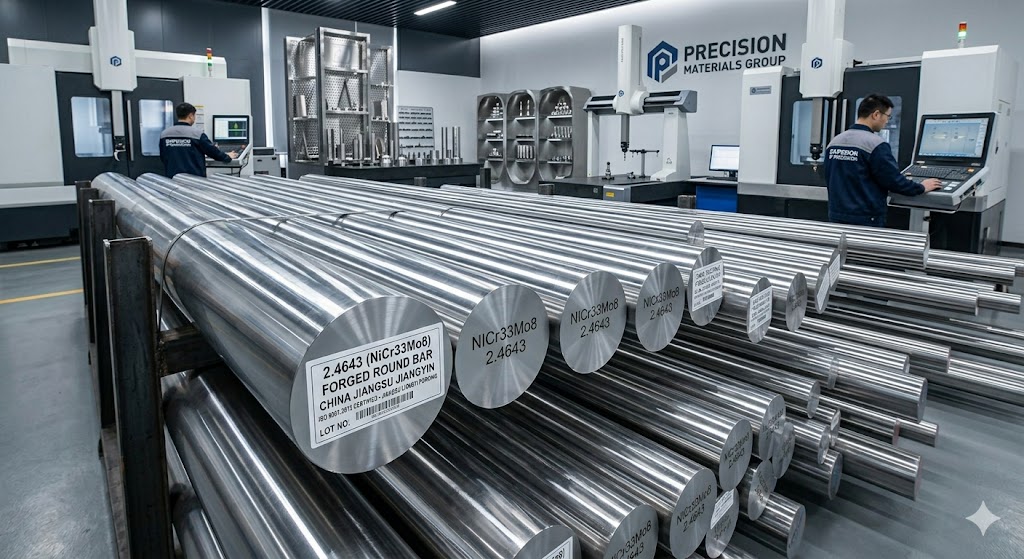
Engineers specifying materials for wet process phosphoric acid (WPA) equipment face a problem that standard corrosion charts rarely capture fully — it is not just concentrated H₃PO₄ attacking the metal surface. It is hydrofluoric acid (HF) impurities acting simultaneously as a passive film destroyer.
When fluoride ions are present in concentrations above 0.3 wt% at temperatures above 60°C — the normal operating reality in WPA reaction and filtration stages — they selectively attack the chromium oxide (Cr₂O₃) passive film that protects nickel alloys. Alloys that perform well in clean phosphoric acid can fail rapidly in real plant conditions where fluoride is present.
This is exactly why material selection for reactor nozzles, heat exchanger tube sheets, pump casings, and valve bodies in WPA plants is so consequential — and why procurement and metallurgical engineers at fertilizer plants across Southeast Asia, North Africa, and the Middle East have converged on 2.4643 NiCr33Mo8 open die forgings as the industry reference alloy. The reason comes down to a single number: 33.
This technical article explains the chromium-driven corrosion protection mechanisms of 2.4643 (NiCr33Mo8) forged parts in phosphoric acid environments. Coverage includes: PREN index calculation, passive film chemistry, HF fluoride attack mechanism, corrosion rate benchmarks vs competing alloys, heat treatment requirements, field evidence from 25+ years of WPA plant supply, and a full procurement specification checklist.
What Chromium Actually Does Inside a Nickel Alloy: The 4-Stage Mechanism
Chromium's role in corrosion protection is often summarized as "it forms a passive film" — accurate but incomplete. The full protection mechanism has four stages, each directly governed by chromium concentration in the bulk alloy:
When the alloy contacts an aqueous corrosive environment, chromium oxidizes selectively and preferentially to form a dense, adherent chromium oxide layer. Because chromium's oxidation potential is thermodynamically favorable over nickel's in most acid environments, it enriches at the surface — but higher bulk Cr content means faster, more complete film formation and a thicker initial oxide layer.
The Cr₂O₃ layer — just 2–5 nanometers thick — acts as a kinetic barrier between the metal and the corrosive solution. It is electrically resistive and chemically stable in oxidizing acids, blocking ion transport that drives metal dissolution. This is passivation at the atomic level: not immunity, but a maintained steady-state equilibrium between film formation and dissolution.
When fluoride ions break down the passive film locally, the alloy must regenerate Cr₂O₃ faster than fluoride can dissolve it. Higher bulk chromium concentration directly accelerates this repassivation rate. Alloys with 16–22% Cr such as C-276 and Alloy 625 cannot sustain this rate in high-fluoride WPA at 75–90°C. 2.4643 at 33% Cr can — and does, consistently, over multi-year operating cycles across documented plant installations.
After proper solution annealing, 2.4643 at 33% Cr maintains near-uniform passive film coverage across grain boundaries and heat-affected zones (HAZ). This prevents the intergranular corrosion attack pathway that causes premature HAZ failures in lower-Cr alloys after field weld repairs without full post-weld heat treatment (PWHT).
At 33% Cr, 2.4643 (NiCr33Mo8) does not merely resist phosphoric acid — it repassivates faster than hydrofluoric acid can dissolve its surface, making the protection genuinely self-renewing under continuous operating conditions.
The PREN Index: Quantifying Chromium's Protective Contribution
The Pitting Resistance Equivalent Number (PREN) is the most widely used quantitative predictor of an alloy's resistance to localized corrosion in chloride-bearing and mixed acid environments. Its formula weights each alloying element by its measured electrochemical contribution:
PREN = 33.3 + (3.3 × 8.3) + 0 = 33.3 + 27.4 = ≈ 60.7
Offshore seawater minimum threshold: PREN > 40 → 2.4643 exceeds this by +52%
The coefficient of 3.3 on molybdenum reflects Mo's role in stabilizing the passive film against chloride adsorption. The coefficient of 16 for nitrogen reflects its grain-boundary film strengthening — though 2.4643 relies primarily on Cr and Mo rather than nitrogen enrichment. In practical terms: super duplex stainless steels (PREN ~40–45) are considered premium seawater grades. Standard 316L SS achieves only PREN ~24–26 — explaining why it fails within months in WPA service.
PREN Comparison: 2.4643 vs Major Industrial Alloys
C-276 (2.4819) achieves PREN ~70 from 16% Mo. However, PREN predicts chloride pitting resistance — not behavior in oxidizing acids or hot alkali. In WPA with fluoride, C-276's 16% Cr means its passive film repassivation under HF attack is insufficient — the Mo-built PREN score is irrelevant to fluoride attack chemistry. C-276 is also prone to selective molybdenum dealloying in NaOH above 80°C, a failure mode PREN does not capture. For WPA service, 2.4643's Cr-dominant PREN of ~61 is far more meaningful than C-276's Mo-driven PREN of ~70.
The Fluoride Attack Mechanism: Why Low-Chromium Alloys Fail in WPA
Wet process phosphoric acid contains fluoride impurities of 0.3 to 1.5 wt% as HF and H₂SiF₆ (hexafluorosilicic acid). At 70–90°C, fluoride ions (F⁻) form highly stable complexes with chromium ions — specifically CrF₃ and CrF₄. When F⁻ reaches the alloy surface, it reacts with the Cr₂O₃ passive film to produce soluble chromium fluoride complexes that dissolve into the acid. The passive film is consumed from below.
In alloys with 16–22% Cr, the sub-surface chromium reservoir is insufficient to maintain steady-state repassivation — the film thins, becomes discontinuous, and localized corrosion initiates. In 2.4643 at 33% Cr, the reservoir is sufficient to maintain film continuity indefinitely under normal WPA operating conditions. The numbers confirm this directly:
| Alloy | Cr % | Mo % | PREN | Corrosion Rate (WPA + HF, 85°C) | Life vs 316L |
|---|---|---|---|---|---|
| 2.4643 NiCr33Mo8 | 33.3 | 8.3 | ~61 | < 0.05 mm/yr | > 40× |
| G-30 (N06030) | 30 | 5.5 | ~48 | 0.08 – 0.12 mm/yr | ~18 – 25× |
| C-276 (2.4819) | 16 | 16 | ~70 | 0.15 – 0.25 mm/yr | ~10 – 15× |
| Alloy 625 (2.4856) | 22 | 9 | ~52 | 0.20 – 0.40 mm/yr | ~6 – 10× |
| 904L Stainless Steel | 21 | 4.5 | ~35 | 0.60 – 1.20 mm/yr | ~2 – 3× |
| 316L Stainless Steel | 17 | 2 | ~25 | > 2.0 mm/yr | 1× (baseline) |
Data: Jiangsu Liangyi in-house material qualification records and published industry performance studies. Indicative rates for 50–55% H₃PO₄ at 85°C with 0.3–1.0 wt% HF. Actual rates vary by concentration, temperature, and flow conditions.
2.4643 vs G-30 Alloy: Why 3% More Chromium Doubles Service Life
The most common question from procurement engineers considering an upgrade from G-30 (N06030): "We already use 30% Cr — is three more percent really worth the cost premium?"
The answer is unequivocally yes — and the reason is non-linear. Chromium protection in HF-bearing phosphoric acid has a threshold behavior: below approximately 31% Cr, the repassivation rate at temperatures above 75°C cannot maintain stable passivity under sustained fluoride attack. Above 33% Cr, the rate crosses into stable, self-sustaining protection. G-30's 30% Cr sits just below this threshold under real-plant conditions, especially when HF concentrations exceed 0.5 wt% or temperatures fluctuate upward during cleaning cycles.
| Lifecycle Factor | G-30 Alloy (30% Cr) | 2.4643 NiCr33Mo8 (33% Cr) |
|---|---|---|
| Typical wall loss per year (tube sheet, 85°C WPA) | 0.08 – 0.12 mm/yr | < 0.05 mm/yr |
| Planned maintenance interval | ~24 months | > 60 months |
| Expected service life (10 mm wall component) | ~7 – 8 years | > 15 years |
| Unplanned shutdowns per 10-year plant cycle | 2 – 4 events | 0 – 1 events |
| Upfront material cost vs G-30 | Baseline (1×) | ~15 – 25% higher |
| 10-year total cost of ownership | Higher — shutdown costs dominate | 30 – 45% lower overall |
The 2.4643 material cost premium over G-30 is typically recovered within the cost of the first avoided unplanned shutdown — before accounting for the additional years of service life that follow.
Beyond Phosphoric Acid: Nitric Acid and Hot Caustic — 33% Cr Wins Again
WPA plants operate with multiple corrosive media. Process streams include nitric acid for cleaning cycles and caustic soda (NaOH) for neutralization and scrubbing. The 33% chromium content of 2.4643 delivers decisive advantages in both environments.
Nitric Acid (HNO₃) Resistance
In oxidizing environments, high chromium is the dominant protective variable — and molybdenum becomes a liability at high concentrations, forming soluble molybdate ions that destabilize the passive film. This is why C-276 (16% Cr) underperforms significantly in HNO₃ despite its high PREN. 2.4643 at 33% Cr achieves documented corrosion rates below 0.10 mm/yr in 65% HNO₃ at 80°C.
Hot Sodium Hydroxide (NaOH) — 2.4643's Most Distinctive Advantage
At NaOH concentrations above 30% and temperatures above 80°C, alloys with very high molybdenum — particularly C-276 at 16% Mo — are susceptible to selective molybdenum dissolution (dealloying). This failure removes Mo from the alloy matrix while leaving the surface visually intact, causing sudden loss of mechanical integrity with no visible warning. 2.4643's balanced composition of 33% Cr and 8.3% Mo eliminates this failure mode. Its chromium-rich passive film is thermodynamically stable in concentrated hot NaOH. Jiangsu Liangyi has recorded no confirmed dealloying failures across any NiCr33Mo8 installation in hot caustic service.
| Corrosive Medium | 2.4643 NiCr33Mo8 | C-276 (2.4819) | G-30 (N06030) | 316L SS |
|---|---|---|---|---|
| WPA 50–55%, 85°C, HF present | Excellent — Best in class | Moderate performance | Good performance | Fails in HF-bearing WPA |
| 65% HNO₃, 80°C (oxidizing) | Excellent | Limited (low Cr content) | Good performance | Moderate performance |
| 50% NaOH, 120°C (hot caustic) | Excellent — Unique advantage | Dealloying risk at >80°C | Moderate performance | Poor — not recommended |
| Chloride SCC (high Cl⁻) | Excellent | Excellent | Good performance | SCC failure — not suitable |
| H₂S sour gas (NACE MR0175 material) | Material meets requirements | Material meets requirements | Material meets requirements | Fails SCC criteria |
Heat Treatment: Making 33% Chromium Work
High chromium content alone does not guarantee high corrosion performance — chromium must be uniformly distributed throughout the microstructure. If 2.4643 is improperly heat treated, chromium precipitates at grain boundaries as chromium carbides (sensitization), locally depleting the matrix far below the passivation threshold. The full performance of 2.4643's 33% Cr is only accessible after correct solution annealing:
Hold time: 30 minutes minimum per 25 mm of section thickness
Cooling: Rapid water quench to below 400°C within 30 seconds
The rapid water quench is non-negotiable for corrosive service. Slow cooling allows chromium to re-precipitate at grain boundaries, creating sensitized zones with local Cr as low as 12–15% — far below the passivation threshold. This sensitization is the root cause of intergranular corrosion failures in field-welded components that return to WPA or sour gas service without full PWHT solution annealing.
All 2.4643 NiCr33Mo8 forgings shipped by Jiangsu Liangyi include furnace charts, time-temperature cooling curves, and heat treatment records as part of the EN 10204 3.1 MTC package. Heat treatment documentation forms Step 5 in Jiangsu Liangyi's 7-stage material traceability chain, from nickel ingot receipt to final delivered forging. Third-party witness by SGS, Bureau Veritas, or TüV Rheinland is available at any stage upon request.
Field Evidence: 3,000+ Tonnes in WPA Plants
The performance analysis above is grounded in documented field evidence. Jiangsu Liangyi has supplied over 3,000 tonnes of 2.4643 (NiCr33Mo8) forged components to WPA production facilities in Thailand, Vietnam, and Malaysia — reactor nozzles, heat exchanger tube sheets, baffle plates, piping shells, and valve parts.
Across these installations: maintenance intervals extended from 24 months (G-30 baseline) to over 60 months. Post-inspection wall thickness measurements after four years of continuous service confirm corrosion allowance consumption consistent with a design life exceeding 15 years. Zero unplanned emergency shutdowns attributable to material failure have been recorded across any 2.4643 reference installation in Jiangsu Liangyi's global reference portfolio.
Why Product Form Matters: Forged 2.4643 vs Cast or Plate
The corrosion resistance data throughout this article applies to properly wrought, solution-annealed 2.4643. Product form is not a secondary consideration: cast 2.4643 has coarser grain structure, higher porosity potential, and less uniform Cr distribution, all of which reduce passive film quality and introduce local composition variation that creates preferential corrosion initiation sites.
Open die forging at minimum 30% forging ratio achieves three measurable improvements: grain refinement, closure of solidification porosity, and compressive residual stress at the surface. Jiangsu Liangyi's 6,300-tonne hydraulic forging press ensures every 2.4643 forging achieves the microstructural quality on which its corrosion performance depends. Parts are manufactured and tested to ASTM B462 / ASME SB-462, with 100% UT per ASTM A388 before shipment.
Specification Checklist for 2.4643 in WPA Service
For engineers preparing purchase specifications for WPA equipment, the following parameters must be explicitly stated when ordering custom 2.4643 NiCr33Mo8 forged parts:
| Parameter | Required Specification | Why It Matters for WPA Corrosion Performance |
|---|---|---|
| Material grade | 2.4643 / NiCr33Mo8 per EN 10302 | Confirms 33% Cr minimum — excludes lower-Cr substitutes |
| Product form standard | ASTM B462 / ASME SB-462 | Governs forging chemistry, mechanical properties, and inspection |
| Heat treatment | Solution annealed + rapid water quench | Mandatory for WPA service — air-cooled delivery not acceptable |
| Material certificate | EN 10204 3.1 minimum; 3.2 for critical parts | Traceable Cr, Mo, C content from the specific production heat |
| NDT requirement | 100% UT per ASTM A388, Class C or better | Detects internal porosity that creates corrosion initiation pathways |
| PWHT if welding required | Full solution anneal at ≥1,150°C after welding | Restores Cr homogeneity in HAZ; stress relief alone not acceptable |
| Optional corrosion test | ASTM G28 Method A or B | Confirms sensitization absence in the delivered heat lot |
Conclusion: 33% Chromium Is the Material Decision
In wet process phosphoric acid service with fluoride impurities, alloy selection is not primarily a cost-per-kilogram question. It is a question of whether the passive film on your reactor nozzle or tube sheet can sustain itself against fluoride attack at 85°C — continuously, for 15 years, without unplanned shutdowns.
The answer is determined by chromium content. At 33%, 2.4643 (NiCr33Mo8) is the only standard Ni-Cr-Mo forging alloy with a chromium reservoir sufficient to maintain steady-state repassivation under real WPA operating conditions. Its PREN of ~61, its documented corrosion rate below 0.05 mm/yr, its unique hot caustic dealloying resistance, and its 2× service life advantage over G-30 are all direct, quantifiable consequences of that 33% Cr figure. The material cost premium over G-30 is real. The total cost of ownership advantage over 10 years is also real — and substantially larger in the other direction.
Frequently Asked Questions About 2.4643 (NiCr33Mo8) in Phosphoric Acid Service
Yes — the difference is non-linear. Chromium's corrosion protection in HF-bearing phosphoric acid has a threshold behavior: below approximately 31% Cr, the repassivation rate under sustained fluoride attack at 75–90°C is insufficient to maintain passive film stability. G-30 at 30% Cr sits just below this threshold under real plant conditions. 2.4643 at 33% Cr is firmly above it. Result: corrosion rates below 0.05 mm/yr for 2.4643 versus 0.08–0.12 mm/yr for G-30 — producing 2× longer service life, 60+ month maintenance intervals versus 24 months, and 30–45% lower total cost of ownership over a 10-year plant cycle.
The PREN of 2.4643 (NiCr33Mo8) is approximately 60–62, calculated as PREN = %Cr + 3.3×%Mo + 16×%N = 33.3 + (3.3 × 8.3) ≈ 60.7. This exceeds the offshore seawater service minimum of PREN > 40 by over 50%. In practical terms, 2.4643 is resistant to pitting and crevice corrosion in environments where super duplex stainless steels (PREN ~42) and standard 316L (PREN ~25) would fail. For phosphoric acid service specifically, the Cr-built PREN of ~61 is more meaningful than C-276's Mo-built PREN of ~70, because the fluoride attack mechanism targets chromium depletion, not molybdenum content.
Yes — 2.4643 (NiCr33Mo8) is uniquely suited to hot caustic soda service. Unlike C-276 (2.4819) (2.4819), which is susceptible to selective molybdenum dealloying in NaOH above 80°C due to its 16% Mo content, 2.4643's balanced 33% Cr / 8.3% Mo composition eliminates this failure mode. Its chromium-rich passive film is thermodynamically stable in concentrated hot NaOH up to 120°C. Corrosion rate is documented below 0.02 mm/yr in 50% NaOH at 120°C, versus 0.30–0.60 mm/yr for C-276 with dealloying risk. Jiangsu Liangyi has no confirmed dealloying failures in any NiCr33Mo8 caustic service installation.
All 2.4643 (NiCr33Mo8) forgings for corrosive service must be solution annealed at 1,140–1,175°C, held for 30 minutes minimum per 25 mm of section thickness, then rapidly water quenched to below 400°C within 30 seconds. This dissolves chromium carbide precipitates and ensures homogeneous 33% Cr distribution — the basis for the alloy's passive film performance. Air cooling is not acceptable for WPA, sour gas, or caustic service. After any field welding, the same full solution anneal must be performed, not just stress relief.
Jiangsu Liangyi Co., Limited provides with all 2.4643 NiCr33Mo8 forgings: EN 10204 3.1 MTC as standard with certified chemical and mechanical results traceable to the production heat; EN 10204 3.2 MTC with third-party inspection witness by SGS, Bureau Veritas, or TüV Rheinland on request; furnace charts and heat treatment time-temperature records; 100% ultrasonic test reports per ASTM A388. Company certifications: ISO 9001:2015, PED CE for European pressure equipment, NACE MR0175 compliance for sour service. All parts manufactured to ASTM B462 / ASME SB-462.
Need Custom 2.4643 (NiCr33Mo8) Forgings for Your WPA or Chemical Plant Project?
Send drawings or material specifications to Jiangsu Liangyi's engineering team. Free material selection consultation and competitive quote within 24 hours. MOQ: 1 piece. ISO 9001:2015 certified. EN 10204 3.1 MTC supplied as standard. 3.2 available on request. Global export to US, EU, MENA, SEA, and Australia.