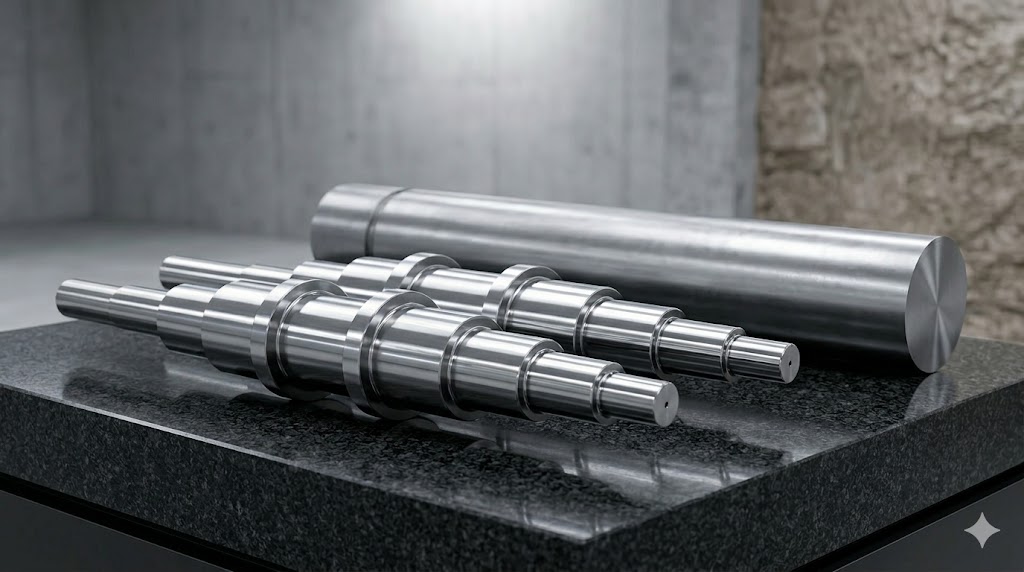
AISI 4130 is a low-carbon, chromium-molybdenum (“chromoly”) alloy steel containing about 0.30% carbon, ~1% chromium and ~0.2% molybdenum. The chromium and molybdenum give it good hardenability and tempering stability, while the low carbon keeps it weldable and tough. After quenching and tempering it develops a tempered-martensite structure that balances high strength with good toughness, which is why 4130 is widely forged into shafts, rings and pressure components for oil & gas, power, marine and mining service.
Key takeaways
- What it is: a low-alloy Cr-Mo steel; the “30” in 4130 means ~0.30% carbon.
- Why chromoly: chromium adds hardenability; molybdenum deepens it and suppresses temper embrittlement.
- Best condition: quenched and tempered, giving tempered martensite — strong yet tough.
- Strength: typically yield from ~517 MPa and tensile ~655–790 MPa, tunable by tempering.
- Weldability: excellent for an alloy steel, thanks to low carbon; heavy sections need preheat and PWHT.
- When to upsize: for very large sections or higher hardness, step up to 4140 or 4340.
AISI 4130 is a low-carbon, chromium-molybdenum alloy steel that engineers reach for when they need a balance of strength, toughness and weldability that plain carbon steels cannot deliver — without paying for the richer alloying of grades like 4340. To understand why it behaves the way it does, you have to look past the datasheet and into the metallurgy.
What AISI 4130 Really Is
At its simplest, 4130 is a steel whose properties are governed by a deliberate, restrained recipe. The designation itself tells the story: in the AISI/SAE four-digit system the first two digits, 41, identify the chromium-molybdenum family, while the final two digits, 30, point to a nominal carbon content of about 0.30 percent. That single number — 0.30 percent carbon — sits at a metallurgical sweet spot. It is high enough to respond meaningfully to heat treatment, yet low enough to keep the steel readily weldable and resistant to cracking.
Everything that makes 4130 useful flows from that balancing act. It is not the strongest alloy steel, nor the toughest, nor the most corrosion resistant. What it offers instead is a dependable, predictable combination of properties across a wide range of section sizes and processing routes. For decades that reliability has made it a default choice for shafts, pressure components, tubular structures and rolled rings in demanding industries.
Names, Standards & Equivalents
One steel, many labels. Because procurement happens across regions and specification systems, the same chromoly composition appears under several designations. Recognising them prevents costly mix-ups when matching a drawing to available stock.
| System | Designation | Where you see it |
|---|---|---|
| AISI / SAE | 4130 | North American drawings and mill certificates |
| UNS | G41300 | Unified numbering, used in formal specifications |
| DIN / EN | 25CrMo4 (1.7218) | European equivalency and cross-border sourcing |
| Industry shorthand | 4130 chromoly | Engineering and fabrication conversation |
These designations are close cousins rather than perfect identical twins — composition tolerances and residual-element limits can differ slightly between national standards — so cross-references such as 25CrMo4 should always be confirmed against the controlling specification before substitution.
The Lean-Alloy Philosophy
It helps to think of 4130 as a study in economy. Where higher-grade alloy steels add nickel, more carbon and heavier doses of chromium and molybdenum to push strength and hardenability upward, 4130 keeps every addition modest. The result is a steel that is cheaper to produce, more forgiving to weld, and easier to machine in its softened condition — while still being genuinely heat-treatable.
4130 earns its place not by excelling at one property, but by refusing to be bad at any of them.
This is exactly why it remains a workhorse. A designer rarely chooses 4130 because it tops a single ranking; they choose it because it covers a broad envelope of requirements with one well-understood material, simplifying inventory, welding procedures and quality control.
What Each Alloying Element Does
The personality of 4130 is written in its chemistry. Each element earns its place by contributing a specific metallurgical effect, and understanding those roles explains every downstream property.
| Element | Typical level | Metallurgical role |
|---|---|---|
| Carbon (C) | 0.28–0.33% | Sets the maximum attainable hardness and strength; kept low to preserve weldability and ductility. |
| Chromium (Cr) | 0.80–1.10% | Boosts hardenability, forms stable carbides, and adds modest oxidation and wear resistance. |
| Molybdenum (Mo) | 0.15–0.25% | Deepens hardenability, refines carbides, and — crucially — suppresses temper embrittlement. |
| Manganese (Mn) | 0.40–0.60% | Improves hardenability and deoxidises the melt; ties up sulphur to limit hot-shortness. |
| Silicon (Si) | 0.15–0.35% | Acts as a deoxidiser and provides mild solid-solution strengthening. |
| S & P | tightly limited | Treated as impurities; kept low to protect toughness and cleanliness. |
The combination of chromium and molybdenum is what defines the "chromoly" character. Chromium alone improves hardenability but leaves the steel vulnerable to temper embrittlement; molybdenum's contribution is to keep grain boundaries clean during tempering, which is why a chromium-molybdenum pairing outperforms either element used alone.
Microstructure by Delivery Condition
4130 is rarely supplied in a single fixed state. Its microstructure — and therefore its properties — depends entirely on the thermal history applied at the mill or the forge shop. The same chemistry can be soft and machinable or hard and strong.
| Condition | Microstructure | Character |
|---|---|---|
| Annealed | Coarse ferrite + pearlite | Softest state; best for machining and cold work |
| Normalised | Fine ferrite + pearlite | Uniform, refined grain; good baseline toughness |
| Quenched | Martensite (± bainite) | Very hard but brittle; not used as-quenched |
| Quenched & tempered | Tempered martensite | The workhorse condition: high strength with restored toughness |
The quenched-and-tempered condition is where 4130 shows its best self. Quenching first traps carbon in a hard, distorted martensitic lattice; tempering then relaxes that lattice and precipitates fine carbides, trading a portion of the hardness for a large gain in ductility and impact resistance. Adjusting the tempering temperature lets a metallurgist dial the final balance to suit the part.
Phase Transformation Behaviour
To heat treat 4130 you must first take it above its upper critical temperature so the structure transforms fully to austenite, the face-centred-cubic phase that dissolves carbon readily. What happens next depends almost entirely on cooling rate.
- Slow cooling (furnace or still air) lets carbon diffuse out, producing soft ferrite-and-pearlite structures.
- Rapid cooling (water, oil or polymer quench) outruns diffusion and forces the austenite to shear into hard martensite.
- Intermediate rates can yield bainite, an intermediate structure with a useful blend of strength and toughness.
Because chromium and molybdenum slow the diffusion-controlled reactions, 4130 tolerates a somewhat slower quench than plain carbon steel before it loses the ability to form martensite. That margin is precisely what the alloy additions buy — and it is the foundation of the steel's hardenability.
Hardenability & the Section-Size Problem
Hardenability is not hardness. It describes how deeply a steel will harden on quenching — how far below the surface a fully hardened structure can be achieved before the cooling rate at the core falls too low. This distinction matters enormously for forgings, which are often thick.
The mass-effect rule
The thicker the section, the slower the core cools during quenching. In heavy forgings the centre may never reach the critical cooling rate, leaving it softer than the surface. 4130's moderate hardenability suits small-to-medium sections well; very large cross-sections often justify a richer grade with deeper hardening response.
This is the single most important reason a buyer might step up from 4130 to a deeper-hardening alloy on a large part. For the bars, shafts and rings where 4130 is most at home, its hardenability is comfortably sufficient — and the predictability of its response is a genuine advantage.
The Mechanical Property Profile
Because its properties are tunable by heat treatment, 4130 does not have one set of numbers — it has a usable range. In a typical quenched-and-tempered condition for forged parts, the steel commonly delivers a yield strength upward of roughly 517 MPa and a tensile strength in the broad neighbourhood of 655–790 MPa, with solid elongation and reduction-of-area values that reflect its good ductility. Pushing the temper lower raises strength and hardness at the cost of toughness; tempering higher does the reverse.
What engineers value most is not any single peak figure but the shape of this curve — the fact that 4130 keeps respectable toughness even as strength climbs. That cooperative relationship between strength and ductility is the hallmark of a well-balanced low-alloy steel.
| Property | AISI 4130 | AISI 4140 | AISI 4340 |
|---|---|---|---|
| Carbon | ~0.30% | ~0.40% | ~0.40% |
| Key alloy | Cr-Mo | Cr-Mo | Ni-Cr-Mo |
| Hardenability | Moderate | High | Very high |
| Strength potential | High | Higher | Highest |
| Weldability | Excellent | Moderate | Lower |
| Best for | Welded, thinner, balanced parts | Harder, wear-oriented parts | Large, high-strength critical parts |
Weldability: The Metallurgy of a Forgiving Steel
Weldability is one of 4130's headline strengths, and it traces directly back to that low carbon content. The risk in welding hardenable steels is that the heat-affected zone cools fast enough to form brittle, crack-prone martensite. The carbon equivalent — a formula that lumps carbon together with the weighted effect of alloying elements — estimates that risk, and 4130's modest carbon keeps its carbon equivalent relatively low.
In practice this means 4130 welds readily by common processes, but it is not entirely free of precautions:
- Preheat slows the cooling of the weld zone, reducing the chance of hard, crack-sensitive structures.
- Post-weld heat treatment relieves residual stress and tempers any hard zones the weld created.
- Low-hydrogen practice limits the dissolved hydrogen that drives cold cracking.
For thin sections these measures are often minimal; for heavy forged components they become essential. The point is that 4130 makes a sound, ductile weld achievable with well-understood, repeatable procedures — a major reason it dominates welded structural and pressure applications.
Toughness & Low-Temperature Service
For pressure-containing and load-bearing parts, resistance to brittle fracture is as important as strength. 4130 in its tempered condition offers good impact toughness, and with appropriate heat treatment it can meet demanding low-temperature impact requirements for cold and sour-service environments. Molybdenum's role in suppressing temper embrittlement is central here: it keeps the tempered structure tough rather than allowing embrittling films to form at grain boundaries during slow cooling through the critical temper range.
This combination — controllable strength, sound welds and dependable toughness down to sub-zero temperatures — is why 4130 became a backbone material for wellhead and pressure equipment governed by stringent oilfield specifications.
Why 4130 Is Forged Rather Than Just Machined From Bar
Chemistry sets the ceiling on what a steel can be; processing decides how much of that potential is realised. Forging works the metal while hot, closing internal porosity, refining the grain and — critically — aligning the grain flow to follow the contour of the finished part.
A forged 4130 shaft is metallurgically superior to the same shape cut from bar, because its grain follows the load path instead of being severed across it.
This continuous, oriented grain structure is what gives forged components their characteristic fatigue strength and directional toughness. A sufficient forging reduction ratio ensures the cast structure of the starting ingot is fully broken down and refined, producing the sound, dense, fine-grained material that heat treatment then converts into final properties. For dynamically loaded parts — shafts, rings, pressure bodies — this is the difference between adequate and excellent service life, and it is the reason 4130 is supplied as custom AISI 4130 forgings rather than as plain bar stock.
Need 4130 in a forged form?
Jiangsu Liangyi forges custom AISI 4130 / 25CrMo4 bars, shafts, seamless rolled rings and hollow components from 30 kg to 30,000 kg. Heat treatment, UT/MPI inspection and EN 10204 3.1 / 3.2 material certificates are available on request to suit your order requirements.
Explore AISI 4130 Forged Parts →Where the Metallurgy Pays Off
Trace each property back to an application and the logic of 4130 becomes clear. Its weldability and toughness suit welded structures and tubular frames. Its balanced strength makes it ideal for transmission shafts, gear blanks and rolled rings. Its sour-service capability and pressure integrity earn it a permanent place in oil-and-gas wellhead and frac-pump components. Its fatigue resistance after forging supports marine propeller shafts and heavy mining gear.
In every case the choice is the same underlying reasoning: a single, well-characterised steel that does many things well, costs less than richer alloys, and behaves predictably from the melt shop to the field. For a deeper look at how these properties translate into finished components, industry field cases and full specification data, see our dedicated reference on AISI 4130 forged parts and applications.
Frequently Asked Questions
What does the "4130" designation actually mean?
In the AISI/SAE four-digit code, the first two digits (41) identify the chromium-molybdenum alloy family and the last two (30) indicate roughly 0.30 percent carbon. So 4130 is, by definition, a low-carbon chromoly steel.
Why is 4130 called "chromoly"?
"Chromoly" is shop shorthand for chromium-molybdenum. Those two elements — around 1 percent chromium and a fraction of a percent molybdenum — are the defining additions that give the steel its hardenability and tempering stability.
Is 4130 hard or soft?
Either, depending on heat treatment. As supplied it is usually annealed or normalised and comparatively soft for machining. After quenching and tempering it develops a tempered-martensite structure with high strength and good toughness.
Can 4130 be welded?
Yes — easy weldability is one of its main attractions, thanks to the low carbon content. Heavier sections should be preheated and post-weld heat treated to avoid cold cracking and to restore properties in the heat-affected zone.
When should I choose a different grade instead of 4130?
When you need deeper through-hardening on very large sections, or significantly higher strength and wear resistance, a richer grade such as 4140 or 4340 is usually the better fit. For balanced, weldable, predictable performance in small-to-medium sections, 4130 is hard to beat.
References & Industry Standards
The standards below are the recognised industry and material standards that apply to AISI 4130 as a steel grade and to the applications discussed in this guide. They are listed for technical reference and education only. The links point to the issuing bodies; always confirm the current edition and confirm any project requirement against the controlling specification before relying on it.
- ASTM A29/A29M — General requirements for hot-wrought carbon and alloy steel bars.
- ASTM A370 — Standard test methods for mechanical testing of steel products.
- ASTM A751 — Test methods for chemical analysis of steel products.
- API 6A — Specification for wellhead and Christmas tree equipment.
- NACE MR0175 / ISO 15156 — Materials for use in sour (H₂S-containing) oilfield environments.
About our certification
Jiangsu Liangyi Co.,Limited holds ISO 9001:2015 certification for its quality management system. Listing the standards above does not imply that the company holds API, NACE, ASTM, AMS or any other certification or accreditation. Where a customer order calls for products manufactured or tested to a specific standard, the applicable requirements and documentation are agreed and confirmed per order.