Material Knowledge · Cr-Mo Alloy Steel
What Is 25CrMoS4 (1.7213) Steel? Composition, Properties and Applications
25CrMoS4 (1.7213) is a free-machining chromium-molybdenum quenching-and-tempering steel. This guide covers its chemical composition, mechanical properties, heat treatment, standards, equivalents and forged applications.
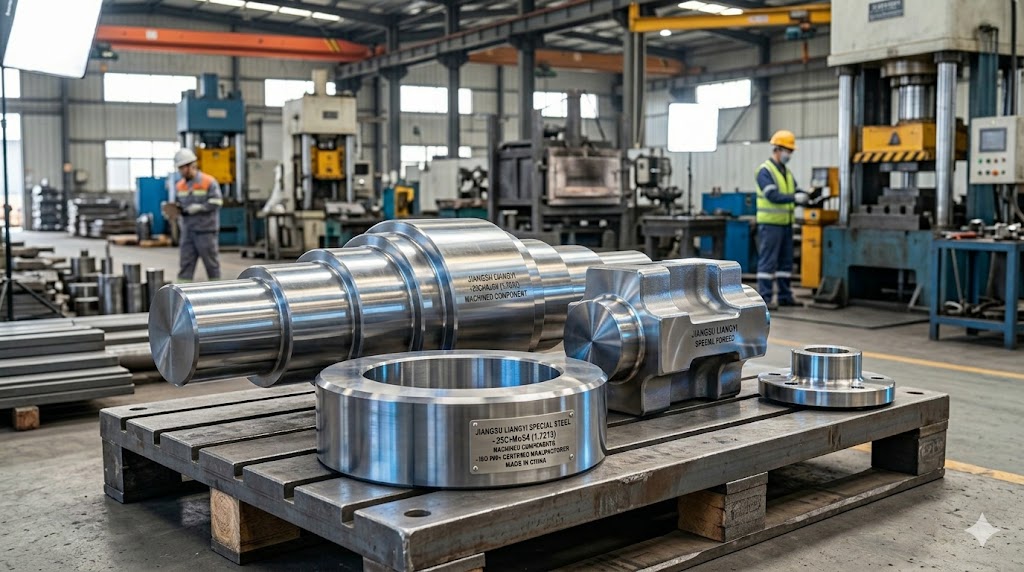
25CrMoS4 (material number 1.7213) is a low-alloy chromium-molybdenum quenching and tempering steel containing about 0.25% carbon, 1% chromium and 0.2% molybdenum, plus a controlled sulfur addition that improves machinability. After quench and temper it reaches roughly 900–1100 MPa tensile strength and is widely forged into shafts, gears, rolled rings, sleeves and pressure components for the oil & gas, power, marine and automotive industries.
- 25CrMoS4 = EN material number 1.7213, a Cr-Mo quenching and tempering steel.
- The "S" means a deliberate sulfur addition (0.020–0.040%) for free-machining behaviour.
- Quenched & tempered: 900–1100 MPa tensile, ≥700 MPa yield, HB 270–325.
- Sister grade 25CrMo4 (1.7218) is the low-sulfur version with higher transverse toughness.
- Standards referenced: EN 10083-3, EN 10277-5, ISO 683-2, ASTM A751; EN 10204 3.1/3.2 material certificates available on request.
The grade in one sentence
25CrMoS4 belongs to the well-known 25CrMo4 family of chromium-molybdenum engineering steels, but with one purposeful twist: the "S" signals a controlled sulfur content that makes the steel far friendlier to cut, drill and turn. It keeps almost all of the strength and toughness of a classic Cr-Mo grade while shaving real cost off machining time. That is why it appears so often in forged parts that need both demanding mechanical performance and heavy downstream machining.
The name itself is a compact specification. Each part of the designation tells you something:
- 25
- About 0.25% carbon (×100), setting the strength after heat treatment.
- Cr
- Chromium — the main hardenability and wear-resistance element (~1%).
- Mo
- Molybdenum — deep hardening and temper-brittleness resistance (~0.2%).
- S
- Deliberate sulfur addition for free-machining behaviour.
- 4
- Indicates the chromium level (roughly 1%).
- 1.7213
- The equivalent German DIN/EN material number.
Chemical composition
The composition is what gives 25CrMoS4 its character. Chromium and molybdenum drive hardenability and temper resistance; the carbon level sets the strength ceiling after heat treatment; and the sulfur — normally kept as low as possible in structural steels — is here held within a defined window on purpose.
| Element | Content range | What it does |
|---|---|---|
| C — Carbon | 0.22 – 0.29 | Sets quench-hardenability and strength |
| Si — Silicon | max 0.40 | Deoxidiser, slight strengthening |
| Mn — Manganese | 0.60 – 0.90 | Hardenability, binds sulfur |
| P — Phosphorus | max 0.035 | Kept low (impurity) |
| S — Sulfur | 0.020 – 0.040 | Deliberate addition for machinability |
| Cr — Chromium | 0.90 – 1.20 | Hardenability, wear and temper resistance |
| Mo — Molybdenum | 0.15 – 0.30 | Deep hardening, reduces temper brittleness |
| Fe — Iron | Balance | Base metal |
Why the sulfur matters: free-machining behaviour
In most alloy steels, sulfur is treated as a contaminant because it can hurt toughness and transverse ductility. 25CrMoS4 flips that logic deliberately. The manganese in the steel combines with sulfur to form fine manganese-sulfide (MnS) inclusions, and those soft inclusions act as natural chip-breakers during cutting. The practical results are shorter chips, lower tool wear, cleaner threaded and bored features, and faster cycle times on lathes and machining centres.
The trade-off is modest. Because the MnS stringers tend to align with the working direction, transverse toughness is slightly lower than in the sulfur-lean sister grade. For most shaft, gear and ring applications — where the main load runs longitudinally — that trade is well worth the machining savings. When maximum cleanliness and impact toughness are the priority instead, engineers usually specify the low-sulfur version, 25CrMo4 (1.7218).
25CrMoS4 vs 25CrMo4: how to choose
These two grades are siblings with the same Cr-Mo backbone. The only material difference is sulfur — and it changes which jobs each one suits best.
| Property | 25CrMoS4 (1.7213) | 25CrMo4 (1.7218) |
|---|---|---|
| Sulfur content | 0.020 – 0.040% (added) | Low (max ~0.035%) |
| Machinability | Higher (free-machining) | Standard |
| Transverse toughness | Slightly lower | Higher |
| Strength after Q&T | 900–1100 MPa | 900–1100 MPa |
| Best for | Machining-intensive parts | Toughness-critical parts |
Mechanical properties after heat treatment
Like all quenching and tempering steels, 25CrMoS4 does not reach useful strength until it is heat treated. Properties always depend on section size, forging ratio and the exact temper temperature, but a representative quenched-and-tempered specification looks like this:
That envelope places 25CrMoS4 firmly in the medium-high strength bracket: noticeably stronger than plain carbon steels, with the toughness and low-temperature impact behaviour needed for parts that see shock or sub-zero service. The figures above are measured at room temperature in the longitudinal direction and align with the requirements of ISO 683-2.
Heat treatment in practice
The standard route is quench and temper. The steel is heated to its austenitising range, quenched (typically in oil for a steel of this hardenability) to form martensite, then tempered at a chosen temperature to set the final strength-toughness balance. A higher temper gives more ductility and impact resistance at slightly lower strength; a lower temper does the reverse.
Molybdenum is the quiet hero here. It improves through-hardening so that even thick forged sections develop consistent properties from surface to core, and it suppresses temper brittleness — the loss of toughness that can otherwise occur when alloy steels are tempered in certain ranges. For large forgings, that deep, uniform response is exactly what makes the grade dependable.
Standards and equivalents
25CrMoS4 is defined primarily within the European standards system, and forged parts are commonly delivered against the following references:
- EN 10083-3 — alloy quenching and tempering steels, technical delivery conditions
- EN 10277-5 — bright steel products for quenching and tempering steels
- EN 10263-4 — steel for cold heading and extrusion, quenching and tempering grades
- ISO 683-2 — heat-treatable alloy and free-cutting steels
- ASTM A751 — standard test methods for chemical analysis of steel products
Internationally, 25CrMoS4 sits close to the AISI/SAE 4130-type chromium-molybdenum family in chemistry, though exact equivalents always depend on the property and sulfur requirements of a given specification rather than chemistry alone. For any safety-critical part, the controlling standard — not a cross-reference table — should govern acceptance.
Common product forms
Because it forges and machines well, 25CrMoS4 is supplied in a broad range of shapes. Typical forged forms include:
- Bars and shafts — round, square and flat bars, plus step shafts, gear shafts, crankshafts and turbine shafts
- Seamless rolled rings — gear rings, slewing bearing rings, flange rings and contoured rings for rotating equipment
- Hollow forgings — sleeves, bushes, hollow bars, barrels, housings and casings
- Geometric and OEM parts — discs, blocks, valve bodies, impellers, flanges and drawing-specific components
Industrial applications
The same strength-plus-machinability balance shows up across heavy industry. In oil & gas, 25CrMoS4 forgings serve as fluid-end modules, wellhead and Christmas-tree parts, and high-pressure flanges. In power generation, it appears in pump impellers, casings, trunnions and pressure-vessel components. Marine and offshore work uses it for propeller shafts and subsea fittings that must resist corrosion fatigue. And in automotive and heavy machinery, it is forged into crankshafts, gearbox gears, pinion shafts and steering knuckles that must survive heavy, repeated loading — often down to −40 °C.
How to specify it for an order
Because final properties depend so heavily on processing, a clear specification saves time and avoids re-work. When requesting a quote or placing an order for 25CrMoS4 forgings, it helps to state:
- Part drawing or description, with finished and rough dimensions
- Unit weight and order quantity
- Required delivery condition (e.g. quenched and tempered) and target properties
- Machining allowance or finish-machined scope
- Non-destructive testing scope (ultrasonic, MPI) and acceptance class
- Certificate level — typically EN 10204 3.1 or 3.2
The full manufacturing scope, dimensional ranges and inspection capability for this grade are handled per project — you can order custom 25CrMoS4 forgings to your drawing.
Frequently asked questions
What is 25CrMoS4 (1.7213) steel?
It is a low-alloy chromium-molybdenum quenching and tempering steel with a controlled sulfur addition for improved machinability. It is forged into high-strength parts such as shafts, gears, rolled rings and pressure components.
What is the difference between 25CrMoS4 and 25CrMo4?
They share the same Cr-Mo base chemistry. 25CrMoS4 (1.7213) contains a deliberate sulfur range of roughly 0.020–0.040% that breaks chips and improves machinability, while 25CrMo4 (1.7218) keeps sulfur low for maximum cleanliness and transverse toughness.
What are the mechanical properties of 25CrMoS4?
Quenched and tempered, it typically reaches 900–1100 MPa tensile strength, minimum 700 MPa yield strength, minimum 13% elongation, and HB 270–325 hardness, measured at room temperature in the longitudinal direction per ISO 683-2.
Which standards cover 25CrMoS4 forgings?
Common references are EN 10083-3, EN 10277-5, EN 10263-4, ISO 683-2 and ASTM A751, and EN 10204 3.1 or 3.2 mill test certificates can be provided on request.
What is the equivalent of 25CrMoS4 steel?
In chemistry, 25CrMoS4 sits close to the AISI/SAE 4130-type chromium-molybdenum family. Exact equivalents depend on the property and sulfur requirements of the controlling specification rather than chemistry alone.
Property values are representative; the controlling standard and the project inspection plan always govern acceptance. Always confirm order-specific data and tolerances before production.