What Is 20NiCrMoS2-2 (1.6526) Steel? A Complete Material Guide
A practical, engineer-focused breakdown of the EN 10084 case-hardening grade behind the names 20NiCrMoS2-2, 1.6526 and 21NiCrMoS2 — what it is made of, how it behaves, how it is heat treated, and where forged parts in this steel earn their keep.
20NiCrMoS2-2 (material number 1.6526, formerly 21NiCrMoS2) is a low-alloy nickel-chromium-molybdenum case-hardening steel specified in EN 10084. It is carburized to form a hard, wear-resistant surface (typically 58–62 HRC) over a tough, ductile core, which makes it a standard choice for forged gears, shafts and bearing components in heavy machinery.
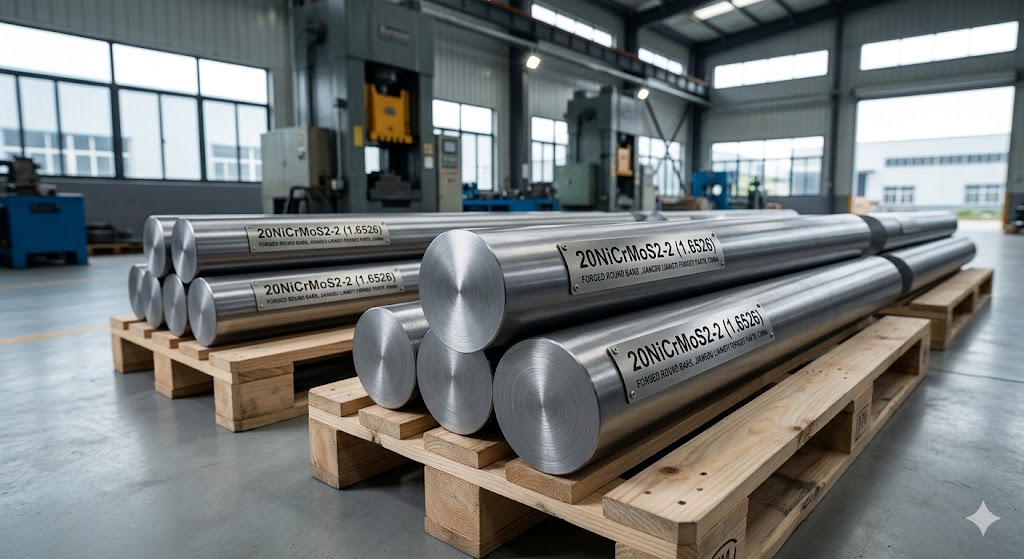
Key facts at a glance
- Standard: EN 10084 case-hardening (carburizing) alloy steel.
- Names: 20NiCrMoS2-2 = 1.6526 = 21NiCrMoS2 (same grade, three labels).
- Type: low-carbon Ni-Cr-Mo steel, machined soft then carburized and quenched.
- Surface hardness after carburizing: ≈ 58–62 HRC; tough lower-hardness core.
- Closest AISI grade: the 8620 family (resulfurized version).
- Difference vs 1.6523: 1.6526 has added sulfur for better machinability.
If a drawing has crossed your desk calling for 20NiCrMoS2-2, 1.6526 or 21NiCrMoS2, all three labels point to one thing: a low-alloy nickel-chromium-molybdenum case-hardening steel built to carry two jobs at once. Its surface is meant to run hard and wear-resistant, while the body underneath stays tough enough to absorb shock and bending without cracking.
That split personality is exactly what gears, shafts and bearing races need — and it is why this grade keeps showing up across transmission and heavy-machinery work. This guide walks through it the way an application engineer would actually reason about it: what the designation means, what the chemistry buys you, how the metallurgy responds to heat, and what to put on a purchase order so the forging you receive performs the way the drawing intended.
01The quick definition
20NiCrMoS2-2 is a case-hardening (carburizing) alloy steel standardised under EN 10084. In the as-supplied state it is relatively soft and machinable. The performance comes later: parts are machined close to shape, then carburized so carbon diffuses into the outer skin, and finally quenched. The result is a high-carbon, very hard outer "case" sitting on a lower-carbon, ductile core.
Think of it as the opposite philosophy to a through-hardening steel like 42CrMo4. Instead of trying to make the whole cross-section hard, this grade deliberately keeps a soft, forgiving heart and concentrates the hardness exactly where the part rubs, meshes or rolls.
- EN symbol name
- 20NiCrMoS2-2
- EN material no.
- 1.6526
- Former name
- 21NiCrMoS2
- Steel family
- Ni-Cr-Mo case-hardening
- Near AISI
- 8620 family (resulfurized)
- Non-sulfur twin
- 1.6523 / 20NiCrMo2-2
02Decoding the designation
The EN naming system is descriptive once you know how to read it, and 20NiCrMoS2-2 spells out its own recipe:
- 20 — roughly 0.20% carbon (the value is the carbon content multiplied by 100). A low, controllable carbon level is essential for carburizing.
- Ni, Cr, Mo — the deliberate alloying elements, listed in order of importance: nickel, chromium and molybdenum.
- S — flags a controlled sulfur addition for free-machining behaviour; this is the single letter that separates it from its twin grade.
- 2-2 — coded multipliers that indicate the approximate nickel and chromium levels.
The number 1.6526 is simply the same steel expressed in the EN material-number system, and 21NiCrMoS2 is the legacy designation many older drawings still carry. None of these are different alloys — they are three doors into the same room.
03What it is made of
The chemistry is intentionally lean. There is enough nickel and chromium to give the core good hardenability and toughness, enough molybdenum to resist temper embrittlement, and a tightly controlled carbon window so the grade carburizes predictably.
| Element | Range (%) | What it contributes |
|---|---|---|
| Carbon (C) | 0.17 – 0.23 | Low base carbon keeps the core tough and the part machinable before carburizing |
| Silicon (Si) | ≤ 0.40 | Deoxidiser; mild strength contribution |
| Manganese (Mn) | 0.65 – 0.95 | Boosts hardenability and ties up residual sulfur |
| Nickel (Ni) | 0.40 – 0.70 | Core toughness and low-temperature impact resistance |
| Chromium (Cr) | 0.35 – 0.70 | Hardenability and a hard, wear-resistant carburized case |
| Molybdenum (Mo) | 0.15 – 0.20 | Deep hardenability; guards against temper brittleness |
| Sulfur (S) | 0.020 – 0.040 | Controlled addition for free-cutting machinability |
| Phosphorus (P) | ≤ 0.025 | Kept low as a tramp impurity |
No single element dominates here. The grade works because the elements are balanced — nickel for toughness, chromium for case hardness, molybdenum for depth, and a measured dose of sulfur for the machine shop. Change one and you change the others' job.
04How it behaves metallurgically
Because the base carbon is around 0.20%, the steel cannot be hardened to high values on its own — quench it as-is and you get a strong but not especially hard part. The hardness is engineered in afterward through carburizing: the part is held in a carbon-rich atmosphere at elevated temperature so carbon migrates into the surface layer, raising local carbon to roughly 0.8% over a depth you control with time and temperature.
After the subsequent quench, that carbon-enriched skin transforms to hard martensite while the low-carbon core stays comparatively soft and ductile. The payoff is a part that resists surface wear and pitting where it contacts other components, yet shrugs off impact and bending loads through its tough centre. The nickel-chromium-molybdenum balance also gives reasonable hardenability, so the effect carries into moderately heavy sections rather than only the thinnest parts.
"The surface does the fighting; the core absorbs the blows. That division of labour is the whole reason this steel exists."
051.6526 vs 1.6523 vs AISI 8620
This is the comparison engineers most often want clarified. 1.6526 (20NiCrMoS2-2) and 1.6523 (20NiCrMo2-2) are metallurgically the same steel. They share the same alloy backbone and respond to heat treatment in essentially the same way. The difference is sulfur.
In 1.6526 the sulfur is raised into a controlled 0.02–0.04% band. Those sulfur particles form manganese-sulfide inclusions that act like built-in chip-breakers, so the steel machines faster, produces cleaner chips and is easier on tooling — a real advantage when a part needs heavy turning, drilling or threading before carburizing. The trade-off is a slight reduction in transverse toughness and fatigue performance.
| Grade | Sulfur | Best for | Note |
|---|---|---|---|
| 20NiCrMoS2-2 (1.6526) | 0.020–0.040 % | Easy machining, high shop throughput | Free-cutting version |
| 20NiCrMo2-2 (1.6523) | low / residual | Fatigue- and toughness-critical parts | Same alloy, less sulfur |
| AISI 8620 | varies by spec | North American equivalent | Same case-hardening family |
The practical rule of thumb: reach for the sulfur-bearing 1.6526 when machinability and cost per part drive the decision, and lean toward the low-sulfur 1.6523 when the part is fatigue- or toughness-critical.
06Heat treatment, step by step
The grade passes through several thermal stages between raw bar and finished part. Each one has a clear purpose:
- Normalising (~910 °C, air cool) — refines and homogenises the grain after forging and improves machinability. Often used to put the steel into a known, consistent state before carburizing.
- Soft annealing (~650–700 °C, slow furnace cool) — drops hardness to its lowest, friendliest level for heavy machining of complex geometries.
- Carburizing — the defining step: carbon is diffused into the surface to set up the hard case. Case depth is dialled in by time and temperature.
- Hardening / austenitising (~840–870 °C, then oil or air quench) — transforms the carbon-rich case to martensite and locks in surface hardness.
- Tempering (~150–200 °C for the case) — relieves quench stresses and recovers toughness with minimal loss of the hardness that matters.
Hot working itself — forging — is carried out in the roughly 1100–850 °C window, with the part cooled in still air afterward. Staying inside that window protects the grain structure and avoids cracking.
07Mechanical properties to expect
Because the grade is delivered soft and developed later, "the" property table depends on condition. The figures below are representative reference values rather than guaranteed minimums — always confirm against the applicable standard and your order.
| Condition | Property | Typical value |
|---|---|---|
| Hardened & tempered | Tensile strength, Rm | ≈ 1100 MPa |
| Annealed (+AC) | Tensile strength, Rm | ≈ 590 MPa |
| Hardened core | Reduction of area, Z | 57 – 62 % |
| Annealed (+A) | Brinell hardness | ≤ 212 HBW |
| +TH treated | Brinell hardness | 161 – 212 HBW |
| +FP treated | Brinell hardness | 149 – 194 HBW |
| Carburized case | Surface hardness | ≈ 58 – 62 HRC |
Specifications, forged forms and ordering details
This guide covers the metallurgy and selection logic. For the full list of available product forms, size range, inspection scope and how to order, see the dedicated product page.
08Forging the grade in practice
20NiCrMoS2-2 forges well within its hot-working range and is a routine grade for open-die forging and ring rolling. Forging — rather than machining from a billet or casting — gives the part a continuous, grain-flow-aligned structure that follows its contours. For rotating and load-bearing components, that aligned flow is a direct contributor to fatigue life and reliability.
The typical route is: forge to a near-net shape, normalise to settle the structure, rough-machine while the steel is soft (where the sulfur addition pays off), then carburize and quench to develop the case. Leaving appropriate machining stock for the small dimensional movement during heat treatment is part of getting the finished tolerances right. You can see the press and ring-rolling capacity behind this on our forging equipment page.
09Where 1.6526 earns its place
The hard-skin / tough-core combination makes this a workhorse for power transmission and heavy mechanical parts. Common forged applications include:
- Gearing — gear shafts, pinion shafts, gear wheels and ring gears, including wind-turbine gearbox components that must survive years of cyclic load.
- Shafts & spindles — transmission shafts, eccentric shafts for crushers, and spindles where surfaces wear but the body must not snap.
- Bearing & bushing parts — races, sleeves, bushes and guide pins that roll or slide against mating surfaces.
- Heavy-industry components — parts for mining, construction, cement and sugar-mill machinery, oil & gas drilling tools and railway transmission, where impact and wear arrive together.
Across these, the appeal is the same: predictable carburizing response, good machinability before treatment, and a forged structure that holds up under fatigue. Real-world examples are collected on our project reference page.
10Specifying and buying it well
To make sure the forging you receive does what the drawing intends, put the right information on the enquiry:
- Grade and standard — state 20NiCrMoS2-2 / 1.6526 to EN 10084, and confirm whether the sulfur-bearing version is required or whether low-sulfur 1.6523 is acceptable.
- Delivery condition — annealed, normalised, or supplied ready for the customer's own carburizing line.
- Case requirements — if carburizing is part of the order, specify case depth and surface hardness targets.
- Inspection & certification — ultrasonic testing, dimensional and surface checks, and the certificate level you need (EN 10204 3.1 or 3.2).
- Geometry & tolerances — drawing, weight, machining stock and any critical features.
For full specifications, available forged forms and the inspection scope we run on every order, head to the dedicated 20NiCrMoS2-2 (1.6526) forging parts page, or browse the wider forging materials list if you are comparing grades.
Key takeaways
- 20NiCrMoS2-2, 1.6526 and 21NiCrMoS2 are three names for one EN 10084 case-hardening steel.
- It is carburized to give a hard surface (≈ 58–62 HRC) over a tough, ductile core.
- The "S" version (1.6526) machines easily; the low-sulfur 1.6523 is tougher for fatigue-critical parts.
- It sits in the AISI 8620 family and is a standard choice for forged gears, shafts and bearing parts.
- For forgings, specify grade, condition, case depth, inspection level and tolerances up front.
11Frequently asked questions
Is 20NiCrMoS2-2 the same as 1.6526?
What is the difference between 1.6526 and 1.6523?
What is the AISI equivalent of 20NiCrMoS2-2?
What hardness can 1.6526 reach?
What is 20NiCrMoS2-2 used for?
Can it be supplied as a forging?
Standards & references
- EN 10084:2008 — Case hardening steels — Technical delivery conditions.
- EN 10204 — Metallic products — Types of inspection documents (MTC 3.1 / 3.2).
- EN 10308 — Non-destructive testing — Ultrasonic testing of steel bars.
Values shown are typical reference data for guidance only and are not guaranteed minimums. Actual chemistry, properties and conformance are subject to the current applicable standard and the agreed purchase order and material test certificate. ISO 9001:2015 is the only quality-management certification referenced on this page. Last reviewed 31 May 2026.