ASTM A564 Grade 634 Forgings | AISI 634 | Type 634 | Alloy 634 Forged Parts Manufacturer in China
Established in 1997, Jiangsu Liangyi is an ISO 9001:2015 certified manufacturer of ASTM A564 Grade 634 (AISI 634 / Type 634 / Alloy 634 / AM-355® equivalent) open die forgings, seamless rolled rings and precision machined components. Over 25 years, we have developed specific process knowledge for this chromium-nickel-molybdenum-nitrogen precipitation hardening grade — from raw material chemistry verification through forging reduction ratio control, heat treatment condition optimization and section-size-dependent NDE protocol — delivering forged parts to power generation, petrochemical and heavy machinery clients in 50+ countries.
This page provides the most technically detailed resource available for engineers specifying ASTM A564 Grade 634 forgings: full metallurgical background, condition-by-condition mechanical data, heat treatment process parameters, forging vs. casting comparison, common specification mistakes, corrosion performance benchmarks and real global application cases. Contact us for a technical review of your drawing and a same-day quotation.
Why Source ASTM A564 Grade 634 Forgings from Jiangsu Liangyi
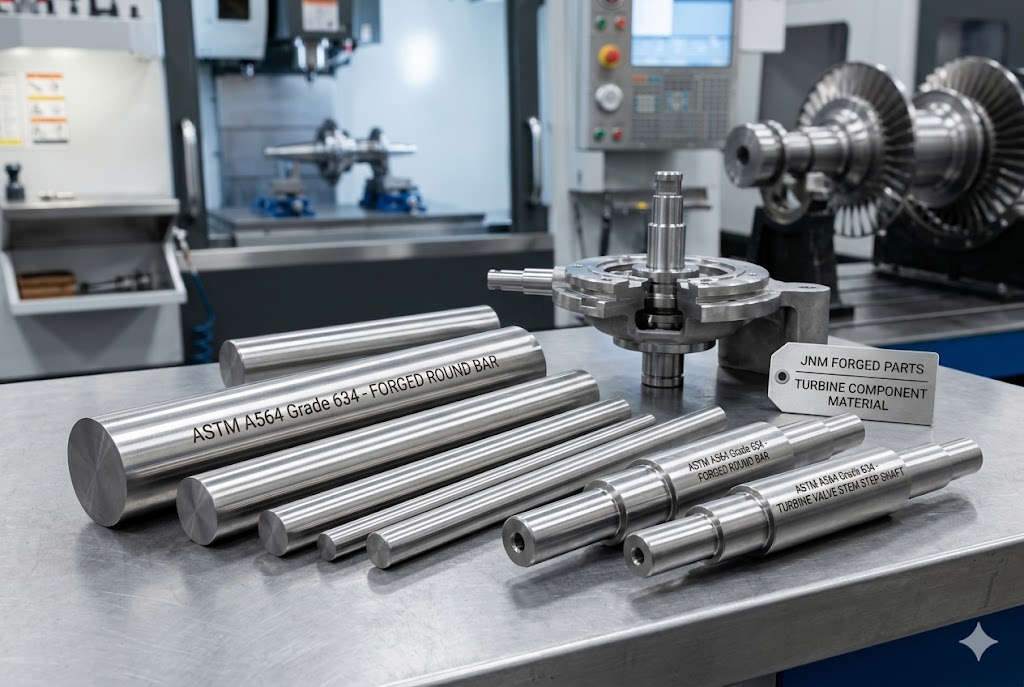
ASTM A564 Grade 634 Forged Bars & Shafts
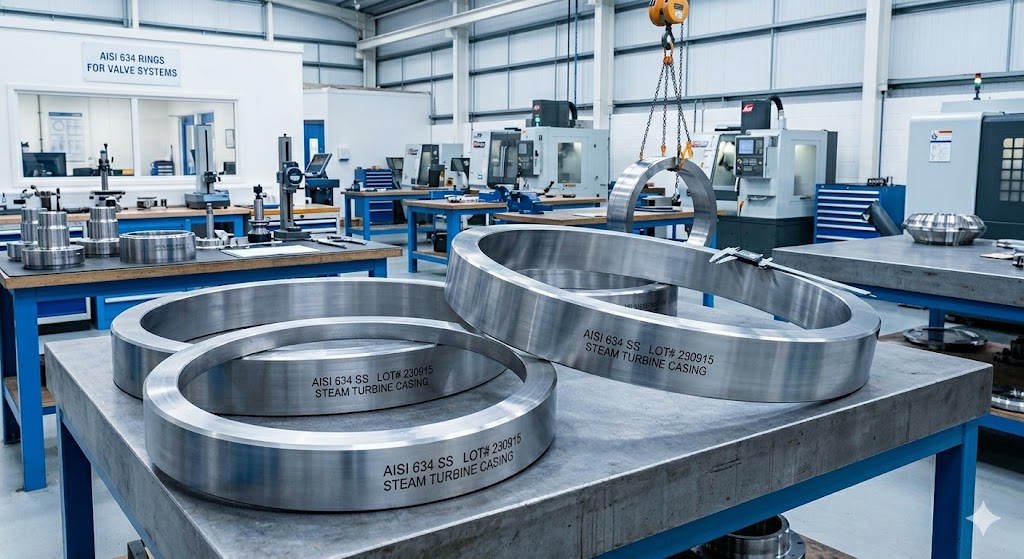
AISI 634 Seamless Rolled Rings
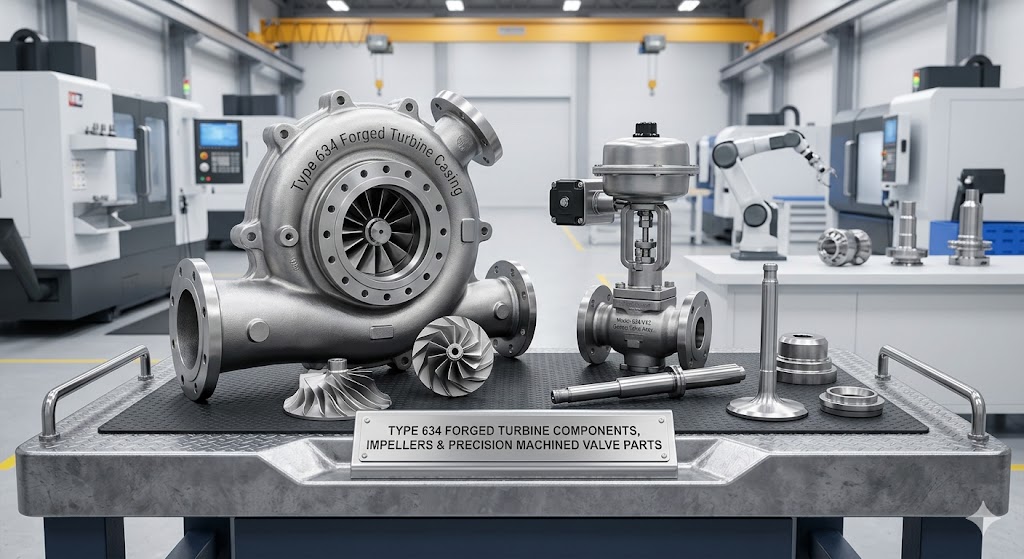
Type 634 Turbine & Valve Forged Parts
ASTM A564 Grade 634 and AM-355®: The Relationship Most Suppliers Get Wrong
Note: AM-355 is a registered trademark of ATI Specialty Alloys & Components. ASTM A564 Grade 634 is an equivalent industrial designation and is not an ATI product.
One of the most frequent sources of confusion we encounter when quoting Grade 634 forgings is the relationship between the ASTM A564 Grade 634 designation and the military specification AM-355 (formally MIL-S-8840). Engineers working in aerospace procurement know AM-355 well; those in power generation or petrochemical often do not, and vice versa — yet they are specifying the same underlying alloy in different documentation systems.
AM-355 was the original designation. Developed in the late 1940s by Allegheny Ludlum (now ATI) specifically for airframe applications requiring high strength-to-weight ratio with corrosion resistance, AM-355 was one of the first semi-austenitic precipitation hardening stainless steels to see widespread production. The alloy was adopted by the AISI system as grade 634 and later incorporated into ASTM A564 as Grade 634.
The key practical difference: AM-355 per MIL-S-8840 typically requires tighter inclusion ratings (cleanliness per ASTM E45 Method A), aircraft-quality melt practices (VIM or VAR), and more stringent fracture toughness testing. ASTM A564 Grade 634 allows standard EAF + AOD production for industrial forgings. If your drawing calls for AM-355 chemistry but does not explicitly require aircraft melt practice, ASTM A564 Grade 634 is the correct industrial procurement specification — and will be accepted by most power generation and petrochemical end-users.
When clients send us AM-355 drawings for turbine valve components, we always confirm which documentation system governs: if the end user is a power plant (not aerospace), we recommend issuing to ASTM A564 Grade 634, which is cleaner for MTC documentation, better supported by EN 10204 3.1 certification language, and avoids ambiguity about melt practice requirements that can trigger unnecessary RFIs during procurement audits.
Metallurgical Deep-Dive: What Makes ASTM A564 Grade 634 Genuinely Different
The Semi-Austenitic Character: Why It Matters for Forging
ASTM A564 Grade 634 is classified as a semi-austenitic precipitation hardening (PH) stainless steel — a description that reveals more about its behavior during manufacturing than most technical datasheets explain. Unlike 17-4PH (martensitic PH) which transforms to martensite during cooling from solution anneal, Grade 634 remains largely austenitic at room temperature after solution annealing. The martensite start temperature (Ms) of solution-annealed Grade 634 is approximately −60 to −18°C, which means room-temperature cooling alone is insufficient to complete the austenite-to-martensite transformation.
This semi-austenitic character is actually by design: it means the alloy is soft and machinable after solution annealing (hardness approximately 25–32 HRC), which is advantageous for rough machining large forgings before final heat treatment. The trade-off is that achieving maximum strength requires the sub-zero cooling step that some suppliers omit to save time and cost — with the consequence that the core of thick forgings contains retained austenite and never achieves the specified minimum strength.
In our shop: For any forging destined for H 900 or H 950 condition in cross-sections exceeding 50mm, sub-zero treatment to −73°C (−100°F) for a minimum of 8 hours is a standard step in our process sheet, not optional. We have seen competitor-supplied forgings from other manufacturers fail mechanical testing at the customer's receiving inspection precisely because this step was omitted.
The Precipitation Hardening Mechanism at the Microstructural Level
Understanding what happens during aging helps engineers select the right condition and avoid misapplication. During solution annealing at 1010–1065°C, all alloying elements dissolve into the austenite matrix. After sub-zero cooling drives the transformation to martensite, the martensitic matrix is a supersaturated solid solution — highly strained but not yet aged. During aging (the "H" step), the heat activates diffusion, and fine intermetallic particles precipitate throughout the martensitic matrix. These precipitates — primarily Fe₂Mo Laves phase and Cr-N compounds — impede dislocation movement, which is the fundamental mechanism for the dramatic strength increase.
Lower aging temperatures (H 900: 482°C) produce finer, more uniformly distributed precipitates → higher strength, lower toughness. Higher aging temperatures (H 1150: 621°C) produce coarser precipitates that are spaced further apart → lower strength, higher toughness and better SCC resistance because the coarser precipitate spacing allows more dislocation mobility before fracture. The H 1150-M double-aging treatment adds an initial high-temperature step (760°C) that first partially reverts martensite back to austenite, then re-precipitates on cooling in a finer and more homogeneous distribution — providing the most balanced toughness and SCC resistance in the Grade 634 system.
Martensite Start (Ms): −60°C to −18°C (varies with exact Ni and N content within specification range)
Martensite Finish (Mf): −120°C to −80°C (sub-zero treatment to −73°C achieves near-complete transformation)
Austenite Reversion Start (during aging above ~650°C): partial reversion occurs, which is exploited in H 1150-M
Solution Anneal Temperature: 1010–1065°C (1850–1950°F) — lower end of range preferred to minimize grain growth in finished forgings
Nitrogen's Dual Role: What Most Datasheets Don't Explain
The 0.07–0.13% nitrogen specification in Grade 634 is not accidental — nitrogen serves two critical and simultaneous functions that make the alloy superior to non-nitrogen PH grades. First, nitrogen is a powerful austenite stabilizer (approximately 30× more effective than nickel on a weight basis), which allows the alloy designer to use less nickel while maintaining adequate austenite stability for controlled transformation during heat treatment. Second, nitrogen dissolved interstitially in the matrix raises both the yield strength of the aged martensite and dramatically improves pitting corrosion resistance: each 0.1% nitrogen raises the PREN (Pitting Resistance Equivalent Number) by approximately 16 points — a larger contribution per unit weight than any other common alloying element.
The practical consequence: in our chemistry verification, nitrogen is one of the most important elements we check, yet it is also one of the elements most likely to be incorrectly certified by suppliers who do not have vacuum fusion or combustion analysis equipment. We verify nitrogen by inert gas fusion analysis on every incoming heat — not by inference from other elements.
ASTM A564 Grade 634 Chemical Composition — Engineering Rationale for Each Element
The following table gives the specified limits per ASTM A564/A564M. The "Engineering Rationale" column represents our manufacturing team's understanding — built from 25 years of producing this alloy — of why each element is controlled to its specific range, not simply what the range is:
| Element | Symbol | Specified Range (%) | What Happens If Out of Range | Why This Range |
|---|---|---|---|---|
| Carbon | C | 0.10 – 0.15 | Below 0.10%: insufficient martensite hardening, reduced strength after aging. Above 0.15%: risk of sensitization and carbide embrittlement at grain boundaries. | Narrow band balances martensite formation potential against corrosion and toughness penalties of excess carbide. Distinguish from 17-4PH (C ≤ 0.07%) where lower C reduces strength potential. |
| Manganese | Mn | 0.50 – 1.25 | Low Mn: reduced hot workability and deoxidation. High Mn: can stabilize austenite excessively, suppressing Ms temperature further below room temperature. | Provides deoxidation and controls Ms. The 0.75% range provides flexibility in melt practice while staying within transformation behavior bounds. |
| Silicon | Si | 0.50 max | Excess Si promotes sigma phase formation above 600°C and can embrittle weld HAZ and heat-treated microstructures. | Si is a deoxidizer and ferrite stabilizer. The 0.50% maximum limits sigma-phase risk while allowing adequate melt practice for large ingots. |
| Phosphorus | P | 0.040 max | P segregates to grain boundaries during solidification. Excess P causes temper embrittlement and reduces impact toughness, particularly at sub-zero temperatures. | AOD refining routinely achieves P ≤ 0.020% in practice. The 0.040% maximum is a "ceiling" — actual values in our heats typically run 0.015–0.025%. |
| Sulfur | S | 0.030 max | S forms MnS inclusions that act as pitting initiation sites. Excess S severely degrades transverse toughness and fatigue performance in forgings. | AOD desulfurization achieves S ≤ 0.005% routinely in our heats — far below the specification maximum. For critical turbine components, we target S ≤ 0.003%. |
| Chromium | Cr | 14.0 – 16.0 | Below 14%: passive film becomes marginal in acidic chloride environments. Above 16%: sigma-phase risk increases at elevated temperatures; can suppress austenite stability and interfere with PH response. | The 14–16% band provides reliable passivation while maintaining the austenite/martensite balance needed for PH behavior. The addition of Mo and N effectively "extends" the corrosion protection of this Cr level. |
| Nickel | Ni | 6.0 – 8.0 | Below 6%: insufficient austenite stability; alloy may transform to fully martensitic on air cooling from solution anneal (losing the "semi-austenitic" advantage of post-anneal machinability). Above 8%: Ms drops too low; difficult to achieve full martensite transformation even with sub-zero treatment. | The 6–8% Ni band is the "sweet spot" for semi-austenitic behavior: austenitic and soft after annealing; transformable to martensite by sub-zero cooling; then age-hardened to high strength. Outside this range, either the anneal-condition machinability or the aging response is compromised. |
| Molybdenum | Mo | 0.40 – 1.00 | This is the element that distinguishes Grade 634 from 17-4PH and 15-5PH. Below 0.40%: Mo addition becomes insufficient to raise PREN meaningfully. Above 1.0%: excessive Mo promotes Laves phase coarsening during aging, reducing toughness. | Mo is the key "chloride fighter." Each 1% Mo raises PREN by approximately 3 points. The 0.4–1.0% range balances corrosion benefit against Laves phase embrittlement risk. This is why Grade 634 outperforms 17-4PH in offshore and wet steam applications. |
| Nitrogen | N | 0.07 – 0.13 | Below 0.07%: insufficient PREN contribution; austenite stabilization role is weakened. Above 0.13%: risk of nitride precipitation during solidification, creating hard particles that reduce toughness and machinability. Also risk of porosity in large ingots if N exceeds solubility. | N is the most potent single-element contributor to pitting resistance per unit addition. Its narrow 0.06% specification range requires careful AOD control of nitrogen partial pressure during refining — a process step we monitor continuously with in-line analysis. |
The 0.07–0.13% N specification window is only 0.06% wide — significantly narrower than the carbon or manganese specifications. Achieving consistent nitrogen in this band requires careful control of nitrogen partial pressure in the AOD vessel during refining. If N is added via nitrogen gas injection, the equilibrium nitrogen content depends on temperature, chromium content, and total pressure — and can shift during the refining arc. Suppliers without real-time nitrogen monitoring capability often hit nitrogen at 0.05% (under-spec) or 0.14% (over-spec).
We verify nitrogen on every heat by inert gas fusion analysis (not by OES estimation), and we have a supplier qualification procedure specifically for Grade 634 chemistry acceptance. Nitrogen out-of-specification forgings have been returned to us from customers — always from heats where we did not verify incoming chemistry ourselves.
ASTM A564 Grade 634 Mechanical Properties — Condition-by-Condition Engineering Guide
The following minimum mechanical property requirements are per ASTM A564/A564M for longitudinal test bars machined from bar or forging. Note that these are minimum values — actual production values from our shop typically exceed minimums by 5–15%. Engineers designing to these values should use the minimums for design calculations, but can expect better actual performance.
| Condition | Aging Temp. | Min. UTS (MPa/ksi) | Min. YS 0.2% (MPa/ksi) | Min. Elong. (%) | Min. RA (%) | Approx. Hardness | Best Application |
|---|---|---|---|---|---|---|---|
| H 900 | 482°C / 900°F | 1380 / 200 | 1240 / 180 | 10 | 35 | 40–44 HRC | Maximum strength at room temperature; high-stress mechanical fasteners |
| H 950 | 510°C / 950°F | 1310 / 190 | 1170 / 170 | 10 | 38 | 38–42 HRC | Turbine valve stems/spindles; MSV/GV seat rings; standard turbine blades |
| H 1000 | 538°C / 1000°F | 1170 / 170 | 1070 / 155 | 12 | 42 | 35–39 HRC | Turbine components in mild chloride exposure; improved fracture toughness vs H 950 |
| H 1025 | 552°C / 1025°F | 1100 / 160 | 1000 / 145 | 13 | 45 | 33–37 HRC | Balance of strength and toughness for thick-section turbine casings |
| H 1075 | 579°C / 1075°F | 1030 / 150 | 930 / 135 | 14 | 48 | 31–35 HRC | Components where some toughness is traded for machinability before final grinding |
| H 1150 | 621°C / 1150°F | 860 / 125 | 690 / 100 | 16 | 50 | 28–32 HRC | Best toughness for section sizes; thick-section structural components |
| H 1150-M | 760°C then 621°C | 790 / 115 | 620 / 90 | 18 | 55 | 24–28 HRC | Best SCC resistance; NACE MR0175 compliance; offshore valve components; H₂S service |
Transverse vs. Longitudinal Properties: The Direction Nobody Tells You About
The ASTM A564 specification values above are for longitudinal test bars — meaning the test bar's axis is parallel to the principal forging direction (the direction of maximum fiber flow). In the real world, some components are loaded in directions perpendicular to the forging fiber — and Grade 634, like all precipitation hardening stainless steels, shows directional variation in ductility and toughness.
For bar products, transverse elongation is typically 8–12% lower and Charpy impact energy is 20–35% lower than longitudinal. For ring forgings (where fiber flow is circumferential), radial and axial properties can differ. If your component is highly stressed in a specific direction — such as a valve body pressurized perpendicular to the forging axis — tell us, and we will orient the forging and specify test bar direction to match your critical stress direction. This is something many specifiers overlook until a failure investigation reveals anisotropic property deficiency.
ASTM A564 does not specify minimum Charpy impact energy for Grade 634 forgings. This is a common oversight in procurement specifications for power plant and oil & gas applications, where impact toughness is critical for thick-walled pressure-containing components. If your application involves pressure containment, low-temperature operation (below 0°C), or dynamic loading, add a supplementary Charpy requirement to your purchase specification — we recommend minimum 27J at the design minimum temperature. Specify test temperature, orientation and notch type explicitly.
Heat Treatment Process: Parameters, Critical Controls & Practical Traps
Stage 1: Solution Annealing — Why Temperature Precision Matters More Than Most Think
Solution annealing temperature for Grade 634 is specified as 1010–1065°C (1850–1950°F), but within this 55°C window, the choice of temperature has meaningful consequences. Annealing at the lower end of the range (~1010–1025°C) produces a finer grain size (ASTM grain size 5–7) with better fatigue resistance and toughness — preferred for rotating turbine components. Annealing at the higher end (~1050–1065°C) fully dissolves all carbides and provides more uniform chemistry distribution — preferred for very large thick-section forgings where dissolution uniformity matters more than fine grain size. We select anneal temperature based on forging cross-section and application, not as a fixed parameter.
Cooling rate after annealing is critical but often underspecified. Air cooling is the ASTM minimum, but for thick sections (over 100mm), still-air cooling can result in a cooling rate through the sensitization temperature range (650–850°C) that promotes carbide precipitation at grain boundaries — reducing both toughness and corrosion resistance. We use forced air or light water mist for sections over 75mm to accelerate cooling through the sensitization range.
Stage 2: Sub-Zero Cooling — The Most Frequently Skipped Step
Sub-zero treatment to −73°C (−100°F) for 8 hours minimum is essential for achieving the specified minimum properties in H 900 and H 950 conditions. The purpose is to complete the martensite transformation: solution-annealed Grade 634 contains primarily austenite at room temperature (Ms is below room temperature), and aging an incompletely transformed microstructure produces a mix of aged martensite and retained austenite — the latter does not respond to precipitation hardening and creates "soft spots" through the forging cross-section.
We were approached by a European turbine OEM after receiving H 950 valve spindles from a competitor supplier that failed their hardness acceptance criterion (specified minimum 36 HRC, received average 31 HRC, with significant scatter 28–33 HRC). Hardness testing showed a bimodal distribution — consistent with inhomogeneous martensite transformation where some regions had transformed and aged correctly, while others remained austenitic and unaged.
Re-heat treatment (solution anneal + sub-zero + re-age) on the rejected spindles recovered the specified properties, confirming the root cause was omitted sub-zero treatment. The client revised their purchase specification to require a documented furnace record showing the sub-zero step — a requirement we already provide as standard. The competitor supplier had omitted sub-zero treatment to save 12 hours of refrigeration time.
Stage 3: Aging — Temperature Precision Is Everything
Aging temperature tolerance is ±14°C (±25°F) per ASTM A564. Our heat treatment furnaces are maintained within this tolerance through documented periodic calibration and independent thermocouple verification. Exceeding the upper temperature tolerance causes over-aging: precipitates coarsen, strength falls, but the forging may still pass hardness if hardness is tested at a surface measurement point. We use through-thickness thermocouple placement for thick forgings to verify that the center of the section reaches and holds the target temperature — not just the surface measured by the furnace control thermocouple.
Aging time is as important as temperature. Standard aging time is 4 hours minimum at temperature. For very large forgings (over 5 tonnes per piece), we extend aging time to 6–8 hours to ensure the core of the forging reaches full precipitation hardening response. Over-time aging at correct temperature does not significantly over-age Grade 634 — this is a more forgiving characteristic than some other PH grades.
H 1150-M Double-Aging: The Preferred Treatment for Petrochemical Service
The H 1150-M condition (Step 1: 760°C / 1400°F for 2 hours, air cool; Step 2: 621°C / 1150°F for 4 hours, air cool) is significantly more complex than single-step aging and requires careful furnace management to achieve the intended microstructure. The first step at 760°C partially reverts martensite to austenite and dissolves coarse precipitates; the second step at 621°C re-precipitates on cooling in a finer, more controlled distribution. The result is the lowest strength (790 MPa minimum UTS) but the best combination of fracture toughness, ductility and resistance to stress-corrosion cracking and hydrogen embrittlement — making it the required condition for NACE MR0175 sour-service compliance.
One practical note: H 1150-M forgings are significantly softer and easier to machine than H 950 — some clients request H 1150-M partly for this machinability advantage even for non-sour applications where the lower strength is acceptable.
Specify Your Heat Treatment Condition — Request Technical ReviewSection Size Effects in Grade 634 Forgings: What Gets Overlooked in Standard Datasheets
Every standard datasheet for ASTM A564 Grade 634 publishes mechanical properties without mentioning the cross-section from which the test bars were taken. For thin sections (under 75mm), the published properties are reliably achievable through the full cross-section. For thick sections, the story is more nuanced — and understanding it correctly prevents specification errors that lead to costly in-service surprises.
Through-Thickness Hardenability in Grade 634
Grade 634 is an austenitic-to-martensitic alloy, not a through-hardening steel in the conventional sense. The transformation from austenite to martensite during sub-zero cooling occurs by a diffusionless shear mechanism that propagates at near-sonic speed — it is not limited by thermal diffusivity in the way that conventional martensitic steel hardenability is. However, if the core of a thick forging does not reach −73°C during sub-zero treatment (due to insufficient refrigeration capacity or too short a hold time), the core retains austenite and the aging step produces inhomogeneous microstructure.
| Cross-Section Diameter/Thickness | Sub-Zero Treatment Requirement | Typical Core UTS vs. Surface | Charpy Impact (Core vs. Surface, Est.) | Our Process Adjustment |
|---|---|---|---|---|
| ≤ 50 mm | 4 hours minimum | Core ≈ Surface (±3%) | Core ≈ Surface (±5%) | Standard process, test from surface |
| 50–100 mm | 6–8 hours | Core 3–7% lower | Core 10–20% lower | Extended sub-zero hold; verify with additional test bars from T/4 and T/2 depth |
| 100–200 mm | 10–12 hours + confirm with center thermocouple | Core 5–12% lower | Core 20–35% lower | Center thermocouple on sub-zero step; test bars specified at center; supplementary Charpy recommended |
| > 200 mm | 12–16 hours, staged cooling from anneal | Core 10–18% lower (may not meet minimum at center without process optimization) | Core 30–50% lower | Engineering review with customer; may recommend H 1000 or H 1025 instead of H 950 for better through-thickness uniformity; center-bore test bar location specified |
The practical implication: if you are ordering large Grade 634 forgings (over 150mm section) and specifying H 950 without discussing section-size effects with your supplier, you may be receiving forgings that pass surface hardness acceptance but have a softer, lower-toughness core. We always raise this issue proactively during technical review of thick-section forging inquiries — it is one of the areas where our Grade 634 expertise adds real value versus a supplier treating it as just another stainless steel order.
ASTM A564 Grade 634 vs. 17-4PH, 15-5PH & 17-7PH: An Engineer's Honest Comparison
The precipitation hardening stainless steel family is often presented as interchangeable options with slightly different strength levels. In our experience supplying all four grades over 25 years, the differences are meaningful and the "right" choice depends strongly on the specific operating environment — not just the required strength level.
| Characteristic | Grade 634 (AISI 634) | 17-4PH (Grade 630) | 15-5PH | 17-7PH (Grade 631) |
|---|---|---|---|---|
| PH Type | Semi-austenitic | Martensitic | Martensitic | Semi-austenitic |
| Cr (%) | 14–16 | 15–17.5 | 14–15.5 | 16–18 |
| Ni (%) | 6–8 | 3–5 | 3.5–5.5 | 6.5–7.75 |
| Mo (%) | 0.4–1.0 (Yes) | None | None | None |
| N (%) | 0.07–0.13 (Yes) | None (≤0.05%) | None | None |
| PREN (est.) | ~22–26 | ~18–20 | ~17–19 | ~18–21 |
| Max UTS (H 900 equiv.) | ~1380 MPa | ~1310 MPa | ~1310 MPa | ~1655 MPa (CH 900) |
| Pitting Resistance (Cl⁻) | Superior | Good | Good | Moderate–Good |
| SCC Resistance (H1150-M) | Excellent / NACE OK | Good / NACE marginal | Good / NACE OK | Moderate |
| High-Temp Strength (to 400°C) | Excellent | Good (drops above 300°C) | Good | Moderate |
| Machined-Anneal Hardness | 25–32 HRC (soft, machinable) | 28–34 HRC (harder to machine) | 28–33 HRC | 25–30 HRC |
| Sub-Zero Required | Yes, for H 900/H 950 | No (transforms on air cool) | No | Yes |
| Availability as Forgings | Good (specialist suppliers) | Excellent (most common) | Good | Limited |
| Preferred for... | Turbines, offshore valves, wet steam, chloride environments | General purpose high-strength components | Better transverse toughness than 17-4; good alternative | Maximum strength applications (aerospace springs, diaphragms) |
We regularly receive inquiries where a buyer's drawing specifies "17-4PH or Grade 634" as if they are fully equivalent alternatives. They are not. 17-4PH has no molybdenum or nitrogen, giving it meaningfully lower pitting resistance (PREN ~18–20 vs ~22–26 for Grade 634). In chloride-containing wet steam, sea water spray or produced water environments, 17-4PH components have shown pitting initiation at stress concentrations under conditions where Grade 634 remains passive. If your application involves any chloride exposure, Grade 634 is the correct choice — not 17-4PH with a "Grade 634 is also acceptable" fallback written in to ease procurement.
Corrosion Performance: Pitting, Crevice Corrosion & Stress-Corrosion Cracking
Pitting Resistance: The PREN Framework
The Pitting Resistance Equivalent Number (PREN = %Cr + 3.3×%Mo + 16×%N) is the industry-standard metric for ranking stainless steels' resistance to pitting in chloride environments. For ASTM A564 Grade 634 at mid-specification chemistry (15% Cr, 0.70% Mo, 0.10% N), PREN ≈ 15 + 3.3×0.70 + 16×0.10 = 15 + 2.31 + 1.60 = ~18.9. Across the full specification chemistry range, PREN varies from approximately 16.5 (minimum-spec chemistry) to ~21.5 (maximum-spec chemistry). For comparison, 17-4PH (no Mo, no N) has PREN ~16–18.
While absolute PREN values should be used comparatively rather than as absolute thresholds, the Mo+N combination in Grade 634 provides a measurable improvement in resistance to pitting initiation in environments such as: cooling water circuits with chloride contamination, wet steam condensate in LP turbine stages, offshore seawater injection valve systems, and produced water handling in oil and gas processing.
Stress-Corrosion Cracking: Choosing the Right Condition
SCC in precipitation hardening stainless steels is primarily a function of strength and heat treatment condition — higher strength conditions are more susceptible. The H 900 condition, while providing maximum strength, has the highest susceptibility to SCC and hydrogen embrittlement and should never be used in environments containing hydrogen, H₂S, or wet chloride service with tensile stress. The progression from H 900 to H 1150-M shows monotonically improving SCC resistance as strength decreases and retained austenite content at grain boundaries increases (providing a more ductile, crack-arrest microstructure).
| Condition | Dry H₂ Gas (<RT) | Wet H₂S / Sour Service | Seawater / Marine | Wet Steam (Cl⁻ <50 ppm) | NACE MR0175 Compliant |
|---|---|---|---|---|---|
| H 900 | Susceptible | Not acceptable | Susceptible | Use with caution | No |
| H 950 | Some susceptibility | Not acceptable | Acceptable (low stress) | Generally OK | No |
| H 1000 | Low susceptibility | Not acceptable | Good | Good | No |
| H 1025–1075 | Low | Borderline | Good | Good | No (check latest NACE) |
| H 1150 | Low | Borderline | Good | Excellent | Borderline |
| H 1150-M | Very low | Acceptable (verify) | Excellent | Excellent | Yes (per NACE/ISO 15156) |
Important note on NACE MR0175 compliance: The H 1150-M condition for Grade 634 / AISI 634 is listed in NACE MR0175 / ISO 15156-3 as acceptable for sour service at specified maximum hardness (≤28 HRC) and stress conditions. Our production of H 1150-M forgings targets 24–27 HRC actual hardness with a 28 HRC maximum acceptance criterion verified by Rockwell testing at multiple locations per forging. If NACE compliance is required, state this explicitly in your purchase specification so we apply the correct hardness verification protocol.
Elevated Temperature Performance of ASTM A564 Grade 634
One of the defining advantages of Grade 634 over simpler PH grades is its retention of useful mechanical properties at intermediate elevated temperatures (200–450°C) — the operating range of steam turbine valve stems, turbine blade roots, and high-pressure valve seats in thermal power plants. The Laves phase (Fe₂Mo) precipitates that form during aging are significantly more stable at elevated temperature than the copper-rich precipitates in 17-4PH, providing Grade 634 with better property retention during long-term elevated temperature service.
| Test Temperature | Typical UTS (MPa) | Typical YS 0.2% (MPa) | Elongation (%) | Retention vs. RT |
|---|---|---|---|---|
| Room Temp (20°C) | ~1380–1450 | ~1240–1310 | 10–14 | 100% (baseline) |
| 100°C | ~1310–1380 | ~1170–1240 | 11–14 | ~95% |
| 200°C | ~1210–1280 | ~1100–1170 | 12–15 | ~88% |
| 300°C | ~1100–1170 | ~1000–1070 | 12–16 | ~80% |
| 400°C | ~970–1050 | ~860–930 | 13–17 | ~70% — significantly better than 17-4PH at this temperature |
| 450°C | ~830–910 | ~720–790 | 14–18 | ~62% |
| 500°C+ | Drops significantly | Drops significantly | Increases | Over-aging range — not recommended for continuous service above 450°C |
Grade 634 is often specified for turbine valve spindles operating at 300–400°C. During long-term service at these temperatures, some additional aging occurs — the precipitates gradually coarsen and strength decreases slightly over years of operation. For components designed to ASTM A564 Grade 634 H 950 minimum properties and operating at 350°C, expect approximately 5–8% strength reduction after 100,000 hours of continuous operation. This "service aging" effect should be factored into design margins for long-term power plant components. If this is a concern for your application, we recommend starting with H 900 condition to provide a higher initial strength baseline that accommodates in-service strength reduction while remaining within design margins.
Why Grade 634 Forgings Decisively Outperform Castings
We are sometimes asked whether a cast AM-355 or Grade 634 component is an acceptable alternative to a forging for cost reduction. In our 25 years of experience supplying both forged and evaluating cast materials, the answer for critical applications is always no — and the technical reasons are specific to how Grade 634's microstructure responds to processing:
Grain Flow & Fiber Structure
During hot forging, the as-cast dendritic grain structure of the ingot is completely broken down and replaced by a fibrous, deformed grain structure aligned with the principal forging direction. This fibrous structure — sometimes called "forging fiber flow" — is not mere cosmetic; it means that grain boundaries, inclusions, and precipitate distributions are oriented favorably relative to the principal stress direction. Components machined from forgings with fiber flow aligned to the maximum stress direction show 20–40% higher fatigue endurance limits than equivalently heat-treated cast material.
Porosity, Segregation & Cleanliness
Grade 634 solidification involves multiple phases with different Cr, Ni, Mo and N solubilities — the result is inevitable segregation of alloying elements between dendrite cores and interdendritic regions in as-cast material. In a casting, this segregation is never fully homogenized and creates microchemistry variations of 1–3% across individual grains. In a forging, the combination of high-temperature solution annealing (which drives diffusion to reduce segregation) and mechanical deformation (which breaks up segregated regions and distributes them) produces a far more chemically homogeneous microstructure. More homogeneous chemistry means more uniform aging response, more predictable mechanical properties and better corrosion performance consistency across the part cross-section.
Mechanical Property Superiority: Quantified
| Property | Forging (Open Die / Ring Rolled) | Casting (Investment / Sand) | Forging Advantage |
|---|---|---|---|
| UTS (typical) | 1350–1450 MPa | 1100–1250 MPa | +10–20% |
| Yield Strength | 1200–1340 MPa | 950–1100 MPa | +15–25% |
| Elongation | 10–16% | 5–8% | +2× ductility |
| Charpy Impact (27°C) | 40–80 J | 15–30 J | +2–3× toughness |
| Fatigue Endurance (10⁷ cycles) | ~550–650 MPa | ~350–450 MPa | +30–50% |
| Microstructural Uniformity | Excellent | Poor–Moderate | — |
| Property Consistency (lot-to-lot) | High | Variable | — |
| Internal Defect Risk | Very Low (UT detectable) | Moderate–High (porosity) | — |
Custom ASTM A564 Grade 634 Forged Shapes & Product Forms
We manufacture the full range of custom AISI 634 / Type 634 forged products in precise dimensions and complex geometries per your drawings. Our maximum production capacity includes forging weight up to 25 tonnes per piece, diameter up to 3 metres, and length up to 12 metres. Available product forms:
Forged Bars, Rods & Step Shafts
ASTM A564 Grade 634 forged round bars (diameter 25mm–800mm), square bars, flat bars, rectangular bars, precision rods and multi-diameter step shafts. Applications include turbine valve spindles and stems, fastener blanks, industrial cutter stock, shaft components and tooling. Supplied with forged allowance for final machining, or fully machined to drawing.
Seamless Rolled Rings
Custom AISI 634 seamless rolled rings in outside diameter 200mm–3000mm, height 50mm–800mm, wall thickness 30mm–400mm. Ring forms include plain rings, flanged rings, contoured rings, T-section and L-section rings. Applications include turbine casing rings, bearing seal rings, labyrinth seal rings, guide rings, valve body blanks and coupling flanges. Forging fiber flow is circumferential — optimizing hoop stress resistance for pressure-containing rings.
Forged Discs, Hubs & Pancake Forgings
Type 634 forged discs, turbine impeller blanks, valve body pancake forgings, hub blanks. Diameter up to 2500mm, thickness 50mm–800mm. Internal bore options available (ring/disc combination). Applications include compressor impellers, pump impellers, turbine discs and large valve body forgings.
Custom Machined Precision Components
Fully machined Grade 634 valve bodies, bonnets, seats, spindles, sleeves, bushings, housings, flanges, nozzles, adapters and custom geometric components per your 2D/3D drawings. We accept DXF, DWG, STEP, IGES, SolidWorks and PDF drawing formats. CNC turning, milling, boring, drilling, threading and grinding available. Typical dimensional tolerance IT7; tight-tolerance features to IT5–IT6 on request.
Submit Your Drawing — Get a Custom Forging QuoteDimensional Tolerances, Surface Finish & Delivery Condition Options
We supply ASTM A564 Grade 634 forgings in any of the following delivery conditions. Specifying the correct delivery condition in your purchase order avoids ambiguity and prevents expensive rework at your facility:
| Delivery Condition | Description | Typical Dimensional Tolerance | Surface Finish | Best For |
|---|---|---|---|---|
| As-Forged (AF) | Forged to near-net shape with no machining, scale removed | ±3–8mm on principal dimensions | Shot-blasted, Ra 12–25 μm | When client has in-house machining capability; simple shapes |
| Heat Treated (HT) | Solution annealed + sub-zero (if required) + aged to specified H condition | Same as AF (heat treatment adds minor scale) | Shot-blasted | When client needs raw material with specified mechanical properties |
| Rough Machined (RM) | Machined with 2–5mm stock on all surfaces | +2/−0 mm on all faces; concentricity ≤1mm TIR | Turned/milled, Ra 6.3–12.5 μm | Most common; client does final machining to tight tolerances |
| Finish Machined (FM) | Machined to drawing dimensions and tolerances | Per drawing (IT6–IT8 standard; IT5 on request) | Ra 1.6–3.2 μm standard; Ra 0.8 μm on request (ground) | Ready-to-assemble components; valve seats/stems |
| Passivated (PA) | Chemical passivation per ASTM A967 after machining | Same as FM; passivation adds no dimensional change | Same as FM + passivated surface | Components in corrosive service; restores passive film cut during machining |
Machining ASTM A564 Grade 634 — even with sharp tooling and correct coolant — embeds iron from cutting tools into the surface layer. This embedded iron "contaminates" the passive chromium oxide film and creates active corrosion sites that look like rust spots within days or weeks of exposure to humid or chloride environments. Passivation per ASTM A967 (nitric acid or citric acid treatment) removes the embedded iron and re-establishes the passive film — restoring the full corrosion resistance of the material.
We recommend passivation as a standard finish for all Grade 634 components that will be exposed to: outdoor storage, sea freight without sealed packaging, wet process environments, or any service condition where surface corrosion is a quality issue. The cost is minimal; the consequence of skipping it can be significant.
Key Industrial Applications of ASTM A564 Grade 634 Forged Parts
The following applications represent proven deployments of Grade 634 / AISI 634 forgings from our production. For each application, we note the specific engineering properties that make Grade 634 the correct material choice — not simply "high strength and corrosion resistance," but the specific combination of properties demanded by the operating environment.
- Main Steam Valve (MSV) & Governor Valve (GV) Spindles/Stems (Power Generation): Requires minimum 1170 MPa yield strength to resist stem collapse under valve-closed differential pressure; excellent fatigue resistance for 10⁷+ open/close cycles; wet steam corrosion resistance. Grade 634 H 950 is the industry standard for this application. Alternative: H 1000 for plants with higher chloride condensate levels.
- Steam Turbine Blade Root & Attachment Forgings: High centrifugal stress from blade mass requires elevated-temperature yield strength retention; fatigue resistance at 10⁸+ cycles; resistance to SCC from wet steam. Grade 634 H 950/H 1000 is used for attachment rings and blade roots in LP stages where wet steam condensation occurs.
- High-Pressure Valve Bodies & Bonnets (Petrochemical): Requires pressure containment at ASME Class 2500 (620 bar); chloride corrosion resistance from process fluids; SCC resistance if H₂S or wet H₂S is present. H 1150-M condition for NACE compliance in sour service. H 1000 or H 1025 for sweet service at high pressure.
- Offshore Wellhead & Christmas Tree Components: Full seawater exposure; cyclic loading from wave action and pressure cycling; mandatory NACE MR0175 compliance if H₂S concentration exceeds threshold. H 1150-M exclusively for sour service. Grade 634's Mo+N pitting resistance advantage over 17-4PH is most significant in this application.
- Industrial Cutter Blanks (Mining & Construction Machinery): Hard particles in rock or soil require high surface hardness (H 900 or H 950 providing 38–44 HRC); wear resistance from carbide and Laves phase precipitates; corrosion resistance in wet cutting environments. Service life comparison versus D2 tool steel shows Grade 634 superior in applications with simultaneous wear and corrosion.
- Heavy Industrial Fasteners (High-Temp / High-Pressure): Double-headed studs and bolts for flanged connections at 350–450°C and pressures to Class 2500; requires resistance to stress relaxation (creep) at temperature; corrosion resistance to avoid galling and seizing during assembly. Grade 634 H 950 or H 1000 preferred over 17-4PH for hot bolting at temperatures above 300°C.
- Nuclear Power Auxiliary Systems: Non-core, low-radioactivity auxiliary valves and fasteners where irradiation embrittlement is not a primary concern; high reliability and corrosion resistance in treated water with low chloride. H 1000 or H 1025 condition for balance of strength and fracture toughness in safety-related valve applications.
We also supply custom Type 634 forgings for marine propulsion, aerospace ground support equipment, food processing (passivated finish), hydrogen generation equipment and specialty research applications — each with engineering review to confirm the appropriate heat treatment condition and surface finish.
Applicable Standards, Codes & Certifications
| Standard / Code | Scope | Our Compliance Status |
|---|---|---|
| ASTM A564 / A564M | Primary product standard for hot-rolled and cold-finished age-hardening stainless steel bars and shapes including Grade 634 | Full compliance; used as primary procurement reference |
| ASTM A484 / A484M | General requirements for stainless steel bars, billets and forgings (surface quality, testing frequency, identification) | Full compliance |
| ASTM A370 | Standard test methods for mechanical testing of steel products (tensile, hardness, impact) | All mechanical testing per A370 |
| ASTM A388 | Standard practice for ultrasonic examination of steel forgings | UT per A388, acceptance level specified per customer requirement |
| ASTM A275 / A275M | Standard practice for magnetic particle examination of steel forgings | MT per A275 standard |
| ASTM E165 / ASTM E1417 | Liquid penetrant examination | PT available on request |
| ASTM A967 / A380 | Passivation of stainless steel parts | Passivation available as standard or optional finish |
| MIL-S-8840 (AM-355) | Military specification predecessor to Grade 634; same chemistry, tighter melt/test requirements | Available on request; note melt practice requirements must be specified |
| API 6A | Wellhead and Christmas tree equipment | We produce material meeting API 6A chemistry and mechanical requirements; documentation package per customer's quality plan available on request |
| API 6D | Pipeline valves | Material meets API 6D chemistry and mechanical requirements; certification documentation per customer specification available on request |
| NACE MR0175 / ISO 15156-3 | Sulfide stress cracking resistant metallic materials for oil & gas sour service | Material in H 1150-M condition meets NACE MR0175/ISO 15156-3 hardness requirement (≤28 HRC); per-piece hardness records provided with MTC |
| ASME Section II Part A / SA-564 | ASME equivalent of ASTM A564 for pressure vessel and boiler code applications | Material meets SA-564 Grade 634 chemistry and mechanical requirements; MTCs note compliance with SA-564 on customer request |
| EN 10302 | European creep-resisting steels and alloys — covers equivalent composition for European procurement | Cross-reference documentation available |
| EN 10204 Type 3.1 / 3.2 | Inspection certificates for metallic products | 3.1 issued as standard; EN 10204 3.2 available when customer arranges an independent third-party inspection body to co-sign |
| ISO 9001:2015 | Quality management system | Certified; certificate available on request |
| Heat Treatment Records | Furnace time-temperature documentation for all heat treatment cycles | Full furnace charts (time-temperature curves) issued with every MTC as standard |
Our 8-Step ASTM A564 Grade 634 Forging Manufacturing Process
Every ASTM A564 Grade 634 forging we produce follows a validated, documented process sequence. Here is what actually happens in our shop from order placement to delivery — with the specific controls that distinguish our process from a generic stainless steel forging operation:
5 Common Specification Mistakes Engineers Make When Ordering Grade 634 Forgings
After 25 years of reviewing customer purchase specifications and drawings, these are the five most frequent errors we see — each of which can lead to costly rejections, delays or in-service failures:
H 950 is the "default" specification for most turbine applications, but for cross-sections over 150mm, through-thickness mechanical uniformity in H 950 is difficult to guarantee without specific process controls. If your drawing says "ASTM A564 Grade 634, Condition H 950" for a 200mm-diameter valve body, you need to confirm with your supplier that sub-zero treatment duration and test bar location are specified — otherwise you may receive a forging that passes surface hardness but has a non-conforming core. For large sections, consider H 1000 or H 1025 which provide better through-thickness uniformity at modest strength reduction.
ASTM A564 allows test bars to be taken from "the forging or an attached test coupon." A supplier can test from the most favorable surface location and pass — while the center of a thick forging has significantly lower toughness. For forgings over 100mm in any cross-section, specify: "Test bars shall be taken from T/4 depth (quarter-point from surface to center) in the minimum section dimension." This ensures properties represent the working cross-section, not the optimistic surface.
ASTM A564 does not include a mandatory Charpy requirement — but for pressure-containing components, impact toughness is a critical safety parameter. A forging can meet all ASTM A564 Grade 634 requirements and have inadequate toughness for your application. Add: "Charpy V-notch impact energy: minimum 27J average, minimum 20J individual, tested at [design minimum temperature] per ASTM A370, longitudinal orientation." This one addition has prevented multiple costly in-service failures for clients who took our advice to include it.
H 900 provides the highest strength but the worst SCC resistance. We regularly receive inquiries for "ASTM A564 Grade 634, H 900 condition" from engineers who want maximum strength for offshore valve applications — without recognizing that H 900 is incompatible with NACE MR0175 and is susceptible to SCC in chloride/H₂S environments. The correct condition for sour or offshore service is H 1150-M. If the strength of H 900 is truly needed and the environment is corrosive, a different alloy system (such as duplex stainless or nickel alloy) should be considered — not Grade 634 in a high-strength condition.
Machined Grade 634 components shipped without passivation frequently show surface rust (iron contamination from tooling) within days of delivery — particularly if exposed to humidity during sea freight. This is not corrosion of the base material but surface contamination that is fully preventable. Specifying "passivation per ASTM A967" in your purchase order adds minimal cost and completely prevents this issue. Clients who do not specify passivation often spend significantly more on rework, cleaning and re-inspection at their receiving end than the passivation cost would have been.
Global Application Cases — ASTM A564 Grade 634 Forgings in Service
The following cases are drawn from our production and delivery records over 25 years of exporting Grade 634 forgings internationally. Technical details are shared to illustrate real engineering decisions, not as marketing claims.
🇸🇬 Case 1: 600MW Combined-Cycle Power Plant Valve Spindles — Singapore / Southeast Asia
Client: EPC contractor for a combined-cycle power plant expansion project.
Component: Main steam valve (MSV) spindles, governor valve (GV) spindles — 24 pieces, each approximately 85kg, 90mm diameter × 950mm length.
Specification challenge: Client's original specification called for H 950 condition, but our review identified that 90mm diameter forgings at H 950 would meet strength minimums but could show Charpy impact below their supplementary requirement of 35J at 20°C, based on our production history with similar section sizes. We recommended H 1000 condition — sacrificing 140 MPa UTS (still well above their design requirement) in exchange for verified 40–60J Charpy at 20°C across all 24 pieces.
Result: All 24 spindles passed customer-arranged third-party witness inspection. Full MTC 3.1 issued. Components have been in continuous service for 7 years with zero in-service failures reported. The client now specifies H 1000 as their standard for all turbine valve spindles in this diameter range.
🇩🇪 Case 2: Industrial Gas Turbine Casing Rings — Germany / European Union
Client: European gas turbine OEM producing 15MW industrial power generation units.
Component: Inner casing rings — 8 pieces per unit, OD 1200mm × 600mm wide × 80mm wall, seamless rolled rings, H 1025 condition.
Specification challenge: Client required 100% UT per an internal standard more stringent than ASTM A388 — effectively a "no indication exceeding 2mm equivalent flat-bottomed hole" acceptance criterion for the full ring volume. This required specific pre-processing (extended ingot homogenization soak at 1200°C before forging) to minimize segregation bands that otherwise create reflectors exceeding the acceptance criterion in thick ring sections.
Process adjustment: We added a 6-hour homogenization soak at 1200°C before forging the ring blanks — a step not in our standard process but validated on a trial heat with full UT acceptance before production. This extended the process by 2 working days but eliminated the rejection risk on a high-value component. All 8 rings passed UT without a single indication requiring disposition.
Result: Ongoing annual supply relationship established. Now in 5th production year with consistent first-pass UT acceptance rate of 100%.
🇸🇦 Case 3: Sour Gas Valve Bodies — Saudi Arabia / Middle East
Client: Major petrochemical operator through a European valve manufacturer.
Component: Gate valve bodies, ASME Class 2500, bore 4 inch — 60 pieces, each approximately 280kg, forged and rough machined, ASTM A564 Grade 634 H 1150-M condition with NACE MR0175 compliance.
Specification challenge: NACE MR0175 requires hardness ≤28 HRC for Grade 634 in sour service. Our standard H 1150-M targeting 24–27 HRC met this, but the valve manufacturer's specification additionally required a hardness traverse (surface + T/4 + T/2 locations per piece) to demonstrate through-thickness uniformity. For 280kg forged valve bodies with 180mm wall sections, this required center-boring test slugs from each piece before finish machining — a labor-intensive step we built into the quotation and process plan from the start rather than discovering it mid-production.
Process innovation: For this project, we developed a modified double-aging procedure (Step 1: 775°C / 5 hours rather than standard 760°C / 2 hours) that achieved more complete martensite reversion in the 180mm section before the second aging step — resulting in hardness traverse uniformity of ≤3 HRC from surface to center, versus ≤6 HRC from our standard H 1150-M procedure. All 60 pieces delivered with hardness traverse records and a per-piece hardness conformance note on the EN 10204 3.1 MTC, confirming maximum hardness ≤28 HRC per NACE MR0175 hardness criteria.
🇺🇸 Case 4: Mining Equipment Cutter Blanks — North America
Client: Heavy mining equipment manufacturer in Pennsylvania, USA.
Component: Flat bar cutter blanks, 50mm × 200mm × 2400mm, Grade 634 H 900 condition (maximum hardness for wear resistance), 40 pieces per order.
Engineering rationale for H 900: Unlike most Grade 634 applications where toughness is the priority, mining cutters operate in abrasive-wear-dominated contact with rock and soil. The 40–44 HRC hardness of H 900 provides the highest available hardness in this alloy — comparable to many tool steels but with the corrosion resistance advantage of stainless steel in wet cutting environments. The low-toughness limitation of H 900 is acceptable because cutter blanks are designed for gradual edge wear, not impact loading.
Logistical detail: These flat bars at 2400mm length required a 3-piece wooden export crate with stainless steel banding (to avoid galvanic contact marks) and VCI paper interlining. We issued a phytosanitary certificate for the wooden packaging per USDA requirements for wood packing material imported to the USA — a documentation step that some exporters overlook, causing hold-ups at US customs.
🇦🇺 Case 5: Offshore Subsea Valve Components — Australia / Oceania
Client: Australian oil and gas operator (LNG facility) through a UK-based subsea equipment supplier.
Component: Valve seats and stems for subsea Christmas tree assemblies, Grade 634 H 1150-M, 100% UT + PT, third-party witnessed inspection by a customer-nominated inspection body.
Key selection rationale vs. 17-4PH: The initial design called for 17-4PH H1150, which the client had used in a previous project in shallower, lower-temperature water. For this deeper, colder location (seafloor temperature 4°C, seawater chloride ~19,000 ppm), our technical team provided a written assessment showing that Grade 634's PREN advantage (~22 vs. ~17 for 17-4PH) and Mo-enhanced passive film stability at low temperature made it the safer choice. The client's materials engineer accepted the recommendation after independent review. This is the type of proactive technical input that distinguishes a metallurgically knowledgeable supplier from a price-only forging shop.
Frequently Asked Questions — Technical & Commercial
ASTM A564 Grade 634, AISI 634 and Type 634 all refer to the same chromium-nickel-molybdenum-nitrogen precipitation hardening stainless steel. ASTM A564 Grade 634 is the product standard designation governing bars and shaped forgings; AISI 634 is the alloy classification used by the American Iron and Steel Institute.
AM-355 (MIL-S-8840) is the aerospace/military predecessor with nearly identical Cr-Ni-Mo-N chemistry. The main differences: AM-355 typically requires aircraft-quality melt practices (VIM or VAR) and tighter inclusion ratings per ASTM E45. For industrial applications (power generation, oil and gas, heavy machinery), ASTM A564 Grade 634 is the correct specification — it is not a lower-quality version of AM-355, just a different (and more practical) documentation system for non-aerospace procurement.
The PREN (Pitting Resistance Equivalent Number, = %Cr + 3.3×%Mo + 16×%N) for Grade 634 at mid-specification chemistry is approximately 22–26, versus 17–19 for 17-4PH (which has no Mo and no meaningful N). The Mo addition in Grade 634 (0.40–1.00%) directly stabilizes the passive chromium oxide film at pit initiation sites in chloride environments. Nitrogen (0.07–0.13%) further boosts PREN and also inhibits pit growth by generating ammonium ions that raise local pH inside developing pits.
In practice: Grade 634 initiates pitting at significantly higher chloride concentrations and higher temperatures than 17-4PH. For wet steam, seawater, or produced water environments, this difference is meaningful. In dry industrial environments with no chloride exposure, the difference is less important and 17-4PH (being more widely available and generally lower-cost) may be acceptable.
For most turbine MSV/GV/CV valve stem applications with section diameters below 75mm, H 950 is the standard industry choice: minimum 1310 MPa UTS, minimum 1170 MPa YS, adequate ductility, and excellent fatigue performance. If your stem will operate in wet steam with chloride contamination above 10 ppm, or if your design requires Charpy impact above 35J at operating temperature, consider H 1000 — it provides minimum 1170 MPa UTS (still well above most design requirements) with meaningfully better toughness and SCC resistance.
For stems over 100mm diameter, we recommend H 1000 or H 1025 regardless of environment, to ensure adequate through-thickness toughness. For NACE sour-service stems, H 1150-M is mandatory (maximum 28 HRC hardness per NACE MR0175). Our engineers will review your specific operating conditions and section size to recommend the most appropriate condition — this review is included at no charge with our quotation.
Sub-zero treatment to −73°C (−100°F) is required for H 900 and H 950 conditions to achieve reliable through-thickness martensite transformation. For H 1000 and higher conditions, the standard aging temperature is high enough that some austenite reversion can occur during aging itself, making sub-zero less critical — though we still recommend it for sections over 75mm to ensure uniformity. For H 1150-M, sub-zero is not required because the first aging step at 760°C deliberately drives partial reversion as part of the microstructure control.
Suppliers who omit sub-zero treatment for H 900/H 950 save 8–12 hours of production time, but the result is inhomogeneous microstructure with "soft spots" of retained austenite, hardness scatter, and mechanical properties that may not meet specification at the forging center. We treat sub-zero as non-negotiable for H 900 and H 950, and document it on every furnace record.
For sections under 50mm, ASTM A564 Grade 634 properties are essentially uniform through the cross-section. For sections 50–100mm, core properties (particularly toughness) can be 5–20% lower than surface measurements. For sections over 150mm, core toughness may be 30–50% lower than surface without specific process adjustments (extended sub-zero hold, center thermocouple verification during aging).
We proactively discuss section size effects with clients during technical review and will recommend: extended sub-zero treatment for thick sections; center thermocouple placement during aging; test bar location specified at T/4 or T/2 depth rather than surface; and where appropriate, selecting a slightly lower strength condition (e.g. H 1000 instead of H 950) that provides better through-thickness uniformity. This is one area where our Grade 634 expertise adds real value.
Yes, ASTM A564 Grade 634 in H 1150-M condition is listed in NACE MR0175 / ISO 15156-3 as acceptable for sour service at hardness ≤28 HRC. This is one of the few PH stainless steels that qualifies for NACE sour service — and the H 1150-M condition that achieves NACE compliance also provides the best corrosion resistance and fracture toughness in the Grade 634 system.
For NACE-applicable orders, we verify hardness at five locations per piece (surface, T/4, and T/2 depth from at least two orientations) and note the maximum measured hardness on the EN 10204 3.1 MTC. The MTC documents that the material meets the ≤28 HRC hardness criterion referenced in NACE MR0175/ISO 15156-3 — compliance confirmation against the standard is the responsibility of the end-user's engineering team. We have supplied Grade 634 H 1150-M to NACE MR0175 requirements for petrochemical clients in the Middle East and for North Sea subsea applications.
Grade 634 maintains useful mechanical properties up to approximately 400–450°C (750–840°F). Above 450°C, two degradation mechanisms become significant: (1) over-aging — the aging precipitates continue to coarsen, reducing strength; and (2) sigma-phase precipitation (a brittle intermetallic) begins to form from the chromium-molybdenum-rich matrix above 550°C. For continuous-service applications above 450°C, we recommend reviewing the design stress margins carefully and considering the slight strength reduction due to in-service aging over the equipment design life.
For short-duration excursions above 450°C (e.g., during plant upsets), Grade 634 in H 950 condition can tolerate brief exposures without permanent property degradation, but repeated excursions above 500°C will cause measurable over-aging over time. For long-term service above 450°C, consider nickel-based superalloy alternatives.
Lead time: 15–30 working days for standard bar and ring forms in common conditions (H 950, H 1000, H 1150-M). Complex machined parts or special NDE requirements: 30–45 working days. Rush production (10–15 days) possible for simple bar/ring forms depending on schedule — confirm at quotation.
Minimum order quantity: None. We produce single prototype pieces from 30kg. The same rigorous process and documentation applies to a single prototype as to a 50-piece production run.
Payment terms: Standard: 30% T/T deposit in advance, 70% balance before shipment against copy of B/L. First-time orders or samples: 100% in advance. L/C at sight for orders typically USD 50,000+. Long-term partnership clients: credit terms negotiable after track record established. All transactions in USD.
Yes. We fully support third-party witnessed inspection by customer-nominated agencies such as TÜV, SGS, Bureau Veritas or Intertek. Standard scope includes: chemistry verification (PMI), dimensional inspection, hardness testing, mechanical test witness, NDE results review and MTC endorsement. Customers arrange their preferred agency directly; we provide full access and require 5 working days' notice to coordinate scheduling.
For projects with API 6A or other quality plan requirements, we support customer-defined inspection hold points, RFI documentation systems and inspector access at all production stages. Please confirm your inspection requirements at the quotation stage so we can build scheduling allowance into the project plan.
Request a Technical Review & Free Quote for ASTM A564 Grade 634 Forgings
Send us your drawing, specification and quantity — our metallurgist will review section size effects, heat treatment condition suitability, NDE requirements and delivery condition within 24 hours, with a competitive technical quotation. We supply Grade 634 forgings to power generation, petrochemical, offshore and heavy machinery clients in North America, Europe, Southeast Asia, Middle East, Australia and Africa.
No drawing yet? We can quote based on rough dimensions and weight. Mention NACE, API or ASME requirements upfront so we build the right documentation package into the initial price.
Contact Us — Get a Free Technical Quote