ASTM A182 Grade F61 / UNS S32550 Forged Parts | China A182-F61 Forging Manufacturer
Jiangsu Liangyi Co., Limited was founded in 1997 and is based in Chengchang Industry Park, Jiangyin City, Jiangsu Province, China. We are an ISO 9001:2015 certified professional manufacturer focused on open die forgings and seamless rolled forged rings made from ASTM A182 Grade F61 (UNS S32550). UNS S32550, also commercially called Ferralium® 255 by Langley Alloys Ltd., is a super duplex stainless steel that is directly equivalent to A182 Grade F61. With more than 25 years of forging experience and an annual production capacity of 120,000 tons, we supply high-quality UNS S32550 / F61 super duplex stainless steel forgings to customers in over 50 countries around the world.
Quick Reference: ASTM A182 Grade F61 / UNS S32550 Forgings at a Glance
- Material Standard
- ASTM A182 Grade F61 (UNS S32550 Super Duplex Stainless Steel)
- UNS Number
- UNS S32550 — directly equivalent to ASTM A182 Grade F61
- Common Trade Names
- Ferralium® 255 (Langley Alloys), S32550, F61, A182-F61, DP3W (Nippon Steel)
- Min. Yield Strength
- 500 MPa (72.5 ksi)
- Min. Tensile Strength
- 700 MPa (101.5 ksi)
- Critical Pitting Temperature
- 40 °C (per ASTM G48 Method A)
- Chromium Content
- 24.5 – 26.5 %
- Molybdenum Content
- 3.10 – 3.80 %
- Max Single-Piece Weight
- Up to 30 tons
- Max Ring Diameter
- Up to 6 m (seamless rolled)
- Annual Production Capacity
- 120,000 tons/year
- Certifications
- ISO 9001:2015; MTC EN 10204 3.1 standard; 3.2 available with customer-nominated TPI
- Lead Time (Standard)
- 4 – 8 weeks; complex parts 8 – 12 weeks
- Export Markets
- 50+ countries (USA, Germany, Japan, Australia, Middle East, etc.)
- Manufacturer
- Jiangsu Liangyi Co., Limited — Jiangyin, Jiangsu, China
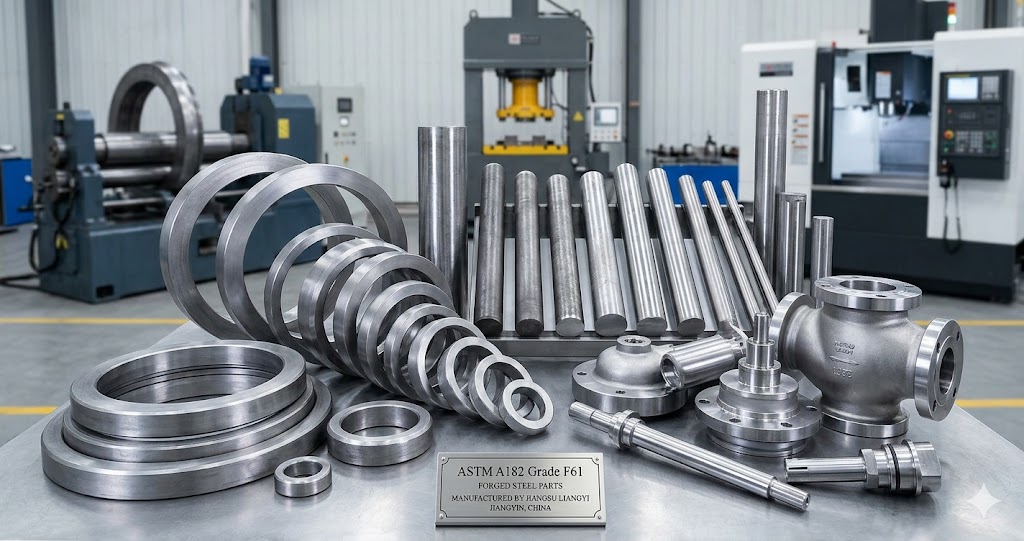
Comprehensive Range of ASTM A182 Grade F61 / UNS S32550 Forged Products
We offer a full range of ASTM A182 Grade F61 (UNS S32550) forged steel products in all kinds of shapes and sizes, with each piece weighing from 30 kg to 30,000 kg. UNS S32550 is the standard ASTM identification for this super duplex stainless steel, and it can be used interchangeably with A182-F61. Our modern production equipment includes 2,000–6,000 ton hydraulic presses and 5-meter seamless rolling machines, allowing us to make custom S32550 / F61 forgings that meet the strictest industry requirements.
Forged Bars & Rods
- A182-F61 Forged Steel round bars (up to 2 m diameter)
- Square bars, flat bars and rectangular bars
- Step bars and custom profiles
- Long rods are up to 15 meters in length
Seamless Rolled Rings
- ASTM A 182 F 61 seamless rolled rings (up to 6 m diameter)
- Open die forged rings and contoured rings
- Gear rings, bearing rings and flange rings
- Heavy-duty rings are up to 30 tons in weight
Hollow Forgings
- Hubs, housings and shell components
- Sleeves, bushes and bushing cases
- Hollow bars and heavy-wall cylinders (up to 3 m OD)
- Pipes, tubes and tubing for high-pressure applications
Discs, Plates & Blocks
- ASTM A182 Grade F61 forged discs and disks
- Thick plates and solid blocks
- Piping shells, casings and barrels
- Tube sheets and baffle plates for heat exchangers
Superior Properties of ASTM A182 Grade F61 / UNS S32550 Super Duplex Steel
A182-F61 (UNS S32550)is a high-performance super duplex stainless steel with excellent tensile strength, strong corrosion resistance, and reliable weldability. It is used for harsh working conditions where regular stainless steels do not last long. The UNS number S32550 reflects its normal makeup: around 25% chromium, 5.5% nickel, 3.5% molybdenum, and 2% copper.
Under ASTM G48-Method A testing, this alloy has a limiting pitting temperature (CPT) of 40 °C, which is twice as high as that of standard duplex 2205. It also resists chloride stress corrosion cracking, crevice corrosion, and pitting corrosion better than many grades, so it works very well for marine, offshore, and chemical processing uses.
Chemical Composition of ASTM A182 Grade F61 / UNS S32550
Table 1 — ASTM A182 F61 / UNS S32550 Chemical Composition (wt. %)
| Element | Weight Percentage (%) | Standard |
|---|
| Chromium (Cr) | 24.5 – 26.5 | ASTM A182 |
| Nickel (Ni) | 5.50 – 6.50 | ASTM A182 |
| Molybdenum (Mo) | 3.10 – 3.80 | ASTM A182 |
| Copper (Cu) | 1.50 – 2.00 | ASTM A182 |
| Nitrogen (N) | 0.20 – 0.25 | ASTM A182 |
| Manganese (Mn) | 0.80 – 1.20 | ASTM A182 |
| Carbon (C) | ≤ 0.025 | ASTM A182 |
| Silicon (Si) | ≤ 0.70 | ASTM A182 |
| Phosphorus (P) | ≤ 0.025 | ASTM A182 |
| Sulfur (S) | ≤ 0.005 | ASTM A182 |
| Iron (Fe) | Balance | ASTM A182 |
Mechanical Properties of A182-F61 Forged Parts
Table 2 — ASTM A182 F61 / UNS S32550 Mechanical Properties (Forged Condition)
| Property | Minimum Value | Typical Range | Test Standard |
|---|
| Tensile Strength (Rm) | 700 MPa | 700 – 900 MPa | EN ISO 6892-1 |
| Yield Point (Rp0.2) | 500 MPa | 500 – 650 MPa | EN ISO 6892-1 |
| Elongation (A) | 25% | 25 – 35% | EN ISO 6892-1 |
| Hardness (HB) | — | 220 – 270 HB | ASTM E10 |
| Impact Toughness (KV) | 40 J | 40 – 60 J | EN ISO 148-1 |
A182-F61 / UNS S32550 vs. Other Common Stainless Steels
Table 3 — Material Comparison: A182-F61 / S32550 vs. Duplex 2205 vs. Alloy 20 vs. 316L
| Property | A182-F61 | Duplex 2205 | Alloy 20 | 316L Stainless Steel |
|---|
| Yield Strength (MPa) | ≥ 500 | ≥ 450 | ≥ 240 | ≥ 170 |
| Critical Pitting Temperature (°C) | 40 | 20 | 25 | 10 |
| Chloride SCC Resistance | Excellent | Very Good | Good | Poor |
| Strength-to-Weight Ratio | Excellent | Very Good | Good | Fair |
| Relative Cost | High | Medium-High | High | Low-Medium |
Complete Physical Properties of UNS S32550 / A182-F61
Besides mechanical strength, the physical properties of UNS S32550 determine how it performs under thermal cycling, piping stress analysis, and heat exchanger design. All values given below are measured at 20 °C unless otherwise noted. For engineers ordering custom forgings, this data is essential for setting FEA boundary conditions and calculating thermal expansion in assemblies made of multiple materials.
Table 4 — UNS S32550 / A182-F61 Physical Properties (20 °C)
| Property | Value | Unit |
|---|
| Density | 7.81 | g/cm³ |
| Elastic Modulus (Young's) | 200 | GPa |
| Poisson's Ratio | 0.30 | — |
| Thermal Conductivity | 14.0 | W/(m·K) |
| Specific Heat Capacity | 480 | J/(kg·K) |
| Mean Thermal Expansion (20–200°C) | 13.0 | ×10⁻⁶ /°C |
| Mean Thermal Expansion (20–300°C) | 13.5 | ×10⁻⁶ /°C |
| Electrical Resistivity | 0.80 | µΩ·m |
| Magnetic Permeability | Ferromagnetic (ferritic phase) | — |
Note: The thermal expansion coefficient of UNS S32550 (about13.0 × 10⁻⁶ /°C) falls between that of austenitic stainless steels (around 17 × 10⁻⁶) and carbon steels (around 12 × 10⁻⁶). This makes it much easier to connect to carbon steel piping, without the large thermal expansion differences that come with using austenitic stainless steels. This is a useful design advantage that is seldom mentioned in standard material datasheets.
PREN & MARC Corrosion Resistance Indices — Calculated for F61 / S32550
Most data sheets only list a minimum PREN value. We provide both the PREN (Pitting Resistance Equivalent Number) and the less commonly known MARCindex, which includes copper — an important element in UNS S32550 / F61 that standard PREN calculations do not take into account.
Table 5 — PREN & MARC Calculation for UNS S32550 / A182-F61 (Typical Composition)
| Index | Formula | Typical Value (F61) | Super Duplex Threshold |
|---|
| PREN | %Cr + 3.3×%Mo + 16×%N | ≈ 40.5
(25.5 + 3.3×3.45 + 16×0.225) | ≥ 40 |
| MARC | %Cr + 3.3×%Mo + 20×%N + 0.5×(%Ni + %Cu) | ≈ 45.3
(25.5 + 11.4 + 4.5 + 0.5×(6.0+1.75)) | ≥ 40 |
The MARC index shows why UNS S32550 performs better than grades like SAF 2507 (UNS S32750) in sulfuric acid environments. The 1.5–2.0% copper content, which PREN does not measure, helps reduce acid corrosion in process streams with high levels of sulfuric acid. Customers in fertilizer production, phosphoric acid processing, and seawater desalination may ask us to calculate the MARC index from the actual chemical analysis of the product and add it to the MTC notes. Please include this request when placing your order.
Safe Operating Temperature Range of UNS S32550 Forgings
UNS S32550 / A182-F61 forgings are rated for continuous service from −50 °C to +300 °C. Understanding the metallurgical boundaries at each end is important for specification:
- Lower limit (−50 °C): The duplex microstructure's ferrite phase retains adequate toughness well below zero — far better than pure ferritic grades. Impact testing at −46 °C is routinely specified for Arctic and LNG-adjacent service and is available in our standard test programme.
- Upper limit (+300 °C): At temperatures above roughly 300 °C, the ferrite phase starts to form chromium-rich alpha-prime (α') particles through spinodal decomposition. This effect is often referred to as 475 °C embrittlement. Even though embrittlement is most severe near 475 °C, it can start at much lower temperatures if the material is exposed for long periods. For this reason, continuous use above 300 °C needs special approval and a revised heat treatment process.
- Sigma phase risk: If the material cools slowly through 700–900 °C during heat treatment, sigma (σ) phase may form and greatly reduce toughness and corrosion resistance. Jiangsu Liangyi uses controlled solution annealing followed by fast water quenching to avoid sigma phase formation. This is an important quality check confirmed by Charpy impact testing and ferrite scope measurement for every production heat.
International Equivalent Standards for ASTM A182 Grade F61 / UNS S32550
Buyers around the world refer to this super duplex alloy using eight different national and international standards. The table below gives a complete cross-reference, including ASTM, UNS, EN/DIN, ISO, JIS, French NF, Swedish SS, and main industry specifications. This helps purchasing teams in any country correctly identify and check the material against their local engineering codes.
Table 6 — International Equivalent Standards: ASTM A182 F61 / UNS S32550 Cross-Reference
| Standard System | Designation | Notes |
|---|
| ASTM (USA) | A182 Grade F61 | Forged / Rolled Alloy Steel Flanges, Fittings & Valves |
| UNS (USA) | S32550 | Unified Numbering System — cross-cutting all US product forms |
| EN / DIN (Europe) | 1.4507 / X2CrNiMoCuN25-6-3 | European Norm; DIN long-form name encodes Cr25-Ni6-Mo3 chemistry |
| ISO | X2CrNiMoCuN25-6-3 | ISO 15510 stainless steel composition table |
| JIS (Japan) | SUS329J4L | Japanese Industrial Standard for duplex SS; closest compositional match |
| NF (France) | Z2 CND 25-06 AZ | AFNOR designation; rarely seen outside French procurement |
| SS (Sweden) | SS 2328 | Swedish Standard; historically used in North Sea oil documentation |
| Trade / Brand Names | Ferralium® 255, DP3W, Uranus® 255 | Ferralium® 255 is a registered trademark of Langley Alloys Ltd. in the UK. Uranus® 255 is a registered trademark of Industeel / ArcelorMittal. DP3W is a trademarked name owned by Nippon Steel. We mention these brand names only to help with material cross-reference and identification. |
| NACE MR0175 / ISO 15156 | Permitted — with restrictions | Approved for sour service (H₂S environments) with hardness ≤ 36 HRC and controlled heat treatment; see Part 3 Table A.3 |
| API 6A / 6D | Material Class DD / EE / FF / HH | Commonly specified in wellhead & valve body forgings for sour service |
| DNV-GL / DNVGL-OS-B101 | Grade F — Super Duplex | needed for offshore structural and pressure-retaining forgings in North Sea |
When checking material test reports (MTRs), buyers should make sure the chemical composition shown meets the needed range for UNS S32550 / EN 1.4507.Unqualified copper content (which should be 1.5–2.0%) is the most common issue when cheaper, lower-grade duplex steel is used instead.We test and verify copper content using optical emission spectrometry (OES) on all incoming raw materials before we start production on any batch.
Heat Treatment Specifications & Metallurgical Rationale for A182-F61 / S32550 Forgings
Heat treatment for UNS S32550 is more than just a processing step. It creates the right balance between austenite and ferrite phases and removes all harmful secondary phases created during forging. Jiangsu Liangyi’s heat treatment process follows ASTM A182 requirements, is supported by published metallurgical research, and is checked for every production batch.
Solution Annealing
All A182-F61 / UNS S32550 forgings are solution annealed in the range 1,025 °C – 1,120 °C, followed by rapid water quenching. The temperature window is deliberately narrow for the following reasons:
- Below 1,025 °C: Residual sigma (σ) phase and chi (χ) phase from forging may not fully dissolve back into solution, leaving embrittling precipitates that cannot be detected by standard hardness testing alone.
- Above 1,120 °C: Austenite grain growth accelerates, reducing toughness and increasing the risk of delta-ferrite banding. Excessive ferrite (above 65%) degrades impact resistance and can promote hydrogen embrittlement in subsea (HISC-critical) applications.
- Water quench (not air cool): Air cooling alone while passing through the 700–900 °C range where sigma phase forms is not enough. A full water quench starting from above 1,025 °C is needed. Jiangsu Liangyi uses a specially designed quench tank with circulation monitoring to make sure the surface temperature of heavy forgings falls below 400 °C within 90 seconds of being submerged.
- Target ferrite content after heat treatment :40–60% ferrite by volume, For standard orders, this is checked using a calibrated ferritescope in line with EN ISO 8249. For important applications that need more volume measurements, we can also use the point-count method on metallographic samples according to ASTM E562. If you are ordering for subsea or other high-reliability applications, please include your needed ferrite content in the purchase order, and we will confirm the measurement method and reporting format when we provide the quotation.
Table 7 — A182-F61 / S32550 Heat Treatment Parameters
| Parameter | Specification |
|---|
| Solution Anneal Temperature | 1,025 °C – 1,120 °C |
| Hold Time (per 25 mm section) | Minimum 1 hour + 15 min/25 mm additional thickness |
| Quench Medium | Water (forced circulation) |
| Time to Below 400 °C (heavy sections) | ≤ 90 seconds |
| Target Ferrite Content | 40 – 60 % (volume fraction) |
| Sigma Phase Verification | Oxalic acid etch + optical microscopy (ASTM A262 Practice A) |
| Furnace Atmosphere | Air or inert gas (no carburising/nitriding atmospheres) |
Welding & Fabrication Guidelines for UNS S32550 / A182-F61 Forgings
UNS S32550 / A182-F61 can be welded easily using all common fusion welding methods, but certain parameters must be controlled to keep the balanced duplex microstructure in both the heat-affected zone (HAZ) and the weld metal. The guidance below is based on EN ISO 15614-1 qualified procedures and practical experience from assemblies using parts supplied by Jiangsu Liangyi.
Recommended Filler Metals
- GTAW / TIG: ER2594 (AWS A5.9) — the 25Cr-9Ni-4Mo-N over-alloyed wire compensates for nitrogen loss through the arc
- SMAW / MMA: E2595-XX (AWS A5.4) — coated electrode for positional welding
- GMAW / MIG: ER2594 wire with Ar + 2% N₂ shielding gas — the nitrogen addition restores phase balance in the weld pool
- SAW: It is not recommended as primary process for this grade due to higher heat input and slow cooling risk through sigma precipitation range
Critical Process Controls
- Preheat: It is not needed for sections up to 25 mm at ambient temperatures above 5 °C. Below 5 °C ambient, preheat to 20 °C minimum to prevent moisture condensation.
- Interpass temperature: Must not exceed 100 °C. This is the single most commonly violated parameter in duplex welding. Temperatures above 100 °C slow cooling through the sigma precipitation window in the HAZ, degrading corrosion resistance. Use contact pyrometers, not colour estimation.
- Heat input: The target is 0.5–2.0 kJ/mm. Low heat input maintains rapid cooling; excessive heat input risks sigma formation and ferrite content exceeding 65%.
- Shielding gas for root pass (GTAW): Ar + 2% N₂ on both shield and purge side. Pure argon purge gas causes severe nitrogen depletion and austenite loss in the root bead — a mistake common in shops experienced only with austenitic SS.
- Post-Weld Heat Treatment (PWHT): Generally, post-weld heat treatment is not needed or recommended. If solution annealing is done after welding, use the same 1,025–1,120 °C water quench process as for the base material. Stress-relief treatments at middle temperatures (such as 550–650 °C) must never be used, as this range falls directly into the sigma and alpha‑prime embrittlement zones.
HISC Risk Assessment for Subsea Applications
Hydrogen-Induced Stress Cracking (HISC) is a failure mode that only affects high-strength duplex stainless steels used in subsea applications with cathodic protection. DNVGL-RP-F112 sets the design and material requirements for HISC control in UNS S32550 parts, with main design rules including a maximum allowable design stress of ≤ 90% of the actual yield strength and a maximum ferrite content of ≤ 65%. Jiangsu Liangyi has many experience helping customers meet ferrite content limits for HISC risk reduction. We can provide multi-point ferrite mapping and full microstructure documentation when needed. Please share your specific DNVGL-RP-F112 requirements with our engineering team at the inquiry stage.
Industrial Applications & Global Project Cases of UNS S32550 / A182-F61 Forgings
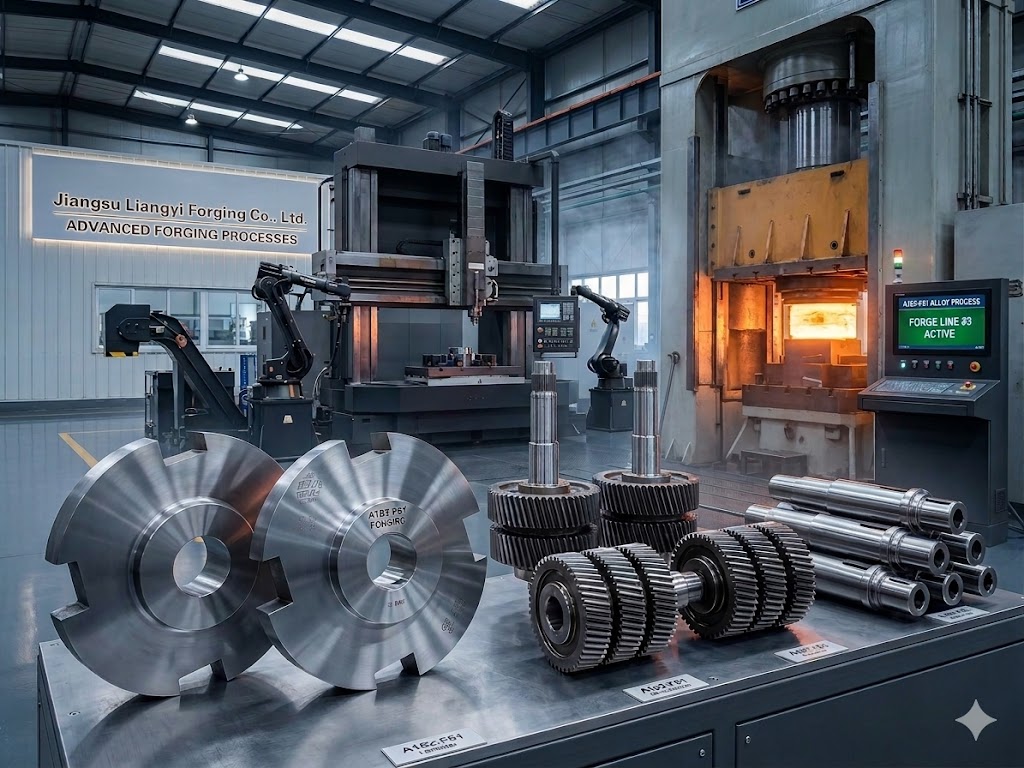
ASTM A182 Grade F61 / UNS S32550 forgings are used in industries that need materials to perform under extreme conditions. Our S32550 forgings have been successfully used in projects around the world, including oil and gas fields in the Middle East, nuclear power plants in Asia, marine installations in Europe, and mining operations in Australia.
Oil & Gas Industry
- Blowout Preventer (BOP) bodies, rams and annulars
- Subsea Christmas trees and wellhead equipment
- Casing heads, tubing heads and hangers
- Drilling pipes, drill rods and drill collars
- Risers, connectors and flexible joints
- Downhole tools and mud motor splined shafts
- Subsea flowlines and manifolds
- High-pressure valves and fittings
Project Case: Supplied A182-F61 wellhead parts for major offshore oil fields in the Persian Gulf.
Valve Manufacturing
- Valve bodies, bonnets and stems
- Valve balls, seat rings and discs
- Butterfly valve main shafts and spindles
- Gate valves, ball valves and check valves
- Cryogenic and high-performance butterfly valves
- Oil measurement valves and flow meter bodies
- Venturi cone meter bodies and blocks
Project Case: Manufactured A182-F61 valve parts for a leading European valve manufacturer serving the global oil and gas industry.
Power Generation
- Nuclear power plant critical components
- Nuclear reactor coolant pump casings
- Containment seal chambers
- Turbine and compressor components
- Labyrinth shaft seals
- Centrifugal compressor impellers
- Pressure vessels and reactor nozzles
Project Case: Supplied A182-F61 turbine parts for thermal power plants in Southeast Asia.
Process & Marine Industries
- Pump casings, impellers and shafts
- Heat exchanger tube sheets and baffles
- Chemical processing equipment
- Marine propeller shafts and components
- Desalination plant equipment
- Mining machinery components
- Pulp and paper processing equipment
Project Case: Provided A182-F61 pump parts for a large desalination plant in the Middle East.
Representative Project Scenarios: UNS S32550 / A182-F61 Forgings
Editorial note: The two examples below show the technical challenges Jiangsu Liangyi is equipped to handle, as well as how we solve problems for high‑requirement UNS S32550 / A182‑F61 orders. Dimensions, test parameters, and process details are based on our actual manufacturing capabilities. Specific client names, third‑party inspection bodies, and internal order numbers have been removed to protect commercial confidentiality. Potential customers may contact us directly for reference information.
Material: ASTM A182 Grade F61 / UNS S32550 Product Form: Seamless Rolled Ring Qty: 6 pieces Destination Region: Northwestern Europe
Background & Drawing Requirement
A subsea equipment manufacturer needed six seamless rolled rings to serve as main connector bodies for an HPHT wellhead system, designed for 15,000 psi working pressure and 177 °C (350 °F) operating temperature. The customer’s drawing specified a near-net-shape ring with a irregular outer diameter profile having two integrated machining bosses. This design removed the need for welded parts, lowering the risk of heat-affected zones in deep-sea service.
OD1,420 mm
ID980 mm
Height380 mm
Wall (min)198 mm
Unit weightapprox. 2,860 kg
Total weightapprox. 17,160 kg
Technical Challenges & Our Solutions
Challenge 1 — Tight ferrite content control (nine-point mapping per ring): The customer’s materials engineer had faced a problem with an earlier supplier: ferrite content in local areas on the outer diameter reached 68%, which exceeded the safe limit for HISC risk in subsea applications with cathodic protection.For this order, the customer required ferrite testing at nine points per ring (instead of the usual single center point), with all readings shown on the MTC and kept between 40–55%.
Our solution:We chose a certified ingot heat with nitrogen at the higher end of the UNS S32550 specification — 0.23% N, confirmed by combustion analysis. We also tightened our solution annealing temperature to 1,060 °C ± 10 °C, the narrow range that maximizes nitrogen solubility without causing austenite grain growth.Before full production, we cut a test ring from a representative billet and mapped ferrite at 25 locations, verifying consistent results between 43% and 51%.All six production rings then met the requirement: nine-point ferrite measurements all stayed within 40–55%.
Challenge 2 — 100% volumetric UT on 198 mm wall thickness: With a minimum wall thickness of 198 mm, standard 4 MHz contact ultrasonic scanning leads to excessive signal attenuation in duplex microstructures, resulting in false calls that exceed normal project acceptance limits.We qualified a 2 MHz immersion ultrasonic method using a calibration block made from extra material from the same heat. We confirmed this procedure with the customer’s designated third-party inspector before scanning any production rings.We then performed 100% volumetric testing to EN 10228-4 Quality Level 3, with no recordable flaws found on any of the six rings.
Challenge 3 — Contoured OD boss geometry on seamless rolled ring: The two circumferential raised pads — extending 30 mm proud of the outer diameter and spaced 90° apart — needed a custom contoured die set made specifically for this order. Standard cylindrical rolling dies would have produced a plain ring requiring welded bosses, which the customer had already rejected for design reasons.Tooling was completed in 18 days, a timeline clearly communicated and scheduled at the quotation stage, with no delay to the agreed delivery date.
Representative Test Results (One Ring of Six — Typical of Heat)
| Test Item | Requirement | Result Achieved | Standard | Status |
|---|
| Tensile Strength (Rm) | ≥ 700 MPa | 748 MPa | EN ISO 6892-1 | ✓ PASS |
| Yield Strength (Rp0.2) | ≥ 500 MPa | 537 MPa | EN ISO 6892-1 | ✓ PASS |
| Elongation (A) | ≥ 25% | 31% | EN ISO 6892-1 | ✓ PASS |
| Hardness (HB) | ≤ 310 HB | 248 HB | ASTM E10 | ✓ PASS |
| Impact KV (−46 °C) — 3 specimens | ≥ 40 J avg | 62 / 58 / 65 J | EN ISO 148-1 | ✓ PASS |
| Ferrite — OD surface zone | 40–55% | 47% | EN ISO 8249 | ✓ PASS |
| Ferrite — Mid-wall zone | 40–55% | 44% | EN ISO 8249 | ✓ PASS |
| Ferrite — ID surface zone | 40–55% | 49% | EN ISO 8249 | ✓ PASS |
| Sigma phase (oxalic acid etch) | None detected | None detected | ASTM A262 Prac. A | ✓ PASS |
| PREN (product analysis) | ≥ 40 | 40.8 | Calculated from MTC | ✓ PASS |
| UT Volumetric (100%) | QL3 — no recordable indications | No recordable indications | EN 10228-4 | ✓ PASS |
| PT Surface (OD + ID + faces) | No linear indications | No indications | EN 10228-2 | ✓ PASS |
All six rings passed third-party witness inspection (by the customer’s nominated agency) on the first attempt.Material Test Certificates were issued per EN 10204 3.1, with 3.2 co‑signing arranged through the customer’s appointed inspector.Nine ferrite readings per ring were all verified within the needed 40–55% range.The parts were packed in sealed VCI export crates and shipped FOB Shanghai, arriving at the destination port ahead of the contracted schedule.
📐 Drawing & Dimensional Specification
A specialized rotating equipment manufacturer needed a stepped hollow forging for a high‑performance pump shaft working under harsh process conditions.The customer specified that the bore must be made by mandrel forging — not drilling after forging — to guarantee proper grain flow perpendicular to torsional stress directions.The shaft had a large‑diameter flange at one end, tapering down to a slender journal, with a full‑length through‑bore.
Max OD (flange end)680 mm
Min OD (journal end)295 mm
Bore ID (as-forged)240 mm (tol. ±8 mm)
Overall Length2,850 mm
As-forged weightapprox. 4,120 kg
Finished weightapprox. 1,640 kg
🔧 The Three Problems We Were Asked to Solve
Problem A
Previous supplier rejected — grain size coarser than specification The customer had previously ordered this part from a European forger, whose as‑forged grain size in the flange section was ASTM 2–3 — much coarser than the needed minimum of ASTM 4.This coarse grain was caused by an insufficient total forging reduction ratio and too many reheating steps during production.The European supplier proposed re‑heat treatment to fix the issue, but the customer correctly refused: solution annealing alone cannot refine grain size in super duplex stainless steel — it only dissolves secondary phases, and cannot break up large primary austenite grains.
Problem B
Bore concentricity over 2,850 mm mandrel-forged length Keeping the bore concentric within ±5 mm TIR on a 2,850 mm stepped shaft during mandrel forging is extremely difficult.The mandrel has no fixed reference point that stays accurate through multiple press strokes and furnace reheats.Thermal distortion during heating also makes the bore drift gradually with each pass.Standard mandrel forging methods used for shorter shafts do not solve this problem at this length.
Problem C
Seven mandatory third-party witness hold points across a 14-week production window The customer’s quality plan needed an international inspection agency (nominated by the customer) to witness seven hold points — from incoming ingot inspection to final dimensional checks — with formal documentation issued at each stage before production could continue.Any failure or cancellation at a hold point would need a formal non-conformance report and root-cause analysis before the next stage could begin, making strict scheduling important to on-time delivery.
✅ How We Resolved Each Issue
Grain size (Problem A): Our forging engineer calculated the minimum total reduction ratio needed to reach ASTM No. 4–6 grain size for UNS S32550 at the 680 mm flange section, considering the original as‑cast grain structure of the billet.We used the 6,000‑ton press for the initial breakdown — a capacity large enough to get the needed reduction in one single pass, whereas the previous supplier had split it over two reheats. Each extra reheat allows partial grain recovery and reduces the refining effect from forging.A separate test piece was forged using exactly the same process as the two production shafts, then cut at three cross‑section levels. The results confirmed uniform ASTM No. 5 grain size across the entire flange area before the production shafts were approved for heat treatment.
Bore concentricity (Problem B): We designed and made a stepped mandrel guide collar, mounted to the rear end of the mandrel with only 0.3 mm diametral clearance. It was fitted before each press pass, and lateral deflection was checked against a fixed datum using a dial indicator after every pass.Any accumulated drift was corrected in the next pass before it could worsen.
Final as-forged bore TIR over the full 2,850 mm length was 3.2 mm — well within the ±5 mm drawing tolerance, leaving plenty of margin for later straightening if needed.
Hold point management (Problem C): We assigned a dedicated production controller to handle this order exclusively. Their job included arranging hold-point notifications (with at least 5 days’ advance notice), putting together full documentation packages before each inspection, and making sure the inspection room with calibrated equipment was ready when inspectors arrived.
All seven hold points were completed on time with no cancellations or rescheduling. The inspection agency issued its certificate for each stage within 3 working days.
📅 Production Milestone Record
Week 1: Checked order.The Manufacturing Process Plan (MPP) was submitted to the customer for approval.The ingot was sourced from a qualified domestic special steel mill, using an AOD + ESR melting route.Hold Point 1 (ingot incoming inspection) was scheduled with the customer’s nominated inspection agency.
Week 2: Hold Point 1 witnessed. Ingot chemistry is verified by OES: Cu 1.78%, N 0.228%, all 11 elements within UNS S32550 / ASTM A182 limits. Ingot released to forge shop.
Week 4: Completed forging (2 production shafts + 1 dissection coupon). Hold Point 2 (forge-complete dimensional check) witnessed. All OD steps, bore diameter, and overall length within as-forged tolerance per MPP.
Week 5: Solution anneal 1,065 °C / 3.5 hr soak / full immersion water quench. Hold Point 3 (furnace chart review + as-quenched hardness). Recorded hardness: 244 HB average (5 locations). Max furnace temperature deviation: ±8 °C from setpoint — within the ±15 °C MPP limit.
Week 7: Dissection coupon sectioned at three planes. Hold Point 4 witnessed. Grain size: ASTM No. 5 (flange cross-section), No. 6 (shaft body). Ferrite: 46% flange / 49% body mid. Sigma phase: none detected by oxalic acid etch. MPP approval to proceed received from customer in writing within 4 days of section examination.
Week 9–10: Performed Mechanical testing on coupons from production shaft no. 1 (tensile, impact at −46 °C, hardness at 5 locations). Hold Point 5 witnessed. All results within specification — see representative data table below.
Week 11–12: Conducted 100% volumetric UT (immersion technique, 2 MHz probe, calibrated on agreed reference block) + 100% PT on all accessible surfaces including bore. Hold Point 6 witnessed. No recordable indications on either shaft.
Week 13: Inspected final dimensions— all main dimensions per drawing are checked and recorded. Hold Point 7 witnessed. MTC per EN 10204 3.1 issued with all test data. Customer-nominated inspector co-signed documentation for EN 10204 3.2 endorsement.
Week 14: Wrapped shafts individually in VCI film, crated in timber export packaging with desiccant. Shipped FOB Shanghai. They all arrived at destination port on Day 102 from order confirmation — 5 days ahead of the contracted delivery date.
📊 Representative Test Results (Production Shaft No. 1 of 2)
Tensile Strength Rm≥ 700 MPa756 MPa✓
Yield Strength Rp0.2≥ 500 MPa544 MPa✓
Elongation A≥ 25%29%✓
Impact KV (−46 °C) — 3 specimens≥ 40 J avg / ≥ 28 J individual68 / 71 / 66 J✓
Hardness (HB) — 5 locations≤ 310 HB241 / 244 / 239 / 246 / 243 HB✓
Grain Size (ASTM E112)≥ ASTM No. 4No. 5 (flange) / No. 6 (body)✓
Ferrite Content (EN ISO 8249)40–60%46% (flange) / 49% (body)✓
Sigma Phase (ASTM A262 Prac. A)NoneNone detected✓
UT 100% volumetricNo recordable indicationsClean✓
PT 100% surfaceNo linear indicationsClean✓
Bore TIR over 2,850 mm≤ ±5 mm3.2 mm✓
Dimensions verified (total)All per drawing38 / 38 within tolerance✓
The customer approved the full qualification documentation package on first submission, with no requests for extra information or re-testing.Both shafts successfully passed all seven hold points, with zero non-conformance reports issued throughout the entire 14-week production period.
Why Choose Jiangsu Liangyi for Your A182-F61 Forging Needs
25+ Years of Forging Expertise
Since 1997, we have been manufacturing high-quality forged steel parts. Our experienced engineering team has extensive knowledge of A182-F61 material properties and forging processes.
Advanced Manufacturing Facilities
Our 80,000 m² factory in Jiangsu, China is equipped with advanced forging equipment including 6,000-ton hydraulic presses and 5-meter seamless rolling machines, allowing us to produce large and custom forgings.
Comprehensive Quality Control
We maintain strict quality control throughout the entire manufacturing process, from raw material inspection to final testing. Our testing lab has advanced NDT, chemical analysis, and mechanical testing equipment.
Global Export Experience
We send our goods to more than 50 countries, including the US, Germany, Japan, Australia, and the Middle East. We know what each market needs and can give you all the paperwork you need.
Custom Forging Solutions
We can produce custom A182-F61 forgings based on your drawings and specifications. Our engineering team works closely with you to develop the most cost-effective and reliable forging solution for your application.
Competitive Pricing & On-Time Delivery
As a direct manufacturer in China, we offer competitive pricing without compromising on quality. Our efficient production processes and large production capacity make sure all orders can be delivered on-time.
Quality Assurance & Testing Standards for UNS S32550 / A182-F61 Forgings
At Jiangsu Liangyi, quality is our top priority. All ASTM A182 Grade F61 / UNS S32550 forged parts are given rigorous testing and inspection to ensure they meet the highest industry standards and customer requirements.
Chemical Analysis
All chemical composition analyses are performed according to ASTM E354, ASTM E1473, ASTM E2465, and ARP1313 standards for trace elements including lead, bismuth, and selenium. Final product analysis conforms to the variations specified in ASTM B880.
Mechanical Testing
- Tensile testing according to EN ISO 6892-1
- Impact testing according to EN ISO 148-1
- Hardness testing according to ASTM E10
- Creep rupture testing according to ISO 204
Non-Destructive Testing (NDT)
- Ultrasonic testing (UT) per agreed specifications
- Magnetic particle testing (MT)
- Liquid penetrant testing (PT)
- Radiographic testing (RT) upon request
Metallurgical Testing
- Macroetching according to ASTM A614
- Grain size estimation according to ASTM E112
- Microstructure analysis
- Intergranular corrosion testing
All products are supplied with Mill Test Certificates (MTC) per EN 10204 3.1 as standard. EN 10204 3.2 co-signature by an independent inspection body is available when the customer nominates and arranges a third-party inspector (such as SGS, Bureau Veritas, TÜV, Intertek, or similar). Third-party inspector access and cooperation are available at no additional charge.
Manufacturing Qualification Process
Before beginning production of any new A182-F61 part, we submit a detailed Manufacturing Process Plan (MPP) to our clients' Material & Process Engineering department for approval. This plan includes comprehensive information about:
- Type of ingot (supplier, manufacturing process, dimensions, and tests)
- Detailed forging process parameters
- Heat treatment process and cycle
- Machining operations and tolerances
- All tests and inspections to be performed
We normally perform a dissection of the first piece produced to verify it meets all specifications. This step may be omitted if we have already demonstrated our ability to successfully produce parts of similar shape, dimensions, and manufacturing process for the same client.
Frequently Asked Questions (FAQ) About A182-F61 Forgings
What is UNS S32550 and is it the same as ASTM A182 Grade F61?
Yes. UNS S32550 is the ASTM Unified Numbering System designation for the same super duplex stainless steel as ASTM A182 Grade F61.Both refer to exactly the same material, with normal composition: 25% Cr, 5.5% Ni, 3.5% Mo, 2% Cu, and 0.2% N. The trade name Ferralium® 255 (Langley Alloys Ltd.) also denotes this alloy.
When purchasing forgings, UNS S32550 and A182‑F61 are fully interchangeable specifications. You will commonly see either designation used on engineering drawings, purchase orders, and material test certificates.
What is ASTM A182 Grade F61?
ASTM A182 Grade F61 is a super duplex stainless steel (UNS S32550) with high chromium (24.5–26.5%), molybdenum (3.10–3.80%) and nitrogen (0.20–0.25%).It has excellent corrosion resistance and high strength. Its minimum yield strength is 500 MPa, and the minimum tensile strength is 700 MPa. making it the best choice of material for harsh environments including offshore oil and gas, marine engineering and chemical processing.
What is the difference between A182-F61 and Duplex 2205?
A182‑F61 contains more chromium, molybdenum, and nitrogen than duplex 2205, so that it has better corrosion resistance — especially against pitting and crevice corrosion.It also has higher strength: minimum yield strength 500 MPa, versus 450 MPa for 2205.F61 has a critical pitting temperature of 40 °C, compared to 20 °C for 2205.
What are the typical applications of A182-F61?
A182‑F61 is used in oil and gas wellhead equipment, subsea parts, valves, pumps, heat exchangers, nuclear power parts, and marine hardware.It is especially well suited for applications that demand high strength and strong corrosion resistance in chloride‑containing environments.
Can you produce custom A182-F61 forgings according to our drawings?
Yes, we specialize in producing custom A182-F61 forgings according to customer drawings and specifications. Our engineering team will work closely with you to develop the most suitable forging process for your specific application.
What is the maximum size and weight of A182-F61 forgings you can produce?
We can produce A182-F61 forgings up to 30 tons in weight. Our maximum forging diameter is 2 meters for bars, 6 meters for seamless rolled rings, and 3 meters for hollow forgings. We can also produce long shafts up to 15 meters in length.
What certifications do you provide for A182-F61 forgings?
We are ISO 9001:2015 certified and supply Mill Test Certificates per EN 10204 3.1 as standard with every shipment. EN 10204 3.2 co-signature by an independent third-party inspector (such as SGS, Bureau Veritas, TÜV, or Intertek) is available when the customer nominates and arranges an inspector — we provide full cooperation and inspection room access at no additional charge.
What is the typical lead time for A182-F61 forgings?
The lead time for A182-F61 forgings depends on the clients drawings, size, and quantity of the parts. Typically, it ranges from 4 to 8 weeks for standard parts and 8 to 12 weeks for custom forgings. We will provide you with a detailed lead time estimate when you send us your inquiry.
How to Order A182-F61 / UNS S32550 Forgings from Jiangsu Liangyi
Our ordering process is designed for both experienced procurement teams and first-time buyers of super duplex stainless steel forgings. Here is exactly what happens from first contact to shipment — with realistic timelines and what we need from you at each stage.
01
Submit Your Inquiry
Send us your technical requirements by email or WhatsApp. The more detail you provide, the more accurate the quotation is. Minimum information needed: material grade (A182-F61 / UNS S32550), product form (ring / bar / disc / hollow), rough dimensions (OD × ID × height or diameter × length), quantity, and needed standard (ASTM / EN / customer spec). CAD drawings (DXF/DWG/PDF/STEP) are welcome but not mandatory at inquiry stage.
Response time: within 4 working hours (Monday–Saturday, GMT+8).
02
Technical Review & Feasibility Confirmation
Our engineering team reviews your requirements against our forging equipment capability — press capacity, ring rolling diameter limits, and heat treatment furnace dimensions. We confirm feasibility or propose nearest achievable dimensions within 24 hours. For unusual geometries, we may request a 3D model to calculate metal flow and die design before quoting.
03
Formal Quotation (Within 24–48 Hours)
Your quotation includes: unit price and total price (EXW Jiangyin or FOB Shanghai), raw material heat origin, forging process outline, heat treatment cycle, test plan with specific standards referenced, MTC type (EN 10204 3.1 standard; 3.2 with customer-nominated TPI), estimated lead time, and packaging description. Quotations are typically valid for 30 days; please confirm validity period on your specific quotation document.
04
Manufacturing Process Plan (MPP) Approval
For new part numbers or new customers, we provide a Manufacturing Process Plan. This plan lists the ingot supplier and melting process (AOD, VIM, ESR if applicable), forging reduction ratios, heat treatment cycle with furnace charts from similar past batches, and a complete testing plan. Customers who have their own Material and Process Engineering teams will review and approve this plan before we start production. This step usually takes 5 to 10 business days, depending on how long the customer needs to review it.
05
Production & In-Process Inspection
We carry out production according to the approved MPP.We can send you production milestone updates whenever you ask (ingot received → forging finished → heat treatment finished).Customer-nominated third-party inspectors such as SGS, Bureau Veritas, TÜV, Intertek or your preferred agency are welcome to visit our works at any milestone.We provide a dedicated inspection room with calibrated measuring equipment at no extra cost.
Typical production duration: For standard parts ,it is 3–6 weeks; for custom parts ,it is 6–10 weeks from order confirmation.
06
Final Inspection & Documentation Package
Before we ship any A182-F61 forging, we check it carefully against your order and the approved MPP.Each delivery comes with a full set of documents: EN 10204 3.1 MTC with real chemical and mechanical test results, dimensional inspection report, NDT reports (UT, PT/MT), heat treatment furnace chart, ferrite content report (if required), and packing list with part marking references.If you have arranged a nominated third-party inspector, we will also include the EN 10204 3.2 co-signed certificate.We email digital copies of all documents before shipment.
07
Export Packing & Shipment
We mark each forging separately with heat number, material grade (UNS S32550 / A182-F61), piece number, and weight, following ASTM A182 marking rules.Parts are packed in wooden export crates with VCI film for sea shipment, or in bubble wrap and plastic crates for air freight.We arrange full container loads (FCL) and less-than-container loads (LCL) through Shanghai or Ningbo ports, or air freight via Shanghai Pudong (PVG).Typical sea shipping time is 25–35 days to the US and Europe, and 10–15 days to the Middle East and Southeast Asia.