Forging Frac Head | API 6A Fracturing Head | Wellhead Goat Heads for Oil & Gas Christmas Tree
Jiangsu Liangyi Co., Limited is China's leading ISO 9001:2015 certified manufacturer of API 6A compliant forging frac heads, fracturing heads, and wellhead goat heads for oil & gas Christmas tree assemblies. With over 25 years of open die forging experience, we provide 10,000–20,000 psi custom wellhead components to more than 50 countries, which including the Permian Basin, North Sea, Middle East sour gas fields, and Asia Pacific shale gas projects.
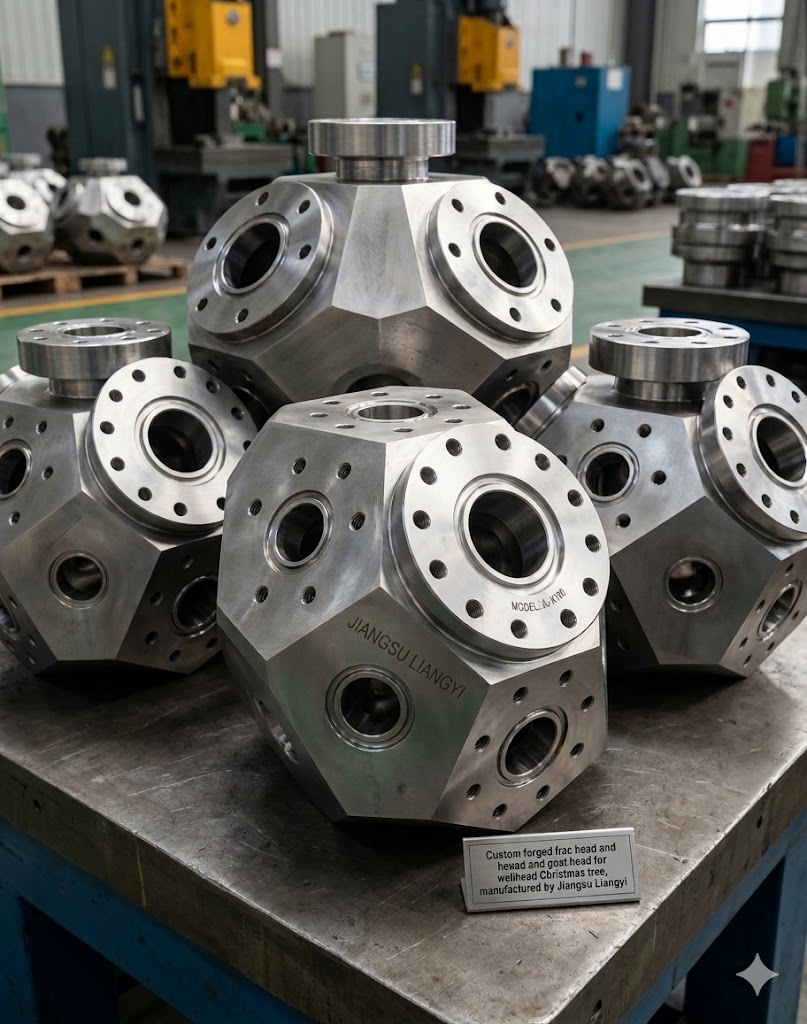
Custom API 6A compliant forging frac head and goat head for wellhead Christmas tree, manufactured by Jiangsu Liangyi
Product Overview: China Leading Forged Frac Head & Wellhead Goat Head Manufacturer
Jiangsu Liangyi Co., Limited is a leading ISO 9001:2015 certified manufacturer of high-performance forging frac head, fracturing head, and wellhead goat heads for wellhead Christmas tree and frac tree assemblies, with over 25 years of open die forging experience supporting the global oil and gas industry. Our 80,000㎡ factory has 6300T hydraulic forging presses, complete in-house heat treatment, CNC machining, and third-party certified testing facilities, it make sure that we can provide end-to-end custom solutions which from steel melting, precision forging, controlled heat treatment to final machining, all our products follow API Spec 6A international standards and client-specific drawings.
Our forged frac heads and goat heads can be used in the extreme high-pressure, corrosive, and cyclic loading conditions of hydraulic fracturing operations, we can provide track record of production in over 50 countries across North America, Europe, the Middle East, Asia Pacific, South America, and Africa. We are a trusted supplier for global oil companies, wellhead equipment integrators, and oilfield service providers.
What is a Frac Head (Goat Head) & Its Main Role in Wellhead Christmas Tree?
A goat head wellhead forging, also known as a forging frac head or fracturing head, it is a mission-critical, precision-forged flow control component of the wellhead Christmas tree and frac tree assembly. Installed as the connection of the frac tree, this engineered flow cross serves as the primary interface between high-pressure treating iron and the wellbore, where pressurized fracturing fluid, proppant, and treatment chemicals enter the frac tree to execute hydraulic fracturing operations.
Our industry-leading forged goat heads has an improved 45-degree angled inlet design, validated via CFD flow field simulation, which maximizes turbulent-free fluid flow rate, minimizes proppant erosion and pressure drop, while reducing the overall size and weight of the wellhead assembly. We provide both studded and flanged end connections that are made to fit with the interfaces of existing wellhead Christmas trees, and all our products can meet the installation needs of both onshore and offshore projects.
Why Choose Forged Frac Heads? Main Performance Advantages
The parts that used in hydraulic fracturing must be very strong to handle stress and have structural integrity. Open die forging is the best production processing for frac heads and goat heads. It is safer and works better than cast components:
Superior Structural Integrity
Our forging process uses a minimum 3:1 forging ratio to refine the steel grain structure, eliminating internal porosity, shrinkage, and inclusions common in cast parts. This process can reduce the risk of catastrophic failure under 10000-20000psi cyclic high pressure, which is a critical safety requirement for wellhead operations.
Enhanced Mechanical Performance
Forged frac heads are stronger in tension by 30-40 percent, which can affect resistance, and they last longer than cast parts. The material properties are the same throughout the entire forging. Our controlled heat treatment process gives you the perfect balance of hardness (22–32 HRC) and toughness at low temperatures, making it great for use in the Arctic and in deep water.
Superior Corrosion & Erosion Resistance
Uniform, refined grain structure from forging improves resistance to sulfide stress corrosion cracking (SSCC) in sour gas environments and proppant erosion during continuous fracturing operations. Compared to standard designs, our CFD-optimized inlet design cuts erosion rates by another 30%.
Complete Material Traceability
Our forged frac heads have 100% batch traceability from raw steel melting to final inspection, according to API 6A PSL1-PSL4 requirements for offshore and critical well applications. We provide complete EN10204 3.1/3.2 Mill Test Certificates (MTC) with every order.
Four Forging Frac Head Series: Matched to Your Well Conditions
Not every frac head faces the same battlefield. A 10,000psi onshore shale well in the Permian Basin has fundamentally different demands from a PSL4 sour-service deepwater riser in the North Sea. We produced four distinct series — each metallurgically and geometrically improved for its operating environment — so you are never paying for capability you don't need, or under-specifying for conditions that could cost you a well.
Onshore Shale & Conventional Wells
Ultra-Deep & Multi-Stage Fracturing
H₂S / CO₂ Corrosive Gas Fields
Deepwater & Subsea Christmas Tree
Complete Technical Specifications — API 6A Forging Frac Head & Wellhead Goat Head
All parameters below are customizable. The table represents our standard configurable range; non-standard combinations are evaluated case-by-case by our engineering team at no charge.
| Parameter | Standard Range | Extended / Custom | Governing Standard |
|---|---|---|---|
| Rated Working Pressure | 10,000 psi / 15,000 psi | Up to 20,000 psi | API Spec 6A 20th Ed. |
| Bore Size (Nominal) | 2⅛" – 7⅛" (API nominal) | Custom per drawing | API 6A Table E.1 |
| Inlet Angle | 45° (standard goat-head) | 30° / 60° / 90° custom | Client drawing / CFD validated |
| End Connections | API 6BX Studded / Flanged | API 6B, NPT, BSP, Hammer Union, Weld Neck | API 6A / ASME B16.5 |
| Outlet Ports | 2 × 45° angled inlets (standard) | 4-outlet / 6-outlet custom cross | Client drawing |
| Temperature Class | L (–46°C to 82°C), N (–46°C to 60°C) | K (–60°C), P (–29°C to 121°C), T, U, V (to 180°C) | API 6A Table 1 |
| Material Class | AA, BB, CC, DD | EE, FF, GG, HH (sour/offshore) | API 6A Annex F |
| PSL Level | PSL1, PSL2 | PSL3, PSL3G, PSL4 | API 6A Section 5 |
| Sealing System | BX / RX Ring Joint Gasket | CIW, Grayloc, custom metal-to-metal | API 6A / Client spec |
| Working Medium | Oil, gas, frac fluid, proppant slurry | H₂S / CO₂ sour service, brine, geothermal | NACE MR0175 / ISO 15156 |
| Hardness (Body) | 22–32 HRC (Rockwell C) | NACE cap ≤22 HRC for sour service | NACE MR0175 |
| Surface Finish (Sealing) | Ra ≤ 0.8 µm (seal grooves) | Ra ≤ 0.4 µm (ultra-tight sealing per client) | API 6A / Client drawing |
| Flange Face Flatness | ≤ 0.02 mm | ≤ 0.01 mm (precision machining) | Client drawing / CMM verified |
| Max Single-Piece Weight | Up to 15 tonnes | Up to 30 tonnes (6300T press) | N/A |
| MTC / Certification | EN10204 3.1 | EN10204 3.2 (with TPI witness) | EN10204 / API 6A |
| Delivery Lead Time | 25–30 working days (standard custom) | 15 working days (expedited) | From drawing approval |
Full Technical Specifications of Our API 6A Compliant Wellhead Goat Heads
All our forging frac head, fracturing head, and wellhead goat heads are produced according to the latest API Spec 6A 20th Edition standards, with complete customizable specifications to meet the unique requirements of your wellhead project. Main technical parameters include:
Rated Working Pressure
Standard range 10000 ~ 15000psi, with custom high-pressure options up to 20000psi available for ultra-deep well and high-pressure fracturing applications, 100% according to API 6A pressure rating standards.
Compatible Working Medium
Engineered for complete compatibility with oil, natural gas, water-based/oil-based fracturing fluid, proppant-laden slurry, brine, and sour service media with H2S and CO2 content, suitable for all conventional and unconventional oil & gas operations.
Operating Temperature Range
Standard rating: −46°C ~ 121°C (LU), with extended temperature ratings available from K (−60°C) to U (180°C) for arctic, deepwater, and high-temperature geothermal well applications, according to API 6A temperature class standards.
Material & Performance Ratings
- Material Class: AA ~ HH, compliant with API 6A requirements
- Product Specification Level (PSL): PSL1 ~ PSL4, with complete traceability for PSL4 offshore projects
- Temperature Rating Classes: K, L, N, P, R, S, T, U, V
Premium Material Grades & Melting Processes for All Oilfield Environments
We provide a complete range of industry-proven material grades for our forging frac head and wellhead goat heads, all according to ASTM, AISI, API, NACE MR0175/ISO 15156, and EN international standards, with complete EN10204 3.1/3.2 Mill Test Certificates (MTC) provided for every order.
Available Material Grades
- Carbon & Low Alloy Steel (Standard Onshore Shale Gas Applications): AISI 4130, AISI 4140, AISI 4340, AISI 4330V mod, AISI 4145H mod, AISI 8620, AISI 8630, ASTM A694 F52, F60, F65, F70
- Stainless & Precipitation Hardening Steel (Moderate Corrosion-Resistant Applications): AISI 410SS, 17-4PH, 15-5PH, A182 F6NM, A182 F51 (2205 Duplex), A182 F53 (2507 Super Duplex), A182 F44, A182 F55, A182 F61, A182 F60
- Chrome-Moly Alloy Steel (High-Temperature/High-Pressure Applications): A182 F11, A182 F22, A182 F91
- Nickel-Based Super Alloys (Severe Sour Service/Offshore Deepwater): Inconel® 625, Inconel® 718, Inconel® 725, Inconel X750, Incoloy® 925, Incoloy® 945, Monel® 400, Monel® K500
Advanced Melting & Refining Processes
To make sure maximum material purity, uniformity, and corrosion resistance for critical wellhead applications, all steel is produced via the Electric Furnace process with Vacuum Degassing (EFVD). For high-demand sour production, offshore, and arctic applications, we also provide Vacuum Induction Melting (VIM), Vacuum Arc Remelting (VAR), and Electro Slag Remelting (ESR), which can reduce non-metallic inclusions and improve material toughness and corrosion resistance.
The Three Ways a Frac Head Fails in the Field — And How Forging Stops All Three
Most pages for products will only show their certifications. We think our clients should know exactly what threatens their frac head at 2:00 AM during a multi-stage completion job and why the metallurgical choices we made at the forging press get rid of those threats at the source. Based on 25 years of feedback from the field, our engineering team has looked at these three ways that things can go wrong and how our forging process stops each one.
Failure Mode 1 — Proppant Erosion & Hydraulic Gouging
The most common failure mode in high-cycle, high-rate fracturing operations
Failure Mode 2 — Sulfide Stress Corrosion Cracking (SSCC)
The silent failure: no warning signs until catastrophic fracture
Failure Mode 3 — High-Cycle Pressure Fatigue Cracking
Invisible cumulative damage from pressure cycling across thousands of fracturing stages
End-to-End In-House Manufacturing & Precision Machining Capabilities
We provide complete in-house production for our forging steel wellhead Christmas tree frac heads, this can reduce third-party quality risks and make sure complete control over every production stage. Our manufacturing process is ISO 9001:2015 certified, with strict quality control at every step:
- Drawing Review & Engineering Design: Our engineering team will provide free technical review of client drawings, material selection and forging process design
- Steel Melting & Raw Material Inspection: We always do full chemical composition analysis and raw material testing before forging.
- Precision Open Die Forging: We have 2000T/4000T/6300T hydraulic forging presses, with minimum 3:1 forging ratio to make sure grain refinement.
- Controlled Heat Treatment: We have 10+ computer-controlled heat treatment furnaces, which can make sure precise quenching, tempering, normalizing, and solution annealing to get targeted mechanical properties.
- High-Precision CNC Machining: We have multi-axis CNC machining centers, vertical/horizontal boring mills, capable of achieving ultra-tight tolerances: flange face flatness ≤0.02mm, seal groove surface finish Ra 0.8µm, which can make sure perfect fit and no leakage.
- Multi-Stage Quality Inspection & Testing: We can do complete NDT testing, mechanical property testing, and dimensional verification for every batch.
Our facility can produce single-piece frac head forgings with the weight up to 30 tonnes, our standard delivery lead time is 25-30 days for custom products, and 15-day expedited delivery available for urgent oilfield projects.
Strict Quality Control & Non-Destructive Testing (NDT) Protocols
Every finished forging frac head and wellhead goat head undergoes rigorous, multi-stage quality inspection and testing before delivery, which can make sure no defects and following API 6A and client specifications.
Core Production & Testing Standards
- ASTM A370 - Mechanical Testing of Steel Products
- ASTM A668 - Carbon and Low Alloy Steel Forgings for General Industrial Use
- ASTM A788 - General Requirements for Steel Forgings
- ASTM E23 - Notched Bar Impact Testing
- ASTM E45 - Determination of Steel Inclusion Content
- ASTM E112 - Determination of Average Grain Size
- ASTM A388 - Ultrasonic Testing of Steel Forgings
- NACE MR0175/ISO 15156 - Sour Service Material Standards
Comprehensive Pre-Delivery Inspection
- Non-Destructive Testing (NDT): 100% Ultrasonic Testing (UT) for internal defects, Magnetic Particle Testing (MT) for surface cracks, Liquid Penetrant Testing (PT), and Radiographic Testing (RT) for complex geometries.
- Mechanical Property Testing: Tensile strength, yield strength, elongation, hardness, and Charpy V-notch impact testing at both ambient and low temperatures, verified for every batch.
- Material Verification: We can provide complete chemical composition analysis via optical emission spectrometry (OES), and PMI testing for alloy and stainless steel grades.
- Dimensional & Visual Inspection: Complete dimensional verification using CMM equipment, and surface finish inspection to meet drawing requirements.
- Hydrostatic Pressure Testing: Optional hydrostatic pressure testing up to 1.5× rated working pressure, available on client request.
Third-Party Inspection (TPI) & Witness Testing
For material witness testing, in-process inspection, and final release inspection, we work with third-party inspection agencies that the client chooses. For orders with standard delivery windows, our QC team plans the ITP (Inspection and Test Plan), hold points, and TPI without adding any extra lead time. We often work with the following approved TPI agencies:
The standard MRB (Mill Record Book) delivered with every order includes: EN10204 3.1/3.2 Mill Test Certificates (MTC), Certified Material Test Reports (CMTR), NDT reports for all applicable methods, dimensional inspection reports with CMM data, heat treatment records with temperature logs, Certificate of Conformance (CoC), and hydrostatic test records where applicable. PSL4 orders include a complete traceability dossier from steel melt heat number to finished forging identification.
Field-Proven Performance: Real Project Case Studies
It's easy to write numbers on a product page. The following are real supply cases from our 25 years of field work, each with a real engineering problem, a specific solution we came up with, and a measurable result that our clients confirmed in writing.
High-Cycle Fatigue Challenge in 1,500-Well Multi-Stage Completion Program
An independent E&P operator running a 1,500-well pad drilling program in the Midland Basin was experiencing frac head body fatigue cracking at the inlet boss root radius after an average of 180 fracturing stages per well — well below their 250-stage design target. Post-failure metallurgical analysis by their third-party lab confirmed crack initiation at subsurface shrinkage microporosity in their existing cast supplier's components. Their completion schedule was at risk.
We redesigned the inlet boss geometry by using FEA (Finite Element Analysis) to reduce the stress concentration factor Kt from 2.8 to 1.6 by increasing the transition fillet radius. We specified AISI 4340 (EFVD) forged at 4.5:1 forging ratio — 50% above our standard minimum — to completely eliminate subsurface micro-porosity. Final heat treatment achieved 26–29 HRC with Charpy impact energy of 85J at −29°C, which exceeding the client's 60J specification by 42%.
PSL4 Deepwater Goat Head for Extreme Cold & Corrosion Environment
A Norwegian company is working on a deepwater gas field in the Barents Sea. They needed PSL4 goat heads for their subsea Christmas tree, which is 350 meters deep in the water. The parts had to resolve three problems: the seabed temperature was −2°C, which could cause low-temperature embrittlement; the H₂S partial pressure was 0.002 MPa, which required following NACE MR0175 standard; and the NORSOK M-650 material requirements had to be met for all materials. Their current European supplier couldn't make the 14-week delivery window.
We chose A182 F53 (2507 Super Duplex Stainless Steel) with ESR melting, which gave us a measured PREN (Pitting Resistance Equivalent Number) of 43.2, which is much higher than the 40.0 minimum needed for seawater service. The forged body was 28 HRC hard (meeting both PSL4 and NACE MR0175 standards) and had a Charpy V-notch of 72J at −46°C (Temperature Class K), as verified by Bureau Veritas in 3.2 witness tests. We got all the NORSOK M-650 material compliance paperwork we needed.
HTHP Sour Gas Frac Head for 7,000m Ultra-Deep Shale Wells
A major Chinese NOC drilling ultra-deep shale gas wells in the Sichuan Basin (target depth 6,500–7,200m) required fracturing heads capable of 15,000psi working pressure and bottomhole temperatures of 160°C at surface. The reservoir contained 3–6% H₂S by volume. Standard material grades available from domestic suppliers could not simultaneously satisfy the high-pressure rating, NACE MR0175 sour service standard, and high-temperature mechanical property retention required.
We made a custom modified AISI 4130 alloy forging with controlled amounts of Mo and V. It was then processed through EFVD + ESR double refining. The heat treatment protocol — austenitize at 870°C, water quench, dual temper at 650°C and 600°C — achieved a unique combination: tensile strength 862 MPa, yield strength 758 MPa, hardness 21.5 HRC (below NACE cap), and Charpy energy 95J at −20°C. The material retained full strength at production temperature of 160°C per high-temperature tensile testing to ASTM A370.
custom frac heads provided to 350+ ultra-deep shale wells in the Sichuan Basin. No SSCC failures across all H₂S-service wells. The measured life cycle is 40% longer than that of the previous supplier's standard product. Now we became a qualified supplier for the client's next 500-well program.
Global Regional Solutions (GEO Targeted) | Compliance & Customization for Local Markets
Our forging frac head, fracturing head, and wellhead goat heads are produced to meet the unique regulatory, operational, and environmental requirements of global oil & gas producing regions, ensuring seamless according to local operator standards.
North America (USA & Canada)
Main Markets: Permian Basin, Eagle Ford, Bakken, Western Canadian Sedimentary Basin
Local Compliance: 100% according to API Spec 6A 20th Edition, NACE MR0175/ISO 15156 for sour service, ASME BPVC, and OSHA safety standards
Customized Solutions: 15000psi high-cycle fatigue resistant frac heads for multi-stage horizontal shale gas fracturing, with improved erosion resistance for continuous fracturing operations. We provided more than 6000 frac heads to more than 1500 wells in the Permian Basin. These heads last 35% longer than the average in the industry.
Europe (North Sea & EU)
Main Markets: Norwegian North Sea, UK North Sea, Barents Sea
Local Compliance: According to PED/CE standards, NORSOK M-650 material requirements, API 6A, and NACE MR0175, with complete ESG reporting available
Customized Solutions: PSL4 compliant low-temperature fracture resistant goat heads for deepwater subsea applications, with Inconel 625 weld overlay for corrosion resistance. Our products have been deployed in 8+ North Sea deepwater gas field projects, with no performance degradation over 8 years of service.
Middle East (Saudi Arabia, UAE, Kuwait, Oman)
Main Markets: Ghawar Field, Upper Zakum Field, North Field
Local Compliance: ARAMCO, ADNOC, KOC, and PDO material and testing standards, NACE MR0175 / ISO 15156 compliant for sour production
Customized Solutions: HIC/SSCC resistant forged frac heads for high H₂S/CO₂ sour gas fields, with EFVD melted modified AISI 4140 steel. We are an approved supplier for 14 onshore sour gas well projects in the UAE and Saudi Arabia and we process the parts 100% according to local operator requirements.
Asia Pacific (China, Southeast Asia, Australia)
Main Markets: Sichuan Basin, Malaysia Offshore, North West Shelf Australia
Local Compliance: CNOOC, PETRONAS, and Woodside operational standards, API 6A, and NACE requirements
Customized Solutions: High-temperature high-pressure (HTHP) frac heads for deep shale gas wells, with tropical marine corrosion resistant materials. We have provided over 4000 custom frac heads for 350+ shale gas wells in the Sichuan Basin, with a life cycle exceeding industry standards by 40%.
South America & Africa
Main Markets: Santos Basin (Brazil), Orinoco Belt (Venezuela), Niger Delta (Nigeria), Algerian Gas Fields
Local Compliance: ANP (Brazil), ENAP (Chile), SONATRACH (Algeria), NNPC (Nigeria) standards
Customized Solutions: Lower-cost, high-performance forged frac heads are used for onshore heavy oil development and offshore pre-salt projects, we can also can provide local technical support. Our products have been deployed in 5+ offshore pre-salt projects in Brazil, with 5 years of stable operation.
How to Order: The JNMT 8-Step Procurement Process — From First Email to Certified Delivery
Procurement of custom forged wellhead components have more steps than a standard catalogue purchase — and more variables than most suppliers openly document. We built our process according to one principle: no surprises. Every step below includes a defined timeline, a clear deliverable from us, and a specific responsibility for the client. You can know exactly where your order is at all times.
Initial Inquiry Submission
Send your inquiry to the email address sales@jnmtforgedparts.com with: product name, rated pressure, bore size, material requirement, quantity, required delivery date, and any existing drawings or datasheets. Our 24/7 monitored inbox makes sure you receive an acknowledgement within 1 working hour during business days (GMT+8).
Free Engineering Review & Technical Clarification
Our application engineering team reviews your drawings and specifications, flags any technical ambiguities (tolerance conflicts, material availability, PSL compliance gaps), and returns a written Technical Clarification Report to you. This step prevents costly mid-production change requests and is provided at no charge regardless of whether you proceed with an order.
Formal Quotation & Delivery Schedule
When the drawing is approved, we send a formal quote that includes the unit price, total price, incoterms (FOB Shanghai / CIF destination / DDP), confirmed delivery lead time, payment terms, and a complete list of the certification documents that will be sent. Quotes are good for 30 days and come with a line-by-line statement of compliance with your specifications.
Contract, ITP & Production Schedule Release
Once the order confirmed by us, we will issue: a formal sales contract, an Inspection and Test Plan (ITP) identifying all hold points and witness test requirements, and a master production schedule with milestone dates for material procurement, forging, heat treatment, machining, NDT, and final inspection. The ITP is reviewed and signed by the client or their nominated TPI agency before production begins.
Material Procurement & Incoming Inspection
We get steel from our qualified mill supply chain that has the right heat number. Before our production, every incoming material is checked for its complete chemical composition by using optical emission spectrometry (OES), its hardness, and its inclusion content. At this point, rejecting the material is not acceptable, even though it is rare. The client is told right away about other heat options.
Forging, Heat Treatment & CNC Machining
We do all of the forging, heat treatment, and CNC machining in-house, with no subcontracting. At each milestone, the client gets an email with pictures of the production progress and a chart showing the heat treatment. The client's TPI agency needs at least three working days' notice for hold points listed in the ITP (for example, witness of forging or witness of hardness testing).
Final Inspection, NDT & Document Compilation
All finished components have 100% UT, MT/PT, dimensional CMM inspection, and mechanical test verification before the MRB (Mill Record Book) is compiled. The complete MRB is submitted to the client (and TPI agency if applicable) for review and approval before any packaging or shipment preparation begins. Final release is not issued until written client acceptance of the MRB is received.
Export Packaging, Freight & Document Dispatch
Components are packed per our export standard (see Packaging section below) and shipped with a complete export documentation package. Shipping documents (commercial invoice, packing list, certificate of origin, MTC copies, CoC, and bill of lading draft) are sent to the client electronically within 24 hours of vessel departure for letter of credit compliance. Tracking information is provided in real time via our logistics partner portal.
Packaging, Export & Logistics: Zero Damage from Factory Floor to Wellsite
If packaging and shipping aren't done with the same care as production, a perfectly made frac head might not work when it gets to the wellsite. Our export packaging protocol is based on the worst-case scenario: 30 days of ocean freight to a tropical port, unloading without covered storage, and driving on unpaved oilfield roads. We follow these rules for every shipment.
Military-Spec Wooden Crate
ISPM-15 phytosanitary heat-treated timber, internally steel-banded for multi-stack stacking loads. Maximum gross weight rated for 3× overload factor during container transit.
VCI Corrosion Protection
All machined surfaces wrapped in Volatile Corrosion Inhibitor (VCI) film — NACE-approved — providing 24-month protection without surface treatment removal on installation.
Flange & Port Protection
Pressure-fitted HDPE flange protectors seal each flange face. All threaded ports are covered with plastic thread protectors that meet API standards and can be stored at temperatures up to 200°F.
Incoterms Options
We can ship to main port all over the world with FOB Shanghai, CIF destination port, or DDP (Delivered Duty Paid). Express air freight can be provided for the urgent parts that weigh less than 500 kg.
Export Documentation
All papers such as commercial invoice, packing list, MTC copies, CoC, and a dangerous goods declaration (if needed) must be given out within 24 hours of the ship leaving for L/C compliance.
Expedited Delivery
15 working-day production for urgent oilfield workover operations. We can help you process air freight for parts that weigh less than 500 kg to any airport.
Low-Carbon & ESG Manufacturing | For Global Sustainable Oil & Gas Projects
As a responsible forging company, we always use environmentally friendly methods to help the oil and gas industry meet its ESG and energy transition goals. Some of our low-carbon projects are:
- Electric arc furnace (EAF) steelmaking with 30% scrap steel recycling, which can reduce carbon emissions by 25% compared to traditional blast furnace steelmaking.
- Waste heat recovery system in our heat treatment furnaces, which can reduce natural gas consumption by 20%.
- Closed-loop cooling water system, which can achieve 95% water recycling rate.
- Complete ESG reporting available for European and North American clients, according to EU CSRD and US SEC ESG disclosure requirements.
Warranty & After-Sales Support
We guarantee that our forged frac heads and goat heads are the best in the business, and we have the best warranty and customer service:
- Standard Warranty: The standard warranty lasts for 12 months from the date of installation or 18 months from the date of shipment, whichever comes first.
- Technical Support: You can get free technical support for life, and if you have an oilfield emergency, you can get help 24/7.
- On-Site Support: For global projects, optional help with installation and commissioning is available on-site.
- Spare Parts: Fast production and delivery of spare parts for emergency workover operations.
Technical Glossary: Oil & Gas Wellhead Forging Terminology Explained
This glossary is written for procurement engineers and project managers who need to communicate with technical teams, review supplier quotations, and evaluate specifications — not just for metallurgists. Each definition includes the practical implication for your purchasing decision.
Related Products: Complete Wellhead Christmas Tree Forged Components
As a complete-range forged wellhead component manufacturer, we can provide all major forged components of the wellhead Christmas tree and frac tree assembly. Sourcing related components from a single qualified manufacturer simplifies your supply chain, which can make sure dimensional compatibility, and provide unified documentation for your project MRB.
Frequently Asked Questions (FAQ) | Forging Frac Head & Goat Heads
In the oil and gas industry, the terms "frac head," "fracturing head," and "goat head" are all used to mean the same thing: the important flow cross component that is put on top of the frac tree/Christmas tree for hydraulic fracturing operations. The term "goat head" comes from the fact that the part has a unique 45-degree angled inlet design that looks like a goat's horns.
API Spec 6A (Specification for Wellhead and Christmas Tree Equipment) is the international standard for oil and gas wellhead equipment. Wellhead frac heads and goat heads are made to this standard. Our products are completely according to the latest API Spec 6A 20th Edition. We offer PSL1-PSL4 levels to meet the needs of different projects.
Our standard forged frac heads can handle pressures between 10,000 and 15,000 psi. For ultra-deep well and high-pressure hydraulic fracturing, we can make custom high-pressure solutions that can handle up to 20,000 psi.
We specialize in custom open die forging solutions. We can manufacture frac heads, goat heads, and other wellhead Christmas tree components 100% according to your custom drawings, material specifications, and project requirements, we provide free engineering support and drawing review throughout the process.
We recommend using modified low alloy steel (AISI 4130/4140 with EFVD melting and hardness ≤22 HRC), duplex stainless steel (A182 F51/F53), or nickel-based super alloys (Inconel 625/718) for sour service wells with H₂S and CO₂ content. These materials are good for very sour environments. Based on the conditions of your well and the H₂S partial pressure data, our engineering team will help you choose the right materials for free.
Standard lead time is 25–30 working days which start from drawing approval and purchase order confirmation. For urgent oilfield workover and well intervention projects, we provide an expedited 15 working-day delivery track — available for selected material grades and standard configurations subject to forge capacity scheduling. Please tell us your urgent requirements at the time of inquiry so we can confirm expedited availability before you commit to a delivery schedule with your client.
Yes, we can support witness inspection and testing by client-nominated TPI agencies. We usually provide third-party inspection from Bureau Veritas, SGS, Intertek, TÜV SÜD, DNV GL, Lloyd's Register, and RINA, among others. An Inspection and Test Plan (ITP) which identifying all hold points ("H") and witness points ("W") is prepared and submitted to the client and TPI agency before production begins. TPI coordination does not impact our standard delivery schedule for orders with normal TPI advance notice (>3 working days per hold point).
Every order is delivered with a complete Mill Record Book (MRB) containing: EN10204 3.1 (or 3.2 with TPI witness) Mill Test Certificates (MTC) and Certified Material Test Reports (CMTR) for all raw materials; complete chemical composition reports; mechanical test reports (tensile, hardness, Charpy impact); heat treatment records with temperature charts; NDT reports (UT, MT/PT, dimensional); hydrostatic test records where applicable; dimensional inspection report with CMM data; and Certificate of Conformance (CoC) signed by our QC Manager. PSL4 orders additionally include full heat/lot traceability dossiers from raw steel melt to finished forging identification marking.
We can accept both single pieces for new project qualification and production runs of more than 500 units. But for very small orders (1–5 pieces) that need complicated materials (like ESR-melted nickel alloys), we may charge a setup cost recovery fee to cover the minimums for getting the raw materials. Our sales team will be honest with you when they give you a quote.
We have different surface treatment ways to meet the needs of storage, operation, and corrosion protection. For example, we use phosphating (zinc or manganese) to protect items stored indoors, Xylan® (PTFE-based fluoropolymer) coating to protect threaded connections from corrosion and galling, hot-dip galvanizing for outdoor storage in humid or marine environments, spray metallizing (zinc or aluminum) for long-term storage in harsh environments, and bare machined surfaces with VCI (Volatile Corrosion Inhibitor) wrap for standard export packaging. All surface treatments are applied after final inspection and dimensional verification.
We machine all major oilfield and industrial thread and connection standards: API 6B and API 6BX flanged connections (standard for wellhead and Christmas tree equipment); NPT (National Pipe Taper) and NPT Hammer Union connections for treating iron and manifold integration; BSP (British Standard Pipe) for international markets; BSPT (British Standard Pipe Taper); Weld Neck (WN) for butt-welded pipeline connections; and different proprietary premium thread connections on request. Connection standard is specified by the client in the drawing or purchase order.
Standard payment terms are 30% advance payment with purchase order confirmation, and 70% balance payment against a copy of the bill of lading (or before shipment for first-time clients). We also accept payment via confirmed Letter of Credit (L/C) at sight — all required documents for L/C compliance (commercial invoice, packing list, bill of lading, certificate of origin, MTC copies) are provided within 24 hours of vessel departure. Available incoterms include: FOB Shanghai (or Tianjin / Qingdao upon request), CIF to any named destination port, and DDP (Delivered Duty Paid) to main global ports upon arrangement.
Custom Forging Solutions & Inquiry Information
We are happy to get requests from clients all over the world for custom forging steel wellhead Christmas tree frac heads, fracturing heads, and wellhead goat heads. Please send us with your drawings, material needs, order quantity, and project specifications, our technical and sales team will give you a detailed quote and a full technical solution within 24 hours.
Trademark Notice: Special Metals Corporation (a Precision Castparts Corp company) owns the trademarks Inconel®, Incoloy®, and Monel®. Whitford Corporation owns the trademark Xylan®. We only use these trademark names to help you find the right material grades and surface treatment specifications. They don't mean that we support or are connected to the trademark owners in any way. All of Jiangsu Liangyi Co., Limited's products are made according to international standards and the drawings that provided by client.
Contact Us for a Free Quotation & Technical Support
Inquiry Email: sales@jnmtforgedparts.com
Phone/WhatsApp: +86-13585067993
Official Website: https://www.jnmtforgedparts.com
Factory Address: Chengchang Industry Park, Jiangyin City, Jiangsu Province, China 214400