AMS 6514 Forging | VIM-VAR China Manufacturer & Supplier
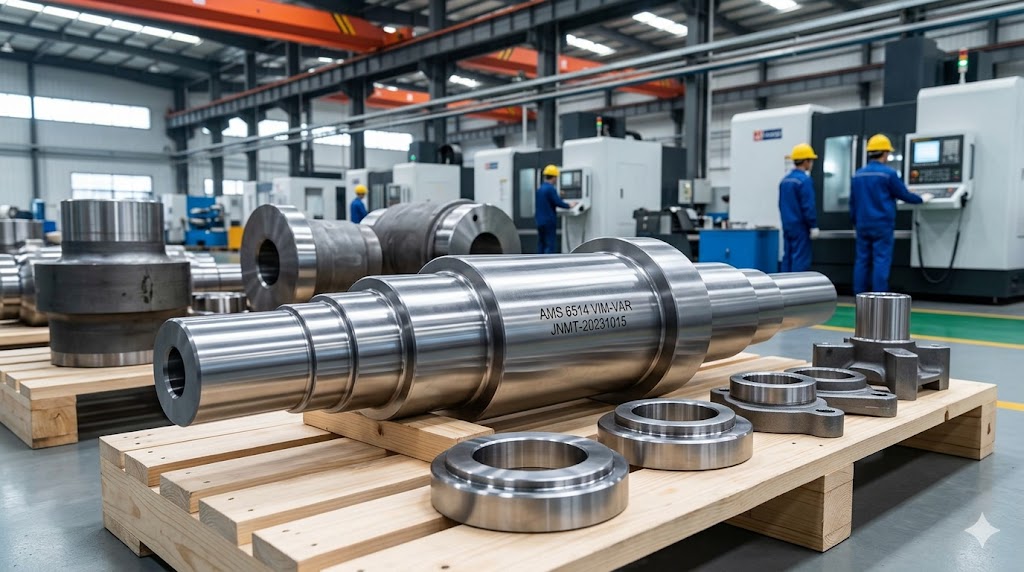
Jiangsu Liangyi Co., Limited is a professional ISO 9001:2015 certified manufacturer of AMS 6514 open die forging parts and seamless rolled rings from Jiangyin, Jiangsu, China. With over 25 years of forging experience, we deliver end-to-end AMS 6514 forging solutions — from VIM-VAR double vacuum melting, precision open die forging, controlled low-temperature aging heat treatment, through to full finish machining — fully compliant with SAE AMS 6514, ASTM A 604, API and EN international standards. Our AMS 6514 forged components serve more than 50 countries across aerospace, nuclear power, oil & gas, and power generation sectors.
What Is AMS 6514? A Deep Technical Introduction
AMS 6514 is an SAE Aerospace Material Specification that covers steel bars, billets, and forgings made from a low-carbon, nickel-cobalt-molybdenum maraging alloy — commonly referred to as 18Ni Grade 300 maraging steel — produced exclusively by vacuum induction melting followed by vacuum arc remelting (VIM-VAR). The "300" designator refers to its minimum nominal yield strength of 300 ksi in some historical classifications, though the AMS 6514 specification formally requires a 270,000 psi (1862 MPa) minimum 0.2% offset yield strength after standard heat treatment.
What distinguishes AMS 6514 from general-grade 18Ni 300 maraging steel sold under DIN 1.6358 or other national standards is not just chemistry — it is the mandatory VIM-VAR melting route, the strict macrostructure limits defined by ASTM A 604 (Severity A for freckles, white spots and radial segregation; Severity B for ring pattern), and the traceability requirements that make this material suitable for safety-critical aerospace and nuclear applications. Any producer supplying "AMS 6514" from electroslag-remelted (ESR) ingots or air-melted stock is not delivering genuine AMS 6514-compliant material.
Why VIM-VAR is non-negotiable: Maraging steels derive their strength from precipitation of intermetallic phases (Ni₃Mo, Ni₃Ti, Fe₂Mo) during low-temperature aging. These phases nucleate preferentially at grain boundaries and inclusion sites. Non-metallic inclusions, dissolved hydrogen, and macro-segregation — all suppressed by VIM-VAR — act as crack initiation points under cyclic loading. In rotating aerospace components operating at millions of fatigue cycles, even a single inclusion can trigger catastrophic fracture. VIM-VAR eliminates this risk.
AMS 6514 vs. AMS 6521 vs. AMS 6532: Choosing the Right Maraging Grade
Engineers frequently ask which VIM-VAR maraging grade is best for their application. The three primary aerospace grades differ substantially in their strength-toughness tradeoff:
| Property | AMS 6521 (18Ni 250) | AMS 6514 (18Ni 300) | AMS 6532 (18Ni 350) |
|---|---|---|---|
| Min Yield Strength | 250 ksi (1724 MPa) | 270 ksi (1862 MPa) | 350 ksi (2415 MPa) |
| Min Tensile Strength | 260 ksi (1793 MPa) | 280 ksi (1930 MPa) | 360 ksi (2483 MPa) |
| Min Elongation (4D) | 8 % | 5 % | 2 % |
| Min Reduction of Area | 40 % | 30 % | 12 % |
| Fracture Toughness KIC (typical) | ~110 MPa√m | ~75 MPa√m | ~40 MPa√m |
| Machinability (annealed) | Excellent | Excellent | Good |
| Weldability | Excellent | Excellent | Good |
| Typical Applications | High-fatigue rotors, missile structures, landing gear | Turbine impellers, valve bodies, nuclear components | Ultra-high-load bolting, pressure vessels |
| Melting Route | VIM-VAR mandatory | VIM-VAR mandatory | VIM-VAR mandatory |
Selection guidance: For most turbomachinery structural applications where both high strength and reliable fatigue life are required, AMS 6514 (18Ni 300) is the optimal choice. Select AMS 6521 when fracture toughness or low-cycle fatigue life is the controlling design criterion. Reserve AMS 6532 only for applications where design space is severely limited and extreme strength is unavoidable — its low toughness demands rigorous damage-tolerance analysis.
How AMS 6514 Compares to Other High-Strength Alloys
Procurement and design engineers regularly evaluate AMS 6514 alongside 17-4 PH stainless steel, Inconel 718, and H13 tool steel. Each has a distinct performance envelope:
| Alloy | Yield Strength | Density | Max Service Temp. | Corrosion Resistance | Weldability | Machinability | Relative Cost |
|---|---|---|---|---|---|---|---|
| AMS 6514 | 270 ksi (1862 MPa) | 8.00 g/cm³ | ~400°C (750°F) | Low (requires coating) | Excellent | Excellent (annealed) | High |
| 17-4 PH (H900) | ~170 ksi (1170 MPa) | 7.78 g/cm³ | ~315°C (600°F) | Good | Good | Good | Medium |
| Inconel 718 | ~150 ksi (1034 MPa) | 8.19 g/cm³ | ~650°C (1200°F) | Excellent | Good | Difficult | Very High |
| AMS 6532 (18Ni 350) | 350 ksi (2415 MPa) | 7.95 g/cm³ | ~400°C (750°F) | Low (requires coating) | Good | Good (annealed) | Very High |
| H13 Tool Steel | ~200 ksi (1380 MPa) | 7.80 g/cm³ | ~550°C (1020°F) | Low | Poor | Good (annealed) | Low–Medium |
The key insight from this comparison: AMS 6514 is the only alloy in this group that simultaneously delivers ultra-high yield strength (>270 ksi), excellent weldability, excellent machinability in the annealed state, and minimal post-aging distortion — making it uniquely suitable for precision high-stress components that require welded assemblies or tight dimensional tolerances after heat treatment.
Its primary limitation — relatively low corrosion resistance — is routinely addressed in service by electroless nickel plating, cadmium plating (aerospace) or physical vapor deposition (PVD) coatings, none of which degrade the underlying mechanical performance.
AMS 6514 Chemical Composition & Metallurgical Principles
Chemical Composition (Per AMS 6514 Specification)
| Element | AMS 6514 Limit | Role in Alloy |
|---|---|---|
| Nickel (Ni) | 18.00 – 19.00 % | Primary austenite/martensite former; promotes low-carbon martensite formation on cooling; enables solute precipitation during aging |
| Cobalt (Co) | 8.50 – 9.50 % | Reduces the solubility of molybdenum in martensite, accelerating Mo precipitation during aging; increases martensite start (Ms) temperature; enhances strength without embrittlement |
| Molybdenum (Mo) | 4.60 – 5.20 % | Forms the primary hardening precipitates Fe₂Mo and Ni₃Mo during aging; most critical element for ultra-high strength in this alloy system |
| Titanium (Ti) | 0.50 – 0.80 % | Forms Ni₃Ti precipitates which further contribute to age hardening; excess Ti can form TiN or TiC if nitrogen and carbon are not tightly controlled — another reason VIM is essential |
| Aluminum (Al) | 0.05 – 0.15 % | Deoxidizer during VIM; prevents Al₂O₃ inclusion formation by ensuring oxygen is scavenged before casting; minor contribution to precipitation hardening |
| Carbon (C) | 0.03 % Max | Must be minimized — carbon forms TiC which reduces the effective titanium available for Ni₃Ti precipitation and reduces toughness. VIM allows precise carbon control to <0.015% in practice |
| Manganese (Mn) | 0.10 % Max | Residual; kept low to prevent MnS inclusion formation and to avoid austenite stabilization that could inhibit full martensite transformation |
| Silicon (Si) | 0.10 % Max | Residual deoxidizer; excess causes brittle silicide phases. Tightly controlled in VIM process |
| Phosphorus (P) | 0.010 % Max | Embrittles grain boundaries; must be kept ultra-low. VIM achieves P levels typically <0.005% |
| Sulfur (S) | 0.010 % Max | Forms MnS inclusions that initiate fatigue cracks; controlled to <0.003% in high-quality VIM heats |
| Iron (Fe) | Balance | Base matrix; forms iron martensite that provides the toughness/strength foundation |
The Precipitation Hardening Mechanism of AMS 6514
Understanding why AMS 6514 achieves such extreme strength without quenching is critical for engineers specifying this alloy. The mechanism works in three stages:
Austenitization and Martensite Formation (Solution Annealing)
At 816°C (1500°F), all alloying elements dissolve into a uniform austenite solid solution. Upon air cooling (no forced quench needed), the alloy transforms to a soft, heavily dislocated iron martensite — not the brittle high-carbon martensite of tool steels. This martensite is relatively soft (28–32 HRC), highly machinable, and fully ductile. This is the optimal condition for final machining before aging.
Precipitation Aging at 482°C (900°F)
During 3–5 hours of aging, fine intermetallic precipitates nucleate and grow on the dislocation network of the martensite matrix: primarily Fe₂Mo (laves phase) and Ni₃Mo at molybdenum-rich zones, plus Ni₃Ti at titanium-enriched sites. These nanoscale precipitates — typically 2–10 nm in diameter — pin dislocation motion and create a massive obstacle to plastic deformation, raising yield strength from ~800 MPa in the annealed state to >1862 MPa after aging.
Cobalt's Synergistic Role
Cobalt does not form precipitates itself. Instead, it reduces the solubility of molybdenum in the martensite matrix, effectively "pushing" more molybdenum into precipitate form during aging. Higher precipitate density means more dislocation obstacles per unit volume — resulting in higher strength at the same aging temperature and time compared to Co-free maraging steels. This is why removing or reducing cobalt (as in some cost-engineered "maraging-type" alloys) produces a measurably lower strength result.
AMS 6514 Macrostructure Quality Requirements (ASTM A 604)
All AMS 6514 forged materials we produce undergo mandatory macrostructure inspection per ASTM A 604. Transverse cross-sections, fully etched in hot hydrochloric acid solution, are examined under controlled lighting for the following defect categories — each with a maximum severity rating:
| Defect Type | Max Severity (AMS 6514) | Origin & Implication |
|---|---|---|
| Freckles | Severity A | Caused by gravity-driven interdendritic liquid flow during VAR solidification; enriched in low-melting-point elements. Freckle stringers act as fatigue initiation sites under bending loads. |
| White Spots | Severity A | Hydrogen-induced, carbon/nitrogen-depleted zones formed during slow cooling of large VAR ingots. White spots are brittle and have catastrophically low fracture toughness — the primary reason VIM is required before VAR (VIM eliminates dissolved hydrogen at source). |
| Radial Segregation | Severity A | Compositional non-uniformity from center to edge of VAR ingot. Creates local strength and toughness gradients within a single forging, which can result in premature failure in service. |
| Ring Pattern | Severity B | Concentric segregation bands caused by arc instabilities during VAR. Less critical than white spots but can create anisotropy in large cross-sections. |
At Jiangsu Liangyi, we verify ASTM A 604 compliance on every heat lot, with photographic records retained for full traceability. Forgings that do not meet Severity A limits for freckles, white spots and radial segregation are rejected — not regraded to a lower specification.
AMS 6514 Heat Treatment: Full Process Guide & Engineering Considerations
Standard Heat Treatment Procedure
| Stage | Temperature | Holding Time | Cooling Method | Purpose |
|---|---|---|---|---|
| Solution Annealing | 816°C ± 14°C (1500°F ± 25°F) | Min. 1 hr/inch of cross-section thickness (min. 1 hour total) | Air cool or water quench | Dissolve all precipitates; achieve uniform soft martensite; relieve forging stresses |
| Aging (Precipitation Hardening) | 482°C ± 6°C (900°F ± 10°F) | 3–5 hours (3 hours standard for most sections) | Air cool | Precipitate Ni₃Mo, Fe₂Mo, Ni₃Ti; achieve full design strength |
Effect of Aging Time on Mechanical Properties
Unlike many precipitation-hardening systems, AMS 6514 reaches peak strength relatively quickly and maintains it over an extended aging window — a significant processing advantage:
| Aging Duration at 482°C | Yield Strength (typical) | Tensile Strength (typical) | Elongation (typical) | Hardness (HRC) |
|---|---|---|---|---|
| 1 hour (under-aged) | ~1600 MPa | ~1700 MPa | ~8% | ~50 |
| 3 hours (standard) | ≥1862 MPa | ≥1930 MPa | ≥5% | 52–54 |
| 5 hours (extended) | ≥1862 MPa | ≥1930 MPa | ≥5% | 52–54 |
| 12 hours (over-aged) | ~1750 MPa (decreasing) | ~1820 MPa | ~6% | 50–52 |
| 24 hours (severely over-aged) | ~1600 MPa | ~1680 MPa | ~7% | 48–50 |
Practical note for engineers: The 3–5 hour aging window at 482°C provides a robust processing range that accommodates furnace loading variations in thick cross-sections. For forgings with cross-sections exceeding 150 mm, we recommend extending aging to 5 hours to ensure that core material — which heats more slowly — receives adequate precipitation treatment throughout. Our furnace qualification records confirm temperature uniformity within ±6°C across all furnace zones, ensuring consistent properties from surface to core.
Why AMS 6514 Heat Treatment Causes Minimal Distortion
One of the most commercially important advantages of AMS 6514 is that dimensional distortion during aging is extremely small — typically less than 0.02% linear change — because:
- No martensitic transformation occurs during aging (the martensite forms during prior solution annealing air-cooling, not during aging itself)
- No water quench is required — eliminating the thermal gradient stresses that cause quench distortion in conventional alloy steels
- The aging temperature (482°C) is far below the martensite start temperature, so no phase transformation is triggered
- Volumetric changes from precipitate formation are uniform and predictable at approximately +0.06% to +0.08%
This minimal distortion means that AMS 6514 components can be machined to near-final dimensions in the annealed state and then aged to full strength with only minimal final grinding or polishing — dramatically reducing machining time and scrap rate compared to quenched-and-tempered alloy steels of similar strength levels.
Re-Aging and Repair Heat Treatment
If an aged AMS 6514 component requires rework or repair welding, it can be re-solution annealed at 816°C and re-aged without degradation — the alloy is fully regenerable. However, each re-anneal/re-age cycle should be documented in the material traceability record, as repeated thermal cycling may cause slight grain coarsening in material that was already near grain growth temperature thresholds. We recommend limiting re-heat-treatment cycles to three without additional grain size verification testing.
Full Range of AMS 6514 Forged Products & Manufacturing Capabilities
As a leading China AMS 6514 forging factory, we manufacture custom AMS 6514 forged steel products fully tailored to your 2D/3D drawings and technical requirements:
AMS 6514 Forged Bars & Rods
- Round bars, square bars, flat bars, rectangular bars and step bars
- Max forging diameter up to 2 meters; single-piece weight range 30 KGS to 30,000 KGS (30 tons)
- Available in hot forged, rough machined or finish machined condition
- Ultrasonic testing (UT) per EN 10308 or applicable standard available for all bar stock
AMS 6514 Seamless Rolled Rings
- Seamless rolled rings, contoured rings, gear rings and seal rings
- Max outer diameter up to 6 meters, max weight up to 30 tons; min ID from 300 mm
- Ring heights from 50 mm to 2000 mm; full compliance with API 6A and ASTM standards
- Near-net-shape rolling available to minimize machining allowance and material waste
AMS 6514 Forged Shafts & Spindles
- Step shafts, splined shafts, turbine shafts, valve spindles and pump shafts
- Max length up to 15 meters, max diameter up to 1800 mm
- 100% straight-beam ultrasonic testing (UT) for all shafts per customer standard
- Keyways, splines and bore features available by CNC machining after aging
AMS 6514 Custom Forged Components
- Forged discs, disks, blocks, plates and flanged components
- Hubs, housings, shells, sleeves, bushes, casings and hollow bars
- Pipes, tubes, tubings, barrels, tube sheets and baffle plates
- Complex near-net-shape forgings with precision machining to tight tolerance (IT6–IT8) available
The VIM-VAR Melting Process: Why It Defines AMS 6514 Quality
The double vacuum melting route — VIM followed by VAR — is not merely a premium option for AMS 6514; it is the defining requirement of the specification. Understanding what VIM-VAR actually achieves helps engineers assess supplier capability and reject non-compliant material claims.
Stage 1: Vacuum Induction Melting (VIM)
In VIM, carefully selected and pre-cleaned raw materials (electrolytic nickel, low-carbon iron, cobalt, molybdenum, titanium, aluminum) are charged into an induction-heated crucible inside a high-vacuum chamber (typically <10⁻³ mbar). The vacuum environment accomplishes four critical metallurgical goals:
- Degassing: Dissolved hydrogen, nitrogen and oxygen — which cause white spots, pinholes and oxide inclusions — are drawn out of the melt by the vacuum gradient. Hydrogen content achievable by VIM: typically <1 ppm versus 3–5 ppm in air-melted heats
- Precise chemistry control: Reactive alloying elements (Ti, Al) can be added without atmospheric oxidation losses, enabling tight control of Ti within ±0.05% and Al within ±0.02% of target
- Inclusion removal: Without oxygen pickup, Al₂O₃ and TiO₂ inclusions do not form. Any remaining inclusions from charge materials are held in suspension and removed by flotation to slag
- Carbon/nitrogen control: CO reaction under vacuum reduces carbon content to <0.015% without over-decarburizing — eliminating TiC formation that would otherwise sequester titanium from the precipitation hardening reaction
VIM produces a chemically homogeneous, low-gas, inclusion-controlled electrode — but the as-cast VIM electrode still contains some macro-segregation and dendritic structure that must be eliminated before forging. This is where VAR is essential.
Stage 2: Vacuum Arc Remelting (VAR)
The VIM electrode is remelted by a DC arc under vacuum in a water-cooled copper crucible. The arc progressively melts the electrode from top to bottom; the liquid metal drips into the slowly solidifying ingot below. This controlled, bottom-up solidification under vacuum achieves:
- Elimination of white spots: Directional solidification removes the steep thermal gradients that cause interdendritic hydrogen to form brittle white spot zones
- Reduction of macro-segregation: The small, controlled melt pool and controlled solidification rate minimize compositional banding and radial segregation
- Freckle control: Careful management of arc current, magnetic stirring and electrode gap prevents the gravity-driven interdendritic convection that creates freckling in large nickel-base ingots
- Consistent grain structure: Fine, directionally solidified columnar grains provide a controlled starting microstructure for subsequent forging operations
Our VIM-VAR capability at Jiangsu Liangyi: We operate dedicated VIM-VAR equipment specifically configured for the nickel-cobalt-molybdenum alloy system. Each heat is produced with full process parameter recording (vacuum level, temperature, electrode melt rate, current/voltage profile) retained as part of the material traceability package. AMS 6514 ingot diameters produced range from 400 mm to 1200 mm, supporting forgings from small billets to 30-ton components.
Stage 3: Ingot Conditioning and Forging Breakdown
After VAR, the ingot undergoes scalping (surface machining to remove surface segregation and cold shut) and is then hot forged in multiple breakdown passes. For AMS 6514, the breakdown forging temperature range is critical — too hot risks incipient melting of segregated zones (burning), too cold results in adiabatic shear bands. Our forging engineers have established AMS 6514 breakdown forging temperatures of 1100°C to 1200°C with forging completion above 900°C to guarantee complete recrystallization and removal of as-cast dendritic structure.
A minimum total reduction ratio of 4:1 (cross-sectional area reduction) is applied during forging breakdown to ensure full homogenization of the VAR structure. For critical aerospace forgings, we apply ≥6:1 reduction, verified by forging simulation prior to production and confirmed by macro-etch inspection of production coupons.
AMS 6514 Forging Manufacturing Process & Quality Control
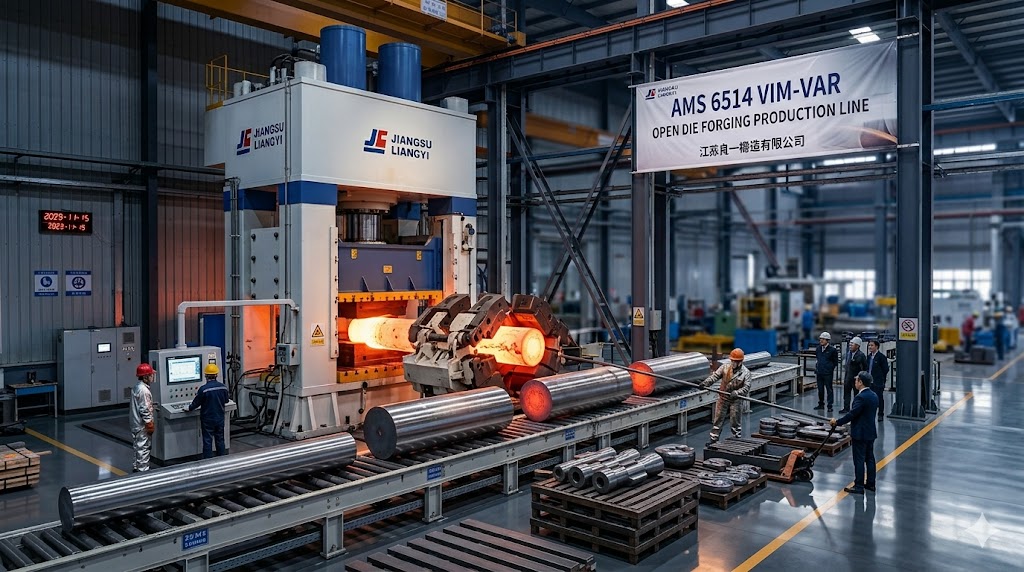
End-to-End Production Flow for AMS 6514 Forgings
Raw Material Verification & Charge Preparation
All incoming raw materials (electrolytic nickel, molybdenum rod, cobalt lumps, low-carbon iron scrap, titanium sponge, aluminum ingot) undergo incoming chemical analysis by optical emission spectroscopy (OES) and X-ray fluorescence (XRF) before any heat is charged. Trace element limits for P, S, Cu, Sn, As, Sb are verified to ensure no harmful residuals enter the melt. Charge sheets are calculated to hit AMS 6514 mid-specification targets — not specification limits — providing safety margin against heat-to-heat variation.
VIM Melting
Charge melting, refining, and alloying addition under vacuum (<5×10⁻³ mbar). Melt temperature and hold time are controlled to ensure full dissolution of Mo and Co. Final chemistry is sampled by vacuum pin sampling and verified by in-house OES before electrode casting. VIM electrodes are cast as round solid or hollow electrodes of 400–900 mm diameter depending on target ingot size.
VAR Remelting
VIM electrode is transferred to our VAR furnace. Arc current, voltage, electrode gap and magnetic stirring parameters are computer-controlled per qualified VAR procedure for each ingot diameter. Melt rate, hot topping and power-down sequence are optimized to minimize pipe depth and maximize usable ingot yield. Full VAR process parameter records are retained per heat.
Ingot Conditioning
VAR ingots are inspected, scalped by CNC turning (minimum 20 mm depth), and top/bottom cropped per established discard ratios to remove the pipe cavity and bottom-end segregation zones. Cropped discard weights are recorded and ratios verified against qualified procedure requirements.
Open Die Forging / Ring Rolling
Heated to 1100–1200°C in a controlled-atmosphere furnace (oxygen-monitored to prevent surface oxidation), then forged on our 2000T / 4000T / 6300T hydraulic presses or ring rolled on 1m–5m ring rolling machines. Multiple intermediate reheat passes are used for large cross-sections to maintain forging temperature above the recrystallization threshold throughout the entire deformation process. Forging ratios are logged per heat and piece.
Heat Treatment (Solution Anneal + Aging)
Performed in our heat treatment furnaces equipped with calibrated thermocouples at multiple zone positions, operated in accordance with sound pyrometry practices. Load thermocouples are used to confirm actual part temperature reaches and maintains the specification temperature for the required hold time. Full heat treatment cycle records are retained per batch.
Rough Machining
Post-heat-treatment forgings are rough machined to drawing allowance dimensions (typically 3–5 mm per surface) by CNC turning / milling centers. This step removes decarburized surface layer and forging scale, and provides a clean geometric datum for NDT inspection and final machining.
Non-Destructive Testing (NDT)
Full NDT inspection per applicable standards: immersion or contact UT (straight beam and angle beam) per AMS 2630 / EN 10308 to detect internal flaws; magnetic particle testing (MT, wet fluorescent) per ASTM E1444 for surface/near-surface cracks; dye penetrant testing (PT, Type 1 / Method C fluorescent) per ASTM E1417 for all non-magnetic surfaces or final machined profiles. All NDT is performed by qualified and experienced NDT personnel.
Mechanical Testing
Test coupons machined from representative material extensions (prolongations) per drawing or specification requirements. Testing includes: room temperature tensile (UTS, YS, El, RA), Vickers or Rockwell hardness survey (surface and cross-section), V-notch Charpy impact at room temperature and/or required test temperature, and grain size determination per ASTM E112. High-temperature tensile testing available upon request.
Final Inspection & Documentation Package
Dimensional inspection by CMM or calibrated gauging to drawing tolerances; visual inspection per relevant standard; review of all test and process records. Complete documentation package assembled: EN 10204 3.1 or 3.2 MTC, ASTM A 604 macrostructure report (with photographic evidence), NDT reports, heat treatment records, and dimensional inspection report. All records archived with full heat number and piece serial number traceability.
Full In-House Production Equipment
- Smelting: 30t Electric Arc Furnace (EAF), 30t Ladle Refining Furnace (LF), 30t Vacuum Degassing Furnace (VOD), medium-frequency induction furnaces, and dedicated VIM-VAR melting equipment for nickel-base and maraging alloys
- Forging: 2000T, 4000T and 6300T hydraulic forging presses; 1T, 3T, 5T and 9T electro-hydraulic forging hammers; 1m–5m radial-axial seamless ring rolling machines
- Heat Treatment: 10+ continuous heat treatment furnaces with independent thermocouple calibration records, operated in accordance with sound pyrometry practices to ensure temperature uniformity
- Machining: CNC turning centers up to 6m swing; 5-axis CNC milling and machining centers; deep-hole boring machines; internal/external grinding machines
- NDT Laboratory: Immersion UT tank (for bars and discs), contact UT probes, wet fluorescent MT bench, fluorescent PT inspection booth, hardness test lab with Vickers (HV5/HV10/HV30), Rockwell and Brinell testers
- Metallurgical Lab: OES spectrometer for chemistry, metallographic preparation and etching, image analysis system for grain size and inclusion rating, macro-etch inspection station
- Mechanical Testing: Universal tensile testing machine (600 kN capacity), Charpy impact tester, high-temperature furnace-attached tensile testing available up to 700°C
Common AMS 6514 Forging Challenges and How We Address Them
Forging AMS 6514 presents specific challenges that distinguish experienced producers from less capable suppliers. Our 25+ years of maraging steel forging experience has taught us how to consistently avoid the following pitfalls:
| Challenge | Root Cause | Jiangsu Liangyi Control Measure |
|---|---|---|
| Surface cracking during forging | Forging below the recrystallization temperature causes adiabatic shear and surface cracking, especially in large cross-sections that cool faster at the surface | Insulated forging dies, rapid press cycle planning, and intermediate reheats after every 3–4 press blows on large billets. Final forging temperature never permitted below 900°C. |
| White spot formation in large forgings | Residual hydrogen from VIM electrode migrating to segregated zones during slow post-forging cooling | Controlled slow cooling of large cross-sections (≥400 mm dia) after forging in insulated pits at 100–200°C/hr, followed by sub-critical anneal at 600°C before transfer to solution annealing |
| Non-uniform grain size after forging | Insufficient forging reduction or non-uniform deformation across cross-section leaves un-recrystallized coarse grains in center of heavy sections | Forging simulation (FEM) used to verify reduction ratio and strain distribution for each new forging shape before production. Minimum 4:1 reduction ratio enforced; 6:1 for critical aerospace forgings. |
| Distortion after aging | Residual forging stresses or machining stresses releasing during aging, combined with non-uniform temperature distribution in furnace load | Stress relief at 480°C for 2h after rough machining (below aging temperature to avoid partial aging); furnace load arranged with blocking to minimize sag; load thermocouples confirm uniform temperature throughout |
| UT rejection after aging (internal reflectors) | Retained porosity or micro-shrinkage from insufficient forging reduction; or hydrogen blistering in under-degassed material | VIM vacuum level <5×10⁻³ mbar enforced as process parameter; minimum forging reduction ratio verified; intermediate UT inspection in rough-machined condition before aging to catch any issues before heat treatment costs are incurred |
AMS 6514 Weldability: Practical Guide for Engineers
AMS 6514 maraging steel offers exceptional weldability — one of its most underappreciated engineering advantages. Unlike most ultra-high-strength steels that require complex preheat schedules, hydrogen management and post-weld heat treatment (PWHT) to avoid cold cracking, AMS 6514 can be welded with minimal precautions and restored to full strength with a single post-weld aging cycle.
Why AMS 6514 Is Easy to Weld
- Low carbon content (<0.03% C): Eliminates the risk of hydrogen-induced cold cracking (HAC) that plagues high-carbon martensitic steels. Carbon equivalent (CE) for AMS 6514 is effectively zero in classical Graville/Yurioka frameworks.
- No quench-sensitive martensite transformation during welding: The HAZ transforms to soft martensite naturally on air cooling — no special quench or controlled cooling required.
- Full strength recovery by post-weld aging: A single aging cycle at 482°C / 3–5 hr after welding restores full mechanical properties across the weld, HAZ and parent material simultaneously.
- Low distortion from PWHT: Because aging at 482°C causes <0.1% dimensional change, post-weld distortion is minimal — ideal for welded precision structures.
Recommended Welding Procedures for AMS 6514
| Parameter | Recommendation |
|---|---|
| Preferred Welding Process | GTAW (TIG) — best cleanliness and heat control; EBW (Electron Beam Welding) for critical aerospace joints requiring minimal HAZ width |
| Base Material Condition | Weld in solution-annealed (soft) condition where possible — avoids welding through aged material which can cause localized over-aging in the HAZ |
| Filler Material | Matching maraging 300 filler (18Ni 300 GTAW wire) preferred. Alternative: 18Ni 250 filler for slightly improved HAZ toughness at cost of small strength reduction in weld zone |
| Preheat | Not required for section thicknesses below 25 mm. For sections >25 mm, optional preheat to 100–150°C may reduce the risk of H₂ cracking from moisture in consumables or base metal surface contamination |
| Interpass Temperature | Keep below 150°C to prevent excessive softening and austenite reversion in previously deposited passes |
| Post-Weld Heat Treatment | Age at 482°C ± 6°C for minimum 3 hours, air cool. For weldments of mixed thickness, hold time should be based on the maximum section thickness (1 hr/inch minimum, 3 hr minimum total). |
| Shielding Gas | Pure argon (99.99% purity) for GTAW; ensure zero nitrogen contamination which causes porosity in maraging steels |
| Surface Preparation | Degrease and mechanically clean to bright metal within 25 mm of joint on both sides. Avoid chlorinated solvents that could leave residual halides causing stress corrosion in service. |
Rigorous Quality Inspection & Testing Procedures
Every AMS 6514 forging part we produce undergoes a structured, multi-stage inspection program ensuring full compliance with AMS 6514, ASTM A 604, and customer-specific requirements:
- Raw Material Inspection: Full chemical composition verification by OES, XRF and combustion analysis (C/S); incoming traceability review of VIM-VAR heat records
- In-Process Dimensional Inspection: Forging dimensions checked after each major forging stage against forging die drawing allowances; deviations corrected before proceeding to next stage
- Macrostructure Inspection: ASTM A 604 full cross-section macro-etch inspection on production coupons from each heat-forging lot; photographic records retained
- Non-Destructive Testing (NDT): Straight-beam and angle-beam ultrasonic testing (UT) for internal defect detection; wet fluorescent magnetic particle testing (MT) per ASTM E1444; fluorescent dye penetrant testing (PT, Type I) per ASTM E1417 for all non-magnetic or final machined surfaces; radiographic testing (RT) upon request
- Metallurgical Testing: Macro and microstructure analysis; ASTM E112 grain size determination; ASTM E45 inclusion rating; hardness survey across cross-section
- Mechanical Testing: Room temperature tensile (UTS, YS 0.2%, Elongation in 4D, Reduction of Area) per ASTM A370; V-notch Charpy impact testing per ASTM E23; micro and macro hardness per ASTM E92/E18; high-temperature tensile upon request
All AMS 6514 forging materials are supplied with complete EN 10204 3.1 or 3.2 mill test certificates (MTC). Third-party witness inspection by BV, SGS, TUV or customer-nominated inspector can be arranged upon request at any stage of production.
Industry Applications & Global Project Cases of AMS 6514 Forged Parts
Our AMS 6514 forged components are widely used in critical high-stress, high-temperature applications across global core industries, with proven project cases in more than 50 countries. Below we describe both the technical rationale for AMS 6514 selection in each industry and specific component examples from our project history.
Aerospace & Turbomachinery
In aerospace and turbomachinery, the combination of ultra-high yield strength, excellent fatigue resistance, minimal heat treatment distortion, and VIM-VAR cleanliness makes AMS 6514 the specification of choice for rotating structural components. The alloy's compliance with SAE AMS aerospace material standards provides a recognized quality baseline for customer quality assurance acceptance. Key design considerations that drive AMS 6514 selection in this sector include:
- High specific strength (strength-to-density ratio) enables weight reduction in rotating machinery where centrifugal loads are controlling design factors
- Predictable, low-distortion aging allows tight hub bore tolerances to be maintained without post-aging grinding in most applications
- Smooth forged surface and fine grain size (ASTM grain size No. 5 or finer achievable) improve high-cycle fatigue life of shroud/blade fillet transitions
Specific components we supply for this sector:
- Turbo centrifugal compressor impellers, shrouded impellers, gas compressor rotors and turbine blades
- Gas turbine LPT 1st & 2nd stage turbine casings, diaphragm nozzles and guide rings
- Labyrinth shaft seals, seal rings, packing seal diaphragms and rotor end rings
- High-strength stud bolts, fasteners and bolting for aerospace gas turbines
Project Reference: Supplied custom AMS 6514 forged turbine impellers and precision turbine casings for aerospace customers in Europe. All pieces passed 100% fluorescent PT and immersion UT to customer-specified acceptance criteria. Dimensional compliance confirmed by CMM to customer drawing tolerances.
Nuclear & Thermal Power Generation
AMS 6514's high toughness, ultra-low impurity content and proven fatigue resistance are critical for nuclear safety-class components where deterministic fracture mechanics analysis is required. The alloy's low S and P content minimizes grain boundary embrittlement under neutron irradiation — a key consideration for components installed near reactor pressure boundaries. Our power generation forgings include:
- Nuclear power reactor coolant pump (RCP) rotor impellers, casing shells and containment seal chambers
- Gas and steam turbine disks, impellers, blisks, wheel discs and blades
- Steam turbine control valves: MSV/GV/CV/CRV valve seats, cores, sleeves, spindles and bonnets; reheat valve discs
- Boiler, heat exchanger, pressure vessel and reactor components: tube sheets, nozzles and channel flanges
Project Reference: Delivered AMS 6514 steam turbine valve components and reactor coolant pump casing forgings for large-scale power plants in the Asia-Pacific region. All forgings achieved full compliance with customer NDT acceptance criteria, with EN 10204 3.1 MTC supplied as standard and third-party witness inspection arranged upon customer request.
Oil & Gas Industry
AMS 6514's ultra-high strength, corrosion resistance (when properly coated) and excellent weldability make it suitable for harsh downhole and high-pressure oilfield environments. In subsurface drilling applications, the alloy's high specific stiffness enables slimmer tool body diameters while maintaining required bending stiffness — critical in directional drilling where maximizing tool OD reduces dog-leg severity constraints. Components we supply:
- Valve balls, bonnets, bodies, stems, seat rings and discs for ball valves, check valves, gate valves and high-performance cryogenic butterfly valves
- Downhole drilling tool mud motor splined drive shafts; electrical submersible pump (ESP) motor splined shafts
- Double studded adapter flanges, oil measurement valve spools and ultrasonic flow meter bodies
- Wellhead equipment components, casing hangers and tubing heads
Project Reference: Supplied large volumes of AMS 6514 mud motor drive shafts with splined ends for a directional drilling tool OEM serving oilfield projects in the Middle East. All dimensional and mechanical requirements verified to customer acceptance standards, with on-time delivery maintained across multiple production batches.
Why Source AMS 6514 Forgings from China? And Why Jiangsu Liangyi?
Engineers and procurement managers from Western Europe, North America and the Middle East often ask us the same question: is it safe to trust AMS 6514 forgings from a Chinese manufacturer? The concern is legitimate — there are suppliers in China producing non-VIM-VAR maraging steel and labeling it as AMS 6514 compliant. Our answer is not to dismiss the question, but to explain precisely what differentiates a genuinely capable supplier from a non-compliant one.
The Real Risks — and How to Mitigate Them
| Risk | How It Manifests | Jiangsu Liangyi Countermeasure |
|---|---|---|
| Non-VIM-VAR material sold as AMS 6514 | ESR or air-melted maraging steel mislabeled; elevated H₂, inclusions, white spots detectable only by cross-section macro-etch | We provide full VIM-VAR process records (heat charge sheets, vacuum level logs, VAR current/voltage traces) as part of our MTC package — not just a chemical certificate. These records are uniquely traceable and cannot be fabricated from another supplier's material. |
| Chemistry out of specification | Mo or Ti at low end of range; reduced precipitation hardening; understrength after aging | We target mid-specification chemistry, not specification minimums. Each heat is analyzed by OES at VIM charge, before electrode casting, and on finished forging coupon — three independent chemistry verification points. |
| Heat treatment non-compliance | Under-aged at wrong temperature; furnace not properly calibrated; properties not fully developed | Furnaces equipped with calibrated thermocouples and load thermocouple use; full heat treatment cycle records with time-temperature data available for customer review. |
| NDT capability gap | Supplier lacks immersion UT or fluorescent PT; surface or volumetric defects missed | Full NDT capability in-house with qualified and experienced inspection personnel; procedures referenced to applicable international standards (EN 10308 UT, ASTM E1417 PT, ASTM E1444 MT). |
Cost and Lead Time Advantages
Compared to European or North American AMS 6514 forging sources, Jiangsu Liangyi typically delivers 30–45% lower piece prices on equivalent forgings, driven by lower energy costs, vertically integrated VIM-VAR-to-machining capability (eliminating subcontractor margins), and optimized raw material procurement at scale. Standard lead times range from 8–14 weeks for complex forgings; 4–6 weeks for standard bars and rings from pre-stocked billet. Expedited scheduling is available for urgent aerospace programs with appropriate advance notice.
All orders include full documentation — MTC, NDT reports, heat treatment records, dimensional reports — in English, enabling seamless review by your quality and engineering teams without translation bottlenecks.
Frequently Asked Questions About AMS 6514 Forged Parts
AMS 6514 is a VIM-VAR double vacuum melted, low-carbon nickel-cobalt-molybdenum maraging steel (equivalent to 18Ni Grade 300) defined by SAE Aerospace Material Specification. It delivers ultra-high yield strength exceeding 270 ksi (1862 MPa) via simple low-temperature aging at 900°F (482°C) — without quenching — with excellent ductility, fracture toughness and weldability. VIM-VAR melting ensures aerospace-grade cleanliness: ultra-low S and P, elimination of white spots, freckles and macro-segregation, and dissolved hydrogen content typically below 1 ppm.
All three are VIM-VAR maraging steels with different strength-toughness levels. AMS 6521 (18Ni 250) provides yield strength ≥250 ksi with the highest toughness (KIC ~110 MPa√m), so it is the best choice for high-fatigue applications. AMS 6514 (18Ni 300) has the best overall balance at ≥270 ksi yield with KIC ~75 MPa√m, so it is the best choice for turbomachinery and nuclear components. AMS 6532 (18Ni 350) achieves ≥350 ksi yield but with significantly reduced toughness (KIC ~40 MPa√m), so it is suitable for applications where extreme strength is the overriding requirement. All three require VIM-VAR melting and low-temperature aging heat treatment.
Jiangsu Liangyi Co., Limited is a leading ISO 9001:2015 certified AMS 6514 forging manufacturer in Jiangyin, Jiangsu, China. With over 25 years of open die forging experience, full in-house VIM-VAR melting, forging, heat treatment, NDT and machining capability, and a proven track record supplying aerospace, nuclear and oil & gas customers in 50+ countries, we offer a fully auditable, traceable supply chain. We provide complete VIM-VAR process records, full heat treatment records with calibrated thermocouple data, and EN 10204 3.1/3.2 MTC with every order.
AMS 6514 is solution annealed at 816°C ± 14°C for minimum 1 hour per inch of cross-section, then air cooled to form soft iron martensite. Aging is performed at 482°C ± 6°C for 3–5 hours (3 hours standard for most cross-sections; 5 hours for sections >150 mm to ensure core temperature soak), followed by air cooling. This produces precipitation of Ni₃Mo, Fe₂Mo and Ni₃Ti intermetallics which raise yield strength to >1862 MPa. No quench is required; dimensional change during aging is <0.1%, making it ideal for precision components. If re-heat-treatment is needed (after rework or repair welding), the full solution anneal + aging cycle can be repeated without material degradation.
VIM is required to achieve the ultra-low carbon (<0.015% achievable), dissolved hydrogen (<1 ppm), and nitrogen levels that prevent TiN/TiC formation and eliminate white spot precursors. VAR is then required to eliminate macrosegregation, freckles and residual shrinkage porosity from the VIM electrode, producing a fully homogeneous, white-spot-free ingot. ESR (electroslag remelting) achieves some inclusion removal but — critically — is conducted under a molten slag that contains oxygen: it cannot achieve the same hydrogen degassing as VAR, and it introduces higher risk of white spot formation in large ingot diameters. For small ingots (<250 mm), ESR may produce adequate results, but for the large cross-sections typical of structural AMS 6514 forgings, VIM-VAR is the only process that reliably meets ASTM A 604 Severity A limits for white spots. AMS 6514 explicitly requires VIM-VAR; ESR is not a permitted alternative.
We produce AMS 6514 seamless rolled rings with a maximum outer diameter of up to 6 meters, a minimum inner diameter of 300 mm, a maximum ring height of 2,000 mm and a maximum single-piece weight of up to 30 tons, all according to customer drawing specifications. Near-net-shape rolling is available to minimize machining allowance. All rings undergo 100% ASTM A 604 macro-etch inspection and UT examination before release.
Yes — AMS 6514 has excellent weldability due to its low carbon content (<0.03% C). Weld in the solution-annealed (soft martensite) condition using GTAW/TIG or EBW with matching 18Ni 300 filler wire and pure argon shielding. No preheat is required for sections under 25 mm. Post-weld, age the complete assembly at 482°C for minimum 3 hours, air cool. This single aging step restores full mechanical properties across weld, HAZ and base material simultaneously with less than 0.1% dimensional change — no additional straightening or machining is typically needed.
AMS 6514 provides significantly higher yield strength — 270 ksi (1862 MPa) versus ~170 ksi for 17-4 PH H900 and ~150 ksi for Inconel 718 — with better fracture toughness than 17-4 PH at equivalent strength. AMS 6514 is easier to machine in the annealed state than either alternative and has lower density than Inconel 718 (8.00 vs 8.19 g/cm³). The main tradeoffs: 17-4 PH has better atmospheric corrosion resistance (no coating needed); Inconel 718 operates at temperatures above 500°C where AMS 6514 loses strength (service temperature limit ~400°C). For structural, rotating and pressure-containing components below 400°C where maximum strength-to-weight ratio and precision are required, AMS 6514 is the superior choice.
Every AMS 6514 forging order is supplied with EN 10204 3.1 or 3.2 Mill Test Certificates (MTC) covering: chemical composition analysis (three verification points: VIM charge, pre-cast, and finished product coupon); full mechanical test results (tensile, hardness, Charpy impact); ASTM A 604 macrostructure inspection with photographic records; NDT reports (UT, MT and/or PT per applicable standard); full heat treatment records with calibrated thermocouple data. Third-party witness inspection by BV, SGS, TUV or customer-nominated inspector can be arranged upon request. We are ISO 9001:2015 certified and support customer-specific quality plans and full production documentation upon request.
MOQ of Jiangsu Liangyi is flexible from single prototype piece to mass production volume. Standard lead times — bars and rings from pre-stocked VIM-VAR billet: 4 to 6 weeks; custom open die forgings and complex shapes: 8 to 14 weeks from order confirmation. Expedited scheduling is available for urgent aerospace or critical project programs. Contact us with your drawing, material specification, quantity and required delivery date for a firm quotation and lead time commitment.
Contact Us for Custom AMS 6514 Forging Solutions from China
Jiangsu Liangyi Co., Limited — your trusted China-based AMS 6514 VIM-VAR forging manufacturer. Whether you need standard AMS 6514 bars and seamless rings, complex open die forgings, or fully finish-machined components, we deliver tailored solutions with competitive pricing, reliable quality assurance and on-time global delivery.
Send us your drawing, material specification, quantity and delivery requirement — we will respond with a detailed technical quotation within 24 hours (business days).
Inquiry Email: sales@jnmtforgedparts.com
Phone / WhatsApp: +86-13585067993 | Chat on WhatsApp
Official Website: https://www.jnmtforgedparts.com
Factory Address: Chengchang Industry Park, Jiangyin City, Jiangsu Province, China