AMS 6512 Forging Parts | China Professional VIM VAR Maraging Steel Forging Manufacturer
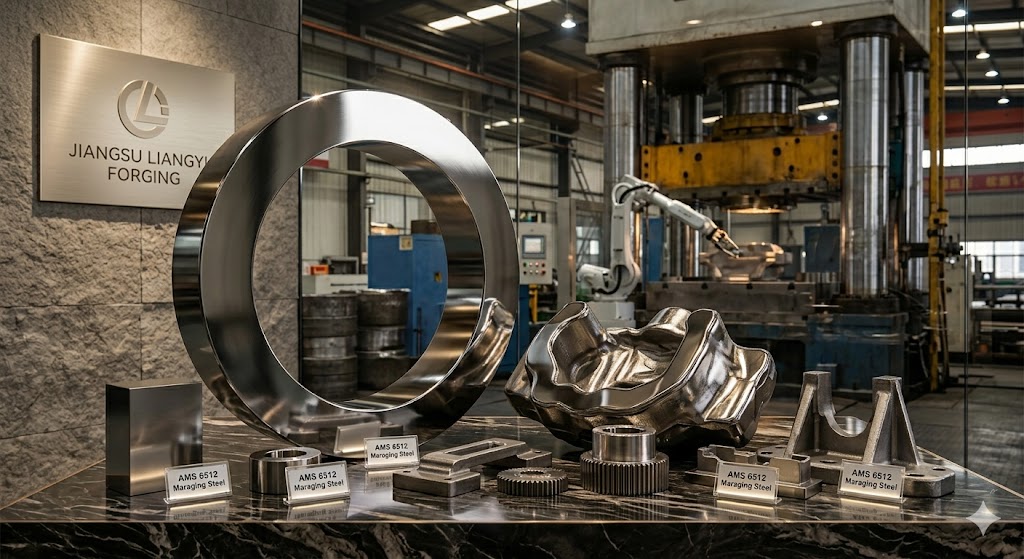
AMS 6512 Maraging Steel – Quick Reference at a Glance
| Material Standard | AMS 6512 (SAE Aerospace Material Specification) | UNS K93120 |
| Common Grade Name | 18Ni350 Maraging Steel / Maraging 350 / Vascomax 350 (C-type, highest strength grade) |
| Melting Process | VIM + VAR (Vacuum Induction Melt + Vacuum Arc Remelt, double vacuum melted) |
| Nickel (Ni) | 17.00 – 19.00 % |
| Cobalt (Co) | 7.00 – 8.50 % |
| Molybdenum (Mo) | 4.60 – 5.20 % |
| Titanium (Ti) | 0.30 – 0.50 % |
| Carbon (C, max) | 0.03 % (ultra-low carbon, non-carbide hardening) |
| Min. Ultimate Tensile Strength | 255,000 psi (1758 MPa) – after aging |
| Min. Yield Strength (0.2%) | 250,000 psi (1724 MPa) |
| Min. Elongation | 6 % (2-inch gauge length) |
| Min. Reduction of Area | 45 % |
| Annealing Temperature | 1500°F ± 25°F (816°C ± 14°C), 1 hr/inch, air cool |
| Aging Temperature | 900°F ± 10°F (480°C ± 6°C), 3 hours min., air cool |
| Annealed Hardness (typical) | RC 30–35 (~300 HB) – readily machinable |
| Aged Hardness (typical) | RC 50–52 (~520 HV) |
| Dimensional Change on Aging | +0.05 to +0.08% linear (highly predictable – no quench distortion) |
| Fracture Toughness KIC (typical) | 55–70 MPa√m (aged condition) |
| Manufacturer | Jiangsu Liangyi Co., Ltd – Jiangyin, Jiangsu, China (est. 1997) |
| Quality Certification | ISO 9001:2015 Certified (certified since 2003) | MTC available to EN 10204 3.1 / 3.2 on request |
| Forging Press Capacity | 6,300 tonne hydraulic open die forging press |
| Ring Rolling Capacity | Max OD 6,000 mm seamless ring rolling mill |
| Max Bar / Disc Diameter | 2,000 mm |
| Max Shaft Length | 15,000 mm (15 metres) |
About AMS 6512 Maraging Steel & Our Forging Capabilities
Jiangsu Liangyi Co., Limited is a professional ISO 9001:2015 certified China manufacturer and global supplier of AMS 6512 open die forging parts, seamless rolled steel forged rings and custom precision machined components. Founded in 1997 and located in Chengchang Industry Park, Jiangyin City, Jiangsu Province, we have over 25 years of uninterrupted specialty forging experience. Our Jiangyin factory supplies high-performance AMS 6512 forgings to clients in more than 50 countries across North America, Europe, the Middle East, Asia Pacific and Australia, with full in-house production capabilities spanning VIM+VAR steel melting, open die forging, seamless ring rolling, heat treatment, finish machining and comprehensive NDT — all under one roof and under one quality management system.
AMS 6512, designated as the 18Ni350 or "maraging 350" grade, is the premium member of the 18% nickel maraging steel family and the highest-strength commercially produced maraging grade. Its defining property is the unique ability to achieve 255,000 psi (1758 MPa) minimum ultimate tensile strength through a simple, low-temperature aging treatment at 480°C — without quenching, without distortion, and without the risk of hydrogen cracking that plagues conventional ultra-high-strength steels. The standard covers VIM+VAR (double vacuum melted) bar, billet and forging stock, mandating the highest melting purity achievable in commercial steelmaking. All AMS 6512 raw material procured by Jiangsu Liangyi is sourced from certified specialty steel mills with full melt traceability, chemical test reports and inclusion ratings to ASTM E45 Class 1 or better.
The Metallurgical Science Behind AMS 6512 – Why It Outperforms Conventional Steels
Understanding how AMS 6512 achieves its exceptional properties requires a brief look at its metallurgical mechanism — something that distinguishes it fundamentally from carbon steels, stainless steels and even other high-strength alloys. This knowledge directly informs how the material must be processed, forged and heat treated to realise its full potential, and why shortcuts in any step result in properties that fall short of specification.
What "Maraging" Actually Means
The term "maraging" combines martensite and aging. Unlike carbon steels where hardness comes from the distorted body-centered tetragonal (BCT) lattice of high-carbon martensite, AMS 6512 starts with a soft, body-centered cubic (BCC) lath martensite containing virtually no carbon (maximum 0.03%). This low-carbon martensite is tough, ductile and easily machinable — with a hardness of only RC 30–35 — because there is no carbon to distort the crystal lattice.
Hardening occurs not through quenching but through controlled aging (precipitation hardening) at 480°C for three hours. At this temperature, ultra-fine intermetallic precipitates — primarily Ni₃Ti, Ni₃Mo and Fe₂Mo — nucleate coherently within the martensite matrix at a scale of 5–20 nanometres. These precipitates pin dislocation movement in the matrix, raising strength dramatically. Because precipitation occurs at such low temperature, atomic diffusion distances are short, dimensional growth is only 0.05–0.08% linear, and the risk of distortion or cracking is essentially eliminated.
Why Carbon is Limited to 0.03% Maximum
The carbon ceiling of 0.03% in AMS 6512 is not arbitrary — it is metallurgically essential. Carbon in maraging steel is a tramp element, not a strengthening element. If carbon exceeds approximately 0.05%, it combines preferentially with titanium and molybdenum to form coarse TiC and Mo₂C carbides during cooling. These carbides remove titanium and molybdenum from solid solution, depleting the atoms that would otherwise form the strengthening precipitates during aging. The result is a direct loss of aged strength — sometimes by 30,000–50,000 psi — and a sharp reduction in toughness. Achieving carbon below 0.03% requires the vacuum melting conditions mandated by AMS 6512, which remove carbon through CO degassing reactions impossible in air-melted or AOD-refined heats.
Key Insight from Our Factory: In our 25+ years of forging maraging steels, the most common cause of below-specification mechanical properties in AMS 6512 is not forging practice — it is incoming material from non-compliant mills where carbon exceeds the 0.03% limit or titanium content sits at the low end of the range. This is why Jiangsu Liangyi conducts full spectrometric chemical analysis on every incoming heat before any forging work begins, rejecting any heat that does not fully comply with AMS 6512 chemistry.
The Role of Cobalt and Molybdenum
In the 18Ni350 (AMS 6512) grade, cobalt and molybdenum each play a specific and synergistic role. Cobalt (7–8.5%) reduces the solubility of molybdenum in the iron–nickel martensite matrix, which increases the driving force for Mo-rich precipitate formation during aging and accelerates the strengthening kinetics. Cobalt also raises the martensite start temperature (Ms), ensuring complete transformation to martensite on air cooling from the annealing temperature — a critical requirement for maximum aged strength. Molybdenum (4.6–5.2%) is the primary precipitation strengthener, forming Ni₃Mo and Fe₂Mo intermetallics. Together, cobalt and molybdenum explain the dramatic strength advantage of AMS 6512 (18Ni350) over the lower-grade AMS 6520 (18Ni200) and AMS 6521 (18Ni250), where cobalt and molybdenum contents are progressively lower.
Why Forging Improves Properties vs. Bar Stock
A common question from procurement engineers is whether forging AMS 6512 offers a meaningful advantage over machining from bar stock. The answer is yes, for three reasons specific to this alloy. First, the directional grain flow produced by open die forging aligns the elongated prior austenite grain boundaries and carbide stringers (even at 0.03% C, trace carbides exist) parallel to the forging axis — and therefore parallel to the primary stress direction in most rotating and pressure-retaining components. Independent fatigue testing demonstrates that AMS 6512 forgings with optimised grain flow show 20–40% higher high-cycle fatigue life compared to components machined transverse to bar grain flow. Second, the mechanical work of forging at a minimum 3:1 reduction ratio breaks down the as-cast dendritic solidification structure of the VAR ingot, homogenising chemical segregation and closing micro-porosity that persists even after VAR. Third, forging allows near-net-shape production that minimises machining of the expensively melted material, which is particularly important for large components in the 500–5000 kg range where bar stock waste would be uneconomical.
The VIM+VAR Double Vacuum Melting Process – Why It Is Non-Negotiable for AMS 6512
AMS 6512 mandates double vacuum melting via VIM (Vacuum Induction Melting) followed by VAR (Vacuum Arc Remelting) — the highest commercially available melting purity standard in steel production. Understanding what each step accomplishes clarifies why specifying anything less than VIM+VAR for AMS 6512 forgings is technically unacceptable for critical applications.
Stage 1 – Vacuum Induction Melting (VIM)
In the VIM furnace, precisely weighed raw materials — electrolytic nickel, cobalt, molybdenum, titanium, aluminium and clean iron scrap — are melted under high vacuum (typically below 1×10⁻³ torr) in an induction-heated alumina crucible at approximately 1,600°C. The vacuum environment serves five critical functions simultaneously: (1) removes dissolved hydrogen to below 2 ppm, eliminating the primary cause of delayed hydrogen-induced cracking in high-strength steels; (2) removes dissolved nitrogen to below 20 ppm, preventing TiN inclusion formation; (3) removes dissolved oxygen to below 10 ppm, preventing Al₂O₃ and SiO₂ inclusion formation; (4) enables precise control of reactive alloying elements such as titanium and aluminium, which would be lost to oxidation in an air-melted heat; and (5) allows carbon to be reduced to below 0.03% via the vacuum CO removal reaction. The VIM process produces a high-purity electrode of precise chemistry, but it solidifies in a conventional top-down manner that introduces macro-segregation and a columnar-to-equiaxed grain transition — deficiencies that the subsequent VAR step corrects.
Stage 2 – Vacuum Arc Remelting (VAR)
The VIM electrode is remelted under vacuum as a consumable electrode in a water-cooled copper crucible. A DC arc struck between the electrode tip and a molten pool in the crucible progressively remelts the electrode at a controlled rate of typically 300–600 kg/hour. Because solidification proceeds upward from the water-cooled base in a shallow, continuously replenished molten pool, dendrite arm spacing is dramatically reduced compared to conventional ingot casting, segregation is eliminated, and macro-porosity and pipe shrinkage are absent. Critically, VAR also produces a radially symmetric solidification structure with consistent chemical homogeneity from centre to surface and from top to bottom — the foundation for uniform mechanical properties throughout large forging cross-sections. The final VAR ingot — typically 400–700 mm diameter for AMS 6512 production — carries a verifiable melt record including electrode melt rate, arc voltage and current log, vacuum level and remelt weight, providing full traceability for aerospace audit requirements.
Why Some Suppliers Skip VIM+VAR: Double vacuum melting adds 15–25% to raw material cost compared to VIM-only or AOD-refined material. Some lower-cost suppliers substitute single VIM or VIM+ESR (Electro-Slag Remelting) material, falsely labelling it as "VIM+VAR equivalent." ESR, while improving homogeneity, melts under a conductive slag exposed to atmosphere and cannot achieve the hydrogen and nitrogen removal levels of true VAR. For non-critical commercial applications this may be acceptable, but for aerospace fatigue-critical parts, oil & gas pressure-retaining components and nuclear safety-related items, VIM+VAR is the only compliant option. Jiangsu Liangyi provides full melt route traceability certification with every AMS 6512 order, including VIM furnace heat records and VAR remelt records from our raw material suppliers.
Full Range of Custom AMS 6512 Forged Product Forms
We manufacture a complete portfolio of AMS 6512 forging products in custom shapes, dimensions and tolerances at our Jiangyin, Jiangsu factory, fully compliant with AMS, ASTM, ASME, EN, DIN and API industry standards. All product forms are manufactured from certified VIM+VAR AMS 6512 stock with minimum 3:1 forging reduction ratio to ensure complete breakdown of the as-cast ingot structure. Available AMS 6512 forged steel product forms include:
- AMS 6512 Forged Bars & Rods: Round bars, square bars, flat bars, rectangular bars and step bars. Maximum diameter up to 2,000 mm. Manufactured to AMS 6512 bar tolerances with straightness <1 mm/m and concentricity within 2 mm for round bars over 200 mm diameter. Fully compliant with aerospace and industrial bar specifications including ASTM A29 and AMS 2370 grain size requirements.
- AMS 6512 Seamless Rolled Forged Rings: Seamless rolled rings, contoured rings, flanged rings, gear rings and custom open die forged rings. Maximum outer diameter up to 6,000 mm, minimum wall thickness achievable 50 mm. Grain flow is circumferential by nature of the rolling process, optimising hoop-stress resistance for high-pressure valve bodies, turbine casings, bearing rings and structural flanges. Dimensional tolerance per ASTM B247 or customer drawings.
- AMS 6512 Forged Shafts & Rotors: Step shafts, gear shafts, turbine shafts, pump shafts, splined drive shafts and compressor rotors. Maximum length up to 15,000 mm and maximum forged diameter up to 1,800 mm. All shafts over 200 mm diameter are 100% UT tested per AMS 2630 for internal flaws before shipment. Grain flow is aligned longitudinally along the shaft axis, maximising torsional fatigue resistance for critical rotating applications.
- AMS 6512 Forged Hollow Components: Hubs, housings, shells, sleeves, bushes, casings, hollow bars, thick-wall cylinders, bomb casings and barrels. Produced by open die forging with a mandrel or by combined forging and deep-hole boring. Wall thickness from 20 mm to 500 mm. Preferred for valve bodies, pump housings, pressure vessel shells and defence ordnance components.
- AMS 6512 Forged Blocks & Plates: Discs, disks, blocks, plates, tooling blanks and structural forged blanks. Supplied as open die forged near-net-shape blanks to reduce machining time and cost on your floor. Maximum weight per piece up to 8,000 kg. Used for aerospace tooling master blocks, landing gear structural members, ordnance components and high-performance die and mould tooling.
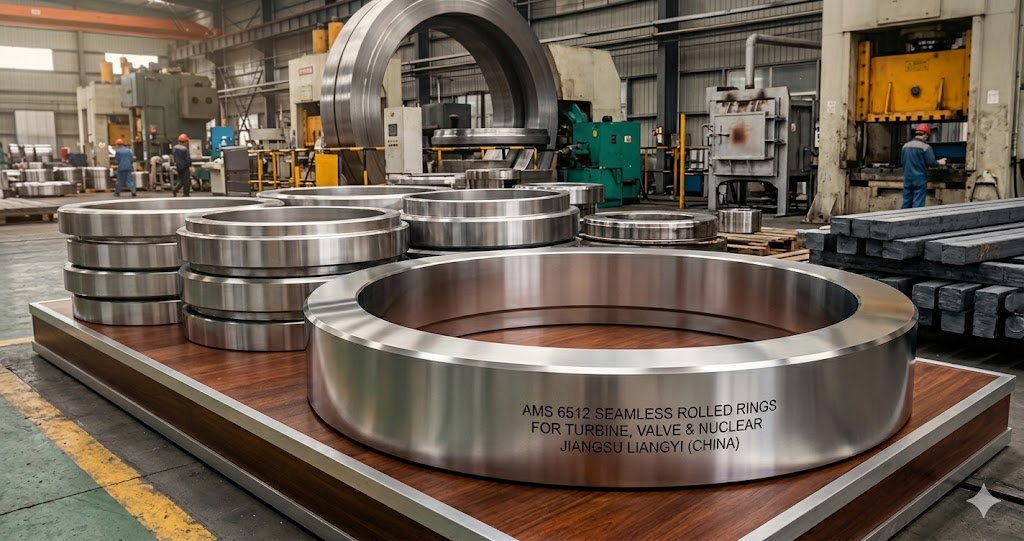
Jiangsu Liangyi's AMS 6512 Forging Process – Step by Step
The manufacture of AMS 6512 forgings demands precise control at every stage, from incoming material verification to final certification. Unlike commodity carbon steel forgings, maraging steel is sensitive to incorrect forging temperatures, insufficient reduction ratios and improper heat treatment sequences. Below is the complete production workflow followed at our Jiangyin, Jiangsu facility for every AMS 6512 forging order, developed and refined over 25+ years of specialty alloy forging experience.
- Incoming Material Verification: Every VIM+VAR AMS 6512 billet or ingot is verified against the mill certificate. Our in-house spectrometer (optical emission spectroscopy, OES) performs independent full chemical analysis of every heat before any forging work begins. Hardness is checked on both ends of each billet. Any heat with chemistry outside AMS 6512 limits — particularly carbon above 0.03% or titanium outside 0.30–0.50% — is rejected and returned to the supplier. This step, which most forging shops skip for cost reasons, is the single most important quality gate we operate.
- Billet Sizing and Cutting: VIM+VAR ingots or billets are cut to the calculated charge weight for each forging using band saw or abrasive disc cutting. Charge weight accounts for scale loss (approximately 1.5–2% for maraging steel), die fill losses and machining allowance. For large forgings over 1,000 kg, multiple billets may be cut from a single VAR ingot with weight records maintained per piece for individual traceability.
- Pre-Heat Furnace Soak: AMS 6512 billets are loaded into a gas-fired box furnace or car-bottom furnace and heated to 1,150–1,200°C (2,100–2,190°F). For billets over 300 mm in diameter, a two-stage heating schedule is used: first soak at 850°C for equalisation, then raise to forging temperature at a controlled rate of <150°C/hour to avoid thermal shock cracking. Minimum soak time at forging temperature is 1 hour per 100 mm of minimum section diameter. Furnace atmosphere is slightly oxidising to minimise surface decarburisation, though AMS 6512 at 0.03% C has virtually no decarburisation risk.
- Open Die Forging / Ring Rolling: Forging is performed on our 6,300-tonne hydraulic open die press using heated flat dies, swage dies and mandrel tools as required by the component geometry. The critical parameter for AMS 6512 is achieving a minimum total forging reduction ratio of 3:1 (measured as the starting cross-sectional area divided by the finished cross-sectional area). This minimum ratio is required to completely break down the dendritic solidification structure of the VAR ingot, close micro-voids and homogenise chemical segregation. For ring rolling on our 5-metre ring mill, the radial and axial reduction ratios are monitored separately and the combined equivalent reduction must also reach 3:1. Forging finish temperature must remain above 900°C (1,650°F); forgings that fall below this temperature are returned to the reheat furnace — never forged cold — to prevent duplex grain microstructure or seam defects.
- Post-Forge Annealing (Solution Treatment): Immediately after forging, while still hot, all AMS 6512 forgings are transferred to a controlled-atmosphere annealing furnace and heated to 1,500°F ± 25°F (816°C ± 14°C) for 1 hour per inch of minimum section thickness, then air cooled. This annealing step is mandatory — it dissolves any carbides precipitated during cooling from forging temperature, homogenises the microstructure, relieves residual forging stresses and produces the uniform, soft lath martensite (RC 30–35) that is the correct condition for subsequent machining and final aging. Forgings that skip this step will exhibit non-uniform hardness, poor machineability and unpredictable aging response.
- Dimensional Inspection and Rough Machining: After annealing, all forgings are dimensionally verified against the customer drawing using our CMM (Coordinate Measuring Machine) and conventional measurement tools. Forgings are then rough-machined in our in-house CNC machine shop to remove forging scale, dress parting lines and achieve rough machining dimensions typically 2–5 mm oversize on all critical surfaces, leaving stock for final machining after aging.
- Precipitation Hardening (Aging): Rough-machined AMS 6512 components are loaded into a controlled atmosphere aging furnace (or vacuum aging furnace for bright finish requirements) and heated to 900°F ± 10°F (480°C ± 6°C), held for a minimum of 3 hours and air cooled. Temperature uniformity within the furnace is ±5°C, verified by calibrated thermocouples. After aging, all pieces are hardness tested with a calibrated Rockwell tester. Pieces failing to achieve the minimum hardness of RC 48 (indicating insufficient aging response, typically caused by incoming chemistry deviation) are re-annealed and re-aged — AMS 6512 permits this single re-treatment without property penalty.
- Final Machining (Optional Customer Service): For customers requiring finish-machined components, our CNC turning centres and machining centres perform final turning, boring, milling, drilling and threading on aged AMS 6512 parts. Aged AMS 6512 at RC 50–52 machines best with PVD-coated carbide inserts at moderate speeds (40–70 m/min), positive rake angles, high-pressure flood coolant and low feed rates. We can machine to tolerances of ±0.01 mm on critical dimensions and Ra 0.8 µm surface finish for bearing journal surfaces.
- Comprehensive Non-Destructive Testing (NDT): All AMS 6512 forgings are subjected to the full NDT programme described in our Quality Assurance section below, calibrated and performed by Level II qualified NDT technicians. UT scanning coverage is 100% of the forging volume for all pressure-retaining and safety-critical applications.
- Documentation and Certification: Each AMS 6512 forging shipment is accompanied by a full material test certificate (MTC) to EN 10204 3.1 (signed by our own QC department) or EN 10204 3.2 (countersigned by an independent third-party inspection authority such as TÜV, Bureau Veritas, SGS or Intertek) as specified by the customer. The MTC includes full chemical analysis, mechanical test results, heat treatment records with time–temperature charts, NDT reports, dimensional inspection report, melt heat number and full traceability to the original VIM+VAR ingot.
AMS 6512 Forging Parts Applications & Global Industry Case Studies
AMS 6512 forged steel parts are engineered for the most demanding industrial environments, where high strength, fatigue resistance, toughness and dimensional stability are simultaneously non-negotiable. Below are our core application verticals and verified global project cases, with manufacturing from our Jiangyin, Jiangsu facility tailored to regional industry standards and customer requirements:
Aerospace & Defense Industry
AMS 6512 is the industry standard for aerospace structural components and tooling, thanks to its exceptional strength-to-weight ratio, fracture toughness and thermal stability up to approximately 300°C. Specific aerospace applications include: aircraft landing gear main fittings and side struts (where 255 ksi UTS is combined with toughness for fatigue crack tolerance); rocket motor case rings and bulkheads; fighter jet airframe forged bulkheads; satellite structural ring frames; guided missile structural components; and precision aerospace tooling masters where dimensional stability through multiple machining and aging cycles is essential. All AMS 6512 aerospace forgings from our China factory are supplied with full chemical, mechanical and NDT certification to AS9102 first article inspection requirements where applicable. We work with customers to identify Nadcap-accredited sub-tier suppliers for heat treatment and NDT where this is required by the aerospace prime contractor.
Oil & Gas Upstream, Midstream & Downstream Industry
In oil & gas applications, AMS 6512 forgings deliver unmatched performance in high-pressure, corrosive and extreme-temperature environments. Key components include: wellhead Christmas tree bodies and bonnets for ultra-high-pressure (20,000–25,000 psi rated) deepwater applications; high-pressure gate valve bodies and bonnets for HPHT wells; blowout preventer (BOP) structural components; downhole drill collar and logging-while-drilling (LWD) tool bodies; subsea pipeline connector hubs and clamp connectors; and reciprocating compressor piston rods for high-pressure gas injection service. All AMS 6512 oil & gas forgings are manufactured to material and dimensional requirements compatible with API 6A wellhead equipment applications, NACE MR0175/ISO 15156 for sour service H₂S environments, and customer-specific IOGP and Shell DEP requirements. Over the past 15 years, Jiangsu Liangyi has shipped thousands of AMS 6512 forged valve and wellhead components to large-scale oil & gas projects in the Middle East (Saudi Arabia, UAE, Kuwait, Oman), North America (USA, Canada) and the North Sea (UK, Norway). To our knowledge, no field failures attributed to material defects have been reported to us under our supply.
Nuclear Power Generation Industry
AMS 6512's exceptional toughness, long-term dimensional stability and radiation resistance (the low-carbon maraging microstructure is inherently resistant to radiation embrittlement compared to high-carbon bainitic steels) make it ideal for critical nuclear power system components. Applications include: reactor coolant pump shaft and impeller forgings; steam generator primary closure stud and nut forgings; pressuriser heater sleeve nozzle forgings; and in-core instrumentation guide tube supports. We manufacture AMS 6512 nuclear-grade forgings at our Jiangyin, China facility for domestic and international nuclear power projects, working under the customer's own nuclear quality assurance programme and hold-point inspection schedule. All nuclear-related AMS 6512 forgings are produced under our ISO 9001:2015 certified quality management system, with third-party inspection by customer-designated inspection agencies and documentation retained per the customer's specified retention requirements.
Power Generation & Turbomachinery Industry
AMS 6512 forgings are widely used in steam and gas turbine systems, centrifugal compressors and power generation equipment. Specific components include: gas turbine compressor disc forgings (where 480°C aging temperature allows the aged part to operate near its aging temperature continuously without strength degradation for the first 50,000 operating hours); centrifugal compressor impeller blanks for high-head natural gas service; large-bore steam turbine seal carrier ring forgings; and turbogenerator rotor end ring forgings. We supply AMS 6512 forged turbine components from our China factory to thermal power plants, LNG facilities and combined-cycle power plants across Asia, Europe and the Middle East, with a proven track record of long-term reliable operation confirmed by customer inspection at mid-life overhaul intervals.
Industrial & General Engineering Applications
Beyond the traditional high-technology sectors, AMS 6512 forgings are increasingly specified for premium industrial applications including: high-performance injection moulding and die casting tool holders and inserts where dimensional stability through repeated heat cycles is critical; precision hydraulic cylinder forgings for large-bore high-cycle applications in construction and mining equipment; high-performance motor racing drivetrain components (transmission shafts, differential housings) in Formula-class vehicles; and large press frame and tie rod forgings where size-independent mechanical properties (a key advantage of maraging steels) are required across 500–2,000 mm cross-sections.
AMS 6512 Grade Selection Guide – When to Choose Maraging 350 vs Alternatives
Selecting the right ultra-high-strength steel involves trade-offs between strength, toughness, weldability, dimensional stability on hardening, machinability and cost. The table below compares AMS 6512 (18Ni350) against its closest structural steel competitors across the parameters that matter most to design engineers and procurement teams. All data reflects typical values in the condition shown; minimum specifications may differ.
| Property / Parameter | AMS 6512 (18Ni350) | AMS 6521 (18Ni250) | AMS 6520 (18Ni200) | AMS 6415 (4340) | AMS 6417 (300M) | 17-4 PH (H900) |
|---|---|---|---|---|---|---|
| UTS (typical, aged/hardened) | 270 ksi (1862 MPa) | 260 ksi (1793 MPa) | 220 ksi (1517 MPa) | 260 ksi (1793 MPa) | 280 ksi (1931 MPa) | 200 ksi (1379 MPa) |
| Fracture Toughness KIC (typical) | 55–70 MPa√m | 70–90 MPa√m | 100–120 MPa√m | 50–70 MPa√m | 55–65 MPa√m | 50–80 MPa√m |
| Dimensional change on hardening | +0.05–0.08% linear | +0.04–0.07% | +0.03–0.05% | 0.3–1.0% (quench) | 0.4–1.2% (quench) | 0.05–0.10% |
| Weldability (without pre-heat) | Excellent (annealed) | Excellent | Excellent | Poor – pre-heat needed | Poor – pre-heat needed | Good |
| Machinability (annealed) | Good (RC 30–35) | Good (RC 28–32) | Good (RC 24–28) | Moderate (RC 28–32) | Moderate (RC 30–35) | Good (RC 28–33) |
| Risk of quench cracking | None (air cool only) | None | None | Significant (oil quench) | Significant (oil quench) | Low |
| Operating temperature (continuous) | Up to 300°C (572°F) | Up to 300°C | Up to 300°C | Up to 200°C | Up to 200°C | Up to 315°C |
| Melting process required | VIM + VAR | VIM + VAR | VIM + VAR | EAF / AOD / VIM | VIM + VAR preferred | VIM / AOD |
| Relative material cost | High (5–8× carbon steel) | High (4–7×) | Moderate (3–5×) | Low (1.5–2×) | Moderate (2–3×) | Moderate (2–4×) |
| Best suited for | Max strength + precision dimensions + fatigue | High strength + toughness balance | Moderate strength + high toughness | Cost-sensitive high strength | Maximum UTS in steel | Corrosion-resistant high strength |
When to Specify AMS 6512 vs AMS 6521 (18Ni250)
AMS 6521 (18Ni250) offers a better balance of strength and fracture toughness for applications where UTS in the 240–260 ksi range is sufficient and maximum KIC is desired — for example, large structural frame members in commercial aircraft where damage tolerance is the primary design driver. Specify AMS 6512 (18Ni350) when you need the highest achievable strength (255 ksi minimum vs 235 ksi minimum for 18Ni250), and the application can tolerate slightly lower KIC. This typically applies to highly stressed thin cross-sections, high-pressure containment vessels with limited wall thickness, and high-speed rotating components where density-specific strength is critical.
When to Specify AMS 6512 vs 300M (AMS 6417)
300M (a silicon-modified 4340) can match or slightly exceed AMS 6512 UTS but requires oil quenching from 870°C, which introduces distortion risk, quench crack risk and hydrogen embrittlement risk in complex geometry components. For components where final machining after hardening is difficult (deep bores, close-tolerance journals, thin walls), AMS 6512's near-zero distortion on aging is the decisive advantage. For simple geometry forgings where post-hardening grinding is straightforward and cost is the primary concern, 300M may be an economical alternative.
AMS 6512 Material Chemical Composition
| Element | Content Range (AMS 6512 Specification) | Role in the Alloy |
|---|---|---|
| Nickel (Ni) | 17.00 – 19.00 % | Forms the iron–nickel matrix; stabilises the BCC lath martensite; the primary alloying element that defines the "18Ni" designation |
| Cobalt (Co) | 7.00 – 8.50 % | Reduces Mo solubility in the matrix, accelerating Ni₃Mo precipitation; raises the Ms temperature ensuring complete martensitic transformation |
| Molybdenum (Mo) | 4.60 – 5.20 % | Primary precipitation strengthening element; forms Ni₃Mo and Fe₂Mo intermetallics during aging that provide the 255 ksi UTS |
| Titanium (Ti) | 0.30 – 0.50 % | Forms Ni₃Ti precipitates; strengthening contribution and also a deoxidiser; titanium content must be controlled tightly or strength is lost to TiC formation |
| Aluminum (Al) | 0.05 – 0.15 % | Deoxidiser; refines grain size; participates in age hardening at lower concentrations than Ti |
| Carbon (C) | 0.03 % Maximum | Strictly limited; carbon forms carbides with Ti and Mo, depleting strengthening precipitates and reducing toughness — VIM+VAR is required to achieve this limit |
| Silicon (Si) | 0.10 % Maximum | Tramp element; limited to prevent silicide inclusion formation |
| Manganese (Mn) | 0.10 % Maximum | Tramp element; forms MnS inclusions which reduce toughness; strictly limited |
| Phosphorus (P) | 0.010 % Maximum | Tramp element; segregates to grain boundaries, causing intergranular embrittlement at high strength levels |
| Sulfur (S) | 0.010 % Maximum | Tramp element; forms MnS inclusions; reduces transverse ductility and toughness |
| Iron (Fe) | Balance | Matrix element |
AMS 6512 Mechanical Properties & Heat Treatment Specifications
| Mechanical Property | Minimum Requirement (AMS 6512) | Typical Achieved Value |
|---|---|---|
| Ultimate Tensile Strength (UTS) | 255,000 psi (1758 MPa) | 260,000–275,000 psi (1793–1896 MPa) |
| Yield Strength (0.2% Offset) | 250,000 psi (1724 MPa) | 255,000–270,000 psi (1758–1862 MPa) |
| Elongation (2" Gauge Length) | 6 % Minimum | 7–10 % |
| Reduction of Area | 45 % Minimum | 50–60 % |
| Hardness (Rockwell C) | RC 48 Minimum | RC 50–52 (typical) |
| Fracture Toughness KIC | Not specified in AMS 6512 (specify separately if required) | 55–70 MPa√m (typical, aged condition) |
| Charpy Impact Energy (V-notch, room temp) | Not specified in AMS 6512 (specify separately if required) | 14–20 J (typical, aged condition) |
| Stress-Rupture Life (at 200°C, 200 ksi) | Verify per ASTM E139 if required | 50+ hours (typical) |
Note: All minimum mechanical properties are tested in the longitudinal direction from the forging. Transverse and short-transverse (through-thickness) properties will be lower; if transverse or bi-directional mechanical properties are required for your application, please specify this when requesting a quotation. Jiangsu Liangyi can test in all three principal directions and report results accordingly.
Complete Heat Treatment Guide for AMS 6512 Forgings
AMS 6512 maraging steel responds to a two-stage heat treatment sequence that is simple to control but unforgiving of temperature deviation. The following guidance reflects our factory's accumulated practical experience over more than 25 years of heat treating maraging steel forgings.
Stage 1 – Annealing (Solution Treatment)
Temperature: 1,500°F ± 25°F (816°C ± 14°C). Time: Minimum 1 hour per inch (25 mm) of minimum cross-section, with minimum overall hold time of 1 hour regardless of section size. Cooling: Air cool. The purpose of annealing is to dissolve all carbides and intermetallics that may have precipitated during solidification or forging cooling, homogenise the chemical distribution, and produce a uniform, soft lath martensite throughout the cross-section. The martensite start temperature (Ms) of AMS 6512 is approximately 155°C (311°F), and the martensite finish temperature (Mf) is approximately 55°C (131°F), meaning that complete transformation to martensite occurs during air cooling through the ambient temperature range without any quenching media required.
An important practical point: the annealing temperature of 816°C (1,500°F) is below the recrystallisation temperature for AMS 6512 (~950°C). This means the grain size set during forging is preserved through annealing — forging at the correct temperature and achieving adequate reduction ratio is therefore the only opportunity to refine grain size. This is one reason why correct forging practice is inseparable from correct heat treatment in achieving the AMS 6512 specification.
Stage 2 – Precipitation Hardening (Aging)
Temperature: 900°F ± 10°F (480°C ± 6°C). Time: Minimum 3 hours from the time the coldest part of the furnace charge reaches temperature. Cooling: Air cool. At 480°C, fine Ni₃Mo, Ni₃Ti and Fe₂Mo intermetallic precipitates nucleate coherently within the lath martensite. These precipitates are invisible to the naked eye (5–20 nm) but dramatically restrict dislocation movement, producing the 255 ksi UTS minimum in just 3 hours. This low aging temperature is one of maraging steel's most practical advantages: energy cost is low, furnace maintenance is easy, and components do not require furnace cooling — air cooling after door opening is sufficient.
Dimensional Change on Aging – Practical Implications
A characteristic that sets AMS 6512 apart from all conventional quench-and-temper steels is its negligible and highly predictable dimensional change on aging: +0.05 to +0.08% linear expansion (approximately +0.5 to +0.8 mm per 1,000 mm). This means a precision-machined component with a 200.00 mm bore diameter will measure approximately 200.10–200.16 mm after aging — a change easily compensated for in the machining stage by cutting the bore 0.10–0.16 mm undersize. By contrast, quenching a 4340 or 300M component from 870°C introduces random distortions of 0.3–1.0% depending on section asymmetry, material banding and quench uniformity — often requiring expensive re-straightening or grinding operations. For high-precision components such as hydraulic cylinder bores, valve stem guides and compressor impeller hubs, AMS 6512's predictable aging expansion eliminates the costly "harden and re-grind" cycle common with conventional steels.
Re-Annealing and Re-Aging
AMS 6512 may be re-annealed and re-aged once without significant degradation of mechanical properties. This provides a practical safety net: if a forging fails mechanical testing after aging (e.g., hardness below RC 48 due to an off-specification chemistry heat that was not detected earlier), the piece can be re-annealed at 816°C and re-aged at 480°C. Jiangsu Liangyi documents all re-treatment cycles on the material test certificate. More than two re-anneal/re-age cycles should be avoided as grain coarsening and overaging can progressively degrade properties.
Machining & Fabrication Guidance for AMS 6512 Maraging Steel
One of the most significant practical advantages of AMS 6512 maraging steel — and one that is frequently underappreciated by engineers encountering the material for the first time — is that the bulk of machining should be performed in the annealed (soft) condition before aging, not in the final hardened condition. This approach dramatically reduces machining cost, extends tool life and avoids the need for post-hardening grinding on most surfaces.
Machining in the Annealed Condition (RC 30–35) – Recommended
In the annealed condition, AMS 6512 machines with characteristics similar to 17-4 PH stainless steel in the annealed condition — it is tougher than carbon steel of similar hardness but does not work-harden excessively. Recommended machining parameters from our factory experience:
- Cutting tools: TiAlN or TiN PVD-coated solid carbide end mills and inserts (ISO Grade P20–P30) or uncoated submicron carbide for finishing passes. High-speed steel (HSS) tools are acceptable for light drilling and tapping operations but wear rapidly on heavier cuts.
- Turning speeds: 70–110 m/min for roughing, 90–130 m/min for finishing. Feed rates: 0.15–0.35 mm/rev for roughing, 0.08–0.15 mm/rev for finishing. Depth of cut: up to 5 mm for roughing on rigid setups.
- Milling: 60–90 m/min peripheral cutting speed, 0.05–0.15 mm/tooth feed, 50% radial stepover maximum. Climb milling preferred to minimise built-up edge formation.
- Drilling: Solid carbide drills preferred for holes below 20 mm diameter. Use positive-rake geometry and high-pressure through-coolant (70+ bar) to prevent chip re-cutting. Drill speed 40–70 m/min, feed 0.05–0.12 mm/rev depending on drill diameter.
- Threading: Carbide-tipped or solid carbide taps at reduced speed (20–30 m/min); use thread milling for blind holes in tight-tolerance applications.
- Coolant: Flood coolant with water-soluble cutting fluid (8–10% concentration) at minimum 20 L/min flow. High-pressure coolant improves surface finish and tool life significantly on AMS 6512.
- Machining allowance for aging: Leave all critical diameter surfaces 0.15–0.20 mm oversize per side (total 0.30–0.40 mm on diameter) before aging, accounting for the +0.05–0.08% linear growth during the 480°C aging treatment. Precision bore dimensions are left undersize by 0.10–0.15 mm total.
Post-Aging Machining (RC 50–52) – For Final Tolerance Only
If post-aging final machining is required to achieve tight tolerances that cannot be achieved by machining allowance compensation, AMS 6512 at RC 50–52 is best processed by: cylindrical grinding (for shafts and journals, Ra 0.4–0.8 µm achievable); surface grinding (for flat faces and flanges); or hard turning using CBN (cubic boron nitride) inserts at reduced speed (50–80 m/min) with minimum depth of cut. Conventional carbide turning in the hardened condition is possible but tool life is short (typically 5–10 minutes of cutting per insert edge). EDM (electrical discharge machining) is an excellent option for complex internal profiles, keyways and blind slots that are difficult to machine post-aging.
Weldability of AMS 6512 Maraging Steel – Key Considerations
AMS 6512 maraging steel is among the most weldable ultra-high-strength steels available — a significant advantage over conventional quench-and-temper steels of similar strength levels such as 4340 or 300M, which require pre-heating to 200–300°C, post-weld heat treatment and carry significant hydrogen cracking risk. The near-zero carbon content of AMS 6512 (maximum 0.03%) means its carbon equivalent (CE) is very low, eliminating the weldability concerns associated with high-carbon martensite.
Welding in the Annealed Condition – Preferred Approach
AMS 6512 should be welded in the annealed condition whenever possible. No pre-heating is required for sections up to 75 mm thick in the annealed condition. Welding heat input should be kept moderate (typically 0.5–1.5 kJ/mm) to limit the width of the heat-affected zone (HAZ) and prevent local overaging or reverted austenite formation. Acceptable welding processes include: GTAW (Gas Tungsten Arc Welding / TIG) — preferred for highest quality joints; GMAW (Gas Metal Arc Welding / MIG) for higher deposition rate applications; PAW (Plasma Arc Welding) for thin sections; and EBW (Electron Beam Welding) in vacuum — the preferred process for aerospace structural joints where maximum joint strength and minimum distortion are required.
Filler Metal Selection
For joining AMS 6512 to AMS 6512, use matching 18Ni350 maraging steel welding consumables (AWS A5.28 ER18Ni classification). These consumables are available as bare wire (GTAW/GMAW) or electrode. The weld metal, after post-weld aging at 480°C, achieves 90–100% of the base metal UTS, giving a weld joint efficiency of approximately 95–100%. For dissimilar metal joints — for example, welding AMS 6512 to 17-4 PH stainless, 316L stainless or nickel alloy — AWS ERNiCrMo-3 filler (commonly known under the trade name Inconel® 625, a registered trademark of Special Metals Corporation) is typically used, providing excellent corrosion resistance and ductility in the as-welded joint, though with lower strength than the base metal; joint design must account for this.
Post-Weld Treatment
The key advantage of maraging steel weldments: after welding and inspection, the entire assembly — base metal, HAZ and weld metal — can be aged simultaneously at 480°C for 3 hours. This single post-weld aging treatment restores full base metal properties in the HAZ (which was softened to RC 30–35 annealed condition by welding heat), hardens the weld metal to near-matching strength, and simultaneously stress-relieves the assembly, all without quenching and without dimensional distortion. This is simply not possible with any quench-and-temper high-strength steel system, and makes AMS 6512 the preferred material for welded structures where post-weld thermal treatment must also restore mechanical properties.
International Equivalent Standards for AMS 6512
AMS 6512 is a United States SAE aerospace material specification covering the 18Ni350 maraging steel grade. Engineers and procurement teams working in international markets will encounter the same material under different national designations. The table below provides the authoritative cross-reference for AMS 6512 equivalents. Jiangsu Liangyi accepts purchase orders under any of these designations and can certify compliance to the specified standard.
| Standard / Origin | Designation | Notes |
|---|---|---|
| SAE / USA (Aerospace) | AMS 6512 / UNS K93120 | Covers VIM+VAR bar, billet and forging stock; the primary specification for forgings |
| SAE / USA (Sheet/Plate) | AMS 6514 | Same 18Ni350 chemistry; covers sheet, strip and plate product forms |
| DIN / Germany | 1.6354 / X2NiCoMo18-9-5 | Direct equivalent; widely used in European aerospace and defence procurement |
| EN / Europe | EN 10269 / 1.6354 | European harmonised standard; same chemistry and property requirements |
| UK / Aerospace | BS 3S143 / DTD 5212 | UK aerospace maraging 350 specification; equivalent chemistry and properties |
| Trade Name (USA) | Vascomax® 350 (Carpenter Technology) | Registered trade name; equivalent composition and properties to AMS 6512 |
| Trade Name (Germany) | Maraging 350 / C350 (VDM Metals) | VDM trade designation; equivalent to AMS 6512 by chemical and property comparison |
| Russia / GOST | 03Н18К9М5Т (GOST 14954) | Near-equivalent; minor composition differences; requires individual review for certification compliance |
| Japan / JIS | No direct JIS equivalent | Typically specified directly by AMS 6512 or DIN 1.6354 in Japanese aerospace projects |
When placing an order with Jiangsu Liangyi for AMS 6512 equivalent material under DIN 1.6354 or other national designations, please specify: (1) the applicable standard number; (2) the heat treatment condition required (annealed or precipitation hardened); (3) the required product form and dimensions; and (4) whether certification is required to EN 10204 3.1 or 3.2. Our quality team will confirm the specific chemical and mechanical test requirements for the cited standard before production begins.
Trademark notices: Vascomax® is a registered trademark of Carpenter Technology Corporation. Maraging 350 / C350 is a trade designation of VDM Metals GmbH. These names are used for identification and cross-reference purposes only and do not imply any affiliation with or endorsement by the trademark owners.
Quality Assurance & Testing for AMS 6512 Forgings
At Jiangsu Liangyi's Jiangyin, Jiangsu factory, quality is the foundation — not a checkbox. Our AMS 6512 quality assurance programme is built around the principle that every critical material and process parameter must be measured and recorded, not assumed. The quality of our AMS 6512 forging products is guaranteed by our in-house metallurgy and chemistry laboratories, advanced inspection equipment, Level II qualified NDT technicians and our ISO 9001:2015 certified quality management system — ISO 9001 certified since 2003, currently to the ISO 9001:2015 version.
Mandatory Acceptance Tests (Performed on Every Lot)
- Full Chemical Composition Analysis: Every incoming heat of AMS 6512 steel is verified by in-house OES (Optical Emission Spectrometry) against the full AMS 6512 chemical requirements. Carbon analysis is confirmed by combustion analysis (LECO) at the 0.03% level where OES accuracy is limited. Heats with any element outside specification are rejected before forging begins.
- Grain Size Inspection: Average grain size per ASTM E112 is measured on macro-etched transverse and longitudinal cross-sections from representative test coupons of each lot, confirming grain refinement from the minimum 3:1 forging reduction ratio has been achieved.
- Hardness Testing (Post-Anneal and Post-Age): Rockwell C hardness is measured on every piece in the annealed condition (target RC 30–35 to confirm correct solution treatment) and on every piece after aging (acceptance criterion minimum RC 48, target RC 50–52).
- Room-Temperature Mechanical Properties: Tensile specimens are machined from test prolongations taken from a representative forging from each heat treat lot, and tested per ASTM E8 for UTS, 0.2% YS, elongation and reduction of area against AMS 6512 minimum requirements.
- Microstructure Inspection: Representative metallographic sections are prepared per ASTM E3, etched with Nital, and examined at 100× and 500× magnification to confirm lath martensite microstructure in the annealed condition and to verify absence of undissolved carbides or delta ferrite.
- Inclusion Rating: Non-metallic inclusion assessment per ASTM E45 Method A is performed on representative sections to verify inclusion content is within Class 1 (thin) and Class 0.5 (heavy) limits consistent with VIM+VAR melting purity requirements.
Comprehensive Non-Destructive Testing (NDT)
- UT (Ultrasonic Testing): 100% volumetric scan per AMS 2630 / ASTM A388 using calibrated immersion or contact straight-beam and angle-beam techniques. Typical acceptance criteria: no indications exceeding flat-bottom-hole (FBH) #3 (3/64" diameter) equivalent reflector per MIL-STD-2154 Class A, or per customer-specific drawing callout. All UT equipment is calibrated to DAC curves traceable to NIST standards.
- MT (Magnetic Particle Testing): 100% surface coverage per ASTM E709 using continuous wet fluorescent magnetic particle method with UV-A illumination. Detection sensitivity verified with ASTM Pie gauge or Berthold standard. All AMS 6512 forgings in the annealed condition (ferromagnetic) can be MT tested; hardened parts retain adequate ferromagnetism for MT testing.
- PT (Liquid Penetrant Testing): Per ASTM E165 / ASME V Article 6 for machined or ground surfaces where MT residual field geometry limits sensitivity. Type II (fluorescent) penetrant, Method C (solvent removable) or Method D (solvent removable with post-emulsification), Sensitivity Level 3.
- RT (Radiographic Testing): Per ASTM E94 / ASME V Article 2 for complex geometry forgings where UT coverage is geometrically limited, and for first-article qualification of new part numbers.
- HT (Hardness Testing): Per ASTM E18 on every piece per lot, as described above under Mandatory Acceptance Tests.
- VT (Visual Inspection): Per ASME V Article 9 with minimum 1,000 lux illumination on all accessible forging surfaces. Acceptance criteria per applicable forging standard or customer drawing visual inspection notes.
- DT (Dimensional Verification): 100% dimensional inspection of all critical dimensions using our CMM (Coordinate Measuring Machine) to ±0.002 mm accuracy, calibrated micrometers, bore gauges, height gauges and thread gauges. Inspection reports are included in the MTC package.
How to Specify AMS 6512 Forgings – A Procurement & Engineering Guide
To receive an accurate quotation and ensure the correct material and properties for your application, the following information should be included in your drawing notes and RFQ (Request for Quotation) to Jiangsu Liangyi. This guide is drawn from the questions we most commonly receive from new procurement engineers and designers working with AMS 6512 for the first time.
Essential Drawing and Purchase Order Information
- Material Specification: Cite "AMS 6512, 18Ni350 Maraging Steel, VIM+VAR" in the material note block. If your procurement system uses UNS numbers, add "UNS K93120". If an international equivalent is required, add "or DIN 1.6354" etc.
- Supply Condition: Specify whether you require the forging supplied in the (a) annealed condition (most common — allows machining before aging by the customer or machine shop), (b) precipitation hardened condition (for components that will be used as-forged without subsequent machining), or (c) annealed + rough machined to drawing (for customers who want machining completed at our factory).
- Heat Treatment: If requesting the precipitation hardened condition, note "Aged per AMS 2759/3 at 480°C ±6°C for 3 hours minimum, air cool" to unambiguously specify the aging parameters rather than allowing default heat treatment practices.
- Grain Flow Direction: For critical structural forgings, specify on the drawing whether the primary fibre direction (grain flow) should be oriented longitudinally (parallel to the major axis), tangentially (circumferential, as in ring rolling) or radially. Correct grain flow orientation can significantly improve fatigue life and fracture toughness in the critical stress direction.
- Mechanical Testing Direction: You need to define mechanical test sample orientation as longitudinal (L), long transverse (LT) or short transverse (ST). Or Jiangsu Liangyi will adopt the longitudinal direction as the default test direction, since this direction delivers the best mechanical performance and follows the common standard for most AMS forging acceptance tests.
- NDT Requirements: Determine the specific NDT tests, standards and acceptance criteria required. "UT per AMS 2630, Class A" or "MT per ASTM E709, Class B, wet fluorescent" or "100% UT per MIL-STD-2154 Class A". Where there is no NDT callout, Jiangsu Liangyi will use our standard programme (UT + MT + VT + HT + DT) and record it in the MTC.
- Certification Level: Specify EN 10204 3.1 (certified by our own QC department) or EN 10204 3.2 (countersigned by independent third-party inspectors). For important aerospace and nuclear applications, 3.2 is typically required. Specify the name of your preferred TPI (TÜV, Bureau Veritas, SGS, Intertek, Apave, etc.) if applicable.
- Dimensions and Tolerances: Provide a complete dimensioned drawing in PDF or DXF/STEP format. For rough forged billets without a finished drawing, specify the minimum bounding dimensions required (diameter × length for round, or L × W × H for blocks) and we will calculate the forge envelope and draft angles required.
- Quantity and Delivery: State quantity (pieces or weight), required delivery date, and whether partial deliveries are acceptable for large orders. AMS 6512 VIM+VAR ingot lead time from our steel suppliers is typically 6–10 weeks; total manufacturing lead time including forging, heat treatment, NDT and certification is typically 10–16 weeks for new orders.
Why Choose Jiangsu Liangyi for Your AMS 6512 Forging Requirements?
- Specialised AMS 6512 & Maraging Steel Expertise: Over 25 years of uninterrupted experience forging maraging steels including AMS 6512, AMS 6521, AMS 6520 and related grades at our Jiangyin, Jiangsu facility. Our metallurgical engineers have published internal process specifications for every stage of maraging steel forging, heat treatment and NDT that are reviewed and updated annually based on production experience and customer feedback.
- Full In-House Production — No Sub-Contracting on Critical Steps: VIM+VAR steel sourcing and traceability verification, open die forging on our 6,300T hydraulic press, seamless ring rolling on our 5-metre ring mill, annealing and aging in calibrated furnaces, rough and finish machining in our CNC shop, and all NDT operations — all performed under one ISO 9001:2015 certified quality system at our Jiangyin factory. We do not sub-contract forging, heat treatment or NDT to third parties, eliminating the chain-of-custody traceability risks that plague multi-supplier networks.
- Global Export Experience in 50+ Countries: We understand the specific certification, documentation and regulatory requirements for North America (ASME, NACE, API, FAR part 21), Europe (EN standards, EASA, CE marking for pressure equipment), Middle East (ADNOC, Aramco, KOC approved vendor requirements) and Asia Pacific markets. Our documentation team has prepared MTC packages complying with over 30 major end-user standards.
- Advanced Equipment Sized for Large Forgings: Our 6,300T hydraulic forging press can produce forgings up to 8,000 kg per piece. Our 5-metre ring rolling mill produces the largest seamless rolled AMS 6512 rings commercially available from China. For reference, the largest ring rolling mill at most Chinese competitors is 3 metres; our 5-metre capacity enables production of large turbine casings, pressure vessel flanges and structural rings that smaller mills cannot produce in one piece.
- Independent Chemical Verification on Every Heat: Unlike most forging shops that accept mill certificates without independent testing, Jiangsu Liangyi performs OES and LECO carbon analysis on every incoming heat of AMS 6512 before forging begins. This investment protects our customers from the growing problem of sub-specification or mis-certified specialty steel in the supply chain.
- Competitive Pricing with Factory-Direct Transparency: As the manufacturing factory, not a trading company, Jiangsu Liangyi offers factory-direct pricing with no hidden middlemen margins. We provide detailed quotation breakdowns showing material cost, forging cost, heat treatment cost and inspection cost separately for transparency in your procurement process.
- Responsive Technical Support: Our bilingual (English/Chinese) engineering team responds to technical RFQs within 24 hours on business days. For complex custom requirements — unusual alloy variants, extreme section sizes, non-standard testing requirements — our metallurgical engineers provide written feasibility assessments and engineering consultations before order placement.
Frequently Asked Questions About AMS 6512 Forgings
AMS 6512 is a high-strength 18Ni350 maraging steel used for mission-critical components including aircraft landing gear main fittings, aerospace structural bulkheads, oil & gas high-pressure wellhead and valve body forgings, nuclear reactor coolant pump shaft forgings, gas turbine compressor disc blanks, centrifugal compressor impellers, and high-performance precision tooling. Its combination of 255,000 psi minimum UTS, typical fracture toughness of 55–70 MPa√m and near-zero distortion on aging (+0.05–0.08% linear) makes it the preferred choice where other steels would distort, crack or lack sufficient strength.
In the annealed condition (solution treated at 816°C), AMS 6512 has a typical Rockwell hardness of RC 30–35 (approximately 300 HB), making it readily machinable with standard carbide tooling at cutting speeds of 70–110 m/min. After precipitation hardening at 900°F (480°C) for 3 hours followed by air cooling, the material strengthens to a minimum UTS of 255,000 psi (1758 MPa) and typical hardness of RC 50–52 (approximately 520 HV). Critically, this transformation involves only +0.05–0.08% linear dimensional growth, so precision-machined components remain within tolerance after aging — a unique advantage over quench-and-temper steels.
Yes, AMS 6512 is a maraging steel. The term combines "martensite" and "aging": the material first forms a soft, low-carbon BCC lath martensite (RC 30–35) on cooling from the annealing temperature, then achieves ultra-high strength through precipitation hardening (aging) at 480°C, which precipitates Ni₃Ti, Ni₃Mo and Fe₂Mo intermetallics within the martensite matrix. AMS 6512 covers the 18Ni350 grade — the highest-strength of the three commercial 18% nickel maraging grades. Its chemistry includes 17–19% Ni, 7–8.5% Co, 4.6–5.2% Mo, 0.3–0.5% Ti, with carbon strictly limited to 0.03% maximum to prevent strength-robbing carbide formation.
AMS 6512 and AMS 6514 both cover the 18Ni350 maraging steel chemistry (UNS K93120), but differ in product form. AMS 6512 covers VIM+VAR double vacuum melted bar, billet and forging stock — the specification to cite when ordering forgings. AMS 6514 covers the same 18Ni350 composition supplied as sheet, strip and plate. Both require a minimum UTS of 255,000 psi after aging. When ordering forging stock or finished forgings, always cite AMS 6512. The double vacuum melting (VIM+VAR) requirement in AMS 6512 ensures lower inclusion ratings, reduced hydrogen content below 2 ppm, and higher fatigue performance compared to air-melted alternatives.
AMS 6512 forgings undergo two heat treatment stages. Stage 1 – Annealing: heat to 1500°F ±25°F (816°C ±14°C), hold for minimum 1 hour per inch of section thickness, air cool. This produces soft RC 30–35 lath martensite suitable for machining. Stage 2 – Precipitation Hardening (Aging): heat to 900°F ±10°F (480°C ±6°C), hold minimum 3 hours, air cool. This precipitates Ni₃Ti and Ni₃Mo intermetallics, raising strength to 255,000 psi minimum with only +0.05–0.08% linear dimensional growth — making AMS 6512 unique among ultra-high-strength steels in its ability to be precision machined before hardening and maintain tolerance after aging. Re-annealing and re-aging is permitted once without property penalty.
AMS 6512 mandates VIM+VAR for three essential reasons. First, VIM removes dissolved gases — hydrogen to below 2 ppm, nitrogen to below 20 ppm, oxygen to below 10 ppm — eliminating hydrogen embrittlement risk, TiN inclusions and oxide inclusions that would reduce fatigue life. Second, it enables carbon to be reduced below 0.03% via vacuum CO removal, preserving the titanium and molybdenum needed for precipitation strengthening. Third, VAR remelting produces a controlled, segregation-free, porosity-free solidification structure essential for uniform properties in large forging cross-sections. Substituting single VIM or ESR material would fail both the chemistry and cleanliness requirements for critical aerospace and oil & gas applications.
Jiangsu Liangyi performs comprehensive NDT on all AMS 6512 forgings: UT (Ultrasonic Testing) per AMS 2630 / ASTM A388, 100% volumetric scan, acceptance per MIL-STD-2154 Class A or B as specified; MT (Magnetic Particle Testing) per ASTM E709, wet fluorescent; PT (Liquid Penetrant Testing) per ASTM E165 for machined surfaces; RT (Radiographic Testing) for complex geometry components; HT (Hardness Testing) per ASTM E18 on every heat treat lot; VT (Visual Inspection) per ASME V; and DT (Dimensional Verification) by CMM to ±0.002 mm accuracy. All NDT personnel are Level II qualified. Full MTC to EN 10204 3.1 or 3.2 is available on request.
Yes. AMS 6512 is one of the most weldable ultra-high-strength steels available. Its near-zero carbon content (maximum 0.03%) means no pre-heat is required for sections up to 75 mm in the annealed condition, and hydrogen cracking risk is essentially zero. Preferred welding processes are GTAW (TIG), GMAW (MIG), PAW or EBW (electron beam for aerospace quality). For 18Ni350 to 18Ni350 joints, use matching maraging steel filler (AWS A5.28 ER18Ni). For dissimilar joints to stainless or nickel alloys, AWS ERNiCrMo-3 filler (trade name Inconel® 625, a registered trademark of Special Metals Corporation) is recommended. After welding, a single post-weld aging treatment at 480°C for 3 hours restores 95–100% of base metal UTS in the weld and HAZ simultaneously — a capability unique to maraging steels.
AMS 6512 (USA/SAE, UNS K93120) is equivalent to: DIN/EN 1.6354 (X2NiCoMo18-9-5, Europe); BS 3S143 (UK aerospace); Vascomax® 350 (Carpenter Technology trade name); Maraging 350 / C350 (VDM Metals trade name); and approximately GOST 03Н18К9М5Т (Russia). All share the nominal 18% Ni, 9% Co, 5% Mo composition achieving 1700+ MPa UTS after aging. Jiangsu Liangyi accepts purchase orders under any of these designations and certifies compliance with full traceability to the VIM+VAR ingot heat records.
Contact Us for Custom AMS 6512 Forging Quotation
Jiangsu Liangyi Co., Limited is your reliable China manufacturer and global supplier of high-quality AMS 6512 forging parts and custom maraging steel components, located in Jiangyin City, Jiangsu Province. Welcome to send your custom drawings, material requirements, quantity details and project specifications for a detailed quotation. For fastest response, email us with your PDF drawing, material specification, required quantity, delivery destination and preferred inspection level. Our engineering team responds to all technical RFQs within 24 hours on business days.
Inquiry Email: sales@jnmtforgedparts.com
Phone / WhatsApp: +86-13585067993
Official Website: https://www.jnmtforgedparts.com
Factory Address: Chengchang Industry Park, Jiangyin City, Jiangsu Province, China 214400
Business Hours: Monday – Friday, 09:00–18:00 CST (UTC+8)