AMS 5940 Forgings | Custom AMS 5940 Forged Parts | China Leading Manufacturer
Key Takeaways
- AMS 5940 is a precipitation-hardening, low-CTE Fe-Ni-Cr superalloy strengthened by coherent γ' phases through Al and Nb additions — ideal for high-temperature turbine, valve, and aerospace components
- Its engineered balance of iron and nickel suppresses thermal expansion, while high aluminum content delivers superior oxidation resistance at sustained temperatures up to 1200°F (649°C)
- Jiangsu Liangyi is an ISO 9001:2015 certified AMS 5940 forging manufacturer established in 1997, with 25+ years of continuous superalloy forging experience
- We supply custom AMS 5940 forgings to 50+ countries including USA, Germany, Saudi Arabia, UAE, Australia and Southeast Asia — from 30 kg to 30,000 kg per piece
- Full in-house production: VIM+VAR+ESR triple melting → precision forging → computer-controlled heat treatment → comprehensive NDT → EN10204 3.1/3.2 certification
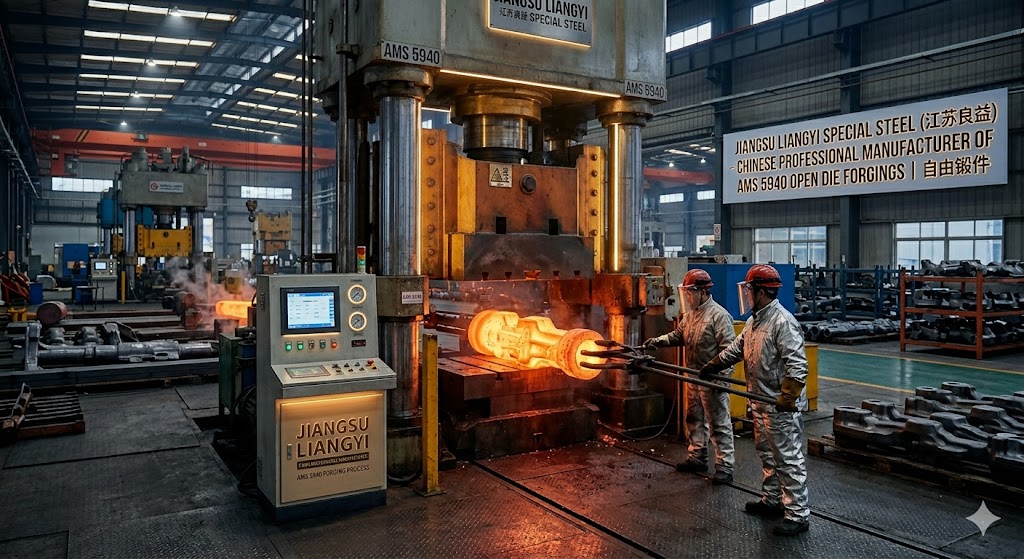
What is AMS 5940? Definition, Specification & Overview
AMS 5940 Specification Overview
AMS 5940 is a SAE Aerospace Material Specification that defines the chemical composition, mechanical property requirements, and testing procedures for bars, billets, and forgings produced from a specific precipitation-hardening, low coefficient of thermal expansion (low CTE) iron-nickel-chromium-aluminum-niobium superalloy. The specification is maintained by SAE International under the AMS (Aerospace Material Specifications) system, which covers metallic materials used primarily in aerospace and high-performance industrial applications.
The alloy covered by AMS 5940 belongs to the family of engineered iron-nickel superalloys in which the ratio of iron to nickel is carefully balanced to achieve a naturally low thermal expansion coefficient — a behavior related to the Invar effect observed in Fe-Ni binary alloys at certain compositions. Unlike plain Invar alloys (which have very low strength), AMS 5940 incorporates significant additions of aluminum and niobium to generate coherent strengthening precipitates, delivering both dimensional stability and high mechanical strength at operating temperatures up to 1200°F (649°C).
This combination of properties — which cannot be simultaneously achieved by standard austenitic superalloys — makes AMS 5940 the material of choice for design engineers working on rotating turbomachinery, high-pressure valve systems, and precision aerospace structures where dimensional growth under thermal cycling would otherwise compromise system performance or fatigue life.
Why Choose Jiangsu Liangyi for Your AMS 5940 Forging Needs?
Established in 1997, Jiangsu Liangyi Co., Limited is an ISO 9001:2015 certified professional manufacturer of AMS 5940 open die forgings and seamless rolled steel forged rings, with over 25 years of continuous experience in manufacturing high-performance superalloy forgings for clients across 50+ countries worldwide. Unlike trading companies or distributors, we operate a fully integrated manufacturing facility — from raw material melting to precision machining and final inspection — giving us complete process control and the technical depth to solve challenging forging problems that off-the-shelf suppliers cannot address.
Our engineering team has accumulated deep, application-specific knowledge of AMS 5940's behavior during forging, heat treatment, and service, enabling us to proactively optimize forging ratios, forging temperature windows, grain flow patterns, and heat treatment cycles to consistently deliver forgings that exceed minimum AMS specification requirements. This is not simply a compliance exercise — our clients in aerospace, oil and gas, and power generation require forgings that perform reliably at the edge of what materials science allows, and our process expertise is built around that expectation.
Our Core Capabilities for AMS 5940 Forgings
- Full in-house production: From steel melting, precision forging, heat treatment to CNC machining and final inspection — all completed in our 80,000 m² factory with 40 million USD in fixed assets and no outsourcing of critical production steps
- Wide production range: Single-piece weight from 30 kg to 30,000 kg, with an annual manufacturing capacity of 120,000 tons across all alloy grades
- Advanced equipment: 2000T–6300T hydraulic forging presses, 1–5M seamless rolling machines, 30T vacuum melting facilities, and a complete suite of nondestructive testing (NDT) instruments
- Global compliance: Our AMS 5940 forgings meet AMS, ASTM, API 6A, DIN, EN and other international standards, with full EN10204 3.1/3.2 mill test certificates (MTC) available for every shipment
- Custom engineering support: DFM (Design for Manufacturability) review, grain flow simulation, and material substitution consulting available to clients at no charge
Metallurgical Science: How AMS 5940 Achieves Low CTE & High Strength
The Low-CTE Mechanism: The Iron-Nickel Invar Effect
The most distinctive property of AMS 5940 — its unusually low coefficient of thermal expansion — originates from a well-understood but delicate physical phenomenon: the Invar effect. In iron-nickel alloys at compositions near 35–45% nickel, the normal tendency of a crystal lattice to expand when heated is partially cancelled by a competing magneto-volume effect. As temperature increases, the magnetic ordering of the Fe-Ni lattice weakens, causing a slight lattice contraction that partially offsets the normal thermal expansion. The result is a much lower net thermal expansion than would be seen in a standard steel or austenitic superalloy.
AMS 5940 exploits this effect by specifying a nickel content of 26–30% and an iron content of 24–27%, placing the alloy's Fe-Ni core composition in the range where Invar-like behavior is strongest. The remaining balance of the alloy — chromium, aluminum, niobium, and trace additions — is carefully chosen to preserve the low-CTE character of the Fe-Ni core while adding oxidation resistance, grain boundary strength, and precipitation hardening capability.
This is why simply substituting a standard nickel superalloy like Inconel 718 in an AMS 5940 application will cause problems: Inconel 718 has a much higher nickel content and different elemental balance, placing it outside the Invar regime and giving it a significantly higher CTE. Components that fit correctly at room temperature will no longer fit correctly at operating temperature, leading to fretting, increased leakage, fatigue crack initiation at interfaces, or misalignment of precision rotating parts.
The Strengthening Mechanism: Coherent Gamma-Prime Precipitation
While low CTE alone could theoretically be achieved with a plain Fe-Ni alloy (like Invar 36), such alloys have inadequate strength for gas turbine, valve, or aerospace structural applications. AMS 5940 solves this problem through precipitation hardening — the same mechanism used in Inconel 718, Waspaloy, and other high-performance superalloys — but executed in a way that does not disrupt the low-CTE Fe-Ni matrix.
The precipitation hardening in AMS 5940 works through two primary mechanisms:
- Gamma-prime (γ') phase precipitation: The aluminum additions promote the formation of coherent, ordered Ni₃Al-based precipitates (the $\gamma'$ phase), which are crystallographically compatible with the face-centered cubic (FCC) matrix. These nano-scale precipitates impede the dislocation motion and thereby increase the strength with little effect on the thermal expansion. Their coherence with the matrix minimizes the mismatch strain which would otherwise lead to residual stress and reduce fatigue life.
- Niobium-rich phase formation: Niobium additions contribute additional strengthening by forming secondary precipitates at grain boundaries and within grains. At controlled concentrations, niobium refines grain size during solution annealing (through grain boundary pinning), prevents grain growth at high temperatures, and contributes to creep resistance by restricting grain boundary sliding — a critical failure mode in components under sustained load at elevated temperature.
The result is an alloy that achieves tensile and yield strengths comparable to high-performance austenitic superalloys while maintaining the low thermal expansion of the Invar-family iron-nickel system. This combination is genuinely difficult to achieve and cannot be approximated by mixing existing alloy systems — it requires the precise compositional control that the AMS 5940 specification defines.
Oxidation Resistance: The Role of High Aluminum Content
At sustained operating temperatures above 900°F (482°C), most iron-nickel alloys suffer from accelerating oxidation that progressively consumes the alloy surface, generates oxide scales that spall and contaminate the gas path, and creates oxygen-enriched zones beneath the surface that embrittle the material. Standard Fe-Ni alloys and even many Cr-bearing stainless steels are inadequate for continuous service at 1200°F (649°C).
AMS 5940 addresses this directly through its high aluminum content of 5–6 wt%, which is significantly higher than most iron-nickel alloys. Above a critical threshold — approximately 2–3% Al in most Fe-Ni systems — aluminum preferentially oxidizes to form a continuous, tightly adherent alpha-Al₂O₃ (alumina) scale on the alloy surface. This alumina scale has exceptionally low oxygen permeability compared to iron oxides or chromia scales, acting as an effective diffusion barrier that dramatically reduces the rate of continued oxidation.
This is not a passive protective coating applied externally — it is a self-forming, self-healing film generated from the alloy's own aluminum reservoir. Should mechanical contact, thermal cycling, or erosion damage the oxide film locally, the underlying alloy re-oxidizes at that location and reforms the protective alumina layer. This makes AMS 5940 far more reliable in long-term service than alloys that depend solely on chromia formation for oxidation protection.
Role of Each Alloying Element in AMS 5940
Understanding why each element is present — and why its limits are set the way they are — is essential for engineers specifying AMS 5940 components and for quality engineers verifying chemical composition results. The following analysis reflects our metallurgical team's working knowledge of how elemental composition drives AMS 5940's performance in service:
| Element | Specified Range | Primary Metallurgical Role | Consequences of Exceeding Limits |
|---|---|---|---|
| Nickel (Ni) | 26.0–30.0% | Main Invar-effect element; stabilizes austenitic FCC matrix; enables γ' formation with Al; controls CTE within required range | High Ni raises CTE (exits Invar regime); Low Ni reduces matrix stability, weakens precipitation response |
| Iron (Fe) | 24.0–27.0% | Balances Ni to get low CTE via magneto-volume effect; reduces material cost vs. pure Ni alloys; contributes to matrix stability | High Fe shifts CTE upward and may promote embrittling delta-ferrite; Low Fe reduces the Invar effect and raises CTE |
| Aluminum (Al) | 5.0–6.0% | Primary precipitation hardening element (Ni₃Al γ' formation); self-forming alumina oxidation barrier; keeps low CTE compatibility | High Al over-precipitates γ', causing brittleness and hot-cracking risk during forging; Low Al reduces strength and oxidation resistance |
| Niobium / Columbium (Nb) | 2.5–3.5% | Secondary precipitation hardener; grain boundary pinning during solution anneal; creep resistance; hot workability stabilizer | High Nb promotes unwanted Laves phase and delta (δ) phase that embrittles grain boundaries; Low Nb reduces creep resistance and grain size control |
| Chromium (Cr) | 2.5–3.5% | Secondary oxidation resistance (chromia formation); solid solution strengthening; sulfidation resistance; controlled to minimize CTE elevation | High Cr raises CTE and can promote sigma-phase embrittlement at long exposures; Low Cr inadequate corrosion protection in sulfur-containing environments |
| Boron (B) | 0.003–0.012% | Grain boundary strengthening; improves hot ductility during forging; reduces grain boundary oxidation; improves stress-rupture life | High B forms brittle boride phases at grain boundaries, reducing ductility and toughness; Low B reduces hot workability and rupture life significantly |
| Carbon (C) | Max. 0.03% | Intentionally minimized; trace carbon at controlled levels provides minor grain boundary strengthening | High C forms Cr-rich carbides (M₂₃C₆) that deplete chromium from matrix (sensitization), raise CTE, and reduce corrosion resistance |
| Manganese (Mn) | Max. 0.50% | Deoxidizer during melting; trace austenite stabilizer; minimized to avoid influence on thermal expansion behavior | Excess Mn raises CTE and reduces oxidation resistance at high temperature; also impairs weldability |
| Silicon (Si) | Max. 0.50% | Deoxidizer; minimal presence to avoid reducing hot ductility and disrupting precipitation response | Excess Si promotes σ-phase formation at high-temperature exposure; reduces hot workability and ductility |
| Sulfur (S) | Max. 0.005% | Undesirable tramp element; must be minimized; controlled via ESR remelting | Excess S forms low-melting sulfide films at grain boundaries, causing hot shortness during forging and significantly reducing ductility and rupture life |
| Phosphorus (P) | Max. 0.015% | Undesirable tramp element; must be minimized; controlled via VIM charge selection | Excess P segregates to grain boundaries, reducing ductility and toughness; promotes low-temperature embrittlement |
| Titanium (Ti) | Max. 0.40% | Trace amounts can contribute to γ' strengthening; limited to prevent Ti-rich phase formation that could reduce fatigue resistance | Excess Ti forms coarse Ni₃Ti (η-phase) that degrades ductility and notch toughness at elevated temperatures |
Main Advantages of AMS 5940 Superalloy for Critical Industrial Applications
AMS 5940 provides advantages over traditional superalloys that are not incremental improvements, but rather fundamentally different capabilities that allow design possibilities not otherwise possible. Each of the following advantages resolves a particular technical limitation that engineers face every day in demanding industrial applications:
- Engineered-Low Thermal Expansion: Unlike alloys where low CTE is an accidental byproduct of composition, AMS 5940's thermal expansion behavior is deliberately engineered through its Fe-Ni ratio. This allows design engineers to predict and account for thermal growth with high confidence across the full operating temperature range — a critical capability for turbine clearance management, where even small unpredicted expansions can cause blade-tip rub and catastrophic rotor damage.
- Alumina-Forming Oxidation Resistance at 1200°F / 649°C: The self-forming α-Al₂O₃ film created by AMS 5940's high aluminum content (5–6%) provides oxidation protection that is significantly more stable than chromia-based protection mechanisms at temperatures above ~1100°F (593°C). This translates directly into longer component service life, fewer planned maintenance outages, and reduced risk of oxide scale spallation contaminating downstream turbine stages.
- Precipitation-Hardened Strength Without CTE Penalty: Most high-strength alloys achieve their strength through compositions that inevitably raise thermal expansion coefficients. AMS 5940's precipitation hardening mechanism operates through coherent γ' precipitates that do not disrupt the Fe-Ni Invar effect, maintaining the low CTE while delivering room-temperature UTS of 160 ksi (1103 MPa) minimum and elevated-temperature UTS of 130 ksi (896 MPa) at 1200°F.
- Stable Grain Structure Under Thermal Cycling:Many alloys that perform well in early tests slowly get worse after repeated temperature changes. This happens as grain boundaries grow weaker, internal particles become larger, and long-term creep damage builds up over time. The added niobium in AMS 5940 locks the grain structure in place to stop grain growth during heat treatment and actual service use. At the same time, its controlled boron content makes grain boundaries stronger to resist slipping and oxidation. Both features help keep steady fatigue performance through thousands of temperature cycles.
- Compatibility with Titanium and Ceramic Components: Many modern aerospace and industrial gas turbine designs incorporate titanium alloy casings or ceramic matrix composite (CMC) components adjacent to metallic hot-section parts. The CTE of titanium alloys (~4.8–9.0 × 10⁻⁶/°C) and SiC/SiC CMC materials (~4–5 × 10⁻⁶/°C) is substantially lower than standard superalloys. AMS 5940's reduced CTE provides a better geometric match with these adjacent materials, reducing interfacial thermal stress and extending the life of fasteners, seals, and mechanical attachments.
- Excellent Triple-Melt Cleanliness for NDT Acceptance: Our AMS 5940 forgings, made with VIM+VAR+ESR triple melting, have far fewer impurities, almost no holes in the material, and much less uneven element distribution than parts made with only single or double melting. This cleaner material performs much better in ultrasonic testing. Its high purity makes sure any signals picked up during full 100% ultrasonic checks come from real internal flaws, not random noise caused by impurities, so we can reliably meet strict inspection acceptance standards every time.
Engineers selecting materials for high-temperature, precision components frequently evaluate AMS 5940 against several other alloys. The comparison below reflects our engineering team's accumulated experience with these materials in actual forging and service applications — not simply published data sheet values, which often fail to capture practical processing and service behavior.
| Property / Criterion | AMS 5940 | Inconel 718 | Invar 36 | Waspaloy |
|---|---|---|---|---|
| Primary Alloy System | Fe-Ni-Cr-Al-Nb | Ni-Cr-Fe-Nb-Mo | Fe-Ni (36% Ni) | Ni-Cr-Co-Mo |
| Thermal Expansion (Low = Better for precision parts) | Low (engineered Invar regime) | Moderate-High | Ultra-Low (near-zero at RT) | Moderate-High |
| Room Temperature UTS (Min.) | 160 ksi (1103 MPa) | 180 ksi (1241 MPa) | 70–90 ksi (482–621 MPa) | 185 ksi (1276 MPa) |
| Oxidation Resistance at 1200°F (649°C) | Excellent (alumina former) | Good (chromia former) | Poor (no Cr/Al protection) | Very Good (chromia former) |
| Sustained Elevated Temperature Strength | Very Good (γ' + Nb) | Very Good (γ'' + γ') | Poor | Excellent (γ' + solid solution) |
| Corrosion Resistance (H₂S / Sour Service) | Good | Very Good | Poor | Good |
| Forgeability (Hot Working Range) | Good (controlled temperature window) | Good | Good (relatively simple) | Moderate (narrow window) |
| API 6A Valve Component Suitability | Excellent | Excellent | Not Suitable | Limited Use |
| Compatibility with Ti Alloy / CMC Structures | Excellent (CTE match) | Poor (CTE mismatch) | Too brittle for structural roles | Poor (CTE mismatch) |
| Precipitation Hardening Response | Strong (Al-based γ') | Very Strong (Nb-based γ'') | None (solid solution only) | Strong (Al/Ti-based γ') |
| Relative Material & Forging Cost | Moderate | Moderate | Low | High (Co content) |
Engineering Summary: AMS 5940's Unique Niche
No single alloy dominates all performance categories. AMS 5940's irreplaceable advantage is the simultaneous delivery of low CTE, precipitation-hardened strength, and alumina-forming oxidation resistance — a combination that neither Inconel 718 (high CTE), Invar 36 (low strength, poor oxidation), nor Waspaloy (high CTE, high cost) can match. When your application demands all three of these properties together, AMS 5940 is essentially the only forging alloy that qualifies.
Material Selection Guide: When to Choose AMS 5940 vs. Alternatives
One of the most common questions we receive from procurement and engineering teams is: "Do we actually need AMS 5940, or can we use Inconel 718 / standard stainless steel for this part?" The following guide reflects the selection logic our technical team uses when consulting on customer applications:
✔ Choose AMS 5940 When:
- Component must maintain precise dimensional fit at temperatures from ambient to 1200°F (649°C), with minimal thermal growth
- Part is installed within or adjacent to titanium alloy, ceramic, or other low-CTE structures where expansion mismatch causes interface stress
- Service requires continuous oxidation resistance at ≥900°F (482°C) without external protective coatings
- Component undergoes frequent thermal cycling (start-stop turbine, intermittent-service valve) requiring dimensional repeatability across cycles
- Aerospace material specification compliance (AMS) is contractually required by OEM or regulatory body
- Stress-rupture life under sustained high-temperature load is a primary design constraint
✗ Consider Alternatives When:
- Maximum room-temperature strength is the sole priority and operating temperature is below 700°F (371°C) — Inconel 718 may offer higher yield strength
- Primary service environment is strongly acidic or reducing (H₂S-rich sour gas at high H₂S partial pressure) — evaluate Inconel 625 or Hastelloy C276
- Cost is the dominant constraint and moderate-temperature service (below 800°F / 427°C) is acceptable — 17-4 PH or 15-5 PH stainless may suffice
- Component operates only at ambient temperature and requires maximum fatigue life — cold-worked and aged Inconel 718 may be preferable
- Very large section components where through-hardening of precipitation-hardened alloy is difficult — consider solid solution strengthened alternatives
Common Substitution Mistake to Avoid
We regularly receive requests from clients asking us to "upgrade" an existing AMS 5940 component to Inconel 718 because the client's procurement team believes Inconel 718 is "stronger." While Inconel 718 does have a higher minimum room-temperature yield strength, replacing AMS 5940 with Inconel 718 in a turbine clearance control component will cause dimensional interference at operating temperature because of Inconel 718's higher CTE. This results in rotor rub, compressor surge risk, or seal leakage — not a strength failure, but a geometric failure caused by mismatched thermal expansion. Alloy substitution for low-CTE applications always requires full thermal analysis, not just strength comparison.
Full-Range Custom AMS 5940 Forged Product Forms
We manufacture custom AMS 5940 forging parts in a complete range of shapes and dimensions, in strict accordance with international standards and client drawings. Unlike many forging companies that specialize in a narrow product range, our facility is equipped to produce the full spectrum of forged forms — from small precision forgings to massive structural billets — all in AMS 5940 with full specification compliance and material traceability. Our available AMS 5940 forged product forms include:
Bar, Billet & Block Forms
- Forged round bars (max diameter 2000 mm)
- Forged square bars and flat bars
- Rectangular blocks and flat billets
- Hexagonal bar sections
- Hollowed / cored bar sections
Ring & Cylinder Forms
- Seamless rolled rings (max OD 6000 mm, max weight 30 t)
- Contoured forged rings with near-net profiles
- Forged sleeves, bushes, and liners
- Heavy wall cylinders and shells (max OD 3000 mm)
- Forged flanges and coupling rings
Disc, Hub & Impeller Forms
- Turbine discs and compressor discs (solid and bored)
- Impeller blanks and blisk forgings
- Forged hubs and wheel bodies
- Valve disc blanks and gate blanks
- Pump impeller and inducer blanks
Shaft, Spindle & Fastener Forms
- Turbine shafts, rotor shafts (max length 15 m)
- Step shafts and multi-diameter shafts
- Pump shafts and compressor shafts
- Valve spindles, stems, and bonnets
- Forged studs, bolts, and structural fasteners
All AMS 5940 forgings are available in the as-forged condition, rough machined condition, semi-finished condition, or fully finished (machined-to-drawing) condition according to client requirements. Explore our full forged product range to see our complete capabilities.
AMS 5940 Forging Manufacturing Process: Step by Step
Manufacturing AMS 5940 forgings that consistently meet specification requirements — and reliably exceed them — requires far more than simply heating the material and pressing it to shape. Each step in our production sequence is engineered to preserve the compositional integrity of the alloy, refine its microstructure, and prevent the metallurgical defects (segregation, grain boundary oxidation, overheating, inadequate reduction ratio) that can compromise component performance in service.
Raw Material Procurement & Charge Preparation
We start with high-purity nickel, iron, aluminum, niobium and chromium raw materials that come with valid certificates and qualified suppliers. We calculate the mix of these raw materials to hit the chemical targets for AMS 5940, while also accounting for element loss during VIM melting. Every raw material is tested and checked before being used, and all incoming material certificates are kept on file to maintain complete traceability.
Vacuum Induction Melting (VIM) — Primary Melt
The charge is melted under high vacuum in our 30-ton VIM furnaces. Vacuum melting prevents oxidation of aluminum and niobium — which would otherwise form oxide inclusions and deplete these critical elements from the matrix. During VIM, the melt is sampled and analyzed multiple times; if any element is outside target range, corrective additions are made before the heat is cast. The result is a VIM electrode with controlled chemistry and no dissolved oxygen or nitrogen.
Vacuum Arc Remelting (VAR) — Secondary Refining
The VIM electrode is remelted under vacuum using a controlled electric arc (VAR process). VAR produces directional solidification from bottom to top of the ingot, which minimizes large-scale segregation of aluminum and niobium — two elements that are prone to segregating to interdendritic spaces during conventional solidification. The controlled solidification front also refines the as-cast grain structure and reduces macro-porosity. VAR ingots have significantly improved ultrasonic inspectability compared to non-remelted material.
Electroslag Remelting (ESR) — Final Cleanliness Upgrade
For the highest-grade AMS 5940 forgings — particularly aerospace and critical rotating components — we apply ESR as the third melting step. The VAR ingot is remelted through a liquid slag layer that chemically scavenges non-metallic inclusions (oxides, sulfides, phosphides) and simultaneously provides controlled directional solidification. ESR produces the cleanest possible ingot microstructure, with inclusion levels typically below the detection threshold of ASTM E 2283 standard cleanliness ratings. The reduced sulfur from ESR processing also improves the alloy's hot ductility during subsequent forging.
Ingot Homogenization & Conversion
Before forging, the triple-melt ingot undergoes homogenization heat treatment at carefully controlled temperatures and times to eliminate any remaining compositional micro-segregation from solidification. The ingot is then converted (cogged and drawn) on our 6300T hydraulic press to reduce the cross-section, break down the as-cast dendritic structure, and achieve the required level of forging reduction ratio (typically ≥4:1 reduction from ingot to billet) to ensure a fully wrought, refined microstructure throughout the section.
Precision Open Die Forging or Seamless Ring Rolling
The converted billet is cut to the required pre-form weight, reheated within the AMS 5940 forging temperature window (below which the material is too hard to work effectively, and above which grain growth or incipient melting can occur), and then forged to final shape. For open die forgings, our 2000T–6300T hydraulic presses provide the controlled, repeatable reduction needed for uniform grain refinement. For seamless rolled rings, our 1–5M ring rolling mills expand the ring blank continuously while maintaining full radial grain flow around the ring circumference — delivering circumferential mechanical property uniformity that machined-from-bar rings cannot match. Die temperatures, reduction sequences, inter-pass reheating cycles, and finishing temperatures are all controlled against qualified forging procedures.
Solution Annealing Heat Treatment
After forging, all AMS 5940 components are given solution annealing in our computer-controlled heat treatment furnaces. Solution annealing dissolves the forging-induced residual strengthening precipitates, relieves internal stresses, and homogenizes the microstructure — preparing the material for the subsequent precipitation hardening step. Furnace temperature uniformity is kept within ±10°F (±5.5°C) across the load, and temperature uniformity surveys (TUS) are performed regularly based on AMS 2750 requirements. After solution annealing, the parts are cooled at controlled rates to avoid grain boundary oxidation and the precipitation of undesirable phases during cooling.
Precipitation Hardening (Aging) Heat Treatment
The AMS 5940 forgings are subjected to a precipitation hardening (aging) cycle following solution annealing to produce the coherent γ' strengthening precipitates that provide the alloy with its high strength. This is done at strictly controlled temperatures and hold times in specialized aging furnaces which have very uniform temperatures. The aging cycle is validated for the specific component geometry and section size for a complete precipitation of the section including the interior of the thick cross-sections. Time-temperature records are fully documented for each batch.
Machining, Surface Finishing & Final Dimensions
Forgings are rough machined, semi-finished, or fully machined to drawing dimensions using our CNC machining centers, lathes, and surface grinding equipment. We use specific cutting parameters and tool geometries designed for precipitation hardened superalloys which are significantly harder to machine than the annealed material. Surface finish, dimensional tolerances, flatness and concentricity are checked against client drawings before final inspection.
Comprehensive NDT, Mechanical Testing & Final Inspection
Every AMS 5940 forging is given a full program of nondestructive testing (100% UT for volumetric integrity, MT or PT for surface indications) and destructive testing on representative coupons from each heat treatment lot (tensile, hardness, grain size, stress-rupture as required). All results are recorded in batch-specific inspection reports and compiled into the complete EN10204 3.1 or 3.2 Mill Test Certificate package that accompanies each shipment.
AMS 5940 Heat Treatment: Solution Annealing & Precipitation Hardening
Heat treatment is not an optional finishing step for AMS 5940 — it is an integral part of the metallurgical development of the alloy's final properties. An incorrectly heat-treated AMS 5940 forging that passes dimensional inspection will fail to meet mechanical property requirements, and may fail in service through insufficient strength, poor creep resistance, or inadequate fatigue life. Our heat treatment capability and process control directly impact the reliability of every AMS 5940 component we ship.
Solution Annealing
Solution annealing serves two primary purposes in AMS 5940 processing: first, it dissolves all strengthening precipitates (γ' phases and any Nb-rich phases) that formed during forging, resetting the microstructure to a homogeneous single-phase austenite; second, it allows grain growth to proceed to a defined, controlled grain size before the grains are "pinned" by newly dissolving Nb-rich particles at the solution anneal temperature. The solution anneal temperature is above the solvus temperature of the strengthening precipitates but below the incipient melting temperature (solidus) of the alloy — a window that must be respected precisely to avoid both under-dissolving (leaving residual phases that interfere with subsequent precipitation) and overheating (which causes grain boundary liquation, an irreversible form of damage that severely reduces ductility and fatigue life).
Our 10 computer-controlled solution annealing furnaces are equipped with multiple thermocouples (including load-attached thermocouples for critical components), SCADA temperature data logging, and regular temperature uniformity surveys in accordance with AMS 2750 pyrometry requirements. After solution annealing, parts are cooled at a controlled rate appropriate to the section size — rapid cooling for thin sections to avoid re-precipitation during cooling, and more controlled cooling for heavy sections to minimize thermal gradients and quench-induced residual stress.
Precipitation Hardening (Aging)
The aging cycle for AMS 5940 is performed at temperatures substantially below the solution anneal temperature — typically in the range where γ' precipitates nucleate and grow at a rate that produces the target precipitate size distribution. The aging time determines the final precipitate size: too short and the precipitates are too fine and may over-age during service at elevated temperature; too long and the precipitates coarsen and lose coherency with the matrix, reducing their effectiveness as dislocation barriers.
For components with thick cross-sections (above approximately 150 mm), our engineering team applies section-size-dependent aging corrections — extending hold times at temperature to ensure that the interior of the forging reaches the same thermal exposure as the surface-adjacent material. This is particularly important for AMS 5940 because the alloy's strengthening is entirely precipitation-dependent: surface hardness that meets specification does not guarantee interior compliance if the core was inadequately aged.
All aging cycles are performed with full time-temperature logging, and representative test pieces from each furnace load are tension-tested and hardness-tested to verify that the resulting mechanical properties meet AMS 5940 requirements before any components from that batch are shipped.
Our Heat Treatment Quality Assurance Controls
- 10 dedicated computer-controlled heat treatment furnaces with independent temperature controllers and data loggers
- Furnace temperature uniformity surveys (TUS) performed regularly per AMS 2750 Class 3 or better requirements
- Load-attached thermocouples on critical or heavy-section components to verify actual part temperature — not just furnace temperature
- Full time-temperature charts archived for every heat treatment batch, with batch number traceable to individual forgings
- Destructive coupon testing (tensile, hardness, grain size) from representative test pieces of every heat treatment lot
- In-house metallographic examination of grain size and precipitate distribution for critical aerospace and rotating machine components
Global Industry Applications & Verified Project Cases of AMS 5940 Forgings
The following industry applications and project cases represent verified, long-term supply relationships and completed engineering projects — not theoretical use cases. Each project case reflects a specific technical challenge solved through the combination of AMS 5940's material properties and our manufacturing capability.
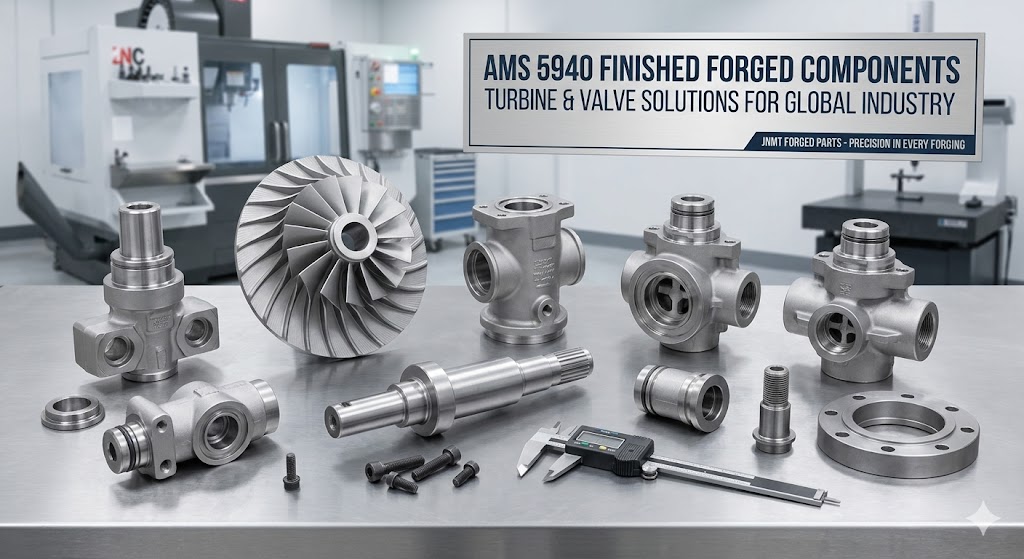
Aerospace & Aviation — Gas Turbine Hot Section Components (Europe & North America)
AMS 5940 is the preferred forging material for aerospace gas turbine hot section components that are located adjacent to the turbine disc and casing — specifically components where dimensional stability during thermal transients (takeoff, climb, cruise, descent, shutdown) directly governs blade tip clearance, seal effectiveness, and compressor stage matching. Tighter clearances achieved through low-CTE materials directly translate into improved specific fuel consumption (SFC) — a commercially critical parameter for both commercial and military aircraft operators.
Our AMS 5940 forged aerospace components include turbine blade forgings, compressor impeller blanks, turbine disc blanks, blisk forgings, structural casing segments, and high-strength structural fasteners. All aerospace components are manufactured under our ISO 9001:2015 certified quality management system. EN10204 3.2 certificates with third-party inspection witness are available upon request through the client's nominated inspection body.
Our Aerospace Forging Capabilities
We have supplied AMS 5940 forgings to aerospace component manufacturers and MRO clients in Europe and North America. Our technical capabilities for aerospace programs include:
- Triple vacuum melting (VIM + VAR + ESR) for the highest ingot cleanliness — essential for meeting stringent aerospace UT acceptance criteria
- Grain flow engineering: forging procedures designed so grain flow follows the component contour, with no reentrant flow permitted — verified by macroscopic grain flow testing on each production lot
- Phased Array Ultrasonic Testing (PAUT) available for critical components, with client-specified reference calibration blocks and enhanced acceptance criteria
- Full material traceability from ingot heat number through every processing step to individual piece marking — EN10204 3.1 standard; EN10204 3.2 with third-party witness available upon request
- Part-attached thermocouples during solution annealing to verify actual part temperature for critical or heavy-section aerospace components
Oil & Gas Extraction & Production — Wellhead & Valve Components (Middle East, North America & Southeast Asia)
The oil and gas industry presents a unique combination of corrosion, pressure, and thermal demands that few alloys can satisfy simultaneously. Wellhead equipment and production tree valve components must operate in sour service environments (H₂S-bearing fluids), at high working pressures (up to 20,000 psi in deep-water and high-pressure wells), at temperatures ranging from ambient to over 350°F (177°C), and they must maintain leak-tight performance over decades of service without requiring disassembly. AMS 5940's combination of strength, corrosion resistance, and dimensional stability under thermal fluctuations makes it an appropriate material for demanding wellhead applications where standard CRA (corrosion-resistant alloy) steels are marginal.
Our AMS 5940 forged oil and gas products — valve bodies, bonnet forgings, gate blanks, stem blanks, seat ring blanks, wellhead connector forgings, and choke body forgings — are produced in accordance with API 6A (latest edition) material and testing requirements, including hardness testing, tensile testing, CVN impact testing, and SSC (Sulfide Stress Cracking) resistance testing where specified by the client. Note: Jiangsu Liangyi does not hold an API Monogram license. Clients requiring API Monogram-stamped products should specify this requirement at the inquiry stage so that appropriate sourcing can be arranged.
Our Oil & Gas Forging Capabilities (Middle East, North America & Southeast Asia)
We have supplied AMS 5940 forged valve and wellhead components to oil and gas clients in the Middle East, North America, and Southeast Asia. Our technical capabilities for oil and gas applications include:
- API 6A material and testing requirements: hardness testing, full cross-section tensile testing, CVN impact testing at minimum design temperature, and 100% volumetric UT inspection — with third-party witness inspection available through the client's nominated TPI body
- Sour service suitability: AMS 5940 forged components produced and tested to address H₂S-bearing, high-pressure downhole service conditions; SSC testing available upon request
- Fracture toughness testing: CTOD (Crack Tip Opening Displacement) and K_IC testing available for critical pressure-containing components in subsea or ultra-deepwater applications
- Full traceability: EN10204 3.1 standard; EN10204 3.2 with independent third-party inspection available through Bureau Veritas, SGS, TÜV, Lloyd's Register, DNV, or the client's approved TPI
Thermal & Nuclear Power Generation — Steam Turbine Control Valve Components (Asia, Europe & Middle East)
Modern large-scale thermal power plants — particularly ultra-supercritical (USC) and advanced ultra-supercritical (A-USC) units rated at 600–1000 MW — operate with main steam temperatures above 1050°F (566°C) and reheat steam temperatures approaching 1100°F (593°C). Steam turbine control valves (MSV, GV, CV, CRV) that regulate steam flow into the turbine must cycle open and closed thousands of times per year without leakage, while being exposed to repeated thermal transients from turbine load changes and start-stop cycles. The dimensional stability of valve disc and valve seat contact faces under these conditions directly controls valve seat leakage rates — a primary source of thermal efficiency loss in aging turbines.
Our AMS 5940 forged power generation components include steam turbine control valve disc blanks, reheat valve disc blanks, MSV/GV/CV/CRV valve seat ring forgings, guide ring forgings, and seal ring forgings. These components are manufactured with particular attention to grain flow continuity at the valve contact face geometry, to ensure that the forging fibre structure follows the valve disc profile and provides maximum resistance to fatigue crack initiation at the seating surface.
Our Power Generation Forging Capabilities (Asia, Europe & Middle East)
We have supplied AMS 5940 forged steam turbine and valve components to power generation OEMs and EPC contractors across Asia, Europe, and the Middle East. Our technical capabilities for power generation applications include:
- Valve disc grain flow optimization: forging grain flow lines engineered to follow the valve disc bowl contour, maximizing fatigue resistance at the seating contact face — the most common failure initiation site in steam turbine control valves
- High-temperature property verification: stress-rupture testing and elevated temperature tensile testing at 1200°F (649°C) available on every production lot, confirming long-term load-bearing capability under sustained operating temperatures
- Frequent thermal cycling performance: AMS 5940's low CTE and stable γ' microstructure are specifically suited to control valves that undergo thousands of open/close thermal cycles per year
- Documentation flexibility: our quality documentation can be prepared in formats compatible with client requirements under ASME, EN, or other applicable pressure equipment codes — please specify your documentation requirements at inquiry stage
Industrial Turbomachinery & Petrochemical Processing (Global)
Beyond aerospace and power generation, AMS 5940 finds important applications in high-performance industrial turbomachinery — centrifugal compressors for natural gas transmission, process gas compressors in refineries and chemical plants, high-speed turbines for industrial power recovery, and cryogenic turboexpanders where dimensional stability across a very wide temperature range (from cryogenic service startup to operating temperature) is critical. Our AMS 5940 forged turbomachinery products include centrifugal compressor impeller blanks, compressor rotor disc forgings, pump casing and bowl forgings, seamless rolled rings for bearing housings and seal glands, and heat exchanger tubesheet forgings for high-temperature service.
AMS 5940 Chemical Composition Requirements (ASTM & AMS Compliant)
All our AMS 5940 forged material is produced via triple melting (VIM + VAR + ESR) to ensure uniform chemical composition and the lowest possible inclusion content. Chemical analysis of each heat is performed using optical emission spectrometry (OES) and ICP-OES in accordance with ASTM E 354 or other purchaser-approved analytical methods, and must meet the requirements of AMS 2269. The composition limits below represent the AMS 5940 specification requirements — our actual production heats typically target the center of each range to maximize the margin against specification limits:
| Element | Symbol | Min. (wt%) | Max. (wt%) | Primary Function |
|---|---|---|---|---|
| Nickel | Ni | 26.0 | 30.0 | Invar effect + γ' precipitation + matrix stability |
| Iron | Fe | 24.0 | 27.0 | Invar-effect balance with Ni; cost reduction vs. pure Ni |
| Aluminum | Al | 5.0 | 6.0 | Primary precipitation hardener (Ni₃Al γ'); oxidation barrier |
| Niobium (Columbium) | Nb | 2.5 | 3.5 | Secondary precipitation hardening; grain boundary pinning; creep resistance |
| Chromium | Cr | 2.5 | 3.5 | Oxidation / sulfidation resistance; solid solution strengthening |
| Boron | B | 0.003 | 0.012 | Grain boundary strengthening; hot ductility; creep life |
| Carbon | C | — | 0.03 | Minimized to prevent Cr carbide sensitization and CTE increase |
| Manganese | Mn | — | 0.50 | Deoxidizer; limited to avoid CTE elevation |
| Silicon | Si | — | 0.50 | Deoxidizer; limited to avoid σ-phase formation |
| Phosphorus | P | — | 0.015 | Tramp impurity; minimized to protect grain boundary ductility |
| Sulfur | S | — | 0.005 | Tramp impurity; minimized to prevent hot shortness; removed by ESR |
| Titanium | Ti | — | 0.40 | Minor γ' contribution; limited to prevent coarse η-phase formation |
| Tantalum | Ta | — | 0.05 | Trace; limited to avoid adverse effects on precipitation response |
| Copper / Cobalt | Cu / Co | — | 0.50 each | Tramp elements; limited to avoid CTE disruption and unexpected phase formation |
Balance: Nickel is listed as the balance element in the AMS 5940 specification. Note that the Fe content range (24–27%) and Ni content range (26–30%) are both explicitly specified rather than left as "balance," which is unusual and reflects the critical importance of their specific ratio to the alloy's low-CTE behavior.
AMS 5940 Mechanical & Physical Properties
All our AMS 5940 forgings are heat treated via solution annealing and precipitation hardening to achieve the required mechanical properties, with full test reports provided for every shipment. The grain flow of our forgings follows the general contour of the part, with no reentrant grain flow permitted — a forging quality parameter specified in AMS 5940 and verified by macroscopic grain flow testing on representative sections from each production lot.
Room Temperature Minimum Mechanical Properties
| Property | Test Direction | Min. Value (ksi) | Min. Value (MPa) | Notes |
|---|---|---|---|---|
| Ultimate Tensile Strength (UTS) | Longitudinal | 160 ksi | 1103 MPa | After solution anneal + precipitation hardening |
| 0.2% Yield Strength (YS) | Longitudinal | 105 ksi | 724 MPa | After solution anneal + precipitation hardening |
| Elongation (in 4D gauge) | Longitudinal | 12% minimum | Gauge length = 4 × specimen diameter | |
| Reduction of Area (RA) | Longitudinal | 20% minimum | Measured at fracture surface | |
Elevated Temperature (1200°F / 649°C) Mechanical Properties
| Property | Test Temperature | Min. Value (ksi) | Min. Value (MPa) |
|---|---|---|---|
| Ultimate Tensile Strength (UTS) | 1200°F / 649°C | 130 ksi | 896 MPa |
| 0.2% Yield Strength (YS) | 1200°F / 649°C | 90 ksi | 621 MPa |
| Elongation (in 4D gauge) | 1200°F / 649°C | 15% minimum | |
| Reduction of Area (RA) | 1200°F / 649°C | 25% minimum | |
Physical Properties & Thermal Characteristics
| Property | Typical Value / Range | Significance |
|---|---|---|
| Crystal Structure | Face-Centered Cubic (FCC) austenite with coherent γ' precipitates | FCC matrix provides toughness; γ' provides strength without phase change embrittlement |
| Density | ~0.298 lb/in³ (8.25 g/cm³) typical | Higher than aluminum; lower than most cobalt-based superalloys; influences rotating component inertia calculations |
| Thermal Expansion Character | Low CTE (Invar-regime behavior) — significantly lower than standard austenitic superalloys across the operating range | Primary design advantage: minimizes dimensional change during thermal cycling; allows tight clearance design |
| Magnetic Properties | Weakly ferromagnetic below Curie temperature; transitions to paramagnetic at elevated temperature | Relevant for magnetic particle testing (MT) interpretation and electromagnetic equipment applications |
| Hardness (Post Aging) | Typically HRC 28–36 (depending on section size and aging cycle) | Indicates adequate precipitation hardening; measured per lot as acceptance test |
| Maximum Continuous Service Temperature | Up to 1200°F (649°C) | Above this temperature, accelerated oxidation and precipitate coarsening reduce performance |
A Note on Stress-Rupture Testing for AMS 5940
In addition to the room-temperature and elevated-temperature tensile tests tabulated above, AMS 5940 specification includes stress-rupture testing requirements — samples must sustain a specified stress level at elevated temperature for a minimum number of hours without rupture, with minimum ductility at rupture. Stress-rupture testing is performed on test specimens from each production lot after precipitation hardening, and is particularly important for components used in creep-critical service (turbine discs, high-temperature valve stems, and seal rings that must maintain sealing load over tens of thousands of operating hours). All our stress-rupture tests are conducted on calibrated test machines with full load-cell traceability, and results are included in the MTC package for every relevant shipment.
Full-Process Manufacturing & Strict Quality Control for AMS 5940 Forgings
Our quality assurance approach for AMS 5940 forgings is built on a simple principle: every quality control step must prevent a non-conformance from reaching the next step — not simply detect it at the end. This means that our quality engineers are involved in production planning, procedure qualification, in-process monitoring, and final inspection, rather than serving purely as an end-of-line inspection function. The result is a production yield rate and a zero-field-failure record that reflects genuine process control, not inspection-by-sorting.
Integrated Steel Melting & Forging Process
Our AMS 5940 material is produced via triple melting (VIM + VAR + ESR) to ensure ultra-high purity and uniform chemical composition across the full ingot cross-section. Our 2000T to 6300T hydraulic forging presses and 1–5M seamless rolling machines forge the material under strict control of forging temperature, reduction ratio, inter-pass reheating frequency, and finishing temperature — all of which are documented in qualified forging procedure sheets (FPS) that are maintained, reviewed, and updated based on production data. We can produce custom AMS 5940 forgings from 30 kg to 30 tons according to client drawings and specifications.
Precision Heat Treatment Capability
We have 10 computer controlled heat treatment furnaces that are dedicated to superalloy processing. These allow for solution annealing and multi-stage precipitation hardening of AMS 5940 forgings. All of our furnaces are equipped with data logging systems that track time-temperature histories for each batch, and we keep our furnace calibration records in accordance with the AMS 2750 pyrometry requirements—a standard that our aerospace and oil-and-gas customers routinely require. All heat treatment processes are fully documented and traceable from furnace batch number to individual forging serial number.
Comprehensive Quality Inspection & Testing Program
We perform a comprehensive acceptance testing program for every heat and lot of AMS 5940 forgings, with all results reported in the MTC. Required acceptance tests include:
- Chemical composition analysis — OES and ICP-OES analysis of each heat; reported against AMS 5940 / AMS 2269 limits
- Mean coefficient of linear expansion testing — Dilatometry testing per AMS specification for each heat, confirming the alloy's thermal expansion characteristics are within the low-CTE range
- Hardness testing — Every piece in the lot; Rockwell C scale; must fall within the specified range for the aging condition
- Average grain size determination — Metallographic examination per ASTM E 112; grain size must meet the AMS 5940 requirement for the specific product form
- Room-temperature tensile properties — UTS, YS (0.2% offset), elongation (4D), and reduction of area from each lot after precipitation hardening; minimum values as tabulated above
- Stress-rupture properties — From each lot after precipitation hardening; minimum rupture life and minimum ductility at rupture per AMS 5940 table
- 100% ultrasonic testing (UT) — Full volumetric inspection of all forgings; acceptance criteria per AMS 2630 or client specification; phased array UT (PAUT) available for critical components
- Magnetic particle testing (MT) or liquid penetrant testing (PT) — 100% surface inspection for all critical components; MT for ferromagnetic condition, PT for non-ferromagnetic condition
- Dimensional inspection — 100% dimensional verification against client drawings using CMM (Coordinate Measuring Machine) and conventional gauging
- Grain flow examination — Macroscopic grain flow verification on sectioned sample from each lot; confirms forging fibre follows part contour with no reentrant flow
Periodic tests — including elevated temperature tensile testing at 1200°F (649°C), elevated temperature stress-rupture, and metallographic examination for incipient melting or detrimental phase formation — are performed on a frequency defined by purchaser requirements or our internal periodic testing schedule, whichever is more stringent.
Global Compliance & Certifications
Our AMS 5940 forgings are produced in accordance with the requirements of major international standards — AMS, ASTM, DIN, EN, and JIS — and our quality management system is certified to ISO 9001:2015. For oil and gas applications, forgings can be produced to meet API 6A material and testing requirements (note: we do not hold an API Monogram license). Our quality documentation can be structured to be compatible with ASME, PED (European Pressure Equipment Directive), or other applicable pressure equipment code requirements — please specify your documentation needs at the inquiry stage. Browse our full material range to explore other superalloy forging options.
Documentation, Certification, Marking & Packaging
Material Test Certificates (MTC)
Each shipment of AMS 5940 forgings comes with a full Material Test Certificate (MTC) package from Jiangsu Liangyi. Our standard MTC is issued in accordance with EN 10204 Type 3.1 – certified by our Quality Control Manager and traceable to the specific ingot heat number, forging lot number, heat treatment batch number and individual piece markings. Independent third-party verification is available upon request in the form of EN 10204 Type 3.2 certificates. 3.2 inspection is a third party inspection body nominated by the client or mutually agreed (e.g. Bureau Veritas, SGS, TÜV, Lloyd's Register, DNV or the client's own approved inspector) witnessing testing and countersigning the certificate. TPI arrangements and any fees are agreed at the quotation stage.
Our MTC package includes:
- Full chemical composition analysis results vs. AMS 5940 specification limits
- Room temperature tensile test results (UTS, YS, elongation, RA) vs. minimum requirements
- Elevated temperature tensile test results (when required)
- Stress-rupture test results (when required)
- Hardness test results from each piece
- Grain size determination results
- Thermal expansion coefficient test results
- UT, MT/PT nondestructive test report with applicable acceptance criteria
- Heat treatment time-temperature records (furnace chart excerpts)
- Dimensional inspection report
- Grain flow inspection report (where applicable)
Part Marking & Traceability
All AMS 5940 forgings are permanently marked per client requirements and AMS standards, typically including: material designation (AMS 5940), heat number, lot number, part number, and our manufacturer's identification code. Marking methods include low-stress vibro-engraving (preferred for precipitation-hardened components to avoid stress concentration), electrochemical etching, and ink stenciling for surfaces that will be subsequently machined. Marking locations are selected to survive machining operations and remain readable through the component's service life.
Packaging & Export Handling
AMS 5940 forgings are packed as per customers’ specifications and the requirements of destination country import regulations. Standard packaging includes: Corrosion protection paper wrap (Vapor Corrosion Inhibitor - VCI) Wooden crates or pallets constructed to fumigation free standards of ISPM-15 (accepted in all major import markets without fumigation certification) Custom cushioning and clamping to prevent movement and damage during ocean or air freight. Sea freight (FCL or LCL), air freight or express courier delivery direct from our factory to the client’s facility or freight forwarder.
Frequently Asked Questions (FAQ) About AMS 5940 Forgings
AMS 5940 is a SAE Aerospace Material Specification that covers bars, billets, and forgings of a specific iron-nickel-chromium-aluminum-niobium superalloy. Its key defining characteristic is a deliberately engineered low coefficient of thermal expansion (low CTE), achieved by balancing the iron and nickel content in a range where the magneto-volume Invar effect partially cancels normal thermal expansion. This is critically important in applications like gas turbine blade tip clearance management, where even small unpredicted dimensional growth at operating temperature can cause blade-to-casing contact (blade rub), loss of turbine efficiency, or compressor surge. In high-pressure valve applications, low CTE makes sure that valve seats keep contact geometry and sealing load across the full thermal range, preventing leakage as temperature fluctuates. No amount of design over-sizing can compensate for an incorrect CTE — the thermal growth mismatch must be addressed through proper material selection.
AMS 5940 is used for important components in gas turbines, steam turbines, aerospace engines, oil and gas wellhead equipment, industrial compressors and high-pressure pumps. Specific applications include: turbine blades, compressor impellers, turbine discs, blisks, aerospace structural fasteners, steam turbine control valve discs (MSV, GV, CV, CRV types), valve bodies and bonnets for API 6A service, wellhead hanger forgings, centrifugal compressor impeller blanks, and high-temperature seal rings and guide rings. The common thread in all these applications is the simultaneous requirement for dimensional stability under thermal cycling, high mechanical strength at elevated temperature, and sustained oxidation resistance — a combination uniquely provided by AMS 5940.
Our AMS 5940 forgings comply with the following standards depending on application: AMS 5940 (base material specification) and AMS 2269 (chemical composition requirements) for aerospace applications; ASTM E 354 for chemical analysis methods; AMS 2630 for ultrasonic testing; AMS 2750 for pyrometry and heat treatment documentation; API 6A (latest edition) material and testing requirements for oil and gas wellhead and Christmas tree equipment (note: we do not hold an API Monogram license); EN 10228 series for NDT of steel forgings; and applicable DIN, EN, and JIS standards as required. Our quality management system is ISO 9001:2015 certified. Documentation can be structured to be compatible with ASME or PED requirements — please specify your needs at inquiry stage.
Yes, we can produce custom AMS 5940 forgings to customer prints. You can send us drawings in 2D (DWG, DXF, PDF) and 3D (STEP, IGES, Parasolid) formats. Our engineering team reviews each drawing before production to identify potential forging manufacturability issues — such as unfavorable parting line locations, insufficient draft angles for die-forged shapes, or cross-sections that may require special forging sequences for AMS 5940 — and provides DFM feedback to the client before committing to production. We do not simply press the material into a die and hope it works: we engineer the forging process to produce a component whose internal grain flow, mechanical properties, and dimensional accuracy genuinely reflect the design intent of the client's drawing.
Triple melting via Vacuum Induction Melting (VIM) + Vacuum Arc Remelting (VAR) + Electroslag Remelting (ESR) is required for AMS 5940 because the alloy's high aluminum content (5–6%) makes it extremely prone to oxidation and inclusion formation if melted in air. VIM provides precise compositional control in a vacuum — preventing Al and Nb oxidation and allowing accurate chemistry targeting. VAR produces directional solidification that minimizes segregation of Al and Nb from ingot center to surface, which would otherwise cause variation in mechanical properties across the forging cross-section. ESR removes non-metallic inclusions (oxides, sulfides) and further refines the solidification structure, producing a final ingot with the homogeneity, cleanliness, and ultrasonically inspectable microstructure that aerospace and critical industrial applications demand. Without triple melting, AMS 5940 forgings would have inclusion populations and compositional variation that would cause rejection under the rigorous NDT and chemistry acceptance criteria required for critical rotating and pressure-containing components.
Our standard lead time for custom AMS 5940 forgings (as-forged, rough machined, or semi-finished) is 4–6 weeks from drawing confirmation and purchase order receipt, assuming material is available in stock. For fully machined-to-drawing components, the standard lead time is 6–8 weeks. For urgent orders, we keep a strategic stock of AMS 5940 billet material, so we can speed up the production with lead times as short as 2–3 weeks for simple shapes. Lead times for very large forgings (above 10 tons), complicated machined parts, or orders requiring third-party inspection witness may be longer — please contact our sales team with your specific requirements for a firm lead time quotation.
Yes. Full EN 10204 Type 3.1 Mill Test Certificates (MTC) are provided as standard with every shipment of AMS 5940 forgings. Our 3.1 MTC is signed by our Quality Control Manager and includes: chemical composition, room-temperature tensile and yield strength, elongation and reduction of area, hardness, grain size, thermal expansion coefficient, heat treatment records, and NDT reports (UT, MT/PT). For clients requiring additional independent verification — common in aerospace, offshore, and critical industrial applications — EN 10204 Type 3.2 certificates are available upon request. Type 3.2 involves a client-nominated third-party inspection body (such as Bureau Veritas, SGS, TÜV, Lloyd's Register, or DNV) witnessing and countersigning the tests; TPI arrangements and fees are confirmed at the quotation stage. All documentation is provided in English; other language versions available on request.
Our maximum production capabilities for AMS 5940 forgings are: single-piece weight from 30 kg to 30,000 kg (30 tons); forged round bars up to 2000 mm diameter; seamless rolled rings up to 6000 mm outer diameter; forged shafts up to 15 meters in length; forged discs, blocks, and plates up to 3000 mm diameter or maximum dimension. For components approaching these maximum sizes, we recommend consulting with our engineering team early in the design phase to verify that the forging reduction ratio required for the required grain size can be achieved given the starting ingot size, and that our available heat treatment furnace capacity can accommodate the part dimensions.
The fundamental difference is thermal expansion behavior. AMS 5940 is designed with a balanced iron-nickel ratio to exploit the Invar effect and achieve a significantly lower coefficient of thermal expansion than Inconel 718. Inconel 718 has higher nickel content (50–55% Ni) that places it outside the Invar regime, giving it a higher CTE typical of standard austenitic alloys. This means Inconel 718 components grow more at operating temperature than AMS 5940 components of the same geometry — which is a critical problem when the component must fit within a titanium housing, ceramic structure, or other low-CTE system. Inconel 718 does offer higher minimum room-temperature yield strength (150 ksi vs. 105 ksi for AMS 5940), which is advantageous in some structural applications. However, for components where dimensional stability under thermal cycling is the primary design driver, Inconel 718 is not a suitable substitute for AMS 5940 — substituting it will cause dimensional interference problems that no amount of strength margin can prevent.
AMS 5940 in the precipitation-hardened condition is significantly more difficult to machine than standard stainless steels or even annealed superalloys, due to its high hardness (HRC 28–36), work-hardening tendency, and poor thermal conductivity. Best practices for machining AMS 5940 include: use of sharp, positive-rake carbide or ceramic cutting inserts; generous flood coolant application to manage heat buildup at the cutting zone; lower cutting speeds than for stainless steel (approximately 40–60% of the cutting speed used for 316 stainless in comparable operations); high feed rates (relative to depth of cut) to minimize rubbing and work hardening ahead of the cutting edge; and avoidance of intermittent cutting or tool dwell that accelerates work hardening at uncut surfaces. When we supply fully machined AMS 5940 forgings, these machining parameters are embedded in our qualified machining procedure sheets, which have been developed and validated over years of production experience with this alloy.
We export AMS 5940 forgings to over 50 countries worldwide. Our established export markets include: North America (United States, Canada, Mexico); Western Europe (Germany, United Kingdom, France, Italy, Netherlands, Belgium, Spain, Sweden, Norway, Finland, Denmark, Switzerland, Austria); Eastern Europe (Poland, Czech Republic, Romania); Middle East (Saudi Arabia, United Arab Emirates, Qatar, Kuwait, Bahrain, Oman, Iraq); Asia Pacific (South Korea, Japan, Singapore, Australia, India, Malaysia, Indonesia, Thailand, Vietnam); Africa (South Africa, Nigeria, Algeria); and South America (Brazil, Argentina, Chile). We manage all export documentation — commercial invoices, packing lists, certificates of origin, and regulatory certificates — and can arrange shipping via major freight forwarders from the port of Shanghai directly to the client's destination port or inland delivery address. View our project references for details of global supply experience.
Related High-Performance Superalloy Forgings
In addition to AMS 5940, we manufacture custom forgings in a complete range of high-performance nickel, iron-nickel, and cobalt-based superalloy materials. We have metallurgical expertise across the full spectrum of precipitation-hardened and solid-solution-strengthened superalloys, which allows us to advise customers on alternative materials when AMS 5940 is not the best selection for a particular application:
- Inconel 725 (Alloy 725, UNS N07725) — High-strength, corrosion-resistant Ni-Cr-Mo-Nb alloy for sour service wellhead components; excellent SSC resistance
- Inconel 600 (Alloy 600, UNS N06600) — Solid solution Ni-Cr alloy with outstanding oxidation and carburization resistance for furnace and chemical process applications
- Inconel 718 (Alloy 718, UNS N07718) — The most widely used precipitation-hardened superalloy; higher room-temperature strength than AMS 5940; suitable where low CTE is not needed
- 1.4944 (X5NiCrTi26-15) — European standard precipitation-hardened Fe-Ni-Cr-Ti alloy for steam turbine components; comparable application range to AMS 5940
- 1.6368 (15NiCuMoNb5-6-4) — High-strength low-alloy steel forging for pressure vessel and nozzle applications; cost-effective where superalloy properties are not needed
- 1.4449 (X3CrNiMo18-12-3) — Austenitic stainless steel forging for moderate-temperature corrosion-resistant applications
- Hastelloy C276, C22, X — Molybdenum-bearing nickel alloys for aggressive corrosion environments; used where AMS 5940's corrosion resistance is insufficient for the specific medium
- Monel 400, Monel K500 — Nickel-copper alloys with excellent resistance to seawater, hydrofluoric acid, and alkalis; used in marine and chemical processing applications
Contact our engineering team to discuss whether AMS 5940 or an alternative superalloy is the optimal choice for your specific design requirements. We provide no-charge material selection consulting as part of our technical support service for qualified inquiries.
Trademark Notice: Inconel® is a registered trademark of Special Metals Corporation (Precision Castparts Corp.). Hastelloy® is a registered trademark of Haynes International, Inc. Monel® is a registered trademark of Special Metals Corporation. Invar® is a registered trademark of Imphy Alloys / ArcelorMittal. These names are referenced on this page for technical comparison purposes only. Jiangsu Liangyi Co., Limited has no affiliation with the trademark owners. Products manufactured by Jiangsu Liangyi are identified by their UNS designations and applicable material specifications.
Contact Us for Custom AMS 5940 Forging Solutions
Jiangsu Liangyi Co., Limited is your trusted China-based manufacturer and global supplier of high-quality AMS 5940 forgings and custom superalloy forged parts. With 25+ years of continuous manufacturing experience, ISO 9001:2015 certification, and a track record of supplying verified components to clients in over 50 countries, we offer the process expertise, equipment capability, and quality discipline required for the most demanding AMS 5940 applications.
Send us your drawings, material specifications, quantity requirements, required certifications, and project timeline — our technical team will review your requirements and respond with a detailed technical and commercial proposal within 24 hours (working days).
Inquiry Email: sales@jnmtforgedparts.com
Phone / WhatsApp: +86-13585067993
Official Website: https://www.jnmtforgedparts.com
Factory Address: Chengchang Industry Park, Jiangyin City, Jiangsu Province, China 214400
Contact Us Now for a Quotation