AMS 5655 Forging Parts | China Leading Manufacturer | Jiangsu Liangyi
📌 Quick Answer — What is AMS 5655?
AMS 5655 is the SAE Aerospace Material Specification for Type 422 martensitic stainless steel (UNS S42200), produced by AOD + ESR double-refining. It contains 11–13% Cr with additions of Mo, W, and V that deliver temper resistance up to 1,200 °F (649 °C) — far above standard 410 SS. Jiangsu Liangyi (Jiangyin, Jiangsu, China) is an ISO 9001:2015 certified manufacturer of AMS 5655 open-die forgings, seamless rolled rings, and turbine components from 30 kg to 30 tons, shipping to 50+ countries with 4–6 week lead times for standard parts. Email: sales@jnmtforgedparts.com
Overview & Manufacturer Profile
Jiangsu Liangyi Co., Limited, established in 1997 and headquartered in Chengchang Industry Park, Jiangyin City, Jiangsu Province, China, is one of Asia's most experienced manufacturers of AMS 5655 open die forging parts and seamless rolled steel rings. With an annual forging capacity of 120,000 metric tons and a forging range from 30 kg to 30,000 kg per piece, we serve procurement engineers, plant managers, and project developers in over 50 countries across six continents.
Our ISO 9001:2015 certified quality management system, backed by a fully equipped in-house metallurgical testing laboratory, ensures that every AMS 5655 forged component we ship meets or exceeds the original specification — whether destined for a gas turbine in Texas, a steam power plant in Germany, or an offshore platform in the Persian Gulf.
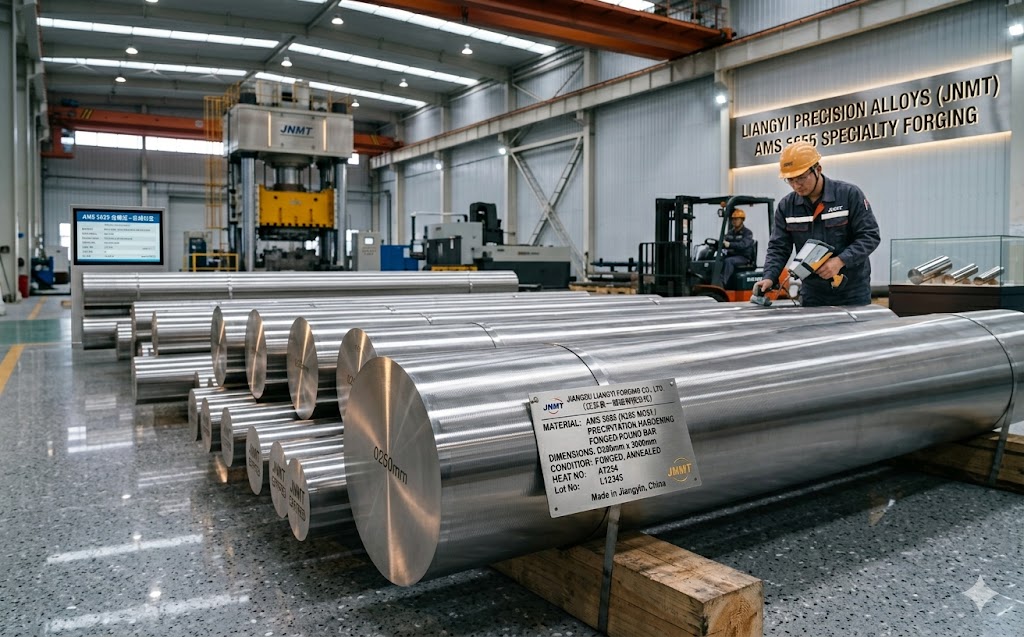
AMS 5655 forged round bars and billets — available from 50 mm to 2,000 mm diameter
Why buyers choose Liangyi: Unlike trading companies, we control the complete manufacturing workflow — from precision forging and controlled heat treatment to NDT testing and CNC machining — with full heat traceability at every stage. Our ISO 9001:2015 quality system and comprehensive process documentation are designed to support third-party inspection and satisfy international project requirements.
What Exactly Is AMS 5655? (Definition & Standard)
AMS 5655 is a SAE International Aerospace Material Specification that covers bars, billets, and forgings of a corrosion- and heat-resistant steel alloy commonly known as Type 422. The specification was developed specifically for aerospace and high-temperature industrial applications that demand sustained strength well above the softening threshold of conventional 410 or 416 martensitic stainless steels.
The Role of AOD + ESR Double-Refining
One of the defining requirements of AMS 5655 is the production route: the steel must be melted by Argon Oxygen Decarburization (AOD) — a process that reduces carbon, sulfur, and dissolved gases to precisely controlled levels — followed by Electroslag Remelting (ESR). The ESR step passes the solidified ingot through a molten flux slag, which floats out oxide inclusions and dendrite segregation that even AOD alone cannot eliminate.
The practical result is a billet with dramatically lower inclusion content, tighter element homogeneity across the cross-section, and superior ultrasonic inspectability — qualities that are indispensable when the forging will become a turbine rotor shaft or an aircraft engine fastener where internal defects can trigger catastrophic failure.
🔬 Liangyi Engineering Insight
In our experience, forgings produced from non-ESR AMS 5655 heats consistently show higher rejection rates during final UT inspection — particularly for large-diameter bars above 400 mm where centre-line segregation is most pronounced. Our standard practice is to source only AOD + ESR certified heats and to maintain full heat traceability from the mill certificate to the finished part tag. This is not a mandatory overspec — it is simply good engineering practice when the cost of a field failure vastly exceeds the incremental material cost.
Scope of the Specification
AMS 5655 applies to product forms including: hot-rolled or forged bars and billets, open-die forgings, and seamless rolled rings. It does not cover sheet, strip, plate, or tubing — those product forms fall under separate AMS numbers. The specification mandates chemical composition limits, minimum mechanical properties after heat treatment, surface condition requirements, and inspection procedures including ultrasonic testing acceptance criteria.
AMS 5655 International Grade Equivalents
Engineers outside North America frequently encounter AMS 5655 under its national or regional designation. The table below provides the most accurate cross-reference between AMS 5655 and its counterparts across major standards bodies. Note that equivalences are approximate — always verify chemistry and property requirements against the specific standard revision applicable to your project.
| Standard Body | Designation | Common Name | Notes |
|---|---|---|---|
| SAE / AMS (USA) | AMS 5655 | Type 422 / AISI 422 | Primary reference specification (this page) |
| UNS (USA) | S42200 | — | Unified Numbering System designation |
| ASTM (USA) | A473 / A565 | Grade 422 | ASTM A473 covers forgings; A565 covers bars for high-temp service |
| DIN / EN (Germany / EU) | W. Nr. 1.4935 | X20CrMoWV12-1 | Very close composition match; slightly different W/V balance |
| EN 10088 (EU) | X20CrMoWV11-1 | — | European harmonised standard; minor Cr lower limit difference |
| BS (United Kingdom) | S152 / En 56E | — | Older British designation; largely superseded by EN 10088 |
| JIS (Japan) | SUS 422 | — | JIS G4303 / G4312; near-equivalent to AISI 422 |
| AFNOR (France) | Z20CDV12 | — | French designation; C-Cr-Mo-V composition emphasis |
| GOST (Russia / CIS) | 20X12ВHМФ | — | Closest Russian equivalent; used in power generation in CIS countries |
| GB / YB (China) | 2Cr12NiMoWV | — | Chinese national standard equivalent per GB/T 8732; used for turbine blades |
| IS (India) | X20Cr13 | — | Approximate; Indian standards often defer to ASTM/EN for critical grades |
⚠️ Specification Note
To avoid problems with customs classification when ordering AMS 5655 forgings to be imported into Germany, France, or other EU countries, procurement documents should include both AMS 5655 and W. Nr.1.4935. If you ask, our export paperwork can show both designations on the MTC. In the same way, projects in Russia or the CIS may need a GOST-format test report in addition to the AMS MTC. We can set this up through our certified partner labs.
AMS 5655 Chemical Composition
The chemical composition of AMS 5655 is precisely formulated to deliver its distinctive high-temperature performance.Unlike conventional 410 stainless steel, which depends entirely on chromium for corrosion protection, AMS 5655 is improved with four main alloying elements: molybdenum, tungsten, vanadium and nickel.Each element fulfills an independent metallurgical function:
- Molybdenum (Mo): Stabilises fine carbides and significantly elevates creep resistance above 500 °C. Also improves pitting corrosion resistance in chloride-bearing steam environments.
- Tungsten (W): The most temperature-stable carbide former in the alloy system. W₂C and M₆C carbides remain undissolved at forging temperatures, pinning austenite grain boundaries and producing a finer recrystallised grain after forging — a main factor in the alloy's fatigue resistance.
- Vanadium (V): Forms extremely fine VC/V₄C₃ precipitates during tempering. These precipitates impede dislocation movement at elevated temperatures, directly responsible for the alloy's temper resistance that outlasts standard 410 by over 150 °C.
- Nickel (Ni): Improves toughness and impact resistance at the lower end of the service temperature range, so it is important for parts that experience cold-start thermal shock.
| Element | Symbol | AMS 5655 Limit (%) | Metallurgical Role |
|---|---|---|---|
| Carbon | C | 0.20 – 0.25 | Strengthening via martensite and carbide formation |
| Manganese | Mn | ≤ 1.00 | Deoxidiser; austenite stabiliser |
| Silicon | Si | ≤ 0.75 | Deoxidiser; oxidation resistance |
| Chromium | Cr | 11.0 – 13.0 | Corrosion resistance; matrix strengthening |
| Nickel | Ni | 0.50 – 1.00 | Toughness improvement; lower Mf temperature |
| Molybdenum | Mo | 0.75 – 1.25 | Creep resistance; solid solution strengthening |
| Tungsten | W | 0.75 – 1.25 | High-temperature carbide stability; grain refinement |
| Vanadium | V | 0.15 – 0.30 | Secondary hardening; temper resistance to 649 °C |
| Phosphorus | P | ≤ 0.025 | Controlled impurity (temper embrittlement risk) |
| Sulfur | S | ≤ 0.025 | Controlled impurity (ductility and toughness) |
| Iron | Fe | Balance (~82%) | Base matrix |
🔬 Liangyi Engineering Insight
For turbine blade and rotor shaft applications, our procurement targets the mid-range of the AMS 5655 specification rather than accepting heats near the composition limits. This conservative approach — aiming for moderate carbon and balanced Mo + W + V levels — maximises the secondary hardening response during tempering while ensuring the alloy remains fully martensitic after austenitising, avoiding the delta-ferrite bands that can form when Cr is at the upper limit with C at the lower limit. Every heat of steel we procure is verified by our in-house OES spectrometer against the certificate chemistry before acceptance.
AMS 5655 Mechanical Properties
The mechanical property requirements of AMS 5655 are specified in the heat-treated (quenched and tempered) condition. Forgings that have not been heat-treated to the specification requirements are not considered to be in conformance with AMS 5655, regardless of their chemical composition. The following table presents both the minimum requirements mandated by the specification and the typical achieved values from our production:
| Property | AMS 5655 Minimum | Liangyi Typical | Test Method |
|---|---|---|---|
| 0.2% Offset Yield Strength | 110 ksi (758 MPa) | 115 – 125 ksi | ASTM E8 / ISO 6892-1 |
| Ultimate Tensile Strength | 130 ksi (895 MPa) | 135 – 150 ksi | ASTM E8 / ISO 6892-1 |
| Elongation (in 2 in / 50 mm) | 13% | 15 – 19% | ASTM E8 / ISO 6892-1 |
| Reduction of Area | 25% | 30 – 42% | ASTM E8 / ISO 6892-1 |
| Brinell Hardness | — (not specified) | 293 – 341 HBW | ASTM E10 / ISO 6506 |
| Charpy V-Notch Impact (at 20 °C) | — (not specified) | 27 – 54 J | ASTM E23 / ISO 148-1 |
Elevated-Temperature Strength Retention
One of the most critical — and least-publicised — properties of AMS 5655 is how well it retains strength at elevated temperature versus the room-temperature baseline. The table below shows approximate strength retention from our internal elevated-temperature testing, which we perform as part of our ongoing process validation program:
| Test Temperature | UTS (approx.) | 0.2% YS (approx.) | Elongation (approx.) |
|---|---|---|---|
| Room Temp (20 °C / 68 °F) | 145 ksi (1,000 MPa) | 120 ksi (827 MPa) | 17% |
| 315 °C (600 °F) | 115 ksi (793 MPa) | 135 ksi (931 MPa) | 18% |
| 482 °C (900 °F) | 105 ksi (724 MPa) | 118 ksi (814 MPa) | 19% |
| 538 °C (1,000 °F) | 98 ksi (676 MPa) | 110 ksi (758 MPa) | 20% |
| 649 °C (1,200 °F) | 82 ksi (565 MPa) | 90 ksi (621 MPa) | 22% |
Note: Values are representative production data. Actual values depend on section size, heat treatment condition, and test specimen orientation. Request our full elevated-temperature test data package with your quotation.
AMS 5655 Physical & Thermal Properties
Engineers designing housings, flanges, and thin-walled components need accurate physical and thermal data for finite element analysis (FEA) and thermal stress calculations. The following values are validated against published literature and our own laboratory measurements. Always verify with your specific heat treatment condition for critical design calculations.
| Property | Value | Unit | Remarks |
|---|---|---|---|
| Density | 7.74 | g/cm³ (0.280 lb/in³) | Slightly lower than 316 SS due to lower Ni |
| Elastic Modulus (Young's Modulus) | 200 | GPa (29 × 10⁶ psi) | Essentially constant up to ~400 °C |
| Shear Modulus | 77 | GPa (11.2 × 10⁶ psi) | — |
| Poisson's Ratio | 0.28 | — | — |
| Thermal Expansion Coefficient (20–100 °C) | 10.8 | µm/(m·°C) [6.0 µin/(in·°F)] | Lower than austenitic SS — important for joint design |
| Thermal Expansion Coefficient (20–540 °C) | 11.6 | µm/(m·°C) [6.4 µin/(in·°F)] | — |
| Thermal Conductivity (at 100 °C) | 23.0 | W/(m·K) [159 BTU·in/(hr·ft²·°F)] | ~50% higher than 316 SS — better for heat dissipation |
| Thermal Conductivity (at 500 °C) | 26.5 | W/(m·K) | Conductivity increases with temperature (unusual) |
| Specific Heat Capacity | 460 | J/(kg·K) [0.11 BTU/(lb·°F)] | At room temperature |
| Electrical Resistivity | 560 | nΩ·m (0.560 µΩ·m) | At room temperature |
| Magnetic Permeability | Ferromagnetic | — | Martensitic structure; µr > 100 in annealed condition |
| Melting Point (solidus) | 1,480 | °C (2,696 °F) | Approximate; varies with composition |
🔬 Design Insight: Thermal Expansion in Turbine Assemblies
The relatively low thermal expansion coefficient of AMS 5655 (10.8 µm/m·°C) compared to austenitic grades like 316 SS (16.0 µm/m·°C) is a key reason why it is preferred for turbine rotor shafts and blades. When the rotor shaft and the turbine casing are made of the same or similar alloy family, the differential thermal growth between shaft and casing remains predictable across the full operating temperature range — reducing the risk of blade tip rubbing or seal gap blowout during rapid load changes.
AMS 5655 Heat Treatment Specifications & Conditions
Heat treatment is not optional for AMS 5655 — it is mandated by the specification and is the step that transforms the as-forged microstructure into the engineered property profile. Selecting the wrong austenitising temperature or tempering condition is one of the most consequential mistakes in AMS 5655 processing, as it directly affects whether the vanadium-containing secondary carbides precipitate correctly to deliver the alloy's characteristic temper resistance.
Condition A — Standard Quench & Temper (Most Common)
| Stage | Temperature Range | Hold Time | Cooling Method | Purpose |
|---|---|---|---|---|
| Pre-heat | 750 – 800 °C (1,380 – 1,470 °F) | 1 hr / 25 mm section | Hold (furnace) | Equalise temperature; avoid thermal shock cracking in large sections |
| Austenitise | 1,010 – 1,065 °C (1,850 – 1,950 °F) | 30 – 60 min per 25 mm | Oil or forced air quench | Dissolve carbides into austenite; achieve uniform chemistry for martensite transformation |
| Temper (1st) | 620 – 650 °C (1,150 – 1,200 °F) | 2 hr minimum per 25 mm | Air cool to room temp | Precipitate V/Mo/W carbides; relieve quench stresses; develop ductility |
| Temper (2nd) | Same as 1st temper ± 15 °C | 2 hr minimum per 25 mm | Air cool to room temp | Complete carbide precipitation; stabilise retained austenite; required by AMS 5655 |
Condition B — Lower Temper (Higher Strength Applications)
For applications where maximum room-temperature hardness is the primary requirement (e.g., valve stems, cutlery-grade parts), a lower tempering temperature may be specified. However, this approach sacrifices temper resistance and should not be used for components that will operate above 480 °C (900 °F):
- Austenitise: 1,010 – 1,065 °C — same as Condition A
- Temper: 540 – 595 °C (1,000 – 1,100 °F) for 2 hours minimum, double temper
- Result: approximately 5–8% higher hardness but 30–40% lower elevated-temperature strength retention above 500 °C
Annealing (for Softening / Re-work)
When AMS 5655 forgings require annealing prior to machining (for example, on very large, complex parts where machining allowance removal benefits from a softer starting condition), the following cycle is appropriate:
- Heat to 815 – 870 °C (1,500 – 1,600 °F)
- Hold for 1 hour per 25 mm of cross-section
- Slow cool at ≤ 30 °C/hour to below 595 °C (1,100 °F), then air cool
- Typical annealed hardness: 241 – 262 HBW
⚠️ Critical Warning — Temper Embrittlement Zone
AMS 5655 (like all 12% Cr martensitic steels) is susceptible to temper embrittlement if held in or slow-cooled through the 370 – 580 °C (700 – 1,075 °F) temperature range. This phenomenon, caused by phosphorus and tin segregation to prior austenite grain boundaries, can dramatically reduce Charpy impact energy without any change in hardness — making it invisible to standard hardness acceptance testing. Our furnace temperature charts and cooling rate logs are retained for every lot to demonstrate that components have not been exposed to this embrittlement range during processing or subsequent stress-relief operations.
AMS 5655 Forging Process Parameters
Forging AMS 5655 correctly requires precise control of billet heating temperature, forging temperature range, and post-forge cooling. Deviating from established forging parameters — either too hot or too cold — can result in excessive scale formation and decarburisation on the high side, or cracking due to inadequate plasticity on the low side. The following data represent our validated process parameters developed and refined across thousands of AMS 5655 heats over 25+ years of production.
| Parameter | Value / Range | Critical Consideration |
|---|---|---|
| Billet Heating Temperature | 1,150 – 1,200 °C (2,100 – 2,190 °F) | Do not exceed 1,220 °C — grain coarsening above this temperature is irreversible and will compromise fatigue life |
| Soaking Time at Forging Temp | 1 hr per 100 mm of billet diameter / thickness | Insufficient soak = cold core; excessive soak = surface decarburisation and scale formation |
| Start Forging Temperature | 1,100 – 1,180 °C (2,010 – 2,160 °F) | Maximum plasticity window; begin heavy reductions here |
| Finish Forging Temperature (Minimum) | 950 °C (1,740 °F) | Do not continue forging below this temperature — risk of adiabatic shear bands and surface cracking |
| Reduction Ratio (recommended) | ≥ 4:1 from ingot; ≥ 3:1 from billet | Adequate reduction is essential to break down as-cast dendritic structure and achieve AMS 5655's UT acceptance requirements |
| Post-Forge Cooling | Cool in dry sand, vermiculite, or insulated box to ≤ 300 °C, then air cool | Rapid post-forge cooling → risk of quench cracking. Too slow → risk of embrittlement zone exposure |
| Post-Forge Anneal (Recommended) | 730 – 760 °C / 2 hrs / slow cool to ≤ 300 °C | Reduces hardness to ≤ 262 HBW for safe rough machining before final Q&T |
| Atmosphere Control | Reducing or neutral atmosphere preferred | Oxidising atmosphere at forging temperatures causes scale embedment that can mask UT reflectors — particularly problematic for turbine blade forgings |
🔬 Liangyi Process Insight: Why Finish Temperature Control Matters
In our forge shop, every furnace loading is programmed with the part's expected soak duration and the operator's target extraction temperature. We use optical pyrometers at the press platen to monitor billet surface temperature at the start of each forging heat. For rotor shaft blanks — where the section reduction ratio must be documented and grain size requirements are specified — we apply a two-stage reduction strategy: heavier initial reductions at the upper forging window, with final reductions closer to 1,000 °C. This approach is designed to maximise grain refinement during the finishing pass without risking surface damage, and our documented process records are available for customer and inspector review.
AMS 5655 vs Other Materials — Full Comparison
The decision to specify AMS 5655 over alternative stainless steels or nickel superalloys involves trade-offs between cost, machinability, temperature capability, and supply lead time. The comparison below is based on our engineering team's direct experience producing and testing all of the listed alloys, and is intended to help engineers make an informed selection — not simply to advocate for any single material.
| Property / Criterion | AMS 5655 (Type 422) | 410 SS (AMS 5613) | 416 SS (AMS 5610) | 17-4PH (AMS 5643) | 431 SS (AMS 5628) |
|---|---|---|---|---|---|
| Max Service Temp (temper res.) | 649 °C (1,200 °F) | 480 °C (900 °F) | 480 °C (900 °F) | 482 °C (900 °F) | 540 °C (1,000 °F) |
| UTS (Q&T, typical) | 125 ksi (862 MPa) | 110 ksi (758 MPa) | 110 ksi (758 MPa) | 170 ksi (H900) | 125 ksi (862 MPa) |
| Corrosion resistance | Good (11–13% Cr + Mo) | Fair (11–13% Cr) | Fair (12–14% Cr) | Good–Excellent (15–17% Cr + Cu) | Good (15–17% Cr + Ni) |
| Machinability | Good (annealed) | Good | Excellent (free-machining) | Good | Moderate (high Ni work-hardens) |
| Weldability | Good (preheat required) | Good (preheat required) | Poor (S addition) | Excellent | Good |
| Forgeability | Good (narrow window) | Excellent (wide window) | Excellent | Good | Good |
| Relative Forging Cost | $$ (moderate) | $ (lowest) | $ (lowest) | $$$ (premium) | $$ (moderate) |
| AOD + ESR required? | Yes (mandated by spec) | No | No | Yes (standard practice) | Sometimes |
| Typical applications | Gas/steam turbine blades, rotor shafts, valve stems | General valves, pump parts, cutlery | Screw machine parts, fasteners | Aerospace frames, pump shafts, medical | Propeller shafts, marine hardware |
When NOT to Choose AMS 5655
We believe engineers are best served by honest guidance, not by materials promoted for every application. AMS 5655 is not the right choice when:
- Chloride corrosion is the primary concern: In severely chloride-bearing environments (seawater immersion, marine splash zones), duplex grades (2205 / 2507) or 316L has superior pitting resistance at lower cost.
- Operating temperature exceeds 650 °C: Above the AMS 5655 temper resistance ceiling, nickel-base superalloys such as UNS N07718 or UNS N07001 are needed.
- Part geometry prevents controlled quenching: Intricate thin-section parts with large property variation risk distortion or cracking during oil quench. Solution-treated precipitation-hardening grades (17-4PH, 15-5PH) have a more process-forgiving alternative.
- Machinability is paramount with no tolerance for sulfur content: 416 (free-machining 12% Cr) reduces machining time by 30–50% but at the cost of elevated-temperature performance.
Custom AMS 5655 Forging Shapes & Size Capabilities
Our forging equipment encompasses a 6,300-ton hydraulic press, a 1,200-ton ring rolling mill, and multiple electro-hydraulic hammers from 1 to 5 tons. This range of equipment, combined with our dedicated AMS 5655 tooling inventory, allows us to produce:
Forged Bars, Rods & Shafts
- Round bars: 50 mm – 2,000 mm diameter, any length to 15 m
- Square bars, flat bars, and rectangular billets to custom cross-section
- Step shafts, gear shafts, turbine shafts, and pump shafts
- Eccentrics, crankshafts, and contoured shaft forgings
Seamless Rolled Rings
- OD range: 300 mm – 6,000 mm; wall thickness from 30 mm; height up to 1,500 mm
- Rectangular profile rings, flanged rings, and contoured-profile rings
- Gear rings, slewing bearing rings, labyrinth seal rings, and packing rings
- Nozzle rings and diaphragm rings for steam turbines
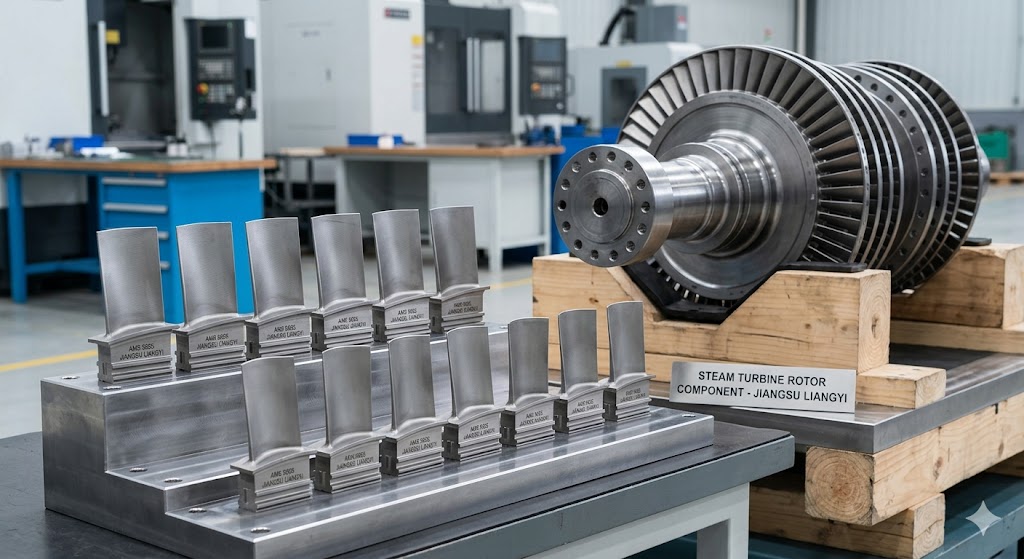
AMS 5655 gas turbine blades precision-machined for high-temperature operation
Hollow & Tubular Forgings
- Hollow bars, sleeves, and bushes: up to 3,000 mm OD
- Hubs, housings, shells, and cylindrical casings
- Dome-ended pressure vessel shells
Flat & Disc Forgings
- Discs and disks: 200 mm – 3,000 mm diameter, height up to 1,000 mm
- Flanges and tube sheets: up to 4,000 mm diameter
- Turbine wheels, impellers, and blisks
- Rectangular blocks and plates to custom dimensions
AMS 5655 Forged Parts for Gas & Steam Turbine Applications
The power generation industry is the single largest consumer of AMS 5655 forgings globally, and it is the application domain where the alloy's unique combination of high-temperature strength, temper resistance, and moderate corrosion resistance most clearly justifies its cost premium over simpler 410 SS. At Jiangsu Liangyi, turbine-grade AMS 5655 forgings account for over 60% of our total AMS 5655 output by weight, and we have accumulated more than 25 years of application-specific process data for this product family.
Complete Turbine Component Offering
- Gas and steam turbine blades and buckets — precision profile-forged with draft angles optimised for minimum machining stock
- Turbine rotor shafts and spindles — up to 15 m length; supplied with full ultrasonic inspection to ASTM A388 Class D acceptance
- Gas compressor blades and diffuser vanes
- Turbine diaphragms and nozzle assemblies
- Guide rings, seal rings, and packing seals
- Turbine wheels, discs, and impellers
- LPT (Low Pressure Turbine) casings and shrouds
- Journal and thrust bearing housings
- Control valves, reheat valves, and stop valve discs
- Valve spindles, stems, and rods
- Double-headed studs, bolts, and fasteners
- MSV / GV / CV / CRV valve seats, cores, and sleeves
- Main steam valve covers and bonnets
- Oil guards, nozzle bearing glands, and sealing rings
- Inlet Guide Vane (IGV) control rings
- Inner and outer heat shields
AMS 5655 Applications Across Global Industries
Aerospace & Defense
- High-temperature bolting and fasteners for aero-engine hot sections
- Valves and valve trim for hydraulic and fuel systems
- Landing gear pivot pins and structural clevis fittings
- Missile and launch vehicle propulsion components
Oil & Gas
- Wellhead and Christmas tree valve bodies
- High-pressure gate valves, ball valves, and check valves
- Pump impellers and wear rings for high-temperature process fluids
- Subsea manifold connectors requiring combined corrosion and pressure resistance
Power Generation
- Gas turbine and steam turbine components (see above)
- Nuclear power plant — coolant pump shafts and valve trim
- Combined-cycle plant — HRSG (Heat Recovery Steam Generator) components
Marine & Heavy Industry
- Large marine propulsion system shafts and bearings
- Industrial compressor components and high-pressure pump shafts
- Chemical processing — reaction vessel stirrer shafts and agitator impellers
- Mining — high-impact crusher components where corrosion resistance matters
Our AMS 5655 Manufacturing Process
Every AMS 5655 forging produced at Jiangsu Liangyi passes through a strictly sequenced manufacturing workflow designed to preserve traceability and eliminate the risk of process deviation going undetected. The following describes each stage:
Steel Procurement & Incoming Inspection
We source AOD + ESR certified AMS 5655 billets exclusively from qualified mills. Every incoming heat is verified by our OES spectrometer against the certificate chemistry before acceptance. We reject heats that fall outside our internal tighter-than-spec aim chemistry targets.
Billet Cutting & Heating
Billets are cut to calculated input weights by band saw or abrasive cut-off. Each piece is tagged with a heat number before entering our furnaces. Heating follows our validated temperature-time curves, with furnace atmosphere monitored to minimise decarburisation.
Precision Forging
Forging is performed on our 2,000–6,300-ton hydraulic presses. Computer-controlled ram speed and stroke logging provides a permanent record of the deformation history of each forging lot. Reduction ratios are calculated and recorded for every piece.
Post-Forge Slow Cool & Sub-Critical Anneal
After forging, parts are placed in insulated sand boxes or furnace-cooled to prevent quench cracking. A sub-critical anneal at 730–760 °C softens the as-forged structure for rough machining.
Rough Machining
Rough machining removes forging scale and excess stock, leaving 3–6 mm finish allowance. Dimensional inspection after roughing confirms that finished part dimensions are achievable before final heat treatment.
Final Heat Treatment (Q&T)
Double quench-and-temper per the AMS 5655 Condition A cycle (see Heat Treatment section). All furnace loads are equipped with calibrated thermocouples whose readings are logged at 1-minute intervals and archived for 10 years.
Testing & Inspection
Full chemical analysis (OES), mechanical testing (tensile, hardness, Charpy), ultrasonic testing, magnetic particle inspection, and dimensional inspection are performed. Test specimens are taken from the prolongation integral with the forging wherever possible.
Finish Machining (if required)
Our CNC machining facilities provide finish-machined AMS 5655 parts to tight drawing tolerances. Surface finish to Ra 0.8 µm or better is achievable on critical sealing faces depending on geometry and material condition.
Documentation, Packaging & Shipment
Complete MTC, UT reports, dimensional inspection report, and third-party certificate (if applicable) accompany every shipment. Packaging per our anti-corrosion standard (see Packaging section).
Quality Assurance & Testing Standards
Our quality system is built around the principle that inspection discovers problems but does not create quality — quality is built in through process control. Nevertheless, comprehensive final inspection provides independent verification that every AMS 5655 forging leaving our facility meets the specification.
Testing Performed on Every AMS 5655 Lot
| Test Type | Standard Applied | Frequency |
|---|---|---|
| Chemical Analysis (OES + wet chemistry) | ASTM E415 / ISO 15350 | Every heat; results reported on MTC |
| Tensile Test (RT) | ASTM E8 / ISO 6892-1 | Every lot per heat |
| Charpy V-Notch Impact | ASTM E23 / ISO 148-1 | When specified in purchase order |
| Brinell Hardness | ASTM E10 / ISO 6506 | Every piece; documented on MTC |
| Ultrasonic Testing (UT) | ASTM A388 / EN 10228-3 | Per purchase order requirements |
| Magnetic Particle Inspection (MPI) | ASTM E709 / EN 10228-1 | When specified in purchase order |
| Grain Size | ASTM E112 / ISO 643 | When specified in purchase order |
| Non-Metallic Inclusion Rating | ASTM E45 Method A / ISO 4967 | When specified in purchase order |
| Dimensional Inspection | Customer drawing / ISO 8015 | Per piece per drawing |
| Visual & Surface Inspection | ASTM A788 / customer spec | Per piece |
Third-Party Certification Bodies
For projects requiring independent witness inspection or EN 10204-3.2 countersignature, we can coordinate third-party inspection arrangements with internationally recognised certification bodies. Commonly requested bodies include:
- TUV SUD and TUV Rheinland (Germany)
- DNV GL (Norway / USA)
- American Bureau of Shipping (ABS)
- Lloyds Register of Shipping (UK)
- Bureau Veritas (France)
- RMRS (Russia Maritime Register)
- RINA (Italy)
- SGS (Switzerland)
- Intertek (USA)
Third-party inspection is arranged on a per-order basis and must be confirmed in the purchase order. Please verify availability for your specific project when requesting a quotation.
How to Read an AMS 5655 Mill Test Certificate (MTC)
Procurement engineers who are new to forged stainless steel sometimes struggle to evaluate whether an MTC they receive from a supplier genuinely demonstrates AMS 5655 compliance. The following guide explains what to look for — and what red flags should trigger a request for clarification or independent verification:
What a Compliant AMS 5655 MTC Must Contain
- Standard Reference: Must explicitly state "AMS 5655" — not simply "Type 422" or "S42200". The specification number is the contract document.
- Heat / Melt Number: A unique identifier traceable to the steel mill's production records. Demand traceability if the MTC does not contain a heat number.
- Melting Practice: The MTC or a supplemental document should state "AOD + ESR" — if the melting practice is not stated, the steel may not comply with the AOD + ESR requirement of AMS 5655.
- Chemical Analysis: All elements listed in the AMS 5655 composition table must be reported. A supplier who omits Vanadium or Tungsten from the chemistry report is providing an incomplete certificate — these are principal alloying elements of the alloy.
- Heat Treatment Record: Austenitising temperature, hold time, quench medium, tempering temperature(s), hold time(s), and cooling method must be stated. Without this, you cannot verify that the double-temper requirement was satisfied.
- Test Specimen Location: Must identify where the tensile and impact specimens were taken from the forging (e.g., "prolongation at large end", "mid-radius", "tangential from ring"). Results from a small companion test ring are not representative of a 30-ton shaft forging.
- Hardness: Brinell hardness must be reported and traceable to individual pieces (not averages across a lot).
- UT Acceptance Class: Must state which UT standard and acceptance class was applied. "UT tested" without a referenced standard is meaningless.
- Authorised Signatory: The MTC must bear an original signature (or digital equivalent with traceable authentication) from a quality-responsible person at the manufacturer.
⚠️ Common MTC Red Flags
- Chemistry shows Vanadium = "—" or "N/A" — this means either the steel was not analysed for V, or it was not intentionally added (i.e., it is likely not genuine Type 422 / AMS 5655)
- Melting practice listed as "EAF only" or omitted — ESR step may not have been performed
- Temper temperature below 590 °C — the alloy will not achieve full secondary carbide precipitation and will have poor temper resistance above 500 °C
- Single temper only — AMS 5655 requires double temper; single temper does not satisfy the specification
- All pieces in a large lot show identical hardness values (e.g., 320 HBW for every piece) — statistically implausible; suggests hardness was estimated rather than measured
Common Mistakes When Specifying AMS 5655 Forgings
Based on our experience handling thousands of enquiries over 25+ years, the following are the most frequent specification and procurement mistakes we encounter — and how to avoid them:
Mistake 1: Specifying by Grade Name Instead of the Full AMS Number
Ordering "Type 422 stainless forging" without citing AMS 5655 leaves the door open for suppliers to provide steel that meets the basic AISI 422 chemistry but was produced by EAF only (no ESR), or with chemistry near the minimum limits, or without the double-temper heat treatment. Always cite AMS 5655 and list the specific requirements (AOD + ESR, double temper, UT class) in your purchase order.
Mistake 2: Accepting a Single Temper Cycle
The single most common heat treatment non-conformance we see in competitor MTCs is a single temper instead of the double temper required by the specification. The second temper is not redundant — it drives the secondary carbide precipitation to completion and transforms any retained austenite that formed during the first temper cycle. Single-tempered AMS 5655 will show adequate room-temperature properties but will soften prematurely in service above 500 °C.
Mistake 3: Choosing AMS 5655 for Wet H₂S Service
AMS 5655 in the standard Q&T condition typically exceeds 22 HRC, placing it above the NACE MR0175 / ISO 15156-3 hardness limit for use in sour (H₂S-containing) service environments. If your application involves wet H₂S, consult a materials engineer — a different grade or a softer heat treatment condition may be required, and Liangyi can provide guidance.
Mistake 4: Under-Specifying UT Acceptance Class for Large Sections
The default AMS 5655 specification does not mandate a specific UT acceptance class — this is left to the buyer's purchase order or drawing. For forgings above 500 mm diameter, specifying ASTM A388 Class D or EN 10228-3 Quality Level 3 is strongly recommended. Forgings that pass only a "go/no-go" UT sweep without a defined reflector acceptance limit can harbour significant sub-surface discontinuities.
Mistake 5: Assuming All Chinese Forging Suppliers Are Equivalent
While China hosts hundreds of forging manufacturers, only a limited number possess the full capability to produce genuine AMS 5655 forgings, supported by documented AOD+ESR smelting procedures, double tempering treatment and fully calibrated inspection testing.Prior to formal production orders, purchasers are advised to verify the supplier’s heat traceability documents, furnace calibration certificates and authentic material test certificates from previous batch orders. Reliable and qualified manufacturers specializing in AMS 5655 production can provide all above credentials promptly upon request.
Packaging, Export Documentation & Shipping
For customers who import AMS 5655 forgings from China, knowing our standard packaging, export documentation, and shipping process well helps to plan project timelines accurately and avoid customs clearance delays.
Standard Anti-Corrosion Packaging
- Surface treatment: All machined surfaces are coated with a removable anti-rust oil (VCI-type) before packaging. As-forged surfaces receive a rust-inhibitive paint or wax coating.
- Wrapping: Each piece is individually wrapped in VCI (Vapour Corrosion Inhibitor) polyethylene film — providing 24-month corrosion protection without special storage conditions.
- Wooden crates: ISPM-15 heat-treated wooden crates or steel skids depending on piece weight and shipping mode. All crates are stamped with the heat-treatment mark required by international phytosanitary regulations.
- Heavy pieces (> 5,000 kg): Steel-framed shipping cradles with blocking and bracing per IICL standards; lashing points provided for sea freight container loading.
- Small precision parts: Individual foam-lined boxes within a master export crate; each part identified by heat number sticker matching the MTC.
Export Documentation Package (Standard)
- Commercial Invoice — FOB / CIF / DAP as agreed; in USD, EUR, or GBP
- Packing List — piece count, individual weights, crate dimensions, gross weight
- Bill of Lading (OBL) — sea freight; or Airway Bill for air shipment
- Certificate of Origin (CO) — China CCPIT or Chamber of Commerce, for preferential duty rates
- Material Test Certificate (MTC) — EN 10204-3.1 as standard; 3.2 with third-party countersignature when specified
- UT / NDT Reports — individual piece reports with scan coverage diagrams
- Dimensional Inspection Report — per drawing; CMM printout for critical dimensions
- Heat Treatment Records — furnace chart copies with time-temperature traces
- Third-Party Inspection Certificate — TUV, DNV, BV, etc. when specified in purchase order
Shipping Modes & Lead Times
| Mode | Destination | Transit Time | Typical Use |
|---|---|---|---|
| Sea Freight (FCL) | USA (East Coast) | 25 – 35 days | Standard production orders |
| Sea Freight (FCL) | Germany / Rotterdam | 28 – 38 days | Standard production orders |
| Sea Freight (FCL) | Australia (Melbourne) | 18 – 25 days | Standard production orders |
| Sea Freight (FCL) | Middle East (Dubai) | 15 – 22 days | Standard production orders |
| Air Freight | Worldwide | 3 – 7 days | Urgent small parts; max ~500 kg/piece practical |
| Express Courier | Worldwide | 3 – 5 days | Samples and small prototype pieces; < 70 kg |
Note: Transit times are from port departure date. Factory lead time (production) is separate — typically 4–6 weeks for standard parts, 6–12 weeks for complex custom forgings.
AMS 5655 Project Case Studies
Case 1 — Combined-Cycle Power Plant, Southeast Asia
We supplied AMS 5655 gas turbine blade forgings and rotor shaft blanks for a large combined-cycle power plant project in Southeast Asia. The EPC contractor required third-party inspection oversight throughout key production stages.
We fully cooperated with the full inspection workflow, covering document review and on-site witness at hold points. All components were delivered on schedule in strict accordance with the project contract. Since commissioning, these components have maintained long-term stable operation, with no material or forging-related failures recorded to date.
Case 2 — Aerospace Engine Fastener Project, European OEM
We produced a batch of AMS 5655 double-ended studs for a European aerospace manufacturer, and they are used for hot-section assemblies of aero engines.In addition to the standard mechanical requirements of AMS 5655, the customer’s technical drawing mandated fracture toughness (K₁c) testing. Our team collaborated with an accredited external testing laboratory to fabricate and test CT specimens sourced from prolongation materials, providing complete qualified test data while adhering to the original delivery timeline.The entire project fully met the customer’s acceptance specifications and quality requirements, achieving successful final approval.
Case 3 — Steam Turbine Valve Retrofit, European Power Utility
We supplied AMS 5655 valve seats, stems, and bonnet ring forgings for a steam turbine life-extension retrofit project in Europe. Replacement parts had to be dimensionally interchangeable with existing worn parts while achieving improved creep resistance. We applied an optimised double-temper cycle and documented the process fully for the customer's engineering review. The customer confirmed the parts met all dimensional and mechanical acceptance criteria upon receipt.
Case 4 — Subsea Valve Bodies, Middle East Project
We produced AMS 5655 gate valve body and bonnet forgings for a subsea deployment project in a high-H₂S / high-CO₂ environment. Since standard AMS 5655 Q&T hardness exceeded the NACE MR0175 limit, we worked with the customer's materials engineer to develop a high-temper condition at 680 °C that reduced hardness to below 22 HRC while retaining the required strength level. The modified heat treatment procedure was confirmed against the project's materials specification before production release.
AMS 5655 Material Selection Guide
Use this decision framework to determine whether AMS 5655 is the right choice for your application — or whether a different grade from our material portfolio would better serve your requirements:
Choose AMS 5655 when your application requires:
- Continuous service temperatures between 480 °C and 649 °C (900 – 1,200 °F)
- High strength (YS > 100 ksi / 690 MPa) at elevated temperature
- Good corrosion resistance to steam and weakly acidic condensates
- Aerospace material specification compliance (AMS traceability)
- A material with a long field history in gas and steam turbines
Consider alternatives when:
- Temperature < 480 °C and high strength needed: Consider 17-4PH (AMS 5643) — lower cost, easier heat treatment, same strength level
- Temperature > 650 °C: Consider nickel-base superalloys UNS N07718 or UNS N07001 — designed for this temperature regime
- Severe chloride corrosion is the primary concern: Consider duplex 2205 (UNS S32205) or 316L (AMS 5648)
- Maximum machinability at lower temperature: Consider 416 SS (AMS 5610) — free-machining grade with 30–50% better machinability
- Sour (H₂S) service environment: Consult our materials engineering team — a modified heat treatment of AMS 5655 or an alternative grade may be required for NACE compliance
Not sure which grade is right for your application? Our engineering team provides material choice consultations at no charge as part of the quotation process. Send us your operating conditions, loading profile, and any applicable design standards, and we will provide a written recommendation with supporting technical rationale.
Frequently Asked Questions About AMS 5655 Forgings
A: AMS 5655 and AISI/ASTM Type 422 refer to the same base alloy composition (UNS S42200), but AMS 5655 imposes additional manufacturing and testing requirements not found in the generic AISI designation. Specifically, AMS 5655 mandates AOD + ESR double-refining of the steel, specific heat treatment conditions (double temper), and defined mechanical property minimums after heat treatment. A forging stamped "Type 422" without the AMS 5655 designation may have been made from EAF-only steel and may lack the superior cleanliness and fatigue resistance that ESR provides. For high-safety applications, always specify AMS 5655 explicitly.
A: Maximum single-piece weight is 30,000 kg (30 metric tons). For seamless rolled rings, maximum OD is 6,000 mm. For forged round bars, maximum diameter is 2,000 mm. For shafts and elongated pieces, maximum length is 15,000 mm (15 m). Minimum piece weight is 30 kg. Contact us with your exact dimensions and we will confirm feasibility and provide a detailed quotation within 24 hours.
A: Standard supply includes an EN 10204-3.1 Material Test Certificate covering chemical composition (OES), mechanical properties (tensile + hardness), heat treatment records, and UT inspection results. EN 10204-3.2 certificates with third-party countersignature from TUV, DNV GL, ABS, Lloyds, BV, RMRS, RINA, or SGS are available when specified in the purchase order. Additional reports (grain size, inclusion rating, fracture toughness) can be arranged on request.
A: Standard open-die forgings and seamless rolled rings in common sizes: 4–6 weeks from order confirmation. Complex custom-profile forgings or parts needing third-party witness inspection: 6–12 weeks. Very large single pieces (> 15 tons): 8–14 weeks depending on steel procurement. We also can speed up production for urgent orders — contact us to discuss your timeline.
A: Yes. We offer complete in-house CNC machining — turning, milling, drilling, boring, and grinding — to finished drawing dimensions. Our machining capability covers parts up to 5 m in diameter and 15 m in length. Surface finish to Ra 0.8 µm or finer on important sealing faces. We can also provide thread rolling, spline hobbing, and gear cutting on standard forms. Fully finish-machined parts are supplied with a dimensional inspection report referencing each critical dimension on the drawing.
A: There is no fixed MOQ. We regularly produce single prototype pieces as well as production runs of thousands of pieces. For single-piece prototype orders, note that tooling / die cost (if closed-die tooling is required) is amortised over the prototype quantity and may result in a higher per-piece price than production pricing. Open-die and ring-rolled parts generally have no tooling cost. Contact us with your quantity for an accurate quotation.
A: Standard AMS 5655 Q&T condition typically exceeds 22 HRC (approximately 238 HBW), placing it above the NACE MR0175 / ISO 15156-3 hardness limit for use in wet H₂S environments. However, we have successfully produced AMS 5655 forgings for sour service applications using a high-temper condition (680 °C / 1,255 °F) that reduces hardness to ≤ 22 HRC while retaining adequate strength for the specific pressure rating. This approach requires NACE TM0177 SSC testing validation. Contact our engineering team to discuss your specific application and H₂S partial pressure conditions.
A: Both are stainless steels with high strength, but they achieve it by different metallurgical mechanisms. AMS 5655 (Type 422) is a martensitic steel hardened by conventional quench-and-temper, with secondary carbide precipitation providing temper resistance up to 649 °C. AMS 5643 (17-4PH) is a precipitation-hardening steel that achieves very high room-temperature strength (H900 condition: ~170 ksi UTS) through copper-rich precipitate hardening, but this hardening mechanism begins to dissolve above ~480 °C. For turbine blades, rotor shafts, and valve stems in high-temperature service, AMS 5655 is the correct choice. For ambient-temperature structural parts, aerospace fittings, and pump shafts where maximum strength at room temperature matters, AMS 5643 is often preferred.
A: Yes. We offer a reverse-engineering service for customers who need to replace worn or damaged AMS 5655 parts without access to original drawings. We use portable CMM (coordinate measuring machine) and 3D scanning to generate a dimensioned drawing from your sample part. Material identification (if unknown) can be performed by OES spectroscopy. We will then produce replacement forgings to the reverse-engineered drawing. Typical reverse-engineering turnaround is 5–10 business days before production begins.
How to Order AMS 5655 Forgings from Jiangsu Liangyi
Our quotation process is designed to give you a detailed, technically complete offer within 24 hours of receiving your enquiry. To get an accurate quotation, please provide as many of the following as available:
- Forging drawing (PDF, DWG, or STEP) with material call-out, tolerances, and surface finish requirements
- Material specification: AMS 5655 (please also note any supplementary requirements)
- Heat treatment condition needed (Condition A high-temper, Condition B lower-temper, or custom)
- Inspection requirements: UT class, MPI, grain size, third-party inspector (if any)
- Certificate type required: EN 10204-3.1 or 3.2; which certification body
- Quantity (pieces) and any repeat order frequency
- Required delivery date and delivery terms (FOB, CIF, DAP, etc.)
- Destination port or address
If you do not yet have a drawing, our engineers can assist with material selection and preliminary forging design based on your application description. We provide this technical consultation at no charge.
Why Choose Jiangsu Liangyi as Your AMS 5655 Forging Partner?
- 25+ Years of AMS 5655 Production Experience: Established in 1997; thousands of AMS 5655 heat lots produced and shipped globally.
- Vertically Integrated Manufacturing: From sourcing AOD + ESR certified steel billets through press forging, ring rolling, heat treatment, NDT, and CNC machining — we manage every critical step with full process documentation.
- ISO 9001:2015 Certified Quality System: Comprehensive quality management covering all manufacturing and inspection processes, with documented records available for customer and third-party review.
- State-of-the-Art Equipment: 6,300-ton hydraulic press; 1,200-ton ring mill; 10 heat treatment furnaces; 5-axis CNC machining centres; portable CMM and UT phased array scanners.
- 120,000-Ton Annual Capacity: Large enough to handle major project lots without subcontracting; responsive enough to expedite urgent prototype orders.
- Transparent Documentation: Full heat traceability from mill certificate to finished part tag; furnace records archived for 10 years; no ghost certificates.
- Global Shipping: Regular container loads to USA, Germany, UK, Australia, Singapore, UAE, India, and beyond. Experienced export team handles all customs documentation.
- Engineering Support: Our in-house metallurgists provide free material selection advice, heat treatment optimisation, and failure analysis support to customers at no additional charge.
Contact Us for AMS 5655 Forging Quotations
Ready to source AMS 5655 forgings with full documentation and verified quality? Send us your drawings or application description and receive a detailed technical quotation within 24 hours.
📧 Inquiry Email
sales@jnmtforgedparts.com
📞 Phone / WhatsApp
+86-13585067993
🌐 Website
www.jnmtforgedparts.com
📍 Factory Address
Chengchang Industry Park
Jiangyin City, Jiangsu Province
214400 China
Send your drawing + quantity → receive a full technical quotation within 24 hours