AMS 5628 Forging Parts | China Professional Forged Steel Manufacturer
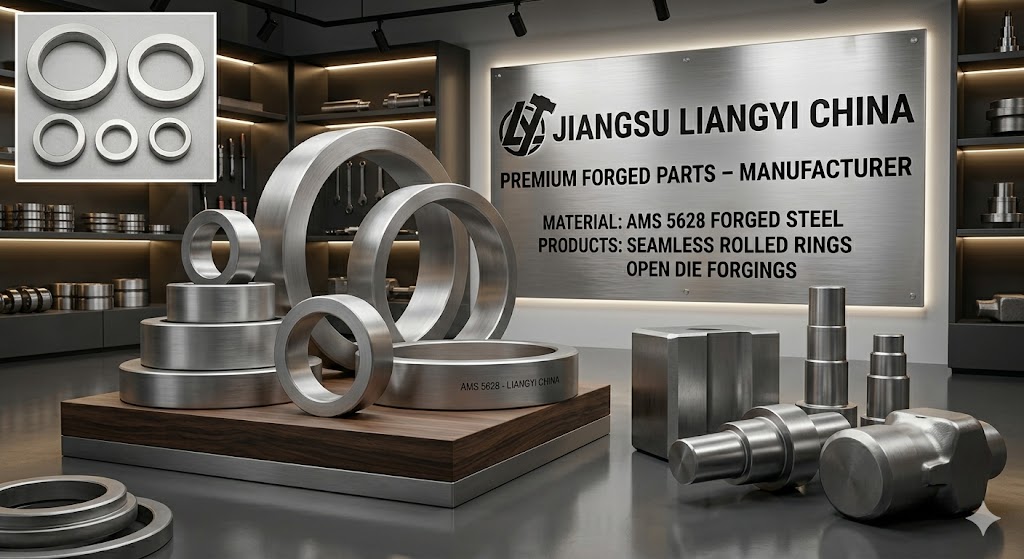
Complete AMS 5628 Engineering Reference — What You Will Find Here
- Metallurgy & advantages over 410 stainless
- EN / JIS / GOST international equivalents
- Full physical & thermal properties data
- Step-by-step forging process from ingot
- Double melt vs triple melt decision guide
- Product range & max size capabilities
- 6 global industry case studies
- Chemical composition & mechanical properties
- Heat treatment parameters in detail
- Corrosion resistance & service environment guide
- Machining & fabrication guidelines
- Surface treatment & post-processing options
- Industry standards cross-reference
- 12-stage quality assurance system
- 5 specification mistakes to avoid
- 14 engineering FAQs
AMS 5628 Material — Deep Metallurgy & Why It Outperforms Standard 410
Jiangsu Liangyi Co., Limited is an ISO 9001:2015 certified specialist manufacturer of AMS 5628 open die forgings and seamless rolled rings. With over 25 years of hands-on production experience in high-alloy stainless forgings, we have produced AMS 5628 components ranging from 30 kg valve spindles to 18-tonne nuclear pump casings, delivering to customers in more than 50 countries through Shanghai Port and Ningbo-Zhoushan Port.
AMS 5628 is a martensitic stainless steel whose design philosophy is best understood in the context of its principal competitor, AMS 5612 (standard 410). Both alloys share a chromium backbone of 11.5–16.5%, which generates the passive Cr₂O₃ surface oxide layer responsible for stainless steel corrosion resistance. The critical difference lies in what happens during solidification. Standard 410 solidifies through a dual-phase ferritic-austenitic path. As it cools, some of that primary ferrite — called delta ferrite — fails to fully transform and remains as elongated stringers in the final microstructure, oriented parallel to the forging direction. Under transverse loading or impact, these stringers act as pre-existing crack initiation sites: the engineering equivalent of a hidden fault line through the material. For room-temperature static applications, this is tolerable. For rotating aerospace components, nuclear coolant pump seals, or subsea valve bodies subjected to cyclic loading and sub-zero temperatures, it represents an unacceptable risk.
AMS 5628 solves this with a targeted nickel addition of 2.0–3.0%. Nickel is a powerful austenite stabiliser. Added at this level, it shifts the alloy's solidification path to suppress delta ferrite formation entirely in the final tempered martensite microstructure. The result is a fully martensitic single-phase structure with refined lath packet size — the fundamental microstructural unit controlling toughness in martensitic steels. Smaller lath packets mean more grain boundaries per unit volume, which deflect crack propagation paths and consume more energy per unit of crack extension. In measurable terms, this pushes the ductile-to-brittle transition temperature (DBTT) of AMS 5628 approximately 50–80°F lower than equivalent 410 — enough to make the difference between passing and failing a Charpy impact test at −73°C (−100°F) for safety-critical applications.
The carbon range of 0.12–0.17% is tightly controlled for a specific reason: carbon content in martensitic stainless steel is the primary lever controlling hardness and strength via the martensite carbon content after quenching. Too low (below 0.12%) and the martensite lacks sufficient hardness for the application; too high (above 0.17%) and the risk of carbide precipitation at grain boundaries during tempering increases, producing a sensitised microstructure with locally reduced chromium and impaired corrosion resistance. The AMS 5628 window was established by decades of fatigue and fracture testing to optimise this balance for aero-engine and nuclear service.
The Four Engineering Reasons AMS 5628 Is Specified Over 410 in Critical Applications
- Complete delta-ferrite elimination: The 2–3% Ni addition fully suppresses residual ferrite stringers, producing consistent mechanical properties in both longitudinal and transverse forging directions — critical for thick-section forgings where transverse properties govern design.
- Lower ductile-to-brittle transition temperature: Refined martensite lath packet size reduces DBTT by 50–80°F vs 410, enabling Charpy V-notch testing at −73°C where standard 410 exhibits near-zero impact energy.
- Vacuum melt compatibility: Tighter composition limits allow full VIM+VAR and VIM+ESR+VAR processing, enabling non-metallic inclusion ratings of B1/C1 or better per ASTM E45 — unachievable with commodity 410 forgings.
- Minimum yield strength guarantee: The H+T condition specifies Rp0.2 ≥ 655 N/mm², significantly higher than annealed 410 (275 N/mm²), providing a defined design envelope for structural calculations.
The martensite start temperature (Ms) for AMS 5628 is approximately 270°C (518°F). This value is critical for the forging process: all hot working must be completed above Ms to avoid forming brittle untempered martensite during deformation. The martensite finish temperature (Mf) sits near ambient for this composition, meaning the transformation to martensite is essentially complete upon cooling to room temperature after austenitizing — unlike some higher-alloy grades that retain significant austenite and require sub-zero cooling to complete transformation.
AMS 5628 International Equivalents — EN, JIS, GOST & Critical Differences
Global procurement engineers regularly encounter AMS 5628 requirements on drawings from aerospace OEMs, nuclear EPCs, and oil field operators, often with a footnote allowing substitution with "equivalent international standard." Understanding where equivalency is genuine and where it creates material non-conformance risk is one of the most practically important skills in this alloy class. The table below presents the five most commonly cross-referenced standards with measurable specification differences highlighted.
| Standard / Grade | C % | Cr % | Ni % | Vacuum Melt | Min. Yield (H+T) | PRE Estimate | Typical Application |
|---|---|---|---|---|---|---|---|
| AMS 5628 This Grade | 0.12–0.17 | 15.5–16.5 | 2.0–3.0 | VIM+VAR or VIM+ESR+VAR required | 655 N/mm² | ~16.8 | Aerospace, Nuclear, Oil & Gas, Defense |
| EN 1.4057 (X17CrNi16-2) | 0.12–0.20 | 15.5–17.5 | 1.5–2.5 | Not required | 600 N/mm² | ~16.5 | Industrial, Marine, Pump shafts |
| JIS SUS 431 | ≤ 0.20 | 15.0–17.0 | 1.25–2.50 | Not required | 590 N/mm² | ~15.9 | Pump shafts, Marine hardware, Japan |
| GOST 20X17H2 | 0.17–0.25 | 16.0–18.0 | 1.5–2.5 | Not required | 635 N/mm² | ~17.1 | Turbine components, CIS countries |
| ASTM A276 Type 431 | ≤ 0.20 | 15.0–17.0 | 1.25–2.50 | Not required | 515 N/mm² (annealed) | ~15.9 | Bar stock, General industry, USA |
⚠ Critical Substitution Warning for Aerospace & Nuclear Engineers
EN 1.4057 and JIS SUS 431 are routinely quoted as "equivalent" to AMS 5628, but three specification gaps make them non-interchangeable for demanding applications. First, both allow carbon up to 0.20% versus the 0.17% maximum in AMS 5628 — this 0.03% difference is enough to cause sensitisation risk during slow cooling through 450–850°C (the chromium carbide precipitation range). Second, the minimum nickel of 1.25–1.5% in EN 1.4057 and SUS 431 may leave residual delta ferrite in the microstructure, which AMS 5628's 2.0% minimum Ni is specifically designed to prevent. Third, neither standard requires vacuum arc remelting, meaning sulphide inclusion content may be 3–5× higher than VIM+VAR material. A First Article Inspection that tests inclusion ratings per ASTM E45 will immediately detect this gap. Jiangsu Liangyi can supply dual-certified material meeting both AMS 5628 and EN 1.4057 simultaneously — contact us with your drawing for a technical assessment.
AMS 5628 Physical & Thermal Properties — Complete Data for Design Engineers
The physical property data below is essential for finite element analysis (FEA), thermal stress calculations, heat exchanger design, and selection of compatible fasteners and housings. Most competitor datasheets omit these values entirely, forcing engineers to use generic "stainless steel" assumptions that can introduce significant error in critical calculations. The values presented here are based on our in-house measurement data and published metallurgical reference data for this alloy class, representing the hardened and tempered (H+T) condition at standard composition (Cr 16%, Ni 2.5%, C 0.14%).
| Property | Value | Unit | Engineering Design Note |
|---|---|---|---|
| Density | 7.75 | g/cm³ | Slightly lower than austenitic 316L (7.99 g/cm³); allows weight-based quantity checking |
| Melting Range | 1,480–1,530 | °C | Relevant for welding heat input calculations and brazing filler selection |
| Elastic Modulus (E) | 200 | GPa | Same as carbon steel; use for deflection and stiffness calculations in FEA models |
| Shear Modulus (G) | 77 | GPa | For torsional shaft design and vibration frequency calculations |
| Poisson's Ratio (ν) | 0.28 | — | Required for biaxial stress state FEA; slightly lower than austenitic grades (0.30) |
| Thermal Conductivity @ 20°C | 22–26 | W/(m·K) | ~10× lower than copper; 40% higher than austenitic 316L — important for heat exchanger tubesheet sizing |
| Thermal Conductivity @ 300°C | 24–27 | W/(m·K) | Slight increase with temperature — opposite trend to austenitic grades |
| Thermal Conductivity @ 500°C | 23–26 | W/(m·K) | Still significantly higher than 316L at equivalent temperatures |
| CTE @ 20–100°C | 10.2 × 10⁻⁶ | /°C | Lower CTE than austenitic SS (16.0 × 10⁻⁶); much closer to carbon steel — important for mixed-material assemblies |
| CTE @ 20–300°C | 11.0 × 10⁻⁶ | /°C | Use this value for turbine and valve body thermal stress calculations at operating temperature |
| CTE @ 20–500°C | 11.5 × 10⁻⁶ | /°C | Upper service temperature range; confirm with thermal fatigue assessment above 400°C |
| Specific Heat (Cp) @ 20°C | 460 | J/(kg·K) | For thermal transient analysis and quench time calculation |
| Specific Heat (Cp) @ 300°C | 520 | J/(kg·K) | Increases with temperature; use for temperature-dependent thermal models |
| Electrical Resistivity @ 20°C | 0.60 | μΩ·m | Ferromagnetic material — significantly lower resistivity than austenitic grades (0.70–0.75 μΩ·m) |
| Magnetic Permeability | Ferromagnetic (μr >> 1) | — | Enables magnetic particle inspection (MPI/MT) and induction heating; not suitable for low-magnetic-field environments |
| Thermal Diffusivity @ 20°C | ≈ 6.1 × 10⁻⁶ | m²/s | Higher than austenitic grades — quench cooling is more rapid and more uniform through section |
CTE Mismatch Warning for Mixed-Material Assemblies
AMS 5628's CTE of 10.2–11.5 × 10⁻⁶ /°C is significantly lower than austenitic stainless steels (15.5–17.5 × 10⁻⁶ /°C) and much closer to carbon steel (11.0–12.5 × 10⁻⁶ /°C). This makes AMS 5628 a better material choice than austenitic grades when interfacing with carbon steel housings or flanges in thermally cycled applications — the lower CTE mismatch reduces differential thermal expansion and the associated fatigue loading on bolted connections. However, if AMS 5628 is threaded into or press-fitted within an austenitic stainless steel housing, the large CTE difference (5–6 × 10⁻⁶ /°C) will generate significant differential thermal stresses at operating temperature that must be explicitly included in the assembly design calculation.
Elevated Temperature Strength Retention
One of the most frequent engineering questions we receive is: how does AMS 5628 strength degrade with temperature, and what is the practical upper service temperature limit? Unlike austenitic grades that maintain reasonable strength up to 800°C, martensitic stainless steels are limited by carbide coarsening and martensite recovery processes that begin significantly above the tempering temperature. The following data represents the approximate strength retention profile for AMS 5628 in the standard H+T condition:
| Temperature | Approx. Yield Strength | Approx. Tensile Strength | Long-Term Service Note |
|---|---|---|---|
| 20°C (Ambient) | 720–800 N/mm² (typical) | 920–1,000 N/mm² | Standard reference condition; full properties achieved |
| 200°C | ~620–680 N/mm² | ~820–900 N/mm² | Normal service range; excellent long-term stability |
| 300°C | ~570–640 N/mm² | ~780–850 N/mm² | Turbine and steam valve application range; stable |
| 400°C | ~510–580 N/mm² | ~720–790 N/mm² | Approaching practical upper limit; creep factor enters design |
| 450°C | ~470–530 N/mm² | ~670–730 N/mm² | Practical upper limit for AMS 5628 — carbide coarsening begins to affect long-term properties |
| 550°C | ~370–430 N/mm² | ~580–640 N/mm² | Not recommended for continuous service — progressive microstructure degradation; consider austenitic grades |
Our AMS 5628 Forging Process — Step-by-Step from Ingot to Finished Part
Most AMS 5628 pages list chemical compositions and quote the standard. What they rarely explain is how the material must be processed to achieve the specified properties — and what happens when the process goes wrong. After producing over 8,000 tonnes of AMS 5628 forgings since 2005, our process engineers have developed a production sequence that consistently delivers first-article approval, even for the most demanding nuclear and aerospace customers.
- Ingot Selection & Melting Process Verification We confirm the required melting route based on the application before material is ordered. For standard industrial forgings, we procure VIM+VAR double-melted ingots from approved Chinese special steel mills, with incoming chemical OES analysis and macro-etch inspection on every heat. For aerospace, nuclear, and subsea applications, we source VIM+ESR+VAR triple-melted ingots, verified to have sulphur below 0.008% and non-metallic inclusion ratings below B1.5 / C1.5 per ASTM E45. Each incoming ingot is assigned a unique traceability number that follows the forging through every subsequent production stage.
- Ingot Heating & Homogenization Soak AMS 5628 ingots are charged into our gas-fired forging furnaces at a controlled rate to avoid thermal shock cracking, then heated to a soaking temperature of 1,180–1,220°C (2,156–2,228°F). Soaking time is critical: we apply a minimum of 1 hour per 100mm of ingot diameter, plus a mandatory 30-minute furnace equalisation period at the set temperature. This dissolves carbide networks that form during solidification — premature forging of an under-soaked ingot produces carbide streaks that pass chemical analysis but create preferential fatigue crack initiation sites. This is one of the most common — and most invisible — quality failures in low-cost AMS 5628 forgings.
- Primary Breakdown Forging (Ingot-to-Billet) Using our 6,000-ton hydraulic press, the ingot undergoes primary breakdown to a billet with a minimum area reduction ratio of 4:1 for bar and shaft products, and 3.5:1 for ring preforms. This simultaneously closes residual solidification porosity, breaks the coarse as-cast dendritic grain structure, and elongates any oxide inclusions into detectable stringers for subsequent UT. Multiple press passes with 90° rotation between each pass are applied to ensure directional uniformity of the refined microstructure.
- Intermediate Reheat & Temperature-Monitored Forging For large forgings requiring multiple sequences, billets are reheated to 1,100–1,150°C between passes. All forging is completed above the martensite start temperature (Ms ≈ 270°C) to prevent brittle untempered martensite formation during deformation — a crack initiation risk unique to martensitic steels. Our press operators use calibrated optical pyrometers to monitor billet surface temperature at every stage, with automatic data logging included in the production record for customer review.
- Finish Forging & Ring Rolling For seamless rings, the billet is punched and transferred to our 1-metre or 5-metre radial-axial ring rolling machines. Feed rate, rolling speed, and axial pressure are controlled to achieve simultaneous radial and axial elongation, maintaining a homogeneous ASTM No. 5 or finer grain size throughout the ring cross-section. This circumferential grain alignment gives ring forgings superior hoop-direction mechanical properties compared to cut-and-welded or fabricated alternatives. For shafts and bars, finish forging to near-net shape preserves the forged grain flow aligned with the primary stress axis, maximising the fatigue and impact performance in service.
- Controlled Post-Forge Cooling This step is absent from most competitor process descriptions, yet it is where many martensitic forging failures originate. After finish forging, AMS 5628 must be cooled at a controlled rate to avoid thermal gradient-induced cracking. We cool forgings in sand-insulated cooling pits or perform a controlled furnace cool from 800°C to below 200°C at a maximum rate of 30°C/hour for sections above 200mm. Sections below 100mm may be air cooled. Forgings that cool too rapidly from the forging temperature will develop through-thickness thermal cracks that only appear during final UT inspection — causing costly rejections and delays that could have been entirely avoided.
- Austenitizing, Quench & Double Tempering Full parameters are detailed in the dedicated Heat Treatment section below. In summary: austenitize at 980–1,050°C with minimum soak time of 1 hour per 25mm section, oil quench within 20 seconds of leaving the furnace, then double temper at 580–650°C with a minimum of 2 hours per 25mm section per temper cycle, with a minimum 24-hour ambient hold between temper cycles for sections above 150mm. All furnace work is performed in our ten computer-controlled continuous furnaces, calibrated and regularly maintained, with ±5°C temperature uniformity and full furnace chart recording.
- Full Non-Destructive & Mechanical Testing Every AMS 5628 forging is individually ultrasonically tested using straight-beam and angle-beam probes before release. For aerospace and nuclear grade parts, the acceptance standard is ASTM A388 Zone I: zero indications exceeding a 3mm equivalent flat-bottom hole, and no complete loss of back-wall echo. Mechanical test specimens are taken from representative test prolongations on the same forging lot, with tensile, hardness, and Charpy impact tests performed by our qualified NDT inspectors in our in-house laboratory.
Double Melt vs Triple Melt for AMS 5628 — Engineering Decision Guide
The melt route choice is one of the most impactful — and most frequently misunderstood — decisions in AMS 5628 procurement. It directly affects inclusion cleanliness, fatigue life, fracture toughness, lead time, and cost. Here is how our technical team evaluates this decision for every new customer inquiry.
VIM+VAR — Double Melt
- Vacuum Induction Melting → Vacuum Arc Remelting
- Inclusion rating: B1.5–B2 / C1.5–C2 per ASTM E45 (typical)
- Sulphur: ≤ 0.015% (VIM removes N, VAR removes macro-segregation)
- Ingot homogeneity: good — VAR dendrite arm spacing uniform
- Best for: valve bodies, structural rings, pump shafts, most oil & gas components
- Cost premium over EAF/AOD: moderate (~25–40%)
- Lead time impact: none vs standard schedule
VIM+ESR+VAR — Triple Melt ★ Aerospace / Nuclear Standard
- VIM → Electroslag Remelting → Vacuum Arc Remelting
- Inclusion rating: B1 / C1 or better per ASTM E45 (ESR removes MnS via slag)
- Sulphur: ≤ 0.008% — ESR slag reaction removes sulphur chemically
- Superior fatigue life: +30–50% over double melt in rotating components (published literature)
- Superior fracture toughness (K_IC) vs double melt at equivalent yield strength
- Required for: rotating aero parts, nuclear Class 1 boundaries, subsea wellheads, fracture-mechanics designed components
- Lead time: add 2–3 weeks for dedicated ingot production
- Cost premium: 40–60% over double melt (ingot cost; forging cost unchanged)
EAF+AOD — Conventional Melt
- Electric Arc Furnace + Argon Oxygen Decarburisation
- Inclusion rating: B3–B4 typical; B2 possible with clean charge
- Not compliant with AMS 5628 for any critical application
- Acceptable for: non-structural decorative applications only
- Lowest cost — not offered by Jiangsu Liangyi for AMS 5628
The ESR Step — Why It Makes the Difference
Electroslag Remelting works by slowly remelting a consumable electrode through a molten slag pool. As the steel passes through the slag, the slag reacts chemically with sulphur in the steel to form CaS, which remains trapped in the slag rather than re-entering the solidifying ingot. This is why ESR is the only commercially practical way to achieve sulphur below 0.008% in large-tonnage melts — VIM and VAR alone cannot reach this level without extraordinary process constraints. The CaS removal eliminates the MnS inclusions that are the primary Type B inclusion family in the ASTM E45 rating, which are also the most damaging to fatigue life because their elongated morphology after forging presents a large projected area perpendicular to tensile stresses.
✔ Our Melt Route Recommendation Framework
If any of the following apply to your component, specify VIM+ESR+VAR triple melt: (a) the part rotates at operating speed; (b) the design uses fracture mechanics (K_IC or ΔK_th); (c) the specification requires ASTM E45 B1/C1 or better; (d) the component is a nuclear Class 1 or 2 pressure boundary; (e) the application is subsea or in a hydrogen-containing environment (hydrogen embrittlement risk increases with inclusion content). For static structural parts, wellhead valve bodies, flanges, most pressure vessel nozzles, and general oil & gas downhole components governed by static yield strength rather than fatigue life, VIM+VAR double melt provides fully compliant AMS 5628 properties. When genuinely uncertain, contact our technical team — we assess your application at no charge and provide a written recommendation with rationale.
Full Range of AMS 5628 Forged Steel Products & Maximum Size Capabilities
Our integrated facility — with presses from 800 to 6,000 tonnes, hammers from 0.75 to 9 tonnes, and ring rollers up to 5 metres — gives us the widest single-source AMS 5628 production envelope available from China. All products below are available in double-melt or triple-melt AMS 5628, with EN 10204 3.1 or 3.2 mill test certificates, dimensional inspection reports, and full NDT records as standard.
| Product Shape | Maximum Dimensions | Max Single Weight | Supply Conditions Available | Key Applications |
|---|---|---|---|---|
| Round Bar / Rod | Ø 50–2,000 mm × L 8,000 mm max | 25,000 kg | Forged black / Rough turned / Precision turned Ra 1.6 | Pump shafts, valve spindles, machining blanks, test bars |
| Square / Flat / Rectangular Bar | 50–1,200 mm side / thickness | 20,000 kg | Forged black / Milled flat with machining allowance | Die inserts, structural blocks, custom blanks, tooling |
| Seamless Rolled Ring | OD 300–6,000 mm, wall 30–600 mm | 30,000 kg | Forged black / Rough turned I.D. & O.D. / Finish machined | Bearing races, turbine casing flanges, nuclear nozzles, gear rings |
| Contoured / Profiled Ring | OD up to 4,500 mm, custom cross-section | 25,000 kg | Near-net shape, defined machining allowance per drawing | Labyrinth seal rings, stepped bearing races, custom flanges |
| Disc / Disk / Plate / Block | OD up to 3,000 mm, thickness 800 mm max | 25,000 kg | Forged black / Face milled / Precision ground | Turbine discs, impellers, wheel discs, pressure vessel heads |
| Step Shaft / Turbine Shaft | Max Ø 1,200 mm × L 15,000 mm | 30,000 kg | Rough turned with machining allowance per drawing | Turbine shafts, compressor shafts, motor shafts, propeller shafts |
| Hollow Bar / Sleeve / Bush / Hub | OD up to 3,000 mm, wall ≥ 40 mm | 20,000 kg | Bored I.D. / Turned O.D. / Finish machined | Pump casings, housings, bearing shells, drive sleeves |
| Flange / DSA Flange / Bossed Blank | OD up to 3,500 mm, various pressure ratings | 18,000 kg | Forged black / Finish machined to ANSI/ASME B16.5 or drawing | Pipeline connections, wellhead assemblies, pressure vessel nozzles |
| Tube Sheet / Baffle / Pressure Vessel Component | OD up to 3,000 mm, thickness 500 mm max | 20,000 kg | Face milled / Drilled to customer drawing | Heat exchanger tube sheets, reactor internals, vessel heads |
| Custom Near-Net Shape Forging | Per customer drawing and weight limit above | 30,000 kg | All conditions available — forged to agreed machining allowance | Any application requiring minimum material removal and maximum grain flow preservation |
For all products, we can arrange protective surface coating (rust-preventive oil, VCI film, wooden crate with desiccant) for sea freight, and full export documentation including commercial invoice, packing list, certificate of origin, EUR.1 form, mill test certificate, inspection release note, and bill of lading. Incoterms available: EXW, FOB Shanghai/Ningbo, CFR, CIF, DDP.
AMS 5628 Global Applications & Six Real Engineering Case Studies
The following case studies are drawn from actual Jiangsu Liangyi projects since 2010. Customer names are replaced with industry and region descriptors per our standard confidentiality agreements, but all technical parameters — material specifications, test results, dimensions, and delivery conditions — are factual production data.
Case Study 1: Aerospace Engine Valve Trim — Europe & North America
VIM+ESR+VAR Triple Melt · AMS 5628 H+T · EN 10204 3.2 · Full NDT InspectionThe Engineering Challenge
A tier-1 European aerospace supplier required valve seats, stems, spindles, and disc blanks for a new turbofan engine's main steam control system. The governing specification was AMS 5628 in H+T condition, with mandatory VIM+ESR+VAR triple melt from a mill with fully traceable heat history. Their previous Chinese supplier had delivered material passing chemical analysis but failing ASTM E45 inclusion rating at B2.5 — unacceptable for a rotating engine component. The critical challenge was sourcing triple-melt material with consistent cleanliness, not just compliant chemistry.
Our Technical Solution
We ordered a dedicated 8-tonne VIM+ESR+VAR heat with aim chemistry C 0.14%, Cr 16.0%, Ni 2.5% — targeting the centre of the AMS 5628 window to maximise process margin. Primary breakdown forging was performed at 6:1 total area reduction ratio (exceeding the 4:1 minimum) to maximise inclusion elongation for UT detection. Heat treatment: austenitize 1,010°C / 2 hours / oil quench → double temper 620°C / 3 hours per cycle, achieving a final hardness of 262–278 HB across all parts.
Results & Verification
ASTM E45 Inclusion: B1 / C1 — Passed ✓ UT: 100% zero rejections ✓ Charpy @ −73°C: 62 J avg (min 47 J req.) ✓ FAI: First Submission Pass ✓
All parts passed First Article Inspection on first submission. This customer has since placed multiple repeat orders, with all subsequent batches also achieving first-submission FAI acceptance. We continue to supply AMS 5628 triple-melt forgings for this programme and similar high-integrity applications.
Case Study 2: Nuclear Power Plant Coolant Pump Components — Asia Pacific
VIM+ESR+VAR Triple Melt · Cryogenic Charpy @ −196°C · EN 10204 3.2 TPI WitnessThe Engineering Challenge
A Chinese nuclear power engineering company required pump impellers, shaft sleeves, containment seal chambers, and pressure nozzle blanks for the primary reactor coolant pump of a third-generation PWR. The material had to meet AMS 5628 chemistry with VIM+ESR+VAR triple-melt cleanliness, and the most demanding requirement was cryogenic toughness at −196°C. The most demanding requirement: Charpy impact testing at −196°C (liquid nitrogen) with a minimum single-specimen energy of 35 J — to demonstrate toughness reserve for postulated accident conditions.
Our Technical Solution
We sourced VIM+ESR+VAR ingots from a specialised nuclear-grade Chinese special steel mill and established a project-specific quality plan with full heat-to-finished-part material traceability. We applied our proprietary double-tempering cycle: first temper at 640°C to dissolve high-carbon martensite and redistribute carbides, then a mandatory 24-hour ambient hold to complete martensitic transformation, then second temper at 610°C to temper any newly formed martensite. This cycle consistently delivers 20–30 J higher cryogenic Charpy values compared to conventional single-temper treatment.
Results & Verification
Charpy @ −196°C: 58 J avg (min 35 J req.) ✓ UT: zero rejectable indications per ASTM A388 ✓ EN 10204 3.2 Certificates: issued ✓ In-service: 3+ years, zero failures ✓
Components remain in continuous operation in the primary coolant circuit. We have subsequently supplied AMS 5628 forgings for two additional reactor units in the same PWR series and supply nuclear-grade components to power plants across Southeast Asia and Japan.
Case Study 3: Oil & Gas Downhole Drilling & Wellhead — Middle East
VIM+VAR Double Melt · API 6A PSL 3G · SGS Third-Party Inspection · CIF DammamThe Engineering Challenge
A major oilfield service company across Saudi Arabia and Arabian Gulf offshore platforms was experiencing premature wear and fatigue cracking in splined drive shafts for mud motor bottom-hole assemblies. The root cause was identified as insufficient toughness in the as-heat-treated condition of their previous material supplier's product. API 6A PSL 3G material requirements applied to all wellhead components.
Our Technical Solution
We supplied VIM+VAR AMS 5628 splined drive shafts (OD 95–180mm, L up to 3,500mm), ESP motor shafts, valve bodies (5,000–15,000 PSI rated), ball valve trim, gate valve stems, and check valve discs. For drive shafts, we modified the tempering to the lower range (590°C vs typical 620°C) to achieve 285–302 HB — optimising wear resistance while maintaining toughness. All valve components underwent hydrostatic testing to 1.5× rated working pressure with RT and PT to API 6A PSL 3G.
Results & Verification
Service life improvement: +30% ✓ API 6A PSL 3G hydrostatic: 100% pass ✓ SGS TPI: Approved ✓ Delivery: CIF Dammam, on schedule ✓
We now supply AMS 5628 forgings to four Middle East oilfield projects on quarterly blanket orders via Shanghai Port.
Case Study 4: Power Generation Steam & Gas Turbine Components — Global
VIM+VAR Double Melt · EN 10204 3.1 · Press-Quench Distortion Control · 14 CountriesThe Engineering Challenge
Multiple turbine OEMs and IPPs across Asia, Europe, and South America required AMS 5628 forgings for turbine refurbishment and new builds: turbine discs and impellers (OD 800–2,400mm, weight 500–8,000 kg), labyrinth seal rings (OD 1,200–4,000mm), MSV/GV/CV/CRV valve seats, spindles, and steam chest nozzle guide rings. The principal engineering challenge was maintaining dimensional stability after heat treatment — large AMS 5628 discs distort 8–15mm during unrestrained oil quench, making it impossible to achieve final tolerances from the available machining allowance.
Our Technical Solution
For discs above 1,500mm OD, we apply a proprietary press-quench jig system: a dedicated tooling fixture applies uniform restraint across the disc face throughout the oil quench, limiting post-quench distortion to within 2mm flatness. This reduces machining time by approximately 30% and eliminates the scrapped-forging risk. For valve components, we supply finish machined to Ra 0.8 on sealing faces and Rz 1.6 on stem O.D. using our in-house CNC turning and grinding facilities.
Results & Verification
Disc flatness post-quench: ≤2mm (vs 8–15mm unrestrained) ✓ Mechanical properties: all batches exceed minimum ✓ Power range served: 50 MW – 1,000 MW ✓ Countries supplied: 14 across 4 continents ✓
Our turbine-grade AMS 5628 forgings have accumulated over 15 years of combined field service with no material-related failures across our reference base.
Case Study 5: Marine Propulsion Shaft & Rudder Stock — Southeast Asia Market
VIM+VAR Double Melt · AMS 5628 H+T · EN 10204 3.1 · Charpy @ −20°C · Seawater ServiceThe Engineering Challenge
A shipbuilding customer required propeller shaft forgings and rudder stock forgings for a series of high-speed patrol vessels operating in seawater exposure conditions, with minimum hardness of 270 HB for shaft seal contact zones and EN 10204 3.1 mill test certificates. The key engineering requirement was Charpy impact testing at −20°C to verify toughness for cold-water coastal operations — a requirement that standard EN 1.4021 (420 stainless) could not reliably meet. AMS 5628 was selected specifically for its defined minimum toughness in the H+T condition at sub-zero temperatures.
Our Technical Solution
We produced AMS 5628 forged shafts ranging from 120mm to 380mm diameter, with lengths up to 6,500mm per section, using our 6,000-ton hydraulic press at a 5:1 total reduction ratio. Heat treatment was optimised to achieve a target hardness of 270–285 HB by adjusting the tempering temperature to 600°C rather than the typical 620–630°C, balancing wear resistance at the seal contact area with toughness for the impact specification. All shafts underwent full-length straight-beam UT at 5 MHz with 100% volumetric scan coverage, followed by wet fluorescent MT on the finish-turned O.D. surface. Full-length hardness traverse and Charpy impact test specimens at −20°C were included in every EN 10204 3.1 mill test certificate.
Results & Capability Demonstrated
Charpy @ −20°C: 70+ J avg (min 47 J req.) ✓ Hardness: 271–284 HB (target 270–285) ✓ Full-length UT: zero rejectable indications ✓ EN 10204 3.1 certificates: complete ✓
This project demonstrates our capability to supply AMS 5628 marine shaft forgings with sub-zero Charpy testing, controlled hardness windows, and full-length NDT. AMS 5628's moderate seawater corrosion resistance — superior to carbon steel, comparable to 431 stainless when properly passivated — combined with its defined mechanical property floor makes it well-suited for high-integrity marine shaft applications where low-temperature toughness governs design. Third-party inspection by marine classification society surveyors can be arranged by the customer for any order.
Case Study 6: Precision Hydraulic Actuator Components — High-Hardness Uniformity Challenge
VIM+ESR+VAR Triple Melt · AMS 5628 H+T · Tight Hardness Window · Thin-Wall Section ControlThe Engineering Challenge
A precision equipment manufacturer required AMS 5628 forged actuator piston rods, cylinder barrels, and valve body assemblies for high-pressure hydraulic systems. The specification required VIM+ESR+VAR triple melt, AMS 5628 H+T condition with hardness tightly controlled to 269–286 HB — a significantly tighter window than the standard 248–302 HB — and full dimensional inspection to drawing tolerance. The most demanding production challenge was the cylinder barrels, which featured thin-wall sections of 12–18mm alongside thicker flange sections, creating a quench uniformity problem: thick and thin sections cool at significantly different rates during oil quench, risking unacceptable hardness variation between flange and barrel wall.
Our Technical Solution
For the thin-wall cylinder barrels, we developed a custom staged quench protocol combining forced air quench on the thin barrel wall with oil quench at the thicker flange ends — exploiting AMS 5628's air-hardenability in sections below 25mm to achieve more uniform through-wall hardness distribution than full oil quench alone. The piston rods were forged with tight-tolerance near-net shape blanks allowing only 4mm total machining stock per face, minimising material waste and preserving grain flow integrity in the finish-machined sealing surface zone. All components underwent 100% ultrasonic volumetric inspection using focused probes for the thin-wall barrel sections, with wet fluorescent magnetic particle inspection on all machined surfaces.
Results & Capability Demonstrated
Hardness uniformity: all readings 270–285 HB (target 269–286) ✓ UT: zero rejectable indications on all pieces ✓ MT: zero linear indications on all surfaces ✓ Dimensional: all features within ±0.05mm of drawing ✓
This project demonstrates our capability for tight hardness window control (±8 HB from target) in mixed-section AMS 5628 forgings, and our ability to develop custom quench protocols to address section-thickness mismatch problems that standard processing cannot resolve. The same approach is applicable to any precision hydraulic, valve, or actuation component where uniform hardness throughout complex cross-sections is a design requirement.
AMS 5628 Chemical Composition, Mechanical Properties & Extended Material Data
The tables below present the full AMS 5628 standard limits alongside Jiangsu Liangyi's aim chemistry targets. Our policy is to target the centre of every specification window — not the edges — to provide maximum margin against process variation and incoming material variability. Engineers designing to AMS 5628 should use the standard minimum values for conservative calculations, not our typical achieved values.
Chemical Composition — Standard Limits, Aim Chemistry & Element Function
| Element | AMS 5628 Standard Limits | JL Aim Chemistry (Typical) | Role in Alloy & Why the Limit Matters |
|---|---|---|---|
| Carbon (C) | 0.12% – 0.17% | 0.14–0.15% | Primary strength-controlling element via martensite carbon content. Below 0.12%: insufficient hardness. Above 0.17%: sensitisation risk and excessive carbide precipitation at grain boundaries during slow cooling. |
| Chromium (Cr) | 15.50% – 16.50% | 15.9–16.2% | Provides corrosion resistance via passive Cr₂O₃ film and increases hardenability. The 16% centre target maximises corrosion performance while keeping delta ferrite potential within the Ni-suppressible range. |
| Nickel (Ni) | 2.0% – 3.0% | 2.3–2.6% | The defining element distinguishing AMS 5628 from standard 410. Suppresses delta ferrite, refines martensite lath packet size, and lowers DBTT by 50–80°F. The minimum 2.0% is the critical lower limit — below this, delta ferrite cannot be reliably suppressed. |
| Silicon (Si) | 0.20% – 0.60% | 0.30–0.45% | Deoxidiser during VIM melting; improves high-temperature oxidation resistance. Above 0.60%: promotes delta ferrite formation, partially negating the Ni addition. |
| Manganese (Mn) | ≤ 0.30% | ≤ 0.25% | Deoxidiser and austenite stabiliser at low concentrations. Controlled below 0.30% because at higher levels it forms MnS inclusions that degrade toughness — the same inclusions the ESR step removes in triple-melt material. |
| Molybdenum (Mo) | ≤ 0.25% | ≤ 0.15% | Improves pitting resistance (each 1% Mo adds ~3.3 points to the PRE). Kept low in AMS 5628 to control hardenability and maintain weldability; if higher pitting resistance is needed, a different alloy (e.g., 17-4PH or duplex) should be selected. |
| Copper (Cu) | ≤ 0.50% | ≤ 0.20% | Residual from scrap charge. Above 0.50% it causes hot shortness during forging (surface cracking). We target below 0.20% as additional margin against surface defect formation in long forgings. |
| Nitrogen (N) | ≤ 0.10% | ≤ 0.05% | VIM melting naturally reduces N to very low levels by degassing under vacuum. Elevated N causes strain ageing (blue brittleness) and can nucleate intergranular cracking in the HAZ during welding. |
| Phosphorus (P) | ≤ 0.040% | ≤ 0.015% | The most damaging tramp element in martensitic stainless steels. P segregates to prior austenite grain boundaries during tempering (temper embrittlement), dramatically reducing impact toughness without any detectable effect on hardness. VIM+ESR+VAR achieves P below 0.010% routinely. |
| Sulphur (S) | ≤ 0.030% | ≤ 0.008% (triple melt) | Forms MnS inclusions — the primary fatigue crack initiation site in vacuum-melted martensitic steels. The ESR step in triple melt removes S chemically via the slag, achieving levels below 0.008% that are impossible with VIM or VAR alone. Even at 0.030% (the AMS maximum), VIM+VAR consistently achieves below 0.015%. |
| Iron (Fe) | Balance | Balance | Base metal — no engineering action required. |
Mechanical Properties — Standard Requirements vs Jiangsu Liangyi Typical Achieved
| Property | AMS 5628 Minimum | JL Typical Achieved | Test Standard | Design Note |
|---|---|---|---|---|
| Yield Strength Rp0.2 | ≥ 655 N/mm² | 720–800 N/mm² | ASTM E8 / ISO 6892-1 | Design to standard minimum; use typical only for feasibility studies |
| Tensile Strength Rm | ≥ 862 N/mm² | 920–1,000 N/mm² | ASTM E8 / ISO 6892-1 | Corresponds to approx. 277–330 ksi — suitable for most structural calculations |
| Elongation A5 | ≥ 20% | 22–28% | ASTM E8 / ISO 6892-1 | Minimum 20% ensures adequate plastic strain capacity before fracture |
| Reduction of Area Z | ≥ 45% | 55–68% | ASTM E8 / ISO 6892-1 | High Z indicates fully ductile fracture mode — important for damage-tolerant design |
| Hardness (Brinell) | 248–302 HB | 255–285 HB | ASTM E10 / ISO 6506 | 248 HB minimum ensures adequate strength; 302 HB maximum limits hydrogen embrittlement risk |
| Charpy V-Notch @ +20°C | ≥ 47 J (typical spec) | 80–120 J | ASTM E23 / ISO 148-1 | Specify test temperature explicitly on drawing — room temp data alone is insufficient |
| Charpy V-Notch @ −40°C | ≥ 47 J (oil & gas spec) | 65–95 J | ASTM E23 / ISO 148-1 | Standard for NORSOK M-630 and many offshore applications |
| Charpy V-Notch @ −73°C | ≥ 47 J (aerospace spec) | 55–80 J | ASTM E23 / ISO 148-1 | −100°F test temperature — standard for many AMS aerospace specifications |
| Charpy V-Notch @ −196°C | ≥ 35 J (nuclear spec) | 45–65 J (triple melt) | ASTM E23 / ISO 148-1 | Cryogenic nuclear postulated accident condition; requires triple melt + double temper cycle |
AMS 5628 Heat Treatment — Complete Parameter Guide for Engineers
Heat treatment is where AMS 5628 forgings either achieve or fall short of their specified properties. The parameters below are not textbook generalisations — they are production-proven settings refined through thousands of heats and hundreds of first-article inspection submissions over 25 years.
| Stage | Parameter | Standard Value | Critical Engineering Note |
|---|---|---|---|
| Austenitizing | Temperature | 980–1,050°C (1,796–1,922°F) | Higher end for thicker sections; lower end (980°C) for maximum toughness; 1,050°C for maximum hardness and strength |
| Soak Time | Min. 1 hr per 25mm section + 30 min furnace equalisation | Insufficient soak leaves undissolved carbides — creates soft spots in hardness survey and local toughness deficit undetectable by UT | |
| Atmosphere | Protective neutral gas or vacuum; avoid air above 900°C | Oxidising atmosphere above 900°C causes inter-granular oxidation up to 0.2mm depth — must be machined off before surface NDT | |
| Quench | Quench Medium | Oil quench (sections >75mm); Forced air (sections ≤75mm) | Never use water quench — water causes thermal shock cracking in martensitic stainless steels. Oil provides adequate cooling rate for full martensite formation in all sections |
| Oil Temperature | 40–80°C, agitated, minimum 300L tank volume per tonne | Cold oil (below 40°C) causes thermal shock cracking at section changes; hot oil (above 80°C) gives incomplete martensite transformation and hardness below minimum | |
| Furnace-to-Quench Transfer | ≤ 20 seconds | Slow transfer allows partial transformation and temperature equalisation — produces mixed microstructure with inconsistent properties. We use dedicated transfer equipment for forgings above 5 tonnes | |
| Tempering | Temperature Range | 580–650°C (1,076–1,202°F) | Strictly avoid 350–550°C — this is the temper embrittlement zone for AMS 5628. Tempering in this range precipitates P and S to prior austenite grain boundaries, dramatically reducing Charpy impact toughness while leaving hardness and tensile strength apparently unchanged |
| Hold Time | Min. 2 hours per 25mm of maximum section, minimum 2 hours total | Insufficient tempering time leaves untempered martensite in the core of thick sections — produces high hardness readings but brittle fracture mode under impact loading | |
| Temper Cycles | Double temper standard for sections ≥ 150mm; double temper mandatory for Charpy spec at ≤ −40°C | Double tempering adds 20–30 J to Charpy impact energy at cryogenic temperatures vs single temper. The mechanism: first temper produces some retained austenite at the Ms → ambient temperature gradient; 24-hr hold allows this to transform to fresh martensite; second temper tempers that fresh martensite | |
| Inter-Temper Hold | Minimum 24 hours at ambient between temper cycles for sections ≥ 150mm | Essential for completing martensite transformation of any retained austenite formed during the first temper cool-down; skipping this hold negates the double-temper benefit | |
| Cool from Temper | Air cool to ambient for most sections; furnace cool for sections > 500mm | Rapid cooling from temper temperature is acceptable for thin parts; for heavy sections, rapid cooling risks re-introducing thermal residual stresses and micro-cracking at section changes |
⚠ The Temper Embrittlement Zone: 350–550°C — The Invisible Failure Trap
This is the single most dangerous heat treatment error in AMS 5628 forgings, because it is completely invisible to standard inspection. A forging tempered at 480°C — within the embrittlement zone — will show completely normal hardness readings (248–302 HB), normal tensile properties, and normal UT results. It will only fail when subjected to impact loading at or below service temperature. The embrittlement mechanism is phosphorus and sulphur grain boundary segregation, which occurs at a thermally activated rate that peaks between 350–550°C. This is why we specify P ≤ 0.015% in our aim chemistry (vs the 0.040% AMS maximum) and perform furnace temperature uniformity checks before every production run — because a furnace control drift of 50°C could take a tempering cycle from 580°C (safe) to 530°C (dangerous) without triggering any inspection alarm. Every Jiangsu Liangyi furnace chart is reviewed against the 580°C minimum threshold before the batch test certificate is signed.
AMS 5628 Corrosion Resistance & Service Environment Guide
Corrosion resistance is frequently the most misunderstood aspect of AMS 5628. Engineers sometimes over-specify the material's corrosion capability (treating it as equivalent to austenitic stainless steel in aggressive environments) or under-specify it (assuming it corrodes like carbon steel). The following guide is based on our 25 years of customer feedback, published corrosion data for chromium-nickel martensitic stainless steels, and the specific NACE and ISO standards governing corrosion-critical applications.
Pitting Resistance Equivalent (PRE) Calculation
The PRE is the standard index for comparing pitting corrosion resistance between stainless steel grades in chloride environments. For AMS 5628:
PRE = %Cr + 3.3 × %Mo + 16 × %N
At aim chemistry (Cr 16.0%, Mo 0.15%, N 0.05%):
PRE ≈ 16.0 + (3.3 × 0.15) + (16 × 0.05) ≈ 17.3
This places AMS 5628 significantly below austenitic 316L (PRE ≈ 24) and duplex 2205 (PRE ≈ 35), confirming that AMS 5628 is not a substitute for these grades in aggressive chloride or process fluid environments. Its corrosion resistance is appropriate for the environments listed below.
| Service Environment | Suitability Rating | Key Limitation / Condition | Recommended Action |
|---|---|---|---|
| Dry steam (up to 450°C) | Excellent | Chromium oxide scale is stable in dry steam; no chlorides | Standard H+T condition; no coating needed |
| Freshwater (de-ionised, potable) | Excellent | Passive film stable; no significant corrosion at ambient temperature | Passivate per ASTM A967 after machining |
| Atmospheric (non-marine, non-industrial) | Excellent | Passive film self-repairs; natural weathering protective | Passivate and store dry; avoid abrasive contact with carbon steel |
| Seawater (brief / splash zone) | Moderate | Passive film can be locally broken by chlorides; pitting possible at Cl⁻ > 1,000 ppm above 60°C | Cathodic protection or protective coating for immersion service; passivation essential; avoid crevices |
| Seawater (full immersion, continuous) | Not Recommended | PRE 17 is insufficient for continuous seawater immersion; pitting initiation risk | Use duplex 2205 (PRE 35) or super duplex 2507 (PRE 42) for continuous seawater immersion |
| Mild organic acids (acetic, citric, pH >3) | Good | Passive film stable in weak organic acids; not recommended below pH 3 | Confirm specific acid concentration and temperature; contact our technical team for assessment |
| H₂SO₄ (any concentration) | Not Suitable | Sulphuric acid attacks Cr₂O₃ passive film; rapid uniform corrosion | Use high-alloy Hastelloy or PTFE-lined alternatives for H₂SO₄ service |
| H₂S-containing gas / sour service | Restricted | NACE MR0175 / ISO 15156 restricts AMS 5628 hardness to ≤ 26 HRC (≈ 253 HB) in H₂S environments above specific partial pressures | Verify H₂S partial pressure and temperature against NACE MR0175 limits; specify maximum hardness on drawing if in sour service |
| Chloride Stress Corrosion Cracking (SCC) | Moderate Risk | Martensitic stainless steels are susceptible to chloride SCC at hardness above 300 HB and Cl⁻ concentrations above 500 ppm at elevated temperature (>60°C) | Keep hardness within 248–285 HB for chloride-exposed applications; avoid crevices; consider cathodic protection |
| Hydrogen Embrittlement (HE) | Moderate Risk at High Hardness | Risk increases with hardness; AMS 5628 at 300 HB has significantly higher HE susceptibility than at 255 HB | Limit maximum hardness to 285 HB for hydrogen-containing environments; specify baking at 190°C/4 hours after electroplating |
Passivation — Why It Is Mandatory After Machining
When AMS 5628 is machined, the cutting process mechanically disrupts the surface passive oxide layer and may embed iron-rich particles (from tooling or fixturing contact with carbon steel) into the surface. These embedded iron particles form galvanic cells with the underlying stainless steel, initiating localised corrosion that appears as rust staining — often mistaken for bulk material corrosion. Passivation per ASTM A967 removes these iron contaminants and restores the Cr₂O₃ passive layer through a controlled nitric acid or citric acid chemical treatment. Jiangsu Liangyi performs passivation per ASTM A967 on all finish-machined AMS 5628 parts as standard, with a free-iron detection test (water break test or ferroxyl test) to confirm surface cleanliness before final packaging. For customers preferring to perform passivation after their own machining operations, we recommend ASTM A967 Method B (citric acid, 4–8% concentration, 60–71°C, 4 minutes minimum immersion) as the safest procedure for high-strength martensitic stainless steels.
✔ NACE MR0175 / ISO 15156 Compliance for Sour Service
For oil and gas applications in H₂S-containing environments (sour service), AMS 5628 is accepted under NACE MR0175 / ISO 15156 as a martensitic stainless steel, subject to the following mandatory limits: maximum hardness of HRC 26 (approximately Brinell 253 HB), maximum yield strength consistent with that hardness, and the specific H₂S partial pressure and pH limits defined in Tables A.2 and A.3 of ISO 15156-2. Jiangsu Liangyi can supply AMS 5628 forgings with heat treatment tailored to achieve maximum hardness of 250 ±8 HB for sour service compliance, with a full hardness traverse report documenting surface-to-core uniformity included in the EN 10204 3.1 certificate.
AMS 5628 Machining & Fabrication Guidelines — Cutting Parameters, Tools & Common Pitfalls
AMS 5628 in the hardened and tempered condition (248–302 HB) is considerably more machinable than austenitic stainless grades such as 316L or 310S, because it does not work-harden as aggressively during cutting. This means tool life is longer and surface finish is more consistent between tool changes — an advantage that procurement engineers should factor into total machined-part cost comparisons. However, AMS 5628 does present specific machining challenges that arise from its high hardness and moderate abrasivity. The guidance below is based on our in-house CNC machining experience with AMS 5628 forgings and feedback from customers who machine our rough-forged blanks.
| Operation | Tool Grade | Cutting Speed (Vc) | Feed (fz or fn) | Depth of Cut (ap) | Coolant |
|---|---|---|---|---|---|
| OD Turning (Roughing) | CVD TiCN/Al₂O₃ coated carbide, ISO grade P20–P30 | 60–80 m/min | 0.20–0.35 mm/rev | 2.0–5.0 mm | Flood, min. 8% emulsion, high pressure preferred |
| OD Turning (Finishing) | CVD or PVD TiAlN coated carbide, ISO grade P10–P20 | 70–90 m/min | 0.08–0.15 mm/rev | 0.3–0.8 mm | Flood, min. 8% emulsion, temperature-controlled recommended |
| Face Milling (Roughing) | PVD TiAlN coated carbide, 45° lead angle | 60–75 m/min | 0.12–0.20 mm/tooth | 2.0–4.0 mm | Flood or through-spindle coolant |
| Face Milling (Finishing) | PVD TiAlN coated carbide, 45° lead angle | 70–90 m/min | 0.06–0.10 mm/tooth | 0.3–0.6 mm | Flood, temperature-controlled |
| Boring (Internal Turning) | CVD TiCN/Al₂O₃, positive rake geometry, ISO P10 | 50–70 m/min | 0.10–0.20 mm/rev | 1.0–3.0 mm | Through-tool coolant preferred to clear chips from bore |
| Drilling | Solid carbide or TiAlN-coated HSS, 118° point angle | 20–30 m/min (carbide), 10–15 m/min (HSS) | 0.08–0.15 mm/rev | Full diameter | High-pressure through-tool coolant mandatory for depths >3×D |
| Threading (Turning) | PVD TiAlN coated carbide threading insert | 40–60 m/min | Per thread pitch | Multiple passes, 0.1–0.3mm increments | Flood, minimum 10% emulsion concentration |
| Grinding (OD / Face) | Aluminium oxide wheel, 46–60 grit, open structure | 28–32 m/s (wheel surface speed) | 0.01–0.05 mm/pass | 0.01–0.05 mm | Flood grinding fluid, min. 3% synthetic grinding oil — prevent thermal damage |
Tool Geometry Recommendations
The insert geometry is as important as the grade selection for consistent AMS 5628 machining. Key recommendations from our production machining experience:
- Rake angle: Positive rake 5–10° for turning and milling. Positive geometry reduces cutting force and heat generation, both of which increase tool life and surface finish in hard stainless steels.
- Clearance angle: 8–12° primary clearance. Insufficient clearance causes rubbing rather than cutting, generating excess heat and work-hardening the surface layer — creating progressively harder material for the next tool pass.
- Nose radius: 0.4–0.8mm for finishing operations. Larger nose radius (1.2mm+) improves surface finish but increases radial cutting force, causing deflection in slender shafts. Use smaller nose radius for length-to-diameter ratios above 5:1.
- Chip breaker: Use a moderate chip breaker geometry — the medium work-hardening of AMS 5628 produces chips that are controllable but will nest if the chip breaker is too open. Tangled chips in internal bore machining are the most common cause of surface damage in AMS 5628 hollow forging machining.
- Edge preparation: A light hone (T-land 0.05–0.10mm) on the cutting edge is recommended for intermittent cuts (irregular forging surfaces in early passes). Avoid sharp edges on interrupted cuts, as AMS 5628's hardness in the H+T condition can micro-chip sharp carbide inserts at scale-to-clean surface transitions.
AMS 5628 Machinability Comparison vs Similar Alloys
| Alloy | Hardness (HB) | Work Hardening Rate | Cutting Force vs AMS 5628 | Tool Life vs AMS 5628 | Surface Finish Achievability | Overall Machinability |
|---|---|---|---|---|---|---|
| AMS 5628 H+T | 248–302 HB | Low-moderate | Reference (1.0×) | Reference (1.0×) | Excellent (Ra 0.4 achievable) | Good — predictable |
| AISI 316L (annealed) | 140–170 HB | High — austenitic work hardening | 1.2–1.4× (higher force) | 0.6–0.8× (shorter tool life) | Good — but surface hardening risk | Moderate — requires light cuts to avoid work hardening |
| AISI 410 (annealed) | 180–210 HB | Low | 0.8× (lower force) | 1.3–1.5× (longer tool life) | Excellent | Better than 316L; easier than AMS 5628 H+T |
| 17-4PH H900 (AMS 5643) | 375–440 HB | Moderate | 1.5–1.8× (significantly higher) | 0.3–0.5× (much shorter tool life) | Good — but high tool wear | Poor — high force, rapid tool wear |
| 17-4PH H1025 (AMS 5643) | 300–360 HB | Moderate | 1.2–1.5× | 0.5–0.7× | Good | Moderate — harder than AMS 5628 H+T |
| Inconel 718 (AMS 5662) | 330–400 HB | Very high — severe work hardening | 2.5–4.0× (very high) | 0.1–0.2× (very short tool life) | Moderate — poor tool life | Very poor — most difficult common aerospace alloy |
⚠ Three Critical Machining Mistakes Specific to AMS 5628
- Insufficient coolant concentration: Running below 6% emulsion concentration causes thermal crazing of carbide inserts within 5–10 minutes at recommended cutting speeds. AMS 5628 generates significant cutting heat at the correct speeds; adequate coolant is not optional.
- Skimming cuts that are too shallow (<0.2mm) on hardened forgings: A very light first pass on a hardened AMS 5628 forging surface produces more heat than it removes material, effectively work-hardening the surface layer further. The minimum depth for the first cleanup pass on a forged surface is 0.5mm — enough to get below the decarburised / oxide skin and into clean material.
- Using carbon steel fixtures and holding devices: Any iron particle transferred to the AMS 5628 surface from carbon steel clamps, fixtures, or tooling will initiate localised galvanic corrosion. Use stainless steel, aluminium, or copper-beryllium clamping devices, and perform passivation per ASTM A967 after all machining operations before inspection and storage.
AMS 5628 Surface Treatment & Post-Processing Options
The base AMS 5628 forging in the H+T condition provides a defined combination of hardness, strength, and corrosion resistance. For specialised applications requiring enhanced surface properties — lower friction, higher wear resistance, improved fatigue life, or enhanced corrosion protection — several proven surface treatment options are applicable. The following guide covers the options we routinely specify or arrange for our customers, with the engineering rationale for each.
Passivation (ASTM A967)
- Process: Nitric acid (20–25%) or citric acid (4–10%) immersion, 21–60°C, 20–30 min
- Effect: Restores Cr₂O₃ passive layer; removes free iron contamination
- Depth: Surface treatment only — no dimensional change
- When specified: Mandatory after all machining operations for corrosion-sensitive applications
- Verification: Water break test or ferroxyl test per ASTM A967
- Cost: Low — standard procedure
- JL capability: ✓ In-house standard
Electropolishing
- Process: Electrochemical polishing in phosphoric/sulphuric acid bath; removes 10–30 µm
- Effect: Improves surface roughness Ra by 50%; removes burrs and micro-crevices; enhances passive layer quality beyond standard passivation
- Depth: 10–30 µm removal — must be factored into final dimension allowance
- When specified: Semiconductor, food processing, high-purity fluid systems; where Ra < 0.4 µm is required
- Corrosion benefit: Measurably improves salt spray resistance vs mechanically polished surface
- Cost: Moderate premium
- JL capability: ✓ Arranged via approved sub-contractor
Gas Nitriding / Ion Nitriding
- Process: Exposure to nitrogen-rich atmosphere at 470–530°C; forms iron nitride case
- Effect: Surface hardness 900–1,100 HV; case depth 0.1–0.3mm; excellent wear and galling resistance
- Bulk properties: Core properties of H+T condition preserved below case
- When specified: Valve stem and seat contact zones; cam and follower surfaces; wear-loaded shaft journals; mud motor drive shaft splines
- Important note: Nitriding temperature must be below the tempering temperature to avoid core softening — for AMS 5628 tempered at 620°C, nitriding must be below 580°C
- Cost: Moderate premium; ion nitriding higher than gas nitriding
- JL capability: ✓ Arranged via approved sub-contractor with AMS 2759/10 or equivalent process qualification
Shot Peening (AMS 2430 / SAE J442)
- Process: High-velocity steel or ceramic shot impact; induces compressive residual stress layer 0.1–0.3mm deep
- Effect: Improves fatigue life by 20–50% for rotating components; closes micro-surface defects; retards fatigue crack initiation
- When specified: All rotating aerospace and automotive components in AMS 5628; turbine disc slots; shaft fillets; connecting rod bearing surfaces
- Verification: Almen strip intensity measurement per AMS 2430; coverage per SAE J442
- Note: Shot peening does not improve corrosion resistance — passivate after peening if corrosion is also a concern
- Cost: Low-moderate
- JL capability: ✓ Arranged via NADCAP-accredited sub-contractor for aerospace parts
HVOF Tungsten Carbide Coating
- Process: High-velocity oxygen fuel thermal spray of WC-Co or WC-CoCr powder; coat thickness 0.1–0.4mm
- Effect: Surface hardness 1,000–1,300 HV; excellent abrasion, erosion, and slurry wear resistance; corrosion protection from base metal
- When specified: Pump shaft journals (replacing hard chrome); valve stem sealing zones in abrasive service; actuator piston rods in contaminated fluid environments
- Corrosion note: WC-CoCr coating provides better corrosion resistance than WC-Co in chloride environments — specify the correct variant for the service environment
- Replacing hard chrome: HVOF WC is now standard for aerospace and environmental compliance — hard chrome plating is banned or restricted in many jurisdictions under REACH and US EPA regulations
- Cost: Moderate-high premium
- JL capability: ✓ Arranged via approved HVOF spray sub-contractor
PVD Coatings (TiN, CrN, DLC)
- Process: Physical Vapour Deposition at 150–500°C; coat thickness 1–5 µm
- Effect: TiN: hardness 2,000–2,500 HV, gold appearance, low friction (µ ≈ 0.4); CrN: 1,800–2,200 HV, silver appearance, better corrosion resistance than TiN; DLC: 2,000–5,000 HV, very low friction (µ ≈ 0.1), excellent wear resistance
- Temperature constraint: PVD process temperature must be below tempering temperature — for AMS 5628 tempered at 620°C, PVD at <500°C preserves core properties. Verify with your PVD supplier
- When specified: Precision valve trim where low friction at contact is critical; actuator components where galling prevention is needed; tooling inserts made from AMS 5628
- Cost: Moderate premium for standard TiN; high premium for DLC
- JL capability: ✓ Arranged via approved PVD sub-contractor
AMS 5628 Industry Standards Cross-Reference — Where This Material Is Accepted
Engineers and procurement professionals working on regulated projects — aerospace, nuclear, oil and gas, defense — need to confirm that AMS 5628 material is explicitly accepted by the governing design code for their application. The following cross-reference summarises the major international standards and codes that reference or accept AMS 5628 martensitic stainless steel, along with the specific clauses or conditions that apply. This is information that most forging supplier websites do not provide — we publish it here because we believe informed engineers make better purchasing decisions.
ASME BPVC Section VIII, Div. 1 & Div. 2
AMS 5628 material is accepted for pressure vessel construction through ASME Code Case 2244 and as UNS S43100 (Type 431) under SA-276 / SA-479, subject to the chemistry and property limits in Section II, Part D. For Div. 2 design-by-analysis applications, the allowable stress values must be calculated from the certified mechanical properties in the mill test certificate. Jiangsu Liangyi can provide ASME-compliant material certifications with all data required by ASME Section II, Part A.
API 6A — Wellhead & Christmas Tree Equipment
AMS 5628 forgings are fully qualified for API 6A service in all Pressure Service Levels (2,000–20,000 PSI) and all Product Specification Levels (PSL 1–4). PSL 3G, the most common high-integrity requirement for critical wellhead service, mandates full chemical analysis, tensile, hardness, and Charpy impact testing per API 6A Table E.2. Jiangsu Liangyi supplies AMS 5628 forgings with all API 6A PSL 3G documentation as standard for wellhead component enquiries.
API 17D — Subsea Wellhead & Tree Equipment
API 17D for subsea wellhead equipment accepts AMS 5628 as a qualified corrosion-resistant alloy for internal pressure-containing components, with the same hardness limit ≤ 26 HRC that applies under NACE MR0175 for sour service. The material must meet API 17D Annex C material qualification requirements, including full-body mechanical test sampling, and be supplied with EN 10204 3.2 certificates with third-party inspection body witness.
NORSOK M-630 — Materials Data Sheets (MDS)
NORSOK M-630 MDS S-52 covers martensitic stainless steel forgings and bars with composition equivalent to AMS 5628 (16Cr-2Ni type). Requirements under MDS S-52 include: VIM+VAR or VIM+ESR+VAR melting (mandatory); full chemistry and mechanical testing per EN 10228-4 or EN 10243-2; Charpy V-notch at −46°C (minimum 42 J average, 30 J single); EN 10204 3.2 with accredited TPI body witness; and NACE MR0175 compliance for sour service components. Jiangsu Liangyi can supply AMS 5628 forgings meeting NORSOK M-630 MDS S-52 requirements, including VIM+VAR or triple melt, Charpy at −46°C, and EN 10204 3.2 certification.
RCC-M (French Nuclear Pressure Equipment Code)
The French RCC-M code, governing nuclear pressure equipment for EDF and export reactor programmes, accepts chromium-nickel martensitic stainless steel equivalent to AMS 5628 composition for Class 1, 2, 3, and 4 components under RCC-M Section M3300 (forged steel). RCC-M requires VIM+ESR+VAR triple melt for Class 1 components, full chemical analysis and mechanical testing per the code's detailed inspection requirements, and EN 10204 3.2 certificates with RCC-M compliant inspection and document control. Jiangsu Liangyi can supply AMS 5628 forgings for nuclear power projects with the documentation and traceability required for customer QA programme compliance, including project-specific Quality Plans and EN 10204 3.2 certificates with customer-arranged TPI witness.
ASME NQA-1 — Nuclear Quality Assurance
ASME NQA-1 is the quality management standard for nuclear facilities in North America, covering all safety-related procurement including forged steel components. AMS 5628 forgings procured under NQA-1 require: a documented and qualified Quality Management System (QMS) from the supplier; material traceability from melt to finished product; calibrated inspection equipment with current certificates; all inspection and test records maintained in a controlled document management system; and supplier audits or surveys as specified by the nuclear facility's QA programme. Jiangsu Liangyi supports customer QA audits and third-party supplier evaluations at our Jiangyin facility; contact us to discuss your specific QA programme requirements.
MIL-S-862 & MIL-SPEC Defense Standards
MIL-S-862 (Bars, Billets, and Forgings, Corrosion and Heat Resistant Steel) is the US military specification historically governing stainless steel forging supply, now largely superseded by commercial AMS specifications but frequently cross-referenced in legacy defense procurement. AMS 5628 is the current preferred commercial specification replacing the relevant provisions of MIL-S-862 for 16Cr-2Ni martensitic stainless steel. Defense procurement documents specifying MIL-S-862 Type 431 or similar can typically be satisfied by AMS 5628 with dual compliance documentation — contact our technical team for a specific assessment.
AS9100 Rev D & NADCAP — Aerospace Quality
AS9100 Rev D is the aerospace quality management system standard governing the supply chain for civil and military aircraft programmes. AMS 5628 forgings supplied for AS9100-regulated programmes must be procured from an AS9100-certified supplier or a supplier on the customer's Approved Supplier List (ASL). NADCAP (National Aerospace and Defense Contractors Accreditation Program) accreditation is required for specific special processes: heat treatment (NADCAP AC7102), NDT (NADCAP AC7114), and welding (NADCAP AC7110). Jiangsu Liangyi operates under an AS9100 compatible quality system and can arrange NADCAP-accredited sub-contractor services for aerospace special processes where required.
Lloyd's Register / DNV / Bureau Veritas — Marine Classification
For marine propulsion shafts, rudder stocks, and structural components, the major classification societies (Lloyd's Register, DNV, Bureau Veritas, ABS) accept AMS 5628 martensitic stainless steel under their respective Type Approval schemes for corrosion-resistant steel shafting. Requirements typically include: mill test certification to EN 10204 3.2 with classification society surveyor witness; Charpy impact testing at the specified service temperature; full-length ultrasonic testing per the society's relevant part rules; and dimensional inspection with classification society surveyor presence. Jiangsu Liangyi can support marine classification society inspection requirements — customers may arrange their own LR, BV, DNV, or ABS surveyor witness at our facility for mechanical testing and NDT. Contact us for specific society requirements.
12-Stage Quality Assurance & Testing System for AMS 5628 Forgings
Our quality control philosophy for AMS 5628 is built on a single principle: every defect found in our inspection department is significantly less costly than the same defect found in the field. We operate a documented 12-stage quality gate system from raw material receipt through final shipment release, with no stage bypassed under any commercial or schedule pressure. All inspections are performed by our trained and qualified in-house NDT inspection team, with inspectors qualified to ASNT SNT-TC-1A guidelines.
| # | Quality Gate | Test Method & Standard | Accept / Reject Criteria |
|---|---|---|---|
| 1 | Incoming Ingot Chemistry | OES (Optical Emission Spectrometry) on each ingot cross-section slice; calibrated to NIST traceable standards | All elements within AMS 5628 specification limits; immediate rejection on any element outside range |
| 2 | Ingot Macro-etch Inspection | Transverse slice etched per ASTM E340; photographic documentation | Macro cleanliness V1 / C1 or better; zero centreline pipe or severe segregation; reject and quarantine on failure |
| 3 | Inclusion Rating (triple melt) | Longitudinal polished specimen per ASTM E45, Method A; image analysis | B1 / C1 maximum for triple melt material; B2 / C2 acceptable for double melt; reject on exceedance |
| 4 | In-Process Forging Dimension Check | Manual gauging, template check, and calibrated tape at each press stage | Within forging process tolerances per EN 10243 or drawing allowance; sufficient stock for all machining faces |
| 5 | Post-Forge Visual Inspection | 100% visual at 100% illumination; magnification loupe for surface seam check | Zero forging laps, cold shuts, or surface tears; minor surface scale acceptable; subsurface only after UT confirmation |
| 6 | Post-Heat-Treatment Hardness Survey | Brinell per ASTM E10; minimum 5 readings per piece on multiple faces | 248–302 HB standard H+T; ±15 HB band for sour service; reject any single reading below 245 HB or above 310 HB |
| 7 | Tensile Testing | ASTM E8 on longitudinal specimens; transverse per customer specification; specimen identification per EN 10021 | Rm ≥ 862 N/mm², Rp0.2 ≥ 655 N/mm², A ≥ 20%, Z ≥ 45%; reject lot on any one value below minimum |
| 8 | Charpy V-Notch Impact Testing | ASTM E23; V-notch specimens; temperature per customer specification from −196°C to +350°C | Per customer drawing minimum; reject lot if average below minimum, or if any single value below 2/3 of specified average minimum |
| 9 | Metallographic Analysis | Polished and etched micro specimen; grain size per ASTM E112; inclusion morphology per ASTM E45 | Grain size ASTM No. 5 or finer; no abnormal grain boundary phases (sigma, delta ferrite); no continuous carbide films at grain boundaries |
| 10 | Ultrasonic Testing (UT) | ASTM A388, 5 MHz probe; straight-beam + angle-beam; calibrated to reference reflectors; 100% scan coverage | Zone I (aerospace/nuclear): zero indications ≥ 3mm FBH equivalent, no total loss of back-wall echo; Zone II (industrial): per customer drawing acceptance class |
| 11 | Magnetic Particle Inspection (MT) | Wet fluorescent MT per ASTM E709, ASME V Art. 7; UV-A illumination; circular and longitudinal magnetisation | Zero linear MT indications on machined surfaces; non-relevant circular indications documented; wet fluorescent sensitivity confirmed by Berthold ring or equivalent |
| 12 | Final Dimensional Inspection | CMM (coordinate measuring machine) or calibrated precision gauging; surface roughness per Ra/Rz specification | All dimensions within drawing tolerance; all surface finish values at or better than specified; full dimensional report issued with each piece |
Test Certificate Contents — EN 10204 3.1 Standard Package
Every shipment of AMS 5628 forgings from Jiangsu Liangyi includes a complete EN 10204 3.1 mill test certificate containing: heat number and melt route confirmation (double or triple melt, with ingot producer name); full OES chemical analysis with traceability to source ingot; all individual mechanical test results (tensile, hardness survey, Charpy with specimen identification and test machine calibration certificate number); macro and micro inspection results with photographic documentation where specified; complete UT scan record with probe calibration confirmation and rejection criteria used; MT inspection record with magnetisation method and sensitivity confirmation; heat treatment record including actual furnace chart traces showing time-temperature profile; dimensional inspection report referencing customer drawing revision; and certificate signatory and company authorisation stamp. EN 10204 3.2 (third-party witness by SGS, BV, TUV, DNV, or Lloyd's Register) is available at no additional surcharge when TPI access is arranged in advance of production start.
5 Common AMS 5628 Specification Mistakes Engineers Make — and How to Avoid Them
After reviewing thousands of customer drawings and purchase orders over 25 years, our technical team has identified five recurring specification errors. We share these openly because informed customers make better purchasing decisions — and because fixing specification errors before production begins costs nothing, while fixing them after Final Inspection costs everyone.
Mistake 1 — Specifying "AMS 5628 Material" Without Defining Melt Route
AMS 5628 defines chemistry and mechanical properties, not melting route. A purchase order stating only "AMS 5628" is technically satisfied by EAF-melted bar, VIM+VAR double melt, or VIM+ESR+VAR triple melt — all of which have dramatically different inclusion cleanliness and fatigue performance. An aerospace rotating component procured on an ambiguous specification may legally receive conventionally melted bar that passes chemistry but fails the ASTM E45 inclusion rating at the First Article Inspection stage. Always specify melt route explicitly: "Material to be VIM+ESR+VAR triple melt per AMS 5628" or "Material to be VIM+VAR double melt per AMS 5628."
Mistake 2 — Specifying Charpy Impact Tests Without Test Temperature
AMS 5628 Charpy impact energy varies by a factor of 2–4 between room temperature and −73°C. A forging achieving 100 J at +20°C may achieve only 45 J at −73°C and 25 J at −196°C. "Charpy impact test per AMS 5628" without a specified temperature and minimum energy value is essentially a meaningless requirement — any result from any temperature can be submitted in compliance. Always specify: "Charpy V-notch impact test per ASTM E23, minimum 3 specimens, at [specify temperature, e.g., −73°C], minimum average [e.g., 47 J], minimum single value [e.g., 38 J]."
Mistake 3 — Using EN 1.4057 or JIS SUS 431 as a Direct AMS 5628 Substitute
These grades are often marketed as equivalent to AMS 5628, but three specification gaps make them non-interchangeable for demanding applications: higher maximum carbon (up to 0.20% vs 0.17%), lower minimum nickel (1.25–1.5% vs 2.0%), and no vacuum melt requirement. A First Article Inspection that includes ASTM E45 inclusion rating and low-temperature Charpy testing will detect the difference. For engineers whose drawings allow "EN 1.4057 or equivalent," Jiangsu Liangyi can supply dual-certified material meeting both AMS 5628 and EN 1.4057 simultaneously by holding chemistry within the more restrictive AMS 5628 limits.
Mistake 4 — Ordering in Annealed Condition Without Planning for Post-Machining Heat Treatment Distortion
Some engineers order AMS 5628 bar in the annealed condition for easier machining, planning to harden after rough machining. This is feasible for sections below 75mm but creates serious dimensional control problems for thicker sections — oil quench distortion can exceed the remaining machining allowance, producing a hardened blank that cannot be finished to drawing dimensions. If you require annealed supply for machineability, plan a minimum post-quench machining allowance of 5mm per face for sections above 100mm, or discuss the geometry with our technical team before ordering.
Mistake 5 — Accepting Test Certificates Without Verifying Specimen Orientation and Location
AMS 5628 forgings exhibit mechanical property anisotropy — longitudinal properties (parallel to forging direction) are consistently higher than transverse properties, especially for Charpy impact energy, elongation, and reduction of area. A certificate reporting only longitudinal tensile and Charpy data may conceal transverse properties that are 20–40% lower. For components loaded in the transverse direction — such as ring forgings under radial pressure, or disc forgings under through-thickness compressive load — always specify: "Tensile and Charpy specimens to be taken from the transverse orientation, from the core of the forging (not the surface), as shown on the sampling diagram." Without this, you are accepting the best-case data, not the worst-case design-relevant data.
About Jiangsu Liangyi — Specialist AMS 5628 Forging Manufacturer Since 1997
Established in 1997 in Jiangyin City, Jiangsu Province, Jiangsu Liangyi Co., Limited has grown from a regional open die forging operation into one of China's leading specialists in high-alloy forged steel for critical industrial applications. Our 80,000 m² integrated facility lies in the Yangtze River Delta manufacturing corridor — 90 minutes from Shanghai Pudong International Airport and 2 hours from both Yangshan Deep Water Port (Shanghai) and Ningbo-Zhoushan Port, giving us direct access to the world's two highest-volume container shipping hubs for competitive global freight rates and reliable transit times to every major market.
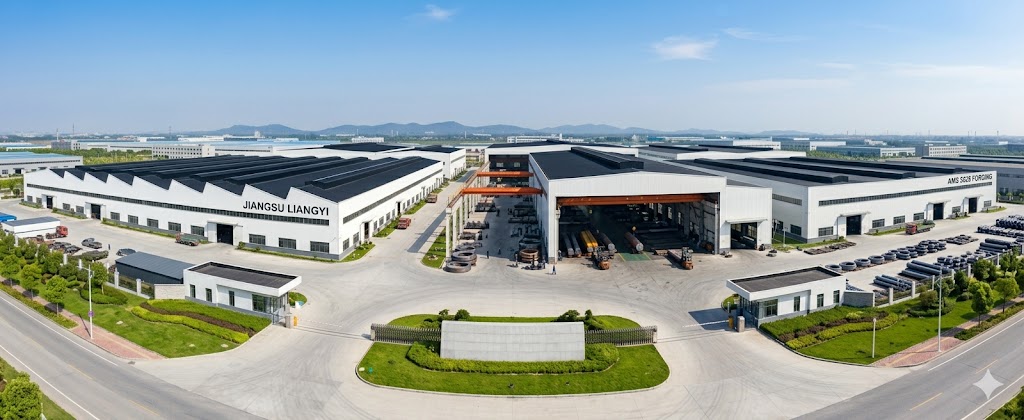
| Equipment | Specification | AMS 5628 Production Relevance |
|---|---|---|
| Hydraulic Forging Presses | 800T, 1,600T, 3,150T, 4,000T, 6,000T | Achieves ≥4:1 area reduction for all AMS 5628 bar and shaft products; enables single-piece forgings up to 30,000 kg |
| Electro-Hydraulic Forging Hammers | 0.75T, 1T, 2T, 3T, 5T, 9T | Smaller AMS 5628 forging lots; complex shapes requiring multiple hammer passes; precision weight control for near-net shapes |
| Ring Rolling Machines | 1-metre and 5-metre radial-axial ring rollers | AMS 5628 rings from Ø300mm to Ø6,000mm; controlled circumferential grain flow; homogeneous ASTM No.5 grain size |
| Heat Treatment Furnaces | 10 × CNC-controlled continuous furnaces; ±5°C uniformity; calibrated and regularly maintained | Precise austenitizing 980–1,050°C and double tempering 580–650°C with full furnace chart recording in every certificate |
| CNC Machining Centres | Turning up to Ø4,500mm; Milling 3,000×8,000mm; Internal and external grinding | Finish machining of AMS 5628 to final drawing including precision bore grinding, thread cutting, sealing surface finishing Ra 0.4 |
| In-House NDT Laboratory | UT (5MHz), MT (wet fluorescent), PT, hardness testers, tensile machine (±0.5% accuracy), Charpy from −196°C to +350°C | All AMS 5628 required testing performed in-house by our qualified NDT inspection team; no sub-contracted NDT for routine production |
| Chemical Analysis | OES spectrometer (28 elements), C/S analyser, N/O analyser | Full incoming ingot verification and production chemistry confirmation on every AMS 5628 heat |
| Annual Production Capacity | 120,000 Tonnes (all alloys combined) | Dedicated AMS 5628 scheduling; no minimum order quantity; short-run and prototype forgings accepted |
We hold ISO 9001:2015 certification and manufacture in full compliance with ASTM, AMS, AISI, API 6A, API 17D, DIN, EN, JIS, and NORSOK standards. Our factory is fully open to third-party inspection by internationally recognised agencies including SGS, Bureau Veritas, TUV Rheinland, Lloyd's Register, and DNV GL — customers may arrange witness inspections and third-party testing through any of these bodies at our Jiangyin facility. We support customer QA audits and supplier surveys at our facility. Our technical team includes forging process engineers, heat treatment specialists, and materials engineers with direct AMS 5628 production experience across oil and gas, power generation, marine, and industrial projects.
14 Frequently Asked Engineering Questions About AMS 5628 Forgings
What is AMS 5628 material and how does its microstructure differ from standard 410 stainless steel?
AMS 5628 is a chromium-nickel martensitic stainless steel with 15.5–16.5% Cr, 2.0–3.0% Ni, and 0.12–0.17% C. The nickel addition is the defining difference from standard 410 (AMS 5612). At the cellular level, nickel suppresses delta ferrite formation during solidification and refines the martensite lath packet size in the final microstructure. Smaller lath packets mean more high-angle grain boundaries per unit volume, which deflect crack propagation, consume more energy per unit crack extension, and lower the ductile-to-brittle transition temperature (DBTT) by approximately 50–80°F. In practical inspection terms: AMS 5628 maintains useful Charpy impact energy at −73°C (−100°F) where standard 410 forgings exhibit near-zero impact toughness. The martensite start temperature (Ms) for AMS 5628 is approximately 270°C, and the martensite finish temperature (Mf) is near ambient — meaning the transformation to martensite is essentially complete upon oil quenching to room temperature without requiring sub-zero cooling.
What are the complete physical and thermal properties of AMS 5628 for FEA and design calculations?
Key physical properties for design calculations: density 7.75 g/cm³; elastic modulus (E) 200 GPa; shear modulus (G) 77 GPa; Poisson's ratio (ν) 0.28; thermal conductivity 22–26 W/(m·K) at 20°C (significantly higher than austenitic grades — 40% above 316L); CTE 10.2 × 10⁻⁶ /°C at 20–100°C, 11.0 × 10⁻⁶ at 20–300°C (much lower than austenitic grades — closer to carbon steel); specific heat (Cp) 460 J/(kg·K) at 20°C; electrical resistivity 0.60 μΩ·m; magnetic permeability: ferromagnetic (enables MPI/MT inspection and induction heating). The lower CTE versus austenitic grades makes AMS 5628 a better choice when interfacing with carbon steel structures in thermally cycled assemblies — the 5–6 × 10⁻⁶/°C CTE mismatch between AMS 5628 and austenitic stainless steel must be included in thermal stress calculations for mixed-material assemblies.
What is the corrosion resistance of AMS 5628 and in which environments should it NOT be used?
AMS 5628 has a pitting resistance equivalent (PRE) of approximately 17, calculated as Cr + 3.3Mo + 16N at aim chemistry. It provides excellent corrosion resistance in dry steam, freshwater, atmospheric service, and mild organic acids (pH >3). It is suitable for seawater splash zones when passivated and coated, but is NOT suitable for continuous seawater immersion without cathodic protection — PRE 17 is insufficient for immersion service where duplex 2205 (PRE 35) or super duplex 2507 (PRE 42) should be used. For H₂S sour service, NACE MR0175 / ISO 15156 limits maximum hardness to HRC 26 (≈ 253 HB). Concentrated sulphuric acid, hydrochloric acid, and hot reducing acids attack the passive film rapidly — AMS 5628 should not be specified for these environments. Passivation per ASTM A967 after machining is mandatory to restore the full passive layer.
What machining parameters and tool types work best for AMS 5628 in the H+T condition?
AMS 5628 in the H+T condition (248–302 HB) machines well with CVD TiCN/Al₂O₃ or PVD TiAlN coated carbide inserts. Recommended turning parameters: cutting speed 60–80 m/min (roughing), 70–90 m/min (finishing); feed 0.20–0.35 mm/rev (roughing), 0.08–0.15 mm/rev (finishing); depth of cut 2–5mm (roughing), 0.3–0.8mm (finishing). Use positive rake angle 5–10° and clearance 8–12°. Mandatory flood coolant at minimum 8% emulsion concentration. AMS 5628 work-hardens less than austenitic grades (316L), allowing sharper tool maintenance over longer cutting runs. Critical mistakes to avoid: insufficient coolant (causes thermal insert crazing), first-pass cuts below 0.5mm depth on hardened surfaces (work-hardens the surface layer), and contact with carbon steel fixtures (embeds iron particles causing galvanic corrosion after inspection).
What is the international equivalent of AMS 5628, and when is substitution acceptable?
The closest international equivalents are EN 1.4057 (X17CrNi16-2) in Europe, JIS SUS 431 in Japan and GOST 20X17H2 in Russia. However, substitution without engineering authorization carries risk: EN 1.4057 allows C up to 0.20% (vs 0.17% max in AMS 5628), Ni as low as 1.5% (vs 2.0% min) and does not require vacuum melting. These differences mean EN 1.4057 may have residual delta ferrite and higher inclusion content and will fail First Article Inspection when inclusion ratings and low-temperature Charpy are tested. For aerospace and nuclear projects where AMS 5628 is specified, substitution with EN 1.4057 or SUS 431 without written engineering authorization will typically cause rejection. Jiangsu Liangyi can supply dual-certified material meeting AMS 5628 and EN 1.4057 simultaneously when requested.
When is VIM+ESR+VAR triple melt required vs VIM+VAR double melt for AMS 5628?
Choose triple melt (VIM+ESR+VAR) when the component: (a) rotates at operating speed (turbine discs, pump impellers, drive shafts); (b) is designed using fracture mechanics (requires K_IC data); (c) forms a nuclear Class 1 or 2 pressure boundary; (d) requires ASTM E45 inclusion rating B1/C1 or better; or (e) operates in a hydrogen-bearing environment where cleanliness directly affects hydrogen embrittlement resistance. The ESR step removes sulphide inclusions via a slag reaction, achieving S ≤ 0.008% and ASTM E45 B1/C1 cleanliness — delivering 30–50% better fatigue life in rotating components vs double melt. For static structural parts, valve bodies, flanges, and most oil & gas downhole components where static strength and corrosion resistance govern design, double melt (VIM+VAR) delivers fully compliant AMS 5628 at 15–25% lower material cost and 2–3 weeks shorter lead time.
What heat treatment does AMS 5628 require, and what is the temper embrittlement risk?
Standard AMS 5628 H+T condition: austenitize at 980–1,050°C, minimum 1 hour per 25mm section; oil quench within 20 seconds (never water — causes cracking); double temper at 580–650°C minimum 2 hours per 25mm per cycle, with 24-hour ambient hold between cycles for sections above 150mm. Critical warning: never temper AMS 5628 at 350–550°C. This range causes phosphorus and sulphur segregation to prior austenite grain boundaries, producing temper embrittlement — a condition that reduces Charpy impact energy to near-zero while leaving hardness, tensile strength, and UT results completely normal. A forging tempered at 480°C will pass all standard inspections and fail catastrophically under impact loading in service. Our proprietary double-tempering cycle (640°C first temper → 24-hour hold → 610°C second temper) consistently adds 20–30 J to cryogenic Charpy values versus single-temper treatment.
What is the maximum continuous service temperature for AMS 5628 forgings?
The practical upper service temperature for AMS 5628 in continuous service is approximately 450°C (842°F). Above this temperature, carbide coarsening and martensite recovery begin to progressively reduce strength and toughness over time. The alloy is not suitable for temperatures above 550°C in continuous service where long-term microstructure stability is required. At 300°C, AMS 5628 retains approximately 570–640 N/mm² yield strength; at 400°C, approximately 510–580 N/mm²; at 450°C, approximately 470–530 N/mm² — always verify against the actual application load and design factor. For applications above 450°C, consider austenitic grades (316H, 321H) or precipitation-hardened grades (17-4PH H1150) with better elevated temperature strength retention. In intermittent service up to 600°C, AMS 5628 can be used with appropriate design margins, but impact testing should be specified during scheduled maintenance outages to monitor for in-service embrittlement.
Can AMS 5628 forgings be welded, and what precautions are mandatory?
AMS 5628 is weldable with appropriate procedure: preheat 200–250°C mandatory for sections above 6mm to prevent hydrogen-assisted cracking (HAC) in the heat-affected zone. Recommended filler metals: ER420 (matching composition) or AWS E410NiMo (improved toughness in the as-welded condition). PWHT at 620–650°C for minimum 2 hours after welding is strongly recommended for structural welds — without PWHT, the as-welded HAZ contains untempered martensite at hardness exceeding 400 HV with very low toughness, creating a crack-susceptible zone at the fusion boundary. This untempered HAZ hardness may also exceed the NACE MR0175 limit of HRC 26, making PWHT mandatory for sour service welds. Maximum interpass temperature during welding: 350°C. Never allow the weld area to cool below 150°C between passes without completing the weld and immediately PWHT-ing. Jiangsu Liangyi can supply AMS 5628 forgings with machined weld-prep profiles, defined buttering pass requirements, and PWHT records per customer welding procedures.
What surface treatments are available for AMS 5628 forgings, and when is each appropriate?
Key surface treatment options for AMS 5628, matched to application requirements: Passivation (ASTM A967) — mandatory after all machining to restore the Cr₂O₃ passive layer and remove iron contamination; low cost; no dimensional change. Electropolishing — removes 10–30 µm, improves Ra by 50%, enhances corrosion resistance; for high-purity fluid and semi-conductor applications. Gas / Ion Nitriding — adds 0.1–0.3mm case at 900–1,100 HV for wear and galling resistance; nitriding temperature must be below the tempering temperature. Shot Peening (AMS 2430) — improves fatigue life 20–50% for rotating components by inducing compressive residual stress. HVOF Tungsten Carbide Coating — 1,000–1,300 HV surface for extreme abrasion and erosion; preferred replacement for hard chrome (REACH/EPA compliance). PVD Coatings (TiN, CrN, DLC) — 1,800–5,000 HV ultra-thin coatings for low friction and galling prevention; process temperature must be below tempering temperature.
What international codes and standards accept AMS 5628 for regulated pressure equipment and safety-critical applications?
AMS 5628 is accepted by: ASME BPVC Section VIII (pressure vessels); API 6A PSL 1–4 (wellhead equipment, all service levels); API 17D (subsea wellhead); NORSOK M-630 MDS S-52 (mandatory VIM+VAR or triple melt); RCC-M Class 1 (French nuclear code, triple melt required for Class 1); ASME NQA-1 (nuclear quality assurance); MIL-S-862 (US military stainless steel bars); AS9100 Rev D (aerospace QMS); NADCAP (aerospace special processes); and Lloyd's Register / DNV / Bureau Veritas (marine classification societies for shaft forgings). Jiangsu Liangyi can provide specific compliance documentation for any of these standards; contact our technical team with the governing specification for your project.
What is the hydrogen embrittlement (HE) risk for AMS 5628 and how is it managed?
Like all martensitic stainless steels, AMS 5628 is susceptible to hydrogen embrittlement, with susceptibility increasing with hardness. At the standard H+T maximum of 302 HB (≈ HRC 31), the risk is moderate and manageable through design. Key management practices: (1) Keep hardness below 285 HB for hydrogen-exposed applications — lower hardness significantly reduces HE susceptibility. (2) For electroplated parts (hard chrome, zinc), bake at 190°C / 4 hours minimum within 4 hours of plating to drive out hydrogen per AMS 2759/9. (3) Avoid aqueous acidic pickling in hydrochloric acid — use nitric-hydrofluoric acid blends and limit immersion time. (4) For subsea high-pressure hydrogen service (HPHT wellheads), verify the specific H₂ partial pressure and temperature against published threshold stress intensity (K_ISCC) data for 16Cr-2Ni martensitic stainless steel. (5) Specify low hydrogen welding consumables (H4 classification) and preheat as described in the welding FAQ above.
Does Jiangsu Liangyi supply AMS 5628 forgings to the Middle East, and what regional standards and logistics are supported?
Yes. We supply AMS 5628 forged valve bodies, wellhead components, pump shafts, and flanges to oilfield and power generation projects in Saudi Arabia, the UAE, and Kuwait on a regular basis. Regional and international standards fully supported include API 6A, API 17D, API 17TR8, NORSOK M-630, ASME VIII, and SAUDI ARAMCO SAES standards. Local third-party inspection by SGS, Bureau Veritas, or TUV is fully supported at our Jiangyin factory. Shipping options: FOB Shanghai, CIF Dammam, CIF Jebel Ali, CIF Shuwaikh, DDP as required. Export documentation: commercial invoice, packing list, certificate of origin (notarised if required), EUR.1 preference certificate under applicable trade agreements, mill test certificate, TPI release note, and bill of lading. Transit time from Shanghai to Dammam is approximately 18–22 days by sea; air freight available for urgent components. Arabic-language quotation summaries available on request for Aramco and other regional procurement system requirements.
What information does Jiangsu Liangyi need to provide an accurate AMS 5628 quotation, and what is the response time?
We only need complete inquiry information to give you accurate quotations in 24 hours. The more detailed information you send the more accurate and competitive the quotation will be. To quote correctly we need: (1) Your drawing or a dimensioned sketch – any format (pdf, dxf, step, hand sketch) accepted (2) Quantity (pieces and/or weight) (3) Material specification with melt route (AMS 5628 VIM+VAR or AMS 5628 VIM+ESR+VAR) (4) Heat treatment condition (H+T standard, or specific hardness target) (5) Supply condition – forged black, rough machined, finish machined, or surface treated (6) Inspection and test requirements – certificate type (3.1 or 3.2), UT class, MT requirement, Charpy temperature if specified (7) Required delivery schedule and incoterm / delivery port. Partial information is fine to start — we will identify gaps and ask targeted follow-up questions to complete the assessment. Standard lead time is 6–10 weeks for double-melt material, 8–12 weeks for triple-melt material from order confirmation. Emergency and outage-replacement schedules are discussed case-by-case.
Request Your Custom AMS 5628 Forging Quotation — Response Within 24 Hours
Our technical sales team includes engineers with direct AMS 5628 forging production experience across aerospace, nuclear power, oil and gas, marine, and defense programmes. We are ready to review your drawing, assess the appropriate melt route and heat treatment condition for your application, confirm applicable standard compliance, and provide a detailed quotation with a confirmed delivery schedule. No minimum order quantity. No obligation. Full technical support from initial inquiry through delivery and beyond.
Inquiry Email: sales@jnmtforgedparts.com
Phone / WhatsApp: +86-13585067993
Official Website: https://www.jnmtforgedparts.com
Factory Address: Chengchang Industry Park, Jiangyin City, Jiangsu Province 214400, China
Working Hours: Monday – Friday, 08:00 – 18:00 CST (UTC+8)
Response Commitment: Quotation within 24 hours of receiving complete drawing and specification details