Jiangsu Liangyi Co., Limited is an ISO 9001:2015 certified Chinese OEM forging manufacturer established in 1997, with a specialized focus on AM 355 (Alloy 355, UNS S35500) — one of the most technically demanding precipitation hardening stainless steels in use today. Located in Jiangyin, Jiangsu Province, we operate an 80,000㎡ vertically integrated production campus with a documented annual output capacity of 120,000 metric tons, serving gas turbine OEMs, power plant EPC contractors, and industrial equipment manufacturers across more than 50 countries.
Our AM 355 forging program is built on nearly three decades of accumulated process knowledge — spanning ingot metallurgy, hot workability management, precision forging die design, multi-step heat treatment execution, and NDT-guided quality release. Every AM 355 component we produce exits our facility with a fully traceable quality dossier, from raw material heat certificates through to final dimension test records. Browse our complete alloy materials portfolio for additional high-performance stainless steel and nickel alloy forging solutions.
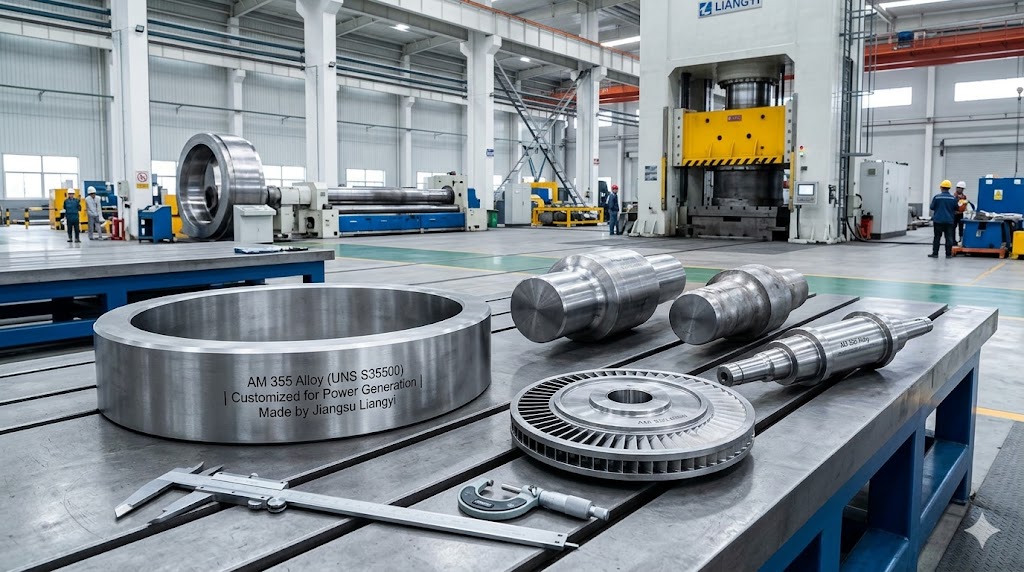
AM 355 (Alloy 355, UNS S35500) — Metallurgy & Alloy Design
AM 355 was developed in the 1950s specifically to bridge the property gap that existed between conventional martensitic stainless steels (such as Type 410 and Type 431) and austenitic grades. The challenge was straightforward in concept but complicated in execution: engineers needed a stainless steel that could deliver ultra-high tensile strength comparable to martensitic grades, while also offering the corrosion resistance approaching that of austenitic grades, and critically, keeping both properties at intermediate service temperatures up to 450°C (840°F).
The solution was a balanced chromium-nickel-molybdenum-nitrogen martensitic system that can undergo two distinct and complementary hardening reactions during heat treatment. This dual-hardening mechanism is the fundamental difference between AM 355 and single-mechanism precipitation hardening alloys such as 17-4PH (UNS S17400) and 15-5PH (UNS S15500), and accounts for its superior elevated temperature performance.
The Role of Each Alloying Element in AM 355
Understanding the function of each alloying element helps explain why AM 355 performs where simpler stainless steels fall short:
- Chromium (Cr, 15–16%):It provides the primary passive oxide film that gives AM 355 its corrosion resistance in steam, mild acid, and oxidizing environments. The 15–16% Cr range is well chosen. It is high enough to guarantee effective passivation, but meanwhile low enough to avoid significant delta-ferrite formation during solidification, which would interfere with the martensitic transformation and adversely affect mechanical properties.
- Nickel (Ni, 4–5%): Stabilizes the austenitic structure at high temperatures, and reduces the martensite start (Ms) and martensite finish (Mf) temperatures to a practical range. Nickel also improves toughness in the martensitic state, and lowers the tendency of delayed cracking during manufacturing and processing.
- Molybdenum (Mo, 2.5–3.25%): It serves a dual purpose: it significantly improves pitting and crevice corrosion resistance in chloride-containing environments (important for steam turbine applications with potential chloride contamination), and it contributes to solid-solution strengthening at elevated temperatures, helping keep hardness and creep resistance under continuous thermal load.
- Nitrogen (N, 0.07–0.13%): It is the main constituent that makes AM 355 different from the other precipitation hardened stainless steels. Nitrogen is involved in the formation of fine Cr2N nitride particles during aging treatment. These particles and the martensitic matrix are responsible for the high strength of the alloy. Nitrogen also provides a strong austenite stabilization and solid solution strengthening to the material which improves the yield strength at high temperatures and significantly reduces the susceptibility to sensitization during heat treatment.
- Carbon (C, 0.10–0.15%): At this relatively high level for a PH stainless steel, carbon increases martensite hardness during transformation, adding to the initial strength base before the precipitation aging process which further increases the properties.
- Manganese (Mn, 0.50–1.25%): Functions as a mild austenite stabilizer and deoxidizer, contributing to melt cleanliness and aiding nitrogen solubility during melting.
Metallurgical Note from Our Engineering Team: One aspect of AM 355 that is frequently misunderstood is the relationship between its martensite finish temperature (Mf ≈ −60°C to −75°C) and the mandatory sub-zero cool step in the SCT heat treatment cycle. Because the Mf lies below room temperature, air-cooling from the solution anneal temperature — even to 0°C — leaves a non-trivial fraction of retained austenite in the microstructure. This retained austenite is soft and will not respond to the subsequent aging treatment, producing a finished part with lower-than-specified yield and tensile strength. Our production protocol specifically includes cryogenic treatment to −73°C (−100°F) as a mandatory step for all AM 355 forgings, guaranteeing complete martensitic transformation before aging commences.
How AM 355's Dual-Hardening Mechanism Works
The sequence of strengthening events in AM 355 is best understood in three stages. First, during hot forging above the recrystallization temperature, the alloy is in a fully austenitic state. Second, upon cooling through the solution anneal and subsequent quench, the austenite transforms to martensite — a supersaturated, high-dislocation-density phase that is already substantially stronger than austenite but not yet at peak properties. Third, aging at 455°C (850°F) or 510°C (950°F) drives precipitation of fine Cr2N nitride particles and other intermetallic compounds at dislocation sites within the martensite laths, pinning dislocation motion and producing the final high-strength, high-toughness combination characteristic of the alloy.
This three-stage process means that both the martensite transformation (controlled by the cooling rate and sub-zero treatment) and the aging response (controlled by temperature and time) must be precisely managed to consistently get specified mechanical properties — a requirement that demands both advanced heat treatment infrastructure and deep process knowledge.
AM 355 Heat Treatment: The SCT Process Explained in Detail
Heat treatment is not a post-processing step for AM 355 — it is a main manufacturing process that determines the final mechanical properties of every component. Our in-house heat treatment department operates ten professional furnaces of varying capacities, controlled to ±5°C uniformity across the load, with full atmosphere control and automated cycle logging for complete traceability.
Standard SCT Heat Treatment Cycle for AM 355 Forgings
- Step 1 — Solution Annealing (Austenitizing) Heat to 1,025°C–1,065°C (1,877°F–1,950°F), hold for sufficient time based on section thickness (typically 1 hour per 25 mm of cross-section, minimum 1 hour), then air cool or oil quench to room temperature. This step dissolves all carbides and nitrides, homogenizes the microstructure, and establishes the fully austenitic condition required for subsequent martensite transformation. Cooling rate must be controlled to avoid sensitization in heavy sections.
- Step 2 — Sub-Zero Cool Treatment (SCT) Cool to −73°C (−100°F) and hold for at least 2 hours. This cryogenic step is mandatory for AM 355 — it drives the martensite finish below the thermodynamic Mf temperature, guaranteeing complete austenite-to-martensite conversion and eliminating retained austenite. Our cryogenic treatment capability uses programmable refrigeration chambers with temperature-uniformity verification. Parts are returned to room temperature at a controlled rate before proceeding to aging, to avoid thermal shock in large-section forgings.
- Step 3 — Precipitation Aging Age at either 455°C (850°F) for 3 hours (maximum strength condition) or 510°C (950°F) for 3 hours (improved ductility and toughness at slightly reduced strength). Aging drives the precipitation of strengthening Cr₂N nitrides and other fine intermetallic compounds within the martensitic matrix. Aging temperature choice is made in consultation with the client based on their target mechanical property profile and component application requirements.
Why Aging Temperature Selection Matters: The 455°C aging condition produces the highest yield and tensile strength (up to 1,276 MPa and 1,517 MPa respectively) but with reduced transverse ductility — a consideration for components with high transverse stress in service. The 510°C condition sacrifices approximately 80–100 MPa of strength in exchange for markedly improved transverse elongation and reduction of area, which is preferred for larger, more complicated forgings where section uniformity is important. Our metallurgical team advises clients on the optimal aging condition for their specific application.
Heat Treatment Capabilities at Jiangsu Liangyi
Our heat treatment department is equipped to handle the full AM 355 SCT cycle for components ranging from small precision parts to large-scale forgings weighing up to 25 metric tons. Following are the main capabilities :
- Ten professional heat treatment furnaces with maximum working temperature of 1,200°C, temperature uniformity ±5°C
- Programmable cryogenic chambers for the mandatory SCT sub-zero step to −73°C (−100°F)
- Atmosphere-controlled furnaces for solution annealing of oxidation-sensitive components
- Full automated cycle logging with time-temperature charts provided with every Mill Test Certificate
- In-house hardness verification after each heat treatment stage, before proceeding to final inspection
- Capability to perform multiple heat treatment cycles for parts requiring intermediate stress relief or dimensional stabilization
AM 355 vs. Competing Alloys: How to Choose the Right Material
Engineers specifying materials for gas or steam turbine components frequently evaluate AM 355 alongside other precipitation hardening stainless steels and martensitic grades. The following comparison outlines the main performance differentiators to guide material choice for demanding applications.
The single most important differentiator for turbine-duty components is not room-temperature strength — it is the ability to retain that strength during continuous operation at elevated temperature. This is where AM 355's nitrogen-improved dual-hardening mechanism delivers a decisive advantage over copper-precipitate-strengthened grades such as 17-4PH and 15-5PH.
| Property / Criterion | AM 355 (UNS S35500) | 17-4PH (UNS S17400) | 15-5PH (UNS S15500) | 13-8Mo (UNS S13800) | Type 410 (UNS S41000) |
|---|---|---|---|---|---|
| Hardening Mechanism | Dual: Martensite + Cr₂N Nitride Precipitation | Cu-rich precipitation (ε-Cu) | Cu-rich precipitation (ε-Cu) | β-NiAl intermetallic precipitation | Martensite only (no precipitation) |
| Typical Peak Yield Strength (RT) | 1,165–1,276 MPa | 1,170–1,310 MPa | 1,170–1,310 MPa | 1,240–1,380 MPa | 760–965 MPa |
| Elevated-Temp Strength Retention (≥400°C) | Excellent — N-assisted nitride stability | Moderate — Cu precipitates coarsen rapidly | Moderate — similar to 17-4PH | Good — stable up to ~370°C | Poor above 400°C |
| Max Continuous Service Temperature | 450°C (840°F) | ~315°C (600°F) | ~315°C (600°F) | ~370°C (700°F) | ~400°C (750°F) with strength loss |
| Corrosion Resistance in Steam/Moisture | Good — Cr+Mo passivation | Good | Good | Very Good | Fair — susceptible to oxidation |
| Forgeability / Hot Workability | Good — narrow hot-work window (1,050–1,180°C) | Good | Good | Good | Excellent |
| NDT Inspectability (UT) | Good (ESR recommended for critical parts) | Good | Very Good (wrought bars) | Very Good | Good |
| Typical Turbine Applications | Compressor blades, disc forgings, valve spindles, shafts (300–450°C duty) | Structural hardware, pump components, moderate-temp parts | Rings, sleeves, moderate-temp structural parts | High-strength fasteners, aerospace structural | Low-temperature turbine blades, general structural |
Note: Property ranges are indicative for wrought/forged product in peak strength heat treatment conditions. Actual values depend on section size, heat treatment specifics, and testing direction. Consult our engineering team for application-specific material selection guidance.
When AM 355 Is the Right Specification Choice
Based on our supply experience with turbine OEMs globally, AM 355 (UNS S35500) is the optimal material specification when three or more of the following criteria apply simultaneously to a component:
- Continuous operating temperature between 300°C and 450°C (573°F–842°F)
- Required yield strength above 1,000 MPa at operating temperature
- Exposure to steam, moisture, or mildly corrosive process media in service
- High-cycle fatigue loading (rotating components, cyclic pressure valves)
- Section thickness above 75 mm, where through-hardening uniformity is important
- OEM specification directly references AMS 5548, ASTM A564 Type 634, or equivalent
If operating temperatures are consistently below 300°C and cost is a primary driver, 17-4PH may offer a more economical solution. If maximum strength at room temperature is required with minimal concern for elevated temperature performance, 13-8Mo or maraging steels may be evaluated. Our technical team provides free material selection consultation as part of the quotation process.
AM 355 Open Die Forging Process: From Ingot to Finished Component
Forging AM 355 is meaningfully more demanding than forging conventional stainless steels or even most other precipitation hardening grades. The combination of high alloy content, narrow hot-workability window, and the sensitivity of the final microstructure to processing history requires a level of process discipline that separates high-quality turbine forging manufacturers from general-purpose shops.
Hot Workability and Forging Temperature Window
AM 355 has a relatively narrow recommended hot-working temperature range of approximately 1,050°C to 1,180°C (1,922°F to 2,156°F).Working below this range risks formation of adiabatic shear bands and cracking in large sections, as this alloy has lower hot ductility than the austenitic grades. If work is done above this range, excessive grain growth may occur which reduces the ultrasonic inspectability of the finished forging and may reduce fatigue resistance. Our production protocol requires pyrometer-verified billet surface temperatures before each forging press stroke on heavy forgings, with reheating cycles specified in the process plan for long or multi-stage forgings.
ESR vs. Conventional Melting: What It Means for Your Component
The starting ingot quality has a direct and measurable impact on the ultrasonic inspectability and fatigue performance of the finished AM 355 forging. Conventional electric arc furnace + ladle refining + vacuum degassing (EAF + LF + VD) melting produces commercially acceptable material for many applications, but inherently contains a distribution of non-metallic inclusions and some segregation in larger ingots.
ESR (Electroslag Remelting) eliminates the majority of oxide and sulfide inclusions by progressive refining through a reactive slag, producing a re-solidified ingot with significantly finer grain structure, dramatically reduced inclusion content, and superior composition homogeneity across the entire cross-section. For rotating turbine components — particularly blades, discs, and shafts where high-cycle fatigue governs design life — the improvement in fatigue endurance from ESR material over conventional melt is well-documented and can be critical for component certification by the OEM.
Standard Melt (EAF + LF + VD) — When Appropriate
- Stationary structural components: casings, housings, flanges
- Non-rotating valve bodies, bonnets, and pressure-containing forgings
- Components with primary stress from pressure loading, not fatigue
- Prototypes and development-phase forgings where material cost is a significant factor
- Applications where UT acceptance criteria are per Class A (standard commercial)
ESR Melt — Recommended or Required For
- Rotating turbine components: blades, discs, shafts, impellers
- Components with strict OEM UT acceptance criteria (e.g., equivalent to ASTM E428 reference standard ≤ Ø3.2 mm)
- High-cycle fatigue applications where endurance limit is a governing design constraint
- Forgings with section thickness above 200 mm where segregation risk is elevated
- Safety-critical applications in nuclear, aerospace auxiliary, or Level 1 pressure equipment
Our Vertically Integrated AM 355 Production Flow
Every AM 355 forging we produce follows a documented, stage-gated production sequence. The following steps describe our standard workflow from purchase order to shipment:
- Engineering Review & Process Planning Upon receipt of client drawings and specifications, our metallurgical engineering team prepares a Forging Process Specification (FPS) defining ingot weight, melt route (EAF+LF+VD or ESR), heating schedule, forging reduction ratio, forging sequence, heat treatment parameters, inspection plan, and documentation requirements. This document is reviewed and approved before any material is ordered.
- Raw Material Procurement & Verification We buy AM 355 ingots from approved suppliers with full traceable heat certification. Incoming chemical composition is verified against specification requirements (ASTM A564 / AMS 5548 or client specified) by our in-house spectrometer analysis. Any material not meeting specification is rejected before entering production.
- Controlled Heating & Hot Forging Ingots are heated in gas-fired furnaces to the specified forging temperature window (1,050°C–1,180°C) with soak time calculated by section thickness.We forge on our fleet of hydraulic presses (from 1,000 to 8,000 tons capacity) with temperature of the billet monitored by infrared pyrometers between forging passes. The forging reduction ratios are equal to or greater than the minimum specified in the process plan to guarantee full breakdown of the dendritic structure and grain refinement.
- Intermediate Inspection & Dimensional Verification As-forged dimensions are verified against forging drawing allowances. Surface is inspected for forging laps, cracks, or surface defects. Any non-conformance is reviewed by our quality team before the component proceeds to heat treatment.
- Full SCT Heat Treatment Cycle Solution anneal → sub-zero cool (SCT, −73°C) → precipitation aging at client-specified temperature. Full thermocouple records are captured and retained as part of the quality dossier. Post-heat-treatment hardness is verified by Brinell or Rockwell testing to confirm the aging response has occurred within the expected range before NDT inspection proceeds.
- Non-Destructive Testing (NDT) Ultrasonic testing (UT) is carried out by Level II qualified UT technicians as per the relevant standard (ASTM A388, EN 10307 or client specification). Machined surfaces are inspected as required using liquid penetrant inspection (LPI) or magnetic particle inspection (MPI). All NDT records are signed and certified by our NDT examiner level III.
- Mechanical Testing Coupon specimens are machined from a sacrificial test piece (or test extension, as agreed with the client) and tested to confirm compliance with specified mechanical properties: yield strength, tensile strength, elongation, reduction of area, Charpy impact energy (if specified), and hardness. Tests are performed both longitudinal and transverse where section geometry allows.
- Precision CNC Machining (if required) If finish-machined or semi-finish-machined parts are ordered, precision CNC turning, milling, boring, and grinding operations are performed in our machining department to the dimensional tolerances specified in the client drawing. Surface finish is verified against Ra requirements by profilometer measurement.
- Final Inspection, Documentation & Shipment Perform full dimensional inspection. Our quality manager prepares, checks and signs the Mill Test Certificate (MTC EN 10204 3.1 or 3.2). Parts are cleaned, coated with approved rust preventative and packed in wooden crates or steel frames as required by the destination. All documentation including MTC, heat treatment records, NDT reports, dimensional inspection report and packing list is supplied in digital form and hard copy with each shipment.
Custom AM 355 Forged Parts & Available Product Forms
Our production capabilities cover the full range of standard and custom forging geometries for AM 355 (Alloy 355, UNS S35500). All forms are produced to customer drawings and specifications, supported by our state-of-the-art forging press and ring rolling equipment. The following sections describe our core product forms and representative component types for AM 355.
Forged Bars, Rods & Rotating Shafts
Round, square, flat, and hexagonal forged bars are available in AM 355 in as-forged or rough-turned condition, with lengths up to 12 meters. Our shaft forging capability covers stepped shafts, gear shafts, compressor and turbine rotor shafts, and precision spindles, with minimum forging reduction ratios and full traceability from ingot through to finished bar. Hollow bars and thick-walled sleeves are also produced by open die forging with mandrel punching for large-bore applications.
- Forged round bars: OD 50 mm to 800 mm, length up to 12,000 mm
- Step shafts, rotor shafts, turbine spindles: custom dimensions per drawing
- Hollow bars, thick-walled sleeves, bushing preforms
- Flat bars, rectangular billets, and machining stock for precision component manufacture
Seamless Rolled Rings & Disc Forgings
Seamless ring rolling in AM 355 is one of our core specialties, with equipment capable of producing rings from 200 mm to 3,000 mm outer diameter. Ring rolling produces a circumferentially oriented grain flow that is mechanically superior for hoop-stress-dominated loading — the primary stress mode for most turbine casing rings, seal rings, and retaining rings. Contoured rings with non-rectangular profiles (L-section, T-section, flanged, or stepped) are produced to near-net shape, minimizing customer machining allowances and material waste.
- Seamless rolled rings: OD 200 mm to 3,000 mm, wall thickness from 20 mm upward
- Contoured and profiled rings: L-section, T-section, stepped-OD, flanged rings
- Disc forgings, turbine wheel blanks, impeller preforms
- Seal rings, labyrinth rings, packing seal rings, blade retaining rings, bearing races
- Flanges, coupling flanges, valve body rings
Custom Near-Net Shape Forgings
For complex geometry components, our open die forging capability produces near-net shape preforms that reduce subsequent machining time and material consumption. Blocks, plates, and custom-profile forgings are produced from AM 355 with controlled forge reduction to achieve the required grain flow orientation for the component's stress distribution in service.
- Forged plates, blocks, and rectangular slabs for machined components
- Valve bodies, bonnets, pressure vessels heads, and complex custom geometries
- Housings, casings, bearing blocks, and structural machine components
- Pipe and tube preforms for high-pressure applications
Whether you require prototype quantities for development testing or multi-ton serial deliveries for production OEM supply, our engineering team will evaluate your drawings and recommend the optimal forging approach — including die design, forging sequence, reduction strategy, and heat treatment condition — to meet your performance specifications at competitive cost. Request a technical quotation today.
Key Applications of AM 355 Forgings in Global Power Generation & Industry
AM 355 (Alloy 355, UNS S35500) forgings are specified wherever a component must simultaneously withstand high mechanical loads, resist fatigue cracking under cyclic stress, and maintain dimensional stability in elevated-temperature, corrosive environments. The following sections describe our principal application areas with engineering-level detail, reflecting the experience built across decades of supply to global turbine OEMs.
1. Gas Turbine Compressor Components (North America & Europe)
In land-based gas turbines for power generation, AM 355 is widely specified for compressor disc forgings, compressor rotor shaft sections, and compressor blade root blocks, where operating temperatures in the 250°C–420°C range coincide with high centrifugal and aerodynamic loading. Our AM 355 disc forgings are supplied to turbine OEMs operating 600MW+ combined cycle units across the United States, Canada, Germany, France, and the United Kingdom, with ultrasonic acceptance criteria meeting or exceeding the OEMs' most stringent internal specifications.
A particular value we deliver in this segment is the availability of ESR-quality AM 355 ingots in section sizes above 500 mm diameter — a capability not available from all global forging suppliers — enabling us to meet the UT acceptance criteria required for Class A rotating components without resorting to smaller, less efficient multi-piece assemblies.
2. Steam Turbine Rotating & Stationary Components (Asia & Middle East)
Industrial steam turbines operating in the 300MW–1000MW range in thermal power plants across Saudi Arabia, the UAE, Qatar, India, South Korea, and Southeast Asia represent one of the highest-volume application areas for our AM 355 forgings. Following are main components:
- Turbine disc forgings: LP (low-pressure) and IP (intermediate-pressure) disc stages where steam temperatures and blade loading require the combination of high yield strength and resistance to stress corrosion cracking in wet steam environments
- Seamless bearing-housing rings and casing rings: Precision ring-rolled components with tight dimensional tolerances and low out-of-round requirements for bearing fit and seal-face alignment
- Labyrinth seal ring systems: Multi-element stacked seal ring assemblies produced to near-net profile ring cross-sections, minimizing leakage path dimensions and maximizing turbine efficiency
- Inlet guide vane (IGV) pivot shafts and control rings: Precision-forged shafts and rings used in variable inlet guide vane systems of compressor stages, requiring both high strength and excellent surface finish after machining
3. High-Pressure Turbine Valve Systems (Global)
AM 355 is the dominant material for main steam valve (MSV), governor valve (GV), control valve (CV), and combined reheat valve (CRV) internal components where high-cycle fatigue from valve stroking, corrosive steam exposure, and operating pressures above 160 bar define the service envelope. We produce the following precision-forged valve components from AM 355:
- Valve spindles, stems, and rods: critical rotating/sliding components requiring tight OD tolerance (h7 or better) and excellent surface finish (Ra ≤ 0.8 μm) after precision grinding
- Valve seat rings and disc forgings: hardface-compatible forged preforms with controlled hardness and surface integrity for subsequent Stellite or Inconel overlay welding
- Valve body and bonnet forgings: pressure-containing near-net shape forgings produced to ASME B16.34 or EN 12516 dimensional and quality requirements
- Valve sleeve and bushing forgings: close-tolerance internal bore forgings in AM 355 for pressure-balanced valve trim assemblies
4. Aerospace Auxiliary & Defense Equipment Components
While aerospace primary structure is dominated by titanium, nickel superalloys, and high-strength aluminum, AM 355 finds significant application in aerospace auxiliary systems — particularly aircraft engine accessory gearboxes, actuator housings, hydraulic manifold bodies, and structural brackets where both high strength-to-weight ratio and corrosion resistance in aviation fuel and hydraulic fluid environments are required. Our AM 355 forgings for this segment are produced with tighter chemical composition controls, 100% ultrasonic inspection to aerospace-grade UT standards, and Certificates of Conformance in addition to standard MTCs.
5. Industrial Machinery, Offshore & Marine Applications
Beyond power generation and aerospace, AM 355 is increasingly specified for high-pressure processing equipment in the oil and gas sector, subsea valve actuators, and marine propulsion system components where the combination of seawater corrosion resistance and mechanical strength is required. Our experience with these applications — particularly regarding the interaction between AM 355's corrosion resistance and electrochemical protection systems used in offshore structures — enables us to provide technically informed guidance to clients in these sectors.
Production Capabilities for AM 355 (Alloy 355) Forgings
Our vertically integrated production infrastructure gives us direct control over every stage of AM 355 forging manufacture — a critical advantage for maintaining the tight process discipline this alloy demands. The following summarizes our core equipment and capacity specifications for AM 355 components.
Forging Press Capacity
Hydraulic open die forging presses from 1,000 T to 8,000 T capacity, capable of processing AM 355 ingots from 200 kg to 25 metric tons per piece. Mandrel pressing capability for hollow forgings and large-bore rings.
Ring Rolling Equipment
Radial-axial ring rolling mills with capability for seamless rings from 200 mm to 3,000 mm outer diameter. Contour rolling dies available for standard L, T, and flanged ring profiles in AM 355.
Heat Treatment Furnaces
Ten professional heat treatment furnaces with max 1,200°C, temperature uniformity ±5°C. Atmosphere control capability. Cryogenic chambers for mandatory SCT sub-zero cooling step to −73°C.
In-House Testing Laboratory
Full mechanical testing capability: room and elevated temperature tensile, Charpy impact (−196°C to +350°C), Brinell/Rockwell/Vickers hardness, and spectrometer chemical analysis. Calibrated annually by CNAS-accredited bodies.
NDT Inspection
In-house UT, LPI, and MPI inspection by ASNT Level II qualified technicians. All test procedures reviewed and reports signed by our Level III NDT examiner. Third-party inspection support for SGS, BV, TUV, and OEM-nominated inspectors.
CNC Precision Machining
CNC turning centers, vertical machining centers, boring mills, and surface grinders for finish and semi-finish machining of AM 355 components. Tolerances to IT6 grade, surface finish to Ra 0.4 μm achievable for precision shaft and valve trim components.
Dimensional Capability Summary
- Rings & Discs: OD 200 mm to 3,000 mm | Weight: up to 25 metric tons | Wall thickness: 20 mm and above
- Bars, Shafts & Rods: OD 50 mm to 800 mm | Length: up to 12,000 mm | Weight: 30 kg to 25 metric tons
- Blocks & Plates: Up to 2,500 mm × 1,500 mm × 800 mm (L × W × H) in as-forged condition
- Melting routes: EAF + LF + VD (standard) | ESR (optional upgrade — recommended for rotating critical components)
- Forging reduction: Minimum 4:1 ingot-to-finish reduction ratio for bar/shaft products; minimum 3:1 for ring/disc products, unless agreed otherwise in the FPS
Chemical Composition of AM 355 (UNS S35500) Alloy
The chemical composition of AM 355 is specified in ASTM A564 (Type 634), AMS 5548, AMS 5549, and equivalent international standards. Our incoming raw material is verified against specification limits by optical emission spectrometry (OES) before acceptance into production. The table below lists the composition requirements for the wrought alloy:
| Element | Symbol | Weight % Range (per ASTM A564 / AMS 5548) | Role in Alloy |
|---|---|---|---|
| Carbon | C | 0.10 – 0.15 | Promotes martensite hardness; carbide formation if excessive |
| Manganese | Mn | 0.50 – 1.25 | Austenite stabilizer; improves nitrogen solubility in melt |
| Silicon | Si | 0.50 max | Deoxidizer; excessive Si reduces toughness |
| Phosphorus | P | 0.040 max | Controlled as impurity; excessive P causes grain boundary embrittlement |
| Sulfur | S | 0.030 max | Controlled as impurity; S forms sulfide inclusions reducing fatigue life |
| Chromium | Cr | 15.0 – 16.0 | Passivation and corrosion resistance; controlled to limit delta-ferrite |
| Nickel | Ni | 4.0 – 5.0 | Austenite stabilizer; improves toughness and lowers Ms temperature |
| Molybdenum | Mo | 2.50 – 3.25 | Pitting corrosion resistance; elevated temperature solid solution strengthener |
| Nitrogen | N | 0.07 – 0.13 | Primary precipitation hardening agent (Cr₂N); strong austenite stabilizer |
Composition per ASTM A564 Grade 634 / AMS 5548. Balance: Iron (Fe). Iron content is nominally 74–77%.
Why Nitrogen Control Is Critical in AM 355 Production: Nitrogen content in the range 0.07–0.13% must be controlled to narrow tolerances because both under-shooting and over-shooting this range produce suboptimal outcomes. Below 0.07% N, the precipitation hardening response during aging is inadequate — fewer Cr₂N nuclei form, resulting in lower-than-specified strength. Above 0.13% N, the risk of nitrogen porosity in the ingot increases and the alloy becomes more susceptible to sensitization during slow cooling through the 550°C–750°C range. Our melting process uses nitrogen gas addition during vacuum induction melting to achieve consistent nitrogen content within ±0.015% of the aim composition, verified by combustion analysis on every heat.
Mechanical Properties of Heat-Treated AM 355 Forgings
AM 355 forgings are supplied in one of several heat treatment conditions depending on the application's strength and ductility requirements. The standard conditions used in turbine and industrial applications, along with typical mechanical properties achieved in our production, are tabulated below. Note that properties are direction-sensitive: longitudinal (L) specimens, with their gauge length parallel to the forging elongation direction, consistently outperform transverse (T) specimens in ductility measures, while yield and tensile strengths are similar in both orientations.
| Heat Treatment Condition | Test Direction | 0.2% Yield Strength (MPa) | Tensile Strength (MPa) | Elongation (%) | Reduction of Area (%) | Hardness (HRC approx.) |
|---|---|---|---|---|---|---|
| SCT + 455°C (850°F) Aging, 3h | Longitudinal | 1,255 | 1,489 | 19 | 38 | 43–46 |
| SCT + 455°C (850°F) Aging, 3h | Transverse | 1,276 | 1,517 | 12 | 21 | 43–46 |
| SCT + 510°C (950°F) Aging, 3h | Longitudinal | 1,179 | 1,276 | 19 | 57 | 40–43 |
| SCT + 510°C (950°F) Aging, 3h | Transverse | 1,165 | 1,276 | 15 | 40 | 40–43 |
Values represent typical properties for forged bar/ring products with minimum 4:1 forging reduction. Actual properties depend on section size, heat treatment equipment uniformity, and specimen location. Minimum values per applicable specification may differ from typical values above.
Elevated Temperature Mechanical Properties
One of the principal engineering advantages of AM 355 over 17-4PH and 15-5PH is its ability to maintain high yield strength at service temperatures in the 300°C–450°C range. The following table provides typical elevated temperature properties for the SCT + 455°C aging condition:
| Test Temperature | 0.2% Yield Strength (MPa) | Tensile Strength (MPa) | Elongation (%) |
|---|---|---|---|
| Room Temperature (20°C) | 1,255 | 1,489 | 19 |
| 200°C (392°F) | ~1,100 | ~1,320 | 18 |
| 300°C (572°F) | ~1,020 | ~1,220 | 18 |
| 400°C (752°F) | ~960 | ~1,140 | 17 |
| 450°C (842°F) | ~920 | ~1,080 | 16 |
Elevated temperature values are indicative typical values for SCT + 455°C aging condition, longitudinal orientation. Specific data for elevated temperature testing requirements can be provided on request as part of MTC documentation.
Quality Assurance & Testing for UNS S35500 Forged Parts
Quality assurance at Jiangsu Liangyi is structured as an integrated, stage-gated system — not a final-stage inspection bottleneck. Every AM 355 forging is subject to mandatory inspection hold points at each production stage, and no component proceeds to the next stage without documented clearance from our quality team. This system ensures that only those parts which meet all specification requirements are delivered to our customers, and that potential non-conformances are identified at the earliest and most cost-effective stage.
In-Process Inspection Hold Points
- Incoming Material Verification: Analysis chemical composition by OES spectrometer on every incoming heat of AM 355 raw material. Material that does not meet specification is quarantined and returned before entering production.
- As-Forged Dimensional Check: Check dimensions of as-forged parts against forging allowance drawings before heat treatment. Oversized and/or undersized forgings are inspected to determine if they are acceptable for rework or rejection before being loaded into the furnace.
- Post-Solution Anneal Verification: Take and inspect grain size samples based on ASTM E112 or EN ISO 643 to confirm sufficient austenitization and controlled grain growth before the SCT process.
- Post-Aging Hardness: 100% Brinell Hardness Verification on all parts after final aging cycle to verify heat treatment response. Any area outside the specified hardness band is quarantined and investigated before NDT.
- NDT Inspection: Dye Penetrant Inspection (DPI) on machined surfaces is performed per ASTM E165, and Magnetic Particle Inspection (MPI) is carried out based on ASTM E709.All inspections are conducted by qualified Level II technicians and reviewed by Level III NDT examiners.
- Final Mechanical Testing: Tensile, impact, and hardness testing from test pieces removed from the forging or attached test prolongation, as specified in the applicable standard or client requirement.
- Final Dimensional Inspection: Full dimensional verification using calibrated measuring equipment against the finished part drawing or purchase order requirements in our metrology laboratory.
Certification & Documentation
Each shipment of AM 355 forgings is accompanied by a comprehensive quality dossier. Standard documentation includes:
- Mill Test Certificate (MTC EN 10204 3.1 or 3.2): Include heat number, chemical composition, heat treatment record (time-temperature chart), mechanical test results (yield strength, tensile strength, elongation, reduction of area, Charpy impact energy, hardness) and conformance statement signed by our Quality Manager
- NDT Reports: UT report with scan coverage diagram, indication map (if any), and accept/reject statement; LPI or MPI report with test conditions, indications, and accept/reject statement; all signed by Level II technician and Level III examiner
- Heat Treatment Records: Complete thermocouple data charts for solution anneal, cryogenic cool, and aging cycles
- Dimensional Inspection Report: Tabulated measurement results for all specified dimensions, referenced to final drawing revision
- Packing List & Shipping Documents: Part number, heat number, quantity, net and gross weight, crate dimensions, country of origin declaration, and customs HS code
Third-party inspection by SGS, Bureau Veritas, TUV Rheinland, DNV, Lloyd's Register, or client-nominated inspection agencies is routinely accommodated at our facility at no additional coordination cost. Witness inspection appointments are scheduled with typically 5 business days advance notice.
Frequently Asked Questions About AM 355 Forgings
Below are detailed answers to the questions most commonly asked by engineers, procurement managers, and quality teams at turbine OEMs and industrial equipment manufacturers worldwide.
AM 355 (UNS S35500, also called Alloy 355) is a martensitic precipitation hardening stainless steel containing chromium (15–16%), nickel (4–5%), molybdenum (2.5–3.25%), and a controlled nitrogen addition (0.07–0.13%). Its high strength is achieved through two simultaneous mechanisms: during cooling from the solution anneal temperature, the austenitic structure transforms to hard martensite; then during the subsequent aging heat treatment, fine chromium nitride (Cr₂N) particles precipitate within the martensite laths, further increasing strength by pinning dislocation movement. This nitrogen-driven dual-hardening mechanism is what gives AM 355 its superior elevated-temperature strength retention — up to 450°C — compared to copper-precipitate-hardened grades like 17-4PH, which soften significantly above 315°C.
SCT stands for Sub-Zero Cool Treatment — a mandatory intermediate step in the AM 355 heat treatment cycle that distinguishes this alloy from most other precipitation hardening stainless steels. After solution annealing at 1,025–1,065°C and cooling to room temperature, the alloy's martensite finish temperature (Mf) lies at approximately −60°C to −75°C. This means that cooling to only room temperature leaves a significant fraction of retained austenite in the microstructure — austenite that is soft and will not respond to aging treatment.
The SCT step involves cooling the part to −73°C (−100°F) and holding for at least 2 hours, which completes the martensitic transformation and eliminates retained austenite. Only then does aging at 455°C or 510°C produce the full precipitation hardening response and the specified mechanical properties. Omitting or improperly executing the SCT step is the most common cause of AM 355 forgings failing to meet their specified yield strength — a fact that underscores the importance of working with a forging manufacturer who has dedicated cryogenic treatment capability and understands the metallurgical necessity of this step.
All three are precipitation hardening stainless steels with similar room-temperature strength ranges (approximately 1,100–1,310 MPa yield strength in peak-aged conditions), but they differ fundamentally in their elevated-temperature behavior. The strength of 17-4PH and 15-5PH is based on copper-rich precipitates (ε-Cu phase), which coarsen rapidly above approximately 315°C (600°F), causing significant strength loss at turbine operating temperatures. AM 355 uses nitrogen-stabilized chromium nitride precipitates, which are thermodynamically more stable at intermediate elevated temperatures, maintaining yield strengths above 900 MPa at 450°C where 17-4PH may have dropped to 650–700 MPa.
In practical terms: for turbine shafts, compressor discs, and other components that must sustain high stress at 350–450°C over hundreds of thousands of operating hours, AM 355 is the technically correct material choice. 17-4PH and 15-5PH are suitable for structural components operating near room temperature where cost and availability are primary selection criteria.
The primary international standards governing AM 355 material are: ASTM A564, Type 634 (bar and shapes); AMS 5548 (bar, forgings, rings, and extrusions); AMS 5549 (sheet, strip, and plate). European supply is commonly governed by EN 10088-3 for stainless steel bars and semi-finished products, with chemical composition equivalent to 1.4547 or similar martensitic PH grades. Forging-specific requirements are often supplemented by turbine OEM internal specifications, which may add more stringent requirements for UT acceptance class, mechanical test sampling frequency, or heat treatment documentation.
We produce AM 355 forgings to any of the above standards, as well as to customer-specific turbine OEM specifications (GE, Siemens, Alstom/GE Power, MHI, etc.) upon receipt of the applicable specification document. Our quality system includes a dedicated specification management register to ensure the correct revision of each customer standard is applied to production.
Our current production capability for AM 355 forgings covers the following dimensional envelope: seamless rolled rings and disc forgings up to 3,000 mm (3 meters) outer diameter; bars, shafts, and rod forgings up to 800 mm diameter and 12,000 mm (12 meters) length; single-component weights from 30 kg up to 25 metric tons. For components approaching the upper limits of this envelope, we conduct a detailed engineering feasibility review — including ingot weight calculation, forging press force requirements, heat treatment furnace loading geometry, and UT scanability assessment — before committing to production. Very large-section AM 355 components above 500 mm cross-section are strongly recommended to be specified as ESR quality to ensure adequate UT inspectability and mechanical property uniformity throughout the section.
Yes. Our machining department offers complete CNC machining services for AM 355 forged parts, from rough turning to precision grinding. We can provide finish-machined or semi-finish-machined parts, ready for assembly or final inspection at the customer’s location. For AM 355 components, we offer: CNC turning (up to 3,000 mm turning diameter), CNC vertical and horizontal milling, deep hole boring, internal and external cylindrical grinding (shaft surfaces can be machined to Ra ≤ 0.4 μm), and thread cutting.In the hardened condition (HRC 40–46) AM 355 presents moderate machining difficulties, being harder than 17-4PH H900 at similar strength levels and with high cutting forces. Our machining team employs application-optimized carbide tooling grades and cutting parameters developed from in-house testing with AM 355 specifically, not general stainless steel guidelines, to achieve consistent surface quality and dimensional control within drawing tolerances.
Every shipment of AM 355 forgings from Jiangsu Liangyi is accompanied by a complete quality documentation package. Standard documents include: Mill Test Certificate (MTC) issued per EN 10204 Type 3.1 (certified by our Quality Manager) or Type 3.2 (with third-party inspector co-signature), covering chemical composition analysis, complete mechanical test results (room temperature tensile, hardness, and Charpy impact if specified), and heat treatment record reference; ultrasonic testing report with scan coverage map, equipment calibration certificate reference, and accept/reject statement signed by Level II UT technician and Level III examiner; surface NDT report (LPI or MPI) covering all machined surfaces; dimensional inspection report with tabulated measurements for all specified dimensions; packing list with heat number, part number, quantity, and weight; and country of origin certificate upon request. Additional documents — such as elevated temperature tensile test results, grain size reports, or third-party laboratory test certificates — can be provided by prior agreement as part of the order specification.
ESR (Electroslag Remelting) is a secondary vacuum-assisted melting process in which a conventionally melted electrode is progressively dissolved through a reactive liquid slag blanket and re-solidified as a cleaner ingot. The slag chemically removes oxide and sulfide inclusions, and the directional solidification pattern produces a uniformly fine grain structure throughout the ingot cross-section. The practical result for AM 355 forgings is significantly lower inclusion counts (particularly oxide and sulfide stringers that otherwise act as fatigue crack initiation sites), better composition homogeneity across heavy sections, and superior ultrasonic inspectability — the finished forging presents a cleaner UT background noise level, allowing finer acceptance thresholds to be reliably applied.
We recommend ESR melting for any AM 355 component that falls into the following categories: rotating turbine components (blades, discs, shafts, impellers) where fatigue is a life-governing failure mode; sections above 500 mm diameter where conventional melt segregation is a concern; components with OEM UT acceptance criteria equivalent to a Ø3.2 mm reference reflector or finer; and safety-critical components in nuclear auxiliary, aerospace, or Level 1/2 pressure equipment classifications. For non-rotating structural and pressure-containing components without stringent fatigue or UT requirements, conventional EAF + LF + VD quality is generally adequate and more economical.
The normal lead time for custom AM 355 forgings is 25–45 working days from purchase order confirmation and approved drawings. This timeline covers: raw material procurement and incoming verification (typically 5–10 days); ingot heating, forging, and as-forged inspection (3–7 days depending on parts drawings); full SCT heat treatment cycle including cryogenic step (4–7 days); NDT inspection and mechanical testing (3–5 days); precision machining if ordered (5–15 days depending on parts drawings and tolerance requirements); final inspection and documentation preparation (2–3 days).For ESR-quality material or very large forgings above 15 metric tons , the lead times may be 5–10 days longer due to the additional melting step. For urgent requirements, expedited scheduling with priority furnace loading and accelerated testing is available — please contact our sales team with your required delivery date for a specific commitment.
Yes — custom drawing-based production is the core of our business model. We do not stock standard shapes for off-the-shelf sale; every AM 355 component we produce is manufactured to a specific client drawing and specification. Our process begins when you send us your 2D or 3D drawings (DXF, DWG, STEP, IGES, or PDF format), the applicable material specification (ASTM, AMS, EN, or OEM standard), required heat treatment condition, NDT requirements, testing and certification requirements, required quantity, and target delivery date. Our metallurgical engineering team reviews the package, prepares a Forging Process Specification, and responds with a detailed technical-commercial quotation within 24 business hours. We are experienced with the drawing and specification formats of major turbine OEMs and EPC contractors, and our quality team maintains a register of applicable turbine OEM specifications to ensure correct application. First-article inspection capability and PPAP-style documentation are available for OEM qualification programs.
Contact Us for Your AM 355 Forging Project
We welcome technical and commercial inquiries for custom AM 355, Alloy 355, and UNS S35500 forged steel parts from turbine OEMs, EPC contractors, and industrial equipment manufacturers worldwide. Send us your drawings, specifications, and project details — our technical and sales team will respond with a detailed quotation and forging process recommendation within 24 business hours.
📧 Email: sales@jnmtforgedparts.com
📞 Phone/WhatsApp: +86-13585067993
🌐 Website: www.jnmtforgedparts.com