AISI 440C (SUS 440C / UNS S44004) Forged Parts — An ISO 9001:2015 Certified Manufacturer in China
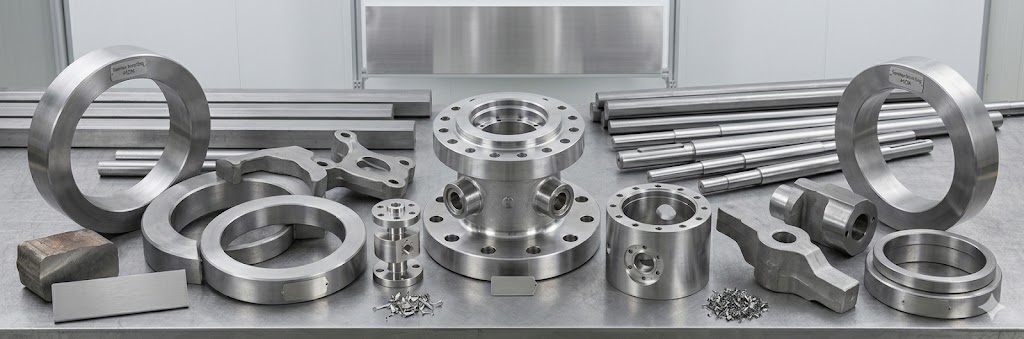 Image: AISI 440C Forged Parts — Rings, Bars, Shafts & Components
 AISI 440C (also designated as UNS S44004, JIS SUS 440C, DIN X105CrMo17 / 1.4125, GB 9Cr18Mo) is a high-carbon (1.0–1.2% C), high-chromium (16–18% Cr) martensitic stainless steel. It has the highest hardness (58–60 HRC) of any commercial stainless steel after quenching and tempering, with a density of 7.80 g/cm³, melting point of 1483°C, elastic modulus of 200 GPa, and tensile strength ≥1965 MPa. According to MatWeb and AZoM, AISI 440C is the best choice material for bearings, valves, cutting tools, gage blocks, and high-wear industrial parts.
- Material: AISI 440C / SUS 440C / UNS S44004 / X105CrMo17 / DIN 1.4125 / GB 9Cr18Mo
- Key Property: Highest hardness of any commercial stainless steel — 58–60 HRC after Q&T
- Density: 7.80 g/cm³ | Melting Point: 1483°C | Elastic Modulus: 200 GPa | Thermal Conductivity: 24.2 W/m·K
- Forging Range: 925–1150°C (do not forge below 900°C)
- Manufacturer: Jiangsu Liangyi Co., Limited — ISO 9001:2015, est. 1997, 80,000 sqm facility, 6300-ton press
- Capacity: 30 KG – 30 tons single-piece | Rings up to 6m OD | Shafts up to 15m | Bars up to 2m dia.
- Standards: ASTM A276, A473, AMS 5630, EN 10088-3, JIS G4303, API 6A, NACE MR0175
- Export: more than 50 countries | Shanghai & Ningbo-Zhoushan Port | Lead time: 3–6 weeks
Established in 1997, Jiangsu Liangyi Co., Limited is a professional ISO 9001:2015 certified manufacturer located in China. Our main products include AISI 440C, SUS 440C, UNS S44004, X105CrMo17 (DIN 1.4125), and alloy 440C open die forging parts and seamless rolled steel forged rings . Our factory covers 80,000 sqm and has advanced forging & inspection equipment (including 6300-ton hydraulic press, ring rolling mills, and CNC machining centers).We provide a full range of service from steel melting, forging, heat treatment to fine machining,and all parts fully meet ASTM A276, ASTM A473, AMS 5630, EN 10088-3 and JIS G4303. With more than 25 years of industry experience, we have exported our products to more than 50countries. We can ship our goods from Shanghai Port and Ningbo-Zhoushan Port to any ports that clients required around the world.
With more than 25 years of industry experience, Get a Free Custom Quotation → Download 440C Datasheet (PDF)Full Range of AISI 440C Forged Products We Manufacture
Jiangsu Liangyi produces custom AISI 440C forged parts in all shapes and sizes based on clients drawings and technical requirements. As one of China's largest open die forging manufacturers with a 6300-ton hydraulic press, we deliver the following main products:
- AISI 440C Forged Bars & Rods: Round, square, flat, rectangular, and hollow bars — the max diameter is 2 meters and weight is up to 30 tons
- SUS 440C Seamless Rolled Rings: Gear rings, slewing bearing rings, contoured rolled rings — the max OD is 6 meters and weight is up to 30 tons
- UNS S44004 Forged Shafts: Step shafts, gear shafts, crank shafts, turbine shafts — the max diameter is 1800mm, and the max length is 15 meters
- Alloy 440C / 1.4125 Structural Components: Hubs, housings, sleeves, bushes, casings, discs, blocks, plates, flanges, pump bodies and valve parts.
- X105CrMo17 Forged Blanks & Custom Shapes: Near-net-shape forgings and rough-machined blanks per drawings — they help clients reduce material waste and machining costs by up to 30%
Why Choose AISI 440C Stainless Steel for Forgings?
AISI 440C is the highest-hardness commercial stainless steel available today. It is a high-carbon (1.0–1.2% C), high-chromium (16–18% Cr) martensitic stainless steel. Its hardness is up to 60 HRC after quenching and tempering, high than 440A (56 HRC), 440B (58 HRC), and AISI 420 (52 HRC). According to MatWeb and AZoM, it has excellent hardness together with moderate corrosion resistance.
Main Advantages of AISI 440C Forged Parts
- Ultra-High Hardness (58–60 HRC): The highest of any stainless steel, so that the parts have great wear and abrasion resistance
- Exceptional Wear Resistance: Abundant chromium carbides (Cr₂₃C₆) resist abrasive, adhesive, and erosive wear
- Excellent Dimensional Stability: Minimal distortion during heat treatment ,so that they are the best choice material for bearing rings and gage blocks
- Moderate Corrosion Resistance: 16–18% Cr passive oxide layer protects in mild atmospheric and fresh water environments
- High Fatigue Strength: Tensile ≥1965 MPa, yield ≥1896 MPa for long lifetime under cyclic loading
- Good Machinability (Annealed): ~40% machinability rating relative to AISI 1212, they can machine well with carbide and ceramic tooling
- Ferromagnetic: Magnetic in all conditions, which make sure they are suitable for sensor and actuator applications
International Equivalent Grades & Standard Cross-Reference for AISI 440C
AISI 440C meet international standards. Following data compiled from ASTM Steel and AZoM:
| Standard | Designation | Specification |
|---|---|---|
| AISI/SAE (USA) | AISI 440C / SAE 51440C | ASTM A276, A473, A580 |
| UNS (USA) | UNS S44004 | ASTM A276, A473 |
| AMS (Aerospace) | AMS 5618, 5630, 5880 | SAE AMS |
| EN/DIN | X105CrMo17 / 1.4125 | EN 10088-3, DIN 17440 |
| JIS (Japan) | SUS 440C | JIS G4303, G4304 |
| GB (China) | 9Cr18Mo / 9Cr18 | GB/T 1220, GB/T 3280 |
| GOST (Russia) | 95Kh18 | GOST 5632 |
| BS (UK) | BS 440C | BS 970 |
Sources: ASTM Steel, AZoM
AISI 440C Chemical Composition (UNS S44004 / X105CrMo17)
The chemical composition of AISI 440C is defined by ASTM A276 and ASTM A473. Its high carbon (1.0–1.2%) combined with high chromium (16–18%) forms a large number of Cr₂₃C₆ carbides, making sure it has excellent hardness.
| Element | Wt% Range | Function |
|---|---|---|
| Iron (Fe) | Balance (78–83) | Base matrix element |
| Chromium (Cr) | 16.0 – 18.0 | Passive oxide layer for corrosion resistance; forms carbides for hardness |
| Carbon (C) | 1.0 – 1.2 | Primary hardening element; enables 60 HRC and maximum wear resistance |
| Manganese (Mn) | 0 – 1.0 | Improves hardenability and hot workability |
| Silicon (Si) | 0 – 1.0 | Deoxidizer; enhances strength |
| Molybdenum (Mo) | 0 – 0.75 | Improves temper resistance and pitting corrosion resistance |
| Phosphorus (P) | 0 – 0.040 | Controlled to minimize brittleness |
| Sulfur (S) | 0 – 0.015 | Controlled for optimal toughness |
Source: ASTM A276
Physical & Thermal Properties of AISI 440C Stainless Steel
Data compiled from MatWeb and AZoM:
| Property | Metric | Imperial |
|---|---|---|
| Density | 7.80 g/cm³ | 0.282 lb/in³ |
| Melting Point | 1483°C | 2700°F |
| Elastic Modulus | 200 GPa | 29,000 ksi |
| Shear Modulus | 83.9 GPa | 12,200 ksi |
| Bulk Modulus | 166 GPa | 24,100 ksi |
| Poisson's Ratio | 0.27 – 0.30 | |
| Thermal Conductivity | 24.2 W/m·K | 168 BTU·in/hr·ft²·°F |
| Thermal Expansion (CTE) | 10.2 μm/m·°C | 5.67 μin/in·°F |
| Specific Heat | 0.460 J/g·°C | 0.110 BTU/lb·°F |
| Magnetic | Ferromagnetic (all conditions) | |
AISI 440C vs 440A vs 440B vs 420 — Comparison
The AISI 440 family consists of three sub-grades differentiated by carbon content. Data from AZoM and Forged Product:
| Property | 440C | 440B | 440A | 420 |
|---|---|---|---|---|
| Carbon (%) | 1.0–1.2 | 0.75–0.95 | 0.60–0.75 | 0.15–0.40 |
| Chromium (%) | 16–18 | 16–18 | 16–18 | 12–14 |
| Max HRC | 58–60 | 56–58 | 54–56 | 50–52 |
| Tensile (MPa) | ≥1965 | ≥1860 | ≥1750 | ≥1550 |
| Corrosion Res. | Moderate | Moderate | Good | Good |
| Toughness | Low | Low–Med | Medium | Med–High |
| Wear Res. | Excellent | Very Good | Good | Moderate |
| Forging °C | 925–1150 | 925–1175 | 925–1200 | 900–1200 |
| Applications | Bearings, valve seats, dies | Cutting tools, instruments | Surgical, knives, cutlery | Plastic molds, knives |
Sources: AZoM, Forged Product
AISI 440C Manufacturing Process
Ultra-High Purity Melting
Jiangsu Liangyi employs advanced triple melting method for AISI 440C. the oxygen content is≤8 ppm ,with minimal non-metallic inclusions per ASTM E45:
- VIM: Primary melting under high vacuum (≤1 Pa) to remove gas impurities and control composition to ±0.01%
- ESR: Secondary refining to reduce sulfur, minimize segregation, and improve uniformity
- VAR: Tertiary refining for aerospace and bearing applications per AMS 5630, making sure it has ultra-high purity
Forging Temperature & Process Control
Based on data from Rolled Alloys and ASTM Steel:
- Preheat: Slowly to 760–820°C (1400–1500°F) until uniformly heated
- Heat to forging temperature: Raise uniformly to 1050–1150°C (1900–2100°F)
- Forge: Immediately. Do not forge below 900°C — risks carbide cracking
- Reheat as needed to stay above 900°C
- Slow cool in furnace, dry lime, or ashes to prevent thermal shock
- Anneal immediately at 843–871°C (1550–1600°F) with slow furnace cooling
Heat Treatment (Hardening & Tempering)
- Hardening: Preheat 760°C, raise to 1010–1065°C, quench in warm oil or air cool
- Sub-Zero (Optional): −73°C to −196°C to convert retained austenite
- Tempering: 148–177°C (300–350°F) for ≥1 hour per inch → final 58–60 HRC
AISI 440C Mechanical Properties — Guaranteed Delivery Values
All parts supplied Q&T, meeting or exceeding ASTM A276 and ASTM A473:
| Property | Guaranteed Value | Test Standard |
|---|---|---|
| Tensile Strength | ≥ 1965 MPa (285 ksi) | ASTM E8 |
| Yield Strength (0.2%) | ≥ 1896 MPa (275 ksi) | ASTM E8 |
| Elongation | ≥ 2% | ASTM E8 |
| Reduction of Area | ≥ 5% | ASTM E8 |
| Hardness (Q&T) | 58 – 60 HRC | ASTM E18 |
| Impact (Charpy V) | ≥ 10 J (RT) | ASTM E23 |
AISI 440C Corrosion Resistance Guide
AISI 440C has moderate corrosion resistance,which is better than carbon tool steels but lower than austenitic 304/316. The 16–18% Cr forms a passive oxide layer, but high carbon consumes some chromium for carbides.
Corrosion Performance by Environment
- Mild Atmosphere: Good — it is suitable for indoor and mild outdoor use
- Fresh Water: Good-it works well in hardened and polished condition
- Mild Chemicals: Moderate — it is suitable for short-term exposure
- Seawater / Marine: Poor — it is can't work well in such conditions; use duplex or super austenitic grades
- Strong Acids (HCl, H₂SO₄): Poor — it is not suitable for such conditons.
- H₂S / Sour Service: Can meet NACE MR0175 when the hardness is controlled below 22 HRC (annealed)
AISI 440C Machinability & Welding Advisory
Machinability
In the annealed condition (~269 HB), AISI 440C has ~40% machinability vs AISI 1212. Based on our production experience and industry references (including Carpenter Technology):
- Tooling: Carbide (C2/C3) or ceramic inserts; HSS wears rapidly
- Cutting Speed: 30–60 m/min (100–200 SFM) with carbide
- Feed Rate: 0.10–0.30 mm/rev roughing, 0.05–0.15 mm/rev finishing
- Coolant: Flood coolant (sulfurized/chlorinated oils) strongly recommended
- Chip Breakers: Required for tough, stringy martensitic chips
Welding Advisory
AISI 440C is generally not recommended for welding due to its high carbon content, which causes rapid air hardening and high risk of HAZ cracking. Per AZoM, if welding is unavoidable:
- Preheat to 260°C (500°F) minimum
- Use matching or AWS ER309/ER310 filler
- Minimize heat input; narrow stringer beads
- PWHT: 732–760°C for 6 hours, slow furnace cool
- Re-anneal and re-harden if full properties are needed
Global Industrial Applications & Project Cases
With more than 25 years of experience, Jiangsu Liangyi has delivered AISI 440C, SUS 440C, UNS S44004, X105CrMo17, and Alloy 440C forged parts to important industries across more than 50 countries. Following are actual project cases with full technical detail.
Case 1 — Oil & Gas Valve Components, Saudi Arabia Wellhead (Middle East)
Background & Challenge: A Saudi company makes wellhead equipment for an Aramco‑level oil operator.Its ASTM A105 carbon steel valve balls and seat rings failed quickly in high‑pressure sour gas service.Original parts failed in 8–12 weeks, witch is caused by sulfide stress cracking (SSC), H₂S corrosion, and abrasive erosion from sand-laden wellstream fluids. Each replacement required a full wellhead shutdown, costing about USD 120,000 each time.
Technical Requirements:
- Material: AISI 440C (UNS S44004), NACE MR0175 / ISO 15156 compliant (hardness controlled to ≤22 HRC in annealed delivery state for field re-hardening option)
- Components: Ball valve spheres (Ø150–250 mm), seat rings, stem forgings
- Standards: ASTM A473, API 6A PR2, EN 10204 3.2 with Bureau Veritas witness
- NDE: 100% UT per ASTM A388, 100% MT per ASTM E709, dimensional CMM report per drawing
- Surface finish: Ra ≤0.4 μm on sealing surfaces; roundness ≤0.01 mm on valve spheres
- Heat treatment: Supplied in annealed condition (Brinell ≤269 HB) ,and full heat treatment records are traceable by heat and lot number.
Jiangsu Liangyi Solution: We supplied VIM+ESR double-melted AISI 440C ingots with oxygen content verified at ≤12 ppm and sulfur ≤0.008%. They are forged on our 6300-ton hydraulic press, slow-cooled in dry lime, and immediately annealed at 855°C for 4 hours with controlled furnace cooling at ≤28°C/hour. We provide full OES chemical analysis for each heat, as well as BV EN 10204 3.2 certificates. All of the parts meet ASTM A473 and API 6A. Their sealing surfaces were precision ground to Ra 0.2 μm and dimensions are verified by CMM.
Outcome: After field hardening to 59–60 HRC and passivation (ASTM A967, Method C), the 440C Parts have more than 14 months lifetime in the same H₂S and high-pressure sour environment where carbon steel lasted 10 weeks. Wellhead shutdown frequency dropped from 4–5 events one year to under 1 event one year per wellhead. Since then,the client has placed 6 repeat orders ,covering 18 wellheads across two fields, with a total value of over USD 2.3 million.
Case 2 — Precision Bearing Rings, Aerospace Supplier, Germany / France
Background & Challenge:A top European aerospace bearing manufacturer (supplying to Airbus and Safran programs) needed AISI 440C seamless rolled bearing rings that meet AMS 5630 standards and have full quality traceability records. Their current European supplier had a 16-week lead time and a high reject rate (more than 3% dimensional scrap) for bearing rings with complex shapes.The customer wanted the rings to have tight ID/OD tolerances (±0.3 mm for forging, ±0.05 mm for machining), strict inclusion ratings (ASTM E45 Method A, Max B-1.5, C-1.0, D-1.0), and VIM+VAR melting certification.
Technical Requirements:
- Material: AISI 440C, VIM+VAR, AMS 5630, AMS 2300 (Premium Aircraft-Quality)
- Ring geometry: OD 120–680 mm, wall 20–80 mm, complex cross-sectional profiles with integral flanges
- Cleanliness: ASTM E45 Method A; Max Heavy Inclusion: B-thin ≤1.5, C-thin ≤1.0, D-thin ≤1.0
- NDE: 100% UT per ASTM A388, FBH reference Ø2.0 mm; 100% MT (wet fluorescent); dye penetrant on machined surfaces
- Mechanical: Tensile ≥1965 MPa, Yield ≥1896 MPa, HRC 58–60 per ring; 3 test specimens per heat
- Certificates: EN 10204 3.2 with TUV witness; full first article inspection (FAI) report per AS9102
- Lead time target: ≤8 weeks raw forged + annealed rings; ≤12 weeks fully machined
Jiangsu Liangyi Solution: We qualified the program through a 4-month PPAP (Production Part Approval Process) that included: We qualified VIM+VAR melt using spectrographic verification according to AMS 2300. We also did ring rolling on our 4-meter ring rolling mill with real-time temperature logging, post-forging anneal at 860°C with furnace atmosphere control, ASTM E45 inclusion rating by a metallographic lab, and full dimensional FAI with a CMM report covering 47 dimensions. The first article was accepted in 11 weeks. Ongoing production makes rings with a measured scrap rate of less than 0.6% and no UT rejections over 28 batches of production in a row.
Outcome: The customer agreed to let Jiangsu Liangyi be a dual-qualified supplier along with their European source, starting with 30% of their annual volume. Because of consistent quality and a 40% cost advantage, our share grew to 65% of the total program volume by the second year. Over 3 years, more than 62,000+ bearing ring blanks were delivered across 14 part numbers with zero field escapes. The program is now expanded to include AISI 52100 and M50 bearing steel rings from the same production cell.
Case 3 — Heavy Mining Work Rolls & Roll Sleeves, Western Australia Iron Ore
Background & Challenge:A Western Australia iron ore pelletizing plant, which processes 8,000 tonnes per day, was using high-chromium white iron rolls (≈700 HV) in their pellet screening deck. Despite their high initial hardness, the white iron rolls exhibited brittle fracture failures every 5–7 weeks due to impact loads from oversized pellet lumps, creating unplanned maintenance windows of 18–24 hours. The plant’s engineering team then looked for a roll material that has both high wear resistance and much better fracture toughness.
Technical Requirements:
- Material: AISI 440C (9Cr18Mo equivalent), open die forged, Q&T to 58–60 HRC
- Roll dimensions: Ø280 × 900 mm body, with integral journals, total weight 480 kg each; 12 rolls per set
- Impact resistance: Charpy V-notch ≥12 J at +20°C (verified per ASTM E23)
- Straightness: ≤0.15 mm/m journal TIR after final turning
- NDE: 100% UT per ASTM A388 (FBH 3 mm reference) post heat treatment; surface MT
- Delivery: Full set of 12 rolls within 8 weeks, with inspection before shipment witnessed by customer QC representative
Jiangsu Liangyi Solution: Rolls were forged from VIM+ESR AISI 440C billets on our 3150-ton press, with careful reduction ratio control (≥4:1 on the roll body to maximize carbide refinement and transverse toughness). Heat treatment was performed in our pit-type vacuum furnace: austenitize at 1040°C/3.5 h, oil quench, subzero treatment at −73°C for 2 h to minimize retained austenite, double temper at 165°C/3 h. Achieved: HRC 59.2 avg, Charpy V = 14 J avg. Full dimension test (CMM + runout on V-blocks), 100% UT, and surface MT completed before witnessed packing.
Outcome: The 440C forged rolls had 11–13 weeks in-service life vs 5–7 weeks for white iron, and — critically — zero brittle fracture events across the first four sets (48 rolls). The predictable wear-out failure mode (gradual surface wear rather than sudden fracture) allowed the plant to schedule roll changes during planned maintenance windows, eliminating all unplanned shutdowns attributable to roll failure.As a result, the annual maintenance cost for the screening deck is deleted to be reduced by AUD 1.4 million. Currently, the client places a standing annual blanket order for 4 sets of rolls (48 rolls in total) each year.
Case 4 — Cold Forming Die Inserts, Automotive Fastener Manufacturer, Germany
Background & Challenge: A German Tier-1 automotive fastener manufacturer that makes high-strength M10–M24 bolts using multi-stage cold heading needed die inserts that needed less maintenance to keep up with their 24/7 production rate of 300 parts per minute. Before they needed to be regrinded, their current tool steel (DIN 1.2379 / D2) inserts lasted about 800,000 strokes. This meant that every 44 hours of operation, they had to stop to regrind, which was a big problem. The customer wanted us to evaluate AISI 440C as a potential option.It may have great performance for Its matrix strengthened by chromium carbides .
Technical Requirements:
- Material: AISI 440C / X105CrMo17 (EN), open die forged billets Ø80–140 mm × 200–500 mm
- Hardness: 59–60 HRC throughout; hardness uniformity ≤±0.5 HRC section-to-section
- Microstructure: ASTM E45 inclusion rating; carbide distribution uniform per ASTM E1245
- Residual stress: Compressive surface RS preferred; grinding stress relief protocol provided
- Surface: Ground finish Ra ≤0.2 μm on die cavity faces
- Quantity: 120 billets per quarter (4 part numbers), with EN 10204 3.1 MTC and full hardness map per billet
Jiangsu Liangyi Solution: Supplied VIM+ESR AISI 440C forged billets with forge reduction ≥5:1, making sure fine and uniform chromium carbide (Cr₂₃C₆) distribution throughout the section. Heat treatment: austenitize 1055°C/1 h (per inch), rapid oil quench, subzero −78°C/2 h (dry ice + acetone bath), double temper 160°C/2 h per cycle. Full hardness mapping (9-point per cross-section, 3 cross-sections per billet) delivered with each MTC.For all 480 billets supplied in the first year, inclusion ratings consistently reached:Max B-thin 1.0, C-thin 0.5.
Outcome: The customer’s in-house toolroom tests over 6 months showed that 440C die inserts averaged 1.35–1.45 million strokes before regrind.
Case 5 — Steam Turbine Blade Forgings, Power Generation, India
Background & Challenge: An Indian EPC contractor was building two 660 MW supercritical thermal power units for a state utility.It needed last-stage steam turbine blade forgings made of corrosion-resistant martensitic stainless steel.The blades work in wet steam at 200–250°C with moisture droplets.
Technical Requirements:
- Material: AISI 440C / 9Cr18Mo (GB equivalent), ESR melted
- Blade blank geometry: Airfoil-profile near-net-shape forgings, 380–650 mm chord, 8–14 kg each
- Heat treatment: Partial hardening + tempering to HRC 54–57 (for improved toughness vs full HT)
- Fatigue: Rotating bending fatigue limit ≥650 MPa at 10⁷ cycles (ASTM E466)
- NDE: 100% UT (FBH 1.6 mm ref) + 100% fluorescent MT on all blade blanks
- MTC: EN 10204 3.2 with LLOYDS witness; material traceability heat-to-blade
- Quantity: 3,800 blade blanks across 6 airfoil profiles for two turbine units; 14-month delivery schedule
Jiangsu Liangyi Solution: Near-net-shape blade blanks were forged using custom dies on our 2000-ton press, with profile tolerances held to ±1.5 mm for minimum machining allowance. ESR melt certification with oxygen ≤10 ppm. Heat treatment in our roller-hearth furnace with ±5°C temperature uniformity; HRC achieved: 55.1 avg (range 54.0–56.5 across all 3,800 pieces). Rotating bending fatigue tests on 5 witness specimens (per ASTM E466) showed fatigue limit of 685–710 MPa. Full NDE: zero UT rejections; 4 MT rejections (surface seams) in 3,800 pieces = 99.9% acceptance rate. Complete traceability matrix delivered: heat number → forging lot → individual blade serial number.
Outcome: All 3,800 blade blanks were delivered on time over 13 months, one month earlier than the contract required.
Case 6 — Desalination Pump Impellers & Wear Rings, Middle East & Southeast Asia
Background & Challenge: These pumps can handle seawater that has been pre-filtered and has a pH of 6.5 to 8.0 and a chloride level of 19,000 to 22,000 ppm.The pump runs all the time at 3,000 rpm, and the tips of the impeller can go as fast as 45 m/s.
Earlier 316L stainless steel impellers failed within 8–10 months from cavitation erosion and crevice corrosion, leading to unplanned plant shutdowns.
AISI 440C was already specified for the wear rings.Using duplex 2205 for impellers was too expensive for the required forging size: Ø520 mm, 95 kg.
The customer asked to test and evaluate a forged AISI 440C impeller.
Technical Requirements:
- Material: AISI 440C impellers (annealed, ≤255 HB, for field heat treatment after machining) and 440C wear rings (Q&T, 58–60 HRC)
- Impeller geometry: Ø520 mm × 180 mm hub, open-die forged disc blanks, 95 kg; wear rings Ø280 mm × 45 mm
- Surface: Passivation per ASTM A967 Method C (citric acid) on all wetted surfaces
- Cleanliness: No free iron contamination; ferrite test per ASTM A380
- Balance: Dynamic balance G2.5 after rough machining (customer performs final balance)
- Quantity: 48 impeller blanks + 96 wear rings per annual call-off; EN 10204 3.1 certificates
Jiangsu Liangyi Solution: Impeller disc blanks forged from VIM+ESR AISI 440C; annealed at 860°C with controlled slow cool to ≤241 HB for machineability. Wear rings forged and Q&T to 59 HRC. All wetted-surface contact forgings passivated in citric acid bath per ASTM A967 Method C; ferrite test performed per ASTM A380 to confirm no free iron contamination. Dimension test per customer drawing with CMM report. Dynamic balance performed on rough-machined impeller blanks to G6.3 pre-finish (customer final balances after shroud welding and finish machining).
Outcome: After field hardening to HRC 59–60 and passivation, the 440C impellers in the Oman SWRO plant have run continuously for 22 months and are still in service with no maintenance needed.This is much longer than the 8–10 months typical for the old 316L impellers.
The high hardness greatly reduced cavitation erosion.After 22 months, the impeller surface roughness (Ra) had only increased by less than 1.2 μm, compared to more than 8 μm on 316L at the same service time.The wear ring clearance loss rate was 0.02 mm per 1000 hours, versus 0.08 mm per 1000 hours for the old design.This extended the pump re‑clearancing interval from 6 months to over 18 months.The OEM now uses AISI 440C as the standard material for all its SWRO pumps rated above 80 bar.
Global Compliance & Quality Control
Jiangsu Liangyi maintains ISO 9001:2015 certification with OES spectrometers, testing machines, hardness testers, UT/MT equipment, and CMM:
- North America: ASTM A276, A473, AMS 5630, API 6A, NACE MR0175
- Europe: EN 10088-3, DIN 17440, EN 10204 3.1/3.2
- Japan: JIS G4303, JIS G4304
- China: GB/T 1220
- Australia: AS standards
- Middle East: NACE MR0175, API 6A
NDE Standards
All NDE work is performed in accordance with ISO 9712 and ASNT SNT-TC-1A procedures:
- 100% UT: Per ASTM A388, calibrated to ASTM E428, full volume coverage
- MT: Surface/near-surface inspection per ASTM E709
- Dimensional: CMM verification with detailed reports
- Chemistry: Full OES per heat including tramp elements
- Mechanical: Tensile, yield, elongation, hardness, impact per ASTM E8/E23
- Microstructure: Per ASTM E45 when required
Mill Test Certificate (MTC)
We provide a full MTC (EN 10204 3.1 standard; 3.2 with third-party witness on request) for every batch, these includes:
- Heat Number, melting process (VIM/ESR/VAR), material traceabilit
- Full dimensional inspection with CMM data
- Heat treatment records (temperature, time, cooling, furnace ID)
- Full chemical analysis including tramp elements
- Complete mechanical results with all individual test values
- UT/MT examination results
- Visual inspection confirmation
- Any additional client-specified tests
Common Processing Mistakes to Avoid with AISI 440C
Based on more than 25 years of manufacturing experience, our engineering team identifies the most common quality failures:
- Forging Below 900°C: Causes carbide network cracking — always maintain above 900°C
- Overheating Above 1200°C: Causes grain boundary melting and permanent toughness loss
- Rapid Cooling After Forging: Creates untempered martensite with extreme brittleness — always slow-cool
- Skipping Immediate Annealing: As-forged 440C is extremely hard and brittle — anneal immediately at 843–871°C
- Tempering at 427–593°C: Severely degrades both corrosion resistance and toughness — temper only at 148–177°C
- Machining After Hardening: Rapidly destroys tools at 58–60 HRC — always machine before final hardening
- Welding Without PWHT: High carbon causes severe HAZ cracking — avoid welding when possible
- Skipping Post-HT UT: Internal cracks from heat treatment may be invisible — always 100% UT per ASTM A388
Frequently Asked Questions — AISI 440C Forged Parts
AISI 440C (UNS S44004, SUS 440C, X105CrMo17, DIN 1.4125, GB 9Cr18Mo) is a high-carbon martensitic stainless steel, it has 1.0–1.2% carbon and 16–18% Cr chromium .It reaches 58–60 HRC ,the highest hardness of any commercial stainless steel ,with density 7.80 g/cm³, melting point 1483°C, and elastic modulus 200 GPa.
After quenching (1010–1065°C) and tempering (148–177°C, ≥1 hour), AISI 440C has 58–60 HRC with tensile strength ≥1965 MPa per ASTM A276/A473.
They The main difference between them is how much carbon they have: 440A has 0.60–0.75% C and a maximum hardness of 56 HRC; 440B has 0.75–0.95% C and a maximum hardness of 58 HRC; and 440C has 1.0–1.2% C and a maximum hardness of 60 HRC.
440C is the hardest and most resistant to wear.
UNS S44004 (USA), SUS 440C / JIS G4303 (Japan), X105CrMo17 / 1.4125 / EN 10088-3 (Europe), 9Cr18Mo / GB/T 1220 (China), 95Kh18 / GOST 5632 (Russia). Standards: ASTM A276, A473, AMS 5630.
Range: 925–1150°C. Preheat to 760–820°C, heat to 1050–1150°C. Never forge below 900°C. Slow cool after forging and anneal immediately at 843–871°C.
Moderate — it works well in mild atmosphere and fresh water, but is not suitable for marine or strong acids. Best in hardened and polished condition. Passivation per ASTM A967 further improves performance.
~40% vs AISI 1212 in annealed condition (~269 HB). Use carbide and ceramic tooling, 30–60 m/min, flood coolant. Always machine before final hardening.
7.80 g/cm³ (0.282 lb/in³) — slightly lower than austenitic 304/316 (8.00 g/cm³).
Yes — ferromagnetic in all conditions (annealed, hardened, tempered) due to martensitic crystal structure.
It can't be welded because its high carbon content may cause air hardening and HAZ cracking. If unavoidable: preheat 260°C, 309/310 filler, PWHT 732–760°C for 6h. Mechanical joining preferred.
30 KG – 30,000 KG single-piece. Bars: max 2m dia. Rings: max 6m OD. Shafts: max 15m length / 1800mm dia.
Yes. we provide full EN 10204 3.1 standard for all orders. EN 10204 3.2 with TUV/SGS/BV/Lloyd's witness are available per request.
Raw forgings: 3–4 weeks. Machined + heat treated: 4–6 weeks. Expedited: 2–3 weeks. Shipping from Shanghai/Ningbo: 2–4 weeks additional.
Further Reading & Authoritative References
- MatWeb — 440C Martensitic Stainless Steel (UNS S44004) Datasheet
- AZoM — Stainless Steel Grade 440C Technical Data
- ASTM A276 — Stainless Steel Bars and Shapes
- ASTM A473 — Stainless Steel Forgings
- Rolled Alloys — 440C Data Sheet (PDF)
- Carpenter Technology — CarTech 440C Technical Data (PDF)
- Wikipedia — Martensitic Stainless Steel
- ISO 9712 — NDE Personnel Qualification
Inquiry for Custom AISI 440C Forged Parts — Get a Free Quote
Jiangsu Liangyi provides AISI 440C, SUS 440C, UNS S44004, X105CrMo17 (DIN 1.4125), GB 9Cr18Mo, and Alloy 440C forged parts with competitive prices and reliable lead times. Send us your drawings, material specs, and quantity for a detailed quotation!
Email: sales@jnmtforgedparts.com
Phone / WhatsApp: +86-13585067993
Website: www.jnmtforgedparts.com
Address: Chengchang Industry Park, Jiangyin City, Jiangsu Province, China 214400
Shipping Ports: Shanghai Port & Ningbo-Zhoushan Port
Send Inquiry Now → Download 440C Datasheet (PDF)