Overview of AISI 4330 / 4330V / 4330V MOD Alloy Steel Forgings
Jiangsu Liangyi Co.,Limited is an ISO 9001:2015 certified open die forging and seamless rolled ring manufacturer established in Jiangyin City, Jiangsu Province, China in 1997. With 27+ years of uninterrupted production experience and an annual facility output exceeding 120,000 tons, we specialize in custom AISI 4330, SAE 4330V, AISI 4330V MOD, and AISI 4330V Modified alloy steel forgings, delivering finished and rough-machined components to more than 50 countries across North America, Europe, the Middle East, Australia, and Southeast Asia.
The AISI 4330 steel family belongs to the chromium-nickel-molybdenum (Cr-Ni-Mo) low-alloy high-strength (LAHS) steel category. Within this family, three distinct engineering grades have been developed and standardized over decades of demanding industrial service: the baseline AISI 4330, the vanadium-microalloyed SAE 4330V, and the nickel-enriched AISI 4330V MOD (Modified). Each grade occupies a specific performance tier, and selecting the correct grade for your application directly affects lifetime, failure risk, and long-term operational cost.
What sets the AISI 4330 series apart from simpler alloy steels is its balanced quaternary alloy chemistry. Chromium provides surface hardenability and oxidation resistance; nickel contributes matrix toughness and low-temperature ductility; molybdenum suppresses temper embrittlement and increases deep hardenability in heavy section forgings; and vanadium (in 4330V grades) refines austenite grain size during hot working, which directly translates to improved notch toughness and fatigue resistance in the finished forging. This engineered combination is why AISI 4330V Modified has become the de-facto standard for downhole oil & gas tool forgings and critical mining equipment worldwide.
All AISI 4330 series forgings produced at our facility comply with ASTM A646 (chemical composition and premium quality requirements), ASTM A388 (ultrasonic examination), and ASTM A370 (mechanical testing). Supplementary requirements including Vacuum Arc Remelting (VAR), Magnetic Particle Inspection (MPI), Charpy testing at -60°F, and grain size certification per ASTM E112 are available on request.
The Metallurgy Behind AISI 4330 Series: Role of Each Alloying Element
Correctly specifying, processing, and applying AISI 4330 series forgings requires understanding how each alloying element contributes to the final mechanical property profile. At Jiangsu Liangyi, our metallurgical engineers have accumulated over two decades of practical production data on how heat treatment parameters and forging reduction ratios interact with these elements to produce consistent, repeatable mechanical properties across sections ranging from 100mm to over 1,000mm diameter. The following analysis is the foundation of our material selection guidance for clients.
Carbon (C): 0.28 – 0.33%
Carbon is the primary strengthening element in all steel, and its content in the AISI 4330 family is deliberately positioned in the 0.28–0.33% range — high enough to achieve the required minimum tensile strength of 862 MPa after quench and temper, but low enough to preserve weldability and impact toughness. Carbon contents above 0.35% in Cr-Ni-Mo steels raise susceptibility to hydrogen-induced cracking during welding and create excessive hardness in the heat-affected zone (HAZ). The 0.28–0.33% window is not arbitrary: it is the product of decades of engineering experience balancing strength against toughness and weldability in heavy-section forgings. This is also why AISI 4330V MOD — with the same 0.28–0.33% C as AISI 4330 — is preferred over AISI 4340 (0.38–0.43% C) for large-section, toughness-critical applications.
Chromium (Cr): 0.70 – 0.95%
Chromium in the 0.70–0.95% range contributes to hardenability, carbide stability, and mild corrosion resistance. In the context of large open die forgings where section sizes can exceed 500mm, chromium’s contribution to hardenability ensures that the oil or water quench can penetrate adequately to develop the required tempered martensite microstructure at the core — not just at the surface. However, chromium alone is insufficient for deep hardenability in very large cross-sections. This is the purpose of the combined Cr + Ni + Mo system in AISI 4330: each element contributes its hardenability increment through the Grossmann H-factor system, and their combined effect produces a steel that maintains consistent mechanical properties throughout sections up to approximately 400mm with standard oil quenching, and up to 600mm+ with water quenching or polymer quench media.
Nickel (Ni): 1.65 – 2.00%
Nickel is the element most responsible for the low-temperature toughness that distinguishes AISI 4330V MOD from less sophisticated alloy steels. Nickel lowers the ductile-to-brittle transition temperature (DBTT) of the steel matrix by reducing the stacking fault energy of the body-centered cubic (BCC) iron lattice, making it more resistant to cleavage fracture at low temperatures. This is why AISI 4330V MOD reliably passes Charpy V-notch impact tests at -40°F (the ASTM A646 minimum) and, with optimized heat treatment and high-Ni heats, at temperatures as low as -60°F — which is directly relevant for Arctic drilling operations, deepwater BOP systems, and LNG facility components. When specifying AISI 4330V MOD for low-temperature service, we recommend requesting nickel content at the upper end of the specified range (1.85–2.00% Ni) and providing us with your target Charpy testing temperature so we can select appropriate heat lots and optimize heat treatment accordingly.
Molybdenum (Mo): 0.35 – 0.50%
Molybdenum serves two critical and independent functions in AISI 4330V MOD. First, it is one of the most potent hardenability-improving elements available on a weight-percent basis — more effective than chromium or manganese at the same addition level — ensuring that very large section AISI 4330V MOD forgings achieve through-thickness mechanical properties meeting specification requirements. Second, and equally importantly, molybdenum suppresses temper embrittlement: a phenomenon where Cr-Ni steels lose toughness after tempering in the 370–560°C range due to grain boundary segregation of phosphorus and other impurities. Without adequate molybdenum, heat treating AISI 4330 at the recommended tempering temperature range could actually produce a brittle product — the opposite of the intended outcome. The 0.35–0.50% Mo specification in AISI 4330 effectively eliminates this risk, making reliable toughness achievable in production across the full recommended tempering temperature range.
Vanadium (V): 0.05 – 0.10% (4330V grades only)
Vanadium is the microalloy addition that elevates SAE 4330V and AISI 4330V MOD above the baseline 4330 grade for fatigue-critical and high-toughness applications. At the 0.05–0.10% addition level, vanadium forms fine vanadium carbide (VC) and vanadium nitride (VN) precipitates during hot working and subsequent normalizing heat treatment. These precipitates — typically less than 10 nanometers in size — pin austenite grain boundaries during forging, preventing excessive grain growth even at forging temperatures above 1,100°C. The resulting refined austenite grain size (ASTM 5 or finer after heat treatment, as required by ASTM A646 supplementary requirement S1) leads directly to improved notch toughness (measured by Charpy impact), better fatigue crack initiation resistance, and more uniform through-thickness mechanical properties in large forgings. This is the primary reason AISI 4330V has replaced baseline AISI 4330 in virtually all safety-critical downhole and subsea oil & gas applications globally.
Silicon (Si): 0.20 – 0.35% | Phosphorus (P): max 0.025% | Sulfur (S): max 0.025%
Silicon acts as a deoxidizer during steelmaking, producing a fully killed steel with minimal gas porosity and inclusion content. Phosphorus and sulfur are strictly controlled impurity elements: phosphorus segregates to grain boundaries during solidification and is a primary contributor to temper embrittlement and intergranular fracture; sulfur forms manganese sulfide (MnS) inclusions that reduce transverse ductility and fatigue life. The ASTM A646 limit of 0.025% for both elements reflects premium-quality steel requirements. For the most demanding subsea and sour service applications, clients frequently specify P max 0.015% and S max 0.010% — limits we routinely achieve through controlled EAF + LF (Electric Arc Furnace + Ladle Furnace) steelmaking with calcium wire treatment for inclusion shape modification.
AISI 4330 vs 4330V vs 4330V MOD: Side-by-Side Technical Comparison
The following table provides a direct technical comparison of the three grades in the AISI 4330 series to support your material selection decision. All three grades share the same base Cr-Ni-Mo chemistry; they differ in vanadium addition, nickel content preference, melting practice requirements, and the performance level they are designed to achieve. This comparison is based on our production and supply experience across all three grades for global industrial clients.
| Comparison Factor | AISI 4330 | SAE 4330V | AISI 4330V MOD |
|---|---|---|---|
| Vanadium (V) Addition | None | 0.05–0.10% | 0.05–0.10% |
| Nickel Content | 1.65–2.00% | 1.65–2.00% | 1.65–2.00% (upper range preferred) |
| Grain Size Requirement | Standard (no fine grain req.) | ASTM 5 or finer (vanadium grain pinning) | ASTM 5 or finer (vanadium grain pinning) |
| Min. Tensile Strength | 862 MPa (125 ksi) | 862 MPa (125 ksi) | 862 MPa (125 ksi) |
| Min. Yield Strength | 689 MPa (100 ksi) | 689 MPa (100 ksi) | 689 MPa (100 ksi) |
| Charpy at -40°F (3-spec. avg.) | 25 ft-lb (34 J) | 25 ft-lb (34 J) | 25 ft-lb (34 J) — typically exceeds 50 ft-lb |
| Low-Temperature Toughness | Good | Very Good | Excellent (preferred for Arctic/deepwater) |
| Fatigue Crack Initiation Resistance | Good | Excellent (fine grain) | Excellent (fine grain + high Ni) |
| Hardenability (large section >300mm) | Good | Very Good | Very Good |
| Melting Practice | EAF + LF (Class I) | EAF + LF or VAR (Class I or II) | VAR preferred for critical API/subsea use |
| Governing Standard | ASTM A646 Gr. 5 (base) | ASTM A646 + Suppl. Req. S1 | ASTM A646 Gr. 5 + S1 + client mods |
| Primary Applications | General industrial gears, shafts, machine tooling | Onshore drilling, gearbox components, jackup pinions | Downhole tools, subsea BOPs, raise boring, Arctic drilling, frac pumps |
| Relative Material Cost | Base reference | +5–10% | +15–25% (VAR remelt premium) |
Engineering Selection Guidance: For most onshore oil & gas and general industrial applications where service temperature remains above -20°C, SAE 4330V provides the optimal balance of performance and cost. For deepwater subsea equipment, Arctic drilling tools, NACE sour service applications, and any component specifying -40°C Charpy certification or tighter, AISI 4330V MOD is the recommended grade. For non-critical general machinery where low-temperature toughness is not a design requirement, AISI 4330 (without vanadium) is a cost-effective solution. Contact our engineering team for a free material choice consultation for your specific application and service conditions.
Not sure which grade fits your project? Our metallurgical engineers will review your application and recommend the optimal grade at no cost. Get Free Material Advice
AISI 4330V MOD vs AISI 4340: Choosing the Right Steel for Your Forging
The most frequent material selection question our technical team receives is: “Should I use AISI 4330V Modified or AISI 4340 for my heavy-section forging?” Both are premium Cr-Ni-Mo low-alloy steels widely used in oil & gas, mining, and heavy machinery. However, they have meaningfully different performance characteristics that make one clearly superior in specific application scenarios. The following analysis is based on our 27+ years of production experience and direct feedback from clients who have used both grades in field service.
The Key Chemical Difference: Carbon and Vanadium
The fundamental difference between AISI 4330V MOD and AISI 4340 is carbon content and vanadium presence. AISI 4330V MOD contains 0.28–0.33% C with 0.05–0.10% V added; AISI 4340 contains 0.38–0.43% C with no vanadium. This approximately 0.10% difference in maximum carbon is more consequential than it appears at first glance:
- Notch Toughness and Low-Temperature Performance: AISI 4330V MOD achieves significantly better Charpy V-notch impact values at -40°F than AISI 4340 at comparable tensile strength levels, due to both the lower carbon content (which reduces the density of brittle carbides at grain boundaries) and the refined grain size from vanadium addition. For components that must be certified at -40°F or lower — including Arctic drilling tools, deepwater Christmas tree components, and subsea BOP bodies — AISI 4330V MOD is the reliable choice, and AISI 4340 will frequently fail to meet the Charpy minimum at these temperatures at the required strength level.
- Fatigue Crack Initiation Resistance: The fine austenite grain size (ASTM 5 or finer) produced by vanadium grain boundary pinning in AISI 4330V MOD directly improves the endurance limit (fatigue strength) under cyclic loading. For rotating components such as downhole motor shafts, jackup pinion shafts, and ESP pump shafts that experience millions of load cycles in service, this grain refinement provides a meaningful and measurable increase in fatigue life that AISI 4340 — with its coarser grain and higher carbon content — cannot match.
- Weldability and Cold Cracking Risk: The lower carbon content of AISI 4330V MOD (carbon equivalent approximately 0.65–0.75% IIW formula) compared to AISI 4340 (carbon equivalent approximately 0.80–0.90%) means significantly lower risk of hydrogen-induced cold cracking (HICC) in the heat-affected zone during welding. This is directly relevant for downhole tool assembly welding, valve body repair welding, and structural welding of machine components.
- Large Section Hardenability: For forgings with section sizes above 250mm, AISI 4330V MOD often produces more uniform through-thickness mechanical properties than AISI 4340. The lower carbon content allows more complete martensite formation during quenching without the risk of surface over-hardening or retained austenite pockets in the core that can create local brittleness in very large 4340 sections.
When AISI 4330V MOD Is the Superior Choice
- Charpy V-notch certification at -40°F or below is specified (Arctic, deepwater, sub-zero service)
- Rotating and cyclic-load fatigue applications: downhole motor shafts, ESP motor shafts, jackup pinion shafts, drill collars
- Large cross-section forgings (OD above 300–400mm) where through-thickness mechanical property uniformity is critical
- Sour gas (H2S) service where hydrogen-induced cracking resistance is required (per NACE MR0175)
- Components that will be welded in fabrication or field repair, where minimizing HAZ hardness and cold cracking risk is important
- Subsea pressure-containing components requiring API 6A qualification
When AISI 4340 May Be Preferred
- Applications requiring absolute maximum yield strength above 1,000 MPa where toughness is secondary
- Small-diameter sections under 100–150mm where section-size hardenability advantages of 4330V MOD are negligible
- Cost-sensitive general machinery applications where low-temperature toughness is not required by specification
- Aerospace applications where AMS 6415 (4340) is specifically called out in the engineering drawing
In our 27+ years of supplying forgings to major oil & gas operators and Tier 1 OEMs in North America, Europe, and the Middle East, the industry trend has strongly shifted toward AISI 4330V MOD over AISI 4340 for safety-critical downhole and subsea components. This is driven by increasingly stringent toughness specifications from operators and by NACE and API requirements for sour service and subsea pressure-containing equipment. We have a dedicated AISI 4330V MOD production program to support this industry direction.
Custom AISI 4330 Forging Products We Supply
As a full-service open die forging and ring rolling manufacturer, we offer comprehensive OEM and custom manufacturing for the complete AISI 4330 series — from raw material procurement and forging through heat treatment, NDT, machining, and export certification — all under one ISO 9001:2015 certified quality management system. Production capacity per piece ranges from 30 kg to 30,000 kg, with annual facility output exceeding 120,000 tons across all alloy grades.
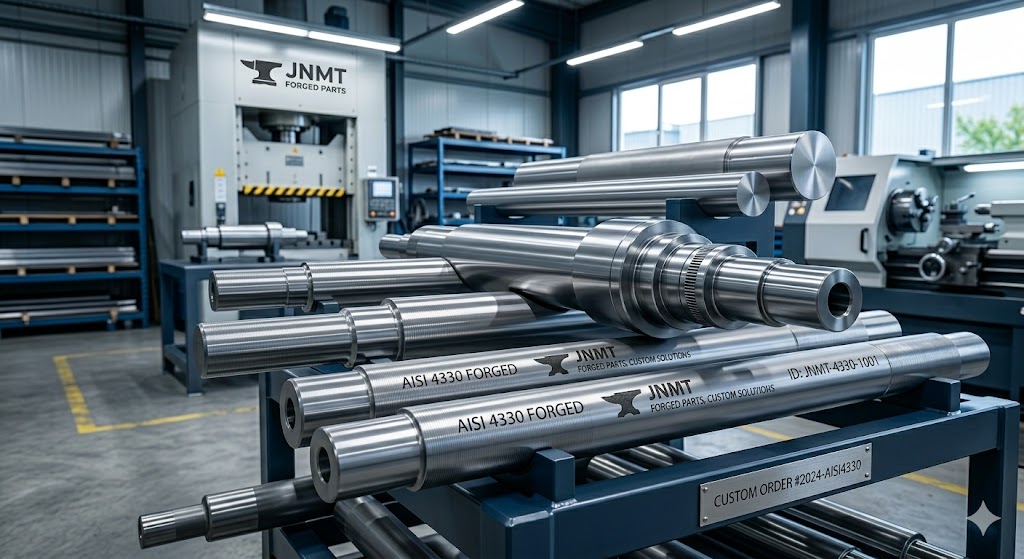
- Open Die Forged Round Bars, Square Bars & Flat Bars: Produced from certified ingots by draw forging or continuous cast billets. Available in normalized, quenched and tempered (Q+T), or annealed condition. Standard delivery is rough-turned or as-forged, with optional CNC finish machining. Maximum length 12,000mm; custom lengths available.
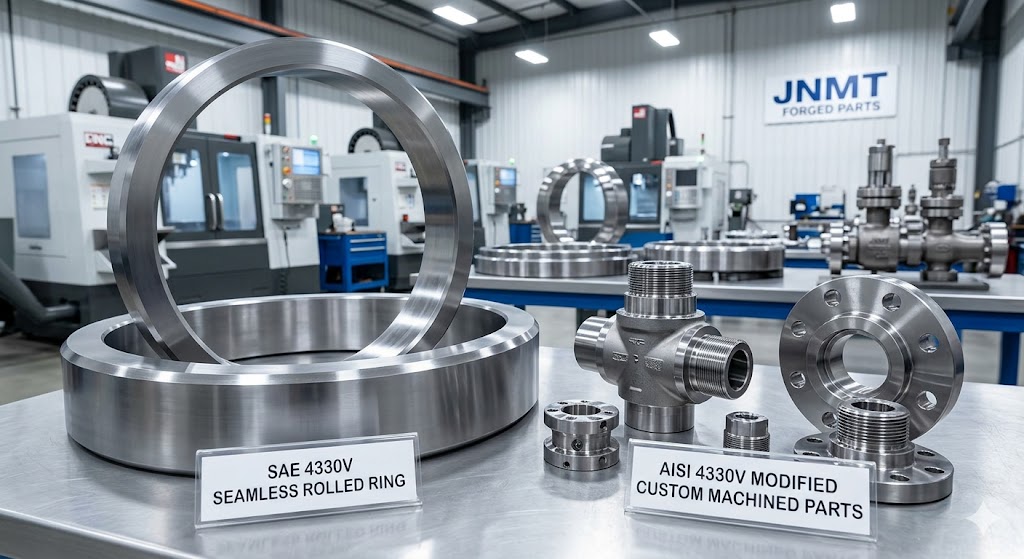
- Seamless Rolled Rings & Profiled Rings: Produced by ring rolling, covering OD 300mm to 5,000mm and heights up to 2,000mm.They are available as rectangular cross-section blanks or near-net-shape profiled rings with complex contoured cross-sections, and reduce material waste and downstream machining cost. Typical applications include swivel rings, bearing races, actuator rings, gear rings, slewing rings, flanged rings, and API wellhead flanges.
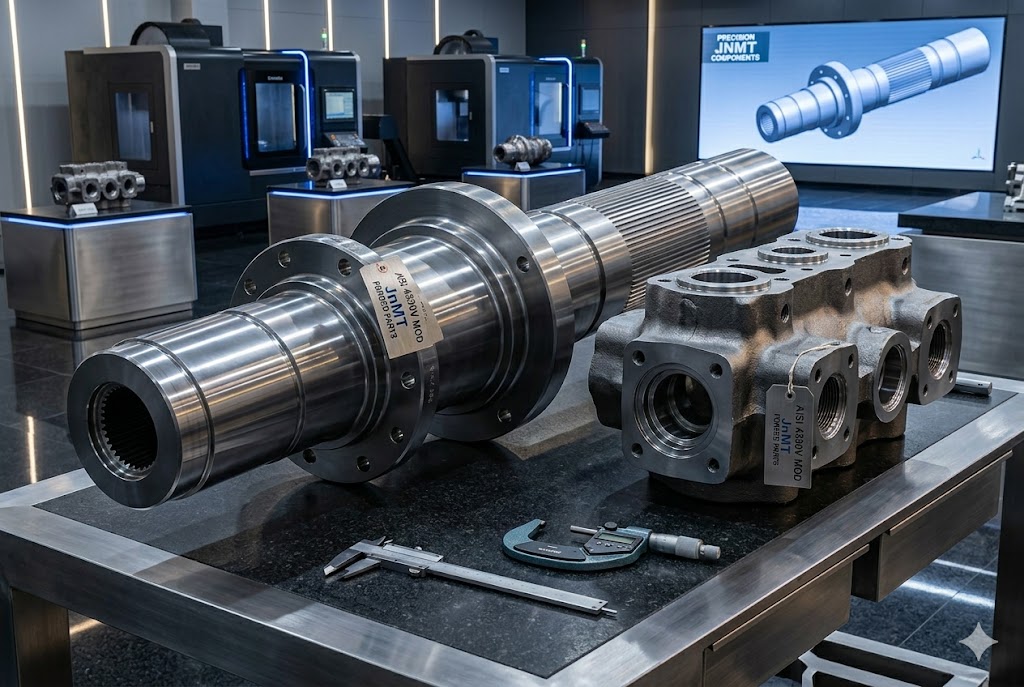
- Forged Gear Shafts & Pinion Shafts: Produced by draw and upset forging to get the required stepped profile, followed by rough-turn machining. Our gear shaft forgings have been applied in multi-MW industrial gearboxes, offshore jackup rig pinion shaft systems, and heavy mining crusher drives. Available with Barkhausen noise testing and residual stress measurement on request.
- Hollow Forged Sleeves, Casings & Tool Bodies: AISI 4330V MOD is the standard material for downhole tool bodies and pressure-containing casings. We produce hollow forgings by ring rolling (short, thick-walled geometries) or mandrel draw forging (longer tube-like geometries). Wall thickness uniformity is verified by post-forging ultrasonic thickness mapping.
- Forged Discs, Blocks & Plates: Wide range of plan dimensions and thicknesses, and they are used for valve body blanks, frac pump fluid end modules, die blocks, and structural machine components. Forged blocks provide superior through-thickness mechanical properties and internal soundness compared to rolled plate for heavy-section applications.
- API 6A Wellhead & BOP Component Forgings: Complete forged blanks for API 6A-rated wellhead and Christmas tree components: spool body blanks, gate valve body forgings, BOP actuator cylinders, choke valve bodies. All forgings for API-rated equipment applications include full heat number traceability and EN 10204 3.1 MTC, and are available with third-party witness inspection.
- Frac Pump Fluid End Modules: High-cycle fatigue is the primary failure mode for frac pump fluid ends. Our AISI 4330V MOD fluid end forgings are produced with enhanced forging reduction ratios (5:1 minimum for fluid ends), tighter inclusion rating requirements, and optional supplementary MPI after final machining. Weight range: 200 kg to 3,000 kg per block; cross-sections up to 600mm square.
- Raise Boring Machine Components: AISI 4330V MOD stems, stabilizers, reamer bodies, and range bodies for underground mining raise boring machines — produced with API thread gauging and make-up torque testing available. OD range: 150mm to 350mm; lengths up to 6,000mm per piece.
- Fully Custom Engineered Forgings to Drawing: Our engineering team reviews your 2D or 3D drawings and delivers a DFM (Design for Manufacturability) analysis, forging process plan, and detailed quotation within 48 hours for most geometries. We work directly with your materials engineers to define the material specification, heat treatment targets, testing plan, and acceptance criteria before production begins.
Send your drawing or RFQ today — technical quotation delivered within 24 hours. Request a Free Quote
Explore our full production equipment: View Our Production Facilities
Industry Applications & Global Project Cases
AISI 4330 series forgings are selected for applications where a demanding combination of tensile strength (>860 MPa), notch toughness at sub-zero temperatures, fatigue resistance under cyclic loading, and hardenability across large cross-sections must be simultaneously achieved. This property combination is not achievable with simpler alloy systems such as AISI 4140, which is why AISI 4330V and 4330V MOD are mandated by engineering specifications at major international oil & gas operators, mining OEMs, and power generation companies. The following describes our principal application sectors with technical depth based on active supply experience.
Oil & Gas Industry: Onshore & Offshore Applications
The oil & gas industry accounts for the largest share of AISI 4330V MOD forging demand globally, driven by extreme mechanical loads (high axial tension, torsion, bending, internal pressure), corrosive environments (H2S, CO2, chlorides), rotational fatigue from drill string operation, and increasingly severe conditions in deepwater, HPHT, and Arctic environments.
- Downhole Drill Collars: Drill collars are thick-walled heavy steel tubes providing weight-on-bit (WOB) to the drill string. In service they experience combined axial compression, bending and torsion loads with cyclic loading over millions of cycles during drilling.AISI 4330V MOD is specified for drill collars because its fine austenite grain size (from vanadium refinement and controlled forging) provides superior fatigue crack initiation resistance at stress-concentration points such as API thread roots. We supply drill collar forgings with OD up to 323.85mm (12-3/4 inches) and wall thicknesses up to 100mm for clients in deepwater Gulf of Mexico and North Sea fields.
- Blowout Preventer (BOP) Body Forgings: BOPs are the primary well pressure control safety devices at the wellhead or seabed. Body forgings for ram-type and annular BOPs are manufactured in AISI 4330V MOD to support the client’s API 6A PR2 qualification process, including cyclic pressure testing and low-temperature Charpy testing. The large section sizes of BOP bodies (main bore diameters 7-1/16” to 21-1/4”; working pressures 3,000–20,000 psi) require excellent deep hardenability — delivered by the Cr-Ni-Mo-V system. We supply BOP body forgings to wellhead equipment manufacturers. API 6A product certification is issued by the equipment manufacturer; we provide full EN 10204 3.1 MTC, UT reports, mechanical test reports, and heat treatment records to support our clients’ API 6A product qualification process.
- Wellhead Spool Bodies, Casing Heads & Tubing Heads: Permanent wellhead forgings require high-pressure containment, 25+ year service life, H2S resistance per NACE MR0175, and low-temperature toughness for Arctic or deepwater installations. We provide EN 10204 3.1 MTC with documented hardness test results and heat treatment records to support your NACE MR0175 / ISO 15156 material compliance verification for HIC/SSCC service applications.
- Frac Pump Fluid End & Power End Components: Hydraulic fracturing pump fluid ends work under extreme cyclic pressure (up to 15,000 psi) and corrosive frac fluid chemistry, which make fatigue failure the dominant failure mode. AISI 4330V MOD fluid end blocks produced with improve forging reduction ratios and tight cleanliness specifications consistently demonstrate extended lifetime compared to standard 4140 or 4340 fluid ends in field use.
- Mud Motor Drive Shafts & ESP Motor Shafts: AISI 4330V MOD motor shafts in oil production experience torsional fatigue from motor startup cycles and bending loads from deviated wellbore trajectories. The fine grain microstructure directly improves the endurance limit of these rotating shafts, reducing in-service failures and extending pump run-life — a critical operational cost driver for ESP operators worldwide.
- Pressure Control & BOP Stack Components: SAE 4330V forged BOP actuator cylinders, swivel rings, riser flanges, double studded adapter flanges, and casing spools for well pressure control systems. Full API 6A mechanical property testing and hydrostatic pressure testing documentation provided.
- Valve & Flow Control Bodies: AISI 4330 forged bodies for ball valves, gate valves, check valves, and back pressure valves — to API 6D and API 600 ratings — with optional API pressure testing and dimensional inspection before shipment.
Mining, Tunneling & Heavy Construction
Underground mining and hard rock tunneling impose uniquely severe demands — extreme impact loads, rotational fatigue, abrasive wear, and chemical exposure. AISI 4330V MOD’s combination of high strength, superior toughness, and fine grain structure makes it the leading material for high-performance mining equipment:
- Raise Boring Machine (RBM) Drill Strings: RBM drill strings operate under combined tension (supporting reamer and string weight), torque from reamer rotation, and bending from eccentric loading in the borehole. AISI 4330V MOD provides the mechanical property combination required by leading RBM OEMs. We supply RBM stem forgings with OD up to 350mm and lengths up to 6,000mm per piece, with API rotary shoulder connection threading by our machining department.
- Roller Reamer & Stabilizer Bodies: Downhole stabilizers and roller reamers experience high radial impact loads from borehole wall contact and rotational fatigue. AISI 4330V MOD keeps structural integrity without surface spalling or cracking under repeated impact, providing the strength-toughness combination not achievable with simpler alloy steels at comparable section sizes.
- Heavy Mining Machinery Structural Components: Spindle hubs, clamping rings, and range bodies for underground drill rigs and boring machines in AISI 4330V MOD, benefiting from the material’s excellent fatigue performance under the shock-load environment of hard rock mining operations.
Industrial Power Transmission & Gearbox Applications
High-power industrial gearboxes and reduction drives in wind turbines, mining conveyors, ship drives, cement mills, and offshore jackup systems require gear and pinion shaft forgings that combine high surface hardness (after case hardening), high core toughness, and dimensional stability during heat treatment:
- Jackup Rig Pinion Shafts: Offshore mobile jackup rigs use rack and pinion jacking systems to raise and lower rig legs. Pinion shafts are massive forgings — typically 300–600mm diameter, 5,000–10,000mm long — operating under high cyclic tooth loads. AISI 4330 provides the required deep hardenability to develop the full mechanical property requirement at the gear tooth root. We supply jackup pinion shaft forgings to manufacturers in Singapore, Norway, and the USA.
- Industrial Ring Gears & Gear Blanks: Large planetary ring gears and spur gear blanks for mining gearboxes and cement mill drives, ring rolled in AISI 4330 with continuous fiber flow pattern in the gear rim for improved bending fatigue strength. Supply range: OD up to 3,500mm, rim heights up to 800mm.
Power Generation: Thermal Power Applications
- High-Pressure Industrial Pump Shafts & Impellers: AISI 4330 forged shafts and impellers for industrial high-pressure pumps in thermal power plant fluid circulation systems, requiring high strength, good fatigue resistance under long-term cyclic operation, and full material traceability via EN 10204 3.1 MTC.
- Steam Turbine Shafts & Discs: Large forged shafts and discs for thermal power steam turbines in AISI 4330 where the combination of high yield strength and good fatigue performance at elevated temperatures (up to 400°C) is required. The material’s resistance to temper embrittlement (from the molybdenum addition) is critical for components in prolonged elevated-temperature service.
Flow Measurement, Valves & Pipeline Components
- Venturi Cone Meter & Ultrasonic Flow Meter Bodies: Precision flow meter bodies requiring internal geometry free of porosity or shrinkage that could cause dimensional instability after machining. 100% UT examination before machining ensures full soundness in all machined areas.
- Pipeline Wye Pieces & Piggable Fittings: Forged wye-piece fittings for pipeline pig launching stations — geometrically complex forgings requiring careful process engineering to ensure adequate forging reduction in all flow-path areas. We work directly with pipeline operators and EPC contractors to engineer the forging process for complex flow fitting geometries.
For project references and supply history: View Our Global Project References
AISI 4330V Modified Chemical Composition — ASTM A646 Grade 5
The chemical composition of AISI 4330V Modified is governed by ASTM A646-95 (Standard Specification for Premium Quality Alloy Steel Blooms and Billets for Aircraft and Aerospace Forgings), Grade No. 5. All heats of steel used at our facility for AISI 4330V MOD orders are verified by our incoming inspection laboratory using optical emission spectrometry (OES) before any forging operations begin. The table below includes the governing specification range and the metallurgical function of each element in the alloy system.
| Chemical Element | ASTM A646 Gr.5 Range (Wt.%) | Metallurgical Function |
|---|---|---|
| Carbon (C) | 0.28–0.33% | Primary strengthening; controlled to balance strength with toughness and weldability |
| Manganese (Mn) | 0.75–1.00% | Deoxidizer; controls sulfide morphology; contributes to hardenability |
| Nickel (Ni) | 1.65–2.00% | Lowers DBTT; enhances core toughness; improves fatigue crack propagation resistance |
| Chromium (Cr) | 0.70–0.95% | Increases hardenability; carbide stability; oxidation and mild corrosion resistance |
| Molybdenum (Mo) | 0.35–0.50% | Suppresses temper embrittlement; significantly increases deep section hardenability |
| Vanadium (V) | 0.05–0.10% | VC/VN precipitate grain pinning; achieves ASTM 5 or finer grain; improves fatigue limit and notch toughness |
| Silicon (Si) | 0.20–0.35% | Deoxidizer; solid solution strengthener |
| Phosphorus (P) | Max 0.025% | Controlled impurity; grain boundary segregation causing temper embrittlement if excessive |
| Sulfur (S) | Max 0.025% | Controlled impurity; MnS inclusions reduce transverse ductility and fatigue life |
For the most critical applications (subsea BOP components, NACE sour service, high-purity industrial applications), clients may specify P max 0.015% and S max 0.010%, which we achieve through EAF + LF steelmaking with calcium wire treatment for inclusion morphology control. Vacuum Arc Remelting (VAR — ASTM A646 Class II) is available to further minimize segregation and maximize through-thickness cleanliness for demanding service conditions.
Explore our complete material grade offerings: View Our Full Material Grade List
Mechanical Properties of AISI 4330V Forged Parts — ASTM A646 Requirements
The minimum mechanical property requirements specified by ASTM A646-95 represent a mandatory floor — not a production target. Well-controlled forging practice combined with precisely optimized quench and temper parameters routinely delivers properties that exceed the minimums, providing a meaningful safety margin for engineering design. All mechanical testing is performed by our in-house testing laboratory, with results documented in the Mill Test Certificate (MTC) provided with every shipment.
| Mechanical Property | ASTM A646 Minimum | Typical Achieved Values* |
|---|---|---|
| Tensile Strength (UTS) | 125,000 psi (862 MPa) | 900–980 MPa |
| Yield Strength (0.2% Offset) | 100,000 psi (689 MPa) | 750–850 MPa |
| Elongation (2” gauge length) | 18% | 19–23% |
| Reduction of Area | 50% | 55–68% |
| Charpy V-Notch (Transverse, @-40°F, single specimen min.) | 20 ft-lb (27 J) | 35–60 J typical |
| Charpy V-Notch (Transverse, @-40°F, 3-specimen avg. min.) | 25 ft-lb (34 J) | 45–75 J typical |
| Brinell Hardness | 269–310 HB | 275–305 HB |
*Typical values based on production data for Q+T heat treatment targeting 280–295 HB on standard section sizes up to 300mm. Actual values depend on section size, heat number, heat treatment parameters, and specimen sampling position. All guaranteed values are the ASTM A646 minimums as stated in the MTC.
Section Size vs. Achievable Core Mechanical Properties
One of the most important practical considerations for AISI 4330V MOD forgings is the relationship between section size and through-thickness mechanical properties. Hardenability — the ability of the steel to form martensite at the core during quenching — decreases as section size increases, because the quench medium cannot cool the core of a very large forging as rapidly as the surface. For AISI 4330V MOD in section sizes up to approximately 400mm (15.7”), oil quenching reliably produces a predominantly martensitic microstructure at the core after proper austenitization, meeting ASTM A646 mechanical property minimums. For sections above 400mm, water quenching or polymer quench media are evaluated on a case-by-case basis by our heat treatment engineers. Clients specifying mechanical properties at the core of forgings larger than 400mm section size should discuss this directly with our technical team prior to order placement so that an appropriate test plan — including mid-radius or core specimen sampling — can be included in the production plan.
Mechanical Test Specification & Sampling Standards
- Tensile tests use 0.500” (12.7mm) diameter round specimens from the longitudinal axis of a full-size prolongation, after the full Q+T cycle, per ASTM A370.
- Charpy impact tests use full-size (10mm × 10mm) specimens from the transverse axis of a full-size prolongation, tested at -40°F in our calibrated impact testing machine, per ASTM A370 and A646.
- For ring forgings and other geometries without a prolongation, specimens are cut from a representative test ring from the same heat and heat treatment charge as production forgings.
- One complete tensile and Charpy test lot is completed for each heat of material and each heat treatment charge, with results included in the MTC.
- Optional supplementary testing: Charpy at -60°F, ASTM E112 grain size measurement, ASTM E45 inclusion rating (Method D), residual element analysis (Sn, Sb, As, Cu), and Jominy end-quench hardenability testing are all available on request.
Heat Treatment Process & Strict Quality Control Standards
Standard Quench and Temper Cycle for AISI 4330V MOD
The heat treatment of AISI 4330V MOD forgings is the most significant step in manufacturing. Our standard three stage cycle for ASTM A646 Grade 5 is run on precision gas fired and electric furnaces with multi-zone temperature control, continuous data logging and precise temperature uniformity control:
- Stage 1 — Normalizing (870–900°C / 1,600–1,650°F): Austenitization followed by air cooling. Normalizing homogenizes the as-forged microstructure, dissolves segregation from the forging process, and conditions the steel for the quench-and-temper cycle. For very large forgings (>400mm section), a double normalization cycle may be applied for improved homogeneity. Soak time is calculated based on maximum cross-sectional thickness at a minimum of 1 hour per 25mm.
- Stage 2 — Austenitizing & Quenching (845–875°C / 1,550–1,610°F): Forgings are re-heated to the austenitizing temperature for a controlled soak period to dissolve all carbides into austenite without excessive grain growth and then rapidly quenched in oil, water or polymer solution depending on the section size and geometry. Consistent quenching results are achieved through proper fixturing, agitation, and quench tank temperature control.
- Stage 3 — Tempering (580–650°C / 1,075–1,200°F): Immediately after quenching (within 4 hours to prevent quench cracking), forgings are tempered at a temperature selected to achieve the target hardness range (typically 269–310 HB per ASTM A646). Tempering temperature is the primary control parameter for the strength-toughness balance. Critically, the molybdenum content of AISI 4330V MOD ensures the steel is NOT susceptible to temper embrittlement throughout the recommended temperature range, allowing reliable toughness to be achieved across all standard tempering conditions.
Why Our 4:1 Minimum Forging Reduction Ratio Matters
Our production standard specifies a minimum 4:1 forging reduction ratio for all AISI 4330 series forgings — the cross-sectional area of the starting ingot or billet must be reduced to no more than 25% of its original area during forging. This ASTM A646 requirement has a direct impact on the internal soundness, grain refinement and transverse mechanical properties. The transverse ductility, fatigue life and cleanliness of forgings produced with an insufficient amount of deformation (<3:1) are much lower than those of properly worked material. In each order, we document the initial ingot and finished forging cross-section dimensions, and we include the reduction ratio calculation in the forging process documentation we provide at shipment.
Non-Destructive Testing & Full-Process Quality Control
- Incoming Raw Material Verification: OES chemical analysis of every heat before production; identity check against mill certificate; retained records for minimum 10 years.
- Forging Process Monitoring: Continuous infrared pyrometer temperature monitoring; reduction ratio documentation; forging temperature records archived per heat number.
- Heat Treatment Documentation: regular furnace calibration and temperature uniformity surveys; continuous temperature logging for every charge; hardness verification before NDT release.
- 100% Ultrasonic Testing (UT): 100% volumetric UT per ASTM A388-95 using 2.25 MHz longitudinal beam transducer. Calibration reference: 1/8-inch diameter FBH (flat bottom hole). Rejection criteria: any indication equal to or exceeding the FBH reference; any loss of back reflection exceeding 50%. UT performed after final heat treatment and rough machining.
- Supplementary NDT Options: Magnetic Particle Testing (MT) per ASTM E709; Liquid Penetrant Testing (PT) per ASTM E165; Phased Array UT (PAUT) for complex geometries; TOFD for weld-repaired areas. All available on client request.
- Dimensional Inspection: Full dimensional inspection against client drawing using calibrated digital calipers, micrometers, CMM, and roundness measurement. Inspection records included in delivery documentation.
- Traceability & Certification: Each finished forging is permanently stamped with heat number, material grade, and our manufacturer identification. Complete MTC (EN 10204 3.1 by our in-house testing lab, or EN 10204 3.2 witnessed by approved third-party) provided with every shipment, including all test reports and heat treatment records.
Weldability, Machinability & Design Considerations
Engineers designing components from AISI 4330V MOD frequently require guidance on welding procedures, machining parameters, and post-weld heat treatment (PWHT) requirements. The following is based on our in-house production experience and direct technical feedback from client engineering teams who have qualified AISI 4330V MOD welding procedures for downhole tool assembly and surface equipment manufacturing.
Weldability of AISI 4330V MOD
AISI 4330V MOD has a carbon equivalent (CE) of approximately 0.65–0.75% by the IIW formula: CE = C + Mn/6 + (Cr+Mo+V)/5 + (Ni+Cu)/15. This places it in the “moderately difficult to weld” category — weldable with proper procedures, but requiring mandatory preheat and PWHT to avoid hydrogen-induced cold cracking and to restore the required mechanical properties in the heat-affected zone.
- Preheat Temperature: 200–260°C (390–500°F) minimum, maintained as interpass temperature. Increase to 300°C for sections above 75mm or in ambient temperatures below 10°C.
- Filler Metal: Low-hydrogen electrode or wire mandatory (H4 or H2 classification, <5 ml/100g diffusible hydrogen). ER100S-G or equivalent for structural welds.
- PWHT: 570–620°C (1,060–1,150°F) for minimum 1 hour per 25mm weld thickness, immediately after welding before the joint cools to room temperature. PWHT temperature must be below the original tempering temperature of the base material. We supply forgings with documented original tempering temperature on request to support PWHT procedure qualification.
- Welding Processes: SMAW, GTAW, GMAW, SAW, and FCAW are all applicable with appropriate procedure qualification. GTAW for root passes and SAW for fill/cap passes is recommended for critical pressure-containing welds.
Machinability of AISI 4330V MOD at Q+T Condition
At 269–310 HB (Q+T condition), AISI 4330V MOD has a machinability rating of approximately 45–55% relative to AISI 1212 (100% reference). Practical machining parameters based on our CNC machining experience:
- Turning: TiAlN or AlTiN coated carbide inserts; cutting speed 100–160 m/min; feed rate 0.2–0.4 mm/rev; depth of cut 2–6mm roughing. Flood coolant strongly recommended.
- Milling: Coated carbide end mills or indexable insert face mills; cutting speed 80–130 m/min; chip load per tooth 0.10–0.20mm. Climb milling preferred for improved surface finish and tool life.
- Drilling: HSS-Co or solid carbide drills, TiAlN coated; cutting speed 15–30 m/min (HSS-Co) or 40–70 m/min (solid carbide). High-pressure through-tool coolant recommended for deep holes (>3× diameter).
- API Thread Cutting: API thread forms (NC, API Reg, API IF, API FH) are commonly machined on AISI 4330V MOD downhole tool bodies in our CNC turning department. All API threads are inspected with certified API gauges per API Spec 7-2 tolerances.
Our Full Custom Forging Production Process (9 Steps)
We provide a full range of services for custom manufacturing from engineering review to global delivery, with full quality traceability and documentation at every step. Our integrated production approach provides a single point of accountability for quality and delivery performance.
Drawing & Spec Review
Free DFM analysis, material confirmation, and technical query response within 48 hours by our engineering team
Certified Raw Material
Heat selection from certified mills; incoming OES chemical verification; mill certificate review before production release
Precision Forging
Open die forging or ring rolling; minimum 4:1 reduction ratio; finish forging temperature control; process documentation
Controlled Heat Treatment
precision gas-fired and electric furnaces; normalize + quench + temper; continuous data logging; hardness verification before NDT
Mechanical Testing
Tensile, Charpy @-40°F, hardness, elongation per ASTM A370 & A646; in-house testing lab
100% UT Inspection
Per ASTM A388 (2.25 MHz, 1/8” FBH); optional MT/PT/PAUT; third-party witness inspection available
CNC Machining
Rough or finish machining per drawing; API thread cutting; CMM dimensional inspection; surface finish check
Final Inspection & Marking
Dimensional, visual, hardness verification; heat number stamping; EN 10204 3.1/3.2 MTC preparation
Packaging & Global Export
Anti-rust, VCI paper, ISPM 15 seaworthy crating; complete export documentation; real-time shipment tracking
Send your drawing today — full technical quotation and production plan within 24 hours. Send Your Drawing Now
Buyer’s Guide: Key Questions When Sourcing AISI 4330V MOD Forgings
Procurement decisions for safety-critical alloy steel forgings are often complicated by a lack of supplier transparency on quality-critical process parameters. The following questions represent what our most experienced clients ask when qualifying a forging supplier for AISI 4330V MOD components. We encourage all prospective clients to apply these criteria — to us and to any supplier they evaluate.
- Do you independently verify the incoming raw material chemistry before forging? A supplier relying solely on the mill certificate without independent OES verification cannot guarantee specification compliance. We perform OES analysis on every heat before production, with results archived and included in the final MTC.
- What is the documented forging reduction ratio for this part? A minimum 4:1 ratio is required by ASTM A646. Some suppliers use starting stock sizes that barely meet this minimum for large or complex geometries. We calculate and document the reduction ratio for every order, available for client audit.
- Are your heat treatment furnaces regularly calibrated with temperature uniformity surveys? Furnace temperature uniformity directly affects mechanical property consistency. Our furnaces are given regular calibration and periodic temperature uniformity surveys, with all records documented in our quality management system and available for client audit.
- What is the UT calibration reference standard and rejection criterion? Not all “100% UT tested” claims are equal. Main parameters are FBH calibration size, scanning frequency, coverage, and rejection criteria. Our standard UT for AISI 4330V MOD is 100% volumetric per ASTM A388 with 2.25 MHz and 1/8-inch FBH. We can accommodate 1/16-inch FBH for important applications on request.
- Can you support EN 10204 3.2 certification with third-party witness inspection? We have hosted inspectors from BV, SGS, TUV SUD, Lloyd’s Register, Bureau Veritas, and RINA at our facility on a regular basis, with a dedicated third-party inspection reception process and inspection workspace.
- What is your raw material heat lot to finished forging traceability system? Full heat number traceability from steel mill certificate through each production step to the final component marking is fundamental for safety-critical forgings. Our traceability records are preserved for a minimum of 10 years in our QMS, available for client audit at any time.
Production Capabilities & Customization Services
Jiangsu Liangyi operates one of Jiangsu Province’s largest integrated forging facilities — over 80,000 m² total plant area — with annual production capacity of 120,000 tons across all alloy grades. Our investment in press capacity, heat treatment equipment, NDT systems, and CNC machining enables us to serve as a true one-stop forging supply partner for demanding global industrial clients.
- Forging Press Capacity: Open die forging presses from 2,000 to 8,000 tons; ring rolling mills for OD 300mm to 5,000mm, heights up to 2,000mm; combined ingot capacity 500 kg to 30,000 kg per piece.
- Weight Range Per Piece: 30 kg to 30,000 kg.
- Maximum Dimensions: OD up to 5,000mm (seamless rolled rings); length up to 12,000mm (shafts and bars); width up to 3,000mm (blocks and plates).
- Heat Treatment: Gas-fired and electric furnaces; working chamber up to 10,000mm (L) × 3,500mm (W) × 3,500mm (H); oil quench tank capacity 200 m³; water quench facility available; equipped with calibrated temperature control and data logging systems.
- CNC Machining: Heavy-duty CNC lathes (swing to 5,000mm diameter, turning length to 12,000mm); CNC boring mills; vertical machining centers; deep hole drilling. Dimensional inspection reports included with all machined deliveries.
- Forging Processes: Open die forging, seamless ring rolling, upset forging, draw forging, and custom forming processes.
- Prototype to Mass Production: No MOQ. Full support from 1-piece first articles through framework supply agreements for multi-year mass production. Production planning team takes care of urgent single piece orders and long term blanket supply commitments.
- Free Engineering Support: For all new inquiries pre-order, we provide free technical review, drawing feasibility assessment, material selection consultation, specification compliance review and heat treatment process recommendations.
Packaging, Shipping & Global Export Services
With 27+ years of exporting forged components to more than 50 countries, our export logistics capability ensures your AISI 4330V MOD forgings arrive in perfect condition — on time, with complete documentation, and ready for inspection. Our export team manages the complete logistics chain from our Jiangyin factory to your designated port or door delivery address worldwide.
Standard Packaging
- Anti-Corrosion Treatment: All machined surfaces coated with industrial-grade anti-rust oil (VCI or petroleum-based). External threads plastic-capped; machined bores plugged; forged surfaces wrapped with VCI anti-rust paper followed by waterproof polyethylene film outer wrap.
- Seaworthy Export Crating: We use custom fumigated wooden crates or pallets compliant with ISPM 15 for each forging geometry with internal blocking and bracing, which prevent movement during ocean freight. Long shaft forgings use custom A-frame wooden crates with intermediate support blocks to prevent bending during shipping.
- Package Marking: Each package is permanently marked with client PO number, item number, material grade, heat number, part weight, outer dimensions, country of origin, and manufacturer identification.
Trade Terms & Shipping
- Supported Incoterms: EXW, FOB Shanghai, FOB Ningbo, CIF, CFR, DAP, DDP — full door-to-door coordination available on request.
- Sea freight via Shanghai/Ningbo. Typical transit: USA Gulf Coast 25–35 days; Europe 20–30 days; Middle East 15–22 days; Australia 15–20 days; Southeast Asia 7–12 days.
- Air freight available for time-critical single-piece shipments from Shanghai Pudong International Airport.
- Complete export documentation: Commercial Invoice, Packing List, Bill of Lading, Certificate of Origin, EN 10204 3.1/3.2 MTC, UT/MT test reports, heat treatment records. All issued in English as digital PDF and originals shipped inside the crate.
- Real-time shipment tracking and proactive logistics updates from container booking through port delivery.
Why Choose Jiangsu Liangyi for Your AISI 4330 Forgings?
- Dedicated AISI 4330 Series Production Program: Unlike generalist forging shops that treat 4330V MOD as an ad-hoc order, we keep pre-qualified steel mill sources, established process parameters, historical mechanical test data by section size, and a technical library of client-specific requirements for repeat orders — reducing the qualification burden on your team and guaranteeing consistent results order after order.
- In-House Metallurgical Engineering: Resident metallurgical engineers provide continuous process improvement and direct technical communication with client engineering teams — eliminating the knowledge gap that exists at many contract forging shops that rely entirely on sales staff for technical discussion.
- ISO 9001:2015 Certified Quality System: Our quality management system is certified to ISO 9001:2015. All mechanical testing is performed by our in-house laboratory using calibrated equipment, with results documented in EN 10204 3.1 Mill Test Certificates. We can provide full EN 10204 3.2 documentation through your nominated inspection agency for projects that require third party witnessed certification.
- Open Audit Access & Third-Party Inspection Support: We welcome client factory audits and have hosted on-site quality reviews from Tier 1 oil & gas OEMs, EPC contractors, and operator technical teams from the USA, UK, Norway, Australia, and the UAE. All production, quality, and engineering records are available for audit review.
- Competitive Total Cost of Ownership: When factoring in the cost of poor quality — scrap forgings, delayed delivery, field failures — our combination of premium process control and competitive pricing consistently delivers lower total cost of ownership than lower-cost alternatives. We have documented cases where clients who switched to Jiangsu Liangyi after quality problems with other Chinese suppliers immediately achieved higher acceptance rates and zero subsequent field failures.
- No MOQ, Prototype to Mass Production: Ongoing support during the product development cycle. Clients that start with a single-piece prototype for qualification can easily transition to volume production without changing suppliers, re-qualifying materials or reformatting documentation packages.
- Responsive English-Speaking Technical Team: New inquiries receive a response within 4 business hours. Technical quotations are delivered within 24–48 hours for standard geometries. We understand that procurement timelines for important capital projects are compressed, and our team is organized to match that pace.
Get a Free Custom Quote for AISI 4330 Forgings
Whether you need standard AISI 4330 forged bars, custom SAE 4330V seamless rolled rings, or complex AISI 4330V MOD machined components for oil and gas, mining, or power generation — our engineering and sales team is ready to deliver a professional technical solution and competitive quotation. Send us your drawings, specifications, or application description. We respond within 24 hours.
Frequently Asked Questions About AISI 4330 Forgings
AISI 4330 is the base chromium-nickel-molybdenum (Cr-Ni-Mo) low-alloy steel, providing excellent hardenability and toughness for general industrial forging applications. AISI 4330V (SAE 4330V) adds 0.05–0.10% vanadium, which refines the austenite grain size during forging and heat treatment (achieving ASTM 5 or finer), directly improving fatigue resistance, notch toughness, and consistency in large-section forgings. AISI 4330V MOD (Modified) maintains the vanadium addition and further specifies higher nickel content near the upper end of the specification range (approaching 2.00% Ni), combined with vacuum arc remelting (VAR) melting practice for critical applications, to deliver superior low-temperature Charpy impact resistance for downhole oil & gas tools, subsea pressure equipment, and Arctic drilling components.
Our AISI 4330 series forgings are manufactured to ASTM A646 (chemistry and mechanical properties), with ultrasonic examination per ASTM A388 and mechanical testing per ASTM A370. We also produce to API 6A (wellhead and Christmas tree equipment), API 7-1 and API 7-2 (downhole tools and threading), NACE MR0175 / ISO 15156 (sour service), DIN, EN, and SAE standards. EN 10204 3.1 MTC is standard; EN 10204 3.2 (witnessed by your nominated third-party inspection agency) is available on request. Supplementary requirements including grain size certification per ASTM E112, inclusion rating per ASTM E45, Barkhausen noise testing, and Charpy testing at -60°F are accommodated on request.
We manufacture the complete range of open die forging and ring rolling shapes: round bars, square bars, flat bars, step shafts, gear shafts, pinion shafts, hollow bars, seamless rolled rings (rectangular and profiled cross-sections), flanged rings, gear blanks, discs, blocks, plates, sleeves, casings, BOP body blanks, frac pump fluid end modules, valve body forgings, and fully custom machined components to your exact drawings. Complex multi-step geometries combining forging and CNC machining are within our regular production scope.
Our production range spans 30 kg to 30,000 kg per piece. Maximum dimensions are: OD up to 5,000mm for seamless rolled rings; length up to 12,000mm for bars and shafts; width up to 3,000mm for blocks and plates. For sizes beyond these limits or unusual geometry requirements, please contact our engineering team — we regularly partner with peer facilities for components exceeding our in-house dimensional envelope while maintaining sole-source quality accountability.
AISI 4330V MOD is the dominant material for safety-critical forgings in onshore and offshore oil & gas (downhole drilling tools, BOP bodies, wellhead spools, frac pump fluid ends), underground mining and raise boring machine components, high-power industrial transmission gearboxes (jackup pinion shafts, ring gears), thermal power generation rotating equipment, marine engineering, and heavy industrial machinery. The material is specified wherever high tensile strength (>862 MPa), certified low-temperature toughness (-40°F Charpy), high fatigue resistance, and deep hardenability in large cross-sections must all be simultaneously achieved and verified by testing.
The key differences are carbon content (0.28–0.33% for 4330V MOD vs 0.38–0.43% for 4340) and vanadium addition (0.05–0.10% V in 4330V MOD, none in 4340). AISI 4330V MOD provides better notch toughness and low-temperature Charpy performance, superior fatigue crack initiation resistance (from fine grain via vanadium), and lower susceptibility to hydrogen-induced cold cracking during welding — at comparable or equal yield and tensile strength. For large-section forgings above 300mm, components requiring -40°F Charpy certification, fatigue-critical rotating applications, or NACE sour service, AISI 4330V MOD is generally the superior choice. Our metallurgical engineers can advise on the optimal selection for your specific application requirements at no cost.
Standard testing includes: 100% ultrasonic examination per ASTM A388 (2.25 MHz, 1/8” FBH calibration); tensile test (UTS, YS, elongation, reduction of area) per ASTM A370; Charpy V-notch impact at -40°F per ASTM A370; Brinell hardness; and OES chemical composition analysis. Optional supplementary testing includes: Charpy at -60°F; ASTM E112 grain size measurement; ASTM E45 inclusion rating; MT per ASTM E709; PT per ASTM E165; dimensional inspection report; third-party witness inspection by BV, SGS, TUV, or your nominated agency.
Yes. Our standard heat treatment targets 269–310 HB and ASTM A646 minimum mechanical properties. We can customize the cycle to achieve alternative hardness targets (e.g., 285–305 HB), elevated yield strength requirements above the ASTM minimum, or PWHT compatibility requirements (with documented original tempering temperature). For each custom heat treatment program, we perform process verification on a test piece before production and document the full furnace temperature profile, soak time, quench parameters, and resulting hardness and tensile test results in the delivery documentation.
We have no strict minimum order quantity. We regularly supply single-piece first-article forgings for qualification testing, as well as multi-year blanket supply agreements for volume production. For small orders (<5 pieces), the quotation transparently reflects per-piece setup and heat treatment overhead. For clients with regular ongoing requirements, we offer framework supply agreements with advantageous pricing for volume commitments. The transition from prototype to production quantities is seamless — no re-qualification, no new supplier documents, no restarting the material approval process.
Yes, we actively support third-party inspection and have established witness inspection reception procedures and dedicated inspection workspace. We have hosted inspectors from BV, SGS, TUV SUD, Lloyd’s Register, Bureau Veritas, and RINA on a regular basis. Our production schedule coordinates witness inspection milestones for chemical testing, mechanical testing, UT, dimensional inspection, and final release. A dedicated quality department point of contact is assigned to every third-party inspection engagement.
Standard lead time for custom AISI 4330V MOD forgings is 15–30 working days from confirmed PO for most standard geometries (bars, rings, discs, simple shafts) up to 5,000 kg per piece. Lead times for larger or more complex forgings (above 10,000 kg, complex multi-step geometries, or EN 10204 3.2 third-party witness certification) are typically 30–45 working days. Expedited production scheduling is available for urgent requirements — contact our sales team with your required delivery date and we will assess feasibility and provide a committed schedule within 24 hours.
Yes. AISI 4330V MOD can be supplied in compliance with NACE MR0175 / ISO 15156-2 for use in H2S-containing oil and gas environments, provided heat treatment is controlled to achieve 22 HRC (237 HBW) maximum hardness for the base material in sour service. For API 6A PSL 3/PSL 4 or severe sour conditions (H2S partial pressure >0.01 MPa), we recommend EN 10204 3.1 certification with hardness test results and a full-section hardness traverse map. Our engineering team can advise on the heat treatment parameters and testing plan required for your specific NACE-compliant application, including guidance on acceptable weld hardness limits for fabricated assemblies.
We support EXW, FOB Shanghai, FOB Ningbo, CIF, CFR, DAP, and DDP. Standard export packaging includes: industrial anti-rust oil coating, VCI anti-rust paper, polyethylene film outer wrap, ISPM 15 compliant fumigated wooden crates with custom blocking and bracing for the specific forging geometry. Complete export documentation — Commercial Invoice, Packing List, Bill of Lading, Certificate of Origin, EN 10204 3.1/3.2 MTC, all test reports — is provided in English as digital PDF and as original hard copies shipped inside the crate. Real-time shipment tracking and proactive logistics updates are provided from container booking through delivery.