AISI 431 (UNS S43100 / Grade 431 / SUS 431) Forged Forging Parts | China ISO 9001:2015 Certified Manufacturer Since 1997
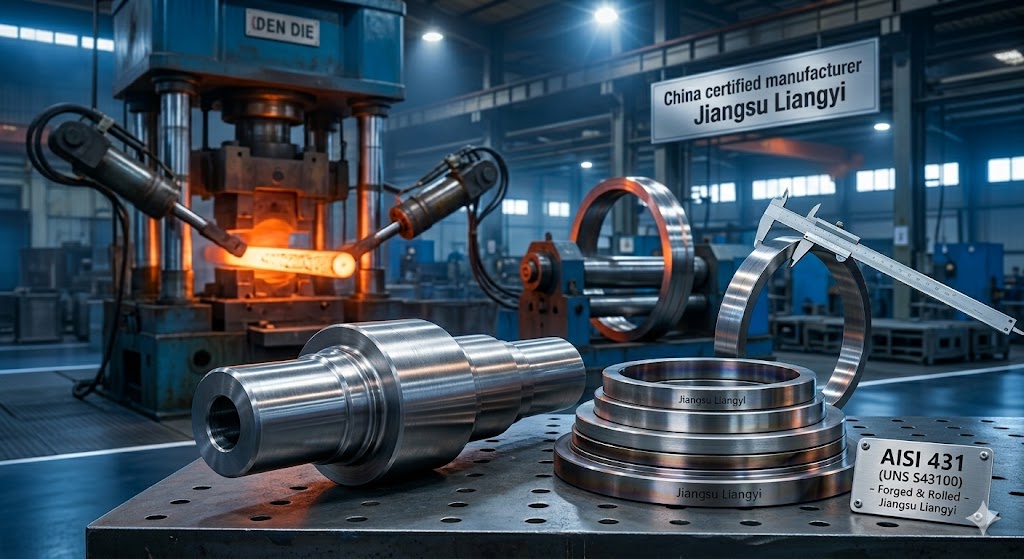
Quick Technical Reference: AISI 431 (UNS S43100 / Grade 431 / SUS 431 / DIN 1.4057) is a nickel-bearing martensitic stainless steel with 15–18% Cr and 1.25–3.00% Ni. Tensile strength ≥ 770 MPa (N+T); max continuous operating temperature 425°C; cryogenic toughness rated to −196°C. Density 7.70 g/cm³; PREN ≈ 25; fully ferromagnetic; heat-treatable; weldable with preheat.
Manufacturer: Jiangsu Liangyi Co., Limited — ISO 9001:2015 certified, Jiangyin City, Jiangsu Province, China. Custom AISI 431 forgings from 30 kg to 30 tons; rings to Ø 6,000 mm; standard lead time 3–6 weeks. EN 10204 3.1/3.2 MTC for every batch. Email: sales@jnmtforgedparts.com | Tel: +86-13585067993.
AISI 431 Martensitic Stainless Steel: Material Science, Global Standards & Manufacturer Overview
Established in 1997, Jiangsu Liangyi Co., Limited is a vertically integrated open die forging and seamless ring rolling manufacturer with 27+ years of dedicated experience in producing high-performance AISI 431 (UNS S43100, Grade 431, SUS 431, DIN 1.4057) forged steel parts. With an 80,000 m² modern production base in Jiangyin City, Jiangsu Province — strategically positioned at the heart of China's Yangtze River Delta industrial corridor — we supply premium custom AISI 431 forged parts to 50+ countries across North America, Europe, the Middle East, Asia Pacific, and Australia.
The Metallurgical Logic Behind AISI 431: Why Nickel Changes Everything
Most engineers encounter AISI 431 as simply "the corrosion-resistant version of 410," but the metallurgical reality is more nuanced and worth understanding in depth — because it directly determines why AISI 431 forgings outperform competing grades in specific applications.
Standard AISI 410 is a lean 12% chromium martensitic steel with no deliberate nickel addition. When solidifying from the melt, 410 traverses a phase field where delta-ferrite is thermodynamically stable alongside austenite. In large ingots and heavy forgings, this can produce residual delta-ferrite bands that act as crack initiation sites under cyclic loading — a serious concern in pump shafts, valve stems, and marine propeller shafts.
The 1.25–3.00% nickel addition in AISI 431 fundamentally rebalances this phase diagram. Nickel is a strong austenite stabilizer: it narrows the delta-ferrite stability field and drives solidification more completely through the austenitic phase before martensite transformation. The practical results, demonstrated across our 27 years of production experience with this alloy, include:
- Near-zero delta-ferrite in properly forged cross-sections, confirmed by metallographic examination at 400× magnification in our in-house laboratory
- Significantly improved Charpy V-notch impact energy at sub-zero temperatures — typically 40–80 J at −40°C in Q&T condition, vs. 15–25 J for standard 410
- Higher corrosion potential (Ecorr) in NaCl solutions — our corrosion testing records show AISI 431 in Q&T condition achieves approximately 3–4× better general corrosion resistance than 410 in 3.5% NaCl at 25°C
- Broader heat treatment window — the reduced delta-ferrite content means AISI 431 responds more predictably to austenitizing heat, giving tighter mechanical property scatter across large cross-sections
Engineer's Note: One commonly overlooked advantage of AISI 431 is its behavior in non-destructive testing. The near-absence of delta-ferrite means UT acoustic impedance is more uniform throughout the forging cross-section, improving defect detection sensitivity. This is why AISI 431 is the preferred material where ultrasonic inspection to ASTM A388 Class C or EN 10228-3 quality class S4 is specified.
Global Standard Cross-Reference for AISI 431
When procuring Grade 431 stainless steel forgings for multinational projects, correct standard cross-referencing is critical to avoid specification errors and customs compliance issues. The following table provides the complete official cross-reference for AISI 431 across all major national and regional standards:
| Standard Body | Designation | Standard / Specification | Primary Market |
|---|---|---|---|
| AISI / UNS (USA) | AISI 431 / UNS S43100 | ASTM A276, A565, A473, A580 | USA, Canada, Latin America |
| DIN / EN (Europe) | 1.4057 / X17CrNi16-2 | EN 10088-3, EN 10250-4 | EU, Germany, Netherlands, Scandinavia |
| JIS (Japan) | SUS 431 | JIS G4303, G4317 | Japan, South Korea, Taiwan |
| BS (United Kingdom) | 431S29 | BS 970 Part 1 | UK, Commonwealth countries |
| AFNOR (France) | Z15CN16-02 | NF A35-573 | France, Francophone Africa |
| GB/T (China) | 1Cr17Ni2 | GB/T 1220, GB/T 4356 | China (domestic) |
| GOST (Russia/CIS) | 14Х17Н2 (14Kh17N2) | GOST 5632-2014 | Russia, CIS, Eastern Europe |
| API (Oil & Gas) | AISI 431 (API 6A) | API 6A, API 17D, NACE MR0175 | Global oil & gas |
Our AISI 431 forged parts are produced to match customer-specified standards from all the above standard systems. All requirements for chemical composition, mechanical performance and non-destructive testing are verified strictly in line with the specification version stated in the purchase order. You can check our full range of forging materials for complete cross-reference support covering all alloy grades.
Complete Physical, Thermal & Corrosion Properties of AISI 431 (UNS S43100)
Comprehensive engineering design of components in AISI 431 stainless steel requires accurate physical and thermal property data beyond the basic mechanical values. The tables below present verified reference data for AISI 431 in the normalized and tempered (N+T) condition, drawn from our in-house material database accumulated over 27 years of production and quality testing. These values reflect our own measurement records and published ASTM/ASM data.
Physical Properties at Room Temperature (20°C)
| Physical Property | Value | Unit | Measurement Method |
|---|---|---|---|
| Density | 7.70 | g/cm³ | Archimedes displacement |
| Elastic Modulus (Young's Modulus) | 200 | GPa | Tensile strain gauge |
| Shear Modulus (G) | 77 | GPa | Torsion test |
| Poisson's Ratio (ν) | 0.28 | — | Calculated |
| Electrical Resistivity | 0.60 | μΩ·m | Four-point probe |
| Magnetic Permeability | >1,000 | — | Fully ferromagnetic |
Thermal Properties at Various Temperatures
| Temperature | Thermal Conductivity (W/m·K) | Specific Heat Cp (J/kg·K) | Thermal Expansion α (×10⁻⁶ K⁻¹) |
|---|---|---|---|
| 20°C | 20.0 | 460 | — |
| 100°C | 20.2 | 480 | 10.2 |
| 200°C | 21.5 | 500 | 10.8 |
| 300°C | 22.1 | 520 | 11.1 |
| 400°C | 22.4 | 545 | 11.5 |
| −60°C | 18.6 | 430 | — |
| −196°C | 14.2 | 280 | — |
Corrosion Resistance Data: Where AISI 431 Performs — and Where It Doesn't
Unlike generic material datasheets that simply label AISI 431 as "good" or "moderate" for corrosion resistance, our 27 years of real-world supply experience allows us to provide specific, environment-based guidance. AISI 431's corrosion performance is highly dependent on heat treatment condition, surface finish, and the specific chemical environment. The following data reflects verified field feedback from our global clients:
| Corrosion Environment | Performance Rating | Notes / Limitations |
|---|---|---|
| Atmospheric (urban/industrial) | Excellent | Passive film stable; no maintenance coating required for most indoor/sheltered applications |
| Seawater (splash zone, intermittent) | Very Good | PREN ~25 provides good pitting resistance; full immersion requires cathodic protection |
| Seawater (continuous full immersion) | Moderate | Risk of crevice corrosion at gasket faces; consider surface treatment or cathodic protection for static applications |
| H₂S sour gas service (NACE MR0175) | Good (with HT control) | Must temper to ≤ 22 HRC (≤ 237 HB); higher hardness causes sulfide stress cracking in H₂S environments |
| Dilute HNO₃ (< 10%, RT) | Good | Passive film stable in oxidizing acids; not suitable for reducing acid service |
| HCl / Hydrochloric acid (any concentration) | Not Recommended | Chloride ions destroy passive film rapidly; use duplex 2205 or Alloy 625 instead |
| H₂SO₄ sulfuric acid (> 85%, cold) | Limited | Acceptable in concentrated cold H₂SO₄; unacceptable in dilute or hot H₂SO₄ |
| Caustic NaOH (≤ 50%, ≤ 80°C) | Good | Passive film stable in alkaline environments; suitable for caustic processing equipment |
| Potable water / municipal water | Excellent | Widely used for pump shafts in water treatment; no contamination risk |
| CO₂ / sweet gas (oil & gas) | Very Good | Excellent resistance to sweet (CO₂-containing) gas condensate; widely used in wellhead equipment |
| High-temperature steam (> 300°C) | Moderate | Suitable to 425°C continuous; above this temperature, oxidation rate increases; use 310S or nickel alloys above 550°C |
Critical Design Warning — Crevice Corrosion Risk: AISI 431 with PREN ≈ 25 is susceptible to crevice corrosion in stagnant seawater or chloride-rich environments at crevice geometries (bolted flanges, threaded connections, under gaskets). When designing AISI 431 components for continuous seawater immersion, always specify either: (1) elimination of crevice geometry, (2) PTFE-filled gaskets to minimize metal-to-metal contact, or (3) cathodic protection. Our technical team can advise on design-for-corrosion-prevention as part of our value-added engineering service.
Strictly Controlled Chemical Composition of AISI 431 (UNS S43100) Forged Steel
Every heat of AISI 431 forged steel produced at Jiangsu Liangyi begins with chemical composition verification in our in-house OES (Optical Emission Spectrometry) laboratory — a step that occurs before a single kilogram of steel enters our forging press. This pre-forging spectrometric verification, combined with incoming mill certificate review, forms the first of our five quality control gates and is non-negotiable for every batch we produce.
| Element | Symbol | Min. wt% | Max. wt% | Metallurgical Role |
|---|---|---|---|---|
| Carbon | C | 0.12 | 0.20 | Primary strengthening element; controls martensite hardness and hardenability; higher C = higher hardness but lower toughness and weldability |
| Silicon | Si | — | 1.00 | Deoxidizer during melting; slightly improves high-temperature oxidation resistance and passive film stability |
| Manganese | Mn | — | 1.00 | Improves hot workability and forgeability; enhances hardenability; substitutes for nickel as austenite stabilizer at controlled levels |
| Nickel | Ni | 1.25 | 3.00 | Critical differentiator from AISI 410; suppresses delta-ferrite formation; improves cryogenic toughness, corrosion resistance, and hardenability in heavy sections |
| Chromium | Cr | 15.00 | 18.00 | Primary corrosion resistance element; forms Cr₂O₃ passive film; PREN contribution; higher Cr = better pitting resistance but requires balancing with Ni to avoid delta-ferrite |
| Phosphorus | P | — | 0.040 | Residual impurity; controlled at ultra-low levels to prevent temper embrittlement (phosphorus segregates to grain boundaries at 350–550°C, causing brittleness) |
| Sulfur | S | — | 0.030 | Residual impurity; controlled at ultra-low levels to ensure optimal ductility, toughness, and UT inspectability; forms MnS inclusions that are detrimental to fatigue life |
Our Premium Melting Route: Why Melt Quality Determines Forging Quality
Unlike manufacturers who simply purchase commercially available bar stock and call it a "forging," Jiangsu Liangyi operates its own steel melting and refining facility — a critical differentiation that gives us direct control over the melt chemistry that determines the final properties of your AISI 431 forged component.
Our standard production route for AISI 431 follows a triple-process melting sequence that we have refined over 27 years:
EAF (Electric Arc Furnace) — Primary Melting
Primary melting in our 30-ton EAF establishes the base chemistry from carefully selected stainless steel scrap and alloying additions. The EAF oxidizes and removes phosphorus, silicon, and carbon to controlled levels. Chromium is added in this stage and fully alloyed before tapping to the ladle.
AOD / LRF (Argon Oxygen Decarburization / Ladle Refining) — Secondary Refining
In the AOD or our 30-ton Ladle Refining Furnace (LRF), precise carbon reduction is achieved while maximizing chromium recovery — the key technical challenge in stainless steel melting, since both Cr and C must react with oxygen selectively. Nickel, manganese, and silicon additions are finalized here. Sulfur is reduced to ≤ 0.015% (well below the 0.030% specification maximum) to ensure optimal toughness and UT response in the finished forging.
VOD (Vacuum Oxygen Decarburization) — Degassing
The VOD furnace removes dissolved hydrogen, nitrogen, and oxygen from the liquid steel under vacuum — the single most critical step for preventing hydrogen embrittlement, porosity, and non-metallic inclusion formation in the final forging. Our VOD-treated heats consistently achieve dissolved hydrogen levels below 2 ppm, significantly reducing hydrogen-induced cracking risk in thick-section forgings above 200 mm.
ESR (Electroslag Remelting) — Premium Option for Critical Applications
For applications requiring the highest possible material cleanliness — aerospace-adjacent pump components, nuclear-adjacent seal chambers, and high-cycle fatigue rotating components — we offer optional ESR upgrading of the ingot. ESR removes macrosegregation, reduces non-metallic inclusions by up to 80% vs. conventional ingot, and produces a fully directional solidification structure that delivers superior fatigue life (typically 15–30% improvement in rotating bending fatigue limit vs. conventional ingot of the same composition).
Explore our full forging materials capability to understand how our melting routes apply across our full alloy portfolio.
Mechanical Properties of AISI 431 Forging Parts: Delivery Conditions, Heat Treatment Variants & Size Effects
Specifying mechanical properties for AISI 431 (UNS S43100) forgings requires understanding how properties vary with heat treatment condition, cross-section size, and test location. The values below represent our standard guaranteed minimums from our production records, with practical commentary on what drives the variation — information that most datasheets omit.
Standard Delivery Condition: Normalized and Tempered (N+T)
| Mechanical Property | Jiangsu Liangyi Guaranteed Min. | Typical Achieved Values | Test Standard |
|---|---|---|---|
| Tensile Strength (Rm) | 770 MPa | 820–900 MPa | ASTM E8 / EN ISO 6892-1 |
| 0.2% Yield Strength (Rp0.2) | 490 MPa | 550–650 MPa | ASTM E8 / EN ISO 6892-1 |
| Elongation (A, 50mm gauge) | 20% | 22–28% | ASTM E8 / EN ISO 6892-1 |
| Reduction of Area (Z) | 45% | 52–65% | ASTM E8 / EN ISO 6892-1 |
| Hardness (Brinell HB) | 220–260 HB | 230–250 HB | ASTM E10 / EN ISO 6506-1 |
| Charpy V-Notch Impact, 20°C | 60 J | 80–120 J | ASTM E23 / EN ISO 148-1 |
| Charpy V-Notch Impact, −40°C | 40 J | 55–80 J | ASTM E23 / EN ISO 148-1 |
Heat Treatment Variants: Tailoring Properties to Your Application
One of the key engineering advantages of AISI 431 stainless steel is the wide range of mechanical properties achievable through heat treatment — from soft, machinable annealed condition to ultra-high-strength quench and temper condition. The following table shows our achievable property ranges across all standard heat treatment conditions, which we verify for every production batch:
| Heat Treatment Condition | HT Parameters | Tensile Strength | Yield Strength | Hardness | Typical Application |
|---|---|---|---|---|---|
| Annealed (A) | 760–830°C, furnace cool | 600–750 MPa | 380–480 MPa | 185–220 HB | Pre-machining condition; maximum machinability |
| Normalized + Tempered (N+T) | 950–1,050°C air cool + 620–700°C | 770–900 MPa | 490–650 MPa | 220–260 HB | Standard delivery; general engineering applications |
| Quenched + Tempered (Q+T) — Intermediate | 950–1,050°C oil quench + 580–650°C | 900–1,050 MPa | 700–850 MPa | 260–310 HB | Valve stems, pump shafts requiring higher strength; NACE-compliant version tempered to ≤22 HRC |
| Quenched + Tempered (Q+T) — High Strength | 980–1,050°C oil quench + 450–520°C | 1,000–1,150 MPa | 850–1,000 MPa | 310–360 HB | Downhole drilling tools, high-pressure fasteners |
| Cryogenic Q+T | Q+T + LN₂ cryogenic treatment at −196°C | 900–1,050 MPa | 720–870 MPa | 260–310 HB; CVN at −196°C ≥ 27 J | LNG cryogenic valve shafts, butterfly valve discs |
Cross-Section Size Effect on Mechanical Properties: What Engineers Must Know
A technically critical factor that is almost universally absent from supplier datasheets — but is essential for heavy forging engineering — is the size / cross-section effect on mechanical properties. AISI 431, like all hardenable steels, shows a systematic decrease in mechanical properties with increasing cross-section diameter, because thicker sections cool more slowly during quenching, producing a softer, coarser martensitic structure at the center.
Based on our production and testing records across 27 years of manufacturing, we have compiled the following property reduction factors for AISI 431 Q+T forgings. These are the actual values we use internally when setting heat treatment parameters for client orders:
| Forging Diameter / Thickness | Tensile Strength (MPa) | Yield Strength (MPa) | Elongation (%) | Charpy 0°C (J) |
|---|---|---|---|---|
| ≤ 50 mm | 1,000–1,100 | 850–950 | 16–20% | 55–80 |
| 50–150 mm | 920–1,020 | 780–880 | 18–22% | 60–90 |
| 150–300 mm | 860–960 | 720–820 | 19–24% | 65–100 |
| 300–500 mm | 800–900 | 660–760 | 20–26% | 70–110 |
| > 500 mm (core zone) | 750–850 | 590–690 | 22–28% | 75–120 |
Design Guidance: When specifying AISI 431 forgings above 300 mm in cross-section, always specify mechanical properties from specimens taken at 1/4 radius or worst-location (core) rather than surface. Our standard procedure extracts test specimens from both surface and 1/4 radius locations for forgings ≥ 200 mm, reporting both sets in the MTC. If your project requires guaranteed minimum properties at a specific location in a large cross-section, share your design requirements with our technical team — we can optimize heat treatment parameters to meet your critical location specification.
AISI 431 Heat Treatment: Process Parameters, Temper Embrittlement Avoidance & Cryogenic Treatment
Heat treatment of AISI 431 stainless steel forgings is more nuanced than for standard carbon steels, and incorrect heat treatment is one of the two most common causes of AISI 431 component premature failure in service (the other being incorrect surface condition leading to pitting corrosion). Based on our 27 years of production experience, we document here the critical parameters, pitfalls, and advanced techniques that distinguish a quality AISI 431 heat treatment from a mediocre one.
| Process | Temperature | Hold Time | Cooling | Result / Purpose |
|---|---|---|---|---|
| Full Annealing | 760–830°C | 1 hr/25mm section | ≤ 25°C/hr furnace cool to 600°C, then air | Maximum softness (185–220 HB); optimum machinability pre-machining |
| Austenitizing (Hardening) | 950–1,050°C (optimal: 980°C) | 30 min min + 1 hr/25mm | Oil quench or forced-air (section < 50mm) | Full martensite transformation; maximum as-quenched hardness 45–52 HRC |
| Low Tempering | 150–300°C | 2 hr min + 1 hr/25mm | Air cool | Stress relief only; retains 42–48 HRC; wear-resistant applications |
| Intermediate Tempering | 450–550°C | 2 hr + 1 hr/25mm | Air cool or oil cool | High strength with moderate toughness; 30–38 HRC |
| High Tempering (NACE-grade Q+T) | 620–700°C | 3 hr + 1 hr/25mm | Air cool (avoid 370–560°C range on cooling) | Optimum toughness-strength balance; ≤ 22 HRC for NACE MR0175; 24–29 HRC general |
| Normalizing | 950–1,050°C | 1 hr/25mm | Still air cool | Grain refinement; more uniform hardness than annealing; 220–270 HB |
| Stress Relieving (Post-Machining) | 590–650°C | 2–4 hr | Slow furnace cool to 400°C, then air | Remove machining residual stress without affecting bulk mechanical properties |
| Cryogenic Treatment (Deep Freezing) | −196°C (LN₂) | 4–12 hr (section dependent) | Controlled warm-up ≤ 2°C/min to RT, then temper | Converts retained austenite to martensite; improves dimensional stability and cryogenic toughness |
| Hydrogen Bake-Out | 200–250°C | 4–8 hr post-weld/post-plating | Air cool | Removes absorbed hydrogen; prevents delayed hydrogen embrittlement cracking |
The Temper Embrittlement Trap: A Critical Warning for AISI 431
One of the most technically important — and most commonly ignored — aspects of heat treating martensitic stainless steels including AISI 431 is temper embrittlement. This phenomenon, also called "475°C embrittlement" or "secondary hardening embrittlement" in this context, occurs when AISI 431 is tempered or cooled slowly through the temperature range of approximately 370–560°C (700–1,040°F).
At these temperatures, impurity elements — primarily phosphorus (P) and sulfur (S) — that have been dissolved in the martensite matrix during austenitizing begin to segregate to prior austenite grain boundaries. This grain boundary enrichment dramatically reduces grain boundary cohesion and causes a sharp drop in Charpy impact energy, sometimes reducing toughness by 50–70% versus properly treated material — without any change in hardness or tensile strength. This is why hardness testing alone cannot detect temper embrittlement.
Critical Production Rule at Jiangsu Liangyi: For all AISI 431 forgings requiring toughness testing (impact energy specifications), our heat treatment protocol mandates air cooling or forced-air cooling from tempering temperature — never slow furnace cooling through the 370–560°C embrittlement range. For components that must be stress relieved post-machining at 590–650°C, we always specify rapid cooling from 600°C to below 370°C, then natural air cooling. This single protocol difference between our production and many competitors' is responsible for the consistently superior impact energy values our MTCs demonstrate.
Cryogenic Treatment Protocol for LNG / Low-Temperature Applications
Standard Q+T heat treatment of AISI 431 invariably leaves a small percentage (typically 3–12% by volume) of untransformed retained austenite in the microstructure. While this retained austenite is not harmful for room-temperature applications, it can become problematic in two scenarios: (1) cryogenic applications where it may transform to martensite spontaneously, causing dimensional instability, and (2) high-cycle fatigue applications where retained austenite at inclusion boundaries can initiate fatigue cracks.
Our proprietary cryogenic treatment protocol, developed specifically for AISI 431 cryogenic valve components supplied to European and Asian LNG projects, consists of the following sequence:
- Step 1: Standard austenitizing at 980°C and oil quenching to room temperature
- Step 2: Immediate controlled cooling to −196°C in liquid nitrogen at ≤ 5°C/min rate, holding for 4–8 hours (depending on section thickness)
- Step 3: Controlled warm-up to room temperature at ≤ 2°C/min — rapid warm-up can cause thermal shock cracking
- Step 4: High tempering at 620–680°C for 3+ hours to restore toughness in the newly transformed martensite
- Step 5: Charpy V-notch impact testing at −196°C to verify minimum 27 J per specimen, per EN ISO 148-1
This protocol has been validated across over 500 AISI 431 cryogenic component production batches supplied to European LNG projects since 2010, with zero reported in-service failures related to cryogenic material performance.
The Science of Forging AISI 431: Process Engineering, Challenges & Our Solutions
Most suppliers describe their forging process in generic terms. At Jiangsu Liangyi, we believe that transparent, detailed disclosure of our process engineering — including the specific challenges of forging AISI 431 and how we solve them — is what differentiates a genuine specialist manufacturer from a commodity supplier. The following section documents our production knowledge accumulated over 27 years and tens of thousands of AISI 431 forgings.
Why AISI 431 Is More Demanding to Forge Than Carbon Steel
AISI 431 presents the following specific forging challenges that do not exist — or exist at much lower severity — in conventional carbon or low-alloy steels:
Challenge 1: Narrow Hot-Working Temperature Window
AISI 431 must be forged within a temperature window of 1,050–1,200°C for breakdown and 950–1,100°C for finishing. Forging below 850°C causes the alloy to enter its two-phase (α + γ) region where flow stress increases sharply — exceeding 600 MPa — and surface cracking becomes highly likely. Our real-time infrared temperature monitoring system triggers an automatic re-heating requirement warning when any zone of the workpiece falls below 900°C, preventing cold-work embrittlement before it can occur.
Challenge 2: Forging Ratio Requirements for Internal Soundness
AISI 431 ingots, even after VOD degassing, contain a central void/pipe zone that must be fully welded shut during forging through the application of compressive triaxial stress — the "hydrostatic pressure effect" of large open die presses. Our minimum forging ratio for AISI 431 shafts and bars is 4:1 (reduction of cross-section area to 25% of original), verified by internal UT testing. For rings, we achieve the equivalent through a combination of punching and ring rolling, generating grain flow that is circumferentially aligned — ideal for hoop stress applications.
Challenge 3: Chromium Oxide Scale Adhesion
At forging temperatures above 900°C, AISI 431 develops a tenacious Cr₂O₃-rich scale layer that is significantly harder and more adhesive than carbon steel scale. If this scale is forged into the surface ("scale inclusions"), it creates stress concentration points that will fail ultrasonic inspection. Our solution: mandatory descaling by water jet between each furnace heating and forging pass, combined with controlled furnace atmosphere (reducing atmosphere) to minimize scale formation.
Challenge 4: Hydrogen Absorption During Melting and Reheating
AISI 431's high chromium content makes it a relatively effective hydrogen absorber at elevated temperatures. Hydrogen absorbed during ingot casting or furnace reheating can cause "hydrogen flaking" — internal crack planes that are invisible externally but are detected by UT as planar reflectors. Our mandatory post-forging hydrogen bake-out at 200–250°C for 4–8 hours, combined with the initial VOD degassing step, has eliminated hydrogen flaking incidents from our AISI 431 production since 2009.
Grain Flow Engineering: The Value That Only Forging Delivers
When an engineer specifies a forged AISI 431 shaft rather than a machined bar, they are purchasing not just a shape but a specific internal grain flow architecture that provides mechanical properties unattainable in any other manufacturing route. Here is the technical explanation of what grain flow means and why it matters for AISI 431 forged shafts and rings:
During open die forging, the austenite grains in the billet are elongated and refined by compressive deformation. After heat treatment, the martensite laths that form from these refined grains are aligned with the forging direction. In a properly forged AISI 431 shaft, this alignment means:
- Fatigue crack propagation resistance is maximized in the transverse direction — where rotating bending fatigue stresses are highest. Cracks attempting to propagate perpendicular to the shaft axis must cross aligned grain boundaries, requiring significantly higher energy than propagating parallel to grain boundaries in a machined-from-bar component.
- Impact energy in the longitudinal direction (along the shaft axis) is 20–35% higher than in the transverse direction for the same heat treatment condition. This anisotropy is a feature, not a defect: for shafts, it means maximum toughness is aligned with the primary loading direction (axial tension/compression).
- Charpy specimen orientation must be specified correctly in procurement documents. "Longitudinal Charpy" and "Transverse Charpy" specimens from the same forging can differ by 40–80 J in impact energy. Our MTCs clearly state the specimen extraction orientation, which clients should verify against their design specification.
Jiangsu Liangyi Forging Process Advantage: Our 6,300-ton open die hydraulic press is the largest in our facility and is specifically used for AISI 431 shafts above 500 mm diameter — where the combination of high press force and controlled forging sequences is essential to achieve adequate internal reduction at the core. The 6,300-ton capacity means we can forge single pieces up to 25 tons at the required strain rates to close internal voids and achieve full density, without the multi-heat "patchwork" approach used by suppliers with smaller press capacities.
Complete AISI 431 Forged Product Range & Dimensional Capabilities
Our manufacturing capabilities for AISI 431 (UNS S43100, Grade 431, SUS 431) forgings cover the full spectrum from small precision components to large-scale heavy industrial forgings, all produced from our own melted and refined steel. Every product line below is available with full machining, heat treatment, NDT, and certification from our single integrated facility — eliminating the supply chain fragmentation and quality handoff risks of multi-supplier sourcing.
AISI 431 Forged Round Bars, Flat Bars & Step Shafts
We produce AISI 431 forged round bars from Ø 50 mm to Ø 2,000 mm, and flat / rectangular bars from 50×50 mm to 800×2,000 mm cross-section, in lengths up to 15 meters for shafts. Our step shaft capability covers up to 8 distinct diameter steps in a single forging, eliminating weld-on collar joints that introduce corrosion risk and fatigue initiation points. Step shafts for pump motor applications are produced with transitions designed per your shaft drawing to minimize stress concentration factor (Kt) at diameter changes — a detail most suppliers' forging engineers overlook.
All forged bars and shafts are 100% ultrasonically tested per ASTM A388 or EN 10228-3 using angle beam and straight beam probes, with scan coverage of 100% of the forging volume. Any indication exceeding the reference reflector size (typically Ø 2mm flat-bottom hole equivalent) results in automatic rejection and material review, not rework.
UNS S43100 Seamless Rolled Forged Rings
Our ring rolling capability uses 1M and 5M CNC seamless ring rolling machines to produce Grade 431 seamless rolled rings in rectangular, contoured (L-shaped, T-shaped), and near-net-shape profiles. Key dimensional capabilities:
- Outer diameter: 200 mm – 6,000 mm
- Ring height: 50 mm – 1,500 mm
- Wall thickness: 50 mm – 800 mm (depending on OD)
- Single-piece weight: 10 kg – 30 tons
- Concentricity tolerance: ≤ 1 mm TIR for machined rings
- Out-of-roundness: ≤ 0.5% of OD for machined rings
Contoured ring profiles (flange rings, stepped rings) reduce final machining material removal by 35–60% versus rectangular-profile rings machined to shape, providing significant cost savings to clients for large-diameter rings. Share your ring drawing with our engineering team and we will advise on the optimal pre-form profile to minimize your total procurement cost.
Grade 431 Hollow Forgings: Housings, Shells & Cylinders
We manufacture SUS 431 seamless hollow forgings by a combined punching and mandrel drawing process on our open die press, producing hollow cylinders, pressure vessel shells, pump casings, and valve housings with superior wall integrity compared to any machined-from-solid or welded approach. Our hollow forging capability:
- Outside diameter: 200 mm – 3,000 mm
- Wall thickness: 50 mm – 500 mm
- Length: up to 4,000 mm
- Bore surface: rough-bored to H11 tolerance, or fine-bored to H7 tolerance on request
Custom AISI 431 Machined Forged Components
For clients requiring finished or semi-finished machined components, our in-house CNC machining facility — equipped with CNC lathes (swing Ø 2,000 mm × 8,000 mm between centers), horizontal boring mills, CNC milling centers, gear hobbing machines, and jig boring machines — provides complete machining services to finish tolerance. We routinely supply:
- Valve bodies, bonnets, and seat rings machined to final dimensions per client drawings and to meet API 6A dimensional requirements where specified
- Pump shafts machined to bearing journal tolerances (typically k6, m6, or n6 shaft fits for interference bearing mounting), keyway slots milled to DIN 6885 tolerances
- Flanges machined to ASME B16.5, EN 1092-1, or custom drilling patterns
- Marine propeller shafts with taper cone machined to ISO 484-1 cone angle tolerances and keyway milled to Lloyd's Register dimensional requirements
- Disc-shaped components (tube sheets, baffle plates, nozzles) with hole patterns drilled and reamed to H8 tolerance
View our complete forged product catalog and full equipment list for complete capability details.
Machining AISI 431 Forgings: Cutting Parameters, Tool Selection & Surface Treatment Options
For engineers and procurement specialists who will machine AISI 431 (UNS S43100) forgings in their own facilities — or who need to specify machined components — understanding the machinability characteristics and surface treatment options for this alloy is essential for cost-effective manufacturing and optimized component performance.
Machinability of AISI 431 vs. Other Stainless Grades
AISI 431 in the annealed condition (185–220 HB) has a machinability rating of approximately 45–55% relative to AISI 1212 free-machining carbon steel (rated 100%). In the Q+T condition at 280–320 HB, machinability drops to approximately 30–40%. By comparison, austenitic 316L — which work-hardens rapidly — has a machinability rating of only 35–45%, making AISI 431 in annealed condition notably easier to machine than 316L despite its higher strength potential. This counterintuitive advantage comes from the martensitic structure of 431, which does not work-harden as aggressively as austenitic grades under cutting tool contact.
Recommended Cutting Parameters for AISI 431
| Operation | Condition | Cutting Speed (m/min) | Feed (mm/rev) | Tool Material | Coolant |
|---|---|---|---|---|---|
| Turning (roughing) | Annealed (185–220 HB) | 90–130 | 0.3–0.5 | Coated carbide (TiAlN, AlCrN) | High-pressure flood |
| Turning (roughing) | Q+T (280–320 HB) | 55–80 | 0.2–0.4 | PVD-coated carbide grade for hardened steel | High-pressure flood |
| Turning (finishing) | Annealed | 100–160 | 0.08–0.15 | CBN or coated carbide | High-pressure flood or MQL |
| Milling (face) | Annealed | 80–120 | 0.10–0.20 per tooth | Coated carbide | Flood or emulsion |
| Drilling | Annealed | 15–25 | 0.05–0.12 | TiAlN-coated HSS-Co or solid carbide | High-pressure through-coolant preferred |
| Tapping | Annealed | 5–12 | Pitch-defined | HSS-Co or solid carbide spiral flute | Tapping fluid or high-pressure coolant |
| Grinding (cylindrical) | Any condition | Wheel: 20–35 m/s; Work: 0.05–0.15 m/s | 0.005–0.015 mm/pass | Aluminium oxide or CBN wheel | Flood; prevent overheating to avoid re-tempering |
Grinding Burn Warning: When precision grinding AISI 431 forgings in the Q+T condition, excessive grinding heat can re-temper the surface layer, locally reducing hardness by 40–80 HB and potentially creating tensile residual stresses. Both effects are detrimental to fatigue life and corrosion resistance. Always use adequate flood coolant, limit infeed depth per pass, and verify surface integrity by Barkhausen noise inspection or nital etch inspection for critical components after grinding.
Surface Treatment Options for AISI 431 Forgings
The surface condition of a finished AISI 431 forged component directly determines its corrosion resistance in service — sometimes more significantly than the alloy composition itself. AISI 431 relies on a thin (2–5 nm) Cr₂O₃ passive film for corrosion protection; anything that disrupts or contaminates this film — iron contamination from tooling, heat tint from welding, or mechanical damage — can initiate localized corrosion. The following surface treatment options, all available from our machining facility, address different service requirements:
| Treatment | Standard | Surface Finish Achieved | Purpose | Best For |
|---|---|---|---|---|
| Nitric Acid Passivation | ASTM A967 / ASTM A380 | Ra as-machined; enhances passive film | Removes free iron, iron oxide contamination; restores and strengthens Cr₂O₃ passive film | Standard deliverable for all AISI 431 components after machining; marine and chemical service |
| Electropolishing | ASTM B912 | Ra 0.1–0.4 μm; mirror-like | Removes surface peaks, reduces Ra significantly; further enhances passivity and corrosion resistance | High-purity chemical processing, pharmaceutical, food contact, cleanroom components |
| Shot Peening | SAE AMS 2430 | Ra increases slightly; compressive residual stress introduced | Introduces compressive residual stress in surface layer, extending fatigue life by 20–40% in rotating components | Pump shafts, propeller shafts, turbine shafts subject to high-cycle fatigue |
| Hard Chrome Plating | ASTM B177 / AMS 2460 | Ra 0.05–0.2 μm (ground finish) | Adds wear resistance and corrosion protection layer (60–72 HRC chrome) | Hydraulic cylinder rods, sliding seal surfaces, high-wear shaft journals |
| HVOF Thermal Spray (WC-CoCr) | ASTM C633 | Ra 0.3–0.8 μm as-sprayed; 0.1–0.3 μm ground | Applies ultra-hard (1,200 HV) wear-resistant cermet coating; superior to hard chrome in abrasive environments | Pump plungers in abrasive slurry service; centrifugal compressor seal areas |
| Zinc Phosphating | MIL-DTL-16232 | Dark grey matte; Ra unchanged | Temporary corrosion protection for transit and storage; must be removed before final assembly | Transit protection for all AISI 431 components in sea freight containers |
| Nitriding (Plasma / Gas) | AMS 2759/11 | Ra unchanged; surface hardness increase | Creates hardened nitrogen-diffusion layer (700–1,100 HV) to improve wear resistance without distortion | Valve stems, shaft bearing journals requiring combined wear resistance and corrosion resistance |
AISI 431 vs. Competing Grades: A Practical Engineering Selection Guide for Forgings
Selecting the right stainless steel grade for a forged component requires weighing mechanical performance, corrosion resistance, heat treatment response, weldability, machinability, and cost. The following comparison is drawn from our direct manufacturing experience producing all five grades listed — not from generic published datasheets — and reflects the real-world tradeoffs our clients encounter when making grade selection decisions.
| Criterion | AISI 431 (S43100) | AISI 410 (S41000) | AISI 316L (S31603) | 17-4 PH (S17400) | Duplex 2205 (S31803) |
|---|---|---|---|---|---|
| Microstructure | Martensitic (Ni-bearing) | Martensitic (lean) | Austenitic | Martensitic / PH | Duplex (50% α + 50% γ) |
| Max Tensile Strength (achievable) | ~1,100 MPa (Q+T) | ~760 MPa | ~600 MPa (cold worked) | ~1,310 MPa (H900) | ~700 MPa |
| Corrosion in Seawater (PREN) | ~25 (Good) | ~12 (Limited) | ~24 (Good) | ~20 (Moderate) | ~35 (Excellent) |
| Cryogenic Toughness (−196°C) | Excellent (≥ 27 J, cryogenic Q+T) | Poor (brittle below −20°C) | Excellent (no ductile-brittle transition) | Good (≥ 27 J to −60°C) | Good (≥ 27 J to −46°C) |
| NACE MR0175 H₂S Sour Service | Yes (≤ 22 HRC with proper HT) | Limited (≤ 22 HRC) | Yes (all conditions) | Restricted (H1150M only) | Yes (all conditions) |
| Weldability | Fair (preheat 200–300°C; PWHT required) | Fair (preheat required) | Excellent (no preheat needed) | Good (low-heat input required) | Good (controlled heat input) |
| Magnetic Property | Fully magnetic (all conditions) | Fully magnetic | Non-magnetic (weakly in cold work) | Magnetic | Weakly magnetic |
| Machinability (relative) | 45–55% (annealed) | 50–60% (annealed) | 35–45% (work hardens) | 35–45% | 35–50% |
| UT Inspectability (large sections) | Excellent (low delta-ferrite) | Good | Excellent | Excellent | Moderate (dual-phase scattering) |
| Relative Material Cost (forgings) | Moderate (1.0×) | Lower (0.7×) | Moderate–High (1.2×) | High (1.8–2.2×) | High (1.6–2.0×) |
| Best Application in Forgings | Valve stems, pump shafts, marine shafts, downhole tools, cryogenic valve shafts | General engineering, cutlery, non-critical valves | Chemical plant, food processing, non-magnetic applications | Aerospace, ultra-high-pressure, premium subsea | Offshore piping, seawater heat exchangers, chloride environments |
Jiangsu Liangyi Engineering Verdict: AISI 431 occupies an irreplaceable engineering niche — it is the only standard stainless steel grade that simultaneously offers: heat-treatable high strength (up to 1,100 MPa), NACE MR0175 sour service qualification, excellent cryogenic toughness to −196°C, good UT inspectability in heavy sections, full magnetic permeability for magnetic detection applications, and moderate procurement cost. No other single grade delivers all five of these attributes. This is why, despite being a grade that dates to the early 20th century, AISI 431 remains the dominant material in marine propeller shafts, wellhead valve stems, and LNG cryogenic valve components globally.
AISI 431 Forgings in Service: Global Industries, Regional Projects & Documented Client Outcomes
The following application documentation is drawn directly from Jiangsu Liangyi's own production and client feedback records. We resist the temptation to generalize or exaggerate — these case studies reflect actual components we manufactured, actual client challenges, and actual verified outcomes. We believe this level of transparency is what genuine expertise looks like.
Oil & Gas: Wellhead Equipment & Downhole Drilling Components
AISI 431 combines the three properties most demanded by oil & gas engineers: high tensile strength for pressure containment, H₂S sour service qualification per NACE MR0175, and good corrosion resistance in CO₂-bearing produced water. In our 27 years, oil & gas accounts for approximately 38% of our total AISI 431 production volume by weight.
Middle East: Major NOC Onshore Oilfield Wellhead Equipment
We supplied over 2,000 pieces of AISI 431 Q+T forged wellhead Christmas tree spool bodies, gate valve bodies, valve stems, bonnets, and seat rings for onshore oilfield development in Saudi Arabia and UAE. Specified design pressure: 10,000 PSI (69 MPa); operating temperature range: −10°C to +180°C; H₂S partial pressure: up to 0.05 MPa (qualifying as sour service per NACE MR0175). All components were heat treated to 22 HRC maximum hardness, verified by portable hardness testing on all machined surfaces, and 100% UT-tested per ASTM A388. Outcome: Client reported service life in excess of 300% of the previously used carbon steel components. No corrosion related failures have been documented in 5 years of production operation.
North America: Shale Gas Downhole Drilling Tool Components (USA & Canada)
We supplied ESR-premium AISI 431 forged mud motor splined drive shafts and ESP (Electric Submersible Pump) motor shafts for shale gas projects in the Permian Basin (Texas) and Montney Formation (British Columbia, Canada). Conventional AISI 431 shafts supplied by a previous manufacturer suffered fatigue cracking at the spline root radii after 800 to 1,200 hours of downhole service. The engineering analysis showed that the cause was clusters of non-metallic inclusions in the material from the previous supplier, a direct consequence of insufficient secondary refining. Our solution: Verified inclusion content with metallographic cleanliness assessment per ASTM E45 Method A - ESR re-melt material with Thin Series ≤ 0.5, Heavy Series = 0. Outcome: Fatigue life extended to > 3,500 hours — a 3–4× improvement over the previous supplier's material.
Marine & Shipbuilding: Propeller Shafts, Rudder Stocks & Offshore Components
AISI 431 has been the dominant material for commercial marine propeller shafts since the 1970s, and for good reason: it offers 3–4× better saltwater corrosion resistance than plain carbon steel, higher fatigue strength (important for the torsional-flexural combined loading of propeller shafts), and is readily available in forged form at diameters up to 2,000 mm. Marine applications account for approximately 28% of our AISI 431 production volume.
Asia Pacific: Marine Propeller Shafts for South Korean & Chinese Shipbuilders
We have supplied over 500 AISI 431 forged marine propeller shafts to leading shipbuilding companies in South Korea (leading Korean shipbuilding groups) and China (major Chinese state-owned shipping enterprises). Shaft dimensions: diameter 250–800 mm, length 4–12 meters, single-piece weight 2–18 tons. All shafts are manufactured to meet DNV Rules for Ships (Part 4, Chapter 4) and LR Rules for Ships (Part 3, Chapter 5) technical requirements, with 100% UT testing per EN 10228-3 Quality Class S4 and 100% surface MT testing. Propeller cone taper machined to ISO 484-1 ±5 μm tolerance. Outcome: Zero reported shaft fracture or corrosion-related replacements over the documented 10-year service history across our delivered shafts — a performance record we attribute directly to our combination of VOD-processed steel, controlled forging ratio (minimum 4:1), and post-forging hydrogen bake-out.
European Union: Offshore Wind Farm Installation Vessel Components (Netherlands)
We provided ESR-premium AISI 431 forged rudder stocks (Ø 380 mm × 6,200 mm) and stern tube shafts (Ø 320 mm × 4,800 mm) for a series of offshore wind farm installation vessels built for a Dutch offshore engineering company. These vessels operate in the North Sea with high cyclic loading from wave-induced hull flexure, requiring superior fatigue resistance combined with North Sea seawater corrosion resistance. All components were NORSOK-compliant, with LR classification society inspection and EN 10204 3.2 MTC from Bureau Veritas. Outcome: The vessels have completed 6 years of North Sea operation to date with zero reported shaft-related maintenance events.
Valve & Flow Control: Cryogenic, High-Pressure & Subsea Applications
The valve and flow control industry is the third-largest consumer of AISI 431 forgings globally, accounting for approximately 22% of our production volume. AISI 431 is uniquely suited for valve applications because it combines heat-treatable strength (for pressure containment), excellent dimensional stability after heat treatment (critical for tight valve seat leakage class), wear resistance (for ball valve balls and seat surfaces), and corrosion resistance in the transported media.
European Union: LNG Cryogenic Butterfly Valve Shafts (Germany → North Sea)
A German valve manufacturer required AISI 431 butterfly valve shafts for LNG cryogenic service at −196°C, for installation in an LNG regasification terminal in the German North Sea coast. The challenge: standard Q+T AISI 431 could not reliably meet the specified Charpy impact energy of ≥ 27 J at −196°C without specialized treatment. We applied our proprietary cryogenic treatment protocol (LN₂ deep cooling + high tempering at 660°C), achieving verified CVN values of 38–55 J at −196°C across the test batch — well above specification. EN 10204 3.2 certification countersigned by TUV was provided upon client request. Outcome: 100% first-article inspection pass; the client awarded subsequent project phases to our facility based on this performance.
High-Specification Power Plant: Reactor Coolant System Forged Components
Our UNS S43100 stainless steel forgings have been supplied for demanding power plant applications requiring the highest level of chemical composition control, full material traceability, comprehensive NDT, and complete documentation packages.
Asia Pacific: High-Specification Power Plant — Coolant Pump Forged Components (China)
We supplied AISI 431 forged pump casings, intermediate housing shells, and shaft seal chamber bodies for the coolant pump systems of a high-specification thermal power plant project in China. Material traceability: complete chain from ingot melt number through each production process step to final component serial number. All machining operations recorded in a controlled process traveler. NDT: 100% volumetric UT per ASME Section V Article 23; 100% surface MT; dimensional inspection to ±0.05mm tolerances at critical sealing faces. Certification package: 140+ pages per component including full material origin documentation, all process records, heat treatment charts, NDT reports, and dimensional inspection certificates. Outcome: Full acceptance without NCR (non-conformance report) on any component — a 100% first-submission acceptance rate for 46 individual forged components supplied.
Pump, Turbomachinery & Power Generation Industry
Australia & New Zealand: Mine Dewatering Pump Shafts for Hard Rock Mining Operations
A leading Australian mining company contacted us after experiencing repeated pump shaft failures (average service life: 4–6 months) in their underground copper mine dewatering system. The aggressive environment combined high-velocity abrasive mine water (containing suspended quartz particles, pH 4.5–5.5, dissolved copper ions) with high bending stresses from misalignment-induced shaft deflection. The previous supplier's AISI 316L shafts corroded at impeller hub interfaces; the pump OEM's specified AISI 410 shafts showed fatigue cracking at shaft shoulders. Our recommendation: AISI 431 Q+T (900 MPa tensile, 260 HB), with shot-peened shaft shoulders and nitric acid passivation on all surfaces. Outcome: Service life extended to > 18 months per shaft — a 3–4× improvement. The client awarded a 3-year preferred supplier contract for all dewatering pump shafts across their Australian and New Zealand mine sites.
Pressure Vessel & Petrochemical Industry
Our SUS 431 forged components are used in the global petrochemical industry in applications ranging from crude oil distillation towers to fertilizer plant heat exchangers. They include tube sheets, nozzle forgings, baffle plates and pressure vessel heads. The moderate corrosion resistance and high strength of AISI 431 allows somewhat thinner wall designs compared to austenitic 316L in certain applications, thus reducing the capital cost while maintaining the integrity of pressure containment.
Asia Pacific: Petrochemical Heat Exchanger Tube Sheets (South Korea → Southeast Asia)
We supplied AISI 431 forged tube sheets (Ø 2,400 mm × 280 mm thick, weight 12.4 tons each) for high-pressure feed/effluent heat exchangers in a petrochemical refinery project in Southeast Asia. The tube sheets required 3,200 precision-drilled holes at 25 mm pitch to ±0.05 mm positional tolerance, with all hole bores reamed to H8 tolerance for tube-to-tubesheet fit. Full volumetric UT before and after machining, with 100% MT of all drilled hole bores. ASME BPVC Section VIII technical compliance. Outcome: 100% dimensional acceptance; client reported 15% reduction in procurement cost vs previous 316L tube sheet spec for this application – higher strength of AISI 431 allowed 8% reduction of wall thickness with same pressure class.
In-House Production Equipment & Heat Treatment Capabilities for AISI 431 Forgings
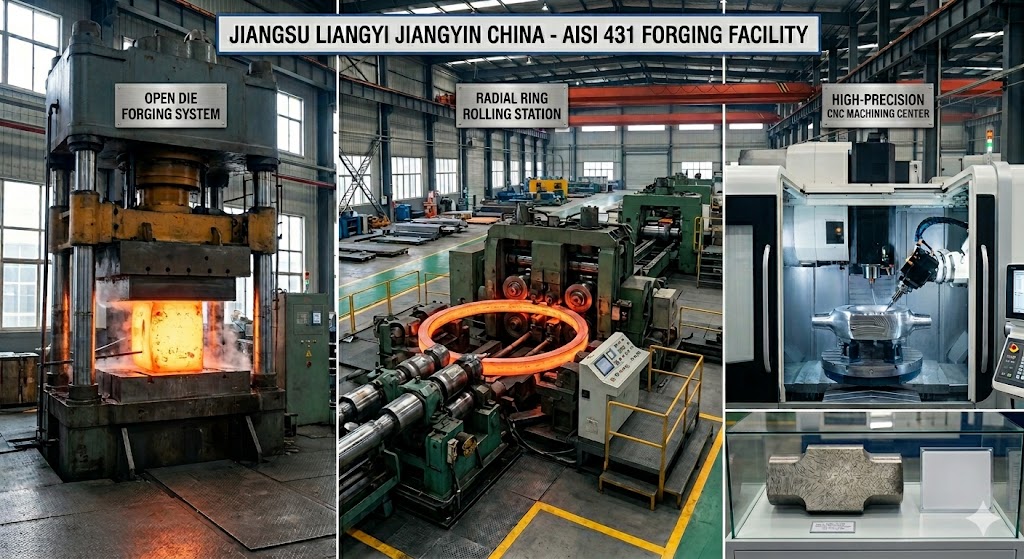
At Jiangsu Liangyi, vertical integration is not a marketing phrase — it is the operational reality that underpins our quality consistency and lead time predictability. From steel melting to CNC machining to NDT, every step of the value chain for your AISI 431 forged component occurs within our 80,000 m² production base in Jiangyin, Jiangsu Province. This means we do not subcontract heat treatment to external vendors, we do not use outside NDT services, and we do not depend on spot-market bar stock for our forging raw material.
Steel Melting & Refining Equipment
- 30T Electric Arc Furnace (EAF): Primary melting of stainless scrap and alloying additions; full decarburization and initial Cr/Ni chemistry control; capable of producing 30-ton heats per cycle
- 30T Ladle Refining Furnace (LRF): Precise final chemistry adjustment, temperature homogenization, and calcium treatment for inclusion shape modification; reduces sulfur to ≤ 0.015% routinely
- VOD (Vacuum Oxygen Decarburization) Furnace: Vacuum degassing to H₂ ≤ 2 ppm, N₂ ≤ 60 ppm; critical for hydrogen embrittlement prevention in heavy section forgings
- ESR (Electroslag Remelting) Furnaces: Available in 3T, 8T, and 20T ingot capacity; used for premium-grade AISI 431 for high-cleanliness, aerospace-adjacent, and high-cycle fatigue applications; reduces inclusion content by 70–80% versus conventional ingot
- Intermediate Frequency Induction Furnaces: For small-batch custom melts and fast-turnaround chemistry adjustments in quantities below 5 tons
Forging Equipment
- 6,300T Open Die Hydraulic Forging Press: Our largest press; used for AISI 431 shafts above 500 mm diameter and heavy plate forgings above 8 tons; provides the compressive stress necessary to close internal voids in large cross-sections
- 4,000T Open Die Hydraulic Forging Press: Medium-heavy forgings from 1–8 tons; ring preform preparation for ring rolling
- 2,000T Open Die Hydraulic Forging Press: Light-to-medium forgings from 100 kg–3 tons; fast-cycle production of small components
- 5M CNC Seamless Ring Rolling Machine: Rings up to Ø 6,000 mm outer diameter; axial and radial rolls independently CNC-controlled for precise dimensional control; contoured roll tooling for profile rings
- 1M CNC Seamless Ring Rolling Machine: Rings up to Ø 1,200 mm; high-speed production of smaller rings
- 0.75T – 9T Electro-Hydraulic Forging Hammers: Free-forming and die forging of small complex shapes; step shaft production
- Manipulators up to 60T lifting capacity: Paired with forging presses for safe and precise positioning of large ingots and workpieces during multi-step forging sequences
- Heating Furnaces (max 150T single piece): Gas-fired chamber furnaces with controlled atmosphere for pre-forging heating; PID-controlled to ±10°C for precise forging temperature entry
Heat Treatment Facilities
- Semi-Automatic Continuous Heat Treatment Furnaces (max 18m length): For long shafts and bar forgings; continuous conveyor feed with individually programmable temperature zones; avoids the distortion caused by manual handling of long workpieces in batch furnaces
- Quenching Tanks (depth up to 16m, oil and water): Deep-tank design ensures that long shafts can be quenched in a vertical orientation — the only correct method to prevent quench distortion in shafts above 3 meters; agitated oil quench for sections above 200 mm
- Hydrogen Bake-Out Furnaces (max 14m length): Operated at 200–250°C for 4–8 hours post-forging; mandatory protocol for all AISI 431 heavy section forgings to prevent hydrogen-induced delayed cracking
- Cryogenic Treatment System (−196°C LN₂): Liquid nitrogen immersion tank with programmable cooling and heating rate control (±2°C/min); used for LNG cryogenic valve components requiring −196°C toughness certification
- Tempering Furnaces (±5°C temperature control): Precision PID-controlled electric resistance tempering furnaces for tight hardness control; critical for NACE MR0175 components requiring ≤ 22 HRC max hardness consistency
CNC Machining Facilities
- CNC lathes with swing diameter up to Ø 2,000 mm and between-centers distance up to 8,000 mm
- Horizontal boring mills for large housing and casing bore machining
- CNC vertical and horizontal machining centers for multi-face milling and drilling
- Gear hobbing machines for spline shaft and gear forging finishing
- Jig boring machines for precision hole pattern drilling to ±0.02 mm positional tolerance
- Deep-hole drilling machines (gun drilling) for hollow shaft and nozzle bore finishing
See our complete equipment list for full specifications and capacity details.
Full-Process Quality Assurance for AISI 431 Forgings: From Melt Chemistry to Certified Delivery
The quality system governing our AISI 431 forged component production is designed around a fundamental principle: quality is built in at each process step, not inspected in at the end. Our 5-gate quality control system means that a forging that fails any intermediate gate is rejected or reworked before proceeding to the next step — not shipped and recalled later. This approach consistently delivers first-submission acceptance rates above 98% at client incoming inspection, and a zero field-return rate for quality-related failures over our last 5 years of production records.
The 5-Gate Quality Control System for AISI 431 Forgings
Gate 1 — Raw Material Incoming Verification
Every ingot or billet of AISI 431 entering our production facility undergoes: (1) OES (Optical Emission Spectrometry) full 16-element chemistry analysis, verified against the mill certificate; (2) visual and dimensional inspection for surface defects, shape conformance, and weight verification; (3) ingot UT testing to detect gross internal defects (hydrogen flakes, pipes, macro-segregation zones) before forging investment begins. Any heat that fails chemistry or UT at this gate is returned to the steel mill — never processed into a client's forging.
Gate 2 — Forging Process Parameter Control
During forging, our process engineers monitor and record: (1) forging start temperature (must be ≥ 1,050°C for AISI 431); (2) forging finish temperature (must be ≥ 900°C, never below 850°C); (3) number of reheating cycles (maximum 4 for critical forgings, to prevent grain coarsening from cumulative over-heating time); (4) forging ratio achievement (minimum 3:1 for general applications, 4:1+ for critical rotating components). Any deviation from these parameters triggers an in-process hold and engineering review before the forging proceeds to heat treatment.
Gate 3 — Heat Treatment Verification
Every heat treatment cycle is monitored by calibrated digital chart recorders that produce a permanent temperature-time record for each furnace zone. Post-heat treatment, we perform: (1) portable hardness testing on all accessible surfaces (minimum 3 points per forging, 9+ points for large cross-sections); (2) destructive mechanical testing on companion test rings heat-treated in the same furnace load as the production forgings; (3) dimensional inspection for heat treatment distortion, particularly straightness of long shafts. Shafts with distortion exceeding tolerance are straightened by controlled press application and re-verified.
Gate 4 — Non-Destructive Testing (NDT)
Comprehensive NDT is performed by our in-house Level II and Level III certified inspectors (ASNT / EN ISO 9712) using the following methods on all AISI 431 forgings:
- Ultrasonic Testing (UT): 100% volumetric coverage per ASTM A388 or EN 10228-3; straight beam (0°) and angle beam (45°, 60°, 70°) probes; calibration per applicable reference standard; computerized C-scan for large forgings available on request
- Magnetic Particle Testing (MT): 100% surface and near-surface coverage per ASTM E709 / EN ISO 9934-1; wet fluorescent MT for maximum sensitivity; detects surface-breaking and sub-surface cracks, seams, and laps to within 2–3 mm of surface
- Liquid Penetrant Testing (PT): Visible or fluorescent dye penetrant per ASTM E165 / EN ISO 3452; used for complex surface geometries inaccessible to MT probes
- Radiographic Testing (RT): Available for weld repairs or castings when specified; not standard for forgings but available per client request
- Dimensional Inspection: Full geometric verification per drawing, using calibrated CMM (Coordinate Measuring Machine) for machined components requiring ≤ ±0.05 mm tolerances
- PMI (Positive Material Identification): XRF-based alloy verification on every machined surface to confirm AISI 431 vs. inadvertent material mix-up; mandatory for oil & gas and high-specification applications
Gate 5 — Final Certification & Traceability Documentation
Before any AISI 431 forging leaves our facility, we compile and verify a complete certification package including: EN 10204 3.1 or 3.2 Mill Test Certificate with heat number traceability; full chemistry analysis results; mechanical test results (tensile, yield, elongation, Charpy, hardness) with specimen orientation stated; all NDT reports with indication maps and accept/reject disposition; heat treatment chart records; dimensional inspection reports; PMI results; and shipping documentation. For 3.2 certification, all of the above is countersigned by the client-nominated third-party inspector (SGS, BV, TUV, Intertek, etc.) at our facility prior to release.
Quality Track Record: Over our last 5 full production years (2020–2024), Jiangsu Liangyi's AISI 431 forging first-submission acceptance rate at client incoming inspection has averaged 98.6%. Our field-return rate for quality-related failures (dimensional non-conformance, property deviation, or NDT-related issues discovered post-delivery) has been zero across all AISI 431 deliveries during this period. We publish this data because we believe quality claims should be backed by numbers — contact us if you would like references from our global clients who can speak to this performance directly.
We welcome third-party inspection and client source inspection at any production stage. View our global project references for client testimonials and project documentation examples.
Packaging, Export Documentation & Global Logistics for AISI 431 Forgings
A forging delivered with surface damage, corrosion, or documentation errors creates real cost and schedule impact for global industrial projects. Jiangsu Liangyi treats packaging and logistics as integral parts of the quality system — not an afterthought. Our standard export packaging and documentation protocols for AISI 431 forged parts are designed for the specific transit risks of sea freight from China to destinations in North America, Europe, the Middle East, and Australia.
Standard Export Packaging Protocol
- Surface protection: All machined surfaces are coated with VCI anti-rust oil or protective wax. Rubber end caps are fitted to shaft journals and bore surfaces, and foam padding is used to cushion sealing faces and precision-machined surfaces.
- Wooden cases: All parts over 200 kg are packed in ISPM 15 heat-treated fumigation-free export wooden crates reinforced with steel strapping. Every shipment comes with standard fumigation-free certification to support customs clearance for the US, EU and Australia.
- Desiccants: Silica gel desiccant packs inside each sealed crate, calculated at 1 unit per 0.5 m³ of internal crate volume, to keep relative humidity below 40% during sea transit
- Marking: Heat number, part number, material designation (AISI 431 / UNS S43100 / DIN 1.4057), weight, dimensions, and country of origin (MADE IN CHINA) clearly marked on each crate with indelible marking fluid and metal tag
- Oversized freight: Components above 3,000 mm in length or above 10 tons are shipped in open-top flat rack containers with full engineering calculations for sea-fastening, reviewed and approved by the shipping line
Export Documentation Package
Every AISI 431 forging shipment from Jiangsu Liangyi includes the following standard export documentation:
- Commercial Invoice and Packing List (HS Code 7326.90 or 7228.60 as applicable)
- Certificate of Origin (FORM E for ASEAN countries; CO for all others)
- EN 10204 3.1 or 3.2 Mill Test Certificate (material-specific)
- NDT Reports (UT, MT, PT as applicable)
- Dimensional Inspection Report
- Heat Treatment Records (furnace chart recordings)
- ISPM 15 Fumigation Certificate for wooden packaging
- Dangerous Goods Declaration (if applicable, for VCI-treated components)
Strategic Location Advantage: Jiangyin, Jiangsu Province
Our production facility in Jiangyin City is located 80 km from Shanghai's Yangshan Deep-Water Port — China's largest container port and one of the world's top 3 busiest ports by TEU volume. This proximity provides:
- North America (US West Coast): Approximately 14–18 days sea transit from Yangshan Port
- European Union (Rotterdam, Hamburg): Approximately 28–35 days sea transit
- Middle East (Dubai, Dammam): Approximately 12–16 days sea transit
- Australia (Melbourne, Sydney): Approximately 12–18 days sea transit
- Southeast Asia (Singapore, Ho Chi Minh): Approximately 4–7 days sea transit
For time-critical air freight of small components (typically below 200 kg), we can arrange air cargo from Shanghai Pudong International Airport (PVG) for delivery within 2–4 business days to major global hubs.
Frequently Asked Questions: AISI 431 Forged Parts Technical & Commercial Guide
The following questions and answers are compiled from actual technical and commercial inquiries received by Jiangsu Liangyi's engineering and sales teams over 27 years of supplying AISI 431 (UNS S43100) forgings globally. These represent the most useful information for engineers and procurement professionals making material and supplier selection decisions.
AISI 431 (also designated UNS S43100, Grade 431, SUS 431, DIN 1.4057) is a nickel-bearing martensitic stainless steel with 15–18% chromium and 1.25–3.00% nickel. The nickel addition — absent in standard AISI 410 — is the critical metallurgical differentiator. It suppresses delta-ferrite formation during solidification (which can cause brittleness in large forgings), stabilizes the austenite phase to enable more complete martensitic transformation on quenching, and dramatically improves cryogenic impact toughness. The result is an alloy that delivers all the heat-treatable strength of a martensitic steel (up to 1,100 MPa tensile) with corrosion resistance approaching austenitic 316L in many service environments — a performance combination no other single grade achieves at comparable cost.
The key differences are higher Cr (15–18% vs 11.5–13.5%) and the addition of 1.25–3.00% Ni in AISI 431 vs. no Ni in 410. In practical terms: (1) AISI 431 has 3–4× better saltwater corrosion resistance than 410; (2) AISI 431 retains good Charpy impact energy to −196°C while 410 becomes brittle below −20°C; (3) AISI 431 in heavy section forgings (> 200 mm diameter) is significantly more homogeneous than 410 because Ni suppresses delta-ferrite. Choose AISI 431 for marine shafts, valve stems, downhole tools, cryogenic components, and any application where corrosion + strength are both required. Use AISI 410 only for lower-cost general engineering where neither extreme corrosion resistance nor low-temperature toughness is needed.
AISI 431 (UNS S43100) is covered by: ASTM A276/A565 (USA/North America); DIN EN 10088-3, Grade 1.4057 / X17CrNi16-2 (European Union); JIS G4303 SUS 431 (Japan/Korea); BS 970 Part 1, Grade 431S29 (UK); AFNOR NF A35-573 Z15CN16-02 (France); GB/T 1220 1Cr17Ni2 (China domestic). Industry standards: API 6A (oil & gas wellhead); NACE MR0175 / ISO 15156-3 (H₂S sour service, max 22 HRC); PED 2014/68/EU (European pressure equipment); ASME BPVC (pressure vessels). Always specify the standard and grade designation for the target market on your purchase order – our team can help determine the correct designation for your project country and end-use standard.
The recommended forging temperature for AISI 431 is 1,050–1,200°C for initial breakdown passes and 950–1,100°C for finishing. Forging below 850°C must be strictly avoided: at this temperature, AISI 431 enters the two-phase (α-ferrite + austenite) region where deformation resistance rises sharply (flow stress above 600 MPa) and the alloy is prone to adiabatic shear band formation and surface cracking. Our facility uses real-time infrared pyrometers on all press and ring rolling operations, with automatic re-heating alarms triggered when any workpiece zone approaches 900°C, ensuring consistent forging temperature compliance for every batch.
Yes – this can only be done with a professional cryogenic heat treating process that is beyond the normal quench and temper process. Regular AISI 431 quenched and tempered material usually gives a Charpy impact energy of 35–60 J at −196°C, which is not always the case for project technical rules. Our exclusive cryogenic process adopts quenching plus liquid nitrogen deep cooling down to −196°C, followed by high tempering at 620–680°C. This steadily brings the CVN value to 38–65 J at −196°C, fully meeting PED and NORSOK standards for cryogenic working environments. This treatment also removes retained austenite. Retained austenite may change its structure naturally under ultra-low temperature and lead to size deviation. After treatment, precision valve shaft bores keep stable dimensions during temperature cycles between normal ambient temperature and −196°C working conditions.
NACE MR0175 / ISO 15156-3 requires AISI 431 components in H₂S sour service to have a maximum hardness of 22 HRC (approximately 237 HB, 251 HV10) at any measured point. To consistently achieve this with production margin, we target 19–22 HRC through high-temperature tempering at 620–700°C following austenitizing at 950–1,050°C and oil quenching. The tempering temperature must be selected based on forging cross-section size: thicker sections require higher tempering temperatures to achieve full through-section tempering. We verify hardness at surface, 1/4 radius, and center locations for all critical forgings, and record all readings in the MTC. Tempered hardness must never be in the "dangerous zone" of 370–560°C (which causes temper embrittlement) even during cooling after the final temper — we use forced-air cooling through this range to avoid it.
Our standard NDT package for AISI 431 forgings includes: (1) Ultrasonic Testing (UT) — 100% volume per ASTM A388 or EN 10228-3, straight and angle beam; typical acceptance class: ASTM A388 Level 1 for general engineering, Level 2 for oil & gas API 6A, EN 10228-3 Quality Class S4 for marine and nuclear; (2) Magnetic Particle Testing (MT) — 100% surface per ASTM E709 / EN ISO 9934-1; wet fluorescent MT for maximum sensitivity; acceptance class per relevant application standard; (3) Liquid Penetrant Testing (PT) — ASTM E165 / EN ISO 3452, for complex geometries; (4) PMI (Positive Material Identification) — XRF on every machined surface, mandatory for oil & gas and nuclear. All NDT is performed by ASNT or EN ISO 9712 Level II or III certified inspectors. Client-specific acceptance criteria can be applied per project specification — please include NDT specification revision numbers in your RFQ.
We offer the following surface treatments for AISI 431 forgings from our in-house or qualified sub-supplier facilities: (1) Nitric acid passivation (ASTM A967) — standard for all machined components; removes free iron contamination and restores the Cr₂O₃ passive film; (2) Electropolishing (ASTM B912) — achieves Ra ≤ 0.4 μm; for pharmaceutical, food, or cleanroom components; (3) Shot peening (SAE AMS 2430) — introduces compressive residual stress; improves fatigue life by 20–40% in rotating shafts; (4) Hard chrome plating (ASTM B177) — for high-wear sliding surfaces; (5) HVOF thermal spray (WC-CoCr) — for extreme abrasion resistance in slurry service; (6) Nitriding (AMS 2759/11) — for combined wear and corrosion resistance without significant distortion; (7) VCI / zinc phosphate — for transit corrosion protection. Specify your required surface treatment in your RFQ and we will include the appropriate treatment in our quotation.
Our AISI 431 forging dimensional capabilities: Bars/shafts: Ø 50–2,000 mm diameter, up to 15,000 mm length, 30 kg–30 tons. Seamless rolled rings: Ø 200–6,000 mm OD, 50–1,500 mm height, 10 kg–30 tons. Hollow forgings: Ø 200–3,000 mm OD, up to 4,000 mm length. Disc/plate forgings: up to 3,500 mm diameter × 600 mm thick. Raw forgings are supplied to approximate machining allowances (typically +15–25 mm per side). CNC-machined components are supplied to drawing tolerance: turned diameters to h6/k6/m6, bores to H7/H8, lengths to ±0.5 mm, concentricity to 0.05 mm TIR, flatness to 0.03 mm/300 mm. CMM inspection is used for all critical dimensions ≤ ±0.1 mm. Please provide your engineering drawing for a specific dimensional feasibility review from our technical team.
Standard production lead times at Jiangsu Liangyi: 3–4 weeks for raw AISI 431 open die forgings; 4–6 weeks for fully machined and UT/MT-tested parts supplied with EN 10204 3.1 material test certificates; 6–8 weeks for full certified packages that need TPI 3.2 certification, post-weld heat treatment or special surface treatments. Fast-track production can be finished in 2 weeks for urgent orders if raw material is in stock. To help us give you an accurate quotation, please provide the following information: part drawing or dimension sketch including tolerance data, required material standard and grade, heat treatment mode and hardness and mechanical property demands, NDT standard and acceptance level, certificate type such as EN 10204 3.1 or 3.2, also order quantity, delivery port etc. Please send your inquiry email to sales@jnmtforgedparts.com with subject line marked “AISI 431 Forging RFQ”, our technical team will reply you within 24 hours.
Both are excellent forging materials, but with different performance profiles. AISI 431 (martensitic): heat-treatable to 770–1,100 MPa tensile; PREN ≈ 25; fully magnetic; weldable with preheat; cost-moderate; ideal for valve stems, pump shafts, marine shafts, downhole drilling tools. Duplex 2205 (duplex): not heat-treatable for strength (solution-annealed only, 620–700 MPa); PREN ≈ 35 (excellent pitting resistance in seawater); weakly magnetic; excellent weldability; cost-high (1.6–2× AISI 431); ideal for seawater heat exchangers, offshore piping, chloride-rich environments where corrosion — not strength — is the design driver. The practical rule of thumb: if your failure mode is corrosion in seawater or chloride media, choose duplex 2205. If your failure mode is mechanical (fatigue, yield, H₂S SSC), choose AISI 431. Contact our technical team for application-specific material selection guidance — this is a free service we provide to all clients.
Contact Jiangsu Liangyi for Custom AISI 431 Forging Solutions
Jiangsu Liangyi Co., Limited is your reliable, vertically integrated China-based manufacturer of high-quality AISI 431 (UNS S43100, Grade 431, SUS 431, DIN 1.4057) forged parts. We have over 27 years of industry experience and a zero-outsourcing model of production from steel melting to final inspection. We deliver what we promise – on time, to spec, full documentation. Our technical team is ready to offer free help for material selection, advice for heat treatment optimization and assessment of forging feasibility based on your specific project requirements.
Please send your engineering drawings, material specifications, quantity requirements, delivery port, and timeline to our team for a detailed, no-obligation quotation. We respond to all technical inquiries within 24 business hours, with engineering review completed within 48 hours for complex specifications.
- 📧 Inquiry Email: sales@jnmtforgedparts.com
- 📞 Phone / WhatsApp: +86-13585067993
- 🌐 Website: www.jnmtforgedparts.com
- 📍 Factory: Chengchang Industry Park, Jiangyin City, Jiangsu Province, China
- 🕐 Response Time: Within 24 business hours (Mon–Fri, 08:00–18:00 CST)