About AISI 422 Stainless Steel — Alloy Definition & Key Attributes
AISI 422 is a hardenable martensitic stainless steel engineered specifically to overcome the creep and oxidation limitations of standard 12% chromium steels at temperatures above approximately 480°C. Its formal international designations are UNS S42200 (USA), EN X20CrMoV12-1 with material number 1.4935 (Europe), and it is standardised for bar products under ASTM A565 Grade 616. The alloy is sometimes referred to commercially as Alloy 422, Grade 422 or, in European practice, simply as 1.4935.
What distinguishes AISI 422 from other martensitic grades is a deliberate addition of three secondary strengthening elements — molybdenum (Mo), tungsten (W) and vanadium (V) — alongside the base chromium-iron-carbon framework. Molybdenum and tungsten dissolve in the ferritic/martensitic matrix, raising the recrystallisation temperature and impeding dislocation glide at high temperatures (solid-solution strengthening). They also form secondary M₂₃C₆ and M₆C carbides that precipitate on grain boundaries and within grains during tempering, providing long-range obstacles to dislocation creep. Vanadium is uniquely effective at grain refinement: it forms extremely stable VC and VN precipitates that resist coarsening even after thousands of hours at 600°C, keeping a fine grain matrix that is critical for both high-temperature fatigue life and toughness.
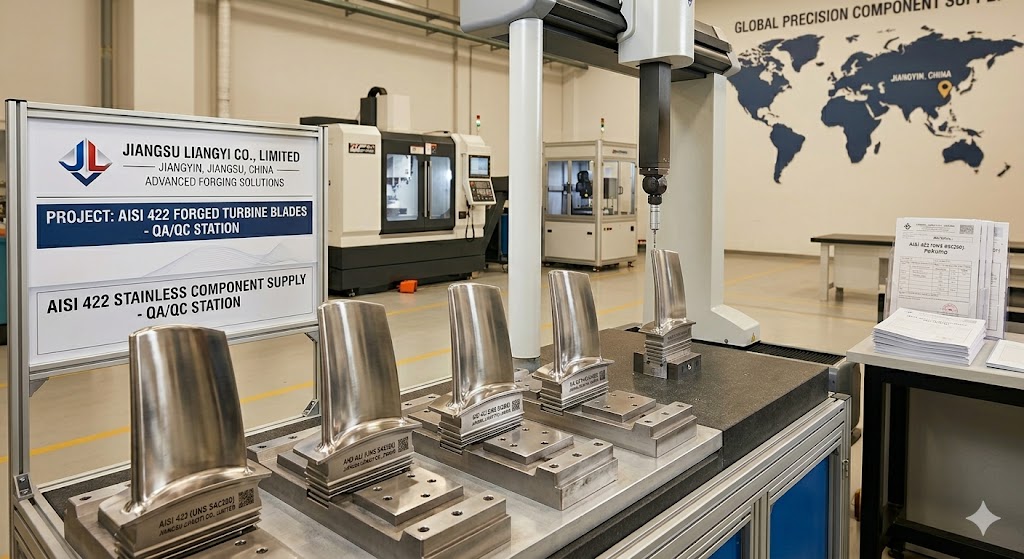
Through a quench-and-double-temper heat treatment, AISI 422 achieves a fully martensitic microstructure with minimum room-temperature UTS of 965 MPa (140 ksi) and 0.2% yield strength of 793 MPa (115 ksi). More importantly, at the design temperature of 649°C the alloy retains approximately 58% of its room-temperature UTS — a retention ratio that is essentially unachievable with plain 12% Cr steels. Creep rupture strength at 600°C over 100,000 hours is approximately 82 MPa, placing AISI 422 alongside the strongest ferritic/martensitic steels used in conventional power plant design codes (EN 13480, ASME B31.1).
Seven Reasons Engineers Specify AISI 422
- Exceptional retained strength at 649°C — UTS ≈ 560 MPa, compared to ~200 MPa for AISI 410 at the same temperature
- Superior creep resistance — 100,000 h rupture strength of ~42 MPa at 649°C; driven by Mo, W and V carbide stabilisation
- Oxidation resistance to 649°C — 11–12.5% Cr forms a stable Cr₂O₃ protective layer in steam and dry combustion gases
- High hardenability — uniform through-hardening in sections up to ~250 mm; eliminates soft-core problems common in plain Cr steels
- Good room-temperature toughness after proper double tempering above 593°C (Charpy ≥ 27 J)
- Proven machinability in annealed condition (190–240 HB); comparable to AISI 4140 in cutting behaviour
- Established design code acceptance — listed in ASME B31.1, ASME VIII Div.1, EN 13480 for pressure-temperature ratings up to 649°C
Manufactured at our advanced facility in Jiangyin, Jiangsu, every Jiangsu Liangyi AISI 422 forging begins with high-quality ingots produced by EAF + LF + VD (or optional ESR for critical applications), ensuring tight chemistry control and ultra-low gas content. All products are shipped with full EN 10204 3.1 traceability documentation.
International Standard Equivalents & Designations for AISI 422
One of the most practical challenges for procurement engineers is reconciling the different national designation systems for the same alloy. The table below consolidates every recognised designation for AISI 422 stainless steel across the major standards bodies, together with the specific product forms covered by each standard. Jiangsu Liangyi can manufacture and certify AISI 422 forgings to any of the standards listed below.
| Standards Body | Designation / Grade | Standard Number | Product Form Covered | Notes |
|---|---|---|---|---|
| AISI / SAE (USA) | AISI 422 | — | General designation | Base trade/design designation |
| UNS (USA) | S42200 | SAE J1086 / ASTM DS-56 | All forms | Primary traceability identifier |
| ASTM (USA) — Bars | Grade 616 | ASTM A565 | Bars & shapes for high-temp. service | Most cited for turbine shaft bars |
| ASTM (USA) — Bars/Shapes | Type 422 | ASTM A276 / A276M | Stainless steel bars and shapes | General bar specification |
| ASTM (USA) — Billets | S42200 | ASTM A314 | Billets for reforging | Applicable to our forging billets |
| ASTM (USA) — Forgings | S42200 | ASTM A484 / A484M | General requirements for SS forgings | Supplementary general requirements |
| EN / DIN (Europe) — Grade | X20CrMoV12-1 | EN 10302:2008 | Creep-resisting steels, bar, plate, strip | Primary European creep-service standard |
| EN / DIN (Europe) — Material No. | 1.4935 | EN 10027-2 | All product forms | Numeric designation used in MTRs |
| DIN (Germany) — Bolting | 1.4935 | DIN 17240 | High-temp. bolting steels | Relevant for valve and flange studs |
| JIS (Japan) — Approximate | SUS616 | JIS G4311 / G4312 | Heat-resisting steel bars / plates | Compositional differences exist; verify spec. |
| GB/T (China) — Approximate | 2Cr12MoWVNb | GB/T 1220 / 8732 | Bars and forgings | Compositional differences exist; verify spec. |
| BS (UK, historic) | Grade 422 S45 | BS 1630 (withdrawn, superseded by EN) | Turbine discs and blades | Legacy designation; now EN 10302 |
Ordering Tip — Specifying the Correct Standard
When placing an order, always specify both the applicable material standard and the product-form standard. For example: "AISI 422 bar to ASTM A565 Grade 616, general requirements to ASTM A484" or "EN X20CrMoV12-1 (1.4935) forging per EN 10302:2008." Jiangsu Liangyi will manufacture and certify to the exact standard combination stated on your purchase order.
AISI 422 vs. AISI 410 vs. AISI 420 — Martensitic Grade Comparison
Engineers frequently ask which martensitic stainless steel grade to specify. The answer depends primarily on operating temperature and mechanical strength requirements. The table below presents a quantitative comparison — not marketing language — to support material selection decisions.
| Property | AISI 410 (UNS S41000) | AISI 420 (UNS S42000) | AISI 422 (UNS S42200) |
|---|---|---|---|
| C content (wt%) | 0.08–0.15 | 0.15–0.40 | 0.20–0.25 |
| Cr content (wt%) | 11.5–13.5 | 12.0–14.0 | 11.0–12.5 |
| Mo + W + V additions | None | None | Mo 0.9–1.3%, W 0.9–1.3%, V 0.2–0.3% |
| Min. UTS after Q+T (MPa) | ~620 | ~690 | 965 |
| Min. YS (0.2%) after Q+T (MPa) | ~480 | ~550 | 793 |
| UTS retained at 500°C (MPa, typical) | ~380 | ~340 | ~780 |
| UTS retained at 600°C (MPa, typical) | ~200 | ~170 | ~650 |
| Max. continuous service temperature | ~480°C (895°F) | ~450°C (840°F) | 649°C (1200°F) |
| 100,000 h creep rupture strength @ 550°C | No meaningful data | No meaningful data | ~160 MPa |
| PREN (pitting resistance) | ~13 | ~13 | ~16 |
| Weldability (preheat required) | 150–260°C | 200–315°C | 200–260°C (PWHT mandatory) |
| Typical applications | General engineering, cutlery blanks, petrochemical | Cutlery, bearings, surgical instruments | Gas turbines, steam turbines, high-temp. valves, aerospace |
| European equivalent | X12Cr13 (1.4006) | X20Cr13 (1.4021) | X20CrMoV12-1 (1.4935) |
| Price level (relative) | Low | Low | Medium (Mo, W, V premium) |
Selection guidance: Use AISI 410 for ambient-to-moderate-temperature corrosion service where cost is paramount. Use AISI 420 where high surface hardness and wear resistance are the primary drivers. Use AISI 422 wherever parts must operate continuously above 480°C — there is no cost-effective alternative within the martensitic stainless steel family for that temperature range.
Chemical Composition of AISI 422 (UNS S42200)
All Jiangsu Liangyi AISI 422 forgings are produced to the composition requirements of EN 10302:2008 and/or ASTM A565 Grade 616, whichever is specified on the purchase order. Chemistry is verified by optical emission spectrometry (OES) in our in-house laboratory, with check analysis available from customer-selected third-party laboratories.
| Element | Symbol | Min. | Max. | Role in Alloy Performance |
|---|---|---|---|---|
| Iron | Fe | Balance | Balance | Base metal; forms body-centred tetragonal martensite on quenching |
| Chromium | Cr | 11.00 | 12.50 | Forms Cr₂O₃ passive film; provides oxidation resistance to 649°C; contributes to hardenability |
| Molybdenum | Mo | 0.90 | 1.30 | Solid-solution strengthening of martensite at elevated temperatures; promotes M₂₃C₆ carbide formation for creep resistance |
| Tungsten | W | 0.90 | 1.25 | Similar to Mo but with lower diffusivity — particularly effective at retarding carbide coarsening during long-term elevated-temperature service |
| Nickel | Ni | 0.50 | 1.00 | Improves hardenability and room-temperature toughness; stabilises austenite during austenitising to suppress ferrite formation |
| Manganese | Mn | 0.50 | 1.00 | Deoxidiser; mild austenite stabiliser; ties up sulfur as MnS to prevent hot shortness |
| Vanadium | V | 0.20 | 0.30 | Grain refinement via VC/VN precipitates; these nanoscale precipitates resist coarsening even after 100,000 h at 600°C, preserving fine grain structure and fatigue resistance |
| Carbon | C | 0.20 | 0.25 | Ensures full martensite hardness on quenching; combines with Cr, Mo, W and V to form strengthening carbides |
| Silicon | Si | — | 0.50 | Deoxidiser; improves high-temperature oxidation resistance marginally |
| Nitrogen | N | 0.02 | 0.04 | Combines with V and Al to form stable nitrides; contributes to high-temperature strength and creep resistance |
| Phosphorus | P | — | 0.025 | Controlled to minimum — grain boundary segregation of P causes temper embrittlement |
| Sulfur | S | — | 0.025 | Controlled to minimum — excess S reduces transverse toughness and corrosion resistance |
Jiangsu Liangyi's Metallurgical Practice: For ESR (Electroslag Remelted) quality AISI 422, we routinely achieve P ≤ 0.015% and S ≤ 0.005% — well below the standard maxima — through the refining action of the ESR slag system. This yields measurably superior transverse toughness and improved ultrasonic inspectability, which is particularly valuable for large turbine rotor shafts.
Room-Temperature Mechanical Properties of AISI 422
The following minimum mechanical properties are specified by ASTM A565 Grade 616 for AISI 422 bars and shapes after quench-and-temper heat treatment. These values represent the lowest acceptable performance — actual values achieved in Jiangsu Liangyi production typically exceed these minima. All testing is performed on specimens cut longitudinally from the forged product per ASTM A370.
| Property | Min. Value | Unit (SI) | Unit (Imperial) | Test Method |
|---|---|---|---|---|
| Ultimate Tensile Strength (UTS) | 965 | MPa | 140 ksi | ASTM A370 |
| 0.2% Offset Yield Strength (YS) | 793 | MPa | 115 ksi | ASTM A370 |
| Elongation (GL = 50.8 mm / 2 in) | 15 | % | % | ASTM A370 |
| Reduction of Area | 45 | % | % | ASTM A370 |
| Brinell Hardness | 293 – 341 | HB | HB | ASTM E10 |
| Charpy V-Notch Impact Energy (23°C) | ≥ 27 | J | ≥ 20 ft·lbf | ASTM A370 / ISO 148-1 |
| Transverse YS (heavy sections) | ≥ 730 | MPa | ≥ 106 ksi | ASTM A370 |
For oversized sections (diameter or thickness exceeding 150 mm), Jiangsu Liangyi recommends specifying transverse mechanical testing in addition to the longitudinal minimums, as transverse properties are more sensitive to forging reduction ratio and heat treatment uniformity in large cross-sections.
High-Temperature Mechanical Properties of AISI 422 (to 649°C)
The following high-temperature tensile properties represent typical values for AISI 422 in the quenched-and-tempered condition, as derived from published EN 10302 and Boiler & Pressure Vessel Code data for X20CrMoV12-1 / S42200. They should be used for indicative engineering calculations; design code allowable stresses (from ASME Section II Part D or EN 10028-7) must be used for pressure equipment design. Note that these properties decrease with increasing section size due to reduced cooling rates during quenching.
| Test Temperature | UTS (MPa) | 0.2% YS (MPa) | 1.0% YS (MPa) | Elongation (%) | Reduction of Area (%) |
|---|---|---|---|---|---|
| 20°C (RT) | ≥ 965 | ≥ 793 | — | ≥ 15 | ≥ 45 |
| 100°C | ~970 | ~810 | ~840 | ~16 | ~52 |
| 200°C | ~950 | ~800 | ~830 | ~16 | ~53 |
| 300°C | ~895 | ~775 | ~805 | ~17 | ~56 |
| 400°C | ~845 | ~745 | ~775 | ~17 | ~58 |
| 450°C | ~815 | ~725 | ~755 | ~17 | ~58 |
| 500°C | ~780 | ~700 | ~730 | ~17 | ~58 |
| 550°C | ~735 | ~660 | ~690 | ~16 | ~56 |
| 600°C | ~650 | ~600 | ~625 | ~15 | ~52 |
| 620°C | ~610 | ~560 | ~585 | ~15 | ~50 |
| 649°C (1200°F) | ~560 | ~510 | ~535 | ~14 | ~48 |
Design Note: The 1.0% total strain yield strength (1.0% YS) is increasingly used in turbine part design codes (notably DIN EN 13480-3 and some ASME interpretations) where limiting total strain under cyclic thermal loading is the controlling design criterion rather than 0.2% offset yield. Jiangsu Liangyi can provide test data for specific heat treatment conditions and section sizes upon request.
The table shows that AISI 422 retains approximately 58% of its room-temperature UTS at 649°C — a figure that places it far ahead of AISI 410 (which retains approximately 32% at 649°C) and is competitive with some precipitation-hardened stainless steels at this temperature range.
Creep & Stress-Rupture Properties of AISI 422
Creep — the time-dependent plastic deformation of a material under sustained stress at elevated temperature — is the primary failure mechanism for turbine parts, high-temperature bolting and pressure-containing parts operating above approximately 400°C. For AISI 422, resistance to creep is the central engineering rationale for its use over less-alloyed martensitic grades.
The tables below present stress-rupture strength and creep-limiting stress data characteristic of AISI 422 / EN X20CrMoV12-1 in the quenched-and-double-tempered condition. These values are consistent with published data for this alloy class as documented in EN 10302:2008 and international pressure vessel design codes. They are typical indicative values; always use approved design code allowable stress values for pressure equipment and structural design.
Stress-Rupture Strength (Time to Fracture)
| Temperature | 1,000 h | 10,000 h | 30,000 h | 100,000 h | 200,000 h (extrapolated) |
|---|---|---|---|---|---|
| 500°C | ~420 | ~340 | ~295 | ~250 | ~215 |
| 550°C | ~280 | ~220 | ~185 | ~155 | ~130 |
| 600°C | ~160 | ~120 | ~100 | ~82 | ~68 |
| 620°C | ~120 | ~88 | ~72 | ~58 | ~47 |
| 649°C | ~82 | ~60 | ~50 | ~40 | ~32 |
Creep-Limiting Stress (1% Total Strain)
| Temperature | 10,000 h | 30,000 h | 100,000 h |
|---|---|---|---|
| 500°C | ~360 | ~320 | ~275 |
| 550°C | ~235 | ~205 | ~170 |
| 600°C | ~138 | ~118 | ~97 |
| 620°C | ~100 | ~84 | ~68 |
| 649°C | ~68 | ~56 | ~44 |
Practical Significance of AISI 422 Creep Data
- Steam turbine design life: A typical steam turbine blade operating at 560°C with 80 MPa bending stress has a predicted 100,000 h creep rupture life comfortably above 1.5× safety factor when made in AISI 422 — a margin impossible to achieve with AISI 410 at the same conditions.
- Bolting applications: At 600°C, AISI 422 bolts can sustain approximately 97 MPa for 100,000 hours at 1% creep strain, making them suitable for high-pressure steam flanges where keeping preload is critical.
- Code design allowable stresses: ASME BPVC Section II Part D tabulates allowable stresses for S42200 up to 649°C (1200°F), enabling the material to be used in ASME Code construction for pressure vessels, piping and boiler parts.
- Influence of section size: Larger cross-sections cool more slowly during quenching, resulting in slightly lower tensile strength and potentially reduced creep life. For critical components, Jiangsu Liangyi recommends specifying minimum forging reduction ratios and section qualification tests.
Physical & Thermal Properties of AISI 422
Physical properties are essential for thermal stress calculations, resonant frequency analysis of turbine blades and dimensional tolerance specification after heat treatment. The values below are characteristic of AISI 422 (EN X20CrMoV12-1) in the quenched-and-tempered condition.
| Property | Value | Unit |
|---|---|---|
| Density | 7.72 | g/cm³ (0.279 lb/in³) |
| Elastic Modulus (Young's) | 200 | GPa (29,000 ksi) |
| Poisson's Ratio | 0.28 | — |
| Shear Modulus | 78 | GPa |
| Thermal Conductivity | 23.8 | W/(m·K) |
| Specific Heat Capacity | 460 | J/(kg·K) |
| Electrical Resistivity | 720 | nΩ·m |
| Magnetic Permeability | Ferromagnetic | — |
| Melting Range | 1,450 – 1,510 | °C |
| Temperature Range | Mean CTE (µm/m·°C) |
|---|---|
| 20 – 100°C | 10.8 |
| 20 – 200°C | 11.0 |
| 20 – 300°C | 11.2 |
| 20 – 400°C | 11.5 |
| 20 – 500°C | 11.8 |
| 20 – 600°C | 12.1 |
| 20 – 649°C | 12.4 |
The relatively low CTE of AISI 422 (compared to austenitic stainless steels at ~16–18 µm/m·°C) is a significant design advantage in turbine blades and vanes, where thermal cycling generates lower differential thermal strains between the blade and the disc. This reduces low-cycle fatigue damage accumulation and contributes to the long service life observed in AISI 422 turbine parts.
AISI 422 Heat Treatment — Complete Procedures
Correct heat treatment is non-negotiable for AISI 422 (UNS S42200). The mechanical properties described in the preceding sections are only achievable after a properly executed quench-and-double-temper cycle. Jiangsu Liangyi performs all heat treatment in-house using computer-controlled furnaces with continuous data-logging; temperature charts are provided with every EN 10204 3.1 certificate as standard.
| Stage | Temperature Range | Holding Time | Cooling Method | Resulting Condition / Purpose |
|---|---|---|---|---|
| Sub-critical Anneal | 760 – 790°C (1400 – 1455°F) | 2 h min. | Furnace cool ≤ 28°C/h to below 540°C, then air cool | Partial softening; stress relief prior to rough machining. Does not produce full annealed structure. |
| Full Anneal | 843 – 899°C (1550 – 1650°F) | 1 h per 25 mm section thickness, min. 2 h | Furnace cool ≤ 14°C/h to below 600°C, then air cool | Maximum softness for machining (190–240 HB); spheroidised carbide microstructure |
| Stress Relief (after machining) | 620 – 680°C (1150 – 1255°F) | 2–4 h | Furnace cool to 315°C, then air cool | Relieves machining stresses without changing hardness significantly |
| Austenitising (Hardening) | 996 – 1,024°C (1825 – 1875°F) | 1 h per 25 mm, min. 1 h; max. 4 h for any section | Oil quench (preferred for sections ≤ 100 mm) or forced air/gas quench | Dissolves all carbides into austenite; on cooling forms fully martensitic structure; hardness typically 47–52 HRC |
| First Temper | 593 – 649°C (1100 – 1200°F) | 2 h min. per 25 mm, min. 2 h total | Air cool to room temperature | Converts martensite to tempered martensite; precipitates fine M₂₃C₆ and VC carbides; eliminates quench cracking risk |
| Second Temper (strongly recommended for all sections ≥ 75 mm) | 593 – 621°C (1100 – 1150°F) | 2 h min. per 25 mm, min. 2 h total | Air cool to room temperature | Ensures complete transformation of any retained austenite; optimises impact toughness and long-term creep properties; achieves final 293–341 HB |
⛔ Critical Embrittlement Zone — 399 to 566°C (750 to 1050°F): AISI 422 must never be tempered, slow-cooled, or allowed to dwell in the temperature range of 399–566°C (750–1050°F). This range causes phosphorus and other tramp elements to segregate to prior austenite grain boundaries — a phenomenon known as temper embrittlement (reversible temper embrittlement) — which can reduce Charpy impact energy to below 7 J at room temperature, an 80%+ reduction from the properly-tempered condition. Components accidentally processed through this range must be re-austenitised and re-tempered. Furnace cool rates must be controlled to pass through this range rapidly during all cooling operations.
Post-Weld Heat Treatment (PWHT)
When AISI 422 components have been welded, PWHT is mandatory — not optional — to restore toughness in the heat-affected zone (HAZ) and weld metal. The recommended PWHT for AISI 422 welds is:
- Pre-PWHT hold: Maintain weldment at 260–315°C for 1–2 hours immediately after welding — before cooling to room temperature — to allow hydrogen diffusion and avoid cold cracking.
- PWHT soak: Heat to 593–649°C (1100–1200°F), hold for 1 hour per 25 mm weld thickness (minimum 2 hours), maintaining ±14°C temperature uniformity throughout the weldment.
- Cooling: Cool at a controlled rate not exceeding 110°C/h down to 315°C, then air cool to room temperature. This rate avoids re-entering the embrittlement zone at a slow cooling rate.
Heat Treatment Traceability at Jiangsu Liangyi
Every AISI 422 forging processed through our Jiangyin facility is individually tracked through heat treatment using unique part identification. Furnace temperature is recorded by calibrated Type K thermocouples at ≤ 1-minute intervals throughout the heat treatment cycle. Charts are reviewed by the QC department, signed and archived. Copies are supplied with the EN 10204 3.1 mill certificate. For EN 10204 3.2 orders, a third-party inspector witnesses and countersigns the heat treatment records.
Corrosion Resistance of AISI 422 Stainless Steel
AISI 422 is a martensitic stainless steel, not an austenitic one. Its corrosion resistance profile is fundamentally different from grades like 316L or 304, and misapplication in corrosive aqueous environments is one of the most common specification errors encountered in practice. Understanding exactly where AISI 422 performs well — and where it does not — is essential for reliable part design.
Pitting Resistance Equivalent Number (PREN)
The PREN is the most widely used single-number index of resistance to pitting corrosion in chloride environments. It is calculated as:
PREN = %Cr + 3.3 × %Mo + 16 × %N
For AISI 422 (typical midpoint composition): PREN = 11.75 + 3.3 × 1.1 + 16 × 0.03 = 11.75 + 3.63 + 0.48 ≈ 16
| Grade | Typical PREN | Chloride Resistance | Typical Use Environment |
|---|---|---|---|
| AISI 410 (UNS S41000) | ~12–13 | Very Low | Mild atmospheric / steam |
| AISI 422 (UNS S42200) | ~16 | Low | High-temp. steam, dry combustion gas |
| AISI 304 (UNS S30400) | ~18–20 | Moderate | General indoor / mild aqueous |
| AISI 316L (UNS S31603) | ~24–26 | Good | Coastal atmosphere, mild chloride aqueous |
| 2205 Duplex (UNS S32205) | ~34–36 | Very Good | Seawater, chloride process fluids |
| 2507 Super Duplex (UNS S32750) | ~42–43 | Excellent | Offshore seawater, aggressive chloride |
Corrosion Resistance by Environment
| Environment / Medium | Resistance | Notes |
|---|---|---|
| High-temperature steam (up to 649°C) | Good | Primary design environment; Cr₂O₃ passive layer stable in dry steam |
| Dry combustion gases (up to 649°C) | Good | Suitable for gas turbine hot sections in clean fuel combustion |
| Rural / light industrial atmosphere | Good | Passive layer stable; surface staining may occur without protective coating |
| Freshwater (low chloride, < 50 ppm Cl⁻) | Fair | Generally acceptable at ambient temperature; risk increases with temperature |
| Dilute nitric acid (HNO₃, < 5%, ambient) | Fair | Passivates in oxidising nitric acid; passive layer may break down in concentrated acid |
| Coastal / marine atmosphere | Fair | Surface rust staining likely without protective treatment; not recommended for splash zone |
| Seawater / brine (any concentration) | Poor | PREN ~16 is insufficient; pitting corrosion expected; use 2205 duplex or nickel alloy instead |
| Hydrochloric acid (HCl, any concentration) | Poor | Rapidly attacked; do not use |
| Sulfuric acid (H₂SO₄, > 10%, ambient) | Poor | Rapidly attacked; do not use in reducing acid environments |
| Chloride process fluids (> 200 ppm Cl⁻) | Poor | High pitting and stress corrosion cracking (SCC) risk; upgrade to duplex or austenitic grade |
| Hydrogen sulfide (H₂S, wet sour service) | Poor | Susceptible to sulfide stress cracking (SSC) at hardness > 22 HRC per NACE MR0175 |
Corrosion Design Guidance — Jiangsu Liangyi Engineering Team's Perspective
In our 25+ years of manufacturing AISI 422 components for power generation and oil & gas applications, the most common corrosion-related field failures we have observed trace back to one of three root causes: (1) specification of AISI 422 in chloride-bearing cooling water systems where the design team focused on temperature rather than corrosion; (2) failure to apply a protective coating or plating on external surfaces exposed to coastal atmospheres; or (3) improper heat treatment leaving residual stress that promotes stress corrosion cracking in mildly corrosive environments. Proper material selection and heat treatment solve all three. Our engineering team is available to review your application conditions and recommend the optimal alloy.
Weldability & Joining of AISI 422
AISI 422 is weldable by all common fusion welding processes, but its martensitic microstructure and relatively high carbon content (0.20–0.25%) mean that welding requires careful procedural control. The key risks are hydrogen-induced cold cracking (HICC) in the heat-affected zone (HAZ) — which can occur hours or even days after welding if hydrogen is not removed by post-weld hold — and softening of the HAZ due to over-tempering, which reduces high-temperature strength in the vicinity of the weld. Both risks are managed by strict adherence to the welding procedure specification (WPS) parameters below.
| Parameter | Recommended Value / Range | Remarks |
|---|---|---|
| Preheat Temperature | 200 – 260°C (400 – 500°F) | Measure at 75 mm from weld centerline; maintain throughout welding |
| Minimum Interpass Temperature | 200°C (400°F) | Do not allow weld to cool below preheat temp. between passes |
| Maximum Interpass Temperature | 315°C (600°F) | Exceeding 315°C can cause over-tempering and softening of HAZ |
| Post-Weld Hold (before cooling) | 260 – 315°C for 1–2 hours | Mandatory; allows hydrogen diffusion before martensite forms on cooling |
| PWHT Temperature | 593 – 649°C (1100 – 1200°F) | PWHT is mandatory; do not omit even for "minor" repairs |
| PWHT Hold Time | 1 h per 25 mm weld thickness, min. 2 h | Based on thickest cross-section |
| PWHT Heating Rate | ≤ 110°C/h above 315°C | Prevents thermal shock in large or complex weldments |
| PWHT Cooling Rate | ≤ 110°C/h from soak to 315°C, then air cool | Must not slow-cool through 399–566°C embrittlement range |
| Heat Input | 0.5 – 2.0 kJ/mm (recommended) | Limit heat input to control HAZ width; avoid excessive bead width |
Recommended Filler Metals for Welding AISI 422
| Welding Process | Preferred Filler Metal | AWS Classification | Notes |
|---|---|---|---|
| TIG / GTAW | ER410NiMo | AWS A5.9 | Best toughness in as-welded condition; preferred for pressure-critical joints |
| TIG / GTAW (alternative) | ER420 | AWS A5.9 | Better matching composition to AISI 422 base metal; use when high-temp. strength of weld metal is prioritised |
| MIG / GMAW | ER410NiMo | AWS A5.9 | Standard choice for production welding; low hydrogen wire is essential |
| SMAW (Stick) | E410NiMo-15 | AWS A5.4 | Low-hydrogen electrode mandatory; keep sealed until use; bake at 300–350°C before welding |
| SAW (Submerged Arc) | ER410NiMo wire + basic flux | AWS A5.23 | Suitable for large groove welds; basic flux essential for low hydrogen |
| Dissimilar to Carbon Steel | ER309L or ENiCrFe-2 | AWS A5.9 / A5.11 | Butter layer of 309L on carbon steel, then weld with matching filler; verify CTE compatibility |
Why ER410NiMo Rather Than a Direct Composition Match? ER410NiMo (with ~4–5% Ni) provides superior as-welded toughness compared to an ER420-type filler, because its lower carbon and higher nickel content retard martensite start temperature (Ms) and result in a more ductile weld microstructure prior to PWHT. After PWHT at 593–649°C, both filler types achieve acceptable properties — but ER410NiMo provides a larger safety margin against cracking if the post-weld hydrogen hold is not perfectly executed.
Machinability & Machining Parameters for AISI 422
AISI 422 in the annealed condition (190–240 HB) has machinability broadly comparable to AISI 4140 alloy steel at similar hardness levels. It is significantly easier to machine than austenitic stainless steels (which work-harden rapidly) and easier than the harder precipitation-hardening grades. In the fully hardened-and-tempered condition (293–341 HB), cutting speeds must be reduced and tooling upgraded accordingly.
The key characteristic of AISI 422 machining is its tendency to generate long, stringy chips during turning, which can tangle around tools and workpiece. Selecting a chip-breaking insert geometry and adequate feed rate resolves this. Coolant application is important: AISI 422 generates moderate cutting temperatures, and high-pressure through-tool coolant significantly extends tool life and improves surface finish.
Recommended Turning Parameters (CNC Lathe)
| Operation | Material Condition | Insert Grade | Cutting Speed (Vc, m/min) | Feed (fn, mm/rev) | Depth of Cut (ap, mm) |
|---|---|---|---|---|---|
| Rough Turning | Annealed (190–240 HB) | CVD TiCN/Al₂O₃ coated carbide, ISO P20–P30 | 100 – 140 | 0.20 – 0.40 | 2.0 – 5.0 |
| Finish Turning | Annealed (190–240 HB) | PVD TiAlN coated carbide, ISO P10–P20 | 130 – 160 | 0.05 – 0.15 | 0.3 – 1.0 |
| Rough Turning | Q+T (293–341 HB) | CVD TiCN/Al₂O₃ coated carbide, ISO P25–P35 | 65 – 95 | 0.15 – 0.30 | 1.5 – 3.5 |
| Finish Turning | Q+T (293–341 HB) | CBN insert (PCBN) or fine-grain PVD carbide | 90 – 130 | 0.05 – 0.12 | 0.2 – 0.6 |
Recommended Milling Parameters (CNC Machining Centre)
| Operation | Material Condition | Cutter Type | Cutting Speed (Vc, m/min) | Feed per Tooth (fz, mm/tooth) | Axial Depth (ap, mm) |
|---|---|---|---|---|---|
| Face Milling | Annealed | Indexable carbide face mill, PVD TiAlN | 80 – 120 | 0.10 – 0.22 | 1.0 – 3.0 |
| Shoulder Milling | Annealed | Indexable carbide end mill, CVD coated | 70 – 100 | 0.08 – 0.18 | 0.5 – 2.0 |
| Solid Carbide End Milling (profile) | Annealed | 4-flute solid carbide, TiAlN PVD coated | 60 – 90 | 0.04 – 0.10 | 0.3 – 1.5 |
| Face Milling | Q+T (293–341 HB) | Indexable carbide, coarse pitch for chip clearance | 50 – 80 | 0.08 – 0.16 | 0.5 – 2.0 |
Drilling & Other Operations
| Operation | Tool | Cutting Speed | Feed | Notes |
|---|---|---|---|---|
| Drilling (annealed) | Carbide drill, TiAlN coated | 40 – 60 m/min | 0.05 – 0.18 mm/rev | High-pressure through-coolant recommended; peck drill for L/D > 5 |
| Drilling (Q+T) | HSS-Co drill or solid carbide | 15 – 30 m/min (HSS-Co) / 30–50 m/min (carbide) | 0.04 – 0.12 mm/rev | Reduce feed on entry and exit to avoid chipping |
| Tapping (annealed) | HSS-Co tap (spiral point, TiN coated) | 3 – 8 m/min | Pitch of thread | Use cutting oil (not water-soluble coolant); 75% thread engagement recommended |
| Cylindrical Grinding | CBN wheel or Al₂O₃ vitrified wheel | 20 – 35 m/s wheel speed; 0.15–0.25 m/s workpiece | 0.005 – 0.025 mm/pass | Use water-soluble coolant; light dress after every 5–10 passes to avoid glazing |
Jiangsu Liangyi In-House Machining Services
Our Jiangyin, Jiangsu facility operates a full CNC machining shop equipped with large CNC lathes (max. turning diameter 3,000 mm, max. between-centres distance 12,000 mm), CNC boring mills, deep-hole drilling machines and surface grinding equipment. AISI 422 components can be supplied in any condition from as-forged to fully finish-machined, heat-treated and NDT-inspected, ready for direct assembly. This eliminates the need for customers to arrange separate machining contractors, simplifying the supply chain and reducing lead time.
When to Upgrade: Alternative & Related Materials to AISI 422
AISI 422 is an excellent alloy within its design envelope, but there are situations where it is not the optimal choice. The following framework helps engineers decide when to stay with AISI 422 and when to consider upgrading — and which material to select for each scenario. Jiangsu Liangyi manufactures forgings in most of the alternative alloys listed below.
| If Your Application Requires… | Stay with AISI 422? | Alternative Material | Why the Alternative? |
|---|---|---|---|
| Service temperature up to 649°C with moderate mechanical loads | Yes — ideal choice | — | AISI 422 is the optimum cost-performance solution |
| Service temperature 649 – 760°C | No | AISI 446 / Alloy 556 / Ferritic SS | AISI 422 loses most creep strength above 649°C; higher Cr ferritic grades offer better oxidation resistance at moderate stress |
| Service temperature 760 – 900°C | No | Alloy 625 (UNS N06625) / Alloy 718 (UNS N07718) | Nickel superalloys maintain strength and oxidation resistance in this regime; AISI 422 would degrade rapidly |
| Service temperature > 900°C | No | Alloy 740H / Mar-M-247 / Single-crystal superalloys | Only advanced Ni-base or Co-base superalloys survive in this regime |
| Chloride-bearing aqueous service (seawater, brine) | No | Duplex 2205 (UNS S32205) / Super Duplex 2507 (UNS S32750) | PREN ~16 is insufficient for chloride resistance; duplex grades offer PREN 34–43 |
| Non-magnetic component in room-temperature service | No | Austenitic SS (304, 316L, 310) | AISI 422 is ferromagnetic; austenitic grades are non-magnetic |
| Very high surface hardness (> 50 HRC) with wear resistance | No | AISI 440C (UNS S44004) / tool steels D2, H13 | AISI 422 reaches max. ~40 HRC; 440C and tool steels can reach 56–62 HRC |
| Hydrogen service (sour gas, NACE MR0175) | No — at full hardness | AISI 422 limited to 22 HRC max. per NACE; or use low-alloy modified 13Cr steels | Above 22 HRC, AISI 422 is susceptible to sulfide stress cracking (SSC) in H₂S environments |
| Cryogenic service (below −50°C) | No | AISI 304L / 316L austenitic SS; 9% Ni steel | Martensitic steels have poor ductile-to-brittle transition; austenitic grades remain tough to −196°C |
| Lower-temperature (< 480°C) general engineering at lower cost | Consider downgrade | AISI 410 (UNS S41000) or F6NM (UNS S41500) | If temperature is genuinely below 480°C, AISI 410 or 13Cr-4Ni (F6NM) provides adequate properties at lower cost |
Jiangsu Liangyi's engineering team is available to review your application temperature, stress levels, corrosion environment and budget to recommend the most appropriate alloy. We manufacture forgings in AISI 422, AISI 410, F6NM (13Cr-4Ni), Alloy 625, Alloy 718, 2205 duplex and many other grades — ensuring you receive an unbiased recommendation rather than a recommendation driven by what a single-material supplier can produce.
AISI 422 Forging Product Capabilities — China Manufacturer
At our state-of-the-art manufacturing facility in Jiangyin, Jiangsu Province, China, we produce a comprehensive range of custom AISI 422 forged steel products in various shapes, sizes and configurations. Our production capacity spans from small precision components weighing 30 kg to heavy forgings exceeding 30,000 kg.
Open-Die Forged Bars, Rounds & Shafts
- AISI 422 round bars, square bars, flat bars and rectangular bars — all cross-sections
- Step shafts, gear shafts, turbine rotor shafts and spindles up to 15 m in length
- Valve spindles, piston rods, stems and rods for high-temperature valve assemblies
- Custom bars up to 2,000 mm in diameter; hollow bars with central bore on request
- Supply conditions: as-forged, normalised, annealed, rough machined, heat-treated (Q+T) or finish machined
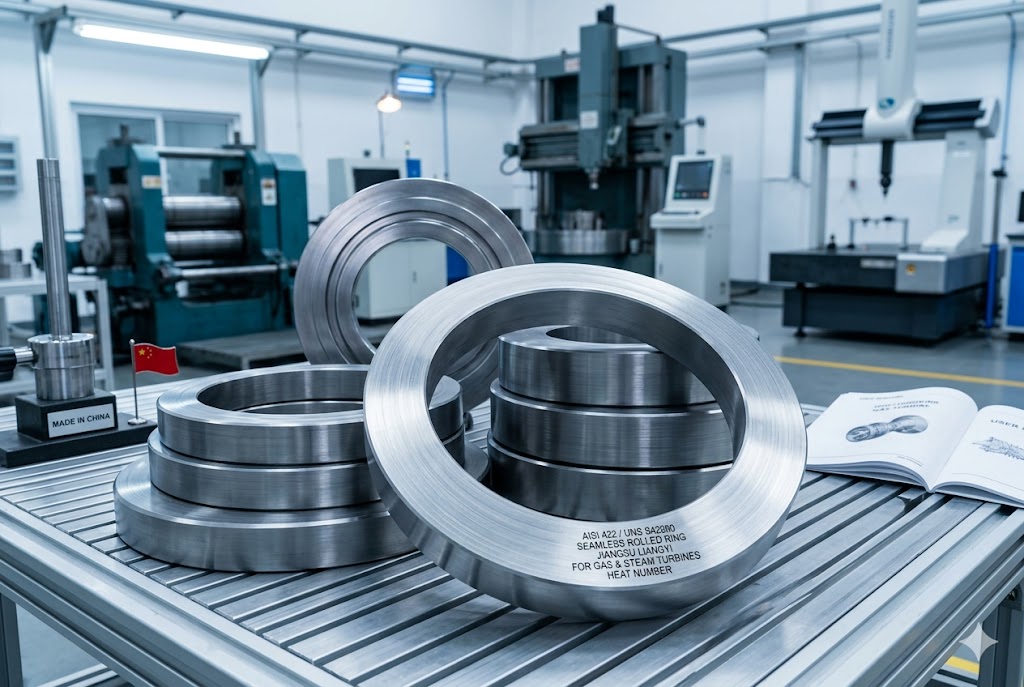
Seamless Rolled Rings
- AISI 422 seamless rolled rings from Ø 200 mm up to Ø 6,000 mm outer diameter
- Ring heights from 50 mm up to 800 mm; wall thicknesses from 30 mm up to 600 mm
- Guide rings, seal rings, labyrinth rings and bearing rings for gas and steam turbines
- Casing rings, blade fitting rings, rotor end rings and shroud rings
- Contoured and custom-profiled rings — including flanged, stepped and grooved profiles — produced by profile ring rolling
- Heavy-duty rings weighing up to 30 tonnes for critical rotating power generation equipment
Custom Open-Die Forged Components
- AISI 422 discs, plates, blocks, hubs and flanges in any shape
- Housings, shells, sleeves, bushings and bearing housings
- Heavy-wall hollow bars and pipes up to 3,000 mm OD
- Valve bodies, bonnets, seats, cores and sleeves for high-pressure high-temperature valve assemblies
- Turbine wheels, impellers, blisks and diaphragm forgings
- High-temperature bolting: studs, bolts and nuts to DIN 17240 / ASTM A193 equivalent
- Complex near-net-shape open-die forgings to customer drawings — minimum material waste
Industrial Applications of AISI 422 Stainless Steel Forgings
AISI 422 has earned its place as the standard material for rotating and static components in gas and steam turbines operating at intermediate temperatures. The following application breakdown reflects over 25 years of Jiangsu Liangyi production experience across global projects.
Power Generation — Gas & Steam Turbines (Primary Application)
- LP, IP and HP steam turbine blades and buckets — blades are typically forged then precision-machined to airfoil profile
- Gas turbine compressor blades, vanes and guide vanes
- Turbine rotor shafts (solid and hollow), spindles and stub shafts
- Turbine discs, wheels and drum rotors
- Turbine diaphragms, nozzle rings and interstage sealing rings
- Low-pressure turbine (LPT) casings, shrouds and outer rings
- Journal and thrust bearing housings
- Main steam valves, reheat valves, control valves — bodies, discs, seats, stems and bonnets
- Inlet guide vane (IGV) actuator rings and control rings
- Bearing gland seals, oil guard rings and labyrinth sealing elements
- Inner and outer heat shields for turbine casings
Aerospace & Defense
- Aerojet engine compressor blades and turbine discs (where AISI 422 meets AMS temperature requirements)
- Structural high-temperature attachment hardware and brackets
- Afterburner and exhaust nozzle components
- Ground-based gas turbine starter components
Oil, Gas & Petrochemical
- High-temperature high-pressure (HTHP) valve seats, stems, bonnets and bodies (in non-chloride service)
- Refinery reactor internals and high-temperature piping flanges
- Compressor impellers and shaft sleeves operating in high-temperature process gas
- Heat exchanger floating heads and tube sheets in high-temperature steam service
Other Industrial Applications
- Nuclear power — research reactor internals at intermediate temperatures
- Industrial gas compressors — impellers and shaft components
- Waste-to-energy plant components in high-temperature flue gas zones
- Industrial furnace components and retort hardware
- High-temperature fastening systems (studs, bolts) for pressure vessels and flanges
View our project references for specific examples of AISI 422 forgings supplied to power generation and industrial customers worldwide.
Manufacturing Capabilities & Equipment — Jiangsu Liangyi, Jiangyin
Jiangsu Liangyi operates a fully vertically integrated manufacturing facility in Jiangyin, Jiangsu Province — covering the complete production process from steelmaking and ingot casting through forging, heat treatment, machining and final quality inspection. This vertical integration eliminates inter-company quality handoffs and ensures complete metallurgical traceability. Our factory covers 80,000 m² with an annual production capacity of 120,000 tonnes.
Steelmaking — From Scrap to High-Purity Ingot
- 60-tonne Electric Arc Furnace (EAF) with 40 MVA transformer — primary melting
- 2 × Ladle Furnace (LF) — precise secondary refining, chemistry adjustment and inclusion shape control
- 2 × Tank Degassing units (VD-VOD type) — achieves H < 1.5 ppm, N < 80 ppm, O < 15 ppm in finished steel
- Bottom-pouring ingot casting pits — controlled solidification for improved internal soundness
- Electroslag Remelting (ESR) Plant — max. ingot weight 32 tonnes; for premium-quality AISI 422 with ultra-low sulfur (< 0.005%), maximum cleanliness and directionally solidified microstructure for critical turbine applications
Forging — Heavy-Duty Press & Hammer Capacity
- 8,500-tonne hydraulic forging press — primary press for large forgings and heavy rings
- 4,500-tonne hydraulic forging press — medium and complex shape forgings
- 50-tonne and 15-tonne manipulators — handling of large open-die forgings during pressing
- 2-tonne, 1-tonne and 450 kg air hammers — small and medium forgings, tooling repair
- 5-tonne electro-hydraulic hammer — precision forging of small complex shapes
- Seamless ring rolling machines — max. finished ring outer diameter 6,000 mm, max. ring weight 30 tonnes
Heat Treatment — Precision Thermal Processing
- Large pit furnaces up to φ2,000 × 12,000 mm — for turbine rotor shafts and long bar forgings
- Table resistor furnaces — uniform temperature for medium components
- Box resistor furnaces — batch heat treatment of small and medium components
- Multiple gas-fired furnaces of various sizes — flexible processing of diverse component sizes
- All furnaces: computer-controlled setpoint and recording, calibrated Type K thermocouples, ≤ ±10°C temperature uniformity across load
Quality Inspection — Comprehensive In-House Testing
- Chemical Analysis: In-house optical emission spectrometry (OES) laboratory; XRF for verification; hydrogen and oxygen content by inert gas fusion (IGF)
- Mechanical Testing: Universal testing machine to 1,000 kN; Charpy impact test at various temperatures; Brinell, Rockwell and Vickers hardness; creep test rigs available for witness tests
- Metallography: Full macro and micro examination; grain size determination per ASTM E112; inclusion rating per ASTM E45 / EN 10247; martensite fraction measurement
- Non-Destructive Testing: Ultrasonic testing (UT) — contact, immersion and phased-array; magnetic particle inspection (MT); liquid penetrant inspection (PT); all NDT operations conducted by qualified and experienced operators
- Dimensional: CMM capability; portable 3D scanning for complex profiles; precision gap gauges, micrometers and ring gauges maintained under regular calibration programme
Why Choose Jiangsu Liangyi for AISI 422 Forgings
China's Jiangsu Province — and Jiangyin City in particular — has developed into one of the world's most concentrated forging industry clusters, with a complete industrial chain from raw material supply through precision machining and quality inspection. Jiangsu Liangyi sits at the centre of this ecosystem, combining the cost advantages of Chinese manufacturing scale with the metallurgical expertise and equipment quality that demanding international customers require.
What Makes Jiangsu Liangyi Different
- Vertical integration: We melt our own steel, forge it, heat-treat it, machine it and inspect it — all at our Jiangyin facility. No subcontracting means complete quality control and single-point accountability.
- 25+ years in high-temperature alloys: Our metallurgical engineers have spent careers specifically on AISI 422, 410, F6NM, Alloy 625 and other demanding alloys — not on commodity steels. This expertise shows in our creep-test data and consistently first-time-right heat treatment results.
- ESR capability: Most Chinese forging factories do not operate ESR furnaces. Our 32-tonne ESR plant allows us to supply premium-quality AISI 422 with P < 0.015% and S < 0.005%, equivalent to the best Western specialty steel producers.
- ISO 9001:2015 + EN 10204 3.1/3.2: All production is managed under our certified QMS. EN 10204 3.1 is standard; 3.2 with third-party witness is available for every order, not just special requests.
- 50+ countries, 25+ years: Our AISI 422 forgings are operating in power plants, turbines and valve assemblies across Asia, Europe, the Middle East, North America and Oceania. References available upon NDA request.
- Transparent engineering support: Our customers receive honest material selection guidance — including when to use a different alloy rather than AISI 422. We will not sell you a more expensive material if AISI 410 is genuinely sufficient, and we will tell you when you need to upgrade to Alloy 625.
Competitive Advantages at a Glance
- Over 25 years specialised experience in high-temperature alloy forgings
- ISO 9001:2015 certified quality management system
- Complete in-house vertical integration from EAF melting to finish machining
- ESR capability for premium cleanliness requirements
- Products exported to more than 50 countries worldwide
- EN 10204 3.1 and 3.2 certificates provided — third-party inspection available
- Comprehensive technical support from experienced metallurgical engineers
- Strategic location in Jiangyin, Jiangsu — direct Yangtze River access for cost-effective global logistics
Explore our complete forging materials portfolio at jnmtforgedparts.com/Materials — including other stainless steels, alloy steels, nickel alloys and superalloys for high-temperature service.
Global AISI 422 Forging Project References
Our AISI 422 forged components have been incorporated in critical equipment across five continents. The following project examples illustrate the range of components, sizes and certification requirements we have delivered from our Jiangyin, Jiangsu facility:
300 MW & 600 MW Thermal Power Plants — Asia
Supplied AISI 422 turbine blades (LP and IP stages), rotor shaft forgings up to 8 tonnes, and high-temperature steam valve seat/stem assemblies for multiple power plants in China, India and Southeast Asia. All products supplied with EN 10204 3.1 MTR; selected projects with EN 10204 3.2 third-party (SGS) inspection.
Combined-Cycle Gas Turbine Projects — Germany & France
Manufactured AISI 422 seamless rolled rings (Ø 1,200 – 2,400 mm) and compressor disc forgings for industrial gas turbines used in European combined-cycle power plants. Full compliance with EN 10302:2008, chemical analysis to 3.2, phased-array UT to customer-specified acceptance criteria.
Oil Refinery & Petrochemical — Middle East
Provided AISI 422 high-temperature valve seat rings, bonnet forgings and spindle bars for refinery block valves and control valves operating at up to 540°C and 250 bar in Saudi Arabia and UAE. NACE MR0175 compliance verified; hardness controlled to max. 22 HRC for SSC resistance.
Waste-to-Energy Plant — Northern Europe
Delivered AISI 422 seamless rolled rings (Ø 3,400 mm, 12 tonnes each) for the turbine casing of a 100 MW waste-to-energy plant. ESR-quality ingots used to meet the customer's ultra-low sulfur specification (S ≤ 0.005%). Delivered with third-party UT and dimensional inspection reports.
Steam Turbine Retrofit Programme — North America
Supplied AISI 422 rotor shaft and disc replacement forgings for an ageing steam turbine fleet retrofit programme. Reverse-engineered from customer OEM drawings; first-article inspection (FAI) completed with dimensional, chemical, mechanical and NDT reports; on-time delivery within 8 weeks.
Nuclear Research Reactor — East Asia
Manufactured AISI 422 forged bars and custom machined internals for a research reactor heat exchanger application. Required extensive NDE including TOFD (time-of-flight diffraction) UT and 100% surface MT. Full material genealogy documentation from heat to finished component.
These projects demonstrate our capability to adapt to the highest certification requirements, the largest component dimensions and the most demanding quality standards — consistently and from a single integrated facility in Jiangyin, Jiangsu, China.