AISI 416 (UNS S41600, Grade 416, Alloy 416) Forging Parts | Premium Stainless Steel Forgings from China
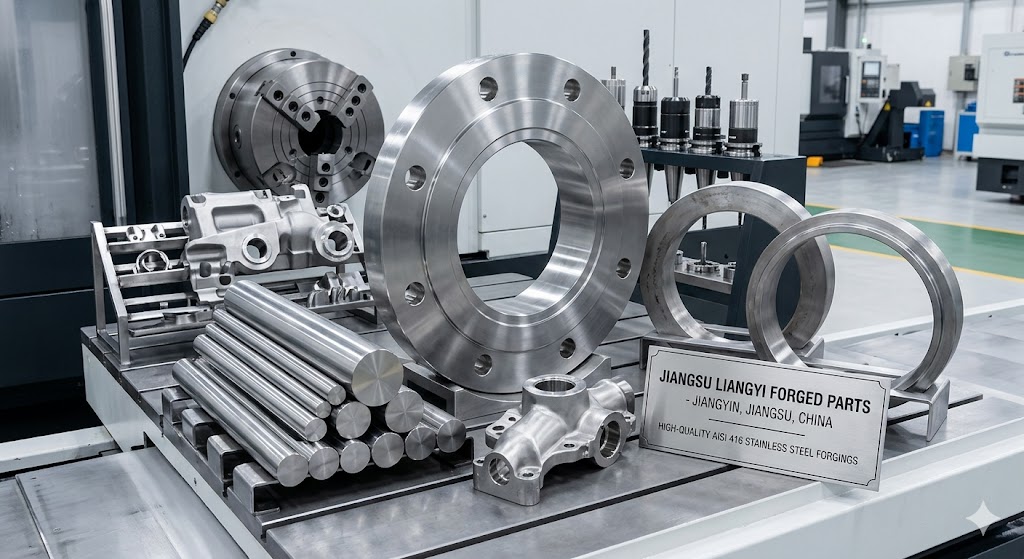
Jiangsu Liangyi Co., Limited, located in Jiangyin City, Jiangsu Province, China, is a professional ISO 9001:2015 certified manufacturer specializing in high-quality AISI 416, UNS S41600, Grade 416, and Alloy 416 open die forging parts and seamless rolled steel forged rings. With over 25 years of specialized manufacturing experience and an annual production capacity of 120,000 tons, we supply precision-engineered custom forged parts to customers in more than 50 countries across North America, Europe, Asia, and the Middle East.
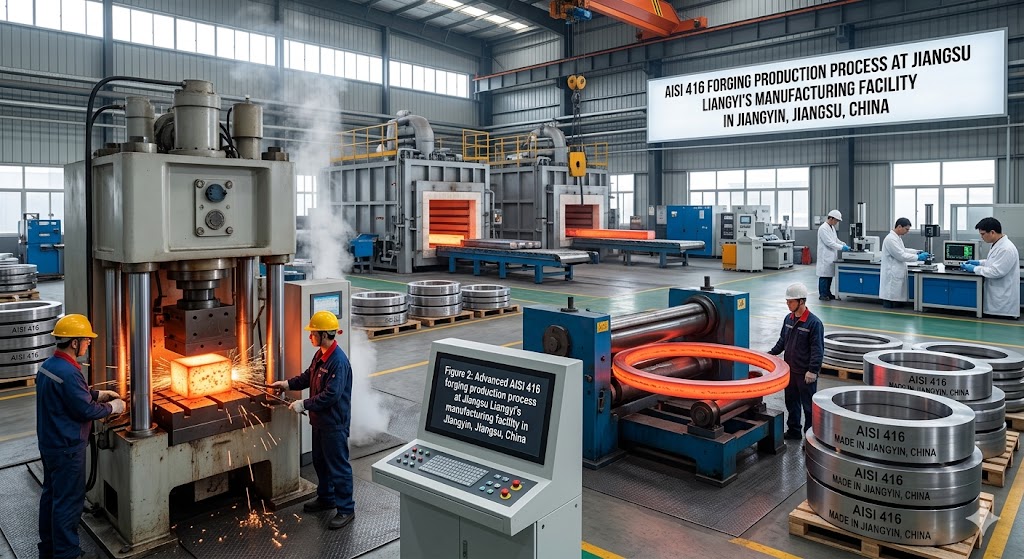
Our mordern prodution plant is located in Jiangyin, Jiangsu, China. Our factory has advanced forging equipment including 2,000–6,000-ton hydraulic presses, 5-meter seamless rolling machines, and comprehensive heat treatment furnaces. We can produce AISI 416 stainless steel forgings ranging from 30 kg to 30,000 kg per piece, with seamless rolled rings up to 6 meters in diameter and shafts up to 15 meters in length. Every UNS S41600 forging we produce passes through rigorous quality inspection to make sure all parts meet international standards including ASTM, AMS, AISI, API 6A, DIN, EN, and JIS.
Why Choose AISI 416 Stainless Steel for Your Forging Requirements?
AISI 416 is a free-machining martensitic stainless steel with an excellent machinability rating of 85%—the highest among all stainless steels. This remarkable material contains sulfur additions that form manganese sulfide inclusions, significantly improving chip breaking and tool life during machining operations. While the sulfur addition slightly reduces formability, weldability, and corrosion resistance compared to AISI 410, the trade-off is well worth it for applications that need mass production of precision parts. Due to its excellent machinability and cost-effectiveness, Grade 416 stainless steel can be used in tempered, hardened, or unhardened forms to meet different application needs.
Get a Custom Quote for AISI 416 Forging Parts Today
Send us your detailed drawings, material specifications, and quantity requirements for a detailed quotation within 24 hours. Our engineering team is ready to assist with your AISI 416 stainless steel forging project.
📧 Request a Quote NowOur Comprehensive AISI 416 Forging Capabilities
Jiangsu Liangyi has advanced forging technology and a skilled engineering team, and we can make all kinds of AISI 416 stainless steel forging products in different shapes and sizes to meet industrial needs. We also provide custom UNS S41600 forged parts with excellent quality.
Available AISI 416 Forged Product Shapes
Forged Bars & Rods
- AISI 416 forged steel round bars with diameters up to 2 meters
- Grade 416 square bars, flat bars, and rectangular bars are made in custom dimensions
- UNS S41600 custom length rods are sued for important industrial applications
- Alloy 416 step shafts, gear shafts, and spindles are forged based on clients specifications
Seamless Rolled Rings
- UNS S41600 seamless rolled rings up to 6 meters in diameter
- Grade 416 contoured and custom forged rings are made for important rotating applications
- AISI 416 seal rings, labyrinth rings, and gear rings are used for turbomachinery
- Alloy 416 pressure vessel rings and flange blanks are made for oil and gas applications
Hollow Forgings
- AISI 416 forged steel hubs, housings, shells, and sleeves with OD up to 3,000 mm
- Grade 416 bushes, bushings, and cases are used for different industrial equipment
- UNS S41600 hollow bars and heavy-wall cylinders are used for high-pressure conditions
- Alloy 416 pump casings and valve bodies are used for fluid control systems
Discs, Plates & Blocks
- Alloy 416 forged discs, disks, and blocks in various thicknesses
- Grade 416 forged plates and flanges are made for structural applications
- AISI 416 single and double bossed blanks are used for custom machining
- UNS S41600 turbine discs and impeller blanks are used for power generation
Pipes & Tubes
- AISI 416 forged steel pipes, tubes, and tubings in various sizes
- Grade 416 piping shells, casings, and barrels are used for pressure systems
- UNS S41600 tube sheets, baffle plates, and nozzles are used for heat exchangers
- Alloy 416 heat exchanger components are made for thermal applications
Industrial Applications of AISI 416 Forging Parts
AISI 416 has excellent machinability, moderate corrosion resistance and good mechanical properties.So that it is the best choice material for a wide range of important industrial applications. Our precision-forged UNS S41600 parts are recognized by leading companies around the world in the following important sectors:
Valve Manufacturing Industry
AISI 416 is the most widely specified material for valve pats due to its exceptional machinability and excellent wear resistance. Our Grade 416 forged parts are used in different types of valves for oil and gas, petrochemical, power generation and other inderstrial conditions.
- AISI 416 valve balls, bonnets, bodies, and stems are used for various valve types
- Grade 416 valve closures, seat rings, cores, and discs are used for important sealing applications
- UNS S41600 parts for H-type two-way, one-way, and back pressure valves
- Alloy 416 ball valves, check valves, gate valves, and globe valves parts
- AISI 416 butterfly valve main shafts and spindles are used for flow control
- Grade 416 cryogenic high-performance butterfly valve shafts are used for low-temperature service
- UNS S41600 oil measurement valve spools and ultrasonic flow meter bodies
Power Generation Industry
Our AISI 416 forged parts are used in both fossil fuel and nuclear power plants for important rotating and pressure applications. The material is easy to machine,so that it can be made into turbine and generator parts.
- AISI 416 nuclear power reactor coolant pump rotors, impellers, and casings
- Grade 416 containment seal chambers for nuclear reactors
- UNS S41600 gas and steam turbine disks, impellers, and blisks
- Alloy 416 turbine blades, guide rings, and seal rings
- AISI 416 labyrinth rings, packing seals, and diaphragm rings
- Grade 416 gas turbine LPT 1st and 2nd stage turbine casings
- UNS S41600 power plant steam turbine control and reheat valve discs
- Alloy 416 gas and steam turbine valve spindles, stems, and rods
- AISI 416 MSV/GV/CV/CRV valve seats, cores, and sleeves
- Grade 416 main steam valve covers and bonnets
Oil & Gas Industry
AISI 416 forged parts are important parts for downhole drilling and production equipment in the oil and gas industry. The material has good strength and excellent machinability,so that it is suitable for different downhole applications:
- AISI 416 downhole drilling tool mud motor splined drive shafts
- Grade 416 downhole electric submersible pump (ESP) motor splined shafts
- UNS S41600 double studded adapter flanges are used for pressure connections
- Alloy 416 pressure vessel and reactor nozzles
- AISI 416 components for wellhead equipment and Christmas trees
- Grade 416 flow control components for pipelines
Compressor & Turbomachinery Industry
Our Grade 416 forgings are used in different types of compressors and turbomachinery for industrial and aerospace applications. The material has excellent machinability so that it can be made into impeller and blade geometries:
- AISI 416 gas and air compressor rotors
- Grade 416 turbo centrifugal compressor impellers and shrouded impellers
- UNS S41600 turbine and compressor labyrinth shaft seals
- Alloy 416 venturi cone meter bodies and blocks
- AISI 416 industrial gas turbine components
Pump Manufacturing Industry
AISI 416 is used in pump manufacturing due to its good strength properties and excellent machinability. Our UNS S41600 pump parts are used for different types of industrial pumps:
- AISI 416 pump casings, covers, and barrels
- Grade 416 pump impellers, shafts, and housings
- UNS S41600 pump shells, bodies, and wear rings
- Alloy 416 centrifugal pump and positive displacement pump components
General Engineering Applications
- AISI 416 double-headed studs and fasteners are used for various industries
- Grade 416 boiler, heat exchanger, and pressure vessel components
- UNS S41600 transition cones and custom forged parts
- Alloy 416 gear blanks and transmission components
Material Properties of AISI 416 Stainless Steel
AISI 416 (UNS S41600) is a free-machining martensitic stainless steel, it has the highest machinability rating among all stainless steel at 85% , which is got by adding 0.15–0.35% sulfur which form manganese sulfide inclusions within the steel. Its excellent machinability rating of 85% is the highest among all stainless steels, so that it is the best choice material for applications that need extensive machining. The sulfur addition in Grade 416 improves machinability by forming manganese sulfide inclusions that act as chip breakers and reduce tool wear. While this sulfur addition slightly reduces formability, weldability, and corrosion resistance compared to Grade 410, the trade-off is highly beneficial for high-volume production environments. Due to its excellent machinability and cost-effectiveness, UNS S41600 is used in highly tempered, hardened, or unhardened conditions to meet different application needs.
AISI 416 vs Other Stainless Steels — Material Comparison
Among commonly used stainless steels, AISI 4 16 has the best machinability (85%) at the lowest cost, but trades corrosion resistance and weldability against AISI 410 and AISI 304.
| Material Property | AISI 416 | AISI 410 | AISI 304 |
|---|---|---|---|
| Machinability Rating | 85% (Excellent) | 55% (Good) | 50% (Moderate) |
| Corrosion Resistance | Moderate | Good | Excellent |
| Weldability | Poor | Fair | Excellent |
| Maximum Hardness (HB) | ≤ 260 | ≤ 250 | ≤ 200 |
| Relative Cost | Low | Medium | High |
| Magnetic Properties | Magnetic | Magnetic | Non-magnetic |
| Heat Treatable | Yes | Yes | No |
Chemical Composition of AISI 416 (UNS S41600)
| Chemical Element | Minimum % | Maximum % |
|---|---|---|
| Carbon (C) | 0.09 | 0.15 |
| Silicon (Si) | 0 | 1.00 |
| Manganese (Mn) | 0 | 1.50 |
| Nickel (Ni) | 0 | 1.00 |
| Chromium (Cr) | 11.50 | 14.00 |
| Molybdenum (Mo) | 0 | 0.60 |
| Phosphorus (P) | 0 | 0.06 |
| Sulfur (S) | 0.15 | 0.35 |
Mechanical Properties of AISI 416 by Heat Treatment Condition
AISI 416 tensile strength ranges from ≥517 MPa (annealed) up to ≥1,030 MPa (hardened and low-temperature tempered), making sure engineers can get a wide range of strength and ductility combinations simply by adjusting the heat treatment .
AISI 416 can be supplied and heat-treated in several conditions to get different combinations of strength, hardness, and ductility. The following table summarizes the different mechanical properties in each condition, allowing engineers to select the correct delivery state for their application.
| Property | Annealed | Hardened & Tempered (HT — Low Temp) | Hardened & Tempered (HT — High Temp) |
|---|---|---|---|
| Tensile Strength Rm (MPa) | ≥ 517 | ≥ 1030 | ≥ 793 |
| Yield Strength Rp0.2 (MPa) | ≥ 275 | ≥ 862 | ≥ 621 |
| Elongation A (%) | ≥ 30 | ≥ 15 | ≥ 20 |
| Reduction of Area (%) | ≥ 50 | ≥ 45 | ≥ 55 |
| Hardness (HB) | ≤ 260 | 285 – 340 | 230 – 285 |
| Hardness (HRC approx.) | ≤ 27 | 29 – 36 | 22 – 29 |
| Charpy Impact (J, room temp) | ≥ 68 | ≥ 27 | ≥ 54 |
| Fatigue Strength (MPa, 10⁷ cycles) | ~240 | ~450 | ~340 |
Note: Values are representative different properties for forged AISI 416 (UNS S41600). Actual values depend on section size, exact heat treatment cycle, and testing location. Jiangsu Liangyi provides full mechanical testing reports with every shipment.
Physical Properties of AISI 416 Stainless Steel
AISI 416 has a density of 7.70 g/cm³, elastic modulus of 200 GPa, and thermal conductivity of 24.9 W/(m·K) at 100 °C, its thermal conductivity
is about 60% higher than austenitic grades like AISI 304 (16.2 W/(m·K)).
Physical properties of AISI 416 are important for thermal and structural calculations in engineering design. The following values apply to the annealed condition at or near room temperature unless otherwise noted.
| Physical Property | Value | Unit |
|---|---|---|
| Density | 7.70 | g/cm³ |
| Elastic Modulus (Young's Modulus) | 200 | GPa |
| Shear Modulus | 80 | GPa |
| Poisson's Ratio | 0.28 | — |
| Thermal Conductivity (at 100 °C) | 24.9 | W/(m·K) |
| Specific Heat Capacity | 460 | J/(kg·K) |
| Thermal Expansion Coefficient (20–100 °C) | 9.9 | 10⁻⁶/°C |
| Thermal Expansion Coefficient (20–315 °C) | 10.8 | 10⁻⁶/°C |
| Electrical Resistivity (at 20 °C) | 0.57 | μΩ·m |
| Magnetic Permeability | Ferromagnetic (fully magnetic) | — |
| Melting Range | 1480 – 1530 | °C |
Heat Treatment Specifications for AISI 416 (UNS S41600)
AISI 416 can be annealed at 815–900 °C for maximum softness (≤217 HB), or hardened by austenitizing at 925–1,010 °C and tempering outside the 370–565 °C embrittlement zone to get 22–42 HRC depending on application.
Unlike austenitic stainless steels, AISI 416 responds to heat treatment and can be hardened to significantly higher strength levels. The correct heat treatment sequence depends on the intended application. We can supply Grade 416 forgings in any of the following conditions, with full process documentation and heat treatment records.
Annealing (Softening)
- Temperature: 815 – 900 °C (1500 – 1650 °F)
- Cooling: Slow furnace cooling to below 595 °C (1100 °F), then air cool — or direct air cooling for thin sections
- Purpose: Produce maximum softness and ductility; restore formability after cold working; delete residual stress
- Resulting hardness: Typically ≤ 217 HB (≤ 97 HRB)
Hardening (Austenitizing + Quenching)
- Austenitizing temperature: 925 – 1010 °C (1700 – 1850 °F)
- Soak time: The minimum is 30 minutes after reaching temperature (longer for large-section forgings)
- Quench medium: Air, oil, or interrupted quench, the actual medium depends on section size
- As-quenched hardness: about 38 – 42 HRC
- Important: Forgings must be tempered immediately after quenching to avoid cracking
Tempering (After Quenching)
Tempering temperature directly controls the final hardness and mechanical properties. Note: Tempering between 370 and 565 °C should be avoided, as this causes temper embrittlement and greatly lowers impact toughness.
| Tempering Temperature | Approx. Hardness (HRC) | Approx. Hardness (HB) | Typical Application |
|---|---|---|---|
| 150 – 200 °C (300 – 390 °F) | ~40 – 42 | ~375 – 395 | Maximum hardness / wear parts |
| 260 – 370 °C (500 – 700 °F) | ~36 – 40 | ~335 – 375 | High hardness fasteners, valve balls |
| ⚠ 370 – 565 °C — AVOID (embrittlement zone) | — | — | Low toughness; not recommended |
| 565 – 650 °C (1050 – 1200 °F) | ~22 – 29 | ~230 – 285 | Balanced strength + toughness (shafts, turbine parts) |
| 650 – 760 °C (1200 – 1400 °F) | ~18 – 22 | ~195 – 230 | Maximum toughness / ductility |
Stress Relieving
- Temperature: 150 – 370 °C (300 – 700 °F) for hardened parts; 650 – 760 °C (1200 – 1400 °F) for annealed parts
- Purpose: Relieve residual machining or fabrication stresses without significant change to mechanical properties
- Cooling: Air cool
International Equivalent Grades for AISI 416
AISI 416 (UNS S41600) is designated EN 1.4005 / X12CrS13 in Europe, JIS SUS 416 in Japan, GB/T Y1Cr13 in China, and AMS 5610 in aerospace specifications — All refer to the same free-machining martensitic stainless steel containing 11.5–14% chromium and 0.15–0.35% sulfur.
AISI 416 (UNS S41600) is recognized under many national and international designation systems. The following table provides the equivalent standard designations to facilitate procurement, cross-referencing, and documentation.
| Standard / Country | Designation | Notes |
|---|---|---|
| AISI / SAE (USA) | 416 / S41600 | UNS S41600; AISI Type 416 |
| EN / DIN (Europe) | 1.4005 / X12CrS13 | EN 10088; near-equivalent to DIN X12CrMoS17 (1.4104) with Mo addition |
| BS (United Kingdom) | 416 S21 | BS 970 Part 1 (withdrawn; superseded by EN 10088) |
| JIS (Japan) | SUS 416 | JIS G 4303 / JIS G 4318 |
| GB / GB/T (China) | Y1Cr13 | GB/T 1220; free-cutting stainless steel (易切削不锈钢) |
| GOST (Russia) | 12X13 | Approximate equivalent; lower sulfur content |
| AMS (Aerospace) | AMS 5610 | Bar, wire, forgings (condition A — annealed) |
| ASTM | A 582 / A 276 / A 314 | A 582: free-machining bar; A 314: forging billets |
Corrosion Resistance of AISI 416
AISI 416 contains 11.5–14% chromium, so that it has good corrosion resistance in mild air, fresh water, and petroleum environments.
However, the added sulfur lowers its resistance to pitting corrosion in chloride environments, so it is not suitable for use in seawater or strong acidic conditions.
While AISI 416's primary advantage is machinability, but it still has great corrosion resistance in many environments because of its chromium content of 11.5–14% Knowing the limits of that protection is very important when chosse the right material.
Suitable Corrosive Environments
- Mild atmospheric exposure: Performs well in rural and urban atmospheres; will develop surface rust in high-humidity or marine environments
- Fresh water: It has good resistance to potable water, cooling water, and steam at moderate temperatures
- Mildly acidic media: It has acceptable resistance in dilute organic acids (acetic, citric) and weakly oxidizing acid solutions
- Petroleum and hydrocarbon media: It has good resistance in oil and gas valve and downhole parts
- Alkalis and bases: Its resistance to dilute caustic solutions is satisfied
Environments to Avoid
- Chloride-containing environments: It is easy to pitting and crevice corrosion; so it is not recommended for seawater immersion or high-chloride process streams
- Sulfuric acid: It has poor resistance in concentrations above ~5%, especially at elevated temperatures
- Hydrochloric acid: It is not suitable in any concentration
- Oxidizing acids (concentrated nitric acid): It is not recommended
- Elevated-temperature oxidizing service: Continuous use above 700 °C (1290 °F) causes scaling; sensitization range 425 – 870 °C may reduce corrosion resistance
Corrosion Resistance Comparison
| Corrosion Type | AISI 416 | AISI 410 | AISI 316 |
|---|---|---|---|
| General / Atmospheric | Moderate | Good | Excellent |
| Pitting (Chloride) | Poor | Fair | Very Good |
| Crevice Corrosion | Poor | Fair | Good |
| Stress Corrosion Cracking | Low susceptibility (martensitic) | Low susceptibility | Susceptible in hot chloride |
| Petroleum / Hydrocarbon | Good | Good | Excellent |
| Fresh Water | Good | Good | Excellent |
Grade Selection Guide — AISI 416 vs Alternative Materials
Choose AISI 416 when easy maching and low cost are your main concern; choose AISI 410 for better corrosion resistance and weldability, choose AISI 420 for maximum hardness, or 17-4PH for high-strength corrosion-resistant applications.
Selecting the right stainless steel grade for a forging application means balancing machinability, corrosion resistance, strength, and cost. The following guide covers the most common grade choices engineers make when selecting AISI 416.
AISI 416 vs AISI 410
Choose AISI 416 when the application needs CNC machining, high production volumes, or tight tolerances. The 85% machinability rating of 416 versus 55% for 410 translates directly into faster cycle times, lower tool costs, and better surface finish.
Choose AISI 410 when great corrosion resistance is needed(seawater service, acid exposure), or when welding is part of the fabrication process. AISI 410's lower sulfur content gives it better weldability and slightly higher pitting resistance.
AISI 416 vs AISI 420
Choose AISI 416 when machinability is the primary concern and moderate hardness (up to ~40 HRC) is sufficient. AISI 416 offers easier machining and lower material cost.
Choose AISI 420 when the maximum hardness is needed. AISI 420 contains higher carbon (0.15–0.40%) and can be hardened to 50–55 HRC, making it the choice for cutlery, surgical instruments, and high-wear applications where hardness outweighs machinability.
AISI 416 vs 17-4PH (UNS S17400)
Choose AISI 416 when cost is a major constraint, machinability is paramount, and the service environment does not demand high strength combined with corrosion resistance. AISI 416 is significantly less expensive than 17-4PH.
Choose 17-4PH when the application needs a combination of very high strength (up to 1310 MPa tensile in Condition H900), good corrosion resistance, and reasonable toughness that cannot be got with AISI 416. Different applications include aerospace structural parts, oil & gas downhole tools in sour-service environments, and high-performance pump shafts where AISI 416 lacks sufficient corrosion protection.
AISI 416 vs AISI 316
Choose AISI 416 when strength, hardness, and machinability are more important than corrosion resistance. AISI 416 is heat-treatable (AISI 316 is not) and offers much higher hardness and wear resistance.
Choose AISI 316 when the service environment has chloride-containing media, marine atmospheres, pharmaceutical or food-grade processes, or strong acids where AISI 416's moderate chromium level and sulfur additions would cause unacceptable pitting or general corrosion.
Our Quality Assurance & Manufacturing Process
At Jiangsu Liangyi Co., Limited, quality is the foundation of our business. All our AISI 416, UNS S41600, Grade 416, and Alloy 416 forged materials are made based on strict international standards including ASTM, AMS, AISI, API 6A, DIN, EN, and JIS. We have implemented a full quality management system certified to ISO 9001:2015, and our manufacturing processes are continuously monitored and improved to make sure all parts have the highest quality. Our company has advanced inspection and testing equipment to test every stainless steel forging.
Comprehensive Manufacturing Process Plan (MPP)
Each production batch of AISI 416 forgings includes a detailed Manufacturing Process Plan (MPP) that covers all important aspects of production:
- Reference documents and customer specifications including material standards, dimensional tolerances, and technical requirements
- Checking operations with acceptance criteria and applicable frequencies for each production stage
- Detailed list of manufacturing process steps from steel melting to final inspection
- Critical parameters including temperature and holding time for heat treatments
- Manufacturing plants and subcontractor information (if applicable)
- Forge study simulation to optimize material flow and grain structure
- Fibering analysis to make sure grain flow orientation is good
- Reduction ratio calculations to verify adequate working of the material
Rigorous Inspection & Testing Procedures
Every finished AISI 416 forging part is tested strictly before shipment. Following are our full inspection reports:
- Chemical composition analysis from both the part sampling area and sample ingot using advanced spectrometry
- Mechanical properties testing from both the part sampling area and sample ingot including tensile, yield, and impact testing
- Hardness curve to characterize surface hardened areas and verify uniform heat treatment
- Roughness measurement results for machined surfaces
- Metallurgical analysis including microstructure evaluation, grain size measurement, and inclusion cleanliness assessment
- Complete heat treatment records documenting all thermal processes
- Non-destructive test (NDT) reports including Ultrasonic Testing (UT), Magnetic Particle Testing (MT), and Liquid Penetrant Testing (PT) as needed
- Mill Test Certificate (MTC) 3.1 / 3.2 as specified by the customer
Why Choose Jiangsu Liangyi as Your AISI 416 Forging Supplier?
- 25+ Years of Specialized Experience: We have over 25 years of expertise in manufacturing high-quality forged steel parts with a focus on stainless steel materials
- Advanced Manufacturing Equipment: We have state-of-the-art forging, heat treatment, and inspection equipment in our modern facility in Jiangyin, Jiangsu, China
- Large Production Capacity: We have annual production capacity of 120,000 tons with the ability to handle both small and large volume orders
- Custom Forging Solutions: We specialize in producing custom AISI 416 forged parts according to your exact drawings and specifications
- Strict Quality Control: ISO 9001:2015 certified with a full quality management system and rigorous inspection procedures
- Competitive Pricing: We provide direct-from-manufacturer pricing with no middlemen, making sure your investment is in excellent value
- Fast & Reliable Delivery: We provide efficient production planning and streamlined processes make sure all parts can be delivered on time to customers .
- Global Customer Service: We have exported to more than 50 countries across North America, Europe, Asia, and the Middle East
- Complete Documentation: Full mill test certificates and inspection reports are provided with every shipment
- Technical Expertise: Experienced engineering team is ready to assist with material selection, design optimization, and technical support
🌍 We Serve Customers Worldwide
- United States
- Germany
- United Kingdom
- France
- Italy
- Netherlands
- Australia
- Canada
- Japan
- South Korea
- Brazil
- India
- Saudi Arabia
- UAE
- China
- And 50+ more countries
Case Studies — AISI 416 Forging Projects by Jiangsu Liangyi
The following case studies illustrate how Jiangsu Liangyi has solved real engineering and procurement challenges for customers across many industries. Each project demonstrates our technical capability, quality commitment, and ability to deliver AISI 416 (UNS S41600) forgings on schedule.
High-Volume Butterfly Valve Shaft Forgings for a European Valve Manufacturer
A top German valve manufacturer that provides cryogenic high-performance butterfly valves to LNG terminals throughout Europe required a dependable long-term supplier for AISI 416 (EN 1.4005) butterfly valve main shafts. The shafts had diameters from Ø50 mm to Ø180 mm and lengths from 400 mm to 900 mm.The important bearing journals demanded tight dimensional tolerances of ±0.05 mm, and the hardness after quenching and tempering was 28–32 HRC.The annual volume was about 2,400 pieces across 12 different size specifications.
The customer’s previous European supplier struggled to maintain consistent hardness along the entire shaft length, with hardness variations as large as ±5 HRC between the journal areas and the middle section. This led to premature wear failures in cryogenic applications.
In addition, the supplier’s 14-week lead time could not meet the customer’s 6-week delivery schedule. Switching suppliers needed full re-qualification, including material certification based on DIN EN 10250-4 and third-party inspection by TÜV.
Jiangsu Liangyi performed a forging simulation for each shaft size to optimize the billet reduction ratio, ensuring a minimum ratio of 4:1 to achieve a fine and uniform grain structure.Heat treatment was carried out in a computer-controlled batch furnace with independent thermocouple monitoring across six zones,delivering temperature uniformity of ±8 °C — well within the required ±15 °C tolerance.For quenching, a programmed oil-quench system with controlled agitation was used to reduce thermal gradients across different cross-sections.Every shaft was 100% inspected for hardness distribution (Brinell test at 5 measuring points per part) before shipment.MTC 3.2 documentation with TÜV witnessed inspection was provided for the qualification batch.
AISI 416 Seamless Rolled Rings for Steam Turbine Labyrinth Seals — Power Generation
A South Korean engineering contractor in charge of overhauling a 600 MW steam turbine at a coal-fired power plant needed a set ofAISI 416 seamless rolled labyrinth seal rings and packing seal rings as replacement parts.The set included 36 pieces in 8 different sizes, ranging from Ø680 mm × 80 mm to Ø2,100 mm × 120 mm.The material was specified as JIS G 4303 SUS 416 with mechanical properties conforming to ASTM A 276, hardness 22–28 HRC in quenched and tempered condition.UT inspection was mandatory based on ASTM A 388, Level C acceptance criteria.Delivery had to be completed within 10 weeks to match the scheduled turbine outage window.
This project faced three key challenges.First, dimensional precision: the largest ring at Ø2,100 mm required roundness ≤1.5 mm and face flatness ≤0.5 mm in the as-rolled condition before finish machining — a very strict requirement for such a large-diameter ring.Second, ultrasonic testing: the relatively thin wall thickness (80–120 mm) combined with free-machining sulfide inclusions in AISI 416 produces high UT background noise, which can hide real flaws. Careful calibration of the UT procedure was important to avoid both false rejects and undetected defects.Third, the 10-week delivery schedule allowed no time for rework, demanding first-pass acceptable quality.
Jiangsu Liangyi assigned a dedicated project engineer to coordinate forging simulation, ring rolling scheduling, and heat treatment in parallel (instead of sequentially), shortening the total production timeline by 18 days.For the large Ø2,100 mm ring, pre-rolling forging simulation determined the optimal billet weight and aspect ratio to meet the required roundness without excessive machining stock.The 5-meter seamless ring rolling mill’s real-time diameter monitoring system controlled the growth rate in final passes, achieving ±0.8 mm roundness on the as-rolled blank.For ultrasonic testing, a custom calibration block was produced from the same AISI 416 heat lot, eliminating acoustic variation errors.The customer’s third-party inspector (Korean classification society surveyor) witnessed all UT and hardness tests on-site before shipment.
AISI 416 Mud Motor Splined Drive Shafts for Downhole Drilling Tools — Oil & Gas
A US-based downhole tool manufacturer specializing in positive-displacement mud motors (PDMs) for directional drilling needed a stable supply of AISI 416 forged steel splined drive shafts in two standard sizes: Ø76.2 mm (3") × 1,250 mm and Ø101.6 mm (4") × 1,600 mm.These splined drive shafts transfer torque from the power section of the mud motor to the bit sub under high cyclic loads, while also resisting bending stresses caused by wellbore curvature in directional drilling.The parts must be made from forged bar stock meeting AMS 5610, quenched and tempered to 32–36 HRC, tested by magnetic particle inspection (MT) per ASTM E709, and be tested in dimension of spline profiles.
The combined annual volume for both sizes is 600–800 pieces under a pull-on-demand arrangement, which requires a 6–8 week inventory buffer to be kept in stock at the Jiangsu Liangyi warehouse.
Splined drive shafts used in directional wells word under extreme harsh fatigue conditions.Each rotation creates a full bending reversal at the dogleg angle, combined with torsional loads from the drill bit.At 32–36 HRC, any surface defects, tool marks, or decarburization caused by heat treatment act as stress raisers and severely shorten fatigue life.The customer had previously suffered premature shaft failures with another Chinese supplier, due to poor decarburization control during heat treatment.A soft surface layer of 0.3–0.5 mm reduced effective fatigue strength by roughly 20%.Furthermore, the pull-on-demand model required Jiangsu Liangyi to maintain safety stock and manage restocking independently, calling for a strict and reliable inventory management system.
To delete decarburization, Jiangsu Liangyi adjusted the heat treatment atmosphere process: All austenitizing and tempering for this project are carried out in an endothermic atmosphere furnace with carbon potential control, maintaining a neutral carbon potential (Cp = 0.10–0.15%) matching the base carbon content of AISI 416. Post heat treatment, hardness is checked on a sample bar from each batch — both at the surface and at 1.5 mm depth — with a maximum allowed surface-to-core hardness difference of 2 HRC. Every shaft undergoes 100% magnetic particle testing per ASTM E709; any linear indication results in immediate rejection.A dedicated account manager tracks the customer’s 8-week rolling consumption data shared monthly, initiates production to keep the needed safety stock, and sends shipment notifications within 48 hours of dispatch.
Frequently Asked Questions About AISI 416 Forging Parts
AISI 416 stainless steel is used for applications that need excellent machinability combined with moderate corrosion resistance and good mechanical properties. Common uses include valve parts, pump parts, turbine blades, fasteners, gear shafts, and other general engineering parts. Due to its excellent machinability, it is the best choice material for high-volume production environments where machining efficiency and tool life are important considerations.
Yes, AISI 416 is a type of martensitic stainless steel that is completely magnetic in all heat treatment conditions.This magnetic property can be helpful in some situations where you need to use magnetic attraction to move or put things together.In the annealed state, austenitic stainless steels like AISI AISI 304 and AISI 316, on the other hand, do not have any magnetic properties.
Yes, AISI 416 can be hardened by heat treatment through quenching and tempering processes. As a martensitic stainless steel, it responds well to heat treatment, allowing it to get higher strength, hardness, and wear resistance properties. The exact heat treatment parameters depend on the specific application requirements, but different hardness ranges from 260 HB in the annealed condition up to approximately 40 HRC after quenching and tempering.
The sulfur content is the main difference between AISI 416 and AISI 410.AISI 416has a lot more sulfur (0.15–0.35%) than AISI 410 (≤0.03%). The higher sulfur content in AISI 416 creates manganese sulfide inclusions that make it much easier to machine (85% vs. 55% for 410). But there is a small trade-off: AISI 416 is not as resistant to corrosion, is not as easy to shape, and is not as easy to weld as AISI 410.You should choose between the two based on whether you need more machinability or corrosion resistance for your specific use.
Our AISI 416 forgings meet all important international standards including ASTM (American Society for Testing and Materials), AMS (Aerospace Material Specifications), AISI (American Iron and Steel Institute), API 6A (American Petroleum Institute), DIN (German Institute for Standardization), EN (European Norm), and JIS (Japanese Industrial Standards). We can also produce forgings to meet specific customer standards and requirements. All our materials are supplied with complete certification documentation.
At Jiangsu Liangyi, we can produce AISI 416 forgings ranging from 30 kg up to an impressive 30,000 kg (30 tons) per piece. Our capabilities include seamless rolled rings up to 6 meters in diameter, forged shafts up to 15 meters in length, and forged round bars up to 2 meters in diameter. We have advanced forging equipment, including 2,000–6,000-ton hydraulic presses and 5-meter seamless rolling machines, so that we can handle both small precision parts and very large forgings.
Yes, we provide full in-house machining services for AISI 416 forgings. We have advanced CNC machinery including CNC lathes, CNC milling machines, CNC machining centers, and other precision equipment. We can supply AISI 416 parts in different conditions: as-forged, rough machined, semi-finished, or fully finished to your exact specifications. This one-stop solution from forging to finishing makes sure all parts have consistent quality and streamlined production for our customers.
The lead time for AISI 416 forging parts depends on clients drawings, quantity and machining requirements.For standard forgings, the normal lead time is 4–6 weeks. For special custom forgings that need extensive machining, special heat treatments, or non-destructive testing, the lead time may be 6–8 weeks or longer. We always provide accurate lead time estimates in our quotations and maintain close communication with customers to fulfill their delivery requirements.
Yes, we can arrange third-party inspection for your AISI 416 forgings through well-known independent organizations including SGS, Bureau Veritas (BV), TÜV, Lloyd's Register or any other accredited agency you specify.Third-party inspection covers dimension test, material certificate review, mechanical property testing, non-destructive testing (NDT), and heat treatment witnessing.We have extensive experience cooperating with all major inspection companies and can fully coordinate the entire inspection process on your behalf.
Absolutely! We specialize in manufacturing custom AISI 416 forgings based on your drawings and specifications.
Our professional engineering team supports you from the early design phase to optimize the forging matrix for better manufacturability, cost efficiency and performance. We accept drawings in all common formats, including CAD, PDF and 3D solid models. Whether you need a single prototype or full-scale production runs, we have the capacity and expertise to deliver high-quality custom AISI 416 forged parts that precisely meet your requirements.
References & Official Standards
All technical data on this page is based on official ASTM, AMS, EN, and JIS standards, supplemented by peer-reviewed material science references — making sure every specification cited is traceable to a primary authoritative source. The following standards and references govern the composition, testing, supply, and qualification of AISI 416 (UNS S41600) stainless steel forgings.
Primary Material & Forging Standards
Standard Specification for Free-Machining Stainless Steel Bars. The primary US product standard governing the chemical composition and surface condition of AISI 416 bar stock.
Standard Specification for Stainless Steel Bars and Shapes. Covers dimensional tolerances, finish requirements, and mechanical properties testing for AISI 416 bar forms.
Standard Specification for Stainless Steel Billets and Bars for Forging. Governs the input material requirements for AISI 416 forging billets, including chemical analysis and surface inspection.
Standard Practice for Ultrasonic Examination of Steel Forgings. Defines acceptance criteria for UT inspection of heavy stainless steel forgings including AISI 416 seamless rings and shafts.
Steel, Corrosion-Resistant, Bars, Wire, and Forgings, 12.5Cr (AISI 416 composition), Annealed. The aerospace material specification governing AISI 416 forgings for aerospace and defense applications.
Stainless steels — Part 3: Technical delivery conditions for semi-finished products, bars, rods, wire, sections and bright products of corrosion resisting steels for general purposes. Covers EN 1.4005 (equivalent to AISI 416).
Stainless Steel Bars. The Japanese Industrial Standard that defines chemical composition, mechanical properties, and testing requirements for SUS 416 (the Japanese equivalent of AISI 416).
Specification for Wellhead and Tree Equipment. Governs material, testing, and traceability requirements for AISI 416 forged parts used in wellhead valves, Christmas trees, and downhole equipment.
Authoritative Third-Party Technical References
ASM International's Metals Handbook (Vol. 2 and Vol. 9) provides peer-reviewed data on AISI 416 physical properties, corrosion behavior, microstructure, and heat treatment response. Widely cited in engineering literature as the primary reference for martensitic stainless steel data. ASM International, Materials Park, Ohio, USA.
The US National Institute of Standards and Technology maintains traceable reference data for stainless steel physical properties (density, thermal conductivity, elastic modulus, thermal expansion) used in engineering standards. NIST data underpins the calibration of test equipment used in quality inspection of AISI 416 forgings.
Note: Standard versions cited reflect editions current at the time of publication. Buyers should confirm the applicable revision with their procurement specification. Jiangsu Liangyi can supply forgings to any specific standard revision upon request.
Contact us today to discuss your specific AISI 416 forging requirements and get a free, no-obligation quotation. Our team of forging experts is ready to assist you.
📧 Contact Us NowContact Jiangsu Liangyi for AISI 416 Forging Quotations
Jiangsu Liangyi Co., Limited is your trusted partner for high-quality AISI 416 stainless steel forgings in China. We welcome your inquiries for custom forged parts according to your drawings and specifications. Our experienced team will provide excellent products and service to customers around the world from our strategic location in Jiangyin City, Jiangsu Province, China.
Jiangyin City, Jiangsu Province
People's Republic of China