AISI 4137 Alloy Steel Forging Parts: Manufacturer Overview
Founded in 1997 and headquartered in Jiangyin City, Jiangsu Province, China, Jiangsu Liangyi Co., Limited has spent nearly three decades establishing itself as one of Asia's most experienced producers of custom open die forgings, seamless rolled rings, and precision-machined alloy steel components. Our 80,000 sqm integrated manufacturing campus houses everything from electric arc furnace steelmaking through to CNC finish-machining and full-scale NDT laboratories, a capability set that eliminates sub-contracting risk and guarantees end-to-end traceability on every order.
Among the dozens of alloy grades we process daily, AISI 4137 chromium-molybdenum steel stands out as one of our highest-volume and most technically demanding materials. The grade's reputation for combining high tensile strength with genuinely robust toughness, a balance that simpler carbon steels or even AISI 4140 cannot always match, makes it the specification of choice for rotating-equipment shafts, wellhead valve bodies, wind turbine gear blanks, and large crusher eccentric shafts across six continents. Over our 26 years of operation we have shipped AISI 4137 forgings to buyers in the United States, Canada, Germany, the UK, Norway, Australia, Saudi Arabia, the UAE, Qatar, South Africa, Brazil, Singapore, Malaysia, and beyond, accumulating a supply record and metallurgical knowledge base that is genuinely difficult to replicate at competitive pricing.
Every AISI 4137 forging we manufacture, from a 30 kg bar section to a 30,000 kg main shaft, travels through the same rigorous quality gate: incoming steel chemistry verified by optical emission spectrometry, controlled-atmosphere forging to preserve grain structure, calibrated heat treatment documented to plus or minus 5 degrees Celsius, mechanical property testing on heat-representative coupons, full-body ultrasonic testing per ASTM A388, and final CMM dimensional verification. The outcome is a Mill Test Certificate satisfying EN 10204 3.1 (and 3.2 where third-party witness is required) and documentation packages that pass major EPC contractor and end-user audits worldwide.
AISI 4137 Forging: At-a-Glance Technical Reference
- AISI/SAE Designation: 4137 (also written SAE 4137, Alloy 4137, CrMo 4137)
- Primary Alloying: Chromium 0.80 to 1.10% + Molybdenum 0.15 to 0.25% + Carbon 0.35 to 0.40%
- Key Standards: ASTM A29/A29M, DIN 17200 (34CrMo4), EN 10083-3, JIS G4053 (SCM435), BS 970 (708M40)
- Tensile Strength (Q&T): 980 MPa minimum; up to 1,200 MPa on request
- Yield Strength (Q&T): 835 MPa minimum
- Elongation: 12% minimum | Reduction of Area: 45% minimum
- Charpy Impact at 20 C: 40 J minimum | Low-temp testing to minus 60 C available
- Hardness (Q&T): 280 to 320 HB standard; adjusted per application
- Single-Piece Weight Range: 30 kg to 30,000 kg
- Maximum Ring OD: 5,000 mm (seamless rolled rings)
- Maximum Shaft Length: Approx. 12,000 mm (open die forged)
- Annual Capacity: 120,000 metric tons
- Standard Lead Time: 15 to 30 days from drawing confirmation
- Certifications: ISO 9001:2015 | EN 10204 3.1 MTC standard (3.2 on request) | Manufacturable to API 6A material requirements
One-Stop Manufacturing
EAF steelmaking, open die forging, ring rolling, heat treatment, CNC machining, NDT, and shipment all under one roof, eliminating sub-contractor risk and ensuring complete process traceability
True OEM Capability
We manufacture to your 2D/3D drawings, tolerance stack-ups, and material specifications, not catalogue shapes. Our engineering team reviews DFM issues before forging starts to prevent costly surprises
Full Standards Coverage
ASTM, DIN, EN, JIS, NACE MR0175, BS 970, plus customer-specific specs from major OEMs in oil and gas, wind energy, mining, and power generation. We manufacture to API 6A material and dimensional requirements; customers apply their own API licence to the finished assembly.
Verified Global Track Record
26+ years, 50+ export countries, 120,000 tonnes per year capacity — backed by long-term repeat customers across six continents and auditable project references available on request
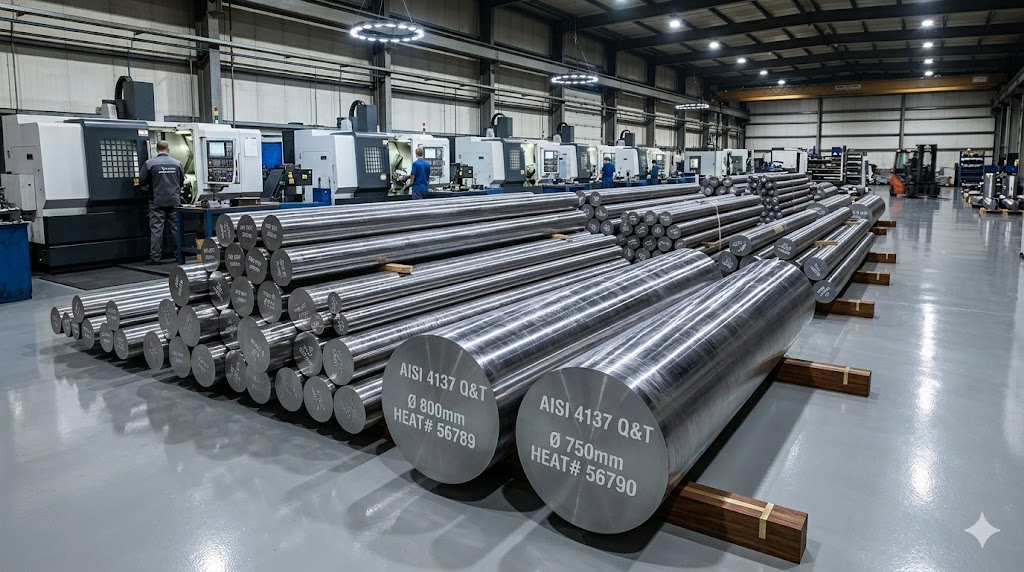
AISI 4137 Forged Round Bars
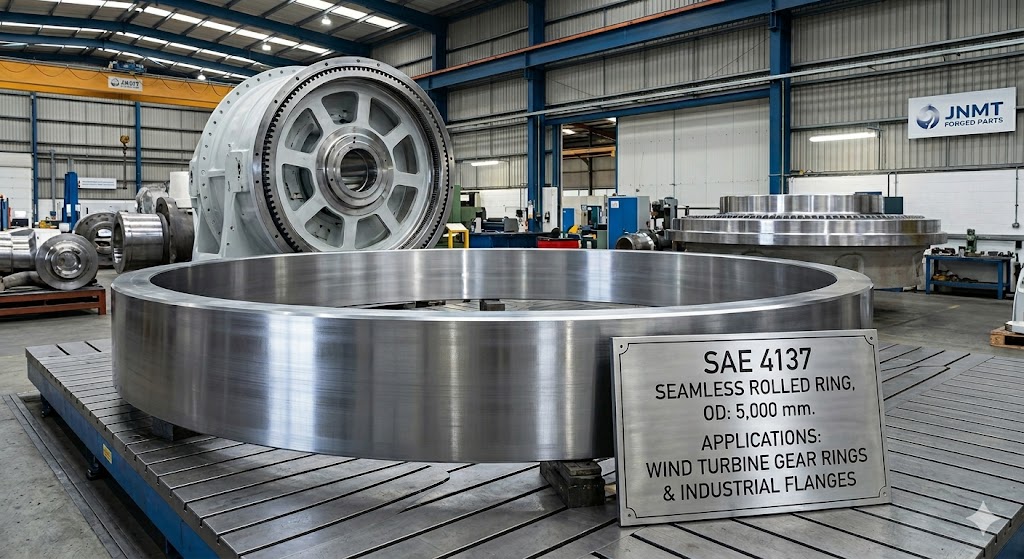
SAE 4137 Seamless Rolled Rings
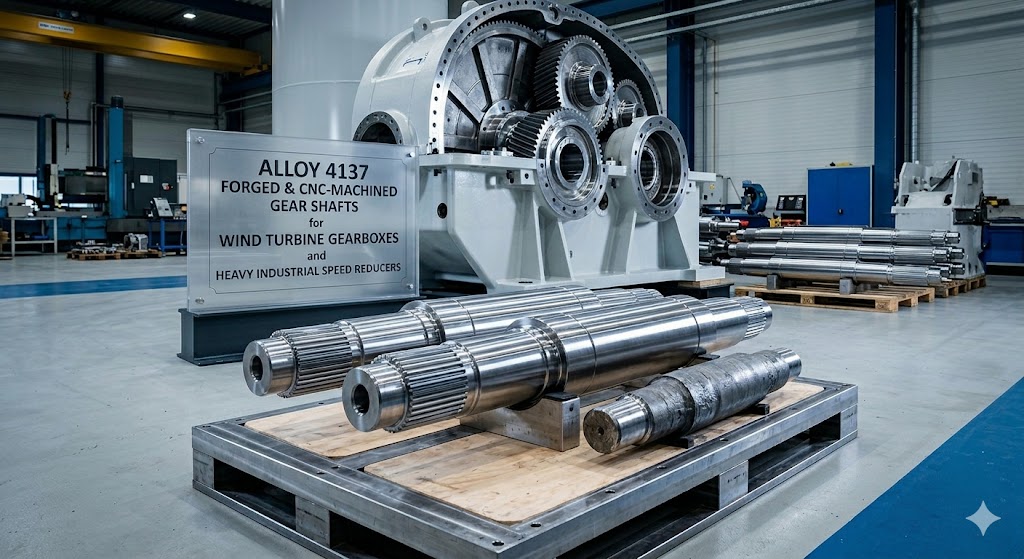
Alloy 4137 Forged Gear Shafts
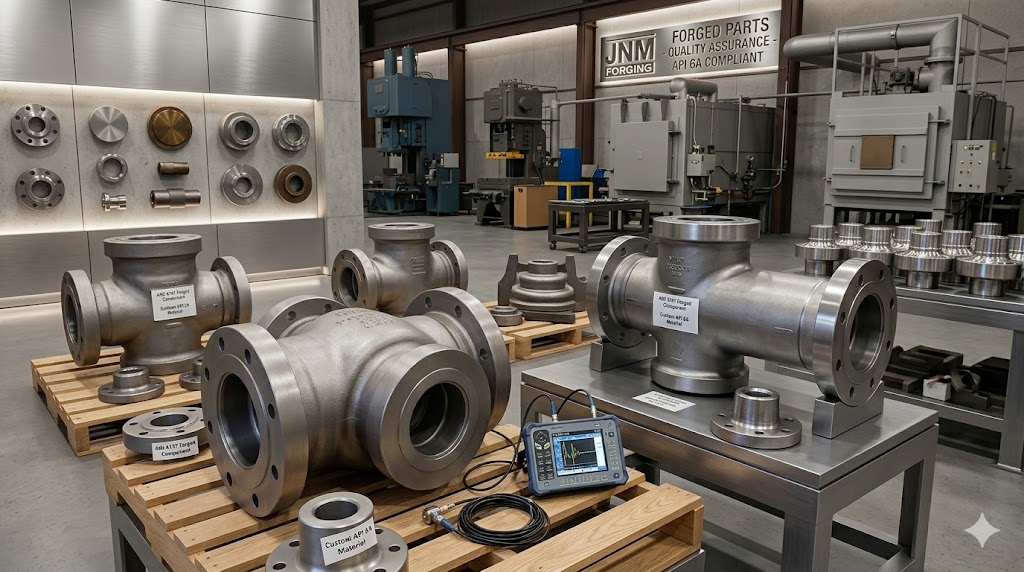
Custom AISI 4137 Forged Components
Why AISI 4137? A Metallurgist's Perspective on This Chromoly Grade
Many buyers specify AISI 4137 because an engineering drawing calls for it. Relatively few understand the metallurgical logic behind the grade, and that logic matters when selecting heat treatment conditions, specifying inspection thresholds, or troubleshooting a field failure. After processing thousands of 4137 forgings over 26 years, our technical team has distilled the key insights below.
The Role of Chromium in AISI 4137
The 0.80 to 1.10% chromium addition in AISI 4137 serves two distinct purposes. First, chromium increases the steel's hardenability, meaning its ability to transform from austenite to martensite at depth during quenching, which means that large-cross-section forgings up to 300 mm equivalent diameter can still achieve through-hardened mechanical properties without resorting to more expensive grades. Second, chromium contributes to temper resistance: a 4137 component tempered at 580 degrees Celsius retains a higher yield strength than a plain-carbon steel tempered under identical conditions, because chromium carbides dissolve and reprecipitate more slowly during tempering, resisting the softening mechanism that otherwise degrades strength.
Critically, the chromium content in 4137 is deliberately kept below 1.10%, the threshold at which carbide networks begin to form at prior austenite grain boundaries during solidification, creating stress-concentration sites that reduce impact toughness. This is why AISI 4137 consistently outperforms higher-chromium tool steels in toughness-critical forging applications, even when those tool steels achieve higher hardness values.
The Role of Molybdenum in AISI 4137
At 0.15 to 0.25%, molybdenum performs three metallurgically important functions simultaneously. It suppresses temper embrittlement, a phenomenon where alloy steels become brittle when slowly cooled through the 375 to 575 degrees Celsius range due to phosphorus and tin segregation at grain boundaries. This makes 4137 significantly more reliable where tempering cycles cannot be precisely controlled, or where components are exposed to elevated service temperatures. Molybdenum also refines prior austenite grain size during austenitisation, producing a finer tempered martensitic microstructure with better fatigue life. Finally, the formation of Mo2C carbides during tempering contributes to secondary hardening, allowing the grade to maintain hardness at service temperatures up to approximately 400 degrees Celsius.
Why 0.35 to 0.40% Carbon Is the Optimal Range
The carbon range in AISI 4137 is deliberately positioned between two competing engineering requirements. Carbon below 0.35% delivers outstanding toughness and weldability but insufficient through-hardened strength for heavy-duty shafts and gears. Carbon above 0.43%, as seen in AISI 4142, improves maximum achievable hardness but introduces risk of quench cracking in large or complex cross-sections and reduces the impact toughness that makes 4137 valued. The 0.35 to 0.40% range is the outcome of decades of industrial experience: it is the range at which a competent heat treater can consistently achieve 980 MPa tensile strength with 40 J Charpy impact energy on cross-sections up to 100 mm diameter, and still deliver useful properties on sections up to 250 mm.
Phase Transformation Temperatures for Practical Heat Treatment
Understanding transformation temperatures is essential for anyone specifying heat treatment conditions for AISI 4137. The critical temperatures for this grade, measured by dilatometry on our production heats, are:
| Transformation Point | Temperature (C) | Practical Significance |
|---|---|---|
| Ac1 (Ferrite to Austenite start on heating) | approx. 755 C | Lower limit for austenitisation; heating below this produces no hardening effect |
| Ac3 (Full austenitisation on heating) | approx. 800 C | Target austenitisation range is Ac3 + 30 to 50 degrees = 830 to 850 C for quenching |
| Ms (Martensite start on quenching) | approx. 340 C | Quench rate must exceed critical cooling rate before reaching Ms to form martensite |
| Mf (Martensite finish) | approx. 185 C | Parts should reach ambient temperature before tempering to complete transformation |
| Temper embrittlement range | 375 to 575 C | Temper above 575 C or below 375 C; avoid slow cooling through this range |
Our standard quench-and-temper cycle for AISI 4137 uses austenitisation at 840 to 860 degrees Celsius, oil or water quenching depending on section size and geometry, followed by tempering in the range 580 to 650 degrees Celsius to achieve target mechanical properties. All cycle parameters are documented in our heat treatment records and included in the MTC delivered with every order.
Why Forging Outperforms Casting and Bar-Stock Machining for AISI 4137 Components
Engineers sometimes ask why a forging is specified rather than a casting or a machined bar. The answer lies in how the manufacturing process affects the internal structure of the steel, and how that structure determines reliability under service loading. This distinction is especially important for AISI 4137 components, where the grade's toughness advantage is only fully realised when the manufacturing process preserves grain flow integrity.
The Grain Flow Advantage of Forging
When steel solidifies, it forms a dendritic crystal structure with segregated alloying elements along grain boundaries. During hot forging, this cast structure is completely broken down by plastic deformation: dendrites are fractured and dispersed, porosity is welded shut under compressive forging force, and the grain structure recrystallises into fine, equiaxed grains with controlled orientation. The result is a continuous, wrapping grain flow that follows the external shape of the forged component, analogous to the way wood grain flows around a knot and provides greater strength than a straight-grained blank cut across a notch.
In a forged gear shaft, grain flow follows the shaft axis at the bore and curves around shoulder fillets, exactly where stress concentrations are highest in service. In a casting of the same geometry, grain has no preferred orientation, and micro-shrinkage porosity creates crack initiation sites at the worst possible locations. In a bar-stock machined component, the grain runs straight through, and any machined feature cutting across the grain, such as a keyway or spline, creates a stress-concentration site where grain boundaries offer minimal resistance to crack propagation.
| Criterion | Open Die Forging | Sand / Investment Casting | Bar-Stock Machining |
|---|---|---|---|
| Internal Porosity | Eliminated by forging pressure at minimum 5:1 reduction ratio | Inherent risk; micro-shrinkage present even after HIP | Rare in bar stock; depends on billet quality |
| Grain Flow | Continuous; follows part contour; maximises fatigue life | Random; no preferred orientation | Straight; severed by machined features |
| Tensile Strength | Highest; fine equiaxed grain after full recrystallisation | Lower than forging by 15 to 25% for same composition | Comparable to forging for small sections; drops at large diameter |
| Impact Toughness | Best; directional grain resists crack propagation | Poor; porosity and random grain reduce impact energy up to 40% | Good in bar axis; reduced transverse to bar axis |
| Fatigue Life | Longest; optimised grain flow eliminates initiation sites | Shortest; micro-porosity creates crack initiation sites | Intermediate; severed grain at machined features reduces fatigue life |
| NDT Reliability | Excellent; UT, MPI, PT all applicable with clean reflector profiles | Limited; casting defects can mask UT signals | Good; limited by bar OD vs. required finished size |
| Maximum Part Size | Up to 30,000 kg per piece | Theoretically unlimited but quality degrades at large size | Limited by available bar stock; typically up to 600 mm OD in market |
| Custom Geometry | Full custom to 2D/3D drawings; step shafts, flanges, tapers | Complex internal passages possible with cores | Limited by bar OD; internal features require deep-hole drilling |
For critical rotating equipment, pressure-containing components, and load-bearing structural parts in oil and gas, wind, mining, and power generation, open die forging is the only manufacturing route that simultaneously delivers the toughness, fatigue life, and NDT reliability that AISI 4137's alloy chemistry is designed to provide. Choosing a casting or oversized bar to avoid forging lead time sacrifices the very properties that the material specification was written to guarantee.
Full Range of AISI 4137 Forging Shapes and Custom Forms We Supply
Our production scope for AISI 4137 alloy steel forgings spans every standard shape category and extends to fully custom profiles manufactured against your engineering drawings. All shapes are available in rough-forged, normalised-only, quenched and tempered, and finish-machined conditions. Our engineering team will advise on the optimal combination of forging envelope and machining stock allowance to minimise lead time and total cost.
Forged Shafts, Bars and Stepped Profiles
Solid shafts are the highest-volume product category for AISI 4137 at our facility. We produce forged round bars and step shafts ranging from 80 mm to 1,200 mm diameter and lengths up to approximately 12,000 mm on our largest presses. Common profiles include:
- Plain round bars: 80 to 1,200 mm diameter; supplied rough-forged or turned to drawing dimensions with generous machining stock
- Stepped shafts: Multiple diameter steps, journal shoulders, spigot ends, and flange collars forged integrally, eliminating welds and maximising grain continuity at stress-concentration points
- Hollow bored shafts: Through-bored or deep-hole-drilled after forging to reduce weight while maintaining superior skin properties unavailable in tube stock
- Tapered shafts: Forged taper-to-parallel transitions, commonly required for turbine rotors and pump shafts
- Square and rectangular bars: 100x100 mm to 600x400 mm cross-sections for die-block and tooling applications
Seamless Rolled Rings and Ring Gear Blanks
Using our 5-metre CNC ring rolling mill, one of the largest in eastern China, we produce AISI 4137 seamless rolled rings from 300 mm to 5,000 mm outer diameter, with wall thicknesses from 60 mm upward, in flat-ring, L-section, T-section, and flanged-ring profiles. Typical ring products include:
- Gear ring blanks for wind turbine planetary gearboxes including planetary stage carrier rings, ring gears, and sun gear shaft blanks
- Slewing bearing inner and outer rings for mobile cranes, excavators, and offshore drilling turntables
- Riding rings for cement rotary kilns and rotary dryers, including continuous-grain-flow profile rolling for superior wear resistance
- Pressure vessel and heat exchanger flanges: ASME B16.5 Class 150 to 2,500 and custom pressure-class flanges
- Valve and wellhead body forgings in ring form, subsequently CNC-machined to API 6A material and dimensional requirements
- Hydraulic cylinder end caps and closure rings for heavy hydraulic press applications
Open Die Forged Discs, Blocks and Plates
- Forged discs: 300 to 3,500 mm diameter, 80 to 800 mm thickness; used as gear blank starting stock, turbine disc preforms, and pump impeller rough machined stock
- Forged blocks and slabs: For die-sink tooling, forging die inserts, and pressure-vessel tube sheets where through-thickness properties are mandatory
- Forged plates: Custom width/length/thickness combinations for heavy fabrications requiring superior through-thickness Charpy values
Hollow Forgings: Sleeves, Housings and Cylinder Blanks
- Pinion housings and gearbox housing preforms, near-net-shape forged to reduce CNC cycle time
- Hydraulic cylinder barrels, forged, rough-bored, and honed to drawing specification
- Pump barrel housings and multi-stage pump body sections
- Thick-walled ring and sleeve blanks for subsequent CNC profile turning to complex OD/ID profiles
Valve Bodies, Wellhead Components and Pressure-Retaining Forgings
- Gate valve, globe valve, and ball valve body and bonnet forgings manufactured to API 6A, ASME B16.34, and customer-specific material requirements
- Wellhead Christmas tree components: casing heads, tubing heads, crossover spools, tubing hangers
- BOP body forgings: ram body, bonnet, and connecting spool forgings
- Subsea connector and clamp hub forgings with full NACE MR0175 hardness compliance
Have a non-standard geometry? Email your drawing for a DFM review and free quotation, typically returned within 24 hours.
AISI 4137 Forging Parts: Deep Industry Application Analysis
Understanding why AISI 4137 is specified in each application, not just the component name, allows buyers and engineers to validate that the material is correctly applied and that the manufacturing specification matches the service environment. Below we provide a technically grounded analysis of the six core industries where our AISI 4137 forgings have the longest supply track record.
1. Oil and Gas: Wellhead, Valve and Drilling Components
The oil and gas industry imposes the most demanding combination of simultaneous requirements on alloy steel forgings: high yield strength to resist burst pressure in valve bodies rated to 103 MPa and above; low-temperature toughness with subsea components required to meet minus 29 degrees Celsius Charpy requirements per API 6A PSL-3; hardness limits per NACE MR0175 at maximum 22 HRC / 237 HB to prevent sulphide stress cracking in H2S environments; and full material traceability with every piece identifiable by heat number to its originating melt.
AISI 4137 satisfies all four simultaneously. Its 0.35 to 0.40% carbon range allows quenching and tempering to 835 MPa yield strength minimum, while a tempering temperature of 620 to 650 degrees Celsius brings Brinell hardness consistently to 235 to 255 HB, comfortably below the NACE ceiling. The Cr+Mo combination delivers Charpy values of 40 J or better at minus 29 degrees Celsius on production test coupons. Our material documentation package — EN 10204 3.1 MTC, full OES chemistry traceability, witnessed mechanical testing on request — is structured to support the quality plans of major oil and gas EPC contractors and operating companies worldwide.
Core AISI 4137 components we supply to oil and gas projects include: gate valve bodies and bonnets for 2-1/8 inch to 21-1/4 inch bore, manufactured to API 6A material and dimensional requirements; casing heads and tubing heads for onshore wellhead trees; BOP ram bodies and connecting spool forgings; mud pump crankshafts and crosshead pins; subsea clamp hub and flange forgings; and fracturing manifold tee and cross forgings in sizes up to 5,000 kg single-piece weight.
2. Wind Energy: Gearbox Shafts, Pinions and Ring Gear Blanks
Modern multi-megawatt wind turbine gearboxes are among the most fatigue-intensive mechanical systems ever engineered at scale. A 5 MW offshore turbine gearbox accumulates more than one billion stress cycles on the planet gear shafts over its 25-year service life, with loads amplified by wind gusts, grid transients, and emergency braking events. Gear tooth bending fatigue and rolling contact fatigue at the flank surface are the dominant failure mechanisms, and both depend critically on the fatigue strength of the core material, the surface hardness achieved after case hardening, and the cleanliness of the forging steel.
AISI 4137 is specified for wind gearbox shafts and planet-carrier components precisely because it provides an excellent combination of through-hardened core toughness with excellent case-hardening response. Carburising or nitriding raises surface hardness to 58 to 62 HRC while the 4137 core remains at 40 J impact energy or better. Our vacuum-degassed AISI 4137 steel achieves oxygen content below 20 ppm and total inclusion rating per ASTM E45 Method A of 1.5 or below thin series, meeting the material cleanliness requirements of ANSI/AGMA 6008 and ISO 6336 for reliability-critical gear applications.
We supply AISI 4137 ring gear blanks from 650 to 2,800 mm OD, wall thickness 80 to 250 mm, for planet and ring gear stages in 1.5 to 6 MW turbines; planet carrier shafts 80 to 350 mm diameter, up to 2,500 mm length; and yaw ring and pitch ring blanks 600 to 4,000 mm OD that are subsequently gear-hobbed or rack-cut by our customers.
3. Mining and Construction: Crusher Shafts, Excavator Slewing Rings and Hoist Components
Mining equipment faces shock loading of a severity unmatched in most other industries. A gyratory crusher eccentric shaft transmits cyclic peak torques equivalent to 3 to 5 times rated torque every time an oversized ore boulder enters the crushing chamber, occurring thousands of times per operating day. A conventional alloy steel forging without adequate toughness reserves will develop fatigue cracks at keyways and step shoulders within months. AISI 4137 in the quenched-and-tempered condition, with 40 to 60 J Charpy impact energy, provides the crack arrest capability to sustain years of this service regime.
Our AISI 4137 forgings for mining are heat-treated to hardness profiles tailored to the application: crusher eccentric shafts at 280 to 310 HB balanced for strength and toughness under shock loading; conveyor pulley shafts at 260 to 290 HB prioritising toughness for cyclic bending; and slewing bearing ring blanks for excavators at 300 to 330 HB with surface hardness priority, toughness verified on notched transverse coupons. We have supplied to projects in Australian iron-ore operations, South American copper mining, African platinum-group metal operations, and Asian coal mines with zero documented field failures attributable to material or manufacturing non-conformance.
4. Cement and Sugar Milling: Kiln Pinion Shafts and Mill Riding Rings
Cement rotary kiln pinion shafts run continuously for 8,000 or more hours per year, transmitting 500 to 5,000 kW of drive power to the kiln bull gear through helical tooth engagement. The pinion shaft experiences simultaneous bending, torsion, and contact stress, with operational temperatures of 60 to 120 degrees Celsius due to proximity to the kiln shell. The combination of case-hardened tooth flanks for wear resistance over a tough, ductile core for shock and bending resistance is exactly what AISI 4137 achieves after carburising or nitriding treatment, making it the dominant material specification in European and Asian cement plant engineering standards.
We supply kiln pinion shaft forgings from 300 to 900 mm diameter, lengths from 1,500 to 5,000 mm, in rough-forged or fully machined condition including spline-cut; riding ring forgings up to 7,500 mm OD in AISI 4137 or equivalent EN 42CrMo4 specification; and mill shell roller shaft forgings for vertical and horizontal roller mills in cement and slag grinding applications.
5. Power Generation: Turbine Shafts, Rotor Stubs and Generator Components
Gas and steam turbine auxiliary shafts, boiler feed pump shafts, and generator coupling flanges represent demanding forgings where dimensional precision requirements, such as runout tolerances of 0.02 mm or less over 3,000 mm shaft length, are as challenging as the mechanical property requirements. Our large-format CNC turning centres with swing diameter to 3,000 mm and length capacity to 12,000 mm allow us to machine long turbine shafts and rotor stubs to finish dimensions with full runout verification. This allows us to deliver ready-to-balance components rather than rough-machined blanks requiring expensive specialist machining at the customer facility.
AISI 4137 turbine shaft forgings from Jiangsu Liangyi have been supplied to combined-cycle gas turbine projects in Southeast Asia, gas compression station projects in Central Asia, and coal-fired reheat boiler auxiliary systems in South Asia. Each shipment included EN 10204 3.2 MTC with witnessed mechanical testing, full UT examination per ASTM A388, and a dimensional report verified against the customer's inspection gauge.
6. Heavy Machinery and Transportation: Transmission Shafts, Wheel Sets and Couplings
Locomotive traction shafts, heavy truck transfer case shafts, crane wheel forgings, and rail vehicle coupling forgings are applications where fatigue under variable amplitude loading is the design-limiting criterion, and where forgings must survive without scheduled maintenance inspection for defined service intervals. AISI 4137, combined with magnetic particle inspection of the finished surface and ultrasonic testing of the full cross-section, provides the materials assurance baseline that rail and heavy transport OEMs require for safety-critical rotating components. We manufacture to EN 13262 for railway wheelset applications, EN 13260, and customer-specific OEM material specifications for heavy transport forging applications.
AISI 4137 Steel: Full Material Specifications, Standards and International Equivalents
Steelmaking Process and Material Purity
All AISI 4137 alloy steel entering our forging process is produced via Electric Arc Furnace (EAF), Ladle Furnace Refining (LF), and Vacuum Degassing (VD), a triple-process route that achieves: oxygen content at or below 20 ppm supporting low inclusion count critical for fatigue-sensitive applications; hydrogen content at or below 1.5 ppm eliminating hydrogen-induced flaking in large cross-sections; sulphur at or below 0.015% tighter than the ASTM A29 ceiling of 0.040% improving transverse ductility and toughness; and phosphorus at or below 0.020% tighter than the ASTM ceiling, reducing temper embrittlement susceptibility. All incoming heats are verified by optical emission spectrometry before entering the forging shop without exceptions.
Chemical Composition per ASTM A29/A29M
| Element | Min (%) | Max (%) | Function in the Alloy |
|---|---|---|---|
| Carbon (C) | 0.35 | 0.40 | Primary strengthening element; controls maximum hardness and hardenability depth |
| Silicon (Si) | 0.15 | 0.35 | Deoxidiser; mild solid-solution strengthener; raises Ac1 temperature slightly |
| Manganese (Mn) | 0.70 | 0.90 | Increases hardenability; ties up sulphur as MnS inclusions; improves hot workability |
| Chromium (Cr) | 0.80 | 1.10 | Major hardenability booster; temper resistance; wear resistance improvement |
| Molybdenum (Mo) | 0.15 | 0.25 | Suppresses temper embrittlement; grain refinement; elevated-temperature strength |
| Phosphorus (P) | --- | 0.035 max | Impurity; promotes temper embrittlement at grain boundaries |
| Sulfur (S) | --- | 0.040 max | Impurity; forms MnS inclusions that reduce transverse toughness |
Mechanical Properties after Quenching and Tempering by Section Size
The mechanical properties of AISI 4137 forgings are section-size dependent because hardenability limits the degree of through-hardening achievable at depth. The table below provides guaranteed minimum values for three representative diameter ranges, giving procurement engineers realistic expectations for their specific cross-section:
| Property | Unit | Up to 100 mm Dia. | 100 to 250 mm Dia. | 250 to 500 mm Dia. |
|---|---|---|---|---|
| Tensile Strength (Rm) | MPa | min. 980 | min. 930 | min. 880 |
| Yield Strength (Rp0.2) | MPa | min. 835 | min. 780 | min. 720 |
| Elongation (A5) | % | min. 12 | min. 13 | min. 14 |
| Reduction of Area (Z) | % | min. 45 | min. 50 | min. 52 |
| Charpy Impact at 20 C (longitudinal) | J | min. 55 | min. 45 | min. 40 |
| Charpy Impact at minus 29 C | J | min. 40 | min. 35 | min. 27 |
| Brinell Hardness | HB | 285 to 320 | 270 to 310 | 255 to 295 |
Values shown are guaranteed minima on production test coupons taken from the extended end of each forging, heat-treated simultaneously with the part. Testing to EN ISO 6892-1 for tensile and EN ISO 148-1 for Charpy. Values apply to our standard Q&T cycle; custom targets achievable by adjustment of tempering temperature. Consult our engineering team for large sections over 500 mm diameter or unusually high toughness requirements.
International Grade Cross-Reference: AISI 4137 Equivalents
| Standard System | Designation | Key Differences from AISI 4137 |
|---|---|---|
| AISI / SAE (USA) | 4137 / SAE 4137 | Baseline specification per ASTM A29/A29M |
| DIN (Germany) | 34CrMo4 / 1.7220 | Slightly lower C max at 0.38% vs. 0.40%; similar Cr and Mo; commonly used interchangeably |
| EN (Europe) | 34CrMo4 per EN 10083-3 | Same as DIN; EN 10250-3 governs open die forgings specifically |
| JIS (Japan) | SCM435 | C 0.33 to 0.38%, Cr 0.90 to 1.20%, Mo 0.15 to 0.25%; slightly lower C minimum |
| BS (United Kingdom) | 708M40 / En19 | C 0.36 to 0.44%, Cr 0.90 to 1.20%; slightly broader C range; used in UK oil and gas historically |
| GB (China) | 35CrMo | C 0.32 to 0.40%, Cr 0.80 to 1.10%, Mo 0.15 to 0.25%; Chinese national standard equivalent |
| GOST (Russia/CIS) | 35KhM | C 0.31 to 0.39%, Cr 0.70 to 1.00%, Mo 0.20 to 0.30%; broadly equivalent with slightly wider ranges |
AISI 4137 vs. 4130, 4140, 4340 and 1045: Detailed Grade Selection Guide
Selecting the wrong alloy grade is one of the most common and costly mistakes in forging procurement. The table below compares AISI 4137 against four frequently considered alternatives across multiple engineering criteria to support informed grade selection:
| Criterion | AISI 4137 | AISI 4130 | AISI 4140 | AISI 4340 | AISI 1045 |
|---|---|---|---|---|---|
| Carbon (%) | 0.35 to 0.40 | 0.28 to 0.33 | 0.38 to 0.43 | 0.38 to 0.43 | 0.43 to 0.50 |
| Nickel (%) | None | None | None | 1.65 to 2.00 | None |
| Tensile Strength Q&T (MPa) | min. 980 | min. 830 | min. 1,020 | min. 1,080 | min. 620 (N/T) |
| Impact Toughness | High | Very High | Medium-High | Very High | Low |
| Hardenability in Large Sections | Good | Moderate | Good | Excellent | Poor |
| Fatigue Resistance | High | Moderate | High | Very High | Moderate |
| Weldability | Moderate, preheat required | Good | Moderate | Difficult | Good |
| NACE MR0175 Compliance | Yes, below 22 HRC achievable | Yes | Yes | Borderline, requires careful HT control | Yes |
| Relative Material Cost | Moderate | Similar | Similar | Higher due to Ni | Lower |
| Best Application Fit | Gear shafts, wellhead valves, crusher shafts, ring gears | Hydraulic tubing, aerospace fittings, light shafts | Drill collars, heavy shafts, tooling | Aircraft undercarriage, extreme-load gears | General engineering, low-stress shafts |
Engineer's Summary: AISI 4137 occupies the ideal engineering position for the majority of heavy industrial forging applications, delivering 980 MPa or better strength with genuinely high toughness at a material cost comparable to 4140, without the weight, cost, and weldability penalties associated with 4340's nickel addition. Upgrade to 4340 only when section sizes exceed 400 mm diameter and full through-hardening is mandatory. Downgrade to 4130 only when design loads are modest and weld fabrication is required without preheat.
Unsure which grade fits your application? Contact our metallurgical team with your load case and we will recommend the optimal grade and heat treatment condition at no charge.
Our AISI 4137 Forging and Heat Treatment Process: Step-by-Step Technical Detail
The quality of a forged component is determined not by a single operation but by the cumulative effect of every step in the manufacturing chain. Below we describe our full production sequence for AISI 4137 forgings in the technical detail that experienced procurement engineers and quality managers need to evaluate a supply partner.
Step 1: Raw Material Receipt and Incoming Inspection
All incoming AISI 4137 steel is held in quarantine until our laboratory completes: (a) optical emission spectrometry (OES), full 14-element chemistry verified against the steel mill heat certificate; (b) Brinell hardness survey, verifying softness for hot workability; and (c) ultrasonic testing of the incoming bloom or ingot, rejecting any heat with embedded macro-defects before forging begins. Incoming blooms failing any criterion are rejected and returned to the steel mill with a non-conformance report raised under our ISO 9001 procedure. No material with chemistry outside ASTM A29/A29M limits enters our forging process.
Step 2: Billet Preparation and Controlled Heating
Selected blooms are cut to optimised billet weights calculated to achieve a minimum forging reduction ratio of 5:1, preferably 7:1 or higher for toughness-critical applications. This guarantees complete breakdown of the cast dendritic structure and closure of any residual micro-porosity. Billets are heated in our gas-fired continuous pusher furnaces maintaining temperature uniformity of plus or minus 15 degrees Celsius across the full billet cross-section. For AISI 4137, our standard forging temperature window is 1,150 to 1,230 degrees Celsius start maximum and 900 degrees Celsius minimum finish temperature. Heating below the start temperature is flagged by our furnace control system; billets with any suspected overheating are scrapped before forging begins.
Step 3: Open Die Forging or Ring Rolling
Solid components are forged on our 800 tonne, 2,000 tonne, 3,150 tonne, and 6,300 tonne hydraulic presses. Our press operators follow internal work process specifications ensuring consistent reduction sequences, rotation angles, and temperature monitoring throughout the forging operation. Rings are produced on our 5-metre radial-axial CNC ring rolling mill, which controls rolling force, ring diameter growth rate, and ring planarity simultaneously, producing rings to DIN EN 10250-1 tolerances. After forging, all parts undergo immediate visual inspection for surface defects while still warm. Any part with a surface defect is either conditioned by grinding or rejected.
Step 4: Post-Forge Heat Treatment
All AISI 4137 forgings receive a normalising treatment immediately after forging at 850 to 900 degrees Celsius, air cooled, to relieve forging stresses and homogenise the microstructure. This is followed by the customer-specified final heat treatment:
- Quench and Temper (standard): Austenitise at 840 to 860 degrees Celsius, minimum 2 hours soak per 25 mm of section; oil or water quench selected based on section size; temper at 580 to 650 degrees Celsius, minimum 1 hour per 25 mm of section; air cool to room temperature. Resulting properties: 980 MPa Rm or better, 280 to 320 HB.
- Normalise and Temper: Used when full quenching is impractical for very large cross-sections or complex geometries. Air quench from 860 to 880 degrees Celsius; temper at 600 to 650 degrees Celsius. Results in 830 MPa typical tensile strength with excellent toughness.
- Anneal: Slow furnace cool from 820 to 860 degrees Celsius; delivers 200 HB or below for maximum machinability before final heat treatment.
- Case Hardening by Carburising or Nitriding: Applied to gear and shaft components requiring surface hardness of 58 to 62 HRC by carburising or 62 to 67 HRC by nitriding with a tough Q&T core. Case depth controlled by gas carburising atmosphere carbon potential and cycle time; a hardness traverse is provided in the inspection report for each carburised batch.
Every heat treatment cycle is executed in our computer-controlled, thermocouple-mapped furnaces with a full thermal record printed and stored for a minimum of 10 years as part of the MTC package delivered with every order.
Step 5: Precision CNC Machining When Specified
Our machining shop operates 28 CNC turning centres with maximum swing diameter of 3,000 mm and maximum length capacity of 12,000 mm; 12 CNC machining centres with table size up to 4,000 mm by 2,000 mm; and 4 deep-hole drilling machines for bore diameter 30 to 350 mm to depth of 6,000 mm. We machine to customer 2D drawings or STEP/IGES 3D models, with final dimensional verification by CMM. Surface roughness is verified by contact profilometer where specified.
Step 6: Surface Finishing Options
- Shot blasting to Sa 2.5: Standard for all rough-machined forgings; removes scale and provides uniform matte surface for NDT and coating adhesion
- Black oxide coating: Mild corrosion protection for storage and transit; no dimensional impact
- Oil preservation coating: Applied to machined surfaces for ocean freight; prevents flash corrosion during transit of up to 12 months
- Phosphating plus oil: Conversion coating for improved corrosion protection and break-in lubrication on shaft journal surfaces
- Primer painting: Epoxy primer in specified colour for flanges and valve bodies where coating specification is required by the end customer
Full-Process Quality Control and Inspection for Every AISI 4137 Forging
Our quality management system operates under ISO 9001:2015 certification with an inspection regime that goes significantly beyond the standard's minimum requirements. For AISI 4137 forgings, quality is embedded at every process step with hold-points that prevent the next operation from starting until the preceding step passes its documented acceptance criterion.
Inspection Gates Throughout the Production Process
- Gate 1, Incoming steel (hold): OES chemistry compared to heat certificate; accept or reject before billet cutting begins
- Gate 2, Pre-forge billet (hold): Weight verification; visual for surface cracks; billet temperature check at furnace exit before press loading
- Gate 3, Post-forge visual (hold): Surface defect inspection while part is still warm; laps, cold shuts, or underfill trigger rejection or conditional grinding approval
- Gate 4, Post-heat-treatment hardness (hold): Brinell hardness survey on minimum 3 locations per piece; must fall within specified band before machining begins
- Gate 5, Rough machined dimensions (check): Spot-check of key diameters, lengths, and bores against drawing before final finishing cut
- Gate 6, Final machined CMM inspection (hold): 100% dimensional verification on critical features; MPI or PT on all accessible machined surfaces
- Gate 7, Pre-shipment (release): Full package review: MTC, UT report, dimensional report, heat treatment record, PMI sticker, and marking verification
Non-Destructive Testing Scope
- Ultrasonic Testing (UT): Full-body straight-beam UT per ASTM A388 on all forgings over 100 mm diameter or over 300 mm length; acceptance per Level 3 or Level 2 for critical applications; 100% immersion testing available for complex-geometry parts
- Magnetic Particle Inspection (MPI): Applied to all rough-machined surfaces per ASTM E709; wet fluorescent MPI for subsurface defect sensitivity; acceptance to ASTM E1444 or ASME Section V Article 7
- Dye Penetrant Test (PT): Applied to all finish-machined surfaces; Type 1 fluorescent preferred for high-sensitivity detection; acceptance per ASTM E165 or ASME Section V Article 6
- X-Ray or Radiographic Testing (RT): Available on request; digital radiography system for rapid turnaround
- Positive Material Identification (PMI): XRF verification of key elements on 100% of pieces before shipment; PMI sticker affixed to each piece
Mechanical Testing
- Tensile test on representative coupons per EN ISO 6892-1 or ASTM E8; one test per forging heat per heat treatment batch
- Charpy V-notch impact testing per EN ISO 148-1 or ASTM E23; standard 3-specimen average at 20 degrees Celsius; sub-zero testing to minus 40 or minus 60 degrees Celsius available with advance notice
- Metallographic examination including grain size per ASTM E112, inclusion rating per ASTM E45, and microstructure verification for martensite without undissolved carbide networks
- High-temperature tensile testing from 50 to 400 degrees Celsius available for turbine and power-generation applications
Part Marking and Traceability
Every finished AISI 4137 forged part carries a permanent low-stress stamp containing: Manufacturer code (JLY) plus Heat number plus Material grade (4137) plus Heat treatment batch number plus Part serial number plus Customer order reference where specified. This marking allows full traceability from the delivered component back to the originating steel melt, the forging press log, and the heat treatment cycle record, satisfying the traceability requirements of EN 10204 3.1 (and 3.2 where third-party witness is arranged) and most major EPC contractor quality plans.
From Drawing to Delivered Forging: Our Engineering Support Process
One of the most common sources of cost overrun and schedule delay in forging procurement is inadequate pre-order engineering review: specifications that cannot be met in the specified timeframe, drawings with machining tolerances requiring four additional CNC setups, or heat treatment requirements that are mutually contradictory. Over 26 years, we have developed a disciplined pre-order engineering process that eliminates these issues before production begins.
Drawing Review and DFM Analysis (Within 24 Hours)
When you send your drawings, material specification, and quantity, our engineering team reviews the package for: (a) Manufacturability, whether the part can be forged in one piece or requires multiple forgings; (b) Material compatibility, whether the specified heat treatment achieves the required mechanical properties for the section size; (c) Inspection feasibility, whether UT can access all critical zones given the final geometry; and (d) Lead time realism, whether the requested delivery is achievable given current press scheduling. We return a formal DFM review note with our quotation at no charge, highlighting any issues found and our proposed solutions.
Production Control and Milestone Communication
On order confirmation, we issue a Production Control Card (PCC), an internal traveller document that accompanies the part through every step from steel receipt to final inspection. The PCC captures heat number, forging press number, operator ID, forging temperature log, heat treatment cycle record, inspector signatures at each gate, NDT report numbers, and final MTC number. The PCC is archived for 10 years and can be retrieved in full if a warranty question arises years after delivery.
We provide a production milestone update at each of the following events: steel received and OES-verified; forging complete; heat treatment complete; machining started; NDT complete; ready for shipment inspection. If any milestone is at risk, we notify the customer immediately, typically 48 to 72 hours before the slip becomes a missed deadline, allowing joint problem-solving before it becomes a crisis.
Packaging and Global Logistics
Our standard packaging for AISI 4137 forgings protects against the rigors of multi-modal global freight. Packaging varies by part size and customer requirement:
- Bare forged or rough-machined parts under 500 kg: Preservative oil on machined surfaces, stretch-wrap, wooden crate with void-fill and moisture absorber pack
- Finish-machined precision parts: Individual VCI poly bag, rigid foam support, wooden crate with shock-mount corners; journal surfaces additionally wrapped in VCI paper
- Large forgings over 5,000 kg: Preservative-coated, heavy hardwood crating with through-bolted base runners; OOG container lashing plan provided for sea freight
- Documentation package: Shipped inside a sealed waterproof pouch attached inside the crate lid; includes MTC, test certificates, inspection reports, packing list, and commercial invoice
Standard sea transit times from Jiangyin Port or Shanghai Port: 25 to 35 days to North America or Europe; 20 to 28 days to the Middle East; 12 to 18 days to Southeast Asia; 25 to 40 days to Australia. DHL and FedEx air freight available for small urgent samples and documentation.
Buyer's Guide: What to Specify When Ordering AISI 4137 Forgings
Incomplete specifications are the single biggest cause of quality disputes, delivery delays, and cost surprises in forging procurement. Based on our experience processing thousands of 4137 forging orders, the following checklist identifies every specification item a buyer must define, and explains why each item matters:
- Material standard and grade: "AISI 4137 per ASTM A29/A29M" or "34CrMo4 per EN 10083-3"; specify the edition or year if a particular revision is required
- Heat treatment condition: "Quenched and Tempered" or "Normalised and Tempered" or "Annealed"; if Q+T, specify whether tempering temperature or target hardness controls the process
- Target mechanical properties: Specify Rm, Rp0.2, elongation, reduction of area, and Charpy temperature and minimum energy; do not leave these to be inferred from the grade alone; section size must be stated
- Hardness requirement: Specify as HB range and/or maximum HRC for NACE compliance; state whether hardness is checked at surface only or includes a traverse to required depth
- NDT scope: "UT per ASTM A388, Level 2 acceptance" and "MPI per ASTM E709 on all machined surfaces"; a general "full NDT" instruction is not sufficient to control the inspection scope
- Dimensional tolerance: Provide a complete 2D drawing with tolerances on every dimension; if only a 3D STEP file is available, specify whether our standard machining tolerances per ISO 2768-m apply to un-toleranced dimensions
- Certification type: "EN 10204 3.1 MTC" for our own testing and certification, or "EN 10204 3.2 MTC" requiring third-party witness; the latter adds 3 to 5 days and third-party inspector cost
- Third-party inspection: If your project requires BV, SGS, TUV, Lloyd's, DNV, or other TPI, state the TPI name and their applicable inspection scope document in your order
- Marking requirements: Specify marking content, method, and location beyond our standard marking
- Surface treatment: Specify any post-machining coating, painting, or preservation requirement
- Packaging specification: Specify any customer-standard packaging requirements including crate dimensions for container fit or weight per pallet
Use this checklist with your next RFQ. Email us your complete package and we will return a detailed quotation within 24 hours, with any missing specification gaps flagged for your review.
Frequently Asked Questions About AISI 4137 Forging Parts
AISI 4137 is a medium-carbon chromium-molybdenum alloy steel containing 0.35 to 0.40% carbon, 0.80 to 1.10% chromium, and 0.15 to 0.25% molybdenum per ASTM A29/A29M. The chromium improves hardenability and temper resistance; the molybdenum suppresses temper embrittlement and contributes to grain refinement. In the quenched-and-tempered condition this composition delivers 980 MPa or better tensile strength with 40 J Charpy impact energy, a strength-toughness combination that plain carbon steels cannot achieve and that more expensive grades like 4340 are unnecessary for in most section sizes. This balance of performance, alloy economy, and availability in large forging cross-sections explains why 4137 is the specification of choice across oil and gas, wind energy, mining, cement, power generation, and heavy machinery industries worldwide.
Per ASTM A29/A29M, AISI 4137 has these composition limits: Carbon 0.35 to 0.40%, Silicon 0.15 to 0.35%, Manganese 0.70 to 0.90%, Chromium 0.80 to 1.10%, Molybdenum 0.15 to 0.25%, Phosphorus 0.035% maximum, and Sulfur 0.040% maximum. At Jiangsu Liangyi, our production AISI 4137 is additionally controlled to Sulfur 0.015% or below and Phosphorus 0.020% or below through our triple-process EAF plus LF plus VD steelmaking route, delivering tighter transverse toughness performance than the standard minimum requirement.
After standard quench and temper heat treatment on cross-sections up to 100 mm diameter, AISI 4137 forgings from Jiangsu Liangyi achieve: Tensile Strength minimum 980 MPa, Yield Strength minimum 835 MPa, Elongation minimum 12%, Reduction of Area minimum 45%, Charpy V-Notch impact energy minimum 55 J at 20 degrees Celsius and minimum 40 J at minus 29 degrees Celsius, and Brinell Hardness 285 to 320 HB. Properties are section-size dependent: on 250 to 500 mm sections, tensile strength typically ranges from 880 to 980 MPa and hardness from 255 to 295 HB. All values are verified on production test coupons with documentary evidence in the MTC. Contact us with your section size for section-specific guaranteed values.
The practical difference between 4137 and 4140 reduces to three factors. First, carbon content: 4137 has 0.35 to 0.40% versus 4140's 0.38 to 0.43%, meaning 4140 achieves slightly higher maximum as-quenched hardness and tensile strength. Second, impact toughness: 4137's lower carbon ceiling delivers approximately 10 to 15% higher Charpy impact energy at the same tempering temperature, making it preferable for shock-loaded, cyclically-loaded, or sub-zero temperature service. Third, quench crack risk: the lower carbon in 4137 reduces thermal stress gradients during quenching, making it safer to water-quench complex geometries without cracking. In practice, 4137 and 4140 are often interchangeable for straightforward shafts and bars, but 4137 is superior for complex-geometry forgings, impact-loaded components, and NACE MR0175 applications where hardness uniformity near the 22 HRC limit matters. We supply both grades and can advise on the optimal selection for your specific application.
Our largest single-piece AISI 4137 forgings reach 30,000 kg, typically large main shafts, mill pinion shafts, or industrial gear wheel blanks produced on our 6,300-tonne hydraulic press. For seamless rolled rings, our 5-metre CNC ring rolling mill produces ring forgings up to 5,000 mm outer diameter. For shaft-type forgings, we produce lengths up to approximately 12,000 mm within our current press capacity. If your requirement exceeds these parameters, contact us and we can often identify a creative forging envelope and machining strategy that stays within our capability while meeting your finished-part dimensional requirements.
We guarantee a minimum forging reduction ratio of 5:1, which is the cross-sectional area of the starting billet divided by the cross-sectional area of the finished forging, for all AISI 4137 forgings, with typical ratios of 7:1 to 12:1 for most shaft and bar products. Forging reduction ratio matters because it determines the degree to which the original cast ingot structure, including dendrites, segregation bands, and micro-porosity, is broken down and eliminated. At ratios below 4:1, some dendritic structure and porosity may remain, reducing through-thickness toughness and fatigue resistance. Our minimum 5:1 ratio is consistent with the requirements of ASTM A696, EN 10250-3, and the material specifications of major wind turbine and oil and gas OEMs.
Yes. AISI 4137 in the quenched-and-tempered condition can comply with NACE MR0175 / ISO 15156 for sour-service H2S-containing environments, provided the final hardness is controlled to 22 HRC or 237 HB maximum throughout the cross-section. We achieve this by selecting a tempering temperature in the range 620 to 660 degrees Celsius, which brings our production AISI 4137 forgings consistently to 220 to 237 HB with yield strength of 750 to 820 MPa, meeting the NACE hardness ceiling while retaining the strength required for pressure-containing applications. We verify NACE compliance by Brinell hardness measurement at multiple surface and sub-surface locations on each piece, documented in the MTC. For PSL-3 API 6A applications, we additionally perform a hardness traverse on a cut coupon to verify sub-surface hardness uniformity.
Our standard NDT programme for AISI 4137 forgings includes: (1) Full-body Ultrasonic Testing per ASTM A388 on all forgings over 100 mm diameter, using straight-beam and angle-beam probes, acceptance typically to Level 2 unless otherwise specified; (2) Magnetic Particle Inspection per ASTM E709 on all rough-machined or finish-machined surfaces, using wet fluorescent method under UV light; (3) Positive Material Identification by XRF on 100% of pieces. Additional NDT including Dye Penetrant Testing, X-Ray, phased-array UT, and TOFD is available on customer request. All NDT is performed by our in-house Level II qualified technicians under supervision of a Level III certified engineer. Third-party NDT is available through BV, SGS, TUV, and Lloyd's.
We issue Mill Test Certificates compliant with EN 10204 Type 3.1 as standard, signed and certified by our own authorised inspection representative independent of production. The MTC includes full chemical composition from OES analysis of the production heat, mechanical test results from coupons heat-treated simultaneously with the order, hardness results, and all NDT reports. For projects requiring EN 10204 Type 3.2 certification — which mandates independent third-party witness of testing and is not a certificate we can issue ourselves — we can arrange for mechanical testing and NDT to be witnessed and co-certified by an approved third-party inspection body such as BV, SGS, TUV, DNV, or Lloyd's Register. The 3.2 process adds 3 to 5 working days to the inspection schedule and the third-party inspector's fees charged at cost. Please specify EN 10204 3.1 or 3.2 clearly in your order to allow correct scheduling.
AISI 4137 is equivalent to these grades in other national standards: DIN and EN: 34CrMo4 with material number 1.7220 per EN 10083-3; JIS: SCM435 per JIS G4053; BS: 708M40 or En19 per BS 970; GB China: 35CrMo per GB/T 3077; GOST Russia: 35KhM. Minor compositional differences exist between these grades, particularly in carbon minimum, chromium range, and allowable impurity levels. Our team can supply AISI 4137 forgings with MTCs referencing any of these equivalent grades on request, subject to chemistry compliance with the specified standard.
We manufacture AISI 4137 valve body, bonnet, and wellhead component forgings to meet the material and dimensional requirements of API Specification 6A — covering carbon and alloy composition, mechanical property minima, hardness limits (including NACE MR0175 sour-service compliance), and NDT scope. We are a forging manufacturer, not an API-licensed assembly facility; the API 6A product licence is typically held by the valve or wellhead OEM who uses our forgings as raw input for their licensed equipment. Our role is to supply forgings with the correct chemistry, mechanical properties, heat treatment documentation, and NDT records that allow our customers to qualify the material within their own API 6A quality system. We supply EN 10204 3.1 MTC as standard, and can arrange EN 10204 3.2 with third-party witness (BV, SGS, TUV, DNV) for PSL 2 and PSL 3 documentation requirements. Working pressure ratings (e.g., 2,000 psi to 20,000 psi) and temperature ratings are defined by the OEM's licensed design — not by us as the forging supplier.
Standard lead time for custom AISI 4137 forgings is 15 to 30 working days from drawing confirmation and order down payment, depending on part complexity, heat treatment route, and machining scope. The breakdown is typically: 3 to 5 days for steel procurement and incoming inspection, plus 2 to 5 days for forging, plus 5 to 7 days for heat treatment including soak time and cooling, plus 3 to 10 days for CNC machining if specified, plus 2 to 4 days for NDT and final inspection. For orders requiring EN 10204 3.2 MTC with third-party witness, add 3 to 5 days for TPI scheduling. Expedited production of 10 to 15 days is sometimes possible for standard shapes that match existing billet inventory. Contact us with your requirement and we will give you an honest assessment based on our current press schedule.
Weld repair of AISI 4137 forgings is technically possible but requires strict controls. The carbon equivalent for AISI 4137 is approximately 0.65 to 0.75, placing it in the high-preheat-required category, typically 200 to 250 degrees Celsius preheat with ERCrMo1 or similar filler, followed by post-weld heat treatment at 650 to 700 degrees Celsius. In practice, our quality policy avoids weld repair on pressure-retaining components including valve bodies and wellhead parts and structural-critical shafts unless specifically agreed with the customer and their end-user. For non-critical cosmetic surface marks, grinding to remove the defect and re-inspecting is always preferred over weld repair. If a weld repair is agreed, we issue a formal Weld Repair Procedure for customer approval before work begins.
The fastest way to get an accurate quotation is to email us at sales@jnmtforgedparts.com with: (1) your 2D drawing or 3D model in PDF, DXF, DWG, STEP, or IGES format; (2) material specification as AISI 4137 per ASTM A29/A29M or equivalent grade; (3) heat treatment condition and target mechanical properties; (4) delivery condition as rough-forged, heat-treated only, or fully machined to drawing; (5) NDT scope and certification type; (6) required quantity and desired delivery date; (7) destination port or address. With a complete package, our engineering team typically returns a detailed quotation within 24 hours on business days. WhatsApp is also available for urgent inquiries at plus 86-13585067993.
Request Your Custom AISI 4137 Forging Quotation
With 26 years of proven experience, ISO 9001:2015 certification, and 120,000 tonnes of annual production capacity, Jiangsu Liangyi delivers custom AISI 4137 (SAE 4137, 34CrMo4) forgings that meet the most demanding specifications in oil and gas, wind energy, mining, and power generation, on time, with full documentation, at globally competitive prices.
Send us your drawings and specifications. We will respond with a free, detailed quotation and DFM review within 24 hours, no commitment required.
Email Inquiry:
sales@jnmtforgedparts.comPhone and WhatsApp:
+86-13585067993Official Website:
www.jnmtforgedparts.comFactory Address:
Chengchang Industry Park, Jiangyin City, Jiangsu Province 214400, China